|
시장보고서
상품코드
2065723
의약품 전자데이터교환(EDI) 시장 : 시장 점유율 분석, 업계 동향 및 통계, 성장 예측(2026-2031년)Pharmaceutical Electronic Data Interchange - Market Share Analysis, Industry Trends & Statistics, Growth Forecasts (2026 - 2031) |
||||||
 Mordor Intelligence
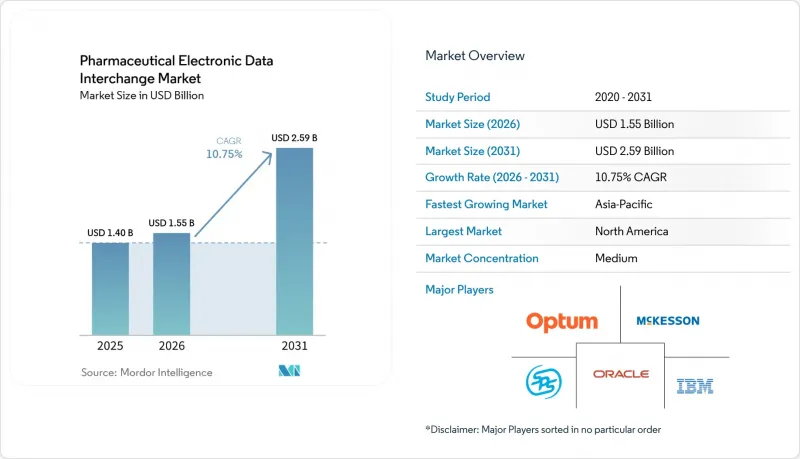
Mordor Intelligence에 의하면, 의약품 전자데이터교환(EDI) 시장 규모는 2025년에 14억 달러로 평가되었고, 2026년 15억 5,000만 달러로 추정되고, 2031년까지 25억 9,000만 달러에 이를 것으로 예측되며, 예측 기간(2026-2031년) CAGR은 10.75%를 나타낼 전망입니다.
본 보고서는 구성 요소별(솔루션 및 소프트웨어, 서비스), 제공 형태별(온프레미스, 클라우드, 직접, 모바일 EDI), 거래 유형별(공급망, 약국, 관리 및 재무, 일련번호 부여 및 추적성), 최종 사용자별(제조업체, CMO 및 CDMO, 유통업체, 약국, 기타), 지역별(북미, 유럽, 아시아태평양, 중동 및 아프리카, 남미)로 분류되어 있습니다. 예상치는 금액(달러)으로 표시되어 있습니다.
세계의 의약품 전자데이터교환(EDI) 시장 동향 및 인사이트
DSCSA EPCIS 리포지토리 도입 : 시급한 수요의 결정적 요인
미국 내 의약품 공급망 전반에 걸쳐 DSCSA가 시행됨에 따라, 완벽한 전자 추적성은 의약품 전자데이터교환 시장에서 중요한 시장 성장 촉진요인으로 부상하고 있습니다. FDA가 상호 운용 가능한 전자 패키지 수준 추적에 중점을 두고 있어, 수작업에 의존하던 우회 방식이 사라지고 있습니다. GS1 미국은 시장을 릴리스 1.3 도입으로 이끌고 있으며, 조제업자의 경우 2026년부터, 제조업체의 경우 2027년까지 단계적으로 도입될 예정입니다. 이를 통해 리포지토리 업그레이드, 파트너 온보딩 및 적합성 테스트가 지속적으로 수행되며, 예외 처리 및 메시지 일관성 확보를 통해 지속적인 수익이 창출됩니다.
NCPDP SCRIPT의 업그레이드로 인해 2028년까지 규정 준수 투자 기회가 고정됩니다.
CMS는 2028년까지 메디케어 파트 D의 전자 처방전에 대해 NCPDP SCRIPT 표준 버전 2023011 준수를 의무화할 예정이며, 2027년까지 추가 표준도 도입될 예정입니다. ONC는 이 일정에 맞추어 인증 요건을 조정하고 있으며, 의료 IT 개발자들에게 2027년까지 전환을 완료할 것을 촉구하고 있습니다. Surescripts는 워크플로우를 개선하고 거래 파트너를 지원하기 위해 인증 테스터를 도입했습니다. 이를 통해 공급업체, 중개업체, 플랫폼 각사가 시스템을 업데이트할 수 있는 명확한 투자 기간이 마련되는 동시에, 실시간 급여 정보 및 사전 승인 데이터의 교환 범위가 확대됩니다.
랜섬웨어와 HIPAA 시행이 EDI 인프라에 측정 가능한 비용을 초래합니다.
연결된 거래 환경이 업무에 필수 불가결해진 현재, 사이버 보안은 의약품 전자데이터교환(EDI) 시장에서 큰 비용 부담이 되고 있습니다. 2025년 8월 Inotiv사를 강타한 랜섬웨어 공격으로 인해 사내 업무 용도과 데이터 저장소가 마비되었으며, 9,542명의 개인정보가 유출되었습니다. 이 사건은 운영상의 위험과 법적 위험이 복합적으로 존재한다는 점을 여실히 보여주고 있습니다. 또한, HIPAA 시행으로 인해 감사, 계약, 플랫폼 보안에 드는 비용이 증가하고 있으며, 특히 대규모 거래량을 통해 규정 준수 비용을 분산시킬 수 없는 소규모 사업체에 큰 영향을 미치고 있습니다.
부문별 분석
2025년, 솔루션 및 소프트웨어는 시장의 53.12%를 차지했으며, 번역 소프트웨어, 시리얼화 플랫폼, 약국 관리 도구가 성장을 주도했습니다. 대기업들이 거래 처리에 임베디드형 엔터프라이즈 시스템에 의존하고 있기 때문에 이 기반은 여전히 매우 중요합니다. 서비스 부문은 2026-2031년 연평균 성장률(CAGR) 10.95%를 나타낼 것으로 예측되며, 이는 소프트웨어보다 규정 준수 이행, 테스트 및 관리형 운영의 중요성이 높아지고 있음을 여실히 보여주고 있습니다.
구매 기업은 촉박한 납기 일정 속에서 EPCIS 2.0 대응, DSCSA 준수 및 거래 관리의 외부 위탁을 실현하기 위해 서비스를 최우선으로 하고 있습니다. 사내 자원이 부족한 중견 제조업체와 CDMO가 주요 수요를 주도하고 있으며, 시장은 지속적인 서비스 수익 모델로 전환되고 있습니다.
2025년에는 온프레미스형 EDI가 55.89%의 점유율을 차지했으며, 이는 AS2, SFTP 및 VAN 연결 시스템의 확고한 기반을 반영한 것입니다. 이러한 시스템은 EDI, ERP 및 창고 업무 흐름과 통합되어 있어, 대량 물량을 취급하는 유통업체와 제조업체에게 여전히 필수적입니다. 웹 및 클라우드 기반 EDI는 확장성과 업데이트 용이성을 바탕으로 2026년부터 2031년까지 연평균 성장률(CAGR) 11.15%를 기록하며 가장 빠르게 성장하는 부문입니다.
직접적인 포인트-투-포인트 EDI는 대규모 거래 쌍에서 여전히 중요하며, 반면 모바일 EDI는 라스트 마일 주문과 같은 틈새 이용 사례에 대응하고 있습니다. 클라우드 도입을 통해 인프라 비용이 절감되고 업데이트가 신속해짐에 따라, 규제 기한을 준수할 수 있을 뿐만 아니라 파트너 온보딩도 용이해집니다.
지역별 분석
2025년, 북미는 의약품 전자데이터교환 시장의 40.76%를 차지했으며, 가장 큰 매출 점유율을 기록했습니다. 미국은 DSCSA, HIPAA 청구서 첨부 서류, NCPDP SCRIPT 업그레이드 등 규제 관련 노력을 통해 연결성, 테스트, 워크플로우 조정에 대한 투자를 촉진함으로써 이러한 성장을 주도하고 있습니다. 캐나다와 멕시코는 수입 중심의 무역과 국경을 넘는 의약품 유통을 통해 기여하고 있으며, 이로 인해 절차의 체계화와 문서화의 복잡성이 증가하고 있습니다.
아시아태평양은 2026-2031년 연평균 성장률(CAGR) 12.25%를 나타낼 것으로 예측되며, 의약품 전자데이터교환 시장에서 가장 두드러진 성장을 보일 것으로 전망됩니다. 이러한 성장은 제조, 처방 워크플로우, 공급 문서에 걸친 의약품의 디지털화에 힘입어 이루어지고 있으며, 중국, 인도, 일본, 호주, 한국이 주요한 역할을 담당하고 있습니다. 일본의 JD-NET 시스템으로의 전환, 2025년 5월 시오노기 제약, 아스테라스 제약, NTT 데이터 간에 체결된 합의 등의 노력은 해당 지역의 규정 준수 및 플랫폼 주도형 성장을 여실히 보여주고 있습니다.
중동 및 아프리카은 사우디아라비아와 UAE 등 GCC 국가들을 필두로 꾸준히 성장하고 있으며, 남아프리카공화국에서는 규제 대상 의약품 공급 서류의 전자화가 진행되고 있습니다. 남미에서는 브라질과 아르헨티나가 전자 처방전 및 추적성 지원을 위한 정책의 현대화를 통해 성장을 주도하고 있습니다. 중동 및 아프리카 및 남미의 소규모 시장은 아직 도입 초기 단계에 있지만, 현지 기준을 충족하는 공급업체와 중견 기업 바이어들에게 장기적인 기회를 제공합니다.
기타 혜택 :
- 엑셀 형식 시장 예측(ME) 시트
- 3개월간의 애널리스트 지원
자주 묻는 질문
목차
제1장 서론
제2장 조사 방법
제3장 주요 요약
제4장 시장 구도
제5장 시장 규모 및 성장 예측
제6장 경쟁 구도
제7장 시장 기회 및 향후 전망
LSH 26.06.24According to Mordor Intelligence, the pharmaceutical electronic data interchange market size was valued at USD 1.40 billion in 2025 and is estimated to grow from USD 1.55 billion in 2026 to reach USD 2.59 billion by 2031, at a CAGR of 10.75% during the forecast period (2026-2031).
This report is Segmented by Component (Solutions/Software, Services), Delivery Mode (On-Premises, Cloud, Direct, Mobile EDI), Transaction Type (Supply Chain, Pharmacy, Admin/Financial, Serialization and Traceability), End User (Manufacturers, CMOs/CDMOs, Distributors, Pharmacies, Others), and Geography (North America, Europe, Asia-Pacific, MEA, South America). Forecasts in Value (USD).
Global Pharmaceutical Electronic Data Interchange Market Trends and Insights
DSCSA EPCIS Repository Adoption: The Binding Near-Term Demand Catalyst
With DSCSA enforcement now active across the U.S. drug supply chain, full electronic traceability has become a critical driver in the pharmaceutical electronic data interchange market. The FDA's focus on interoperable, electronic package-level tracing eliminates reliance on manual workarounds. GS1 US is steering the market toward Release 1.3 adoption, with phased rollouts starting in 2026 for dispensers and extending to 2027 for manufacturers. This ensures ongoing activity in repository upgrades, partner onboarding, and conformance testing, driving recurring revenue from exception handling and message alignment.
NCPDP SCRIPT Upgrades Create a Locked-In Compliance Investment Window Through 2028
CMS has mandated NCPDP SCRIPT Standard Version 2023011 compliance for Medicare Part D e-prescribing by 2028, with additional standards due by 2027. ONC has aligned certification requirements with this timeline, pushing health IT developers to complete transitions by 2027. Surescripts has upgraded workflows and introduced a certification tester to assist trading partners. This creates a defined investment window for vendors, intermediaries, and platforms to update systems, while expanding the scope of real-time benefits and prior authorization data exchange.
Ransomware and HIPAA Enforcement Impose Measurable EDI Infrastructure Costs
Cybersecurity has become a significant expense for the pharmaceutical electronic data interchange market, as connected transaction environments are now integral to operations. An August 2025 ransomware attack on Inotiv disrupted internal business applications and data storage while compromising data of 9,542 individuals. This incident highlights the combined operational and legal risks. Additionally, HIPAA enforcement drives up costs for audits, contracts, and platform security, particularly impacting smaller entities that cannot distribute compliance expenses across large transaction volumes.
Other drivers and restraints analyzed in the detailed report include:
- HHS Claims Attachment Standards: A USD 781.98 Million Annual Efficiency Gain for EDI Adopters
- Cloud and Network-Based EDI Displaces Point-to-Point Architectures
- Legacy Multi-Standard Integration Suppresses Mid-Market Adoption Velocity
For complete list of drivers and restraints, kindly check the Table Of Contents.
Segment Analysis
In 2025, Solutions/Software accounted for 53.12% of the market, driven by translation software, serialization platforms, and pharmacy management tools. This base remains critical as large organizations rely on embedded enterprise systems for transaction processing. Services are projected to grow at a 10.95% CAGR from 2026 to 2031, highlighting the rising importance of compliance execution, testing, and managed operations over software.
Buyers are prioritizing services to address EPCIS 2.0 readiness, DSCSA conformance, and outsourced transaction management under tight deadlines. Mid-sized manufacturers and CDMOs, lacking internal resources, are key demand drivers, shifting the market toward recurring service revenue models.
On-Premises EDI held a 55.89% share in 2025, reflecting the established base of AS2, SFTP, and VAN-connected systems. These systems remain vital for high-volume distributors and manufacturers integrated with EDI, ERP, and warehouse workflows. Web- and Cloud-Based EDI is the fastest-growing segment, with an 11.15% CAGR from 2026 to 2031, driven by scalability and ease of updates.
Direct point-to-point EDI remains relevant for large trading pairs, while Mobile EDI serves niche use cases like last-mile ordering. Cloud deployment reduces infrastructure costs and accelerates updates, aligning with regulatory deadlines and easing partner onboarding.
Geography Analysis
In 2025, North America accounted for 40.76% of the pharmaceutical electronic data interchange market, securing the largest revenue share. The U.S. leads this growth due to regulatory initiatives like DSCSA, HIPAA claims attachments, and NCPDP SCRIPT upgrades, which drive investments in connectivity, testing, and workflow adjustments. Canada and Mexico contribute through import-driven trade and cross-border pharmaceutical distribution, increasing serialization and documentation complexity.
Asia-Pacific is projected to grow at a 12.25% CAGR from 2026 to 2031, making it the fastest-growing region in the pharmaceutical electronic data interchange market. Growth is driven by digitalization in pharmaceuticals across manufacturing, prescription workflows, and supply documentation, with China, India, Japan, Australia, and South Korea as key players. Japan's JD-NET system migration and initiatives like the May 2025 agreement between Shionogi, Astellas, and NTT DATA highlight compliance and platform-led growth in the region.
The Middle East and Africa region is growing steadily, led by GCC countries like Saudi Arabia and the UAE, with South Africa advancing in regulated pharmaceutical supply documentation. In South America, Brazil and Argentina drive growth through policy modernization supporting electronic prescribing and traceability. Smaller markets in MEA and South America remain in early adoption stages but offer long-term opportunities for vendors catering to localized standards and mid-market buyers.
- Athenahealth
- Availity, LLC
- Axway Software SA
- Boomi, LP
- Cleo Communications US, LLC
- Cognizant
- Comarch S.A.
- Edifecs, Inc.
- Experian Information Solutions, Inc.
- GE HealthCare Technologies Inc.
- Global Healthcare Exchange, LLC
- IBM
- Mckesson
- NextGen Healthcare
- NTT DATA Group Corporation
- OpenText
- Optum
- Oracle
- SPS Commerce, Inc.
- TrueCommerce, Inc.
Additional Benefits:
- The market estimate (ME) sheet in Excel format
- 3 months of analyst support
TABLE OF CONTENTS
1 Introduction
- 1.1 Study Assumptions & Market Definition
- 1.2 Scope of the Study
2 Research Methodology
3 Executive Summary
4 Market Landscape
- 4.1 Market Overview
- 4.2 Market Drivers
- 4.2.1 Regulatory Mandates for Standardized Healthcare Transactions
- 4.2.2 NCPDP SCRIPT and Pharmacy Workflow Upgrades
- 4.2.3 Cloud and API-Enabled EDI Modernization
- 4.2.4 Claims Attachments Digitization and Workflow Automation
- 4.2.5 DSCSA Serialized EPCIS Repository Adoption
- 4.2.6 Rebate and Chargeback Automation in Pharma Channels
- 4.3 Market Restraints
- 4.3.1 Cybersecurity and HIPAA/HITECH Exposure
- 4.3.2 Legacy-System Integration and Multi-Standard Mapping Complexity
- 4.3.3 EPCIS Interpretation Mismatches Across Trading Partners
- 4.3.4 Manual, Fax, Email, and Portal Persistence in Long-Tail Channels
- 4.4 Value / Supply-Chain Analysis
- 4.5 Regulatory Landscape
- 4.6 Technological Outlook
- 4.7 Porter's Five Forces Analysis
- 4.7.1 Bargaining Power of Buyers
- 4.7.2 Bargaining Power of Suppliers
- 4.7.3 Threat of New Entrants
- 4.7.4 Threat of Substitutes
- 4.7.5 Intensity of Rivalry
5 Market Size & Growth Forecasts (Value, USD)
- 5.1 By Component
- 5.1.1 Solutions / Software
- 5.1.2 Services
- 5.2 By Delivery Mode
- 5.2.1 On-Premises
- 5.2.2 Web- and Cloud-Based EDI
- 5.2.3 Direct (Point-to-Point) EDI
- 5.2.4 Mobile EDI
- 5.3 By Transaction Type
- 5.3.1 Supply Chain Transactions
- 5.3.2 Pharmacy and Prescription Transactions
- 5.3.3 Administrative and Financial Transactions
- 5.3.4 Serialization and Traceability Data Exchange
- 5.4 By End User
- 5.4.1 Pharmaceutical Manufacturers and Biopharmaceutical Companies
- 5.4.2 CMOs and CDMOs
- 5.4.3 Wholesale Distributors and Specialty Distributors
- 5.4.4 Retail, Chain, Mail-Order, and Specialty Pharmacies
- 5.4.5 Others
- 5.5 By Geography
- 5.5.1 North America
- 5.5.1.1 United States
- 5.5.1.2 Canada
- 5.5.1.3 Mexico
- 5.5.2 Europe
- 5.5.2.1 Germany
- 5.5.2.2 United Kingdom
- 5.5.2.3 France
- 5.5.2.4 Italy
- 5.5.2.5 Spain
- 5.5.2.6 Rest of Europe
- 5.5.3 Asia-Pacific
- 5.5.3.1 China
- 5.5.3.2 India
- 5.5.3.3 Japan
- 5.5.3.4 Australia
- 5.5.3.5 South Korea
- 5.5.3.6 Rest of Asia-Pacific
- 5.5.4 Middle East and Africa
- 5.5.4.1 GCC
- 5.5.4.2 South Africa
- 5.5.4.3 Rest of Middle East and Africa
- 5.5.5 South America
- 5.5.5.1 Brazil
- 5.5.5.2 Argentina
- 5.5.5.3 Rest of South America
- 5.5.1 North America
6 Competitive Landscape
- 6.1 Market Concentration
- 6.2 Market Share Analysis
- 6.3 Company Profiles (includes Global level Overview, Market level overview, Core Segments, Financials as available, Strategic Information, Market Rank/Share for key companies, Products & Services, and Recent Developments)
- 6.3.1 athenahealth, Inc.
- 6.3.2 Availity, LLC
- 6.3.3 Axway Software SA
- 6.3.4 Boomi, LP
- 6.3.5 Cleo Communications US, LLC
- 6.3.6 Cognizant Technology Solutions Corporation
- 6.3.7 Comarch S.A.
- 6.3.8 Edifecs, Inc.
- 6.3.9 Experian Information Solutions, Inc.
- 6.3.10 GE HealthCare Technologies Inc.
- 6.3.11 Global Healthcare Exchange, LLC
- 6.3.12 International Business Machines Corporation
- 6.3.13 McKesson Corporation
- 6.3.14 NextGen Healthcare, Inc.
- 6.3.15 NTT DATA Group Corporation
- 6.3.16 Open Text Corporation
- 6.3.17 Optum, Inc.
- 6.3.18 Oracle Corporation
- 6.3.19 SPS Commerce, Inc.
- 6.3.20 TrueCommerce, Inc.
7 Market Opportunities & Future Outlook
- 7.1 White-space & Unmet-need Assessment