|
시장보고서
상품코드
2081124
EV 충전소 시장 예측(-2033년) : 용도별, 충전 포인트 사업자별, 충전 인프라 유형별, 충전 포인트 유형별, 충전 서비스 유형별, 접속 단계별, DC 급속 충전 유형별, 전기버스 충전 유형별, 설치 유형별, 충전 레벨별, 운영별, 지역별EV Charging Station Market by DC Fast Charging, Application, Level of Charging, Charging Point, Charging Infrastructure, Operation, Charge Point Operator, Connection Phase, Service, Installation, and Region - Global Forecast to 2033 |
||||||

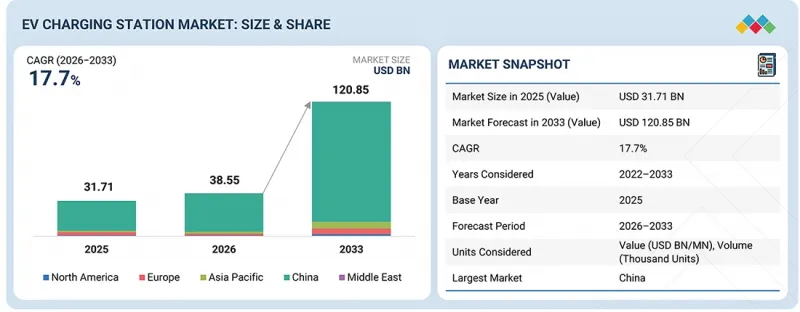
세계의 EV 충전소 시장 규모는 2026년 385억 5,000만 달러에서 2033년까지 1,208억 5,000만 달러로, CAGR 17.7%로 확대할 것으로 예측됩니다.
시장 확대는 차량 플랫폼의 진화, 충전 생태계의 통합, 그리고 전력망의 현대화가 맞물리면서 점차 구체화되고 있습니다.
| 조사 범위 | |
|---|---|
| 조사 대상 기간 | 2026-2033년 |
| 기준연도 | 2025년 |
| 예측 기간 | 2026-2033년 |
| 대상 단위 | 10억 달러 |
| 부문 | 용도별, 충전 포인트 사업자별, 충전 인프라 유형별, 충전 포인트 유형별, 충전 서비스 유형별, 접속 상별, DC 급속 충전 유형별, 전기버스 충전 유형별, 설치 유형별, 충전 레벨별, 운영별, 지역별 |
| 대상 지역 | 중국, 아시아태평양, 유럽, 북미, 중동, 기타 지역 |
각 자동차 제조사들은 차량 판매에 그치지 않고, 충전소 운영사, 에너지 공급사, 기술 기업과의 전략적 제휴를 통해 종단 간 충전 생태계 구축을 추진하고 있습니다. 2025년 3월, BYD는 차세대 전기자동차의 충전 시간을 대폭 단축하도록 설계된 메가와트급 충전 기능을 갖춘 'Super e Platform'을 발표했습니다. 한편, 여러 자동차 제조사들은 더 높은 충전 처리량을 지원하기 위해 800V 및 1,000V 아키텍처의 도입을 가속화했습니다. 동시에, 파워 반도체, 에너지 관리 소프트웨어, 양방향 충전 기술의 발전으로 인해 충전기의 가동률과 전력 시스템과의 연동 능력이 향상되고 있습니다. 장기적인 성장을 유지하기 위해서는 고출력 충전 인프라의 확충, 전력계통과의 연결성 확보, 그리고 승용차 및 상용차의 전기화 다음 단계를 지원할 상호 운용 가능한 충전 네트워크의 개발 등 업계의 역량에 달려 있습니다.
'설치 유형별로는 예측 기간 중 고정식 충전기가 시장에서 가장 큰 부문이 될 것으로 예상됩니다.'
설치 유형별로는 고정식 충전소가 전기자동차 충전소 시장에서 가장 큰 점유율을 차지할 것으로 추정됩니다. 이는 공공 충전 허브, 고속도로 연선, 상업 시설, 그리고 차량 대여 업체 충전 거점 등에 대한 광범위한 확장이 배경에 있습니다. 이러한 우위는 정부의 인프라 구축 프로그램, 전력 회사의 투자, 그리고 충전 네트워크 사업자들이 영구적인 충전 인프라 확장을 위해 추진하는 장기적인 노력에 힘입어 더욱 공고해지고 있습니다. 2025년 말까지 공공 충전 인프라는 충전 가용성과 관련된 과제가 ‘도입 과제’에서 ‘네트워크 최적화 과제’로 점차 전환되는 규모에 도달함에 따라 사업자들은 충전기의 신뢰성, 이용률 및 전력 공급 능력에 주력하게 되었습니다. 새로 가동을 시작한 충전소의 대부분은 여전히 도시 모빌리티 네트워크, 목적지 충전 거점 및 전략적 교통 회랑에 통합된 고정식 시설로 남아 있습니다. 또한 150kW를 초과하는 고출력 DC 급속 충전기의 도입 확대는 주로 고정식 충전 인프라에 집중되어 있으며, 이는 공공 충전 생태계의 중추로서의 역할을 강화하고 시장내 주도적 지위를 지원하고 있습니다.
'예측 기간 중 DC 충전소 부문은 전기자동차 충전소 시장에서 가장 큰 점유율을 차지할 것으로 예상됩니다.'
2026년에 전체 시장 점유율의 약 46%를 차지할 것으로 예상되는 전 세계 DC 급속 충전기 시장은 강력한 정부 정책, 대규모 인프라 투자, 그리고 중국과 한국 같은 주요 전기자동차 시장의 존재에 힘입어 성장하고 있습니다. 2026년에는 공공 충전소가 전 세계 DC 급속 충전기 시장을 주도하며, 전체 시장 점유율의 약 60%를 차지할 것으로 전망됩니다. 이는 BYD의 1,000kW 슈퍼차징 계획 등의 노력에 힘입어 고속도로의 급속 충전 회랑과 도심 지역의 충전 허브가 급속히 확대되고 있는 것이 원동력이 되고 있습니다. 화웨이가 10만 곳의 초고속 충전소를 지속적으로 확충하고 있는 점과, 메르세데스-벤츠와 BMW의 합작 회사가 2026년 말까지 7,000곳을 설치하겠다는 목표를 세운 노력 등이 이를 지원하고 있습니다. 1,000볼트 차량 아키텍처가 주류가 되고, 10분 이내 충전을 원하는 소비자의 수요가 가속화됨에 따라 DC 인프라는 2033년까지 전 세계에서 증가할 충전소 설치 시장에서 최대 점유율을 차지할 구조적 우위를 가지고 있습니다.
'아시아태평양(중국 제외)은 예측 기간 중 상당한 시장 점유율을 차지할 것으로 전망됩니다.'
예측 기간 중, 중국을 제외한 아시아태평양의 전기자동차 충전소 시장에서 인도가 가장 큰 점유율을 차지할 것으로 전망됩니다. 이 국가의 주도적 입지는 차량 전기화 목표, 충전 인프라 구축, 그리고 국내 생산 구상을 결합한 협력적 접근 방식을 통해 점점 더 공고해지고 있습니다. 2024년 9월, 인도 정부는 'PM E DRIVE' 계획을 시작하며 공공 충전 인프라 구축을 가속화하고 국내 전기자동차 생태계를 강화하기 위해 막대한 자금을 배정했습니다. 2025년, 인도는 대도시권, 도시 간 회랑 및 차량 충전 거점에서의 충전 인프라 구축을 가속화하여, 장기적인 전기자동차 보급과 네트워크 활용의 기반을 강화했습니다. 충전 사업자, 석유 판매 회사, 유틸리티 및 OEM의 민관 투자를 통해 도심, 고속도로, 물류 회랑에 걸친 충전망의 커버리지는 지속적으로 확대되고 있습니다. 2025년 8월, NITI Aayog는 '인도 전기 모빌리티 지수'를 도입하여 전기자동차 도입 준비 현황과 인프라 개발을 평가하기 위한 주 차원의 체계를 마련했습니다. 이러한 노력을 통해 강력한 정책 일관성, 가속화되는 차량 보급, 그리고 지속적인 인프라 투자에 힘입어 인도는 2033년까지 아시아태평양에서 전기자동차 충전 인프라 확장의 주요 성장 동력으로서의 입지를 확고히 하고 있습니다.
전기자동차 충전소 시장은 ABB(스위스), BYD(중국), ChargePoint(미국), Tesla(미국), Siemens(독일) 등 주요 기업이 주도하고 있습니다. 이 기업은 강력한 제품 포트폴리오뿐만 아니라 전 세계적인 탄탄한 판매 네트워크를 보유하고 있습니다.
조사 범위:
본 조사 보고서에서는 전기자동차 충전소 시장을 충전 레벨별, 용도별, 충전 지점 유형별, 충전 인프라 유형별, 전기버스 충전 유형별, 충전 서비스 유형별, 충전 지점 사업자별, DC 급속 충전 방식별, 설치 유형별, 운영 모드별, 연결 상별, 그리고 지역/지리별로 분류하고 있습니다. 이 보고서의 범위에는 전기자동차 충전소 시장의 성장에 영향을 미치는 주요 요인(촉진요인, 제약 요인, 과제 및 기회)에 대한 상세한 정보가 포함되어 있습니다. 주요 업계 진출 기업에 대해 상세한 분석을 수행하여, 해당 기업의 사업 개요, 솔루션, 서비스, 주요 전략, 계약, 파트너십, 합의 사항, 제품·서비스 출시, 합병·인수 및 기타 동향에 대한 인사이트를 제공하고 있습니다. 또한 이 보고서에서는 전기자동차 충전소 시장의 생태계에서 두각을 보이고 있는 스타트업 기업에 대한 경쟁 분석도 다루고 있습니다.
이 보고서를 구매할 때의 주요 이점:
- 이 보고서는 전기자동차 충전소 시장 전체 및 그 하위 부문의 매출에 대한 가장 정확한 추정치를 제공함으로써, 시장 선도 기업 및 신규 진입 기업 여러분을 지원합니다.
- 이 보고서는 이해관계자들이 경쟁 구도를 이해하고, 자사의 비즈니스를 더 나은 위치로 이끌며, 적절한 시장 진입 전략을 수립하는 데 필요한 추가적인 인사이트를 얻는 데 도움이 됩니다.
- 또한 이 보고서는 이해관계자들이 시장 동향을 파악하고, 주요 시장 촉진요인, 억제요인, 과제 및 기회에 관한 정보를 얻는 데 도움이 됩니다.
- 이 보고서는 이해관계자들이 용량에 기반한 각종 전기자동차 충전 시스템의 현재 및 향후 가격 동향을 이해하는 데 도움이 됩니다.
이 보고서에서는 다음 사항에 대한 인사이트를 제공합니다. :
주요 촉진요인(전기자동차 보급의 급증, 충전 네트워크 확대를 위한 정부의 재정적 인센티브, 주행 거리를 향상시키는 배터리 화학 기술의 발전, 그리고 차량의 전기화가 전기자동차 충전 시장의 성장을 가속화할 것) 및 제약 요인(전기자동차 보급을 제한하는 충전 규격의 불일치, 초고속 충전 인프라에 필요한 막대한 설비 투자, 전기자동차 충전을 위한 전력 인프라 미비, 그리고 다층 주택에서의 사후 설치 과제)에 대한 분석, 기회(V2G 기술 및 양방향 충전의 발전, IoT 기반 스마트 충전 네트워크 도입, 친환경적이고 지속가능한 전기자동차 충전 솔루션의 확대, 실용적인 충전 수단으로 부상하는 배터리 교환, 스마트 시티 구상에 대한 전기자동차 충전 통합, 스마트 충전기로의 시장 전환, 그리고 ‘Charging-as-a-Service(CaaS)’ 비즈니스 모델의 확대) 및 과제(내연기관(ICE) 차량과 전기자동차의 비용 격차, 전기자동차 충전기 설치에 대한 규제 장벽, 충전시 비재생에너지원에 대한 높은 의존도, 전기자동차 부문의 성장을 저해하는 리튬 자원 부족, 그리고 CPO(충전소 운영자)의 낮은 가동률과 수익성 문제)
- 제품 개발/혁신: 전기자동차 충전소 시장의 향후 기술, 연구개발 활동 및 제품·서비스 출시에 관한 상세 인사이트
- 시장 개발: 수익성이 높은 시장에 대한 포괄적인 정보(이 보고서에서는 다양한 지역의 전기자동차 충전소 시장을 분석하고 있습니다)
- 시장의 다양화: 전기자동차 충전소 시장의 신제품·서비스, 미개발 지역, 최근 동향 및 투자에 관한 포괄적인 정보
- 경쟁사 분석: ABB(스위스), EVBox(네덜란드), BYD(중국), ChargePoint(미국), Tesla(미국), 그리고 BP(영국), Shell(영국), ENGIE(프랑스), Total Energies(프랑스), Enel X(이탈리아) 등, 전기자동차 충전소 시장의 주요 참여 기업의 시장 순위, 성장 전략, 서비스 제공에 대한 상세한 평가
자주 묻는 질문
목차
제1장 서론
제2장 개요
제3장 주요 인사이트
제4장 시장 개요
제5장 업계 동향
제6장 기술 진보, AI에 의한 영향, 특허, 혁신, 향후 응용
제7장 규제 상황
제8장 고객 상황과 구매 행동
제9장 OEM 분석과 향후 로드맵
제10장 EV 충전소 시장(용도별)
제11장 EV 충전소 시장(충전 포인트 사업자별)
제12장 EV 충전소 시장(충전 인프라 유형별)
제13장 EV 충전소 시장(충전 포인트 유형별)
제14장 EV 충전소 시장(충전 서비스 유형별)
제15장 EV 충전소 시장(접속 상별)
제16장 전기자동차 충전소 시장(DC 급속 충전 유형별)
제17장 EV 충전소 시장(전기버스 충전 유형별)
제18장 EV 충전소 시장(설치 유형별)
제19장 EV 충전소 시장(충전 레벨별)
제20장 EV 충전소 시장(운영별)
제21장 EV 충전소 시장(지역별)
제22장 경쟁 구도
제23장 기업 개요
제24장 조사 방법
제25장 부록
KSA 26.07.14The global EV charging station market is projected to grow from USD 38.55 billion in 2026 to USD 120.85 billion by 2033 at a CAGR of 17.7%. Market expansion is increasingly being shaped by the convergence of vehicle platform evolution, charging ecosystem integration, and utility grid modernization.
| Scope of the Report | |
|---|---|
| Years Considered for the Study | 2026-2033 |
| Base Year | 2025 |
| Forecast Period | 2026-2033 |
| Units Considered | USD Billion |
| Segments | DC Fast Charging, Application, Level of Charging, Charging, Connection Phase, Service, Installation, and Region |
| Regions covered | China, Asia Pacific, Europe, North America, Middle East, and Rest of the World |
OEMs are moving beyond vehicle sales to establish end-to-end charging ecosystems through strategic partnerships with charge point operators, energy providers, and technology companies. In March 2025, BYD introduced its Super e Platform featuring megawatt-class charging capability designed to significantly reduce charging duration for next-generation EVs, while several OEMs accelerated the rollout of 800V and 1,000V architectures to support higher charging throughput. Simultaneously, advancements in power semiconductors, energy management software, and bidirectional charging technologies are improving charger utilization and grid interaction capabilities. Sustaining long-term growth will depend on the industry's ability to scale high-power charging infrastructure, secure grid connectivity, and develop interoperable charging networks that can support the next phase of passenger and commercial vehicle electrification.
"By installation type, fixed charger is expected to be the largest segment of the market during the forecast period."
Fixed charging stations are estimated to account for the largest share of the EV charging station market by installation type, driven by their extensive deployment across public charging hubs, highway corridors, commercial properties, and fleet charging depots. Their dominance is reinforced by government infrastructure programs, utility investments, and long-term commitments from charging network operators to expand permanent charging assets. By the end of 2025, public charging infrastructure had reached a scale where charging availability increasingly shifted from a deployment challenge to a network optimization challenge, with operators focusing on charger reliability, utilization, and power delivery capacity. Most newly commissioned charging sites continue to be fixed installations integrated into urban mobility networks, destination charging locations, and strategic transport corridors. Additionally, the growing deployment of high-power DC fast chargers exceeding 150 kW is primarily concentrated within fixed charging infrastructure, strengthening its role as the backbone of public charging ecosystems and supporting its market leadership.
"The DC charging station segment is expected to capture the largest share of the EV charging station market during the forecast period."
The global DC fast chargers market, accounting for approximately 46% of total market share in 2026, is supported by strong government policies, extensive infrastructure investments, and the presence of major EV markets such as China and South Korea. Public charging stations are leading the global DC fast chargers market in 2026, accounting for approximately 60% of total market share, driven by the rapid expansion of highway fast-charging corridors and urban charging hubs, supported by initiatives such as BYD's 1,000 kW supercharging plans, Huawei's ongoing rollout of 100,000 ultrafast stations, and the Mercedes-Benz-BMW joint venture working toward 7,000 stations by year-end 2026. As 1,000-volt vehicle architectures become mainstream and consumer demand for sub-10-minute charging accelerates, DC infrastructure is structurally positioned to capture the largest share of incremental station deployments globally through 2033.
"Asia Pacific (excluding China) is expected to account for a significant market share during the forecast period."
India is predicted to account for the largest share of the Asia Pacific EV charging station market, excluding China, during the forecast period. The country's leadership is increasingly driven by a coordinated approach that combines vehicle electrification targets, charging infrastructure deployment, and domestic manufacturing initiatives. In September 2024, the Government of India launched the PM E DRIVE scheme, allocating substantial funding to accelerate the rollout of public charging infrastructure and strengthen the national EV ecosystem. In 2025, India accelerated charging infrastructure deployment across metropolitan areas, intercity corridors, and fleet charging locations, strengthening the foundation for long-term EV adoption and network utilization. Public and private sector investments by charging operators, oil marketing companies, utilities, and OEMs continue to expand charging coverage across urban centers, highways, and logistics corridors. In August 2025, NITI Aayog introduced the India Electric Mobility Index, providing a state-level framework to benchmark EV readiness and infrastructure development. These initiatives position India as the primary growth engine for EV charging infrastructure expansion across Asia Pacific through 2033, supported by strong policy alignment, accelerating vehicle adoption, and sustained infrastructure investment.
In-depth interviews were conducted with CEOs, marketing directors, other innovation and technology directors, and executives from various key organizations operating in this market.
- By Company Type: OEMs - 24%, Tier I - 67%, and Others - 9%
- By Designation: CXOs - 33%, Managers - 52%, and Executives - 15%
- By Region: North America - 40%, Europe - 20%, Asia Pacific (Excluding China) - 28%, China - 6%, Middle East - 3%, and Rest of the World - 3%
The EV charging station market is dominated by major players, including ABB (Switzerland), BYD (China), ChargePoint (US), Tesla (US), and Siemens (Germany). These companies have strong product portfolios as well as strong distribution networks at the global level.
Research Coverage:
This research report categorizes EV charging station market by level of charging (Level 1, Level 2, and Level 3), application (private, semi-public, and public), based on charging point type (AC charging, DC charging), charging infrastructure type (CCS, CHAdeMO, Type 1, Tesla SC (NACS), GB/T Fast, and Type 2), electric bus charging type (off-board top-down pantographs, on-board bottom-up pantographs, and charging via connectors), charging service type (EV charging services and battery swapping services), charge point operator (Asia Pacific, Europe, and North America), DC fast charging type [Slow DC (<49 kW), Fast DC (50-149 kW) and DC Ultra-Fast 1 (150-349 KW), and DC Ultra-Fast 2 (>349 kW)], installation type (portable chargers and fixed chargers), operation (mode 1, mode 2, mode 3, and mode 4), connection phase (single phase and three phase), and Region/Geography (China, Asia Pacific, Europe, North America, the Middle East, and the Rest of the World). The scope of the report covers detailed information regarding the major factors, such as drivers, restraints, challenges, and opportunities influencing the growth of the EV charging station market. A detailed analysis of the key industry players was done to provide insights into their business overview, solutions, and services; key strategies; Contracts, partnerships, agreements, product & service launches, mergers & acquisitions, and other developments. This report covers the competitive analysis of upcoming startups in the EV charging station market ecosystem.
Key Benefits of Buying the Report:
- The report will help market leaders/new entrants with information on the closest approximations of revenue numbers for the overall EV charging station market and its subsegments.
- This report will help stakeholders understand the competitive landscape and gain more insights to position their businesses better and plan suitable go-to-market strategies.
- The report will also help stakeholders understand the market pulse and provide information on key market drivers, restraints, challenges, and opportunities.
- The report will help stakeholders understand the current and future pricing trends of different EV charging systems based on their capacity.
The report provides insights into the following pointers:
Analysis of key drivers (surge in electric vehicle adoption, financial incentives offered by governments to promote charging networks, advancements in battery chemistry improving driving range, and fleet electrification accelerates EV charging market growth), restraints (fragmented charging standards limiting EV adoption, high capital investment required for ultrafast charging infrastructure, underdeveloped power infrastructure for EV charging, and retrofitting challenges in multistorey residential buildings), opportunities (advancements in V2G technology and bidirectional charging, adoption of IoT-enabled smart charging networks, expansion of green and sustainable EV charging solutions, battery-swapping emerging as a viable charging alternative, integration of EV charging in smart city initiatives, market shift towards smart chargers, and expansion of Charging-as-a-Service business model), and challenges (cost gap between ICE vehicles and EVs, regulatory hurdles in EV charger installation, high reliance on non-renewable energy sources for charging, scarcity of lithium resources challenging EV sector growth, and low utilization rates and profitability challenges for CPOs)
- Product Development/Innovation: Detailed insights into upcoming technologies, research & development activities, and product & service launches in the EV charging station market
- Market Development: Comprehensive information about lucrative markets (the report analyzes the EV charging station market across varied regions)
- Market Diversification: Exhaustive information about new products & services, untapped geographies, recent developments, and investments in the EV charging station market
- Competitive Assessment: In-depth assessment of market ranking, growth strategies, and service offerings of leading players like ABB (Switzerland), EVBox (Netherlands), BYD (China), ChargePoint (US), Tesla (US), and Charge Point Operators, including BP (UK), Shell (UK), ENGIE (France), Total Energies (France), and Enel X (Italy), among others in EV charging station market
TABLE OF CONTENTS
1 INTRODUCTION
- 1.1 STUDY OBJECTIVES
- 1.2 MARKET DEFINITION
- 1.3 STUDY SCOPE
- 1.3.1 MARKET SEGMENTATION AND REGIONAL SCOPE
- 1.3.2 INCLUSIONS AND EXCLUSIONS
- 1.3.3 YEARS CONSIDERED
- 1.4 CURRENCY CONSIDERED
- 1.5 UNIT CONSIDERED
- 1.6 STAKEHOLDERS
- 1.7 SUMMARY OF CHANGES
2 EXECUTIVE SUMMARY
- 2.1 KEY INSIGHTS AND MARKET HIGHLIGHTS
- 2.2 KEY MARKET PARTICIPANTS: MAPPING OF STRATEGIC DEVELOPMENTS
- 2.3 DISRUPTIVE TRENDS SHAPING MARKET
- 2.4 HIGH-GROWTH SEGMENTS
- 2.5 REGIONAL SNAPSHOT: MARKET SIZE, GROWTH RATE, AND FORECAST
3 PREMIUM INSIGHTS
- 3.1 ATTRACTIVE OPPORTUNITIES FOR PLAYERS IN EV CHARGING STATION MARKET
- 3.2 EV CHARGING STATION MARKET, BY LEVEL OF CHARGING
- 3.3 EV CHARGING STATION MARKET, BY CHARGING POINT TYPE
- 3.4 EV CHARGING STATION MARKET, BY CHARGING INFRASTRUCTURE TYPE
- 3.5 EV CHARGING STATION MARKET, BY APPLICATION
- 3.6 EV CHARGING STATION MARKET, BY DC FAST CHARGING TYPE
- 3.7 EV CHARGING STATION MARKET, BY INSTALLATION TYPE
- 3.8 EV CHARGING STATION MARKET, BY OPERATION
- 3.9 EV CHARGING STATION MARKET, BY CONNECTION PHASE
- 3.10 EV CHARGING STATION MARKET, BY REGION
4 MARKET OVERVIEW
- 4.1 INTRODUCTION
- 4.2 MARKET DYNAMICS
- 4.2.1 DRIVERS
- 4.2.1.1 Financial incentives by government to promote charging networks
- 4.2.1.2 Ongoing fleet electrification
- 4.2.1.3 Strategic partnerships between OEMs to secure charging access
- 4.2.2 RESTRAINTS
- 4.2.2.1 Fragmented charging standards globally
- 4.2.2.2 High capital investment for ultrafast charging infrastructure
- 4.2.2.3 Retrofitting constraints in multistory residential buildings
- 4.2.3 OPPORTUNITIES
- 4.2.3.1 Advancements in V2G technology and bidirectional charging
- 4.2.3.2 Rapid adoption of IoT-enabled smart charging networks
- 4.2.3.3 Rise of green EV charging solutions
- 4.2.3.4 Emerging trend of battery swapping
- 4.2.3.5 Expansion of charging-as-a-service business model
- 4.2.3.6 Zero infrastructure revenue stream for CPOs
- 4.2.4 CHALLENGES
- 4.2.4.1 Regulatory hurdles in EV charger installation
- 4.2.4.2 Over-reliance on non-renewable energy sources
- 4.2.4.3 Low utilization rates and profitability challenges for CPOs
- 4.2.4.4 High power requirement for ultrafast chargers
- 4.2.1 DRIVERS
5 INDUSTRY TRENDS
- 5.1 MACROECONOMIC INDICATORS
- 5.1.1 GDP TRENDS AND FORECAST
- 5.1.2 TRENDS IN GLOBAL EV CHARGING MARKET
- 5.1.3 TRENDS IN GLOBAL ELECTRIC VEHICLE INDUSTRY
- 5.2 ECOSYSTEM ANALYSIS
- 5.2.1 OEMS
- 5.2.2 CHARGING POINT MANUFACTURERS
- 5.2.3 CHARGING POINT OPERATORS
- 5.2.4 PAYMENT PROCESSING COMPANIES
- 5.2.5 NAVIGATION AND MAPPING PROVIDERS
- 5.3 SUPPLY CHAIN ANALYSIS
- 5.4 BILL OF MATERIALS
- 5.4.1 AC (LEVEL 2) CHARGING POINTS, 2026 VS. 2033
- 5.4.2 DC SLOW CHARGING POINTS, 2026 VS. 2033
- 5.4.3 DC FAST CHARGING POINTS, 2026 VS. 2033
- 5.4.4 DC ULTRAFAST 1 CHARGING POINTS, 2026 VS. 2033
- 5.5 PRICING ANALYSIS
- 5.5.1 AVERAGE SELLING PRICE OF CHARGING POINTS OFFERED BY KEY PLAYERS, 2025
- 5.5.2 AVERAGE SELLING PRICE TREND, BY DC CHARGING POINT TYPE, 2023-2025
- 5.5.3 AVERAGE SELLING PRICE TREND, BY REGION, 2023-2025
- 5.6 TRADE ANALYSIS
- 5.6.1 IMPORT SCENARIO (HS CODE 8504)
- 5.6.2 EXPORT SCENARIO (HS CODE 8504)
- 5.7 CASE STUDY ANALYSIS
- 5.7.1 CHARGING STATION SIZE OPTIMIZATION BY SHELL
- 5.7.2 LOAD-BALANCING SYSTEM BY POD POINT
- 5.7.3 EV CHARGING NETWORK BY CHARGEPOINT
- 5.7.4 FAST-CHARGING NETWORK BY EVGO
- 5.7.5 EV CHARGING NETWORK IN CITY OF BOULDER
- 5.7.6 CHARGING NETWORK BY ELECTRIFY AMERICA
- 5.7.7 EV CHARGING NETWORK IN CHINA BY MERCEDES-BENZ AND BMW
- 5.7.8 DC FAST CHARGING IN UK BY CHARGEPOINT AND RAW CHARGING
- 5.7.9 SCALABLE FLEET CHARGING INFRASTRUCTURE IN CALIFORNIA BY ABB AND PG&E
- 5.8 INVESTMENT AND FUNDING SCENARIO
- 5.9 TRENDS/DISRUPTIONS IMPACTING CUSTOMER BUSINESS
- 5.10 PERFORMANCE INDICATORS FOR EV CHARGING
- 5.11 FUTURE OF CHARGING
- 5.11.1 FAST-CHARGING HUBS
- 5.11.2 CURBSIDE CHARGING
- 5.11.3 SOFTWARE DEFINED CHARGING NETWORKS
- 5.11.4 AI AND SMART ENERGY MANAGEMENT
- 5.11.5 INDUCTION CHARGING
- 5.12 POWER BOOSTER IN CHARGING SYSTEMS
- 5.13 KEY CONFERENCES AND EVENTS, 2026-2027
6 TECHNOLOGICAL ADVANCEMENTS, AI-DRIVEN IMPACT, PATENTS, INNOVATIONS, AND FUTURE APPLICATIONS
- 6.1 KEY TECHNOLOGIES
- 6.1.1 WIRELESS CHARGING
- 6.1.2 BIDIRECTIONAL CHARGING
- 6.1.3 MEGAWATT CHARGING
- 6.2 COMPLEMENTARY TECHNOLOGIES
- 6.2.1 OVERHEAD CHARGING
- 6.2.2 PLUG-AND-PAY CHARGING
- 6.2.3 ROBOTIC AND MOBILE CHARGING
- 6.3 ADJACENT TECHNOLOGIES
- 6.3.1 TURBOCHARGING
- 6.3.2 SMART CHARGING
- 6.3.3 IOT INTEGRATION
- 6.4 IMPACT OF AI/GEN AI
- 6.5 PATENT ANALYSIS
7 REGULATORY LANDSCAPE
- 7.1 REGIONAL REGULATIONS AND COMPLIANCE
- 7.1.1 REGULATORY BODIES, GOVERNMENT AGENCIES, AND OTHER ORGANIZATIONS
- 7.2 REGULATORY FRAMEWORK
- 7.2.1 NETHERLANDS
- 7.2.2 GERMANY
- 7.2.3 FRANCE
- 7.2.4 UK
- 7.2.5 CHINA
- 7.2.6 US
- 7.2.7 CANADA
8 CUSTOMER LANDSCAPE & BUYER BEHAVIOR
- 8.1 BUYER STAKEHOLDERS AND BUYING EVALUATION CRITERIA
- 8.1.1 KEY STAKEHOLDERS IN BUYING PROCESS
- 8.1.2 BUYING CRITERIA
9 OEM ANALYSIS AND FUTURE ROADMAP
- 9.1 OEM EV CHARGING STATION STRATEGY AND ROADMAP ANALYSIS
- 9.1.1 OEM CHARGING INFRASTRUCTURE ROADMAP
- 9.1.1.1 Tesla
- 9.1.1.2 Volkswagen
- 9.1.1.3 Ford Motor Company
- 9.1.1.4 General Motors
- 9.1.1.5 Hyundai Motor Group
- 9.1.1.6 BMW/Mercedes-Benz
- 9.1.1.7 Rivian
- 9.1.1.8 Lucid Motors
- 9.1.2 OEM PARTNERSHIPS WITH CHARGING OPERATORS
- 9.1.3 PROPRIETARY CHARGING NETWORK STRATEGIES
- 9.1.4 NACS ADOPTION IMPACT ON OEM ECOSYSTEM
- 9.1.5 KEY OEM EV CHARGING ROADMAP
- 9.1.1 OEM CHARGING INFRASTRUCTURE ROADMAP
- 9.2 BUSINESS MODELS
- 9.2.1 EV CHARGING BUSINESS MODEL FRAMEWORK
- 9.2.2 CHARGE POINT OPERATOR (CPO) MODEL
- 9.2.2.1 Cost structure and economics
- 9.2.2.1.1 CAPEX breakdown
- 9.2.2.1.2 OPEX breakdown
- 9.2.2.1.3 Revenue per charger
- 9.2.2.1.4 Utilization economic
- 9.2.2.1.5 Payback assumptions for CPOs
- 9.2.2.1 Cost structure and economics
- 9.2.3 CHARGING AS A SERVICE (CAAS) MODEL
- 9.2.4 OEM INTEGRATED CHARGING ECOSYSTEM MODEL
- 9.2.5 FLEET CHARGING BUSINESS MODEL
- 9.2.6 SUBSCRIPTION AND SERVICE REVENUE MODEL
- 9.2.7 SOFTWARE AND BACKEND REVENUE MODEL
- 9.2.8 MAINTENANCE AND UPTIME CONTRACTS
- 9.3 FUTURE REVENUE POOLS AND EMERGING OPPORTUNITIES
- 9.3.1 MEGAWATT CHARGING FOR COMMERCIAL VEHICLES
- 9.3.2 FLEET CHARGING INFRASTRUCTURE
- 9.3.3 RENEWABLE INTEGRATED CHARGING STATIONS
- 9.3.4 BATTERY SWAPPING AND HYBRID INFRASTRUCTURE MODELS
- 9.3.5 AUTONOMOUS EV CHARGING SYSTEMS
10 EV CHARGING STATION MARKET, BY APPLICATION
- 10.1 INTRODUCTION
- 10.2 CHARGING STATION OFFERINGS, BY APPLICATION
- 10.3 PRIVATE
- 10.3.1 GOVERNMENT SUPPORT FOR INSTALLATIONS AND EMERGENCE OF BIDIRECTIONAL CHARGING TO DRIVE MARKET
- 10.4 SEMI-PUBLIC
- 10.4.1 ONGOING EFFORTS TO SET UP SEMI-PUBLIC CHARGING STATIONS TO DRIVE MARKET
- 10.5 PUBLIC
- 10.5.1 SURGE IN DEMAND FOR DESTINATION AND HIGHWAY CHARGING TO DRIVE MARKET
- 10.6 PRIMARY INSIGHTS
11 EV CHARGING STATION MARKET, BY CHARGE POINT OPERATOR
- 11.1 INTRODUCTION
- 11.2 ASIA PACIFIC: CHARGE POINT OPERATORS
- 11.2.1 CHINA
- 11.2.2 INDIA
- 11.2.3 JAPAN
- 11.2.4 SOUTH KOREA
- 11.3 EUROPE: CHARGE POINT OPERATORS
- 11.3.1 GERMANY
- 11.3.2 FRANCE
- 11.3.3 UK
- 11.3.4 DENMARK
- 11.3.5 NETHERLANDS
- 11.3.6 NORWAY
- 11.3.7 WITZERLAND
- 11.3.8 SPAIN
- 11.4 NORTH AMERICA: CHARGE POINT OPERATORS
- 11.4.1 US
- 11.4.2 CANADA
12 EV CHARGING STATION MARKET, BY CHARGING INFRASTRUCTURE TYPE
- 12.1 INTRODUCTION
- 12.2 PRIMARY CHARGING INFRASTRUCTURE, BY COUNTRY/REGION
- 12.3 TYPE 1
- 12.3.1 HIGH DEMAND FOR AC CHARGING IN NORTH AMERICA TO DRIVE MARKET
- 12.4 TYPE 2
- 12.4.1 RAPID ADOPTION OF AC CHARGING IN EUROPE AND ASIA PACIFIC TO DRIVE MARKET
- 12.5 CHADEMO
- 12.5.1 STRONG V2G CAPABILITIES AND CONTINUED BACKING FROM JAPANESE OEMS TO DRIVE MARKET
- 12.6 CCS
- 12.6.1 UNIFIED INTERFACE WITH ABILITY TO CHARGE VIA BOTH AC AND DC POWER TO DRIVE MARKET
- 12.7 NACS/TESLA SUPERCHARGER
- 12.7.1 EXPANDING TESLA SUPERCHARGER NETWORK TO DRIVE MARKET
- 12.8 GB/T FAST
- 12.8.1 INCREASING DC CHARGING SETUPS IN CHINA TO DRIVE MARKET
- 12.9 PRIMARY INSIGHTS
13 EV CHARGING STATION MARKET, BY CHARGING POINT TYPE
- 13.1 INTRODUCTION
- 13.2 CHARGING POINT COMPARISON, BY KEY PLAYER
- 13.3 AC CHARGING
- 13.3.1 RESIDENTIAL AND WORKPLACE INSTALLATIONS TO DRIVE MARKET
- 13.4 DC CHARGING
- 13.4.1 HIGHWAY AND FLEET ELECTRIFICATION TO DRIVE MARKET
- 13.5 PRIMARY INSIGHTS
14 EV CHARGING STATION MARKET, BY CHARGING SERVICE TYPE
- 14.1 INTRODUCTION
- 14.2 EV CHARGING SERVICES
- 14.3 BATTERY SWAPPING SERVICES
15 EV CHARGING STATION MARKET, BY CONNECTION PHASE
- 15.1 INTRODUCTION
- 15.2 EV CHARGING STATIONS, BY CONNECTION PHASE
- 15.3 SINGLE PHASE
- 15.3.1 STEADY GROWTH IN RESIDENTIAL APPLICATIONS TO DRIVE MARKET
- 15.4 THREE PHASE
- 15.4.1 EXPANSION OF PUBLIC AND COMMERCIAL CHARGING HUBS TO DRIVE MARKET
- 15.5 PRIMARY INSIGHTS
16 EV CHARGING STATION MARKET, BY DC FAST CHARGING TYPE
- 16.1 INTRODUCTION
- 16.2 DC FAST CHARGING OFFERINGS, BY KEY PLAYER
- 16.3 SLOW DC
- 16.3.1 FLEXIBLE DEPLOYMENT THROUGH SEMI-PUBLIC CHARGING POINTS TO DRIVE MARKET
- 16.4 FAST DC
- 16.4.1 INCREASING DEMAND FOR QUICK TURNAROUND CHARGING TO DRIVE MARKET
- 16.5 DC ULTRAFAST 1
- 16.5.1 EXPANDING HIGH-CAPACITY CHARGING INFRASTRUCTURE TO DRIVE MARKET
- 16.6 DC ULTRAFAST 2
- 16.6.1 RISING ELECTRIFICATION OF COMMERCIAL VEHICLE FLEETS TO DRIVE MARKET
- 16.7 400 KW
- 16.8 MEGAWATT CHARGING SYSTEMS
- 16.9 PRIMARY INSIGHTS
17 EV CHARGING STATION MARKET, BY ELECTRIC BUS CHARGING TYPE
- 17.1 INTRODUCTION
- 17.2 OFF-BOARD TOP-DOWN PANTOGRAPHS
- 17.3 ON-BOARD BOTTOM-UP PANTOGRAPHS
- 17.4 CHARGING VIA CONNECTORS
18 EV CHARGING STATION MARKET, BY INSTALLATION TYPE
- 18.1 INTRODUCTION
- 18.2 PORTABLE CHARGERS, BY KEY PLAYER
- 18.3 PORTABLE CHARGERS
- 18.3.1 FLEXIBLE OFF-GRID SOLUTIONS TO DRIVE MARKET
- 18.4 FIXED CHARGERS
- 18.4.1 STRATEGIC ALLIANCES, PUBLIC-PRIVATE INVESTMENTS, AND GOVERNMENT SUBSIDIES TO DRIVE MARKET
- 18.5 PRIMARY INSIGHTS
19 EV CHARGING STATION MARKET, BY LEVEL OF CHARGING
- 19.1 INTRODUCTION
- 19.2 EV CHARGER OFFERINGS, BY LEVEL OF CHARGING
- 19.3 LEVEL 1
- 19.3.1 COST-EFFECTIVE RESIDENTIAL SOLUTIONS TO DRIVE MARKET
- 19.4 LEVEL 2
- 19.4.1 EXPANDING COMMERCIAL AND PUBLIC NETWORKS TO DRIVE MARKET
- 19.5 LEVEL 3
- 19.5.1 DEMAND FOR DESTINATION CHARGES AND GROWING FLEET ELECTRIFICATION TO DRIVE MARKET
- 19.6 PRIMARY INSIGHTS
20 EV CHARGING STATION MARKET, BY OPERATION
- 20.1 INTRODUCTION
- 20.2 EV CHARGING STATIONS, BY OPERATION
- 20.3 MODE 1
- 20.3.1 GROWTH IN EMERGING ECONOMIES TO DRIVE MARKET
- 20.4 MODE 2
- 20.4.1 EXPANSION OF PUBLIC CHARGING NETWORKS TO DRIVE MARKET
- 20.5 MODE 3
- 20.5.1 FOCUS ON SAFETY AND USER EXPERIENCE TO DRIVE MARKET
- 20.6 MODE 4
- 20.6.1 NEED FOR LONG-RANGE EV CAPABILITIES TO DRIVE MARKET
- 20.7 PRIMARY INSIGHTS
21 EV CHARGING STATION MARKET, BY REGION
- 21.1 INTRODUCTION
- 21.2 ASIA PACIFIC
- 21.2.1 INDIA
- 21.2.1.1 FAME-II scheme and state EV policies to drive market
- 21.2.2 JAPAN
- 21.2.2.1 Energy security and 2050 carbon neutrality goals to drive market
- 21.2.3 SOUTH KOREA
- 21.2.3.1 Rapid EV infrastructure supported by government policies to drive market
- 21.2.4 SINGAPORE
- 21.2.4.1 Increasing investment in EV adoption to meet 2040 ICE phase-out target to drive market
- 21.2.5 THAILAND
- 21.2.5.1 Accelerating EV charging network growth to drive market
- 21.2.6 TAIWAN
- 21.2.6.1 EV charging infrastructure supported by government incentives to drive market
- 21.2.7 INDONESIA
- 21.2.7.1 Strategic public-private partnerships for EV Infrastructure to drive market
- 21.2.1 INDIA
- 21.3 CHINA
- 21.4 EUROPE
- 21.4.1 FRANCE
- 21.4.1.1 Deployment of fast & ultrafast charging stations to drive market
- 21.4.2 GERMANY
- 21.4.2.1 Private investment with Green Financing to drive market
- 21.4.3 NETHERLANDS
- 21.4.3.1 Investment in ultrafast charging hubs to drive market
- 21.4.4 NORWAY
- 21.4.4.1 Innovation in EV charging infrastructure to drive market
- 21.4.5 SWEDEN
- 21.4.5.1 Freight electrification goals to drive market
- 21.4.6 UK
- 21.4.6.1 Government initiatives backed by rising investments in ultra-low emission vehicles to drive market
- 21.4.7 DENMARK
- 21.4.7.1 Government support for EV infrastructure adoption to drive market
- 21.4.8 AUSTRIA
- 21.4.8.1 Rapid EV adoption and growth of EV charging infrastructure to drive market
- 21.4.9 SPAIN
- 21.4.9.1 Installation of EV charging infrastructure to drive market
- 21.4.10 SWITZERLAND
- 21.4.10.1 Partnerships between OEMs and electric energy distributors for EV charging station deployment to drive market
- 21.4.1 FRANCE
- 21.5 NORTH AMERICA
- 21.5.1 CANADA
- 21.5.1.1 Partnerships between CPOs and financial bodies to drive market
- 21.5.2 US
- 21.5.2.1 Large-scale deployment of public EV charging infrastructure to drive market
- 21.5.1 CANADA
- 21.6 MIDDLE EAST
- 21.6.1 ISRAEL
- 21.6.1.1 Integration of wireless charging technology in public infrastructure to drive market
- 21.6.2 UAE
- 21.6.2.1 Government initiatives and technological advancements in EV charging infrastructure to drive market
- 21.6.3 SAUDI ARABIA
- 21.6.3.1 Partnerships and large-scale investments in EV charging stations to drive market
- 21.6.1 ISRAEL
- 21.7 REST OF THE WORLD
- 21.7.1 BRAZIL
- 21.7.1.1 Public-private investments between utility providers and CPOs to drive market
- 21.7.2 MEXICO
- 21.7.2.1 Increased adoption of zero-emission cars to drive market
- 21.7.3 SOUTH AFRICA
- 21.7.3.1 Government funding for EV charging infrastructure to drive market
- 21.7.4 OTHERS
- 21.7.1 BRAZIL
22 COMPETITIVE LANDSCAPE
- 22.1 INTRODUCTION
- 22.2 KEY PLAYER STRATEGIES/RIGHT TO WIN, 2022-2026
- 22.3 MARKET SHARE ANALYSIS, 2025
- 22.3.1 CHARGE POINT MANUFACTURERS
- 22.3.2 CHARGE POINT OPERATORS
- 22.4 REVENUE ANALYSIS, 2021-2025
- 22.5 COMPANY VALUATION AND FINANCIAL METRICS
- 22.6 BRAND/PRODUCT COMPARISON
- 22.7 COMPANY EVALUATION MATRIX: KEY PLAYERS, 2025
- 22.7.1 STARS
- 22.7.2 EMERGING LEADERS
- 22.7.3 PERVASIVE PLAYERS
- 22.7.4 PARTICIPANTS
- 22.7.5 COMPANY FOOTPRINT
- 22.7.5.1 Company footprint
- 22.7.5.2 Country/Region footprint
- 22.7.5.3 Charging point footprint
- 22.7.5.4 Level of charging footprint
- 22.8 COMPANY EVALUATION MATRIX: STARTUPS/SMES, 2025
- 22.8.1 PROGRESSIVE COMPANIES
- 22.8.2 RESPONSIVE COMPANIES
- 22.8.3 DYNAMIC COMPANIES
- 22.8.4 STARTING BLOCKS
- 22.8.5 COMPETITIVE BENCHMARKING
- 22.8.5.1 List of startups/SMEs
- 22.8.5.2 Competitive benchmarking of startups/SMEs
- 22.9 COMPETITIVE SCENARIO
- 22.9.1 PRODUCT LAUNCHES/DEVELOPMENTS
- 22.9.2 DEALS
- 22.9.3 EXPANSIONS
- 22.9.4 OTHER DEVELOPMENTS
23 COMPANY PROFILES
- 23.1 CHARGE POINT MANUFACTURERS
- 23.1.1 ABB
- 23.1.1.1 Business overview
- 23.1.1.2 Products/Solutions/Services offered
- 23.1.1.3 Recent developments
- 23.1.1.3.1 Product launches/developments
- 23.1.1.3.2 Deals
- 23.1.1.3.3 Expansions
- 23.1.1.3.4 Other developments
- 23.1.1.4 MnM view
- 23.1.2 BYD COMPANY LTD.
- 23.1.2.1 Business overview
- 23.1.2.2 Products/Solutions/Services offered
- 23.1.2.3 Recent developments
- 23.1.2.3.1 Product launches/developments
- 23.1.2.3.2 Deals
- 23.1.2.3.3 Expansions
- 23.1.2.3.4 Other Developments
- 23.1.2.4 MnM view
- 23.1.3 CHARGEPOINT, INC.
- 23.1.3.1 Business overview
- 23.1.3.2 Products/Solutions/Services offered
- 23.1.3.3 Recent developments
- 23.1.3.3.1 Product launches/developments
- 23.1.3.3.2 Deals
- 23.1.3.3.3 Other developments
- 23.1.3.4 MnM view
- 23.1.4 TESLA
- 23.1.4.1 Business overview
- 23.1.4.2 Products/Solutions/Services offered
- 23.1.4.3 Recent developments
- 23.1.4.3.1 Product Launches/Developments
- 23.1.4.3.2 Deals
- 23.1.4.3.3 Other developments
- 23.1.4.4 MnM view
- 23.1.5 SIEMENS
- 23.1.5.1 Business overview
- 23.1.5.2 Products/Solutions/Services offered
- 23.1.5.3 Recent developments
- 23.1.5.3.1 Product launches/developments
- 23.1.5.3.2 Deals
- 23.1.5.3.3 Other developments
- 23.1.5.4 MnM view
- 23.1.6 EVBOX
- 23.1.6.1 Business overview
- 23.1.6.2 Products/Solutions/Services offered
- 23.1.6.3 Recent developments
- 23.1.6.3.1 Product launches/developments
- 23.1.6.3.2 Deals
- 23.1.6.3.3 Other Developments
- 23.1.7 DELTA ELECTRONICS, INC.
- 23.1.7.1 Business overview
- 23.1.7.2 Products/Solutions/Services offered
- 23.1.7.3 Recent developments
- 23.1.7.3.1 Product launches/developments
- 23.1.7.3.2 Deals
- 23.1.8 STARCHARGE
- 23.1.8.1 Business overview
- 23.1.8.2 Products/Solutions/Services offered
- 23.1.8.3 Recent developments
- 23.1.8.3.1 Product launches/developments
- 23.1.8.3.2 Deals
- 23.1.8.3.3 Expansions
- 23.1.8.3.4 Other developments
- 23.1.9 SCHNEIDER ELECTRIC
- 23.1.9.1 Business overview
- 23.1.9.2 Products/Solutions/Services offered
- 23.1.9.3 Recent developments
- 23.1.9.3.1 Product launches/developments
- 23.1.9.3.2 Deals
- 23.1.9.3.3 Expansions
- 23.1.10 KEMPOWER OYJ
- 23.1.10.1 Business overview
- 23.1.10.2 Products/Solutions/Services offered
- 23.1.10.3 Recent developments
- 23.1.10.3.1 Product launches/developments
- 23.1.10.3.2 Deals
- 23.1.10.3.3 Expansions
- 23.1.10.3.4 Other developments
- 23.1.11 EFACEC
- 23.1.11.1 Business overview
- 23.1.11.2 Products/Solutions/Services offered
- 23.1.11.3 Recent developments
- 23.1.11.3.1 Product launches/developments
- 23.1.11.3.2 Deals
- 23.1.11.3.3 Expansions
- 23.1.11.3.4 Other Developments
- 23.1.1 ABB
- 23.2 CHARGING POINT OPERATORS
- 23.2.1 SHELL PLC
- 23.2.1.1 Business overview
- 23.2.1.2 Products/Solutions/Services offered
- 23.2.1.3 Recent developments
- 23.2.1.3.1 Deals
- 23.2.1.3.2 Expansions
- 23.2.1.3.3 Other developments
- 23.2.1.4 MnM view
- 23.2.2 TOTALENERGIES
- 23.2.2.1 Business overview
- 23.2.2.2 Products/Solutions/Services offered
- 23.2.2.3 Recent developments
- 23.2.2.3.1 Product launches/developments
- 23.2.2.3.2 Deals
- 23.2.2.3.3 Other developments
- 23.2.2.4 MnM view
- 23.2.3 BP P.L.C.
- 23.2.3.1 Business overview
- 23.2.3.2 Products/Solutions/Services offered
- 23.2.3.3 Recent developments
- 23.2.3.3.1 Deals
- 23.2.3.3.2 Expansions
- 23.2.3.3.3 Other developments
- 23.2.3.4 MnM view
- 23.2.4 ENEL X S.R.L.
- 23.2.4.1 Business overview
- 23.2.4.2 Products/Solutions/Services offered
- 23.2.4.3 Recent developments
- 23.2.4.3.1 Deals
- 23.2.4.3.2 Expansions
- 23.2.4.3.3 Other developments
- 23.2.4.4 MnM view
- 23.2.5 VIRTA GLOBAL
- 23.2.5.1 Business overview
- 23.2.5.2 Products/Solutions/Services offered
- 23.2.5.3 Recent developments
- 23.2.5.3.1 Deals
- 23.2.5.3.2 Other developments
- 23.2.6 ALLEGO B.V.
- 23.2.6.1 Business overview
- 23.2.6.2 Products/Solutions/Services offered
- 23.2.6.3 Recent developments
- 23.2.6.3.1 Deals
- 23.2.6.3.2 Expansions
- 23.2.6.3.3 Other developments
- 23.2.7 TGOOD ELECTRIC CO., LTD.
- 23.2.7.1 Business overview
- 23.2.7.2 Products/Solutions/Services offered
- 23.2.7.3 Recent developments
- 23.2.7.3.1 Deals
- 23.2.7.3.2 Other Developments
- 23.2.8 STATE GRID CORPORATION CHINA
- 23.2.8.1 Business overview
- 23.2.8.2 Recent developments
- 23.2.8.2.1 Deals
- 23.2.8.2.2 Expansions
- 23.2.9 VATTENFALL AB
- 23.2.9.1 Business overview
- 23.2.9.2 Products/Solutions/Services offered
- 23.2.9.3 Recent developments
- 23.2.9.3.1 Deals
- 23.2.9.3.2 Expansions
- 23.2.9.3.3 Other developments
- 23.2.1 SHELL PLC
- 23.3 OTHER PLAYERS
- 23.3.1 BLINK CHARGING CO.
- 23.3.2 ENPHASE ENERGY
- 23.3.3 ELECTRIFY AMERICA
- 23.3.4 OPCONNECT
- 23.3.5 EV SAFE CHARGE INC.
- 23.3.6 IONITY
- 23.3.7 WALLBOX
- 23.3.8 SPARK HORIZON
- 23.3.9 DBT
- 23.3.10 CHARGE+
- 23.3.11 ALFEN NV
- 23.3.12 IES SYNERGY
- 23.3.13 MADIC GROUP
- 23.3.14 BEEV
- 23.3.15 INSTAVOLT
- 23.3.16 FRESHMILE
- 23.3.17 POD POINT
- 23.3.18 BE CHARGE
- 23.3.19 MER
- 23.3.20 ENBW
- 23.3.21 RWE
- 23.3.22 POWERDOT
- 23.3.23 SPARKCHARGE
- 23.3.24 JOLT
- 23.3.25 INSTALLER
- 23.3.26 NUMBAT
- 23.3.27 ITSELECTRIC INC
24 RESEARCH METHODOLOGY
- 24.1 RESEARCH DATA
- 24.1.1 SECONDARY DATA
- 24.1.1.1 Secondary sources
- 24.1.1.2 Key data from secondary sources
- 24.1.2 PRIMARY DATA
- 24.1.2.1 Primary participants
- 24.1.2.2 Breakdown of primary interviews
- 24.1.2.3 Primary interviewees from demand and supply sides
- 24.1.1 SECONDARY DATA
- 24.2 MARKET SIZE ESTIMATION
- 24.2.1 BOTTOM-UP APPROACH
- 24.2.2 TOP-DOWN APPROACH
- 24.3 DATA TRIANGULATION
- 24.4 FACTOR ANALYSIS
- 24.5 RESEARCH ASSUMPTIONS
- 24.6 RESEARCH LIMITATIONS
- 24.7 RISK ASSESSMENT
25 APPENDIX
- 25.1 DISCUSSION GUIDE
- 25.2 KNOWLEDGESTORE: MARKETSANDMARKETS' SUBSCRIPTION PORTAL
- 25.3 CUSTOMIZATION OPTIONS
- 25.3.1 BREAKDOWN OF EV CHARGING STATION MARKET, BY CHARGING LEVEL, AT COUNTRY LEVEL (FOR COUNTRIES COVERED IN REPORT)
- 25.3.2 BREAKDOWN OF EV CHARGING STATION MARKET, BY DC CHARGING TYPE, AT COUNTRY LEVEL (FOR COUNTRIES COVERED IN REPORT)
- 25.3.3 COMPANY INFORMATION
- 25.3.3.1 Profiles of additional market players (up to five)
- 25.4 RELATED REPORTS
- 25.5 AUTHOR DETAILS