|
시장보고서
상품코드
2082821
반도체 IP 시장(-2032년) : 설계 IP(컴퓨트 IP, 인터페이스 IP, 메모리 IP, 보안 IP), IP 코어(소프트 IP 및 하드 IP), IP 소스(라이선싱, 로열티), IP 소비자, 아키텍처(ARM, x86, RISC-V), 업계, 지역별Semiconductor IP Market by Design IP (Compute IP, Interface IP, Memory IP, Security IP), IP Core (Soft IP and Hard IP), IP Source (Licensing, Royalty), IP Consumer, Architecture (ARM, x86, RISC-V), Vertical, and Region - Global Forecast to 2032 |
||||||

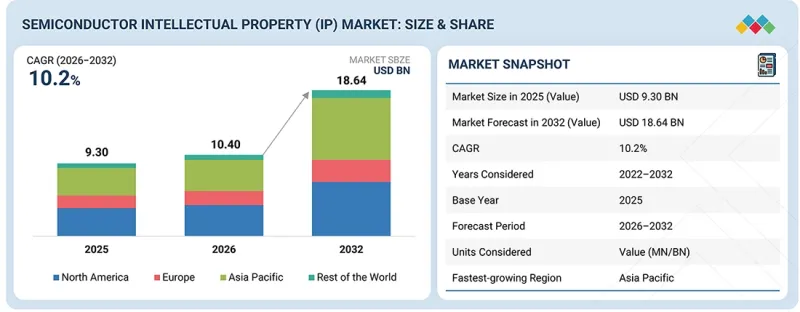
반도체 IP 시장 규모는 2025년에 93억 달러로 추정되며, 2032년에는 186억 4,000만 달러에 이를 것으로 예측됩니다.
또한, 2026-2032년 연평균 성장률(CAGR) 10.2%를 기록할 것으로 전망됩니다.
| 조사 범위 | |
|---|---|
| 조사 대상 기간 | 2021-2032년 |
| 기준연도 | 2025년 |
| 예측 기간 | 2026-2032년 |
| 단위 | 금액(달러) |
| 부문 | 설계, IP, IP 코어, 업계, 지역별 |
| 대상 지역 | 북미, 유럽, 아시아태평양, 기타 지역 |
시장의 성장은 AI, 고성능 컴퓨팅, 클라우드 인프라, 차세대 연결 기술을 지원할 수 있는 첨단 칩 아키텍처에 대한 수요 증가에 힘입어 이루어지고 있습니다. 반도체 개발 비용이 계속 상승하고 설계 주기가 점점 더 촉박해지는 가운데, 칩 제조업체들은 혁신을 가속화하고 엔지니어링의 복잡성을 줄이며 개발 생산성을 높이기 위해 사전에 검증된 IP 솔루션을 점점 더 많이 활용하고 있습니다. 맞춤형 실리콘, AI 지원 프로세서, 칩렛 기반 설계, 소프트웨어 정의 시스템에 대한 투자 확대에 힘입어, 가전제품, 자동차, 통신, 산업용 자동화, 데이터센터 등 다양한 산업 분야에서 반도체 IP에 대한 수요가 더욱 증가하고 있습니다. 또한, 이종 컴퓨팅, 첨단 패키징 기술, 신흥 RISC-V 생태계의 발전이 IP 공급업체에 새로운 수익 창출 기회를 제공하며, 반도체 업계경쟁 구도를 재편하고 있습니다.
'보안 IP는 2032년까지 가장 빠르게 성장할 설계 IP 부문으로 부상할 것으로 예측됩니다.'
설계 IP별로 살펴보면, 보안 IP 부문이 예측 기간 동안 가장 빠른 성장세를 보일 것으로 예측됩니다. 이 부문에는 신뢰 경로(RoT) 솔루션, 암호화 엔진, 보안 부팅 기술, 신뢰 실행 환경(TEE), 물리적 복제 방지 기능(PUF), 양자암호 이후 블록이 포함됩니다. 사이버 공격의 빈도 증가, 커넥티드 기기의 보급 확대, 소프트웨어 정의 차량의 확산, 클라우드 기반 AI 인프라의 규모 확대가 하드웨어 수준의 보안 솔루션에 대한 수요를 견인하고 있습니다. 보안이 선택적 기능에서 설계상의 필수 요건으로 전환되는 가운데, 보안 IP 제공업체들은 자동차, 산업용, CE 제품, 데이터센터 등 각 분야에서 큰 성장 기회를 얻고 있습니다.
'하드 IP 부문은 2032년까지 소프트 IP 부문보다 높은 성장률을 나타낼 것으로 예측됩니다.'
하드 IP에는 SerDes PHY, PCIe PHY, DDR PHY, HBM PHY, RF 블록, 아날로그 회로 등 공정 고유의 물리적 구현이 포함됩니다. 첨단 공정 노드, 고대역폭 메모리 아키텍처, AI 가속기, 고속 상호 연결 기술의 채택 확대가 고도로 최적화된 물리적 IP에 대한 수요를 뒷받침하고 있습니다. 반도체 기업들이 전력 효율, 성능 최적화, 시장 출시 기간 단축을 더욱 중시함에 따라, 하드 IP 솔루션은 차세대 칩 개발에서 그 중요성이 점점 더 커지고 있습니다.
'아키텍처별로는 RISC-V 아키텍처가 예측 기간 동안 가장 빠른 성장세를 보일 것으로 예측됩니다.'
RISC-V 아키텍처의 개방적이고 확장성이 뛰어난 명령어 세트 덕분에, 반도체 기업들은 기존의 라이선싱상의 제약 없이 맞춤형 프로세서를 개발할 수 있게 됩니다. 자국 주도의 반도체 개발, 산업 자동화, 차량용 전자기기, AI 가속기, 임베디드 시스템에 대한 관심이 높아지면서 RISC-V 기반 프로세서 코어의 채택이 가속화되고 있습니다. 또한, IP 공급업체, 소프트웨어 개발사, 반도체 제조업체에 의한 생태계 지원 확대가 여러 최종 시장에서 상용화를 더욱 촉진하고 있습니다.
'아시아태평양은 앞으로도 가장 빠르게 성장하는 지역 시장이 될 것으로 예측됩니다.'
반도체 자급자족을 위한 투자 증가, 국내 칩 설계 생태계의 확대, AI 반도체 개발의 진전, 견조한 CE 제품 생산이 아시아태평양 시장 확대에 기여하고 있습니다. 중국, 인도, 대만, 한국, 일본 등의 국가들은 정부의 지원, 민간 투자, 전략적 기술 이니셔티브를 통해 반도체 설계 역량을 지속적으로 강화하고 있으며, 이는 이 지역 전체의 반도체 IP 공급업체들에게 실질적이고 지속적인 기회를 창출하고 있습니다.
본 보고서에서는 전 세계 반도체 IP 시장을 조사했으며, 시장 개요, 시장 성장에 영향을 미치는 다양한 요인에 대한 분석, 기술 및 특허 동향, 법규제 환경, 사례 연구, 시장 규모 추이 및 전망, 각종 분류·지역/주요 국가별 상세 분석, 경쟁 구도, 주요 기업 프로파일 등을 정리했습니다.
자주 묻는 질문
목차
제1장 서론
제2장 주요 요약
제3장 프리미엄 인사이트
제4장 시장 개요
제5장 업계 동향
제6장 기술 진보, AI의 영향, 특허, 혁신
제7장 규제 상황
제8장 고객 현황과 구매 행동
제9장 반도체 IP 시장 : 설계 IP별
제10장 반도체 IP 시장 : 아키텍처 유형별
제11장 반도체 IP 시장 : IP소스별
제12장 반도체 IP 시장 : IP코어별
제13장 반도체 IP 시장 : 업계별
제14장 반도체 IP 시장 : IP소비자 유형별
제15장 반도체 IP 시장 : 지역별
제16장 경쟁 구도
제17장 기업 개요
제18장 조사 방법
제19장 부록
LSH 26.07.14The semiconductor IP market was estimated at USD 9.30 billion in 2025 and is projected to reach USD 18.64 billion by 2032, expanding at a CAGR of 10.2% from 2026 to 2032.
| Scope of the Report | |
|---|---|
| Years Considered for the Study | 2021-2032 |
| Base Year | 2025 |
| Forecast Period | 2026-2032 |
| Units Considered | Value (USD Billion) |
| Segments | By Design IP, IP Core, Vertical and Region |
| Regions covered | North America, Europe, APAC, RoW |
Market growth is being fueled by the increasing need for sophisticated chip architectures capable of supporting artificial intelligence, high-performance computing, cloud infrastructure, and next-generation connectivity technologies. As semiconductor development costs continue to rise and design cycles become more demanding, chipmakers are increasingly leveraging pre-validated IP solutions to accelerate innovation, reduce engineering complexity, and improve development productivity. Growing investments in custom silicon, AI-enabled processors, chiplet-based designs, and software-defined systems are further strengthening demand for semiconductor IP across a wide range of industries, including consumer electronics, automotive, telecommunications, industrial automation, and data centers. In addition, advancements in heterogeneous computing, advanced packaging technologies, and emerging RISC-V ecosystems are creating new monetization opportunities for IP providers and reshaping the competitive landscape of the semiconductor industry.
"Security IP is expected to emerge as the fastest-growing design IP segment through 2032"
By design IP, the security IP segment is expected to register the fastest growth during the forecast period. This segment includes root-of-trust solutions, cryptographic engines, secure boot technologies, trusted execution environments, physically unclonable functions, and post-quantum cryptography blocks. Rising frequency of cyberattacks, growing adoption of connected devices, expansion of software-defined vehicles, and scaling of cloud-based AI infrastructure are driving demand for hardware-level security solutions. As security transitions from an optional feature to a core design requirement, security IP providers are experiencing significant growth opportunities across automotive, industrial, consumer electronics, and data center applications.
"The hard IP segment is expected to register a higher growth rate than the soft IP segment through 2032"
Based on IP core type, the hard IP segment is projected to witness a higher CAGR than the soft IP segment during the forecast period. Hard IP encompasses process-specific physical implementations such as SerDes PHYs, PCIe PHYs, DDR PHYs, HBM PHYs, RF blocks, and analog circuits. Growing adoption of advanced process nodes, high-bandwidth memory architectures, AI accelerators, and high-speed interconnect technologies is fueling demand for highly optimized physical IP. As semiconductor companies place greater emphasis on power efficiency, performance optimization, and faster time-to-market, hard IP solutions are becoming increasingly critical for next-generation chip development.
"By architecture type, the RISC-V architecture segment is expected to exhibit the fastest growth during the forecast period."
RISC-V architecture is expected to emerge as the fastest-growing architecture type segment during the forecast period. Its open and extensible instruction set enables semiconductor companies to develop customized processors without traditional licensing constraints. Growing interest in sovereign semiconductor development, industrial automation, automotive electronics, AI accelerators, and embedded systems is accelerating the adoption of RISC-V-based processor cores. Increasing ecosystem support from IP vendors, software developers, and semiconductor manufacturers is further driving commercialization across multiple end markets.
"Asia Pacific is estimated to remain the fastest-growing regional market for semiconductor IP"
From a regional perspective, Asia Pacific is expected to be the fastest-growing market for semiconductor IP solutions throughout the forecast period. Rising investments in semiconductor self-sufficiency, expansion of domestic chip design ecosystems, growing AI semiconductor development, and strong consumer electronics manufacturing are all contributing to regional market expansion. Countries including China, India, Taiwan, South Korea, and Japan continue to strengthen their semiconductor design capabilities through government support, private investment, and strategic technology initiatives, creating substantial and sustained opportunities for semiconductor IP providers across the region.
Extensive primary interviews were conducted with key industry experts offering semiconductor IP solutions to determine and verify the market size for various segments and subsegments gathered through secondary research. The study contains insights from various industry experts, from component suppliers to Tier 1 companies and OEMs. The break-up of the primaries is as follows:
- By Company Type: Tier 1-40%, Tier 2-35%, and Tier 3-25%
- By Designation: C-level-40%, Directors-45%, and Others-15%
- By Region: North America-41%, Europe-26%, Asia Pacific-28%, and Rest of the World-5%
The report profiles key players in the semiconductor IP market with their respective market ranking analysis.
Prominent players profiled in this report include Arm Holdings (UK), Synopsys (US), Cadence Design Systems (US), Rambus (US), Alphawave Semi (UK), CEVA (Israel), Imagination Technologies (UK), SiFive (US), Arteris (US), Andes Technology (Taiwan), and eMemory Technology (Taiwan), among others. Apart from these, Silicon Creations (US), VeriSilicon (China), Secure-IC (France), BrainChip (Australia), Achronix Semiconductor (US), Flex Logix Technologies (US), Think Silicon (Greece), and Untether AI (Canada) are among the few other companies in the semiconductor IP market.
Research Coverage:
This research report categorizes the semiconductor IP market based on design IP, IP core, IP source, IP consumer type, architecture type, vertical, and region. The report describes the major drivers, restraints, challenges, and opportunities pertaining to the market and forecasts the same till 2032. The report also consists of leadership mapping and analysis of all the companies included in the semiconductor IP market ecosystem.
Key Benefits of Buying the Report
The report will help the market leaders/new entrants in this market with information on the closest approximations of the numbers for the overall Semiconductor IP market and the subsegments. This report will help stakeholders understand the competitive landscape and gain more insights to position their businesses better and plan suitable go-to-market strategies. The report also helps stakeholders understand the pulse of the market and provides them with information on key market drivers, restraints, challenges, and opportunities.
The report provides insights into the following pointers:
- Analysis of key drivers (rising adoption of edge AI and real-time on-device inference across autonomous systems, industrial automation, and smart devices; growing demand for AI-enabled consumer electronics including wearables, hearables, XR devices, and smart home products; increasing deployment of AI sensing technologies in automotive applications such as ADAS, driver monitoring, and in-cabin sensing; expansion of industrial automation, machine vision, and predictive maintenance systems within Industry 4.0 environments), restraints (power consumption and thermal management limitations in compact and battery-operated AI sensing devices; rising concerns related to data privacy, cybersecurity, and regulatory compliance for AI-enabled sensing systems), opportunities (growing adoption of AI-native edge devices such as AI PCs, smart glasses, XR systems, and multimodal wearable platforms; expansion of robotics, autonomous systems, and smart industrial infrastructure requiring contextual AI perception), and challenges (difficulty in balancing inference accuracy, latency, and ultra-low-power operation in edge AI sensing environments; limited compute, memory, and thermal resources for running advanced AI models directly on embedded sensing devices).
- Product Development/Innovation: Detailed insights into upcoming technologies, research & development activities, and new product & service launches in the semiconductor IP market
- Market Development: Comprehensive information about lucrative markets-the report analyzes the semiconductor IP market across varied regions.
- Market Diversification: Exhaustive information about new products & services, untapped geographies, recent developments, and investments in the semiconductor IP market
Competitive Assessment: In-depth assessment of market shares, growth strategies, and service offerings of leading players, such as Arm Holdings (UK), Synopsys (US), Cadence Design Systems (US), Rambus (US), Alphawave Semi (UK), CEVA (Israel), Imagination Technologies (UK), SiFive (US), Arteris (US), Andes Technology (Taiwan), and eMemory Technology (Taiwan), among others.
TABLE OF CONTENTS
1 INTRODUCTION
- 1.1 STUDY OBJECTIVES
- 1.2 MARKET DEFINITION
- 1.3 MARKET SCOPE
- 1.3.1 MARKET SEGMENTATION AND REGIONAL SCOPE
- 1.3.2 INCLUSIONS AND EXCLUSIONS
- 1.3.3 YEARS CONSIDERED
- 1.4 CURRENCY CONSIDERED
- 1.5 LIMITATIONS
- 1.6 STAKEHOLDERS
- 1.7 SUMMARY OF CHANGES
2 EXECUTIVE SUMMARY
- 2.1 MARKET HIGHLIGHTS AND KEY INSIGHTS
- 2.2 KEY MARKET PARTICIPANTS: MAPPING OF STRATEGIC DEVELOPMENTS
- 2.3 DISRUPTIVE TRENDS IN SEMICONDUCTOR IP MARKET
- 2.4 HIGH-GROWTH SEGMENTS
- 2.5 REGIONAL SNAPSHOT: MARKET SIZE, GROWTH RATE, AND FORECAST
3 PREMIUM INSIGHTS
- 3.1 ATTRACTIVE OPPORTUNITIES FOR PLAYERS IN SEMICONDUCTOR IP MARKET
- 3.2 SEMICONDUCTOR IP MARKET, BY DESIGN IP
- 3.3 SEMICONDUCTOR IP MARKET, BY ARCHITECTURE TYPE
- 3.4 SEMICONDUCTOR IP MARKET, BY IP SOURCE
- 3.5 SEMICONDUCTOR IP MARKET, BY IP CORE
- 3.6 SEMICONDUCTOR IP MARKET, BY VERTICAL
- 3.7 SEMICONDUCTOR IP MARKET, BY IP CONSUMER TYPE
- 3.8 SEMICONDUCTOR IP MARKET, BY REGION
4 MARKET OVERVIEW
- 4.1 INTRODUCTION
- 4.2 MARKET DYNAMICS
- 4.2.1 DRIVERS
- 4.2.1.1 Increasing complexity of advanced SoC designs
- 4.2.1.2 Rising adoption of AI-enabled and edge computing devices
- 4.2.1.3 Increasing semiconductor content across automotive, industrial, healthcare, telecommunications, and data center applications
- 4.2.1.4 Growing focus on reducing chip design cost and accelerating time to market
- 4.2.2 RESTRAINTS
- 4.2.2.1 High cost associated with development of IP-optimized leading-edge nodes
- 4.2.2.2 Integration and interoperability issues associated with deployment of multiple semiconductor IP blocks
- 4.2.3 OPPORTUNITIES
- 4.2.3.1 Rising adoption of AI accelerators, specialized compute IP, and edge computing architectures across industries
- 4.2.3.2 Growing use of semiconductor IP in autonomous systems and software-defined vehicles
- 4.2.3.3 Increasing commercialization and adoption of RISC-V processor architectures
- 4.2.4 CHALLENGES
- 4.2.4.1 Increasing risks of IP theft, piracy, and counterfeiting
- 4.2.4.2 Longer design, verification, and validation cycles
- 4.2.1 DRIVERS
- 4.3 UNMET NEEDS AND WHITE SPACES
- 4.3.1 UNMET NEEDS IN SEMICONDUCTOR IP MARKET
- 4.3.2 WHITE SPACE OPPORTUNITIES IN SEMICONDUCTOR IP MARKET
- 4.4 INTERCONNECTED MARKETS AND CROSS-SECTOR OPPORTUNITIES
- 4.4.1 INTERCONNECTED MARKETS
- 4.4.2 CROSS-SECTOR OPPORTUNITIES
- 4.5 STRATEGIC MOVES BY TIER 1/2/3 PLAYERS
5 INDUSTRY TRENDS
- 5.1 INTRODUCTION
- 5.2 PORTER'S FIVE FORCES ANALYSIS
- 5.2.1 THREAT OF NEW ENTRANTS
- 5.2.2 THREAT OF SUBSTITUTES
- 5.2.3 BARGAINING POWER OF SUPPLIERS
- 5.2.4 BARGAINING POWER OF BUYERS
- 5.2.5 INTENSITY OF COMPETITIVE RIVALRY
- 5.3 MACROECONOMIC OUTLOOK
- 5.3.1 INTRODUCTION
- 5.3.2 GDP TRENDS AND FORECAST
- 5.3.3 TRENDS IN GLOBAL SEMICONDUCTOR INDUSTRY
- 5.3.4 TRENDS IN GLOBAL SEMICONDUCTOR IP INDUSTRY
- 5.4 SUPPLY CHAIN ANALYSIS
- 5.5 ECOSYSTEM ANALYSIS
- 5.6 PRICING ANALYSIS
- 5.6.1 PRICING RANGE OF SEMICONDUCTOR COMPUTE IP DESIGN, BY KEY PLAYER, 2025
- 5.6.2 AVERAGE UPFRONT SEMICONDUCTOR IP LICENSE FEE TREND, BY DESIGN IP, 2022-2025
- 5.6.3 AVERAGE SEMICONDUCTOR IP ROYALTY FEE TREND, BY DESIGN IP, 2022-2025
- 5.7 TRADE ANALYSIS
- 5.7.1 IMPORT SCENARIO (HS CODE 8542)
- 5.7.2 EXPORT SCENARIO (HS CODE 8542)
- 5.8 KEY CONFERENCES AND EVENTS, 2026-2027
- 5.9 TRENDS/DISRUPTIONS IMPACTING CUSTOMER BUSINESS
- 5.10 INVESTMENT AND FUNDING SCENARIO, 2023 TO 2025
- 5.11 CASE STUDY ANALYSIS
- 5.11.1 SIEMENS AND ALPHAWAVE SEMI EXPAND HIGH-SPEED CONNECTIVITY IP ACCESS THROUGH OEM COLLABORATION
- 5.11.2 GLOBALFOUNDRIES AND MIPS STRENGTHEN COMPUTE IP CAPABILITIES THROUGH STRATEGIC ACQUISITION
- 5.11.3 SYNOPSYS AND TSMC COLLABORATE TO ACCELERATE AI AND MULTI-DIE SEMICONDUCTOR INNOVATION
- 5.12 IMPACT OF US TARIFFS
- 5.12.1 KEY TARIFF RATES
- 5.12.2 PRICE IMPACT ANALYSIS
- 5.12.3 IMPACT ON VARIOUS COUNTRIES/REGIONS
- 5.12.3.1 US
- 5.12.3.2 Europe
- 5.12.3.3 Asia Pacific
- 5.12.4 IMPACT ON END USERS
6 TECHNOLOGICAL ADVANCEMENT, AI-DRIVEN IMPACT, PATENTS, AND INNOVATIONS
- 6.1 KEY TECHNOLOGIES
- 6.1.1 ADVANCED SYSTEM-ON-CHIP (SOC) DESIGN ARCHITECTURES
- 6.1.2 RISC-V AND OPEN-STANDARD INSTRUCTION SET ARCHITECTURE (ISA)
- 6.2 COMPLEMENTARY TECHNOLOGIES
- 6.2.1 ELECTRONIC DESIGN AUTOMATION (EDA) AND DESIGN VERIFICATION TECHNOLOGIES
- 6.2.2 ADVANCED PACKAGING AND CHIPLET INTEGRATION TECHNOLOGIES
- 6.3 ADJACENT TECHNOLOGIES
- 6.3.1 GENERATIVE AI FOR SEMICONDUCTOR DESIGN OPTIMIZATION
- 6.4 TECHNOLOGY ROADMAP
- 6.5 PATENT ANALYSIS
- 6.6 IMPACT OF AI ON SEMICONDUCTOR IP MARKET
- 6.6.1 TOP USE CASES AND MARKET POTENTIAL
- 6.6.2 BEST PRACTICES FOLLOWED BY COMPANIES IN SEMICONDUCTOR IP MARKET
- 6.6.3 CASE STUDIES OF AI IMPLEMENTATION IN SEMICONDUCTOR IP MARKET
- 6.6.4 INTERCONNECTED/ADJACENT ECOSYSTEM AND IMPACT ON MARKET PLAYERS
- 6.6.5 CLIENTS' READINESS TO ADOPT AI IN SEMICONDUCTOR IP MARKET
7 REGULATORY LANDSCAPE
- 7.1 REGIONAL REGULATIONS AND COMPLIANCE
- 7.1.1 REGULATORY BODIES, GOVERNMENT AGENCIES, AND OTHER ORGANIZATIONS
- 7.1.2 STANDARDS AND REGULATIONS RELATED TO SEMICONDUCTOR IP
8 CUSTOMER LANDSCAPE AND BUYER BEHAVIOR
- 8.1 DECISION-MAKING PROCESS
- 8.2 KEY STAKEHOLDERS AND BUYING CRITERIA
- 8.2.1 KEY STAKEHOLDERS IN BUYING PROCESS
- 8.2.2 BUYING CRITERIA
- 8.3 ADOPTION BARRIERS AND INTERNAL CHALLENGES
- 8.4 UNMET NEEDS OF VARIOUS END USERS FROM DIFFERENT VERTICALS
9 SEMICONDUCTOR IP MARKET, BY DESIGN IP
- 9.1 INTRODUCTION
- 9.2 COMPUTE IP
- 9.2.1 CPU IP
- 9.2.1.1 Rising use of CPU IPs in consumer electronics, data centers, and automotive systems to accelerate segmental growth
- 9.2.2 GPU IP
- 9.2.2.1 Elevating demand for gaming, cloud computing, and advanced visualization solutions to fuel segmental expansion
- 9.2.3 NPU IP
- 9.2.3.1 Potential to accelerate image recognition, natural language processing tasks with low power consumption to boost demand
- 9.2.4 DSP IP
- 9.2.4.1 Increasing deployment of 5G infrastructure, ADAS, and intelligent connected devices to contribute to segmental growth
- 9.2.5 MCU IP
- 9.2.5.1 Growing utilization of MCU IPs in automotive electronics, consumer appliances, and medical devices to foster market growth
- 9.2.6 OTHER COMPUTE IP TYPES
- 9.2.1 CPU IP
- 9.3 INTERFACE IP
- 9.3.1 PCIE IP
- 9.3.1.1 Scalability, high bandwidth, and low latency features to drive adoption in data center applications
- 9.3.2 MEMORY INTERFACE IP
- 9.3.2.1 Higher bandwidth and improved power efficiency attributes to promote usage in HPC and cloud computing applications
- 9.3.3 HIGH-SPEED CONNECTIVITY IP
- 9.3.3.1 Escalating use of cloud computing, AI workloads, and chiplet-based architectures to spike high-speed connectivity IP demand
- 9.3.4 USB IP
- 9.3.4.1 Extensive use in smartphones, tablets, personal computers, and consumer electronics to stimulate market growth
- 9.3.5 DIE-TO-DIE/UCIE IP
- 9.3.5.1 Surging use of chiplet-based architectures by semiconductor manufacturers to facilitate segmental growth
- 9.3.6 CXL IP
- 9.3.6.1 Ability to enable memory sharing and resource pooling to spur demand
- 9.3.7 MIPI IP
- 9.3.7.1 Increasing demand for wearable devices with advanced imaging, sensing, and display technologies to propel segmental growth
- 9.3.8 OTHER INTERFACE IP TYPES
- 9.3.1 PCIE IP
- 9.4 MEMORY IP
- 9.4.1 RISING DEMAND FOR AI, HPC, AND DATA-CENTRIC APPLICATIONS TO DRIVE SEGMENTAL GROWTH
- 9.5 ANALOG AND MIXED-SIGNAL IP
- 9.5.1 INCREASING FOCUS OF SEMICONDUCTOR MANUFACTURERS ON REDUCING DESIGN COMPLEXITY AND ACCELERATING TIME-TO-MARKET TO PROMOTE SEGMENTAL GROWTH
- 9.6 SECURITY IP
- 9.6.1 RISING CYBERSECURITY REQUIREMENTS AND INCREASING CONNECTED DEVICE DEPLOYMENTS TO DRIVE SEGMENTAL GROWTH
- 9.7 FOUNDATION & PHYSICAL LIBRARY IP
- 9.7.1 INCREASING DESIGN COMPLEXITY AT ADVANCED PROCESS NODES TO DRIVE SEGMENTAL GROWTH
- 9.8 OTHER DESIGN IPS
- 9.8.1 VERIFICATION IP
- 9.8.2 INFRASTRUCTURE IP
10 SEMICONDUCTOR IP MARKET, BY ARCHITECTURE TYPE
- 10.1 INTRODUCTION
- 10.2 ARM ARCHITECTURE
- 10.2.1 STRONG FOCUS OF SOC DEVELOPERS ON FASTER TIME-TO-MARKET AND ENERGY-EFFICIENT COMPUTING SOLUTIONS TO DRIVE MARKET
- 10.3 X86 ARCHITECTURE
- 10.3.1 CONTINUED INVESTMENTS IN ADVANCED COMPUTING, EDGE SERVERS, AND AI-ENABLED DATA CENTERS TO CONTRIBUTE TO SEGMENTAL GROWTH
- 10.4 RISC-V ARCHITECTURE
- 10.4.1 SIGNIFICANT PROGRESS IN AUTOMOTIVE AND INDUSTRIAL ELECTRONICS TO CREATE GROWTH OPPORTUNITIES
- 10.5 OTHER PROPRIETARY ARCHITECTURES
11 SEMICONDUCTOR IP MARKET, BY IP SOURCE
- 11.1 INTRODUCTION
- 11.2 ROYALTY
- 11.2.1 SIGNIFICANT FOCUS OF CHIP DESIGNERS ON MINIMIZING UPFRONT COSTS TO FUEL SEGMENTAL GROWTH
- 11.3 LICENSING
- 11.3.1 GROWING ADOPTION BY SMALL AND MEDIUM-SIZED VENDORS TO FOSTER SEGMENTAL GROWTH
12 SEMICONDUCTOR IP MARKET, BY IP CORE
- 12.1 INTRODUCTION
- 12.2 SOFT IP CORE
- 12.2.1 COMPILE-TIME CUSTOMIZATION CAPABILITIES OF SOFT IP CORE TO DRIVE MARKET
- 12.3 HARD IP CORE
- 12.3.1 SUPERIOR PERFORMANCE TO BOOST DEMAND
13 SEMICONDUCTOR IP MARKET, BY VERTICAL
- 13.1 INTRODUCTION
- 13.2 CONSUMER ELECTRONICS
- 13.2.1 RISING DEMAND FOR SMARTPHONES WITH HIGH PROCESSING SPEED AND STORAGE CAPACITY TO DRIVE MARKET
- 13.3 TELECOMMUNICATIONS
- 13.3.1 EXPANDING 5G/6G NETWORK INFRASTRUCTURE AND HIGH-SPEED CONNECTIVITY REQUIREMENTS TO SPIKE DEMAND
- 13.4 DATA CENTER
- 13.4.1 RISING AI WORKLOADS AND HIGH-PERFORMANCE COMPUTING REQUIREMENTS TO ACCELERATE MARKET GROWTH
- 13.5 INDUSTRIAL
- 13.5.1 GROWING DEMAND FOR ADVANCED FPGA-BASED SEMICONDUCTOR CHIPS AND MIXED-SIGNAL IPS TO FUEL MARKET GROWTH
- 13.6 AUTOMOTIVE
- 13.6.1 ADVANCEMENT OF SOFTWARE-DEFINED VEHICLES AND AUTONOMOUS TECHNOLOGIES TO DRIVE MARKET GROWTH
- 13.7 COMMERCIAL
- 13.7.1 RISING NEED FOR ACCESS CONTROL SYSTEMS TO ENSURE SAFETY AND SECURITY TO DRIVE DEMAND
- 13.8 OTHER VERTICALS
14 SEMICONDUCTOR IP MARKET, BY IP CONSUMER TYPE
- 14.1 INTRODUCTION
- 14.2 FABLESS SEMICONDUCTOR COMPANIES
- 14.2.1 GROWING DEMAND FOR AI PROCESSORS, DATA CENTER CHIPS, AND AUTOMOTIVE SEMICONDUCTORS TO CONTRIBUTE TO MARKET GROWTH
- 14.3 INTEGRATED DEVICE MANUFACTURERS
- 14.3.1 RISING INVESTMENTS IN AUTOMOTIVE ELECTRONICS, AUTOMATION, AND AI COMPUTING TO ENCOURAGE IDMS TO USE LICENSED IPS
- 14.4 SYSTEM COMPANIES & CUSTOM SILICON DEVELOPERS
- 14.4.1 GROWING TREND TOWARD CUSTOM SILICON DEVELOPMENT TO CREATE GROWTH OPPORTUNITIES
- 14.5 OTHER IP CONSUMER TYPES
15 SEMICONDUCTOR IP MARKET, BY REGION
- 15.1 INTRODUCTION
- 15.2 NORTH AMERICA
- 15.2.1 US
- 15.2.1.1 Leadership in chip design, EDA, and advanced semiconductor research to drive market
- 15.2.2 CANADA
- 15.2.2.1 Increasing adoption of connected devices, industrial automation systems, and smart infrastructure to fuel market growth
- 15.2.3 MEXICO
- 15.2.3.1 Emphasis on building strong semiconductor design ecosystem to create growth opportunities
- 15.2.1 US
- 15.3 EUROPE
- 15.3.1 GERMANY
- 15.3.1.1 Significant presence of leading automotive OEMs and industrial technology providers to support market growth
- 15.3.2 UK
- 15.3.2.1 Robust presence of leading IP providers to contribute to market growth
- 15.3.3 FRANCE
- 15.3.3.1 Growing demand for AI-enabled systems, secure electronics, automotive semiconductors to foster market growth
- 15.3.4 NETHERLANDS
- 15.3.4.1 Investments in advanced chip development technologies to create lucrative opportunities
- 15.3.5 REST OF EUROPE
- 15.3.1 GERMANY
- 15.4 ASIA PACIFIC
- 15.4.1 JAPAN
- 15.4.1.1 Leading position in robotics and advanced electronics to spike semiconductor IP demand
- 15.4.2 CHINA
- 15.4.2.1 Prominent presence of leading smartphone manufacturers to facilitate market growth
- 15.4.3 SOUTH KOREA
- 15.4.3.1 Significant focus on strengthening fabless and SoC design capabilities to stimulate demand
- 15.4.4 TAIWAN
- 15.4.4.1 Adoption of advanced-node and AI-focused semiconductor development initiatives to spur demand
- 15.4.5 INDIA
- 15.4.5.1 Heightened emphasis on achieving self-reliance in semiconductor production to support market expansion
- 15.4.6 REST OF ASIA PACIFIC
- 15.4.1 JAPAN
- 15.5 ROW
- 15.5.1 SOUTH AMERICA
- 15.5.1.1 Increasing investments in digital transformation to boost demand
- 15.5.2 MIDDLE EAST
- 15.5.2.1 GCC
- 15.5.2.1.1 Growing adoption of consumer electronics and smart infrastructure to drive market
- 15.5.2.2 Rest of Middle East
- 15.5.2.1 GCC
- 15.5.3 AFRICA
- 15.5.3.1 Government initiatives to strengthen digital economies through advanced manufacturing to support market growth
- 15.5.1 SOUTH AMERICA
16 COMPETITIVE LANDSCAPE
- 16.1 INTRODUCTION
- 16.2 KEY PLAYER COMPETITIVE STRATEGIES/RIGHT TO WIN (2022-2026)
- 16.3 REVENUE ANALYSIS, 2021-2025
- 16.4 MARKET SHARE ANALYSIS, 2025
- 16.5 COMPANY VALUATION AND FINANCIAL METRICS
- 16.6 BRAND COMPARISON
- 16.7 COMPANY EVALUATION MATRIX: KEY PLAYERS, 2025
- 16.7.1 STARS
- 16.7.2 EMERGING LEADERS
- 16.7.3 PERVASIVE PLAYERS
- 16.7.4 PARTICIPANTS
- 16.7.5 COMPANY FOOTPRINT: KEY PLAYERS, 2025
- 16.7.5.1 Company footprint
- 16.7.5.2 Region footprint
- 16.7.5.3 Design IP footprint
- 16.7.5.4 IP source footprint
- 16.7.5.5 Vertical footprint
- 16.8 COMPANY EVALUATION MATRIX: STARTUPS/SMES, 2025
- 16.8.1 PROGRESSIVE COMPANIES
- 16.8.2 RESPONSIVE COMPANIES
- 16.8.3 DYNAMIC COMPANIES
- 16.8.4 STARTING BLOCKS
- 16.8.5 COMPETITIVE BENCHMARKING: STARTUPS/SMES, 2025
- 16.8.5.1 Detailed list of key startups/SMEs
- 16.8.5.2 Competitive benchmarking of key startups/SMEs
- 16.9 COMPETITIVE SCENARIO
- 16.9.1 PRODUCT LAUNCHES/ENHANCEMENTS
- 16.9.2 DEALS
17 COMPANY PROFILES
- 17.1 KEY PLAYERS
- 17.1.1 ARM LIMITED
- 17.1.1.1 Business overview
- 17.1.1.2 Products/Solutions/Services offered
- 17.1.1.3 Recent developments
- 17.1.1.3.1 Product launches/enhancements
- 17.1.1.3.2 Deals
- 17.1.1.4 MnM view
- 17.1.1.4.1 Key strengths/Right to win
- 17.1.1.4.2 Strategic choices
- 17.1.1.4.3 Weaknesses and competitive threats
- 17.1.2 SYNOPSYS, INC.
- 17.1.2.1 Business overview
- 17.1.2.2 Products/Solutions/Services offered
- 17.1.2.3 Recent developments
- 17.1.2.3.1 Product launches/enhancements
- 17.1.2.3.2 Deals
- 17.1.2.4 MnM view
- 17.1.2.4.1 Key strengths/Right to win
- 17.1.2.4.2 Strategic choices
- 17.1.2.4.3 Weaknesses and competitive threats
- 17.1.3 CADENCE DESIGN SYSTEMS, INC.
- 17.1.3.1 Business overview
- 17.1.3.2 Products/Solutions/Services offered
- 17.1.3.3 Recent developments
- 17.1.3.3.1 Product launches/enhancements
- 17.1.3.3.2 Deals
- 17.1.3.4 MnM view
- 17.1.3.4.1 Key strengths/Right to win
- 17.1.3.4.2 Strategic choices
- 17.1.3.4.3 Weaknesses and competitive threats
- 17.1.4 RAMBUS
- 17.1.4.1 Business overview
- 17.1.4.2 Products/Solutions/Services offered
- 17.1.4.3 Recent developments
- 17.1.4.3.1 Product launches/enhancements
- 17.1.4.3.2 Deals
- 17.1.4.4 MnM view
- 17.1.4.4.1 Key strengths/Right to win
- 17.1.4.4.2 Strategic choices
- 17.1.4.4.3 Weaknesses and competitive threats
- 17.1.5 ALPHAWAVE SEMI
- 17.1.5.1 Business overview
- 17.1.5.2 Products/Solutions/Services offered
- 17.1.5.3 Recent developments
- 17.1.5.3.1 Product launches/enhancements
- 17.1.5.3.2 Deals
- 17.1.5.4 MnM view
- 17.1.5.4.1 Key strengths/Right to win
- 17.1.5.4.2 Strategic choices
- 17.1.5.4.3 Weaknesses and competitive threats
- 17.1.6 IMAGINATION TECHNOLOGIES
- 17.1.6.1 Business overview
- 17.1.6.2 Products/Solutions/Services offered
- 17.1.6.3 Recent developments
- 17.1.6.3.1 Product launches/enhancements
- 17.1.6.3.2 Deals
- 17.1.7 CEVA, INC.
- 17.1.7.1 Business overview
- 17.1.7.2 Products/Solutions/Services offered
- 17.1.7.3 Recent developments
- 17.1.7.3.1 Products launches/enhancements
- 17.1.7.3.2 Deals
- 17.1.8 EMEMORY TECHNOLOGY INC.
- 17.1.8.1 Business overview
- 17.1.8.2 Products/Solutions/Services offered
- 17.1.8.3 Recent developments
- 17.1.8.3.1 Product launches/enhancements
- 17.1.8.3.2 Deals
- 17.1.9 VERISILICON
- 17.1.9.1 Business overview
- 17.1.9.2 Products/Solutions/Services offered
- 17.1.9.3 Recent developments
- 17.1.9.3.1 Products launches/enhancements
- 17.1.9.3.2 Deals
- 17.1.10 SIFIVE, INC.
- 17.1.10.1 Business overview
- 17.1.10.2 Products offered
- 17.1.10.3 Recent developments
- 17.1.10.3.1 Product launches/enhancements
- 17.1.10.3.2 Deals
- 17.1.1 ARM LIMITED
- 17.2 OTHER PLAYERS
- 17.2.1 LATTICE SEMICONDUCTOR
- 17.2.2 ACHRONIX SEMICONDUCTOR CORPORATION
- 17.2.3 ANALOG BITS
- 17.2.4 ARTERIS, INC.
- 17.2.5 FRONTGRADE GAISLER
- 17.2.6 DOLPHIN SEMICONDUCTOR
- 17.2.7 DREAM CHIP TECHNOLOGIES GMBH
- 17.2.8 EUREKA TECHNOLOGY, INC.
- 17.2.9 FARADAY TECHNOLOGY CORPORATION
- 17.2.10 TAKUMI CORPORATION
- 17.2.11 M31 TECHNOLOGY CORPORATION
- 17.2.12 MIPS
- 17.2.13 CREDO, INC.
- 17.2.14 ANDES TECHNOLOGY
- 17.2.15 CODASIP
18 RESEARCH METHODOLOGY
- 18.1 RESEARCH DATA
- 18.1.1 SECONDARY DATA
- 18.1.1.1 Major secondary sources
- 18.1.1.2 Key data from secondary sources
- 18.1.2 PRIMARY DATA
- 18.1.2.1 Participants in primary interviews
- 18.1.2.2 Key data from primary sources
- 18.1.2.3 Key industry insights
- 18.1.2.4 Breakdown of primaries
- 18.1.3 SECONDARY AND PRIMARY RESEARCH
- 18.1.1 SECONDARY DATA
- 18.2 MARKET SIZE ESTIMATION
- 18.2.1 BOTTOM-UP APPROACH
- 18.2.1.1 Approach to estimate market size using bottom-up analysis (demand side)
- 18.2.2 TOP-DOWN APPROACH
- 18.2.2.1 Approach to estimate market size using top-down analysis (supply side)
- 18.2.2.2 Approach to capture market size using supply-side analysis (approach 1)
- 18.2.2.3 Approach to capture market size using supply-side analysis (approach 2)
- 18.2.1 BOTTOM-UP APPROACH
- 18.3 DATA TRIANGULATION
- 18.4 RESEARCH ASSUMPTIONS
- 18.5 RESEARCH LIMITATIONS
- 18.6 RISK ASSESSMENT
19 APPENDIX
- 19.1 DISCUSSION GUIDE
- 19.2 KNOWLEDGESTORE: MARKETSANDMARKETS' SUBSCRIPTION PORTAL
- 19.3 CUSTOMIZATION OPTIONS
- 19.4 RELATED REPORTS
- 19.5 AUTHOR DETAILS