|
시장보고서
상품코드
2084070
세미 트레일러 시장 예측(-2033년) : 유형(플랫베드, 로우보이, 드라이 밴, 냉장, 탱커, 기타), 적재량(25톤 미만, 25-50톤, 51-100톤, 100톤 초과), 전체 길이, 차축 수, 용도, 지역별Semi-Trailer Market by Type (Flatbed, Lowboy, Dry Van, Refrigerated, Tanker, Others), Tonnage (Below 25 Ton, 25-50 Ton, 51-100 Ton, Above 100 Ton), Length, Number of Axles, End-Use & Region - Global Forecast to 2033 |
||||||

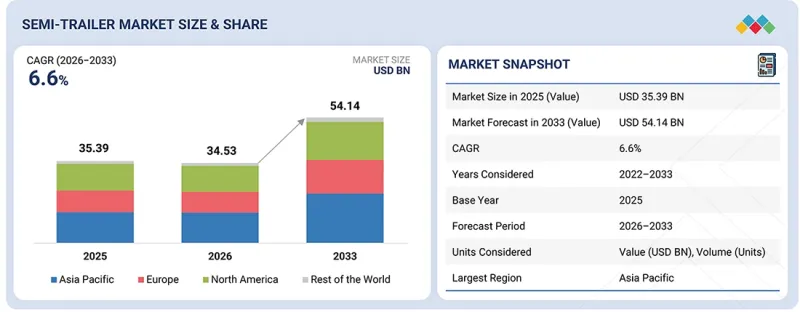
세미 트레일러 시장 규모는 2026년 345억 3,000만 달러에서 2033년에는 541억 4,000만 달러로, CAGR 6.6%로 확대할 것으로 예측됩니다.
소매, 제조, 건설, 농업, 에너지, E-Commerce 등 각 분야에서 장거리 효율적인 화물 운송이 요구됨에 따라 화물 운송에 대한 수요가 증가하고 있습니다.
| 조사 범위 | |
|---|---|
| 조사 대상 기간 | 2026-2033년 |
| 기준연도 | 2025년 |
| 예측 기간 | 2026-2033년 |
| 단위 | 달러 |
| 부문 | 유형, 워크로드, 전체 길이, 차축 수, 용도, 지역별 |
| 대상 지역 | 아시아태평양, 유럽, 북미, 기타 지역 |
소비재 및 소포 물류 네트워크의 확장에 따라 트럭 트레일러에 대한 수요가 증가하는 한편, 냉장 트레일러는 식품, 음료, 의약품 분야의 콜드 체인이 급속히 성장함에 따라 그 혜택을 누리고 있습니다. 플랫베드 및 로보이 트레일러는 인프라 프로젝트, 재생에너지 설비 설치, 중장비 운송 분야에서 도입이 확대되고 있으며, 탱크 트레일러는 연료, 화학 제품, 벌크 액체의 물류 분야에서 여전히 없어서는 안 될 존재입니다. 또한 연비 효율 및 배기가스 관련 규제가 강화됨에 따라 첨단 트레일러 설계와 에너지 효율이 높은 냉장 시스템의 도입이 가속화되고 있습니다.
'전장별로는 45피트를 초과하는 부문이 예측 기간 중 가장 빠른 성장세를 보일 것으로 전망됩니다. '
물류 사업자들이 적재 용량, 운영 효율, 규제 준수, 운영 유연성 사이에서 최적의 균형을 모색하는 가운데, 45피트 초과 부문은 세미트레일러 시장에서 가장 빠른 성장세를 보일 것으로 전망됩니다. E-Commerce, FMCG(일용소비재), 소매 유통, 자동차 공급망, 복합 운송, 창고 간 운송 분야의 화물량 증가가 한 번의 운송으로 더 많은 화물을 실을 수 있는 트레일러에 대한 수요를 이끌고 있습니다. 더 짧은 사양의 트레일러와 비교했을 때, 45피트가 넘는 트레일러는 적재 용적의 활용률이 현저히 높기 때문에 화물의 집약화가 진행되어 단위당 운송 비용이 절감되고, 차량군의 생산성이 향상됩니다. 또한 많은 화물 처리 시설, 물류 거점, 주요 물류 시장에서 시행되는 도로 규제에 잘 부합한다는 점도 보급을 지원하고 있습니다. 특히 물류 기업이 집중형 창고, 허브 앤 스포크형 배송망, 국경 간 운송을 확대함에 따라 그 수요는 더욱 증가하고 있습니다. 공급망 전반에서 운송 효율, 자산 가동률, 비용 최적화가 중시되는 가운데, 45피트가 넘는 세미트레일러는 대량 운송에 있으며, 유력한 선택지로 자리 잡고 있으며, 앞으로도 강력한 시장 성장이 예상됩니다.
'차축 수별로는 3축 미만 부문이 2026년에 가장 큰 시장 점유율을 차지할 것으로 전망됩니다. '
3축 미만 부문은 세미트레일러 시장을 독점할 것으로 추정됩니다. 이는 드라이밴트레일러, 냉장 트레일러, 표준 플랫베드 트레일러, 커튼사이드 트레일러 등 일상적인 화물 운송에 널리 사용되는 주요 트레일러 유형의 표준 구성이기 때문에 시장내 최대 규모의 부문이 될 것으로 예상됩니다. 이 부문은 적재 용량, 차축 하중 분산 성능, 선회 성능의 균형이 뛰어납니다. 3축 미만의 트레일러가 시장을 독점하고 있는 이유는 팔레트 적재 화물, 식료품 유통, 소포 배송, 연료 수송, 산업용 화물 분야에서 널리 사용되고 있기 때문입니다. 경량화 덕분에 적재 용량과 연비가 향상되고, 유지보수 비용도 절감됩니다. 또한 뛰어난 기동성 덕분에 도시 지역의 물류, 창고 업무, 지역 간 운송 경로에 최적입니다. 차량 중량도 가벼워 법정 중량 제한 범위 내에서 적재 효율을 높일 수 있으며, 타이어와 부품의 수가 적어 유지보수 비용과 수명 주기 비용을 절감할 수 있습니다. 수요가 특히 높은 곳은 아시아태평양으로, E-Commerce의 확대, 제조업의 활성화, 지역 간 화물 운송의 증가가 차량 수의 증가를 이끌고 있습니다. 이어 북미와 유럽에서는 확립된 물류 네트워크를 통해, 지역내 및 장거리 화물 운송 업무에 이러한 세미트레일러가 활용되고 있습니다. 여러 최종사용자 산업에 걸쳐 적용 가능한 범용성뿐만 아니라, 낮은 소유 비용과 높은 운영 효율성도 세미트레일러 시장에서 이 제품의 지배적인 위상을 지원하고 있습니다.
'아시아태평양이 예측 기간 중 가장 높은 성장률을 기록할 것으로 전망됩니다. '
이는 해당 지역이 분산된 트럭 운송에서 조직적이고 기술적으로 고도로 발달한 화물 운송 시스템으로 전환되고 있기 때문입니다. 중국은 광범위한 제조 거점, 활발한 국내 화물 운송, 지속적으로 성장하는 E-Commerce 부문, 대규모 건설 및 산업 활동에 힘입어 이 지역 최대 시장으로 자리매김하고 있습니다. 특히 제조, 소매 유통, 건설 자재, 항만 물류 등 각 분야에서 사용되는 드라이밴, 플랫베드, 컨테이너 섀시, 대형 다축 트레일러에 대한 수요가 증가하고 있습니다. 인도는 도로 화물 운송량 확대, 고속도로 인프라에 대한 정부 투자, 창고 용량 증가, 그리고 FMCG, E-Commerce, 자동차, 농업 분야의 공급망 성장을 촉진하며, 성장에 두 번째로 큰 기여를 하는 시장입니다. 인도에서는 적재 능력과 운용 비용의 균형이 뛰어난 3축 미만 및 중형 적재급 트레일러에 대한 수요가 주를 이루고 있습니다. 일본과 한국에서는 자동차, 전자기기, 산업 기계 등 수출 산업이 성숙기에 접어들었기 때문에 특수 용도 트레일러, 컨테이너 운송 솔루션, 고효율 물류 장비의 도입이 활발히 이루어지고 있습니다. 다양한 요구 사항에 대응하기 위해 지역내 각 OEM 기업은 다양한 차축 구성, 적재량 등급, 트레일러 유형으로 구성된 제품 포트폴리오를 확대하고 있으며, E-Commerce 및 FMCG 유통부터 자동차, 산업, 건설, 항만 물류 분야에 이르기까지 업계별 특성에 맞춘 솔루션을 제공하고 있습니다. 다양한 화물 운송 수요에 대응할 수 있는 이러한 역량은, 강력한 경제 성장 및 물류 현대화와 맞물려 예측 기간 중 해당 지역의 주도적인 성장 궤도를 지원할 것으로 전망됩니다.
이 보고서에서는 전 세계 세미트레일러 시장을 조사하여, 시장 개요, 시장 성장에 영향을 미치는 다양한 요인에 대한 분석, 기술 및 특허 동향, 법규제 환경, 사례 연구, 시장 규모 추이 및 전망, 각종 분류·지역/주요 국가별 상세 분석, 경쟁 현황, 주요 기업 개요 등을 정리하여 전해드립니다.
자주 묻는 질문
목차
제1장 서론
제2장 개요
제3장 주요 인사이트
제4장 시장 개요
제5장 업계 동향
제6장 기술의 진보, AI의 영향, 특허, 혁신, 향후 응용
제7장 규제 상황
제8장 고객 상황과 구매 행동
제9장 세미 트레일러 시장 : 유형별
제10장 세미 트레일러 시장 : 톤수별
제11장 세미 트레일러 시장 : 전체 길이별
제12장 세미 트레일러 시장 : 차축 수별
제13장 세미 트레일러 시장 : 용도별
제14장 세미 트레일러 시장 : 재질별
제15장 세미 트레일러 시장 : 지역별
제16장 경쟁 구도
제17장 기업 개요
제18장 조사 방법
제19장 부록
KSA 26.07.16The semi-trailer market is projected to grow from USD 34.53 billion in 2026 to USD 54.14 billion by 2033, at a CAGR of 6.6%. There is increasing demand for freight transportation across the retail, manufacturing, construction, agriculture, energy, and e-commerce sectors, which require efficient movement of goods over long distances.
| Scope of the Report | |
|---|---|
| Years Considered for the Study | 2026-2033 |
| Base Year | 2025 |
| Forecast Period | 2026-2033 |
| Units Considered | USD Billion |
| Segments | by Type, Tonnage, Length, Number of Axles, End-Use & Region |
| Regions covered | Asia Pacific, Europe, North America, and Rest of the World |
Demand for dry van trailers is rising with expanding consumer goods and parcel logistics networks, while refrigerated trailers are benefiting from rapid growth in food, beverage, and pharmaceutical cold chains. Flatbed and lowboy trailers are witnessing higher adoption for infrastructure projects, renewable energy installations, and heavy equipment transportation, whereas tanker trailers remain critical for fuel, chemical, and bulk liquid logistics. In addition, stricter fuel-efficiency and emissions regulations are accelerating the adoption of advance trailer designs and energy-efficient refrigeration systems.
"The above 45 feet segment is projected to account for the fastest growth in the semi-trailer market, by length, during the forecast period."
The above 45 feet segment is projected to account for the fastest growth in the semi-trailer market as logistics operators seek the optimal balance among cargo capacity, operating efficiency, regulatory compliance, and operational flexibility. Rising freight volumes across e-commerce, FMCG, retail distribution, automotive supply chains, intermodal logistics, and warehouse-to-warehouse transportation are driving demand for trailers capable of moving more cargo per trip. Compared with shorter configurations, trailers above 45 feet offer significantly higher cargo cube utilization, enabling better load consolidation, lower transportation costs per unit, and improved fleet productivity. Their compatibility with most loading docks, logistics hubs, and road regulations across major freight markets further supports adoption, particularly as companies expand centralized warehousing, hub and spoke distribution networks, and cross-border freight operations. As supply chains continue to prioritize freight efficiency, asset utilization, and cost optimization, above-45-foot semi-trailers are increasingly the preferred choice for high-volume transportation, supporting their strong growth outlook.
"The <3-axles segment is estimated to be the largest in the semi-trailer market, by number of axles, in 2026."
The <3-axles segment is estimated to dominate the semi-trailer market, because it is the preferred configuration for the most widely used trailer types, including dry van trailers, refrigerated trailers, standard flatbed trailers, curtain-side trailers, and many tanker trailers that support day-to-day freight transportation across. It offers an ideal balance of cargo capacity, axle weight distribution, and turning radius. Trailers with fewer than three axles dominate the market due to their widespread use in palletized goods, grocery distribution, parcel delivery, fuel transport, and industrial freight. Their lower weight improves payload capacity and fuel efficiency while reducing maintenance costs. In addition, superior maneuverability makes them well-suited for urban logistics, warehouse operations, and regional transportation routes. Their lower tare weight allows higher payload utilization within legal weight limits, while fewer tires and components reduce maintenance and lifecycle expenses. Demand is especially strong in the Asia Pacific, where expanding e-commerce, manufacturing activity, and regional freight movement are driving fleet additions, followed by North America and Europe, where established distribution networks rely on these trailers for regional and long-haul freight operations. Their versatility across multiple end-use industries, combined with lower ownership costs and operational efficiency, supports their dominant position in the semi-trailer market.
"The Asia Pacific region is projected to register the fastest growth rate in the semi-trailer market during the forecast period."
Asia Pacific is projected to register the fastest growth in the semi-trailer market during 2026-2033, owing to the region's transition from fragmented trucking operations to organized and technologically advanced freight transportation systems. China is the largest market in the region, supported by its extensive manufacturing base, strong domestic freight activity, growing e-commerce sector, and large-scale construction and industrial operations. Demand is particularly high for dry van, flatbed, container chassis, and heavy-duty multi-axle trailers used across manufacturing, retail distribution, construction materials, and port logistics. India is the second-largest contributor to growth, driven by expanding road freight movement, government investments in highway infrastructure, increasing warehousing capacity, and growth in FMCG, e-commerce, automotive, and agricultural supply chains. Demand in India is largely concentrated in less-than-3-axle and medium-tonnage trailers that offer a balance between payload capacity and operating costs. Japan and South Korea generate steady demand through their mature automotive, electronics, industrial manufacturing, and export-oriented sectors, with strong adoption of specialized trailers, container transport solutions, and high-efficiency logistics equipment. To address diverse requirements, regional OEMs are expanding product portfolios across axle configurations, tonnage classes, and trailer types, offering solutions tailored to industry-specific needs ranging from e-commerce and FMCG distribution to automotive, industrial, construction, and port logistics applications. This ability to serve a wide range of freight requirements, combined with strong economic growth and logistics modernization, is expected to support the region's leading growth trajectory through the forecast period.
The breakdown of the profile of primary participants in the automotive semi-trailer market is as follows :
- By Company Type: Semi-trailer Manufacturers - 80% and End Users-20%
- By Designation: C-Level Executives - 55%, Director Level- 10%, and Others - 35%
- By Region: North America -40%, Europe - 30%, Asia Pacific - 20%, Rest of the World - 10%
China International Marine Containers (China), Wabash National (US), Schmitz Cargobull AG (Germany), Utility Trailer Manufacturing Company (US), and Fahrzeugwerk Bernard Krone (Germany) are the leading providers of semi-trailers in the global market.
Research Coverage:
This research report categorizes the semi-trailer market size based on type (flatbed, lowboy, dry van, refrigerated, tanker, others), tonnage (below 25 ton, 25-50 ton, 51-100 ton, above 100 ton), length (up to 45 feet, above 45 feet), number of axles (<3 axles, 3-4 axles, <4 axles), material type (steel semi-trailers, aluminum semi-trailers, composite/lightweight semi-trailers), end use (automotive, chemical, FMCG, healthcare, heavy industry, logistics, oil & gas, others), and region (Asia Pacific, North America, Europe, and Rest of the World).
The report comprehensively discusses key factors impacting the growth of the semi-trailer market, including drivers, constraints, challenges, and opportunities. It provides detailed analyses of major industry players, offering insights into their business profiles, solutions, services, key strategies, contracts, partnerships, agreements, product and service launches, mergers and acquisitions, recession impacts, and recent developments. Additionally, the report includes a competitive analysis of key players within the semi-trailer market ecosystem.
Reasons to buy this report:
This report offers comprehensive analyses of market share and supply chains and detailed information on component manufacturers. It is designed to aid market leaders and new entrants by providing precise revenue estimates for the overall semi-trailer market. Additionally, the report helps stakeholders understand the market dynamics, highlighting key drivers, restraints, challenges, and opportunities.
The report provides insights into the following pointers:
- Analysis of key drivers (expansion of e-commerce, cold-chain, and hub-to-hub logistics networks), restraints (cyclical freight demand and fleet replacement delay, rising cargo theft, and insurance cost inflation), opportunities (growth of smart and connected trailers, expansion of trailer electrification systems), and challenges (supply chain volatility, production capacity constraints)
- Product Development/Innovation: Detailed insights into upcoming technologies, research & development activities, and product & service launches in the semi-trailer market
- Market Development: Comprehensive information about lucrative markets (the report analyzes the semi-trailer market across varied regions)
- Market Diversification: Exhaustive information about new products & services, untapped geographies, recent developments, and investments in the semi-trailer market
- Competitive Assessment: In-depth assessment of market shares, growth strategies, and service offerings of leading players in the semi-trailer market, such as China International Marine Containers (China), Wabash National (US), Schmitz Cargobull AG (Germany), Utility Trailer Manufacturing Company (US), and Fahrzeugwerk Bernard Krone (Germany)
TABLE OF CONTENTS
1 INTRODUCTION
- 1.1 STUDY OBJECTIVES
- 1.2 MARKET DEFINITION
- 1.3 STUDY SCOPE
- 1.3.1 MARKET SEGMENTATION AND REGIONAL SNAPSHOT
- 1.3.2 INCLUSIONS AND EXCLUSIONS
- 1.3.3 YEARS CONSIDERED
- 1.4 CURRENCY CONSIDERED
- 1.5 UNIT CONSIDERED
- 1.6 STAKEHOLDERS
- 1.7 SUMMARY OF CHANGES
2 EXECUTIVE SUMMARY
- 2.1 KEY INSIGHTS AND MARKET HIGHLIGHTS
- 2.2 KEY MARKET PARTICIPANTS: MAPPING OF STRATEGIC DEVELOPMENTS
- 2.3 DISRUPTIVE TRENDS IN SEMI-TRAILER MARKET
- 2.4 HIGH GROWTH SEGMENTS
- 2.5 REGIONAL SNAPSHOT: MARKET SIZE, GROWTH RATE, AND FORECAST
3 PREMIUM INSIGHTS
- 3.1 ATTRACTIVE OPPORTUNITIES FOR PLAYERS IN SEMI-TRAILER MARKET
- 3.2 SEMI-TRAILER MARKET, BY TYPE
- 3.3 SEMI-TRAILER MARKET, BY LENGTH
- 3.4 SEMI-TRAILER MARKET, BY TONNAGE
- 3.5 SEMI-TRAILER MARKET, BY NUMBER OF AXLES
- 3.6 SEMI-TRAILER MARKET, BY END-USE
- 3.7 SEMI-TRAILER MARKET, BY REGION
4 MARKET OVERVIEW
- 4.1 INTRODUCTION
- 4.2 MARKET DYNAMICS
- 4.2.1 DRIVERS
- 4.2.1.1 Expansion of e-commerce, cold-chain, and hub-to-hub logistics networks
- 4.2.1.1.1 Expanding cold chain industry
- 4.2.1.1.2 Increasing trailer-to-tractor ratio
- 4.2.1.1.3 Aging trailer fleets to drive replacement demand
- 4.2.1.1 Expansion of e-commerce, cold-chain, and hub-to-hub logistics networks
- 4.2.2 RESTRAINTS
- 4.2.2.1 Cyclical freight demand and fleet replacement delays
- 4.2.2.2 Rising cargo theft and insurance cost inflation
- 4.2.3 OPPORTUNITIES
- 4.2.3.1 Growth of smart and connected trailers
- 4.2.3.2 Expansion of trailer electrification system
- 4.2.4 CHALLENGES
- 4.2.4.1 Supply chain volatility
- 4.2.4.2 Regional supply chain challenges
- 4.2.4.2.1 North America
- 4.2.4.2.2 Europe
- 4.2.4.2.3 Asia Pacific
- 4.2.4.2.4 Middle East
- 4.2.4.3 Production capacity constraints
- 4.2.1 DRIVERS
- 4.3 UNMET NEEDS AND WHITE SPACES
- 4.4 INTERCONNECTED MARKETS AND CROSS-SECTOR OPPORTUNITIES
- 4.5 STRATEGIC MOVES BY TIER 1/2/3 SUPPLIERS
5 INDUSTRY TRENDS
- 5.1 MACROECONOMIC INDICATORS
- 5.1.1 GDP TRENDS AND FORECAST
- 5.1.2 TRENDS IN SEMI-TRAILER INDUSTRY
- 5.2 ECOSYSTEM ANALYSIS
- 5.2.1 SEMI-TRAILER MANUFACTURERS
- 5.2.2 COMPONENT SUPPLIERS
- 5.2.3 RAW MATERIAL SUPPLIERS
- 5.2.4 FLEET OPERATORS AND TRUCKING COMPANIES
- 5.2.5 LOGISTICS SERVICE PROVIDERS
- 5.2.6 DEALERS, DISTRIBUTORS AND LEASING COMPANIES
- 5.2.7 TELEMATICS & SMART TRAILER TECHNOLOGY PROVIDERS
- 5.2.8 MAINTENANCE, REPAIR & AFTERMARKET SERVICE PROVIDERS
- 5.2.9 FINANCIAL INSTITUTIONS & INSURANCE PROVIDERS
- 5.2.10 END USERS
- 5.2.11 CONNECTED LOGISTICS ECOSYSTEM IMPACT
- 5.2.11.1 Trailer telematics penetration
- 5.2.11.2 Fleet management integration
- 5.2.11.3 Real-time cargo monitoring
- 5.2.11.4 Predictive maintenance adoption
- 5.3 SUPPLY CHAIN ANALYSIS
- 5.4 PRICING ANALYSIS
- 5.4.1 ASIA PACIFIC: SEMI-TRAILER AVERAGE SELLING PRICE, BY TYPE, 2025
- 5.4.2 EUROPE: SEMI-TRAILER AVERAGE SELLING PRICE, BY TYPE, 2025
- 5.4.3 NORTH AMERICA: SEMI-TRAILER AVERAGE SELLING PRICE, BY TYPE, 2025
- 5.5 TRENDS/DISRUPTIONS IMPACTING CUSTOMER BUSINESS
- 5.6 KEY CONFERENCES AND EVENTS, 2026-2027
- 5.7 TRADE ANALYSIS
- 5.7.1 IMPORT SCENARIO
- 5.7.2 EXPORT SCENARIO
- 5.8 CASE STUDY ANALYSIS
- 5.8.1 CIMC VEHICLES ADVANCED SMART REFRIGERATED TRAILERS FOR COLD CHAIN LOGISTICS
- 5.8.2 WABASH INTRODUCED LIGHTWEIGHT DURAPLATE HD TRAILERS TO INCREASE PAYLOAD EFFICIENCY
- 5.8.3 SCHMITZ CARGOBULL ENHANCED FLEET VISIBILITY THROUGH TRAILERCONNECT TELEMATICS
- 5.8.4 KRONE IMPROVED TRANSPORT EFFICIENCY WITH KRONE SMART ASSIST DIGITAL SOLUTIONS
- 5.8.5 GREAT DANE ENHANCED TRAILER DURABILITY THROUGH FREEDOM HT COMPOSITE PANEL SYSTEM
- 5.9 IMPACT OF EU-INDIA FTA ON AUTOMOTIVE & TRANSPORTATION INDUSTRY
- 5.9.1 IMPACT OF EU-INDIA FTA ON SEMI-TRAILER MARKET
- 5.10 IMPACT OF ISRAEL-IRAN CONFLICT ON AUTOMOTIVE & TRANSPORTATION INDUSTRY
- 5.10.1 IMPACT OF ISRAEL-IRAN CONFLICT ON SEMI-TRAILER MARKET
- 5.10.1.1 Impact on raw materials and components
- 5.10.1.2 Regional supply chain realignment analysis
- 5.10.1.3 North America nearshoring impact
- 5.10.1.4 European freight network evolution
- 5.10.1.5 China & Asia manufacturing corridors
- 5.10.1.6 India as logistics hub
- 5.10.1 IMPACT OF ISRAEL-IRAN CONFLICT ON SEMI-TRAILER MARKET
6 TECHNOLOGICAL ADVANCEMENTS, AI-DRIVEN IMPACT, PATENTS, INNOVATIONS, AND FUTURE APPLICATIONS
- 6.1 KEY TECHNOLOGIES
- 6.1.1 SMART TRAILER TELEMATICS
- 6.1.2 ELECTRIFIED TRAILER AXLE SYSTEMS
- 6.2 COMPLEMENTARY TECHNOLOGIES
- 6.2.1 CARGO AND LOAD MONITORING SYSTEMS
- 6.2.2 ELECTRONIC BRAKING AND STABILITY CONTROL SYSTEMS
- 6.3 ADJACENT TECHNOLOGIES
- 6.3.1 AUTONOMOUS TRUCKING SYSTEMS
- 6.3.2 COLD CHAIN LOGISTICS PLATFORM
- 6.4 TECHNOLOGY/PRODUCT ROADMAP
- 6.4.1 SHORT-TERM ROADMAP
- 6.4.2 MID-TERM ROADMAP
- 6.4.3 LONG-TERM ROADMAP
- 6.5 PATENT ANALYSIS
- 6.6 FUTURE APPLICATIONS
- 6.7 OEM ANALYSIS
- 6.7.1 TONNAGE VS. TRAILER LENGTH
- 6.7.2 TONNAGE VS. NUMBER OF AXLES
- 6.8 TOTAL COST OF OWNERSHIP
- 6.8.1 FUEL EFFICIENCY IMPACT
- 6.8.2 MAINTENANCE COST ANALYSIS
- 6.8.3 LIGHTWEIGHTING ROI
- 6.8.4 TRAILER UTILIZATION METRICS
- 6.8.5 COST BENEFIT ANALYSIS
- 6.9 IMPACT OF AI/GENERATIVE AI
- 6.9.1 TOP USE CASES AND MARKET POTENTIAL
- 6.9.2 BEST PRACTICES
- 6.9.3 CASE STUDIES OF AI IMPLEMENTATION
- 6.9.4 INTERCONNECTED ECOSYSTEM AND IMPACT ON MARKET PLAYERS
- 6.9.5 CLIENTS' READINESS TO ADOPT AI/GENERATIVE AI
- 6.10 FLEET REPLACEMENT CYCLE AND TRAILER AGING ANALYSIS
- 6.11 FLEET PROFITABILITY ANALYSIS
- 6.11.1 HIDDEN COST DRIVERS AFFECTING FLEET PROFITABILITY
- 6.12 TRAILER UTILIZATION AND FREIGHT EFFICIENCY ANALYSIS
- 6.13 FUTURE LOGISTICS EVOLUTION ANALYSIS
7 REGULATORY LANDSCAPE
- 7.1 REGIONAL REGULATIONS AND COMPLIANCE
- 7.1.1 REGULATORY BODIES, GOVERNMENT AGENCIES, AND OTHER ORGANIZATIONS
- 7.1.2 STANDARD TRAILER LENGTHS IN NORTH AMERICA AND EUROPE
8 CUSTOMER LANDSCAPE AND BUYER BEHAVIOR
- 8.1 DECISION-MAKING PROCESS
- 8.2 KEY STAKEHOLDERS IN BUYING PROCESS AND THEIR EVALUATION CRITERIA
- 8.2.1 KEY STAKEHOLDERS IN BUYING PROCESS
- 8.2.2 BUYING CRITERIA
- 8.3 ADOPTION BARRIERS AND INTERNAL CHALLENGES
- 8.4 UNMET NEEDS FROM VARIOUS END-USE INDUSTRIES
- 8.5 MARKET PROFITABILITY
- 8.5.1 REVENUE POTENTIAL
- 8.5.2 COST DYNAMICS
- 8.5.3 MARGIN OPPORTUNITIES
9 SEMI-TRAILER MARKET, BY TYPE
- 9.1 INTRODUCTION
- 9.2 FLATBED
- 9.2.1 INFRASTRUCTURE EXPANSION AND HEAVY EQUIPMENT MOBILITY TO DRIVE DEMAND
- 9.3 LOWBOY
- 9.3.1 EXPANSION OF HEAVY EQUIPMENT MOVEMENT AND INDUSTRIAL INFRASTRUCTURE TO DRIVE DEMAND
- 9.4 DRY VAN
- 9.4.1 EXPANSION OF HIGH-VOLUME RETAIL, E-COMMERCE, AND FMCG DISTRIBUTION NETWORKS TO DRIVE DEMAND
- 9.5 REFRIGERATED
- 9.5.1 EXPANSION OF COLD CHAIN LOGISTICS AND PHARMACEUTICAL COMPLIANCE STANDARDS TO DRIVE DEMAND
- 9.6 TANKER
- 9.6.1 EXPANSION OF INDUSTRIAL LIQUIDS, CHEMICALS, AND ENERGY DISTRIBUTION NETWORKS TO DRIVE DEMAND
- 9.7 OTHERS
- 9.8 INDUSTRY INSIGHTS
10 SEMI-TRAILER MARKET, BY TONNAGE
- 10.1 INTRODUCTION
- 10.2 BELOW 25 TONS
- 10.2.1 HIGH UTILIZATION OF STANDARD HIGHWAY-COMPLIANT TRAILERS FOR ROUTINE FREIGHT MOVEMENT TO DRIVE MARKET
- 10.3 25-50 TONS
- 10.3.1 RISING DEMAND FOR BALANCED CAPACITY TRAILERS FOR LONG-HAUL AND INTERCITY FREIGHT CONSOLIDATION TO DRIVE MARKET
- 10.4 51-100 TONS
- 10.4.1 EXPANSION OF HEAVY-DUTY BULK AND REINFORCED CARGO MOVEMENT REQUIRING MULTI-AXLE STRUCTURAL CAPACITY TO DRIVE MARKET
- 10.5 ABOVE 100 TONS
- 10.5.1 RISING DEPLOYMENT OF SPECIALIZED MODULAR AXLE SYSTEMS FOR ULTRA-HEAVY AND OVERSIZED PROJECT CARGO TRANSPORT TO DRIVE MARKET
- 10.6 INDUSTRY INSIGHTS
11 SEMI-TRAILER MARKET, BY LENGTH
- 11.1 INTRODUCTION
- 11.2 UP TO 45 FEET
- 11.2.1 URBAN AND REGIONAL DISTRIBUTION DEMAND TO DRIVE MARKET
- 11.3 ABOVE 45 FEET
- 11.3.1 LONG-HAUL CONSOLIDATION EFFICIENCY TO DRIVE MARKET
- 11.4 INDUSTRY INSIGHTS
12 SEMI-TRAILER MARKET, BY NUMBER OF AXLES
- 12.1 INTRODUCTION
- 12.2 <3 AXLES
- 12.2.1 HIGH DEPENDENCE OF GLOBAL FREIGHT NETWORKS ON STANDARD CARGO TRANSPORTATION TO DRIVE MARKET
- 12.3 3-4 AXLES
- 12.3.1 INCREASING NEED FOR HIGH PAYLOAD AND BULK COMMODITY TRANSPORTATION TO DRIVE MARKET
- 12.4 >4 AXLES
- 12.4.1 RISING INVESTMENTS IN ENERGY, INDUSTRIAL MEGA PROJECTS, AND HEAVY EQUIPMENT TRANSPORTATION TO DRIVE MARKET
- 12.5 INDUSTRY INSIGHTS
13 SEMI-TRAILER MARKET, BY END-USE
- 13.1 INTRODUCTION
- 13.2 AUTOMOTIVE
- 13.2.1 AUTOMOTIVE MANUFACTURING EXPANSION AND MULTI-TIER VEHICLE SUPPLY CHAINS TO DRIVE DEMAND
- 13.3 CHEMICAL
- 13.3.1 RISING BULK CHEMICAL PRODUCTION AND HAZARDOUS MATERIAL TRANSPORTATION REQUIREMENTS TO DRIVE DEMAND
- 13.4 FMCG
- 13.4.1 RAPID SHIFT TOWARD HIGH FREQUENCY HUB AND SPOKE FMCG DISTRIBUTION WITH COLD CHAIN AND MODERN RETAIL EXPANSION TO DRIVE MARKET
- 13.5 HEALTHCARE
- 13.5.1 EXPANSION OF TEMPERATURE-CONTROLLED PHARMACEUTICAL DISTRIBUTION NETWORKS AND REGULATED LONG-DISTANCE DRUG LOGISTICS TO DRIVE DEMAND
- 13.6 HEAVY INDUSTRIES
- 13.6.1 HIGH WEIGHT AND OVERSIZED INDUSTRIAL FREIGHT MOVEMENT TO DRIVE DEMAND
- 13.7 LOGISTICS
- 13.7.1 GROWTH OF CONTRACT LOGISTICS NETWORKS AND HIGH FREQUENCY FREIGHT MOVEMENT TO DRIVE DEMAND
- 13.8 OIL & GAS
- 13.8.1 EXPANSION OF UPSTREAM FIELD DEVELOPMENT AND REFINERY TO TERMINAL LOGISTICS TO DRIVE MARKET
- 13.9 OTHERS
- 13.10 INDUSTRY INSIGHTS
14 SEMI-TRAILER MARKET, BY MATERIAL TYPE
- 14.1 INTRODUCTION
- 14.1.1 FACTORS INFLUENCING MATERIAL CHOICE
- 14.2 STEEL SEMI-TRAILERS
- 14.3 ALUMINUM SEMI-TRAILERS
- 14.4 STEEL VS. ALUMINUM FLATBED SEMI-TRAILERS
- 14.5 COMPOSITE MATERIAL SEMI-TRAILERS
- 14.6 WOOD SEMI-TRAILERS
15 SEMI-TRAILER MARKET, BY REGION
- 15.1 INTRODUCTION
- 15.2 ASIA PACIFIC
- 15.2.1 CHINA
- 15.2.1.1 Government infrastructure spending and industrial construction projects to drive market
- 15.2.2 INDIA
- 15.2.2.1 Expanding cold chain industry to drive market
- 15.2.3 JAPAN
- 15.2.3.1 Emphasis on adopting technologically advanced semi-trailers to drive market
- 15.2.4 SOUTH KOREA
- 15.2.4.1 Growth of export-based consumer electronics to drive market
- 15.2.5 REST OF ASIA PACIFIC
- 15.2.1 CHINA
- 15.3 NORTH AMERICA
- 15.3.1 US
- 15.3.1.1 Presence of strong healthcare industry to drive market
- 15.3.2 CANADA
- 15.3.2.1 Growing exports from US to drive market
- 15.3.3 MEXICO
- 15.3.3.1 Expansion of nearshoring investments in manufacturing to drive market
- 15.3.1 US
- 15.4 EUROPE
- 15.4.1 GERMANY
- 15.4.1.1 Presence of largest semi-trailer manufacturers to drive market
- 15.4.2 UK
- 15.4.2.1 Demand for customized semi-trailers to drive market
- 15.4.3 FRANCE
- 15.4.3.1 Established food & beverage industry to drive market
- 15.4.4 SPAIN
- 15.4.4.1 Matured food processing and equipment industry to drive market
- 15.4.5 POLAND
- 15.4.5.1 Growing manufacturing industry to drive market
- 15.4.6 ITALY
- 15.4.6.1 Established transportation and logistics industries to drive market
- 15.4.7 REST OF EUROPE
- 15.4.1 GERMANY
- 15.5 REST OF THE WORLD (ROW)
- 15.5.1 BRAZIL
- 15.5.1.1 Expansion of agribusiness export corridors and port connectivity upgrades to drive market
- 15.5.2 RUSSIA
- 15.5.2.1 Growing domestic freight transportation to drive market
- 15.5.3 OTHERS
- 15.5.1 BRAZIL
16 COMPETITIVE LANDSCAPE
- 16.1 OVERVIEW
- 16.2 KEY PLAYER STRATEGIES/RIGHT TO WIN, JANUARY 2025-JUNE 2026
- 16.3 MARKET SHARE ANALYSIS, 2025
- 16.4 OVERVIEW OF OEM-WISE PRODUCTION (UNITS) OF SEMI-TRAILERS, 2022-2025
- 16.4.1 INTRODUCTION
- 16.4.2 CHINA INTERNATIONAL MARINE CONTAINERS (CIMC)
- 16.4.3 SCHMITZ CARGOBULL
- 16.4.4 HYUNDAI TRANSLEAD
- 16.4.5 UTILITY TRAILER MANUFACTURING COMPANY
- 16.4.6 GREAT DANE
- 16.4.7 KRONE
- 16.4.8 WABASH CORPORATION
- 16.4.9 WIELTON SA
- 16.4.10 STOUGHTON TRAILERS
- 16.4.11 KOGEL TRAILERS
- 16.5 REVENUE ANALYSIS
- 16.6 COMPANY VALUATION AND FINANCIAL METRICS
- 16.7 BRAND/PRODUCT COMPARISON
- 16.8 COMPANY EVALUATION MATRIX: SEMI-TRAILER KEY PLAYERS, 2025
- 16.8.1 STARS
- 16.8.2 EMERGING LEADERS
- 16.8.3 PERVASIVE PLAYERS
- 16.8.4 PARTICIPANTS
- 16.8.5 COMPANY FOOTPRINT
- 16.8.5.1 Company footprint
- 16.8.5.2 Region footprint
- 16.8.5.3 Semi-trailer type footprint
- 16.8.5.4 Number of axles footprint
- 16.9 COMPANY EVALUATION MATRIX: KEY PLAYERS FOR TRUCK REFRIGERATION UNITS, 2025
- 16.9.1 STARS
- 16.9.2 EMERGING LEADERS
- 16.9.3 PERVASIVE PLAYERS
- 16.9.4 PARTICIPANTS
- 16.9.5 COMPANY FOOTPRINT
- 16.9.5.1 Company footprint
- 16.9.5.2 Region footprint
- 16.9.5.3 Application footprint
- 16.9.5.4 Power source footprint
- 16.10 COMPETITIVE SCENARIO
- 16.10.1 PRODUCT LAUNCHES/DEVELOPMENTS
- 16.10.2 DEALS
- 16.10.3 EXPANSIONS
17 COMPANY PROFILES
- 17.1 KEY PLAYERS
- 17.1.1 CHINA INTERNATIONAL MARINE CONTAINERS (CIMC)
- 17.1.1.1 Business overview
- 17.1.1.2 Products offered
- 17.1.1.3 Recent developments
- 17.1.1.3.1 Product launches/developments
- 17.1.1.4 MnM view
- 17.1.1.4.1 Key strengths
- 17.1.1.4.2 Strategic choices
- 17.1.1.4.3 Weaknesses and competitive threats
- 17.1.2 SCHMITZ CARGOBULL
- 17.1.2.1 Business overview
- 17.1.2.2 Products offered
- 17.1.2.3 Recent developments
- 17.1.2.3.1 Product launches/developments
- 17.1.2.3.2 Deals
- 17.1.2.3.3 Expansions
- 17.1.2.4 MnM view
- 17.1.2.4.1 Key strengths
- 17.1.2.4.2 Strategic choices
- 17.1.2.4.3 Weaknesses and competitive threats
- 17.1.3 HYUNDAI TRANSLEAD
- 17.1.3.1 Business overview
- 17.1.3.2 Products offered
- 17.1.3.3 Recent developments
- 17.1.3.3.1 Product launches/developments
- 17.1.3.3.2 Deals
- 17.1.3.4 MnM view
- 17.1.3.4.1 Key strengths
- 17.1.3.4.2 Strategic choices
- 17.1.3.4.3 Weaknesses and competitive threats
- 17.1.4 UTILITY TRAILER MANUFACTURING COMPANY
- 17.1.4.1 Business overview
- 17.1.4.2 Products offered
- 17.1.4.3 Recent developments
- 17.1.4.3.1 Product launches/developments
- 17.1.4.3.2 Deals
- 17.1.4.3.3 Expansions
- 17.1.4.4 MnM view
- 17.1.4.4.1 Key strengths
- 17.1.4.4.2 Strategic choices
- 17.1.4.4.3 Weaknesses and competitive threats
- 17.1.5 GREAT DANE
- 17.1.5.1 Business overview
- 17.1.5.2 Products offered
- 17.1.5.3 Recent developments
- 17.1.5.3.1 Product launches/developments
- 17.1.5.3.2 Deals
- 17.1.5.3.3 Other developments
- 17.1.5.4 MnM view
- 17.1.5.4.1 Key strengths
- 17.1.5.4.2 Strategic choices
- 17.1.5.4.3 Weaknesses and competitive threats
- 17.1.6 WABASH NATIONAL
- 17.1.6.1 Business overview
- 17.1.6.2 Products offered
- 17.1.6.3 Recent developments
- 17.1.6.3.1 Product launches/developments
- 17.1.6.3.2 Deals
- 17.1.6.3.3 Expansions
- 17.1.7 FAHRZEUGWERK BERNARD KRONE
- 17.1.7.1 Business overview
- 17.1.7.2 Products offered
- 17.1.7.3 Recent developments
- 17.1.7.3.1 Product launches/developments
- 17.1.7.3.2 Deals
- 17.1.7.3.3 Expansions
- 17.1.8 KOGEL TRAILER
- 17.1.8.1 Business overview
- 17.1.8.2 Products offered
- 17.1.8.3 Recent developments
- 17.1.8.3.1 Product launches/developments
- 17.1.8.3.2 Expansions
- 17.1.9 LAMBERET
- 17.1.9.1 Business overview
- 17.1.9.2 Products offered
- 17.1.10 SCHWARZMUELLER GROUP
- 17.1.10.1 Business overview
- 17.1.10.2 Products offered
- 17.1.11 WIELTON SA
- 17.1.11.1 Business overview
- 17.1.11.2 Products offered
- 17.1.12 KASSBOHRER
- 17.1.12.1 Business overview
- 17.1.12.2 Products offered
- 17.1.1 CHINA INTERNATIONAL MARINE CONTAINERS (CIMC)
- 17.2 OTHER PLAYERS
- 17.2.1 MANAC
- 17.2.2 MAC TRAILER
- 17.2.3 WILSON TRAILER COMPANY
- 17.2.4 EAST MANUFACTURING CORPORATION
- 17.2.5 STOUGHTON TRAILERS, LLC
- 17.2.6 FELLING TRAILERS
- 17.2.7 KENTUCKY TRAILERS
- 17.2.8 PITTS TRAILERS
- 17.2.9 PREMIER TRAILERS
- 17.2.10 SDC TRAILERS LTD.
- 17.2.11 DENNISON TRAILERS LTD.
- 17.2.12 VAN HOOL
- 17.2.13 MONTRACON
- 17.2.14 RAC GERMANY
- 17.2.15 SATRAC
- 17.2.16 KEMPF
- 17.2.17 FLIEGL
- 17.2.18 STAS
- 17.3 PLAYERS FOR TRUCK REFRIGERATION UNITS
- 17.3.1 CARRIER TRANSICOLD
- 17.3.2 THERMO KIN
- 17.3.3 DAIKIN INDUSTRIES, LTD.
- 17.3.4 MITSUBISHI HEAVY INDUSTRIES, LTD.
- 17.3.5 ZHENGZOU GUCHEN THERMO CO., LTD.
- 17.3.6 RINAC
- 17.3.7 HULTSTEINS
18 RESEARCH METHODOLOGY
- 18.1 RESEARCH DATA
- 18.1.1 SECONDARY DATA
- 18.1.1.1 List of secondary sources
- 18.1.1.2 Key data from secondary sources
- 18.1.2 PRIMARY DATA
- 18.1.2.1 List of primary participants
- 18.1.2.2 Breakdown of primary interviews
- 18.1.3 SAMPLING TECHNIQUES AND DATA COLLECTION METHODS
- 18.1.1 SECONDARY DATA
- 18.2 MARKET SIZE ESTIMATION
- 18.2.1 BOTTOM-UP APPROACH
- 18.2.2 TOP-DOWN APPROACH
- 18.3 DATA TRIANGULATION
- 18.4 RESEARCH LIMITATIONS
- 18.5 RESEARCH ASSUMPTIONS AND RISK ASSESSMENT
19 APPENDIX
- 19.1 INSIGHTS FROM INDUSTRY EXPERTS
- 19.2 DISCUSSION GUIDE
- 19.3 KNOWLEDGESTORE: MARKETSANDMARKETS' SUBSCRIPTION PORTAL
- 19.4 CUSTOMIZATION OPTIONS
- 19.4.1 SEMI-TRAILER MARKET, BY NUMBER OF AXLES, AT COUNTRY-LEVEL
- 19.4.1.1 <3 Axles
- 19.4.1.2 3-4 Axles
- 19.4.1.3 >4 Axles
- 19.4.2 SEMI-TRAILER MARKET, BY TONNAGE, AT COUNTRY-LEVEL
- 19.4.2.1 Below 25T
- 19.4.2.2 25T-50T
- 19.4.2.3 51T-100T
- 19.4.2.4 Above 100T
- 19.4.1 SEMI-TRAILER MARKET, BY NUMBER OF AXLES, AT COUNTRY-LEVEL
- 19.5 RELATED REPORTS
- 19.6 AUTHOR DETAILS