|
시장보고서
상품코드
2121345
세미 트레일러 : 시장 점유율 분석, 업계 동향과 통계, 성장 예측(2026-2031년)Semi-Trailer - Market Share Analysis, Industry Trends & Statistics, Growth Forecasts (2026 - 2031) |
||||||
 Mordor Intelligence
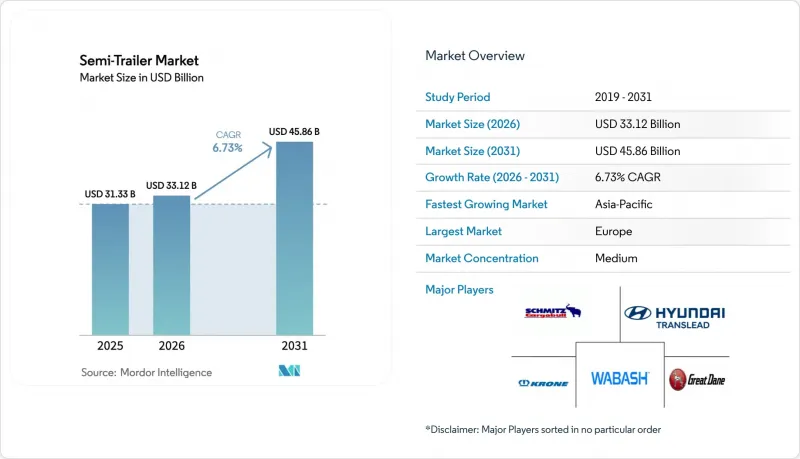
Mordor Intelligence에 따르면 세미 트레일러 시장 규모는 2025년 313억 3,000만 달러, 2026년 331억 2,000만 달러에서 2031년까지 458억 6,000만 달러로 확대될 것으로 예측되며, 2026년부터 2031년까지 연평균 성장률(CAGR)은 6.73%가 될 전망입니다.
본 보고서는 차종(플랫베드, 드라이밴, 기타), 적재 중량(25톤 미만, 25톤-50톤, 기타), 전장(28-45피트, 45피트 이상), 최종 이용 산업(운송·물류, 식음료, 기타), 지역별로 분류되어 있습니다. 시장 규모 및 전망은 금액(달러) 기준으로 제시되어 있습니다.
세계 세미 트레일러 시장 동향 및 인사이트
E-Commerce 화물의 급증
2025년, 물류 기업들은 소포 및 소량 화물(LTL) 처리량이 전년 대비 대폭 증가한 데 대응하여 드라이 밴과 커튼 사이더를 추가로 조달했습니다. 아마존은 자사 소유 트레일러를 추가하여 운송 능력을 강화하고, 수년에 걸친 상각 기간을 통해 마일당 운영 비용을 현저히 절감하는 데 성공했습니다. 미국 중서부에 위치한 월마트의 지역 풀필먼트 센터에서는 도크 처리 능력을 향상시키기 위해 롤업 도어가 장착된 45피트 이하 트레일러가 필요합니다. 도시 지역의 라스트 마일 배송 수요가 증가함에 따라, 대형 트레일러보다 통행 규제가 있는 도로를 더 유연하게 주행할 수 있는 28피트 이하 트레일러의 도입이 확대되고 있습니다. 미국 내 E-Commerce 매출의 소폭 증가는 연간 트레일러 운행 횟수의 대폭적인 증가로 이어져, 북미 OEM의 생산 일정을 압박하고 있습니다. 그 결과, 모듈식 인테리어 및 퀵 스왑식 액슬 키트를 제공하는 제조업체들은 상품 가격 변동이라는 과제 속에서도 가격 면에서 프리미엄을 확립하고 있습니다.
세계 콜드체인 물류의 확대
세계보건기구(WHO)의 2024년 지침에서는 생물학적 제제 및 백신 운송 시 지속적인 온도 모니터링을 의무화하고 있으며, 이러한 요건이 듀얼 증발기를 갖춘 멀티존 냉동 트레일러의 수요를 뒷받침하고 있습니다. Carrier Transicold의 전기식 유닛 ‘Vector eCool’은 2025년에 2세대 모델로 업데이트되어 디젤 발전기가 필요 없게 되었으며, 트레일러 1대당 연간 운영 비용을 대폭 절감하고 있습니다. 2025년, 미국의 멕시코 및 중미산 신선 농산물 수입이 증가하면서 국경을 넘는 냉장 트레일러 운송량이 확대됨에 따라 NAFTA 회원국 간 트레일러 사양의 표준화가 촉진되었습니다. 2030년까지 식품 폐기물을 50% 감축하는 것을 목표로 하는 유럽의 ‘팜-투-포크(Farm-to-Fork)’ 전략은 산소와 이산화탄소 농도를 조절할 수 있는 제어형 트레일러의 개발을 뒷받침하고 있습니다. 이러한 트레일러는 기존 냉장 트레일러보다 비용이 훨씬 더 많이 들지만, 운송업체들은 계약 운임 인상이나 보험 자기부담금 인하를 통해 그 추가 비용을 회수하고 있습니다.
높은 설비 투자와 금리 부담
2025년 하반기, 미국 연방준비제도이사회(FRB)가 2025년 12월 10일 정책금리 목표 범위를 3.5%-3.75%로 인하했음에도 불구하고, 미국의 기준금리는 여전히 높은 수준을 유지했습니다. 이 결정으로 인해 표준 53피트 드라이밴의월 리스 비용은 전년 대비 대폭 감소했습니다. 이에 따라 이미 이익률이 한계에 다다랐던 소규모 차량 운영사는 차량 교체 주기를 수년 동안 연장했습니다. 마찬가지로, 유럽중앙은행(ECB)의 병행 조치 역시 특히 고가인 냉동차 및 탱크로리 부문에서 유럽의 차량 운영사들에게 신중한 태도를 취하게 했습니다. 2025년 상반기에 리스 회사의 미결제 수주가 현저히 감소한 것은 차입 비용에 대한 민감도가 높음을 여실히 보여주었습니다. 신흥 시장에서는 정부 지원 대출 제도를 통해 그 영향을 완화했으나, 전 세계 OEM의 매출 전망은 여전히 금융 정책의 변동과 밀접하게 연동되어 있었습니다.
부문별 분석
2025년, 드라이밴은 세미 트레일러 시장 점유율의 40.85%를 차지하며, 소매, 소비재, 일반 화물 운송 노선에서 폭넓게 활용되고 있음을 반영합니다. 한편, 냉장 트레일러는 바이오의약품 유통 및 신선 식품 거래가 활성화됨에 따라 2031년까지 연평균 성장률(CAGR) 7.92%로 성장할 것으로 예측되며, 이 성장 속도는 다른 모든 유형을 능가할 것입니다. 플랫베드는 전 세계 인프라 계획과 연계된 건설 및 중장비 프로젝트로부터 주기적인 호재를 받고 있는 반면, 로우보이는 풍력 터빈 부품 등 초대형 화물용 틈새 솔루션에 그치고 있습니다. 탱커 수요는 특히 셰일 자원이 풍부한 북미에서 석유화학 및 벌크 액체 부문에 집중되어 있습니다. 대조적으로, 커튼사이드의 인기는 신속한 측면 적재를 중시하는 유럽에서 아시아의 대규모 E-Commerce 허브로 확산되고 있습니다.
캐리어 트랜시콜드(Carrier Transicold)는 2025년에 냉장 유닛 출하대수를 대폭 늘렸으며, 서비스 수준 계약(SLA)에 따라 부패를 최소화해야 하는 경우 콜드체인 차량 보유 사업자들이 고품질 하드웨어에 대한 투자를 주저하지 않는다는 사실이 입증되었습니다. 드라이밴의 가격 책정은 상품화(commoditization)로 인한 압박에 직면해 있으며, 각 OEM 업체들은 공기역학적 성능이 뛰어난 사이드 스커트, 보트 테일, 연비 효율이 뛰어난 타이어 등을 통해 차별화를 꾀하고 있습니다. 플랫베드 및 로우보이 제조사들은 현재 규제상 재인증 없이 확장 가능한 모듈식 데크 시스템을 판매하고 있으며, 이는 여러 관할 구역을 횡단하는 운송업체들에게 매력적인 선택지가 되고 있습니다. 아시아에서 커튼 사이더의 성장세는 측면 적재를 합법화한 일본의 개정 자동차법에 기인하며, 이로 인해 연간 수천 대 규모의 수요 증가가 예상됩니다. 탱커의 혁신 기술에는 스테인리스 라이닝과 화학제품에서 식품 등급으로의 역방향 운송을 가능하게 하는 다구획 쉘 등이 포함되어 있어 적재율 향상에 기여하고 있습니다.
25-50톤 부문은 2025년 세미 트레일러 시장 규모의 42.61%를 차지하며, 축중량 규제가 이 최적의 중량 범위에 수렴하는 중거리 운송 노선에서 선호되고 있습니다. 25톤 이하 트레일러는 가장 빠르게 성장하고 있으며, 도시 지역의 배송 규제 및 정체 요금을 회피할 수 있는 경량 알루미늄 프레임에 힘입어 연평균 성장률(CAGR)은 8.32%를 기록하고 있습니다. 51-100톤 구간은 호주와 캐나다의 광업 및 중공업 노선에 대응하는 반면, 100톤을 초과하는 플랫폼은 호송 차량이나 노선 허가가 필요한 특수 자산으로 남아 있습니다. 경량 설계를 통해 자중을 800-1,200kg 줄일 수 있으므로, 차축 하중 제한을 걱정하지 않고 적재량을 늘려 3-4%의 연료 절감을 실현합니다.
2026년에 시행될 유럽의 개정 ‘중량·치수 지침’에 따라 유로 VI 규격 트레일러의 적재량 상한이 1톤 상향 조정됨에 따라 알루미늄 채택이 가속화되고 있습니다. 슈미츠 카고불(Schmitz Cargobull)사는 2028년까지 매년 경량화 모델에 대한 수주가 서서히 증가할 것으로 예측하고 있습니다. 특히 유럽연합(EU) 역내의 중량급 톤수 대에서는 표준화된 부품이 활용되고 있어, 시간 엄수가 요구되는 노선을 운행하는 차량군의 유지보수 물류가 용이해집니다. 중량물 운송 부문에서는 인프라상의 제약에 직면해 있습니다. 남미의 많은 교량에서는 40톤의 중량 제한이 부과되어 있어, 적재량을 줄이거나 고액의 허가증을 취득할 수밖에 없습니다. 중량을 보다 고르게 분산시키는 3축 및 4축 레이아웃이 노면을 보호하고 규제 허용 범위를 최대한 활용하기 위해 보급되고 있습니다.
지역별 분석
아시아태평양은 내륙 지방과 중앙아시아를 연결하는 중국의 ‘일대일로’ 회랑과 인도의 ‘국가 물류 정책’에 힘입어 2025년 전 세계 매출의 35.87%를 차지했습니다. 이 지역에서는 백신 및 신선식품의 콜드체인 물류에 대한 수요가 증가하는 데 더해, 중국의 2선 도시와 동남아시아의 수출 거점에서의 인프라 정비가 진행되고 있습니다. 일본에서는 사이드 로딩식 커튼 사이더에 대한 법적 승인으로 인해 해당 지역의 연간 수요가 수천 대 규모로 증가할 것으로 예상됩니다. 호주의 철광석 부문에서는 수백만 톤에 달하는 광물 수송을 위해 대형 플랫베드 트럭의 구매가 이어지고 있으며, 동남아시아의 E-Commerce 성장에 따라 좁은 도심 도로에서도 기동성이 뛰어난 소형 28피트 밴이 선호되고 있습니다.
중동 및 아프리카에서는 항만 확장과 자유무역지대의 우대 조치가 국경 간 화물 운송을 촉진하여 7.42%라는 가장 높은 성장률을 기록할 것으로 예상됩니다. 두바이의 제벨 알리 항구 확장으로 2027년까지 500만 TEU의 처리 능력이 추가되는 한편, 사우디아라비아의 NEOM 허브에서는 특수 탱커 및 냉장 트레일러 도입이 진행되고 있습니다. 유럽으로의 가교 역할을 하는 튀르키예는 농산물 및 식품 수출에 힘입어 2025년에 냉장 트레일러 등록 대수가 대폭 증가했습니다. 남아프리카공화국의 철도 현대화는 인터모달 터미널과 연계된 컨테이너 섀시 수요를 촉진하여 고속도로 정체를 완화하는 동시에 물류 비용 절감에 기여하고 있습니다. 사하라 이남 회랑에서는 여전히 인프라 제약이 남아 있지만, 우대 금융 패키지와 민관 협력(PPP)을 통해 그 격차는 점차 줄어들고 있습니다.
북미에서는 차량 노후화에 따라 시장이 확대되고 있을 뿐만 아니라, 60피트 드라이밴 도입 검사 사업에 따른 정책적 지원도 받고 있습니다. 2027년에 시행될 EPA 3단계 트레일러 배기가스 규제에서는 공기역학적 스커트와 저회전저항 타이어의 장착이 의무화되어 구매 사양이 재정의되고 있습니다. 캐나다의 제로 배출 판매 의무화로 인해 전기 트랙터와 회생식 액슬 간의 호환성이 촉진되고 있습니다. 유럽 시장의 확대는 엄격한 중량·길이 제한과, 교체 주기를 장기화시키는 높은 금리로 인해 저해되고 있습니다. 남미 시장의 성장은 브라질의 국산 트레일러에 대한 ‘Rota 2030’ 세제 혜택과, 특수 탱커가 필요한 아르헨티나의 셰일 물류에 힘입어 뒷받침되고 있습니다.
기타 혜택
- 엑셀 형식의 시장 예측(ME) 시트
- 3개월간의 애널리스트 지원
목차
제1장 소개
제2장 조사 방법
제3장 주요 요약
제4장 시장 구도
제5장 시장 규모와 성장 예측
제6장 경쟁 구도
제7장 시장 기회와 향후 전망
KSMAccording to Mordor Intelligence, the semi-trailer market size is projected to expand from USD 31.33 billion in 2025 and USD 33.12 billion in 2026 to USD 45.86 billion by 2031, registering a CAGR of 6.73% between 2026 and 2031.
This report is Segmented by Vehicle Type (Flat Bed, Dry Van, and More), Tonnage (Below 25 Ton, 25 Ton - 50 Ton, and More), Foot Length (28-45 Ft and Above 45 Ft), End-Use Industry (Transportation and Logistics, Food and Beverage, and More) and Geography. The Market Sizes and Forecasts are Provided in Terms of Value (USD).
Global Semi-Trailer Market Trends and Insights
E-Commerce Freight Boom
In 2025, logistics firms responded to a significant year-over-year surge in parcel and less-than-truckload volumes by procuring more dry vans and curtain-siders. Amazon bolstered its capacity by adding proprietary trailers, achieving notable reductions in per-mile operating costs over a multi-year amortization. Walmart's regional fulfillment centers in the United States Midwest require sub-45-ft trailers with roll-up doors to enhance dock throughput. The push for urban last-mile delivery is driving the adoption of sub-28-ft trailers, which can navigate restricted streets more adeptly than their larger counterparts. A slight increase in the United States' e-commerce sales mix translates into a substantial rise in annual trailer trips, intensifying production schedules for North American OEMs. Consequently, manufacturers offering modular interiors and quick-swap axle kits command a pricing premium, even amidst commodity challenges.
Expansion of Global Cold-Chain Logistics
The World Health Organization's 2024 guidance requires continuous temperature monitoring for biologics and vaccine shipments, a mandate that drives demand for multi-zone reefer trailers equipped with dual evaporators. Carrier Transicold's Vector eCool electric unit, updated in 2025 with a second-generation model, eliminates diesel generators and reduces annual operating costs per trailer by a significant margin . The United States' imports of fresh produce from Mexico and Central America advanced in 2025, deepening cross-border reefer flows and supporting standardized trailer specifications between NAFTA partners. Europe's Farm-to-Fork strategy, which aims to reduce food waste by 50% by 2030, is driving the development of controlled-atmosphere trailers that can modulate oxygen and carbon dioxide levels . Although these units cost significantly more than legacy reefers, carriers recoup the premium through higher contractual rates and lower insurance deductibles.
High Capex and Interest-Rate Burden
In late 2025, U.S. benchmark rates remained elevated, though the Federal Reserve reduced the target range on December 10, 2025, to 3.5%-3.75%. This decision significantly reduced the monthly lease costs for standard 53-ft dry vans compared to previous years. In response, small fleets, already grappling with slim profit margins, extended their replacement cycles by a few years. Similarly, the European Central Bank's parallel actions made regional fleets cautious, particularly concerning reefer and tanker units with higher price points. A notable drop in leasing company order books in H1 2025 underscored their sensitivity to borrowing costs. While emerging markets mitigated the impact through state-backed loan schemes, global OEM revenue forecasts remained closely aligned with shifts in monetary policy.
Other drivers and restraints analyzed in the detailed report include:
- Trailer Telematics and Real-Time Visibility Adoption
- Infrastructure Stimulus in Emerging Economies
- Volatile Steel and Aluminum Prices
For complete list of drivers and restraints, kindly check the Table Of Contents.
Segment Analysis
Dry vans captured 40.85% of the semi-trailer market share in 2025, reflecting broad use across retail, consumer goods, and general freight routes. Refrigerated trailers, however, are projected to grow at a 7.92% CAGR by 2031, a pace that outpaces every other configuration as biologics distribution and the fresh-food trade intensify. Flatbeds gain cyclical boosts from construction and heavy-machinery projects tied to global infrastructure programs, while lowboys remain niche solutions for over-dimensional cargo such as wind-turbine components. Tanker demand is skewed toward the petrochemical and bulk liquid segments, especially in shale-rich North America. In contrast, curtain-sider popularity spreads from Europe into high-volume Asian e-commerce hubs that value rapid side loading.
Carrier Transicold shipped significantly more reefer units in 2025, confirming that cold-chain fleets are willing to invest in premium hardware when service-level agreements mandate minimal spoilage. Dry-van pricing faces pressure from commoditization, prompting OEMs to differentiate themselves through aerodynamic side skirts, boat tails, and fuel-saving tires. Flatbed and lowboy producers now market modular deck systems that scale without regulatory recertification, appealing to carriers that traverse multiple jurisdictions. Curtain-sider momentum in Asia follows Japan's revised vehicle act, which legalizes side loading and should add several thousand units annually. Tanker innovations include stainless-steel linings and multi-compartment shells that support chemical-to-food-grade backhauls, improving load factors.
The 25-to-50-ton segment accounted for 42.61% of the semi-trailer market size in 2025, favored for mid-haul corridors where axle-weight rules converge on this optimal weight range. Trailers under 25 tons are expanding fastest, with an 8.32% CAGR driven by urban delivery mandates and lightweight aluminum frames that avoid congestion pricing. The 51-to-100-ton bracket serves mining and heavy-industry corridors in Australia and Canada, while platforms exceeding 100 tons remain specialized assets that require escort vehicles and route permits. Lightweight designs shave 800-1,200 kg from tare, allowing additional cargo with no axle penalty and yielding 3-4% fuel savings.
Europe's revised Weights and Dimensions Directive, effective in 2026, grants an additional one-ton payload allowance for Euro VI trailers, accelerating the adoption of aluminum. Schmitz Cargobull projects incremental lightweight orders annually through 2028, predominantly in the European Union-mid-range tonnage benefits from standardized parts, which ease maintenance logistics for fleets operating on time-critical lanes. Heavy-haul segments face infrastructure restrictions; many South American bridges impose 40-ton weight limits, forcing partial loads or costly permits. Tri-axle and quad-axle layouts that disperse weight more evenly are gaining traction to protect pavement integrity and unlock regulatory tolerance.
Complete Report Scope:
- By Vehicle Type
- Flatbed
- Dry Van
- Refrigerated (Reefer)
- Lowboy
- Tanker
- Curtain-Sider
- Other Types
- By Tonnage
- Below 25 Ton
- 25 Ton - 50 Ton
- 51 Ton - 100 Ton
- Above 100 Ton
- By Foot Length
- 28 - 45 ft
- Above 45 ft
- By End-Use Industry
- Transportation and Logistics
- Food and Beverage
- Construction nd Mining
- Agriculture
- Manufacturing and Industrial Goods
- Retail and E-commerce
- By Geography
- North America
- United States
- Canada
- Rest of North America
- South America
- Brazil
- Argentina
- Rest of South America
- Europe
- Germany
- United Kingdom
- France
- Italy
- Spain
- Russia
- Rest of Europe
- Asia-Pacific
- China
- India
- Japan
- South Korea
- Australia
- Rest of Asia-Pacific
- Middle East and Africa
- Turkey
- Saudi Arabia
- United Arab Emirates
- South Africa
- Rest of Middle East and Africa
- North America
Geography Analysis
Asia-Pacific accounted for 35.87% of 2025 global revenue, underpinned by China's Belt and Road corridors connecting inland provinces to Central Asia and by India's National Logistics Policy. The region reflects heightened demand for cold-chain logistics of vaccines and perishables, as well as infrastructure upgrades in second-tier Chinese cities and Southeast Asian export zones. Japan's legal approval of side-loading curtain-siders is expected to lift annual regional demand by several thousand units. Australia's iron-ore sector continues to purchase heavy-duty flatbeds for millions of tons of mining output, and Southeast Asian e-commerce growth favors compact 28-ft vans maneuverable on narrow urban roads.
The Middle East and Africa are expected to register the fastest growth at 7.42%, driven by port expansions and free-zone incentives, which stimulate cross-border freight. Dubai's Jebel Ali extension added 5 million TEU capacity by 2027, while Saudi Arabia's NEOM hub invites specialized tanker and reefer fleets. Turkey's role as a bridge into Europe drove a substantial rise in refrigerated-trailer registrations in 2025, fueled by agro-food exports. South Africa's rail modernization promotes container-chassis demand that integrates with intermodal terminals, trimming highway congestion and cutting logistics costs. Infrastructure limitations persist in sub-Saharan corridors, yet concessional finance packages and public-private partnerships are gradually narrowing the gap.
North America is growing due to fleet maturity, but it also receives policy boosts from 60-ft dry-van pilots. EPA Phase 3 trailer emissions rules, effective 2027, oblige aerodynamic skirts and low-rolling-resistance tires, reshaping purchase specs. Canada's zero-emission sales mandates foster compatibility with regenerative axles in electric tractors. Europe's expansion is hampered by strict weight-length limits and elevated interest rates that stretch replacement horizons. South America's rise is supported by Brazil's Rota 2030 tax relief for domestic trailers and by Argentina's shale logistics, which require specialized tankers.
- Wabash National Corporation
- Great Dane LLC
- Hyundai Translead
- Utility Trailer Manufacturing Company
- Schmitz Cargobull AG
- Krone GmbH & Co. KG
- China International Marine Containers Co., Ltd.
- Manac Inc.
- MAC Trailer Manufacturing Inc.
- East Manufacturing Corporation
- Stoughton Trailers LLC
- Vanguard National Trailer Corp.
- Kogel Trailer GmbH
- Wielton S.A.
- Fontaine Trailer Co.
- Pitts Trailers
- Premier Trailer Mfg. Inc.
- Kassbohrer Fahrzeugwerke
- Schwarzmuller Gruppe
Additional Benefits:
- The market estimate (ME) sheet in Excel format
- 3 months of analyst support
TABLE OF CONTENTS
1 Introduction
- 1.1 Study Assumptions & Market Definition
- 1.2 Scope of the Study
2 Research Methodology
3 Executive Summary
4 Market Landscape
- 4.1 Market Overview
- 4.2 Market Drivers
- 4.2.1 E-commerce freight boom
- 4.2.2 Expansion of global cold-chain logistics
- 4.2.3 Adoption of 60-ft dry-van rules in North America
- 4.2.4 Electrified regenerative-axle trailers cut TCO
- 4.2.5 Trailer telematics & real-time visibility adoption
- 4.2.6 Infrastructure stimulus in emerging economies
- 4.3 Market Restraints
- 4.3.1 High capex & interest-rate burden
- 4.3.2 Volatile steel & aluminum prices
- 4.3.3 EU weight/length regulatory limits
- 4.3.4 Sparse charging infra for electric TRUs & e-axles
- 4.4 Value/Supply-Chain Analysis
- 4.5 Regulatory Landscape
- 4.6 Technological Outlook
- 4.7 Porter's Five Forces
- 4.7.1 Bargaining Power of Buyers
- 4.7.2 Bargaining Power of Suppliers
- 4.7.3 Threat of New Entrants
- 4.7.4 Threat of Substitutes
- 4.7.5 Competitive Rivalry
5 Market Size & Growth Forecasts (Value (USD))
- 5.1 By Vehicle Type
- 5.1.1 Flatbed
- 5.1.2 Dry Van
- 5.1.3 Refrigerated (Reefer)
- 5.1.4 Lowboy
- 5.1.5 Tanker
- 5.1.6 Curtain-Sider
- 5.1.7 Other Types
- 5.2 By Tonnage
- 5.2.1 Below 25 Ton
- 5.2.2 25 Ton - 50 Ton
- 5.2.3 51 Ton - 100 Ton
- 5.2.4 Above 100 Ton
- 5.3 By Foot Length
- 5.3.1 28 - 45 ft
- 5.3.2 Above 45 ft
- 5.4 By End-Use Industry
- 5.4.1 Transportation and Logistics
- 5.4.2 Food and Beverage
- 5.4.3 Construction nd Mining
- 5.4.4 Agriculture
- 5.4.5 Manufacturing and Industrial Goods
- 5.4.6 Retail and E-commerce
- 5.5 By Geography
- 5.5.1 North America
- 5.5.1.1 United States
- 5.5.1.2 Canada
- 5.5.1.3 Rest of North America
- 5.5.2 South America
- 5.5.2.1 Brazil
- 5.5.2.2 Argentina
- 5.5.2.3 Rest of South America
- 5.5.3 Europe
- 5.5.3.1 Germany
- 5.5.3.2 United Kingdom
- 5.5.3.3 France
- 5.5.3.4 Italy
- 5.5.3.5 Spain
- 5.5.3.6 Russia
- 5.5.3.7 Rest of Europe
- 5.5.4 Asia-Pacific
- 5.5.4.1 China
- 5.5.4.2 India
- 5.5.4.3 Japan
- 5.5.4.4 South Korea
- 5.5.4.5 Australia
- 5.5.4.6 Rest of Asia-Pacific
- 5.5.5 Middle East and Africa
- 5.5.5.1 Turkey
- 5.5.5.2 Saudi Arabia
- 5.5.5.3 United Arab Emirates
- 5.5.5.4 South Africa
- 5.5.5.5 Rest of Middle East and Africa
- 5.5.1 North America
6 Competitive Landscape
- 6.1 Market Concentration
- 6.2 Strategic Moves
- 6.3 Market Share Analysis
- 6.4 Company Profiles (Includes Global level Overview, Market Level Overview, Core Segments, Financials as Available, Strategic Information, Market Rank/Share for Key Companies, Products & Services, and Recent Developments)
- 6.4.1 Wabash National Corporation
- 6.4.2 Great Dane LLC
- 6.4.3 Hyundai Translead
- 6.4.4 Utility Trailer Manufacturing Company
- 6.4.5 Schmitz Cargobull AG
- 6.4.6 Krone GmbH & Co. KG
- 6.4.7 China International Marine Containers Co., Ltd.
- 6.4.8 Manac Inc.
- 6.4.9 MAC Trailer Manufacturing Inc.
- 6.4.10 East Manufacturing Corporation
- 6.4.11 Stoughton Trailers LLC
- 6.4.12 Vanguard National Trailer Corp.
- 6.4.13 Kogel Trailer GmbH
- 6.4.14 Wielton S.A.
- 6.4.15 Fontaine Trailer Co.
- 6.4.16 Pitts Trailers
- 6.4.17 Premier Trailer Mfg. Inc.
- 6.4.18 Kassbohrer Fahrzeugwerke
- 6.4.19 Schwarzmuller Gruppe
7 Market Opportunities & Future Outlook
- 7.1 White-space & Unmet-Need Assessment