
|
시장보고서
상품코드
2086831
데이터센터용 배터리 시장 : UPS별(100kWh 미만, 100-500kWh, 500kWh-1MWh, 1MWh 이상), BESS별(1MWh 미만, 1-30MWh, 30MWh 이상), 배터리 유형별(리튬이온, 납축, 나트륨 이온, 플로우 배터리), 데이터센터별(엔터프라이즈, 하이퍼스케일, 코로케이션) - 세계 예측(-2032년)Data Center Battery Market by UPS (<100 kWh, 100-500 kWh, 500 kWh-1 MWh, >1 MWh), BESS (<1 MWh, 1-30 MWh, >30 MWh), Battery Type (Li-ion, Lead-acid, Sodium-ion, Flow Battery), Data Center (Enterprise, Hyperscale, Colocation) - Global Forecast to 2032 |
||||||

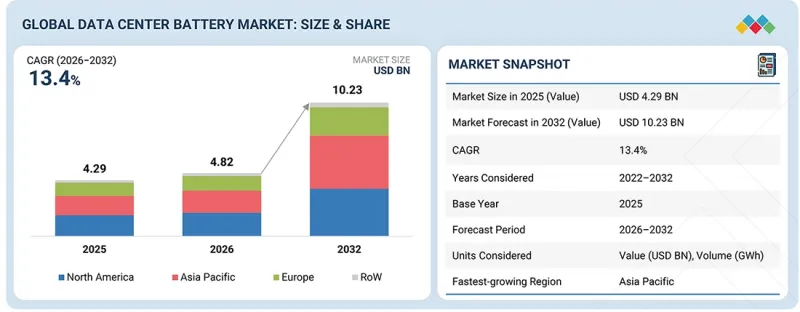
세계의 데이터센터용 배터리 시장 규모는 2026년 48억 2,000만 달러에서 2032년에는 102억 3,000만 달러로 성장하여 2026년부터 2032년까지 기간의 CAGR은 13.4%에 달할 것으로 예측됩니다.
이 시장의 성장은 엔터프라이즈, 코로케이션, 하이퍼스케일 데이터센터 분야에서 신뢰성이 높은 백업 전원 및 에너지 저장 솔루션에 대한 수요가 증가하고 있는 데 힘입고 있습니다.
| 조사 범위 | |
|---|---|
| 조사 대상 기간 | 2021-2032년 |
| 기준 연도 | 2025년 |
| 예측 기간 | 2026-2032년 |
| 단위 | 금액(달러) |
| 부문 | 배터리 유형, 데이터센터, 지역별 |
| 대상 지역 | 북미, 유럽, 아시아태평양, 기타 지역 |
데이터센터 사업자들이 AI, 클라우드 컴퓨팅, 고성능 컴퓨팅(HPC) 워크로드를 처리하기 위해 용량을 확대함에 따라, 첨단 배터리 기술에 대한 투자가 크게 증가하고 있습니다. 배터리는 현대 디지털 인프라 전반에 걸쳐 운영 중단 방지, 전력 품질 관리 지원, 에너지 복원력 강화에 있어 매우 중요한 역할을 수행하고 있습니다. 배터리 에너지 저장 시스템의 도입 확대, 운영 지속성에 대한 관심 증가, 에너지 효율이 높은 전력 아키텍처의 채택 증가가 전 세계 데이터센터 생태계 전반의 수요를 더욱 부추기고 있습니다.
"첨단 납축배터리가 예측 기간 동안 큰 시장 점유율을 차지할 것으로 보입니다."
첨단 납축배터리는 백업 전원 용도로의 확고한 도입 실적과 기업 시설 및 코로케이션 시설에서의 광범위한 도입 실적을 바탕으로, 2026년부터 2032년까지 상당한 시장 점유율을 차지할 것으로 전망됩니다. 이러한 배터리는 입증된 신뢰성, 낮은 초기 비용, 성숙한 공급망, 그리고 미션 크리티컬 환경에서의 뛰어난 성능 덕분에 UPS 시스템에서 계속해서 널리 사용되고 있습니다. 데이터센터 운영 사업자들은 신뢰성이 높고 단시간 동안 전원을 공급할 수 있는 백업 전원과 예측 가능한 가동 성능이 요구되는 분야에서 첨단 납축배터리 기술을 지속적으로 도입하고 있습니다. 배터리 설계, 수명 주기 성능, 유지보수 요건에 대한 지속적인 개선이 그 도입을 더욱 촉진하고 있습니다. 기존 전력 인프라와의 호환성 및 기존 시설에서의 광범위한 보급으로 인해, 첨단 납축배터리는 예측 기간 동안 시장 수익의 주요 기여 요인이 될 것으로 전망됩니다.
"콜로케이션 데이터센터는 예측 기간 동안 상당한 연평균 성장률(CAGR)을 기록할 것으로 전망됩니다."
콜로케이션 데이터센터 부문은 IT 인프라 기업의 아웃소싱 확대와 통신사 중립적이며 확장성이 뛰어난 데이터센터 시설에 대한 수요 증가를 배경으로, 예측 기간 동안 상당한 연평균 성장률(CAGR)을 달성할 것으로 전망됩니다. 기업들은 설비 투자를 줄이면서도 첨단 전력, 냉각 및 연결 인프라에 대한 접근성을 확보하기 위해 코로케이션 서비스 도입을 점점 더 확대하고 있습니다. 콜로케이션 사업자들은 클라우드 제공업체, AI, 워크로드, 기업 고객을 지원하기 위해 시설의 수용 능력을 확대하고 고밀도 환경을 구축하고 있습니다. 이러한 확대로 인해, 까다로운 가동 시간 요건을 충족할 수 있는 UPS 배터리 및 배터리 에너지 저장 시스템에 대한 수요가 크게 증가하고 있습니다. 하이퍼스케일 코로케이션 캠퍼스에 대한 투자 확대와 더불어, 에너지 효율 및 운영 복원력에 대한 중요성이 부각됨에 따라 코로케이션 생태계 전반에 걸쳐 배터리 도입이 더욱 확대될 것으로 예상됩니다.
"북미는 예측 기간 동안 데이터센터용 배터리 시장에서 높은 연평균 성장률(CAGR)을 기록할 것으로 전망됩니다."
북미에서는 하이퍼스케일 인프라, AI 데이터센터, 클라우드 컴퓨팅 시설에 대한 대규모 투자의 뒷받침을 받아, 예측 기간 동안 강력한 성장을 이룰 것으로 전망됩니다. 이 지역에는 세계 최대 규모의 데이터센터 시장이 여러 곳 존재하며, 하이퍼스케일 사업자, 코로케이션 제공업체, 기업 조직으로부터 계속해서 막대한 투자를 유치하고 있습니다. 고밀도 컴퓨팅 환경의 도입 확대는 전력 공급의 신뢰성과 운영의 연속성을 확보하는 첨단 배터리 기술에 대한 수요를 이끌고 있습니다. 또한, 배터리 에너지 저장 시스템의 보급 확대, 재생에너지 통합을 위한 노력, 에너지 복원력이 뛰어난 인프라에 대한 투자가 데이터센터 시설 전반에 걸친 배터리 도입을 가속화하고 있습니다. 디지털 인프라의 지속적인 확대와 기존 시설의 현대화를 통해 북미는 세계 시장에서 주요 성장 지역으로서의 입지를 확고히 하고 있습니다.
본 보고서에서는 전 세계 데이터센터용 배터리 시장을 조사하여, 시장 개요, 시장 성장에 영향을 미치는 다양한 요인에 대한 분석, 기술 및 특허 동향, 법규제 환경, 사례 연구, 시장 규모 추정 및 전망, 각종 분류·지역/주요 국가별 상세 분석, 경쟁 현황, 주요 기업 개요 등을 정리하고 있습니다.
자주 묻는 질문
목차
제1장 소개
제2장 주요 요약
제3장 주요 인사이트
제4장 시장 개요
제5장 업계 동향
제6장 기술의 진보, AI의 영향, 특허, 혁신
제7장 고객 상황과 구매 행동
제8장 규제 상황
제9장 BESS의 주요 입력 에너지원과 관련된 최신 동향
제10장 데이터센터 전력 인프라에서 UPS와 BESS의 역할
제11장 데이터센터용 배터리 시장 : 시스템 유형별
제12장 데이터센터용 배터리 시장 : 배터리 유형별
제13장 데이터센터용 배터리 시장 : 데이터센터 유형별
제14장 데이터센터용 배터리 시장 : 용도별
제15장 데이터센터용 배터리 시장 : 기업 유형별
제16장 데이터센터용 배터리 시장 : 지역별
제17장 경쟁 구도
제18장 기업 개요
제19장 조사 방법
제20장 부록
KSM 26.07.20The global data center battery market is projected to grow from USD 4.82 billion in 2026 to USD 10.23 billion by 2032, at a CAGR of 13.4% over the 2026-2032 period. Market growth is supported by the increasing need for reliable backup power and energy storage solutions across enterprise, colocation, and hyperscale data centers.
| Scope of the Report | |
|---|---|
| Years Considered for the Study | 2021-2032 |
| Base Year | 2025 |
| Forecast Period | 2026-2032 |
| Units Considered | Value (USD Billion) |
| Segments | By Battery Type, Data Center and Region |
| Regions covered | North America, Europe, APAC, RoW |
As data center operators expand capacity to support artificial intelligence, cloud computing, and high-performance computing workloads, investments in advanced battery technologies are increasing significantly. Batteries play a critical role in ensuring uninterrupted operations, supporting power quality management, and enhancing energy resilience across modern digital infrastructure. The growing deployment of battery energy storage systems, increasing focus on operational continuity, and rising adoption of energy-efficient power architectures are further reinforcing demand across the global data center ecosystem.
" Advanced Lead Acid Batteries to Hold a Significant Share of the Data Center Battery Market During the Forecast Period."
Advanced lead acid batteries are projected to account for a significant share of the data center battery market from 2026 to 2032, supported by their established deployment in backup power applications and an extensive installed base in enterprise and colocation facilities. These batteries remain widely used in UPS systems for their proven reliability, lower upfront costs, mature supply chain, and strong performance in mission-critical environments. Data center operators continue to deploy advanced lead acid technologies for applications requiring dependable, short-duration backup power and predictable operating performance. Ongoing improvements in battery design, lifecycle performance, and maintenance requirements further support adoption. Their compatibility with existing power infrastructure and widespread acceptance across legacy facilities position advanced lead acid batteries as a major contributor to market revenues throughout the forecast period.
"Colocation Data Centers to Register a Significant CAGR in the Data Center Battery Market During the Forecast Period."
The colocation data center segment is expected to achieve a significant CAGR over the forecast period, driven by growing enterprise outsourcing of IT infrastructure and rising demand for carrier-neutral, scalable data center facilities. Organizations are increasingly adopting colocation services to reduce capital expenditures while gaining access to advanced power, cooling, and connectivity infrastructure. Colocation operators are expanding facility capacity and deploying higher-density environments to accommodate cloud providers, artificial intelligence workloads, and enterprise customers. This expansion is generating substantial demand for UPS batteries and battery energy storage systems that can support stringent uptime requirements. Growing investments in hyperscale colocation campuses, coupled with increasing emphasis on energy efficiency and operational resilience, are expected to strengthen battery deployments across the colocation ecosystem.
"North America is Expected to Register a Significant CAGR in the Data Center Battery Market During the Forecast Period."
North America is expected to see strong growth in the data center battery market throughout the forecast period, supported by large-scale investments in hyperscale infrastructure, artificial intelligence data centers, and cloud computing facilities. The region hosts some of the world's largest data center markets and continues to attract significant investments from hyperscale operators, colocation providers, and enterprise organizations. The growing deployment of high-density computing environments is driving demand for advanced battery technologies that ensure power reliability and operational continuity. In addition, the growing adoption of battery energy storage systems, renewable energy integration initiatives, and investments in energy-resilient infrastructure are accelerating battery deployments across data center facilities. The continuous expansion of digital infrastructure and the modernization of existing facilities position North America as a key growth region within the global market.
Breakdown of primaries
For this study, a variety of executives from key organizations operating in the data center battery market were interviewed in-depth, including CEOs, marketing directors, and innovation and technology directors.
- By Company Type: Tier 1 - 40%, Tier 2 - 35%, and Tier 3 - 25%
- By Designation: C-level Executives - 48%, Directors - 33%, and Others - 19%
- By Region: North America - 35%, Europe - 18%, Asia Pacific - 40%, and RoW - 7%
Note: Other designations include product, sales, and marketing managers.
Three tiers of companies have been defined based on their total revenue as of 2025: tier 3: revenue less than USD 500 million; tier 2: revenue between USD 500 million and USD 5 billion; and tier 1: revenue more than USD 5 billion.
RoW mainly includes South America, Africa, and the Middle East.
Major players operating in the data center battery market include Contemporary Amperex Technology Co., Limited (China), LG Energy Solution (South Korea), Samsung SDI (South Korea), Tesla (US), Panasonic Holdings Corporation (Japan), BYD Company Ltd. (China), GS Yuasa Corporation (Japan), EnerSys (US), EVE Energy Co., Ltd. (China), Toshiba Corporation (Japan), Sunwoda Electronic Co., Ltd. (China), Gotion (China), Leoch International Technology Limited Inc. (Singapore), Exide Industries Limited (India), East Penn Manufacturing Company (US), Saft (France), Zhejiang Narada Power Source Co., Ltd. (China), Shuangdeng Group Co., Ltd. (China), Ipower Batteries (India), ZincFive (US), C&D Technologies, Inc. (US), Xiamen Hithium Energy Storage Technology (China), ESS Tech, Inc. (US), REPT BATTERO Energy Co., Ltd. (China), Ritar International Group (China), CSB Energy Technology Co., Ltd. (Taiwan), and HOPPECKE Batterien GmbH & Co. KG (Germany). These companies offer a broad portfolio of UPS batteries, battery energy storage systems, and advanced power solutions for enterprise, colocation, and hyperscale data center applications. Market participants compete on technological innovation, product reliability, energy density, lifecycle performance, manufacturing scale, and strategic partnerships with data center operators and infrastructure providers. The study provides a detailed competitive analysis of these key players, including company profiles, recent developments, and key market strategies.
The study provides a detailed competitive analysis of these key players in the data center battery market, presenting their company profiles, recent developments, and key market strategies.
Research Coverage
The data center battery market is segmented by system type, battery type, data center type, application, enterprise vertical, and region. The system type segment includes uninterruptible power supply (UPS) and battery energy storage systems (BESS), while the battery type segment comprises lithium-ion batteries, advanced lead-acid batteries, and other battery technologies. By data center type, the market covers enterprise, hyperscale, and colocation data centers. Applications analyzed include backup power, peak shaving and load shifting, renewable energy integration, and demand response and ancillary services. Regionally, the market is segmented into North America, Europe, Asia Pacific, and RoW.
Reasons to buy the report
The report will help market leaders and new entrants by providing the closest available revenue estimates for the overall data center battery market and its subsegments. It will help stakeholders understand the competitive landscape and gain additional insights to position their businesses better and plan suitable go-to-market strategies. The report also helps stakeholders assess the prospects of the market and provides insights into key drivers, restraints, challenges, and opportunities.
Key Benefits of Buying the Report
- Analysis of key drivers (expansion of hyperscale, colocation, and AI-focused data centers, Increasing demand for uninterrupted power supply and energy resilience, growing adoption of battery energy storage systems, and increasing focus on energy resilience and renewable energy integration), restraints (high initial deployment costs, battery replacement expenses, thermal management requirements, and supply chain volatility for critical battery materials), opportunities (Growing adoption of battery energy storage systems (BESS) in data centers, increasing integration of renewable energy and grid interactive power infrastructure,expansion of AI-driven data center infrastructure, increasing deployment of grid-interactive data centers, growth in renewable-powered facilities, and rising adoption of long-duration energy storage solutions), and challenges (supply chain volatility for critical battery materials, integration of advanced battery systems with existing power infrastructure, battery safety concerns, lifecycle management complexities, space constraints in existing facilities, and integration of advanced battery systems with legacy power infrastructure) influencing the growth of the data center battery market.
- Product Development/Innovation: Detailed insights on upcoming technologies, research & development activities, and product launches in the data center battery market
- Market Development: Comprehensive information about lucrative markets - the report analyzes the data center battery market across varied regions
- Market Diversification: Exhaustive information about new products/services, untapped geographies, recent developments, and investments in the data center battery market
- Competitive Assessment: In-depth assessment of market share, growth strategies, product portfolios, and service offerings of leading players such as Contemporary Amperex Technology Co., Limited (China), LG Energy Solution (South Korea), Samsung SDI (South Korea), Tesla (US), and Panasonic Holdings Corporation (Japan). The report provides detailed insights into their competitive positioning, strategic developments, product innovations, and growth initiatives across the global data center battery market.
TABLE OF CONTENTS
1 INTRODUCTION
- 1.1 STUDY OBJECTIVES
- 1.2 MARKET DEFINITION
- 1.3 MARKET SCOPE
- 1.3.1 MARKET SEGMENTATION AND REGIONAL SCOPE
- 1.3.2 YEARS CONSIDERED
- 1.3.3 INCLUSIONS AND EXCLUSIONS
- 1.4 CURRENCY CONSIDERED
- 1.4.1 UNIT CONSIDERED
- 1.5 LIMITATIONS
- 1.6 STAKEHOLDERS
2 EXECUTIVE SUMMARY
- 2.1 MARKET HIGHLIGHTS AND KEY INSIGHTS
- 2.2 KEY MARKET PARTICIPANTS: MAPPING OF STRATEGIC DEVELOPMENTS
- 2.3 DISRUPTIVE TRENDS IN DATA CENTER BATTERY MARKET
- 2.4 HIGH-GROWTH SEGMENTS
- 2.5 REGIONAL SNAPSHOT: MARKET SIZE, GROWTH RATE, AND FORECAST
3 PREMIUM INSIGHTS
- 3.1 ATTRACTIVE OPPORTUNITIES FOR PLAYERS OPERATING IN DATA CENTER BATTERY MARKET
- 3.2 DATA CENTER BATTERY MARKET, BY SYSTEM TYPE
- 3.3 DATA CENTER BATTERY MARKET, BY BATTERY TYPE
- 3.4 DATA CENTER BATTERY MARKET, BY DATA CENTER TYPE
- 3.5 DATA CENTER BATTERY MARKET, BY ENTERPRISE VERTICAL
- 3.6 DATA CENTER BATTERY MARKET, BY COUNTRY
4 MARKET OVERVIEW
- 4.1 INTRODUCTION
- 4.2 MARKET DYNAMICS
- 4.2.1 DRIVERS
- 4.2.1.1 Rising Investments in AI-driven Hyperscale Data Center Infrastructure
- 4.2.1.2 Transition Toward Lithium-ion Batteries in Mission-critical Applications
- 4.2.1.3 Increasing Adoption of BESS for Energy Optimization and Grid Support
- 4.2.1.4 Growing Need for High Availability and Business Continuity
- 4.2.1.5 Sustainability Initiatives Driving Next-generation Battery Deployment
- 4.2.2 RESTRAINTS
- 4.2.2.1 High Initial Capital Investment Limits Battery Modernization Initiatives
- 4.2.2.2 Supply Chain Volatility for Critical Battery Raw Materials
- 4.2.3 OPPORTUNITIES
- 4.2.3.1 Emergence of Hybrid UPS-BESS Architectures Enables Smarter Power Infrastructure
- 4.2.3.2 Renewable Energy Integration Expands Demand for Battery Storage Solutions
- 4.2.3.3 Emergence of Alternative Battery Chemistries Broadens Market Potential
- 4.2.3.4 AI-enabled Battery Monitoring Improves Lifecycle Performance
- 4.2.4 CHALLENGES
- 4.2.4.1 Integrating Battery Systems with Existing Power Infrastructure
- 4.2.4.2 Balancing Reliability, Sustainability, and Lifecycle Economics
- 4.2.1 DRIVERS
- 4.3 INTERCONNECTED MARKETS AND CROSS-SECTOR OPPORTUNITIES
- 4.4 STRATEGIC MOVES BY TIER-1/2/3 PLAYERS
5 INDUSTRY TRENDS
- 5.1 INTRODUCTION
- 5.2 MACROECONOMIC INDICATORS
- 5.2.1 INTRODUCTION
- 5.2.2 GDP TRENDS AND FORECAST
- 5.2.3 TRENDS IN GLOBAL CLOUD AND HYPERSCALE DATA CENTER INDUSTRY
- 5.2.4 TRENDS IN GLOBAL COLOCATION DATA CENTER INDUSTRY
- 5.3 VALUE CHAIN ANALYSIS
- 5.4 ECOSYSTEM ANALYSIS
- 5.5 PRICING ANALYSIS
- 5.5.1 PRICING RANGE OF LITHIUM-ION BATTERY PACKS, BY KEY PLAYER, 2025
- 5.5.2 AVERAGE SELLING PRICE TREND OF UPS-GRADE BATTERY PACKS, 2022-2025
- 5.5.3 AVERAGE SELLING PRICE TREND OF UPS-GRADE BATTERY PACKS, BY REGION, 2022-2025
- 5.6 TRADE ANALYSIS
- 5.6.1 IMPORT SCENARIO (850650)
- 5.6.2 EXPORT SCENARIO (850650)
- 5.7 TRENDS/DISRUPTIONS IMPACTING CUSTOMER BUSINESS
- 5.8 INVESTMENT AND FUNDING SCENARIO, 2021-2025
- 5.9 PORTER'S FIVE FORCES ANALYSIS
- 5.9.1 THREAT OF NEW ENTRANTS
- 5.9.2 THREAT OF SUBSTITUTES
- 5.9.3 BARGAINING POWER OF SUPPLIERS
- 5.9.4 BARGAINING POWER OF BUYERS
- 5.9.5 INTENSITY OF COMPETITIVE RIVALRY
- 5.10 CASE STUDY ANALYSIS
- 5.10.1 ENERSYS DATASAFE XE BATTERIES IMPROVE ENERGY EFFICIENCY AND SPACE UTILIZATION IN MILAN DATA CENTER
- 5.10.2 SAFT ENABLES DIESEL-FREE BACKUP POWER WITH BESS DEPLOYMENT AT MICROSOFT DATA CENTER IN SWEDEN
- 5.10.3 ALIGNED DATA CENTERS AND CALIBRANT ENERGY DEPLOY BESS TO ACCELERATE GRID INTERCONNECTION FOR AI DATA CENTERS
- 5.11 KEY CONFERENCES AND EVENTS, 2026-2027
- 5.12 IMPACT OF 2025 US TARIFF - OVERVIEW
- 5.12.1 INTRODUCTION
- 5.12.2 KEY TARIFF RATES
- 5.12.3 PRICE IMPACT ANALYSIS
- 5.12.4 IMPACT ON COUNTRIES/REGIONS
- 5.12.4.1 US
- 5.12.4.2 Europe
- 5.12.4.3 Asia Pacific
- 5.12.5 IMPACT ON INDUSTRIES
6 TECHNOLOGICAL ADVANCEMENTS, AI-DRIVEN IMPACT, PATENTS, AND INNOVATIONS
- 6.1 KEY TECHNOLOGIES
- 6.1.1 ADVANCED LITHIUM-ION CHEMISTRIES
- 6.1.2 MODULAR & RACK-SCALE BATTERY ARCHITECTURE
- 6.1.3 COMPLEMENTARY TECHNOLOGIES
- 6.1.3.1 Advanced Battery Management Systems (BMS)
- 6.1.3.2 Energy Management Systems (EMS)
- 6.2 TECHNOLOGY ROADMAP
- 6.3 PATENT ANALYSIS
- 6.4 IMPACT OF AI ON DATA CENTER BATTERY MARKET
- 6.4.1 TOP USE CASES AND MARKET POTENTIAL
- 6.4.2 BEST PRACTICES IN DATA CENTER BATTERY MARKET
- 6.4.3 CASE STUDIES OF AI IMPLEMENTATION IN DATA CENTER BATTERY MARKET
- 6.4.4 INTERCONNECTED ADJACENT ECOSYSTEM AND IMPACT ON MARKET PLAYERS
- 6.4.5 CLIENTS' READINESS TO ADOPT AI IN DATA CENTER BATTERY MARKET
7 CUSTOMER LANDSCAPE & BUYER BEHAVIOR
- 7.1 DECISION-MAKING PROCESS
- 7.2 KEY STAKEHOLDERS AND BUYING CRITERIA
- 7.2.1 KEY STAKEHOLDERS IN BUYING PROCESS
- 7.2.2 BUYING CRITERIA
- 7.3 ADOPTION BARRIERS & INTERNAL CHALLENGES
- 7.4 UNMET NEEDS FROM VARIOUS VERTICALS
8 REGULATORY LANDSCAPE
- 8.1 REGULATORY LANDSCAPE
- 8.1.1 REGULATORY BODIES, GOVERNMENT AGENCIES, AND OTHER ORGANIZATIONS
- 8.1.2 INDUSTRY STANDARDS
9 MAJOR INPUT ENERGY SOURCES AND RECENT TRENDS RELATED TO BESS
- 9.1 INTRODUCTION
- 9.2 TYPES OF BESS
- 9.2.1 FRONT-OF-THE-METER (FTM) SYSTEMS
- 9.2.2 BEHIND-THE-METER (BTM) SYSTEMS
- 9.3 COMPARATIVE ANALYSIS OF BATTERY TECHNOLOGIES
- 9.4 COMPARATIVE ANALYSIS OF ENERGY STORAGE SYSTEMS
10 ROLE OF UPS AND BESS IN DATA CENTER POWER INFRASTRUCTURE
- 10.1 INTRODUCTION
- 10.2 ROLE OF UPS SYSTEMS IN DATA CENTERS
- 10.2.1 ENSURING INSTANTANEOUS POWER CONTINUITY FOR MISSION-CRITICAL DATA CENTER OPERATIONS
- 10.3 ROLE OF BATTERY ENERGY STORAGE SYSTEMS (BESS) IN DATA CENTERS
- 10.3.1 ENABLING LONG-DURATION ENERGY FLEXIBILITY AND INTELLIGENT POWER MANAGEMENT
- 10.4 FUNCTIONAL DIFFERENCES BETWEEN UPS AND BESS
- 10.5 HYBRID UPS-BESS ARCHITECTURES
- 10.5.1 INTEGRATED ENERGY STORAGE ARCHITECTURES STRENGTHEN FUTURE DATA CENTER POWER SYSTEMS
11 DATA CENTER BATTERY MARKET, BY SYSTEM TYPE
- 11.1 INTRODUCTION
- 11.2 UNINTERRUPTIBLE POWER SUPPLY (UPS)
- 11.2.1 INCREASING CRITICAL POWER REQUIREMENTS ACCELERATE ADOPTION OF ADVANCED UPS BATTERIES
- 11.2.2 BY BATTERY CAPACITY
- 11.2.2.1 < 100 KWH
- 11.2.2.2 100 KWH - 500 KWH
- 11.2.2.3 500 KWH - 1 MWH
- 11.2.2.4 > 1 MWH
- 11.3 BATTERY ENERGY STORAGE SYSTEM (BESS)
- 11.3.1 GROWING ENERGY OPTIMIZATION INITIATIVES STRENGTHEN DATA CENTER BESS DEPLOYMENT
- 11.3.2 BY BATTERY CAPACITY
- 11.3.2.1 < 1 MWH
- 11.3.2.2 1 MWH - 30 MWH
- 11.3.2.3 > 30 MWH
12 DATA CENTER BATTERY MARKET, BY BATTERY TYPE
- 12.1 INTRODUCTION
- 12.2 LITHIUM-ION BATTERY
- 12.2.1 INCREASING HIGH-DENSITY DATA CENTERS ACCELERATE LITHIUM-ION BATTERY ADOPTION
- 12.3 LEAD-ACID BATTERY
- 12.3.1 PROVEN RELIABILITY CONTINUES SUPPORTING LEAD ACID BATTERY DEPLOYMENTS IN UPS SYSTEMS
- 12.4 OTHERS
- 12.4.1 EMERGING BATTERY CHEMISTRIES EXPAND FUTURE TECHNOLOGY OPTIONS FOR DATA CENTERS
13 DATA CENTER BATTERY MARKET, BY DATA CENTER TYPE
- 13.1 INTRODUCTION
- 13.2 ENTERPRISE DATA CENTERS
- 13.2.1 BUSINESS-CRITICAL OPERATIONS CONTINUE DRIVING RELIABLE BATTERY INFRASTRUCTURE INVESTMENTS
- 13.3 CLOUD & HYPERSCALE DATA CENTERS
- 13.3.1 LARGE-SCALE DIGITAL INFRASTRUCTURE ACCELERATES ADVANCED BATTERY SYSTEM DEPLOYMENT
- 13.4 COLOCATION DATA CENTERS
- 13.4.1 MULTI-TENANT SERVICE REQUIREMENTS STRENGTHEN INVESTMENT IN RELIABLE BATTERY INFRASTRUCTURE
14 DATA CENTER BATTERY MARKET, BY APPLICATION
- 14.1 INTRODUCTION
- 14.2 BACKUP POWER
- 14.2.1 ENSURING CONTINUOUS OPERATIONS REMAINS PRIMARY BATTERY DEPLOYMENT OBJECTIVE
- 14.2.2 SHORT BACKUP
- 14.2.2.1 UPS Battery Deployments Ensure Immediate Protection Against Power Interruptions
- 14.2.3 EXTENDED BACKUP POWER
- 14.2.3.1 Longer Duration Energy Storage Expands Extended Backup Power Capabilities
- 14.3 PEAK SHAVING & LOAD SHIFTING
- 14.3.1 GROWING ENERGY COST PRESSURES ACCELERATE BESS DEPLOYMENT FOR LOAD OPTIMIZATION
- 14.4 RENEWABLE ENERGY INTEGRATION
- 14.4.1 GROWING CLEAN ENERGY ADOPTION STRENGTHENS BATTERY INTEGRATION ACROSS DATA CENTERS
- 14.5 DEMAND RESPONSE & ANCILLARY SERVICES
- 14.5.1 GRID SERVICE PARTICIPATION CREATES ADDITIONAL COMMERCIAL VALUE FOR BATTERY ASSETS
15 DATA CENTER BATTERY MARKET, BY ENTERPRISE VERTICAL
- 15.1 INTRODUCTION
- 15.2 BFSI
- 15.2.1 EXPANDING DIGITAL BANKING INFRASTRUCTURE STRENGTHENS HIGH-RELIABILITY BATTERY DEPLOYMENT
- 15.3 HEALTHCARE & LIFE SCIENCES
- 15.3.1 EXPANDING DIGITAL HEALTHCARE SYSTEMS INCREASES DEMAND FOR RELIABLE BATTERY SOLUTIONS
- 15.4 MANUFACTURING
- 15.4.1 INDUSTRIAL DIGITALIZATION SUPPORTS INCREASING ADOPTION OF ADVANCED BATTERY TECHNOLOGIES
- 15.5 E-COMMERCE & RETAIL
- 15.5.1 GROWING ONLINE RETAIL OPERATIONS INCREASE DATA CENTER INFRASTRUCTURE INVESTMENTS
- 15.6 MEDIA & ENTERTAINMENT
- 15.6.1 GROWING DIGITAL CONTENT CONSUMPTION DRIVES MEDIA DATA CENTER EXPANSION
- 15.7 IT & TELECOMMUNICATIONS
- 15.7.1 RISING ENTERPRISE IT SERVICES EXPAND DATA CENTER INFRASTRUCTURE
- 15.8 GOVERNMENT & PUBLIC SECTOR
- 15.8.1 PUBLIC SECTOR DIGITAL INITIATIVES DRIVE DATA CENTER MODERNIZATION
- 15.9 OTHER ENTERPRISE VERTICALS
- 15.9.1 INCREASING ENTERPRISE DATA CENTER INVESTMENTS EXPAND BATTERY DEPLOYMENT OPPORTUNITIES
16 DATA CENTER BATTERY MARKET, BY REGION
- 16.1 INTRODUCTION
- 16.2 NORTH AMERICA
- 16.2.1 US
- 16.2.1.1 Growing AI Infrastructure Continues Expanding Advanced Battery Deployments
- 16.2.2 CANADA
- 16.2.2.1 Sustainable Data Center Growth Supports Increased Battery Infrastructure Investments
- 16.2.3 MEXICO
- 16.2.3.1 Expanding Digital Infrastructure Creates Strong Battery Deployment Opportunities
- 16.2.1 US
- 16.3 EUROPE
- 16.3.1 GERMANY
- 16.3.1.1 Digital Economy Expansion Drives Reliable Data Center Battery Infrastructure
- 16.3.2 UK
- 16.3.2.1 Expanding Colocation Capacity Accelerates Advanced Battery Solution Adoption
- 16.3.3 FRANCE
- 16.3.3.1 Cloud Infrastructure Expansion Strengthens Demand For Reliable Battery Systems
- 16.3.4 NETHERLANDS
- 16.3.4.1 Expanding Colocation Capacity Strengthens Demand For Advanced Battery Systems
- 16.3.5 SPAIN
- 16.3.5.1 Strategic Data Center Investments Expand Battery Deployment Across Facilities
- 16.3.6 ITALY
- 16.3.6.1 Enterprise Digital Transformation Increases Adoption Of Modern Battery Solutions
- 16.3.7 REST OF EUROPE
- 16.3.7.1 Growing Regional Digital Infrastructure Expands Demand For Reliable Battery Solutions
- 16.3.1 GERMANY
- 16.4 ASIA PACIFIC
- 16.4.1 CHINA
- 16.4.1.1 Expanding AI Computing Capacity Drives Large-scale Battery Deployment
- 16.4.2 JAPAN
- 16.4.2.1 Modernizing Digital Infrastructure Encourages Advanced Battery Technology Adoption
- 16.4.3 SOUTH KOREA
- 16.4.3.1 Growing Cloud Investments Increase Demand For Reliable Battery Infrastructure
- 16.4.4 INDIA
- 16.4.4.1 Rapid Data Center Expansion Strengthens Demand For Advanced Battery Solutions
- 16.4.5 AUSTRALIA
- 16.4.5.1 Rising Hyperscale Investments Strengthen Demand For Reliable Battery Infrastructure
- 16.4.6 REST OF ASIA PACIFIC
- 16.4.6.1 Expanding Regional Cloud Infrastructure Strengthens Demand For Battery Solutions
- 16.4.1 CHINA
- 16.5 ROW
- 16.5.1 SOUTH AMERICA
- 16.5.1.1 Growing Cloud Investments Expand Demand For Reliable Battery Infrastructure
- 16.5.2 MIDDLE EAST
- 16.5.2.1 National Digital Transformation Accelerates Advanced Battery Infrastructure Deployment
- 16.5.3 AFRICA
- 16.5.3.1 Expanding Digital Connectivity Strengthens Demand For Data Center Batteries
- 16.5.1 SOUTH AMERICA
17 COMPETITIVE LANDSCAPE
- 17.1 INTRODUCTION
- 17.2 KEY PLAYER STRATEGIES/RIGHT TO WIN, 2022-2025
- 17.3 REVENUE ANALYSIS, 2021-2025
- 17.4 MARKET SHARE ANALYSIS, 2025
- 17.5 COMPANY VALUATION AND FINANCIAL METRICS, 2024
- 17.6 BRAND/PRODUCT COMPARISON
- 17.7 COMPANY EVALUATION MATRIX: KEY PLAYERS, 2025
- 17.7.1 STARS
- 17.7.2 EMERGING LEADERS
- 17.7.3 PERVASIVE PLAYERS
- 17.7.4 PARTICIPANTS
- 17.7.5 COMPANY FOOTPRINT: KEY PLAYERS, 2025
- 17.7.5.1 Company footprint
- 17.7.5.2 Region footprint
- 17.7.5.3 System type footprint
- 17.7.5.4 Battery type footprint
- 17.8 COMPANY EVALUATION MATRIX: STARTUPS/SMES, 2025
- 17.8.1 PROGRESSIVE COMPANIES
- 17.8.2 RESPONSIVE COMPANIES
- 17.8.3 DYNAMIC COMPANIES
- 17.8.4 STARTING BLOCKS
- 17.8.5 COMPETITIVE BENCHMARKING: STARTUPS/SMES, 2023
- 17.8.5.1 Detailed list of key startups/SMEs
- 17.8.5.2 Competitive benchmarking of key startups/SMEs
- 17.9 COMPETITIVE SCENARIO
- 17.9.1 PRODUCT LAUNCHES
- 17.9.2 DEALS
- 17.9.3 EXPANSIONS
18 COMPANY PROFILES
- 18.1 KEY PLAYERS
- 18.1.1 CONTEMPORARY AMPEREX TECHNOLOGY CO., LIMITED
- 18.1.1.1 Business overview
- 18.1.1.2 Products/Solutions/Services offered
- 18.1.1.3 Recent developments
- 18.1.1.3.1 Product launches
- 18.1.1.4 MnM view
- 18.1.1.4.1 Key strengths/Right to win
- 18.1.1.4.2 Strategic choices
- 18.1.1.4.3 Weaknesses and competitive threats
- 18.1.2 LG ENERGY SOLUTION
- 18.1.2.1 Business overview
- 18.1.2.2 Products/Solutions/Services offered
- 18.1.2.3 Recent developments
- 18.1.2.3.1 Product launches
- 18.1.3 MNM VIEW
- 18.1.3.1 Key strengths/Right to win
- 18.1.3.2 Strategic choices
- 18.1.3.3 Weaknesses and competitive threats
- 18.1.4 SAMSUNG SDI
- 18.1.4.1 Business overview
- 18.1.4.2 Products/Solutions/Services offered
- 18.1.4.3 Recent developments
- 18.1.4.3.1 Expansions
- 18.1.4.4 MnM view
- 18.1.4.4.1 Key strengths/Right to win
- 18.1.4.4.2 Strategic choices
- 18.1.4.4.3 Weaknesses and competitive threats
- 18.1.5 TESLA
- 18.1.5.1 Business overview
- 18.1.5.2 Products/Solutions/Services offered
- 18.1.5.3 MnM view
- 18.1.5.3.1 Key strengths/Right to win
- 18.1.5.3.2 Strategic choices
- 18.1.5.3.3 Weaknesses and competitive threats
- 18.1.6 PANASONIC HOLDINGS CORPORATION
- 18.1.6.1 Business overview
- 18.1.6.2 Products/Solutions/Services offered
- 18.1.6.3 Recent developments
- 18.1.6.3.1 Expansions
- 18.1.6.4 MnM view
- 18.1.6.4.1 Key strengths/Right to win
- 18.1.6.4.2 Strategic choices
- 18.1.6.4.3 Weaknesses and competitive threats
- 18.1.7 SHUANGDENG GROUP C0,LTD
- 18.1.7.1 Business overview
- 18.1.7.2 Products/Solutions/Services offered
- 18.1.8 BYD COMPANY LTD.
- 18.1.8.1 Business overview
- 18.1.8.2 Products/Solutions/Services offered
- 18.1.9 GS YUASA CORPORATION
- 18.1.9.1 Business overview
- 18.1.9.2 Products/Solutions/Services offered
- 18.1.10 ENERSYS
- 18.1.10.1 Business overview
- 18.1.10.2 Products/Solutions/Services offered
- 18.1.10.3 Recent developments
- 18.1.10.3.1 Product launches
- 18.1.11 EVE ENERGY CO., LTD.
- 18.1.11.1 Business overview
- 18.1.11.2 Products/Solutions/Services offered
- 18.1.12 TOSHIBA CORPORATION
- 18.1.12.1 Business overview
- 18.1.13 TOSHIBA CORPORATION
- 18.1.13.1 Products/Solutions/Services offered
- 18.1.13.2 Recent developments
- 18.1.13.2.1 Expansions
- 18.1.14 SUNWODA ELECTRONIC CO., LTD.
- 18.1.14.1 Business overview
- 18.1.14.2 Products/Solutions/Services offered
- 18.1.14.2.1 Deals
- 18.1.15 GOTION, INC.
- 18.1.15.1 Business overview
- 18.1.15.2 Products/Solutions/Services offered
- 18.1.16 LEOCH INTERNATIONAL TECHNOLOGY LIMITED INC
- 18.1.16.1 Business overview
- 18.1.16.2 Products/Solutions/Services offered
- 18.1.16.3 Recent developments
- 18.1.16.3.1 Deals
- 18.1.1 CONTEMPORARY AMPEREX TECHNOLOGY CO., LIMITED
- 18.2 OTHER KEY PLAYERS
- 18.2.1 EXIDE INDUSTRIES LIMITED
- 18.2.2 EAST PENN MANUFACTURING COMPANY
- 18.2.3 SAFT
- 18.2.4 ZHEJIANG NARADA POWER SOURCE CO., LTD.
- 18.2.5 XIAMEN HITHIUM ENERGY STORAGE TECHNOLOGY
- 18.3 OTHER PLAYERS
- 18.3.1 ZINCFIVE
- 18.3.2 C&D TECHNOLOGIES, INC.
- 18.3.3 ESS TECH, INC.
- 18.3.4 REPT BATTERO ENERGY CO., LTD.
- 18.3.5 RITAR INTERNATIONAL GROUP
- 18.3.6 CSB ENERGY TECHNOLOGY CO., LTD.
- 18.3.7 HOPPECKE BATTERIEN GMBH & CO. KG
- 18.3.8 IPOWER
19 RESEARCH METHODOLOGY
- 19.1 RESEARCH DATA
- 19.1.1 SECONDARY AND PRIMARY RESEARCH
- 19.1.2 SECONDARY DATA
- 19.1.2.1 List of major secondary sources
- 19.1.2.2 Key data from secondary sources
- 19.1.3 PRIMARY DATA
- 19.1.3.1 Breakdown of primaries
- 19.1.3.2 Key data from primary sources
- 19.1.3.3 Key primary participants
- 19.1.3.4 Key industry insights
- 19.2 MARKET SIZE ESTIMATION
- 19.2.1 BOTTOM-UP APPROACH
- 19.2.2 TOP-DOWN APPROACH
- 19.2.3 MARKET SIZE CALCULATION FOR BASE YEAR
- 19.3 MARKET FORECAST APPROACH
- 19.3.1 SUPPLY SIDE
- 19.3.2 DEMAND SIDE
- 19.4 DATA TRIANGULATION
- 19.5 RESEARCH ASSUMPTIONS
- 19.6 RESEARCH LIMITATIONS
- 19.7 RISK ASSESSMENT
20 APPENDIX
- 20.1 DISCUSSION GUIDE
- 20.2 KNOWLEDGESTORE: MARKETSANDMARKETS' SUBSCRIPTION PORTAL
- 20.3 CUSTOMIZATION OPTIONS
- 20.4 RELATED REPORTS
- 20.5 AUTHOR DETAILS


