

|
시장보고서
상품코드
2119255
인산철리튬 배터리 소재 : 시장 점유율 분석, 업계 동향 및 통계, 성장 예측(2026-2031년)Lithium Iron Phosphate (LFP) Battery Materials - Market Share Analysis, Industry Trends & Statistics, Growth Forecasts (2026 - 2031) |
||||||
 Mordor Intelligence
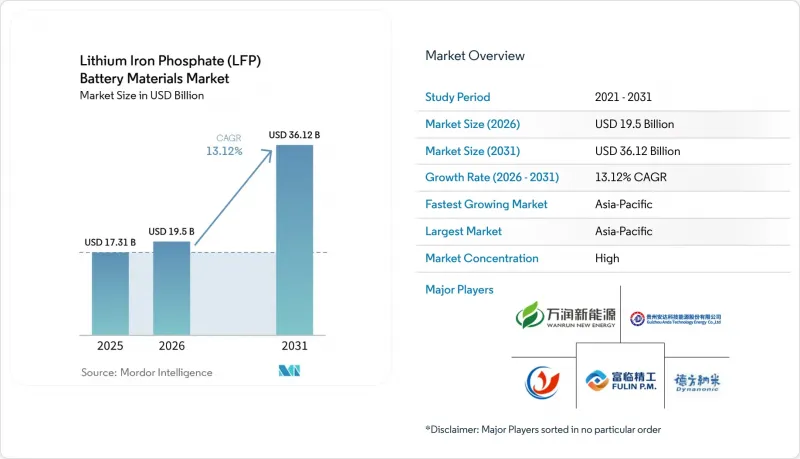
Mordor Intelligence에 의하면, 인산철리튬 배터리 소재 시장 규모는 2025년에 173억 1,000만 달러로 평가되었습니다. 2026년 195억 달러에서 2031년까지 361억 2,000만 달러로 확대되고 2026년부터 2031년까지 연평균 복합 성장률(CAGR)은 13.12%를 나타낼 전망입니다.
본 보고서는 소재 유형(LFP 양극재 등), 셀 형태(원통형 셀 등), 용도(배터리 에너지 저장 시스템 등), 지역(아시아태평양, 북미, 유럽, 남미, 중동 및 아프리카)별로 분류되어 있습니다. 시장 전망은 금액(미 달러) 기준으로 제시되어 있습니다.
세계의 인산철리튬 배터리 소재 시장 동향 및 인사이트
전기차(EV) 및 가정용 에너지 저장 시스템에의 적용
전기차(EV)와 가정용 에너지 저장 시스템은 인산철리튬 배터리 소재 시장의 두 가지 주요 수요원입니다. LFP는 전 세계 전기차용 배터리 수요의 거의 절반을 공급하고 있으며, 2020년 10% 미만에서 증가세를 보였습니다. 이는 표준 주행 거리 차량 및 가정용 에너지 저장 시스템에서 LFP의 용도가 확대된 것을 반영한 것입니다. 이 화학 조성은 열적 안정성과 3,000회 이상의 충방전 사이클 수명을 갖추고 있어, 서로 다른 운영 요건을 가진 운송용 및 가정용 용도 모두를 지원합니다. 이를 통해 제조업체는 공통의 소재 플랫폼을 바탕으로 서로 다른 충전 패턴을 가진 용도에 대응할 수 있게 됩니다.
이러한 조합을 통해 모빌리티, 계통 안정화, 백업 전원 등의 분야에서 LFP 배터리 소재 수요 기반이 확대됩니다. 제조업체는 자동차 프로그램에 대한 의존도와 고정형 시스템에서 수요 간 균형을 맞출 수 있습니다. 이는 고정형 시스템의 경우, 구매 결정이 자동차의 주행 거리가 아니라 장기적인 운영 요건에 의해 좌우되는 경우가 많기 때문입니다. 그 결과 발생하는 수요 구조는 경기 순환의 영향을 완전히 배제하는 것은 아니지만, 소재 시장에 여러 가지 실질적인 성장 경로를 가져다줍니다. 또한, 자동차 및 에너지 저장 시스템에 대한 투자 동향이 소재 구매에 영향을 미칠 가능성은 있으나, 두 고객층 모두 자금 조달 조건, 정책 지원 및 신뢰성 높은 생산 능력 확보에 민감하기 때문에 단일 최종 용도 주기에 대한 의존도를 낮출 수 있습니다.
저비용 및 코발트 무함유 화학 조성
코발트와 니켈을 사용하지 않는다는 점은 LFP 화학 조성에 있어 여전히 비용 및 조달 측면에서 핵심적인 이점으로 남아 있습니다. 철과 인산염은 니켈·망간·코발트 계열 화학 조성에서 사용되는 금속보다 입수하기 쉬운 원료입니다. 이러한 조성 덕분에 여러 금속 공급망에 대한 의존도나 코발트 조달에 수반되는 엄격한 감시의 위험이 완화됩니다. 이는 완성된 셀의 기술적 특성과 함께 원자재의 확보 가능성을 평가하는 구매자에게 중요한 고려 사항입니다. 자동차 제조업체나 에너지 저장 시스템 개발자가 보다 단순한 원자재 조달을 원할 경우, LFP 배터리 소재 시장은 혜택을 받게 됩니다.
재료 비용의 변동은 탄산리튬이나 인산염의 가격에 크게 좌우되기 때문에 이러한 화학 조성이라 하더라도 가격 리스크가 완전히 배제되는 것은 아닙니다. 특히, 투입 원자재 가격이 급등하더라도 가격 조정을 즉시 수행할 수 없는 양극재 가공업체의 경우 더욱 그렇습니다. 그러나 동시에 관리해야 할 금속 원자재의 수가 줄어들기 때문에 하류 구매자에게 있어 LFP 배터리 소재 시장에서의 장기 계약을 단순화하는 것이 가능합니다.
프리미엄 모빌리티에서의 낮은 질량 에너지 밀도
표준 LFP 셀은 셀 수준에서 160-170 Wh/kg의 에너지 밀도를 실현하지만, 이에 비해 니켈을 많이 함유한 니켈·망간·코발트(NMC) 계열 대체품은 250-280 Wh/kg을 실현하고 있습니다. 이러한 차이로 인해 장거리 주행이 요구되는 승용차나, kW시당 중량이 중요한 설계 요소가 되는 용도에서의 채택이 제한되고 있습니다. 이는 에너지 밀도가 낮은 셀의 경우, 동일한 차량 주행 거리를 달성하기 위해 더 많은 적재 공간이나 추가적인 셀 질량이 필요할 수 있기 때문입니다. 따라서 유럽 및 북미의 프리미엄 차량에서는 고사양 모델을 위해 NMC의 사용이 계속되고 있습니다. LMFP는 망간을 치환함으로써 에너지 밀도를 200 Wh/kg까지 높일 수 있으므로, 이 과제에 대한 해결책이 될 수 있습니다. 그러나 LMFP는 표준 LFP에 비해 12-17% 비용이 높기 때문에 보급 확대가 더딘 실정입니다. 고전압 소재인 LMFP는 확립된 인산염계 화학 조성을 포기하지 않으면서 성능을 향상시키는 실용적인 수단을 제공하지만, LMFP가 보다 경쟁력 있는 비용 수준에 도달하기 전까지는 LFP 배터리 소재 시장의 고급차 분야 진출 기회는 제한된 상태로 남아 있을 것입니다.
부문 분석
2025년에는 LFP 양극재가 53.82%라는 가장 큰 매출 점유율을 차지했습니다. LFP 셀 1기가와트시 생산 당 1,600-1,800톤의 LFP 양극 분말이 필요하기 때문에 양극 재료 수요는 자동차 및 에너지 저장용 셀 생산량 증가와 밀접하게 연결되어 있습니다. LFP 도입이 증가할 때마다, 그 수요는 다른 하류 소비 카테고리를 거치지 않고 직접 분말 수요로 이어집니다. 전해질 소재는 자동차용 및 고정형 에너지 저장용 셀의 생산이 동시에 확대되고 있으며, 셀 내 전하 이동을 가능하게 하는 데 필수적인 역할을 하고 있기 때문에 매출 점유율에서 2위를 차지했습니다. 분리막, 바인더, 전도성 첨가제 및 집전체는 나머지 소재 범주를 구성합니다. 이러한 제품들은 셀 생산량 증가에 따라 성장하지만, 그 이익률은 양극재나 전해액 재료에 비해 낮은 경향이 있고 표준화도 진행되고 있기 때문에 매출에 대한 기여도는 고부가가치 화학 사양에 대한 의존도가 낮으며, 전체 셀 생산량과 더 밀접하게 연결되어 있습니다.
음극재 시장은 2031년까지 연평균 성장률(CAGR) 14.42%를 나타낼 것으로 예측되며, 이는 재료 유형 중 가장 높은 성장률입니다. LFP 배터리 소재 시장은 실리콘-탄소 복합 제품 및 고압축 인공 흑연에 대한 수요의 수혜를 받고 있습니다. 이러한 소재들은 더 높은 에너지 밀도와 더 빠른 충전 성능을 목표로 하는 5세대 셀을 뒷받침하고 있으며, 셀 제조업체들이 충전 특성 개선과 팩 이용 효율 향상을 추구하는 가운데, 고압축 설계를 통해 음극의 품질이 더욱 중요시되고 있습니다. BTR New Energy Materials(BTR)는 2026년 3월 초고속 충전용 흑연 음극 시리즈 ‘T-Max’ 및 ‘T-Pro 6C’를 발표했습니다.
지역별 분석
아시아태평양은 2025년 전 세계 매출의 46.63%를 차지했으며, 2031년까지 연평균 성장률(CAGR) 14.07%를 나타낼 것으로 예측됩니다. 이러한 위상은 소재 생산, 셀 제조 및 전기차 수요가 지역적으로 통합되어 있음을 반영하며, 소재 공급업체들은 확립된 업스트림 및 중류 생산 네트워크의 혜택을 누리면서 대규모 국내 고객에게 서비스를 제공할 수 있게 되었습니다. 양극재 및 음극재 생산에서 중국의 역할은 아시아태평양 LFP 배터리 소재 시장의 기반이 되고 있으며, 중국은 2025년에 375만 톤의 LFP 소재를 생산했습니다. 인도, 일본, 한국 및 아세안(ASEAN) 국가들은 추가적인 수요 거점으로 부상하고 있으며, 이러한 역할은 각국의 배터리 제조 계획, 자동차 수요 및 더 광범위한 지역 공급망과의 연계에 의해 형성되고 있습니다. 인도의 제조 계획과 한국 배터리 제조업체들의 인증 획득 활동은 지역 공급업체와 북미 및 유럽의 고객을 연결하여, 아시아태평양의 역할을 국내 수요에 그치지 않고 해외 공장 공급망까지 확대하는 조달 네트워크를 구축하고 있습니다.
북미와 유럽을 합치면 전 세계 매출의 약 3분의 1을 차지했습니다. 미국의 프로젝트 파이프라인은 급속히 확대되고 있지만, 2025년 시점에서 국내 생산 능력은 양극 활물질 수요의 47%, 음극 활물질 수요의 23%만을 충당하고 있었습니다. 이러한 격차로 인해 프로젝트 발표가 증가하더라도 예측 기간의 대부분 동안 수입에 대한 의존이 지속될 가능성이 높습니다. 왜냐하면 기존 수입품을 대체하기 위해서는 새로운 소재 생산 능력을 구축하고, 인증을 획득하며, 신뢰성이 높은 업스트림 원자재를 공급해야 하기 때문입니다. LG에너지솔루션은 2027년부터 미시간주 랜싱에서 테슬라사에 ‘메가팩 3’용 각형 LFP 배터리를 공급하는 계약을 체결했습니다. 유럽에서는 배터리 관련 규제 요건이 강화됨에 따라, 현지 공급망에 관한 문서가 갖춰진 소재의 채택이 중요시되고 있으며, 이는 직접 자재비 측면에서는 당초 수입품이 더 경쟁력 있어 보일지라도 조달 결정에 영향을 미칠 가능성이 있습니다. 따라서 LFP 배터리 소재 시장은 셀 비용뿐만 아니라 지역별 규정 준수 계획에서도 더욱 중요한 위치를 차지하게 되었습니다.
남미, 중동 및 아프리카는 여전히 매출 기여도가 낮은 상태입니다. 아르헨티나와 칠레는 LFP 합성에 사용되는 탄산리튬공급원으로서, 리튬 염수 생산국으로 중요한 위치를 차지하고 있습니다. 브라질은 특히 배터리와 결합된 재생에너지 시스템 분야에서 에너지 저장 설비의 도입 거점으로 부상하고 있습니다. 모로코는 통합형 배터리 제조 역량 구축을 목표로 하고 있는 반면, 사우디아라비아는 ‘비전 2030’을 통해 하류 제조 분야에 자금을 지원하고 있습니다. 이 지역들은 예측 기간 동안 세계 시장 점유율 구도를 바꾸지는 않을 것으로 보이지만, 특히 현지에서의 셀 제조 및 재생에너지 저장 시스템 개발이 진전되고 지역 내 소재 소비 기반이 더욱 명확해짐에 따라, 기존 아시아 생산자들의 현지화 투자를 뒷받침할 미래 수요 거점이 될 가능성이 있습니다.
기타 혜택 :
- 엑셀 형식 시장 예측(ME) 시트
- 3개월간의 애널리스트 지원
자주 묻는 질문
목차
제1장 서론
제2장 조사 방법
제3장 주요 요약
제4장 시장 구도
제5장 시장 규모 및 성장 예측
제6장 경쟁 구도
제7장 시장 기회 및 향후 전망
KTH 26.09.10According to Mordor Intelligence, the lithium iron phosphate (LFP) battery materials market size was estimated at USD 17.31 billion in 2025 and is estimated to grow from USD 19.50 billion in 2026 to USD 36.12 billion by 2031, at a CAGR of 13.12% during the forecast period (2026-2031).
This report is Segmented by Material Type (LFP Cathode Materials and More), Cell Format (Cylindrical Cells, and More), Application (Battery Energy Storage Systems and More), and Geography (Asia-Pacific, North America, Europe, South America, and Middle-East and Africa). The Market Forecasts are Provided in Terms of Value (USD).
Global Lithium Iron Phosphate (LFP) Battery Materials Market Trends and Insights
EV and Stationary Storage Adoption
Electric vehicles and stationary storage represent the two main demand channels for the lithium iron phosphate (LFP) battery materials market. LFP supplied close to half of global electric-car battery demand, up from less than 10% in 2020, reflecting its wider use in standard-range vehicles and storage systems. The chemistry offers thermal stability and a cycle life exceeding 3,000 charge-discharge events, supporting both transport and stationary applications with different operating needs. This allows producers to serve applications with distinct charging patterns from a common material platform.
This combination broadens the demand base for LFP battery materials across mobility, grid balancing, and backup power. Producers can balance exposure to vehicle programs with demand from stationary systems, where purchasing decisions are often shaped by long-duration operating requirements rather than vehicle range. The resulting mix does not eliminate cyclicality, but it provides the materials base with more than one substantial route to growth. It also reduces reliance on a single end-use cycle, even though vehicle and storage investment patterns can influence material purchasing, as both customer groups remain sensitive to financing conditions, policy support, and the availability of reliable manufacturing capacity.
Lower Cost and Cobalt-Free Chemistry
The absence of cobalt and nickel remains a central cost and sourcing advantage for LFP chemistry. Iron and phosphate are more widely available feedstocks than the metals used in nickel-manganese-cobalt chemistries. This composition reduces exposure to several metal supply chains and the scrutiny associated with cobalt sourcing, a consideration for buyers that assess raw-material availability alongside the technical properties of the finished cell. The LFP battery materials market benefits when automakers and storage developers seek simpler raw-material procurement.
Material cost movements depend strongly on lithium carbonate and phosphate prices, so the chemistry does not eliminate price risk, particularly for cathode processors whose pricing arrangements may not adjust immediately when inputs become more expensive. It can, however, simplify long-term contracting in the LFP battery materials market for downstream buyers, as fewer metal inputs must be managed simultaneously.
Lower Gravimetric Energy Density in Premium Mobility
Standard LFP cells deliver 160-170 Wh/kg at the cell level, compared with 250-280 Wh/kg for nickel-rich Nickel Manganese Cobalt (NMC) alternatives. This difference limits use in long-range passenger vehicles and in applications where weight per kilowatt-hour is a critical design factor, as a lower-energy-density cell may require more pack space or additional cell mass to achieve the same vehicle range. Premium European and North American vehicle programs have therefore continued to use NMC for high-specification models. LMFP offers a possible response, as manganese substitution can increase energy density to 200 Wh/kg. However, LMFP carries a 12-17% cost premium over standard LFP, which delays wider adoption. The LFP battery materials market will remain less exposed to premium mobility until LMFP reaches more competitive cost levels, even as the higher-voltage material provides a practical route to improve performance without abandoning the established phosphate-based chemistry.
Other drivers and restraints analyzed in the detailed report include:
- Cell-to-Pack and High-Compaction Design Gains
- Regional Battery Supply-Chain Localization
- Lithium Chemical Price and Margin Volatility
For complete list of drivers and restraints, kindly check the Table Of Contents.
Segment Analysis
LFP cathode materials held the largest revenue share at 53.82% in 2025. Each gigawatt-hour of LFP cell production requires 1,600-1,800 tons of LFP cathode powder, keeping cathode material demand closely tied to growth in vehicle and storage cell output. Each increase in LFP deployment translates directly into powder demand, rather than flowing through a separate downstream consumption category. Electrolyte materials accounted for the second-largest revenue share, supported by simultaneous expansion in vehicle and stationary storage cell production and by their essential role in enabling charge transfer within the cell. Separators, binders, conductive additives, and current collectors comprised the remaining materials category. These products grow with cell output, although their margins are often lower and more standardized than those of cathode or electrolyte materials, making their revenue contribution less dependent on premium chemistry specifications and more closely tied to overall cell production output.
Anode materials are forecast to grow at a 14.42% CAGR through 2031, the highest rate among material types. The LFP battery materials market for anodes benefits from demand for silicon-carbon composite products and high-compaction artificial graphite. These materials support fifth-generation cells that target higher energy density and faster charging performance, while higher-compaction designs increase the value of anode quality as cell makers pursue improved charging behavior and more efficient pack use. BTR New Energy Materials Co., Ltd (BTR) introduced its T-Max and T-Pro 6C ultra-fast-charging graphite anode series in March 2026.
Complete Report Scope:
- By Material Type
- LFP Cathode Materials
- Anode Materials
- Electrolyte Materials
- Others (Separators, Binders, Conductive Additives, Current Collectors)
- By Cell Format
- Cylindrical Cells
- Prismatic Cells
- Pouch Cells
- By Application
- Electric Vehicles
- Battery Energy Storage Systems
- Consumer Electronics
- Others (Industrial Equipment, Telecom Backup)
- By Geography
- Asia-Pacific
- China
- India
- Japan
- South Korea
- ASEAN Countries
- Rest of Asia-Pacific
- North America
- United States
- Canada
- Mexico
- Europe
- Germany
- United Kingdom
- France
- Italy
- NORDIC Countries
- Rest of Europe
- South America
- Brazil
- Argentina
- Rest of South America
- Middle-East and Africa
- Saudi Arabia
- South Africa
- Rest of Middle-East and Africa
- Asia-Pacific
Geography Analysis
Asia-Pacific held 46.63% of global revenue in 2025 and is forecast to grow at a 14.07% CAGR through 2031. This position reflects the regional integration of materials production, cell manufacturing, and electric vehicle demand, enabling material suppliers to serve large domestic customers while benefiting from established upstream and midstream production networks. China's role in cathode and anode production anchors the Asia-Pacific LFP battery materials market, with the country producing 3.75 million tons of LFP material in 2025. India, Japan, South Korea, and ASEAN countries represent additional demand points, with their roles shaped by local cell manufacturing plans, vehicle demand, and links to broader regional supply chains. India's manufacturing plans and South Korean cell makers' qualification work connect regional suppliers with customers in North America and Europe, creating procurement links that extend Asia-Pacific's role beyond domestic demand into overseas factory supply chains.
North America and Europe together accounted for approximately one-third of global revenue. The US project pipeline has grown rapidly; however, domestic capacity covered only 47% of cathode active material demand and 23% of anode active material demand in 2025. This gap is likely to sustain import dependence for much of the forecast period, even as project announcements increase, because new materials capacity must be built, qualified, and supplied with reliable upstream inputs before it can displace established imports. LG Energy Solution entered an agreement with Tesla to supply prismatic LFP batteries for Megapack 3 from Lansing, Michigan, beginning in 2027. In Europe, battery regulation requirements are strengthening the case for materials with local supply chain documentation, which can influence sourcing decisions even when imports may initially appear more competitive on direct material costs. The LFP battery materials market has therefore become more relevant to regional compliance planning, not only to cell cost.
South America, the Middle-East, and Africa remain smaller revenue contributors. Argentina and Chile are important as lithium-brine suppliers of lithium carbonate used in LFP synthesis. Brazil is emerging as a storage deployment location, particularly for renewable energy systems paired with batteries. Morocco is seeking to develop integrated battery manufacturing capacity, while Saudi Arabia is funding downstream manufacturing through Vision 2030. These regions are not expected to alter global share patterns during the forecast period, but they may become future demand nodes that support localization investments by established Asian producers, particularly as local cell manufacturing and renewable storage development create a clearer basis for regional materials consumption.
- Aleees
- BTR New Material Group Co., Ltd.
- BYD Europe B.V.
- Changzhou Liyuan New Energy Technology Co., Ltd.
- Chongqing Terui Battery Materials Co., Ltd.
- Gotion
- Guizhou Anda Energy Technology Co., Ltd.
- Hubei Wanrun New Energy Technology Co., Ltd.
- Hunan Yuneng New Energy Battery Material Co., Ltd.
- Mianyang Fulin Precision Machining Co.,Ltd.
- Nano One Materials Corp.
- Pulead Technology Industry Co., Ltd.
- RT-Hitech Co., Ltd.
- Shenzhen Dynanonic Co., Ltd.
- Tianjin STL Energy Technology Co., Ltd.
- Yantai Zhuoneng Battery Materials Co., Ltd.
Additional Benefits:
- The market estimate (ME) sheet in Excel format
- 3 months of analyst support
TABLE OF CONTENTS
1 Introduction
- 1.1 Study Assumptions and Market Definition
- 1.2 Scope of the Study
2 Research Methodology
3 Executive Summary
4 Market Landscape
- 4.1 Market Overview
- 4.2 Market Drivers
- 4.2.1 EV and Stationary Storage Adoption
- 4.2.2 Lower Cost and Cobalt-Free Chemistry
- 4.2.3 Cell-to-Pack and High-Compaction Design Gains
- 4.2.4 Regional Battery Supply-Chain Localization
- 4.2.5 Long-Term Procurement and Capacity Reservation Agreements
- 4.2.6 LFP-to-LMFP Upgrade Path
- 4.3 Market Restraints
- 4.3.1 Lower Gravimetric Energy Density in Premium Mobility
- 4.3.2 Lithium Chemical Price and Margin Volatility
- 4.3.3 China-Centric Processing and Trade-Policy Exposure
- 4.3.4 Qualification Cycles and Process Consistency Risk
- 4.4 Value Chain Analysis
- 4.5 Porter's Five Forces Analysis
- 4.5.1 Threat of New Entrants
- 4.5.2 Bargaining Power of Suppliers
- 4.5.3 Bargaining Power of Buyers
- 4.5.4 Threat of Substitutes
- 4.5.5 Competitive Rivalry
5 Market Size and Growth Forecasts (Value)
- 5.1 By Material Type
- 5.1.1 LFP Cathode Materials
- 5.1.2 Anode Materials
- 5.1.3 Electrolyte Materials
- 5.1.4 Others (Separators, Binders, Conductive Additives, Current Collectors)
- 5.2 By Cell Format
- 5.2.1 Cylindrical Cells
- 5.2.2 Prismatic Cells
- 5.2.3 Pouch Cells
- 5.3 By Application
- 5.3.1 Electric Vehicles
- 5.3.2 Battery Energy Storage Systems
- 5.3.3 Consumer Electronics
- 5.3.4 Others (Industrial Equipment, Telecom Backup)
- 5.4 By Geography
- 5.4.1 Asia-Pacific
- 5.4.1.1 China
- 5.4.1.2 India
- 5.4.1.3 Japan
- 5.4.1.4 South Korea
- 5.4.1.5 ASEAN Countries
- 5.4.1.6 Rest of Asia-Pacific
- 5.4.2 North America
- 5.4.2.1 United States
- 5.4.2.2 Canada
- 5.4.2.3 Mexico
- 5.4.3 Europe
- 5.4.3.1 Germany
- 5.4.3.2 United Kingdom
- 5.4.3.3 France
- 5.4.3.4 Italy
- 5.4.3.5 NORDIC Countries
- 5.4.3.6 Rest of Europe
- 5.4.4 South America
- 5.4.4.1 Brazil
- 5.4.4.2 Argentina
- 5.4.4.3 Rest of South America
- 5.4.5 Middle-East and Africa
- 5.4.5.1 Saudi Arabia
- 5.4.5.2 South Africa
- 5.4.5.3 Rest of Middle-East and Africa
- 5.4.1 Asia-Pacific
6 Competitive Landscape
- 6.1 Market Concentration
- 6.2 Strategic Moves
- 6.3 Market Share (%)/Ranking Analysis
- 6.4 Company Profiles (includes Global Overview, Market Overview, Core Segments, Financials as available, Strategic Information, Products and Services, and Recent Developments)
- 6.4.1 Aleees
- 6.4.2 BTR New Material Group Co., Ltd.
- 6.4.3 BYD Europe B.V.
- 6.4.4 Changzhou Liyuan New Energy Technology Co., Ltd.
- 6.4.5 Chongqing Terui Battery Materials Co., Ltd.
- 6.4.6 Gotion
- 6.4.7 Guizhou Anda Energy Technology Co., Ltd.
- 6.4.8 Hubei Wanrun New Energy Technology Co., Ltd.
- 6.4.9 Hunan Yuneng New Energy Battery Material Co., Ltd.
- 6.4.10 Mianyang Fulin Precision Machining Co.,Ltd.
- 6.4.11 Nano One Materials Corp.
- 6.4.12 Pulead Technology Industry Co., Ltd.
- 6.4.13 RT-Hitech Co., Ltd.
- 6.4.14 Shenzhen Dynanonic Co., Ltd.
- 6.4.15 Tianjin STL Energy Technology Co., Ltd.
- 6.4.16 Yantai Zhuoneng Battery Materials Co., Ltd.
7 Market Opportunities and Future Outlook
- 7.1 White-Space and Unmet-Need Assessment


