
|
시장보고서
상품코드
2087995
의료 분야 AI 시장(-2031년) : 기능 (영상진단, 로봇공학, AI 스크라이브, 원격의료, 임상결정지원(CDS), 정밀의학, 방사선, 수익관리(RCM), 사이버보안), 도구 (기계학습(ML), 자연어처리(NLP), 컴퓨터 비전), 최종 사용자 (병원, 외래수술센터(ASC), 보험사)Artificial Intelligence (AI) in Healthcare Market by Function (Imaging, Robotics, AI Scribe, Telehealth, CDS, Precision Medicine, Radiation, RCM, Cybersecurity), Tools (ML, NLP, Computer Vision), End User (Hospital, ASC, Payer) - Global Forecast to 2031 |
||||||

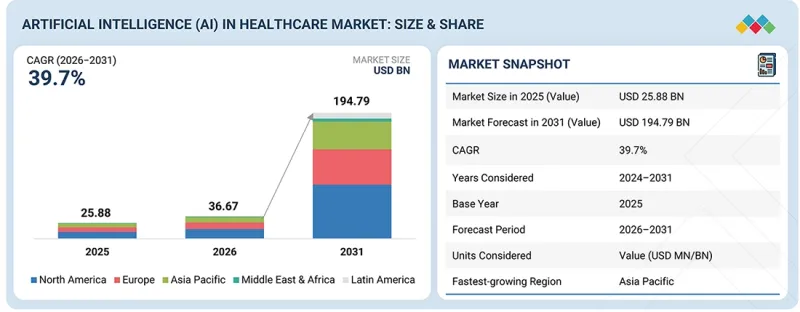
세계의 의료 분야 AI 시장 규모는 2026년 366억 7,000만 달러에서 2031년에는 1,947억 9,000만 달러에 이를 것으로 예측되며, 예측 기간 중 연평균 복합 성장률(CAGR)은 39.7%를 나타낼 전망입니다.
병원과 의료 시스템이 임상 효율 향상, 의사의 번아웃 완화, 환자 치료 성과 향상을 목적으로 AI 솔루션 도입을 확대함에 따라, 의료 분야의 AI 시장은 급속히 성장하고 있습니다.
| 조사 범위 | |
|---|---|
| 조사 대상 기간 | 2024-2031년 |
| 기준연도 | 2025년 |
| 예측 기간 | 2026-2031년 |
| 단위 | 금액(달러) |
| 부문 | 제공 형태, 기능, 용도, 도입 형태, 툴, 최종사용자별 |
| 대상 지역 | 북미, 유럽, 아시아태평양, 라틴아메리카, 중동 및 아프리카 |
예를 들어, 클리블랜드 클리닉은 2025년에 80개 이상의 전문 분야에 걸쳐 이 기술을 평가한 후, 미국 전역의 외래 진료 네트워크에 앰비언스 헬스케어의 AI 진료 기록 플랫폼을 도입했습니다. 이 솔루션은 도입 후 15주 이내에 4,000명 이상의 임상의가 채택했으며, 100만 건 이상의 환자 진료 기록 작성을 가능하게 했습니다. 또한, 2026년 1월에는 Aultman Health System이 Oracle Cerner와의 통합을 통해 수백 명의 임상의들을 대상으로 Nabla의 앰비언트 AI 솔루션을 도입했습니다. 한편, AtlantiCare는 Oracle Health의 Clinical AI Agent를 도입한 후 문서 작성 시간이 50% 단축되었다고 보고했습니다. 병원, 진료소, 의료 시스템 전반에 걸쳐 실제 현장 도입이 지속적으로 확대되고 있는 가운데, AI는 전 세계 의료 서비스의 미래를 형성하는 데 있어 점점 더 중요한 역할을 할 것으로 기대되고 있습니다.
도입 형태별로는 클라우드 기반 모델 부문이 예측 기간 동안 가장 높은 성장률을 보일 것으로 전망됩니다.
클라우드 기반 모델 부문은 확장성, 비용 대비 효과, 접근 용이성 덕분에 가장 큰 시장 점유율을 차지하고 있습니다. 클라우드 기반 모델은 실시간 데이터 처리와 협업을 촉진합니다. 원활한 통합, 안전한 데이터 저장, 신속한 도입을 가능하게 하므로 의료 서비스 제공업체 및 보험사에 특히 적합합니다. 이들은 높은 품질 기준을 유지하면서, 보다 신속하고 신뢰할 수 있는 의료 서비스를 제공합니다. 클라우드 기반 AI 솔루션은 비용 대비 효과, 확장성, 원격 액세스 지원 덕분에 점점 더 인기를 얻고 있습니다. 이러한 솔루션은 원활한 통합과 실시간 분석을 가능하게 합니다. 원격의료의 보급 확대와 의료 IT 인프라의 발전이 클라우드 기반 모델에 대한 수요를 더욱 촉진하고 있습니다.
최종 사용자별로는 병원 및 진료소 부문이 2025년에 가장 큰 점유율을 차지했습니다.
이는 맞춤형 의료 및 정밀한 진단·수술 계획에 대한 수요 증가, 최소 침습 수술의 확대, 기존 시스템과의 상호 운용성 필요성에서 기인한 것입니다. AI를 활용한 의료 솔루션은 병원 및 진료소에서 진단 정확도 향상, 업무 효율화, 맞춤형 치료를 실현합니다. 이를 통해 사무 업무의 자동화, 환자의 예후 예측, 실시간 데이터 분석을 통한 신속한 의사결정이 가능해집니다. 또한 AI는 원격 모니터링을 지원하고, 자원을 최적화하며, 불필요한 치료를 최소화함으로써 비용 절감에도 기여합니다.
예측 기간 동안 아시아태평양이 가장 높은 성장률을 보일 것으로 예측됩니다.
아시아태평양은 의료 분야의 급속한 디지털화, AI에 대한 투자 확대, 전자건강기록(EHR) 도입 확대, 디지털 헬스 이니셔티브에 대한 정부의 강력한 지원에 힘입어 의료 분야 AI 시장에서 가장 빠르게 성장하고 있습니다. 중국, 인도, 싱가포르, 일본, 한국 등의 국가에서는 진단, 의료 영상, 임상 의사결정 지원, 병원 업무 흐름 관리에 AI를 적극적으로 도입하고 있습니다. 예를 들어, 2026년 2월, 인도는 SAHI(Strategy for AI in Healthcare)를 발표하며 의료 생태계 전반에 걸쳐 책임감 있는 대규모 AI 도입을 위한 국가적 틀을 마련했습니다. 이 지역의 의료 제공업체들도 AI 도입을 확대되고 있습니다. 싱가포르에서는 보건부가 공공 의료 시스템 전반에 걸쳐 임상 기록 작성을 위한 생성형 AI와 AI를 활용한 영상 진단 솔루션의 도입을 확대되고 있습니다. 또한, Ng Teng Fong General Hospital 등의 병원에서는 환자 관리 및 의료 서비스 제공의 개선을 목적으로 AI 기반 도구가 활용되고 있습니다.
본 보고서에서는 전 세계 의료 분야의 AI 시장을 조사했으며, 시장 개요, 시장 성장에 영향을 미치는 다양한 요인에 대한 분석, 기술 및 특허 동향, 법규제 환경, 사례 연구, 시장 규모 추이 및 전망, 각종 분류·지역/주요 국가별 상세 분석, 경쟁 현황, 주요 기업 프로파일 등을 정리했습니다.
자주 묻는 질문
목차
제1장 서론
제2장 주요 요약
제3장 프리미엄 인사이트
제4장 시장 개요
제5장 업계 동향
제6장 기술 진보, AI의 영향, 특허, 혁신, 향후 응용
제7장 규제 상황
제8장 고객 현황과 구매 행동
제9장 의료 분야 AI 시장 : 기능별
제10장 의료 분야 AI 시장 : 제공 구분별
제11장 의료 분야 AI 시장 : 용도별
제12장 의료 분야 AI 시장 : 도입 모델별
제13장 의료 분야 AI 시장 : 툴별
제14장 의료 분야 AI 시장 : 최종사용자별
제15장 의료 분야 AI 시장 : 지역별
제16장 경쟁 구도
제17장 기업 개요
제18장 조사 방법
제19장 부록
LSH 26.07.20The global artificial intelligence (AI) in healthcare market is projected to reach USD 194.79 billion by 2031 from USD 36.67 billion in 2026, at a CAGR of 39.7% during the forecast period. The AI in healthcare market is growing rapidly as hospitals and health systems increasingly deploy AI solutions to improve clinical efficiency, reduce physician burnout, and enhance patient outcomes.
| Scope of the Report | |
|---|---|
| Years Considered for the Study | 2024-2031 |
| Base Year | 2025 |
| Forecast Period | 2026-2031 |
| Units Considered | Value (USD billion) |
| Segments | Offering, Function, Application, Deployment, Tool, End User |
| Regions covered | North America, Europe, Asia Pacific, Latin America, and the Middle East & Africa |
For example, in 2025, the Cleveland Clinic rolled out Ambience Healthcare's AI documentation platform across its US outpatient network after evaluating the technology across more than 80 specialties. The solution was adopted by over 4,000 clinicians within 15 weeks of deployment, enabling documentation for more than one million patient encounters. Additionally, in January 2026, Aultman Health System deployed Nabla's ambient AI solution across hundreds of clinicians through integration with Oracle Cerner, while AtlantiCare reported a 50% reduction in documentation time after implementing Oracle Health's Clinical AI Agent. As real-world adoption continues to expand across hospitals, clinics, and health systems, AI is expected to play an increasingly critical role in shaping the future of healthcare delivery worldwide.
By deployment, the cloud-based models segment is expected to register the highest growth during the forecast period.
The AI in healthcare market is categorized into three deployment models: on-premises, cloud-based, and hybrid. The cloud-based models segment holds the largest share due to their scalability, cost-effectiveness, and accessibility. Cloud-based models facilitate real-time data processing and collaboration. They enable seamless integration, secure data storage, and rapid deployment, making them particularly well-suited for healthcare providers and payers. They provide faster, more reliable care while maintaining high-quality standards. Cloud-based AI solutions are becoming increasingly popular due to their cost-effectiveness, scalability, and support for remote access. These solutions enable seamless integration and real-time analytics. The growing adoption of telehealth and advancements in healthcare IT infrastructure further drive the demand for cloud-based models.
By end user, the hospitals & clinics segment dominated the artificial intelligence (AI) in healthcare market for healthcare providers in 2025.
By end user, the artificial intelligence (AI) in healthcare market for healthcare providers is segmented into hospitals & clinics, ambulatory surgical centers, home healthcare agencies & assisted living facilities, diagnostic & imaging centers, pharmacies, and other healthcare providers. The hospitals & clinics segment accounted for the largest share of the artificial intelligence (AI) in healthcare market for healthcare providers. This is attributed to the increasing demand for personalized medicines, precise diagnostics & surgical planning, growth in minimally invasive procedures, and the requirement for interoperability with existing systems. AI-based healthcare solutions enhance diagnostic accuracy, streamline operations, and personalize care in hospitals and clinics. They automate administrative tasks, predict patient outcomes, and enable faster decision-making with real-time data analysis. AI also supports remote monitoring, optimizes resources, and reduces costs by minimizing unnecessary treatments.
The Asia Pacific is expected to register the highest growth during the forecast period.
The artificial intelligence (AI) in healthcare market is divided into North America, Europe, Asia Pacific, Latin America, and the Middle East & Africa. The Asia Pacific region is the fastest growing in the AI in healthcare market, driven by rapid healthcare digitalization, increasing investments in artificial intelligence, expanding adoption of electronic health records (EHRs), and strong government support for digital health initiatives. Countries such as China, India, Singapore, Japan, and South Korea are actively integrating AI into diagnostics, medical imaging, clinical decision support, and hospital workflow management. For instance, in February 2026, India launched its Strategy for AI in Healthcare (SAHI), establishing a national framework for the responsible and large-scale adoption of AI across the healthcare ecosystem. Healthcare providers across the region are also expanding AI adoption. In Singapore, the Ministry of Health is scaling generative AI for clinical documentation and AI-powered imaging solutions across the public healthcare system, while hospitals such as Ng Teng Fong General Hospital are using AI-enabled tools to improve patient management and care delivery.
The breakdown of primary participants is as mentioned below:
- By Company Type: Tier 1 (32%), Tier 2 (44%), and Tier 3 (24%)
- By Designation: Directors (30%), Managers (34%), and Others (36%)
- By Region: North America (40%), Europe (28%), Asia Pacific (20%), Latin America (7%), and the Middle East & Africa (5%)
Key Players
The prominent players operating in the artificial intelligence (AI) in healthcare market include Koninklijke Philips N.V. (Netherlands), Microsoft Corporation (US), Siemens Healthineers AG (Germany), NVIDIA Corporation (US), Epic Systems Corporation (US), GE Healthcare (US), Medtronic (US), Oracle (US), Veradigm LLC (US), Merative (IBM) (US), Google (US), Cognizant (US), Johnson & Johnson (US), Amazon Web Services, Inc. (US), SOPHiA GENETICS (US), Riverian Technologies (US), Terarecon (ConcertAI) (US), Solventum Corporation (US), Tempus (US), Viz.ai (US). These companies adopted strategies such as product launches, product updates, expansions, partnerships, collaborations, mergers, and acquisitions to strengthen their market presence in the artificial intelligence (AI) in healthcare market.
Research Coverage
The report analyzes the artificial intelligence (AI) in healthcare market and estimates the market size and future growth potential of various market segments by offering, function, application, deployment model, tool, end user, and region. The report also analyses factors (such as drivers, restrains, opportunities, and challenges) affecting market growth. It evaluates the opportunities and challenges for market stakeholders. The report also examines micromarkets in terms of their growth trends, prospects, and contributions to the total artificial intelligence (AI) in healthcare market. The report forecasts revenue for the market segments across five major regions. The report also provides a competitive analysis of the key players in this market, along with their company profiles, product offerings, recent developments, and key market strategies.
Reasons to Buy the Report
This report will help established firms, as well as new entrants/smaller firms, gauge the market pulse, which, in turn, will help them garner a greater share of the market. Firms purchasing the report could use one or a combination of the following strategies to strengthen their market positions.
This report provides insights on:
- Analysis of key drivers (rapid proliferation of AI in healthcare sector and growing need for improved healthcare services), restraints (shortage of skilled AI professionals handling AI-powered solutions and lack of standardized frameworks for AI and ML technologies), opportunities (strategic partnerships and collaborations among healthcare companies and AI technology providers and increase in focus on developing human-aware AI systems), challenges (concerns regarding data privacy and lack of interoperability) are factors contributing the growth of the artificial intelligence (AI) in healthcare market.
- Product Development/Innovation: Detailed insights on upcoming trends, research & development activities, and software launches in the artificial intelligence (AI) in healthcare market.
- Market Development: Comprehensive information on the lucrative emerging markets, offering, function, application, deployment, tool, end user, and region
- Market Diversification: Exhaustive information about software portfolios, growing geographies, recent developments, and investments in the artificial intelligence (AI) in healthcare market.
- Competitive Assessment: In-depth assessment of market shares, growth strategies, product offerings, company evaluation quadrant, and capabilities of leading players in the global artificial intelligence (AI) in healthcare market, such as Koninklijke Philips N.V. (Netherlands), Microsoft Corporation (US), Siemens Healthineers AG (Germany), NVIDIA Corporation (US), and Epic Systems Corporation (US).
TABLE OF CONTENTS
1 INTRODUCTION
- 1.1 STUDY OBJECTIVES
- 1.2 MARKET DEFINITION
- 1.3 MARKET SCOPE
- 1.3.1 MARKET SEGMENTATION AND REGIONAL SCOPE
- 1.3.2 INCLUSIONS AND EXCLUSIONS
- 1.3.3 YEARS CONSIDERED
- 1.4 CURRENCY CONSIDERED
- 1.5 STAKEHOLDERS
2 EXECUTIVE SUMMARY
- 2.1 MARKET HIGHLIGHTS AND KEY INSIGHTS
- 2.2 KEY MARKET PARTICIPANTS: MAPPING OF STRATEGIC DEVELOPMENTS
- 2.3 DISRUPTIVE TRENDS IN AI IN HEALTHCARE MARKET
- 2.4 HIGH-GROWTH SEGMENTS
- 2.5 REGIONAL SNAPSHOT: MARKET SIZE, GROWTH RATE, AND FORECAST
3 PREMIUM INSIGHTS
- 3.1 AI IN HEALTHCARE MARKET OVERVIEW
- 3.2 AI IN HEALTHCARE MARKET, BY APPLICATION AND REGION
- 3.3 AI IN HEALTHCARE MARKET: GEOGRAPHIC SNAPSHOT
4 MARKET OVERVIEW
- 4.1 INTRODUCTION
- 4.2 MARKET DYNAMICS
- 4.2.1 DRIVERS
- 4.2.1.1 Increasing need for early detection and diagnosis of diseases
- 4.2.1.2 Exponential growth in data volume and complexity due to surging adoption of digital technologies
- 4.2.1.3 Significant cost pressure on healthcare service providers with increasing prevalence of chronic diseases
- 4.2.1.4 Rapid proliferation of AI in healthcare sector
- 4.2.1.5 Growing inclination toward precision medicine and personalized care
- 4.2.2 RESTRAINTS
- 4.2.2.1 Reluctance among medical practitioners to adopt AI-based technologies
- 4.2.2.2 Shortage of skilled AI professionals handling AI-powered solutions
- 4.2.2.3 Lack of standardized frameworks for AI and ML technologies
- 4.2.3 OPPORTUNITIES
- 4.2.3.1 Rising demand for AI-driven clinical decision support systems
- 4.2.3.2 Increasing focus on developing human-aware AI systems
- 4.2.3.3 Strategic partnerships and collaborations among healthcare companies and AI technology providers
- 4.2.3.4 Rising adoption of AI-enabled medical imaging and diagnostics
- 4.2.4 CHALLENGES
- 4.2.4.1 Inaccurate predictions due to scarcity of high-quality healthcare data
- 4.2.4.2 Concerns regarding data privacy
- 4.2.4.3 Lack of interoperability between AI solutions offered by different vendors
- 4.2.1 DRIVERS
- 4.3 UNMET NEEDS AND WHITE SPACES
- 4.4 INTERCONNECTED MARKETS AND CROSS-SECTOR OPPORTUNITIES
- 4.5 STRATEGIC MOVES BY TIER 1/2/3 PLAYERS
5 INDUSTRY TRENDS
- 5.1 PORTER'S FIVE FORCES ANALYSIS
- 5.1.1 THREAT OF NEW ENTRANTS
- 5.1.2 THREAT OF SUBSTITUTES
- 5.1.3 BARGAINING POWER OF SUPPLIERS
- 5.1.4 BARGAINING POWER OF BUYERS
- 5.1.5 INTENSITY OF COMPETITIVE RIVALRY
- 5.2 MACROECONOMIC OUTLOOK
- 5.2.1 INTRODUCTION
- 5.2.2 GDP TRENDS AND FORECAST
- 5.2.3 TRENDS IN GLOBAL HEALTHCARE IT INDUSTRY
- 5.3 VALUE CHAIN ANALYSIS
- 5.4 ECOSYSTEM ANALYSIS
- 5.5 PRICING ANALYSIS
- 5.5.1 INDICATIVE PRICING FOR AI IN HEALTHCARE, BY APPLICATION (2025)
- 5.5.2 INDICATIVE PRICING FOR AI IN HEALTHCARE MARKET, BY REGION (2025)
- 5.6 KEY CONFERENCES AND EVENTS, 2026-2027
- 5.7 TRENDS/DISRUPTIONS IMPACTING CUSTOMER BUSINESS
- 5.8 INVESTMENT AND FUNDING SCENARIO
- 5.9 CASE STUDY ANALYSIS
- 5.9.1 ACCELERATING LUNG CANCER DIAGNOSIS THROUGH AI ACROSS NHS HOSPITALS
- 5.9.2 STRENGTHENING PATIENT TRUST THROUGH DIGITAL PATIENT ENGAGEMENT SOLUTIONS
- 5.9.3 OPTIMIZING PATIENT ENGAGEMENT AND COMMUNICATION WITH TRUBRIDGE PATIENT CONNECT
- 5.10 IMPACT OF US TARIFF - OVERVIEW
- 5.10.1 INTRODUCTION
- 5.10.2 KEY TARIFF RATES
- 5.10.3 PRICE IMPACT ANALYSIS
- 5.10.4 IMPACT ON COUNTRIES/REGIONS
- 5.10.4.1 US
- 5.10.4.2 Europe
- 5.10.4.3 Asia Pacific
- 5.10.5 IMPACT ON END USERS
6 TECHNOLOGICAL ADVANCEMENTS, AI-DRIVEN IMPACT, PATENTS, INNOVATIONS, AND FUTURE APPLICATIONS
- 6.1 KEY EMERGING TECHNOLOGIES
- 6.1.1 MACHINE LEARNING AND DEEP LEARNING
- 6.1.2 NATURAL LANGUAGE PROCESSING
- 6.1.3 COMPUTER VISION
- 6.2 COMPLEMENTARY TECHNOLOGIES
- 6.2.1 CLOUD COMPUTING
- 6.2.2 DIGITAL TWINS
- 6.2.3 ROBOTIC PROCESS AUTOMATION
- 6.3 ADJACENT TECHNOLOGIES
- 6.3.1 BLOCKCHAIN
- 6.3.2 AUGMENTED REALITY AND VIRTUAL REALITY
- 6.3.3 INTERNET OF THINGS
- 6.4 PATENT ANALYSIS
- 6.4.1 PATENT PUBLICATION TRENDS FOR AI IN HEALTHCARE LANDSCAPE
- 6.4.2 INSIGHTS: JURISDICTION AND TOP APPLICANT ANALYSIS
- 6.5 FUTURE APPLICATIONS
- 6.5.1 AI-DRIVEN PRECISION MEDICINE
- 6.5.2 REAL-TIME CLINICAL DECISION SUPPORT WITH GENERATIVE AI
- 6.5.3 DISEASE PREDICTION AND EARLY INTERVENTION THROUGH PREDICTIVE ANALYTICS
- 6.5.4 AI-POWERED VIRTUAL HEALTH ASSISTANTS AND DIGITAL CARE NAVIGATION
- 6.5.5 ADVANCING AUTONOMOUS AI AGENTS FOR HEALTHCARE WORKFLOW AUTOMATION
7 REGULATORY LANDSCAPE
- 7.1 REGIONAL REGULATIONS AND COMPLIANCE
- 7.1.1 REGULATORY BODIES, GOVERNMENT AGENCIES, AND OTHER ORGANIZATIONS
- 7.1.2 REGULATORY FRAMEWORK
8 CUSTOMER LANDSCAPE AND BUYER BEHAVIOR
- 8.1 INTRODUCTION
- 8.2 DECISION-MAKING PROCESS
- 8.3 KEY STAKEHOLDERS INVOLVED IN BUYING PROCESS AND THEIR EVALUATION CRITERIA
- 8.3.1 KEY STAKEHOLDERS IN BUYING PROCESS
- 8.3.2 BUYING CRITERIA
- 8.4 ADOPTION BARRIERS AND INTERNAL CHALLENGES
- 8.5 UNMET NEEDS OF VARIOUS END USERS
- 8.5.1 UNMET NEEDS
- 8.5.2 END-USER EXPECTATIONS
- 8.6 MARKET PROFITABILITY
- 8.7 IMPACT ON COUNTRIES/REGIONS
- 8.7.1 US
- 8.7.2 EUROPE
- 8.7.3 ASIA PACIFIC
- 8.8 IMPACT ON END USERS
9 AI IN HEALTHCARE MARKET, BY FUNCTION
- 9.1 INTRODUCTION
- 9.2 DIAGNOSIS & EARLY DETECTION
- 9.2.1 PRE-SCREENING
- 9.2.1.1 Early detection, better outcomes, and cost-effective care associated with pre-screening to boost market
- 9.2.2 IVD
- 9.2.2.1 IVD market, by technology
- 9.2.2.1.1 Immunoassays
- 9.2.2.1.1.1 Potential to enhance biomarker detection and laboratory automation to accelerate demand
- 9.2.2.1.2 Clinical chemistry
- 9.2.2.1.2.1 Ability to improve laboratory efficiency and diagnostic accuracy to spur adoption
- 9.2.2.1.3 Molecular diagnostics
- 9.2.2.1.3.1 Pressing need to identify viral and bacterial pathogens in infectious diseases to facilitate adoption
- 9.2.2.1.1 Immunoassays
- 9.2.2.2 IVD market, by application
- 9.2.2.2.1 Image analysis & interpretation
- 9.2.2.2.1.1 Rising focus of pathologists on analyzing tissue samples for detecting abnormalities at faster rate to fuel segmental growth
- 9.2.2.2.2 Biomarker discovery & analysis
- 9.2.2.2.2.1 Elevating adoption of precision medicine to create growth opportunities
- 9.2.2.2.3 Other IVD applications
- 9.2.2.2.1 Image analysis & interpretation
- 9.2.2.1 IVD market, by technology
- 9.2.3 DIAGNOSTIC IMAGING
- 9.2.3.1 Diagnostic imaging market, by application
- 9.2.3.1.1 Disease interpretation & report analysis
- 9.2.3.1.1.1 Proficiency in identifying disease-specific patterns and correlating findings across multiple data sources to fuel adoption
- 9.2.3.1.2 Image captioning & annotation
- 9.2.3.1.2.1 Increasing use of machine learning for automated image captioning to foster market growth
- 9.2.3.1.3 Image reconstruction
- 9.2.3.1.3.1 Greater emphasis of healthcare facilities on optimizing imaging workflows and increasing scanner throughput to augment adoption
- 9.2.3.1.4 Other diagnostic imaging applications
- 9.2.3.1.1 Disease interpretation & report analysis
- 9.2.3.2 Diagnostic imaging market, by modality
- 9.2.3.2.1 Magnetic resonance imaging
- 9.2.3.2.1.1 Escalating adoption of AI across MRI workflows to enhance diagnostic confidence and improve scanner utilization to augment market growth
- 9.2.3.2.2 Computed tomography
- 9.2.3.2.2.1 Urgent need for efficient diagnosis to provide the right treatments to drive market
- 9.2.3.2.3 X-ray imaging
- 9.2.3.2.3.1 Development of innovative AI-based X-ray imaging solutions to drive market
- 9.2.3.2.4 Ultrasound
- 9.2.3.2.4.1 Increasing investments in developing AI-assisted ultrasound imaging auto-assessment tools to expedite market growth
- 9.2.3.2.5 Nuclear imaging
- 9.2.3.2.5.1 Integration of AI algorithms for quick detection and monitoring of abnormalities to facilitate market growth
- 9.2.3.2.6 Other diagnostic imaging modalities
- 9.2.3.2.1 Magnetic resonance imaging
- 9.2.3.1 Diagnostic imaging market, by application
- 9.2.4 RISK ASSESSMENT & PATIENT STRATIFICATION
- 9.2.4.1 Critical need to identify high-risk patients and predict their disease progression risks to boost demand
- 9.2.5 DRUG ALLERGY ALERTING
- 9.2.5.1 Significant focus on improving accuracy and speed of identifying allergic reactions to contribute to market growth
- 9.2.6 OTHER DIAGNOSIS & EARLY DETECTION FUNCTIONS
- 9.2.1 PRE-SCREENING
- 9.3 TREATMENT PLANNING & PERSONALIZATION
- 9.3.1 PERSONALIZED TREATMENT PLANNING
- 9.3.1.1 Precision medicine & genomic analysis
- 9.3.1.1.1 Adoption of AI-based software for personalized treatment decisions and improved outcomes to propel market
- 9.3.1.2 Predictive models for treatment response
- 9.3.1.2.1 Ability to personalize therapies, improve outcomes, and minimize adverse effects to fuel growth
- 9.3.1.3 Treatment recommendation systems
- 9.3.1.3.1 Competency in offering personalized, evidence-based treatment options to spike demand
- 9.3.1.1 Precision medicine & genomic analysis
- 9.3.2 PHARMACOLOGICAL THERAPY
- 9.3.2.1 Drug response prediction
- 9.3.2.1.1 Increasing use of AI-powered drug response prediction in oncology and chronic disease management to drive market
- 9.3.2.2 Dosing & administration
- 9.3.2.2.1 Capability of AI-based dosing models to adjust doses in real-time based on individual patient responses to spur demand
- 9.3.2.3 Other pharmacological therapy functions
- 9.3.2.1 Drug response prediction
- 9.3.3 SURGICAL THERAPY
- 9.3.3.1 Preoperative imaging & 3D modeling
- 9.3.3.1.1 Widening use of AI-driven 3D modeling in orthopedic, cardiovascular, neurological surgeries to fuel market growth
- 9.3.3.2 Intraoperative guidance & robotics
- 9.3.3.2.1 Inclination toward minimally invasive surgeries and faster patient recovery to boost implementation
- 9.3.3.3 Postoperative analysis & recovery
- 9.3.3.3.1 Ability to predict recovery patterns, identify risks, and provide personalized rehabilitation plans to boost demand
- 9.3.3.1 Preoperative imaging & 3D modeling
- 9.3.4 RADIATION THERAPY
- 9.3.4.1 Motion synchronization & auto contouring
- 9.3.4.1.1 Need for precise delivery of radiation and minimum exposure to surrounding healthy tissues to reinforce segmental growth
- 9.3.4.2 Real-time adaptive treatment delivery
- 9.3.4.2.1 Growing focus on consistent treatment accuracy and clinical outcome optimization to strengthen demand
- 9.3.4.3 Response assessment & quality assurance
- 9.3.4.3.1 Ability of AI solutions to analyze medical images, treatment plans, and dosimetric data to accelerate demand
- 9.3.4.4 Other radiation therapy functions
- 9.3.4.1 Motion synchronization & auto contouring
- 9.3.5 BEHAVIORAL THERAPY & PSYCHOTHERAPY
- 9.3.5.1 Virtual counseling & chatbots
- 9.3.5.1.1 Potential to improve patient communication, engagement, and service efficiency to expand implementation
- 9.3.5.2 Progress monitoring & feedback
- 9.3.5.2.1 Increasing use of smart wearables and mobile health apps to drive market
- 9.3.5.3 Follow-up & long-term support
- 9.3.5.3.1 Widespread adoption of telemedicine platforms to drive market expansion
- 9.3.5.1 Virtual counseling & chatbots
- 9.3.6 IMMUNOTHERAPY
- 9.3.6.1 Real-time patient data monitoring
- 9.3.6.1.1 High demand for proactive healthcare management to foster segmental growth
- 9.3.6.2 Response & side-effect prediction
- 9.3.6.2.1 Need for earlier detection of treatment-related risks across drugs and vaccines to support segmental growth
- 9.3.6.3 Relapse prediction & long-term management
- 9.3.6.3.1 Necessity for continuous patient monitoring and risk stratification to fuel demand
- 9.3.6.1 Real-time patient data monitoring
- 9.3.7 OTHER TREATMENT PLANNING & PERSONALIZATION FUNCTIONS
- 9.3.1 PERSONALIZED TREATMENT PLANNING
- 9.4 PATIENT ENGAGEMENT & REMOTE MONITORING
- 9.4.1 SYMPTOM MANAGEMENT & VIRTUAL ASSISTANCE
- 9.4.1.1 Constant requirement for symptom management in chronic diseases to accelerate adoption of AI-powered apps
- 9.4.2 TELEHEALTH & REMOTE PATIENT MONITORING
- 9.4.2.1 Increasing adoption of mobile health apps and wearable devices to augment segmental growth
- 9.4.3 HEALTHCARE ASSISTANCE ROBOTS
- 9.4.3.1 Competency in improving quality of care and reducing burden on healthcare workers to promote adoption
- 9.4.4 MEDICATION REMINDERS
- 9.4.4.1 Capability to deliver medication guidance, personalized health coaching, and care coordination to foster demand
- 9.4.5 PATIENT EDUCATION & EMPOWERMENT
- 9.4.5.1 Need to improve treatment adherence and enhance self-management to drive market
- 9.4.6 OTHER PATIENT ENGAGEMENT & REMOTE MONITORING FUNCTIONS
- 9.4.1 SYMPTOM MANAGEMENT & VIRTUAL ASSISTANCE
- 9.5 POST-TREATMENT SURVEILLANCE & SURVIVORSHIP CARE
- 9.5.1 RECURRENCE MONITORING
- 9.5.1.1 Advancing post-treatment care through intelligent recurrence monitoring to support market growth
- 9.5.2 LONG-TERM OUTCOME PREDICTION
- 9.5.2.1 Greater emphasis on predicting disease recurrence and survival chances to improve uptake of AI-powered medical devices
- 9.5.3 MENTAL HEALTH & SUPPORT SYSTEMS
- 9.5.3.1 Rising focus on emotional well-being of patients with critical illness to support segmental growth
- 9.5.1 RECURRENCE MONITORING
- 9.6 PHARMACY MANAGEMENT
- 9.6.1 EPRESCRIBING
- 9.6.1.1 Urgent need to replace paper-based prescription to electronic platform to expedite adoption of ePrescribing solutions
- 9.6.2 MEDICATION MANAGEMENT
- 9.6.2.1 Innovative medication management programs between healthcare professionals and pharmacists to encourage segmental growth
- 9.6.3 PHARMACY AUDIT & ANALYSIS
- 9.6.3.1 Demand for operational excellence and improved patient care outcomes across pharmacies to create growth opportunities
- 9.6.4 OTHER PHARMACY MANAGEMENT FUNCTIONS
- 9.6.1 EPRESCRIBING
- 9.7 DATA MANAGEMENT & ANALYTICS
- 9.7.1 RISING FOCUS OF HEALTHCARE ORGANIZATIONS ON DEVELOPING PERSONALIZED TREATMENT PLANS TO SUPPORT SEGMENTAL GROWTH
- 9.8 AI SCRIBE
- 9.8.1 GROWING NEED TO IMPROVE CLINICIAN PRODUCTIVITY AND REDUCE DOCUMENTATION TIME TO STRENGTHEN AI SCRIBE DEPLOYMENT
- 9.9 CLINICAL DECISION SUPPORT SYSTEMS
- 9.9.1 INCREASING NEED FOR EVIDENCE-BASED CLINICAL DECISION-MAKING TO SPIKE ADOPTION
- 9.10 ADMINISTRATIVE
- 9.10.1 PATIENT REGISTRATION & SCHEDULING
- 9.10.1.1 Rising adoption of self-service patient registration solutions to contribute to segmental growth
- 9.10.2 PATIENT ELIGIBILITY & AUTHORIZATION
- 9.10.2.1 Growing demand for faster prior authorization workflows to facilitate market growth
- 9.10.3 REVENUE CYCLE MANAGEMENT
- 9.10.3.1 Significant need to reduce claim denials and reimbursement delays to reinforce demand
- 9.10.4 WORKFORCE MANAGEMENT
- 9.10.4.1 Growing need to optimize healthcare workforce utilization to create lucrative opportunities
- 9.10.5 SUPPLY CHAIN & INVENTORY MANAGEMENT
- 9.10.5.1 Strong focus on reducing inventory costs and waste to bolster market growth
- 9.10.6 COMPLIANCE & DOCUMENTATION
- 9.10.6.1 Increasing regulatory compliance requirements in healthcare to escalate demand for AI-based compliance & documentation
- 9.10.7 HEALTHCARE WORKFLOW MANAGEMENT
- 9.10.7.1 Surging need for end-to-end workflow automation to foster segmental growth
- 9.10.8 ASSET MANAGEMENT
- 9.10.8.1 Pressing need to improve equipment availability and reduce downtime to heighten demand for AI-based asset management
- 9.10.9 CUSTOMER RELATIONSHIP MANAGEMENT
- 9.10.9.1 Growing focus on personalized patient engagement to boost segmental growth
- 9.10.10 FRAUD DETECTION & RISK MANAGEMENT
- 9.10.10.1 Rising financial losses to drive investment in AI-based proactive risk management solutions
- 9.10.11 CYBERSECURITY
- 9.10.11.1 Critical requirement to protect sensitive patient data to propel demand for AI-powered threat detection solutions
- 9.10.12 OTHER ADMINISTRATIVE FUNCTIONS
- 9.10.1 PATIENT REGISTRATION & SCHEDULING
10 AI IN HEALTHCARE MARKET, BY OFFERING
- 10.1 INTRODUCTION
- 10.2 INTEGRATED SOLUTIONS
- 10.2.1 ESCALATING DEPLOYMENT OF ENTERPRISE-WIDE AI PLATFORMS TO CONTRIBUTE TO SEGMENTAL GROWTH
- 10.3 NICHE/POINT SOLUTIONS
- 10.3.1 GROWING ADOPTION OF SPECIALIZED AI APPLICATIONS FOR TARGETED CLINICAL AND ADMINISTRATIVE TASKS TO DRIVE MARKET
- 10.4 AI TECHNOLOGIES
- 10.4.1 HARNESSING AI FOR IMPROVED PATIENT OUTCOMES AND OPERATIONAL EFFICIENCY TO SUPPORT MARKET GROWTH
- 10.5 SERVICES
- 10.5.1 INCREASING FOCUS ON SEAMLESS AI DEPLOYMENT AND ONGOING SUPPORT TO FACILITATE SEGMENTAL GROWTH
11 AI IN HEALTHCARE MARKET, BY APPLICATION
- 11.1 INTRODUCTION
- 11.2 CLINICAL APPLICATIONS
- 11.2.1 NECESSITY TO ENHANCE PATIENT MONITORING AND CLINICAL DECISION-MAKING ABILITY TO SPUR DEMAND
- 11.3 NON-CLINICAL APPLICATIONS
- 11.3.1 REQUIREMENT TO ENHANCE OPERATIONAL EFFICIENCY, REDUCE ADMINISTRATIVE BURDEN, AND ENSURE BETTER RESOURCE ALLOCATION TO FOSTER MARKET GROWTH
12 AI IN HEALTHCARE MARKET, BY DEPLOYMENT MODEL
- 12.1 INTRODUCTION
- 12.2 ON-PREMISES MODEL
- 12.2.1 CRITICALITY OF DATA PRIVACY AND SECURITY TO SUPPORT DEPLOYMENT OF ON-PREMISES HEALTHCARE INFRASTRUCTURE
- 12.3 CLOUD-BASED MODEL
- 12.3.1 RAPID SCALABILITY AND SECURE DATA HANDLING AND INTEGRATION ATTRIBUTES TO ELEVATE DEMAND FOR CLOUD-BASED AI SOLUTIONS IN HEALTHCARE
- 12.4 HYBRID MODEL
- 12.4.1 FOCUS OF HEALTHCARE ORGANIZATIONS ON PROTECTING DATA WITHOUT SACRIFICING SCALABILITY TO DRIVE SEGMENTAL GROWTH
13 AI IN HEALTHCARE MARKET, BY TOOL
- 13.1 INTRODUCTION
- 13.2 MACHINE LEARNING
- 13.2.1 DEEP LEARNING
- 13.2.1.1 Convolutional neural networks
- 13.2.1.1.1 Ability to analyze X-rays, CT scans, and MRIs with high precision to elevate adoption
- 13.2.1.2 Recurrent neural networks
- 13.2.1.2.1 Competency in analyzing sequential data to predict disease progression and treatment efficacy to boost deployment
- 13.2.1.3 Generative adversarial networks
- 13.2.1.3.1 Capability to generate synthetic data to train AI models and address data scarcity and privacy issues to propel demand
- 13.2.1.4 Graph neural networks
- 13.2.1.4.1 Ability to recommend personalized treatment to stimulate adoption
- 13.2.1.5 Other deep learning tools
- 13.2.1.1 Convolutional neural networks
- 13.2.2 SUPERVISED LEARNING
- 13.2.2.1 Growing importance of evidence-based decision-making in predictive and diagnostic tasks to spur demand
- 13.2.3 REINFORCEMENT LEARNING
- 13.2.3.1 Significance of precision medicine, value-based care, and intelligent clinical decision support to accelerate demand
- 13.2.4 UNSUPERVISED LEARNING
- 13.2.4.1 Increasing need to uncover hidden insights from unstructured healthcare data to boost adoption
- 13.2.5 OTHER MACHINE LEARNING TOOLS
- 13.2.1 DEEP LEARNING
- 13.3 NATURAL LANGUAGE PROCESSING
- 13.3.1 SENTIMENT ANALYSIS
- 13.3.1.1 Increasing adoption of AI for patient feedback analysis to contribute to market growth
- 13.3.2 PATTERN & IMAGE RECOGNITION
- 13.3.2.1 Growing utilization of AI for early disease detection and personalized treatment planning to facilitate market expansion
- 13.3.3 AUTO CODING
- 13.3.3.1 Elevating use of AI tools to improve claim reimbursement process to fuel market growth
- 13.3.4 CLASSIFICATION & CATEGORIZATION
- 13.3.4.1 Business need to organize and classify healthcare data efficiently to expand AI implementation
- 13.3.5 TEXT ANALYTICS
- 13.3.5.1 Necessity to derive insights from unstructured clinical text to enhance use of text analytics
- 13.3.6 SPEECH RECOGNITION
- 13.3.6.1 Rising focus on reducing physician administrative burden to accelerate demand
- 13.3.1 SENTIMENT ANALYSIS
- 13.4 CONTEXT-AWARE COMPUTING
- 13.4.1 DEVICE CONTEXT
- 13.4.1.1 Integration of connected medical devices to boost demand for intelligent device-aware healthcare applications
- 13.4.2 USER CONTEXT
- 13.4.2.1 Rising focus on individualized clinical decision support to spike demand
- 13.4.3 PHYSICAL CONTEXT
- 13.4.3.1 Increasing adoption of AI for real-time environmental and patient context monitoring to generate demand
- 13.4.1 DEVICE CONTEXT
- 13.5 GENERATIVE AI
- 13.5.1 INCREASING USE OF GENERATIVE MODELS TO OFFER TAILORED INTERVENTIONS TO DRIVE MARKET
- 13.6 COMPUTER VISION
- 13.6.1 ABILITY TO DETECT ABNORMALITIES SUCH AS TUMORS AND FRACTURES TO FUEL ADOPTION
- 13.7 IMAGE ANALYSIS
- 13.7.1 GROWING ADOPTION OF AI FOR EARLY DISEASE DETECTION AND DIAGNOSIS TO CONTRIBUTE TO MARKT GROWTH
14 AI IN HEALTHCARE MARKET, BY END USER
- 14.1 INTRODUCTION
- 14.2 HEALTHCARE PROVIDERS
- 14.2.1 HOSPITALS & CLINICS
- 14.2.1.1 Increasing focus on enhancing patient outcomes through AI to expedite market expansion
- 14.2.2 AMBULATORY CARE CENTERS
- 14.2.2.1 Rising adoption of AI to reduce care delivery costs to reinforce market growth
- 14.2.3 HOME HEALTHCARE AGENCIES & ASSISTED-LIVING FACILITIES
- 14.2.3.1 Escalating demand for personalized and continuous patient care to accelerate market growth
- 14.2.4 DIAGNOSTIC & IMAGING CENTERS
- 14.2.4.1 Increasing partnerships between hospitals and imaging centers to develop regulatory-cleared AI tools to support market growth
- 14.2.5 PHARMACIES
- 14.2.5.1 Heightened need for AI-driven inventory optimization to unlock opportunities
- 14.2.6 OTHER HEALTHCARE PROVIDERS
- 14.2.1 HOSPITALS & CLINICS
- 14.3 HEALTHCARE PAYERS
- 14.3.1 PUBLIC PAYERS
- 14.3.1.1 Increasing focus on cost optimization and fraud prevention to promote adoption of AI by public payers
- 14.3.2 PRIVATE PAYERS
- 14.3.2.1 Leveraging AI to optimize claims management, member engagement, and value-based care programs to drive market
- 14.3.1 PUBLIC PAYERS
- 14.4 PATIENTS
- 14.4.1 INCREASING ADOPTION OF AI FOR PATIENT ENGAGEMENT AND SELF-CARE TO FACILITATE MARKET GROWTH
- 14.5 OTHER END USERS
15 AI IN HEALTHCARE MARKET, BY REGION
- 15.1 INTRODUCTION
- 15.2 NORTH AMERICA
- 15.2.1 MACROECONOMIC OUTLOOK FOR NORTH AMERICA
- 15.2.2 US
- 15.2.2.1 Increasing focus on personalized medicine and precision healthcare to drive market
- 15.2.3 CANADA
- 15.2.3.1 Rising use of AI to improve disease care and patient survival and clinical workflows to drive market
- 15.3 EUROPE
- 15.3.1 MACROECONOMIC OUTLOOK FOR EUROPE
- 15.3.2 GERMANY
- 15.3.2.1 Collaborative health-related research and innovation programs and initiatives to contribute to market growth
- 15.3.3 UK
- 15.3.3.1 Significant focus of government on early diagnosis, personalized treatments, and rapid drug development to boost AI demand
- 15.3.4 FRANCE
- 15.3.4.1 Expanding AI-enabled digital healthcare and patient services to foster market growth
- 15.3.5 ITALY
- 15.3.5.1 Growing deployment of AI infrastructure to ensure transparency, data protection, and patient safety to facilitate market growth
- 15.3.6 SPAIN
- 15.3.6.1 Partnerships between scientists, medical professionals, and AI experts to develop innovative diagnostic tools to drive market
- 15.3.7 REST OF EUROPE
- 15.4 ASIA PACIFIC
- 15.4.1 MACROECONOMIC OUTLOOK FOR ASIA PACIFIC
- 15.4.2 CHINA
- 15.4.2.1 Growing focus on healthcare innovation through national AI initiatives to accelerate market growth
- 15.4.3 JAPAN
- 15.4.3.1 Strong healthcare infrastructure to drive adoption of advanced AI
- 15.4.4 INDIA
- 15.4.4.1 Strong government support for digital health initiatives to create lucrative opportunities
- 15.4.5 AUSTRALIA
- 15.4.5.1 Strong research ecosystem and national digital health initiatives to drive market
- 15.4.6 SOUTH KOREA
- 15.4.6.1 National Strategy for Artificial Intelligence and Digital Healthcare Innovation Plan initiatives to support market growth
- 15.4.7 REST OF ASIA PACIFIC
- 15.5 LATIN AMERICA
- 15.5.1 MACROECONOMIC OUTLOOK FOR LATIN AMERICA
- 15.5.2 BRAZIL
- 15.5.2.1 Expanding digital health infrastructure and growing adoption of AI-enabled healthcare technologies to foster market growth
- 15.5.3 MEXICO
- 15.5.3.1 Growing adoption of AI-driven chronic disease management platforms to stimulate market growth
- 15.5.4 REST OF LATIN AMERICA
- 15.6 MIDDLE EAST & AFRICA
- 15.6.1 MACROECONOMIC OUTLOOK FOR MIDDLE EAST & AFRICA
- 15.6.2 GCC
- 15.6.2.1 Saudi Arabia
- 15.6.2.1.1 Accelerating AI-driven healthcare transformation under Saudi Vision 2030 to contribute to market growth
- 15.6.2.2 UAE
- 15.6.2.2.1 Rising focus on improving healthcare quality and delivering personalized patient care to reinforce market growth
- 15.6.2.3 Rest of GCC
- 15.6.2.1 Saudi Arabia
- 15.6.3 SOUTH AFRICA
- 15.6.3.1 Expanding use of AI to enhance medical imaging, clinical decision support, and disease surveillance to drive market
- 15.6.4 REST OF MIDDLE EAST & AFRICA
16 COMPETITIVE LANDSCAPE
- 16.1 INTRODUCTION
- 16.2 KEY PLAYER COMPETITIVE STRATEGY/RIGHT TO WIN, JANUARY 2023 TO JUNE 2026
- 16.3 REVENUE ANALYSIS, 2021-2025
- 16.4 MARKET SHARE ANALYSIS, 2025
- 16.5 COMPANY EVALUATION MATRIX: KEY PLAYERS, 2025
- 16.5.1 STARS
- 16.5.2 EMERGING LEADERS
- 16.5.3 PERVASIVE PLAYERS
- 16.5.4 PARTICIPANTS
- 16.5.5 COMPANY FOOTPRINT: KEY PLAYERS, 2025
- 16.5.5.1 Company footprint
- 16.5.5.2 Region footprint
- 16.5.5.3 Application footprint
- 16.5.5.4 Tool footprint
- 16.5.5.5 Function footprint
- 16.5.5.6 Offering footprint
- 16.5.5.7 Deployment footprint
- 16.5.5.8 End user footprint
- 16.6 COMPANY EVALUATION MATRIX: STARTUPS/SMES, 2025
- 16.6.1 PROGRESSIVE COMPANIES
- 16.6.2 RESPONSIVE COMPANIES
- 16.6.3 DYNAMIC COMPANIES
- 16.6.4 STARTING BLOCKS
- 16.6.5 COMPETITIVE BENCHMARKING: STARTUPS/SMES, 2025
- 16.6.5.1 Detailed list of key startups/SMEs
- 16.6.5.2 Company footprint (startups/SMEs)
- 16.7 COMPANY VALUATION AND FINANCIAL METRICS
- 16.7.1 FINANCIAL METRICS
- 16.7.2 COMPANY VALUATION
- 16.8 BRAND/PRODUCT COMPARISON
- 16.9 COMPETITIVE SCENARIO
- 16.9.1 PRODUCT LAUNCHES/ENHANCEMENTS/APPROVALS
- 16.9.2 DEALS
- 16.9.3 OTHER DEVELOPMENTS
17 COMPANY PROFILES
- 17.1 KEY PLAYERS
- 17.1.1 KONINKLIJKE PHILIPS N.V.
- 17.1.1.1 Business overview
- 17.1.1.2 Products & services offered
- 17.1.1.3 Recent developments
- 17.1.1.3.1 Product launches/enhancements/approvals
- 17.1.1.3.2 Deals
- 17.1.1.3.3 Expansions
- 17.1.1.3.4 Other developments
- 17.1.1.4 MnM view
- 17.1.1.4.1 Right to win
- 17.1.1.4.2 Strategic choices
- 17.1.1.4.3 Weaknesses & competitive threats
- 17.1.2 MICROSOFT CORPORATION
- 17.1.2.1 Business overview
- 17.1.2.2 Products & services offered
- 17.1.2.3 Recent developments
- 17.1.2.3.1 Product launches/enhancements/approvals
- 17.1.2.3.2 Deals
- 17.1.2.4 MnM view
- 17.1.2.4.1 Right to win
- 17.1.2.4.2 Strategic choices
- 17.1.2.4.3 Weaknesses & competitive threats
- 17.1.3 NVIDIA CORPORATION
- 17.1.3.1 Business overview
- 17.1.3.2 Products & services offered
- 17.1.3.3 Recent developments
- 17.1.3.3.1 Product launches/enhancements/approvals
- 17.1.3.3.2 Deals
- 17.1.3.4 MnM view
- 17.1.3.4.1 Right to win
- 17.1.3.4.2 Strategic choices
- 17.1.3.4.3 Weaknesses & competitive threats
- 17.1.4 SIEMENS HEALTHINEERS AG
- 17.1.4.1 Business overview
- 17.1.4.2 Products & services offered
- 17.1.4.3 Recent developments
- 17.1.4.3.1 Product launches/enhancements/approvals
- 17.1.4.3.2 Deals
- 17.1.4.4 MnM view
- 17.1.4.4.1 Right to win
- 17.1.4.4.2 Strategic choices
- 17.1.4.4.3 Weaknesses & competitive threats
- 17.1.5 GE HEALTHCARE
- 17.1.5.1 Business overview
- 17.1.5.2 Products & services offered
- 17.1.5.3 Recent developments
- 17.1.5.3.1 Product launches/enhancements/approvals
- 17.1.5.3.2 Deals
- 17.1.5.3.3 Other developments
- 17.1.5.4 MnM view
- 17.1.5.4.1 Right to win
- 17.1.5.4.2 Strategic choices
- 17.1.5.4.3 Weaknesses & competitive threats
- 17.1.6 EPIC SYSTEMS CORPORATION
- 17.1.6.1 Business overview
- 17.1.6.2 Products & services offered
- 17.1.6.3 Recent developments
- 17.1.6.3.1 Product launches/enhancements/approvals
- 17.1.6.3.2 Deals
- 17.1.7 ORACLE
- 17.1.7.1 Business overview
- 17.1.7.2 Products & services offered
- 17.1.7.3 Recent developments
- 17.1.7.3.1 Product launches/enhancements/approvals
- 17.1.7.3.2 Deals
- 17.1.7.3.3 Expansions
- 17.1.8 VERADIGM INC.
- 17.1.8.1 Business overview
- 17.1.8.2 Products & services offered
- 17.1.8.3 Recent developments
- 17.1.8.3.1 Product launches/enhancements/approvals
- 17.1.8.3.2 Deals
- 17.1.9 AMAZON WEB SERVICES, INC.
- 17.1.9.1 Business overview
- 17.1.9.2 Products & services offered
- 17.1.9.3 Recent developments
- 17.1.9.3.1 Product launches/enhancements/approvals
- 17.1.9.3.2 Deals
- 17.1.9.3.3 Expansions
- 17.1.10 MERATIVE
- 17.1.10.1 Business overview
- 17.1.10.2 Products & services offered
- 17.1.10.3 Recent developments
- 17.1.10.3.1 Product launches/enhancements/approvals
- 17.1.10.3.2 Deals
- 17.1.11 IBM
- 17.1.11.1 Business overview
- 17.1.11.2 Products & services offered
- 17.1.11.3 Recent developments
- 17.1.11.3.1 Deals
- 17.1.12 MEDTRONIC
- 17.1.12.1 Business overview
- 17.1.12.2 Products & services offered
- 17.1.12.3 Recent developments
- 17.1.12.3.1 Product launches/enhancements/approvals
- 17.1.12.3.2 Deals
- 17.1.13 GOOGLE
- 17.1.13.1 Business overview
- 17.1.13.2 Products & services offered
- 17.1.13.3 Recent developments
- 17.1.13.3.1 Product launches/enhancements/approvals
- 17.1.13.3.2 Deals
- 17.1.13.3.3 Other developments
- 17.1.14 SOPHIA GENETICS
- 17.1.14.1 Business overview
- 17.1.14.2 Products & services offered
- 17.1.14.3 Recent developments
- 17.1.14.3.1 Product launches/enhancements/approvals
- 17.1.14.3.2 Deals
- 17.1.14.3.3 Other developments
- 17.1.15 JOHNSON & JOHNSON SERVICES, INC.
- 17.1.15.1 Business overview
- 17.1.15.2 Products & services offered
- 17.1.15.3 Recent developments
- 17.1.15.3.1 Product launches/enhancements/approvals
- 17.1.15.3.2 Deals
- 17.1.16 TEMPUS AI, INC.
- 17.1.16.1 Business overview
- 17.1.16.2 Products & services offered
- 17.1.16.3 Recent developments
- 17.1.16.3.1 Product launches/enhancements/approvals
- 17.1.16.3.2 Deals
- 17.1.17 CONCERTAI
- 17.1.17.1 Business overview
- 17.1.17.2 Products & services offered
- 17.1.17.3 Recent developments
- 17.1.17.3.1 Product launches/enhancements/approvals
- 17.1.17.3.2 Deals
- 17.1.18 SOLVENTUM CORPORATION
- 17.1.18.1 Business overview
- 17.1.18.2 Products & services offered
- 17.1.18.3 Recent developments
- 17.1.18.3.1 Deals
- 17.1.18.3.2 Other developments
- 17.1.19 COGNIZANT
- 17.1.19.1 Business overview
- 17.1.19.2 Products & services offered
- 17.1.19.3 Recent developments
- 17.1.19.3.1 Product launches/enhancements/approvals
- 17.1.19.3.2 Deals
- 17.1.20 VIZ.AI, INC.
- 17.1.20.1 Business overview
- 17.1.20.2 Products & services offered
- 17.1.20.3 Recent developments
- 17.1.20.3.1 Product launches/enhancements/approvals
- 17.1.20.3.2 Deals
- 17.1.20.3.3 Other developments
- 17.1.21 RIVERAIN TECHNOLOGIES
- 17.1.21.1 Business overview
- 17.1.21.2 Products & services offered
- 17.1.21.3 Recent developments
- 17.1.21.3.1 Product launches/enhancements/approvals
- 17.1.21.3.2 Deals
- 17.1.1 KONINKLIJKE PHILIPS N.V.
- 17.2 OTHER PLAYERS
- 17.2.1 QVENTUS
- 17.2.2 QURE.AI
- 17.2.3 SUKI AI, INC.
- 17.2.4 ENLITIC
- 17.2.5 SEGMED
18 RESEARCH METHODOLOGY
- 18.1 RESEARCH DATA
- 18.1.1 SECONDARY DATA
- 18.1.1.1 Key data from secondary sources
- 18.1.2 PRIMARY DATA
- 18.1.2.1 Key data from primary sources
- 18.1.2.2 Key industry insights
- 18.1.1 SECONDARY DATA
- 18.2 MARKET SIZE ESTIMATION
- 18.3 DATA TRIANGULATION
- 18.4 MARKET SHARE ESTIMATION
- 18.5 RESEARCH ASSUMPTIONS
- 18.6 RESEARCH LIMITATIONS
- 18.6.1 METHODOLOGY-RELATED LIMITATIONS
- 18.6.2 SCOPE-RELATED LIMITATIONS
- 18.7 RISK ASSESSMENT
19 APPENDIX
- 19.1 DISCUSSION GUIDE
- 19.2 KNOWLEDGESTORE: MARKETSANDMARKETS' SUBSCRIPTION PORTAL
- 19.3 CUSTOMIZATION OPTIONS
- 19.4 RELATED REPORTS
- 19.5 AUTHOR DETAILS