
|
시장보고서
상품코드
2087998
비행 시뮬레이터 세계 시장 : 솔루션별, 유형별, 기술별, 용도별, 최종 용도별, 지역별 - 예측(-2031년)Flight Simulator Market by Type (Full Flight Simulators, Flight Training Devices) End Use (Pilot Training, Mission & Tactical Training), Technology (Fixed-Base, Immersive Head Mounted Display), Application, Solution, and Region - Global Forecast to 2031 |
||||||

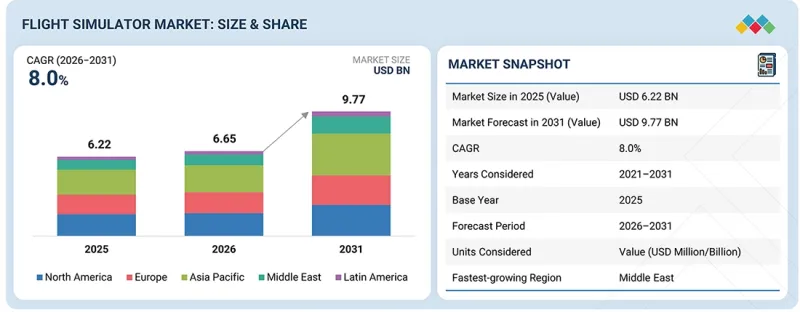
비행 시뮬레이터 시장 규모는 2026년 66억 5,000만 달러에서 2031년까지 97억 7,000만 달러에 이르고, CAGR 8.0%로 성장할 것으로 예측됩니다.
| 조사 범위 | |
|---|---|
| 조사 대상 기간 | 2020-2031년 |
| 기준연도 | 2025년 |
| 예측 기간 | 2026-2031년 |
| 산정 단위 | 금액(10억 달러) |
| 부문 | 솔루션별, 유형별, 기술별, 용도별, 최종 용도별, 지역별 |
| 대상 지역 | 북미, 유럽, 아시아태평양, 기타 지역 |
비행 시뮬레이터 시장은 조종사 훈련 수요 증가, 장비 확충, 재훈련 요건의 강화, 그리고 비상 상황이나 복잡한 절차에 대한 보다 안전한 훈련에 힘입어 성장하고 있습니다. 항공사, 비행 학교, 국방 기관, 무인 항공기(UAV) 운영 업체 및 첨단 항공 모빌리티 기업들은 항공기 사용 빈도를 줄이고, 훈련 위험을 완화하며, 전 세계적으로 승무원의 자격을 유지하기 위해 시뮬레이터를 활용하고 있습니다.
'솔루션별로는 예측 기간 동안 서비스 부문이 주요 부문이 될 것으로 전망됩니다.'
서비스 부문은 시뮬레이터에 지속적인 유지보수 활동이 필수적이라는 점을 배경으로 주도적인 위치를 차지할 것으로 전망됩니다. 여기에는 최적의 성능과 안전성을 확보하기 위한 자격 확인 실시, 최신 기술을 적용하기 위한 소프트웨어 업데이트, 현실적이고 최신의 환경을 유지하기 위한 시각적 데이터베이스 업데이트, 그리고 마모된 부품을 교체하기 위한 예비 부품 제공 등이 포함됩니다. 또한, 효과적인 훈련을 위해서는 강사의 지원이 필수적이며, 이를 통해 사용자가 시뮬레이터의 기능을 최대한 활용할 수 있게 됩니다. 이러한 지속적인 수요는 시뮬레이터 납품 후에도 계속될 것이며, 항공사, 훈련 센터, 국방 기관 모두에 영향을 미칠 것입니다.
'기술별로는 몰입형 헤드마운트 디스플레이 시스템/VR-MR 트레이너 구성 부문이 예측 기간 동안 가장 높은 연평균 성장률(CAGR)을 보일 것으로 전망됩니다'
VR/MR 훈련 방식은 그 수많은 장점 덕분에 가장 큰 시장 점유율을 차지할 것으로 예측됩니다. 이러한 시스템은 조종석 조작, 비상 상황, 임무 계획, UAV(무인 항공기) 훈련, AAM(항공기 간) 훈련 등 다양한 시나리오에 걸친 반복 훈련을 위해 범용성이 높고 몰입감 있는 환경을 제공합니다. VR/MR 트레이너의 주요 장점은 기존의 풀플라이트 시뮬레이터에 비해 초기 도입 비용이 저렴하고, 훈련 프로그램에 도입하기 쉽다는 점입니다. 또한, 필요한 물리적 공간이 대폭 줄어들기 때문에 다양한 훈련 시설에 도입하기가 용이합니다. 훈련 모듈의 신속하고 효율적인 업데이트 기능을 통해 컨텐츠를 항상 최신 상태로 유지할 수 있으며, 장기간의 가동 중단이나 고액의 업그레이드 비용을 피할 수 있습니다. 전반적으로, 합리적인 가격, 공간 활용도의 우수성, 유지보수의 용이성이 결합되어 VR 및 MR 훈련 구성은 현대의 훈련 요구에 있어 매력적인 선택지가 되고 있습니다.
'예측 기간 동안 북미가 두 번째로 큰 시장 점유율을 차지할 것으로 전망된다'
북미는 시뮬레이션 기술의 탄탄한 기반을 바탕으로 시장 점유율 2위를 차지할 것으로 전망됩니다. 이 지역에는 다수의 비행 시뮬레이터가 도입되어 있으며, 대형 항공사, 비즈니스 항공 업체, 국방 훈련 프로그램 등 다양한 사용자의 요구를 충족시키고 있습니다. 각 OEM 업체들의 강력한 존재감이 시장 상황을 더욱 공고히 하고 있습니다. 정기적인 조종사 자격 취득, 지속적인 재인증 검사, 항공기 업그레이드, 종합적인 시뮬레이터 유지보수, 그리고 무인항공기(UAV) 훈련에 대한 수요가 이 지역의 항공 시뮬레이션 시장 호황에 기여하고 있습니다.
CAE Inc.(캐나다), FlightSafety International(미국), Thales(프랑스), Airbus(네덜란드) 및 TRU Simulation+Training Inc.(미국)는 비행 시뮬레이터 시장의 주요 기업 중 일부입니다.
조사 범위
본 시장 조사는 다양한 부문 및 하위 부문에 걸친 비행 시뮬레이터 시장을 대상으로 합니다. 본 조사는 다양한 분야 및 지역에서 이 시장 규모와 성장 잠재력을 추정하는 것을 목적으로 합니다. 또한, 시장 내 주요 기업에 대한 상세한 경쟁 분석, 기업 프로파일, 제품 및 사업 내용에 관한 주요 분석 결과, 최근 동향, 그리고 각 기업이 채택하고 있는 주요 시장 전략에 대해서도 다루고 있습니다.
이 보고서를 구매해야 하는 이유
본 보고서는 시장을 선도하는 기업과 신규 진출기업을 대상으로, 비행 시뮬레이터 시장 전체의 매출액에 관한 가장 정확한 추정치를 제공합니다. 또한, 이해관계자들이 경쟁 구도를 이해하고, 자사의 비즈니스를 더 나은 위치로 이끌며, 적절한 시장 진출 전략을 수립하기 위한 추가적인 인사이트를 얻는 데 도움이 됩니다. 또한, 본 보고서는 이해관계자들이 시장 동향을 파악하는 데 도움이 되며, 주요 시장 성장 촉진요인, 억제요인, 과제 및 기회에 관한 정보를 제공합니다.
본 보고서에서는 다음 사항에 대한 인사이트를 제공합니다.
- 시장 성장 촉진요인(조종사의 필수 훈련 시간, 항공 여객 수송량 증가), 제약 요인(높은 초기 구입 비용, 규제 인증 지연), 기회(첨단 항공 모빌리티(AAM)와의 통합, 실제 비행 운영 비용), 과제(OEM 고유의 데이터에 대한 접근, 네트워크 사이버 보안 위험)
- 시장 침투도 : 시장을 선도하는 주요 기업들이 제공하는 비행 시뮬레이터에 관한 종합적인 정보
- 제품 개발/혁신 : 시장의 향후 기술 동향, 연구개발 활동 및 신제품 출시에 관한 상세한 분석
- 시장 개발: 다양한 지역의 수익성이 높은 시장에 대한 종합적인 정보
- 시장의 다양화: 시장의 신제품, 미개척 지역, 최근 동향 및 투자에 관한 종합적인 정보
- 경쟁사 분석 : 시장을 선도하는 주요 기업의 시장 점유율, 성장 전략, 제품 및 생산 능력에 대한 상세한 평가
자주 묻는 질문
목차
제1장 서론
제2장 주요 요약
제3장 프리미엄 인사이트
제4장 시장 개요
제5장 업계 동향
제6장 기술 진보, AI의 영향, 특허, 혁신, 그리고 향후 응용
제7장 지속가능성과 규제 상황
제8장 고객 현황과 구매 행동
제9장 비행 시뮬레이터 시장(솔루션별) : 시장 규모 및 2031년까지 예측 - 100만 달러 및 대수)
제10장 비행 시뮬레이터 시장(유형별) : 시장 규모 및 2031년까지 예측 - 100만 달러)
제11장 비행 시뮬레이터 시장(기술별) : 시장 규모 및 2031년까지 예측 - 100만 달러)
제12장 비행 시뮬레이터 시장(용도별) : 시장 규모 및 2031년까지 예측 - 100만 달러)
제13장 비행 시뮬레이터 시장(최종 용도별) : 시장 규모 및 2031년까지 예측 - 100만 달러)
제14장 비행 시뮬레이터 시장(지역별) : 시장 규모 및 2031년까지 예측 - 100만 달러 및 대수)
제15장 경쟁 구도
제16장 기업 개요
제17장 조사 방법
제18장 부록
LSH 26.07.20The flight simulator market is projected to grow from USD 6.65 billion in 2026 to USD 9.77 billion by 2031 at a CAGR of 8.0%.
| Scope of the Report | |
|---|---|
| Years Considered for the Study | 2020-2031 |
| Base Year | 2025 |
| Forecast Period | 2026-2031 |
| Units Considered | Value (USD Billion) |
| Segments | By Type, End Use, Technology and Region |
| Regions covered | North America, Europe, APAC, RoW |
The flight simulator market is driven by rising pilot training needs, fleet expansion, stricter recurrent training, and safer practice for emergencies and complex procedures. Airlines, flight schools, defense forces, UAV operators, and advanced air mobility firms use simulators to reduce aircraft use, lower training risk, and keep crews qualified globally.
"By solution, the services segment to be dominant segment during forecast period"
The services segment is projected to take the lead, driven by the fact that simulators necessitate a range of continuous maintenance activities. These include conducting qualification checks to ensure optimal performance and safety, implementing software updates to incorporate the latest technologies, refreshing visual databases to maintain realistic and up-to-date environments, and providing spare parts to replace worn components. Additionally, instructor support is crucial for effective training, ensuring that users can fully leverage the capabilities of the simulators. These ongoing needs will remain prevalent even after the simulators have been delivered, impacting airlines, training centers, and defense organizations alike.
"By technology, immersive head-mounted display systems/VR-MR trainer configurations segment to register the highest CAGR during forecast period"
VR/MR training configurations are estimated to capture the largest market share due to their numerous advantages. These systems provide a versatile and immersive environment for repeated practice across various scenarios, including cockpit operations, emergency situations, mission planning, UAV training, and AAM exercises. A key benefit of VR/MR trainers is their lower initial setup costs in comparison to traditional full-flight simulators, making them more accessible for training programs. Additionally, they require considerably less physical space, allowing for easier implementation in diverse training facilities. The rapid and efficient update capability of the training modules ensures that the content remains current and relevant, eliminating extensive downtime or costly upgrades. Overall, the combination of affordability, space efficiency, and ease of maintenance makes VR and MR training configurations an attractive option for modern training needs.
"North America to account for second largest market share during forecast period"
North America is projected to hold the second-largest market share, driven by a robust foundation of simulation technology. This region boasts a significant number of flight simulators, catering to a variety of users, including major airlines, business aviation entities, and defense training programs. The strong presence of OEMs further enhances the market landscape. The demand for regular pilot qualifications, ongoing recurrent checks, aircraft upgrades, comprehensive simulator maintenance, and training for UAVs all contribute to the thriving aviation simulation market in this area.
The breakdown of profiles for primary participants in the Flight Simulator market is provided below:
- By Company Type: Tier 1 - 40%, Tier 2 - 30%, and Tier 3 - 30%
- By Designation: Directors - 20%, C-level Executives - 10%, and Others (Managers and Other Non-C-level Executives) - 70%
- By Region: North America - 25%, Europe - 15%, Asia Pacific - 40%, Middle East - 15%, Latin America - 3%, and Africa - 2%
CAE Inc. (Canada), FlightSafety International (US), Thales (France), Airbus (Netherlands), and TRU Simulation + Training Inc (US) are some of the key players in the flight simulator market.
Research Coverage
This market study covers the Flight Simulator market across various segments and subsegments. It aims to estimate the size and growth potential of this market across different parts and regions. This study also includes an in-depth competitive analysis of key players in the market, their company profiles, key observations on their products and business offerings, recent developments, and the key market strategies they have adopted.
Reasons to Buy This Report
The report will help market leaders/new entrants with information on the closest approximations of revenue for the overall Flight Simulator market. It will also help stakeholders understand the competitive landscape and gain more insights to position their businesses better and plan suitable go-to-market strategies. The report will also help stakeholders understand the market pulse and will provide information on key market drivers, restraints, challenges, and opportunities.
The report provides insights into the following pointers:
- Market drivers (mandatory pilot training hours, increase in air transport passenger traffic), restraints (high upfront purchase capital, and regulatory certification backlogs), opportunities (advanced air mobility (AAM) integration, and live flight operating expenses), challenges (OEM proprietary data access and network cybersecurity risks)
- Market Penetration: Comprehensive information on flight simulators offered by the top players in the market
- Product Development/Innovation: Detailed insights into upcoming technologies, research & development activities, and product launches in the market
- Market Development: Comprehensive information about lucrative markets across varied regions
- Market Diversification: Exhaustive information about new products, untapped geographies, recent developments, and investments in the market
- Competitive Assessment: In-depth assessment of market share, growth strategies, products, and manufacturing capabilities of leading players in the market
TABLE OF CONTENTS
1 INTRODUCTION
- 1.1 STUDY OBJECTIVES
- 1.2 MARKET DEFINITION
- 1.3 STUDY SCOPE
- 1.3.1 MARKET SEGMENTATION AND REGIONAL SNAPSHOT
- 1.3.2 INCLUSIONS AND EXCLUSIONS
- 1.3.3 YEARS CONSIDERED
- 1.4 CURRENCY CONSIDERED
- 1.5 STAKEHOLDERS
2 EXECUTIVE SUMMARY
- 2.1 MARKET HIGHLIGHTS AND KEY INSIGHTS
- 2.2 KEY MARKET PARTICIPANTS: MAPPING OF STRATEGIC DEVELOPMENTS
- 2.3 DISRUPTIVE TRENDS IN FLIGHT SIMULATORS MARKET
- 2.4 HIGH GROWTH SEGMENTS
- 2.5 REGIONAL SNAPSHOT: MARKET SIZE, GROWTH RATE, AND FORECAST
3 PREMIUM INSIGHTS
- 3.1 ATTRACTIVE OPPORTUNITIES FOR PLAYERS IN FLIGHT SIMULATORS MARKET
- 3.2 FLIGHT SIMULATORS MARKET, BY TYPE
- 3.3 FLIGHT SIMULATORS MARKET, BY TECHNOLOGY
- 3.4 FLIGHT SIMULATORS MARKET, BY APPLICATION
- 3.5 FLIGHT SIMULATORS MARKET, BY END-USE
4 MARKET OVERVIEW
- 4.1 INTRODUCTION
- 4.2 MARKET DYNAMICS
- 4.2.1 DRIVERS
- 4.2.1.1 Mandatory pilot training hours
- 4.2.1.2 Increase in air transport passenger traffic
- 4.2.1.3 Commercial and military fleet expansion
- 4.2.2 RESTRAINTS
- 4.2.2.1 High upfront purchase capital
- 4.2.2.2 Regulatory certification backlogs
- 4.2.3 OPPORTUNITIES
- 4.2.3.1 Advanced air mobility (AAM) integration
- 4.2.3.2 Live flight operating expenses
- 4.2.4 CHALLENGES
- 4.2.4.1 OEM proprietary data access
- 4.2.4.2 Network cybersecurity risks
- 4.2.1 DRIVERS
- 4.3 UNMET NEEDS AND WHITE SPACES IN FLIGHT SIMULATORS MARKET
- 4.4 INTER-CONNECTED MARKETS AND CROSS-SECTOR OPPORTUNITIES
- 4.5 STRATEGIC MOVES BY TIER 1/2/3 PLAYERS
- 4.5.1 STRATEGIC MOVES BY TIER 1, 2, AND 3 PLAYERS
5 INDUSTRY TRENDS
- 5.1 INTRODUCTION
- 5.2 ECOSYSTEM ANALYSIS
- 5.3 VALUE CHAIN ANALYSIS
- 5.4 PRICING ANALYSIS
- 5.4.1 AVERAGE SELLING PRICE OF FLIGHT SIMULATORS, BY TYPE
- 5.4.2 AVERAGE SELLING PRICE, BY REGION
- 5.5 TRADE ANALYSIS
- 5.5.1 IMPORT SCENARIO (HS CODE 88052100)
- 5.5.2 EXPORT SCENARIO (HS CODE 88052100)
- 5.6 CASE STUDIES
- 5.6.1 CASE STUDY 1: CAE INC. DELIVERS LARGE-SCALE ROTARY-WING SYNTHETIC TRAINING INFRASTRUCTURE FOR MILITARY FLIGHT SCHOOL
- 5.6.2 CASE STUDY 2: L3HARRIS LINK SIMULATION & TRAINING UNIFIES MANNED AND UNMANNED AIRCREW REHEARSAL ENVIRONMENTS
- 5.6.3 CASE STUDY 3: THALES GROUP IMPLEMENTS HIGH-FIDELITY TYPE-RATING SIMULATION FOR COMMERCIALLY DEPLOYED FLEETS
- 5.7 INVESTMENT & FUNDING SCENARIO
- 5.8 TRENDS & DISRUPTIONS IMPACTING CUSTOMER BUSINESS
- 5.9 OPERATIONAL DATA
- 5.10 TOTAL COST OF OWNERSHIP
- 5.10.1 INITIAL COSTS
- 5.10.2 TRAINING AND SUPPORT COSTS
- 5.10.3 ANNUAL OPERATIONS & MAINTENANCE COSTS
- 5.10.4 MID-LIFE UPGRADE COSTS
- 5.10.5 OTHER COSTS
- 5.11 MACROECONOMIC OUTLOOK
- 5.11.1 INTRODUCTION
- 5.11.2 GDP TRENDS AND FORECAST
- 5.11.3 TRENDS IN GLOBAL FLIGHT SIMULATORS MARKET
- 5.12 BILL OF MATERIALS (BOM ANALYSIS)
- 5.13 BUSINESS MODELS
- 5.13.1 TRAINING AS A SERVICE (TAAS) / WET LEASING
- 5.13.2 SIMULATOR DRY LEASING
- 5.13.3 OUTRIGHT SALE WITH AFTERMARKET LIFECYCLE SUPPORT
6 TECHNOLOGICAL ADVANCEMENTS, AI-DRIVEN IMPACT, PATENTS, INNOVATIONS, AND FUTURE APPLICATIONS
- 6.1 KEY EMERGING TECHNOLOGIES
- 6.1.1 ADVANCED VISUAL SYSTEMS, IMAGE GENERATORS, AND TERRAIN DATABASES
- 6.1.2 AI/ML-BASED ASSESSMENT, DEBRIEFING, AND ADAPTIVE SCENARIO GENERATION
- 6.1.3 HIGH-FIDELITY FLIGHT DYNAMICS, CONTROL LOADING, AND MOTION CUEING
- 6.2 COMPLEMENTARY TECHNOLOGIES
- 6.2.1 MOTION CUEING & HAPTIC FEEDBACK TECHNOLOGIES
- 6.3 ADJACENT TECHNOLOGIES
- 6.3.1 LIVE, VIRTUAL, AND CONSTRUCTIVE (LVC) AND DISTRIBUTED MISSION TRAINING NETWORKS
- 6.3.2 ADVANCED AIR TRAFFIC CONTROL (ATC), AIRSPACE, AND AIRPORT ENVIRONMENT SIMULATION
- 6.4 TECHNOLOGY/PRODUCT ROADMAP
- 6.5 PATENT ANALYSIS
- 6.6 FUTURE APPLICATIONS
- 6.7 IMPACT OF AI/GENERATIVE AI ON FLIGHT SIMULATORS MARKET
- 6.7.1 TOP USE CASES AND POTENTIAL IN FLIGHT SIMULATORS MARKET
- 6.7.2 BEST PRACTICES FOLLOWED BY MANUFACTURERS IN FLIGHT SIMULATORS MARKET
- 6.7.3 CASE STUDIES OF AI IMPLEMENTATION IN FLIGHT SIMULATORS MARKET
- 6.7.4 INTERCONNECTED ADJACENT ECOSYSTEM AND IMPACT ON MARKET PLAYERS
- 6.7.5 CLIENTS' READINESS TO ADOPT GENERATIVE AI
- 6.8 SUCCESS STORIES AND REAL-WORLD APPLICATIONS
7 SUSTAINABILITY AND REGULATORY LANDSCAPE
- 7.1 REGIONAL REGULATIONS AND COMPLIANCE
- 7.1.1 REGULATORY BODIES, GOVERNMENT AGENCIES, AND OTHER ORGANIZATIONS
- 7.2 REGULATORY FRAMEWORK
- 7.3 INDUSTRY STANDARDS
- 7.4 SUSTAINABILITY INITIATIVES
- 7.4.1 CARBON IMPACT AND ECO-APPLICATIONS OF GRAPHENE
8 CUSTOMER LANDSCAPE & BUYER BEHAVIOR
- 8.1 DECISION-MAKING PROCESS
- 8.2 BUYERS, STAKEHOLDERS, AND BUYING EVALUATION CRITERIA
- 8.2.1 KEY STAKEHOLDERS IN BUYING PROCESS
- 8.2.2 BUYING CRITERIA
- 8.3 ADOPTION BARRIERS & INTERNAL CHALLENGES
- 8.4 UNMET NEEDS FROM VARIOUS END-USE INDUSTRIES
9 FLIGHT SIMULATORS MARKET, BY SOLUTION (MARKET SIZE & FORECAST TO 2031 - USD MILLION & UNITS)
- 9.1 INTRODUCTION
- 9.2 HARDWARE
- 9.2.1 AIRCRAFT-SPECIFIC PHYSICAL TRAINING ENVIRONMENTS TO DRIVE MARKET
- 9.2.2 COCKPIT AND CABIN REPLICAS
- 9.2.3 VISUAL DISPLAY SYSTEMS AND PROJECTORS
- 9.2.4 CONTROL LOADING AND FLIGHT CONTROLS
- 9.2.5 INSTRUCTOR OPERATING STATION
- 9.2.6 AVIONICS PANELS, GAUGES, AND INTERFACES
- 9.2.7 HAPTIC, SENSOR TRACKING, AND ELECTRONICS
- 9.2.8 MOTION PLATFORMS
- 9.3 SOFTWARE
- 9.3.1 AIRCRAFT-SPECIFIC SIMULATION LOGIC AND TRAINING DATA INTEGRATION TO DRIVE MARKET
- 9.3.2 SIMULATION ENGINE
- 9.3.3 SCENARIO GENERATION AND THREAT/WEATHER LIBRARIES
- 9.3.4 TERRAIN, AIRPORT, AND VISUAL DATABASES
- 9.3.5 AI ASSESSMENT AND AFTER-ACTION REVIEW MODULE
- 9.3.6 DIGITAL TWIN MODELS
- 9.3.7 LMS AND TRAINING MANAGEMENT INTEGRATION
- 9.3.8 FLIGHT DYNAMICS AND AIRCRAFT SYSTEM MODELS
- 9.4 SERVICES
- 9.4.1 SIMULATOR AVAILABILITY, REGULATORY READINESS, AND LIFECYCLE SUPPORT TO DRIVE MARKET
- 9.4.2 MAINTENANCE AND SUPPORT
- 9.4.3 SOFTWARE UPGRADES AND DATABASE UPDATES
- 9.4.4 INSTALLATION, INTEGRATION, AND COMMISSIONING
- 9.4.5 CERTIFICATION AND QUALIFICATION SUPPORT
- 9.4.6 HARDWARE UPGRADES AND RETROFITS
- 9.4.7 TRAINING-AS-A-SERVICE
10 FLIGHT SIMULATORS MARKET, BY TYPE (MARKET SIZE & FORECAST TO 2031-USD MILLION)
- 10.1 INTRODUCTION
- 10.2 FULL FLIGHT SIMULATORS
- 10.2.1 AIRCRAFT-SPECIFIC FULL-MOTION TRAINING AND REGULATORY QUALIFICATION NEEDS TO DRIVE MARKET
- 10.3 FLIGHT TRAINING DEVICES
- 10.3.1 LOWER-COST AIRCRAFT-SPECIFIC PROCEDURE AND SYSTEMS TRAINING TO DRIVE MARKET
- 10.4 COCKPIT PROCEDURE TRAINERS
- 10.4.1 COCKPIT FLOW PRACTICE AND PROCEDURE FAMILIARIZATION TO DRIVE MARKET
- 10.5 PART-TASK TRAINERS
- 10.5.1 TASK-SPECIFIC SKILL PRACTICE BEFORE FULL SIMULATOR SESSIONS TO DRIVE MARKET
11 FLIGHT SIMULATORS MARKET, BY TECHNOLOGY (MARKET SIZE & FORECAST TO 2031-USD MILLION)
- 11.1 INTRODUCTION
- 11.2 FIXED-BASE SYSTEM
- 11.2.1 PROCEDURE-BASED TRAINING WITHOUT FULL-MOTION INFRASTRUCTURE TO DRIVE SEGMENTAL GROWTH
- 11.3 FULL MOTION SYSTEM
- 11.3.1 MOTION-CUE-BASED PILOT HANDLING AND RECURRENT TRAINING TO DRIVE SEGMENTAL GROWTH
- 11.4 IMMERSIVE HEAD-MOUNTED DISPLAY SYSTEM/VR-MR TRAINER CONFIGURATION
- 11.4.1 IMMERSIVE COCKPIT PRACTICE AND SPACE-EFFICIENT TRAINING ACCESS TO DRIVE SEGMENTAL GROWTH
12 FLIGHT SIMULATORS MARKET, BY APPLICATION (MARKET SIZE & FORECAST TO 2031-USD MILLION)
- 12.1 INTRODUCTION
- 12.2 COMMERCIAL AVIATION
- 12.2.1 COMMERCIAL AVIATION FLEET TRAINING AND RECURRENT QUALIFICATION NEEDS TO DRIVE MARKET
- 12.2.2 NARROW-BODY AIRCRAFT
- 12.2.3 WIDE-BODY AIRCRAFT
- 12.2.4 REGIONAL TRANSPORT AIRCRAFT
- 12.2.5 COMMERCIAL HELICOPTERS
- 12.3 BUSINESS & GENERAL AVIATION
- 12.3.1 BUSINESS AND GENERAL AVIATION PILOT PROFICIENCY AND AIRCRAFT FAMILIARIZATION NEEDS TO DRIVE MARKET
- 12.3.2 BUSINESS JETS
- 12.3.3 LIGHT AIRCRAFT
- 12.4 MILITARY AVIATION
- 12.4.1 MILITARY AVIATION MISSION READINESS AND AIRCRAFT-SPECIFIC CREW TRAINING TO DRIVE MARKET
- 12.4.2 FIGHTER AIRCRAFT
- 12.4.3 TRANSPORT AIRCRAFT
- 12.4.4 SPECIAL MISSION AIRCRAFT
- 12.4.5 MILITARY HELICOPTERS
- 12.5 UNMANNED AERIAL VEHICLES
- 12.5.1 UNMANNED AERIAL VEHICLE OPERATOR TRAINING AND MISSION REHEARSAL NEEDS TO DRIVE MARKET
- 12.5.2 FIXED-WING UAV
- 12.5.3 ROTARY-WING UAV
- 12.5.4 FIXED-WING HYBRID VTOL UAV
- 12.6 ADVANCED AIR MOBILITY
- 12.6.1 ADVANCED AIR MOBILITY PILOT TRAINING AND POWERED-LIFT OPERATING READINESS TO DRIVE MARKET
- 12.6.2 AIR TAXI
- 12.6.3 AIR SHUTTLES & AIR METROS
- 12.6.4 AIR AMBULANCE & MEDICAL EMERGENCY VEHICLES
- 12.6.5 PERSONAL AERIAL VEHICLES
13 FLIGHT SIMULATORS MARKET, BY END-USE (MARKET SIZE & FORECAST TO 2031-USD MILLION)
- 13.1 INTRODUCTION
- 13.2 PILOT TRAINING
- 13.2.1 PILOT TRAINING REQUIREMENTS AND AIRCRAFT-SPECIFIC PROFICIENCY NEEDS TO DRIVE MARKET
- 13.2.2 INSTRUMENT FLIGHT RULES (IFR) TRAINING
- 13.2.3 BASIC PROCEDURE TRAINING
- 13.2.4 MULTI-CREW COOPERATION (MCC) & JET TRANSITION
- 13.2.5 EMERGENCY & ABNORMAL OPERATIONS
- 13.2.6 TYPE RATING
- 13.3 MISSION & TACTICAL TRAINING
- 13.3.1 MISSION-SPECIFIC CREW READINESS AND TACTICAL SCENARIO PRACTICE TO DRIVE MARKET
- 13.3.2 COMBAT & WEAPONRY TRAINING
- 13.3.3 DEFENSIVE ELECTRONIC WARFARE
- 13.3.4 INTERCONNECTED FLEET OPERATIONS
- 13.3.5 DANGEROUS OPERATIONS TRAINING
14 FLIGHT SIMULATORS MARKET, BY REGION (MARKET SIZE & FORECAST TO 2031 - USD MILLION & UNITS)
- 14.1 INTRODUCTION
- 14.2 NORTH AMERICA
- 14.2.1 US
- 14.2.1.1 Growing pilot training and demand across commercial and military aviation to drive market
- 14.2.2 CANADA
- 14.2.2.1 Expansion of flight simulation infrastructure to strengthen market growth
- 14.2.1 US
- 14.3 EUROPE
- 14.3.1 UK
- 14.3.1.1 Strengthening defense modernization and advanced simulation technologies to drive market
- 14.3.2 GERMANY
- 14.3.2.1 Growing defense procurement and aviation training capacity to drive market
- 14.3.3 FRANCE
- 14.3.3.1 Indigenous aerospace programs and export-oriented military aviation training to drive market
- 14.3.4 ITALY
- 14.3.4.1 Expansion of integrated flight training systems and multi-domain simulation capabilities to drive market
- 14.3.5 SPAIN
- 14.3.5.1 Expansion of aviation simulation export capabilities and international training services to drive market
- 14.3.6 POLAND
- 14.3.6.1 Expansion of commercial aviation training infrastructure and specialized simulation applications to drive market
- 14.3.7 REST OF EUROPE
- 14.3.1 UK
- 14.4 ASIA PACIFIC
- 14.4.1 CHINA
- 14.4.1.1 Expansion of indigenous commercial aircraft programs and aviation training ecosystems to drive market
- 14.4.2 JAPAN
- 14.4.2.1 Rising demand for aircraft type-specific pilot training and domestic simulator capacity expansion to drive market
- 14.4.3 INDIA
- 14.4.3.1 Simulator-centric pilot qualification and expansion of indigenous simulation ecosystem to drive market
- 14.4.4 SOUTH KOREA
- 14.4.4.1 Integration of artificial intelligence into next-generation pilot training systems to drive market
- 14.4.5 AUSTRALIA
- 14.4.5.1 Sovereign aircrew training modernization and domestic simulation capability to drive market
- 14.4.6 THAILAND
- 14.4.6.1 Expansion as certified flight simulation hub in Asia Pacific to drive market
- 14.4.7 REST OF ASIA PACIFIC
- 14.4.1 CHINA
- 14.5 MIDDLE EAST
- 14.5.1 GCC
- 14.5.1.1 UAE
- 14.5.1.1.1 Expansion of Middle East's largest flight simulation and pilot training hub to drive market
- 14.5.1.2 Saudi Arabia
- 14.5.1.2.1 Expansion of airline pilot training infrastructure and advanced flight simulation capacity to drive market
- 14.5.1.3 Turkey
- 14.5.1.3.1 Expansion of airline pilot training infrastructure and advanced flight simulation capacity to drive market
- 14.5.1.1 UAE
- 14.5.2 REST OF MIDDLE EAST
- 14.5.1 GCC
- 14.6 LATIN AMERICA
- 14.6.1 BRAZIL
- 14.6.1.1 Growing demand for regional aviation training services and certified simulator-based pilot qualification to drive market
- 14.6.2 ARGENTINA
- 14.6.2.1 Fleet modernization and transition training requirements across the civil and specialized aviation to drive market
- 14.6.3 REST OF LATIN AMERICA
- 14.6.1 BRAZIL
- 14.7 AFRICA
- 14.7.1 SOUTH AFRICA
- 14.7.1.1 Expansion of airline pilot training capacity and certified flight training organizations to drive market
- 14.7.2 ALGERIA
- 14.7.2.1 Modernization of military aviation capabilities and expansion of domestic pilot training to accelerate flight simulator adoption
- 14.7.3 REST OF AFRICA
- 14.7.1 SOUTH AFRICA
15 COMPETITIVE LANDSCAPE
- 15.1 INTRODUCTION
- 15.2 KEY PLAYER STRATEGIES/RIGHT TO WIN, 2021-2026
- 15.3 REVENUE ANALYSIS, 2021-2025
- 15.4 MARKET SHARE ANALYSIS, 2025
- 15.5 BRAND/PRODUCT COMPARISON
- 15.6 COMPANY VALUATION AND FINANCIAL METRICS
- 15.7 COMPANY EVALUATION MATRIX: KEY PLAYERS, 2025
- 15.7.1 STARS
- 15.7.2 EMERGING LEADERS
- 15.7.3 PERVASIVE PLAYERS
- 15.7.4 PARTICIPANTS
- 15.7.5 COMPANY FOOTPRINT, KEY PLAYERS, 2025
- 15.7.5.1 Company footprint
- 15.7.5.2 Region footprint
- 15.7.5.3 End-use footprint
- 15.8 COMPANY EVALUATION MATRIX: STARTUPS/SMES, 2025
- 15.8.1 PROGRESSIVE COMPANIES
- 15.8.2 RESPONSIVE COMPANIES
- 15.8.3 DYNAMIC COMPANIES
- 15.8.4 STARTING BLOCKS
- 15.8.5 COMPETITIVE BENCHMARKING: STARTUPS/SMES, 2025
- 15.8.5.1 List of startups/SMEs
- 15.8.5.2 Competitive benchmarking of startups/SMEs
- 15.9 COMPETITIVE SCENARIO
- 15.9.1 PRODUCT LAUNCHES/DEVELOPMENTS
- 15.9.2 DEALS
- 15.9.3 OTHER DEVELOPMENTS
16 COMPANY PROFILES
- 16.1 KEY PLAYERS
- 16.1.1 CAE INC.
- 16.1.1.1 Business overview
- 16.1.1.2 Products/ Solutions/ Services offered
- 16.1.1.3 Recent developments
- 16.1.1.3.1 Product launches
- 16.1.1.3.2 Deals
- 16.1.1.3.3 Other developments
- 16.1.1.4 MnM View
- 16.1.1.4.1 Right to win
- 16.1.1.4.2 Strategic choices
- 16.1.1.4.3 Weaknesses and competitive threats
- 16.1.2 FLIGHTSAFETY INTERNATIONAL INC.
- 16.1.2.1 Business overview
- 16.1.2.2 Products/ Solutions/ Services offered
- 16.1.2.3 Recent developments
- 16.1.2.3.1 Product launches/developments
- 16.1.2.3.2 Deals
- 16.1.2.3.3 Other developments
- 16.1.2.4 MnM View
- 16.1.2.4.1 Right to win
- 16.1.2.4.2 Strategic choices
- 16.1.2.4.3 Weaknesses and competitive threats
- 16.1.3 ACRON AVIATION
- 16.1.3.1 Business overview
- 16.1.3.2 Products/ Solutions/ Services offered
- 16.1.3.3 Recent developments
- 16.1.3.3.1 Product launches
- 16.1.3.3.2 Deals
- 16.1.3.3.3 Other developments
- 16.1.4 THALES
- 16.1.4.1 Business overview
- 16.1.4.2 Products/ Solutions/ Services offered
- 16.1.4.3 Recent developments
- 16.1.4.3.1 Product developments
- 16.1.4.3.2 Deals
- 16.1.4.3.3 Other developments
- 16.1.4.4 MnM View
- 16.1.4.4.1 Right to win
- 16.1.4.4.2 Strategic choices
- 16.1.4.4.3 Weaknesses and competitive threats
- 16.1.5 TRU SIMULATION + TRAINING INC.
- 16.1.5.1 Business overview
- 16.1.5.2 Products/ Solutions/ Services offered
- 16.1.5.3 Recent developments
- 16.1.5.3.1 Product launches
- 16.1.5.3.2 Deals
- 16.1.5.3.3 Other developments
- 16.1.5.4 MnM View
- 16.1.5.4.1 Right to win
- 16.1.5.4.2 Strategic choices
- 16.1.5.4.3 Weaknesses and competitive threats
- 16.1.6 RTX
- 16.1.6.1 Business overview
- 16.1.6.2 Products/ Solutions/ Services offered
- 16.1.6.3 Recent developments
- 16.1.6.3.1 Product announcements
- 16.1.6.4 MnM View
- 16.1.6.4.1 Right to win
- 16.1.6.4.2 Strategic choices
- 16.1.6.4.3 Weaknesses and competitive threats
- 16.1.7 THE BOEING COMPANY
- 16.1.7.1 Business overview
- 16.1.7.2 Products/ Solutions/ Services offered
- 16.1.7.3 Recent developments
- 16.1.7.3.1 Deals
- 16.1.7.3.2 Other developments
- 16.1.8 AIRBUS
- 16.1.8.1 Business overview
- 16.1.8.2 Products/ Solutions/ Services offered
- 16.1.8.3 Recent developments
- 16.1.8.3.1 Deals
- 16.1.8.3.2 Other developments
- 16.1.9 LEONARDO S.P.A.
- 16.1.9.1 Business overview
- 16.1.9.2 Products/ Solutions/ Services offered
- 16.1.9.3 Recent developments
- 16.1.9.3.1 Product launches
- 16.1.9.3.2 Deals
- 16.1.9.3.3 Other developments
- 16.1.10 ELBIT SYSTEMS LTD.
- 16.1.10.1 Business overview
- 16.1.10.2 Products/ Solutions/ Services offered
- 16.1.10.3 Recent developments
- 16.1.10.3.1 Product announcements
- 16.1.11 LOCKHEED MARTIN CORPORATION
- 16.1.11.1 Business overview
- 16.1.11.2 Products/ Solutions/ Services offered
- 16.1.11.3 Recent developments
- 16.1.11.3.1 Product developments
- 16.1.11.3.2 Deals
- 16.1.11.3.3 Other developments
- 16.1.12 INDRA
- 16.1.12.1 Business overview
- 16.1.12.2 Products/ Solutions/ Services offered
- 16.1.12.3 Recent developments
- 16.1.12.3.1 Product launches/developments
- 16.1.12.3.2 Deals
- 16.1.12.3.3 Other developments
- 16.1.13 ALSIM
- 16.1.13.1 Business overview
- 16.1.13.2 Products/ Solutions/ Services offered
- 16.1.13.3 Recent developments
- 16.1.13.3.1 Product launches
- 16.1.13.3.2 Deals
- 16.1.13.3.3 Other developments
- 16.1.14 ELITE SIMULATION SOLUTIONS AG
- 16.1.14.1 Business overview
- 16.1.14.2 Products/ Solutions/ Services offered
- 16.1.14.3 Recent developments
- 16.1.14.3.1 Product launches
- 16.1.14.3.2 Deals
- 16.1.14.3.3 Other developments
- 16.1.15 AVION
- 16.1.15.1 Business overview
- 16.1.15.2 Products/ Solutions/ Services offered
- 16.1.15.3 Recent developments
- 16.1.15.3.1 Deals
- 16.1.15.3.2 Other developments
- 16.1.16 LOFT DYNAMICS
- 16.1.16.1 Business overview
- 16.1.16.2 Products/ Solutions/ Services offered
- 16.1.16.3 Recent developments
- 16.1.16.3.1 Product launches
- 16.1.16.3.2 Deals
- 16.1.16.3.3 Other developments
- 16.1.1 CAE INC.
- 16.2 OTHER PLAYERS
- 16.2.1 REISER SIMULATION AND TRAINING GMBH
- 16.2.2 PRECISION FLIGHT CONTROLS
- 16.2.3 FLIGHTDECK SOLUTIONS
- 16.2.4 ENTROL
- 16.2.5 VIRTUAL FLY S.L.
- 16.2.6 REDBIRD FLIGHT SIMULATIONS, INC.
- 16.2.7 QUANTUM3D
- 16.2.8 TRC SIMULATORS B.V.
- 16.2.9 SIMNEST AVIATION KFT
- 16.2.10 SOFTEKSIM
17 RESEARCH METHODOLOGY
- 17.1 RESEARCH DATA
- 17.1.1 SECONDARY DATA
- 17.1.1.1 Key data from secondary sources
- 17.1.2 PRIMARY DATA
- 17.1.2.1 Key data from primary sources
- 17.1.2.2 Breakdown of primary interviews
- 17.1.1 SECONDARY DATA
- 17.2 MARKET SIZE ESTIMATION
- 17.2.1 BOTTOM-UP APPROACH
- 17.2.2 TOP-DOWN APPROACH
- 17.2.3 MARKET SIZE CALCULATION FOR BASE YEAR
- 17.3 MARKET FORECAST APPROACH
- 17.3.1 SUPPLY SIDE
- 17.3.2 DEMAND SIDE
- 17.4 DATA TRIANGULATION
- 17.5 FACTOR ANALYSIS
- 17.6 RESEARCH ASSUMPTIONS
- 17.7 RESEARCH LIMITATIONS
- 17.8 RISK ASSESSMENT
18 APPENDIX
- 18.1 DISCUSSION GUIDE
- 18.2 ANNEXURE
- 18.3 KNOWLEDGESTORE: MARKETSANDMARKETS' SUBSCRIPTION PORTAL
- 18.4 CUSTOMIZATION OPTIONS
- 18.5 RELATED REPORTS
- 18.6 AUTHOR DETAILS


