
|
시장보고서
상품코드
2101321
EV 충전 케이블 시장 : 전원별(AC, DC), 충전 레벨별(레벨 1, 2, 3), 용도별(개인용, 공공용), 충전 모드별(모드 1, 2, 3, 4), 커넥터 유형별, 케이블 길이별, 케이블 유형별, 형상별, 직경별, 지역별 - 세계 예측(-2033년)EV Charging Cable Market by Power Supply (AC, DC), Charging Level (Level 1, 2 & 3), Application (Private, Public), Mode of Charging (Mode 1 & 2, 3 and 4), Connector Type, Cable Length, Cable Type, Shape, Diameter, and Region - Global Forecast to 2033 |
||||||

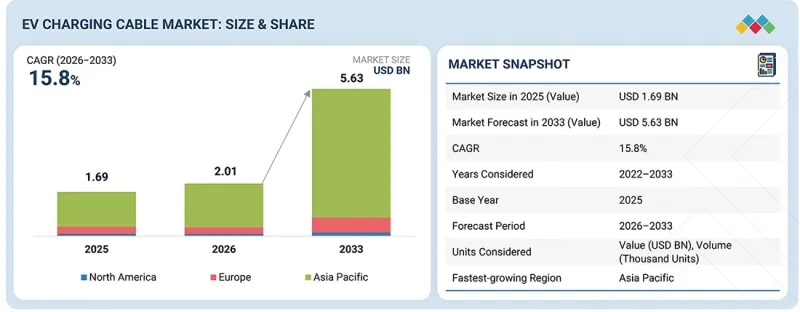
EV 충전 케이블 시장 규모는 2026년 20억 1,000만 달러에서 2033년에는 56억 3,000만 달러로 성장할 것으로 예상되며, CAGR은 15.8%에 달할 것으로 예측됩니다.
이러한 시장 성장을 주도하는 요인은 충전 인프라의 급속한 확대, 전기자동차 보급 확대, 고출력 충전 생태계로의 전환입니다. 배터리식 전기자동차의 보급률 상승에 따라 주거지, 직장, 목적지, 공공 충전 네트워크의 구축이 가속화되고 있으며, AC 및 DC의 모든 용도에서 충전 케이블 솔루션에 대한 지속적인 수요가 발생하고 있습니다.
| 조사 범위 | |
|---|---|
| 조사 대상 기간 | 2026-2033년 |
| 기준 연도 | 2025년 |
| 예측 기간 | 2026-2033년 |
| 단위 | 달러 |
| 부문 | 용도, 케이블 유형, 충전 레벨, 커넥터 유형, 충전 레벨, 직경, 피복재, 케이블 길이, 모드, 전원, 형상 |
| 대상 지역 | 아시아태평양, 유럽, 북미 |
인프라 구축에 있어 정부의 지원은 매우 중요한 역할을 하고 있습니다. 미국의 초당적 인프라 법안에서는 전기자동차(EV) 충전 인프라 구축에 75억 달러가 배정되었으며, 2030년까지 50만 기의 공공 충전기를 설치한다는 국가 목표가 설정되어 있습니다. 또한, 에너지·교통 합동 사무국(Joint Office of Energy and Transportation) 및 NREL의 조사에 따르면, 예상되는 전기자동차 보급 수준을 뒷받침하기 위해서는 2030년까지 미국에서 약 120만 기의 공공 충전기가 필요할 가능성이 있는 것으로 나타났습니다. 이에 반해, 현재 가동중인 일반 이용 가능한 충전 포트는 23만-24만 기 정도에 그치고 있습니다. 이러한 충전 설비의 급속한 확대로 인해, 특히 고출력 및 높은 가동률을 요구하는 충전 환경을 대상으로 충전 케이블 수요가 크게 증가할 것으로 예상됩니다.
업계 각사도 미래의 충전 수요에 대응하기 위해 동시에 투자를 확대하고 있습니다. 예를 들어, 2025년에 IONNA LLC는 BMW, 제너럴 모터스, 혼다, 현대, 기아, 메르세데스-벤츠, 스텔란티스 등 주요 자동차 제조사의 지원을 받아 향후 몇 년 동안 북미에 3만 개의 충전 베이를 설치할 계획을 재차 밝혔습니다. 또한, Tesla Inc.는 2025년에 전 세계 슈퍼차저 네트워크를 2020년의 약 1만 7,000개 커넥터에서 7만 개 이상으로 확대하여, 5년 동안 충전 인프라 구축을 4배로 늘렸다고 밝혔습니다. 아울러 2026년에는 Electrify America가 350kW를 지원하는 초고속 충전 네트워크를 확대하고 있습니다. 한편, CCS, NACS, 수랭식 충전 기술의 보급 확대에 따라 열 성능, 유연성, 내구성이 향상된 첨단 케이블 시스템에 대한 수요도 증가하고 있습니다.
"고출력 충전의 보급이 직경 20mm 초과 케이블에 대한 수요를 가속화"
직경 20mm 초과 부문은 전기자동차 충전 케이블 시장에서 가장 높은 성장률을 기록할 것으로 예측됩니다. 이는 주로 고출력 DC 급속 충전 인프라, 메가와트급 충전 시스템, 상용차용 충전 허브의 도입 확대가 주도할 것입니다. 대구경 케이블은 뛰어난 전류 수용 능력, 개선된 열 관리, 낮은 전송 손실을 제공하므로 250kW를 초과하는 충전 용도에 최적입니다. 배터리 용량이 큰 전기자동차의 보급이 확대됨에 따라 충전 시간 단축에 대한 수요가 높아지고 있어, 대전류 충전 솔루션으로의 전환이 가속화되고 있습니다. 또한, 차량 전동화 프로그램, 전기 버스 충전 네트워크, 대형 트럭용 충전 회랑의 확대로 인해 내구성과 운영 신뢰성이 향상된 견고한 케이블 아키텍처에 대한 수요가 증가할 것으로 예상됩니다.
업계 각사는 차세대 충전 요건에 대응하기 위해 고출력 충전 네트워크 및 첨단 케이블 기술에 대한 투자를 확대하고 있습니다. 예를 들어, 2025년 2월, IONNA LLC는 전미 규모의 충전 네트워크를 공식적으로 시작하며, 북미 전역에 3만 개가 넘는 초고속 충전 베이를 설치할 계획을 발표했습니다. 이 네트워크에는 최대 400kW의 전력을 공급하는 충전기가 도입될 예정이며, 더 큰 도체 단면적과 케이블 직경에 대응하는 대전류용 케이블 어셈블리 및 첨단 열 관리 솔루션이 필요하게 됩니다. 마찬가지로, 2025년 4월에는 ABB E-mobility가 최대 400kW의 출력을 갖추고 최대 4대의 전기자동차를 동시에 충전할 수 있는 일체형 충전기인 A400 All-in-One을 발표했습니다. 이 충전기에는 첨단 수랭식 케이블 기술이 적용되어 케이블의 유연성을 높이고 취급 시 부담을 줄이는 동시에 지속적인 고출력 충전을 가능하게 합니다. 이를 통해 대구경 충전 케이블에 대한 수요 확대가 뒷받침되고 있습니다. 또한, 2026년 3월에는 Kempower가 대형 전기 트럭 및 상용차 차량군을 위한 메가와트급 충전 시스템(MCS) 제품군을 확충하여 최대 1.2MW의 충전 용량을 지원하게 되었습니다. 메가와트급 충전 인프라의 도입으로 인해, 더 큰 도체 크기와 첨단 열 관리 성능을 갖춘 고전류 충전 케이블에 대한 수요가 증가할 것으로 전망됩니다.
"충전 인프라 확대로 북미, 고성장 시장으로서의 입지 확고히"
북미의 전기자동차 충전 케이블 시장은 충전 네트워크의 급속한 확대와 고출력 충전 인프라 이용 증가에 힘입어 성장하고 있습니다. 이 지역의 선도적 지위는 공공 충전 설비의 도입이 지속적으로 증가하고 있으며, 전기자동차 보급률이 높아지고 있고, 더 높은 통전 용량을 갖춘 첨단 케이블 솔루션이 필요한 급속 충전 생태계로의 전환이 진행되고 있다는 점에 의해 뒷받침되고 있습니다. 또한, 가정용 충전 설비의 꾸준한 보급이 모드 1 및 모드 2 충전 케이블에 대한 수요를 더욱 부추기고 있는 반면, 상용차 차량군의 전기화는 고출력 케이블 용도 분야에서 추가적인 기회를 창출하고 있습니다.
이 시장에서는 북미 전역에서 충전 설비 접근성을 확대하기 위해 충전 네트워크 사업자와 자동차 제조업체들의 대규모 투자가 진행되고 있습니다. 예를 들어, Tesla Inc.는 2025년에 슈퍼차저 네트워크를 확장했습니다. 이 네트워크는 2020년 전 세계 약 1만 7,000개에서 2025년에는 전 세계적으로 7만 개 이상의 커넥터로 증가했습니다. 이는 내구성이 뛰어나고 고성능인 충전 케이블에 대한 수요가 증가하고 있음을 보여줍니다. 또한, IONNA LLC는 2025년, 전기자동차의 장거리 이동 및 상업용 모빌리티 용도를 지원하기 위해 향후 수년 내에 북미에 최소 3만 기의 고출력 충전 베이를 설치할 계획을 발표했습니다. 아울러, Electrify America는 2026년까지 최대 350kW 충전기를 갖춘 초고속 충전 인프라를 확대하고 있으며, 차세대 전기자동차를 위해 설계된 대용량 케이블 구조로의 전환을 지원하고 있습니다. 이러한 동향은 북미 시장의 성장이 단순한 규제적 지원뿐만 아니라, 충전 밀도 확대, 출력 향상, 견고한 충전 생태계에 대한 장기적인 투자를 통해 점점 더 견인되고 있음을 보여줍니다.
본 보고서에서는 전 세계 전기자동차 충전 케이블 시장을 조사하여, 시장 개요, 시장 성장에 영향을 미치는 다양한 요인에 대한 분석, 기술 및 특허 동향, 법규 환경, 사례 연구, 시장 규모 추정 및 전망, 각종 분류·지역/주요 국가별 상세 분석, 경쟁 구도, 주요 기업 개요 등을 종합적으로 다루고 있습니다.
자주 묻는 질문
목차
제1장 소개
제2장 주요 요약
제3장 주요 인사이트
제4장 시장 개요
제5장 업계 동향
제6장 EV 충전 케이블 시장의 기술 진보, AI의 영향, 특허, 혁신, 향후 응용
제7장 지속가능성과 규제 상황
제8장 고객 상황과 구매 행동
제9장 EV 충전 케이블 시장 : 용도별
제10장 EV 충전 케이블 시장 : 케이블 유형별
제11장 EV 충전 케이블 시장 : 충전 레벨별
제12장 EV 충전 케이블 시장 : 커넥터 유형별
제13장 EV 충전 케이블 시장 : 직경별
제14장 EV 충전 케이블 시장 : 피복재별
제15장 EV 충전 케이블 시장 : 길이별
제16장 EV 충전 케이블 시장 : 모드별
제17장 EV 충전 케이블 시장 : 전원별
제18장 EV 충전 케이블 시장 : 형상별
제19장 EV 충전 케이블 시장 : 지역별
제20장 경쟁 구도
제21장 기업 개요
제22장 조사 방법
제23장 부록
KSM 26.08.03The EV charging cable market is projected to grow from USD 2.01 billion in 2026 to USD 5.63 billion by 2033, at a CAGR of 15.8%. The market is driven by the rapid expansion of charging infrastructure, increasing electric vehicle adoption, and the transition toward higher-power charging ecosystems. Rising penetration of battery electric vehicles is accelerating the deployment of residential, workplace, destination, and public charging networks, creating sustained demand for charging cable solutions across AC and DC applications.
| Scope of the Report | |
|---|---|
| Years Considered for the Study | 2026-2033 |
| Base Year | 2025 |
| Forecast Period | 2026-2033 |
| Units Considered | USD billion |
| Segments | Application, Cable Type, Charging Level, Connector Type, Charging Level, Diameter, Jacket Material, Length, Mode, Power Supply, Shape |
| Regions covered | Asia Pacific, Europe, North America |
Government support plays a pivotal role in infrastructure development, with the US Bipartisan Infrastructure Law allocating USD 7.5 billion for EV charging deployment and supporting the national objective of installing 500,000 public chargers by 2030. Furthermore, studies by the Joint Office of Energy and Transportation and NREL indicate that the United States may require approximately 1.2 million public chargers by 2030 to support projected EV adoption levels, compared with nearly 230,000-240,000 publicly accessible charging ports currently in operation. This substantial increase in charging installations is expected to generate significant demand for charging cables, particularly for high-power and high-utilization charging environments.
Industry participants are simultaneously scaling investments to address future charging requirements. For instance, in 2025, IONNA LLC reaffirmed plans to deploy 30,000 charging bays across North America over the coming years, supported by major automotive manufacturers including BMW, General Motors, Honda, Hyundai, Kia, Mercedes-Benz, and Stellantis. For instance, in 2025, Tesla Inc. expanded its global Supercharger footprint to more than 70,000 connectors, up from approximately 17,000 connectors in 2020, reflecting a fourfold increase in charging infrastructure deployment within five years. Additionally, in 2026, Electrify America is expanding its 350 kW ultra-fast charging network, while the growing adoption of CCS, NACS, and liquid-cooled charging technologies is increasing demand for advanced cable systems with enhanced thermal performance, flexibility, and durability.
"High-Power Charging Adoption Accelerates Demand for >20 mm Cables"
The >20 mm diameter segment is projected to register the highest growth in the EV charging cable market, primarily driven by the increasing deployment of high-power DC fast charging infrastructure, megawatt charging systems, and charging hubs for commercial vehicles. Larger diameter cables offer superior current-carrying capacity, improved thermal management, and lower transmission losses, making them well suited for charging applications exceeding 250 kW. The growing adoption of battery electric vehicles with larger battery capacities, coupled with increasing demand for reduced charging times, is accelerating the transition toward high-current charging solutions. In addition, the expansion of fleet electrification programs, electric bus charging networks, and heavy-duty truck charging corridors is expected to strengthen demand for robust cable architectures with enhanced durability and operational reliability.
Industry participants are increasingly investing in high-power charging networks and advanced cable technologies to support next-generation charging requirements. For instance, in February 2025, IONNA LLC officially launched its nationwide charging network and announced plans to deploy more than 30,000 ultra-fast charging bays across North America. The network will feature chargers delivering up to 400 kW, requiring high-current cable assemblies and advanced thermal management solutions that support larger conductor cross-sections and cable diameters. Similarly, in April 2025, ABB E-mobility introduced its A400 All-in-One charger, capable of delivering up to 400 kW and simultaneously charging up to four electric vehicles. The charger incorporates advanced liquid-cooled cable technology to improve cable flexibility, reduce handling effort, and enable continuous high-power charging, supporting increasing demand for larger-diameter charging cables. Furthermore, in March 2026, Kempower expanded its Megawatt Charging System (MCS) portfolio for heavy-duty electric trucks and commercial fleets, supporting charging capacities of up to 1.2 MW. The deployment of megawatt-scale charging infrastructure is expected to increase demand for high-current charging cables with larger conductor sizes and enhanced thermal management capabilities.
"Residential Charging Expansion Sustains Mode 1 & 2 Dominance"
Mode 1 and Mode 2 charging configurations account for the largest share of the EV charging cable market owing to their widespread use in residential, workplace, and destination charging applications. These charging modes provide cost advantages, ease of installation, and compatibility with existing electrical infrastructure, making them a preferred solution for private EV owners. Home charging is the dominant charging method in several mature EV markets, supporting sustained demand for Mode 1 and Mode 2 charging cables. The affordability of these systems, combined with the growing penetration of battery electric vehicles and plug-in hybrid electric vehicles, has reinforced their market leadership. Furthermore, increasing deployment of residential charging programs, multifamily housing charging solutions, and employer-supported charging initiatives is expected to maintain a significant installed base for Mode 1 and Mode 2 charging over the coming years.
Automotive manufacturers, charging equipment suppliers, and energy companies are expanding home and destination charging ecosystems, strengthening demand for Mode 1 and Mode 2 charging solutions. For instance, in March 2025, Wallbox launched the Pulsar Pro North America, its latest AC EV charger designed for shared residential and commercial charging applications, featuring smart connectivity, dynamic power sharing, and remote management capabilities. For instance, in April 2025, ChargePoint Holdings, Inc. introduced its next-generation AC charging architecture for residential, commercial, and fleet applications, featuring bidirectional charging, dynamic load management, and charging speeds of up to 19.2 kW, reinforcing the expansion of home and workplace charging infrastructure. Similarly, in November 2025, EVBox unveiled its Megawatt Charging System (MCS) charger at the Solutrans 2025 exhibition, expanding its portfolio for heavy-duty electric trucks and commercial vehicles while supporting the industry's transition toward ultra-high-power charging infrastructure.
"Charging Infrastructure Expansion Positions North America as a High-Growth Market"
North America's EV charging cable market is driven by the rapid expansion of charging networks and increasing utilization of high-power charging infrastructure. The region's leadership is supported by sustained growth in public charging deployments, rising EV penetration, and the increasing shift toward fast-charging ecosystems that require advanced cable solutions with higher current-carrying capabilities. The strong installed base of residential charging also reinforces demand for Mode 1 and Mode 2 charging cables, while commercial fleet electrification is creating additional opportunities for high-power cable applications.
The market has witnessed substantial investments from charging network operators and automotive manufacturers aimed at expanding charging accessibility across North America. For instance, in 2025, Tesla Inc. expanded its Supercharger network, which has grown from approximately 17,000 Superchargers globally in 2020 to more than 70,000 connectors worldwide by 2025, highlighting the increasing need for durable, high-performance charging cables. For instance, in 2025, IONNA LLC announced plans to deploy at least 30,000 high-power charging bays across North America in the coming years to support long-distance EV travel and commercial mobility applications. Additionally, in 2026, Electrify America is expanding its ultra-fast charging infrastructure with chargers rated up to 350 kW, supporting the transition toward higher-capacity cable architectures designed for next-generation electric vehicles. These developments indicate that North America's growth is increasingly driven by charging density expansion, power upgrades, and long-term investments in resilient charging ecosystems rather than solely by regulatory support.
In-depth interviews were conducted with CEOs, marketing directors, other innovation and technology directors, and executives from various key organizations operating in this market.
- By Company Type: Cable Manufacturers - 50%, OEMs - 40%, Others - 10%
- By Designation: CXOs - 20%, Directors - 30%, Others - 50%
- By Country: Asia Pacific - 40%, North America - 24%, Europe - 36%
The prominent players in the EV charging cable market include TE Connectivity (Switzerland), LEONI AG (Germany), Aptiv PLC (Ireland), Yazaki Corporation (Japan), and Prysmian Group (Italy). The market ranking was derived by considering a certain percentage of the segmental revenue for each of the companies mentioned above, along with their growth strategies and new products. These companies also offer extensive solutions in the EV charging cable industry.
Research Coverage:
The report covers the EV charging cable market by application (public and private), power supply (AC and DC), cable type (normal charging cable, high power charging cable, liquid cooled high power charging cable), diameter (<10 mm, 10-20 mm, >20 mm), length (2-5 meter, 6-10 meter, >10 meter), mode (mode 1 & 2, mode 3, and mode 4), charging level (level 1, level 2, and level 3), shape (straight and coiled), jacket material (all rubber jacket, thermoplastic elastomer (TPE) jacket, polyvinyl chloride (PVC) jacket), connector type (type 1, type 2, CCS 1, CCS2, CHADEMO, GB/T, NACS/TESLA CONNECTORS), and region (Asia Pacific, Europe, and North America). It covers the competitive landscape and company profiles of the major players in the EV charging cable market ecosystem.
The study also includes an in-depth competitive analysis of the key players in the market, along with their company profiles, key observations related to product and business offerings, recent developments, and key market strategies.
Key Benefits of Buying the Report:
- This report will help market leaders/new entrants in this market with information on the closest approximations of revenue numbers for the EV charging cable market ecosystem and its subsegments.
- This report will help stakeholders understand the competitive landscape and gain more insights to better position their businesses and plan suitable go-to-market strategies.
- This report will also help stakeholders understand the market's pulse and provide information on key market drivers, restraints, challenges, and opportunities.
The report provides insight into the following pointers:
- Analysis of key drivers (Investment in High-Power EV Charging Infrastructure, OEMs Transitioning to High-Voltage Vehicle Architectures, Government-Backed Charging Infrastructure Deployment, Expansion of Semi-Public and Workplace Charging Infrastructure), restraints (Raw Material Cost Volatility for Conductive and Insulation Materials, Fragmented Global Charging Interface Standards), opportunities (CPOs Adoption of Liquid-Cooled Charging Cables, Increasing Megawatt Charging System Deployment for Electric Trucks, Growing Replacement Demand for EV Charging Cables, Adoption of Smart Sensor-Integrated Charging Cables), and challenges (Thermal Management at Ultra-High Current Ratings, Harmonizing Global Connector and Communication Standards)
- Product Development/Innovation: Detailed insights into upcoming technologies, research & development activities, and product launches in the EV charging cable market.
- Market Development: Comprehensive information about lucrative markets - the report analyzes the EV charging cable market across varied regions.
- Market Diversification: Exhaustive information about new products, untapped geographies, recent developments, and investments in the EV charging cable market.
- Competitive Assessment: In-depth assessment of market ranking, growth strategies, and service offerings of leading players like TE Connectivity (Switzerland), LEONI AG (Germany), Aptiv PLC (Ireland), Yazaki Corporation (Japan), and Prysmian Group (Italy) in the EV charging cable market.
TABLE OF CONTENTS
1 INTRODUCTION
- 1.1 STUDY OBJECTIVES
- 1.2 MARKET DEFINITION
- 1.2.1 INCLUSIONS AND EXCLUSIONS
- 1.3 STUDY SCOPE
- 1.3.1 MARKETS COVERED AND REGIONAL SNAPSHOT
- 1.3.2 YEARS CONSIDERED
- 1.4 CURRENCY CONSIDERED
- 1.5 STAKEHOLDERS
- 1.6 SUMMARY OF CHANGES
2 EXECUTIVE SUMMARY
- 2.1 MARKET HIGHLIGHTS AND KEY INSIGHTS
- 2.2 KEY MARKET PARTICIPANTS: MAPPING OF STRATEGIC DEVELOPMENTS
- 2.3 DISRUPTIVE TRENDS IN EV CHARGING CABLE MARKET
- 2.4 HIGH-GROWTH SEGMENTS IN EV CHARGING CABLE MARKET
- 2.5 REGIONAL SNAPSHOT: MARKET SIZE, GROWTH RATE, AND FORECAST
3 PREMIUM INSIGHTS
- 3.1 ATTRACTIVE OPPORTUNITIES FOR PLAYERS IN EV CHARGING CABLE MARKET
- 3.2 EV CHARGING CABLE MARKET, BY APPLICATION
- 3.3 EV CHARGING CABLE MARKET, CABLE TYPE
- 3.4 EV CHARGING CABLE MARKET, BY LEVEL TYPE
- 3.5 EV CHARGING CABLE MARKET, BY DIAMETER TYPE
- 3.6 EV CHARGING CABLE MARKET, BY LENGTH TYPE
- 3.7 EV CHARGING CABLE MARKET, MODE TYPE
- 3.8 EV CHARGING CABLE MARKET, BY POWER SUPPLY
- 3.9 EV CHARGING CABLE MARKET, BY SHAPE TYPE
4 MARKET OVERVIEW
- 4.1 INTRODUCTION
- 4.2 MARKET DYNAMICS
- 4.2.1 DRIVERS
- 4.2.1.1 Investment toward high-power EV charging infrastructure
- 4.2.1.2 OEMs transitioning to high-voltage vehicle architectures
- 4.2.1.3 Government-backed charging infrastructure deployment
- 4.2.1.4 Expansion of semi-public and workplace charging infrastructure
- 4.2.2 RESTRAINTS
- 4.2.2.1 Volatile conductive and insulation material costs
- 4.2.2.2 Fragmented global charging interface standards
- 4.2.3 OPPORTUNITIES
- 4.2.3.1 CPOs adoption of liquid-cooled charging cables
- 4.2.3.2 Increasing megawatt charging system deployment for electric trucks
- 4.2.3.3 Growing replacement demand for EV charging cables
- 4.2.3.4 Adoption of smart sensor-integrated charging cables
- 4.2.4 CHALLENGES
- 4.2.4.1 Thermal management at ultra-high current ratings
- 4.2.4.2 Harmonizing global connector and communication standards
- 4.2.1 DRIVERS
- 4.3 UNMET NEEDS AND WHITE SPACES
- 4.3.1 RELIABLE PERFORMANCE UNDER HIGH-VOLTAGE REAL-WORLD CONDITIONS
- 4.3.2 SIMPLIFIED CHARGING AND ENERGY MANAGEMENT IN DEPOTS
- 4.3.3 LIMITED ECOSYSTEM INTEGRATION AND DATA USAGE
5 INDUSTRY TRENDS
- 5.1 MACROECONOMIC INDICATORS
- 5.1.1 INTRODUCTION
- 5.1.2 GDP TRENDS AND FORECAST
- 5.1.3 TRENDS IN EV CHARGING INDUSTRY
- 5.1.4 TRENDS IN GLOBAL EV INDUSTRY
- 5.2 SUPPLY CHAIN ANALYSIS
- 5.3 ECOSYSTEM MAPPING
- 5.3.1 RAW MATERIAL SUPPLIERS
- 5.3.2 TIER 2 SUPPLIERS
- 5.3.3 TIER 1 SUPPLIERS
- 5.3.4 EV CHARGING STATION PROVIDERS
- 5.3.5 EV CHARGING STATION OPERATORS
- 5.3.6 OEMS
- 5.4 PRICING ANALYSIS
- 5.4.1 AVERAGE SELLING PRICE TREND, BY KEY PLAYER, 2024-2026
- 5.4.2 AVERAGE SELLING PRICE TREND, BY REGION, 2024-2026
- 5.5 TRADE ANALYSIS
- 5.5.1 IMPORT SCENARIO (HS CODE 8504)
- 5.5.2 EXPORT SCENARIO (HS CODE 8504)
- 5.6 KEY CONFERENCES AND EVENTS, 2026-2027
- 5.7 TRENDS AND DISRUPTIONS IMPACTING CUSTOMER BUSINESSES
- 5.8 INVESTMENT AND FUNDING SCENARIO
- 5.9 CASE STUDY ANALYSIS
- 5.9.1 WEIGHT REDUCTION FOR HIGH-VOLTAGE COMPONENTS
- 5.9.2 DC FAST CHARGERS TO SUPPORT EXPANSION OF RIDE-HAILING FLEET
- 5.9.3 OXGUL-E PROJECT - INNOVATIVE ON-STREET EV CHARGING SOLUTION
- 5.9.4 ULTRA-FAST HIGH-POWER CHARGING WITH 3M'S LIQUID COOLING TECHNOLOGY
- 5.9.5 DONCASTER CABLES - CERTIFICATE OF ASSESSED DESIGN FOR EV-ULTRA
- 5.9.6 LEONI AG: SCALING HIGH POWER CHARGING THROUGH LIQUID-COOLED CABLE DEPLOYMENT
- 5.9.7 ITT CANNON AND 3M: ENABLING ULTRA FAST CHARGING THROUGH LIQUID-COOLED CABLE ARCHITECTURE
- 5.10 IMPACT OF ISRAEL-IRAN WAR
- 5.10.1 INTRODUCTION
- 5.10.2 ENERGY MARKET DISRUPTION
- 5.10.3 OPERATING COST IMPACT
- 5.10.4 MARKET DEMAND SHIFT
- 5.10.5 SUPPLY CHAIN AND LOCALIZATION IMPACT
- 5.10.6 STRATEGIC MARKET OUTLOOK
- 5.11 EU-INDIA TRADE DEAL IMPACT ANALYSIS
- 5.11.1 INTRODUCTION
- 5.11.2 EU TARIFFS
- 5.11.3 INDIA EU FTA SUPPORTING EV CHARGING CABLE MARKET GROWTH
- 5.11.4 IMPORT TO INDIA
- 5.11.5 EXPORT FROM INDIA
6 TECHNOLOGICAL ADVANCEMENTS, AI-DRIVEN IMPACT, PATENTS, INNOVATIONS, AND FUTURE APPLICATIONS IN EV CHARGING CABLE MARKET
- 6.1 TECHNOLOGY ANALYSIS
- 6.1.1 INTRODUCTION
- 6.1.2 KEY EMERGING TECHNOLOGIES
- 6.1.2.1 Liquid-cooled EV charging cables
- 6.1.2.2 Open Charge Point Protocol
- 6.1.2.3 V2X chargers
- 6.1.2.4 Bidirectional chargers
- 6.1.2.5 Smart EV charging systems
- 6.1.3 COMPLEMENTARY TECHNOLOGIES
- 6.1.3.1 Handsfree EV charging
- 6.1.3.2 Smart temperature-monitored charging
- 6.1.3.3 Lightweight and ergonomic cable design
- 6.1.4 ADJACENT TECHNOLOGIES
- 6.1.4.1 Shared thermal loop integration between charger and cable
- 6.2 TECHNOLOGY/PRODUCT ROADMAP
- 6.3 PATENT ANALYSIS
- 6.3.1 INTRODUCTION
- 6.3.1.1 List of Patents
- 6.3.1 INTRODUCTION
- 6.4 IMPACT OF AI/GENERATIVE AI ON EV CHARGING CABLE MARKET
- 6.4.1 TOP USE CASES AND MARKET POTENTIAL
- 6.4.1.1 Key AI/Generative EV charging cable market use cases
- 6.4.1.2 Market potential
- 6.4.2 BEST PRACTICES FOLLOWED BY MANUFACTURERS/OEMS IN EV CHARGING CABLE MARKET
- 6.4.2.1 AI-driven integration patterns
- 6.4.3 CASE STUDIES RELATED TO AI IMPLEMENTATION IN EV CHARGING CABLE MARKET
- 6.4.3.1 AI-driven cable monitoring and thermal optimization in high-power EV charging infrastructure
- 6.4.3.2 AI-based manufacturing defect detection in charging cable production
- 6.4.3.3 AI-enabled liquid cooled cable performance optimization
- 6.4.3.4 AI-driven connector and contact health analytics
- 6.4.3.5 AI-powered cable lifecycle and predictive service management
- 6.4.4 INTERCONNECTED ECOSYSTEM AND IMPACT ON MARKET PLAYERS
- 6.4.5 CLIENT READINESS TO ADOPT AI INTEGRATED EV CHARGING CABLE SOLUTIONS
- 6.4.1 TOP USE CASES AND MARKET POTENTIAL
7 SUSTAINABILITY AND REGULATORY LANDSCAPE
- 7.1 REGULATORY LANDSCAPE
- 7.1.1 COUNTRY-WISE REGULATIONS
- 7.1.2 REGULATORY BODIES, GOVERNMENT AGENCIES, AND OTHER ORGANIZATIONS
- 7.1.3 INDUSTRY STANDARDS
- 7.2 SUSTAINABILITY INITIATIVES
- 7.3 SUSTAINABILITY IMPACT AND REGULATORY POLICY INITIATIVES
- 7.4 CERTIFICATION, LABELING, AND ECO-STANDARDS
- 7.4.1 CERTIFICATION, LABELLING, AND ENVIRONMENTAL STANDARDS RELEVANT TO EV CHARGING CABLE MARKET
8 CUSTOMER LANDSCAPE AND BUYING BEHAVIOR
- 8.1 DECISION-MAKING PROCESS
- 8.2 KEY STAKEHOLDERS AND BUYING CRITERIA
- 8.2.1 NORMAL CHARGING CABLES
- 8.2.2 HIGH-POWER CHARGING CABLES
- 8.2.3 LIQUID COOLED HIGH-POWER CHARGING CABLES
- 8.2.4 KEY STAKEHOLDERS IN BUYING PROCESS
- 8.2.5 BUYING CRITERIA
- 8.3 ADOPTION BARRIERS & INTERNAL CHALLENGES
- 8.4 UNMEET NEED TO VARIOUS END USERS
9 EV CHARGING CABLE MARKET, BY APPLICATION
- 9.1 INTRODUCTION
- 9.2 PRIVATE CHARGING
- 9.2.1 GROWING ADOPTION OF SUSTAINABLE VEHICLES TO DRIVE MARKET
- 9.3 PUBLIC CHARGING
- 9.3.1 ULTRA-FAST CHARGING DEPLOYMENT TO DRIVE DEMAND FOR HIGH-POWER EV CABLES
- 9.4 KEY PRIMARY INSIGHTS
10 EV CHARGING CABLE MARKET, BY CABLE TYPE
- 10.1 INTRODUCTION
- 10.2 NORMAL CHARGING CABLE
- 10.2.1 WIDESPREAD COMPATIBILITY AND ACCESSIBILITY OF NORMAL CHARGING CABLES FOR EVERYDAY EV CHARGING NEEDS TO DRIVE GROWTH
- 10.3 HIGH-POWER CHARGING CABLE
- 10.3.1 INCREASING DEMAND FOR FASTER CHARGING TIMES AND EXTENDED EV RANGE TO DRIVE MARKET
- 10.4 LIQUID-COOLED HIGH-POWER CHARGING CABLE
- 10.4.1 NEED FOR EFFICIENT HEAT MANAGEMENT AND REDUCED CABLE WEIGHT TO DRIVE MARKET
- 10.5 KEY PRIMARY INSIGHTS
11 EV CHARGING CABLE MARKET, BY CHARGING LEVEL
- 11.1 INTRODUCTION
- 11.2 LEVEL 1
- 11.2.1 GROWING HOME-BASED EV CHARGING TO INCREASE DEMAND FOR PORTABLE LEVEL 1 CABLES
- 11.3 LEVEL 2
- 11.3.1 GROWING PREFERENCE FOR FASTER EVERYDAY CHARGING TO DRIVE LEVEL 2 CABLE DEMAND
- 11.4 LEVEL 3
- 11.4.1 EXPANSION OF HIGH POWER FAST CHARGING NETWORKS TO BOOST LEVEL 3 CABLE ADOPTION
- 11.5 KEY PRIMARY INSIGHTS
12 EV CHARGING CABLE MARKET, BY CONNECTOR TYPE
- 12.1 INTRODUCTION
- 12.2 TYPE 1
- 12.3 TYPE 2
- 12.4 CCS1
- 12.5 CCS2
- 12.6 CHADEMO
- 12.7 GB/T
- 12.8 NACS/TESLA CONNECTORS
- 12.9 KEY PRIMARY INSIGHTS
13 EV CHARGING CABLE MARKET, BY DIAMETER
- 13.1 INTRODUCTION
- 13.2 <10 MM
- 13.2.1 ABILITY TO PROVIDE HASSLE-FREE CHARGING TO DRIVE MARKET
- 13.3 10-20 MM
- 13.3.1 CONTRIBUTES TO ENHANCED WEAR RESISTANCE AND A LONGER LIFESPAN
- 13.4 >20 MM
- 13.4.1 ABILITY TO OFFER SWIFT RECHARGING TO DRIVE MARKET
- 13.5 KEY PRIMARY INSIGHTS
14 EV CHARGING CABLE MARKET, BY JACKET MATERIAL
- 14.1 INTRODUCTION
- 14.2 ALL RUBBER JACKET
- 14.3 THERMOPLASTIC ELASTOMER (TPE) JACKET
- 14.4 POLYVINYL CHLORIDE (PVC) JACKET
15 EV CHARGING CABLE MARKET, BY LENGTH
- 15.1 INTRODUCTION
- 15.1.1 CABLE DIMENSIONS BY TOP OEMS
- 15.2 2-5 METERS
- 15.2.1 CONVENIENT HOME CHARGING NEEDS AND COMPATIBILITY WITH SMALL SPACES TO DRIVE MARKET
- 15.3 6-10 METERS
- 15.3.1 VERSATILITY AND CONVENIENCE FOR CHARGING AND ACCOMMODATING VARIOUS PARKING AND STATION SETUPS TO DRIVE MARKET
- 15.4 >10 METERS
- 15.4.1 NEED FOR FLEXIBLE AND CONVENIENT CHARGING OPTIONS IN VARIOUS PARKING LAYOUTS TO DRIVE MARKET
- 15.5 KEY PRIMARY INSIGHTS
16 EV CHARGING CABLE MARKET, BY MODE
- 16.1 INTRODUCTION
- 16.2 MODE 1 & 2
- 16.2.1 GROWING EV DEMAND AND EASE OF HOME CHARGING TO DRIVE MARKET
- 16.3 MODE 3
- 16.3.1 DEMAND FOR DESTINATION AC PUBLIC AND SEMI-PUBLIC CHARGING TO DRIVE MARKET
- 16.4 MODE 4
- 16.4.1 GROWING NEED FOR DC FAST CHARGING TO DRIVE MARKET
- 16.5 KEY PRIMARY INSIGHTS
17 EV CHARGING CABLE MARKET, BY POWER SUPPLY
- 17.1 INTRODUCTION
- 17.1.1 PROVIDER OF EV CHARGING CABLES
- 17.2 AC CHARGING
- 17.2.1 EXPANDING RESIDENTIAL AND WORKPLACE CHARGING INFRASTRUCTURE SUPPORTING AC CHARGING CABLE ADOPTION
- 17.3 DC CHARGING
- 17.3.1 GROWING DEMAND FOR HIGH-POWER CHARGING TO DRIVE MARKET
- 17.4 KEY PRIMARY INSIGHTS
18 EV CHARGING CABLE MARKET, BY SHAPE
- 18.1 INTRODUCTION
- 18.1.1 CABLE TYPE PROVIDED BY EV CABLE MANUFACTURE
- 18.2 STRAIGHT
- 18.2.1 BROAD OEM COMPATIBILITY AND HIGH POWER DELIVERY TO DRIVE ADOPTION OF STRAIGHT EV CHARGING CABLES
- 18.3 COILED
- 18.3.1 SPACE-SAVING DESIGN TO DRIVE DEMAND
- 18.4 KEY PRIMARY INSIGHTS
19 EV CHARGING CABLE MARKET, BY REGION
- 19.1 INTRODUCTION
- 19.2 ASIA PACIFIC
- 19.2.1 CHINA
- 19.2.1.1 Transition toward ultra-fast and megawatt-class charging infrastructure to drive market
- 19.2.2 JAPAN
- 19.2.2.1 Expansion of public and destination charging networks to drive market
- 19.2.3 INDIA
- 19.2.3.1 OEM-led charging ecosystems to drive market
- 19.2.4 SOUTH KOREA
- 19.2.4.1 Growth in plug-and-charge enabled public charging to drive market
- 19.2.1 CHINA
- 19.3 EUROPE
- 19.3.1 FRANCE
- 19.3.1.1 Government support and charging network expansion to drive market
- 19.3.2 GERMANY
- 19.3.2.1 Electrification strategy, charging infrastructure expansion, and OEM-led EV transition to drive market
- 19.3.3 SPAIN
- 19.3.3.1 Expansion of public fast-charging infrastructure and charging network partnerships to drive market
- 19.3.4 AUSTRIA
- 19.3.4.1 Rapid increase in EV adoption to drive market
- 19.3.5 NORWAY
- 19.3.5.1 Expansion of high-power public charging infrastructure and continued EV market maturity to drive market
- 19.3.6 SWEDEN
- 19.3.6.1 Presence of market-leading OEMs and startups to drive market
- 19.3.7 NETHERLANDS
- 19.3.7.1 Expansion of ultra-fast public charging and heavy-duty charging corridors to drive market
- 19.3.8 UK
- 19.3.8.1 Expansion of rapid charging hubs and on-street EV charging to drive market
- 19.3.9 ITALY
- 19.3.9.1 Deployment of fast and ultra-fast public charging under PNRR to drive market
- 19.3.10 DENMARK
- 19.3.10.1 Expansion of municipal charging networks and fast-charging partnerships to drive market
- 19.3.11 SWITZERLAND
- 19.3.11.1 Growth in highway HPC charging and network consolidation to drive market
- 19.3.1 FRANCE
- 19.4 NORTH AMERICA
- 19.4.1 US
- 19.4.1.1 Expansion of NACS fast-charging networks to drive market
- 19.4.2 CANADA
- 19.4.2.1 Government-backed charging network expansion to drive market
- 19.4.1 US
20 COMPETITIVE LANDSCAPE
- 20.1 OVERVIEW
- 20.2 KEY PLAYERS' STRATEGIES/RIGHT TO WIN
- 20.3 MARKET RANKING ANALYSIS FOR KEY PLAYERS, 2025
- 20.4 REVENUE ANALYSIS OF KEY PLAYERS, 2025
- 20.5 COMPANY VALUATION AND FINANCIAL METRICS
- 20.5.1 COMPANY VALUATION
- 20.5.2 FINANCIAL METRICS
- 20.6 BRAND/PRODUCT COMPARISON
- 20.7 COMPANY EVALUATION MATRIX
- 20.7.1 STARS
- 20.7.2 EMERGING LEADERS
- 20.7.3 PERVASIVE PLAYERS
- 20.7.4 PARTICIPANTS
- 20.7.5 COMPANY FOOTPRINT: KEY PLAYERS, 2025
- 20.7.5.1 Company footprint
- 20.8 SME EVALUATION MATRIX
- 20.8.1 PROGRESSIVE COMPANIES
- 20.8.2 RESPONSIVE COMPANIES
- 20.8.3 DYNAMIC COMPANIES
- 20.8.4 STARTING BLOCKS
- 20.8.5 COMPETITIVE BENCHMARKING
- 20.8.5.1 Competitive benchmarking of SMEs
- 20.9 COMPETITIVE SCENARIO
- 20.9.1 PRODUCT LAUNCHES/DEVELOPMENTS
- 20.9.2 DEALS
- 20.9.3 EXPANSIONS
- 20.9.4 OTHER DEVELOPMENTS
21 COMPANY PROFILES
- 21.1 KEY PLAYERS
- 21.1.1 TE CONNECTIVITY
- 21.1.1.1 Business overview
- 21.1.1.2 Products offered
- 21.1.1.3 Recent developments
- 21.1.1.3.1 Product launches/enhancements
- 21.1.1.3.2 Deals
- 21.1.1.4 MnM view
- 21.1.1.4.1 Key strengths
- 21.1.1.4.2 Strategic choices
- 21.1.1.4.3 Weaknesses and competitive threats
- 21.1.2 LEONI AG
- 21.1.2.1 Business overview
- 21.1.2.2 Products offered
- 21.1.2.3 Recent developments
- 21.1.2.3.1 Product launches
- 21.1.2.3.2 Deals
- 21.1.2.3.3 Expansions
- 21.1.2.3.4 Others
- 21.1.2.4 MnM view
- 21.1.2.4.1 Key strengths
- 21.1.2.4.2 Strategic choices
- 21.1.2.4.3 Weaknesses and competitive threats
- 21.1.3 APTIV
- 21.1.3.1 Business overview
- 21.1.3.2 Products offered
- 21.1.3.3 Recent developments
- 21.1.3.3.1 Deals
- 21.1.3.3.2 Expansions
- 21.1.3.3.3 Others
- 21.1.3.4 MnM view
- 21.1.3.4.1 Key strengths
- 21.1.3.4.2 Strategic choices
- 21.1.3.4.3 Weaknesses and competitive threats
- 21.1.4 YAZAKI CORPORATION
- 21.1.4.1 Business overview
- 21.1.4.2 Products offered
- 21.1.4.3 Recent developments
- 21.1.4.3.1 Product launches
- 21.1.4.3.2 Eexpansions
- 21.1.4.3.3 Others
- 21.1.4.4 MnM view
- 21.1.4.4.1 Key strengths
- 21.1.4.4.2 Strategic choices
- 21.1.4.4.3 Weaknesses and competitive threats
- 21.1.5 PRYSMIAN
- 21.1.5.1 Business overview
- 21.1.5.2 Products offered
- 21.1.5.3 Recent developments
- 21.1.5.3.1 Product launches/developments
- 21.1.5.3.2 Deals
- 21.1.5.4 MnM view
- 21.1.5.4.1 Key strengths
- 21.1.5.4.2 Strategic choices
- 21.1.5.4.3 Weaknesses and competitive threats
- 21.1.6 BRUGG GROUP
- 21.1.6.1 Business overview
- 21.1.6.2 Products offered
- 21.1.6.3 Recent developments
- 21.1.6.3.1 Product launches
- 21.1.6.3.2 Deals
- 21.1.7 HUBER+SUHNER
- 21.1.7.1 Business overview
- 21.1.7.2 Products offered
- 21.1.7.3 Recent developments
- 21.1.7.3.1 Product launches/enhancements/upgrades
- 21.1.7.3.2 Deals
- 21.1.8 PHOENIX CONTACT
- 21.1.8.1 Business overview
- 21.1.8.2 Products offered
- 21.1.8.3 Recent developments
- 21.1.8.3.1 Product launches/enhancements
- 21.1.8.3.2 Deals
- 21.1.8.3.3 Others
- 21.1.9 SINBON ELECTRONICS
- 21.1.9.1 Business overview
- 21.1.9.2 Products offered
- 21.1.9.3 Recent developments
- 21.1.9.3.1 Product developments
- 21.1.9.3.2 Expansions
- 21.1.9.3.3 Others
- 21.1.10 COROFLEX
- 21.1.10.1 Business overview
- 21.1.10.2 Products offered
- 21.1.10.3 Recent developments
- 21.1.10.3.1 Product launches
- 21.1.10.3.2 Expansions
- 21.1.10.3.3 Others
- 21.1.11 TEISON ENERGY TECHNOLOGY CO., LTD.
- 21.1.11.1 Business overview
- 21.1.11.2 Products offered
- 21.1.11.3 Recent developments
- 21.1.11.3.1 Product developments
- 21.1.11.3.2 Others
- 21.1.1 TE CONNECTIVITY
- 21.2 OTHER PLAYERS
- 21.2.1 ELAND CABLES
- 21.2.2 SYSTEM WIRE AND CABLE
- 21.2.3 DYDEN CORPORATION
- 21.2.4 EV CABLES LTD.
- 21.2.5 MANLON POLYMERS
- 21.2.6 CHENGDU KHONS TECHNOLOGY CO., LTD.
- 21.2.7 ELKEM ASA
- 21.2.8 ALLWYN CABLES
- 21.2.9 HWATEK WIRES AND CABLE CO., LTD.
- 21.2.10 SHANGHAI MIDA EV POWER CO., LTD.
- 21.2.11 CALEDONIAN CABLES
- 21.2.12 ZHENGZHOU SAICHUAN ELECTRONIC TECHNOLOGY CO., LTD.
- 21.2.13 SUZHOU YIHANG ELECTRONIC SCIENCE & TECHNOLOGY CO., LTD.
22 RESEARCH METHODOLOGY
- 22.1 RESEARCH DATA
- 22.1.1 SECONDARY DATA
- 22.1.2 KEY SECONDARY SOURCES
- 22.1.2.1 List of secondary sources
- 22.1.2.2 Key data from secondary sources
- 22.1.3 PRIMARY DATA
- 22.1.3.1 Primary interviews: Demand and supply sides
- 22.1.3.2 Key industry insights and breakdown of primary interviews
- 22.1.3.3 List of primary participants
- 22.2 MARKET SIZE ESTIMATION
- 22.2.1 BOTTOM-UP APPROACH
- 22.2.2 TOP-DOWN APPROACH
- 22.3 DATA TRIANGULATION
- 22.4 FACTOR ANALYSIS
- 22.5 RESEARCH ASSUMPTIONS
- 22.6 RESEARCH LIMITATIONS
- 22.7 RISK ASSESSMENT
23 APPENDIX
- 23.1 KEY INSIGHTS OF INDUSTRY EXPERTS
- 23.2 DISCUSSION GUIDE
- 23.3 KNOWLEDGESTORE: MARKETSANDMARKETS' SUBSCRIPTION PORTAL
- 23.4 CUSTOMIZATION OPTIONS
- 23.4.1 EV CHARGING CABLE MARKET, BY CHARGING LEVEL, AT THE COUNTRY LEVEL (FOR COUNTRIES COVERED IN THE REPORT)
- 23.4.2 EV CHARGING CABLE MARKET, BY MODE, AT THE COUNTRY LEVEL (FOR COUNTRIES COVERED IN THE REPORT)
- 23.4.3 COMPANY INFORMATION
- 23.4.3.1 Profiles of additional market players (up to five)
- 23.5 RELATED REPORTS
- 23.6 AUTHOR DETAILS


