|
시장보고서
상품코드
2102910
체온 관리 시스템 시장 예측(-2031년) : 제품(환자 가온 시스템, 냉각 시스템, 부속품), 케어 환경(주술기, 급성기, 신생아 케어), 용도(순환기, 신경, 소아, 정형외과), 지역별Temperature Management Systems Market by Product (Patient Warming Systems, Cooling Systems, Accessories), Care Setting (Perioperative, Acute, Newborn Care), Application (Cardiology, Neurology, Pediatric, Orthopedic), & Region - Global Forecast to 2031 |
||||||

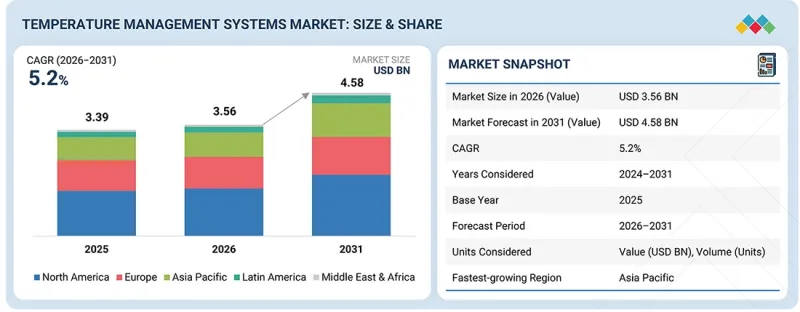
체온 관리 시스템 시장 규모는 2026년 35억 6,000만 달러에서 2031년에는 45억 8,000만 달러로 CAGR 5.2%로 확대할 것으로 예측됩니다.
이 시장의 성장은 전 세계 수술 건수의 증가, 심혈관 질환 및 신경질환의 유병률 상승, 수술 전후 저체온증 및 기타 체온 관련 합병증 예방에 대한 의식의 향상 등에 힘입고 있습니다.
| 조사 범위 | |
|---|---|
| 조사 대상 기간 | 2026-2031년 |
| 기준연도 | 2025년 |
| 예측 기간 | 2026-2031년 |
| 단위 | 금액(달러) |
| 부문 | 제품, 케어 환경, 용도, 지역 |
| 대상 지역 | 북미, 유럽, 아시아태평양, 라틴아메리카, 중동 및 아프리카 |
응급의료 현장에서는 특히 심정지 후 관리, 신생아 의료, 외상성 뇌손상 치료 분야에서 목표 체온 관리(TTM)의 도입이 확대되고 있으며, 이는 시장 성장을 더욱 가속화하고 있습니다.
"제품별로는 환자 체온 유지 시스템이 2025년에 가장 큰 점유율을 차지했습니다."
환자 체온 유지 시스템 부문의 성장은 주로 전 세계적인 수술 건수의 증가와 의도하지 않은 수술 전후 저체온증 예방에 대한 관심 고조에 의해 주도되고 있습니다. 수술 중 정상 체온을 유지하는 것은 수술 부위 감염, 과도한 출혈, 마취 회복 지연, 입원 기간 연장 등의 합병증 위험을 줄이는 데 도움이 되므로, 환자 체온 유지 시스템은 수술 전후 의료의 모든 상황에서 표준 치료법으로 자리 잡고 있습니다. 수술실, 중환자실, 수술 후 회복실에서 온풍식 가온 시스템, 전도식 가온 장치, 가온용 부속품의 도입이 확대되고 있는 점도 이 부문의 시장 지위를 더욱 공고히 하고 있습니다.
"케어 환경별로 보면 수술 전후 관리 분야가 2025년에 가장 큰 점유율을 차지했습니다."
주술기 케어 부문은 환자의 정상 체온을 유지하고 주술기 저체온증을 예방하기 위해 수술 전, 수술 중, 수술 후 전반에 걸쳐 체온 관리 시스템이 널리 사용되고 있으며, 2025년에 시장을 주도했습니다. 수술을 받는 환자는 마취 투여, 장시간에 걸친 수술, 저온의 수술실 환경에 노출되는 등으로 인해 의도하지 않은 체온 저하가 발생하기 쉬우므로, 적극적인 체온 관리는 수술 전후 관리의 중요한 구성 요소가 되고 있습니다. 수술실, 수술 전 유닛, 마취 후 회복실(PACU)에서의 환자 체온 유지 시스템의 광범위한 도입이 이 부문의 주도적 지위에 크게 기여하고 있습니다.
'예측 기간 중 아시아태평양이 가장 높은 성장률을 기록할 것으로 전망됩니다."
아시아태평양은 의료 인프라 확충, 의료비 증가, 신흥 경제국에서의 병원 및 수술 시설의 급속한 현대화에 힘입어, 예측 기간 중 체온 관리 시스템 시장에서 가장 빠른 성장을 이룰 것으로 예상됩니다. 수술 건수의 증가, 심혈관 질환 및 신경계 질환 유병률의 상승, 응급 환자 증가로 인해 이 지역내에서는 첨단 체온 관리 솔루션에 대한 수요가 크게 증가하고 있습니다. 정부 및 민간 의료 제공자들은 의료 인프라, 특히 중환자실(ICU), 신생아 중환자실(NICU), 수술실에 막대한 투자를 하고 있으며, 환자 체온 조절 시스템의 도입이 가속화되고 있습니다. 또한 의료 접근성의 지속적인 개선, 의료 관광의 확대, 기술적으로 진보된 의료기기의 도입 증가 역시 시장 성장에 기여하고 있습니다. 이 지역의 성장을 주도하는 주요 국가로는 중국, 인도, 일본, 한국 등이 있습니다.
이 보고서에서는 전 세계 체온 관리 시스템 시장을 조사하여, 시장 개요, 시장 성장에 영향을 미치는 각종 요인 분석, 기술 및 특허 동향, 법규제 환경, 사례 연구, 시장 규모 추이 및 전망, 각종 분류·지역/주요 국가별 상세 분석, 경쟁 구도, 주요 기업 개요 등을 종합적으로 다루고 있습니다.
자주 묻는 질문
목차
제1장 서론
제2장 개요
제3장 주요 인사이트
제4장 시장 개요
제5장 업계 동향
제6장 기술의 진보, AI의 영향, 특허, 혁신, 향후 응용
제7장 지속가능성·규제 상황
제8장 고객 상황과 구매 행동
제9장 체온 관리 시스템 시장 : 제품별
제10장 체온 관리 시스템 시장 : 케어 환경별
제11장 체온 관리 시스템 시장 : 용도별
제12장 체온 관리 시스템 시장 : 수량 분석
제13장 체온 관리 시스템 시장 : 지역별
제14장 경쟁 구도
제15장 기업 개요
제16장 조사 방법
제17장 부록
KSA 26.08.05The market for temperature management systems is projected to grow from USD 3.56 billion in 2026 to USD 4.58 billion by 2031, at a CAGR of 5.2%. Market growth is supported by the increasing number of surgical procedures worldwide, rising incidence of cardiovascular and neurological disorders, and growing awareness regarding the prevention of perioperative hypothermia and other temperature-related complications.
| Scope of the Report | |
|---|---|
| Years Considered for the Study | 2026-2031 |
| Base Year | 2025 |
| Forecast Period | 2026-2031 |
| Units Considered | Value (USD billion) |
| Segments | Product, Care Setting, Application, Region |
| Regions covered | North America, Europe, Asia Pacific, Latin America, the Middle East, and Africa |
The expanding adoption of targeted temperature management (TTM) in critical care settings, particularly for post-cardiac arrest management, neonatal care, and traumatic brain injury treatment, is further accelerating market growth.
"By product, patient warming systems held the largest share of the temperature management systems market in 2025."
The growth of the patient warming systems segment is primarily driven by the increasing number of surgical procedures performed worldwide and the growing emphasis on preventing inadvertent perioperative hypothermia. Patient warming systems have become a standard of care across perioperative settings, as maintaining normothermia during surgical procedures helps reduce the risk of complications such as surgical-site infections, excessive blood loss, prolonged anesthesia recovery, and extended hospital stays. The widespread adoption of forced-air warming systems, conductive warming devices, and warming accessories across operating rooms, intensive care units, and postoperative recovery units has further strengthened the segment's market position.
"By care setting, the perioperative care segment held the largest share of the temperature management systems market in 2025."
The perioperative care segment dominated the market in 2025 due to its extensive use of temperature management systems before, during, and after surgical procedures to maintain patient normothermia and prevent perioperative hypothermia. Surgical patients are particularly vulnerable to unintended heat loss due to anesthesia administration, prolonged procedures, and exposure to low-temperature operating room environments, making active temperature management a critical component of perioperative care. The widespread implementation of patient warming systems across operating rooms, preoperative units, and post-anesthesia care units (PACUs) has significantly contributed to the segment's leading position.
"Asia Pacific to register the fastest growth rate in the temperature management systems market during the forecast period."
The Asia Pacific region is expected to witness the fastest growth in the temperature management systems market during the forecast period, driven by expanding healthcare infrastructure, rising healthcare expenditure, and the rapid modernization of hospitals and surgical facilities across emerging economies. The rising volume of surgical procedures, growing prevalence of cardiovascular and neurological disorders, and increasing number of critical care admissions are significantly driving demand for advanced temperature management solutions across the region. Governments and private healthcare providers are making substantial investments in healthcare infrastructure, particularly in intensive care units, neonatal care units, and operating rooms, thereby accelerating the adoption of patient warming and cooling systems. Furthermore, continuous improvements in healthcare accessibility, growing medical tourism, and increasing adoption of technologically advanced medical devices are contributing to market growth. Major countries driving regional expansion include China, India, Japan, and South Korea.
Breakdown of primary participants in the temperature management systems market is as follows:
- By Company Type: Tier 1 (32%), Tier 2 (40%), and Tier 3 (28%)
- By Designation: C-level Executives (27%), Directors (18%), and Other Designations (55%)
- By Region: North America (51%), Europe (21%), Asia Pacific (18%), Latin America (6%), and the Middle East & Africa (4%)
The key players in the temperature management systems market are Solventum Corporation (US), GE HealthCare Technologies Inc. (US), Dragerwerk AG & Co. KGaA (Germany), Ecolab Inc. (US), Asahi Kasei Corporation (Japan), Becton, Dickinson and Company (US), ICU Medical, Inc. (US), Gentherm Incorporated (US), Inspiration Healthcare Group plc (UK), Medtronic plc (Ireland), and Stryker Corporation (US).
Research Coverage:
This research report categorizes the temperature management systems market by product (patient warming systems, patient cooling systems, and accessories), care setting (perioperative care, acute care, newborn care, and other care settings) application (general surgery, cardiology, neurology, pediatrics, thoracic surgery, orthopedic surgery, and other applications), and region (North America, Europe, Asia Pacific, Latin America, and the Middle East & Africa).
The scope of the report covers detailed information regarding the major factors, such as drivers, restraints, opportunities, and challenges influencing the growth of the temperature management systems market. A detailed analysis of key industry players has been conducted to provide insights into their business overviews, solutions, and key strategies, including partnerships, collaborations, expansions, agreements, product launches, and recent developments in the temperature management systems market. This report presents a competitive analysis of emerging startups in the temperature management systems ecosystem.
Reasons to Buy This Report:
The report will help leaders/new entrants in this market by providing information on the closest approximations of revenue for the overall temperature management systems market and its subsegments. This report will help stakeholders understand the competitive landscape and gain deeper insights to better position their businesses and plan suitable go-to-market strategies. The report also helps stakeholders understand the market pulse and provides information on key drivers, restraints, opportunities, and challenges.
The report provides insights into the following pointers:
- Analysis of key drivers (increasing prevalence of chronic and infectious diseases, rising number of surgical procedures, increasing number of hypothermia cases), restraints (high cost of intravascular temperature management systems, lack of awareness regarding temperature management systems in developing countries, lack of proper supply chain management), opportunities (increasing growth opportunities in emerging markets, growing number of contracts and agreements between market players, developing healthcare infrastructure), and challenges (product recalls, lack of skilled healthcare professionals) are influencing the growth of the temperature management systems market.
- Product Development/Innovation: Detailed insights on upcoming technologies, research & development activities, and product launches in the temperature management systems market.
- Market Development: Comprehensive information about lucrative markets; the report analyzes the temperature management systems market across varied regions.
- Market Diversification: Exhaustive information about new products, untapped geographies, recent developments, and investments in the temperature management systems market.
- Competitive Assessment: In-depth assessment of market shares, growth strategies, and product offerings of leading players like Solventum Corporation (US), GE HealthCare Technologies Inc. (US), Dragerwerk AG & Co. KGaA (Germany), and Ecolab Inc. (US).
TABLE OF CONTENTS
1 INTRODUCTION
- 1.1 STUDY OBJECTIVES
- 1.2 MARKET DEFINITION
- 1.3 STUDY SCOPE
- 1.3.1 MARKETS COVERED & REGIONAL SCOPE
- 1.3.2 INCLUSIONS & EXCLUSIONS
- 1.3.3 YEARS CONSIDERED
- 1.4 CURRENCY CONSIDERED
- 1.5 STAKEHOLDERS
- 1.6 SUMMARY OF CHANGES
2 EXECUTIVE SUMMARY
- 2.1 KEY INSIGHTS & MARKET HIGHLIGHTS
- 2.2 KEY MARKET PARTICIPANTS: INSIGHTS & STRATEGIC DEVELOPMENTS
- 2.3 DISRUPTIVE TRENDS SHAPING MARKET GROWTH
- 2.4 HIGH-GROWTH SEGMENTS & EMERGING FRONTIERS
- 2.5 SNAPSHOT: GLOBAL MARKET SIZE, GROWTH RATE, AND FORECAST
3 PREMIUM INSIGHTS
- 3.1 TEMPERATURE MANAGEMENT SYSTEMS MARKET OVERVIEW
- 3.2 TEMPERATURE MANAGEMENT SYSTEMS MARKET, BY PRODUCT, 2026 VS. 2031
- 3.3 TEMPERATURE MANAGEMENT SYSTEMS MARKET, BY CARE SETTING, 2026 VS. 2031
- 3.4 TEMPERATURE MANAGEMENT SYSTEMS MARKET, BY APPLICATION, 2026 VS. 2031
- 3.5 TEMPERATURE MANAGEMENT SYSTEMS MARKET: GEOGRAPHIC GROWTH OPPORTUNITIES
4 MARKET OVERVIEW
- 4.1 INTRODUCTION
- 4.2 MARKET DYNAMICS
- 4.2.1 DRIVERS
- 4.2.1.1 Increasing prevalence of chronic and infectious diseases
- 4.2.1.2 Rising number of surgical procedures
- 4.2.1.3 Increasing number of hypothermia cases
- 4.2.1.4 Technological advancements in temperature management systems
- 4.2.2 RESTRAINTS
- 4.2.2.1 High cost of intravascular temperature management systems
- 4.2.2.2 Lack of awareness regarding temperature management systems in developing countries
- 4.2.2.3 Lack of proper supply chain management
- 4.2.3 OPPORTUNITIES
- 4.2.3.1 Increasing growth opportunities in emerging markets
- 4.2.3.2 Growing number of contracts and agreements between market players
- 4.2.3.3 Increasing adoption in neonatal and pediatric care
- 4.2.4 CHALLENGES
- 4.2.4.1 Product recalls and patient safety concerns
- 4.2.4.2 Lack of skilled healthcare professionals
- 4.2.1 DRIVERS
- 4.3 UNMET NEEDS & WHITE SPACES
- 4.3.1 UNMET NEEDS IN TEMPERATURE MANAGEMENT SYSTEMS MARKET
- 4.3.2 WHITE SPACE OPPORTUNITIES
- 4.4 INTERCONNECTED MARKETS & CROSS-SECTOR OPPORTUNITIES
- 4.4.1 INTERCONNECTED MARKETS
- 4.4.2 CROSS-SECTOR OPPORTUNITIES
- 4.5 STRATEGIC MOVES BY TIER 1/2/3 PLAYERS
- 4.5.1 KEY MOVES & STRATEGIC FOCUS
5 INDUSTRY TRENDS
- 5.1 PORTER'S FIVE FORCES ANALYSIS
- 5.1.1 BARGAINING POWER OF SUPPLIERS
- 5.1.2 BARGAINING POWER OF BUYERS
- 5.1.3 THREAT OF NEW ENTRANTS
- 5.1.4 THREAT OF SUBSTITUTES
- 5.1.5 INTENSITY OF COMPETITIVE RIVALRY
- 5.2 MACROECONOMIC INDICATORS
- 5.2.1 INTRODUCTION
- 5.2.2 GDP TRENDS & FORECAST
- 5.3 SUPPLY CHAIN ANALYSIS
- 5.4 VALUE CHAIN ANALYSIS
- 5.5 ECOSYSTEM ANALYSIS
- 5.5.1 TEMPERATURE MANAGEMENT SYSTEMS MARKET: ROLE OF COMPANIES IN ECOSYSTEM
- 5.6 PRICING ANALYSIS
- 5.6.1 AVERAGE SELLING PRICE TREND OF TEMPERATURE MANAGEMENT SYSTEMS, BY KEY PLAYER, 2024-2026
- 5.6.2 AVERAGE SELLING PRICE TREND OF TEMPERATURE MANAGEMENT SYSTEMS, BY REGION, 2024-2026
- 5.7 TRADE ANALYSIS
- 5.7.1 IMPORT SCENARIO (HS CODE 901890)
- 5.7.2 EXPORT SCENARIO (HS CODE 901890)
- 5.8 KEY CONFERENCES & EVENTS, 2026-2027
- 5.9 TRENDS/DISRUPTIONS IMPACTING CUSTOMERS' BUSINESSES
- 5.10 INVESTMENT & FUNDING SCENARIO
- 5.11 CASE STUDY ANALYSIS
- 5.11.1 ANESTHETIC ROOM PRE-WARMING REDUCES THE INCIDENCE OF INADVERTENT PERIOPERATIVE HYPOTHERMIA IN SURGICAL PATIENTS
- 5.11.2 CONDUCTIVE PATIENT WARMING SYSTEMS REDUCE PERIOPERATIVE COSTS BY MORE THAN 50%
- 5.12 IMPACT OF 2025 US TARIFFS ON TEMPERATURE MANAGEMENT SYSTEMS MARKET
- 5.12.1 INTRODUCTION
- 5.12.2 KEY TARIFF RATES
- 5.12.3 PRICE IMPACT ANALYSIS
- 5.12.4 IMPACT ON REGIONS
- 5.12.4.1 North America
- 5.12.4.2 Europe
- 5.12.4.3 Asia Pacific
- 5.12.5 IMPACT ON END-USE INDUSTRIES
- 5.12.5.1 Hospitals, ambulatory surgical centers (ASCs), and specialty clinics
- 5.12.5.2 Critical care centers & emergency departments
- 5.12.5.3 Neonatal intensive care units (NICUs) & maternity care centers
- 5.12.5.4 Academic medical centers & healthcare networks
6 TECHNOLOGICAL ADVANCEMENTS, AI-DRIVEN IMPACT, PATENTS, INNOVATIONS, AND FUTURE APPLICATIONS
- 6.1 KEY TECHNOLOGIES
- 6.1.1 INTRAVASCULAR TEMPERATURE MANAGEMENT
- 6.1.2 SURFACE WARMING TECHNOLOGIES
- 6.2 COMPLEMENTARY TECHNOLOGIES
- 6.2.1 INFRARED RADIANT HEATING TECHNOLOGY
- 6.3 TECHNOLOGY/PRODUCT ROADMAP
- 6.4 PATENT ANALYSIS
- 6.4.1 LIST OF MAJOR PATENTS
- 6.5 FUTURE APPLICATIONS
- 6.6 IMPACT OF AI/GENERATIVE AI ON TEMPERATURE MANAGEMENT SYSTEMS MARKET
- 6.6.1 INTRODUCTION
- 6.6.2 TOP USE CASES & MARKET POTENTIAL
- 6.6.3 KEY COMPANIES IMPLEMENTING AI
- 6.6.4 FUTURE OF AI
7 SUSTAINABILITY & REGULATORY LANDSCAPE
- 7.1 REGIONAL REGULATIONS & COMPLIANCE
- 7.1.1 REGULATORY BODIES, GOVERNMENT AGENCIES, AND OTHER ORGANIZATIONS
- 7.1.2 INDUSTRY STANDARDS
- 7.2 SUSTAINABILITY INITIATIVES
- 7.2.1 ENVIRONMENTAL IMPACT & ECO-FRIENDLY INITIATIVES IN TEMPERATURE MANAGEMENT SYSTEMS
- 7.2.1.1 Eco-friendly initiatives
- 7.2.1 ENVIRONMENTAL IMPACT & ECO-FRIENDLY INITIATIVES IN TEMPERATURE MANAGEMENT SYSTEMS
- 7.3 SUSTAINABILITY IMPACT & REGULATORY POLICY INITIATIVES
8 CUSTOMER LANDSCAPE & BUYER BEHAVIOR
- 8.1 DECISION-MAKING PROCESS
- 8.2 BUYER STAKEHOLDERS & BUYING EVALUATION CRITERIA
- 8.2.1 KEY STAKEHOLDERS IN BUYING PROCESS
- 8.2.2 BUYING CRITERIA
- 8.3 ADOPTION BARRIERS & INTERNAL CHALLENGES
- 8.4 UNMET NEEDS ACROSS VARIOUS CARE SETTINGS
- 8.5 MARKET PROFITABILITY
- 8.5.1 REVENUE POTENTIAL
- 8.5.2 COST DYNAMICS
- 8.5.3 MARGIN OPPORTUNITIES IN KEY APPLICATIONS
9 TEMPERATURE MANAGEMENT SYSTEMS MARKET, BY PRODUCT
- 9.1 INTRODUCTION
- 9.2 PATIENT WARMING SYSTEMS
- 9.2.1 SURFACE WARMING SYSTEMS
- 9.2.1.1 Convective warming systems
- 9.2.1.1.1 Rising adoption among hospitals to drive market
- 9.2.1.2 Conductive warming systems
- 9.2.1.2.1 Safe, inexpensive, and effective method for warming patients during perioperative procedures
- 9.2.1.1 Convective warming systems
- 9.2.2 INTRAVASCULAR WARMING SYSTEMS
- 9.2.2.1 Technological advancements to aid market growth
- 9.2.1 SURFACE WARMING SYSTEMS
- 9.3 PATIENT COOLING SYSTEMS
- 9.3.1 SURFACE COOLING SYSTEMS
- 9.3.1.1 Rising burden of out-of-hospital cardiac arrest to drive adoption of surface cooling systems
- 9.3.2 INTRAVASCULAR COOLING SYSTEMS
- 9.3.2.1 Increased precision in smaller temperature ranges to drive adoption
- 9.3.1 SURFACE COOLING SYSTEMS
- 9.4 ACCESSORIES
- 9.4.1 INCREASING DEMAND FOR ACCESSORIES FOR PATIENT WARMING & COOLING SYSTEMS TO DRIVE GROWTH
10 TEMPERATURE MANAGEMENT SYSTEMS MARKET, BY CARE SETTING
- 10.1 INTRODUCTION
- 10.2 PERIOPERATIVE CARE
- 10.2.1 OPERATING ROOMS
- 10.2.1.1 Increasing number of surgical procedures to drive demand
- 10.2.2 POSTOPERATIVE CARE UNITS
- 10.2.2.1 Enhanced recovery protocols to accelerate demand for temperature management technology
- 10.2.3 PREOPERATIVE CARE UNITS
- 10.2.3.1 Preoperative patient warming protocols to drive adoption
- 10.2.1 OPERATING ROOMS
- 10.3 ACUTE CARE
- 10.3.1 INTENSIVE CARE UNITS
- 10.3.1.1 Growing prevalence of life-threatening diseases to drive market
- 10.3.2 EMERGENCY ROOMS
- 10.3.2.1 Rising number of ER visits to drive growth
- 10.3.3 CORONARY CARE UNITS
- 10.3.3.1 Rising cardiac emergencies to accelerate temperature management adoption in coronary care units
- 10.3.4 BURN CENTERS
- 10.3.4.1 Severe effects of hypothermia on burn victims to necessitate temperature management measures
- 10.3.5 NEUROLOGICAL CARE UNITS
- 10.3.5.1 Growing prevalence of Alzheimer's, stroke, and other neurological diseases to drive market
- 10.3.6 CATH LABS
- 10.3.6.1 High incidence of cardiac arrests to support demand for temperature management
- 10.3.1 INTENSIVE CARE UNITS
- 10.4 NEWBORN CARE
- 10.4.1 DELIVERY SUITES
- 10.4.1.1 High birth rate in developing regions to support market growth
- 10.4.2 NEONATAL INTENSIVE CARE UNITS
- 10.4.2.1 High neonatal death rates to increase demand for temperature management systems
- 10.4.3 POSTNATAL WARDS
- 10.4.3.1 Increasing recommendations for postnatal care to support market growth
- 10.4.1 DELIVERY SUITES
- 10.5 OTHER CARE SETTINGS
11 TEMPERATURE MANAGEMENT SYSTEMS MARKET, BY APPLICATION
- 11.1 INTRODUCTION
- 11.2 GENERAL SURGERY
- 11.2.1 LARGE NUMBER OF GENERAL SURGERIES PERFORMED TO DRIVE MARKET
- 11.3 CARDIOLOGY
- 11.3.1 HIGH INCIDENCE OF CARDIAC ARRESTS TO PROPEL MARKET
- 11.4 NEUROLOGY
- 11.4.1 INCREASING INCIDENCE OF TRAUMATIC BRAIN INJURY, STROKES, AND TUMORS TO SUPPORT MARKET GROWTH
- 11.5 PEDIATRICS
- 11.5.1 INCREASING FOCUS ON REDUCING INFANT MORTALITY TO SUPPORT MARKET GROWTH
- 11.6 THORACIC SURGERY
- 11.6.1 INCREASING PREVALENCE OF LUNG DISEASES TO DRIVE ADOPTION
- 11.7 ORTHOPEDIC SURGERY
- 11.7.1 GROWING NUMBER OF KNEE AND HIP REPLACEMENT PROCEDURES TO PROPEL MARKET
- 11.8 OTHER APPLICATIONS
12 TEMPERATURE MANAGEMENT SYSTEMS MARKET: VOLUME ANALYSIS
- 12.1 INTRODUCTION
- 12.2 US: PATIENT WARMING SYSTEMS INSTALLED BASE
13 TEMPERATURE MANAGEMENT SYSTEMS MARKET, BY REGION
- 13.1 INTRODUCTION
- 13.2 NORTH AMERICA
- 13.2.1 MACROECONOMIC OUTLOOK FOR NORTH AMERICA
- 13.2.2 US
- 13.2.2.1 Improving neonatal outcomes to fuel adoption of infant temperature management solutions
- 13.2.3 CANADA
- 13.2.3.1 Increasing preterm birth rates to support market growth
- 13.3 EUROPE
- 13.3.1 MACROECONOMIC OUTLOOK FOR EUROPE
- 13.3.2 GERMANY
- 13.3.2.1 High surgical procedure rates to create significant growth opportunities for temperature management systems
- 13.3.3 UK
- 13.3.3.1 Increasing chronic kidney disease burden to support adoption of patient warming systems
- 13.3.4 FRANCE
- 13.3.4.1 Aging population to drive demand for perioperative and critical care temperature management technologies
- 13.3.5 ITALY
- 13.3.5.1 Optimized acute care delivery to create growth opportunities
- 13.3.6 SPAIN
- 13.3.6.1 High burden of chronic diseases to accelerate demand
- 13.3.7 REST OF EUROPE
- 13.4 ASIA PACIFIC
- 13.4.1 MACROECONOMIC OUTLOOK FOR ASIA PACIFIC
- 13.4.2 CHINA
- 13.4.2.1 Growth in elderly care facilities to strengthen need for advanced temperature management systems
- 13.4.3 JAPAN
- 13.4.3.1 Rising cardiovascular and thoracic surgical volumes to drive market
- 13.4.4 INDIA
- 13.4.4.1 Expanding healthcare infrastructure to create significant growth opportunities
- 13.4.5 REST OF ASIA PACIFIC
- 13.5 LATIN AMERICA
- 13.5.1 INCREASING DEMAND FOR PERIOPERATIVE AND INTENSIVE CARE SERVICES TO BOOST MARKET GROWTH
- 13.5.2 MACROECONOMIC OUTLOOK FOR LATIN AMERICA
- 13.6 MIDDLE EAST & AFRICA
- 13.6.1 INCREASING SURGICAL PROCEDURE VOLUMES TO SUPPORT MARKET GROWTH
- 13.6.2 MACROECONOMIC OUTLOOK FOR MIDDLE EAST & AFRICA
14 COMPETITIVE LANDSCAPE
- 14.1 INTRODUCTION
- 14.2 KEY PLAYER STRATEGIES/RIGHT TO WIN
- 14.2.1 OVERVIEW OF STRATEGIES DEPLOYED BY PLAYERS IN TEMPERATURE MANAGEMENT SYSTEMS MARKET
- 14.3 REVENUE ANALYSIS, 2023-2025
- 14.4 MARKET SHARE ANALYSIS, 2025
- 14.4.1 GLOBAL MARKET SHARE ANALYSIS, 2025
- 14.5 COMPANY EVALUATION MATRIX: KEY PLAYERS, 2025
- 14.5.1 STARS
- 14.5.2 EMERGING LEADERS
- 14.5.3 PERVASIVE PLAYERS
- 14.5.4 PARTICIPANTS
- 14.5.5 COMPANY FOOTPRINT: KEY PLAYERS, 2025
- 14.5.5.1 Company footprint
- 14.5.5.2 Region footprint
- 14.5.5.3 Product footprint
- 14.5.5.4 Care setting footprint
- 14.5.5.5 Application footprint
- 14.6 COMPANY EVALUATION MATRIX: STARTUPS/SMES, 2025
- 14.6.1 PROGRESSIVE COMPANIES
- 14.6.2 RESPONSIVE COMPANIES
- 14.6.3 DYNAMIC COMPANIES
- 14.6.4 STARTING BLOCKS
- 14.6.5 COMPANY EVALUATION MATRIX: STARTUPS/SMES, 2025
- 14.6.5.1 Detailed list of key startups/SMEs
- 14.6.5.2 Competitive benchmarking of startups/SMEs (1/2)
- 14.6.5.3 Competitive benchmarking of startups/SMEs (2/2)
- 14.7 COMPANY VALUATION & FINANCIAL METRICS
- 14.7.1 FINANCIAL METRICS
- 14.7.2 COMPANY VALUATION
- 14.8 BRAND/PRODUCT COMPARISON
- 14.9 COMPETITIVE SCENARIO
- 14.9.1 PRODUCT LAUNCHES & APPROVALS
- 14.9.2 DEALS
- 14.9.3 EXPANSIONS
15 COMPANY PROFILES
- 15.1 KEY PLAYERS
- 15.1.1 SOLVENTUM CORPORATION
- 15.1.1.1 Business overview
- 15.1.1.2 Products offered
- 15.1.1.3 Recent developments
- 15.1.1.3.1 Deals
- 15.1.1.4 MnM view
- 15.1.1.4.1 Right to win
- 15.1.1.4.2 Strategic choices
- 15.1.1.4.3 Weaknesses & competitive threats
- 15.1.2 BECTON, DICKINSON AND COMPANY
- 15.1.2.1 Business overview
- 15.1.2.2 Products offered
- 15.1.2.3 MnM view
- 15.1.2.3.1 Right to win
- 15.1.2.3.2 Strategic choices
- 15.1.2.3.3 Weaknesses & competitive threats
- 15.1.3 ASAHI KASEI CORPORATION
- 15.1.3.1 Business overview
- 15.1.3.2 Products offered
- 15.1.3.3 Recent developments
- 15.1.3.3.1 Product approvals
- 15.1.3.3.2 Deals
- 15.1.3.4 MnM view
- 15.1.3.4.1 Right to win
- 15.1.3.4.2 Strategic choices
- 15.1.3.4.3 Weaknesses & competitive threats
- 15.1.4 DRAGERWERK AG & CO. KGAA
- 15.1.4.1 Business overview
- 15.1.4.2 Products offered
- 15.1.4.3 Recent developments
- 15.1.4.3.1 Product approvals
- 15.1.4.4 MnM view
- 15.1.4.4.1 Right to win
- 15.1.4.4.2 Strategic choices
- 15.1.4.4.3 Weaknesses & competitive threats
- 15.1.5 GE HEALTHCARE TECHNOLOGIES INC.
- 15.1.5.1 Business overview
- 15.1.5.2 Products offered
- 15.1.5.3 MnM view
- 15.1.5.3.1 Right to win
- 15.1.5.3.2 Strategic choices
- 15.1.5.3.3 Weaknesses & competitive threats
- 15.1.6 MEDLINE INC.
- 15.1.6.1 Business overview
- 15.1.6.2 Products offered
- 15.1.6.3 Recent developments
- 15.1.6.3.1 Product launches
- 15.1.6.3.2 Deals
- 15.1.7 ICU MEDICAL, INC.
- 15.1.7.1 Business overview
- 15.1.7.2 Products offered
- 15.1.7.3 Recent developments
- 15.1.7.3.1 Deals
- 15.1.8 GENTHERM INCORPORATED
- 15.1.8.1 Business overview
- 15.1.8.2 Products offered
- 15.1.8.3 Recent developments
- 15.1.8.3.1 Deals
- 15.1.9 MEDTRONIC PLC
- 15.1.9.1 Business overview
- 15.1.9.2 Products offered
- 15.1.10 THE SURGICAL COMPANY HOLDING B.V
- 15.1.10.1 Business overview
- 15.1.10.2 Products offered
- 15.1.10.3 Recent developments
- 15.1.10.3.1 Product approvals
- 15.1.10.3.2 Deals
- 15.1.10.3.3 Other developments
- 15.1.11 INSPIRATION HEALTHCARE GROUP PLC.
- 15.1.11.1 Business overview
- 15.1.11.2 Products offered
- 15.1.1 SOLVENTUM CORPORATION
- 15.2 OTHER PLAYERS
- 15.2.1 3T MEDICAL SYSTEMS, INC.
- 15.2.2 ADROIT MEDICAL SYSTEMS, INC.
- 15.2.3 HAEMONETICS CORPORATION
- 15.2.4 AUGUSTINE SURGICAL, INC.
- 15.2.5 BELMONT MEDICAL TECHNOLOGIES
- 15.2.6 BIEGLER GMBH
- 15.2.7 ENCOMPASS GROUP, LLC
- 15.2.8 ENTHERMICS, INC.
- 15.2.9 PFM MEDICAL GMBH
- 15.2.10 LIFE RECOVERY SYSTEMS
- 15.2.11 MEDCARE VISIONS PVT. LTD.
- 15.2.12 TAHATAKSI ALC
- 15.2.13 BEIJING ETERNAL MEDICAL TECHNOLOGY CO., LTD.
- 15.2.14 ISTANBUL MEDIKAL LTD.
16 RESEARCH METHODOLOGY
- 16.1 RESEARCH DATA
- 16.2 RESEARCH APPROACH
- 16.2.1 SECONDARY RESEARCH
- 16.2.1.1 Key data from secondary sources
- 16.2.2 PRIMARY DATA
- 16.2.2.1 Primary sources
- 16.2.2.2 Key data from primary sources
- 16.2.2.3 Key industry insights
- 16.2.1 SECONDARY RESEARCH
- 16.3 MARKET SIZE ESTIMATION
- 16.3.1 BOTTOM-UP APPROACH
- 16.3.1.1 Approach 1: Company revenue estimation approach
- 16.3.1.2 Approach 2: Presentations of companies and primary interviews
- 16.3.1.3 Growth forecast
- 16.3.2 TOP-DOWN APPROACH
- 16.3.1 BOTTOM-UP APPROACH
- 16.4 MARKET BREAKDOWN & DATA TRIANGULATION
- 16.5 MARKET SHARE ESTIMATION
- 16.6 RESEARCH ASSUMPTIONS
- 16.6.1 PARAMETRIC ASSUMPTIONS
- 16.6.2 GROWTH RATE ASSUMPTIONS
- 16.7 RESEARCH LIMITATIONS
- 16.8 RISK ASSESSMENT
17 APPENDIX
- 17.1 DISCUSSION GUIDE
- 17.2 KNOWLEDGESTORE: MARKETSANDMARKETS' SUBSCRIPTION PORTAL
- 17.3 CUSTOMIZATION OPTIONS
- 17.4 RELATED REPORTS
- 17.5 AUTHOR DETAILS