
|
시장보고서
상품코드
2105116
건축용 단열재 시장 : 소재별, 건물 유형별, 용도별, 지역별 - 세계 예측(-2031년)Building Thermal Insulation Market by Material Type (Glass Wool, Stone Wool, Plastic Foam), Application (Roof Insulation, Wall Insulation, Floor Insulation), Building Type (Residential, Non-Residential), and Region - Global Forecast to 2031 |
||||||

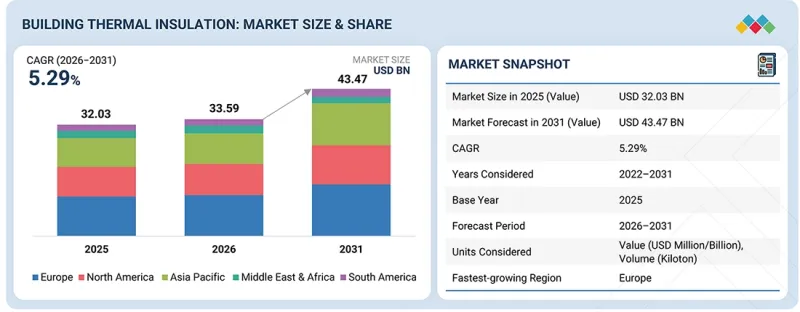
건축용 단열재 시장 규모는 2026년에 335억 9,000만 달러로 추정되며, 2026년부터 2031년까지 CAGR 5.29%로 확대되어 2031년에는 434억 7,000만 달러에 달할 것으로 예측됩니다.
| 조사 범위 | |
|---|---|
| 조사 대상 기간 | 2022-2031년 |
| 기준 연도 | 2025년 |
| 예측 기간 | 2026-2031년 |
| 산정 단위 | 금액(100만/10억 달러) 및 킬로톤 |
| 부문 | 소재별, 건물 유형별, 용도별, 지역별 |
| 대상 지역 | 북미, 유럽, 아시아태평양, 중동 및 아프리카, 남미 |
"건설 업계의 수요 확대가 건축용 단열재 시장의 성장을 견인하고 있습니다."
건축용 단열재 시장의 성장은 주로 확대되는 건설 부문에 의해 주도되고 있습니다. 이는 신축 및 리모델링 프로젝트 전반에 걸쳐 에너지 효율 향상, 거주자의 쾌적성 확보, 그리고 점점 더 엄격해지는 건축 에너지 규제의 준수를 위해 단열재가 필요하기 때문입니다. 전 세계적인 도시화, 인구 증가, 인프라 투자가 진행되는 가운데, 신규 주택 프로젝트, 사무실 건물, 병원, 교육 기관, 창고의 수는 계속 증가하고 있으며, 이에 따라 록울, 글라스울, 발포 플라스틱(EPS, XPS, 폴리우레탄(PU/PIR)), 페놀계, 엘라스토머계 등의 단열재와 셀룰로오스, 에어로겔 단열재 등 기타 재료의 소비량이 직접적으로 증가하고 있습니다.
"2025년, 건축용 단열재 시장에서 소재별로 볼 때, 스톤울 부문은 가치 기준으로 3위의 점유율을 차지했습니다."
락울은 뛰어난 단열성, 내화성, 차음성 및 내구성을 바탕으로 2025년 건축용 단열재 시장에서 금액 기준 3위의 점유율을 차지했습니다. 이러한 특성 덕분에 방화 안전성과 긴 수명이 중시되는 용도에서 락울은 최적의 선택지가 되고 있습니다. 락울 단열재는 상업 시설, 산업 시설 및 고층 주택에서 더 널리 사용되고 있습니다.
"2025년, 바닥 단열은 건축용 단열재의 용도별 시장에서 금액 기준으로 3위 규모를 차지했습니다."
2025년, 바닥 단열 용도는 건축용 단열재 시장에서 3위 부문으로 부상했습니다. 이는 바닥 단열이 건물의 기초를 통한 열 손실 저감 및 실내 환경의 쾌적성 향상에 중요한 역할을 하고 있음에도 불구하고, 지붕이나 벽의 단열만큼 보편적으로 시공되지 않기 때문입니다. 현재 전 세계 선진 지역에서는 건물의 종합적인 에너지 성능을 향상시키기 위해 주택, 상업 시설, 공공 시설에서 바닥 단열 채택이 점점 더 확대되고 있습니다. 그러나 전 세계 개발도상국에서는 그 보급이 여전히 더딘 실정입니다.
"2025년, 아시아태평양은 세계 건축용 단열재 시장에서 금액 기준 3위의 점유율을 차지했습니다."
아시아태평양은 급속한 도시화, 건설 활동의 활성화, 에너지 절약형 건축 기법의 보급 확대, 그리고 중국, 싱가포르, 한국, 일본, 인도 등 주요 경제권에서의 건축 에너지 규제 강화를 배경으로, 2025년 세계 건축용 단열재 시장에서 세 번째로 큰 점유율을 차지했습니다.
본 보고서에서는 다음과 같은 주요 기업 개요을 다루고 있습니다. Kingspan Group PLC(아일랜드), Knauf Insulation(벨기에), Owens Corning(미국), Rockwool A/S(덴마크), Saint-Gobain SA(프랑스), BASF SE(독일), Dow Inc.(미국), Johns Manville Corporation(미국), Carlisle Companies Inc.(미국), CNBM Group(중국), Soprema Group(프랑스)입니다.
조사 범위
본 보고서에서는 건축용 단열재 시장을 소재, 건축물 유형, 용도, 지역별로 분류하여 각 지역의 시장 규모(단위 - 100만 달러) 추정치를 제시하고 있습니다. 또한, 주요 기업에 대한 상세한 분석을 통해 건축용 단열재 시장에서 각 기업의 사업 개요, 서비스 및 주요 전략에 대한 인사이트를 제공합니다.
본 보고서를 구매해야 하는 이유
본 조사 보고서는 업계 분석(업계 동향), 주요 기업의 시장 점유율 분석, 기업 개요와 같은 다각적인 분석에 초점을 맞추고 있으며, 이를 종합하여 건축용 단열재 시장의 경쟁 구도, 신흥 및 고성장 부문, 고성장 지역, 그리고 시장의 촉진요인, 억제요인, 성장 기회에 대한 전체적인 그림을 제시하고 있습니다.
본 보고서는 다음 사항에 대한 인사이트를 제공합니다:
- 시장 침투도 : 세계 시장에서 주요 기업이 제공하는 건축용 단열재에 관한 종합적인 정보
- 건축용 단열재 시장의 성장에 영향을 미치는 주요 촉진요인(온실가스 배출 감축을 위한 엄격한 규제, 친환경 건축물 개발, 에너지 소비 및 관련 비용 절감, 리베이트 및 세액 공제, 엄격한 건축 기준), 제약요인(발포 플라스틱 가격 변동), 기회(높은 에너지 수요, 기타 친환경 단열재의 가용성), 그리고 과제(건축용 단열재에 대한 인식 부족, 공급망을 지속적으로 교란시키는 지정학적 불안정성)에 대한 분석
- 제품 개발 및 혁신 : 건축용 단열재 시장의 향후 기술, 연구 개발 활동, 신제품 및 서비스 출시에 대한 상세한 인사이트
- 시장 개발 : 수익성이 높은 신흥 시장에 대한 종합적인 정보 ? 본 보고서에서는 지역별 건축용 단열재 시장을 분석하고 있습니다
- 시장 다각화 : 신제품, 미개척 지역 및 전 세계 건축용 단열재 시장의 최근 동향에 대한 종합적인 정보
- 경쟁 분석 : 건축용 단열재 시장에서 주요 기업의 시장 점유율, 전략, 제품 및 생산능력에 대한 상세한 평가
자주 묻는 질문
목차
제1장 소개
제2장 주요 요약
제3장 주요 인사이트
제4장 시장 개요
제5장 업계 동향
제6장 기술 진보, AI에 의한 영향, 특허, 그리고 혁신
제7장 규제 상황과 지속가능성에 대한 대처
제8장 고객 상황과 구매 행동
제9장 건축용 단열재 시장(소재별)
제10장 건축용 단열재 시장(건물 유형별)
제11장 건축용 단열재 시장(용도별)
제12장 건축용 단열재 시장(지역별)
제13장 경쟁 구도
제14장 기업 개요
제15장 조사 방법
제16장 부록
KSM 26.08.07The building thermal insulation market size is estimated at USD 33.59 billion in 2026 and is projected to reach USD 43.47 billion by 2031, at a CAGR of 5.29% between 2026 and 2031.
| Scope of the Report | |
|---|---|
| Years Considered for the Study | 2022-2031 |
| Base Year | 2025 |
| Forecast Period | 2026-2031 |
| Units Considered | Value (USD Million/Billion) and Volume (Kiloton) |
| Segments | Material, Building Type, Application, and Region |
| Regions covered | North America, Europe, Asia Pacific, Middle East & Africa, and South America |
"Growing demand from the construction industry is driving building thermal insulation market growth."
The growth in the building thermal insulation market is primarily driven by the expanding construction sector. This is because every new building and retrofit project requires insulation to improve energy efficiency, occupant comfort, and compliance with increasingly stringent building energy regulations. As the world witnesses global urbanization, population growth, and infrastructure investments, the number of new housing projects, office complexes, hospitals, educational institutions, and warehouses continues to rise, directly increasing the consumption of insulation materials such as stone wool, glass wool, plastic foam (EPS, XPS, polyurethane (PU/PIR), phenolic, elastomeric), and other materials such as cellulose and aerogel insulation, among others.
"In 2025, the stone wool segment accounted for the third-largest value share in the building thermal insulation market, by material."
Stone wool accounted for the third-largest share of the building thermal insulation market by value in 2025, due to its excellent thermal insulation, fire resistance, acoustic performance, and durability. These characteristics make it the preferred choice for applications where fire safety and long service life are important. Stone wool insulation is used more widely in commercial, industrial, and high-rise residential buildings.
"Floor insulation was the third-largest application of building thermal insulation in 2025, in terms of value"
In 2025, floor insulation application emerged as the third-largest segment of the building thermal insulation market. This is because it plays an important role in reducing heat loss through building foundations and improving indoor comfort, but it is not as universally installed as roof and wall insulation. Floor insulation is now increasingly being adopted in residential, commercial, and institutional buildings in developed regions of the world to enhance overall building energy performance. However, its adoption remains slow in developing nations of the world.
"Asia Pacific accounted for third-largest share in global building thermal insulation market, in terms of value, in 2025"
Asia Pacific accounted for the third-largest share of the global building thermal insulation market in 2025, driven by rapid urbanization, rising construction activity, growing adoption of energy-efficient building practices, and stronger building energy regulations across key economies such as China, Singapore, South Korea, Japan, and India, among others.
- By Company Type: Tier 1 - 32%, Tier 2 - 41%, and Tier 3 - 27%
- By Designation: Directors - 21%, Managers - 23%, and Others - 56%
- By Region: North America - 41%, Europe - 30%, Asia Pacific - 18%, RoW- 11%
The report profiles the following key players: Kingspan Group PLC (Ireland), Knauf Insulation (Belgium), Owens Corning (US), Rockwool A/S (Denmark), Saint-Gobain SA (France), BASF SE (Germany), Dow Inc. (US), Johns Manville Corporation (US), Carlisle Companies Inc. (US), CNBM Group Co., Ltd. (China), and Soprema Group (France).
Study Coverage
This report segments the building thermal insulation market by material, building type, application, and region, and provides estimates of the overall market size (in USD Million) across various regions. A detailed analysis of key industry players has been conducted to provide insights into their business overviews, services, and key strategies in the building thermal insulation market.
Reasons to Buy this Report
This research report focuses on multiple levels of analysis-industry analysis (industry trends), market share analysis of top players, and company profiles-which together provide an overall view of the competitive landscape, emerging and high-growth segments of the building thermal insulation market, high-growth regions, and market drivers, restraints, and opportunities.
The report provides insights into the following points:
- Market Penetration: Comprehensive information on building thermal insulation offered by top players in the global market
- Analysis of key drivers (Stringent regulations to reduce greenhouse gas emissions, development of green buildings, reduction in energy consumption and related costs, rebates and tax credits, stringent building codes), restraints (fluctuation in prices of plastic foam), opportunities (high energy requirements, availability of other green insulation materials), and challenges (lack of awareness about building thermal insulation, geopolitical instability disrupting supply chain continuously) influencing growth of the building thermal insulation market
- Product Development/Innovation: Detailed insights on upcoming technologies, research & development activities, and new product & service launches in the building thermal insulation market
- Market Development: Comprehensive information about lucrative emerging markets-the report analyzes the market for building thermal insulation across regions
- Market Diversification: Exhaustive information about new products, untapped regions, and recent developments in the global building thermal insulation market
- Competitive Assessment: In-depth assessment of market shares, strategies, products, and manufacturing capabilities of leading players in the building thermal insulation market
TABLE OF CONTENTS
1 INTRODUCTION
- 1.1 STUDY OBJECTIVES
- 1.2 MARKET DEFINITION
- 1.2.1 BUILDING THERMAL INSULATION MARKET: INCLUSIONS AND EXCLUSIONS
- 1.2.2 BUILDING THERMAL INSULATION MARKET: DEFINITION AND INCLUSIONS, BY MATERIAL
- 1.2.3 BUILDING THERMAL INSULATION MARKET: DEFINITION AND INCLUSIONS, BY APPLICATION
- 1.2.4 BUILDING THERMAL INSULATION MARKET: DEFINITION AND INCLUSIONS, BY BUILDING TYPE
- 1.3 STUDY SCOPE
- 1.3.1 MARKET COVERED AND REGIONAL SCOPE
- 1.3.2 YEARS CONSIDERED
- 1.4 CURRENCY CONSIDERED
- 1.5 UNITS CONSIDERED
- 1.6 STAKEHOLDERS
2 EXECUTIVE SUMMARY
- 2.1 MARKET HIGHLIGHTS AND KEY INSIGHTS
- 2.2 KEY MARKET PARTICIPANTS: MAPPING OF STRATEGIC DEVELOPMENT
- 2.3 DISRUPTIVE TRENDS IN BUILDING THERMAL INSULATION MARKET
- 2.4 HIGH-GROWTH SEGMENTS
- 2.5 REGIONAL SNAPSHOT: MARKET SIZE, GROWTH RATE, AND FORECAST
3 PREMIUM INSIGHTS
- 3.1 ATTRACTIVE OPPORTUNITIES FOR PLAYERS IN BUILDING THERMAL INSULATION MARKET
- 3.2 BUILDING THERMAL INSULATION MARKET, BY APPLICATION AND REGION
- 3.3 BUILDING THERMAL INSULATION MARKET, BY MATERIAL
- 3.4 BUILDING THERMAL INSULATION MARKET, BY BUILDING TYPE
- 3.5 BUILDING THERMAL INSULATION MARKET, BY KEY COUNTRIES
4 MARKET OVERVIEW
- 4.1 INTRODUCTION
- 4.2 MARKET DYNAMICS
- 4.2.1 DRIVERS
- 4.2.1.1 Stringent regulations to reduce greenhouse gas emissions
- 4.2.1.2 Development of green buildings
- 4.2.1.3 Reduction in energy consumption and related costs
- 4.2.1.4 Rebates and tax credits
- 4.2.1.5 Stringent building energy codes
- 4.2.2 RESTRAINTS
- 4.2.2.1 Fluctuation in prices of plastic foam
- 4.2.3 OPPORTUNITIES
- 4.2.3.1 High energy requirements
- 4.2.3.2 Availability of other green insulation materials
- 4.2.4 CHALLENGES
- 4.2.4.1 Lack of awareness about building thermal insulation
- 4.2.4.2 Geopolitical instability disrupting supply chain continuously
- 4.2.1 DRIVERS
- 4.3 INTERCONNECTED MARKETS AND CROSS-SECTOR OPPORTUNITIES
- 4.3.1 INTERCONNECTED MARKET
- 4.3.2 CROSS-SECTOR OPPORTUNITIES
- 4.4 STRATEGIC MOVES BY TIER-1/2/3 PLAYERS
- 4.4.1 KEY MOVES AND STRATEGIC FOCUS
5 INDUSTRY TRENDS
- 5.1 PORTER'S FIVE FORCES ANALYSIS
- 5.1.1 THREAT OF NEW ENTRANTS
- 5.1.2 THREAT OF SUBSTITUTES
- 5.1.3 BARGAINING POWER OF SUPPLIERS
- 5.1.4 BARGAINING POWER OF BUYERS
- 5.1.5 INTENSITY OF COMPETITIVE RIVALRY
- 5.2 MACROECONOMIC INDICATORS
- 5.2.1 INTRODUCTION
- 5.2.2 GDP TRENDS AND FORECAST FOR MAJOR ECONOMIES
- 5.2.3 TRENDS IN GLOBAL CONSTRUCTION INDUSTRY
- 5.3 SUPPLY CHAIN ANALYSIS
- 5.3.1 RAW MATERIALS
- 5.3.2 MANUFACTURING
- 5.3.3 DISTRIBUTION NETWORK
- 5.3.4 APPLICATION/END USERS
- 5.4 ECOSYSTEM ANALYSIS
- 5.5 PRICING ANALYSIS
- 5.5.1 AVERAGE SELLING PRICE OF KEY PLAYERS, BY APPLICATION
- 5.5.2 AVERAGE SELLING PRICE TREND OF BUILDING THERMAL INSULATION, BY REGION
- 5.6 TRADE ANALYSIS
- 5.6.1 IMPORT SCENARIO (HS CODE 6806)
- 5.6.2 EXPORT SCENARIO (HS CODE 6806)
- 5.7 KEY CONFERENCES AND EVENTS
- 5.8 TRENDS/DISRUPTIONS IMPACTING CUSTOMER BUSINESS
- 5.8.1 REVENUE SHIFTS & REVENUE POCKETS FOR BUILDING THERMAL INSULATION
- 5.9 INVESTMENT AND FUNDING SCENARIO
- 5.10 CASE STUDY ANALYSIS
- 5.10.1 ENHANCING COMMUNITY WELL-BEING: WILMCOTE HOUSE'S THERMAL EFFICIENCY UPGRADE
- 5.10.2 DISCRETE FIRE PROTECTION: SLUSEHOLMEN KARRE K APARTMENT PROJECT IN THE SOUTH HARBOUR OF COPENHAGEN
- 5.11 IMPACT OF 2025 US TARIFF - BUILDING THERMAL INSULATION MARKET
- 5.11.1 INTRODUCTION
- 5.11.2 KEY TARIFF RATES
- 5.11.3 PRICE IMPACT ANALYSIS
- 5.11.4 IMPACT ON COUNTRY/REGION
- 5.11.4.1 US
- 5.11.4.2 Europe
- 5.11.4.3 Asia Pacific
- 5.11.5 IMPACT ON APPLICATIONS
6 TECHNOLOGICAL ADVANCEMENTS, AI-DRIVEN IMPACT, PATENTS, AND INNOVATIONS
- 6.1 KEY EMERGING TECHNOLOGIES
- 6.1.1 XPS FOAM TECHNOLOGY
- 6.1.2 ECOSE TECHNOLOGY
- 6.2 COMPLEMENTARY TECHNOLOGIES
- 6.2.1 AIR SEALING
- 6.2.2 REFLECTIVE ROOFING MATERIALS
- 6.2.3 SMART MEMBRANES IN BUILDING THERMAL INSULATION
- 6.3 TECHNOLOGY/PRODUCT ROADMAP
- 6.3.1 SHORT-TERM (2025-2027)
- 6.3.2 MID-TERM (2027-2030) | CIRCULAR ECONOMY
- 6.3.3 LONG-TERM (2030-2035+)
- 6.4 PATENT ANALYSIS
- 6.4.1 APPROACH
- 6.4.2 DOCUMENT TYPE
- 6.4.3 TOP APPLICANTS
- 6.4.4 JURISDICTION ANALYSIS
- 6.5 IMPACT OF AI/GEN AI ON BUILDING THERMAL INSULATION MARKET
- 6.5.1 TOP USE CASES AND MARKET POTENTIAL
- 6.5.2 BEST PRACTICES IN BUILDING THERMAL INSULATION PROCESSING
- 6.5.3 CASE STUDIES OF AI IMPLEMENTATION IN BUILDING THERMAL INSULATION MARKET
- 6.5.4 INTERCONNECTED ADJACENT ECOSYSTEM AND IMPACT ON MARKET PLAYERS
- 6.5.5 CLIENTS' READINESS TO ADOPT GENERATIVE AI IN BUILDING THERMAL INSULATION MARKET
7 REGULATORY LANDSCAPE AND SUSTAINABILITY INITIATIVES
- 7.1 REGIONAL REGULATIONS AND COMPLIANCE
- 7.1.1 REGULATORY BODIES, GOVERNMENT AGENCIES, AND OTHER ORGANIZATIONS
- 7.1.2 INDUSTRY STANDARDS
- 7.2 SUSTAINABILITY INITIATIVES
- 7.2.1 RESOURCE EFFICIENCY & LIGHTWEIGHTING
- 7.2.2 ENVIRONMENTAL SAFETY & COMPLIANCE
- 7.3 SUSTAINABILITY IMPACT AND REGULATORY POLICY INITIATIVES
- 7.4 CERTIFICATIONS, LABELING, AND ECO-STANDARDS
8 CUSTOMER LANDSCAPE & BUYER BEHAVIOR
- 8.1 DECISION-MAKING PROCESS
- 8.2 BUYER STAKEHOLDERS AND BUYING EVALUATION CRITERIA
- 8.2.1 KEY STAKEHOLDERS IN BUYING PROCESS
- 8.2.2 BUYING CRITERIA
- 8.3 ADOPTION BARRIERS & INTERNAL CHALLENGES
- 8.4 UNMET NEEDS IN VARIOUS APPLICATIONS
9 BUILDING THERMAL INSULATION MARKET, BY MATERIAL
- 9.1 INTRODUCTION
- 9.2 PLASTIC FOAM
- 9.2.1 GROWTH IN BUILDING & CONSTRUCTION INDUSTRY TO INCREASE DEMAND FOR PLASTIC FOAM
- 9.2.2 POLYSTYRENE FOAM
- 9.2.2.1 Expanded polystyrene (EPS) foam
- 9.2.2.2 Extruded polystyrene (XPS) foam
- 9.2.3 POLYURETHANE (PUR) & POLYISOCYANURATE (PIR) FOAM
- 9.2.4 OTHER PLASTIC FOAMS
- 9.2.4.1 Phenolic foam
- 9.2.4.2 Elastomeric foam
- 9.3 GLASS WOOL
- 9.3.1 LIGHTWEIGHT, NON-COMBUSTIBLE, HIGH TEAR STRENGTH, AND CORROSION-RESISTANT PROPERTIES TO DRIVE DEMAND
- 9.4 STONE WOOL
- 9.4.1 GROWTH OF CONSTRUCTION & ARCHITECTURAL SECTORS FUELING MARKET GROWTH
- 9.5 OTHER MATERIALS
- 9.5.1 AEROGEL
- 9.5.2 CELLULOSE
- 9.5.3 CELLULAR GLASS
- 9.5.4 WOOD FIBER
- 9.5.5 DENIM
- 9.5.6 GYPSUM
- 9.5.7 SILICA-BASED MICROPOROUS MATERIALS
- 9.5.8 WOOD WOOL
10 BUILDING THERMAL INSULATION MARKET, BY BUILDING TYPE
- 10.1 INTRODUCTION
- 10.2 NON-RESIDENTIAL BUILDING
- 10.2.1 ROBUST MANUFACTURING AND INCREASE IN INDUSTRIAL ACTIVITIES TO DRIVE MARKET
- 10.2.2 INDUSTRIAL BUILDINGS
- 10.2.3 COMMERCIAL BUILDINGS
- 10.2.4 OTHERS
- 10.3 RESIDENTIAL BUILDING
- 10.3.1 URBANIZATION AND GOVERNMENT REGULATIONS ON ENERGY-EFFICIENT BUILDINGS TO FUEL DEMAND
11 BUILDING THERMAL INSULATION MARKET, BY APPLICATION
- 11.1 INTRODUCTION
- 11.2 WALL INSULATION
- 11.2.1 HIGHEST HEAT LOSS FROM WALLS TO DRIVE MARKET
- 11.2.2 EXTERNAL WALL INSULATION
- 11.2.3 INTERNAL WALL INSULATION
- 11.2.4 CAVITY WALL INSULATION
- 11.2.5 PARTITION WALL INSULATION
- 11.2.6 FOUNDATION WALL INSULATION
- 11.3 ROOF INSULATION
- 11.3.1 INCREASE IN CONSTRUCTION ACTIVITIES TO DRIVE MARKET
- 11.3.2 FLAT ROOF INSULATION
- 11.3.3 PITCHED ROOF INSULATION
- 11.3.4 CATHEDRAL CEILING INSULATION
- 11.4 FLOOR INSULATION
- 11.4.1 HIGH QUALITY AND TECHNOLOGICAL ADVANCEMENTS DRIVING DEMAND
- 11.4.2 GROUND FLOOR INSULATION
- 11.4.3 SUSPENDED FLOOR INSULATION
- 11.4.4 SLAB-ON-GRADE FLOOR INSULATION
- 11.4.5 INTERMEDIATE FLOOR INSULATION
- 11.4.6 UNDERFLOOR HEATING INSULATION
- 11.4.7 FOUNDATION SLAB INSULATION
- 11.4.8 RAISED FLOOR INSULATION
12 BUILDING THERMAL INSULATION MARKET, BY REGION
- 12.1 INTRODUCTION
- 12.2 EUROPE
- 12.2.1 EUROPE BUILDING THERMAL INSULATION MARKET, BY MATERIAL
- 12.2.2 EUROPE BUILDING THERMAL INSULATION MARKET, BY BUILDING TYPE
- 12.2.3 EUROPE BUILDING THERMAL INSULATION MARKET, BY COUNTRY
- 12.2.3.1 Germany
- 12.2.3.1.1 Investments in residential segment and green building labeling systems to drive market
- 12.2.3.2 France
- 12.2.3.2.1 Government regulations and presence of established companies to support market growth
- 12.2.3.3 Poland
- 12.2.3.3.1 Stringent building codes and increasing construction activities to drive demand
- 12.2.3.4 UK
- 12.2.3.4.1 Green building council and investments in construction to fuel demand
- 12.2.3.5 Italy
- 12.2.3.5.1 New project finance rules and investment policies to support market growth
- 12.2.3.6 Russia
- 12.2.3.6.1 Glass wool to be fastest-growing segment during forecast period
- 12.2.3.7 Spain
- 12.2.3.7.1 Strict building codes and increased consumer spending to drive demand
- 12.2.3.1 Germany
- 12.3 NORTH AMERICA
- 12.3.1 NORTH AMERICA BUILDING THERMAL INSULATION MARKET, BY MATERIAL
- 12.3.2 NORTH AMERICA BUILDING THERMAL INSULATION MARKET, BY BUILDING TYPE
- 12.3.3 NORTH AMERICA BUILDING THERMAL INSULATION MARKET, BY COUNTRY
- 12.3.3.1 US
- 12.3.3.1.1 Increased private construction and energy-efficient codes to fuel demand
- 12.3.3.2 Canada
- 12.3.3.2.1 Growing commercial and residential construction to drive demand
- 12.3.3.3 Mexico
- 12.3.3.3.1 Stone wool to be fastest-growing segment during forecast period
- 12.3.3.1 US
- 12.4 ASIA PACIFIC
- 12.4.1 ASIA PACIFIC BUILDING THERMAL INSULATION MARKET, BY MATERIAL
- 12.4.2 ASIA PACIFIC BUILDING THERMAL INSULATION MARKET, BY BUILDING TYPE
- 12.4.3 ASIA PACIFIC BUILDING THERMAL INSULATION MARKET, BY COUNTRY
- 12.4.3.1 China
- 12.4.3.1.1 Mandatory building energy codes for commercial and residential buildings to drive demand
- 12.4.3.2 Japan
- 12.4.3.2.1 Plastic foam to dominate market during forecast period
- 12.4.3.3 India
- 12.4.3.3.1 Economic growth and government initiatives to support market growth
- 12.4.3.4 South Korea
- 12.4.3.4.1 Green building certification rating and certification systems to support market growth
- 12.4.3.5 Thailand
- 12.4.3.5.1 Growth in tourism sector fueling demand
- 12.4.3.6 Malaysia
- 12.4.3.6.1 Government's approach to green features in buildings to support market
- 12.4.3.7 Indonesia
- 12.4.3.7.1 Implementation of building energy codes to drive market
- 12.4.3.1 China
- 12.5 MIDDLE EAST & AFRICA
- 12.5.1 MIDDLE EAST & AFRICA BUILDING THERMAL INSULATION MARKET, BY MATERIAL
- 12.5.2 MIDDLE EAST & AFRICA BUILDING THERMAL INSULATION MARKET, BY BUILDING TYPE
- 12.5.3 MIDDLE EAST & AFRICA BUILDING THERMAL INSULATION MARKET, BY COUNTRY
- 12.5.3.1 GCC Countries
- 12.5.3.1.1 Saudi Arabia
- 12.5.3.1.2 UAE
- 12.5.3.1.3 Qatar
- 12.5.3.2 South Africa
- 12.5.3.2.1 Stringent regulations to drive demand
- 12.5.3.1 GCC Countries
- 12.6 SOUTH AMERICA
- 12.6.1 SOUTH AMERICA BUILDING THERMAL INSULATION MARKET, BY MATERIAL
- 12.6.2 SOUTH AMERICA BUILDING THERMAL INSULATION MARKET, BY BUILDING TYPE
- 12.6.3 SOUTH AMERICA BUILDING THERMAL INSULATION MARKET, BY COUNTRY
- 12.6.3.1 Brazil
- 12.6.3.1.1 Energy efficiency labeling systems to fuel demand for building thermal insulation
- 12.6.3.2 Argentina
- 12.6.3.2.1 Standards regarding building envelope design and heating efficiency in building rules to drive market
- 12.6.3.1 Brazil
13 COMPETITIVE LANDSCAPE
- 13.1 INTRODUCTION
- 13.2 KEY PLAYER STRATEGIES
- 13.3 MARKET SHARE ANALYSIS
- 13.3.1 RANKING OF KEY MARKET PLAYERS
- 13.4 REVENUE ANALYSIS
- 13.5 COMPANY EVALUATION MATRIX: KEY PLAYERS, 2025
- 13.5.1 STARS
- 13.5.2 EMERGING LEADERS
- 13.5.3 PERVASIVE PLAYERS
- 13.5.4 PARTICIPANTS
- 13.5.5 COMPANY FOOTPRINT: KEY PLAYERS, 2024
- 13.5.5.1 Company footprint
- 13.5.5.2 Region footprint
- 13.5.5.3 Insulation material footprint
- 13.5.5.4 Application footprint
- 13.6 COMPANY EVALUATION MATRIX: START-UPS/SMES, 2025
- 13.6.1 PROGRESSIVE COMPANIES
- 13.6.2 RESPONSIVE COMPANIES
- 13.6.3 DYNAMIC COMPANIES
- 13.6.4 STARTING BLOCKS
- 13.6.5 COMPETITIVE BENCHMARKING: START-UPS/SMES, 2025
- 13.6.5.1 List of start-ups/SMEs
- 13.6.5.2 Competitive benchmarking of key startups/SMEs
- 13.7 BRAND/PRODUCT COMPARISON
- 13.8 COMPANY VALUATION AND FINANCIAL METRICS
- 13.9 COMPETITIVE SCENARIO
- 13.9.1 PRODUCT LAUNCHES
- 13.9.2 DEALS
- 13.9.3 EXPANSIONS
- 13.9.4 OTHER DEVELOPMENTS
14 COMPANY PROFILES
- 14.1 KEY PLAYERS
- 14.1.1 KINGSPAN GROUP PLC
- 14.1.1.1 Business overview
- 14.1.1.2 Products/Solutions/Services offered
- 14.1.1.3 Recent developments
- 14.1.1.3.1 PRODUCT LAUNCHES
- 14.1.1.3.2 Deals
- 14.1.1.3.3 Expansions
- 14.1.1.4 MnM view
- 14.1.1.4.1 Key strengths/Right to win
- 14.1.1.4.2 Strategic choices
- 14.1.1.4.3 Weaknesses and competitive threats
- 14.1.2 SAINT-GOBAIN SA
- 14.1.2.1 Business overview
- 14.1.2.2 Products/Solutions/Services offered
- 14.1.2.3 Recent developments
- 14.1.2.3.1 Deals
- 14.1.2.3.2 Expansions
- 14.1.2.3.3 Other developments
- 14.1.2.4 MnM view
- 14.1.2.4.1 Key strengths/Right to win
- 14.1.2.4.2 Strategic choices
- 14.1.2.4.3 Weaknesses and competitive threats
- 14.1.3 OWENS CORNING
- 14.1.3.1 Business overview
- 14.1.3.2 Products/Solutions/Services offered
- 14.1.3.3 Recent developments
- 14.1.3.3.1 PRODUCT LAUNCHES
- 14.1.3.3.2 Deals
- 14.1.3.4 MnM view
- 14.1.3.4.1 Key strengths/Right to win
- 14.1.3.4.2 Strategic choices
- 14.1.3.4.3 Weaknesses and competitive threats
- 14.1.4 ROCKWOOL A/S
- 14.1.4.1 Business overview
- 14.1.4.2 Products/Solutions/Services offered
- 14.1.4.3 Recent developments
- 14.1.4.3.1 Product launches
- 14.1.4.3.2 Expansions
- 14.1.4.4 MnM view
- 14.1.4.4.1 Key strengths/Right to win
- 14.1.4.4.2 Strategic choices
- 14.1.4.4.3 Weaknesses and competitive threats
- 14.1.5 KNAUF INSULATION
- 14.1.5.1 Business overview
- 14.1.5.2 Products/Solutions/Services offered
- 14.1.5.3 Recent developments
- 14.1.5.3.1 Deals
- 14.1.5.3.2 Expansions
- 14.1.5.3.3 Other developments
- 14.1.5.4 MnM view
- 14.1.5.4.1 Key strengths/Right to win
- 14.1.5.4.2 Strategic choices
- 14.1.5.4.3 Weaknesses and competitive threats
- 14.1.6 JOHNS MANVILLE CORPORATION
- 14.1.6.1 Business overview
- 14.1.6.2 Products/Solutions/Services offered
- 14.1.6.3 Recent developments
- 14.1.6.3.1 Product launches
- 14.1.6.3.2 Expansions
- 14.1.7 CNBM GROUP CO., LTD.
- 14.1.7.1 Business overview
- 14.1.7.2 Products/Solutions/Services offered
- 14.1.7.3 Recent developments
- 14.1.7.3.1 Deals
- 14.1.7.3.2 Expansions
- 14.1.8 SOPREMA GROUP
- 14.1.8.1 Business overview
- 14.1.8.2 Products/Solutions/Services offered
- 14.1.9 BASF SE
- 14.1.9.1 Business overview
- 14.1.9.2 Products/Solutions/Services offered
- 14.1.9.3 Recent developments
- 14.1.9.3.1 Product launches
- 14.1.9.3.2 Deals
- 14.1.9.3.3 Expansions
- 14.1.10 DOW INC.
- 14.1.10.1 Business overview
- 14.1.10.2 Products/Solutions/Services offered
- 14.1.11 CARLISLE COMPANIES INC.
- 14.1.11.1 Business overview
- 14.1.11.2 Products/Solutions/Services offered
- 14.1.11.3 Recent developments
- 14.1.11.3.1 Deals
- 14.1.11.3.2 Expansions
- 14.1.12 GAF MATERIALS LLC
- 14.1.12.1 Business overview
- 14.1.12.2 Products/Solutions/Services offered
- 14.1.12.3 Recent developments
- 14.1.12.3.1 Expansions
- 14.1.13 ASPEN AEROGELS, INC.
- 14.1.13.1 Business overview
- 14.1.13.2 Products offered
- 14.1.13.3 Recent developments
- 14.1.13.3.1 Deals
- 14.1.1 KINGSPAN GROUP PLC
- 14.2 OTHER PLAYERS
- 14.2.1 ATLAS ROOFING CORPORATION
- 14.2.2 HOLCIM LIMITED
- 14.2.3 HUNTSMAN INTERNATIONAL LLC
- 14.2.4 URSA INSULATION SA
- 14.2.5 RECTICEL SA
- 14.2.6 KCC CORPORATION
- 14.2.7 SIKA GROUP
- 14.2.8 NICHIAS CORPORATION
- 14.2.9 FIBRAN S.A.
- 14.2.10 ODE INSULATION
- 14.2.11 TROCELLEN GMBH
- 14.2.12 CELLOFOAM NORTH AMERICA, INC.
15 RESEARCH METHODOLOGY
- 15.1 RESEARCH DATA
- 15.1.1 SECONDARY DATA
- 15.1.2 PRIMARY DATA
- 15.2 MARKET SIZE ESTIMATION
- 15.2.1 BOTTOM-UP APPROACH
- 15.2.2 TOP-DOWN APPROACH
- 15.3 GROWTH FORECAST
- 15.3.1 SUPPLY SIDE
- 15.3.2 DEMAND-SIDE ANALYSIS
- 15.4 DATA TRIANGULATION
- 15.5 RESEARCH ASSUMPTIONS
- 15.6 LIMITATIONS
- 15.7 RISK ASSESSMENT
16 APPENDIX
- 16.1 DISCUSSION GUIDE
- 16.2 KNOWLEDGESTORE: MARKETSANDMARKETS' SUBSCRIPTION PORTAL
- 16.3 CUSTOMIZATION OPTIONS
- 16.4 RELATED REPORTS
- 16.5 AUTHOR DETAILS


