
|
시장보고서
상품코드
2107174
훈련기 시장 예측(-2032년) : 추진 방식별, 좌석 배치별, 최종사용자별, 지역별Trainer Aircraft Market by Aircraft Type (Fixed-Wing, Rotary-Wing), Propulsion Type (Conventional Fuel Powered Trainers, Electrified Trainers), Seat Configuration, End User, and Region - Global Forecast to 2032 |
||||||

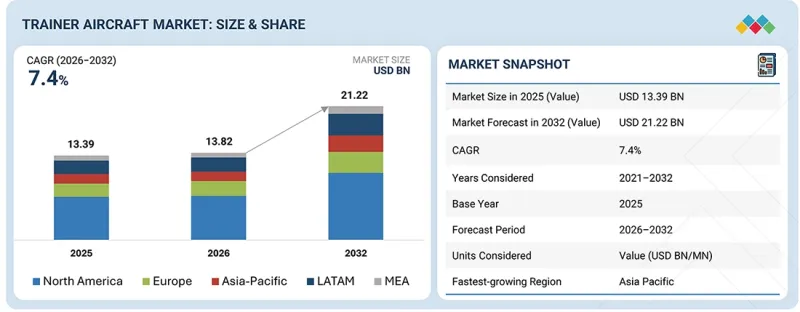
훈련기 시장 규모는 2026년 138억 2,000만 달러에서 2032년까지 212억 2,000만 달러로 확대하며, 예측 기간 중 CAGR은 7.4%에 달할 것으로 전망되고 있습니다.
| 조사 범위 | |
|---|---|
| 조사 대상 기간 | 2020-2032년 |
| 기준연도 | 2025년 |
| 예측 기간 | 2026-2032년 |
| 산정 단위 | 금액(10억 달러) |
| 부문 | 추진 방식별, 좌석 배치별, 최종사용자별, 지역별 |
| 대상 지역 | 북미, 유럽, 아시아태평양, 기타 지역 |
수량 기준으로는 납품 대수가 2026년 1,598대에서 2032년까지 2,192대로 증가할 것으로 예상됩니다. 이 시장의 성장은 노후화된 훈련기의 교체, 항공사 조종사에 대한 수요 증가, 국방 예산 확대, 디지털 항공기로의 전환과 같은 요인들에 힘입고 있으며, 이러한 요인들은 전 세계 훈련기 시장을 촉진하는 주요 요인 중 일부입니다.
"항공기 유형별로는 예측 기간 중 고정익 부문이 가장 큰 시장 점유율을 차지할 것으로 전망됩니다."
고정익 훈련기는 다양한 민간 항공 비행 학교, 항공사 조종사 양성 기관, 각국 공군 및 정부 기관에서 널리 사용되고 있으며, 시장에서 가장 큰 점유율을 차지할 것으로 전망됩니다. 이러한 항공기는 초급, 기초, 중급, 상급 및 전투기 도입 훈련의 각 단계에서 조종사 양성 과정에 활용되고 있습니다.
"최종사용자별로는 군사 부문이 예측 기간 중 현저한 성장을 기록할 것으로 전망됩니다."
군사 부문은 조종사 훈련 현대화에 대한 투자 확대, 구형 훈련기 교체, 그리고 첨단 제트기 및 터보프롭식 훈련기 조달에 힘입어 강력한 성장이 예상됩니다. 국방 기관들은 실전기의 환경을 재현하고 실전기로의 전환 기간을 단축할 수 있는 플랫폼을 점점 더 많이 요구하고 있습니다.
"북미는 예측 기간 중 큰 시장 점유율을 차지할 것으로 전망됩니다."
북미는 주요 항공기 제조사의 입지, 다수의 비행 학교 및 항공 교육 기관, 활발한 일반 항공 활동, 그리고 끊임없는 [AB1.1] 군용 조종사 훈련 수요에 힘입어 큰 시장 점유율을 차지할 것으로 예상됩니다. 아시아태평양 및 유럽 역시 훈련 인프라 확충, 국방 개혁 프로그램, 그리고 상업 항공 수요의 확대로 인해 주목할 만한 성장 기회를 가져올 것으로 예측됩니다. [AB2.1]
Textron Aviation(미국), Leonardo S.p.A.(이탈리아), Hindustan Aeronautics Limited(인도), Turkish Aerospace Industries(터키), Diamond Aircraft Industries(오스트리아), Airbus Helicopters(프랑스)는 훈련기 시장의 주요 기업 중 일부입니다.
조사 범위:
본 시장 조사는 다양한 부문 및 하위 부문에 걸친 훈련기 시장을 대상으로 합니다. 본 조사는 다양한 분야 및 지역에서 해당 시장의 규모와 성장 잠재력을 추정하는 것을 목적으로 합니다. 또한 시장내 주요 기업에 대한 상세한 경쟁 분석, 기업 개요, 제품 및 사업 내용에 관한 주요 발견 사항, 최근 동향, 그리고 각 기업이 채택하고 있는 주요 시장 전략에 대해서도 포괄적으로 다루고 있습니다.
이 보고서를 구매해야 하는 이유:
이 보고서는 시장을 선도하는 기업 및 신규 진입 기업에게 훈련기 시장 전체의 매출에 관한 가장 정확한 추정치를 제공합니다. 또한 이해관계자가 경쟁 구도를 이해하고, 자사의 비즈니스를 더 나은 위치로 이끌며, 적절한 시장 진입 전략을 수립하기 위한 인사이트를 얻는 데 도움이 됩니다. 더불어, 이 보고서는 이해관계자가 시장 동향을 파악하는 데 도움을 주며, 주요 시장 촉진요인, 억제요인, 과제 및 기회에 대한 정보를 제공합니다.
이 보고서는 다음 사항에 대한 인사이트를 제공합니다. :
- 시장 촉진요인(조종사 수요 증가, 비행 훈련 학교 확대, 군용기 기단의 현대화), 억제요인(항공기 취득 비용의 높음 및 긴 인증 요건), 기회(첨단 터보프롭 및 제트 훈련기에 대한 수요 확대, 디지털 아비오닉스 및 시뮬레이션 통합 플랫폼의 도입), 과제(긴 조달 주기, 정부 및 방위 계약에 대한 의존도)
- 시장 침투도: 시장을 선도하는 주요 기업이 제공하는 훈련기에 대한 포괄적인 정보
- 제품 개발/혁신: 시장의 향후 기술 동향, 연구개발 활동 및 신제품 출시에 대한 상세한 분석
- 시장 개발: 다양한 지역의 수익성 높은 시장에 대한 포괄적인 정보
- 시장 다각화: 신제품, 미개발 지역, 최근 동향 및 시장 투자에 대한 포괄적인 정보
- 경쟁 분석: 시장을 선도하는 주요 기업의 시장 점유율, 성장 전략, 제품 및 생산 능력에 대한 상세한 평가
자주 묻는 질문
목차
제1장 서론
제2장 개요
제3장 주요 인사이트
제4장 시장 개요
제5장 업계 동향
제6장 지속가능성과 규제 상황
제7장 기술 진보, AI에 의한 영향, 특허, 혁신, 향후 응용
제8장 고객 상황과 구매 행동
제9장 훈련기 시장(기체 유형별)(시장 규모 및 2032년까지의 예측- 100만 달러 및 대수)
제10장 훈련기 시장(추진 방식별)(시장 규모 및 2032년까지의 예측- 100만 달러 및 대수)
제11장 훈련기 시장(좌석 배치별)(시장 규모 및 2032년까지의 예측- 100만 달러 및 대수)
제12장 훈련기 시장(최종사용자별)(시장 규모 및 2032년까지의 예측- 100만 달러 및 대수)
제13장 훈련기 시장(시장 규모와 2032년까지의 예측- 100만 달러 및 대수)
제14장 경쟁 구도
제15장 기업 개요
제16장 조사 방법
제17장 부록
KSA 26.08.12The trainer aircraft market is projected to grow from USD 13.82 billion in 2026 to USD 21.22 billion by 2032, at a CAGR of 7.4% during the forecast period.
| Scope of the Report | |
|---|---|
| Years Considered for the Study | 2020-2032 |
| Base Year | 2025 |
| Forecast Period | 2026-2032 |
| Units Considered | Value (USD Billion) |
| Segments | By Aircraft Type, Propulsion Type, End User and Region |
| Regions covered | North America, Europe, APAC, RoW |
In terms of volume, deliveries are expected to increase from 1,598 units in 2026 to 2,192 units by 2032. This market growth is also supported by the replacement of aging trainer aircraft fleets, increasing demand for airline pilots, increased defense budget, and the shift toward digital aircraft, which have been some of the key factors boosting the global trainer aircraft market.
"By aircraft type, the fixed-wing segment is projected to hold the largest market share during the forecast period."
Fixed-wing trainer aircraft are likely to hold the largest share of the market due to their extensive use in various civil aviation flight schools, airline academies, military air forces, and government departments. These aircraft are being utilized in the process of developing pilots at primary, basic, intermediate, advance and lead-in fighter training levels.
"By end user, the military segment is projected to register significant growth during the forecast period."
The military segment is expected to witness strong growth owing to increasing investments in pilot training modernization, replacement of legacy trainer fleets, and the procurement of advanced jet and turboprop trainer aircraft. Defense organizations are increasingly seeking platforms that replicate operational aircraft environments and reduce the transition time to frontline aircraft.
"North America is projected to hold a significant market share during the projected period."
North America is expected to hold substantial market share, backed by the presence of key aircraft manufacturers, a large number of flight schools and aviation institutes, robust general aviation activity, and unceasing[AB1.1] military pilot-training requisites. Asia Pacific and Europe are also projected to offer notable expansion opportunities due to mounting training infrastructure, defense transformation programs, and growing commercial aviation requirements.[AB2.1]
The breakdown of profiles for primary participants in the trainer aircraft market is provided below:
- By Company Type: Tier 1 - 40%, Tier 2 - 30%, and Tier 3 - 30%
- By Designation: Directors - 20%, C-level Executives - 10%, and Others (Managers and Other Non-C-level Executives) - 70%
- By Region: North America - 40%, Europe - 25%, Asia Pacific - 15%, Middle East - 15%, Latin America - 3%, and Africa - 2%
Textron Aviation (US), Leonardo S.p.A. (Italy), Hindustan Aeronautics Limited (India), Turkish Aerospace Industries (Turkiye), Diamond Aircraft Industries (Austria), and Airbus Helicopters (France) are some of the key players in the trainer aircraft market.
Research Coverage:
This market study covers the trainer aircraft market across various segments and subsegments. It aims to estimate the size and growth potential of this market across different parts and regions. This study also includes an in-depth competitive analysis of key players in the market, their company profiles, key observations on their products and business offerings, recent developments, and the key market strategies they have adopted.
Reasons to Buy This Report:
The report will help market leaders/new entrants with information on the closest approximations of revenue for the overall trainer aircraft market. It will also help stakeholders understand the competitive landscape and gain more insights to position their businesses better and plan suitable go-to-market strategies. The report will also help stakeholders understand the market pulse and will provide information on key market drivers, restraints, challenges, and opportunities.
The report provides insights into the following pointers:
- Market drivers (rising pilot demand, expansion of flight training academies and military fleet modernization), restraints (high aircraft acquisition costs and lengthy certification requirements), opportunities (growing demand for advanced turboprop and jet trainers and adoption of digital avionics & simulation-integrated platforms), challenges (long procurement cycles and dependence on government and defense contracts)
- Market Penetration: Comprehensive information on trainer aircraft offered by the top players in the market
- Product Development/Innovation: Detailed insights into upcoming technologies, research & development activities, and product launches in the market
- Market Development: Comprehensive information about lucrative markets across varied regions
- Market Diversification: Exhaustive information about new products, untapped geographies, recent developments, and investments in the market
- Competitive Assessment: In-depth assessment of market share, growth strategies, products, and manufacturing capabilities of leading players in the market
TABLE OF CONTENTS
1 INTRODUCTION
- 1.1 STUDY OBJECTIVES
- 1.2 MARKET DEFINITION
- 1.3 STUDY SCOPE
- 1.3.1 MARKET SEGMENTATION AND REGIONAL SNAPSHOT
- 1.3.2 INCLUSIONS AND EXCLUSIONS
- 1.3.3 YEARS CONSIDERED
- 1.4 CURRENCY CONSIDERED
- 1.5 STAKEHOLDERS
2 EXECUTIVE SUMMARY
- 2.1 MARKET HIGHLIGHTS AND KEY INSIGHTS
- 2.2 KEY MARKET PARTICIPANTS: MAPPING OF STRATEGIC DEVELOPMENTS
- 2.3 DISRUPTIVE TRENDS IN TRAINER AIRCRAFT MARKET
- 2.4 HIGH GROWTH SEGMENTS
- 2.5 REGIONAL SNAPSHOT: MARKET SIZE, GROWTH RATE, AND FORECAST
3 PREMIUM INSIGHTS
- 3.1 ATTRACTIVE OPPORTUNITIES FOR PLAYERS IN TRAINER AIRCRAFT MARKET
- 3.2 TRAINER AIRCRAFT MARKET, BY SEAT CONFIGURATION
- 3.3 TRAINER AIRCRAFT MARKET, BY PROPULSION TYPE
- 3.4 TRAINER AIRCRAFT MARKET, BY AIRCRAFT TYPE
- 3.5 TRAINER AIRCRAFT MARKET, BY END USER
4 MARKET OVERVIEW
- 4.1 INTRODUCTION
- 4.2 MARKET DYNAMICS
- 4.2.1 DRIVERS
- 4.2.1.1 Growing global demand for military pilot training due to increasing defense modernization
- 4.2.1.2 Growth in global commercial aviation boosting pilot training requirements
- 4.2.1.3 Replacement of aging trainer aircraft fleets with digitally enabled fuel-efficient training platforms
- 4.2.2 RESTRAINTS
- 4.2.2.1 High acquisition and lifecycle costs of advanced trainer aircraft
- 4.2.2.2 Lengthy procurement cycles and defense budget constraints
- 4.2.3 OPPORTUNITIES
- 4.2.3.1 Development of hybrid-electric and sustainable trainer aircraft
- 4.2.3.2 Rising demand for indigenous aerospace manufacturing and technology transfer
- 4.2.3.3 Growing adoption of Training-as-a-Service (TaaS) models driving long-term trainer aircraft procurement
- 4.2.4 CHALLENGES
- 4.2.4.1 Increasing complexity in aligning trainer aircraft with modern fighter training requirements
- 4.2.4.2 Maintaining aircraft availability amid increasing fleet utilization
- 4.2.1 DRIVERS
- 4.3 UNMET NEEDS AND WHITE SPACES IN TRAINER AIRCRAFT MARKET
- 4.4 INTER-CONNECTED MARKETS AND CROSS-SECTOR OPPORTUNITIES
- 4.5 STRATEGIC MOVES BY TIER 1/2/3 PLAYERS
- 4.5.1 STRATEGIC MOVES BY TIER 1, 2, AND 3 PLAYERS
5 INDUSTRY TRENDS
- 5.1 INTRODUCTION
- 5.2 MACROECONOMIC OUTLOOK
- 5.2.1 INTRODUCTION
- 5.2.2 GDP TRENDS AND FORECAST
- 5.2.3 TRENDS IN GLOBAL TRAINER AIRCRAFT MARKET
- 5.3 VALUE CHAIN ANALYSIS
- 5.4 ECOSYSTEM ANALYSIS
- 5.5 TRADE ANALYSIS
- 5.5.1 IMPORT SCENARIO (HS CODE 880211)
- 5.5.2 EXPORT SCENARIO (HS CODE 880211)
- 5.6 KEY CONFERENCES & EVENTS, 2025-2026
- 5.7 TRENDS & DISRUPTIONS IMPACTING CUSTOMER BUSINESS
- 5.8 INVESTMENT & FUNDING SCENARIO
- 5.9 PRICING ANALYSIS
- 5.10 AVERAGE SELLING PRICE OF TRAINER AIRCRAFT MARKET, BY AIRCRAFT TYPE
- 5.11 AVERAGE SELLING PRICE, BY REGION
- 5.12 OPERATIONAL DATA
- 5.13 CASE STUDIES
- 5.13.1 CASE STUDY 1: PILATUS AIRCRAFT LTD. MODERNIZED CANADA'S FUTURE AIRCREW TRAINING (FACT) PROGRAM WITH PC-21 TRAINER AIRCRAFT
- 5.13.2 CASE STUDY 2: LEONARDO S.P.A. STRENGTHENED MILITARY PILOT TRAINING WITH M-346 ADVANCED TRAINER AIRCRAFT
- 5.13.3 CASE STUDY 3: AIR INDIA EXPANDED COMMERCIAL PILOT TRAINING WITH NEW TRAINER AIRCRAFT FLEET
- 5.14 TOTAL COST OF OWNERSHIP
- 5.14.1 INTEGRATION AND DEPLOYMENT COSTS
- 5.14.2 TRAINING AND SPARES COSTS
- 5.14.3 ANNUAL OPERATIONS & MAINTENANCE COSTS
- 5.14.4 MID-LIFE OVERHAUL COSTS
- 5.14.5 OTHER COSTS
- 5.15 VOLUME DATA
- 5.16 BILL OF MATERIALS (BOM) ANALYSIS
- 5.16.1 BUSINESS MODELS
- 5.16.2 DIRECT AIRCRAFT SALES (CAPITAL PROCUREMENT MODEL)
- 5.16.3 INTEGRATED TRAINING SYSTEM (ITS) SOLUTIONS
- 5.16.4 PERFORMANCE-BASED LOGISTICS (PBL) & LIFECYCLE SUSTAINMENT
6 SUSTAINABILITY AND REGULATORY LANDSCAPE
- 6.1 REGIONAL REGULATIONS AND COMPLIANCE
- 6.1.1 REGULATORY BODIES, GOVERNMENT AGENCIES, AND OTHER ORGANIZATIONS
- 6.1.2 INDUSTRY STANDARDS
- 6.2 SUSTAINABILITY INITIATIVES
- 6.3 ECO-APPLICATIONS
- 6.4 SUSTAINABILITY IMPACT AND REGULATORY POLICY INITIATIVES
- 6.4.1 SUSTAINABILITY IMPACT ON TRAINER AIRCRAFT MARKET
- 6.4.2 REGULATORY POLICIES GOVERNING TRAINER AIRCRAFT CERTIFICATION, PROCUREMENT, AND DEPLOYMENT
- 6.5 CERTIFICATIONS, LABELING, AND ECO-STANDARDS
7 TECHNOLOGICAL ADVANCEMENTS, AI-DRIVEN IMPACT, PATENTS, INNOVATIONS, AND FUTURE APPLICATIONS
- 7.1 KEY EMERGING TECHNOLOGIES
- 7.1.1 AI-ENABLED DIGITAL ENGINEERING, OPEN MISSION SYSTEMS, AND DIGITAL TWIN-BASED AIRCRAFT DEVELOPMENT
- 7.1.2 FIFTH-GENERATION COCKPIT ARCHITECTURES, EMBEDDED TRAINING SYSTEMS, AND AI-ENABLED HUMAN-MACHINE TEAMING
- 7.1.3 ADVANCED COMPOSITE STRUCTURES, HYBRID PROPULSION TECHNOLOGIES, AND INTELLIGENT HEALTH MONITORING
- 7.2 COMPLEMENTARY TECHNOLOGIES
- 7.2.1 ADVANCED AVIONICS ARCHITECTURES AND GLASS COCKPIT SYSTEMS
- 7.2.2 EMBEDDED TACTICAL TRAINING SYSTEMS (ETTS)
- 7.3 ADJACENT TECHNOLOGIES
- 7.3.1 DIGITAL TRAINING MANAGEMENT AND PILOT PERFORMANCE ANALYTICS PLATFORMS
- 7.3.2 AIRCRAFT FLEET MANAGEMENT AND PREDICTIVE OPERATIONS PLATFORMS
- 7.4 TECHNOLOGY/PRODUCT ROADMAP
- 7.5 EMERGING TECHNOLOGY TRENDS
- 7.5.1 AUTONOMOUS FLIGHT ASSISTANCE AND INTELLIGENT PILOT SUPPORT SYSTEMS
- 7.5.2 ADAPTIVE AIRCRAFT TRAINING INTELLIGENCE AND PERFORMANCE-BASED FLIGHT TRAINING
- 7.5.3 HYDROGEN-READY AND HYBRID-ELECTRIC TRAINER AIRCRAFT TECHNOLOGIES
- 7.5.4 OPTIONALLY PILOTED TRAINER AIRCRAFT TECHNOLOGIES
- 7.5.5 CONNECTED AIRCRAFT AND SECURE DIGITAL TRAINING ECOSYSTEMS
- 7.5.6 COLLABORATIVE MANNED-UNMANNED TRAINING TECHNOLOGIES
- 7.5.7 SELF-HEALING MATERIALS AND MULTIFUNCTIONAL SMART STRUCTURES
- 7.6 PATENT ANALYSIS
- 7.7 FUTURE APPLICATIONS
- 7.8 IMPACT OF AI/GENERATIVE AI ON TRAINER AIRCRAFT MARKET
- 7.8.1 TOP USE CASES AND MARKET POTENTIAL TRAINER AIRCRAFT MARKET
- 7.8.2 BEST PRACTICES FOLLOWED BY MANUFACTURERS IN TRAINER AIRCRAFT MARKET
- 7.8.3 INTERCONNECTED ADJACENT ECOSYSTEM AND IMPACT ON MARKET PLAYERS
- 7.8.4 CLIENTS' READINESS TO ADOPT GENERATIVE AI
- 7.9 SUCCESS STORIES AND REAL-WORLD APPLICATIONS
8 CUSTOMER LANDSCAPE AND BUYER BEHAVIOR
- 8.1 DECISION-MAKING PROCESS
- 8.2 KEY STAKEHOLDERS IN BUYING PROCESS AND THEIR EVALUATION CRITERIA
- 8.2.1 KEY STAKEHOLDERS IN BUYING PROCESS
- 8.2.2 BUYING CRITERIA
- 8.3 ADOPTION BARRIERS AND INTERNAL CHALLENGES
- 8.4 UNMET NEEDS OF END USERS
- 8.4.1 NEED FOR SEAMLESS TRANSITION TO OPERATIONAL AIRCRAFT
- 8.4.2 NEED FOR HIGHLY ADAPTABLE AND FUTURE-READY TRAINING PLATFORMS
- 8.4.3 NEED FOR ENHANCED FLEET AVAILABILITY AND COMPREHENSIVE LIFECYCLE SUPPORT
9 TRAINER AIRCRAFT MARKET, BY AIRCRAFT TYPE (MARKET SIZE & FORECAST TO 2032-USD MILLION & UNITS)
- 9.1 INTRODUCTION
- 9.2 FIXED-WING TRAINER AIRCRAFT
- 9.2.1 BASIC TRAINER AIRCRAFT
- 9.2.1.1 Support early-stage pilot proficiency
- 9.2.2 ADVANCED TRAINER AIRCRAFT
- 9.2.2.1 To witness strong growth driven by Lead-In Fighter Training (LIFT) requirements
- 9.2.3 JET TRAINER AIRCRAFT
- 9.2.3.1 To accelerate military pilot training modernization
- 9.2.1 BASIC TRAINER AIRCRAFT
- 9.3 ROTARY-WING TRAINER AIRCRAFT
- 9.3.1 LIGHT HELICOPTER TRAINERS
- 9.3.1.1 Strengthening military pilot training through fleet modernization
- 9.3.2 ADVANCED HELICOPTER TRAINERS
- 9.3.2.1 Enable operational conversion to next-generation military rotorcraft
- 9.3.1 LIGHT HELICOPTER TRAINERS
10 TRAINER AIRCRAFT MARKET, BY PROPULSION TYPE (MARKET SIZE & FORECAST TO 2032-USD MILLION & UNITS)
- 10.1 INTRODUCTION
- 10.2 CONVENTIONAL FUEL-POWERED TRAINERS
- 10.2.1 PISTON ENGINE
- 10.2.1.1 Growing demand for primary pilot training to drive procurement of piston engine trainer aircraft
- 10.2.2 TURBOPROP
- 10.2.2.1 Expanding advanced pilot training requirements to accelerate procurement of turboprop trainer aircraft
- 10.2.3 TURBOSHAFT
- 10.2.3.1 Expanding rotary-wing fleet modernization to drive procurement of turboshaft-powered trainer aircraft
- 10.2.4 JET TRAINER
- 10.2.4.1 Military aviation modernization and rising demand for advanced pilot training to drive growth
- 10.2.5 TURBO JET
- 10.2.5.1 Legacy fleet sustainment and cost-effective advanced flight training to support segmental growth
- 10.2.6 TURBO FAN
- 10.2.6.1 Superior fuel efficiency and operational performance to drive adoption of turbofan-powered trainer aircraft
- 10.2.7 ELECTRIFIED TRAINERS
- 10.2.7.1 Fully electric
- 10.2.7.1.1 Growing demand for cost-efficient and sustainable flight training to drive adoption of fully electric trainer aircraft
- 10.2.7.2 Hybrid electric
- 10.2.7.2.1 Advancements in hybrid propulsion systems to support development of next-generation trainer aircraft
- 10.2.7.1 Fully electric
- 10.2.1 PISTON ENGINE
11 TRAINER AIRCRAFT MARKET, BY SEAT CONFIGURATION (MARKET SIZE & FORECAST TO 2032-USD MILLION & UNITS)
- 11.1 INTRODUCTION
- 11.2 SINGLE SEAT
- 11.2.1 SINGLE-SEAT TRAINER AIRCRAFT SEGMENT TO EXPERIENCE STEADY DEMAND SUPPORTED BY ADVANCED SOLO FLIGHT TRAINING REQUIREMENTS
- 11.3 TWO SEATS
- 11.3.1 TWO-SEAT TRAINER AIRCRAFT SEGMENT TO LEAD MARKET DRIVEN BY INSTRUCTOR-LED TRAINING AND MODERN PILOT DEVELOPMENT PROGRAMS
- 11.4 THREE TO FOUR SEATS
- 11.4.1 THREE- TO FOUR-SEAT TRAINER AIRCRAFT SEGMENT TO REGISTER STEADY GROWTH DRIVEN BY MULTI-CREW TRAINING REQUIREMENTS AND EXPANDING MISSION-SPECIFIC AVIATION PROGRAMS
- 11.5 OTHERS (FIVE AND SIX SEATS)
12 TRAINER AIRCRAFT MARKET, BY END USER (MARKET SIZE & FORECAST TO 2032-USD MILLION & UNITS)
- 12.1 INTRODUCTION
- 12.2 CIVIL FLIGHT SCHOOLS
- 12.2.1 TO WITNESS STRONG GROWTH DRIVEN BY EXPANDING PILOT TRAINING CAPACITY AND FLEET MODERNIZATION
- 12.3 AIRLINE ACADEMIES
- 12.3.1 TO WITNESS ROBUST GROWTH DRIVEN BY EXPANDING CADET TRAINING PROGRAMS AND MODERNIZATION OF PILOT TRAINING FLEETS
- 12.4 MILITARY FORCES
- 12.4.1 DEFENSE MODERNIZATION AND NEXT-GENERATION PILOT TRAINING REQUIREMENTS TO DRIVE GROWTH
- 12.5 GOVERNMENT ORGANIZATIONS
- 12.5.1 MODERNIZATION AND EXPANSION OF PUBLIC-SECTOR AVIATION TRAINING REQUIREMENTS TO DRIVE GROWTH
- 12.6 PRIVATE FLYING CLUBS
- 12.6.1 RECREATIONAL PILOT TRAINING AND FLEET RENEWAL INITIATIVES TO DRIVE DEMAND
13 TRAINER AIRCRAFT MARKET (MARKET SIZE & FORECAST TO 2032 - USD MILLION & UNITS)
- 13.1 INTRODUCTION
- 13.2 NORTH AMERICA
- 13.2.1 US
- 13.2.1.1 Next-generation military trainer aircraft procurement and commercial pilot demand to drive market expansion
- 13.2.2 CANADA
- 13.2.2.1 Future Aircrew Training (FAcT) program to strengthen country's military trainer aircraft modernization
- 13.2.1 US
- 13.3 EUROPE
- 13.3.1 ITALY
- 13.3.1.1 Indigenous trainer aircraft manufacturing and military pilot training programs to drive market
- 13.3.2 UK
- 13.3.2.1 Military pilot training modernization and Hawk trainer fleet replacement to drive market
- 13.3.3 GERMANY
- 13.3.3.1 Bundeswehr modernization and integrated fixed-wing and rotary-wing training to drive market
- 13.3.4 FRANCE
- 13.3.4.1 Military pilot training modernization and Mentor 2 Program to drive market
- 13.3.5 SWITZERLAND
- 13.3.5.1 Trainer aircraft innovation and domestic fleet sustainment to reinforce Swiss trainer aircraft market
- 13.3.6 CZECH REPUBLIC
- 13.3.6.1 Indigenous trainer aircraft manufacturing and military pilot training modernization to drive market
- 13.3.7 REST OF EUROPE
- 13.3.1 ITALY
- 13.4 ASIA PACIFIC
- 13.4.1 INDIA
- 13.4.1.1 Indigenous trainer aircraft development and basic flight training expansion to drive market
- 13.4.2 JAPAN
- 13.4.2.1 Trainer aircraft fleet recapitalization and next-generation jet trainer planning to strengthen market
- 13.4.3 SOUTH KOREA
- 13.4.3.1 Homegrown trainer aircraft innovation and global production partnerships to reinforce market
- 13.4.4 AUSTRALIA
- 13.4.4.1 Advanced pilot training infrastructure and PC-21 capability expansion to boost market
- 13.4.5 THAILAND
- 13.4.5.1 Trainer aircraft sustainment and advanced flight training capability support market
- 13.4.6 INDONESIA
- 13.4.6.1 Commercial pilot training expansion and civil aviation training infrastructure is projected to support market growth
- 13.4.7 REST OF ASIA PACIFIC
- 13.4.1 INDIA
- 13.5 LATIN AMERIICA
- 13.5.1 BRAZIL
- 13.5.1.1 Trainer aircraft manufacturing and export programs to strengthen market growth in Brazil
- 13.5.2 MEXICO
- 13.5.2.1 Military pilot training sustainment and trainer fleet lifecycle support to drive market
- 13.5.3 ARGENTINA
- 13.5.3.1 Renewal of primary military trainer aircraft fleet to drive market
- 13.5.4 REST OF LATIN AMERICA
- 13.5.1 BRAZIL
- 13.6 MIDDLE EAST & AFRICA
- 13.6.1 MIDDLE EAST
- 13.6.1.1 Saudi Arabia
- 13.6.1.1.1 Vision 2030 defense localization to accelerate military pilot training modernization
- 13.6.1.2 UAE
- 13.6.1.2.1 Integration of indigenous military aviation programs to drive market
- 13.6.1.3 Turkey
- 13.6.1.3.1 Expanding airline pilot training capacity to drive market
- 13.6.1.4 Israel
- 13.6.1.4.1 Integration of fifth-generation fighter training requirements to drive market
- 13.6.1.5 Rest of Middle East
- 13.6.1.1 Saudi Arabia
- 13.6.2 AFRICA
- 13.6.2.1 South Africa
- 13.6.2.1.1 Expansion of military pilot training programs to drive market
- 13.6.2.2 Nigeria
- 13.6.2.2.1 Enhancement in advanced military pilot training capabilities to drive market
- 13.6.2.3 Rest of Africa
- 13.6.2.1 South Africa
- 13.6.1 MIDDLE EAST
14 COMPETITIVE LANDSCAPE
- 14.1 INTRODUCTION
- 14.2 KEY PLAYER STRATEGIES/RIGHT TO WIN, 2021-2026
- 14.3 REVENUE ANALYSIS, 2021-2025
- 14.4 MARKET SHARE ANALYSIS, 2025
- 14.5 BRAND/PRODUCT COMPARISON
- 14.6 COMPANY VALUATION AND FINANCIAL METRICS
- 14.7 COMPANY EVALUATION MATRIX: KEY PLAYERS, 2025
- 14.7.1 STARS
- 14.7.2 EMERGING LEADERS
- 14.7.3 PERVASIVE PLAYERS
- 14.7.4 PARTICIPANTS
- 14.7.5 COMPANY FOOTPRINT, KEY PLAYERS, 2025
- 14.7.5.1 Company footprint
- 14.7.5.2 Region footprint
- 14.7.5.3 Aircraft type footprint
- 14.7.5.4 End user footprint
- 14.8 COMPANY EVALUATION MATRIX: STARTUPS/SMES, 2025
- 14.8.1 PROGRESSIVE COMPANIES
- 14.8.2 RESPONSIVE COMPANIES
- 14.8.3 DYNAMIC COMPANIES
- 14.8.4 STARTING BLOCKS
- 14.8.5 COMPETITIVE BENCHMARKING: STARTUPS/SMES, 2025
- 14.8.5.1 List of startups/SMEs
- 14.8.5.2 Competitive benchmarking of startups/SMEs
- 14.9 COMPETITIVE SCENARIO
- 14.9.1 PRODUCT ANNOUNCEMENTS/ENHANCEMENTS/LAUNCHES/ DEVELOPMENTS
- 14.9.2 DEALS
- 14.9.3 OTHER DEVELOPMENTS
15 COMPANY PROFILES
- 15.1 KEY PLAYERS
- 15.1.1 TEXTRON INC.
- 15.1.1.1 Business overview
- 15.1.1.2 Products/ Solutions/ Services offered
- 15.1.1.3 Recent developments
- 15.1.1.3.1 Product launches/announcements
- 15.1.1.3.2 Deals
- 15.1.1.3.3 Other developments
- 15.1.1.4 MnM view
- 15.1.1.4.1 Right to win
- 15.1.1.4.2 Strategic choices
- 15.1.1.4.3 Weaknesses and competitive threats
- 15.1.2 PILATUS AIRCRAFT LTD
- 15.1.2.1 Business overview
- 15.1.2.2 Products/ Solutions/ Services offered
- 15.1.2.3 Recent developments
- 15.1.2.3.1 Product launches/announcements
- 15.1.2.3.2 Deals
- 15.1.2.3.3 Other developments
- 15.1.3 LEONARDO S.P.A
- 15.1.3.1 Business overview
- 15.1.3.2 Products/ Solutions/ Services offered
- 15.1.3.3 Recent developments
- 15.1.3.3.1 Product announcements
- 15.1.3.3.2 Deals
- 15.1.3.3.3 Other developments
- 15.1.3.4 MnM view
- 15.1.3.4.1 Right to win
- 15.1.3.4.2 Strategic choices
- 15.1.3.4.3 Weaknesses and competitive threats
- 15.1.4 HINDUSTAN AERONAUTICS LIMITED (HAL)
- 15.1.4.1 Business overview
- 15.1.4.2 Products/ Solutions/ Services offered
- 15.1.4.3 Recent developments
- 15.1.4.3.1 Product launches/announcements/developments
- 15.1.5 TURKISH AEROSPACE INDUSTRIES, INC.
- 15.1.5.1 Business overview
- 15.1.5.2 Products/ Solutions/ Services offered
- 15.1.5.3 Recent developments
- 15.1.5.3.1 Product announcements
- 15.1.5.3.2 Deals
- 15.1.5.3.3 Other developments
- 15.1.5.4 MnM view
- 15.1.5.4.1 Right to win
- 15.1.5.4.2 Strategic choices
- 15.1.5.4.3 Weaknesses and competitive threats
- 15.1.6 JIANGXI HONGDU AVIATION INDUSTRY GROUP CO., LTD.
- 15.1.6.1 Business overview
- 15.1.6.2 Products/ Solutions/ Services offered
- 15.1.6.3 Recent developments
- 15.1.6.3.1 Product developments
- 15.1.6.4 MnM view
- 15.1.6.4.1 Right to win
- 15.1.6.4.2 Strategic choices
- 15.1.6.4.3 Weaknesses and competitive threats
- 15.1.7 TECNAM S.P.A
- 15.1.7.1 Business overview
- 15.1.7.2 Products/ Solutions/ Services offered
- 15.1.7.3 Recent developments
- 15.1.7.3.1 Product enhancements/announcements
- 15.1.7.3.2 Deals
- 15.1.7.3.3 Other developments
- 15.1.8 DIAMOND AIRCRAFT INDUSTRIES
- 15.1.8.1 Business overview
- 15.1.8.2 Products/ Solutions/ Services offered
- 15.1.8.3 Recent developments
- 15.1.8.3.1 Product deliveries
- 15.1.8.3.2 Deals
- 15.1.8.3.3 Other developments
- 15.1.9 PIPER AIRCRAFT, INC.
- 15.1.9.1 Business overview
- 15.1.9.2 Products/ Solutions/ Services offered
- 15.1.9.3 Recent developments
- 15.1.9.3.1 Product launches
- 15.1.9.3.2 Deals
- 15.1.9.3.3 Other developments
- 15.1.10 CIRRUS DESIGN CORPORATION
- 15.1.10.1 Business overview
- 15.1.10.2 Products/ Solutions/ Services offered
- 15.1.10.3 Recent developments
- 15.1.10.3.1 Product launches/developments
- 15.1.10.3.2 Deals
- 15.1.10.3.3 Other developments
- 15.1.11 AIRBUS
- 15.1.11.1 Business overview
- 15.1.11.2 Products/ Solutions/ Services offered
- 15.1.11.3 Recent developments
- 15.1.11.3.1 Product launches/developments
- 15.1.11.3.2 Deals
- 15.1.11.3.3 Other developments
- 15.1.11.4 MnM view
- 15.1.11.4.1 Right to win
- 15.1.11.4.2 Strategic choices
- 15.1.11.4.3 Weaknesses and competitive threats
- 15.1.12 ROBINSON HELICOPTER COMPANY
- 15.1.12.1 Business overview
- 15.1.12.2 Products/ Solutions/ Services offered
- 15.1.12.3 Recent developments
- 15.1.12.3.1 Product launches/developments
- 15.1.12.3.2 Deals
- 15.1.12.3.3 Other developments
- 15.1.13 ENSTROM HELICOPTER CORPORATION
- 15.1.13.1 Business overview
- 15.1.13.2 Products/ Solutions/ Services offered
- 15.1.13.3 Recent developments
- 15.1.13.3.1 Product announcements
- 15.1.13.3.2 Deals
- 15.1.13.3.3 Other developments
- 15.1.14 AERO VODOCHODY AEROSPACE A.S.
- 15.1.14.1 Business overview
- 15.1.14.2 Products/ Solutions/ Services offered
- 15.1.14.3 Recent developments
- 15.1.14.3.1 Product deliveries/announcements
- 15.1.14.3.2 Deals
- 15.1.14.3.3 Other developments
- 15.1.15 RUSSIAN HELICOPTERS JSC
- 15.1.15.1 Business overview
- 15.1.15.2 Products/ Solutions/ Services offered
- 15.1.1 TEXTRON INC.
- 15.2 OTHER PLAYERS
- 15.2.1 SIERRA NEVADA COMPANY, LLC
- 15.2.2 CALIDUS
- 15.2.3 ZLIN AIRCRAFT A.S.
- 15.2.4 EVEKTOR
- 15.2.5 FLIGHT DESIGN
- 15.2.6 BYE AEROSPACE
- 15.2.7 DYNALI HELICOPTER COMPANY
- 15.2.8 VULCANAIR
- 15.2.9 BRM AERO S.R.O
- 15.2.10 JMB AIRCRAFT S.R.O.
16 RESEARCH METHODOLOGY
- 16.1 RESEARCH DATA
- 16.1.1 SECONDARY DATA
- 16.1.1.1 Key data from secondary sources
- 16.1.1.2 List of key secondary sources
- 16.1.2 PRIMARY DATA
- 16.1.2.1 Key data from primary sources
- 16.1.2.2 Key primary participants
- 16.1.2.3 Breakdown of primary interviews
- 16.1.1 SECONDARY DATA
- 16.2 MARKET SIZE ESTIMATION
- 16.2.1 BOTTOM-UP APPROACH
- 16.2.2 TOP-DOWN APPROACH
- 16.2.3 MARKET SIZE CALCULATION FOR BASE YEAR
- 16.3 MARKET FORECAST APPROACH
- 16.3.1 SUPPLY SIDE
- 16.3.2 DEMAND SIDE
- 16.4 DATA TRIANGULATION
- 16.5 FACTOR ANALYSIS
- 16.6 RESEARCH ASSUMPTIONS
- 16.7 RESEARCH LIMITATIONS
- 16.8 RISK ASSESSMENT
17 APPENDIX
- 17.1 DISCUSSION GUIDE
- 17.2 ANNEXURE
- 17.3 KNOWLEDGESTORE: MARKETSANDMARKETS' SUBSCRIPTION PORTAL
- 17.4 CUSTOMIZATION OPTIONS
- 17.5 RELATED REPORTS
- 17.6 AUTHOR DETAILS