
|
시장보고서
상품코드
2107274
아크릴 에멀전 시장 : 유형별, 용도별, 지역별 - 세계 예측(-2031년)Acrylic Emulsion Market by Type (Pure Acrylic Emulsion, Polymer & Copolymer Acrylic Emulsion), Application (Paints & Coatings, Adhesives & Sealants, Construction Additives, Paper Coatings), and Region - Global Forecast To 2031 |
||||||

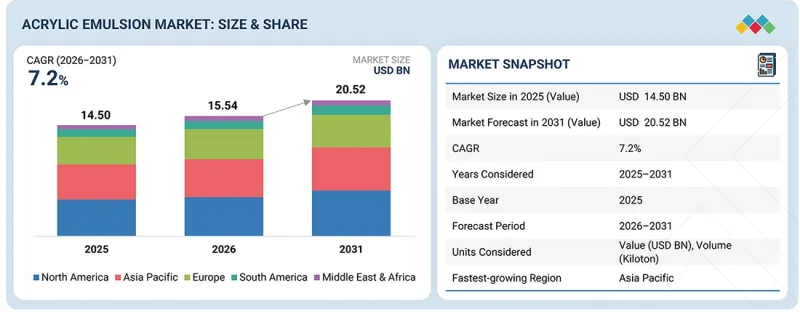
아크릴 에멀전 시장 규모는 2026년 155억 4,000만 달러에서 2031년까지 205억 2,000만 달러에 달할 것으로 예상되며, 예측 기간 동안 CAGR은 7.2%를 기록할 전망입니다.
| 조사 범위 | |
|---|---|
| 조사 대상 기간 | 2025-2031년 |
| 기준 연도 | 2025년 |
| 예측 기간 | 2026-2031년 |
| 산정 단위 | 금액(100만/10억 달러) 킬로톤 |
| 부문 | 유형별, 용도별, 지역별 |
| 대상 지역 | 북미, 아시아태평양, 유럽, 중동 및 아프리카, 남미 |
세계의 아크릴 에멀전 시장은 건설, 인프라, 자동차, 섬유, 산업용 도료, 포장 산업의 급속한 확장에 힘입어, 각 지역에서 고품질이면서 내구성이 뛰어나고 친환경적인 제품에 대한 수요가 증가함에 따라 급속히 성장하고 있습니다. 이러한 산업 분야에서는 도료 및 접착제에 수성 도료가 사용되고 있으며, 이것이 아크릴 에멀전 수요를 견인하고 있습니다.
"예측 기간 동안 아크릴 에멀전 시장에서 폴리머 및 코폴리머계 아크릴 에멀전이 주요 부문이 될 것으로 전망됩니다."
폴리머 및 코폴리머계 아크릴 에멀전은 뛰어난 접착성, 긴 수명, 내후성, 화학적 안정성을 갖추고 있어 페인트·코팅, 접착제, 건설, 포장, 섬유 및 산업용 분야에서 폭넓은 범용성을 발휘합니다. 이 부문의 성장은 수성, 저VOC, 친환경 코팅 솔루션에 대한 수요는 물론, 다양한 다운스트림 부문에서의 폴리머 기술 혁신에 의해 주도되고 있습니다.
"예측 기간 동안 페인트·코팅은 아크릴 에멀전 시장에서 가장 큰 용도 부문이 될 것으로 전망됩니다."
예측 기간 동안 내구성이 높고 내후성이 뛰어나며 친환경적인 코팅 솔루션에 대한 수요가 증가함에 따라, 페인트·코팅이 아크릴 에멀전의 용도 부문에서 주도적인 역할을 할 것으로 예상됩니다. 아크릴 에멀전은 뛰어난 접착력, 우수한 발색성, 뛰어난 내화학성, 저VOC 특성을 갖추고 있습니다. 건축용, 산업용 및 보호용 코팅에 사용하기에 적합합니다. 건설 활동의 확대, 인프라 개발 및 수성 코팅 사용 증가 또한 페인트·코팅 용도에서 아크릴 에멀전의 추가적인 기회를 창출하고 있습니다.
"예측 기간 동안 북미는 아크릴 에멀전 시장의 주요 지역이 될 전망입니다."
북미 아크릴 에멀전 시장은 2031년까지 매출이 크게 증가할 것으로 예상됩니다. 이는 주로 보다 지속가능한 수성 코팅 솔루션에 대한 수요가 증가하고 있기 때문입니다. 저VOC 소재에 대한 시장의 관심, 환경 규제, 인프라 성장 및 폴리머 기술의 발전이 아크릴 에멀전 사용을 견인하는 주요 요인이 될 것으로 예상됩니다. 미국과 캐나다는 높은 수준의 제조 역량을 보유하고 있으며, 연구 활동도 활발히 진행되고 있어 친환경 소재에 대한 투자가 다양한 최종 이용 산업에서 시장 성장을 뒷받침할 것으로 전망됩니다.
대상 기업 : BASF(독일), Dow(미국), Arkema(프랑스), Covestro AG(독일), Celanese Corporation(미국), DIC Corporation(일본), Synthomer plc(영국), Trinseo(미국), Lubrizol(미국), Allnex(독일), Elan Technology(미국), OC Oerlikon Management AG(스위스)가 본 보고서의 대상입니다.
본 조사에서는 아크릴 에멀전 시장의 이러한 주요 기업들에 대해 기업 개요, 최근 동향 및 주요 시장 전략을 포함한 상세한 경쟁 분석을 수행하고 있습니다.
조사 범위
본 조사 보고서에서는 아크릴 에멀전 시장을 종류(순수 아크릴 에멀전, 폴리머 및 코폴리머 아크릴 에멀전) 및 용도(페인트·코팅, 접착제·실런트, 건설용 첨가제, 제지용 코팅, 기타 용도)별로 분류하고 있습니다. 본 보고서의 범위에는 아크릴 에멀전 시장의 성장에 영향을 미치는 촉진요인, 제약요인, 과제 및 기회에 대한 상세한 정보가 포함되어 있습니다. 주요 업계 플레이어에 대한 상세한 분석을 통해 사업 개요, 제공 제품, 그리고 아크릴 에멀전 시장과 관련된 합병·인수, 제품 출시, 사업 확장 등의 주요 전략에 대한 인사이트를 제공합니다. 또한, 본 보고서에서는 아크릴 에멀전 시장 생태계에 진입하는 신생 기업에 대한 경쟁 분석도 포괄하고 있습니다.
본 보고서를 구매해야 하는 이유
본 보고서는 시장 선도 기업 및 신규 진입 기업에게 아크릴 에멀전 시장 전체 및 각 하위 부문의 매출에 대한 가장 정확한 추정치를 제공합니다. 본 보고서는 이해관계자가 경쟁 구도를 이해하고, 자사의 사업 포지셔닝에 대한 추가적인 인사이트를 얻어, 적절한 시장 진입 전략을 수립하는 데 도움이 됩니다. 또한 시장 동향을 파악하고, 주요 시장 촉진요인, 억제요인, 과제 및 기회에 대한 정보를 제공합니다.
본 보고서는 다음 사항에 대한 인사이트를 제공합니다:
- 주요 촉진요인 분석(건설, 산업, 접착제 용도에서의 수성 아크릴 코팅 채택 확대, 건설 및 리모델링 활동 증가에 따른 아크릴계 솔루션 수요 촉진, 저VOC이며 지속가능하고 고성능인 코팅 솔루션에 대한 선호도 증가), 제약요인(생산 비용에 영향을 미치는 아크릴 원료 가격 변동, 특수 용도에서의 대체 수지 시스템과의 경쟁, 배합 최적화를 통해 고성능 특성을 실현하는 데 따르는 복잡성), 기회(바이오 기반 및 지속가능한 아크릴 에멀전 솔루션에 대한 수요 확대, 접착제, 섬유, 산업용 도료 등 특수 용도로의 확대, 내구성과 기능성이 향상된 고성능 아크릴 시스템 개발), 및 과제(성능 향상과 비용 경쟁력의 균형 유지, 다양한 용도 및 환경에서 일관된 품질 유지, 배출량 및 지속가능성과 관련된 변화하는 규제 요건 대응)
- 제품 개발/혁신 : 아크릴 에멀전 시장의 향후 기술, 연구개발 활동 및 제품·서비스 출시에 대한 상세한 인사이트
- 시장 개발 : 수익성이 높은 시장에 대한 종합적인 정보(본 보고서에서는 다양한 지역의 아크릴 에멀전 시장을 분석하고 있습니다)
- 시장 다각화 : 아크릴 에멀전 시장의 신제품·서비스, 미개척 지역, 최근 동향 및 투자에 대한 종합적인 정보
- 경쟁 분석 : BASF(독일), Dow(미국), Arkema(프랑스), Covestro AG(독일), Celanese Corporation(미국), DIC Corporation(일본), Synthomer plc(영국), Trinseo(미국), Lubrizol(미국), Allnex(독일) 등 주요 기업의 시장 점유율, 성장 전략 및 서비스 제공 내용에 대한 상세한 평가
자주 묻는 질문
목차
제1장 소개
제2장 주요 요약
제3장 주요 인사이트
제4장 시장 개요
제5장 업계 동향
제6장 기술 진보, AI에 의한 영향, 특허, 혁신
제7장 규제 상황과 지속가능성에 대한 대처
제8장 고객 상황과 구매 행동
제9장 아크릴 에멀전 시장(유형별)
제10장 아크릴 에멀전 시장(용도별)
제11장 아크릴 에멀전 시장(지역별)
제12장 경쟁 구도
제13장 기업 개요
제14장 조사 방법
제15장 부록
KSM 26.08.14The acrylic emulsion market is expected to reach USD 20.52 billion by 2031 from USD 15.54 billion in 2026, at a CAGR of 7.2% during the forecast period.
| Scope of the Report | |
|---|---|
| Years Considered for the Study | 2025-2031 |
| Base Year | 2025 |
| Forecast Period | 2026-2031 |
| Units Considered | Value (USD Million/Billion) Volume (Kiloton) |
| Segments | Type and Application |
| Regions covered | North America, Asia Pacific, Europe, Middle East & Africa, and South America |
The global market for acrylic emulsions is rapidly growing due to the increase in demand for high-quality, durable, and green products across regions, supported by the rapid expansion of the construction, infrastructure, automotive, textile, industrial coating, and packaging industries. These industries are using water-borne paints for coatings and adhesives, driving demand for acrylic emulsions.
"Polymer & copolymer acrylic emulsion is projected to be the leading segment in the acrylic emulsion market during the forecast period."
Polymer & copolymer acrylic emulsions have excellent adhesiveness, long life, resistance to weather, chemical stability, and versatility across paint & coating, adhesive, construction, packaging, textile, and industrial uses. Segmental growth is led by demand for water-based, low-VOC, and eco-friendly coating solutions, along with innovations in polymer technologies across various downstream sectors.
"Paints & coatings are projected to be the largest application segment in the acrylic emulsion market during the forecast period."
During the forecast period, paints & coatings are expected to dominate the application segment of acrylic emulsion because of the rising demand for tough, weatherproof, and eco-friendly coating solutions. Acrylic emulsions provide good adherence, retain color well, are resistant to chemicals, and have low VOC properties. They are appropriate for use in architectural, industrial, and protective coatings. The expanding construction activities, infrastructure development, and increased use of water-based coatings are also creating more opportunities for acrylic emulsions in paints & coatings applications.
"North America is projected to be a leading acrylic emulsion market during the forecast period."
The acrylic emulsion market in North America is expected to experience a considerable rise in revenue by 2031. This is largely due to an increasing demand for more sustainable waterborne coating solutions. The focus of the market on low-VOC materials, environmental regulations, growth of infrastructure, and the progress made in polymer technology are expected to be the main factors driving the utilization of acrylic emulsions. The US and Canada have advanced manufacturing capabilities and conduct research activities, and investments in environment-friendly materials will help support market growth across various end-use industries.
By Company Type: Tier 1: 40%, Tier 2: 30%, and Tier 3: 30%
By Designation: Directors: 30%, Managers: 20%, and Others: 50%
By Region: North America: 20%, Europe: 10%, Asia Pacific: 40%, South America: 10%, and Middle East & Africa 20%
Notes: Others include sales, marketing, and product managers.
Tier 1: >USD 1 Billion; Tier 2: USD 500 million-1 Billion; and Tier 3: <USD 500 million
Companies Covered: BASF (Germany), Dow (US), Arkema (France), Covestro AG (Germany), Celanese Corporation (US), DIC Corporation (Japan), Synthomer plc (UK), Trinseo (US), Lubrizol (US), Allnex (Germany), Elan Technology (US), and OC Oerlikon Management AG (Switzerland) are covered in the report.
The study includes an in-depth competitive analysis of these key players in the acrylic emulsion market, with their company profiles, recent developments, and key market strategies.
Research Coverage
This research report categorizes the acrylic emulsion market by type (pure acrylic emulsion, polymer & copolymer acrylic emulsion) and application (paints & coatings, adhesives & sealants, construction additives, paper coatings, and other applications). The report's scope covers detailed information regarding drivers, restraints, challenges, and opportunities influencing the growth of the acrylic emulsion market. A detailed analysis of the key industry players has been done to provide insights into their business overview, products offered, and key strategies, such as mergers, acquisitions, product launches, and expansions, associated with the acrylic emulsion market. This report covers a competitive analysis of upcoming startups in the acrylic emulsion market ecosystem.
Reasons to Buy the Report
The report will offer the market leaders/new entrants with information on the closest approximations of the revenue numbers for the overall acrylic emulsion market and the subsegments. This report will help stakeholders understand the competitive landscape, gain more insights into positioning their businesses better, and plan suitable go-to-market strategies. The report will help stakeholders understand the pulse of the market and provide them with information on key market drivers, restraints, challenges, and opportunities.
The report provides insights into the following points:
- Analysis of key drivers (rising adoption of waterborne acrylic coatings across construction, industrial, and adhesive applications and increasing construction and renovation activities driving demand for acrylic-based solutions and growing preference for low-VOC, sustainable, and high-performance coating solutions), restraints (volatility in acrylic raw material prices impacting production costs and competition from alternative resin systems in specialized applications and complexity in achieving advanced performance properties through formulation optimization), opportunities (growing demand for bio-based and sustainable acrylic emulsion solutions and expansion into specialty applications such as adhesives, textiles, and industrial coatings and development of high-performance acrylic systems with enhanced durability and functionality), and challenges (balancing performance improvements with cost competitiveness and maintaining consistent quality across diverse applications and environments and meeting evolving regulatory requirements related to emissions and sustainability)
- Product Development/Innovation: Detailed insights into upcoming technologies, research & development activities, and product & service launches in the acrylic emulsion market
- Market Development: Comprehensive information about profitable markets (the report analyzes the acrylic emulsion market across varied regions)
- Market Diversification: Exhaustive information about new products & services, untapped geographies, recent developments, and investments in the acrylic emulsion market
- Competitive Assessment: In-depth assessment of market shares, growth strategies, and service offerings of leading players such as BASF (Germany), Dow (US), Arkema (France), Covestro AG (Germany), Celanese Corporation (US), DIC Corporation (Japan), Synthomer plc (UK), Trinseo (US), Lubrizol (US), and Allnex (Germany)
TABLE OF CONTENTS
1 INTRODUCTION
- 1.1 STUDY OBJECTIVES
- 1.2 MARKET DEFINITION
- 1.3 STUDY SCOPE
- 1.3.1 MARKET SEGMENTATION & REGIONAL SCOPE
- 1.3.2 INCLUSIONS & EXCLUSIONS
- 1.3.3 YEARS CONSIDERED
- 1.3.4 CURRENCY CONSIDERED
- 1.3.5 UNITS CONSIDERED
- 1.4 STAKEHOLDERSS
2 EXECUTIVE SUMMARY
- 2.1 KEY INSIGHTS AND MARKET HIGHLIGHTS
- 2.2 KEY MARKET PARTICIPANTS: MAPPING OF STRATEGIC DEVELOPMENTS
- 2.3 DISRUPTIVE TRENDS SHAPING ACRYLIC EMULSION MARKET
- 2.4 HIGH GROWTH SEGMENTS
- 2.5 SNAPSHOT: GLOBAL MARKET SIZE, GROWTH RATE, AND FORECAST
3 PREMIUM INSIGHTS
- 3.1 ATTRACTIVE OPPORTUNITIES FOR ACRYLIC EMULSION MARKET PLAYERS
- 3.2 ACRYLIC EMULSION MARKET, BY TYPE
- 3.3 ACRYLIC EMULSION MARKET, BY APPLICATION
- 3.4 ACRYLIC EMULSION MARKET, BY COUNTRY
4 MARKET OVERVIEW
- 4.1 INTRODUCTION
- 4.2 MARKET DYNAMICS
- 4.2.1 DRIVERS
- 4.2.1.1 Rising adoption of waterborne coatings across construction, industrial, and adhesive applications
- 4.2.1.2 Increasing construction and renovation activities driving demand for acrylic-based solutions
- 4.2.1.3 Growing preference for low-VOC, sustainable, and high-performance coating solutions
- 4.2.2 RESTRAINTS
- 4.2.2.1 Volatility in acrylic raw material prices impacting production costs
- 4.2.2.2 Competition from alternative resin systems in specialized applications
- 4.2.2.3 Complexity in achieving advanced performance properties through formulation optimization
- 4.2.3 OPPORTUNITIES
- 4.2.3.1 Growing demand for bio-based and sustainable acrylic emulsion solutions
- 4.2.3.2 Expansion into specialty applications such as adhesives, textiles, and industrial coatings
- 4.2.3.3 Development of high-performance acrylic systems with enhanced durability and functionality
- 4.2.4 CHALLENGES
- 4.2.4.1 Balancing performance improvements with cost competitiveness
- 4.2.4.2 Maintaining consistent quality across diverse applications and environments
- 4.2.4.3 Meeting evolving regulatory requirements related to emissions and sustainability
- 4.2.1 DRIVERS
- 4.3 UNMET NEEDS AND WHITE SPACES
- 4.3.1 UNMET NEEDS IN ACRYLIC EMULSION MARKET
- 4.3.2 WHITE SPACE OPPORTUNITIES
- 4.4 INTERCONNECTED MARKETS AND CROSS-SECTOR OPPORTUNITIES
- 4.4.1 INTERCONNECTED MARKETS
- 4.4.2 CROSS-SECTOR OPPORTUNITIES
- 4.5 EMERGING BUSINESS MODELS AND ECOSYSTEM SHIFTS
- 4.5.1 EMERGING BUSINESS MODELS
- 4.5.2 ECOSYSTEM SHIFTS
- 4.6 STRATEGIC MOVES BY TIER-1/2/3 PLAYERS
- 4.6.1 KEY MOVES AND STRATEGIC FOCUS
5 INDUSTRY TRENDS
- 5.1 PORTER'S FIVE FORCES ANALYSIS
- 5.1.1 THREAT OF NEW ENTRANTS
- 5.1.2 THREAT OF SUBSTITUTES
- 5.1.3 BARGAINING POWER OF SUPPLIERS
- 5.1.4 BARGAINING POWER OF BUYERS
- 5.1.5 INTENSITY OF COMPETITIVE RIVALRY
- 5.2 MACROECONOMIC OUTLOOK
- 5.2.1 GLOBAL GDP TRENDS
- 5.3 VALUE CHAIN ANALYSIS
- 5.4 ECOSYSTEM ANALYSIS
- 5.5 PRICING ANALYSIS
- 5.5.1 AVERAGE SELLING PRICE TREND, BY REGION
- 5.5.2 AVERAGE SELLING PRICE TREND OF ACRYLIC EMULSIONS, BY TYPE
- 5.6 TRADE ANALYSIS
- 5.6.1 IMPORT SCENARIO (HS CODE 320910)
- 5.6.2 EXPORT SCENARIO (HS CODE 320910)
- 5.7 KEY CONFERENCES AND EVENTS
- 5.8 TRENDS AND DISRUPTIONS IMPACTING CUSTOMER BUSINESS
- 5.9 INVESTMENT AND FUNDING SCENARIO
- 5.10 CASE STUDY ANALYSIS
- 5.10.1 ACRYLIC EMULSION IN INFRASTRUCTURE PROTECTIVE COATINGS
- 5.10.2 ACRYLIC EMULSION IN WATER-BASED COATING APPLICATIONS
- 5.11 IMPACT OF 2025 US TARIFF - ACRYLIC EMULSION MARKET
- 5.11.1 INTRODUCTION
- 5.11.2 KEY TARIFF RATES
- 5.11.3 PRICE IMPACT ANALYSIS
- 5.11.4 IMPACT ON REGIONS
- 5.11.4.1 North America
- 5.11.4.2 Europe
- 5.11.4.3 Asia Pacific
- 5.11.5 IMPACT ON END-USE INDUSTRIES
6 TECHNOLOGICAL ADVANCEMENTS, AI-DRIVEN IMPACT, PATENTS, AND INNOVATIONS
- 6.1 KEY EMERGING TECHNOLOGIES
- 6.1.1 BIO-BASED ACRYLIC EMULSIONS
- 6.1.2 HIGH-SOLID ACRYLIC EMULSIONS
- 6.1.3 SELF-CROSSLINKING ACRYLIC EMULSIONS
- 6.2 COMPLEMENTARY TECHNOLOGIES
- 6.2.1 WATERBORNE COATING SYSTEMS
- 6.2.2 ADVANCED EMULSION POLYMERIZATION PROCESSES
- 6.3 ADJACENT TECHNOLOGIES
- 6.3.1 ACRYLIC-POLYURETHANE HYBRID SYSTEMS
- 6.3.2 UV-CURABLE ACRYLIC SYSTEMS
- 6.4 TECHNOLOGY/PRODUCT ROADMAP
- 6.4.1 SHORT-TERM (2026-2027) |OPTIMIZATION & PERFORMANCE ENHANCEMENT
- 6.4.2 MID-TERM (2027-2030) | EXPANSION & STANDARDIZATION
- 6.4.3 LONG-TERM (2030-2035+) | ADVANCED FUNCTIONALITY & SUSTAINABLE INNOVATION
- 6.5 PATENT ANALYSIS
- 6.5.1 LEGAL STATUS OF PATENTS
- 6.5.2 JURISDICTION ANALYSIS
- 6.6 FUTURE APPLICATIONS
- 6.6.1 ADVANCED BIO-BASED & SUSTAINABLE ACRYLIC EMULSION SOLUTIONS
- 6.6.2 AUTOMATED PRODUCTION & ADVANCED FORMULATION TECHNOLOGIES
- 6.6.3 SMART COATING PERFORMANCE MONITORING SYSTEMS
- 6.6.4 DIGITAL MANUFACTURING & PROCESS INTEGRATION PLATFORMS
- 6.6.5 SELF-HEALING & HIGH-PERFORMANCE ACRYLIC EMULSION TECHNOLOGIES
- 6.7 IMPACT OF AI/GEN AI ON ACRYLIC EMULSION MARKET
- 6.7.1 TOP USE CASES AND MARKET POTENTIAL
- 6.7.2 BEST PRACTICES IN ACRYLIC EMULSION MARKET
- 6.7.3 CASE STUDIES OF AI IMPLEMENTATION IN ACRYLIC EMULSION MARKET
- 6.7.4 INTERCONNECTED ADJACENT ECOSYSTEM AND IMPACT ON MARKET PLAYERS
- 6.7.5 CLIENTS' READINESS TO ADOPT GENERATIVE AI ACRYLIC EMULSION MARKET
7 REGULATORY LANDSCAPE AND SUSTAINABILITY INITIATIVES
- 7.1 REGIONAL REGULATIONS AND COMPLIANCE
- 7.1.1 REGULATORY BODIES, GOVERNMENT AGENCIES, AND OTHER ORGANIZATIONS
- 7.1.2 INDUSTRY STANDARDS
- 7.2 REGULATORY POLICY INITIATIVES
- 7.2.1 SAFETY PROTOCOLS
- 7.2.2 SUSTAINABLE DEVELOPMENT
- 7.2.3 STANDARDIZATION
- 7.2.4 CIRCULAR ECONOMY
- 7.3 SUSTAINABILITY INITIATIVES
- 7.3.1 MATERIAL PERFORMANCE, ENVIRONMENT, AND SAFETY INITIATIVES
- 7.3.1.1 Low-carbon materials and sustainable product strategies
- 7.3.1.2 Green buildings & eco applications
- 7.3.1 MATERIAL PERFORMANCE, ENVIRONMENT, AND SAFETY INITIATIVES
- 7.4 SUSTAINABILITY IMPACT & REGULATORY POLICY INITIATIVES
- 7.5 CERTIFICATIONS, LABELING, AND ECO-STANDARDS
8 CUSTOMER LANDSCAPE & BUYER BEHAVIOR
- 8.1 DECISION-MAKING PROCESS
- 8.2 KEY STAKEHOLDERS AND BUYING CRITERIA
- 8.2.1 KEY STAKEHOLDERS IN BUYING PROCESS
- 8.2.2 BUYING CRITERIA
- 8.3 ADOPTION BARRIERS & INTERNAL CHALLENGES
- 8.4 UNMET NEEDS IN VARIOUS END-USE INDUSTRIES
- 8.5 MARKET PROFITABILITY
- 8.5.1 REVENUE POTENTIAL
- 8.5.2 COST DYNAMICS
- 8.5.3 MARGIN OPPORTUNITIES IN KEY END-USE INDUSTRIES
9 ACRYLIC EMULSION MARKET, BY TYPE
- 9.1 INTRODUCTION
- 9.2 PURE ACRYLIC EMULSION
- 9.2.1 EXCELLENT PERFORMANCE CHARACTERISTICS TO INCREASE DEMAND IN VARIOUS APPLICATIONS
- 9.3 POLYMER & COPOLYMER ACRYLIC EMULSION
- 9.3.1 EXCEPTIONAL VERSATILITY AND PERFORMANCE ATTRIBUTES TO DRIVE DEMAND
- 9.3.2 STYRENE ACRYLIC EMULSION
- 9.3.3 VINYL ACRYLIC EMULSION
- 9.3.4 SILICONE-MODIFIED ACRYLIC EMULSION
- 9.3.5 OTHERS
10 ACRYLIC EMULSION MARKET, BY APPLICATION
- 10.1 INTRODUCTION
- 10.2 PAINTS & COATINGS
- 10.2.1 ARCHITECTURAL COATINGS
- 10.2.2 AUTOMOTIVE COATINGS
- 10.2.3 INDUSTRIAL COATINGS
- 10.3 ADHESIVES & SEALANTS
- 10.3.1 GENERAL PURPOSE ADHESIVES
- 10.3.2 PRESSURE-SENSITIVE ADHESIVES
- 10.4 CONSTRUCTION ADDITIVES
- 10.4.1 CEMENT MODIFIERS
- 10.4.2 CONCRETE ADMIXTURES
- 10.4.3 BINDERS
- 10.5 PAPER COATINGS
- 10.6 OTHER APPLICATIONS
11 ACRYLIC EMULSION MARKET, BY REGION
- 11.1 INTRODUCTION
- 11.2 NORTH AMERICA
- 11.2.1 US
- 11.2.1.1 Booming construction activities driving demand
- 11.2.2 CANADA
- 11.2.2.1 Increase in demand due to government measures to drive market
- 11.2.3 MEXICO
- 11.2.3.1 Increased public and private investments in infrastructure projects to drive market
- 11.2.1 US
- 11.3 EUROPE
- 11.3.1 GERMANY
- 11.3.1.1 Steady economic growth and rapid urbanization to boost market
- 11.3.2 FRANCE
- 11.3.2.1 Increasing Automotive and Construction Activities to boost market
- 11.3.3 SPAIN
- 11.3.3.1 Growing Construction Sector Recovery to Boost Market
- 11.3.4 UK
- 11.3.4.1 Growing Automotive and Construction Industries to drive market
- 11.3.5 ITALY
- 11.3.5.1 Rise in renovation and refurbishment projects to boost market
- 11.3.6 REST OF EUROPE
- 11.3.1 GERMANY
- 11.4 ASIA PACIFIC
- 11.4.1 CHINA
- 11.4.1.1 Green building initiatives to drive market
- 11.4.2 INDIA
- 11.4.2.1 Expanding construction sector fueling acrylic emulsion demand
- 11.4.3 JAPAN
- 11.4.3.1 Surge in redevelopment activities to boost market
- 11.4.4 SOUTH KOREA
- 11.4.4.1 Strong construction industry to fuel market
- 11.4.5 MALAYSIA
- 11.4.5.1 Growth of Construction and Industrial Manufacturing to Drive Market
- 11.4.6 THAILAND
- 11.4.6.1 Growth of real estate and tourism industries to drive market
- 11.4.7 INDONESIA
- 11.4.7.1 Rapid urbanization and infrastructure development to drive market
- 11.4.8 VIETNAM
- 11.4.8.1 Rapid Industrialization and Infrastructure Development to Drive Market
- 11.4.9 SINGAPORE
- 11.4.9.1 Industrial Manufacturing and Sustainable Construction to Drive Market
- 11.4.10 REST OF ASIA PACIFIC
- 11.4.1 CHINA
- 11.5 MIDDLE EAST & AFRICA
- 11.5.1 GCC COUNTRIES
- 11.5.1.1 Saudi Arabia
- 11.5.1.1.1 Development of Jeddah Economic City to drive market
- 11.5.1.2 UAE
- 11.5.1.2.1 Growing emphasis on eco-friendly construction solutions to boost market
- 11.5.1.3 Rest of GCC
- 11.5.1.1 Saudi Arabia
- 11.5.2 SOUTH AFRICA
- 11.5.2.1 Growing investment in construction sector to boost market
- 11.5.3 REST OF MIDDLE EAST & AFRICA
- 11.5.1 GCC COUNTRIES
- 11.6 SOUTH AMERICA
- 11.6.1 BRAZIL
- 11.6.1.1 Infrastructure investments and urban development to boost market
- 11.6.2 ARGENTINA
- 11.6.2.1 Growth of construction industry to drive market
- 11.6.3 REST OF SOUTH AMERICA
- 11.6.1 BRAZIL
12 COMPETITIVE LANDSCAPE
- 12.1 INTRODUCTION
- 12.2 KEY PLAYER STRATEGIES/RIGHT TO WIN
- 12.3 REVENUE ANALYSIS, 2021-2025
- 12.4 MARKET SHARE ANALYSIS, 2025
- 12.5 PRODUCT COMPARISON
- 12.6 COMPANY EVALUATION MATRIX: KEY PLAYERS, 2024
- 12.6.1 STARS
- 12.6.2 EMERGING LEADERS
- 12.6.3 PERVASIVE PLAYERS
- 12.6.4 PARTICIPANTS
- 12.6.5 COMPANY FOOTPRINT: KEY PLAYERS, 2025
- 12.6.5.1 Company footprint
- 12.6.5.2 Region footprint
- 12.6.5.3 Type footprint
- 12.6.5.4 Application footprint
- 12.7 COMPANY EVALUATION MATRIX: STARTUPS/SMES, 2025
- 12.7.1 PROGRESSIVE COMPANIES
- 12.7.2 RESPONSIVE COMPANIES
- 12.7.3 DYNAMIC COMPANIES
- 12.7.4 STARTING BLOCKS
- 12.7.5 COMPETITIVE BENCHMARKING: STARTUPS/SMES, 2025
- 12.7.5.1 Detailed list of key startups/SMEs
- 12.7.5.2 Competitive benchmarking of key startups/SMEs
- 12.8 COMPANY VALUATION & FINANCIAL METRICS
- 12.8.1 FINANCIAL METRICS
- 12.8.2 COMPANY VALUATION
- 12.8.3 ENTERPRISE VALUATION
- 12.9 COMPETITIVE SCENARIO
- 12.9.1 PRODUCT LAUNCHES
- 12.9.2 DEALS
- 12.9.3 EXPANSIONS
13 COMPANY PROFILES
- 13.1 KEY PLAYERS
- 13.1.1 BASF
- 13.1.1.1 Business overview
- 13.1.1.2 Products/Solutions/Services offered
- 13.1.1.3 Recent developments
- 13.1.1.3.1 Product launches
- 13.1.1.3.2 Deals
- 13.1.1.3.3 Expansions
- 13.1.1.4 MnM view
- 13.1.1.4.1 Right to win
- 13.1.1.4.2 Strategic choices
- 13.1.1.4.3 Weaknesses & competitive threats
- 13.1.2 DOW
- 13.1.2.1 Business overview
- 13.1.2.2 Products/Solutions/Services offered
- 13.1.2.3 Recent developments
- 13.1.2.3.1 Product launches
- 13.1.2.3.2 Expansions
- 13.1.2.4 MnM view
- 13.1.2.4.1 Right to win
- 13.1.2.4.2 Strategic choices
- 13.1.2.4.3 Weaknesses & competitive threats
- 13.1.3 ARKEMA
- 13.1.3.1 Business overview
- 13.1.3.2 Products/Solutions/Products offered
- 13.1.3.3 Recent developments
- 13.1.3.3.1 Product launches
- 13.1.3.3.2 Deals
- 13.1.3.3.3 Expansions
- 13.1.3.4 MnM view
- 13.1.3.4.1 Right to win
- 13.1.3.4.2 Strategic choices
- 13.1.3.4.3 Weaknesses & competitive threats
- 13.1.4 COVESTRO AG
- 13.1.4.1 Business overview
- 13.1.4.2 Products/Solutions/Services offered
- 13.1.4.3 Recent developments
- 13.1.4.3.1 Product launches
- 13.1.4.3.2 Deals
- 13.1.4.4 MnM view
- 13.1.4.4.1 Right to win
- 13.1.4.4.2 Strategic choices
- 13.1.4.4.3 Weaknesses & competitive threats
- 13.1.5 CELANESE CORPORATION
- 13.1.5.1 Business overview
- 13.1.5.2 Products/Solutions/Services offered
- 13.1.5.3 Recent developments
- 13.1.5.3.1 Expansions
- 13.1.5.4 MnM view
- 13.1.5.4.1 Right to win
- 13.1.5.4.2 Strategic choices
- 13.1.5.4.3 Weaknesses & competitive threats
- 13.1.6 DIC CORPORATION
- 13.1.6.1 Business overview
- 13.1.6.2 Products/Solutions/Services offered
- 13.1.6.3 Recent developments
- 13.1.6.3.1 Deals
- 13.1.6.3.2 Expansions
- 13.1.6.4 MnM view
- 13.1.7 SYNTHOMER PLC
- 13.1.7.1 Business overview
- 13.1.7.2 Products/Solutions/Services offered
- 13.1.7.3 Recent developments
- 13.1.7.3.1 Product launches
- 13.1.7.3.2 Deals
- 13.1.7.4 MnM view
- 13.1.8 TRINSEO
- 13.1.8.1 Business overview
- 13.1.8.2 Products/Solutions/Services offered
- 13.1.8.3 Recent developments
- 13.1.8.3.1 Product launches
- 13.1.8.3.2 Deals
- 13.1.8.3.3 Expansions
- 13.1.8.4 MnM view
- 13.1.9 LUBRIZOL
- 13.1.9.1 Business overview
- 13.1.9.2 Products/Solutions/Services offered
- 13.1.9.3 Recent developments
- 13.1.9.3.1 Expansions
- 13.1.9.4 MnM view
- 13.1.10 ALLNEX GMBH
- 13.1.10.1 Business overview
- 13.1.10.2 Products/Solutions/Services offered
- 13.1.10.3 Recent developments
- 13.1.10.3.1 Deals
- 13.1.10.4 MnM view
- 13.1.11 NIPPON SHOKUBAI CO., LTD.
- 13.1.11.1 Business overview
- 13.1.11.2 Products/Solutions/Services offered
- 13.1.11.3 Recent developments
- 13.1.11.3.1 Deals
- 13.1.11.3.2 Expansions
- 13.1.11.4 MnM view
- 13.1.1 BASF
- 13.2 OTHER PLAYERS
- 13.2.1 3M
- 13.2.2 AVERY DENNISON CORPORATION
- 13.2.3 APEC
- 13.2.4 ARCHROMA
- 13.2.5 APCOTEX
- 13.2.6 EVONIK INDUSTRIES AG
- 13.2.7 GELLNER INDUSTRIAL, LLC
- 13.2.8 HENKEL AG & CO. KGAA
- 13.2.9 H.B. FULLER
- 13.2.10 JSR CORPORATION
- 13.2.11 LAMBERTI S.P.A.
- 13.2.12 MALLARD CREEK POLYMERS
- 13.2.13 MITSUBISHI CHEMICAL CORPORATION
- 13.2.14 ORGANIK KIMYA
14 RESEARCH METHODOLOGY
- 14.1 RESEARCH DATA
- 14.1.1 SECONDARY DATA
- 14.1.1.1 Key data from secondary sources
- 14.1.2 PRIMARY DATA
- 14.1.2.1 Key data from primary sources
- 14.1.2.2 Key industry insights
- 14.1.2.3 Breakdown of primary interviews
- 14.1.1 SECONDARY DATA
- 14.2 MARKET SIZE ESTIMATION
- 14.2.1 BOTTOM-UP APPROACH
- 14.2.2 TOP-DOWN APPROACH
- 14.3 DATA TRIANGULATION
- 14.4 STUDY ASSUMPTIONS
- 14.5 RESEARCH LIMITATIONS
15 APPENDIX
- 15.1 DISCUSSION GUIDE
- 15.2 KNOWLEDGESTORE: MARKETSANDMARKETS' SUBSCRIPTION PORTAL
- 15.3 CUSTOMIZATION OPTIONS
- 15.4 RELATED REPORTS
- 15.5 AUTHOR DETAILS


