
|
시장보고서
상품코드
2108977
터미널 트랙터 시장 예측(-2033년) : 유형별, 용도별, 구동 방식별, 추진 방식별, 톤수별, 업계별, 모터 출력별, 배터리 화학별, 지역별Terminal Tractor Market By Type (Manual, Automated), Drive (4x2, 4x4, 6x4), Tonnage (<50, 50-100, >100 Tons), Application (Marine, Airport, Oil & Gas, Warehouse), Battery Chemistry, End Use, Propulsion, Power Output, & Region - Global Forecast to 2033 |
||||||

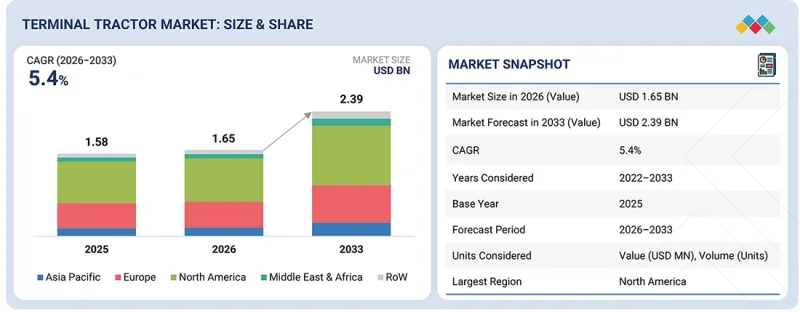
터미널 트랙터 시장 규모는 2026년 16억 5,000만 달러로 추정되고, 2033년까지 23억 9,000만 달러로 성장이 전망되며, CAGR 5.4%로 확대될 것으로 예측됩니다.
| 조사 범위 | |
|---|---|
| 조사 대상 기간 | 2026-2033년 |
| 기준 연도 | 2025년 |
| 예측 기간 | 2026-2033년 |
| 산정 단위 | 10억 달러 |
| 부문 | 유형별, 용도별, 구동 방식별, 추진 방식별, 톤수별, 업계별, 모터 출력별, 배터리 화학별, 지역별 |
| 대상 지역 | 아시아태평양, 유럽, 중동 및 아프리카, 북미 및 기타 지역 |
이 시장은 컨테이너 화물 운송, 세계 무역, 수출입 활동의 지속적인 확대, 그리고 창고, 물류, 철도 화물 운송 분야 수요 증가에 힘입어 최근 몇 년간 꾸준한 성장을 기록하고 있습니다. 항만 현대화 및 터미널 자동화에 대한 투자 확대에 힘입어, 터미널 트랙터를 포함한 첨단 화물 취급 장비의 도입이 더욱 촉진되고 있습니다.
"예측 기간 동안, 모터 출력별로 본 세계 터미널 트랙터 시장에서 250 kW 이상 부문이 가장 높은 성장률을 보일 것으로 예측됩니다."
250 kW 이상 부문은 예측 기간 동안 가장 높은 성장률을 나타낼 것으로 전망됩니다. 모터 출력이 250 kW를 초과하는 터미널 트랙터는 주로 만재 컨테이너 트레일러, RoRo 화물 및 중량급 인터모달 화물의 연속적인 이동에 사용되며, 이러한 작업에서는 높은 시동 토크, 빠른 가속 및 여러 교대 근무에 걸친 지속적인 가동 능력이 필수적입니다. 북미에서는 주요 컨테이너 항만의 전기화, 대규모 창고 및 물류 네트워크, 그리고 디젤식 야드 장비의 교체를 가속화하는 정부 주도의 클린 포트 이니셔티브를 배경으로, 이 출력 등급에 대한 수요가 가장 크게 증가할 것으로 예측됩니다. 이러한 수요에 부응하기 위해 각 OEM 업체들은 고출력 전동 터미널 트랙터로 제품 라인업을 확충하고 있습니다. MAFI사의 ‘T230e’는 리튬 이온 배터리 기술을 채택하여 최대 모터 출력 300 kW를 실현했습니다. 한편, SANY사의 ‘SM4256 전동 터미널 트랙터’는 최대 280 kW의 모터 출력을 제공하며, 가혹한 항만 및 산업용 화물 취급 현장에서 고출력 전동 터미널 트랙터가 발휘하는 성능을 입증하고 있습니다. 화물 처리량과 제로 배출 요건이 지속적으로 증가하는 가운데, 모터 출력이 250 kW를 초과하는 터미널 트랙터에 대한 수요는 가장 빠른 속도로 확대될 것으로 예측됩니다.
"예측 기간 동안 구동 방식별로는 4x2 부문이 터미널 트랙터 시장에서 가장 큰 점유율을 차지할 것으로 전망됩니다."
구동 방식별로는 예측 기간 동안 4x2 부문이 가장 큰 점유율을 차지할 것으로 예측됩니다. 이 부문의 성장은 비용 대비 효과, 운영 효율성, 그리고 광범위한 물류 및 터미널 용도에서의 범용성에 의해 주도되고 있습니다. 2026년 시점에서 아시아태평양, 유럽, 북미는 4x2 축 유형 터미널 트랙터의 85% 이상을 차지하고 있습니다. 소비자들이 총 소유 비용 절감과 차량 가동률 향상에 점점 더 중점을 두게 됨에 따라, 전 세계 OEM 업체들은 주류 야드 업무에서 4x2 플랫폼을 지속적으로 우선시할 수밖에 없게 되었습니다. 항만에서는 빈도가 높고 단거리인 컨테이너 및 트레일러의 환적 작업에서 4x2축 트랙터가 여전히 주요 용도로 사용되고 있기 때문에 창고 및 물류 용도가 시장 가치의 대부분을 차지하고 있습니다. 북미와 유럽은 광범위한 물류 인프라 덕분에 여전히 최대의 도입 시장으로 남아 있지만, 아시아태평양에서는 컨테이너 무역 증가, 항만 처리 능력의 확대, 그리고 창고에 대한 투자에 힘입어 가장 빠른 성장이 나타나고 있습니다. 중국, 인도, 말레이시아 등의 국가들은 유럽 및 북미로의 주요 수출국이며, 아시아태평양 각 항구에서 대량의 화물을 발생시키고 있습니다. 따라서 4x2 터미널 트랙터는 항만 시설 내에서의 고빈도·단거리 트레일러 이동에 있어 앞으로도 비용 대비 효과가 높은 솔루션으로 자리매김할 것입니다. 간단한 구동 시스템 덕분에 도입 비용과 유지 관리 비용을 절감할 수 있어, 업무량이 많은 수출 허브에서의 연속 운행에 최적입니다.
'예측 기간 동안, 미국은 북미에서 터미널 트랙터의 최대 시장이 될 것으로 전망됩니다.'
예측 기간 동안 미국은 북미에서 터미널 트랙터의 최대 시장이 될 것으로 전망됩니다. 미국 시장을 견인하는 요인으로는 견고한 국내 제조거점, 잘 정비된 항만 인프라, 충실한 무역 역량, 그리고 효율적인 물류 솔루션에 대한 수요 증가를 들 수 있습니다. 미국에서는 전자상거래 산업의 급속한 확장과 물류 인프라에 대한 대규모 투자가 진행되고 있습니다. 미국 인구조사국에 따르면, 2026년 1분기 전자상거래 매출액은 3267억 달러에 달하고, 2025년 4분기 대비 2.7% 증가했습니다. 이러한 성장에 따라 효율적인 창고 운영과 트레일러 이동이 요구되고 있으며, 터미널 트랙터는 이에 큰 운영상의 이점을 제공합니다. 또한, 항만 및 해상 터미널 운영, 창고, 복합운송으로 구성된 광범위한 지역 네트워크와 더불어 노후화된 설비의 교체 수요도 시장 성장을 뒷받침하고 있습니다. 또한, 복합운송 확대 계획과 항만 인프라에 대한 대규모 투자, 전자상거래의 확대, 자동화 도입은 물론, 휴스턴이나 브런즈윅 등 주요 항만의 처리 능력 증강으로 인해 효율적인 터미널 트랙터에 대한 수요가 더욱 높아질 것으로 전망됩니다. 제조업체와 터미널 운영사들도 자동화 및 차량 현대화를 위한 노력을 가속화하고 있으며, 북미 전역의 물류 허브, 배송 센터, 항만 터미널에서 터미널 트랙터의 도입이 더욱 확대되고 있습니다. 칼마(Kalmar), 테르베르그 스페셜 비히클스(Terberg Special Vehicles), TICO 매뉴팩처링(TICO Manufacturing), MAFI 트랜스포트 시스템즈(MAFI Transport Systems)와 같은 주요 기업들은 전미의 항만, 인터모달 터미널, 창고 및 물류 사업자에게 터미널 트랙터를 적극적으로 공급하고 있습니다. 항만 현대화, 물류 인프라 확장, 차량 교체에 대한 지속적인 투자, 그리고 주요 터미널 트랙터 OEM 제조업체들의 강력한 입지에 힘입어, 미국은 예측 기간 동안 북미 최대의 터미널 트랙터 시장으로서의 지위를 유지할 것으로 전망됩니다.
터미널 트랙터 시장에는 칼마르(Kalmar, 핀란드), 테르베르그 스페셜 비히클스(Terberg Special Vehicles, 네덜란드), TICO 트랙터스(TICO Tractors, 미국), 캐파시티 트럭스(Capacity Trucks, 미국), MAFI 트랜스포트-시스템(MAFI Transport-Systeme GmbH, 독일) 등의 주요 기업이 진출해 있습니다.
조사 범위
본 조사 보고서에서는 터미널 트랙터 시장의 조사 부문을 분류하고 있습니다. 용도(창고 및 물류, 항만, 공항, 석유 및 가스), 구동 방식(4x2, 4x4, 6x4), 유형(수동 및 자동), 적재량(50톤 미만, 50-100톤, 100톤 초과), 추진 방식(디젤, 전기, CNG/LNG), 최종 이용 산업(소매, 식품 및 음료, 내륙 수로·해운 서비스, 철도 물류, RoRo), 배터리 화학 조성(LFP, NMC, 기타 배터리 화학 조성), 모터 출력(150 kW 미만, 150-250 kW, 250 kW 초과), 지역(아시아태평양, 북미, 중동 및 아프리카(MEA), 유럽, 기타 지역(RoW))입니다.
본 보고서의 조사 범위는 터미널 트랙터 시장의 성장에 영향을 미치는 촉진요인, 제약 요인, 과제, 기회 등 주요 요인에 대한 상세한 정보를 포괄하고 있습니다. 주요 업계 기업에 대한 철저한 분석을 통해 각 기업의 사업 개요, 솔루션, 서비스, 주요 전략, 계약, 파트너십, 합의 사항, 제품 및 서비스 출시, 합병·인수, 그리고 터미널 트랙터 시장과 관련된 최근 동향에 대한 인사이트력을 제공합니다. 또한, 본 보고서에서는 터미널 트랙터 시장 생태계 내 중소기업(SME) 및 스타트업에 대한 경쟁 분석, 공급업체 분석, 주요 공급업체의 개발 동향에 대해서도 다루고 있습니다.
본 보고서를 구매할 때의 주요 이점 :
본 보고서는 터미널 트랙터 시장 전체 및 각 하위 부문의 매출에 대한 가장 정확한 추정치를 제공함으로써, 시장 선도 기업 및 신규 진출기업을 지원합니다. 본 보고서에는 종합적인 시장 점유율 분석, 공급망 분석, 부품 제조업체에 대한 상세한 목록 및 인사이트, 소재별 세분화, 철저한 공급망 분석, 그리고 경쟁 구도가 포함되어 있습니다. 또한, 본 보고서는 이해관계자들이 시장 동향을 파악하는 데 도움이 되며, 주요 시장 성장 촉진요인, 제약 요인, 과제 및 기회에 대한 정보를 제공합니다.
본 보고서는 다음 사항에 대한 인사이트를 제공합니다.
주요 촉진요인(항만 화물 처리량 증가, 철도 화물 운송 확대, 전자상거래 및 물류 업계 수요 증가), 제약 요인(막대한 초기 투자 비용, 전기식 터미널 트랙터용 충전 인프라 미비), 기회(전기식 터미널 트랙터에 대한 선호도 증가, 저배출형 터미널 트랙터에 대한 수요 증가, 자율주행 터미널 트랙터 기술 개발), 과제(다른 항만 설비와의 연계 부족)에 대한 분석
- 제품 개발 및 혁신 : 터미널 트랙터 시장의 향후 기술, 연구 개발 활동, 제품 및 서비스 출시에 대한 상세한 분석
- 시장 개발 : 각 지역의 수익성 높은 시장에 대한 종합적인 정보
- 시장 다각화 : 터미널 트랙터 시장의 제품 및 서비스, 미개척 지역, 최근 동향 및 투자에 관한 종합적인 정보
- 경쟁 분석 : 터미널 트랙터 시장에서 Kalmar(핀란드), Terberg Special Vehicles(네덜란드), Capacity Trucks(미국), MAFI Transport-Systeme GmbH(독일), TICO Tractors(미국) 등 주요 기업의 시장 점유율, 성장 전략 및 서비스 제공 내용에 대한 상세한 평가.
자주 묻는 질문
목차
제1장 서론
제2장 주요 요약
제3장 프리미엄 인사이트
제4장 시장 개요
제5장 업계 동향
제6장 기술 진보, 특허, 혁신, 향후 용도
제7장 규제 상황
제8장 고객 현황과 구매 행동
제9장 터미널 트랙터 시장 : 유형별
제10장 터미널 트랙터 시장 : 용도별
제11장 터미널 트랙터 시장 : 구동 방식별
제12장 터미널 트랙터 시장 : 추진 방식별
제13장 터미널 트랙터 시장 : 톤수 별
제14장 터미널 트랙터 시장 : 업계별
제15장 전동 터미널 트랙터 시장 : 모터 출력별
제16장 전동 터미널 트랙터 시장 : 배터리 화학별
제17장 터미널 트랙터 시장 : 지역별
제18장 경쟁 구도
제19장 기업 개요
제20장 조사 방법
제21장 부록
AJY 26.08.18The terminal tractor market is projected to grow from USD 1.65 billion in 2026 to USD 2.39 billion by 2033, at a CAGR of 5.4%.
| Scope of the Report | |
|---|---|
| Years Considered for the Study | 2026-2033 |
| Base Year | 2025 |
| Forecast Period | 2026-2033 |
| Units Considered | USD billion |
| Segments | By Type, Drive, Tonnage, Application, Battery Chemistry, End Use, Propulsion, Power Output, & Region |
| Regions covered | Asia Pacific, Europe, Middle East & Africa, North America, and RoW |
The market has recorded steady growth in recent years, supported by the continued expansion of containerized cargo movement, global trade, import and export activities, and increasing demand from the warehousing, logistics, and rail freight sectors. Growing investments in port modernization and terminal automation are further strengthening the adoption of advanced cargo handling equipment, including terminal tractors.
">250 kW is projected to be the fastest-growing segment in the global terminal tractor market, by motor power output, during the forecast period."
The >250 kW segment is anticipated to record the highest rate during the forecast period. Terminal tractors with motor outputs of >250 kW are primarily deployed for continuous movement of fully loaded container trailers, RoRo cargo, and heavy intermodal loads, where high starting torque, rapid acceleration, and sustained operation across multiple shifts are essential. North America is expected to witness the strongest demand for this power class, driven by the electrification of major container ports, large-scale warehouse and distribution networks, and government-backed clean port initiatives accelerating the replacement of diesel yard equipment. To meet this demand, OEMs are expanding their portfolios with high-power electric terminal tractors. MAFI's T230e delivers a maximum motor output of 300 kW with lithium-ion battery technology, while SANY's SM4256 Electric Terminal Tractor provides up to 280 kW of motor power, demonstrating the capability of high-output electric terminal tractors in demanding port and industrial cargo handling applications. As freight throughput and zero-emission requirements continue to increase, demand for terminal tractors with motor outputs >250 kW is expected to grow at the fastest pace.
"The 4x2 segment is projected to account for the largest share of the terminal tractor market, by drive, during the forecast period."
By drive, the 4x2 segment is projected to account for the largest share during the forecast period. The segment's growth is driven by its cost-effectiveness, operational efficiency, and versatility across a broad range of logistics and terminal applications. Asia Pacific, Europe, and North America hold more than 85% of terminal tractors of the 4x2 axle type as of 2026. The higher consumers' focus on lower total cost of ownership and higher fleet utilization rate has forced global OEMs to prioritize 4X2 platforms for mainstream yard operations continuously. The warehouse and logistics application holds the dominant value as the ports remain the anchor use of 4x2 axle tractors for high-frequency, short-haul containers and trailer shunting. North America and Europe remain the largest installed market due to their extensive logistics infrastructure, while Asia Pacific is witnessing the fastest expansion, supported by rising containerized trade, port capacity additions, and warehouse investments. Countries such as China, India, and Malaysia are key exporters to Europe and North America, generating high cargo volumes across Asia Pacific ports. Hence, 4x2 terminal tractors will continue to be considered as a cost-effective solution for high-frequency, short-distance trailer movement within port facilities. Their simpler drivetrain reduces acquisition and maintenance costs, making them well suited for continuous operations in busy export hubs.
"The US is projected to be the largest market for terminal tractors in North America during the forecast period."
The US is projected to be the largest market for terminal tractors in North America during the forecast period. The factors driving the US market are a strong domestic manufacturing base, established port infrastructure, substantial trade capabilities, and higher demand for efficient logistics solutions. The country has experienced rapid expansion in the e-commerce industry and substantial investments in logistics infrastructure. According to the US Census Bureau, e-commerce sales reached USD 326.7 billion in Q1 2026, an increase of 2.7% from the fourth quarter of 2025. This growth demands efficient warehouse operations and trailer movements, where terminal tractors offer significant operational advantages. Additionally, regional extensive network of port/marine terminal operations, warehousing, and intermodal logistics, alongside the urge to replace aging equipment, are supporting the market growth. Furthermore, expansion plans of intermodal transportation and major investments in port infrastructure, e-commerce expansion, and automation adoption, with key ports such as Houston and Brunswick increasing capacity, are likely to boost the demand for efficient terminal tractors. Manufacturers and terminal operators are also accelerating automation and fleet modernization initiatives, reinforcing the adoption of terminal tractors across logistics hubs, distribution centers, and port terminals throughout North America. Major players such as Kalmar, Terberg Special Vehicles, TICO Manufacturing, and MAFI Transport Systeme are actively supplying terminal tractors to ports, intermodal terminals, warehouses, and logistics operators across the US. Supported by continued investments in port modernization, logistics infrastructure expansion, fleet replacement, and the strong presence of leading terminal tractor OEMs, the US is expected to maintain its position as the largest terminal tractor market in North America throughout the forecast period.
In-depth interviews were conducted with CEOs, marketing directors, other innovation and technology directors, and executives from various key organizations operating in the terminal tractor market.
The break-up of primaries is as follows:
- By Company Type: Terminal Tractor OEMs - 90%, End User Organizations - 10%
- By Designation: C-Level Executives - 35%, Directors - 40%, and Others - 25%
- By Region: North America-25%, Europe-35%, Asia Pacific-25%, and Rest of the World-15%
The terminal tractor market comprises major players, such as Kalmar (Finland), Terberg Special Vehicles (Netherlands), TICO Tractors (US), Capacity Trucks (US), and MAFI Transport-Systeme GmbH (Germany).
Research Coverage
This research report categorizes the study segments of the terminal tractor market. It forecasts the market size, by application (warehouse & logistics, marine port, airport, and oil & gas), drive (4x2, 4x4, and 6x4), type (manual and automated), tonnage (<50 tons, 50-100 tons, and >100 tons), propulsion (diesel, electric, CNG/LNG), end use industry (retail, food & beverages, inland waterways & marine service, rail logistics, and RoRo), battery chemistry (LFP, NMC, Other battery chemistries), motor power output (<150 kW, 150-250 kW, >250 kW), and region (Asia Pacific, North America, Middle East & Africa [MEA], Europe, and the Rest of the World [RoW]).
The report's scope covers detailed information regarding the major factors, such as drivers, restraints, challenges, and opportunities, influencing the growth of the terminal tractor market. A thorough analysis of the key industry players provides insights into their business overview, solutions, and services; key strategies; contracts, partnerships, agreements, product & service launches, mergers, and acquisitions; and recent developments associated with the terminal tractor market. This report also covers competitive analysis of SMEs/startups in the terminal tractor market ecosystem, supplier analysis, and development by key suppliers.
Key Benefits of buying the Report:
The report will help the market leaders/new entrants with information on the closest approximations of the revenue numbers for the overall terminal tractor market and the subsegments. The report includes a comprehensive market share analysis, supply chain analysis, extensive lists and insights into component manufacturers, chapter segmentation based on materials, a thorough supply chain analysis, and a competitive landscape. The report also helps stakeholders understand the market pulse and provides information on key market drivers, restraints, challenges, and opportunities.
The report provides insights on the following pointers:
Analysis of key drivers (growth in port traffic, rising rail freight transportation, growth in demand from e-commerce and logistics industries), restraints (significant initial investment cost, limited availability of charging infrastructure for electric terminal tractors), opportunities (increasing preference for electric terminal tractors, rising demand for low-emission terminal tractors, technological developments in automated terminal tractors), and challenges (limited synchronization with other port equipment)
- Product Development/Innovation: Detailed insights on upcoming technologies, research & development activities, and product & service launches in the terminal tractor market
- Market Development: Comprehensive information about lucrative markets across regions
- Market Diversification: Exhaustive information about products & services, untapped geographies, recent developments, and investments in the terminal tractor market
- Competitive Assessment: In-depth assessment of market share, growth strategies, and service offerings of leading players such as Kalmar (Finland), Terberg Special Vehicles (Netherlands), Capacity Trucks (US), MAFI Transport-Systeme GmbH (Germany), and TICO Tractors (US) in the terminal tractor market.
TABLE OF CONTENTS
1 INTRODUCTION
- 1.1 STUDY OBJECTIVES
- 1.2 MARKET DEFINITION
- 1.2.1 INCLUSIONS AND EXCLUSIONS
- 1.3 MARKET SCOPE
- 1.3.1 YEARS CONSIDERED
- 1.4 CURRENCY CONSIDERED
- 1.5 STAKEHOLDERS
- 1.6 SUMMARY OF CHANGES
2 EXECUTIVE SUMMARY
- 2.1 KEY INSIGHTS AND MARKET HIGHLIGHTS
- 2.2 KEY MARKET PARTICIPANTS: MAPPING OF STRATEGIC DEVELOPMENTS
- 2.3 DISRUPTIVE TRENDS IN TERMINAL TRACTOR MARKET
- 2.4 HIGH GROWTH SEGMENTS
- 2.5 REGIONAL SNAPSHOT: MARKET SIZE, GROWTH RATE, AND FORECAST
3 PREMIUM INSIGHTS
- 3.1 ATTRACTIVE OPPORTUNITIES FOR PLAYERS IN TERMINAL TRACTOR MARKET
- 3.2 TERMINAL TRACTOR MARKET, BY TYPE
- 3.3 TERMINAL TRACTOR MARKET, BY TONNAGE CAPACITY
- 3.4 ELECTRIC TERMINAL TRACTOR MARKET, BY BATTERY CHEMISTRY
- 3.5 TERMINAL TRACTOR MARKET, BY PROPULSION
- 3.6 TERMINAL TRACTOR MARKET, BY DRIVE
- 3.7 ELECTRIC TERMINAL TRACTOR MARKET, BY MOTOR POWER OUTPUT
- 3.8 TERMINAL TRACTOR MARKET, BY APPLICATION
- 3.9 TERMINAL TRACTOR MARKET, LOGISTICS BY INDUSTRY
- 3.10 TERMINAL TRACTOR MARKET, BY REGION
4 MARKET OVERVIEW
- 4.1 INTRODUCTION
- 4.2 MARKET DYNAMICS
- 4.2.1 DRIVERS
- 4.2.1.1 Rising port traffic
- 4.2.1.2 Expansion of intermodal rail freight operations
- 4.2.1.3 Rising investments in e-commerce and logistics infrastructure
- 4.2.1.4 Accelerating replacement of diesel terminal tractors with electric & hydrogen platforms
- 4.2.1.5 Automation and 24/7 yard operations driving demand for connected and autonomous terminal tractors
- 4.2.2 RESTRAINTS
- 4.2.2.1 Significant initial investment costs
- 4.2.2.2 Limited financial justification for zero-emission terminal tractors outside high-utilization fleets
- 4.2.3 OPPORTUNITIES
- 4.2.3.1 Increasing preference for electric terminal tractors
- 4.2.3.2 Reduced maintenance cost for electric terminal tractors
- 4.2.3.3 Rising demand for low-emission terminal tractors
- 4.2.3.4 Technological developments in automated terminal tractors
- 4.2.3.5 Electrification-as-a-service (EaaS) and energy ecosystems creating new revenue models
- 4.2.4 CHALLENGES
- 4.2.4.1 Limited synchronization with other port equipment
- 4.2.4.2 Integrating zero-emission and autonomous terminal tractors into legacy port infrastructure and digital ecosystems
- 4.2.1 DRIVERS
- 4.3 UNMET NEEDS AND WHITE SPACES
- 4.4 INTERCONNECTED MARKETS AND CROSS-SECTOR OPPORTUNITIES
- 4.5 STRATEGIC MOVES BY TIER-1/2/3 SUPPLIERS
- 4.5.1 STRATEGIC MOVES BY COMPANY TIERS
- 4.5.2 STRATEGIC MOVES BY OEMS
5 INDUSTRY TRENDS
- 5.1 MACROECONOMIC OUTLOOK
- 5.1.1 INTRODUCTION
- 5.1.2 GDP TRENDS AND FORECAST
- 5.1.3 TRENDS IN TERMINAL TRACTOR INDUSTRY
- 5.1.3.1 Regional GDP dynamics
- 5.1.3.2 Developed markets
- 5.1.3.3 Emerging markets
- 5.1.3.3.1 China
- 5.1.3.3.2 India
- 5.2 SUPPLY CHAIN ANALYSIS
- 5.3 ECOSYSTEM ANALYSIS
- 5.3.1 TERMINAL TRACTOR MANUFACTURERS
- 5.3.2 RAW MATERIAL SUPPLIERS
- 5.3.3 COMPONENT PROVIDERS
- 5.3.4 TECHNOLOGY PROVIDERS
- 5.3.5 FLEET OPERATORS
- 5.3.6 AFTERMARKET AND DISTRIBUTION PLAYERS
- 5.4 PRICING ANALYSIS
- 5.4.1 BY PROPULSION
- 5.4.2 BY TYPE
- 5.4.3 BY REGION
- 5.5 TOTAL COST OF OWNERSHIP OF TERMINAL TRACTOR MARKET
- 5.6 TRADE ANALYSIS
- 5.6.1 IMPORT SCENARIO (HS CODE 870990)
- 5.6.2 EXPORT SCENARIO (HS CODE 870990)
- 5.7 KEY CONFERENCES AND EVENTS, 2026-2027
- 5.8 TRENDS/DISRUPTIONS IMPACTING CUSTOMER BUSINESS
- 5.9 CASE STUDY ANALYSIS
- 5.9.1 KALMAR'S FULLY ELECTRIC TERMINAL TRACTOR (TT7 EV)
- 5.9.2 APM TERMINALS MAASVLAKTE II'S DEPLOYMENT OF AUTOMATED ELECTRIC TERMINAL TRACTORS
- 5.9.3 PORT OF LOS ANGELES' ADVANCED YARD TRACTOR DEPLOYMENT AND ECO-FRATIS DRAYAGE TRUCK EFFICIENCY PROJECT
- 5.10 OEM ANALYSIS
- 5.10.1 BATTERY CAPACITY OF ELECTRIC TERMINAL TRACTORS BY OEMS
- 5.10.2 DRIVE TYPES OF TERMINAL TRACTORS BY OEMS
- 5.10.3 BATTERY CAPACITY OF ELECTRIC TERMINAL TRACTORS BY OEMS
- 5.10.4 OEM PARTNERSHIPS WITH BATTERY MANUFACTURERS
- 5.11 IMPACT OF EU-FTA TRADE DEAL ON PORT EQUIPMENT INDUSTRY
- 5.12 IMPACT OF ISRAEL-IRAN WAR ON PORT EQUIPMENT INDUSTRY
- 5.13 FUTURE REVENUE POOL ANALYSIS
- 5.13.1 DIESEL TERMINAL TRACTORS
- 5.13.2 BATTERY-ELECTRIC TERMINAL TRACTORS
- 5.13.3 HYDROGEN FUEL-CELL TERMINAL TRACTORS
- 5.13.4 AUTONOMOUS TERMINAL TRACTORS
- 5.13.5 FLEET MANAGEMENT SOFTWARE
- 5.13.6 CHARGING & ENERGY INFRASTRUCTURE
- 5.13.7 AFTERMARKET & LIFECYCLE SERVICES
- 5.14 GLOBAL PORT ELECTRIFICATION & GREEN PORT READINESS INDEX
- 5.15 TERMINAL TRACTOR AS A SERVICE (TTAAS) BUSINESS MODEL
6 TECHNOLOGICAL ADVANCEMENTS, PATENTS, INNOVATIONS, AND FUTURE APPLICATIONS
- 6.1 KEY TECHNOLOGIES
- 6.1.1 AUTOMATION OF TERMINAL TRACTORS
- 6.1.1.1 Alternative energy solutions for terminal tractors
- 6.1.2 AUTOMATED MATERIAL HANDLING IOT
- 6.1.1 AUTOMATION OF TERMINAL TRACTORS
- 6.2 COMPLEMENTARY TECHNOLOGIES
- 6.2.1 FLEET MANAGEMENT SYSTEMS
- 6.2.2 ELECTRONIC STABILITY MANAGEMENT
- 6.3 ADJACENT TECHNOLOGIES
- 6.3.1 ELECTRIC VEHICLE CHARGING INFRASTRUCTURE
- 6.3.2 TERMINAL TRACTOR TELEMATICS
- 6.4 PATENT ANALYSIS
- 6.5 FUTURE APPLICATIONS
- 6.6 IMPACT OF AI/GENERATIVE AI
7 REGULATORY LANDSCAPE
- 7.1 REGIONAL REGULATIONS AND COMPLIANCE
- 7.1.1 REGULATORY BODIES, GOVERNMENT AGENCIES, AND OTHER ORGANIZATIONS
- 7.1.2 EMISSION REGULATIONS
- 7.1.3 SAFETY STANDARDS FOR TERMINAL TRACTORS
8 CUSTOMER LANDSCAPE AND BUYER BEHAVIOR
- 8.1 DECISION-MAKING PROCESS
- 8.2 KEY STAKEHOLDERS IN BUYING PROCESS AND THEIR EVALUATION CRITERIA
- 8.2.1 KEY STAKEHOLDERS IN BUYING PROCESS
- 8.2.2 BUYING CRITERIA
- 8.2.3 BUYING CRITERIA
- 8.3 ADOPTION BARRIERS AND INTERNAL CHALLENGES
- 8.4 UNMET NEEDS OF VARIOUS END-USE INDUSTRIES
- 8.5 MARKET PROFITABILITY
- 8.5.1 REVENUE POTENTIAL
- 8.5.2 COST DYNAMICS
- 8.5.3 MARGIN OPPORTUNITIES
9 TERMINAL TRACTOR MARKET, BY TYPE
- 9.1 INTRODUCTION
- 9.2 MANUAL
- 9.2.1 EASE OF MAINTENANCE AND REPAIR TO DRIVE DEMAND
- 9.3 AUTOMATED
- 9.3.1 ADVANCEMENT IN PORT AND TERMINAL OPERATIONS TO DRIVE DEMAND
- 9.4 KEY PRIMARY INSIGHTS
10 TERMINAL TRACTOR MARKET, BY APPLICATION
- 10.1 INTRODUCTION
- 10.2 AIRPORT
- 10.2.1 RISING GLOBAL AIR TRAFFIC AND CARGO DEMAND TO DRIVE SEGMENTAL GROWTH
- 10.3 MARINE PORTS
- 10.3.1 SIGNIFICANT INVESTMENTS IN MARINE PORT DEVELOPMENT AND MODERNIZATION TO DRIVE SEGMENTAL GROWTH
- 10.4 OIL & GAS
- 10.4.1 RISING OIL DEMAND TO DRIVE SEGMENTAL GROWTH
- 10.5 WAREHOUSE & LOGISTICS
- 10.5.1 ROBUST GROWTH OF LOGISTICS INDUSTRY TO DRIVE SEGMENTAL GROWTH
- 10.6 KEY PRIMARY INSIGHTS
11 TERMINAL TRACTOR MARKET, BY DRIVE
- 11.1 INTRODUCTION
- 11.2 4X2
- 11.2.1 RISING DEMAND FOR EFFICIENT TERMINAL OPERATIONS TO DRIVE MARKET
- 11.3 4X4
- 11.3.1 INCREASE IN CARGO VOLUMES IN DEVELOPED ECONOMIES TO DRIVE MARKET
- 11.4 6X4
- 11.4.1 INCREASING ADOPTION OF HIGHER LOAD CAPACITY TERMINAL TRUCKS TO DRIVE MARKET
- 11.5 KEY PRIMARY INSIGHTS
12 TERMINAL TRACTOR MARKET, BY PROPULSION
- 12.1 INTRODUCTION
- 12.2 DIESEL
- 12.2.1 NEED FOR HIGH-POWER AND COST-EFFECTIVE TERMINAL TRACTORS FOR DEMANDING APPLICATIONS TO DRIVE MARKET
- 12.3 ELECTRIC
- 12.3.1 STRINGENT GLOBAL EMISSION REGULATIONS TO DRIVE MARKET
- 12.4 CNG/LNG
- 12.4.1 ENVIRONMENTAL BENEFITS TO DRIVE MARKET
- 12.5 HYDROGEN
- 12.5.1 OEM INNOVATIONS AND COLLABORATIONS TO DRIVE MARKET
- 12.6 KEY PRIMARY INSIGHTS
13 TERMINAL TRACTOR MARKET, BY TONNAGE
- 13.1 INTRODUCTION
- 13.2 <50 TONS
- 13.2.1 GROWTH IN SEABORNE TRADE TO DRIVE DEMAND
- 13.3 50-100 TONS
- 13.3.1 GROWING EXPORTS AND IMPORTS WORLDWIDE TO DRIVE MARKET
- 13.4 >100 TONS
- 13.4.1 HIGH IMPORT AND EXPORT ACTIVITIES FOR HANDLING OVERSIZED AND HEAVY CARGO TO DRIVE MARKET
- 13.5 KEY PRIMARY INSIGHTS
14 TERMINAL TRACTOR MARKET: LOGISTICS, BY INDUSTRY
- 14.1 INTRODUCTION
- 14.2 RETAIL
- 14.2.1 GROWTH OF RETAIL INDUSTRY DRIVEN BY E-COMMERCE IN EMERGING ECONOMIES TO DRIVE MARKET
- 14.3 FOOD & BEVERAGES
- 14.3.1 GROWTH OF JUST-IN-TIME DELIVERY MODELS TO DRIVE MARKET
- 14.4 INLAND WATERWAYS & MARINE SERVICE
- 14.4.1 INCREASING WATERBORNE FREIGHT ACTIVITIES TO DRIVE MARKET
- 14.5 RAIL LOGISTICS
- 14.5.1 RISING DEMAND FOR SUSTAINABLE FREIGHT TRANSPORTATION SOLUTIONS TO DRIVE MARKET
- 14.6 ROLL-ON/ROLL-OFF (RORO)
- 14.6.1 EXPANSION OF AUTOMOTIVE AND HEAVY MACHINERY EXPORTS TO DRIVE MARKET
- 14.7 KEY PRIMARY INSIGHTS
15 ELECTRIC TERMINAL TRACTOR MARKET, BY MOTOR POWER OUTPUT
- 15.1 INTRODUCTION
- 15.2 <150 KW
- 15.2.1 EASE OF INTEGRATION INTO SMALLER-SCALE ELECTRIC FLEETS TO BOOST GROWTH
- 15.3 150-250 KW
- 15.3.1 SUITABILITY FOR STANDARD PORT LOGISTICS TO DRIVE SEGMENT
- 15.4 >250 KW
- 15.4.1 ABILITY TO MEET DEMANDING REQUIREMENTS OF HEAVY-DUTY LOGISTICS
- 15.5 KEY PRIMARY INSIGHTS
16 ELECTRIC TERMINAL TRACTOR MARKET, BY BATTERY CHEMISTRY
- 16.1 INTRODUCTION
- 16.2 LITHIUM IRON PHOSPHATE (LFP)
- 16.2.1 SHIFT TOWARD SAFER, COST-EFFECTIVE, AND SUSTAINABLE OPERATIONS TO DRIVE MARKET
- 16.3 NICKEL MANGANESE COBALT (NMC)
- 16.3.1 HIGH ENERGY AND POWER DENSITIES TO DRIVE MARKET
- 16.4 OTHER CHEMISTRIES
- 16.5 KEY PRIMARY INSIGHTS
17 TERMINAL TRACTOR MARKET, BY REGION
- 17.1 INTRODUCTION
- 17.2 ASIA PACIFIC
- 17.2.1 CHINA
- 17.2.1.1 Increasing cargo through sea routes and growth in e-commerce sector to drive market
- 17.2.2 JAPAN
- 17.2.2.1 Increase in trade through major marine ports to drive market
- 17.2.3 SOUTH KOREA
- 17.2.3.1 Growing semiconductor exports to drive market
- 17.2.4 INDIA
- 17.2.4.1 Government initiatives to boost economic growth to drive market
- 17.2.5 REST OF ASIA PACIFIC
- 17.2.1 CHINA
- 17.3 EUROPE
- 17.3.1 GERMANY
- 17.3.1.1 Booming logistics sector to drive market
- 17.3.2 FRANCE
- 17.3.2.1 Presence of advanced industrial sector to drive market
- 17.3.3 UK
- 17.3.3.1 Maximum trade through seaports to drive market
- 17.3.4 SPAIN
- 17.3.4.1 Growth of logistics sector to drive market
- 17.3.5 RUSSIA
- 17.3.5.1 Investments in port modernization to impact market
- 17.3.6 REST OF EUROPE
- 17.3.1 GERMANY
- 17.4 NORTH AMERICA
- 17.4.1 US
- 17.4.1.1 Growth of e-commerce sector to drive market
- 17.4.2 MEXICO
- 17.4.2.1 Increasing marine port activities to drive market
- 17.4.3 CANADA
- 17.4.3.1 Increase in import and export activities to boost market
- 17.4.1 US
- 17.5 MIDDLE EAST & AFRICA
- 17.5.1 UAE
- 17.5.1.1 Increasing port expansion and automation activities to drive market
- 17.5.2 SAUDI ARABIA
- 17.5.2.1 Increasing maritime trade volumes to drive market
- 17.5.3 SOUTH AFRICA
- 17.5.3.1 Revival of maritime transport sector to drive market
- 17.5.4 REST OF MIDDLE EAST & AFRICA
- 17.5.1 UAE
- 17.6 REST OF THE WORLD
- 17.6.1 BRAZIL
- 17.6.1.1 Unprecedented growth of e-commerce sector to drive market
- 17.6.2 CHILE
- 17.6.2.1 Growth of freight and logistics market to drive growth
- 17.6.3 ARGENTINA
- 17.6.3.1 Rapid growth of e-commerce sales to drive market
- 17.6.4 OTHERS IN ROW
- 17.6.1 BRAZIL
18 COMPETITIVE LANDSCAPE
- 18.1 OVERVIEW
- 18.2 KEY PLAYER STRATEGIES/RIGHT TO WIN, JANUARY 2022-MAY 2026
- 18.3 MARKET SHARE ANALYSIS, 2025
- 18.4 REVENUE ANALYSIS
- 18.5 COMPANY VALUATION AND FINANCIAL METRICS
- 18.6 BRAND/PRODUCT COMPARISON
- 18.7 COMPANY EVALUATION MATRIX: TERMINAL TRACTOR KEY PLAYERS, 2025
- 18.7.1 STARS
- 18.7.2 EMERGING LEADERS
- 18.7.3 PERVASIVE PLAYERS
- 18.7.4 PARTICIPANTS
- 18.7.5 COMPANY FOOTPRINT
- 18.7.5.1 Region footprint
- 18.7.5.2 Propulsion footprint
- 18.7.5.3 Application footprint
- 18.8 COMPANY EVALUATION MATRIX: STARTUPS/SMES, 2025
- 18.8.1 PROGRESSIVE COMPANIES
- 18.8.2 RESPONSIVE COMPANIES
- 18.8.3 DYNAMIC COMPANIES
- 18.8.4 STARTING BLOCKS
- 18.8.5 COMPETITIVE BENCHMARKING
- 18.8.5.1 List of startups/SMEs
- 18.8.5.2 Competitive benchmarking of startups/SMEs
- 18.9 COMPETITIVE SCENARIO
- 18.9.1 PRODUCT LAUNCHES/DEVELOPMENTS
- 18.9.2 DEALS
- 18.9.3 EXPANSIONS
19 COMPANY PROFILES
- 19.1 KEY PLAYERS
- 19.1.1 KALMAR
- 19.1.1.1 Business overview
- 19.1.1.2 Products offered
- 19.1.1.3 Recent Developments
- 19.1.1.3.1 Product launches/developments
- 19.1.1.3.2 Deals
- 19.1.1.3.3 Expansions
- 19.1.1.3.4 Other developments
- 19.1.1.4 MnM view
- 19.1.1.4.1 Right to win
- 19.1.1.4.2 Strategic choices
- 19.1.1.4.3 Weaknesses and competitive threats
- 19.1.2 KONECRANES
- 19.1.2.1 Business overview
- 19.1.2.2 Products offered
- 19.1.2.2.1 Deals
- 19.1.2.2.2 Other developments
- 19.1.2.3 MnM view
- 19.1.2.3.1 Right to win
- 19.1.2.3.2 Strategic choices
- 19.1.2.3.3 Weaknesses and competitive threats
- 19.1.3 TERBERG SPECIAL VEHICLES
- 19.1.3.1 Business overview
- 19.1.3.2 Products offered
- 19.1.3.3 Recent developments
- 19.1.3.3.1 Product launches/developments
- 19.1.3.3.2 Deals
- 19.1.3.3.3 Expansions
- 19.1.3.3.4 Other developments
- 19.1.3.4 MnM view
- 19.1.3.4.1 Right to win
- 19.1.3.4.2 Strategic choices
- 19.1.3.4.3 Weaknesses and competitive threats
- 19.1.4 LINDE MATERIAL HANDLING
- 19.1.4.1 Business overview
- 19.1.4.2 Products offered
- 19.1.4.3 Recent developments
- 19.1.4.3.1 Product launches/developments
- 19.1.4.3.2 Expansions
- 19.1.4.4 MnM view
- 19.1.4.4.1 Right to win
- 19.1.4.4.2 Strategic choices
- 19.1.4.4.3 Weaknesses and competitive threats
- 19.1.5 CAPACITY TRUCKS
- 19.1.5.1 Business overview
- 19.1.5.2 Products offered
- 19.1.5.3 Recent developments
- 19.1.5.3.1 Product launches/developments
- 19.1.5.3.2 Deals
- 19.1.5.4 MnM view
- 19.1.5.4.1 Right to win
- 19.1.5.4.2 Strategic choices
- 19.1.5.4.3 Weaknesses and competitive threats
- 19.1.6 MOLTRANSPORT-SYSTEME GMBH
- 19.1.6.1 Business overview
- 19.1.6.2 Products offered
- 19.1.6.3 Recent developments
- 19.1.6.3.1 Product launches
- 19.1.6.3.2 Deals
- 19.1.7 AUTOCAR, LLC
- 19.1.7.1 Business overview
- 19.1.7.2 Products offered
- 19.1.7.3 Recent developments
- 19.1.7.3.1 Deals
- 19.1.7.3.2 Other developments
- 19.1.8 MOL (MOL CY NV)
- 19.1.8.1 Business overview
- 19.1.8.2 Products offered
- 19.1.9 TICO TRACTORS
- 19.1.9.1 Business overview
- 19.1.9.2 Products offered
- 19.1.9.3 Recent developments
- 19.1.9.3.1 Product launches
- 19.1.9.3.2 Deals
- 19.1.9.3.3 Expansions
- 19.1.10 SANY GROUP
- 19.1.10.1 Business overview
- 19.1.10.2 Products offered
- 19.1.10.3 Recent developments
- 19.1.10.3.1 Deals
- 19.1.1 KALMAR
- 19.2 OTHER PLAYERS
- 19.2.1 HOIST MATERIAL HANDLING, INC.
- 19.2.2 BLYYD
- 19.2.3 ORANGE EV
- 19.2.4 DAYSWORTH INTERNATIONAL
- 19.2.5 CHINA SINOTRUK INTERNATIONAL CO., LIMITED
- 19.2.6 BYD
- 19.2.7 AB VOLVO
- 19.2.8 HYSTER-YALE MATERIALS HANDLING, INC.
- 19.2.9 DONGFENG MOTOR COMPANY
- 19.2.10 TRANSPORTER INDUSTRY INTERNATIONAL GMBH
- 19.2.11 HANMA TECHNOLOGY GROUP CO., LTD.
- 19.2.12 DONGFENG MOTOR COMPANY.
- 19.2.13 TRANSPORTER INDUSTRY INTERNATIONAL GMB
- 19.2.14 HANMA TECHNOLOGY GROUP CO. LTD.
20 RESEARCH METHODOLOGY
- 20.1 RESEARCH DATA
- 20.1.1 SECONDARY DATA
- 20.1.1.1 List of key secondary sources to estimate terminal tractor market
- 20.1.1.2 Key data from secondary sources
- 20.1.2 PRIMARY DATA
- 20.1.2.1 Sampling techniques and data collection methods
- 20.1.2.2 List of primary participants
- 20.1.1 SECONDARY DATA
- 20.2 MARKET ESTIMATION METHODOLOGY
- 20.2.1 BOTTOM-UP APPROACH
- 20.2.2 TOP-DOWN APPROACH
- 20.3 DATA TRIANGULATION
- 20.4 FACTOR ANALYSIS
- 20.5 RESEARCH ASSUMPTIONS AND RISK ASSESSMENT
- 20.6 RESEARCH ASSUMPTIONS
- 20.7 RESEARCH LIMITATIONS
21 APPENDIX
- 21.1 INSIGHTS FROM INDUSTRY EXPERTS
- 21.2 DISCUSSION GUIDE
- 21.3 KNOWLEDGESTORE: MARKETSANDMARKETS' SUBSCRIPTION PORTAL
- 21.4 CUSTOMIZATION OPTIONS
- 21.4.1 TERMINAL TRACTOR MARKET, BY PROPULSION AND COUNTRY
- 21.4.2 TERMINAL TRACTOR MARKET, BY OWNERSHIP MODEL
- 21.4.2.1 Direct Purchase
- 21.4.2.2 Leasing
- 21.4.2.3 Rental
- 21.4.3 TERMINAL TRACTOR MARKET, BY CHARGING TYPE
- 21.4.3.1 AC Charging
- 21.4.3.2 DC Fast Charging
- 21.4.3.3 Opportunity Charging
- 21.4.3.4 Battery Swapping
- 21.4.4 DETAILED ANALYSIS AND PROFILING OF ADDITIONAL MARKET PLAYERS (UP TO 5)
- 21.5 RELATED REPORTS
- 21.6 AUTHOR DETAILS


