

|
시장보고서
상품코드
2108980
스마트 미터 시장 : 유형별, 컴포넌트별, 기술별, 통신기술별, 최종 사용자별, 지역별 - 예측(-2031년)Smart Meter Market by Type (Electric, Gas, Water), Component (Hardware, Software), Technology (AMI, AMR), Communication Technology (RF, PLC, Cellular), End User (Residential, Commercial, Industrial), and Region - Global Forecast To 2031 |
||||||

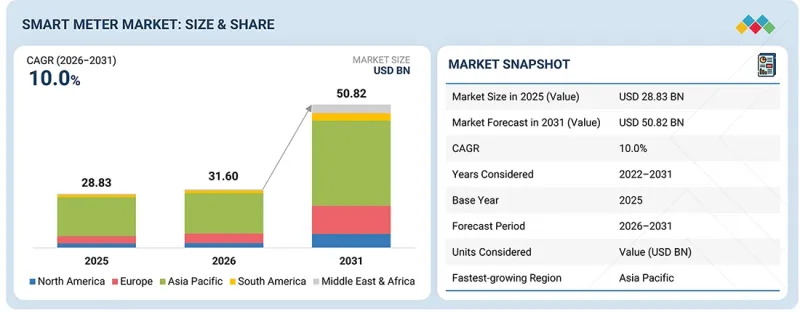
스마트 미터 시장 규모는 2026년 316억 달러로 추정되고, 2031년까지 508억 2,000만 달러로 확대될 전망이며, 예측 기간 중 연평균 복합 성장률(CAGR)은 10.0%로 성장이 전망되고 있습니다.
| 조사 범위 | |
|---|---|
| 조사 대상 기간 | 2020-2032년 |
| 기준 연도 | 2025년 |
| 예측 기간 | 2026-2032년 |
| 산정 단위 | 금액(10억 달러) |
| 부문 | 유형별, 컴포넌트별, 기술별, 통신기술별, 최종 사용자별, 지역별 |
| 대상 지역 | 북미, 유럽, 아시아태평양, 중동 및 아프리카, 라틴아메리카 |
세계 각국 정부는 미래의 전력 수요에 대응하기 위해 다양한 노력을 기울이고 있으며, 재생에너지원을 활용한 발전을 추진함으로써 탄소 발자국 감축에 주력하고 있습니다. 스마트 미터는 이러한 노력을 실현하는 데 있어 매우 중요한 역할을 수행하게 될 것입니다.
'주거용 : 최종 사용자별 스마트 미터 시장에서 가장 빠르게 성장하고 있는 부문'
스마트 수도 미터 시장에서 최종 사용자별 세분화에는 일반적으로 주거, 상업, 산업이 포함되며, 그중 주거 부문이 가장 큰 점유율을 차지하고 있습니다. 주거용 도입의 성장은 도시화, 물 부족, 그리고 정확한 계량과 물 손실 감소를 요구하는 규제적 압력에 의해 주도되고 있습니다. 수도 유틸리티자는 미터의 누적 설치 대수가 증가함에 따라 무수익수를 대폭 줄일 수 있고, 시간대별 요금제나 누수 감지 프로그램을 시행할 수 있게 되므로 주거용 확장을 우선시하고 있습니다. 도입을 뒷받침하는 동향으로는 보조금 및 민관 파트너십, 고밀도 주택에 최적화된 IoT 지원 저전력 통신(NB-IoT, LoRaWAN), 그리고 상수도 데이터를 다른 지자체 서비스와 통합하는 스마트 시티 이니셔티브 등을 들 수 있습니다. 실시간 사용량 확인 앱이나 단계별 요금제에 대한 소비자 수요가 높아지고 있는 점도 보급을 촉진하고 있습니다. 기존 인프라와의 통합이나 초기 설비 투자와 관련된 과제는 남아 있지만, 하드웨어 비용의 감소, 배터리 수명의 연장, 분석을 기반으로 한 수요 예측을 통해 주택 시장의 꾸준한 확대가 유지되고 있습니다.
'하드웨어 : 구성 요소별 스마트 미터 시장의 주요 부문'
컴포넌트별로 보면, 스마트 수도 미터 시장은 하드웨어와 소프트웨어로 나뉘며, 하드웨어 부문이 계속해서 더 큰 비중을 차지할 것으로 추정됩니다. 하드웨어에는 전원 시스템, 마이크로컨트롤러, 통신 인터페이스가 포함됩니다. 이러한 구성 요소는 정확한 감지, 로컬 처리, 안전한 데이터 버퍼링, 그리고 헤드엔드 시스템으로의 신뢰성 높은 전송이라는 핵심 기능을 수행합니다. 견고한 전원 설계 덕분에 현장 수명이 연장되고 빈번한 보고가 가능해집니다. 또한, 뛰어난 내결함성을 갖춘 MCU와 펌웨어는 엣지 분석, 변조 감지 및 무선 펌웨어 업데이트(FOTA)를 지원합니다. 게다가 다양한 통신 옵션을 통해 도시 지역부터 외딴 지역에 이르기까지 모든 설치 환경에서 연결성이 보장됩니다. CIS, MDMS 및 요금 청구 플랫폼이 운영과 분석을 관리하는 한편, 하드웨어의 신뢰성과 설계는 유틸리티자의 장기적인 정확도, 유지보수 주기 및 총 소유 비용을 결정짓습니다.
'예측 기간 동안 유럽은 지역별 시장 규모에서 2위를 차지할 것으로 전망됩니다'
유럽은 스마트 미터 도입을 선도하고 있으며, 예측 기간 동안 세계 2위의 스마트 미터 시장이 될 것으로 전망됩니다. 프랑스, 독일, 이탈리아, 스페인, 영국 등 서유럽 국가들은 정부 프로그램, 법적 요건, 그리고 유틸리티자의 기여를 통해 시장 확대를 주도하고 있습니다. ‘유럽 그린딜’ 및 ‘Fit for 55’ 이니셔티브와 같은 정책은 2050년까지 기후 중립을 달성하겠다는 유럽의 목표에 부합하여, 송전망의 현대화를 촉진하고 에너지 효율을 높이는 것을 목적으로 합니다. 이러한 혁신의 주요 촉진요인으로는 엄격한 배출 제한, 대규모 수요 측 관리(DSM) 프로젝트, 분산형 에너지 자원의 활용 극대화, 그리고 스마트 그리드 기술에 대한 자금 배분이 꼽힙니다. 또한, 통신 기술(NB-IoT, 셀룰러 IoT), 상호 운용성 표준, 소비자 대상 서비스(변동 요금, 에너지 관리 앱) 분야의 끊임없는 신기술 개발이 시장 성장을 가속화하는 데 기여하고 있습니다.
중요한 정성적·정량적 정보를 수집·검증하고 미래 시장 전망을 평가하기 위해, 업계 주요 관계자, 각 분야 전문가, 주요 시장 진출기업의 경영진, 업계 컨설턴트 등 다양한 전문가를 대상으로 상세한 인터뷰를 실시했습니다. 1차 인터뷰의 내역은 다음과 같습니다.
Landis+Gyr(스위스), Itron Inc.(미국), Sagemcom(프랑스), Schneider Electric(프랑스), OSAKI Electric(일본), Siemens(독일)은 스마트 미터 시장의 주요 기업 중 일부입니다. 본 조사에서는 이러한 주요 기업에 대해 기업 프로파일, 최근 동향 및 주요 시장 전략을 포함한 상세한 경쟁 분석을 수행하고 있습니다.
조사 범위 :
본 보고서에서는 스마트 미터 시장을 유형, 컴포넌트, 기술, 통신 기술, 최종 사용자 및 지역별로 정의, 설명 및 예측했습니다. 시장에 대한 상세한 정성적·정량적 분석을 제공합니다. 또한, 주요 시장 성장 촉진요인 및 과제에 대해 종합적인 고찰을 수행하고 있습니다. 더불어 시장의 다양한 중요한 측면에 대해서도 다루고 있습니다. 여기에는 경쟁 구도 분석, 시장 역학, 시장 추정(금액 기준), 그리고 스마트 미터 시장의 향후 동향이 포함됩니다.
본 보고서를 구매할 때의 주요 이점
- 스마트 미터 시장의 성장에 영향을 미치는 주요 촉진요인, 제약 요인, 기회, 과제에 대한 분석.
- 시장 동향 : 2025년 3월, 지멘스(Siemens)는 CPFL 에너지아(CPFL Energia)와 제휴하여 2029년까지 상파울루의 약 160만 대의 가정용 스마트 미터를 현대화할 계획을 발표했습니다. 이 프로젝트에서는 지멘스의 'Gridscale X Meter Data Management(MDM)' 소프트웨어를 도입하여 스마트 미터 데이터 수집을 지원하고, 송전망의 신뢰성을 향상시키며, 브라질의 배전 네트워크 디지털화를 가속화할 예정입니다.
- 제품 혁신 및 개발 : 스마트 미터 시장은 실시간 모니터링, 자동 청구 및 보다 신속한 누수 감지를 가능하게 하는 IoT, AI, 클라우드 네이티브 플랫폼을 통해 급속히 진화하고 있습니다. 엣지 분석과 머신러닝을 통해 이상 감지 능력이 향상되고 예측 유지보수가 지원됨으로써 가동 중단 시간과 비수익 용수 감축으로 이어집니다. NB-IoT, LTE-M, LoRaWAN, 프라이빗 LTE/5G와 같은 연결 기술의 발전으로 인구 밀집 도시 지역이나 외딴 지역에서도 신뢰성 높은 통신 범위가 확대되고 있습니다. 센서의 개량을 통해 측정 정밀도가 향상되었으며, 다중 파라미터(유량, 압력, 수질) 모니터링이 가능해졌습니다. 동시에 지속가능성에 대한 집중을 통해 장수명 배터리, 에너지 수확 옵션, 그리고 저전력 펌웨어가 실현되고 있습니다. 유틸리티 사업자의 디지털화가 진행되는 가운데, 사이버 보안, 상호 운용성 표준 및 OTA 기반 펌웨어 관리는 이제 핵심 요건이 되었습니다. 이러한 혁신들이 결합되어 운영 효율성이 향상되고 총 소유 비용이 절감되며, 상수도 유틸리티자 및 스마트 시티 플랫폼이 더욱 탄력적이고 소비자 중심의 서비스를 제공할 수 있게 됩니다.
- 시장의 다양화 : 2024년 3월, Aclara는 Utilidata와 제휴하여 Utilidata의 분산형 AI 플랫폼을 Aclara의 스마트 미터에 통합했습니다. 이 제휴는 고급 분석과 실시간 데이터 처리를 통해 송전망 운영을 강화하고 수자원 관리를 개선하는 것을 목표로 합니다.
- 경쟁사 분석 : Landis+Gyr(스위스), Itron Inc.(미국), Sagemcom(프랑스), OSAKI Electric(싱가포르), Siemens(독일), Badger Meter, Inc.(미국), Sensus(Xylem)(미국), Honeywell International Inc.(미국), Aclara(Hubbell)(미국), Kamstrup(덴마크), Wasion Holdings International(중국) 등, 스마트 미터 시장 내 주요 기업의 시장 점유율, 성장 전략, 서비스 제공 내용에 대해 상세하게 평가합니다.
자주 묻는 질문
목차
제1장 서론
제2장 주요 요약
제3장 프리미엄 인사이트
제4장 시장 개요
제5장 업계 동향
제6장 기술 진보, AI의 영향, 특허, 혁신, 향후 용도
제7장 규제 상황
제8장 고객 현황 및 구매 행동
제9장 스마트 미터 시장 : 유형별
제10장 스마트 미터 시장 : 컴포넌트별
제11장 스마트 미터 시장 : 기술별
제12장 스마트 미터 시장 : 통신기술별
제13장 스마트 미터 시장 : 최종 사용자별
제14장 스마트 미터 시장 : 지역별
제15장 경쟁 구도
제16장 기업 개요
제17장 조사 방법
제18장 부록
AJY 26.08.18The smart meter market is projected to grow from USD 31.60 billion in 2026 to USD 50.82 billion by 2031, at a CAGR of 10.0% during the forecast period.
| Scope of the Report | |
|---|---|
| Years Considered for the Study | 2020-2032 |
| Base Year | 2025 |
| Forecast Period | 2026-2032 |
| Units Considered | Value (USD Billion) |
| Segments | By Offering, End User, and Region |
| Regions covered | North America, Europe, Asia Pacific, Middle East & Africa, and Latin America |
Governments worldwide are undertaking several initiatives to meet future electricity demands and are focusing on reducing their carbon footprint by promoting the use of renewable energy sources to produce energy. Smart meters will play a crucial role in achieving these initiatives.
"Residential: The fastest-growing segment of the smart meter market, by end user "
In the smart water meter market, end user segmentation typically includes residential, commercial, and industrial, with the residential segment holding the largest share. Growth in residential deployments is driven by urbanization, water scarcity, and regulatory pressure for accurate measurement and loss reduction. Utilities prioritize residential rollout because cumulative meter counts deliver large volume savings in non-revenue water and enable time-of-use and leakage detection programs. Trends supporting adoption include subsidies and public-private partnerships, IoT-enabled low-power communication (NB IoT, LoRaWAN) tailored for dense housing, and smart city initiatives integrating water data with other municipal services. Consumer demand for real-time usage apps and tiered billing models increases acceptance. Challenges remain around legacy infrastructure integration and upfront capex, but declining hardware costs, longer battery life, and analytics-led demand forecasting sustain steady residential market expansion.
"Hardware: The dominant segment of the smart meter market, by component"
Based on component, the smart water meter market is split into hardware and software, with the hardware segment estimated to remain the larger segment. Hardware encompasses power systems, microcontrollers, and communication interfaces. These components perform core functions: accurate sensing, local processing, secure data buffering, and reliable transmission to head-end systems. Robust power design extends field life and enables frequent reporting; resilient MCU and firmware support edge analytics, tamper detection, and firmware-over-the-air updates; and diverse comms options ensure connectivity across urban and remote deployments. While CIS, MDMS, and billing platforms manage operations and analytics, the hardware's reliability and design determine long-term accuracy, maintenance cycles, and total cost of ownership for utilities.
"Europe is expected to be the second-largest regional market during the forecast period"
Europe is the frontrunner in smart meter implementation as it is expected to become the second-largest smart meter market globally during the forecast period. Western European countries such as France, Germany, Italy, Spain, and the UK are responsible for the expansion via government programs, legislative requirements, and utility contributions. Policy initiatives such as the European Green Deal and the Fit for 55 initiative aim to stimulate the process of modernization of the grids and increase energy efficiency in line with Europe's set goal to become climate neutral by 2050. The essential drivers of this innovation comprise high emission restriction limits, large-scale demand-side management projects, maximizing use of distributed energy resources, and allocation of funds for smart-grid technologies. Furthermore, the constant development of new technologies in communication (NB IoT, cellular IoT), standards of interoperability, and services aimed at consumers (variable pricing, energy management apps) help to speed up market growth.
In-depth interviews were conducted with various key industry participants, subject-matter experts, C-level executives of key market players, and industry consultants, among other experts, to obtain and verify critical qualitative and quantitative information, as well as to assess future market prospects. The distribution of primary interviews is as follows:
By Company Type: Tier 1- 65%, Tier 2- 24%, and Tier 3- 11%
By Designation: C-Level- 30%, Managers- 25%, and Others- 45%
By Region: North America- 30%, Europe- 20%, Asia Pacific- 25%, Middle East & Africa- 15%, and South America- 10%
Note: The tiers of the companies are defined based on their total revenues as of 2025. Tier 1: >USD 1 billion, Tier 2: From USD 500 million to USD 1 billion, and Tier 3: <USD 500 million
Landis+Gyr (Switzerland), Itron Inc. (US), Sagemcom (France), Schneider Electric (France), OSAKI Electric Co., Ltd. (Japan), and Siemens (Germany) are some of the key players in the smart meter market. The study includes an in-depth competitive analysis of these key players, with their company profiles, recent developments, and key market strategies.
Research Coverage:
The report defines, describes, and forecasts the smart meter market by type, component, technology, communication technology, end user, and region. It offers a detailed qualitative and quantitative analysis of the market. The report provides a comprehensive review of the major market drivers, restraints, opportunities, and challenges. It also covers various important aspects of the market. These include an analysis of the competitive landscape, market dynamics, market estimates in terms of value, and future trends in the smart meter market.
Key Benefits of Buying the Report
- Analysis of key drivers, restraints, opportunities, and challenges influencing the growth of the smart meter market.
- Market Development: In March 2025, Siemens partnered with CPFL Energia to modernize approximately 1.6 million residential smart meters in Sao Paulo by 2029. The project deploys Siemens Gridscale X Meter Data Management (MDM) software to support smart meter data collection, improve grid reliability, and accelerate digitalization of Brazil's electricity distribution network.
- Product Innovation/ Development: The smart meter market is rapidly advancing with IoT, AI, and cloud-native platforms enabling real-time monitoring, automated billing, and faster leak detection. Edge analytics and machine learning improve anomaly detection and support predictive maintenance, reducing downtime and non-revenue water. Connectivity advances-NB-IoT, LTE-M, LoRaWAN, and private LTE/5G-extend reliable reach in dense urban and remote areas. Sensor improvements raise measurement accuracy and support multi-parameter monitoring (flow, pressure, quality). Concurrently, focus on sustainability yields longer-life batteries, energy-harvesting options, and lower-power firmware. Cybersecurity, interoperability standards, and OTA firmware management are now core requirements as utilities digitize. Together, these innovations increase operational efficiency, lower total cost of ownership, and enable water utilities and smart-city platforms to deliver more resilient, consumer-centric services.
- Market Diversification: In March 2024, Aclara partnered with Utilidata to integrate their distributed AI platform into Aclara's smart meters. This collaboration is intended to enhance grid operations and improve the management of water resources through advanced analytics and real-time data processing.
- Competitive Assessment: In-depth assessment of market shares, growth strategies, and service offerings of leading players like Landis+Gyr (Switzerland), Itron Inc. (US), Sagemcom (France), OSAKI Electric Co., Ltd. (Singapore), Siemens (Germany), Badger Meter, Inc. (US), Sensus (Xylem) (US), Honeywell International Inc. (US), Aclara (Hubbell) (US), Kamstrup (Denmark), and Wasion Holdings International (China), among others, in the smart meter market.
TABLE OF CONTENTS
1 INTRODUCTION
- 1.1 STUDY OBJECTIVES
- 1.2 MARKET DEFINITION
- 1.3 MARKET SCOPE
- 1.3.1 MARKETS COVERED AND REGIONAL SCOPE
- 1.3.2 YEARS CONSIDERED
- 1.3.3 INCLUSIONS AND EXCLUSIONS
- 1.4 CURRENCY CONSIDERED
- 1.5 UNIT CONSIDERED
- 1.6 LIMITATIONS
- 1.7 STAKEHOLDERS
- 1.8 SUMMARY OF CHANGES
2 EXECUTIVE SUMMARY
- 2.1 MARKET HIGHLIGHTS AND KEY INSIGHTS
- 2.2 KEY MARKET PARTICIPANTS: MAPPING OF STRATEGIC DEVELOPMENTS
- 2.3 DISRUPTIVE TRENDS IN SMART METER MARKET
- 2.4 HIGH-GROWTH SEGMENTS
- 2.5 REGIONAL SNAPSHOT: MARKET SIZE, GROWTH RATE, AND FORECAST
3 PREMIUM INSIGHTS
- 3.1 ATTRACTIVE OPPORTUNITIES FOR PLAYERS IN SMART METER MARKET
- 3.2 SMART METER MARKET, BY TYPE AND REGION
- 3.3 SMART METER MARKET, BY TECHNOLOGY
- 3.4 SMART METER MARKET, BY COMMUNICATION TECHNOLOGY
- 3.5 SMART METER MARKET, BY COMPONENT
- 3.6 SMART METER MARKET, BY END USER
- 3.7 SMART METER MARKET, BY COUNTRY
4 MARKET OVERVIEW
- 4.1 INTRODUCTION
- 4.2 MARKET DYNAMICS
- 4.2.1 DRIVERS
- 4.2.1.1 Government-led digitalization and utility modernization programs
- 4.2.1.2 Increasing utility investments in smart grid modernization and digital infrastructure
- 4.2.2 RESTRAINTS
- 4.2.2.1 High capital requirement and interoperability issues due to lack of universal standards
- 4.2.2.2 Data privacy and cybersecurity concerns
- 4.2.3 OPPORTUNITIES
- 4.2.3.1 Emergence of AMI 2.0 solutions
- 4.2.3.2 Adoption of IoT, AI, and cloud computing technologies in utility management
- 4.2.4 CHALLENGES
- 4.2.4.1 Difficulties in managing large volumes of data generated by smart meters
- 4.2.1 DRIVERS
- 4.3 UNMET NEEDS AND WHITE SPACES
- 4.4 INTERCONNECTED MARKETS AND CROSS-SECTOR OPPORTUNITIES
- 4.4.1 INTERCONNECTED MARKETS
- 4.4.2 CROSS-SECTOR OPPORTUNITIES
5 INDUSTRY TRENDS
- 5.1 PORTER'S FIVE FORCES ANALYSIS
- 5.1.1 THREAT OF NEW ENTRANTS
- 5.1.2 BARGAINING POWER OF SUPPLIERS
- 5.1.3 BARGAINING POWER OF BUYERS
- 5.1.4 THREAT OF SUBSTITUTES
- 5.1.5 INTENSITY OF COMPETITIVE RIVALRY
- 5.2 MACROECONOMIC OUTLOOK
- 5.2.1 INTRODUCTION
- 5.2.2 GDP TRENDS AND FORECAST
- 5.2.3 TRENDS IN GLOBAL SMART METER INDUSTRY
- 5.3 VALUE CHAIN ANALYSIS
- 5.4 ECOSYSTEM ANALYSIS
- 5.5 PRICING ANALYSIS
- 5.5.1 PRICING RANGE OF SMART METERS, BY TYPE, 2025
- 5.5.2 AVERAGE SELLING PRICE TREND OF SMART METERS, BY REGION, 2022-2025
- 5.6 TRADE ANALYSIS
- 5.6.1 IMPORT SCENARIO (HS CODE 9028)
- 5.6.2 EXPORT SCENARIO (HS CODE 9028)
- 5.7 KEY CONFERENCES AND EVENTS, 2026-2027
- 5.8 TRENDS/DISRUPTIONS IMPACTING CUSTOMER BUSINESS
- 5.9 INVESTMENT AND FUNDING SCENARIO
- 5.10 CASE STUDY ANALYSIS
- 5.11 IMPACT OF US TARIFFS - SMART METER MARKET
- 5.11.1 INTRODUCTION
- 5.11.2 KEY TARIFF RATES
- 5.11.3 PRICE IMPACT ANALYSIS
- 5.11.4 IMPACT ON REGIONS
- 5.11.4.1 North America
- 5.11.4.2 Europe
- 5.11.4.3 Asia Pacific
- 5.11.4.4 South America
- 5.11.4.5 Middle East & Africa
- 5.11.5 IMPACT ON END USERS
6 TECHNOLOGICAL ADVANCEMENTS, AI-DRIVEN IMPACT, PATENTS, INNOVATIONS, AND FUTURE APPLICATIONS
- 6.1 EMERGING TECHNOLOGIES
- 6.1.1 ADVANCED METERING INFRASTRUCTURE (AMI)
- 6.1.2 INTERNET OF THINGS (IOT)
- 6.2 COMPLEMENTARY TECHNOLOGIES
- 6.2.1 SMART GRID INFRASTRUCTURE
- 6.2.2 METER DATA MANAGEMENT SYSTEM (MDMS)
- 6.3 TECHNOLOGY/PRODUCT ROADMAP
- 6.4 PATENT ANALYSIS
- 6.5 FUTURE APPLICATIONS
- 6.6 IMPACT OF AI/GEN AI ON SMART METER MARKET
- 6.6.1 TOP USE CASES AND MARKET POTENTIAL
- 6.6.2 BEST PRACTICES FOLLOWED BY MANUFACTURERS/OEMS IN SMART METER MARKET
- 6.6.3 CASE STUDIES OF AI/GEN AI IMPLEMENTATION IN SMART METER MARKET
- 6.6.4 INTERCONNECTED/ADJACENT ECOSYSTEM AND IMPACT ON MARKET PLAYERS
- 6.6.5 CLIENTS' READINESS TO ADOPT AI/GEN AI IN SMART METER MARKET
7 REGULATORY LANDSCAPE
- 7.1 REGIONAL REGULATIONS AND COMPLIANCE
- 7.1.1 REGULATORY BODIES, GOVERNMENT AGENCIES, AND OTHER ORGANIZATIONS
- 7.1.2 INDUSTRY STANDARDS
8 CUSTOMER LANDSCAPE AND BUYER BEHAVIOR
- 8.1 DECISION-MAKING PROCESS
- 8.2 KEY STAKEHOLDERS INVOLVED IN BUYING PROCESS AND THEIR EVALUATION CRITERIA
- 8.2.1 KEY STAKEHOLDERS IN BUYING PROCESS
- 8.2.2 BUYING CRITERIA
- 8.3 ADOPTION BARRIERS AND INTERNAL CHALLENGES
- 8.4 UNMET NEEDS OF VARIOUS END USERS
9 SMART METER MARKET, BY TYPE
- 9.1 INTRODUCTION
- 9.2 ELECTRIC
- 9.2.1 GROWING FOCUS ON ENERGY EFFICIENCY, GRID MODERNIZATION, AND COST OPTIMIZATION TO ACCELERATE ELECTRIC SMART METER ADOPTION
- 9.3 GAS
- 9.3.1 REMOTE MONITORING CAPABILITIES AND ENHANCED SAFETY BENEFITS TO ENCOURAGE SMART GAS METER DEPLOYMENT
- 9.4 WATER
- 9.4.1 PRESSING NEED TO MODERNIZE AGING WATER INFRASTRUCTURE TO FACILITATE SMART WATER METER IMPLEMENTATION
10 SMART METER MARKET, BY COMPONENT
- 10.1 INTRODUCTION
- 10.2 HARDWARE
- 10.2.1 POWER SYSTEMS
- 10.2.1.1 Strong focus on improving grid resilience to fuel segmental growth
- 10.2.2 MICROCONTROLLERS
- 10.2.2.1 Potential to enhance meter intelligence through AI/IoT to foster segmental growth
- 10.2.3 COMMUNICATION INTERFACES
- 10.2.3.1 Increasing adoption of wireless protocols to connect networks within grids to augment segmental growth
- 10.2.1 POWER SYSTEMS
- 10.3 SOFTWARE
- 10.3.1 CUSTOMER INFORMATION SYSTEM (CIS)
- 10.3.1.1 Rising adoption of advanced analytics for comprehensive understanding of operations to foster segmental growth
- 10.3.2 METER DATA MANAGEMENT SYSTEM (MDMS)
- 10.3.2.1 Increasing adoption of cloud-based utility platforms to contribute to market growth
- 10.3.3 METERING & BILLING SOFTWARE
- 10.3.3.1 Rising use of automated billing solutions to accelerate segmental growth
- 10.3.1 CUSTOMER INFORMATION SYSTEM (CIS)
11 SMART METER MARKET, BY TECHNOLOGY
- 11.1 INTRODUCTION
- 11.2 ADVANCED METERING INFRASTRUCTURE (AMI)
- 11.2.1 DEPLOYMENT OF AMI 2.0 FOR RESILIENT AND DECARBONIZED ELECTRICITY NETWORK TO CREATE LUCRATIVE OPPORTUNITIES
- 11.3 AUTOMATIC METER READING (AMR)
- 11.3.1 FOCUS ON COST SAVINGS AND ACCURATE UTILITY BILLING TO BOOST AMR TECHNOLOGY ADOPTION
12 SMART METER MARKET, BY COMMUNICATION TECHNOLOGY
- 12.1 INTRODUCTION
- 12.2 RADIO FREQUENCY (RF)
- 12.2.1 LOW POWER CONSUMPTION, LONG-RANGE CONNECTIVITY, AND COST-EFFECTIVENESS FEATURES TO DRIVE ADOPTION
- 12.3 POWER LINE COMMUNICATION (PLC)
- 12.3.1 COMPATIBILITY WITH EXISTING POWER GRID INFRASTRUCTURE TO BOOST DEMAND
- 12.4 CELLULAR
- 12.4.1 EXPANDING CELLULAR NETWORK COVERAGE AND 5G ROLLOUT TO CREATE GROWTH OPPORTUNITIES
13 SMART METER MARKET, BY END USER
- 13.1 INTRODUCTION
- 13.2 RESIDENTIAL
- 13.2.1 REQUIREMENT FOR EFFICIENT HOUSEHOLD ENERGY MANAGEMENT SOLUTIONS TO FOSTER MARKET GROWTH
- 13.3 COMMERCIAL
- 13.3.1 DEMAND FOR REAL-TIME ENERGY MONITORING AND ELECTRICITY USAGE OPTIMIZATION TO PROMOTE SMART METER ADOPTION
- 13.4 INDUSTRIAL
- 13.4.1 FOCUS ON ENERGY CONSERVATION AND CARBON REDUCTION INITIATIVES TO REINFORCE SMART METER DEPLOYMENT
14 SMART METER MARKET, BY REGION
- 14.1 INTRODUCTION
- 14.2 NORTH AMERICA
- 14.2.1 US
- 14.2.1.1 Increasing investment in AMI 2.0 upgrades by utilities to accelerate market growth
- 14.2.2 CANADA
- 14.2.2.1 Growing focus on improving grid resilience and digital infrastructure to support market growth
- 14.2.3 MEXICO
- 14.2.3.1 Rising concerns over water scarcity and leakage issues to encourage smart meter adoption
- 14.2.1 US
- 14.3 ASIA PACIFIC
- 14.3.1 CHINA
- 14.3.1.1 Expansion of electric vehicle market to spike smart meter demand
- 14.3.2 AUSTRALIA
- 14.3.2.1 High adoption of rooftop solar panels and residential battery storage solutions to drive market
- 14.3.3 JAPAN
- 14.3.3.1 Continued investments in digital distribution networks and advanced grid management technologies to propel market
- 14.3.4 INDIA
- 14.3.4.1 Growing focus on improving billing efficiency and reducing power theft to promote smart meter deployment
- 14.3.5 SOUTH KOREA
- 14.3.5.1 Government support for digital infrastructure and smart city development to foster market growth
- 14.3.6 REST OF ASIA PACIFIC
- 14.3.1 CHINA
- 14.4 EUROPE
- 14.4.1 GERMANY
- 14.4.1.1 Constant focus on clean energy and power sector digitalization to contribute to market growth
- 14.4.2 FRANCE
- 14.4.2.1 Greater emphasis on improving water network efficiency and reducing leakage to reinforce market growth
- 14.4.3 ITALY
- 14.4.3.1 Increasing adoption of digital grid technologies for enhancing network efficiency to boost smart meter deployment
- 14.4.4 UK
- 14.4.4.1 Rising consumer demand for real-time energy consumption insights to drive market
- 14.4.5 SPAIN
- 14.4.5.1 Increasing focus on enhancing energy efficiency and promoting electrification to support market growth
- 14.4.6 POLAND
- 14.4.6.1 Government-backed grid digitalization initiatives to spur smart meter demand
- 14.4.7 REST OF EUROPE
- 14.4.1 GERMANY
- 14.5 SOUTH AMERICA
- 14.5.1 BRAZIL
- 14.5.1.1 Growing adoption of distributed solar generation and time-of-use tariffs to drive smart meter implementation
- 14.5.2 ARGENTINA
- 14.5.2.1 Digital grid initiatives to create growth opportunities
- 14.5.3 CHILE
- 14.5.3.1 Rapid advances in renewable energy sector to facilitate smart meter demand
- 14.5.4 REST OF SOUTH AMERICA
- 14.5.1 BRAZIL
- 14.6 MIDDLE EAST & AFRICA
- 14.6.1 GCC
- 14.6.1.1 Saudi Arabia
- 14.6.1.1.1 Long-term energy transition through Vision 2030 initiatives to reinforce market growth
- 14.6.1.2 UAE
- 14.6.1.2.1 Rising investments in clean energy and grid modernization to accelerate market growth
- 14.6.1.3 Qatar
- 14.6.1.3.1 Grid modernization, smart city development, and utility digitalization initiatives to support market growth
- 14.6.1.1 Saudi Arabia
- 14.6.2 ISRAEL
- 14.6.2.1 Expanding digital grid modernization initiatives to accelerate smart meter deployment
- 14.6.3 SOUTH AFRICA
- 14.6.3.1 Rollout of smart prepaid electricity meters under infrastructure modernization program to drive market
- 14.6.4 EGYPT
- 14.6.4.1 Strong focus on building more flexible and resilient electricity network to fuel market growth
- 14.6.5 TURKEY
- 14.6.5.1 Increasing renewable energy investments to support market growth
- 14.6.6 REST OF MIDDLE EAST & AFRICA
- 14.6.1 GCC
15 COMPETITIVE LANDSCAPE
- 15.1 OVERVIEW
- 15.2 KEY PLAYER STRATEGIES/RIGHT TO WIN, 2022-2026
- 15.3 REVENUE ANALYSIS, 2021-2025
- 15.4 MARKET SHARE ANALYSIS, 2025
- 15.5 COMPANY VALUATION AND FINANCIAL METRICS
- 15.6 BRAND COMPARISON
- 15.7 COMPANY EVALUATION MATRIX: KEY PLAYERS, 2025
- 15.7.1 STARS
- 15.7.2 EMERGING LEADERS
- 15.7.3 PERVASIVE PLAYERS
- 15.7.4 PARTICIPANTS
- 15.7.5 COMPANY FOOTPRINT, KEY PLAYERS, 2025
- 15.7.5.1 Company footprint
- 15.7.5.2 Region footprint
- 15.7.5.3 Component footprint
- 15.7.5.4 Type footprint
- 15.7.5.5 End user footprint
- 15.8 COMPANY EVALUATION MATRIX: STARTUPS/SMES, 2025
- 15.8.1 PROGRESSIVE COMPANIES
- 15.8.2 RESPONSIVE COMPANIES
- 15.8.3 DYNAMIC COMPANIES
- 15.8.4 STARTING BLOCKS
- 15.8.5 COMPETITIVE BENCHMARKING: STARTUPS/SMES, 2025
- 15.8.5.1 Detailed list of key startups/SMEs
- 15.8.5.2 Competitive benchmarking of key startups/SMEs
- 15.9 COMPETITIVE SCENARIO
- 15.9.1 PRODUCT LAUNCHES
- 15.9.2 DEALS
- 15.9.3 EXPANSIONS
- 15.9.4 OTHER DEVELOPMENTS
16 COMPANY PROFILES
- 16.1 KEY PLAYERS
- 16.1.1 ITRON INC.
- 16.1.1.1 Business overview
- 16.1.1.2 Products/Services/Solutions offered
- 16.1.1.3 Recent developments
- 16.1.1.3.1 Product launches
- 16.1.1.3.2 Deals
- 16.1.1.3.3 Expansions
- 16.1.1.3.4 Other developments
- 16.1.1.4 MnM view
- 16.1.1.4.1 Key strengths/Right to win
- 16.1.1.4.2 Strategic choices
- 16.1.1.4.3 Weaknesses/Competitive threats
- 16.1.2 LANDIS+GYR
- 16.1.2.1 Business overview
- 16.1.2.2 Products/Services/Solutions offered
- 16.1.2.3 Recent developments
- 16.1.2.3.1 Product launches
- 16.1.2.3.2 Deals
- 16.1.2.3.3 Other developments
- 16.1.2.4 MnM view
- 16.1.2.4.1 Key strengths/Right to win
- 16.1.2.4.2 Strategic choices
- 16.1.2.4.3 Weaknesses/Competitive threats
- 16.1.3 SCHNEIDER ELECTRIC
- 16.1.3.1 Business overview
- 16.1.3.2 Products/Services/Solutions offered
- 16.1.3.3 Recent developments
- 16.1.3.3.1 Deals
- 16.1.3.3.2 Other developments
- 16.1.4 SAGEMCOM
- 16.1.4.1 Business overview
- 16.1.4.2 Products/Services/Solutions offered
- 16.1.4.3 Recent developments
- 16.1.4.3.1 Product launches
- 16.1.4.3.2 Deals
- 16.1.4.3.3 Other developments
- 16.1.4.4 MnM view
- 16.1.4.4.1 Key strengths/Right to win
- 16.1.4.4.2 Strategic choices
- 16.1.4.4.3 Weaknesses/Competitive threats
- 16.1.5 SIEMENS
- 16.1.5.1 Business overview
- 16.1.5.2 Products/Services/Solutions offered
- 16.1.5.3 Recent developments
- 16.1.5.3.1 Deals
- 16.1.5.4 MnM view
- 16.1.5.4.1 Key strengths/Right to win
- 16.1.5.4.2 Strategic choices
- 16.1.5.4.3 Weaknesses/Competitive threats
- 16.1.6 OSAKI ELECTRIC CO., LTD. (EDMI)
- 16.1.6.1 Business overview
- 16.1.6.2 Products/Services/Solutions offered
- 16.1.6.3 Recent developments
- 16.1.6.3.1 Product launches
- 16.1.6.3.2 Deals
- 16.1.6.3.3 Other developments
- 16.1.7 WASION HOLDINGS INTERNATIONAL
- 16.1.7.1 Business overview
- 16.1.7.2 Products/Services/Solutions offered
- 16.1.7.3 Recent developments
- 16.1.7.3.1 Product launches
- 16.1.7.3.2 Deals
- 16.1.7.3.3 Other developments
- 16.1.8 BADGER METER, INC.
- 16.1.8.1 Business overview
- 16.1.8.2 Products/Services/Solutions offered
- 16.1.8.3 Recent developments
- 16.1.8.3.1 Product launches
- 16.1.8.3.2 Deals
- 16.1.9 SENSUS (XYLEM)
- 16.1.9.1 Business overview
- 16.1.9.2 Products/Services/Solutions offered
- 16.1.9.3 Recent developments
- 16.1.9.3.1 Product launches
- 16.1.9.3.2 Deals
- 16.1.9.3.3 Other developments
- 16.1.10 HONEYWELL INTERNATIONAL INC.
- 16.1.10.1 Business overview
- 16.1.10.2 Products/Services/Solutions offered
- 16.1.10.3 Recent developments
- 16.1.10.3.1 Product launches
- 16.1.10.3.2 Deals
- 16.1.10.3.3 Other developments
- 16.1.11 KAMSTRUP A/S
- 16.1.11.1 Business overview
- 16.1.11.2 Products/Services/Solutions offered
- 16.1.11.3 Recent developments
- 16.1.11.3.1 Deals
- 16.1.11.3.2 Expansions
- 16.1.12 GENUS
- 16.1.12.1 Business overview
- 16.1.12.2 Products/Services/Solutions offered
- 16.1.12.3 Recent developments
- 16.1.12.3.1 Product launches
- 16.1.12.3.2 Deals
- 16.1.12.3.3 Expansions
- 16.1.12.3.4 Other developments
- 16.1.13 ACLARA
- 16.1.13.1 Business overview
- 16.1.13.2 Products/Services/Solutions offered
- 16.1.13.3 Recent developments
- 16.1.13.3.1 Product launches
- 16.1.13.3.2 Deals
- 16.1.14 HEXING ELECTRICAL CO., LTD.
- 16.1.14.1 Business overview
- 16.1.14.2 Products/Services/Solutions offered
- 16.1.14.3 Recent developments
- 16.1.14.3.1 Product launches
- 16.1.14.3.2 Deals
- 16.1.14.3.3 Other developments
- 16.1.15 JIANGSU LINYANG ENERGY CO., LTD.
- 16.1.15.1 Business overview
- 16.1.15.2 Products/Services/Solutions offered
- 16.1.15.3 Recent developments
- 16.1.15.3.1 Product launches
- 16.1.15.3.2 Deals
- 16.1.15.3.3 Other developments
- 16.1.1 ITRON INC.
- 16.2 OTHER PLAYERS
- 16.2.1 NETWORKED ENERGY SERVICES
- 16.2.2 ISKRAEMECO GROUP
- 16.2.3 EDMP GROUP
- 16.2.4 WEGOT UTILITY SOLUTIONS PVT LTD.
- 16.2.5 HOLLEY TECHNOLOGY LTD.
- 16.2.6 SECURE METERS LTD.
- 16.2.7 HPL
- 16.2.8 CLOU ELECTRONICS CO., LTD.
- 16.2.9 ZHEJIANG CHINT INSTRUMENT & METER CO., LTD.
- 16.2.10 FLONIDAN A/S
- 16.2.11 PIETRO FIORENTINI S.P.A.
17 RESEARCH METHODOLOGY
- 17.1 RESEARCH DATA
- 17.2 SECONDARY AND PRIMARY RESEARCH
- 17.2.1 SECONDARY DATA
- 17.2.1.1 List of key secondary sources
- 17.2.1.2 Key data from secondary sources
- 17.2.2 PRIMARY DATA
- 17.2.2.1 List of primary interview participants
- 17.2.2.2 Key industry insights
- 17.2.2.3 Breakdown of primaries
- 17.2.2.4 Key data from primary sources
- 17.2.1 SECONDARY DATA
- 17.3 MARKET SIZE ESTIMATION
- 17.3.1 BOTTOM-UP APPROACH
- 17.3.2 TOP-DOWN APPROACH
- 17.4 MARKET FORECAST APPROACH
- 17.4.1 DEMAND-SIDE
- 17.4.1.1 Demand-side calculations
- 17.4.2 SUPPLY-SIDE
- 17.4.2.1 Supply-side assumptions
- 17.4.2.2 Supply-side calculations
- 17.4.1 DEMAND-SIDE
- 17.5 DATA TRIANGULATION
- 17.6 RESEARCH LIMITATIONS
- 17.7 RISK ANALYSIS
18 APPENDIX
- 18.1 INSIGHTS FROM INDUSTRY EXPERTS
- 18.2 DISCUSSION GUIDE
- 18.3 KNOWLEDGESTORE: MARKETSANDMARKETS' SUBSCRIPTION PORTAL


