
|
시장보고서
상품코드
2109025
학생 정보 시스템 시장 : 제공 제품별, 플랫폼 모듈별, 기술별, 도입 모드별, 최종 사용자별, 지역별 예측(-2031년)Student Information System Market by Offering, Platform Module, Deployment Mode, Technology, End User, and Region - Global Forecast to 2031 |
||||||

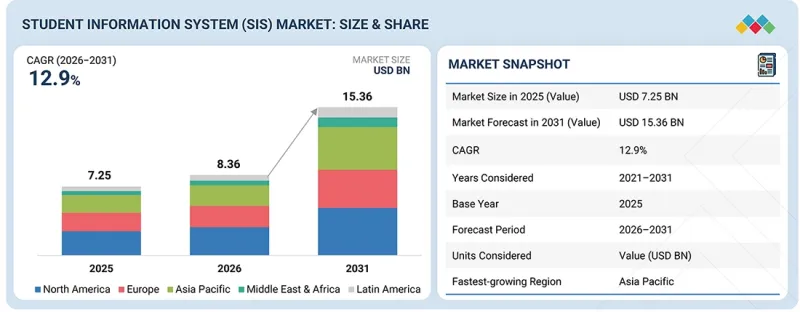
학생 정보 시스템 시장은 K-12 학교, 고등교육 기관, 직업 교육 기관 클라우드 기반 SIS 플랫폼, 일원화 된 학생 정보 관리 및 디지털 캠퍼스 운영에 수요 증가를 배경으로, 2026년 83억 6,000만 달러에서 2031년까지 153억 6,000만 달러로 확대되어 CAGR은 12.9%를 나타낼 것으로 예측됩니다.
교육 기관에서는 학생 등록, 입학 절차, 출석 관리, 학업 기록, 성적 평가, 시간표 작성, 규정 준수 보고 및 학생의 전체 라이프사이클에 걸친 관리를 효율화하고, 업무 효율과 학생 참여도를 높이기 위해 클라우드 네이티브 SIS 소프트웨어 도입이 점점 더 확대되고 있습니다.
| 조사 범위 | |
|---|---|
| 조사 대상 기간 | 2021-2031년 |
| 기준 연도 | 2025년 |
| 예측 기간 | 2026-2031년 |
| 산정 단위 | 금액(10억 달러) |
| 부문 | 제공 제품별, 플랫폼 모듈별, 기술별, 도입 모드별, 최종 사용자별, 지역별 |
| 대상 지역 | 아시아태평양, 북미, 유럽 및 세계 기타 지역 |
데이터 기반 의사결정이 점점 더 중요해짐에 따라, AI를 활용한 학생 분석, 워크플로우 자동화, 학생의 학업 성공을 예측하는 인사이트, 그리고 학습 관리 시스템(LMS), 기업 자원 계획(ERP), 재무, 인사 용도과의 원활한 통합에 대한 수요가 가속화되고 있습니다. 그러나 레거시 시스템의 현대화, 데이터 마이그레이션의 복잡성, 예산 제약 및 학생 데이터의 개인정보 보호 요구 사항이 여전히 시장 성장을 저해하고 있습니다. 이러한 과제에도 불구하고, 디지털 교육, 상호 운용성 표준, 클라우드를 통한 현대화, 그리고 안전한 SIS 아키텍처에 대한 투자가 증가함에 따라, 연계된 교육 생태계 전반에서 SIS 소프트웨어의 전략적 중요성은 계속해서 높아지고 있습니다.
'도입 형태별로는 예측 기간 동안 클라우드 기반 부문이 On-Premise형 부문보다 높은 성장률을 보일 것으로 전망됩니다'
클라우드 기반 학생 정보 시스템(SIS)은 더 높은 확장성, 운영상의 민첩성, 지속적인 혁신, 그리고 인프라 관리 비용 절감을 추구하는 교육 기관에게 선호되는 도입 모델이 되고 있습니다. Software-as-a-Service(SaaS)를 통해 제공되는 클라우드 도입으로 인해 교육 기관이 관리하는 하드웨어가 불필요해지는 한편, 자동 업데이트, 통합된 보안, 재해 복구, 유연한 확장성, 그리고 학습 관리 시스템, 전사적 자원 관리(ERP) 플랫폼, 디지털 ID 서비스, 타사 교육 용도과의 원활한 통합이 가능해집니다. 또한 클라우드 아키텍처는 업무에 지장을 주는 업그레이드 주기 없이 인공지능, 예측 분석, 모바일 서비스, 상호 운용 가능한 캠퍼스 생태계를 신속하게 도입하기 위한 기반도 제공합니다. 교육 기관이 학생 관리의 현대화를 추진하고, 연계된 디지털 캠퍼스 도입을 확대함에 따라, 클라우드 도입은 단순한 인프라 결정 사항에서 벗어나 조직의 회복력을 강화하고, 운영 효율성을 향상시키며, 지속적인 기술 혁신을 뒷받침하는 전략적인 비즈니스 촉진요인으로 진화하고 있습니다. Jenzabar에 따르면, 2024년 3월, 이 회사는 Google Cloud와 전략적 파트너십을 체결하고 Google Cloud VMware Engine, Compute Engine 및 Google Kubernetes Engine을 활용하여 SIS 플랫폼의 현대화를 추진함으로써 클라우드의 확장성, 복원력 및 플랫폼 현대화를 강화했습니다. 이는 벤더들이 장기적인 혁신과 엔터프라이즈급 도입을 지원하기 위해 하이퍼스케일 클라우드 인프라를 점점 더 많이 활용하고 있음을 보여줍니다. 또한 TechnologyOne에 따르면, 2025 회계연도에 영국 전역의 SaaS+ 도입 건수는 6건에서 17건으로 증가했습니다. 이는 인프라 업그레이드 없이도 지속적인 기능 강화를 실현하는 클라우드 기반 학생 관리 플랫폼에 대한 교육 기관의 선호도가 가속화되고 있음을 여실히 보여줍니다. 또한 Jenzabar에 따르면, 2025년 1월, 이 회사는 Constituo와 제휴하여 캠퍼스 내 용도 간의 클라우드 기반 통합을 간소화했습니다. 이를 통해 교육 기관은 통합된 프레임워크를 통해 학술, 관리, 운영 시스템을 원활하게 연동할 수 있게 되었습니다. 이는 기술적 사일로를 해소하고 교육 기관의 효율성을 향상시키는 상호 운용 가능한 클라우드 생태계의 중요성이 높아지고 있음을 반영합니다. 신흥 벤더들은 멀티테넌트형 SaaS 아키텍처, API 우선 상호운용성, 클라우드 네이티브 보안 및 AI 지원 인프라를 우선시하여, 차세대 커넥티드 디지털 캠퍼스를 뒷받침할 수 있는 확장성이 뛰어난 학생 정보 시스템을 구축해야 합니다.
'플랫폼 모듈별로는 예측 기간 동안 핵심인 학생 관리 부문이 가장 큰 시장 점유율을 차지할 것으로 전망됩니다'
핵심 학생 관리는 학생 정보 시스템(SIS)의 운영 기반을 형성하며, 교육 기관이 통합된 관리 환경을 통해 학생의 입학·등록, 학생 기록, 출석 현황, 시간표·일정, 학생 프로파일, 졸업 및 동문 기록을 일원적으로 관리할 수 있게 해줍니다. 주요 기록 시스템으로서 이 모듈은 기관 내 각 부서 간 데이터의 일관성을 확보하는 동시에, 효율적인 학사 관리, 학생 진도 추적 및 규정 준수를 지원합니다. 최근의 기술 발전은 구성 가능한 워크플로우 자동화, 실시간 기록 동기화, 셀프 서비스형 관리 기능, 표준 기반의 상호 운용성, 역할 기반 접근 관리, 그리고 교육 기관의 효율성을 높이고 관리상의 복잡성을 줄여주는 통합된 마스터 데이터 아키텍처에 중점을 두고 있습니다. 각 벤더사는 평생 학습자의 기록, 유연한 학습 경로, 캠퍼스 간 연계, 그리고 관련 교육 기관 시스템과의 원활한 통합을 지원하기 위해 핵심 관리 모듈의 재설계를 점점 더 적극적으로 추진하고 있습니다. 2025년 4월, Ellucian사는 'Ellucian Student' 비전을 발표했습니다. 이는 Banner와 Colleague의 기능을 통합한 통일된 SIS(학생 정보 시스템)로, 입학 절차, 학사 관리, 학생 기록 및 교육 기관 운영을 지원하는 단일 상호 운용 가능한 플랫폼을 통해 학생의 전체 라이프사이클을 관리하도록 설계되었습니다. 신흥 벤더와 솔루션 제공업체는 교육 기관의 운영을 간소화하는 동시에, 다양한 교육 환경에서 확장 가능한 현대화를 가능하게 하는 구성 가능한 학생 관리 프레임워크, 표준화된 데이터 모델, 그리고 상호 운용 가능한 기록 관리 기능을 우선시해야 합니다.
'예측 기간 동안 북미가 성숙한 시장으로서 주도할 것'
예측 기간 동안 북미는 학생 정보 시스템 시장을 주도할 것으로 추정됩니다. 그 배경에는 클라우드 기반 SIS 플랫폼의 광범위한 도입, 성숙한 교육 기술 인프라, 그리고 통합된 학생 정보 관리, 학생 라이프사이클 관리, 디지털 캠퍼스 운영에 대한 강력한 수요가 있습니다. 미국 및 캐나다의 교육 기관에서는 입학, 출석, 학업 성적, 채점, 시간표, 규정 준수 보고, 학생 참여도를 관리하기 위한 안전한 SIS 소프트웨어가 요구되고 있으며, 이는 AI를 활용한 학생 분석, 워크플로우 자동화, 상호 운용 가능한 SIS 플랫폼에 대한 수요를 견인하고 있습니다. K-12 학군, 고등교육 기관, 커뮤니티 칼리지에서는 학업 및 관리 업무를 효율화하기 위해 학생 정보 시스템을 학습 관리 시스템(LMS), 전사적 자원 관리(ERP), 재무, 인사, 고객 관계 관리(CRM) 용도과 통합하는 움직임이 점점 더 확산되고 있습니다. 이 지역에서는 주요 SIS 공급업체, 클라우드 기술 제공업체, 교육 기술 기업의 강력한 입지가 두드러지며, 플랫폼의 지속적인 혁신을 주도하고 있습니다. 디지털 교육에 대한 투자 확대, 학생 성공에 대한 중요성 증대, 그리고 학생 데이터 개인정보 보호에 관한 규제 요건의 강화는 교육 기관의 효율화, 데이터 기반 의사 결정, 그리고 협력적인 교육 생태계가 계속해서 전략적 우선순위로 남아 있는 북미의 학생 정보 시스템 시장을 성숙한 혁신 주도형 시장으로 더욱 공고히 하고 있습니다.
본 보고서에는 학생 정보 시스템 시장의 주요 시장 진출기업에 대한 조사가 포함되어 있습니다. 시장의 주요 벤더 프로파일로는 Ellucian Company(미국), PowerSchool(미국), Oracle(미국), Workday(미국), Jenzabar(미국), Blackbaud(미국), Frontline Technologies Group(미국), Infinite Campus(미국), Skyward(미국), FACTS(미국), SAP(독일), Aeries Software(미국), Veracross(미국), Apar Technologies(싱가포르), wisenet(호주), Rediker Software(미국), ThinkWave(미국), Academia by Serosoft(미국), MasterSoft(인도), Thesis(미국), Alma(미국), ISS(레바논), Populi(미국), FUNIDATA(핀란드), GradeLink(미국), QuickSchools(미국), Smartclasses.in(인도), DreamClass(미국), TUIO(미국), CoreCamous(인도), OneWorldSIS(미국), StudentFirst(미국), iGradePlus(미국), TechnologyOne(호주).
조사 범위
본 조사 보고서에서는 학생 정보 시스템 시장을 제공 내용(SIS 소프트웨어 및 서비스), 플랫폼 모듈(핵심 학생 관리, 학사 관리, 재무 관리, 입학·모집, 커뮤니케이션·참여, 분석·규정 준수 및 기타 플랫폼 모듈), 기술(기존/규칙 기반 SIS 및 AI 지원 SIS), 도입 형태(On-Premise 및 클라우드 기반), 최종 사용자(K-12/학교, 고등교육 기관, 직업·기술·전문 훈련 기관), 지역(북미, 유럽, 아시아태평양, 중동 및 아프리카, 라틴아메리카)에 따라 분류하고 있습니다. 본 보고서의 범위에는 학생 정보 시스템 시장의 성장에 영향을 미치는 주요 요인(촉진요인, 제약 요인, 과제 및 기회 등)에 대한 상세한 정보가 포함되어 있습니다. 주요 업계 참여자에 대한 심층 분석을 통해 각 기업의 사업 개요, 솔루션, 서비스, 주요 전략, 계약, 파트너십, 합의 사항, 신제품 및 서비스 출시, 합병·인수, 그리고 시장과 관련된 최근 동향에 대한 인사이트를 제공합니다. 또한, 본 보고서에서는 학생 정보 시스템 시장 생태계에서 두각을 나타내고 있는 스타트업 기업의 경쟁 분석에 대해서도 다루고 있습니다.
본 보고서를 구매해야 하는 이유
본 보고서는 시장 선도 기업 및 신규 진출기업에게 학생 정보 시스템 시장 전체 및 그 하위 부문의 매출에 대한 가장 정확한 추정치를 제공합니다. 이를 통해 이해관계자들은 경쟁 구도를 이해하고, 자사의 비즈니스를 더 나은 위치로 이끌며, 적절한 시장 진출 전략을 수립하기 위한 추가적인 인사이트를 얻을 수 있습니다. 또한, 시장 동향을 파악하고 주요 시장 성장 촉진요인, 억제요인, 과제 및 기회에 대한 정보를 얻는 데에도 도움이 됩니다.
본 보고서에서는 다음 사항에 대한 인사이트를 제공합니다.
- 주요 성장 촉진요인 분석(SIS 플랫폼 전반에 걸쳐 AI를 활용한 워크플로우 오케스트레이션으로의 전환이 진행되고 있음, 캠퍼스 생태계 전반에 걸쳐 표준 기반의 상호 운용성에 대한 수요가 증가하고 있음, 연결된 시스템 전반에 걸쳐 학생 라이프사이클의 실시간 가시화에 대한 필요성이 확대되고 있음, 학업, 재무, 운영 관련 기록 통합에 대한 수요 증가), 제약 요인(고도로 맞춤화된 레거시 시스템이 전환 및 안정화를 복잡하게 만들고 있다는 점, 거버넌스 및 규정 준수 감시가 강화됨에 따라 조달에 대한 주저함이 커지고 있다는 점), 기회(디지털 자격 증명 인프라가 검증 및 기술 이식성 서비스를 지원한다는 점, 개방형 표준이 파트너 마켓플레이스 및 통합 서비스의 수익을 창출한다는 점, 다국적 전개에서 현지화된 구성 및 지역적 확장이 유리하게 작용한다는 점, 학점 이수 평가의 자동화가 새로운 학생 이동 솔루션을 창출한다는 점), 과제(연결된 생태계 전반에 걸친 기계 간 액세스 보안 확보, 가동 중인 통합 엔드포인트 전반에 걸친 데이터 무결성 유지)에 대해 인사이트를 제공합니다.
- 제품 개발/혁신 : 학생 정보 시스템 시장에서 향후 기술, 연구 개발 활동, 그리고 신제품 및 서비스 출시에 관한 상세한 인사이트.
- 시장 개발 : 수익성 높은 시장에 대한 종합적인 정보 ? 본 보고서에서는 다양한 지역에 걸친 학생 정보 시스템 시장을 분석했습니다.
- 시장 다각화 : 학생 정보 시스템 시장의 신제품 및 서비스, 미개척 지역, 최근 동향 및 투자에 대한 종합적인 정보.
- 경쟁사 평가 : Ellucian Company(미국), PowerSchool(미국), Oracle(미국), Workday(미국), Jenzabar(미국), Blackbaud(미국), Frontline Technologies Group(미국), Infinite Campus(미국), Skyward(미국), FACTS(미국), SAP(독일), Aeries Software(미국), Veracross(미국), Apar Technologies(싱가포르), wisenet(호주), Rediker Software(미국), ThinkWave(미국), Academia by Serosoft(미국), MasterSoft(인도), Thesis(미국), Alma(미국), ISS(레바논), Populi(미국), FUNIDATA(핀란드), GradeLink(미국), QuickSchools(미국), Smartclasses.in(인도), DreamClass(미국), TUIO(미국), CoreCamous(인도), OneWorldSIS(미국), StudentFirst(미국), iGradePlus(미국), TechnologyOne(호주). 또한, 본 보고서는 이해관계자들이 학생 정보 시스템 시장 동향을 파악하는 데 도움이 되며, 주요 시장 성장 촉진요인, 제약 요인, 과제 및 기회에 대한 정보를 제공합니다.
자주 묻는 질문
목차
제1장 서론
제2장 주요 요약
제3장 프리미엄 인사이트
제4장 시장 개요
제5장 업계 동향
제6장 기술, 특허, 디지털 기술, AI 도입에 의한 전략적 파괴
제7장 고객 현황과 구매 행동
제8장 규제 상황
제9장 학생 정보 시스템 시장(제공 제품별)
제10장 학생 정보 시스템 시장(플랫폼 모듈별)
제11장 학생 정보 시스템 시장(기술별)
제12장 학생 정보 시스템 시장(도입 모드별)
제13장 학생 정보 시스템 시장(최종 사용자별)
제14장 학생 정보 시스템 시장(지역별)
제15장 경쟁 구도
제16장 기업 개요
제17장 조사 방법
제18장 부록
KTH 26.08.20The student information system (SIS) market is projected to rise from USD 8.36 billion in 2026 to USD 15.36 billion by 2031, at a CAGR of 12.9%, driven by increasing demand for cloud-based SIS platforms, centralized student information management, and digital campus administration across K-12 schools, higher education institutions, and vocational education providers. Educational institutions are increasingly adopting cloud native SIS software to streamline student enrollment, admissions, attendance, academic records, grading, scheduling, compliance reporting, and end-to-end student lifecycle management while improving operational efficiency and student engagement.
| Scope of the Report | |
|---|---|
| Years Considered for the Study | 2021-2031 |
| Base Year | 2025 |
| Forecast Period | 2026-2031 |
| Units Considered | Value (USD BN) |
| Segments | by Offering, Platform Module, Deployment Mode, Technology, End User, and Region |
| Regions covered | Asia Pacific, North America, Europe, and Rest of the World |
Growing emphasis on data-driven decision-making is accelerating demand for AI-powered student analytics, workflow automation, predictive student success insights, and seamless integration with learning management systems, enterprise resource planning, finance, and human resources applications. However, legacy system modernization, data migration complexity, budget constraints, and student data privacy requirements continue to restrain market growth. Despite these challenges, increasing investment in digital education, interoperability standards, cloud modernization, and secure SIS architecture continues to strengthen the strategic importance of SIS software across connected education ecosystems.
"By deployment mode, cloud-based segment to exhibit higher growth rate than on-premises segment during forecast period"
Cloud-based student information systems (SIS) have become the preferred deployment model for educational institutions seeking greater scalability, operational agility, continuous innovation, and lower infrastructure management costs. Delivered through Software-as-a-Service (SaaS), cloud deployments eliminate institution-managed hardware while enabling automatic updates, centralized security, disaster recovery, elastic scalability, and seamless integration with learning management systems, enterprise resource planning platforms, digital identity services, and third-party education applications. Cloud architecture also provides the foundation for rapidly deploying artificial intelligence, predictive analytics, mobile services, and interoperable campus ecosystems without disruptive upgrade cycles. As educational institutions increasingly modernize student administration and adopt connected digital campuses, cloud deployment has evolved from an infrastructure decision into a strategic business enabler that accelerates institutional resilience, improves operational efficiency, and supports continuous technology innovation. According to Jenzabar, in March 2024, the company formed a strategic partnership with Google Cloud to modernize its SIS platform using Google Cloud VMware Engine, Compute Engine, and Google Kubernetes Engine, strengthening cloud scalability, resilience, and platform modernization. This demonstrates that vendors are increasingly leveraging hyperscale cloud infrastructure to support long-term innovation and enterprise-grade deployments. Additionally, according to TechnologyOne, in FY2025, SaaS+ deployments across the UK increased from six to seventeen institutional go-lives, highlighting accelerating institutional preference for cloud-based student management platforms that deliver continuous feature enhancements without infrastructure upgrades. Also, according to Jenzabar, in January 2025, the company partnered with Constituo to simplify cloud-based integration across campus applications, enabling institutions to seamlessly connect academic, administrative, and operational systems through a unified integration framework. This reflects the growing importance of interoperable cloud ecosystems that reduce technology silos and improve institutional efficiency. Emerging vendors should prioritize multi-tenant SaaS architectures, API first interoperability, cloud native security, and AI-ready infrastructure to build highly scalable student information systems capable of supporting the next generation of connected digital campuses.
"By platform module, core student administration segment to hold largest market share during forecast period"
Core student administration forms the operational backbone of a student information system (SIS), enabling educational institutions to centrally manage student enrollment and registration, student records, attendance, timetable and scheduling, student profiles, and graduation and alumni records through a unified administrative environment. As the primary system of record, this module ensures data consistency across institutional departments while supporting efficient academic administration, student progression tracking, and regulatory compliance. Recent advancements have focused on configurable workflow automation, real-time record synchronization, self-service administrative functions, standards-based interoperability, role-based access management, and centralized master data architecture that improve institutional efficiency and reduce administrative complexity. Vendors are increasingly redesigning core administration modules to support lifelong learner records, flexible academic pathways, cross-campus operations, and seamless integration with adjacent institutional systems. In April 2025, Ellucian introduced its vision for Ellucian Student, bringing together the capabilities of Banner and Colleague into a unified SIS designed to manage the complete student lifecycle through a single interoperable platform supporting enrollment, academic administration, student records, and institutional operations. Emerging vendors and solution providers should prioritize configurable student administration frameworks, standardized data models, and interoperable record management capabilities that simplify institutional operations while enabling scalable modernization across diverse educational environments.
"North America to lead market with mature during forecast period"
North America is estimated to lead the student information system (SIS) market during the forecast period, driven by widespread adoption of cloud-based SIS platforms, mature education technology infrastructure, and strong demand for centralized student information management, student lifecycle management, and digital campus administration. Educational institutions across the US and Canada require secure SIS software to manage enrollment, attendance, academic records, grading, scheduling, compliance reporting, and student engagement, driving demand for AI-powered student analytics, workflow automation, and interoperable SIS platforms. K-12 school districts, higher education institutions, and community colleges are increasingly integrating student information systems with learning management systems, enterprise resource planning, finance, human resources, and customer relationship management applications to streamline academic and administrative operations. The region benefits from the strong presence of leading SIS vendors, cloud technology providers, and education technology companies, driving continuous platform innovation. Growing investment in digital education, increasing emphasis on student success, and rising regulatory requirements for student data privacy further reinforce North America's position as a mature and innovation-driven market for student information systems where institutional efficiency, data-driven decision-making, and connected education ecosystems remain strategic priorities.
Breakdown of Primaries
In-depth interviews were conducted with chief executive officers (CEOs), innovation and technology directors, system integrators, and executives from various key organizations operating in the student information system (SIS) market.
- By Company: Tier I - 35%, Tier II - 45%, and Tier III - 20%
- By Designation: Directors - 35%, Managers - 25%, and others - 40%
- By Region: North America - 45%, Europe - 20%, Asia Pacific - 25%, Middle East & Africa - 5%, and Latin America - 5%
The report includes a study of key players in the student information system (SIS) market. It profiles major vendors in the market, including Ellucian Company (US), PowerSchool (US), Oracle (US), Workday (US), Jenzabar (US), Blackbaud (US), Frontline Technologies Group (US), Infinite Campus (US), Skyward (US), FACTS (US), SAP (Germany), Aeries Software (US), Veracross (US), Apar Technologies (Singapore), wisenet (Australia), Rediker Software (US), ThinkWave (US), Academia by Serosoft (US), MasterSoft (India), Thesis (US), Alma (US), ISS (Lebanon), Populi (US), FUNIDATA (Finland), GradeLink (US), QuickSchools (US), Smartclasses.in (India), DreamClass (US), TUIO (US), CoreCamous (India), OneWorldSIS (US), StudentFirst (US), iGradePlus (US), and TechnologyOne (Australia).
Research Coverage
This research report categorizes the student information system (SIS) market based on offering (SIS software and services), platform module (core student administration, academia management, financial management, admission & recruitment, communication & engagement, analytics & compliance, and other platform modules), technology (conventional/rule-bases SIS and AI-enabled SIS), deployment mode (on-premises and cloud-based), end user (K-12/schools, higher education institutions, and vocational, skills, & professional training institutions), and region (North America, Europe, Asia Pacific, Middle East & Africa, and Latin America). The report's scope covers detailed information regarding the major factors, such as drivers, restraints, challenges, and opportunities, influencing the growth of the student information system (SIS) market. A detailed analysis of the key industry players was done to provide insights into their business overview, solutions, and services; key strategies; contracts, partnerships, agreements, new product & service launches, and mergers and acquisitions; and recent developments associated with the market. This report also covers the competitive analysis of upcoming startups in the student information system (SIS) market ecosystem.
Reason to Buy this Report
The report would provide market leaders and new entrants with information on the closest approximations of the revenue numbers for the overall student information system (SIS) market and its subsegments. It would help stakeholders understand the competitive landscape and gain more insights to better position their businesses and plan suitable go-to-market strategies. It also helps stakeholders understand the market's pulse and provides them with information on key market drivers, restraints, challenges, and opportunities.
The report provides insights on the following pointers:
- Analysis of key drivers (Increasing shift toward AI-enabled workflow orchestration across SIS platforms, Rising demand for standards-based interoperability across campus ecosystems, Expanding need for real-time student lifecycle visibility across connected systems, Growing need for unified academic, financial, and operational records), restraints (Deeply customized legacy estates complicate migration and stabilization, Procurement hesitation rises amid governance and compliance scrutiny), opportunities (Digital credential infrastructure supports verification and skills portability services, Open standards create partner marketplace and integration services revenue, Multinational rollouts favor localized configurations and regional expansion, Automated transfer credit evaluation creates new student mobility solutions), and challenges (Securing machine-to-machine access across connected ecosystems, Preserving data integrity across live integration endpoints).
- Product Development/Innovation: Detailed insights on upcoming technologies, research & development activities, and new product & service launches in the student information system (SIS) market.
- Market Development: Comprehensive information about lucrative markets - the report analyses the student information system (SIS) market across varied regions.
- Market Diversification: Exhaustive information about new products & services, untapped geographies, recent developments, and investments in the student information system (SIS) market.
- Competitive Assessment: In-depth assessment of market shares, growth strategies, and service offerings of leading players such as Ellucian Company (US), PowerSchool (US), Oracle (US), Workday (US), Jenzabar (US), Blackbaud (US), Frontline Technologies Group (US), Infinite Campus (US), Skyward (US), FACTS (US), SAP (Germany), Aeries Software (US), Veracross (US), Apar Technologies (Singapore), wisenet (Australia), Rediker Software (US), ThinkWave (US), Academia by Serosoft (US), MasterSoft (India), Thesis (US), Alma (US), ISS (Lebanon), Populi (US), FUNIDATA (Finnland), GradeLink (US), QuickSchools (US), Smartclasses.in (India), DreamClass (US), TUIO (US), CoreCamous (India), OneWorldSIS (US), StudentFirst (US), iGradePlus (US), and TechnologyOne (Australia). The report also helps stakeholders understand the student information system (SIS) market's pulse and provides information on key market drivers, restraints, challenges, and opportunities.
TABLE OF CONTENTS
1 INTRODUCTION
- 1.1 STUDY OBJECTIVES
- 1.2 MARKET DEFINITION
- 1.3 MARKET SCOPE
- 1.3.1 MARKET SEGMENTATION AND REGIONAL SCOPE
- 1.3.2 INCLUSIONS AND EXCLUSIONS
- 1.3.3 YEARS CONSIDERED
- 1.4 CURRENCY CONSIDERED
- 1.5 LIMITATIONS
- 1.6 STAKEHOLDERS
- 1.7 SUMMARY OF CHANGES
2 EXECUTIVE SUMMARY
- 2.1 MARKET HIGHLIGHTS AND KEY INSIGHTS
- 2.2 KEY MARKET PARTICIPANTS: MAPPING OF STRATEGIC DEVELOPMENTS
- 2.3 DISRUPTIVE TRENDS IN STUDENT INFORMATION SYSTEM (SIS) MARKET
- 2.4 HIGH-GROWTH SEGMENTS
- 2.5 REGIONAL SNAPSHOT: MARKET SIZE, GROWTH RATE, AND FORECAST
3 PREMIUM INSIGHTS
- 3.1 ATTRACTIVE OPPORTUNITIES FOR PLAYERS IN STUDENT INFORMATION SYSTEM (SIS) MARKET
- 3.2 STUDENT INFORMATION SYSTEM (SIS) MARKET, BY OFFERING
- 3.3 STUDENT INFORMATION SYSTEM (SIS) MARKET, BY PLATFORM MODULE
- 3.4 STUDENT INFORMATION SYSTEM (SIS) MARKET, BY TECHNOLOGY
- 3.5 STUDENT INFORMATION SYSTEM (SIS) MARKET, BY DEPLOYMENT MODE
- 3.6 STUDENT INFORMATION SYSTEM (SIS) MARKET, BY END USER
- 3.7 STUDENT INFORMATION SYSTEM (SIS) MARKET, BY REGION
4 MARKET OVERVIEW
- 4.1 INTRODUCTION
- 4.2 MARKET DYNAMICS
- 4.2.1 DRIVERS
- 4.2.1.1 Increasing shift toward AI-enabled workflow orchestration across SIS platforms
- 4.2.1.2 Rising demand for standards-based interoperability across campus ecosystems
- 4.2.1.3 Expanding need for real-time student lifecycle visibility across connected systems
- 4.2.1.4 Growing need for unified academic, financial, and operational records
- 4.2.2 RESTRAINTS
- 4.2.2.1 Deeply customized legacy estates complicate migration and stabilization
- 4.2.2.2 Procurement hesitation rises amid governance and compliance scrutiny
- 4.2.3 OPPORTUNITIES
- 4.2.3.1 Digital credential infrastructure supports verification and skills portability services
- 4.2.3.2 Open standards create partner marketplace and integration services revenue
- 4.2.3.3 Multinational rollouts favor localized configurations and regional expansion
- 4.2.3.4 Automated transfer credit evaluation creates new student mobility solutions
- 4.2.4 CHALLENGES
- 4.2.4.1 Securing machine-to-machine access across connected ecosystems
- 4.2.4.2 Preserving data integrity across live integration endpoints
- 4.2.1 DRIVERS
- 4.3 UNMET NEEDS AND WHITE SPACES
- 4.3.1 UNMET NEEDS IN STUDENT INFORMATION SYSTEM (SIS) MARKET
- 4.3.2 WHITE SPACE OPPORTUNITIES
- 4.4 INTERCONNECTED MARKETS AND CROSS-SECTOR OPPORTUNITIES
- 4.4.1 INTERCONNECTED MARKETS
- 4.4.2 CROSS-SECTOR OPPORTUNITIES
- 4.5 EMERGING BUSINESS MODELS AND ECOSYSTEM SHIFTS
- 4.5.1 EMERGING BUSINESS MODELS
- 4.5.1.1 Student Information System (SIS) business models
- 4.5.2 ECOSYSTEM SHIFTS
- 4.5.1 EMERGING BUSINESS MODELS
- 4.6 STRATEGIC MOVES BY TIER-1/2/3 PLAYERS
- 4.6.1 KEY MOVES AND STRATEGIC FOCUS
5 INDUSTRY TRENDS
- 5.1 PORTER'S FIVE FORCES ANALYSIS
- 5.1.1 THREAT OF NEW ENTRANTS
- 5.1.2 THREAT OF SUBSTITUTES
- 5.1.3 BARGAINING POWER OF SUPPLIERS
- 5.1.4 BARGAINING POWER OF BUYERS
- 5.1.5 INTENSITY OF COMPETITIVE RIVALRY
- 5.2 MACROECONOMIC INDICATORS
- 5.2.1 INTRODUCTION
- 5.2.2 GDP TRENDS & FORECASTS
- 5.2.3 TRENDS IN GLOBAL LEARNING MANAGEMENT SYSTEM INDUSTRY
- 5.2.4 TRENDS IN GLOBAL DIGITAL EDUCATION INDUSTRY
- 5.3 VALUE CHAIN ANALYSIS
- 5.4 ECOSYSTEM ANALYSIS
- 5.5 PRICING ANALYSIS
- 5.5.1 AVERAGE SELLING PRICE TREND, 2025
- 5.5.2 AVERAGE SELLING PRICE OF KEY VENDORS, BY END USER, 2025
- 5.6 KEY CONFERENCES AND EVENTS, 2026
- 5.7 TRENDS/DISRUPTIONS IMPACTING CUSTOMER BUSINESS
- 5.8 INVESTMENT AND FUNDING SCENARIO
- 5.9 CASE STUDY ANALYSIS
- 5.9.1 FLORIDA POLYTECHNIC UNIVERSITY MODERNIZED STUDENT OPERATIONS WITH ELLUCIAN TO CREATE UNIFIED DIGITAL CAMPUS EXPERIENCE
- 5.9.2 NORTHPOINTE CHRISTIAN SCHOOLS BUILT INTEGRATED AND SECURE EDUCATION ECOSYSTEM WITH POWERSCHOOL
- 5.9.3 AMBROSE UNIVERSITY STRENGTHENED INSTITUTIONAL AGILITY AND STUDENT EXPERIENCE WITH JENZABAR ONE
- 5.9.4 CALVERT HALL COLLEGE HIGH SCHOOL UNIFIED STUDENT LIFECYCLE AND SCHOOL OPERATIONS WITH BLACKBAUD
- 5.9.5 REDLANDS SYDNEY ADVANCED TOWARD UNIFIED SCHOOL OPERATIONS WITH VERACROSS AND ACCUCOM
- 5.10 IMPACT OF 2025 US TARIFF - STUDENT INFORMATION SYSTEM (SIS) MARKET
- 5.10.1 INTRODUCTION
- 5.10.2 KEY TARIFF RATES
- 5.10.3 PRICE IMPACT ANALYSIS
- 5.10.4 IMPACT ON REGIONS
- 5.10.4.1 North America
- 5.10.4.2 Europe
- 5.10.4.3 Asia Pacific
- 5.10.5 IMPACT ON VERTICALS
- 5.10.5.1 K-12/Schools
- 5.10.5.2 Higher Education Institutions
- 5.10.5.3 Vocational, Skills & Professional Training Institutions
6 STRATEGIC DISRUPTION THROUGH TECHNOLOGY, PATENTS, DIGITAL, AND AI ADOPTION
- 6.1 TECHNOLOGY ANALYSIS
- 6.1.1 KEY EMERGING TECHNOLOGIES
- 6.1.1.1 Cloud-native Software-as-a-Service Architecture
- 6.1.1.2 Standards-based Interoperability and API Architecture
- 6.1.1.3 Predictive Student Analytics and Machine Learning
- 6.1.2 COMPLEMENTARY TECHNOLOGIES
- 6.1.2.1 Mobile-first Progressive Web Applications
- 6.1.2.2 Identity and Access Management
- 6.1.2.3 Low-code Workflow Automation
- 6.1.3 ADJACENT TECHNOLOGIES
- 6.1.3.1 Blockchain and Distributed Ledger Technology
- 6.1.3.2 Internet of Things and Smart Campus Technologies
- 6.1.1 KEY EMERGING TECHNOLOGIES
- 6.2 TECHNOLOGY/PRODUCT ROADMAP
- 6.2.1 SHORT-TERM (2026-2028) | CLOUD MODERNIZATION & INTEROPERABILITY
- 6.2.2 MID-TERM (2028-2031) | COMPOSABLE & INTELLIGENT SIS ECOSYSTEM
- 6.2.3 LONG-TERM (2031-2035+) | AUTONOMOUS & LIFELONG LEARNER INFRASTRUCTURE
- 6.3 PATENT ANALYSIS
- 6.4 FUTURE APPLICATIONS
- 6.4.1 AGENTIC AI STUDENT LIFECYCLE ORCHESTRATION
- 6.4.2 PREDICTIVE STUDENT SUCCESS & NEXT BEST ACTION INTERVENTION
- 6.4.3 SKILLS GRAPH-DRIVEN ACADEMIC TO CAREER PATHWAY ORCHESTRATION
- 6.4.4 LIFELONG LEARNER & STACKABLE CREDENTIAL RECORDS
- 6.4.5 INTELLIGENT CREDIT MOBILITY & CROSS INSTITUTIONAL RECORD EXCHANGE
- 6.5 IMPACT OF AI/GENERATIVE AI ON STUDENT INFORMATION SYSTEM (SIS) MARKET
- 6.5.1 TOP USE CASES AND MARKET POTENTIAL
- 6.5.2 TOP USE CASES AND MARKET POTENTIAL
- 6.5.3 BEST PRACTICES IN STUDENT INFORMATION SYSTEM (SIS) MARKET
- 6.5.4 CASE STUDY OF AI IMPLEMENTATION IN STUDENT INFORMATION SYSTEM (SIS) MARKET
- 6.5.4.1 AI-powered SIS Modernization and Workflow Automation at Anne Arundel Community College
- 6.5.5 INTERCONNECTED ADJACENT ECOSYSTEM AND IMPACT ON MARKET PLAYERS
- 6.5.6 CLIENT READINESS TO ADOPT GENERATIVE AI IN THE STUDENT INFORMATION SYSTEM (SIS) MARKET
- 6.6 SUCCESS STORIES AND REAL-WORLD APPLICATIONS
- 6.6.1 ELLUCIAN: STUDENT
- 6.6.2 WORKDAY: STUDENT INFORMATION SYSTEM
7 CUSTOMER LANDSCAPE AND BUYER BEHAVIOR
- 7.1 DECISION-MAKING PROCESS
- 7.2 BUYER STAKEHOLDERS AND BUYING EVALUATION CRITERIA
- 7.2.1 KEY STAKEHOLDERS IN BUYING PROCESS
- 7.2.2 BUYING CRITERIA
- 7.3 ADOPTION BARRIERS AND INTERNAL CHALLENGES
- 7.4 UNMET NEEDS IN VARIOUS END-USER INDUSTRIES
- 7.5 MARKET PROFITABILITY
- 7.5.1 REVENUE POTENTIAL
- 7.5.2 COST DYNAMICS
- 7.5.3 MARGIN OPPORTUNITIES IN KEY APPLICATIONS
8 REGULATORY LANDSCAPE
- 8.1 REGULATORY LANDSCAPE
- 8.1.1 REGULATORY BODIES, GOVERNMENT AGENCIES, AND OTHER ORGANIZATIONS
- 8.1.2 INDUSTRY STANDARDS, BY REGION
- 8.1.2.1 North America
- 8.1.2.2 Europe
- 8.1.2.3 Asia Pacific
- 8.1.2.4 Middle East & South Africa
- 8.1.2.5 Latin America
9 STUDENT INFORMATION SYSTEM (SIS) MARKET, BY OFFERING
- 9.1 INTRODUCTION
- 9.1.1 OFFERING: STUDENT INFORMATION SYSTEM (SIS) MARKET DRIVERS
- 9.2 STUDENT INFORMATION SYSTEM SOFTWARE/SIS SOFTWARE
- 9.2.1 UNIFIED STUDENT ADMINISTRATION PLATFORMS STRENGTHEN INSTITUTIONAL DIGITAL OPERATIONS
- 9.3 SERVICES
- 9.3.1 PROFESSIONAL SERVICES
- 9.3.1.1 Growing Institutional Modernization Strengthens Demand for Specialized Professional Services
- 9.3.1.2 Implementation & Integration
- 9.3.1.3 Training & Support
- 9.3.1.4 Consulting & Strategy
- 9.3.2 MANAGED SERVICES
- 9.3.2.1 Proactive Lifecycle Management Enhances Long-term Student Information System Performance
- 9.3.1 PROFESSIONAL SERVICES
10 STUDENT INFORMATION SYSTEM (SIS) MARKET, BY PLATFORM MODULE
- 10.1 INTRODUCTION
- 10.1.1 PLATFORM MODULE: STUDENT INFORMATION SYSTEM (SIS) MARKET DRIVERS
- 10.2 CORE STUDENT ADMINISTRATION
- 10.2.1 INTEGRATED STUDENT ADMINISTRATION PLATFORMS STRENGTHEN INSTITUTIONAL OPERATIONAL EXCELLENCE
- 10.2.2 COURSE REGISTRATION
- 10.2.3 STUDENT RECORDS MANAGEMENT
- 10.2.4 ATTENDANCE MANAGEMENT
- 10.2.5 TIMETABLE & SCHEDULING
- 10.2.6 STUDENT PROFILE MANAGEMENT
- 10.2.7 GRADUATION & ALUMNI RECORDS
- 10.3 ACADEMIA MANAGEMENT
- 10.3.1 INTEGRATED ACADEMIC OPERATIONS DRIVE CURRICULUM EXCELLENCE AND STUDENT SUCCESS OUTCOMES
- 10.3.2 CURRICULUM MANAGEMENT
- 10.3.3 COURSE MANAGEMENT
- 10.3.4 EXAMINATION MANAGEMENT
- 10.3.5 GRADEBOOK & TRANSCRIPT MANAGEMENT
- 10.3.6 FACULTY MANAGEMENT
- 10.4 FINANCIAL MANAGEMENT
- 10.4.1 INTEGRATED FINANCIAL OPERATIONS STRENGTHEN INSTITUTIONAL SUSTAINABILITY AND STUDENT FINANCIAL ACCESSIBILITY
- 10.4.2 TUITION & FEE MANAGEMENT
- 10.4.3 FINANCIAL AID & SCHOLARSHIPS
- 10.4.4 BILLING & PAYMENTS
- 10.4.5 BUDGET & FINANCIAL REPORTING
- 10.5 ADMISSION & RECRUITMENT
- 10.5.1 DIGITAL ADMISSIONS MODERNIZATION ACCELERATES STUDENT ACQUISITION AND ENROLLMENT CONVERSION
- 10.5.2 ONLINE APPLICATIONS
- 10.5.3 APPLICANT TRACKING
- 10.5.4 ADMISSION WORKFLOW
- 10.5.5 ENROLLMENT MANAGEMENT
- 10.6 COMMUNICATION & ENGAGEMENT
- 10.6.1 CONNECTED DIGITAL ENGAGEMENT PLATFORMS STRENGTHEN INSTITUTIONAL COMMUNICATION AND STUDENT SUCCESS
- 10.6.2 PARENT PORTAL
- 10.6.3 STUDENT PORTAL
- 10.6.4 FACULTY PORTAL
- 10.6.5 NOTIFICATIONS & MESSAGING
- 10.6.6 MOBILE APPLICATIONS
- 10.7 ANALYTICS & COMPLIANCE
- 10.7.1 PREDICTIVE INSTITUTIONAL INTELLIGENCE ACCELERATES DATA-DRIVEN STUDENT SUCCESS AND REGULATORY EXCELLENCE
- 10.7.2 DASHBOARDS & REPORTING
- 10.7.3 STUDENT PERFORMANCE ANALYTICS
- 10.7.4 RETENTION & SUCCESS ANALYTICS
- 10.7.5 GOVERNMENT & REGULATORY REPORTING
- 10.8 OTHER PLATFORM MODULES
11 STUDENT INFORMATION SYSTEM (SIS) MARKET, BY TECHNOLOGY
- 11.1 INTRODUCTION
- 11.1.1 TECHNOLOGY: STUDENT INFORMATION SYSTEM (SIS) MARKET DRIVERS
- 11.2 CONVENTIONAL/RULE-BASED SIS
- 11.2.1 ESTABLISHED RULE-BASED ARCHITECTURES CONTINUE DELIVERING RELIABLE INSTITUTIONAL ADMINISTRATION
- 11.3 AI-ENABLED SIS
- 11.3.1 AI NATIVE STUDENT INFORMATION SYSTEMS REDEFINE INTELLIGENT CAMPUS ADMINISTRATION AND STUDENT SUCCESS
12 STUDENT INFORMATION SYSTEM (SIS) MARKET, BY DEPLOYMENT MODE
- 12.1 INTRODUCTION
- 12.1.1 DEPLOYMENT MODE: STUDENT INFORMATION SYSTEM (SIS) MARKET DRIVERS
- 12.2 ON-PREMISES
- 12.2.1 INSTITUTIONAL CONTROL AND LONG-TERM CUSTOMIZATION SUSTAIN DEMAND FOR ON-PREMISES DEPLOYMENTS
- 12.3 CLOUD-BASED
- 12.3.1 CLOUD-NATIVE STUDENT INFORMATION SYSTEMS DRIVE SCALABLE AND INTELLIGENT DIGITAL CAMPUS TRANSFORMATION
13 STUDENT INFORMATION SYSTEM (SIS) MARKET, BY END USER
- 13.1 INTRODUCTION
- 13.1.1 END USER: STUDENT INFORMATION SYSTEM (SIS) MARKET DRIVERS
- 13.2 K-12/SCHOOLS
- 13.2.1 K-12 STUDENT INFORMATION SYSTEMS MODERNIZE SCHOOL OPERATIONS AND FAMILY ENGAGEMENT
- 13.3 HIGHER EDUCATION INSTITUTIONS
- 13.3.1 HIGHER EDUCATION INSTITUTIONS DRIVE DEMAND FOR INTEGRATED AND SCALABLE STUDENT LIFECYCLE MANAGEMENT
- 13.4 VOCATIONAL, SKILLS, AND PROFESSIONAL TRAINING INSTITUTIONS
- 13.4.1 VOCATIONAL AND PROFESSIONAL TRAINING INSTITUTIONS ADOPT FLEXIBLE STUDENT INFORMATION SYSTEMS TO SUPPORT WORKFORCE READY LEARNING
14 STUDENT INFORMATION SYSTEM (SIS) MARKET, BY REGION
- 14.1 INTRODUCTION
- 14.2 NORTH AMERICA
- 14.2.1 US
- 14.2.1.1 Strengthening Secure and Interoperable Student Information Systems Across US
- 14.2.2 CANADA
- 14.2.2.1 Advancing Interoperable Student Information Systems Across Canada's Digital Education Ecosystem
- 14.2.1 US
- 14.3 EUROPE
- 14.3.1 UK
- 14.3.1.1 Accelerating Cloud-based Student Information System Modernization Across UK
- 14.3.2 GERMANY
- 14.3.2.1 Advancing Interoperable Student Information Systems Through Germany's Digital Education Modernization
- 14.3.3 FRANCE
- 14.3.3.1 Advancing Connected Student Information Systems for France's Digital Campus Transformation
- 14.3.4 ITALY
- 14.3.4.1 Enhancing Student Information Systems Through Italy's Connected Digital Campus Ecosystem
- 14.3.5 REST OF EUROPE
- 14.3.1 UK
- 14.4 ASIA PACIFIC
- 14.4.1 CHINA
- 14.4.1.1 Accelerating Smart Campus Transformation Through Intelligent Student Information Systems in China
- 14.4.2 INDIA
- 14.4.2.1 Scaling Intelligent Student Information Systems for India's Digital Education Transformation
- 14.4.3 JAPAN
- 14.4.3.1 Advancing Intelligent Student Information Systems Through Japan's Digital Campus Modernization
- 14.4.4 AUSTRALIA & NEW ZEALAND
- 14.4.4.1 Accelerating Cloud-native Student Information Systems Across Australia & New Zealand
- 14.4.5 SOUTH KOREA
- 14.4.5.1 Advancing Intelligent Student Information Systems Through South Korea's Smart Education Transformation
- 14.4.6 REST OF ASIA PACIFIC
- 14.4.1 CHINA
- 14.5 MIDDLE EAST & AFRICA
- 14.5.1 GCC COUNTRIES
- 14.5.1.1 Saudi Arabia
- 14.5.1.1.1 Accelerating Student Information System Innovation Through Saudi Arabia's Vision 2030 Education Transformation
- 14.5.1.2 UAE
- 14.5.1.2.1 Advancing Intelligent Student Information Systems Through UAE's Smart Education Ecosystem
- 14.5.1.3 Other GCC countries
- 14.5.1.1 Saudi Arabia
- 14.5.2 SOUTH AFRICA
- 14.5.2.1 Advancing Digital Campus Modernization Through Student Information Systems in South Africa
- 14.5.3 REST OF MIDDLE EAST & AFRICA
- 14.5.1 GCC COUNTRIES
- 14.6 LATIN AMERICA
- 14.6.1 BRAZIL
- 14.6.1.1 Accelerating Student Information System Modernization Across Brazil's Digital Higher Education Ecosystem
- 14.6.2 MEXICO
- 14.6.2.1 Accelerating Cloud-native Student Information Systems Across Mexico's Higher Education Ecosystem
- 14.6.3 REST OF LATIN AMERICA
- 14.6.1 BRAZIL
15 COMPETITIVE LANDSCAPE
- 15.1 INTRODUCTION
- 15.2 KEY PLAYER STRATEGIES/RIGHT TO WIN, 2024-2026
- 15.3 REVENUE ANALYSIS, 2021-2025
- 15.4 MARKET SHARE ANALYSIS, 2025
- 15.5 PRODUCT COMPARISON
- 15.6 COMPANY EVALUATION MATRIX: KEY PLAYERS, 2025
- 15.6.1 STARS
- 15.6.2 EMERGING LEADERS
- 15.6.3 PERVASIVE PLAYERS
- 15.6.4 PARTICIPANTS
- 15.6.5 COMPANY FOOTPRINT: KEY PLAYERS, 2025
- 15.6.5.1 Company footprint
- 15.6.5.2 Regional footprint
- 15.6.5.3 Platform module footprint
- 15.6.5.4 Technology footprint
- 15.7 COMPANY EVALUATION MATRIX: STARTUPS/SMES, 2025
- 15.7.1 PROGRESSIVE COMPANIES
- 15.7.2 RESPONSIVE COMPANIES
- 15.7.3 DYNAMIC COMPANIES
- 15.7.4 STARTING BLOCKS
- 15.7.5 COMPETITIVE BENCHMARKING: STARTUP/SMES, 2025
- 15.7.5.1 Detailed list of key startups/SMEs
- 15.7.5.2 Competitive benchmarking of key startups/SMEs
- 15.8 COMPANY VALUATION AND FINANCIAL METRICS
- 15.8.1 COMPANY VALUATION OF KEY VENDORS
- 15.8.2 FINANCIAL METRICS OF KEY VENDORS
- 15.9 COMPETITIVE SCENARIO
- 15.9.1 PRODUCT LAUNCHES/ENHANCEMENTS
- 15.9.2 DEALS
16 COMPANY PROFILES
- 16.1 INTRODUCTION
- 16.2 MAJOR PLAYERS
- 16.2.1 ELLUCIAN COMPANY
- 16.2.1.1 Business overview
- 16.2.1.2 Products/Solutions/Services offered
- 16.2.1.3 Recent developments
- 16.2.1.3.1 Product launches/enhancements
- 16.2.1.3.2 Deals
- 16.2.1.4 MnM view
- 16.2.1.4.1 Right to win
- 16.2.1.4.2 Strategic choices
- 16.2.1.4.3 Weaknesses and competitive threats
- 16.2.2 POWERSCHOOL
- 16.2.2.1 Business overview
- 16.2.2.2 Products/Solutions/Services offered
- 16.2.2.3 Recent developments
- 16.2.2.3.1 Product launches/enhancements
- 16.2.2.3.2 Deals
- 16.2.2.3.3 Expansions
- 16.2.2.4 MnM view
- 16.2.2.4.1 Right to win
- 16.2.2.4.2 Strategic choices
- 16.2.2.4.3 Weaknesses and competitive threats
- 16.2.3 ORACLE
- 16.2.3.1 Business overview
- 16.2.3.2 Products/Solutions/Services offered
- 16.2.3.3 Recent developments
- 16.2.3.3.1 Product launches/enhancements
- 16.2.3.3.2 Deals
- 16.2.3.4 MnM view
- 16.2.3.4.1 Right to win
- 16.2.3.4.2 Strategic choices
- 16.2.3.4.3 Weaknesses and competitive threats
- 16.2.4 WORKDAY
- 16.2.4.1 Business overview
- 16.2.4.2 Products/Solutions/Services offered
- 16.2.4.3 Recent developments
- 16.2.4.3.1 Product launches/enhancements
- 16.2.4.3.2 Deals
- 16.2.4.4 MnM view
- 16.2.4.4.1 Right to win
- 16.2.4.4.2 Strategic choices
- 16.2.4.4.3 Weaknesses and competitive threats
- 16.2.5 JENZABAR
- 16.2.5.1 Business overview
- 16.2.5.2 Products/Solutions/Services offered
- 16.2.5.3 Recent developments
- 16.2.5.3.1 Product launches/enhancements
- 16.2.5.3.2 Deals
- 16.2.5.4 MnM view
- 16.2.5.4.1 Right to win
- 16.2.5.4.2 Strategic choices
- 16.2.5.4.3 Weaknesses and competitive threats
- 16.2.6 BLACKBAUD
- 16.2.6.1 Business overview
- 16.2.6.2 Products/Solutions/Services offered
- 16.2.6.3 Recent developments
- 16.2.6.3.1 Product launches/enhancements
- 16.2.6.3.2 Deals
- 16.2.7 FRONTLINE TECHNOLOGIES GROUP
- 16.2.7.1 Business overview
- 16.2.7.2 Products/Solutions/Services offered
- 16.2.7.3 Recent developments
- 16.2.7.3.1 Deals
- 16.2.8 INFINITE CAMPUS
- 16.2.8.1 Business overview
- 16.2.8.2 Products/Solutions/Services offered
- 16.2.8.3 Recent developments
- 16.2.8.3.1 Deals
- 16.2.9 SKYWARD
- 16.2.9.1 Business overview
- 16.2.9.2 Products/Solutions/Services offered
- 16.2.9.3 Recent developments
- 16.2.9.3.1 Deals
- 16.2.10 FACTS
- 16.2.10.1 Business overview
- 16.2.10.2 Products/Solutions/Services offered
- 16.2.10.3 Recent developments
- 16.2.10.3.1 Product launches/enhancements
- 16.2.10.3.2 Deals
- 16.2.11 SAP
- 16.2.11.1 Business overview
- 16.2.11.2 Products/Solutions/Services offered
- 16.2.11.3 Recent developments
- 16.2.11.3.1 Deals
- 16.2.1 ELLUCIAN COMPANY
- 16.3 OTHER PLAYERS
- 16.3.1 TECHNOLOGYONE
- 16.3.2 AERIES SOFTWARE
- 16.3.3 VERACROSS
- 16.3.4 APAR TECHNOLOGIES
- 16.3.5 WISENET
- 16.3.6 REDIKER SOFTWARE
- 16.3.7 THINKWAVE
- 16.3.8 ACADEMIA BY SEROSOFT
- 16.3.9 MASTERSOFT
- 16.3.10 BUZZYEARS EDUCATION (SKOLARO)
- 16.3.11 SIS GLOBAL
- 16.3.12 THESIS
- 16.3.13 ALMA
- 16.3.14 ISS
- 16.3.15 POPULI
- 16.3.16 FUNIDATA
- 16.3.17 GRADELINK
- 16.3.18 EMPOWER, COMSPEC INTERNATIONAL
- 16.3.19 QUICKSCHOOLS
- 16.3.20 SMARTCLASSES.IN
- 16.3.21 DREAMCLASS
- 16.3.22 BOCAVOX (MAESTRO SIS)
- 16.3.23 VERTITECH (CLASSTER)
- 16.3.24 OPEN SOLUTIONS FOR EDUCATION
- 16.3.25 TUIO
- 16.3.26 CORECAMPUS
- 16.3.27 ONEWORLDSIS
- 16.3.28 STUDENT FIRST
- 16.3.29 IGRADEPLUS
- 16.3.30 CREATRIX CAMPUS
- 16.3.31 SYCAMORE
- 16.3.32 PRAXISCHOOL
- 16.3.33 CAMUDIGITALCAMPUS
- 16.3.34 ILLUMINATE EDUCATION
17 RESEARCH METHODOLOGY
- 17.1 RESEARCH DATA
- 17.1.1 SECONDARY DATA
- 17.1.1.1 Data & List of Key Secondary Sources
- 17.1.2 PRIMARY DATA
- 17.1.1 SECONDARY DATA
- 17.2 MARKET SIZE ESTIMATION
- 17.3 DATA TRIANGULATION
- 17.4 FACTOR ANALYSIS
18 APPENDIX
- 18.1 DISCUSSION GUIDE
- 18.2 KNOWLEDGESTORE: MARKETSANDMARKETS' SUBSCRIPTION PORTAL
- 18.3 CUSTOMIZATION OPTIONS
- 18.4 RELATED REPORTS
- 18.5 AUTHOR DETAILS


