
|
시장보고서
상품코드
2111121
AI 보안 오퍼레이션 센터(SOC) 시장 예측(-2031년) : 오퍼링별, 조직 규모별, 용도별, 업계별, 지역별AI Security Operations Center (SOC) Market by Software Platform (AI-Native SOC, AI SOC Agents, Security Data Platforms), Service (AI-Augmented MDR, AI SOC-as-a-Service, Incident Response & Forensics), Application, Vertical - Global Forecast to 2031 |
||||||

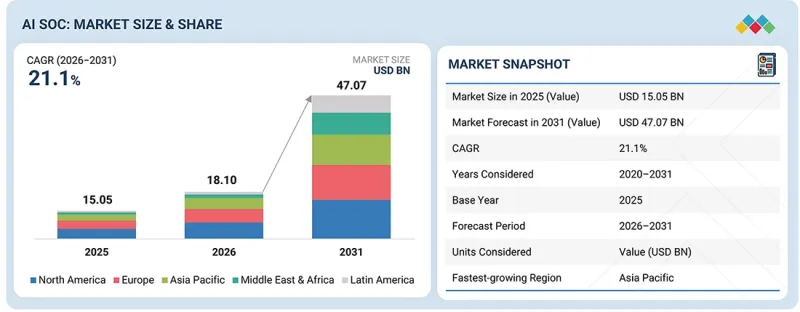
AI 보안 오퍼레이션 센터(SOC) 시장 규모는 예측 기간 중 CAGR 21.1%로 확대하며, 2026년 181억 달러에서 2031년에는 470억 7,000만 달러에 달할 것으로 전망되고 있습니다.
이러한 성장은 기업 전반에 걸친 생성형 AI, 자율형 AI 에이전트 및 AI 기반 비즈니스 애플리케이션의 급속한 도입에 의해 주도되고 있습니다.
| 조사 범위 | |
|---|---|
| 조사 대상 기간 | 2020-2031년 |
| 기준연도 | 2025년 |
| 예측 기간 | 2026-2031년 |
| 산정 단위 | 금액(100만/10억 달러) |
| 부문 | 오퍼링별, 조직 규모별, 용도별, 업계별, 지역별 |
| 대상 지역 | 북미, 유럽, 아시아태평양, 중동 및 아프리카, 라틴아메리카 |
AI가 사업 운영에 필수적인 요소로 자리 잡음에 따라 조직들은 AI 워크로드를 보호하고, 머신 ID의 보안을 확보하며, 자율적인 작동을 모니터링하고, 정책 준수를 보장할 수 있는 AI 네이티브 보안 플랫폼에 대한 투자를 점점 더 늘리고 있습니다. 동시에 정부 및 업계 단체는 규제 프레임워크, 보안 표준, 신뢰할 수 있는 AI 구상을 통해 책임 있는 AI 거버넌스를 추진하고 있으며, 이로 인해 기업의 AI 보안 투자가 더욱 가속화되고 있습니다. 이러한 동향은 최신 하이브리드 및 멀티클라우드 기업 환경 전반에 걸쳐 자율적이고 회복력이 뛰어나며, 인텔리전스 중심의 보안 운영을 실현하는 AI SOC 플랫폼에 큰 기회를 창출하고 있습니다.
"소프트웨어 플랫폼별로는 AI SOC 에이전트 솔루션 부문이 예측 기간 중 가장 높은 연평균 성장률(CAGR)을 기록할 것으로 전망됩니다."
AI SOC 에이전트 솔루션 분야는 경보의 자율적 조사, 보안 이벤트의 상관 분석, 대응 워크플로우 실행 및 분석가의 의사결정 지원을 가능하게 하는 에이전트형 AI의 급속한 보급에 힘입어, 예측 기간 중 가장 높은 연평균 성장률(CAGR)을 기록할 것으로 전망됩니다. 기존의 AI 코파일럿과 달리, AI SOC 에이전트는 다단계 추론을 수행하고, 반복적인 SOC 작업을 자동화하며, 진화하는 위협에 지속적으로 적응함으로써 운영 효율성을 대폭 향상시킬 수 있습니다. 자율적인 보안 운영에 대한 기업의 수요가 증가하는 데다, AI 에이전트 및 지능형 워크플로우 자동화에 대한 투자가 늘어나면서 대기업과 관리형 보안 서비스 제공업체(MSP)에서의 도입이 가속화되고 있습니다.
"조직 규모별로는 2026년에 대기업 부문이 가장 큰 시장 점유율을 차지할 것으로 예측됩니다."
2026년에는 대기업 부문이 AI SOC 시장에서 가장 큰 점유율을 차지할 것으로 예측됩니다. 이러한 높은 성장률은 대기업의 디지털 생태계 규모와 복잡성, 광범위한 공격 표면, 그리고 전 세계 사업 활동 전반에서 발생하는 방대한 양의 보안 이벤트에 기인합니다. 이러한 조직에서는 비즈니스에 필수적인 자산을 보호하고 운영 복원력을 유지하기 위해 지속적인 위협 가시화, 다중 도메인 텔레메트리의 지능형 상관 분석, 그리고 신속한 의사결정이 요구됩니다. 또한 엄격한 규제 요건, AI를 활용한 비즈니스 프로세스 도입 확대, 그리고 사이버 보안 혁신에 대한 지속적인 투자가 대기업의 고도화된 AI SOC 플랫폼 도입을 촉진하고 있습니다.
"산업별로는 에너지·공공사업 부문이 예측 기간 중 가장 높은 연평균 성장률(CAGR)을 기록할 것으로 예상됩니다."
에너지·공공사업 부문은 핵심 인프라의 급속한 디지털화, 운영 기술(OT) 및 산업 제어 시스템(ICS)을 표적으로 한 사이버 공격의 증가, 그리고 송전망 운영에서의 AI 도입 확대로 인해 예측 기간 중 AI SOC 시장에서 가장 높은 연평균 성장률(CAGR)을 기록할 것으로 전망됩니다. 전력 회사들이 송전망 현대화, 재생 가능 에너지 통합, AI 기반 제어 시스템 도입을 추진함에 따라 각 조직은 IT 및 OT 환경 전반에 걸친 사이버 위협을 지속적으로 모니터링, 탐지 및 대응하기 위해 AI 주도형 보안 운영에 투자하고 있습니다. 핵심 인프라 보호에 대한 정부의 관심 증가와 견고한 사이버 방어에 대한 투자 확대가 에너지 및 공공 서비스 부문 전반에 걸쳐 AI SOC 도입을 더욱 가속화하고 있습니다.
주요 응답자 현황
AI SOC 시장의 주요 벤더로는 Microsoft(미국), Cisco(미국), CrowdStrike(미국), Palo Alto Networks(미국), Google(미국), Sophos(미국), IBM(미국), Fortinet(미국), Arctic Wolf(미국), Elastic(네덜란드), Rapid7(미국), SentinelOne(미국), Lumu Technologies(미국), ReliaQuest(미국), Exabeam(미국), eSentire(캐나다), Expel(미국), Huntress(미국), UnderDefense(미국), 스텔라 사이버(미국), 라디언트 보안(미국), 토크(미국), 인테저(미국), 코니퍼스.AI(미국), 드롭존 AI(미국), 심비안(미국), 프로핏 보안(미국), 레기온 보안(미국), 사이버실로(미국), Bricklayer AI(미국), Augur(미국), BlinkOps(미국), Gruve(미국), Swimlane(미국), CyberNX(인도), Anvilogic(미국), AIStrike(미국), D3 Security(캐나다), Exaforce(미국), Riversafe(영국), SOC Jedi.AI(미국), Vulnuris(인도) 등이 있습니다.
본 조사에서는 AI SOC 시장의 주요 기업에 대한 상세한 경쟁 분석, 각사의 기업 개요, 최근 동향 및 주요 시장 전략을 포괄적으로 다루고 있습니다.
조사 범위
이 보고서에서는 AI SOC 시장을 세분화하여, 제공 서비스별, 조직 규모별, 용도별, 산업별 및 지역별로 분석하고 있습니다.
또한 본 조사에서는 시장의 주요 참여 기업에 대한 상세한 경쟁 분석, 각 기업의 프로필, 제품 및 사업 제공에 대한 주요 소견, 최근 동향, 그리고 주요 시장 전략에 대해서도 다루고 있습니다.
이 보고서 구매의 주요 이점
이 보고서는 AI SOC 시장 전체 및 그 하위 부문의 매출에 대한 가장 정확한 추정치 정보를 제공함으로써, 시장을 선도하는 기업 및 신규 진입 기업 여러분을 지원합니다. 이 보고서는 이해관계자 여러분이 경쟁 구도를 이해하고, 자사의 비즈니스를 더 나은 위치로 이끌며, 적절한 시장 진입 전략을 수립하는 데 필요한 귀중한 인사이트를 얻는 데 도움이 됩니다. 또한 이 보고서는 이해관계자 여러분이 시장 동향을 파악할 수 있도록 지원하며, 주요 시장 촉진요인, 제약, 과제 및 기회에 대한 정보를 제공합니다.
이 보고서는 다음 사항에 대한 인사이트를 제공합니다. :
- 주요 촉진요인(AI를 활용한 사이버 위협 증가, 클라우드, 하이브리드 및 ID 중심 인프라 도입 확대, 기업 환경 전반에 걸친 자율형 AI 에이전트의 보급, 숙련된 사이버 보안 전문가 부족 심화) 및 제약 요인(자율형 AI 의사결정에 대한 신뢰 부족, 진화하는 AI 거버넌스 및 규제 환경), 기회(중소기업(SME)에서의 AI SOC 도입, 에이전트형 및 생성형 AI 환경을 위한 AI 보안, 통합형 AI 네이티브 보안 플랫폼, AI SOC-as-a-Service 및 관리형 AI 보안 운영) 및 과제(AI가 생성하는 보안 판단의 정확성과 신뢰성 확보, AI 모델의 보안 및 적대적 위협 대응)에 대한 인사이트를 제공합니다.
- 제품 개발/혁신: AI SOC 시장의 향후 기술, 연구개발 활동, 신제품 및 서비스 출시에 대한 상세 인사이트.
- 시장 개발: 수익성이 높은 시장에 대한 포괄적인 정보 ? 이 보고서는 다양한 지역에 걸친 AI SOC 시장을 분석합니다.
- 시장 다각화: AI SOC 시장의 신제품·서비스, 미개발 지역, 최근 동향 및 투자에 대한 포괄적인 정보.
- 경쟁 분석: AI SOC 시장에서 Microsoft(미국), Cisco(미국), CrowdStrike(미국), Palo Alto Networks(미국), Google(미국), Rapid7(미국) 등 주요 기업의 시장 점유율, 성장 전략 및 서비스 제공에 대한 상세한 평가.
자주 묻는 질문
목차
제1장 서론
제2장 개요
제3장 주요 인사이트
제4장 시장 개요
제5장 업계 동향
제6장 기술 진보, AI에 의한 영향, 특허, 혁신, 향후 응용
제7장 규제 상황
제8장 소비자의 상황과 구매 행동
제9장 AI 보안 오퍼레이션 센터 시장(오퍼링별)
제10장 AI 보안 오퍼레이션 센터 시장(조직 규모별)
제11장 AI 보안 오퍼레이션 센터 시장(용도별)
제12장 AI 보안 오퍼레이션 센터 시장(업계별)
제13장 AI 보안 오퍼레이션 센터 시장(지역별)
제14장 경쟁 구도
제15장 기업 개요
제16장 조사 방법
제17장 부록
KSA 26.08.19The AI Security Operations Center (SOC) market is projected to grow from USD 18.10 billion in 2026 to USD 47.07 billion by 2031 at a CAGR of 21.1% during the forecast period. This growth is driven by the rapid adoption of generative AI, autonomous AI agents, and AI-powered business applications across enterprises.
| Scope of the Report | |
|---|---|
| Years Considered for the Study | 2020-2031 |
| Base Year | 2025 |
| Forecast Period | 2026-2031 |
| Units Considered | Value (USD Million/Billion) |
| Segments | Offering, Application, Organization Size, Vertical, and Region |
| Regions covered | North America, Europe, Asia Pacific, Middle East & Africa, Latin America |
As AI becomes integral to business operations, organizations are increasingly investing in AI-native security platforms capable of protecting AI workloads, securing machine identities, monitoring autonomous actions, and ensuring policy compliance. Simultaneously, governments and industry bodies are advancing responsible AI governance through regulatory frameworks, security standards, and trusted AI initiatives, further accelerating enterprise investment in AI security. These developments are creating significant opportunities for AI SOC platforms to enable autonomous, resilient, and intelligence-driven security operations across modern hybrid and multi-cloud enterprise environments.
"By software platform, the AI SOC agent solutions segment is expected to witness the highest CAGR during the forecast period."
The AI SOC agent solutions segment is expected to register the highest CAGR during the forecast period due to the rapid adoption of agentic AI capable of autonomously investigating alerts, correlating security events, executing response workflows, and supporting analyst decision-making. Unlike traditional AI copilots, AI SOC agents can perform multi-step reasoning, automate repetitive SOC tasks, and continuously adapt to evolving threats, significantly improving operational efficiency. Growing enterprise demand for autonomous security operations, coupled with increasing investments in AI agents and intelligent workflow automation, is accelerating adoption across large enterprises and managed security providers.
"By organization size, the large enterprises segment is projected to hold the largest market share in 2026."
The large enterprises segment is projected to hold the largest share of the AI SOC market in 2026. This high growth is due to the scale and complexity of their digital ecosystems, extensive attack surfaces, and high volumes of security events generated across global operations. These organizations require continuous threat visibility, intelligent correlation of multi-domain telemetry, and rapid decision-making to protect business-critical assets and maintain operational resilience. Additionally, stringent regulatory obligations, increasing adoption of AI-driven business processes, and sustained investments in cybersecurity transformation are driving the deployment of advanced AI SOC platforms across large enterprises.
"By vertical, the energy & utilities segment is expected to grow at the highest CAGR during the forecast period."
The energy & utilities segment is expected to register the highest CAGR in the AI SOC market during the forecast period due to the rapid digitalization of critical infrastructure, increasing cyberattacks targeting operational technology (OT) and industrial control systems (ICS), and the growing adoption of AI across grid operations. As utilities modernize power grids, integrate renewable energy, and deploy AI-enabled control systems, organizations are investing in AI-driven security operations to continuously monitor, detect, and respond to cyber threats across IT and OT environments. Rising government focus on protecting critical infrastructure and increasing investments in resilient cyber defense are further accelerating AI SOC adoption across the energy and utilities sector.
Breakdown of Primaries
The study draws insights from a range of industry experts, including component suppliers, Tier 1 companies, and OEMs. The break-up of the primaries is as follows:
- By Company Type: Tier 1 - 35%, Tier 2 - 45%, and Tier 3 - 20%
- By Designation: C-level Executives - 50%, Managers and Other Levels - 50%
- By Region: North America - 25%, Europe - 30%, Asia Pacific - 25%, Middle East & Africa - 10%, Latin America - 10%
Major vendors in the AI SOC market include Microsoft (US), Cisco (US), CrowdStrike (US), Palo Alto Networks (US), Google (US), Sophos (US), IBM (US), Fortinet (US), Arctic Wolf (US), Elastic (Netherlands), Rapid7 (US), SentinelOne (US), Lumu Technologies (US), ReliaQuest (US), Exabeam (US), eSentire (Canada), Expel (US), Huntress (US), UnderDefense (US), Stellar Cyber (US), Radiant Security (US), Torq (US), Intezer (US), Conifers.AI (US), Dropzone AI (US), Simbian (US), Prophet Security (US), Legion Security (US), CyberSilo (US), Bricklayer AI (US), Augur (US), BlinkOps (US), Gruve (US), Swimlane (US), CyberNX (India), Anvilogic (US), AIStrike (US), D3 Security (Canada), Exaforce (US), Riversafe (UK), SOC Jedi.AI (US), and Vulnuris (India).
The study includes an in-depth competitive analysis of the key players in the AI SOC market, their company profiles, recent developments, and key market strategies.
Research Coverage
The report segments the AI SOC market and forecasts its size based on offerings (software platforms (AI-enabled detection and analytics platforms, AI-orchestrated response and automation platforms, AI-native SOC platforms, AI SOC agent solutions, security data platforms, threat intelligence platforms, AI governance, risk, and compliance solutions)), services (AI-augmented managed detection and response (MDR), AI SOC-as-a-service (SOCAAS), incident response and forensics services, threat intelligence and advisory services), organization size (SMEs, large enterprises), application (threat detection and monitoring, alert triage and prioritization, incident investigation and analysis, threat hunting, incident response and remediation, insider threat detection, cloud security monitoring, identity and access monitoring, compliance monitoring and reporting, security analytics and visualization), vertical (banking, financial services, and insurance (BFSI), government and defense, healthcare and life sciences, IT and telecommunications, manufacturing, retail and ecommerce, energy and utilities, media and entertainment, education, others), and region (North America, Europe, Asia Pacific, Middle East & Africa, and Latin America).
The study also includes an in-depth competitive analysis of the market's key players, their company profiles, key observations related to product and business offerings, recent developments, and key market strategies.
Key Benefits of Buying the Report
The report will help market leaders/new entrants with information on the closest approximations of revenue numbers for the overall AI SOC market and its subsegments. This report will help stakeholders understand the competitive landscape and gain valuable insights to better position their businesses and plan suitable go-to-market strategies. The report also helps stakeholders understand the market pulse and provides information on key market drivers, restraints, challenges, and opportunities.
The report provides insights on the following pointers:
- Analysis of critical drivers (Rising AI-powered cyber threats, Increasing adoption of cloud, hybrid, and identity-centric infrastructures, Expansion of autonomous AI agents across enterprise environments, Growing shortage of skilled cybersecurity professionals), restraints (Limited trust in autonomous AI decision-making, Evolving AI governance and regulatory landscape), opportunities (AI SOC adoption among small and medium-sized enterprises (SMEs), AI security for agentic and generative AI environments, Unified AI-native security platforms, AI SOC-as-a-service and managed AI security operations), and challenges (Ensuring accuracy and reliability of AI-generated security decisions, Addressing AI model security and adversarial threats).
- Product Development/Innovation: Detailed insights on upcoming technologies, research & development activities, new products, and service launches in the AI SOC market.
- Market Development: Comprehensive information about lucrative markets - the report analyzes the AI SOC market across varied regions.
- Market Diversification: Exhaustive information about new products and services, untapped geographies, recent developments, and investments in the AI SOC market.
- Competitive Assessment: In-depth assessment of market shares, growth strategies, and service offerings of leading players, such as Microsoft (US), Cisco (US), CrowdStrike (US), Palo Alto Networks (US), Google (US), and Rapid7 (US), among others, in the AI SOC market.
TABLE OF CONTENTS
1 INTRODUCTION
- 1.1 STUDY OBJECTIVES
- 1.2 MARKET DEFINITION
- 1.3 STUDY SCOPE AND SEGMENTATION
- 1.3.1 MARKET SEGMMENTATION & REGION COVERAGE
- 1.3.2 INCLUSIONS AND EXCLUSIONS
- 1.3.3 YEARS CONSIDERED
- 1.4 CURRENCY CONSIDERED
- 1.5 STAKEHOLDERS
2 EXECUTIVE SUMMARY
- 2.1 MARKET HIGHLIGHTS AND KEY INSIGHTS
- 2.2 KEY MARKET PARTICIPANTS: MAPPING OF STRATEGIC DEVELOPMENTS
- 2.3 DISRUPTIVE TRENDS SHAPING MARKET
- 2.4 HIGH-GROWTH SEGMENTS & EMERGING FRONTIERS
- 2.5 SNAPSHOT: GLOBAL MARKET SIZE, GROWTH RATE, AND FORECAST
3 PREMIUM INSIGHTS
- 3.1 ATTRACTIVE OPPORTUNITIES FOR PLAYERS IN AI SOC MARKET
- 3.2 AI SOC MARKET, BY OFFERING
- 3.3 AI SOC MARKET, BY SOFTWARE PLATFORM
- 3.4 AI SOC MARKET, BY SERVICE
- 3.5 AI SOC MARKET, BY ORGANIZATION SIZE
- 3.6 AI SOC MARKET, BY APPLICATION
- 3.7 AI SOC MARKET, BY VERTICAL
- 3.8 AI SOC MARKET, BY REGION
4 MARKET OVERVIEW
- 4.1 INTRODUCTION
- 4.2 MARKET DYNAMICS
- 4.2.1 DRIVERS
- 4.2.1.1 Rising AI-powered cyber threats
- 4.2.1.2 Increasing adoption of cloud, hybrid, and identity-centric infrastructures
- 4.2.1.3 Expansion of autonomous AI agents across enterprise environments
- 4.2.1.4 Growing shortage of skilled cybersecurity professionals
- 4.2.2 RESTRAINTS
- 4.2.2.1 Limited trust in autonomous AI decision-making
- 4.2.2.2 Evolving AI governance and regulatory landscape
- 4.2.3 OPPORTUNITIES
- 4.2.3.1 AI SOC adoption among small and medium-sized enterprises (SMEs)
- 4.2.3.2 AI security for agentic and generative AI environments
- 4.2.3.3 Unified AI-native security platforms
- 4.2.3.4 AI SOC-as-a-service and managed AI security operations
- 4.2.4 CHALLENGES
- 4.2.4.1 Ensuring accuracy and reliability of AI-generated security decisions
- 4.2.4.2 Addressing AI model security and adversarial threats
- 4.2.1 DRIVERS
- 4.3 UNMET NEEDS AND WHITE SPACES
- 4.4 INTERCONNECTED MARKETS AND CROSS-SECTOR OPPORTUNITIES
- 4.4.1 INTERCONNECTED MARKETS
- 4.4.2 CROSS-SECTOR OPPORTUNITIES
- 4.5 STRATEGIC MOVES BY TIER -1/2/3 PLAYERS
- 4.5.1 CROSS-TIER STRATEGIC PATTERNS
- 4.5.2 STRATEGIC TRENDS
- 4.5.2.1 Rise of Agentic AI in security operations
- 4.5.2.2 Human-AI collaborative security
- 4.5.2.3 AI-Powered Continuous Threat Exposure Management (CTEM)
5 INDUSTRY TRENDS
- 5.1 PORTER'S FIVE FORCES ANALYSIS
- 5.1.1 THREAT OF NEW ENTRANTS
- 5.1.2 BARGAINING POWER OF SUPPLIERS
- 5.1.3 BARGAINING POWER OF BUYERS
- 5.1.4 THREAT OF SUBSTITUTES
- 5.1.5 INTENSITY OF COMPETITIVE RIVALRY
- 5.2 MACROECONOMIC INDICATORS
- 5.2.1 INTRODUCTION
- 5.2.2 GDP TRENDS AND FORECAST
- 5.2.3 TRENDS IN GLOBAL ICT INDUSTRY
- 5.2.4 TRENDS IN GLOBAL AI SOC INDUSTRY
- 5.3 VALUE CHAIN ANALYSIS
- 5.3.1 AI & SECURITY INFRASTRUCTURE
- 5.3.2 CORE SECURITY DATA & DETECTION PLATFORMS
- 5.3.3 AI SOC PLATFORM & AGENTIC AI PROVIDERS
- 5.3.4 AUTOMATION, ORCHESTRATION & INTEGRATION PARTNERS
- 5.3.5 MANAGED AI SOC SERVICES (CROSS-STAGE LAYER)
- 5.3.6 END USER GROUPS
- 5.4 ECOSYSTEM ANALYSIS
- 5.5 PRICING ANALYSIS
- 5.5.1 AVERAGE ANNUAL SELLING PRICE OF KEY AI SOC VENDORS FOR A 500-ENDPOINT DEPLOYMENT
- 5.5.2 INDICATIVE PRICING ANALYSIS FOR KEY PLAYERS
- 5.6 KEY CONFERENCES & EVENTS, 2026
- 5.7 TRENDS AND DISRUPTIONS IMPACTING CUSTOMER BUSINESS
- 5.8 INVESTMENT AND FUNDING SCENARIO
- 5.9 CASE STUDY ANALYSIS
- 5.9.1 KEY ENTERPRISE USE CASES OF AI SOC
- 5.9.1.1 AI-Driven Phishing and Business Email Compromise (BEC) Response
- 5.9.1.2 Autonomous Alert Triage and Threat Investigation
- 5.9.1.3 Identity and Insider Threat Detection
- 5.9.1.4 Cloud Security Investigation and Response
- 5.9.1.5 AI-driven Data Loss Prevention (DLP) and Sensitive Data Protection
- 5.9.2 CASE STUDIES
- 5.9.2.1 St. Luke's University Health Network Enhances Healthcare Cyber Defense with Microsoft Security Copilot and AI-Driven SOC Operations
- 5.9.2.2 Mondelez International Modernizes Global Security Operations Through CrowdStrike's AI-Native Falcon Platform
- 5.9.2.3 Fortune 500 Oil & Gas Company Transforms Legacy SOC into an AI-Driven Security Operations Center with Palo Alto Networks Cortex XSIAM
- 5.9.2.4 US Financial Services Firm Unifies Enterprise Security Operations with Stellar Cyber's AI-Native SecOps Platform
- 5.9.2.5 CarbonHelix Accelerates MSSP Growth Through Intezer's AI-Powered Autonomous Security Operations Center
- 5.9.1 KEY ENTERPRISE USE CASES OF AI SOC
- 5.10 IMPACT OF 2025 US TARIFFS - AI SOC MARKET
- 5.10.1 INTRODUCTION
- 5.10.2 KEY TARIFF RATES
- 5.10.3 PRICE IMPACT ANALYSIS
- 5.10.4 IMPACT ON COUNTRY/REGION
- 5.10.4.1 North America
- 5.10.4.2 Europe
- 5.10.4.3 Asia Pacific
- 5.10.5 IMPACT ON END-USE INDUSTRIES
6 TECHNOLOGICAL ADVANCEMENTS, AI-DRIVEN IMPACT, PATENTS, INNOVATIONS, AND FUTURE APPLICATIONS
- 6.1 TECHNOLOGY ANALYSIS
- 6.1.1 KEY EMERGING TECHNOLOGIES
- 6.1.1.1 Agentic AI for Autonomous Security Operations
- 6.1.1.2 AI-Powered Continuous Threat Exposure Management (CTEM)
- 6.1.1.3 Large Language Model (LLM)-Driven Security Copilots
- 6.1.1.4 AI-Native Extended Detection and Response (XDR)
- 6.1.1.5 Multi-Agent Security Orchestration and Autonomous Incident Response
- 6.1.2 COMPLEMENTARY TECHNOLOGIES
- 6.1.2.1 Cloud-Native Application Protection Platform (CNAPP)
- 6.1.2.2 Identity Threat Detection and Response (ITDR)
- 6.1.2.3 Threat Intelligence Platforms (TIPs)
- 6.1.3 ADJACENT TECHNOLOGIES
- 6.1.3.1 Cyber Asset Attack Surface Management (CAASM)
- 6.1.3.2 Breach and Attack Simulation (BAS)
- 6.1.3.3 Secure Access Service Edge (SASE)
- 6.1.1 KEY EMERGING TECHNOLOGIES
- 6.2 TECHNOLOGY/PRODUCT ROADMAP
- 6.2.1 SHORT-TERM (2026-2027) | FOUNDATION & EARLY COMMERCIALIZATION
- 6.2.2 MID-TERM (2027-2030) SCALING, AUTONOMY & ECOSYSTEM EXPANSION
- 6.2.3 LONG-TERM (2030-2035+) | AUTONOMOUS, PREDICTIVE & SELF-OPTIMIZING SECURITY OPERATIONS
- 6.3 PATENT ANALYSIS
- 6.4 FUTURE APPLICATIONS
- 6.4.1 PREDICTIVE CYBER DEFENSE AND CYBER RESILIENCE
- 6.4.2 AI-NATIVE REGULATORY COMPLIANCE AND CONTINUOUS AUDIT OPERATIONS
- 6.4.3 CYBER FUSION CENTERS FOR ENTERPRISE RISK INTELLIGENCE
- 6.4.4 AUTONOMOUS THIRD-PARTY AND SUPPLY CHAIN RISK MONITORING
- 6.4.5 EXECUTIVE CYBER DECISION INTELLIGENCE AND BUSINESS RISK FORECASTING
- 6.5 IMPACT OF AI/GEN AI ON AI SOC MARKET
- 6.5.1 BEST PRACTICES IN AI SOC MARKET
- 6.5.2 CASE STUDIES OF AI IMPLEMENTATION IN AI SOC MARKET
- 6.5.3 INTERCONNECTED ADJACENT ECOSYSTEM AND IMPACT ON MARKET PLAYERS
- 6.5.4 CLIENTS' READINESS TO ADOPT GENERATIVE AI IN AI SOC MARKET
- 6.6 SUCCESS STORIES AND REAL-WORLD APPLICATIONS
- 6.6.1 PALO ALTO NETWORKS: IMAGINATION TECHNOLOGIES - AI-POWERED SOC MODERNIZATION
- 6.6.2 MICROSOFT: CITY OF JOHANNESBURG - AI-ENABLED SECURITY OPERATIONS
7 REGULATORY LANDSCAPE
- 7.1 REGIONAL REGULATIONS AND COMPLIANCE
- 7.1.1 REGULATORY BODIES, GOVERNMENT AGENCIES, AND OTHER ORGANIZATIONS
- 7.1.2 INDUSTRY STANDARDS
8 CONSUMER LANDSCAPE & BUYER BEHAVIOR
- 8.1 DECISION-MAKING PROCESS
- 8.2 KEY STAKEHOLDERS & BUYING CRITERIA
- 8.2.1 KEY STAKEHOLDERS IN BUYING PROCESS
- 8.2.2 BUYING CRITERIA
- 8.3 ADOPTION BARRIERS & INTERNAL CHALLENGES
- 8.4 UNMET NEEDS IN VARIOUS END-USE INDUSTRIES
9 AI SOC MARKET, BY OFFERING
- 9.1 INTRODUCTION
- 9.1.1 OFFERING: AI SOC MARKET DRIVERS
- 9.2 SOFTWARE PLATFORMS
- 9.2.1 RISING ENTERPRISE DEMAND FOR UNIFIED AI SECURITY PLATFORMS TO DRIVE SOFTWARE PLATFORM ADOPTION
- 9.2.2 AI-ENABLED DETECTION AND ANALYTICS PLATFORMS
- 9.2.2.1 AI-driven threat detection and contextual security analytics are redefining modern security operations
- 9.2.3 AI-ORCHESTRATED RESPONSE AND AUTOMATION PLATFORMS
- 9.2.3.1 Intelligent security orchestration and agentic automation are transforming incident response operations
- 9.2.4 AI-NATIVE SOC PLATFORMS
- 9.2.4.1 Unified AI-native security operations platforms are driving the transition toward autonomous cyber defense
- 9.2.5 AI SOC AGENT SOLUTIONS
- 9.2.5.1 Agentic AI is enabling autonomous security operations through intelligent AI SOC agents
- 9.2.6 SECURITY DATA PLATFORMS
- 9.2.6.1 Unified security data foundations are enabling AI-ready security operations at enterprise scale
- 9.2.7 THREAT INTELLIGENCE PLATFORMS
- 9.2.7.1 Real-time threat intelligence to enable proactive and context-aware AI security operations
- 9.2.8 AI GOVERNANCE, RISK, AND COMPLIANCE SOLUTIONS
- 9.2.8.1 Responsible AI governance and continuous compliance are emerging as core components of AI-native security operations
- 9.3 SERVICES
- 9.3.1 AI-DRIVEN MANAGED SECURITY SERVICES ARE ENABLING ENTERPRISES TO SCALE SECURITY OPERATIONS WITHOUT EXPANDING INTERNAL SOC TEAMS
- 9.3.2 AI-AUGMENTED MANAGED DETECTION AND RESPONSE (MDR)
- 9.3.2.1 AI-augmented MDR services are enabling continuous threat defense through expert-led and AI-powered security operations
- 9.3.3 AI SOC-AS-A-SERVICE (SOCAAS)
- 9.3.3.1 Cloud-delivered AI security operations are expanding access to enterprise-grade cyber defense
- 9.3.4 INCIDENT RESPONSE AND FORENSICS SERVICES
- 9.3.4.1 AI-powered incident response and digital forensics are accelerating cyber recovery and operational resilience
- 9.3.5 THREAT INTELLIGENCE AND ADVISORY SERVICES
- 9.3.5.1 Intelligence-led cyber advisory services are strengthening proactive risk management in AI-enabled security operations
10 AI SOC MARKET, BY ORGANIZATION SIZE
- 10.1 INTRODUCTION
- 10.1.1 ORGANIZATION SIZE: AI SOC MARKET DRIVERS
- 10.2 LARGE ENTERPRISES
- 10.2.1 COMPLEX DIGITAL ECOSYSTEMS AND LARGE-SCALE SECURITY OPERATIONS ARE ACCELERATING AI SOC ADOPTION ACROSS LARGE ENTERPRISES
- 10.3 SMES
- 10.3.1 CLOUD-NATIVE AI SOC SERVICES ARE ENABLING SMES TO ACCESS ENTERPRISE-GRADE CYBERSECURITY CAPABILITIES
11 AI SOC MARKET, BY APPLICATION
- 11.1 INTRODUCTION
- 11.1.1 APPLICATION: AI SOC MARKET DRIVERS
- 11.2 THREAT DETECTION AND MONITORING
- 11.2.1 SHIFT FROM ALERT-CENTRIC SECURITY TO CONTINUOUS RISK OBSERVABILITY IS ACCELERATING AI-DRIVEN THREAT DETECTION
- 11.3 ALERT TRIAGE AND PRIORITIZATION
- 11.3.1 BUSINESS-CONTEXT-DRIVEN ALERT PRIORITIZATION IS IMPROVING SOC DECISION QUALITY AND REDUCING ANALYST FATIGUE
- 11.4 INCIDENT INVESTIGATION AND ANALYSIS
- 11.4.1 AI-ASSISTED INVESTIGATIONS ARE SHIFTING SECURITY OPERATIONS FROM EVIDENCE COLLECTION TO RAPID DECISION-MAKING
- 11.5 THREAT HUNTING
- 11.5.1 PROACTIVE ADVERSARY HUNTING IS SHIFTING SECURITY OPERATIONS FROM REACTIVE DEFENSE TO CONTINUOUS CYBER RESILIENCE
- 11.6 INCIDENT RESPONSE AND REMEDIATION
- 11.6.1 RAPID BUSINESS RECOVERY IS DRIVING AI-ENABLED INCIDENT RESPONSE AND REMEDIATION CAPABILITIES
- 11.7 INSIDER THREAT DETECTION
- 11.7.1 HUMAN RISK INTELLIGENCE IS EMERGING AS A STRATEGIC APPLICATION OF AI SOC PLATFORMS
- 11.8 CLOUD SECURITY MONITORING
- 11.8.1 CONTINUOUS MULTICLOUD VISIBILITY IS EMERGING AS A STRATEGIC REQUIREMENT FOR AI-DRIVEN SECURITY OPERATIONS
- 11.9 IDENTITY AND ACCESS MONITORING
- 11.9.1 CONTINUOUS IDENTITY VISIBILITY IS BECOMING CENTRAL TO AI-DRIVEN SECURITY OPERATIONS
- 11.10 COMPLIANCE MONITORING AND REPORTING
- 11.10.1 CONTINUOUS COMPLIANCE ASSURANCE IS BECOMING A STRATEGIC FUNCTION OF AI-POWERED SECURITY OPERATIONS
- 11.11 SECURITY ANALYTICS AND VISUALIZATION
- 11.11.1 VISUAL SECURITY INTELLIGENCE IS ENABLING FASTER CYBER RISK DECISIONS ACROSS MODERN SECURITY OPERATIONS
12 AI SOC MARKET, BY VERTICAL
- 12.1 INTRODUCTION
- 12.1.1 VERTICAL: AI SOC MARKET DRIVERS
- 12.2 BFSI
- 12.2.1 RISING AI-ENABLED FINANCIAL FRAUD AND REGULATORY REQUIREMENTS ARE ACCELERATING AI SOC ADOPTION ACROSS THE BFSI SECTOR
- 12.3 GOVERNMENT AND DEFENSE
- 12.3.1 NATIONAL CYBER RESILIENCE INITIATIVES AND DEFENSE AI MODERNIZATION ARE ACCELERATING AI SOC ADOPTION
- 12.4 HEALTHCARE & LIFE SCIENCES
- 12.4.1 EXPANDING DIGITAL HEALTH ECOSYSTEMS AND PROTECTION OF SENSITIVE PATIENT DATA ARE DRIVING AI SOC ADOPTION
- 12.5 IT & TELECOMMUNICATIONS
- 12.5.1 EXPANDING AI-NATIVE NETWORKS AND HYPERSCALE DIGITAL INFRASTRUCTURES ARE ACCELERATING AI SOC DEPLOYMENTS ACROSS THE IT AND TELECOMMUNICATIONS SECTOR
- 12.6 MANUFACTURING
- 12.6.1 INDUSTRY 4.0 AND IT-OT CONVERGENCE ARE ACCELERATING AI SOC ADOPTION ACROSS THE MANUFACTURING SECTOR
- 12.7 RETAIL & ECOMMERCE
- 12.7.1 EXPANDING DIGITAL COMMERCE AND AI-DRIVEN CUSTOMER ENGAGEMENT ARE DRIVING AI SOC ADOPTION ACROSS THE RETAIL AND ECOMMERCE SECTOR
- 12.8 ENERGY & UTILITIES
- 12.8.1 MODERNIZATION OF CRITICAL ENERGY INFRASTRUCTURE AND IT-OT CONVERGENCE ARE DRIVING AI SOC ADOPTION ACROSS THE ENERGY AND UTILITIES SECTOR
- 12.9 MEDIA & ENTERTAINMENT
- 12.9.1 PROTECTING DIGITAL CONTENT, STREAMING PLATFORMS, AND AI-DRIVEN MEDIA ECOSYSTEMS IS ACCELERATING AI SOC ADOPTION ACROSS THE MEDIA AND ENTERTAINMENT INDUSTRY
- 12.10 EDUCATION
- 12.10.1 DIGITAL LEARNING EXPANSION AND RISING CYBER THREATS ARE ACCELERATING AI SOC ADOPTION ACROSS EDUCATIONAL INSTITUTIONS
- 12.11 OTHER VERTICALS
13 AI SOC MARKET, BY REGION
- 13.1 INTRODUCTION
- 13.2 NORTH AMERICA
- 13.2.1 NORTH AMERICA: AI SOC MARKET DRIVERS
- 13.2.2 US
- 13.2.2.1 Federal AI cybersecurity modernization accelerating autonomous SOC adoption
- 13.2.3 CANADA
- 13.2.3.1 National cybersecurity strategy and trusted AI governance strengthening AI SOC growth
- 13.3 EUROPE
- 13.3.1 EUROPE: AI SOC MARKET DRIVERS
- 13.3.2 UK
- 13.3.2.1 Trusted AI governance and financial sector digitalization advancing intelligent security operations
- 13.3.3 GERMANY
- 13.3.3.1 Industrial digitalization and smart manufacturing increasing demand for autonomous cyber defense
- 13.3.4 FRANCE
- 13.3.4.1 Cyber sovereignty initiatives and trusted AI governance reinforcing national digital resilience
- 13.3.5 ITALY
- 13.3.5.1 AI strategy and public sector digitalization accelerating cyber modernization
- 13.3.6 REST OF EUROPE
- 13.4 ASIA PACIFIC
- 13.4.1 ASIA PACIFIC: AI SOC MARKET DRIVERS
- 13.4.2 CHINA
- 13.4.2.1 Indigenous AI innovation and cloud security leadership transforming intelligent cyber resilience
- 13.4.3 JAPAN
- 13.4.3.1 AI-security research and resilient digital infrastructure advancing next-generation cyber defense
- 13.4.4 INDIA
- 13.4.4.1 AI-native security operations and cybersecurity services ecosystem accelerating cyber modernization
- 13.4.5 REST OF ASIA PACIFIC
- 13.5 MIDDLE EAST & AFRICA
- 13.5.1 MIDDLE EAST & AFRICA: AI SOC MARKET DRIVERS
- 13.5.2 GULF COOPERATION COUNCIL (GCC)
- 13.5.2.1 Sovereign AI investments and regional cybersecurity cooperation strengthening intelligent cyber resilience
- 13.5.2.2 KSA
- 13.5.2.2.1 Vision 2030 and national AI governance accelerating intelligent cybersecurity transformation
- 13.5.2.3 UAE
- 13.5.2.3.1 AI-native government and sovereign AI ecosystem transforming digital security
- 13.5.2.4 Rest of GCC
- 13.5.3 REST OF MIDDLE EAST
- 13.5.4 AFRICA
- 13.5.4.1 Expanding AI-enabled security operations strengthening cyber resilience across digital economies
- 13.6 LATIN AMERICA
- 13.6.1 LATIN AMERICA: AI SOC MARKET DRIVERS
- 13.6.2 BRAZIL
- 13.6.2.1 National AI investments and regulatory modernization accelerating AI-driven security operations
- 13.6.3 MEXICO
- 13.6.3.1 Nearshoring-driven industrial digitalization and national cybersecurity modernization accelerating AI-enabled security operations
- 13.6.4 REST OF LATIN AMERICA
14 COMPETITIVE LANDSCAPE
- 14.1 KEY PLAYER STRATEGIES/RIGHT TO WIN
- 14.2 REVENUE ANALYSIS
- 14.3 MARKET SHARE ANALYSIS
- 14.4 BRAND/PRODUCT COMPARISON
- 14.5 COMPANY VALUATION AND FINANCIAL METRICS
- 14.5.1 COMPANY VALUATION
- 14.5.2 FINANCIAL METRICS USING EV/EBIDTA
- 14.6 COMPANY EVALUATION MATRIX: KEY PLAYERS, 2025
- 14.6.1 STARS
- 14.6.2 EMERGING LEADERS
- 14.6.3 PERVASIVE PLAYERS
- 14.6.4 PARTICIPANTS
- 14.6.5 COMPANY FOOTPRINT: KEY PLAYERS
- 14.6.5.1 Company footprint
- 14.6.5.2 Offering footprint
- 14.6.5.3 Organization Size footprint
- 14.6.5.4 Vertical footprint
- 14.6.5.5 Regional footprint
- 14.7 COMPANY EVALUATION MATRIX: STARTUPS/SMES, 2025
- 14.7.1 PROGRESSIVE COMPANIES
- 14.7.2 RESPONSIVE COMPANIES
- 14.7.3 DYNAMIC COMPANIES
- 14.7.4 STARTING BLOCKS
- 14.7.5 COMPETITIVE BENCHMARKING: STARTUPS/SMES
- 14.7.5.1 Detailed list of key startups/SMEs
- 14.7.5.2 Competitive benchmarking of key startups/SMEs
- 14.7.5.2.1 Offering footprint
- 14.7.5.2.2 Organization size footprint
- 14.7.5.2.3 Vertical footprint
- 14.7.5.2.4 Regional footprint
- 14.8 COMPETITIVE SCENARIO AND TRENDS
- 14.8.1 PRODUCT LAUNCHES
- 14.8.2 DEALS
- 14.8.3 EXPANSIONS
15 COMPANY PROFILES
- 15.1 KEY PLAYERS
- 15.1.1 MICROSOFT
- 15.1.1.1 Business overview
- 15.1.1.2 Products/Solutions/Services offered
- 15.1.1.3 Recent developments
- 15.1.1.3.1 Product launches/enhancements
- 15.1.1.3.2 Deals
- 15.1.1.4 MnM view
- 15.1.1.4.1 Key strengths
- 15.1.1.4.2 Strategic choices
- 15.1.1.4.3 Weaknesses & competitive threats
- 15.1.2 CISCO
- 15.1.2.1 Business overview
- 15.1.2.2 Products/Solutions/Services offered
- 15.1.2.3 Recent developments
- 15.1.2.3.1 Product launches/enhancements
- 15.1.2.3.2 Deals
- 15.1.2.4 MnM view
- 15.1.2.4.1 Key strengths
- 15.1.2.4.2 Strategic choices
- 15.1.2.4.3 Weaknesses & competitive threats
- 15.1.3 CROWDSTRIKE
- 15.1.3.1 Business overview
- 15.1.3.2 Products/Solutions/Services offered
- 15.1.3.3 Recent developments
- 15.1.3.3.1 Product launches/enhancements
- 15.1.3.3.2 Deals
- 15.1.3.3.3 Expansions
- 15.1.3.4 MnM view
- 15.1.3.4.1 Key strengths
- 15.1.3.4.2 Strategic choices
- 15.1.3.4.3 Weaknesses & competitive threats
- 15.1.4 PALO ALTO NETWORKS
- 15.1.4.1 Business overview
- 15.1.4.2 Products/Solutions/Services offered
- 15.1.4.3 Recent developments
- 15.1.4.3.1 Product launches/enhancements
- 15.1.4.3.2 Deals
- 15.1.4.3.3 Expansions
- 15.1.4.4 MnM view
- 15.1.4.4.1 Key strengths
- 15.1.4.4.2 Strategic choices
- 15.1.4.4.3 Weaknesses & competitive threats
- 15.1.5 GOOGLE
- 15.1.5.1 Business overview
- 15.1.5.2 Products/Solutions/Services offered
- 15.1.5.3 Recent developments
- 15.1.5.3.1 Product launches/enhancements
- 15.1.5.3.2 Deals
- 15.1.5.3.3 Expansions
- 15.1.5.4 MnM view
- 15.1.5.4.1 Key strengths
- 15.1.5.4.2 Strategic choices
- 15.1.5.4.3 Weaknesses & competitive threats
- 15.1.6 LUMU TECHNOLOGIES
- 15.1.6.1 Business overview
- 15.1.6.2 Products/Solutions/Services offered
- 15.1.6.3 Recent developments
- 15.1.6.3.1 Product launches/enhancements
- 15.1.6.3.2 Deals
- 15.1.6.3.3 Expansions
- 15.1.7 SOPHOS
- 15.1.7.1 Business overview
- 15.1.7.2 Products/Solutions/Services offered
- 15.1.7.3 Recent developments
- 15.1.7.3.1 Product launches/enhancements
- 15.1.7.3.2 Deals
- 15.1.8 IBM
- 15.1.8.1 Business overview
- 15.1.8.2 Products/Solutions/Services offered
- 15.1.8.3 Recent developments
- 15.1.8.3.1 Product launches/enhancements
- 15.1.8.3.2 Deals
- 15.1.8.3.3 Expansions
- 15.1.9 FORTINET
- 15.1.9.1 Business overview
- 15.1.9.2 Products/Solutions/Services offered
- 15.1.9.3 Recent developments
- 15.1.9.3.1 Product launches/enhancements
- 15.1.9.3.2 Deals
- 15.1.10 ARCTIC WOLF
- 15.1.10.1 Business overview
- 15.1.10.2 Products/Solutions/Services offered
- 15.1.10.3 Recent developments
- 15.1.10.3.1 Product launches/enhancements
- 15.1.10.3.2 Deals
- 15.1.11 ELASTIC
- 15.1.11.1 Business overview
- 15.1.11.2 Products/Solutions/Services offered
- 15.1.11.3 Recent developments
- 15.1.11.3.1 Product launches/enhancements
- 15.1.11.3.2 Deals
- 15.1.12 RAPID7
- 15.1.12.1 Business overview
- 15.1.12.2 Products/Solutions/Services offered
- 15.1.12.3 Recent developments
- 15.1.12.3.1 Product launches/enhancements
- 15.1.12.3.2 Deals
- 15.1.12.3.3 Expansions
- 15.1.13 SENTINELONE
- 15.1.13.1 Business overview
- 15.1.13.2 Products/Solutions/Services offered
- 15.1.13.3 Recent developments
- 15.1.13.3.1 Product launches/enhancements
- 15.1.13.3.2 Deals
- 15.1.13.3.3 Expansions
- 15.1.1 MICROSOFT
- 15.2 OTHER KEY PLAYERS
- 15.2.1 RELIAQUEST
- 15.2.2 EXABEAM
- 15.2.3 ESENTIRE
- 15.2.4 EXPEL
- 15.2.5 HUNTRESS
- 15.2.6 UNDERDEFENSE
- 15.2.7 STELLAR CYBER
- 15.2.8 RADIANT SECURITY
- 15.2.9 TORQ
- 15.2.10 INTEZER
- 15.2.11 CONIFERS
- 15.2.12 DROPZONE AI
- 15.2.13 SIMBIAN
- 15.2.14 PROPHET SECURITY
- 15.2.15 LEGION SECURITY
- 15.2.16 CYBERSILO
- 15.2.17 BRICKLAYER AI
- 15.2.18 AUGUR
- 15.2.19 BLINKOPS
- 15.2.20 GRUVE
- 15.2.21 SWIMLANE
- 15.2.22 CYBERNX
- 15.2.23 ANVILOGIC
- 15.2.24 AISTRIKE
- 15.2.25 D3 SECURITY
- 15.2.26 EXAFORCE
- 15.2.27 RIVERSAFE
- 15.2.28 SOC JEDI.AI
- 15.2.29 VULNURIS
16 RESEARCH METHODOLOGY
- 16.1 RESEARCH DATA
- 16.1.1 SECONDARY DATA
- 16.1.2 PRIMARY DATA
- 16.1.2.1 Breakup of primary profiles
- 16.1.2.2 Key industry insights
- 16.2 DATA TRIANGULATION
- 16.3 MARKET SIZE ESTIMATION
- 16.4 MARKET FORECAST
- 16.5 RESEARCH ASSUMPTIONS
- 16.6 LIMITATIONS & RISK ASSESSMENT
17 APPENDIX
- 17.1 DISCUSSION GUIDE
- 17.2 KNOWLEDGESTORE: MARKETSANDMARKETS' SUBSCRIPTION PORTAL
- 17.3 CUSTOMIZATION OPTIONS
- 17.4 RELATED REPORTS
- 17.5 AUTHOR DETAILS


