

|
시장보고서
상품코드
2123096
SOCaaS(Security Operation Center As A Service) 시장 : 점유율 분석, 업계 동향과 통계, 성장 예측(2026-2031년)Security Operation Center As A Service - Market Share Analysis, Industry Trends & Statistics, Growth Forecasts (2026 - 2031) |
||||||
 Mordor Intelligence
Mordor Intelligence에 의하면, SOCaaS(Security Operation Center As A Service) 시장은 2026년에 147억 7,000만 달러 규모가 되어, 2031년까지 269억 3,000만 달러에 이를 것으로 예측되며, 예측 기간중은 CAGR 12.77%로 확대해 갈 전망입니다.
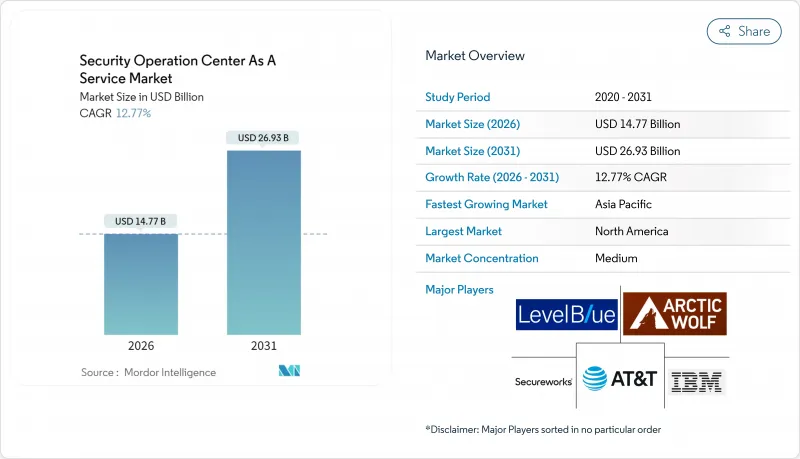
본 보고서는 기업 규모(중소기업 및 대기업), 서비스 유형(관리형 감지 및 대응,사고 대응 및 위협 헌팅 등), 배포 모델(퍼블릭 클라우드, 프라이빗 클라우드, 하이브리드 클라우드), 최종 사용자 산업(은행, 금융서비스 및 보험(BFSI), IT 및 통신 등), 지역별로 분류되어 있습니다. 시장 예측은 금액(달러) 기준으로 제시되어 있습니다.
세계 SOCaaS(Security Operation Center As A Service) 시장 동향 및 인사이트
다중 벡터형 사이버 공격의 급증
현재 위협 행위자들은 랜섬웨어, 데이터 유출, 서비스 거부형 협박을 빠르게 연속적으로 조합하여, 여전히 정기적인 로그 확인에 의존하고 있는 사내 팀을 압도하고 있습니다. 연방수사국(FBI)은 2023년 사이버 범죄로 인한 피해액을 125억 달러로 기록했는데, 이는 랜섬웨어와 비즈니스 이메일 사기로 인한 22%의 급증에 기인한 것입니다. 2024년, 미국 사이버보안·인프라보안청(CISA)은 침입 후 잠복 시간을 24시간 미만으로 단축하는 ‘초기 접근 중개자(IAB)’가 연루된 사고가 30% 증가했음을 확인했습니다. 이러한 가속화로 인해, 전 세계적인 분석가 체제와 수분 이내에 횡방향 이동을 식별할 수 있는 행동 분석 기능을 갖춘 관리형 감지 및 대응(MDR) 제공업체가 유리한 입장에 있습니다. 과거에는 주간 검토를 용인하던 조직들도 현재는 감지까지의 평균 시간을 1시간 미만으로 요구하게 되면서, 외부 전문가에 대한 의존도가 높아지고 있습니다. 경계 방어에서 ‘침해를 전제로 한’ 자세로의 전환은 지속적인 모니터링과 결합된 사고 대응 정액제 계약의 매출을 더욱 끌어올리고 있습니다.
심화되는 사이버 보안 인력 부족
2024년, 전 세계 보안 인력 부족 규모는 400만 명에 달했으며, 그중 북미만 해도 70만 개의 공석이 있었습니다. 최고 수준의 분석가의 급여 상승률은 전년 대비 15%를 넘어섰지만, 이직률은 여전히 25%를 상회하고 있어 조직의 노하우가 유실되고 미처리 경보 건수가 증가하고 있습니다. 중소기업은 대형 기술 기업이나 금융 기업이 제시하는 보상 수준에 맞추는 데 가장 큰 어려움을 겪고 있으며, 그 결과 분석가 비용을 수백 개의 고객사에 분산시키는 구독형 SOCaaS(Security Operation Center As A Service) 시장 솔루션 도입이 확대되고 있습니다. 서비스 제공업체는 규모의 경제를 실현함으로써, 개별 기업으로는 도입을 정당화하기 어려운 고도의 자동화 및 위협 인텔리전스 플랫폼에 대한 투자를 가능하게 하고 있습니다. 이러한 인력 부족은 쿠버네티스 런타임 보호와 같은 클라우드 네이티브 분야에서 특히 심각하여, 아웃소싱 추세를 더욱 강화하고 있습니다.
데이터 주권 및 로그 보관 장소에 대한 우려
일반 데이터 보호 규정(GDPR(EU 개인정보보호규정))에 따른 개인 데이터 이전 제한으로 인해, 공급업체는 해당 지역 내에서 보안 운영 센터를 운영하거나 표준 계약 조항을 채택할 수밖에 없으며, 이로 인해 비용과 복잡성이 증가하고 있습니다. 인도의 ‘디지털 개인 데이터 보호법’도 유사한 요건을 도입하여 국내 시설에 대한 투자를 촉진하고 있습니다. 중국의 ‘사이버 보안법’은 중요 정보 인프라의 로그를 해외로 수출하는 것을 금지하고 있어, 사실상 해당 분야 수요를 현지 기업으로 한정하고 있습니다. 그 결과 발생하는 시장 분할은 세계 제공업체의 규모의 경제를 저해하는 한편, 지역 전문 기업에게는 홈그라운드에서의 우위를 가져다주고 있습니다.
부문 분석
2025년 SOCaaS(Security Operation Center As A Service) 시장의 매출액 중 68.23%를 대기업 부문이 차지하고 있으며, 이는 하이브리드 환경의 광범위함과 엄격한 감사 의무를 반영하고 있습니다. 이러한 구매 기업들은 대개 Tier 3 위협 헌팅이나 사내 인텔리전스를 자체적으로 유지하면서, Tier 1 트리아지 및 Tier 2 조사를 외부에 위탁함으로써 조직적 맥락을 유지하면서도 연중무휴 24시간 대응 체계를 확보하고 있습니다. 중소기업용 SOCaaS(Security Operation Center As A Service) 시장은 턴키 방식의 클라우드 구독을 통해 설비 투자가 불필요하고, 직원 수 증가에 맞추어 확장할 수 있기 때문에 연평균 성장률(CAGR) 13.84%라는 빠른 속도로 성장하고 있습니다. 매니지드 서비스 제공업체를 통한 프로그램화된 채널 판매는 도입 비용을 더욱 낮추고, 고급 감지 기능을 합리적인 가격으로 이용할 수 있게 해줍니다.
소규모 기업은 일반적으로 엔드포인트 감지, 보안 인식 제고 교육, 취약점 스캔을 결합한 표준화된 플레이북을 채택하는 반면, 대기업은 맞춤형 런북이나 업계별 인텔리전스를 요구하고 있습니다. 최고정보보안책임자(CISO)가 만성적인 인력 부족에 직면함에 따라, 포춘 500대 기업조차 외부 분석가에게 전달되는 경보의 비율을 늘리고 있습니다. 소규모 구매자에게 아웃소싱은 규제 준수 및 사이버 보험 가입 자격을 얻기 위한 유일한 실용적인 수단이 되어가고 있습니다.
MDR(Managed Detection and Response)은 지속적인 모니터링과 안내에 따른 시정 조치를 기반으로 2025년 SOCaaS(Security Operation Center As A Service) 시장의 41.52%를 차지했습니다. 사고 대응 및 위협 헌팅 서비스는 2031년까지 연평균 성장률(CAGR) 13.19%를 나타낼 것으로 예측됩니다. 이는 기업들이 “적극적인 탐색을 수행하지 않으면 공격자가 몇 주 동안 감지되지 않은 채 잠복해 있을 가능성이 있다”는 점을 인식함에 따라, 수동적인 로그 집계보다 높은 성장률을 보일 것으로 전망됩니다. 선제적인 위협 감지를 목적으로 하는 SOCaaS(Security Operation Center As A Service) 시장 규모는 현재로서는 아직 작지만, 공격자의 전술에 정통한 고위 분석가가 필요하기 때문에 고가대로 제공되고 있습니다.
클라우드 데이터 레이크를 통해 스토리지와 분석이 분리됨에 따라, 기존의 보안 모니터링은 상품화가 진행되고 있으며, 공급업체들은 오탐을 억제하고 분석가가 고정밀 신호에 집중할 수 있도록 자동화 기능을 통합하고 있습니다. 또한, 통합된 오케스트레이션 기능과 취약점 관리도 성장의 원동력으로 부상하고 있으며, 벤더들은 툴셋을 통합하여 고객 1인당 평균 수익(ARPU) 증대를 정당화할 수 있게 되었습니다. 이러한 통합적인 접근 방식은 침해로 인한 비용을 절감하고 조달 프로세스도 간소화합니다.
지역별 분석
북미는 미국 증권거래위원회(SEC)의 공시 규정, 성숙한 사이버 보험 시장, 그리고 포춘 500대 기업의 집중으로 인해 2025년 매출의 43.81%를 차지했습니다. 이 지역에서는 기존의 On-Premise형 보안 정보 및 이벤트 관리(SIEM) 플랫폼에서 총 소유 비용(TCO)을 절감하는 클라우드 네이티브 관리형 감지 및 대응(MDR) 솔루션으로의 전환이 진행되고 있습니다. 캐나다의 정보 유출 통지 제도가 수요를 더욱 부추기고 있는 반면, 멕시코에서 니어쇼어링이 활성화됨에 따라 이 지역의 허브는 사이버 위험 증가에 노출되어 있습니다.
유럽은 약 28%의 점유율을 차지하고 있으며, 그 원동력은 중요 및 필수 조직에 대해 24시간 보고를 의무화하는 ‘네트워크 및 정보 보안 지침 2(NIS II)’입니다. 독일, 프랑스, 영국에서는 서비스 품질 기준을 높이는 국가 인증 제도를 통해 도입이 촉진되고 있습니다. 그러나 일반 데이터 보호 규정(GDPR(EU 개인정보보호규정))의 거주지 요건으로 인해 벤더 시장이 세분화되고 있으며, 국내에 보안 운영 센터(SOC)를 보유한 벤더가 우위를 점하고 있습니다.
아시아태평양은 연평균 성장률(CAGR) 15.27%로 확대될 것으로 예측되며, 이는 세계에서 가장 빠른 속도입니다. 인도의 ‘디지털 개인 데이터 보호법’에서는 보안 텔레메트리 데이터의 현지 저장이 의무화되어 있어, 이에 따라 세계 공급업체들은 뭄바이와 방갈로르에 시설을 개설하고 있습니다. 싱가포르의 중요 정보 인프라에 대한 6시간 이내 사고 보고 규정, 호주의 ‘중요 인프라 보호법’, 그리고 한국의 금융 부문 지침은 모두 규정 준수를 주도하는 수요를 창출하고 있습니다. 중국에서는 해외로 데이터가 유출되는 것을 규제하는 정책으로 인해 여전히 국내 공급업체가 시장을 독점하고 있지만, 다국적 기업들은 그룹 전체의 가시성을 유지하기 위해 자회사와 병행하여 계약을 체결하는 경우가 많습니다.
남미, 중동 및 아프리카는 2025년 매출의 약 15%를 차지했습니다. 브라질 중앙은행의 사이버 보안 결의안과 아랍에미리트(UAE)의 관리형 보안 라이선싱 제도가 해당 지역의 성장을 뒷받침하고 있습니다. 사우디아라비아의 ‘필수 사이버 보안 대책’에서는 중요 인프라에 대해 연중무휴 24시간 감시를 실시할 것을 의무화하고 있으며, 남아프리카공화국의 규제 당국은 거시경제적 역풍에도 불구하고 사이버 복원력에 관한 지침 준수를 철저히 하고 있습니다.
기타 혜택:
- 엑셀 형식 시장 예측(ME) 시트
- 3개월간의 애널리스트 지원
자주 묻는 질문
목차
제1장 서론
제2장 조사 방법
제3장 주요 요약
제4장 시장 구도
제5장 시장 규모와 성장 예측
제6장 경쟁 구도
제7장 시장 기회와 향후 전망
JHS 26.09.09According to Mordor Intelligence, the security operation center as a service market was valued at USD 14.77 billion in 2026 and is projected to reach USD 26.93 billion by 2031, advancing at a 12.77% CAGR over the forecast period.
This report is Segmented by Enterprise Size (Small and Medium Enterprises, and Large Enterprises), Service Type (Managed Detection and Response, Incident Response and Threat Hunting, and More), Deployment Model (Public Cloud, Private Cloud, and Hybrid Cloud), End-User Industry (BFSI, IT and Telecom, and More), Geography. The Market Forecasts are Provided in Terms of Value (USD).
Global Security Operation Center As A Service Market Trends and Insights
Exponential Rise in Multi-Vector Cyber-Attacks
Threat actors now chain ransomware, data exfiltration, and denial-of-service extortion in rapid succession, overwhelming in-house teams that still rely on periodic log reviews. The Federal Bureau of Investigation recorded USD 12.5 billion in cyber-crime losses during 2023, a 22% surge driven by ransomware and business email compromise. In 2024, the Cybersecurity and Infrastructure Security Agency observed a 30% uptick in incidents involving initial-access brokers that shorten dwell time to fewer than 24 hours. This acceleration favors managed detection and response providers that maintain global analyst benches and behavioral analytics capable of identifying lateral movement within minutes. Organizations that once tolerated weekly reviews now demand sub-hour mean time to detect, creating dependencies on outsourced experts. The shift from perimeter defense to assume-breach postures further boosts incident-response retainer sales bundled with continuous monitoring.
Escalating Cybersecurity-Talent Shortage
The worldwide security workforce gap reached 4 million positions in 2024, including 700,000 vacancies in North America alone. Salary inflation for tier-one analysts topped 15% year-over-year, yet turnover remained higher than 25%, eroding institutional knowledge and expanding alert backlogs. Small and medium enterprises struggle most to match compensation levels offered by large technology and financial players, prompting them to adopt subscription-based security operation center as a service market offerings that spread analyst costs across hundreds of clients. Providers achieve economies of scale to fund advanced automation and threat-intelligence platforms that individual enterprises cannot justify. The shortage is particularly acute in cloud-native disciplines such as Kubernetes runtime protection, further solidifying the outsourcing trend.
Data-Sovereignty and Log-Residency Concerns
General Data Protection Regulation restrictions on personal-data transfer compel providers to operate in-region security operations centers or adopt standard contractual clauses, adding cost and complexity. India's Digital Personal Data Protection Act introduces similar requirements, spurring investments in domestic facilities. China's Cybersecurity Law prevents overseas export of critical information infrastructure logs, effectively reserving that portion of demand for local champions. The resulting fragmentation hampers global providers' economies of scale, yet gives regional specialists a home-field advantage.
Other drivers and restraints analyzed in the detailed report include:
- Expanding Cloud and Hybrid IT Attack Surface
- Regulatory Push for Real-Time Incident Disclosure
- Integration Complexity With Legacy Tooling
For complete list of drivers and restraints, kindly check the Table Of Contents.
Segment Analysis
The large-enterprise tier accounted for 68.23% of 2025 revenue in the security operation center as a service market, reflecting the breadth of hybrid estates and stringent audit obligations. These buyers often keep tier-three threat hunting and in-house intelligence but outsource tier-one triage and tier-two investigation, retaining institutional context while gaining 24/7 coverage. The security operations center-as-a-service market for small and medium enterprises is growing faster, advancing at a 13.84% CAGR, because turnkey cloud subscriptions eliminate capital expenditure and scale with headcount growth. Programmatic channel sales by managed service providers further lower acquisition costs and make advanced detection affordable.
Small companies typically adopt standardized playbooks that bundle endpoint detection, security awareness training, and vulnerability scanning, while large organizations demand bespoke runbooks and sector-specific intelligence. As chief information security officers face persistent hiring gaps, even Fortune 500 firms are increasing the portion of alerts routed to external analysts. For smaller buyers, outsourcing is becoming the only viable path to regulatory compliance and cyber-insurance eligibility.
Managed detection and response captured 41.52% of security operation center as a service market share in 2025, underpinned by continuous monitoring and guided remediation. Incident response and threat hunting services are projected to post a 13.19% CAGR to 2031, outperforming passive log aggregation as enterprises recognize that adversaries can dwell undetected for weeks without proactive searches. The security operation center as a service market size for proactive hunting remains smaller today but commands premium pricing because it requires senior analysts versed in adversary tactics.
Legacy security monitoring is commoditizing as cloud data lakes decouple storage from analytics, prompting providers to integrate automation that suppresses false positives and focuses analysts on high-fidelity signals. Bundled orchestration capabilities and vulnerability management are also emerging as growth vectors, allowing vendors to consolidate toolsets and justify higher average revenue per customer. The unified approach reduces breach costs and simplifies procurement.
Complete Report Scope:
- By Enterprise Size
- Small and Medium Enterprises (SMEs)
- Large Enterprises
- By Service Type
- Managed Detection and Response (MDR)
- Incident Response and Threat Hunting
- Security Monitoring and Log Management
- Other Service Types
- By Deployment Model
- Public Cloud
- Private Cloud
- Hybrid Cloud
- By End-User Industry
- BFSI
- IT and Telecom
- Healthcare and Life Sciences
- Manufacturing
- Government and Public Sector
- Retail and E-Commerce
- By Geography
- North America
- United States
- Canada
- Mexico
- Europe
- Germany
- United Kingdom
- France
- Italy
- Spain
- Russia
- Rest of Europe
- Asia Pacific
- China
- Japan
- India
- South Korea
- ASEAN
- Australia and New Zealand
- Rest of Asia Pacific
- South America
- Brazil
- Argentina
- Rest of South America
- Middle East
- Saudi Arabia
- UAE
- Turkey
- Rest of Middle East
- Africa
- South Africa
- Nigeria
- Rest of Africa
- North America
Geography Analysis
North America accounted for 43.81% of 2025 revenue, buoyed by the United States Securities and Exchange Commission's disclosure rule, mature cyber-insurance markets, and a concentration of Fortune 500 enterprises. The region is witnessing the replacement of legacy on-premises security information and event management platforms with cloud-native managed detection and response solutions that lower the total cost of ownership. Canada's breach-notification regime further supports demand, while nearshoring activity in Mexico exposes regional hubs to heightened cyber risk.
Europe claimed a roughly 28% share, anchored by the Network and Information Security Directive 2 that compels 24-hour reporting across essential and important entities. Germany, France, and the United Kingdom bolster adoption through national certifications that raise service-quality baselines. Nevertheless, General Data Protection Regulation residency provisions fragment the provider landscape, favoring vendors with in-country security operations centers.
Asia Pacific is projected to expand at a 15.27% CAGR, the fastest worldwide. India's Digital Personal Data Protection Act requires local storage of security telemetry, prompting global providers to open Mumbai and Bengaluru facilities. Singapore's six-hour incident-reporting rule for critical information infrastructure, Australia's Critical Infrastructure Protection Act, and South Korea's financial-sector guidelines all create compliance-driven demand. China remains dominated by domestic suppliers due to outbound-data restrictions, yet multinational firms often execute parallel contracts for subsidiaries to maintain group-wide visibility.
South America, the Middle East, and Africa contributed nearly 15% of 2025 revenue. Brazil's central bank cybersecurity resolution and the United Arab Emirates' managed security licensing scheme have stimulated regional growth. Saudi Arabia's Essential Cybersecurity Controls compel critical infrastructure to implement 24/7 monitoring, and South Africa's regulators are enforcing cyber-resilience guidelines despite macroeconomic headwinds.
- SecureWorks Inc.
- IBM Corporation
- AT&T Inc.
- Arctic Wolf Networks, Inc.
- Trustwave Holdings, Inc. (LevelBlue)
- Atos SE
- BAE Systems plc
- Capgemini SE
- Symantec Corporation
- Thales Group (Thales S.A.)
- Fujitsu Limited
- NTT Ltd. (NTT Security Corporation)
- Lumen Technologies, Inc.
- Alert Logic, Inc.
- Cygilant, Inc.
- BlackStratus, Inc.
- Digital Guardian, Inc.
- Rapid7, Inc.
- Securonix, Inc.
- Trellix LLC
Additional Benefits:
- The market estimate (ME) sheet in Excel format
- 3 months of analyst support
TABLE OF CONTENTS
1 INTRODUCTION
- 1.1 Study Assumptions and Market Definition
- 1.2 Scope of the Study
2 RESEARCH METHODOLOGY
3 EXECUTIVE SUMMARY
4 MARKET LANDSCAPE
- 4.1 Market Overview
- 4.2 Market Drivers
- 4.2.1 Exponential Rise in Multi-Vector Cyber-Attacks
- 4.2.2 Escalating Cybersecurity-Talent Shortage
- 4.2.3 Expanding Cloud and Hybrid IT Attack Surface
- 4.2.4 Regulatory Push for Real-Time Incident Disclosure
- 4.2.5 Cyber-Insurance Mandates for 24/7 MDR
- 4.2.6 OT and IoT Convergence Demanding Unified Visibility
- 4.3 Market Restraints
- 4.3.1 Data-Sovereignty and Log-Residency Concerns
- 4.3.2 Integration Complexity With Legacy Tooling
- 4.3.3 Limited Organization-Specific Context in Outsourced SOC
- 4.3.4 Alert-Fatigue From High False-Positive Rates
- 4.4 Industry Value Chain Analysis
- 4.5 Regulatory Landscape
- 4.6 Technological Outlook
- 4.7 Porter's Five Forces Analysis
- 4.7.1 Bargaining Power of Suppliers
- 4.7.2 Bargaining Power of Buyers
- 4.7.3 Threat of New Entrants
- 4.7.4 Threat of Substitutes
- 4.7.5 Intensity of Competitive Rivalry
- 4.8 Impact of Macroeconomic Factors on the Market
5 MARKET SIZE AND GROWTH FORECASTS (VALUE)
- 5.1 By Enterprise Size
- 5.1.1 Small and Medium Enterprises (SMEs)
- 5.1.2 Large Enterprises
- 5.2 By Service Type
- 5.2.1 Managed Detection and Response (MDR)
- 5.2.2 Incident Response and Threat Hunting
- 5.2.3 Security Monitoring and Log Management
- 5.2.4 Other Service Types
- 5.3 By Deployment Model
- 5.3.1 Public Cloud
- 5.3.2 Private Cloud
- 5.3.3 Hybrid Cloud
- 5.4 By End-User Industry
- 5.4.1 BFSI
- 5.4.2 IT and Telecom
- 5.4.3 Healthcare and Life Sciences
- 5.4.4 Manufacturing
- 5.4.5 Government and Public Sector
- 5.4.6 Retail and E-Commerce
- 5.5 By Geography
- 5.5.1 North America
- 5.5.1.1 United States
- 5.5.1.2 Canada
- 5.5.1.3 Mexico
- 5.5.2 Europe
- 5.5.2.1 Germany
- 5.5.2.2 United Kingdom
- 5.5.2.3 France
- 5.5.2.4 Italy
- 5.5.2.5 Spain
- 5.5.2.6 Russia
- 5.5.2.7 Rest of Europe
- 5.5.3 Asia Pacific
- 5.5.3.1 China
- 5.5.3.2 Japan
- 5.5.3.3 India
- 5.5.3.4 South Korea
- 5.5.3.5 ASEAN
- 5.5.3.6 Australia and New Zealand
- 5.5.3.7 Rest of Asia Pacific
- 5.5.4 South America
- 5.5.4.1 Brazil
- 5.5.4.2 Argentina
- 5.5.4.3 Rest of South America
- 5.5.5 Middle East
- 5.5.5.1 Saudi Arabia
- 5.5.5.2 UAE
- 5.5.5.3 Turkey
- 5.5.5.4 Rest of Middle East
- 5.5.6 Africa
- 5.5.6.1 South Africa
- 5.5.6.2 Nigeria
- 5.5.6.3 Rest of Africa
- 5.5.1 North America
6 COMPETITIVE LANDSCAPE
- 6.1 Market Concentration
- 6.2 Strategic Moves
- 6.3 Market Share Analysis
- 6.4 Company Profiles (includes Global Level Overview, Market Level Overview, Core Segments, Financials as Available, Strategic Information, Market Rank/Share for Key Companies, Products and Services, and Recent Developments)
- 6.4.1 SecureWorks Inc.
- 6.4.2 IBM Corporation
- 6.4.3 AT&T Inc.
- 6.4.4 Arctic Wolf Networks, Inc.
- 6.4.5 Trustwave Holdings, Inc. (LevelBlue)
- 6.4.6 Atos SE
- 6.4.7 BAE Systems plc
- 6.4.8 Capgemini SE
- 6.4.9 Symantec Corporation
- 6.4.10 Thales Group (Thales S.A.)
- 6.4.11 Fujitsu Limited
- 6.4.12 NTT Ltd. (NTT Security Corporation)
- 6.4.13 Lumen Technologies, Inc.
- 6.4.14 Alert Logic, Inc.
- 6.4.15 Cygilant, Inc.
- 6.4.16 BlackStratus, Inc.
- 6.4.17 Digital Guardian, Inc.
- 6.4.18 Rapid7, Inc.
- 6.4.19 Securonix, Inc.
- 6.4.20 Trellix LLC
7 MARKET OPPORTUNITIES AND FUTURE OUTLOOK
- 7.1 White-Space and Unmet-Need Assessment


