
|
시장보고서
상품코드
2111123
데이터센터 열관리 시장 예측(-2032년) : 기술별, 솔루션별, 컴포넌트별, 데이터센터 유형별, 최종 용도 산업별, 지역별Data Center Thermal Management Market by Solution (Hardware, Services), Component, Data Center Type (Hyperscale, Enterprise, Colocation Providers), End-use Industry, Technology, Type of Cooling (Air, Liquid), and Region - Global Forecast to 2032 |
||||||

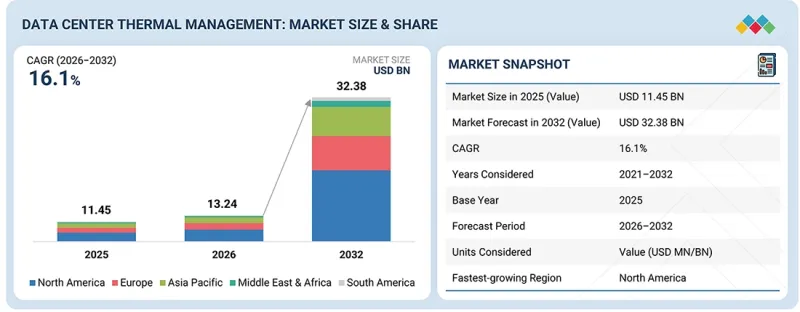
데이터센터 열관리 시장 규모는 2026년 132억 4,000만 달러에서 2032년까지 323억 8,000만 달러로 성장하며, 예측 기간 중 CAGR은 16.1%에 달할 것으로 전망되고 있습니다.
인공지능(AI), 생성형 AI, 고성능 컴퓨팅(HPC) 및 클라우드 컴퓨팅의 채택 확대가 전 세계 데이터센터 열 관리 시장의 주요 성장 요인으로 작용하고 있습니다.
| 조사 범위 | |
|---|---|
| 조사 대상 기간 | 2021-2032년 |
| 기준연도 | 2025년 |
| 예측 기간 | 2026-2032년 |
| 산정 단위 | 금액(100만/10억 달러) |
| 부문 | 기술별, 솔루션별, 컴포넌트별, 데이터센터 유형별, 최종 용도 산업별, 지역별 |
| 대상 지역 | 아시아태평양, 유럽, 북미, 중동 및 아프리카, 남미 |
NVIDIA, AMD, Intel 등의 기업이 제공하는 첨단 GPU 및 가속기를 탑재한 AI 서버는 기존 서버 아키텍처에 비해 훨씬 더 높은 열 부하를 발생시킵니다. 이로 인해 랙의 전력 밀도는 기존의 5-15 kW에서 50-100kW로 상승하며, 일부 AI 도입 사례에서는 랙당 150kW를 초과하는 경우도 있습니다. 이러한 높은 열 부하에 대응하기 위해서는 시스템의 신뢰성과 성능을 지속적으로 확보하면서 효율적으로 열을 방출할 수 있는 첨단 열 관리 솔루션이 필요합니다.
"구성 요소별로 보면 예측 기간 중 데이터센터 열 관리 시장에서 금액 기준으로 가장 큰 부문은 액체 냉각 시스템이 될 것입니다."
예측 기간 중 전 세계 데이터센터 열 관리 시장에서 액체 냉각 시스템은 금액 기준으로 가장 큰 부문이 될 것으로 예상됩니다. 이러한 추세는 인공지능(AI), 고성능 컴퓨팅(HPC), 클라우드 컴퓨팅 및 대규모 분석의 도입 확대에 의해 주도되고 있습니다. 이러한 워크로드에는 기존의 공랭식 방식보다 훨씬 더 높은 열 부하를 감당할 수 있는 첨단 열 관리 솔루션이 필요합니다. 서버 프로세서 및 AI 가속기의 전력 소비가 점점 증가함에 따라 액체 냉각 시스템은 연산 성능 향상, 장비 신뢰성 확보, 그리고 전반적인 운영 효율 개선을 목표로 하는 데이터센터 사업자에게 필수적인 투자로 자리 잡고 있습니다.
액체 냉각 시스템의 시장 가치가 높아지는 주요 이유는 관련 하드웨어 비용이 높고 설치 과정이 더 복잡하기 때문입니다. 이러한 시스템에는 냉각 분배 장치(CDU), 펌프, 콜드 플레이트, 매니폴드, 열교환기, 배관 네트워크 외에도 모니터링 시스템 및 제어 소프트웨어가 포함됩니다. 이러한 통합형 시스템은 기존의 공랭식 시스템에 비해 초기 투자 비용이 크지만, 에너지 소비량 절감, 전력 사용 효율(PUE) 향상, 랙 밀도 향상, 일상적인 운영 비용 절감 등 장기적인 이점이 매우 큽니다. 그 결과, 하이퍼스케일 클라우드 제공업체, 코로케이션 사업자 및 기업 데이터센터는 AI 지원 시설을 구축하기 위해, 많은 경우 예정보다 빨리 액체 냉각 인프라에 대한 예산 배분을 확대하고 있습니다.
"데이터센터 유형별로 보면 예측 기간 중 하이퍼스케일 데이터센터는 데이터센터 열 관리 시장에서 가장 빠르게 성장하는 부문입니다."
하이퍼스케일 데이터센터 부문은 예측 기간 중 데이터센터 열 관리 시장에서 가장 높은 연평균 성장률(CAGR)을 기록할 것으로 예상됩니다. 이러한 성장은 주로 하이퍼스케일 클라우드 인프라의 급속한 확장에 더해, AI 훈련 클러스터, 고성능 컴퓨팅(HPC), 대규모 코로케이션 환경 구축에 의해 주도되고 있습니다. 하이퍼스케일 클라우드 제공업체와 디지털 인프라 기업은 인공지능(AI), 생성형 AI, 빅데이터 분석, 클라우드 기반 서비스의 급격한 증가에 대응하기 위해 대규모 데이터센터 건설을 점점 더 확대하고 있습니다. 이러한 시설에는 일반적으로 수천 대의 고성능 서버와 AI 가속기가 설치되어 있으며, 그 결과 전력 소비량과 발열량이 증가하고 있습니다. 따라서 최적의 가동 상태를 유지하고 서비스 중단을 방지하기 위해서는 정교한 열 관리가 필수적입니다.
이를 실현하기 위해 하이퍼스케일 데이터센터 운영 사업자들은 차세대 냉각 기술에 막대한 투자를 하고 있습니다. 이러한 기술에는 다이렉트 투 칩(Direct-to-Chip) 액체 냉각, 침지 냉각, 정밀 공조, 컴퓨터실용 에어 핸들러(CRAH), 컴퓨터실용 에어컨(CRAC), 냉매 분배 장치(CDU), 열교환기, 더욱 스마트한 기류 제어 시스템, AI를 활용한 열 모니터링 플랫폼 등이 포함됩니다. 이러한 전략을 결합함으로써 효율적인 열 제거가 가능해지며, 100kW를 초과하기도 하는 고밀도 랙 구성의 관리, 시설 전체의 신뢰성 향상, 그리고 냉각에 따른 에너지 소비 절감이 실현됩니다.
"최종 용도 산업별로 보면 예측 기간 중 정부·국방 부문은 데이터센터 열 관리 시장에서 가장 빠르게 성장하는 부문이 될 것입니다."
정부·국방 부문은 예측 기간 중 전 세계 데이터센터 열 관리 시장에서 가장 높은 연평균 성장률(CAGR)을 보일 것으로 예상됩니다. 그 주요 이유는 안전한 디지털 인프라, 국방 현대화 프로그램, 그리고 확대되는 인공지능(AI), 사이버 보안, 미션 크리티컬 컴퓨팅 사용 사례에 대한 투자가 증가하고 있기 때문입니다. 정부 기관 및 국방 조직 또한 정보 수집·모니터링, 지휘통제시스템, 지리공간 분석, 그리고 기밀 처리 클라우드 환경을 위해 데이터센터의 용량을 확대하고 있습니다. 그리고 당연히 이러한 유형의 워크로드에는 대량의 열을 발생시키는 고성능 컴퓨팅(HPC) 인프라가 필요하므로 시스템을 중단 없이 계속 가동하고 시스템의 신뢰성을 보호하며 데이터 보안을 유지할 수 있는 첨단 열 관리 솔루션에 대한 수요가 높아지고 있습니다. 오늘날의 많은 국방 용도, 즉 자율 시스템, 실시간 전장 분석, 위성통신, 사이버 방어 작전 등은 고밀도 컴퓨팅을 핵심으로 구축되어 있으므로, 열 관리는 효율적이어야 합니다. 이에 따라 정부 기관에서는 액체 냉각 시스템, 정밀 공조, 보다 스마트한 기류 관리 및 혼합 냉각 아키텍처의 도입이 진행되고 있으며, 이를 통해 장비를 최적의 상태로 유지하면서 에너지 소비량과 일일 운영 비용을 다소 절감할 수 있게 되었습니다.
"예측 기간 중 북미는 금액 기준으로 데이터센터 열 관리 시장에서 최대 규모를 차지할 것으로 전망됩니다."
예측 기간 중 북미는 금액 기준으로 데이터센터 열 관리 시장에서 최대 규모를 차지할 것으로 전망됩니다. 이러한 성장은 주로 확립된 디지털 인프라, 하이퍼스케일 클라우드 제공업체의 강력한 입지, 그리고 인공지능(AI) 및 고성능 컴퓨팅(HPC) 워크로드의 급속한 증가에 의해 주도되고 있습니다. 미국과 캐나다에서는 하이퍼스케일, 코로케이션 및 기업용 데이터센터에 대한 막대한 투자가 계속되고 있습니다. Amazon Web Services(AWS), Microsoft, Google, Meta, Oracle, CoreWeave 등의 기업은 AI 지원 인프라 확충을 추진하고 있습니다. 고밀도 서버 랙 및 GPU 클러스터 도입이 확대됨에 따라 열 부하가 증가하고 있으며, 그 결과 해당 지역 전체에서 첨단 열 관리 솔루션에 대한 수요가 높아지고 있습니다.
또한 이 지역은 차세대 냉각 기술 개발 분야에서 최첨단을 달리고 있습니다. 여기에는 다이렉트 투 칩(Direct-to-Chip) 수냉, 침지 냉각, 정밀 공조, 컴퓨터실용 에어 핸들러(CRAH), 컴퓨터실용 에어컨(CRAC), 냉각수 분배 장치(CDU), 열교환기, 스마트 열 모니터링 시스템 등이 포함됩니다. 이러한 첨단 툴을 활용함으로써 데이터센터 운영 팀은 냉각 효율 향상, 최적의 온도 유지, 에너지 소비량 절감, 전력 사용 효율(PUE) 개선을 실현할 수 있을 뿐만 아니라, 전력 소비가 많은 AI 애플리케이션의 증가하는 수요에도 대응할 수 있게 됩니다.
데이터센터 열 관리 시장에서 사업을 운영하는 주요 기업으로는 Vertiv Group Corp(미국), Johnson Controls, Inc.(미국), Schneider Electric(프랑스), Carrier(미국), Daikin Industries Ltd.(일본), Mitsubishi Electric Corporation(일본), Super Micro Computer Inc(미국), Modine(미국), Trane(아일랜드), Lenovo(중국), STULZ GMBH(독일), Sugon Information Industry(중국), Munters(스웨덴), Delta Electronics Inc.(대만), CoollT Systems(Ecolab)(캐나다), Baltimore Aircoil Company, Inc.(미국), Eaton(아일랜드), Rittal GmbH & Co. KG(독일), DCX Liquid Cooling Systems(폴란드), Taisol Electronics(대만), Alfa Laval(스웨덴), Green Revolution Cooling Inc.(미국), Flex Ltd(미국), Koari Heat Treatment(대만), GIGA-BYTE Technology(대만), Legrand(프랑스), Submer(스페인), Inspur(중국), Asperitas(네덜란드), Zutacore Inc.(미국) 등입니다. 이러한 주요 기업은 데이터센터 열 관리 시장에서 중요한 역할을 수행하고 있습니다. 이들 기업은 시장 점유율과 매출을 확대하기 위해 제휴, 합작 투자, 사업 확장 등 다양한 전략을 채택하고 있습니다.
조사 범위:
이 보고서에서는 구성 요소, 데이터센터 유형, 최종 용도 산업, 서비스, 기술, 냉각 방식 및 지역을 기준으로 데이터센터 열 관리 시장의 정의, 세분화 및 시장 규모 예측을 수행하고 있습니다. 주요 기업의 전략적 프로필을 작성하고, 해당 기업의 시장 점유율과 핵심 경쟁력을 종합적으로 분석하고 있습니다. 또한 시장에서 각 기업의 사업 확장, 제휴, 인수합병(M&A) 등의 경쟁 동향을 추적·분석하고 있습니다.
이 보고서를 구매해야 하는 이유:
이 보고서는 데이터센터 열 관리 시장 및 각 부문의 매출에 대해 가장 정확한 추정치를 제공함으로써, 시장 선도 기업 및 신규 진입 기업에 도움이 될 것으로 기대됩니다. 또한 이 보고서는 이해관계자가 시장의 경쟁 구도를 더 깊이 이해하고, 사업적 입지를 강화하기 위한 귀중한 인사이트를 얻어 효과적인 시장 진입 전략을 수립하는 데 도움이 될 것으로 기대됩니다. 아울러, 이해관계자가 시장 동향을 파악할 수 있도록 지원하는 동시에 주요 시장 촉진요인, 억제요인, 과제 및 기회에 대한 정보를 제공합니다.
이 보고서는 다음과 같은 사항에 대한 인사이트를 제공합니다. :
- 데이터센터 열 관리 시장의 성장에 영향을 미치는 촉진요인(데이터센터 효율 개선의 필요성, 데이터센터 수의 대폭 증가), 제약 요인(막대한 설비 투자, 전문적인 인프라 요구 사항), 기회(액체 냉각 기술의 부상, 모듈형 데이터센터 냉각에 대한 수요 증가), 그리고 과제(정전시 냉각 문제, 이산화탄소 배출량 감축의 필요성)에 대한 분석입니다.
- 제품 개발/혁신: 데이터센터 열 관리 시장의 향후 기술 동향 및 연구개발 활동에 대한 상세한 분석.
- 시장 동향: 수익성이 높은 시장에 대한 포괄적인 정보 ? 이 보고서에서는 다양한 지역의 데이터센터 열 관리 시장을 분석하고 있습니다.
- 시장 다각화: 데이터센터 열 관리 시장의 신제품, 각종 유형, 미개발 지역, 최근 동향 및 투자에 관한 포괄적인 정보.
- 경쟁사 평가: Vertiv Group Corp(미국), Johnson Controls, Inc.(미국), Schneider Electric(프랑스), Carrier(미국), 다이킨 공업 주식회사(일본), 미쓰비시 전기 주식회사(일본), Super Micro Computer Inc(미국), Modine(미국), Trane(아일랜드), Lenovo(중국), STULZ GMBH(독일), Sugon Information Industry(중국), Munters(스웨덴), Delta Electronics Inc.(대만), CoollT Systems(Ecolab)(캐나다), Baltimore Aircoil Company, Inc.(미국), Eaton(아일랜드), Rittal GmbH & Co. KG(독일), DCX Liquid Cooling Systems(폴란드), Taisol Electronics(대만), Alfa Laval(스웨덴), Green Revolution Cooling Inc.(미국), Flex Ltd(미국), Koari Heat Treatment(대만), GIGA-BYTE Technology(대만), Legrand(프랑스), Submer(스페인), Inspur(중국), Asperitas(네덜란드), Zutacore Inc.(미국) 등.
자주 묻는 질문
목차
제1장 서론
제2장 개요
제3장 주요 인사이트
제4장 시장 개요
제5장 업계 동향
제6장 기술, 특허, 디지털 기술, AI의 도입에 의한 전략적 파괴
제7장 지속가능성과 규제 상황
제8장 고객 상황과 구매 행동
제9장 데이터센터 열관리 시장(기술별)
제10장 데이터센터 열관리 시장(솔루션별)
제11장 데이터센터 열관리 시장(컴포넌트별)
제12장 데이터센터 열관리 시장(데이터센터 유형별)
제13장 데이터센터 열관리 시장(최종 용도 산업별)
제14장 데이터센터 열관리 시장(지역별)
제15장 경쟁 구도
제16장 기업 개요
제17장 조사 방법
제18장 부록
KSA 26.08.19The data center thermal management market is projected to grow from USD 13.24 billion in 2026 to USD 32.38 billion by 2032, at a CAGR of 16.1% during the forecast period. The increasing adoption of artificial intelligence (AI), generative AI, high-performance computing (HPC), and cloud computing is the primary driver of the global data center thermal management market.
| Scope of the Report | |
|---|---|
| Years Considered for the Study | 2021-2032 |
| Base Year | 2025 |
| Forecast Period | 2026-2032 |
| Units Considered | Value (USD Million/Billion) |
| Segments | Component, Data Center Type, End-Use Industry, Solution, Technology, Type of Cooling, and Region |
| Regions covered | Asia Pacific, Europe, North America, the Middle East & Africa, and South America |
AI servers equipped with advanced GPUs and accelerators from companies such as NVIDIA, AMD, and Intel generate substantially higher heat loads than conventional server architectures, pushing rack power densities from traditional 5-15 kW to 50-100 kW and, in some AI deployments, beyond 150 kW per rack. These elevated thermal loads require advanced thermal management solutions that can efficiently dissipate heat while ensuring continuous system reliability and performance.
"By component, liquid cooling systems is the largest segment of the data center thermal management market, in terms of value, during the forecast period."
Liquid cooling systems are expected to be the largest segment, by value, of the global data center thermal management market during the forecast period. This trend is driven by the increasing deployment of artificial intelligence (AI), high-performance computing (HPC), cloud computing, and large-scale analytics. These workloads require advanced thermal management solutions capable of handling much higher heat loads than traditional air-cooling methods. As server processors and AI accelerators continue to draw more power, liquid cooling systems are becoming essential investments for data center operators aiming to enhance computing performance, ensure greater equipment reliability, and improve overall operational efficiency.
Liquid cooling systems tend to have a higher market value primarily because the associated hardware costs are elevated, and the installation process is more complex. These systems include cooling distribution units (CDUs), pumps, cold plates, manifolds, heat exchangers, piping networks, as well as monitoring systems and control software. Although these integrated setups require a larger upfront capital investment compared to conventional air cooling systems, they offer significant long-term benefits, such as lower energy consumption, improved Power Usage Effectiveness (PUE), higher rack density, and reduced day-to-day operational costs. Consequently, hyperscale cloud providers, colocation operators, and enterprise data centers are now allocating more budget toward liquid cooling infrastructure to build AI-ready facilities, often ahead of schedule.
"By data center type, the hyperscale data centers are the fastest-growing segment of the data center thermal management market during the forecast period."
The hyperscale data center segment is expected to experience the highest CAGR in the data center thermal management market during the forecast period. This growth is primarily driven by the rapid expansion of hyperscale cloud infrastructure, along with the development of AI training clusters, high-performance computing (HPC), and large-scale colocation setups. Hyperscale cloud providers and digital infrastructure companies are increasingly constructing large data centers to accommodate the significant rise in artificial intelligence, generative AI, big data analytics, and cloud-based services. These facilities typically house thousands of high-performance servers and AI accelerators, which lead to increased power consumption and heat output. As a result, advanced thermal management is essential for maintaining optimal operating conditions and preventing service interruptions.
To achieve this, operators of hyperscale data centers are investing substantially in next-generation cooling techniques. These techniques include direct-to-chip liquid cooling, immersion cooling, precise air conditioning, computer room air handlers (CRAHs), computer room air conditioners (CRACs), coolant distribution units (CDUs), heat exchangers, smarter airflow control systems, and AI-driven thermal monitoring platforms. Together, these strategies facilitate efficient heat removal, manage high-density rack configurations that can exceed 100 kW, enhance the reliability of the overall facility, and reduce energy consumption associated with cooling.
"By end-use industry, the government & defense segment is the fastest-growing segment of the data center thermal management market during the forecast period."
The government & defense segment is expected to have the highest CAGR in the global data center thermal management market over the forecast period, mainly because more investments are going into secure digital infrastructure, defense modernization programs, and growing artificial intelligence (AI), cybersecurity, and mission-critical computing use cases. Government agencies and defense organizations are also expanding their data center abilities for intelligence gathering surveillance, command and control systems, geospatial analytics, and classified cloud environments. And of course, these types of workloads need high-performance computing (HPC) infrastructure that produces a lot of heat, so there's a strong demand for advanced thermal management solutions that can keep everything running without interruption, protect system reliability, and uphold data security. A lot of today's defense applications autonomous systems, real-time battlefield analytics, satellite communications, and cyber defense operations are built around high-density computing, and it means thermal management must be efficient. Because of this, government agencies are more deploying liquid cooling systems, precise air conditioning, smarter airflow management, and mixed cooling architectures, so equipment stays at its best while energy consumption and day to day operating costs get pushed down a bit.
"North America is projected to be the largest data center thermal management market, in terms of value, during the forecast period."
North America is expected to be the largest market for data center thermal management by value during the forecast period. This growth is primarily driven by its established digital infrastructure, a significant presence of hyperscale cloud providers, and the rapid increase in artificial intelligence (AI) and high-performance computing (HPC) workloads. The US and Canada continue to experience significant investment in hyperscale, colocation, and enterprise data centers. Companies like Amazon Web Services (AWS), Microsoft, Google, Meta, Oracle, and CoreWeave are expanding their AI-ready infrastructures. As more high-density server racks and GPU clusters are implemented, thermal loads are increasing, which in turn raises the demand for enhanced thermal management solutions across the region.
Moreover, this area is at the forefront of developing next-generation cooling technologies. These include direct-to-chip liquid cooling, immersion cooling, precision air conditioning, computer room air handlers (CRAHs), computer room air conditioners (CRACs), coolant distribution units (CDUs), heat exchangers, and smart thermal monitoring systems. With these advanced tools, data center teams can improve cooling efficiency, maintain optimal temperatures, reduce energy consumption, and achieve better Power Usage Effectiveness (PUE) outcomes, all while managing the growing demands of power-hungry AI applications.
Profile break-up of primary participants for the report:
- By Company Type: Tier 1 - 45%, Tier 2 - 22%, and Tier 3 - 33%
- By Designation: C-Level Executives- 50%, Directors- 10%, and Others - 40%
- By Region: North America - 17%, Asia Pacific - 17%, Europe - 33%, Middle East & Africa - 25%, and South America - 8%
Leading players operating in the data center thermal management market include Vertiv Group Corp (US), Johnson Controls, Inc. (US), Schneider Electric (France), Carrier (US), Daikin Industries Ltd. (Japan), Mitsubishi Electric Corporation (Japan), Super Micro Computer Inc (US), Modine (US), Trane (Ireland), Lenovo (China), STULZ GMBH (Germany), Sugon Information Industry Co., Ltd. (China), Munters (Sweden), Delta Electronics Inc. (Taiwan), CoollT Systems (Ecolab) (Canada), Baltimore Aircoil Company, Inc. (US), Eaton (Ireland), Rittal GmbH & Co. KG (Germany), DCX Liquid Cooling Systems (Poland), Taisol Electronics Co., Ltd. (Taiwan), Alfa Laval (Sweden), Green Revolution Cooling Inc. (US), Flex Ltd (US), Koari Heat Treatment Co., Ltd. (Taiwan), GIGA-BYTE Technology Co., Ltd. (Taiwan), Legrand (France), Submer (Spain), Inspur Co., Ltd. (China), Asperitas (Netherlands), Zutacore Inc. (US), and others. These key players are significant contributors to the data center thermal management market. These players have adopted various strategies, including agreements, joint ventures, and expansions, to increase their market share and business revenue.
Research Coverage:
The report defines, segments, and projects the size of the data center thermal management market based on component, data center type, end-use industry, service, technology, type of cooling, and region. It strategically profiles the key players and comprehensively analyzes their market shares and core competencies. It also tracks and analyzes competitive developments, such as expansions, partnerships, and acquisitions undertaken by them in the market.
Reasons to Buy the Report:
The report is expected to help market leaders/new entrants by providing them with the closest approximations of revenue numbers for the data center thermal management market and its segments. This report is also expected to help stakeholders gain a deeper understanding of the market's competitive landscape, acquire valuable insights to enhance their business positions, and develop effective go-to-market strategies. It also enables stakeholders to understand the market's pulse and provides information on key market drivers, restraints, challenges, and opportunities.
The report provides insights into the following pointers:
- Analysis of drivers (Need for improved efficiency in data centers, Significant growth in number of data centers), restraints (High capital investment, Requirement of specialized infrastructure), opportunities (Emergence of liquid cooling technology, Growing requirement for modular data center cooling), and challenges (Cooling challenges during power outages, Necessity of reducing carbon emissions) are influencing the growth of the data center thermal management market.
- Product Development/Innovation: Detailed insights into upcoming technologies and research & development activities in the data center thermal management market.
- Market Development: Comprehensive information about lucrative markets - the report analyzes the data center thermal management market across varied regions.
- Market Diversification: Exhaustive information about new products, various types, untapped geographies, recent developments, and investments in the data center thermal management market.
- Competitive Assessment: In-depth assessment of market shares, growth strategies, and product offerings of leading players such as Vertiv Group Corp (US), Johnson Controls, Inc. (US), Schneider Electric (France), Carrier (US), Daikin Industries Ltd. (Japan), Mitsubishi Electric Corporation (Japan), Super Micro Computer Inc (US), Modine (US), Trane (Ireland), Lenovo (China), STULZ GMBH (Germany), Sugon Information Industry Co., Ltd. (China), Munters (Sweden), Delta Electronics Inc. (Taiwan), CoollT Systems (Ecolab) (Canada), Baltimore Aircoil Company, Inc. (US), Eaton (Ireland), Rittal GmbH & Co. KG (Germany), DCX Liquid Cooling Systems (Poland), Taisol Electronics Co., Ltd. (Taiwan), Alfa Laval (Sweden), Green Revolution Cooling Inc. (US), Flex Ltd (US), Koari Heat Treatment Co., Ltd. (Taiwan), GIGA-BYTE Technology Co., Ltd. (Taiwan), Legrand (France), Submer (Spain), Inspur Co., Ltd. (China), Asperitas (Netherlands), Zutacore Inc. (US), and others.
TABLE OF CONTENTS
1 INTRODUCTION
- 1.1 STUDY OBJECTIVES
- 1.2 MARKET DEFINITION
- 1.3 STUDY SCOPE
- 1.3.1 MARKETS COVERED AND REGIONAL SCOPE
- 1.4 INCLUSIONS AND EXCLUSIONS
- 1.4.1 YEARS CONSIDERED
- 1.4.2 CURRENCY CONSIDERED
- 1.5 STAKEHOLDERS
- 1.6 RESEARCH LIMITATIONS
2 EXECUTIVE SUMMARY
- 2.1 KEY INSIGHTS AND MARKET HIGHLIGHTS
- 2.2 KEY MARKET PARTICIPANTS: SHARE INSIGHTS AND STRATEGIC DEVELOPMENTS
- 2.3 DISRUPTIVE TRENDS IN DATA CENTER THERMAL MANAGEMENT MARKET
- 2.4 HIGH-GROWTH SEGMENTS
- 2.5 REGIONAL SNAPSHOT: MARKET SIZE, GROWTH RATE, AND FORECAST
3 PREMIUM INSIGHTS
- 3.1 ATTRACTIVE OPPORTUNITIES FOR PLAYERS IN DATA CENTER THERMAL MANAGEMENT MARKET
- 3.2 DATA CENTER THERMAL MANAGEMENT MARKET, BY DATA CENTER TYPE
- 3.3 DATA CENTER THERMAL MANAGEMENT MARKET, BY TECHNOLOGY
- 3.4 DATA CENTER THERMAL MANAGEMENT MARKET, BY SOLUTIONS
- 3.5 DATA CENTER THERMAL MANAGEMENT MARKET, BY COMPONENTS
- 3.6 DATA CENTER COOLING MARKET, BY END-USE INDUSTRY
- 3.7 DATA CENTER THERMAL MANAGEMENT MARKET, BY REGION
- 3.8 DATA CENTER THERMAL MANAGEMENT MARKET, BY COUNTRY
4 MARKET OVERVIEW
- 4.1 INTRODUCTION
- 4.2 MARKET DYNAMICS
- 4.2.1 DRIVERS
- 4.2.1.1 Need for improving efficiency in data centers
- 4.2.1.2 Significant growth in number of data centers
- 4.2.2 RESTRAINTS
- 4.2.2.1 High capital investment
- 4.2.2.2 Requirement of specialized infrastructure
- 4.2.3 OPPORTUNITIES
- 4.2.3.1 Emergence of liquid cooling technology
- 4.2.3.2 Increase in server rack density
- 4.2.3.3 Growing requirement for modular data center cooling
- 4.2.3.4 Development of innovative cooling techniques
- 4.2.4 CHALLENGES
- 4.2.4.1 Cooling challenges during power outage
- 4.2.4.2 Necessity of reducing carbon emissions
- 4.2.1 DRIVERS
- 4.3 UNMET NEEDS AND WHITE SPACES
- 4.3.1 UNMET NEEDS IN DATA CENTER THERMAL MANAGEMENT MARKET
- 4.3.2 WHITE SPACE OPPORTUNITIES
- 4.4 INTERCONNECTED MARKETS AND CROSS SECTOR OPPORTUNITIES
- 4.4.1 INTERCONNECTED MARKETS
- 4.4.2 CROSS SECTOR OPPORTUNITIES
- 4.5 EMERGING BUSINESS MODELS AND ECOSYSTEM SHIFTS
- 4.5.1 EMERGING BUSINESS MODELS
- 4.5.2 ECOSYSTEM SHIFTS
- 4.6 STRATEGIC MOVES BY TIER 1/2/3 PLAYERS
- 4.6.1 KEY MOVES AND STRATEGIC FOCUS
5 INDUSTRY TRENDS
- 5.1 PORTER'S FIVE FORCES ANALYSIS
- 5.1.1 BARGAINING POWER OF SUPPLIERS
- 5.1.2 THREAT OF NEW ENTRANTS
- 5.1.3 THREAT OF SUBSTITUTES
- 5.1.4 BARGAINING POWER OF BUYERS
- 5.1.5 INTENSITY OF COMPETITIVE RIVALRY
- 5.2 GLOBAL MACROECONOMIC OUTLOOK
- 5.2.1 GDP TRENDS
- 5.2.2 TRENDS IN GLOBAL AI SECTOR
- 5.3 VALUE CHAIN ANALYSIS
- 5.4 ECOSYSTEM ANALYSIS
- 5.5 KEY CONFERENCES AND EVENTS, 2026-2027
- 5.6 TRENDS AND DISRUPTIONS IMPACTING CUSTOMER BUSINESS
- 5.7 INVESTMENT AND FUNDING SCENARIO
- 5.8 CASE STUDY ANALYSIS
- 5.8.1 REDUCTION IN DATA CENTER ENERGY SPENDING BY ADOPTING IMMERSION COOLING
- 5.8.2 BETTER PER RACK POWER DENSITY AND SCALABILITY
6 STRATEGIC DISRUPTION THROUGH TECHNOLOGY, PATENTS, DIGITAL, AND AI ADOPTIONS
- 6.1 KEY EMERGING TECHNOLOGIES
- 6.1.1 AIR COOLING
- 6.1.2 LIQUID COOLING
- 6.2 ADJACENT TECHNOLOGIES
- 6.2.1 THERMOELECTRIC COOLING
- 6.2.2 ON-CHIP COOLING/EMBEDDED MICROFLUIDICS
- 6.3 COMPLEMENTARY TECHNOLOGIES
- 6.3.1 ADVANCED THERMAL INTERFACE MATERIALS
- 6.3.2 LIQUID LEAK DETECTION & CONTAINMENT SYSTEMS
- 6.4 PATENT ANALYSIS
- 6.4.1 INTRODUCTION
- 6.4.2 METHODOLOGY
- 6.4.3 DOCUMENT TYPE
- 6.4.4 INSIGHTS
- 6.4.5 LEGAL STATUS OF PATENTS
- 6.4.6 JURISDICTION ANALYSIS
- 6.4.7 TOP APPLICANTS
- 6.4.8 MAJOR PATENTS
- 6.5 FUTURE APPLICATIONS
- 6.5.1 AI-OPTIMIZED HYBRID COOLING SYSTEMS: INTEGRATED AIR AND LIQUID COOLING SYSTEMS THAT OPTIMIZE THERMAL PERFORMANCE FOR AI, HPC, AND MIXED-USE DATA CENTERS
- 6.5.2 INTELLIGENT THERMAL MANAGEMENT PLATFORMS: AI-ENABLED COOLING PLATFORMS THAT OPTIMIZE TEMPERATURE, ENERGY USE, AND SYSTEM PERFORMANCE IN REAL TIME
- 6.5.3 HIGH-TEMPERATURE LIQUID COOLING AND HEAT REUSE SYSTEMS: WARM-WATER COOLING SYSTEMS THAT IMPROVE ENERGY EFFICIENCY AND ENABLE WASTE HEAT RECOVERY
- 6.5.4 MODULAR AI-READY COOLING INFRASTRUCTURE: PREFABRICATED COOLING SYSTEMS THAT ENABLE RAPID DEPLOYMENT AND SCALABLE EXPANSION OF AI DATA CENTERS
- 6.6 IMPACT OF AI ON DATA CENTER THERMAL MANAGEMENT MARKET
- 6.6.1 TOP USE CASES AND MARKET POTENTIAL
- 6.6.2 BEST PRACTICES: COMPANIES/INSTITUTIONS USE CASES
- 6.6.3 CASE STUDIES OF AI IMPLEMENTATION IN DATA CENTER THERMAL MANAGEMENT MARKET
- 6.6.4 INTERCONNECTED ADJACENT ECOSYSTEM AND IMPACT ON MARKET PLAYERS
- 6.6.5 CLIENTS' READINESS TO ADOPT GENERATIVE AI IN DATA CENTER THERMAL MANAGEMENT MARKET
- 6.6.5.1 Vertiv: AI-assisted thermal management for high-density data centers
- 6.6.5.2 Schneider Electric: AI-enabled software for intelligent data center cooling
7 SUSTAINABILITY AND REGULATORY LANDSCAPE
- 7.1 REGIONAL REGULATIONS AND COMPLIANCE
- 7.1.1 REGULATORY BODIES, GOVERNMENT AGENCIES, AND OTHER ORGANIZATIONS
- 7.1.2 INDUSTRY STANDARDS
- 7.2 SUSTAINABILITY INITIATIVES
- 7.2.1 CARBON IMPACT AND ECO APPLICATIONS OF DATA CENTER THERMAL MANAGEMENT
- 7.3 SUSTAINABILITY IMPACT AND REGULATORY POLICY INITIATIVES
- 7.4 CERTIFICATIONS, LABELLING, AND ECO STANDARDS
8 CUSTOMER LANDSCAPE & BUYER BEHAVIOUR
- 8.1 DECISION-MAKING PROCESS
- 8.2 KEY STAKEHOLDERS AND BUYING CRITERIA
- 8.2.1 KEY STAKEHOLDERS IN BUYING PROCESS
- 8.2.2 BUYING CRITERIA
- 8.3 ADOPTION BARRIERS & INTERNAL CHALLENGES
- 8.4 UNMET NEEDS IN VARIOUS END-USE INDUSTRIES
- 8.5 MARKET PROFITABILITY
- 8.5.1 REVENUE POTENTIAL
- 8.5.2 COST DYNAMICS
- 8.5.3 MARGIN OPPORTUNITIES, BY TYPE OF COOLING
9 DATA CENTER THERMAL MANAGEMENT MARKET, BY TECHNOLOGY
- 9.1 INTRODUCTION
- 9.2 AIR COOLING
- 9.2.1 ENTRENCHED INFRASTRUCTURE DOMINANCE AND PRECISION ENGINEERING ADVANCEMENTS SUSTAINING MARKET
- 9.3 LIQUID COOLING
- 9.3.1 SURGING AI AND HPC RACK DENSITIES PROPELLING DIRECT-TO- CHIP COOLING
10 DATA CENTER THERMAL MANAGEMENT MARKET, BY SOLUTIONS
- 10.1 INTRODUCTION
- 10.2 HARDWARE
- 10.2.1 HYPERSCALE EXPANSION AND AI-DRIVEN RACK DENSITY SURGE TO SUSTAIN MARKET GROWTH
- 10.3 SERVICES
- 10.3.1 ACCELERATING LIQUID COOLING ADOPTION AND LEGACY RETROFIT DEMAND TO DRIVE SEGMENT GROWTH
11 DATA CENTER THERMAL MANAGEMENT MARKET, BY COMPONENTS
- 11.1 INTRODUCTION
- 11.2 AIR CONDITIONING
- 11.2.1 LOW INSTALLATION & MAINTENANCE COSTS DRIVING DEMAND
- 11.3 CHILLING UNITS
- 11.3.1 LOW COST AND BETTER PERFORMANCE CHARACTERISTICS TO INCREASE ADOPTION
- 11.4 COOLING TOWERS
- 11.4.1 INCREASING ADOPTION OF COST-EFFECTIVE COOLING TOWER SOLUTIONS TO FUEL DEMAND
- 11.5 LIQUID COOLING SYSTEMS
- 11.5.1 GROWING DEMAND FOR HIGH-EFFICIENCY COOLING SYSTEMS TO DRIVE MARKET GROWTH
- 11.6 ECONOMIZER SYSTEMS
- 11.6.1 SIGNIFICANT ENERGY SAVING AND INCREASING ADOPTION IN LARGE DATA CENTERS TO FUEL DEMAND
- 11.7 CONTROL SYSTEMS
- 11.7.1 NECESSITY TO MONITOR & CONTROL COOLING UNITS IN DATA CENTER FUELING ADOPTION
- 11.8 OTHER COMPONENTS
12 DATA CENTER THERMAL MANAGEMENT MARKET, DATA CENTER TYPE
- 12.1 INTRODUCTION
- 12.2 HYPERSCALE DATA CENTERS
- 12.2.1 UNPRECEDENTED AI-DRIVEN POWER DENSITIES SUPPORTING MARKET GROWTH
- 12.3 ENTERPRISE DATA CENTERS
- 12.3.1 LEGACY INFRASTRUCTURE RETROFIT AND RISING AI WORKLOAD ADOPTION DRIVING INCREMENTAL THERMAL UPGRADES
- 12.4 COLOCATION DATA CENTERS
- 12.4.1 MULTI-TENANT HYPERSCALE-READY CAMPUSES AND AI TENANT ONBOARDING ACCELERATE ADVANCED COOLING INVESTMENT
13 DATA CENTER THERMAL MANAGEMENT MARKET, END-USE INDUSTRY
- 13.1 INTRODUCTION
- 13.2 BFSI
- 13.2.1 RAPID DIGITALIZATION, REAL-TIME ANALYTICS, AND SUSTAINABILITY MANDATES TO DRIVE GROWTH
- 13.3 IT & TELECOM
- 13.3.1 HYPERSCALE CLOUD EXPANSION AND AI WORKLOAD PROLIFERATION CEMENT SUSTAINED MARKET LEADERSHIP
- 13.4 RESEARCH & ACADEMIC
- 13.4.1 INCREASING DEMAND FOR INNOVATIVE COOLING SOLUTIONS TO SUPPORT MARKET
- 13.5 GOVERNMENT & DEFENSE
- 13.5.1 GOVERNMENT INITIATIVES TOWARD DIGITALIZATION TO INCREASE DEMAND
- 13.6 RETAIL
- 13.6.1 INCREASING FOCUS BY RETAIL SECTOR TO ENHANCE IT INFRASTRUCTURE TO SUPPORT MARKET GROWTH
- 13.7 ENERGY
- 13.7.1 EMPHASIS ON SUSTAINABLE & ENERGY-EFFICIENT DATA CENTER THERMAL MANAGEMENT SOLUTIONS TO DRIVE DEMAND
- 13.8 MANUFACTURING
- 13.8.1 LOWER OPERATIONAL COSTS AND CAPITAL EXPENDITURE TO DRIVE DEMAND
- 13.9 HEALTHCARE
- 13.9.1 AI-DRIVEN DIAGNOSTICS AND DIGITAL HEALTH INFRASTRUCTURE ACCELERATING DEMAND
- 13.10 OTHER END-USE INDUSTRIES
14 DATA CENTER THERMAL MANAGEMENT MARKET, BY REGION
- 14.1 INTRODUCTION
- 14.2 ASIA PACIFIC
- 14.2.1 CHINA
- 14.2.1.1 Digital transformation to drive data center expansion and data center thermal management market
- 14.2.2 INDIA
- 14.2.2.1 Increasing internet users to drive rapid adoption of data center thermal management
- 14.2.3 JAPAN
- 14.2.3.1 Presence of large service providers to drive market
- 14.2.4 SOUTH KOREA
- 14.2.4.1 Data center infrastructural investments and digital revolution to drive market
- 14.2.5 REST OF ASIA PACIFIC
- 14.2.1 CHINA
- 14.3 NORTH AMERICA
- 14.3.1 US
- 14.3.1.1 Presence of IT and internet giants to drive market
- 14.3.2 CANADA
- 14.3.2.1 Increased digitization and huge data generation to drive adoption
- 14.3.3 MEXICO
- 14.3.3.1 Exponential growth in data traffic to drive demand
- 14.3.1 US
- 14.4 EUROPE
- 14.4.1 GERMANY
- 14.4.1.1 Growth of data centers in IT and technology sectors to drive market
- 14.4.2 UK
- 14.4.2.1 Surge in data consumption and presence of major hyperscale sites to fuel demand for efficient cooling solutions
- 14.4.3 NETHERLANDS
- 14.4.3.1 Favorable factors, such as tax exemption for green energy usage, to drive market
- 14.4.4 FRANCE
- 14.4.4.1 Growth in ICT sector and focus on environmental sustainability to drive market
- 14.4.5 ITALY
- 14.4.5.1 Rising demand for colocation data centers to boost market
- 14.4.6 REST OF EUROPE
- 14.4.1 GERMANY
- 14.5 MIDDLE EAST & AFRICA
- 14.5.1 GCC COUNTRIES
- 14.5.1.1 UAE
- 14.5.1.1.1 Increasing adoption of newer technologies to support market growth
- 14.5.1.2 Saudi Arabia
- 14.5.1.2.1 Demand for rugged data center solutions & managed services and digitization to drive market
- 14.5.1.3 Rest of GCC countries
- 14.5.1.1 UAE
- 14.5.2 SOUTH AFRICA
- 14.5.2.1 Developed telecommunication infrastructure to fuel market
- 14.5.3 REST OF MIDDLE EAST & AFRICA
- 14.5.1 GCC COUNTRIES
- 14.6 SOUTH AMERICA
- 14.6.1 BRAZIL
- 14.6.1.1 Digital transformation to drive market growth
- 14.6.2 REST OF SOUTH AMERICA
- 14.6.1 BRAZIL
15 COMPETITIVE LANDSCAPE
- 15.1 INTRODUCTION
- 15.2 KEY PLAYERS' STRATEGIES/RIGHT TO WIN
- 15.3 REVENUE ANALYSIS
- 15.4 MARKET SHARE AND RANKING ANALYSIS
- 15.4.1 RANKING ANALYSIS OF KEY MARKET PLAYERS
- 15.4.2 MARKET SHARE OF KEY PLAYERS
- 15.5 BRAND/PRODUCT COMPARISON
- 15.6 COMPANY VALUATION AND FINANCIAL METRICS
- 15.7 COMPANY EVALUATION MATRIX: KEY PLAYERS, 2025
- 15.7.1 STARS
- 15.7.2 EMERGING LEADERS
- 15.7.3 PERVASIVE PLAYERS
- 15.7.4 PARTICIPANTS
- 15.7.5 COMPANY FOOTPRINT: KEY PLAYERS, 2025
- 15.7.5.1 Company footprint
- 15.7.5.2 Region footprint
- 15.7.5.3 Technology footprint
- 15.7.5.4 Components footprint
- 15.8 COMPANY EVALUATION MATRIX: STARTUPS/SMES, 2025
- 15.8.1 PROGRESSIVE COMPANIES
- 15.8.2 RESPONSIVE COMPANIES
- 15.8.3 DYNAMIC COMPANIES
- 15.8.4 STARTING BLOCKS
- 15.8.5 COMPETITIVE BENCHMARKING: STARTUPS/SMES, 2025
- 15.8.5.1 Detailed list of key startups/SMEs
- 15.8.5.2 Competitive benchmarking of key startups/SMEs
- 15.9 COMPETITIVE SCENARIO
- 15.9.1 PRODUCT LAUNCHES
- 15.9.2 DEALS
- 15.9.3 EXPANSIONS
16 COMPANY PROFILES
- 16.1 KEY PLAYERS
- 16.1.1 VERTIV GROUP CORP.
- 16.1.1.1 Business overview
- 16.1.1.2 Products/Solutions/Services offered
- 16.1.1.3 Recent developments
- 16.1.1.3.1 Product launches
- 16.1.1.3.2 Deals
- 16.1.1.4 MnM view
- 16.1.1.4.1 Key strengths
- 16.1.1.4.2 Strategic choices
- 16.1.1.4.3 Weaknesses and competitive threats
- 16.1.2 JOHNSON CONTROLS
- 16.1.2.1 Business overview
- 16.1.2.2 Products/Solutions/Services offered
- 16.1.2.3 Recent developments
- 16.1.2.3.1 Deals
- 16.1.2.3.2 Expansions
- 16.1.2.4 MnM view
- 16.1.2.4.1 Key strengths
- 16.1.2.4.2 Strategic choices
- 16.1.2.4.3 Weaknesses and competitive threats
- 16.1.3 CARRIER
- 16.1.3.1 Business overview
- 16.1.3.2 Products/Solutions/Services offered
- 16.1.3.3 Recent developments
- 16.1.3.3.1 Product launches
- 16.1.3.3.2 Deals
- 16.1.3.4 MnM view
- 16.1.3.4.1 Key strengths
- 16.1.3.4.2 Strategic choices
- 16.1.3.4.3 Weaknesses and competitive threats
- 16.1.4 SCHNEIDER ELECTRIC
- 16.1.4.1 Business overview
- 16.1.4.2 Products/Solutions/Services offered
- 16.1.4.3 Recent developments
- 16.1.4.3.1 Product launches
- 16.1.4.3.2 Deals
- 16.1.4.4 MnM view
- 16.1.4.4.1 Key strengths
- 16.1.4.4.2 Strategic choices
- 16.1.4.4.3 Weaknesses and competitive threats
- 16.1.5 DAIKIN INDUSTRIES, LTD.
- 16.1.5.1 Business overview
- 16.1.5.2 Products/Solutions/Services offered
- 16.1.5.3 Recent developments
- 16.1.5.3.1 Product launches
- 16.1.5.3.2 Deals
- 16.1.5.3.3 Expansions
- 16.1.5.4 MnM view
- 16.1.5.4.1 Key strengths
- 16.1.5.4.2 Strategic choices
- 16.1.5.4.3 Weaknesses and competitive threats
- 16.1.6 GREEN REVOLUTION COOLING, INC.
- 16.1.6.1 Business overview
- 16.1.6.2 Products/Solutions/Services offered
- 16.1.6.3 Recent developments
- 16.1.6.3.1 Deals
- 16.1.7 SUBMER
- 16.1.7.1 Business overview
- 16.1.7.2 Products/Solutions/Services offered
- 16.1.7.3 Recent developments
- 16.1.7.3.1 Product launches
- 16.1.7.3.2 Deals
- 16.1.7.3.3 Expansions
- 16.1.7.3.4 Others
- 16.1.8 ASPERITAS
- 16.1.8.1 Business overview
- 16.1.8.2 Products/Solutions/Services offered
- 16.1.8.3 Recent developments
- 16.1.8.3.1 Product launches
- 16.1.8.3.2 Deals
- 16.1.9 COOLIT SYSTEMS (ECOLAB)
- 16.1.9.1 Business overview
- 16.1.9.2 Products/Solutions/Services offered
- 16.1.9.3 Recent developments
- 16.1.9.3.1 Product launches
- 16.1.9.3.2 Deals
- 16.1.9.3.3 Expansions
- 16.1.10 DCX LIQUID COOLING SYSTEMS
- 16.1.10.1 Business overview
- 16.1.10.2 Products/Solutions/Services offered
- 16.1.10.3 Recent developments
- 16.1.10.3.1 Product launches
- 16.1.11 MITSUBISHI ELECTRIC CORPORATION
- 16.1.11.1 Business overview
- 16.1.11.2 Products/Solutions/Services offered
- 16.1.11.3 Recent developments
- 16.1.11.3.1 Product launches
- 16.1.11.3.2 Deals
- 16.1.12 RITTAL GMBH & CO. KG
- 16.1.12.1 Business overview
- 16.1.12.2 Products/Solutions/Services offered
- 16.1.12.3 Recent developments
- 16.1.12.3.1 Product launches
- 16.1.12.3.2 Deals
- 16.1.13 TRANE
- 16.1.13.1 Business overview
- 16.1.13.2 Products/Solutions/Services offered
- 16.1.13.3 Recent developments
- 16.1.13.3.1 Product launches
- 16.1.13.3.2 Deals
- 16.1.14 MUNTERS GROUP AB
- 16.1.14.1 Business overview
- 16.1.14.2 Products/Solutions/Services offered
- 16.1.14.3 Recent developments
- 16.1.14.3.1 Deals
- 16.1.14.3.2 Expansions
- 16.1.14.3.3 Others
- 16.1.15 STULZ GMBH
- 16.1.15.1 Business overview
- 16.1.15.2 Products/Solutions/Services offered
- 16.1.15.3 Recent developments
- 16.1.15.3.1 Product launches
- 16.1.15.3.2 Expansions
- 16.1.16 DELTA ELECTRONICS, INC.
- 16.1.16.1 Business overview
- 16.1.16.2 Products/Solutions/Services offered
- 16.1.16.3 Recent developments
- 16.1.16.3.1 Deals
- 16.1.17 MODINE
- 16.1.17.1 Business overview
- 16.1.17.2 Products/Solutions/Services offered
- 16.1.17.3 Recent developments
- 16.1.17.3.1 Product launches
- 16.1.17.3.2 Deals
- 16.1.17.3.3 Expansions
- 16.1.17.3.4 Others
- 16.1.18 EATON CORPORATION PLC (BOYD)
- 16.1.18.1 Business overview
- 16.1.18.2 Products/Solutions/Services offered
- 16.1.18.3 Recent developments
- 16.1.18.3.1 Product launches
- 16.1.18.3.2 Deals
- 16.1.19 SUPER MICRO COMPUTER, INC.
- 16.1.19.1 Business overview
- 16.1.19.2 Products/Solutions/Services offered
- 16.1.19.3 Recent developments
- 16.1.19.3.1 Deals
- 16.1.19.3.2 Expansions
- 16.1.20 FLEX LTD.
- 16.1.20.1 Business overview
- 16.1.20.2 Products/Solutions/Services offered
- 16.1.20.3 Recent developments
- 16.1.20.3.1 Product launches
- 16.1.20.3.2 Deals
- 16.1.21 ALFA LAVAL
- 16.1.21.1 Business overview
- 16.1.21.2 Products/Solutions/Services offered
- 16.1.22 LEGRAND
- 16.1.22.1 Business overview
- 16.1.22.2 Products/Solutions/Services offered
- 16.1.22.3 Recent developments
- 16.1.22.3.1 Product launches
- 16.1.22.3.2 Deals
- 16.1.22.3.3 Expansions
- 16.1.23 BALTIMORE AIRCOIL COMPANY, INC.
- 16.1.23.1 Business overview
- 16.1.23.2 Products/Solutions/Services offered
- 16.1.23.3 Recent developments
- 16.1.23.3.1 Product launches
- 16.1.23.3.2 Deals
- 16.1.24 NVENT
- 16.1.24.1 Business overview
- 16.1.24.2 Products/Solutions/Services offered
- 16.1.24.3 Recent developments
- 16.1.24.3.1 Product launches
- 16.1.24.3.2 Deals
- 16.1.25 KAORI HEAT TREATMENT CO., LTD.
- 16.1.25.1 Business overview
- 16.1.25.2 Products/Solutions/Services offered
- 16.1.26 GIGA-BYTE TECHNOLOGY CO., LTD.
- 16.1.26.1 Business overview
- 16.1.26.2 Products/Solutions/Services offered
- 16.1.26.3 Recent developments
- 16.1.26.3.1 Deals
- 16.1.27 ZUTACORE, INC.
- 16.1.27.1 Business overview
- 16.1.27.2 Products/Solutions/Services offered
- 16.1.27.3 Recent developments
- 16.1.27.3.1 Deals
- 16.1.27.3.2 Others
- 16.1.28 LENOVO
- 16.1.28.1 Business overview
- 16.1.28.2 Products/Solutions/Services offered
- 16.1.28.3 Recent developments
- 16.1.28.3.1 Product launches
- 16.1.28.3.2 Deals
- 16.1.29 SUGON INFORMATION INDUSTRY CO., LTD.
- 16.1.29.1 Business overview
- 16.1.29.2 Products/Solutions/Services offered
- 16.1.29.3 Recent developments
- 16.1.29.3.1 Product launches
- 16.1.29.3.2 Deals
- 16.1.29.3.3 Others
- 16.1.30 INSPUR CO., LTD.
- 16.1.30.1 Business overview
- 16.1.30.2 Products/Solutions/Services offered
- 16.1.31 ACCELSIUS LLC
- 16.1.31.1 Business overview
- 16.1.31.2 Products/Solutions/Services offered
- 16.1.31.3 Recent developments
- 16.1.31.3.1 Product launches
- 16.1.32 TAISOL ELECTRONICS CO., LTD.
- 16.1.32.1 Business overview
- 16.1.32.2 Products/Solutions/Services offered
- 16.1.1 VERTIV GROUP CORP.
- 16.2 OTHER PLAYERS
- 16.2.1 COOLCENTRIC
- 16.2.2 ICEOTOPE
- 16.2.3 LIQUIDCOOL SOLUTIONS
- 16.2.4 MIDAS IMMERSION COOLING
- 16.2.5 CHILLDYNE, INC. (DAIKIN)
- 16.2.6 MALICO INC.
17 RESEARCH METHODOLOGY
- 17.1 RESEARCH DATA
- 17.1.1 SECONDARY DATA
- 17.1.1.1 List of key secondary sources
- 17.1.1.2 Key data from secondary sources
- 17.1.2 PRIMARY DATA
- 17.1.2.1 Key data from primary sources
- 17.1.2.2 Key industry insights
- 17.1.2.3 List of participating companies for primary research
- 17.1.2.4 Breakdown of primary interviews
- 17.1.1 SECONDARY DATA
- 17.2 MARKET SIZE ESTIMATION
- 17.2.1 TOP-DOWN APPROACH
- 17.2.2 BOTTOM-UP APPROACH
- 17.3 MARKET FORECAST APPROACH
- 17.3.1 DEMAND SIDE ANALYSIS
- 17.3.2 SUPPLY SIDE ANALYSIS
- 17.3.3 CALCULATION FOR SUPPLY SIDE ANALYSIS
- 17.4 GROWTH FORECAST
- 17.5 DATA TRIANGULATION
- 17.6 RESEARCH ASSUMPTIONS
- 17.7 RESEARCH LIMITATIONS
- 17.8 RISK ASSESSMENT
- 17.9 FACTOR ANALYSIS
18 APPENDIX
- 18.1 DISCUSSION GUIDE
- 18.2 KNOWLEDGESTORE: MARKETSANDMARKETS' SUBSCRIPTION PORTAL
- 18.3 CUSTOMIZATION OPTIONS
- 18.4 RELATED REPORTS
- 18.5 AUTHOR DETAILS


