
|
시장보고서
상품코드
2111245
가스 절연 개폐장치 시장 예측(-2031년) : 컨피규레이션별, 최종사용자별, 설치 장소별, 절연 유형별, 정격전압별, 지역별Gas-Insulated Switchgear Market by Installation (Indoor, Outdoor), Insulation Type (SF6, SF6-free), Voltage Rating, Configuration (Hybrid, Isolated Phase, Integrated Three Phase, Compact GIS), End User, and Region - Global Forecast to 2031 |
||||||

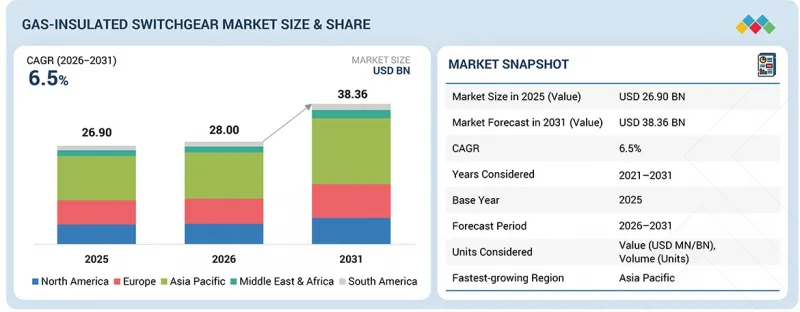
세계의 가스 절연 개폐장치 시장 규모는 2026년에는 280억 달러, 2031년까지 383억 6,000만 달러에 달할 것으로 예측되고 있으며, 예측 기간 중 CAGR은 6.5%에 달할 전망입니다.
이러한 성장은 신뢰성이 높고 컴팩트한 전력 인프라에 대한 수요 증가뿐만 아니라, 보다 청정한 에너지 시스템으로의 전환 및 송전·배전 네트워크 확대를 반영한 것입니다.
| 조사 범위 | |
|---|---|
| 조사 대상 기간 | 2021-2031년 |
| 기준연도 | 2025년 |
| 예측 기간 | 2026-2031년 |
| 산정 단위 | 금액(100만/10달러), 수량(대) |
| 부문 | 컨피규레이션별, 최종사용자별, 설치 장소별, 절연 유형별, 정격전압별, 지역별 |
| 대상 지역 | 유럽, 아시아태평양, 북미, 중동 및 아프리카, 남미 |
가스 절연 개폐기(GIS)는 주요 구성 부품을 밀폐형 케이스 내에 통합함으로써 효율적이고 안전한 전기 회로 제어를 가능하게 하며, 도시 지역이나 설치 공간이 제한된 환경에 적합합니다. 유럽, 아시아태평양, 북미 각국 정부는 송전망 현대화, 재생 가능 에너지 통합, 그리고 SF6 가스 배출에 관한 규제에 점점 더 주력하고 있으며, 이러한 요인들이 맞물려 첨단 개폐기 솔루션에 대한 투자를 촉진하고 있습니다. 디지털화의 진전과 SF6 프리 기술의 보급에 따라 예측 기간 중 시장은 지속적인 성장을 이룰 것으로 전망됩니다.
정책적 지원에 더해, 기술 발전과 업계 간의 강력한 협력이 시장 도입 준비와 상업적 실현 가능성을 가속화하고 있습니다. SF6가 없는 개폐기, 디지털 모니터링 시스템, 스마트 그리드 인프라의 혁신을 통해 운영 효율이 대폭 향상되고 시스템의 복잡성이 완화됨에 따라 전력 회사와 산업계는 송전 및 배전 네트워크 전반에 걸쳐 도입을 확대할 수 있게 되었습니다. 동시에 주요 전력 회사, 장비 제조업체, 기술 제공업체는 전기화에 대한 전문 지식, 송전망 현대화 역량 및 디지털 솔루션을 활용하기 위해 전략적 파트너십을 구축하고 있습니다. 이러한 협력을 통해 새로운 도입 기회가 열리고 있으며, 중국, 인도, 유럽, 미국 등 주요 시장에서 대규모 인프라 투자가 가속화되고 있습니다. 신뢰할 수 있는 전력에 대한 수요 증가, 지속가능성에 대한 관심 고조, 재생에너지 통합을 위한 투자 확대에 따라 가스 절연 개폐기는 2031년까지 효율적이고 탄력적인 전력망을 지원하는 데 있으며, 현대 전력 시스템에서 매우 중요한 역할을 할 것으로 예상됩니다.
"예측 기간 중 SF6 프리 부문이 가장 높은 성장률을 기록할 것으로 예상됩니다."
가스 절연 개폐기 시장에서 SF6 프리 절연으로의 전환은 환경 문제에 대한 관심 증가와 온실가스 배출 감축을 요구하는 규제적 압력을 반영하고 있습니다. 청정 공기, 질소(N2), 이산화탄소(CO₂), 기타 친환경 가스 혼합물과 같은 대체 수단이 개발 및 채택되고 있습니다. 이러한 대체 수단은 SF6와 동등한 절연 특성 및 아크 소멸 특성을 제공하면서도 환경에 미치는 영향을 대폭 줄여줍니다. 수분 함량이 낮은 건조 공기로 구성된 ‘클린 에어’는 중저압 시스템에 뛰어난 절연 특성을 제공하는 새로운 대안입니다. 무독성이며 풍부하게 존재하고 지구 온난화에 기여하지 않기 때문에 지속가능한 선택지가 되고 있습니다. 마찬가지로 N2와 CO₂도 낮은 지구 온난화 계수(GWP)와 운전 조건 하에서의 안정성으로 인해 활용이 검토되고 있습니다. 이러한 가스는 대개 조합하여 사용되며, 안전성 및 신뢰성 기준을 충족하면서 고전압 용도에 충분한 절연 성능을 제공합니다.
"2025년에는 220 kV 이상의 전압 부문이 가스 절연 개폐기 시장에서 가장 큰 점유율을 차지했습니다."
220 kV 이상의 전압 부문은 장거리에 걸친 대량의 전력 수송에 필수적인 대용량 송전망에서 널리 사용되고 있으므로 2025년에는 가장 큰 시장 점유율을 차지하고 있습니다. 전력 수요 증가, 대규모 재생 가능 에너지 프로젝트 통합의 진전, 그리고 국경을 넘는 송전망 인프라 확장에 따라 전력 회사는 효율적이고 안정적인 송전을 위해 초고전압 시스템을 우선시하고 있습니다. 또한 이 부문에서는 GIS 기술이 컴팩트한 크기, 높은 신뢰성, 도시 지역이나 공간이 제한된 환경에 대한 적응성 덕분에 강력한 지지를 받고 있으며, 시장내 우위를 더욱 공고히 하고 있습니다.
중동 및 아프리카는 예측 기간 중 가스 절연 개폐기(GIS) 시장에서 두 번째로 빠르게 성장하는 시장으로 부상하고 있습니다.
중동 및 아프리카는 2026-2031년에 가스 절연 개폐기(GIS) 시장에서 두 번째로 빠르게 성장하는 시장으로 부상하고 있습니다. 이는 주로 전력 수요의 견고한 증가와 정부 정책에 힘입은 대규모 송전망 확장 계획에 기인합니다. 국제에너지기구(IEA)에 따르면 중동 및 북아프리카 지역의 전력 수요는 2000-2024년 사이에 이미 3배로 증가했습니다. 도시화, 산업 성장, 그리고 냉방 및 해수 담수화 수요 증가에 힘입어 2035년까지 전력 수요는 약 50% 증가할 것으로 예상됩니다. 이러한 수요를 충족시키기 위해 각국 정부는 전력 인프라에 막대한 투자를 하고 있으며, 2024년 전력 부문 투자액은 약 440억 달러에 달할 것으로 예상되며, 앞으로도 계속 증가할 전망입니다. 이 중 약 40%가 송전망 현대화 및 송전 네트워크에 배정되고 있습니다. 이로 인해 특히 신뢰성과 컴팩트한 설계가 필수적인 고전압 용도 분야에서 GIS에 대한 강력한 수요가 발생하고 있습니다. 또한 UAE, 사우디아라비아, 남아프리카 전역에서 재생에너지 프로젝트가 급속히 확대됨에 따라 변동하는 전력 흐름을 관리하기 위한 첨단 송전망 시스템이 필요해지고 있으며, 이는 GIS 도입을 더욱 촉진하고 있습니다. 전반적으로 전력 소비 증가, 정부 주도의 인프라 투자, 재생 가능 에너지 통합 확대가 맞물리면서 이 지역은 가스 절연 개폐기(GIS) 개발 기업에게 고성장 거점으로 자리매김하고 있습니다.
가스 절연 개폐기 시장은 혁신과 대규모 인프라 확장을 주도하는 확고한 입지를 가진 글로벌 업계 리더들의 존재감이 두드러지는 것이 특징입니다. 가스 절연 개폐기 시장의 주요 기업으로는 General Electric Company(미국), Siemens(독일), 슈나이더 일렉트릭(프랑스), ABB(스위스), 이튼(아일랜드), 미쓰비시 전기(일본), 도시바 에너지 시스템즈 앤 솔루션즈(일본), 히타치(일본), 현대전기(한국), 후지전기(일본), CG Power and Industrial Solutions Ltd.(인도), 닛신전기(일본), 메이덴샤(일본), 파월 인더스트리즈(미국), 효성중공업(한국), 시위안 일렉트릭(중국), CHINT 그룹(중국), 일진전기(한국), Zhejiang Volcano Electrical Technology(중국), Henan Pinggao Electric(중국), XIAN XD SWITCHGEAR ELECTRIC(중국), Switchgear Company(벨기에), Elektrobudowa S.A.(폴란드), SEL S.p.A.(이탈리아), G&W Electric(미국) 등이 있습니다.
조사 범위:
이 보고서에서는 설치 형태(실내, 실외), 절연 방식(SF6, SF6 프리), 정격전압(5 kV 이하, 6-15 kV, 16-27 kV, 28-40.5 kV, 40.6-73 kV, 74-220 kV, 220 kV 초과), 구성(하이브리드, 단상 절연형, 일체형 3상, 콤팩트 GIS), 최종사용자(산업용, 상업·공공기관용, 전력회사, 데이터센터, 애프터마켓) 및 지역(아시아태평양, 북미, 유럽, 중동 및 아프리카, 남미) 등 다양한 매개변수를 기반으로 한 가스 절연 개폐기(GIS) 시장에 대한 포괄적인 정의, 설명 및 예측을 제공합니다. 또한 이 보고서에서는 가스 절연 개폐기 시장에 대한 철저한 정성적·정량적 분석을 제공하며, 주요 시장 촉진요인, 제약, 기회, 과제에 대한 포괄적인 검토를 포함하고 있습니다. 더 나아가, 경쟁 구도 평가 시장 역학 분석, 가치 기반 시장 규모 추정, 가스 절연 개폐기 시장의 향후 동향 등 시장의 중요한 측면에 대해서도 포괄적으로 다루고 있습니다. 이 보고서에서는 가스 절연 개폐기 시장의 주요 기업에 대한 투자 및 자금 조달 정보도 제공합니다.
이 보고서 구매의 주요 이점
이 보고서는 가스 절연 개폐기 시장의 기존 업계 리더와 신규 진입자 모두에게 이익이 되도록 세심하게 설계되었습니다. 시장 전체 및 그 하위 부문에 대한 신뢰할 수 있는 매출 예측을 제공합니다. 이 데이터는 이해관계자에게 귀중한 정보원이 되어, 경쟁 구도를 포괄적으로 이해하고 자사의 비즈니스를 위한 효과적인 시장 전략을 수립할 수 있도록 합니다. 또한 이 보고서는 이해관계자가 시장의 현황을 파악할 수 있는 수단으로 기능하며, 시장 촉진요인, 제약, 과제 및 성장 기회에 대한 중요 인사이트를 제공합니다. 이러한 인사이트를 활용함으로써 이해관계자는 충분한 정보를 바탕으로 의사결정을 내리고, 끊임없이 변화하는 가스 절연 개폐기 시장의 동향에 대해 항상 최신 정보를 얻을 수 있습니다.
- 가스 절연 개폐기 시장의 성장에 영향을 미치는 주요 촉진요인(SF6 프리 솔루션 채택, 재생 가능 에너지로의 전환, 전기적 안전성 및 효율성 향상), 제약 요인(높은 조달 비용, SF6 가스 배출에 관한 규제적 제한), 기회(급속한 도시화 및 산업화, 스마트 그리드 네트워크의 확대), 그리고 과제(가스 절연 개폐기와 관련된 운영상 과제, 비조직 부문의 경쟁)에 대한 분석을 수행합니다.
- 제품 개발 및 혁신: 가스 절연 개폐기 시장은 끊임없이 진화하고 있으며, 신제품 출시, 사업 확장, 계약, 합의 및 파트너십이 주요 초점이 되고 있습니다. General Electric Company(미국), Siemens(독일), Schneider Electric(프랑스), ABB(스위스), Eaton(아일랜드), Mitsubishi Electric Corporation(일본), Toshiba Energy Systems & Solutions Corporation(일본), Hitachi Ltd.(일본)과 같은 업계 선도 기업은 SF6 프리 솔루션, 디지털 감시 시스템, 소형 변전소 설계 등 첨단 개폐기 기술에 적극적으로 투자하고 있습니다. 이러한 지속적인 혁신을 통해 운영 효율 향상, 전기 안전성 강화, 환경 부담 저감이 도모되어 전 세계 전력 사업자, 산업, 도시 지역의 전력 인프라에 대해 신뢰성이 높고 확장성이 뛰어난 구축이 가능해졌습니다.
- 시장 동향: 가스 절연 개폐기 시장은 정부 차원의 지원 확대, 송전망 현대화를 위한 노력, 그리고 유럽 및 아시아태평양 등 주요 지역의 송배전 인프라에 대한 투자 증가에 힘입어 꾸준한 발전을 이루고 있습니다. SF6 프리 솔루션 및 디지털 변전소를 포함한 개폐기 기술의 발전은 유리한 규제 체계 및 지속가능성을 중시하는 정책과 맞물려 도입 일정을 가속화하고 있습니다. 또한 전력 회사, 인프라 개발업체 및 산업 관계자들의 투자 증가로 인해 프로젝트 실행 능력이 강화되고, 시장 전체의 성숙도가 높아지고 있습니다.
- 시장의 다양화: 시장은 설치 형태(실내·실외), 절연 기술(SF6 및 SF6 프리), 전압 수준, 구성 유형(하이브리드, 상분리형, 통합 3상형, 콤팩트 GIS) 등 다방면에 걸쳐 서서히 다양화되고 있습니다. 인도, 중국, 동남아시아 등의 신흥 시장으로의 지역적 확장에 따라 유럽과 같은 성숙 시장에 대한 의존도가 낮아지고 있습니다. 또한 스마트 그리드 시스템, 자동화, 실시간 모니터링 등의 디지털 기술과의 통합을 통해 적용 범위가 확대되고, 이해관계자들에게 새로운 수입원이 창출되고 있습니다.
- 경쟁 상황 평가: 가스 절연 개폐기 시장의 주요 기업이 차지하는 시장내 위치, 성장 전략 및 제공하는 서비스를 파악하기 위해 상세한 조사가 수행되었습니다. 이러한 주요 기업으로는 General Electric Company(미국), Siemens(독일), 슈나이더 일렉트릭(프랑스), ABB(스위스), 이튼(아일랜드), 미쓰비시 전기(일본), 도시바 에너지 시스템즈 앤 솔루션즈(일본), 히타치(일본), 현대전기(한국), 후지전기(일본), CG Power and Industrial Solutions Ltd.(인도), 닛신전기(일본), 메이덴샤(일본), 파월 인더스트리즈(미국), 효성중공업(한국), 시위안전기(중국), CHINT 그룹(중국), 일진전기(한국), Zhejiang Volcano Electrical Technology(중국), Henan Pinggao Electric(중국), XIAN XD SWITCHGEAR ELECTRIC(중국), Switchgear Company(벨기에), Elektrobudowa S.A.(폴란드), SEL S.p.A.(이탈리아), G&W Electric(미국) 등이 있습니다. 본 분석에서는 가스 절연 개폐기 시장에서 이들 주요 기업의 경쟁적 위치, 시장 성장을 촉진하기 위한 노력, 그리고 각사가 제공하는 제품 및 서비스의 범위에 대해 상세 인사이트를 제공합니다.
자주 묻는 질문
목차
제1장 서론
제2장 개요
제3장 주요 인사이트
제4장 시장 개요
제5장 가스 절연 개폐장치 시장(컨피규레이션별)
제6장 가스 절연 개폐장치 시장(최종사용자별)
제7장 가스 절연 개폐장치 시장(설치 장소별)
제8장 가스 절연 개폐장치 시장(절연 유형별)
제9장 가스 절연 개폐장치 시장(정격전압별)
제10장 가스 절연 개폐장치 시장(지역별)
제11장 경쟁 구도
제12장 기업 개요
제13장 조사 방법
제14장 부록
KSA 26.08.19The global gas-insulated switchgear market is projected to be valued at USD 28.00 billion in 2026 and USD 38.36 billion by 2031, recording a CAGR of 6.5% during the forecast period. This growth reflects the increasing demand for reliable and compact electrical infrastructure, along with the transition toward cleaner energy systems and the expansion of power transmission and distribution networks.
| Scope of the Report | |
|---|---|
| Years Considered for the Study | 2021-2031 |
| Base Year | 2025 |
| Forecast Period | 2026-2031 |
| Units Considered | Value (USD Million/Billion), Volume (Units) |
| Segments | By Installation, Voltage Rating, Configuration, End User, and Region |
| Regions covered | Europe, Asia Pacific, North America, the Middle East & Africa, South America |
Gas-insulated switchgear (GIS) enables efficient and safe electrical circuit control by integrating key components within a sealed enclosure, making it suitable for urban and space-constrained environments. Governments across Europe, Asia Pacific, and North America are increasingly focusing on grid modernization, renewable energy integration, and regulations on SF6 gas emissions, which are collectively driving investments in advanced switchgear solutions. As digitalization increases and SF6-free technologies gain traction, the market is expected to witness sustained growth over the forecast period.
Beyond policy support, technological advancements and strong industry collaboration are accelerating market readiness and commercial viability. Innovations in SF6-free switchgear, digital monitoring systems, and smart grid infrastructure have significantly improved operational efficiency and reduced system complexities, enabling utilities and industries to scale deployments across transmission and distribution networks. Simultaneously, major utilities, equipment manufacturers, and technology providers are forming strategic partnerships to leverage electrification expertise, grid modernization capabilities, and digital solutions. These collaborations are unlocking new deployment opportunities and accelerating large-scale infrastructure investments across key markets such as China, India, Europe, and the US. With growing demand for reliable power, increasing focus on sustainability, and rising investments in renewable energy integration, gas-insulated switchgear is expected to play a critical role in modern power systems, supporting efficient and resilient electricity networks through 2031.
"SF6-free segment is expected to register the highest growth rate during the forecast period "
The shift toward SF6-free insulation in the gas-insulated switchgear market reflects growing environmental concerns and regulatory pressures to reduce greenhouse gas emissions. Alternatives such as clean air, nitrogen (N2), carbon dioxide (CO2), and other eco-friendly gas mixtures are being developed and adopted. These alternatives provide comparable dielectric and arc-quenching properties to SF6 while significantly reducing their environmental impact. Clean air, composed of dry air with low moisture content, is an emerging alternative that offers excellent insulation properties for medium- and low-voltage systems. It is non-toxic, abundant, and does not contribute to global warming, making it a sustainable option. Similarly, N2 and CO2 are being explored for their low GWP and stability under operating conditions. These gases, often used in combination, provide sufficient insulation for high-voltage applications while meeting safety and reliability standards.
"Above 220 kV voltage segment held the largest share of the gas-insulated switchgear market in 2025"
The above 220 kV voltage segment holds the largest market share in 2025 as it is widely used in high-capacity transmission networks that are critical for carrying bulk electricity over long distances. With rising power demand, increasing integration of large-scale renewable energy projects, and expansion of cross-border grid infrastructure, utilities are prioritizing extra-high voltage systems for efficient and stable transmission. Additionally, GIS technology is highly preferred in this segment due to its compact size, higher reliability, and suitability for urban and space-constrained environments, further strengthening its dominance in the market.
Middle East & Africa is emerging as the second fastest-growing market for gas-insulated switchgear during the forecast period
The Middle East & Africa is emerging as the second fastest-growing market for gas-insulated switchgear from 2026 to 2031 primarily due to strong growth in electricity demand and large-scale grid expansion programs supported by government policies. According to the International Energy Agency, electricity demand in the Middle East and North Africa has already tripled between 2000 and 2024. It is expected to increase by around 50% by 2035, driven by urbanization, industrial growth, and rising cooling and desalination needs. To meet this demand, governments are significantly investing in power infrastructure, with power sector investments reaching about USD 44 billion in 2024 and projected to rise further, with nearly 40% allocated to grid modernization and transmission networks. This creates strong demand for GIS, especially in high-voltage applications where reliability and compact design are critical. Additionally, the rapid expansion of renewable energy projects across the UAE, Saudi Arabia, and South Africa requires advanced grid systems to manage variable power flows, further supporting GIS deployment. Overall, the combination of rising electricity consumption, government-led infrastructure investments, and increasing renewable integration is positioning the region as a high-growth hub for gas-insulated switchgear developers.
Breakdown of Primaries:
In-depth interviews with key industry participants, subject-matter experts, C-level executives at key market players, and industry consultants, among other experts, were conducted to obtain and verify critical qualitative and quantitative information and to assess future market prospects. The primary interviews were distributed as follows:
By Company Type: Tier-1 - 30%, Tier-2 - 55%, and Tier-3 - 15%
By Designation: C-Level - 30%, Directors - 20%, and Managers - 50%
By Region: Europe - 30%, Asia Pacific - 40%, North America - 15%, South America: 5%, Middle East & Africa: 10%
The gas-insulated switchgear market is characterized by the strong presence of established global industry leaders driving innovation and large-scale infrastructure deployment. Notable players in the gas-insulated switchgear market include General Electric Company (US), Siemens (Germany), Schneider Electric (France), ABB (Switzerland), Eaton (Ireland), Mitsubishi Electric Corporation (Japan), Toshiba Energy Systems & Solutions Corporation (Japan), Hitachi Ltd. (Japan), Hyundai Electric Co., Ltd. (South Korea), Fuji Electric Co., Ltd. (Japan), CG Power and Industrial Solutions Ltd. (India), Nissin Electric Co., Ltd. (Japan), Meidensha Corporation (Japan), Powell Industries (US), Hyosung Heavy Industries (South Korea), Sieyuan Electric Co., Ltd. (China), CHINT Group (China), Iljin Electric (South Korea), Zhejiang Volcano Electrical Technology Co., Ltd. (China), Henan Pinggao Electric Co., Ltd. (China), XIAN XD SWITCHGEAR ELECTRIC CO., LTD (China), Switchgear Company (Belgium), Elektrobudowa S.A. (Poland), SEL S.p.A. (Italy), and G&W Electric (US).
Research Coverage:
The report provides a comprehensive definition, description, and forecast of the gas-insulated switchgear market based on various parameters, including installation (indoor, outdoor), insulation type (SF6, SF6-free), voltage rating (up to 5 kV, 6-15 kV, 16-27 kV, 28-40.5 kV, 40.6-73 kV, 74-220 kV, above 220 kV), configuration (hybrid, isolated-phase, integrated three-phase, compact GIS), end user (industrial, commercial & institutional, electrical utilities, data centers, aftermarket), and region (Asia Pacific, North America, Europe, the Middle East & Africa, and South America). The report also offers a thorough qualitative and quantitative analysis of the gas-insulated switchgear market, encompassing a comprehensive examination of the key market drivers, limitations, opportunities, and challenges. Additionally, it covers critical facets of the market, such as an assessment of the competitive landscape, an analysis of market dynamics, value-based market estimates, and future trends in the gas-insulated switchgear market. The report provides investment and funding information on key players in the gas-insulated switchgear market.
Key Benefits of Buying the Report
The report is thoughtfully designed to benefit both established industry leaders and newcomers in the gas-insulated switchgear market. It provides reliable revenue forecasts for the entire market and its subsegments. This data is a valuable resource for stakeholders, enabling them to gain a comprehensive understanding of the competitive landscape and formulate effective market strategies for their businesses. Furthermore, the report serves as a channel for stakeholders to grasp the current state of the market, providing essential insights into market drivers, limitations, challenges, and growth opportunities. By incorporating these insights, stakeholders can make well-informed decisions and stay informed about the constantly evolving dynamics of the gas-insulated switchgear market.
- Analysis of key drivers (adoption of SF6-free solutions, transition toward renewable energy, enhanced electrical safety and efficiency), restraints (high procurement costs, regulatory restrictions on SF6 gas emissions), opportunities (rapid urbanization and industrialization, expansion of smart grid networks), and challenges (operational challenges associated with gas-insulated switchgear, competition from unorganized sector) influencing the growth of the gas-insulated switchgear market.
- Product Development/Innovation: The gas-insulated switchgear market is in a constant state of evolution, with a primary focus on product launches, expansions, contracts, agreements, and partnerships. Leading industry players like General Electric Company (US), Siemens (Germany), Schneider Electric (France), ABB (Switzerland), Eaton (Ireland), Mitsubishi Electric Corporation (Japan), Toshiba Energy Systems & Solutions Corporation (Japan), and Hitachi Ltd. (Japan) are actively investing in advanced switchgear technologies, including SF6-free solutions, digital monitoring systems, and compact substation designs. This continuous innovation is improving operational efficiency, enhancing electrical safety, reducing environmental impact, and enabling reliable and scalable deployment of power infrastructure across utilities, industries, and urban applications globally.
- Market Development: The gas-insulated switchgear market is witnessing steady development driven by increasing government support, grid modernization initiatives, and growing investments in power transmission and distribution infrastructure across key regions such as Europe and the Asia Pacific. Advancements in switchgear technologies, including SF6-free solutions and digital substations, coupled with favorable regulatory frameworks and sustainability-driven policies, are accelerating deployment timelines. Additionally, rising investments from utilities, infrastructure developers, and industrial players are strengthening project execution capabilities and enhancing overall market maturity.
- Market Diversification: The market is gradually diversifying across multiple dimensions, including installation types (indoor and outdoor), insulation technologies (SF6 and SF6-free), voltage levels, and configuration types (hybrid, isolated-phase, integrated three-phase, and compact GIS). Geographic expansion into emerging markets such as India, China, and Southeast Asia is reducing dependency on mature markets like Europe. Furthermore, integration with digital technologies, including smart grid systems, automation, and real-time monitoring, is broadening the scope of applications and creating new revenue streams for stakeholders.
- Competitive Assessment: A detailed review has been done to understand the market position, growth strategies, and services offered by key players in the gas-insulated switchgear market. These prominent companies include General Electric Company (US), Siemens (Germany), Schneider Electric (France), ABB (Switzerland), Eaton (Ireland), Mitsubishi Electric Corporation (Japan), Toshiba Energy Systems & Solutions Corporation (Japan), Hitachi Ltd. (Japan), Hyundai Electric Co., Ltd. (South Korea), Fuji Electric Co., Ltd. (Japan), CG Power and Industrial Solutions Ltd. (India), Nissin Electric Co., Ltd. (Japan), Meidensha Corporation (Japan), Powell Industries (US), Hyosung Heavy Industries (South Korea), Sieyuan Electric Co., Ltd. (China), CHINT Group (China), Iljin Electric (South Korea), Zhejiang Volcano Electrical Technology Co., Ltd. (China), Henan Pinggao Electric Co., Ltd. (China), XIAN XD SWITCHGEAR ELECTRIC CO., LTD (China), Switchgear Company (Belgium), Elektrobudowa S.A. (Poland), SEL S.p.A. (Italy), and G&W Electric (US). This analysis provides in-depth insights into the competitive positions of these major players, their approaches to driving market growth, and the range of products and services they offer within the gas-insulated switchgear market.
TABLE OF CONTENTS
1 INTRODUCTION
- 1.1 STUDY OBJECTIVES
- 1.2 MARKET DEFINITION
- 1.3 STUDY SCOPE
- 1.3.1 MARKETS COVERED AND REGIONAL SCOPE
- 1.3.2 INCLUSIONS AND EXCLUSIONS
- 1.3.3 YEARS CONSIDERED
- 1.4 CURRENCY CONSIDERED
- 1.5 UNITS CONSIDERED
- 1.6 LIMITATIONS
- 1.7 STAKEHOLDERS
- 1.8 SUMMARY OF CHANGES
2 EXECUTIVE SUMMARY
- 2.1 MARKET HIGHLIGHTS AND KEY INSIGHTS
- 2.2 KEY MARKET PARTICIPANTS: MAPPING OF STRATEGIC DEVELOPMENTS
- 2.3 DISRUPTIVE TRENDS IN GAS-INSULATED SWITCHGEAR MARKET
- 2.4 HIGH GROWTH SEGMENTS
- 2.5 REGIONAL SNAPSHOT: MARKET SIZE, GROWTH RATE, AND FORECAST
3 PREMIUM INSIGHTS
- 3.1 ATTRACTIVE OPPORTUNITIES FOR PLAYERS IN GAS-INSULATED SWITCHGEAR MARKET
- 3.2 GAS-INSULATED SWITCHGEAR MARKET, BY REGION
- 3.3 GAS-INSULATED SWITCHGEAR MARKET IN ASIA PACIFIC, BY COUNTRY AND INSTALLATION
- 3.4 GAS-INSULATED SWITCHGEAR MARKET SHARE, BY CONFIGURATION
- 3.5 GAS-INSULATED SWITCHGEAR MARKET SHARE, BY INSTALLATION
- 3.6 GAS-INSULATED SWITCHGEAR MARKET SHARE, BY VOLTAGE RATING
- 3.7 GAS-INSULATED SWITCHGEAR MARKET SHARE, BY INSULATION TYPE
- 3.8 GAS-INSULATED SWITCHGEAR MARKET SHARE, BY END USER
- 3.9 GAS-INSULATED SWITCHGEAR MARKET, BY REGION
4 MARKET OVERVIEW
- 4.1 INTRODUCTION
- 4.2 MARKET DYNAMICS
- 4.2.1 DRIVERS
- 4.2.1.1 Record grid investments driving demand for substations and GIS
- 4.2.1.2 Sustained power-sector Capex accelerating grid decarbonization and substation investments
- 4.2.1.3 Sustained growth in global wind generation driving expansion of GIS-intensive grid infrastructure
- 4.2.1.4 Shift toward an electricity-based economy reshaping grid investments
- 4.2.2 RESTRAINTS
- 4.2.2.1 Environmental liabilities associated with SF6 usage restricting GIS adoption
- 4.2.3 OPPORTUNITIES
- 4.2.3.1 AI is transforming data centers into utility-scale power consumers
- 4.2.3.2 Offshore wind entering multi-year grid infrastructure investment cycle
- 4.2.4 CHALLENGES
- 4.2.4.1 Escalating raw material costs reshaping GIS manufacturing economics
- 4.2.1 DRIVERS
- 4.3 PORTER'S FIVE FORCES ANALYSIS
- 4.3.1 THREAT OF NEW ENTRANTS
- 4.3.2 THREAT OF SUBSTITUTES
- 4.3.3 INTENSITY OF COMPETITIVE RIVALRY
- 4.3.4 BARGAINING POWER OF SUPPLIERS
- 4.3.5 BARGAINING POWER OF BUYERS
- 4.4 MACROECONOMIC OUTLOOK
- 4.4.1 INTRODUCTION
- 4.4.1.1 Moderating but resilient global growth amid geopolitical and energy-security headwinds
- 4.4.1.2 Persistent inflation and stalled disinflation trend keeping capital costs elevated
- 4.4.1.3 Divergent regional growth trajectories reshaping geography of power infrastructure investment
- 4.4.2 GDP TRENDS AND FORECAST
- 4.4.3 TREND IN OIL & GAS INDUSTRY RELATED TO GAS-INSULATED SWITCHGEAR
- 4.4.3.1 Electrification of upstream and midstream operations is elevating GIS as preferred choice for hazardous, space-constrained sites
- 4.4.3.2 Brownfield modernization of aging assets is creating steady replacement cycle independent of new project sanctioning
- 4.4.4 TREND IN INDUSTRIAL (MANUFACTURING) SECTOR RELATED TO GAS-INSULATED SWITCHGEAR
- 4.4.4.1 Rising automation and energy-intensive process electrification are increasing on-site power reliability requirements
- 4.4.4.2 Expansion of industrial facilities within constrained plot sizes is favoring compact substation footprints
- 4.4.1 INTRODUCTION
- 4.5 VALUE CHAIN ANALYSIS
- 4.5.1 RAW MATERIAL PROVIDERS
- 4.5.2 COMPONENT MANUFACTURERS
- 4.5.3 GAS-INSULATED SWITCHGEAR MANUFACTURERS/ASSEMBLERS
- 4.5.4 END USERS
- 4.5.5 POST-SALE SERVICE PROVIDERS
- 4.6 ECOSYSTEM ANALYSIS
- 4.7 PRICING ANALYSIS
- 4.7.1 AVERAGE SELLING PRICE TREND, BY REGION
- 4.7.2 PRICING RANGE OF GAS-INSULATED SWITCHGEAR, BY VOLTAGE RATING, 2025
- 4.8 TRADE ANALYSIS
- 4.8.1 IMPORT SCENARIO (HS CODE 853720)
- 4.8.2 EXPORT SCENARIO (HS CODE 853720)
- 4.8.3 IMPORT SCENARIO (HS CODE 853521)
- 4.8.4 EXPORT SCENARIO (HS CODE 853521)
- 4.8.5 IMPORT SCENARIO (HS CODE 853529)
- 4.8.6 EXPORT SCENARIO (HS CODE 853529)
- 4.9 KEY CONFERENCES AND EVENTS, 2026-2027
- 4.10 TRENDS/DISRUPTIONS IMPACTING CUSTOMER BUSINESS
- 4.11 INVESTMENT AND FUNDING SCENARIO
- 4.12 CASE STUDY ANALYSIS
- 4.12.1 HITACHI ENERGY'S ECO-EFFICIENT UNDERGROUND GIS SUBSTATION ENABLES SUSTAINABLE URBAN GRID MODERNIZATION
- 4.12.2 GE VERNOVA'S SF6-FREE 420 KV GIS ADVANCES NORWAY'S GRID DECARBONIZATION AND INDUSTRIAL ELECTRIFICATION
- 4.12.3 SIEMENS ENERGY'S WORLD'S FIRST SF6-FREE HIGH-VOLTAGE SWITCHGEAR ENABLES SUSTAINABLE GRID MODERNIZATION
- 4.12.4 SCHNEIDER ELECTRIC'S SF6-FREE GM AIRSET ENABLES EAM NETZ TO FUTURE-PROOF ITS DISTRIBUTION GRID
- 4.13 TECHNOLOGY ANALYSIS
- 4.13.1 KEY TECHNOLOGIES
- 4.13.1.1 SF6 gas insulation technology
- 4.13.1.2 Vacuum interruption technology
- 4.13.1.3 Clean air/dry air insulation technology
- 4.13.1.4 Low-GWP synthetic gas insulation technology (g3 and Novec 4710)
- 4.13.1.5 Digital condition monitoring technology
- 4.13.2 COMPLEMENTARY TECHNOLOGIES
- 4.13.2.1 SCADA (supervisory control and data acquisition) technology
- 4.13.2.2 Partial discharge detection technology
- 4.13.3 ADJACENT TECHNOLOGIES
- 4.13.3.1 HVDC (high-voltage direct current) transmission technology
- 4.13.3.2 Battery energy storage technology
- 4.13.3.3 Smart grid digitalization technology
- 4.13.1 KEY TECHNOLOGIES
- 4.14 PATENT ANALYSIS
- 4.15 IMPACT OF GENERATIVE AI/AI IN GAS-INSULATED SWITCHGEAR MARKET
- 4.15.1 ADOPTION OF GENERATIVE AI/AI IN GAS-INSULATED SWITCHGEAR MARKET
- 4.15.2 IMPACT OF GENERATIVE AI/AI ON END USERS
- 4.15.3 IMPACT OF AI ON GAS-INSULATED SWITCHGEAR MARKET, BY REGION
- 4.16 REGULATORY LANDSCAPE
- 4.16.1 REGULATORY BODIES, GOVERNMENT AGENCIES, AND OTHER ORGANIZATIONS
- 4.16.2 CODES AND REGULATIONS RELATED TO GAS-INSULATED SWITCHGEAR
- 4.17 KEY STAKEHOLDERS AND BUYING CRITERIA
- 4.17.1 KEY STAKEHOLDERS IN BUYING PROCESS
- 4.17.2 BUYING CRITERIA
5 GAS-INSULATED SWITCHGEAR MARKET, BY CONFIGURATION
- 5.1 INTRODUCTION
- 5.2 HYBRID
- 5.2.1 PRACTICAL BRIDGE BETWEEN AGING AIR-INSULATED YARDS AND FULLY SEALED SUBSTATIONS
- 5.3 ISOLATED-PHASE
- 5.3.1 DESIGN FOCUSES ON SUPPORTING HIGH-CAPACITY GENERATION AND MISSION-CRITICAL INFRASTRUCTURE
- 5.4 INTEGRATED THREE-PHASE
- 5.4.1 ENABLE COST-EFFICIENT DEPLOYMENT ACROSS DISTRIBUTION NETWORKS
- 5.5 COMPACT GIS
- 5.5.1 ENABLES SPACE-EFFICIENT DEPLOYMENT ACROSS URBAN, UNDERGROUND, AND DATA CENTER APPLICATIONS
6 GAS-INSULATED SWITCHGEAR MARKET, BY END USER
- 6.1 INTRODUCTION
- 6.2 INDUSTRIAL
- 6.2.1 PROCESS
- 6.2.1.1 Rely on GIS to protect continuous, high-value production lines
- 6.2.2 DISCRETE
- 6.2.2.1 Draws on GIS for compact, reliable power distribution on factory floor
- 6.2.3 OIL & GAS
- 6.2.3.1 Oil & gas operations lead industrial demand on hazardous-area reliability requirements
- 6.2.4 OTHERS
- 6.2.1 PROCESS
- 6.3 COMMERCIAL & INSTITUTIONAL
- 6.3.1 COMMERCIAL
- 6.3.1.1 Commercial real estate adopts GIS to power dense, high-rise, mixed-use developments
- 6.3.2 INSTITUTIONAL
- 6.3.2.1 Institutional buyers anchor steady demand from hospitals, universities, and public campuses
- 6.3.3 INFRASTRUCTURE
- 6.3.3.1 Command the largest share as transit, airports, and utility-adjacent facilities electrify
- 6.3.4 GOVERNMENT
- 6.3.4.1 Prioritize GIS for long-life, low-maintenance public asset investment
- 6.3.1 COMMERCIAL
- 6.4 ELECTRICAL UTILITIES
- 6.4.1 GENERATION
- 6.4.1.1 Generation-linked substations draw bulk of utility GIS investment as new capacity comes online
- 6.4.2 TRANSMISSION & DISTRIBUTION
- 6.4.2.1 Sustain steady demand through grid modernization and reinforcement
- 6.4.1 GENERATION
- 6.5 DATA CENTERS
- 6.5.1 NON-HYPERSCALE
- 6.5.1.1 Non-hyperscale and colocation facilities provide steady complementary demand base
- 6.5.2 HYPERSCALE
- 6.5.2.1 Drive bulk of data center GIS demand amid AI compute boom
- 6.5.1 NON-HYPERSCALE
- 6.6 AFTERMARKET
- 6.6.1 GROWING, HIGH-VALUE ANNUITY STREAM BUILT ON RAPIDLY AGING GLOBAL INSTALLED BASE
7 GAS-INSULATED SWITCHGEAR MARKET, BY INSTALLATION
- 7.1 INTRODUCTION
- 7.2 INDOOR
- 7.2.1 PREFERRED CHOICE IN REGIONS WITH HARSH OR CORROSIVE CLIMATES
- 7.3 OUTDOOR
- 7.3.1 MAINTAINS MARKET LEADERSHIP DRIVEN BY LARGE-SCALE TRANSMISSION AND UTILITY SWITCHYARD APPLICATIONS
8 GAS-INSULATED SWITCHGEAR MARKET, BY INSULATION TYPE
- 8.1 INTRODUCTION
- 8.2 SF6
- 8.2.1 SF6 CONTINUES TO DOMINATE DUE TO PROVEN RELIABILITY AND ENORMOUS INSTALLED BASE
- 8.3 SF6-FREE
- 8.3.1 ACCELERATES AS REGULATION AND NET-ZERO COMMITMENTS RESHAPE PROCUREMENT PRIORITIES
9 GAS-INSULATED SWITCHGEAR MARKET, BY VOLTAGE RATING
- 9.1 INTRODUCTION
- 9.2 UP TO 5 KV
- 9.2.1 SERVES AS ENTRY POINT FOR MOTOR CONTROL AND CAPTIVE LOW-VOLTAGE SWITCHING
- 9.3 6 TO 15 KV
- 9.3.1 ANCHORS MAINSTREAM URBAN AND INDUSTRIAL DISTRIBUTION NETWORKS
- 9.4 16 TO 27 KV
- 9.4.1 DRIVES GROWTH ACROSS PRIMARY DISTRIBUTION AND RENEWABLE COLLECTOR NETWORKS
- 9.5 28 TO 40.5 KV
- 9.5.1 STANDARD VOLTAGE FOR WIND AND SOLAR COLLECTOR SUBSTATIONS
- 9.6 40.6 TO 73 KV
- 9.6.1 CRITICAL LINK BETWEEN DISTRIBUTION NETWORKS AND WIDER GRID
- 9.7 74 TO 220 KV
- 9.7.1 FORMS BACKBONE OF REGIONAL TRANSMISSION AND LARGE-SCALE GRID INTEGRATION
- 9.8 ABOVE 220 KV
- 9.8.1 COMMANDS LARGEST SHARE AS BULK POWER TRANSMISSION AND ULTRA-HIGH-VOLTAGE GRIDS EXPAND
10 GAS-INSULATED SWITCHGEAR MARKET, BY REGION
- 10.1 INTRODUCTION
- 10.2 ASIA PACIFIC
- 10.2.1 CHINA
- 10.2.1.1 Accelerating UHV grid expansion and renewable integration to drive market
- 10.2.2 INDIA
- 10.2.2.1 Record capacity additions and global manufacturing expansions to propel market
- 10.2.3 JAPAN
- 10.2.3.1 Data center boom and SF6-free grid mandate to drive demand
- 10.2.4 SOUTH KOREA
- 10.2.4.1 KEPCO's long-term grid reinforcement to support market growth
- 10.2.5 AUSTRALIA
- 10.2.5.1 AEMO's integrated system plan accelerates high-voltage GIS deployment
- 10.2.6 REST OF ASIA PACIFIC
- 10.2.1 CHINA
- 10.3 EUROPE
- 10.3.1 GERMANY
- 10.3.1.1 Continuous investments in grid modernization to drive market
- 10.3.2 FRANCE
- 10.3.2.1 Large transmission and distribution network and strong commitment to grid decarbonization to support market growth
- 10.3.3 UK
- 10.3.3.1 Accelerating transition toward low-carbon electricity systems to propel market
- 10.3.4 SPAIN
- 10.3.4.1 Rapid renewable capacity additions to drive market
- 10.3.5 ITALY
- 10.3.5.1 Large-scale national grid modernization program to support market growth
- 10.3.6 REST OF EUROPE
- 10.3.1 GERMANY
- 10.4 NORTH AMERICA
- 10.4.1 US
- 10.4.1.1 AI-driven electricity demand and federal grid modernization to drive market
- 10.4.2 CANADA
- 10.4.2.1 National grid interconnection strategy and transmission expansion to propel market
- 10.4.3 MEXICO
- 10.4.3.1 Record state-led transmission investment to fuel market growth
- 10.4.1 US
- 10.5 SOUTH AMERICA
- 10.5.1 BRAZIL
- 10.5.1.1 USD 24 billion transmission expansion plan and record auction activity cement to drive market
- 10.5.2 ARGENTINA
- 10.5.2.1 Privatization, regulatory reform, and priority grid projects to propel market
- 10.5.3 REST OF SOUTH AMERICA
- 10.5.1 BRAZIL
- 10.6 MIDDLE EAST & AFRICA
- 10.6.1 GCC COUNTRIES
- 10.6.1.1 Saudi Arabia
- 10.6.1.1.1 Fastest-growing market due to Vision 2030's localized GIS manufacturing and 58.7 GW renewable push
- 10.6.1.2 UAE
- 10.6.1.2.1 DEWA's AED 10 billion transmission buildout and data center boom to drive demand
- 10.6.1.3 Kuwait
- 10.6.1.3.1 USD 16 billion generation expansion and IEC-aligned grid standards to fuel market growth
- 10.6.1.4 Rest of GCC countries
- 10.6.1.1 Saudi Arabia
- 10.6.2 SOUTH AFRICA
- 10.6.2.1 Well-funded, multi-year Transmission Development Plan to propel market
- 10.6.3 REST OF MIDDLE EAST & AFRICA
- 10.6.1 GCC COUNTRIES
11 COMPETITIVE LANDSCAPE
- 11.1 INTRODUCTION
- 11.2 KEY PLAYER STRATEGIES/RIGHT TO WIN, 2022-2026
- 11.3 REVENUE ANALYSIS, 2021-2025
- 11.4 MARKET SHARE ANALYSIS, 2025
- 11.5 COMPANY EVALUATION MATRIX: KEY PLAYERS, 2025
- 11.5.1 STARS
- 11.5.2 EMERGING LEADERS
- 11.5.3 PERVASIVE PLAYERS
- 11.5.4 PARTICIPANTS
- 11.5.5 COMPANY FOOTPRINT: KEY PLAYERS, 2025
- 11.5.5.1 Company footprint
- 11.5.5.2 Region footprint
- 11.5.5.3 Installation footprint
- 11.5.5.4 Insulation type footprint
- 11.5.5.5 Configuration type footprint
- 11.5.5.6 End-user footprint
- 11.6 COMPANY EVALUATION MATRIX: STARTUPS/SMES, 2025
- 11.6.1 PROGRESSIVE COMPANIES
- 11.6.2 RESPONSIVE COMPANIES
- 11.6.3 DYNAMIC COMPANIES
- 11.6.4 STARTING BLOCKS
- 11.6.5 COMPETITIVE BENCHMARKING: STARTUPS/SMES, 2025
- 11.6.5.1 Detailed list of key startups/SMEs
- 11.6.5.2 Competitive benchmarking of key startups/SMEs
- 11.7 COMPANY VALUATION AND FINANCIAL METRICS
- 11.8 BRAND COMPARISON
- 11.9 COMPETITIVE SCENARIO
- 11.9.1 PRODUCT LAUNCHES
- 11.9.2 DEALS
- 11.9.3 EXPANSIONS
- 11.9.4 OTHER DEVELOPMENTS
12 COMPANY PROFILES
- 12.1 KEY PLAYERS
- 12.1.1 SIEMENS ENERGY
- 12.1.1.1 Business overview
- 12.1.1.2 Products/Solutions/Services offered
- 12.1.1.3 Recent developments
- 12.1.1.3.1 Deals
- 12.1.1.3.2 Expansions
- 12.1.1.3.3 Other developments
- 12.1.1.4 MnM view
- 12.1.1.4.1 Key strengths
- 12.1.1.4.2 Strategic choice
- 12.1.1.4.3 Weaknesses & competitive threats
- 12.1.2 HITACHI ENERGY LTD.
- 12.1.2.1 Business overview
- 12.1.2.2 Products/Solutions/Services offered
- 12.1.2.3 Recent developments
- 12.1.2.3.1 Product launches
- 12.1.2.4 Recent developments
- 12.1.2.4.1 Deals
- 12.1.2.4.2 Expansions
- 12.1.2.4.3 Other developments
- 12.1.2.5 MnM view
- 12.1.2.5.1 Key strengths
- 12.1.2.5.2 Strategic choices
- 12.1.2.5.3 Weaknesses & competitive threats
- 12.1.3 ABB
- 12.1.3.1 Business overview
- 12.1.3.2 Products/Solutions/Services offered
- 12.1.3.3 Recent developments
- 12.1.3.3.1 Product launches
- 12.1.3.3.2 Deals
- 12.1.3.3.3 Expansions
- 12.1.3.3.4 Other developments
- 12.1.3.4 MnM view
- 12.1.3.4.1 Key strengths
- 12.1.3.4.2 Strategic choices
- 12.1.3.4.3 Weaknesses & competitive threats
- 12.1.4 SCHNEIDER ELECTRIC
- 12.1.4.1 Business overview
- 12.1.4.2 Products/Solutions/Services offered
- 12.1.4.3 Recent developments
- 12.1.4.3.1 Product launches
- 12.1.4.3.2 Deals
- 12.1.4.3.3 Expansions
- 12.1.4.4 MnM view
- 12.1.4.4.1 Key strengths
- 12.1.4.4.2 Strategic choices
- 12.1.4.4.3 Weaknesses & competitive threats
- 12.1.5 GE VERNOVA
- 12.1.5.1 Business overview
- 12.1.5.2 Products/Solutions/Services offered
- 12.1.5.3 Recent developments
- 12.1.5.3.1 Deals
- 12.1.5.3.2 Expansions
- 12.1.5.3.3 Other developments
- 12.1.5.4 MnM view
- 12.1.5.4.1 Key strengths
- 12.1.5.4.2 Strategic choices
- 12.1.5.4.3 Weaknesses & competitive threats
- 12.1.6 EATON
- 12.1.6.1 Business overview
- 12.1.6.2 Products/Solutions/Services offered
- 12.1.6.3 Recent developments
- 12.1.6.3.1 Product launches
- 12.1.6.3.2 Deals
- 12.1.6.3.3 Expansions
- 12.1.7 MITSUBISHI ELECTRIC CORPORATION
- 12.1.7.1 Business overview
- 12.1.7.2 Products/Solutions/Services offered
- 12.1.7.3 Recent developments
- 12.1.7.3.1 Expansions
- 12.1.8 HD HYUNDAI ELECTRIC CO., LTD.
- 12.1.8.1 Business overview
- 12.1.8.2 Products/Solutions/Services offered
- 12.1.8.3 Recent developments
- 12.1.8.3.1 Product launches
- 12.1.8.3.2 Deals
- 12.1.8.3.3 Other developments
- 12.1.9 FUJI ELECTRIC CO., LTD.
- 12.1.9.1 Business overview
- 12.1.9.2 Products/Solutions/Services offered
- 12.1.9.3 Recent developments
- 12.1.9.3.1 Expansions
- 12.1.10 CG POWER AND INDUSTRIAL SOLUTIONS LTD.
- 12.1.10.1 Business overview
- 12.1.10.2 Products/Solutions/Services offered
- 12.1.10.3 Recent developments
- 12.1.10.3.1 Product launches
- 12.1.10.3.2 Deals
- 12.1.10.3.3 Expansions
- 12.1.11 MEIDENSHA CORPORATION
- 12.1.11.1 Business overview
- 12.1.11.2 Products/Solutions/Services offered
- 12.1.11.2.1 Expansions
- 12.1.12 G&W ELECTRIC
- 12.1.12.1 Products/Solutions/Services offered
- 12.1.12.2 Recent developments
- 12.1.12.2.1 Deals
- 12.1.12.2.2 Other developments
- 12.1.13 HYOSUNG HEAVY INDUSTRIES
- 12.1.13.1 Business overview
- 12.1.13.2 Products/Solutions/Services offered
- 12.1.13.3 Recent developments
- 12.1.13.3.1 Product launches
- 12.1.13.3.2 Deals
- 12.1.13.3.3 Expansions
- 12.1.13.3.4 Other developments
- 12.1.14 TOSHIBA CORPORATION
- 12.1.14.1 Business overview
- 12.1.14.2 Products/Solutions/Services offered
- 12.1.14.3 Recent developments
- 12.1.14.3.1 Product launches
- 12.1.14.3.2 Expansions
- 12.1.14.3.3 Other developments
- 12.1.15 LS ELECTRIC CO., LTD.
- 12.1.15.1 Business overview
- 12.1.15.2 Products/Solutions/Services offered
- 12.1.15.3 Recent developments
- 12.1.15.3.1 Other developments
- 12.1.16 TBEA CO., LTD.
- 12.1.16.1 Business overview
- 12.1.16.2 Products/Solutions/Services offered
- 12.1.16.3 Recent developments
- 12.1.16.3.1 Other developments
- 12.1.17 ORMAZABAL
- 12.1.17.1 Business overview
- 12.1.17.2 Products/Solutions/Services offered
- 12.1.17.3 Recent developments
- 12.1.17.3.1 Expansions
- 12.1.17.3.2 Other developments
- 12.1.18 SWITCHGEAR COMPANY
- 12.1.18.1 Business overview
- 12.1.18.2 Products/Solutions/Services offered
- 12.1.19 WEG
- 12.1.19.1 Business overview
- 12.1.19.2 Products/Solutions/Services offered
- 12.1.20 CHINT GROUP
- 12.1.20.1 Business overview
- 12.1.20.2 Products/Solutions/Services offered
- 12.1.20.3 Recent developments
- 12.1.20.3.1 Product launches
- 12.1.20.3.2 Other developments
- 12.1.1 SIEMENS ENERGY
- 12.2 OTHER PLAYERS
- 12.2.1 ELECTRIC&ELECTRONIC CO., LTD.
- 12.2.2 SIEYUAN ELECTRIC CO., LTD.
- 12.2.3 SEL S.P.A.
- 12.2.4 ILJIN ELECTRIC
- 12.2.5 ZHEJIANG VOLCANO ELECTRICAL TECHNOLOGY CO., LTD.
13 RESEARCH METHODOLOGY
- 13.1 RESEARCH DATA
- 13.1.1 SECONDARY DATA
- 13.1.1.1 List of key secondary sources
- 13.1.1.2 Key data from secondary sources
- 13.1.2 PRIMARY DATA
- 13.1.2.1 Key data from primary sources
- 13.1.2.2 List of primary interview participants
- 13.1.2.3 Key industry insights
- 13.1.2.4 Breakdown of primary interviews
- 13.1.1 SECONDARY DATA
- 13.2 MARKET SIZE ESTIMATION METHODOLOGY
- 13.2.1 BOTTOM-UP APPROACH
- 13.2.1.1 Regional analysis
- 13.2.1.2 Country-level analysis
- 13.2.2 TOP-DOWN APPROACH
- 13.2.3 DEMAND-SIDE ANALYSIS
- 13.2.3.1 Demand-side assumptions
- 13.2.3.2 Demand-side calculations
- 13.2.4 SUPPLY-SIDE ANALYSIS
- 13.2.4.1 Supply-side assumptions
- 13.2.4.2 Supply-side calculations
- 13.2.1 BOTTOM-UP APPROACH
- 13.3 MARKET FORECAST APPROACH
- 13.4 DATA TRIANGULATION
- 13.5 FACTOR ANALYSIS
- 13.6 RESEARCH ASSUMPTIONS AND LIMITATIONS
- 13.7 RISK ANALYSIS
14 APPENDIX
- 14.1 INSIGHTS FROM INDUSTRY EXPERTS
- 14.2 DISCUSSION GUIDE
- 14.3 KNOWLEDGESTORE: MARKETSANDMARKETS' SUBSCRIPTION PORTAL
- 14.4 CUSTOMIZATION OPTIONS
- 14.5 RELATED REPORTS
- 14.6 AUTHOR DETAILS


