
|
시장보고서
상품코드
2111247
수소 저장 탱크 및 운송 시장 예측(-2031년) : 재료 유형별, 압력별, 탱크 유형별, 용도별, 모듈식 저장별, 지역별Hydrogen Storage Tanks and Transportation Market by Modular Storage (Fuel Storage, Distribution Systems), Tank Type, Application (Vehicles, Railways, Marine, Stationary Storage, Trailer), Pressure and Region - Global Forecast to 2031 |
||||||

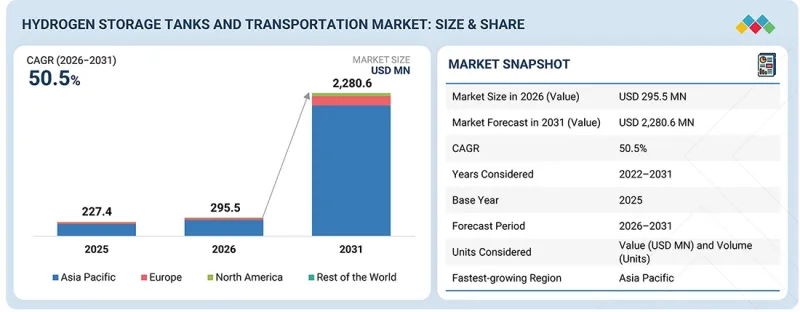
세계의 수소 저장 탱크 및 운송 시장 규모는 2026년 2억 9,550만 달러에서 2031년까지 22억 8,060만 달러로, CAGR 50.5%로 확대할 것으로 예측됩니다.
| 조사 범위 | |
|---|---|
| 조사 대상 기간 | 2022-2031년 |
| 기준연도 | 2025년 |
| 예측 기간 | 2026-2031년 |
| 산정 단위 | 금액(100만 달러)/수량(대) |
| 부문 | 재료 유형별, 압력별, 탱크 유형별, 용도별, 모듈식 저장별, 지역별 |
| 대상 지역 | 유럽, 아시아태평양, 북미 및 기타 지역 |
이 시장은 수소 생산 능력의 급속한 확대, 연료전지 자동차(FCEV)의 보급 확대, 그리고 수소 충전소 및 수송 인프라에 대한 투자 증가에 힘입어 성장하고 있습니다. 전 세계 각국 정부는 운송, 산업, 발전 분야의 탈탄소화를 위한 수소 전략을 추진하고 있으며, 이로 인해 첨단 수소 저장 탱크 및 운송 솔루션에 대한 막대한 수요가 발생하고 있습니다. 그린 수소 프로젝트의 상용화와 수소 공급망 구축이 시장 성장을 더욱 가속화하고 있습니다.
경량 복합재료, 탄소섬유 제조 및 극저온 저장 기술의 발전으로 수소 저장 시스템의 성능, 안전성 및 비용 효율성이 향상되고 있습니다. 동시에, 튜브 트레일러, 액체 수소 탱커, ISO 컨테이너 등을 포함한 수소 물류에 대한 투자가 증가함에 따라 생산 현장에서 최종사용자에게까지 효율적인 수소 수송이 가능해졌습니다. 이러한 진전은 전 세계 수소 밸류체인을 강화하고, 여러 최종 용도 분야에서 수소의 광범위한 보급을 지원하고 있습니다.
"2025년, 모듈식 저장 유형별로는 수소 연료 저장 시스템이 수소 저장 탱크 및 운송 시장에서 가장 큰 점유율을 차지했습니다."
모듈식 저장에 중점을 둔 수소 연료 저장 시스템은 승용차, 버스, 트럭, 철도, 선박 및 고정 용도 분야의 차량용 수소 저장 시스템 보급에 힘입어 2025년에는 최대 시장 점유율을 차지했습니다. 고압 유형 III 및 유형 IV 복합 탱크는 높은 수소 저장 용량, 경량 구조, 내식성 및 향상된 안전성 등의 장점으로 인해 모빌리티 용도에 최적으로 평가받으며 점점 더 선호되고 있습니다. 또한 수소 충전소, 산업용 수소 저장 및 청정 수소 프로젝트에 대한 투자 확대가 대규모 저장 시스템의 수요를 견인하고 있습니다. 전 세계에서 수소 도입이 지속적으로 확대되는 가운데, 연료 저장 부문은 지속적인 기술 혁신과 수소 인프라 도입 확대에 힘입어 예측 기간 중 선도적인 위치를 유지할 것으로 전망됩니다.
"탱크 유형별로는 유형 IV가 시장에서 가장 빠르게 성장하는 부문입니다."
탱크 유형별로는 유형 IV가 예측 기간 중 가장 높은 연평균 성장률(CAGR)을 기록할 것으로 전망됩니다. 이는 모빌리티 및 운송 분야에서 경량이며 고압의 수소 저장 솔루션 채택이 확대되고 있기 때문입니다. 유형 IV 탱크는 탄소섬유 복합재로 완전히 피복된 폴리머 라이너를 특징으로 하며, 기존의 금속 탱크에 비해 경량화, 높은 내식성, 피로 강도 향상, 수소 저장 효율 향상과 같은 큰 이점이 있습니다. 이러한 특성 덕분에 차량의 주행 거리 및 적재량 극대화가 중요한 연료전지 승용차, 버스, 트럭, 철도 및 신흥 수소 동력 선박 분야에서 유형 IV 탱크가 최적의 선택지로 자리 잡고 있습니다.
수소 저장 탱크 및 운송 시장은 주로 정평이 난 세계적인 선도 기업이 주도하고 있습니다. 시장의 주요 기업으로는 Hexagon Purus(노르웨이), Plastic Omnium(프랑스), Tenaris(룩셈부르크), Luxfer Holdings PLC(영국), NPROXX(네덜란드) 등이 있습니다.
조사 범위:
이 보고서에서는 수소 저장 탱크 및 운송 시장에 대해 모듈식 저장(수소 연료 저장 시스템, 수소 공급 시스템), 압력 유형(200 bar 미만, 200-500 bar, 500 bar 이상), 탱크 유형(유형 I, 유형 II, 유형 III, 유형 IV), 용도(자동차, 철도, 선박, 고정식 저장, 수소 수송용 트레일러) 및 지역(아시아태평양, 북미, 유럽, 기타 지역)에 초점을 맞추고 있습니다. 이 보고서는 시장 촉진요인, 제약, 기회, 과제에 대한 정성적 및 정량적 분석을 제공합니다. 주요 다루는 요소로는 경쟁 구도 평가 시장 역학, 시장 규모 추산, 향후 동향은 물론, 수소 저장 탱크 및 운송 시장의 주요 기업에 대한 투자 정보가 포함됩니다.
이 보고서 구매의 주요 이점
이 보고서는 수소 저장 탱크 및 운송 시장의 기존 업계 리더와 신규 진입자 모두에게 유용하도록 세심하게 설계되었습니다. 시장 전체 및 개별 하위 부문에 대해 신뢰할 수 있는 매출 예측을 제공합니다. 이 데이터는 이해관계자들에게 귀중한 정보원이 되어, 경쟁 구도를 포괄적으로 이해하고 자사의 비즈니스를 위한 효과적인 시장 전략을 수립할 수 있도록 합니다. 또한 이 보고서는 이해관계자들이 시장의 현황을 파악할 수 있는 수단으로 기능하며, 시장 촉진요인, 제약, 과제 및 성장 기회에 대한 중요 인사이트를 제공합니다. 이러한 인사이트를 활용함으로써 이해관계자는 충분한 정보를 바탕으로 의사결정을 내리고, 끊임없이 변화하는 수소 저장 탱크 및 운송 산업의 동향에 대해 항상 최신 정보를 얻을 수 있습니다.
- 주요 촉진요인(청정 수소 생산에 대한 투자 확대, 수소 충전 인프라 확충, 연료전지 자동차(FCEV)의 보급 확대, 국가별 수소 전략 지원, 산업 탈탄소화에 따른 수소 수요 증가) , 제약 요인(탄소섬유 복합재료의 높은 비용, 개발도상 지역의 수소 인프라 부족, 막대한 설비 투자 요건), 기회(그린 수소 프로젝트 증가, 수소 운송 네트워크 확대, 수소를 동력원으로 하는 상용차 도입 확대, 경량 복합재료 저장 기술의 발전) 및 과제(수소 저장 안전 요건, 높은 제조 비용, 표준화된 수소 수송 인프라의 부재)에 대해 분석하고, 수소 저장 탱크 및 수송 시장의 성장에 미치는 영향을 밝힙니다.
- 제품 개발 및 혁신: 제품 개발과 혁신이 수소 저장 탱크 및 운송 시장을 변화시키고 있으며, 각 제조사는 경량, 고압, 그리고 비용 효율성이 뛰어난 저장 솔루션에 주력하고 있습니다. 각 기업은 저장 용량, 안전성, 내구성을 향상시키기 위해 첨단 유형 III 및 유형 IV 복합재 탱크, 극저온 액체 수소 저장 시스템, 차세대 탄소섬유 기술에 대한 투자를 추진하고 있습니다. 수소 운송 모듈, 튜브 트레일러, 액체 수소 탱커에 대한 지속적인 혁신은 효율적인 수소 공급망 구축을 지원하는 동시에 시스템 전체의 비용 절감에도 기여하고 있습니다.
- 시장 발전: 수소 저장 탱크 및 운송 분야의 시장 발전은 수소 생산, 저장, 운송 인프라에 대한 투자 확대에 힘입어 주도되고 있습니다. 주요 기업은 생산 능력을 확대하고, 자동차 제조사 및 산업용 가스 기업과 전략적 제휴를 맺으며 아시아태평양, 유럽, 북미 전역에서 입지를 강화하고 있습니다. 수소 허브 및 청정 수소 프로젝트에 대한 정부의 재정 지원도 시장 확대를 더욱 가속화하고 있습니다.
- 시장의 다각화: 수소 저장 솔루션이 기존의 모빌리티 용도에서 산업용 저장, 수소 충전소, 선박, 철도, 고정형 에너지 저장 분야로 확대됨에 따라 시장의 다각화가 가속화되고 있습니다. 각 제조사는 기체 및 액체 수소 모두를 지원하는 솔루션을 개발하여 제품 포트폴리오를 확충하는 한편, 중국, 인도, 중동, 유럽 등 고성장 시장에 지역적으로 진출함으로써 증가하는 수소 관련 투자의 혜택을 누리려 하고 있습니다.
- 경쟁 분석: 수소 저장 탱크 및 운송 시장의 주요 기업의 시장 입지, 제품 포트폴리오, 성장 전략, 그리고 경쟁적 위치를 평가하기 위해 포괄적인 평가가 실시되었습니다. 이 분석에서는 Hexagon Purus(노르웨이), Plastic Omnium(프랑스), Tenaris(룩셈부르크), Luxfer Holdings PLC(영국), NPROXX(네덜란드), 도요타 고세이(일본), FORVIA H2 Mobility(프랑스), Hanwha Cimarron(미국), Steelhead Composites(미국), Everest Kanto Cylinder Ltd.(인도)와 같은 주요 기업을 대상으로 하며, 각 기업의 시장 점유율, 전략적 구상, 기술력 및 경쟁 우위에 대한 인사이트를 제공합니다.
자주 묻는 질문
목차
제1장 서론
제2장 개요
제3장 주요 인사이트
제4장 시장 개요
제5장 업계 동향
제6장 규제 상황과 지속가능성 구상
제7장 기술 진보, AI에 의한 영향, 특허, 혁신, 향후 응용
제8장 고객 상황과 구매 행동
제9장 수소 저장 탱크 및 운송 시장(재료 유형별)
제10장 수소 저장 탱크 및 운송 시장(압력별)
제11장 수소 저장 탱크 및 운송 시장(탱크 유형별)
제12장 수소 저장 탱크 및 운송 시장(용도별)
제13장 수소 저장 탱크 및 운송 시장(모듈식 저장 방식별)
제14장 수소 저장 탱크 및 운송 시장(지역별)
제15장 경쟁 구도
제16장 기업 개요
제17장 조사 방법
제18장 부록
KSA 26.08.19The global hydrogen storage tanks and transportation market is projected to grow from USD 295.5 million in 2026 to USD 2,280.6 million by 2031 at a CAGR of 50.5%.
| Scope of the Report | |
|---|---|
| Years Considered for the Study | 2022-2031 |
| Base Year | 2025 |
| Forecast Period | 2026-2031 |
| Units Considered | Value (USD Million)/Volume (Units) |
| Segments | by Pressure, By Modular Storage, By Tank Type, By Application |
| Regions covered | Europe, Asia Pacific, North America, and Rest of the World |
The market is driven by the rapid expansion of hydrogen production capacity, increasing deployment of fuel cell electric vehicles (FCEVs), and growing investments in hydrogen refueling stations and transportation infrastructure. Governments worldwide are implementing hydrogen strategies to decarbonize transportation, industry, and power generation, creating significant demand for advanced hydrogen storage tanks and transportation solutions. The commercialization of green hydrogen projects and the development of hydrogen supply chains are further accelerating market growth.
Technological advancements in lightweight composite materials, carbon fiber manufacturing, and cryogenic storage technologies are improving the performance, safety, and cost-effectiveness of hydrogen storage systems. At the same time, increasing investments in hydrogen logistics, including tube trailers, liquid hydrogen tankers, and ISO containers, are enabling efficient hydrogen transportation from production sites to end users. These developments are strengthening the global hydrogen value chain and supporting the widespread adoption of hydrogen across multiple end-use sectors.
"Hydrogen fuel storage systems held the largest share of the hydrogen storage tanks and transportation market, by modular storage, in 2025."
Hydrogen fuel storage systems, by modular storage, accounted for the largest market share in 2025 owing to the widespread deployment of onboard hydrogen storage systems across passenger cars, buses, trucks, railways, marine vessels, and stationary applications. High-pressure Type III and Type IV composite tanks are increasingly preferred because they offer high hydrogen storage capacity, lightweight construction, corrosion resistance, and enhanced safety, making them well-suited for mobility applications. In addition, growing investments in hydrogen refueling stations, industrial hydrogen storage, and green hydrogen projects are driving demand for large-scale storage systems. As hydrogen adoption continues to expand globally, the fuel storage segment is expected to maintain its leading position throughout the forecast period, supported by continuous technological innovation and increasing deployment of hydrogen infrastructure.
"Type IV, by tank type, is the fastest-growing segment of the market."
Type IV, by tank type, is projected to register the highest CAGR during the forecast period, driven by the increasing adoption of lightweight, high-pressure hydrogen storage solutions across mobility and transportation applications. Type IV tanks feature a polymer liner fully wrapped with carbon fiber composites, offering significant advantages such as reduced weight, high corrosion resistance, improved fatigue performance, and enhanced hydrogen storage efficiency compared with conventional metallic tanks. These characteristics make them the preferred choice for fuel cell electric passenger cars, buses, trucks, railways, and emerging hydrogen-powered marine applications, where maximizing vehicle range and payload is critical.
Breakdown of Primaries:
In-depth interviews with key industry participants, subject-matter experts, C-level executives of key market players, and industry consultants, among other experts, were conducted to obtain and verify critical qualitative and quantitative information, as well as to assess future market prospects. The primary interviews were distributed as follows:
By Company Type: Tier 1- 40%, Tier 2 - 35%, and Tier 3 - 25%
By Designation: C-Level Executives - 35%, Directors - 25%, and Managers - 40%
By Region: North America - 20%, Europe - 25%, Asia Pacific - 40%, Rest of the World - 15%.
Note: Managers include sales managers, production managers, and regional managers.
Tier 1 company: revenue >USD 5 billion; tier 2 company: revenue between USD 1 and USD 5 billion; and tier 3 company: revenue <USD 1 billion in 2025
Well-established global leaders predominantly govern the hydrogen storage tanks and transportation market. Notable players in the market include Hexagon Purus (Norway), Plastic Omnium (France), Tenaris (Luxembourg), Luxfer Holdings PLC (UK), and NPROXX (Netherlands).
Research Coverage:
The report offers a detailed definition, description, and forecast of the hydrogen storage tanks and transportation market, focusing on modular storage (hydrogen fuel storage systems, hydrogen distribution systems), pressure type (below 200 bar, 200 to 500 bar, above 500 bar ), tank type (Type I, Type II, Type III, Type IV), application (vehicles, railways, marine, stationary storage, and hydrogen transportation trailers), and region (Asia Pacific, North America, Europe, and the Rest of the World). It provides a qualitative and quantitative analysis of market drivers, limitations, opportunities, and challenges. Key elements covered are competitive landscape assessment, market dynamics, value estimates, and future trends, along with investment information on major players in the hydrogen storage tanks and transportation market.
Key Benefits of Buying the Report
The report is thoughtfully designed to benefit both established industry leaders and newcomers in the hydrogen storage tanks and transportation market. It provides reliable revenue forecasts for the entire market as well as its individual sub-segments. This data is a valuable resource for stakeholders, enabling them to gain a comprehensive understanding of the competitive landscape and formulate effective market strategies for their businesses. Furthermore, the report serves as a channel for stakeholders to grasp the current state of the market, providing essential insights into market drivers, limitations, challenges, and growth opportunities. By incorporating these insights, stakeholders can make well-informed decisions and stay informed about the constantly evolving dynamics of the hydrogen storage tanks and transportation industry.
- Analysis of key drivers (increasing investments in clean hydrogen production, expanding hydrogen refueling infrastructure, rising adoption of fuel cell electric vehicles (FCEVs), supportive government hydrogen strategies, and growing demand for hydrogen in industrial decarbonization), restraints (high cost of carbon fiber composites, limited hydrogen infrastructure in developing regions, and high capital investment requirements), opportunities (growing green hydrogen projects, expansion of hydrogen transportation networks, increasing deployment of hydrogen-powered commercial vehicles, and advancements in lightweight composite storage technologies), and challenges (hydrogen storage safety requirements, high manufacturing costs, and lack of standardized hydrogen transportation infrastructure) influencing the growth of the hydrogen storage tanks and transportation market.
- Product Development/Innovation: Product development and innovation are transforming the hydrogen storage tanks and transportation market, with manufacturers focusing on lightweight, high-pressure, and cost-efficient storage solutions. Companies are investing in advanced Type III and Type IV composite tanks, cryogenic liquid hydrogen storage systems, and next-generation carbon fiber technologies to improve storage capacity, safety, and durability. Continuous innovation in hydrogen transportation modules, tube trailers, and liquid hydrogen tankers is supporting the development of efficient hydrogen supply chains while reducing overall system costs.
- Market Development: Market development in the hydrogen storage tanks and transportation sector is driven by increasing investments in hydrogen production, storage, and transportation infrastructure. Leading manufacturers are expanding production capacities, forming strategic partnerships with automotive OEMs and industrial gas companies, and strengthening their presence across Asia Pacific, Europe, and North America. Government funding for hydrogen hubs and clean hydrogen projects is further accelerating market expansion.
- Market Diversification: Market diversification is accelerating as hydrogen storage solutions expand beyond traditional mobility applications into industrial storage, hydrogen refueling stations, marine, railways, and stationary energy storage. Manufacturers are broadening their product portfolios by developing solutions for both gaseous and liquid hydrogen while expanding geographically into high-growth markets such as China, India, the Middle East, and Europe to capitalize on increasing hydrogen investments.
- Competitive Assessment: A comprehensive evaluation has been conducted to assess the market presence, product portfolios, growth strategies, and competitive positioning of leading players in the hydrogen storage tanks and transportation market. The analysis covers key companies, including Hexagon Purus (Norway), Plastic Omnium (France), Tenaris (Luxembourg), Luxfer Holdings PLC (UK), NPROXX (Netherlands), Toyoda Gosei (Japan), FORVIA H2 Mobility (France), Hanwha Cimarron (US), Steelhead Composites (US), and Everest Kanto Cylinder Ltd. (India), providing insights into their market shares, strategic initiatives, technological capabilities, and competitive strengths.
TABLE OF CONTENTS
1 INTRODUCTION
- 1.1 STUDY OBJECTIVES
- 1.2 MARKET DEFINITION
- 1.3 MARKET SCOPE
- 1.3.1 MARKET SEGMENTATION AND REGIONAL SCOPE
- 1.3.2 INCLUSIONS AND EXCLUSIONS
- 1.3.3 YEARS CONSIDERED
- 1.4 CURRENCY CONSIDERED
- 1.5 UNIT CONSIDERED
- 1.6 LIMITATIONS
- 1.7 STAKEHOLDERS
- 1.8 SUMMARY OF CHANGES
2 EXECUTIVE SUMMARY
- 2.1 MARKET HIGHLIGHTS AND KEY INSIGHTS
- 2.2 KEY MARKET PARTICIPANTS: MAPPING OF STRATEGIC DEVELOPMENTS
- 2.3 DISRUPTIVE TRENDS IN HYDROGEN STORAGE TANKS AND TRANSPORTATION MARKET
- 2.4 HIGH-GROWTH SEGMENTS
- 2.5 REGIONAL SNAPSHOT: GLOBAL MARKET SIZE, GROWTH RATE, AND FORECAST
3 PREMIUM INSIGHTS
- 3.1 ATTRACTIVE OPPORTUNITIES FOR PLAYERS IN HYDROGEN STORAGE TANKS AND TRANSPORTATION MARKET
- 3.2 HYDROGEN STORAGE TANKS AND TRANSPORTATION MARKET, BY MODULAR STORAGE AND REGION
- 3.3 HYDROGEN STORAGE TANKS AND TRANSPORTATION MARKET, BY MODULAR STORAGE
- 3.4 HYDROGEN STORAGE TANKS AND TRANSPORTATION MARKET, BY TANK TYPE
- 3.5 HYDROGEN STORAGE TANKS AND TRANSPORTATION MARKET, BY PRESSURE
- 3.6 HYDROGEN STORAGE TANKS AND TRANSPORTATION MARKET, BY APPLICATION
- 3.7 HYDROGEN STORAGE TANKS AND TRANSPORTATION MARKET, BY COUNTRY
4 MARKET OVERVIEW
- 4.1 INTRODUCTION
- 4.2 MARKET DYNAMICS
- 4.2.1 DRIVERS
- 4.2.1.1 Regulatory support for hydrogen-powered buses, trucks, and commercial vehicles
- 4.2.1.2 Increasing deployment of hydrogen storage tanks across mobility, industrial, and stationary applications
- 4.2.1.3 Increasing global hydrogen demand
- 4.2.2 RESTRAINTS
- 4.2.2.1 Achieving cost competitiveness with battery-electric technologies and conventional fuels
- 4.2.2.2 Stringent safety standards and certification requirements for hydrogen storage systems
- 4.2.3 OPPORTUNITIES
- 4.2.3.1 Growing investments in green hydrogen hubs and hydrogen transportation networks
- 4.2.3.2 Advancements in Type IV composite tanks and liquid hydrogen storage technologies
- 4.2.3.3 Rising adoption of hydrogen in marine, railways, and industrial decarbonization
- 4.2.4 CHALLENGES
- 4.2.4.1 Limited hydrogen transportation and refueling infrastructure in emerging markets
- 4.2.4.2 High cost of carbon fiber composite tanks and hydrogen storage systems
- 4.2.1 DRIVERS
- 4.3 INTERCONNECTED MARKETS AND CROSS-SECTOR OPPORTUNITIES
- 4.4 STRATEGIC MOVES BY TIER-1/2/3 PLAYERS
5 INDUSTRY TRENDS
- 5.1 PORTER'S FIVE FORCES ANALYSIS
- 5.1.1 THREAT OF SUBSTITUTES
- 5.1.2 BARGAINING POWER OF SUPPLIERS
- 5.1.3 BARGAINING POWER OF BUYERS
- 5.1.4 THREAT OF NEW ENTRANTS
- 5.1.5 INTENSITY OF COMPETITIVE RIVALRY
- 5.2 MACROECONOMIC OUTLOOK
- 5.2.1 INTRODUCTION
- 5.2.1.1 Global energy investment trends
- 5.2.1.2 Hydrogen economy investment and capacity additions
- 5.2.1.3 Industrial decarbonization and hydrogen demand
- 5.2.1.4 Raw material prices, interest rates, and financing conditions
- 5.2.2 GDP TRENDS AND FORECAST
- 5.2.3 TRENDS IN HYDROGEN INFRASTRUCTURE DEVELOPMENT
- 5.2.4 TRENDS IN RENEWABLE ENERGY EXPANSION AND GRID DECARBONIZATION
- 5.2.1 INTRODUCTION
- 5.3 SUPPLY CHAIN ANALYSIS
- 5.4 ECOSYSTEM ANALYSIS
- 5.5 TRADE ANALYSIS
- 5.5.1 EXPORT SCENARIO (HS CODE 280410)
- 5.5.2 IMPORT SCENARIO (HS CODE 280410)
- 5.6 CASE STUDY ANALYSIS
- 5.6.1 FORVIA SUPPLIES TYPE IV HYDROGEN STORAGE SYSTEMS FOR HYDROGEN COMMERCIAL MOBILITY
- 5.6.2 HEXAGON PURUS EXPANDS HYDROGEN STORAGE MANUFACTURING TO SUPPORT GLOBAL HYDROGEN MOBILITY
- 5.6.3 WORTHINGTON ENTERPRISES ADVANCES HIGH-PRESSURE HYDROGEN STORAGE SOLUTIONS FOR INDUSTRIAL AND MOBILITY APPLICATIONS
- 5.7 KEY CONFERENCES AND EVENTS, 2026-2027
- 5.8 PRICING ANALYSIS
- 5.8.1 PRICING RANGE OF HYDROGEN STORAGE TANKS AND TRANSPORTATION SYSTEMS, BY TANK TYPE, 2025
- 5.8.2 AVERAGE SELLING PRICE TREND OF HYDROGEN STORAGE TANKS AND TRANSPORTATION SYSTEMS, BY REGION, 2022-2025
- 5.8.3 COST BREAKDOWN FOR TYPE 4 HYDROGEN STORAGE SYSTEMS
- 5.9 TRENDS/DISRUPTIONS IMPACTING CUSTOMER BUSINESS
- 5.10 INVESTMENT AND FUNDING SCENARIO
- 5.11 IMPACT OF 2025 US TARIFF - HYDROGEN STORAGE TANKS AND TRANSPORTATION MARKET
- 5.11.1 INTRODUCTION
- 5.11.2 KEY TARIFF RATES
- 5.11.3 PRICE IMPACT ANALYSIS
- 5.11.4 IMPACT ON COUNTRIES/REGIONS
- 5.11.4.1 US
- 5.11.4.2 Europe
- 5.11.4.3 Asia Pacific
- 5.11.5 IMPACT ON END-USE INDUSTRIES
6 REGULATORY LANDSCAPE AND SUSTAINABILITY INITIATIVES
- 6.1 REGIONAL REGULATIONS AND COMPLIANCE
- 6.1.1 REGULATORY BODIES, GOVERNMENT AGENCIES, AND OTHER ORGANIZATIONS
- 6.1.2 HYDROGEN STORAGE TANKS AND TRANSPORTATION MARKET: REGULATORY FRAMEWORK
- 6.2 SUSTAINABILITY INITIATIVES
- 6.2.1 LIGHTWEIGHT COMPOSITE TANKS FOR IMPROVED HYDROGEN STORAGE EFFICIENCY
- 6.2.2 LOW-CARBON MANUFACTURING AND MATERIAL EFFICIENCY
- 6.2.3 HYDROGEN LOSS REDUCTION, SAFETY, AND CIRCULAR DESIGN
- 6.3 IMPACT OF REGULATORY POLICY ON SUSTAINABILITY INITIATIVES
7 TECHNOLOGICAL ADVANCEMENTS, AI-DRIVEN IMPACT, PATENTS, INNOVATIONS, AND FUTURE APPLICATIONS
- 7.1 KEY EMERGING TECHNOLOGIES
- 7.1.1 MATERIAL-BASED HYDROGEN STORAGE
- 7.1.2 COMPRESSED HYDROGEN STORAGE
- 7.1.3 TYPE V
- 7.2 COMPLEMENTARY TECHNOLOGIES
- 7.2.1 BOIL-OFF GAS (BOG) MANAGEMENT AND RELIQUEFACTION SYSTEMS
- 7.2.2 VACUUM PUMPS, INSULATION TESTING SYSTEMS, AND MAINTENANCE TOOLS
- 7.3 ADJACENT TECHNOLOGIES
- 7.3.1 HYDROGEN ENERGY STORAGE
- 7.4 TECHNOLOGY/PRODUCT ROADMAP
- 7.5 PATENT ANALYSIS
- 7.6 FUTURE APPLICATIONS
- 7.7 IMPACT OF AI/GEN AI ON HYDROGEN STORAGE TANKS AND TRANSPORTATION MARKET
- 7.7.1 TOP USE CASES AND MARKET POTENTIAL
- 7.7.2 BEST PRACTICES FOLLOWED BY OEMS IN HYDROGEN STORAGE TANKS AND TRANSPORTATION MARKET
- 7.7.3 CASE STUDIES RELATED TO AI/GEN AI IMPLEMENTATION IN HYDROGEN STORAGE TANKS AND TRANSPORTATION MARKET
- 7.7.4 INTERCONNECTED ECOSYSTEMS AND IMPACT ON MARKET PLAYERS
- 7.7.5 CLIENTS' READINESS TO ADOPT AI/GEN AI IN HYDROGEN STORAGE TANKS AND TRANSPORTATION MARKET
8 CUSTOMER LANDSCAPE AND BUYING BEHAVIOR
- 8.1 DECISION-MAKING PROCESS
- 8.2 KEY STAKEHOLDERS INVOLVED IN BUYING PROCESS AND EVALUATION CRITERIA
- 8.2.1 KEY STAKEHOLDERS IN BUYING PROCESS
- 8.2.2 BUYING CRITERIA
- 8.3 ADOPTION BARRIERS AND INTERNAL CHALLENGES
- 8.4 UNMET NEEDS OF VARIOUS END-USE INDUSTRIES
- 8.5 MARKET PROFITABILITY
9 HYDROGEN STORAGE TANKS AND TRANSPORTATION MARKET, BY MATERIAL TYPE
- 9.1 INTRODUCTION
- 9.2 METALS
- 9.2.1 METALS CONTINUE TO PROVIDE STRUCTURAL STRENGTH AND COST-EFFECTIVE SOLUTIONS FOR HYDROGEN STORAGE SYSTEMS
- 9.3 GLASS FIBERS
- 9.3.1 GLASS FIBER COMPOSITES SUPPORT COST-EFFECTIVE HYDROGEN STORAGE SOLUTIONS
- 9.4 CARBON FIBERS
- 9.4.1 CARBON FIBER COMPOSITES ARE DRIVING NEXT-GENERATION TYPE III AND TYPE IV HYDROGEN STORAGE TANKS
10 HYDROGEN STORAGE TANKS AND TRANSPORTATION MARKET, BY PRESSURE
- 10.1 INTRODUCTION
- 10.2 BELOW 200 BAR
- 10.2.1 GROWING DEMAND FOR STATIONARY HYDROGEN STORAGE AND INDUSTRIAL APPLICATIONS TO DRIVE ADOPTION
- 10.3 200 TO 500 BAR
- 10.3.1 EXPANDING HYDROGEN REFUELING INFRASTRUCTURE AND COMMERCIAL MOBILITY TO DRIVE GROWTH
- 10.4 ABOVE 500 BAR
- 10.4.1 GROWING ADOPTION OF HIGH-PRESSURE HYDROGEN STORAGE SYSTEMS TO PROPEL MARKET
11 HYDROGEN STORAGE TANKS AND TRANSPORTATION MARKET, BY TANK TYPE
- 11.1 INTRODUCTION
- 11.2 TYPE I
- 11.2.1 LOW COST AND HIGH DURABILITY MAKE TYPE I TANKS SUITABLE FOR STATIONARY AND INDUSTRIAL APPLICATIONS
- 11.3 TYPE II
- 11.3.1 GROWING DEPLOYMENT IN STATIONARY STORAGE AND HYDROGEN REFUELING INFRASTRUCTURE TO DRIVE MARKET
- 11.4 TYPE III
- 11.4.1 ADAPTABILITY FOR HEAVY-DUTY VEHICLE APPLICATIONS TO PROPEL MARKET
- 11.5 TYPE IV
- 11.5.1 LIGHTWEIGHT DESIGN AND GROWING DEPLOYMENT IN COMMERCIAL HYDROGEN MOBILITY TO DRIVE MARKET
12 HYDROGEN STORAGE TANKS AND TRANSPORTATION MARKET, BY APPLICATION
- 12.1 INTRODUCTION
- 12.2 VEHICLES
- 12.2.1 PASSENGER FUEL CELL VEHICLES
- 12.2.1.1 New passenger fuel cell vehicle launches and technology advancements to support market growth
- 12.2.2 COMMERCIAL/HEAVY-DUTY VEHICLES
- 12.2.2.1 Increasing deployment of hydrogen-powered trucks and buses to drive demand
- 12.2.3 ICE HYDROGEN VEHICLES
- 12.2.3.1 Commercial deployment of hydrogen ICE trucks and off-highway vehicles to drive demand
- 12.2.1 PASSENGER FUEL CELL VEHICLES
- 12.3 RAILWAYS
- 12.3.1 DECARBONIZATION OF NON-ELECTRIFIED RAIL NETWORKS TO DRIVE GROWTH
- 12.4 MARINE
- 12.4.1 GROWING DECARBONIZATION INITIATIVES IN MARITIME INDUSTRY TO DRIVE MARKET
- 12.5 STATIONARY STORAGE
- 12.5.1 GROWING INVESTMENTS IN INDUSTRIAL HYDROGEN STORAGE AND RENEWABLE ENERGY INTEGRATION TO DRIVE MARKET
- 12.6 HYDROGEN TRANSPORTATION TRAILERS
- 12.6.1 EXPANSION OF HYDROGEN LOGISTICS NETWORKS TO DRIVE MARKET
13 HYDROGEN STORAGE TANKS AND TRANSPORTATION MARKET, BY MODULAR STORAGE
- 13.1 INTRODUCTION
- 13.2 HYDROGEN FUEL STORAGE SYSTEMS
- 13.2.1 EXPANDING HYDROGEN MOBILITY, INDUSTRIAL DECARBONIZATION, AND ENERGY STORAGE APPLICATIONS TO DRIVE MARKET
- 13.3 HYDROGEN DISTRIBUTION SYSTEMS
- 13.3.1 EXPANSION OF HYDROGEN LOGISTICS AND DISTRIBUTION INFRASTRUCTURE TO PROPEL MARKET
14 HYDROGEN STORAGE TANKS AND TRANSPORTATION MARKET, BY REGION
- 14.1 INTRODUCTION
- 14.2 NORTH AMERICA
- 14.2.1 US
- 14.2.1.1 Government incentives drive expansion of hydrogen storage and transportation infrastructure
- 14.2.2 CANADA
- 14.2.2.1 Hydrogen Strategy for Canada to support market growth
- 14.2.1 US
- 14.3 ASIA PACIFIC
- 14.3.1 CHINA
- 14.3.1.1 Hydrogen commercial vehicle rollout to strengthen storage and distribution networks
- 14.3.2 JAPAN
- 14.3.2.1 Public and private investments to support hydrogen infrastructure development
- 14.3.3 INDIA
- 14.3.3.1 Expansion of hydrogen-powered heavy-duty mobility to drive demand
- 14.3.4 SOUTH KOREA
- 14.3.4.1 Investments in hydrogen ports and import facilities to drive market
- 14.3.5 REST OF ASIA PACIFIC
- 14.3.1 CHINA
- 14.4 EUROPE
- 14.4.1 GERMANY
- 14.4.1.1 Expansion of hydrogen import networks to accelerate demand for advanced transport and storage solutions
- 14.4.2 UK
- 14.4.2.1 Expansion of hydrogen pipeline infrastructure to drive demand for hydrogen storage and transportation systems
- 14.4.3 ITALY
- 14.4.3.1 Large-scale public investments to strengthen hydrogen storage and transport ecosystem
- 14.4.4 FRANCE
- 14.4.4.1 Strategic participation in European hydrogen corridors to strengthen hydrogen transport infrastructure
- 14.4.5 NETHERLANDS
- 14.4.5.1 Growing hydrogen adoption across industrial clusters to drive investments in hydrogen logistics
- 14.4.6 REST OF EUROPE
- 14.4.1 GERMANY
- 14.5 ROW
- 14.5.1 SOUTH AMERICA
- 14.5.1.1 Growing investments in hydrogen mobility and green hydrogen projects to propel market
- 14.5.2 MIDDLE EAST & AFRICA
- 14.5.2.1 Green hydrogen production and export infrastructure investments to drive demand
- 14.5.1 SOUTH AMERICA
15 COMPETITIVE LANDSCAPE
- 15.1 OVERVIEW
- 15.2 KEY PLAYER COMPETITIVE STRATEGIES/RIGHT TO WIN, JANUARY 2022-JULY 2026
- 15.3 REVENUE ANALYSIS, 2021-2025
- 15.4 MARKET SHARE ANALYSIS, 2025
- 15.5 BRAND COMPARISON
- 15.5.1 HEXAGON PURUS (NORWAY)
- 15.5.2 OPMOBILITY (FRANCE)
- 15.5.3 TENARIS (LUXEMBOURG)
- 15.5.4 LUXFER HOLDINGS PLC (UK)
- 15.5.5 NPROXX (NETHERLANDS)
- 15.6 COMPANY EVALUATION MATRIX: KEY PLAYERS, 2025
- 15.6.1 STARS
- 15.6.2 EMERGING LEADERS
- 15.6.3 PERVASIVE PLAYERS
- 15.6.4 PARTICIPANTS
- 15.6.5 COMPANY FOOTPRINT: KEY PLAYERS, 2025
- 15.6.5.1 Company footprint
- 15.6.5.2 Region footprint
- 15.6.5.3 Tank type footprint
- 15.6.5.4 Modular storage footprint
- 15.6.5.5 Pressure footprint
- 15.6.5.6 Application footprint
- 15.7 COMPANY EVALUATION MATRIX: STARTUPS/SMES, 2025
- 15.7.1 PROGRESSIVE COMPANIES
- 15.7.2 RESPONSIVE COMPANIES
- 15.7.3 DYNAMIC COMPANIES
- 15.7.4 STARTING BLOCKS
- 15.7.5 COMPETITIVE BENCHMARKING: STARTUPS/SMES, 2025
- 15.7.5.1 Detailed list of key startups/SMEs
- 15.7.5.2 Competitive benchmarking of key startups/SMEs
- 15.8 COMPANY VALUATION AND FINANCIAL METRICS
- 15.9 COMPETITIVE SCENARIO
- 15.9.1 PRODUCT LAUNCHES
- 15.9.2 DEALS
- 15.9.3 EXPANSIONS
- 15.9.4 OTHER DEVELOPMENTS
16 COMPANY PROFILES
- 16.1 KEY PLAYERS
- 16.1.1 HEXAGON PURUS
- 16.1.1.1 Business overview
- 16.1.1.2 Products/Services/Solutions offered
- 16.1.1.3 Recent developments
- 16.1.1.3.1 Deals
- 16.1.1.3.2 Expansions
- 16.1.1.3.3 Other developments
- 16.1.1.4 MnM view
- 16.1.1.4.1 Key strategies/Right to win
- 16.1.1.4.2 Strategic choices
- 16.1.1.4.3 Weaknesses/Competitive threats
- 16.1.2 OPMOBILITY.
- 16.1.2.1 Business overview
- 16.1.2.2 Products/Services/Solutions offered
- 16.1.2.3 Recent developments
- 16.1.2.3.1 Deals
- 16.1.2.3.2 Expansions
- 16.1.2.3.3 Other developments
- 16.1.2.4 MnM view
- 16.1.2.4.1 Key strategies/Right to win
- 16.1.2.4.2 Strategic choices
- 16.1.2.4.3 Weaknesses/Competitive threats
- 16.1.3 TENARIS
- 16.1.3.1 Business overview
- 16.1.3.2 Products/Services/Solutions offered
- 16.1.3.3 Recent developments
- 16.1.3.3.1 Product launches
- 16.1.3.3.2 Deals
- 16.1.3.3.3 Other developments
- 16.1.3.4 MnM view
- 16.1.3.4.1 Key strengths/Right to win
- 16.1.3.4.2 Strategic choices
- 16.1.3.4.3 Weaknesses/Competitive threats
- 16.1.4 LUXFER HOLDINGS PLC
- 16.1.4.1 Business overview
- 16.1.4.2 Products/Services/Solutions offered
- 16.1.4.3 Recent developments
- 16.1.4.3.1 Product launches
- 16.1.4.3.2 Deals
- 16.1.4.3.3 Expansions
- 16.1.4.3.4 Other developments
- 16.1.4.4 MnM view
- 16.1.4.4.1 Key strengths/Right to win
- 16.1.4.4.2 Strategic choices
- 16.1.4.4.3 Weaknesses/Competitive threats
- 16.1.5 NPROXX
- 16.1.5.1 Business overview
- 16.1.5.2 Products/Services/Solutions offered
- 16.1.5.3 Recent developments
- 16.1.5.3.1 Product launches
- 16.1.5.3.2 Deals
- 16.1.5.3.3 Expansions
- 16.1.5.4 MnM view
- 16.1.5.4.1 Key strengths/Right to win
- 16.1.5.4.2 Strategic choices
- 16.1.5.4.3 Weaknesses/Competitive threats
- 16.1.6 TOYODA GOSEI
- 16.1.6.1 Business overview
- 16.1.6.2 Products/Services/Solutions offered
- 16.1.7 RHEINMETALL AG
- 16.1.7.1 Business overview
- 16.1.7.2 Products/Services/Solutions offered
- 16.1.8 EVEREST KANTO CYLINDER
- 16.1.8.1 Business overview
- 16.1.8.2 Products/Services/Solutions offered
- 16.1.9 FORVIA
- 16.1.9.1 Business overview
- 16.1.9.2 Products/Services/Solutions offered
- 16.1.10 QUANTUM FUEL SYSTEMS LLC
- 16.1.10.1 Business overview
- 16.1.10.2 Products/Services/Solutions offered
- 16.1.10.3 Recent developments
- 16.1.10.3.1 Product launches
- 16.1.10.3.2 Deals
- 16.1.10.3.3 Other developments
- 16.1.11 COMPOSITE ADVANCED TECHNOLOGIES, LLC
- 16.1.11.1 Business overview
- 16.1.11.2 Products/Services/Solutions offered
- 16.1.12 WELDSHIP
- 16.1.12.1 Business overview
- 16.1.12.2 Products/Services/Solutions offered
- 16.1.13 UMOE ADVANCED COMPOSITES
- 16.1.13.1 Business overview
- 16.1.13.2 Products/Services/Solutions offered
- 16.1.13.3 Recent developments
- 16.1.13.3.1 Deals
- 16.1.13.3.2 Expansions
- 16.1.13.3.3 Other developments
- 16.1.14 MARINE SERVICE NOORD
- 16.1.14.1 Business overview
- 16.1.14.2 Products/Services/Solutions offered
- 16.1.15 STEELHEAD COMPOSITES, INC.
- 16.1.15.1 Business overview
- 16.1.15.2 Products/Services/Solutions offered
- 16.1.15.3 Recent developments
- 16.1.15.3.1 Deals
- 16.1.15.3.2 Expansions
- 16.1.1 HEXAGON PURUS
- 16.2 OTHER PLAYERS
- 16.2.1 HANWHA CIMARRON
- 16.2.2 DOOSAN MOBILITY INNOVATION
- 16.2.3 AMS COMPOSITE CYLINDERS
- 16.2.4 BNH GAS TANKS
- 16.2.5 SHIJIAZHUANG ENRIC GAS EQUIPMENT CO., LTD.
- 16.2.6 CALVERA HYDROGEN
- 16.2.7 ADVANCED STRUCTURAL TECHNOLOGIES
- 16.2.8 ALSAFE
- 16.2.9 FABER INDUSTRIE S.P.A.
- 16.2.10 VAKO GMBH & CO. KG
17 RESEARCH METHODOLOGY
- 17.1 RESEARCH DATA
- 17.1.1 SECONDARY DATA
- 17.1.1.1 List of major secondary sources
- 17.1.1.2 Key data from secondary sources
- 17.1.2 PRIMARY DATA
- 17.1.2.1 List of primary interview participants
- 17.1.2.2 Key industry insights
- 17.1.2.3 Breakdown of primaries
- 17.1.2.4 Key data from primary sources
- 17.1.1 SECONDARY DATA
- 17.2 DATA TRIANGULATION
- 17.3 MARKET SIZE ESTIMATION
- 17.3.1 BOTTOM-UP APPROACH
- 17.3.2 TOP-DOWN APPROACH
- 17.4 DEMAND-SIDE ANALYSIS
- 17.4.1 ASSUMPTIONS FOR DEMAND-SIDE ANALYSIS
- 17.4.2 CALCULATIONS FOR DEMAND-SIDE ANALYSIS
- 17.5 SUPPLY-SIDE ANALYSIS
- 17.5.1 ASSUMPTIONS FOR SUPPLY-SIDE ANALYSIS
- 17.5.2 CALCULATIONS FOR SUPPLY-SIDE ANALYSIS
- 17.6 GROWTH FORECAST ASSUMPTIONS
- 17.7 RESEARCH LIMITATIONS
- 17.8 RISK ASSESSMENT
18 APPENDIX
- 18.1 INSIGHTS FROM INDUSTRY EXPERTS
- 18.2 DISCUSSION GUIDE
- 18.3 KNOWLEDGESTORE: MARKETSANDMARKETS' SUBSCRIPTION PORTAL
- 18.4 CUSTOMIZATION OPTIONS
- 18.5 RELATED REPORTS
- 18.6 AUTHOR DETAILS


