|
시장보고서
상품코드
2112298
해부 병리학 시장 예측(-2031년) : 유형별, 프로세스별, 질환별, 최종사용자별, 지역별Anatomic Pathology Market by Product [Consumables (Histopathology, Cytopathology), Instruments, Software], Process, Disease (Breast, GI, Prostate), End User (Hospitals, Research Labs), Services, Model (In House, Outsourced) - Global Forecast to 2031 |
||||||

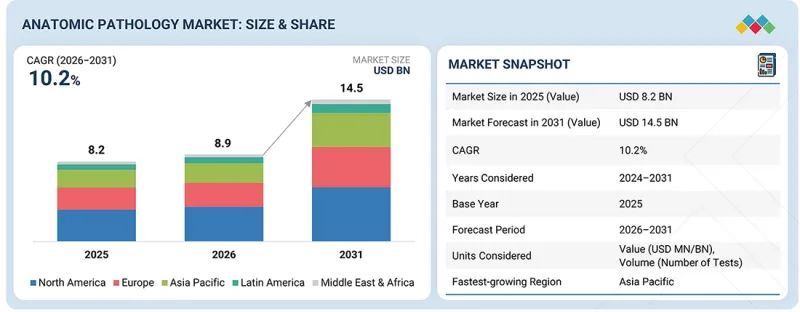
해부 병리학 시장 규모는 2026년 89억 달러에서 2031년까지 145억 달러로, CAGR 10.2%로 확대할 것으로 예측됩니다.
전 세계에서 암 및 기타 만성질환의 유병률이 증가하고 있으며, 조직병리학, 세포병리학 및 바이오마커 기반 진단 검사에 대한 수요가 증가하고 있습니다. 의료 시스템에서 맞춤형 의료 접근법이 점점 더 많이 채택됨에 따라 다양한 유형의 암에 대해 정확한 조직 특성 평가 및 바이오마커 평가에 대한 필요성이 높아지고 있습니다.
| 조사 범위 | |
|---|---|
| 조사 대상 기간 | 2026-2031년 |
| 기준연도 | 2025년 |
| 예측 기간 | 2026-2031년 |
| 산정 단위 | 금액(10억 달러) |
| 부문 | 유형별, 프로세스별, 질환별, 최종사용자별, 지역별 |
| 대상 지역 | 북미, 아시아태평양, 유럽, 중동 및 아프리카, 라틴아메리카 |
또한 디지털 병리학, 인공지능, 검사실 자동화 및 다중 조직 분석 기술의 발전으로 진단 효율, 워크플로우 표준화 및 임상적 의사결정이 향상되고 있습니다. 이러한 혁신을 통해 의료 제공자는 보다 정확하고 신속한 진단을 수행할 수 있게 되었으며, 이는 해부 병리학 시장의 성장을 지원하고 있습니다.
"질환 유형별로는 유방암 부문이 해부 병리학 시장에서 가장 큰 점유율을 차지할 것으로 예상됩니다."
질환 유형에 따라 해부 병리학 시장은 유방암, 위암, 림프종, 전립선암, 비소세포폐암(NSCLC) 및 기타 질환으로 분류됩니다. 유방암 부문은 전 세계에서 발병률이 높고, 질병의 진단, 분류, 병기 분류 및 치료 계획 수립에 해부 병리학적 기법이 널리 활용되고 있으므로 가장 큰 시장 점유율을 차지하고 있습니다. 병리 검사실에서는 유방 조직 검체의 포괄적인 평가를 지원하기 위해 조직병리학, 면역조직화학(IHC), in situ 하이브리드화(ISH) 및 바이오마커 평가가 일상적으로 활용되고 있습니다. 또한 암 조기 발견에 대한 중요성이 커지고, 유방암 검진 활동이 확대되며, 정확한 병리학적 특성 규명에 대한 수요가 증가함에 따라 해부 병리학 솔루션 도입이 지속적으로 촉진되고 있으며, 그 결과 유방암은 시장내 최대 질환 부문으로 자리매김하고 있습니다.
"병원 부문은 해부 병리학 시장에서 가장 큰 점유율을 차지할 것으로 예상됩니다."
전 세계 해부 병리학 시장은 최종사용자별로 병원, 연구소, 제약 회사, 의약품 개발 수탁 기관(CRO), 기타 최종사용자로 분류할 수 있습니다. 이 중 병원 부문이 가장 큰 시장 점유율을 차지했습니다. 통합 의료 시스템 내에서 수행되는 암 진단, 외과수술 및 조직 검사 건수가 많기 때문에 병원은 여전히 해부병리 검사의 주요 수행 장소로 남아 있습니다. 또한 첨단 병리 인프라의 활용 확대, 검사실의 자동화 및 디지털 병리 기술 도입 확대, 그리고 신속하고 정확한 진단 서비스에 대한 수요 증가가 전 세계 병원내 검사실에서 해부병리 솔루션의 지속적인 활용을 지원할 것으로 예상됩니다.
"2026-2031년에 아시아태평양은 해부 병리학 분야에서 가장 빠르게 성장하는 시장이 될 것입니다."
전 세계 해부 병리학 시장은 북미, 유럽, 아시아태평양, 라틴아메리카, 중동 및 아프리카로 구분됩니다. 아시아태평양은 2026-2031년에 지역별 가장 높은 연평균 성장률(CAGR)을 기록할 것으로 예측됩니다. 이 지역에서는 암 발생률이 급격히 증가하고 있으며, 조직 병리학, 세포 병리학 및 바이오마커 기반 진단 서비스에 대한 큰 수요가 발생하고 있습니다. 중국에서는 의료 인프라 현대화를 위한 노력과 암 진단에 대한 투자 확대를 통해 병리 검사실의 수용 능력이 확충되고 있습니다. 인도에서는 3차 의료기관, 암 센터, 민간 진단 검사실의 네트워크가 확대되고 있으며, 이로 인해 첨단 병리 기술 및 검사실 자동화의 도입이 가속화되고 있습니다. 한편, 일본에서는 고령화의 진행, 높은 암 검진율, 그리고 디지털 병리 솔루션 도입 확대가 해당 지역의 해부병리 시장 확대를 지속적으로 지원하고 있습니다.
F. Hoffmann-La Roche Ltd.(스위스), Danaher Corporation(미국), PHC Holdings Corporation(일본), Hologic, Inc.(미국), Agilent Technologies, Inc.(미국), Becton, Dickinson and Company(미국), Koninklijke Philips N.V.(네덜란드),Merck KGaA(독일), Bio SB(미국) 및 Sakura Finetek Japan(일본)은 해부 병리학 시장의 주요 참여 기업 중 일부입니다.
조사 범위:
본 조사 보고서에서는 해부 병리학 시장을 유형별 제품 시장(소모품, 기기, 소프트웨어, 보존 시스템), 공정별 제품 시장(전분석/시료 전처리, 고급 염색/IHC, 1차 및 특수 염색, 디지털 병리),질환별 제품 시장(유방암, 위암, 림프종, 전립선암, 비소세포폐암, 기타 질환), 최종사용자별 제품 시장(병원, 연구소, 제약 회사, 수탁 연구 기관, 기타 최종사용자), 유형별 서비스 시장(조직병리학 서비스 및 세포병리학 서비스),모델별 서비스 시장(병원내 수행 및 외부 위탁), 질환별 서비스 시장(유방암, 위암, 림프종, 전립선암, 비소세포폐암 및 기타 질환), 그리고 지역별(북미, 유럽, 아시아태평양, 라틴아메리카, 중동 및 아프리카)로 분류되어 있습니다.
이 보고서의 조사 범위에는 해부 병리학 시장의 성장에 영향을 미치는 촉진요인, 제약 요인, 기회, 과제 등 주요 요인에 대한 상세한 정보가 포함되어 있습니다. 주요 업계 플레이어에 대해서는 사업 개요, 솔루션,인수합병, 계약, 제품 및 서비스 출시와 같은 주요 전략, 그리고 해부 병리학 시장과 관련된 최근 동향에 대한 인사이트를 제공하기 위해 상세한 분석이 이루어졌습니다. 또한 이 보고서에서는 해부 병리학 시장 생태계에서 두각을 보이고 있는 스타트업 기업에 대한 경쟁 분석도 다루고 있습니다.
이 보고서를 구매해야 하는 이유:
이 보고서는 해부 병리학 시장 전체 및 각 하위 부문의 매출에 대한 가장 정확한 추정치를 제공함으로써 시장을 선도하는 기업과 신규 진입 기업을 지원합니다. 이 보고서는 이해관계자들이 경쟁 구도를 이해하고, 자사의 비즈니스를 더 유리한 위치에 놓으며, 적절한 시장 진입 전략을 수립하기 위한 추가적인 인사이트를 얻는 데 도움이 됩니다. 또한 이 보고서는 이해관계자들이 시장 동향을 파악하는 데 도움을 주며, 주요 시장 촉진요인, 억제요인, 기회 및 과제에 대한 정보를 제공합니다.
이 보고서는 다음 사항에 대한 인사이트를 제공합니다. :
- 병리학 시장의 성장에 영향을 미치는 주요 촉진요인(암 및 기타 대상 질환의 높은 발병률, 디지털 병리학에 대한 수요 증가, 보험 환급 가능성, 그리고 맞춤형 의료에 대한 관심 증가),제약 요인(장비 및 소모품의 높은 비용), 기회(신흥 경제국에서의 확장 가능성 및 암 치료제 임상 시험 건수 증가), 과제(재생산품의 가용성, 엄격한 규제 요건, 숙련된 전문가 부족)에 대한 분석.
- 제품 개발/혁신: 해부 병리학 시장의 향후 기술 동향, 연구개발 활동 및 신제품 출시에 대한 상세한 분석.
- 시장 개발: 수익성이 높은 시장에 대한 포괄적인 정보 - 이 보고서에서는 다양한 지역의 해부 병리학 시장을 분석하고 있습니다.
- 시장 다각화: 해부 병리학 시장의 신제품, 미개발 지역, 최근 동향 및 투자에 관한 포괄적인 정보
- 경쟁 분석: F. Hoffmann-La Roche Ltd.(스위스), Danaher Corporation(미국), PHC Holdings Corporation(일본), Hologic, Inc.(미국), Agilent Technologies, Inc.(미국) 등 주요 기업의 시장 점유율, 성장 전략 및 제품 라인업에 대한 상세한 평가.
자주 묻는 질문
목차
제1장 서론
제2장 개요
제3장 주요 인사이트
제4장 시장 개요
제5장 업계 동향
제6장 기술 진보, AI에 의한 영향, 특허, 혁신, 향후 응용
제7장 지속가능성과 규제 상황
제8장 고객 상황과 구매 행동
제9장 해부 병리학 제품 시장(유형별)
제10장 해부 병리학 제품 시장(프로세스별)
제11장 해부 병리학 시장(질환별)
제12장 질환별(검사 건수) 병리 진단 시장 규모 분석
제13장 해부 병리학 제품 시장(최종사용자별)
제14장 해부 병리 서비스 시장(유형별)
제15장 해부 병리 서비스 시장(유형별)
제16장 병리 진단 서비스 시장(질환별)
제17장 해부 병리학 시장(지역별)
제18장 경쟁 구도
제19장 기업 개요
제20장 조사 방법
제21장 부록
KSA 26.08.21The anatomic pathology market is projected to grow from USD 8.9 billion in 2026 to USD 14.5 billion by 2031, at a CAGR of 10.2%. The increasing global prevalence of cancer and other chronic diseases is driving demand for histopathology, cytopathology, and biomarker-based diagnostic testing. As healthcare systems increasingly adopt personalized medicine approaches, the need for accurate tissue characterization and biomarker assessment is expanding across a wide range of cancer types.
| Scope of the Report | |
|---|---|
| Years Considered for the Study | 2026-2031 |
| Base Year | 2025 |
| Forecast Period | 2026-2031 |
| Units Considered | Value (USD billion) |
| Segments | Product Market (Type, Process, Disease, End User, and Region) and Service Market (Type, Model, and Disease) |
| Regions covered | North America, Asia Pacific, Europe, the Middle East & Africa, and Latin America |
Furthermore, advancements in digital pathology, artificial intelligence, laboratory automation, and multiplex tissue analysis technologies are improving diagnostic efficiency, workflow standardization, and clinical decision-making. These innovations are enabling healthcare providers to deliver more accurate and timely diagnoses, thereby supporting the growth of the anatomic pathology market.
"The breast cancer segment is expected to account for the largest share of the anatomic pathology market, by disease type."
Based on disease type, the anatomic pathology market is segmented into breast cancer, gastric cancer, lymphoma, prostate cancer, non-small-cell lung cancer (NSCLC), and other diseases. The breast cancer segment accounts for the largest market share due to the high global incidence of the disease and the extensive use of anatomic pathology techniques for disease diagnosis, classification, grading, and treatment planning. Pathology laboratories routinely utilize histopathology, immunohistochemistry (IHC), in situ hybridization (ISH), and biomarker assessment to support comprehensive evaluation of breast tissue specimens. Additionally, the increasing emphasis on early cancer detection, growing breast cancer screening initiatives, and rising demand for accurate pathological characterization continue to drive the adoption of anatomic pathology solutions, making breast cancer the largest disease segment within the market.
"The hospitals segment is expected to account for the largest share of the anatomic pathology market."
The global anatomic pathology market can be segmented by end user into hospitals, research laboratories, pharmaceutical companies, contract research organizations (CROs), and other end users. Among these, the hospitals segment accounted for the largest market share. Hospitals remain the primary setting for anatomic pathology testing due to the high volume of cancer diagnoses, surgical procedures, and tissue-based examinations performed within integrated healthcare systems. Furthermore, the increasing availability of advanced pathology infrastructure, growing adoption of laboratory automation and digital pathology technologies, and rising demand for timely and accurate diagnostic services are expected to support the continued utilization of anatomic pathology solutions across hospital-based laboratories worldwide.
"The Asia Pacific is the fastest-growing market for anatomic pathology from 2026 to 2031."
The global anatomic pathology market is divided into North America, Europe, Asia Pacific, Latin America, and the Middle East & Africa. Asia Pacific is projected to grow at the highest regional CAGR from 2026 to 2031. The region is witnessing a rapid increase in cancer incidence, creating significant demand for histopathology, cytopathology, and biomarker-based diagnostic services. China is expanding pathology laboratory capacity through healthcare infrastructure modernization initiatives and increasing investments in cancer diagnostics. India's growing network of tertiary-care hospitals, cancer centers, and private diagnostic laboratories is accelerating the adoption of advanced pathology technologies and laboratory automation. Meanwhile, Japan's aging population, high cancer screening rates, and increasing adoption of digital pathology solutions continue to support the expansion of the anatomic pathology market across the region.
The break-up of the profiles of primary participants in the anatomic pathology market:
- By Company Type: Tier 1 (40%), Tier 2 (30%), and Tier 3 (30%)
- By Designation: C-level Executives (27%), Directors (18%), and Others (55%)
- By Region: North America (51%), Europe (21%), Asia Pacific (18%), Latin America (6%), and the Middle East & Africa (4%)
F. Hoffmann-La Roche Ltd. (Switzerland), Danaher Corporation (US), PHC Holdings Corporation (Japan), Hologic, Inc. (US), Agilent Technologies, Inc. (US), Becton, Dickinson and Company (US), Koninklijke Philips N.V. (Netherlands), Merck KGaA (Germany), Bio SB (US), and Sakura Finetek Japan Co., Ltd. (Japan) are some of the key players in the anatomic pathology market.
Research Coverage:
This research report categorizes the anatomic pathology market into the product market by type (consumables, instruments, software, and storage systems), product market by process (preanalytics/sample preparation, advanced staining/IHC, primary & special staining, and digital pathology), product market by disease (breast cancer, gastric cancer, lymphoma, prostate cancer, non-small-cell lung cancer, and other diseases), product market by end user (hospitals, research laboratories, pharmaceutical companies, contract research organizations, and other end users), service market by type (histopathology services and cytopathology services), service market by model (in-house and outsourced), service market by disease (breast cancer, gastric cancer, lymphoma, prostate cancer, non-small-cell lung cancer, and other diseases), and by region (North America, Europe, Asia Pacific, Latin America, and the Middle East & Africa).
The scope of the report covers detailed information regarding the major factors, such as drivers, restraints, opportunities, and challenges influencing the growth of the anatomic pathology market. A detailed analysis of the key industry players has been done to provide insights into their business overview; solutions; key strategies such as acquisitions, agreements, and product & service launches; and recent developments associated with the anatomic pathology market. Competitive analysis of upcoming startups in the anatomic pathology market ecosystem is covered in this report.
Reasons to buy this report:
The report will help market leaders/new entrants in this market with information on the closest approximations of the revenue numbers for the overall anatomic pathology market and the subsegments. This report will help stakeholders understand the competitive landscape and gain more insights to position their businesses better and plan suitable go-to-market strategies. The report also helps stakeholders understand the pulse of the market and provides them with information on key market drivers, restraints, opportunities, and challenges.
The report provides insights on the following pointers:
- Analysis of key drivers (high incidence of cancer and other target diseases, growing demand for digital pathology, availability of reimbursement, and growing focus on personalized medicine), restraints (high cost of instruments and consumables), opportunities (expansion potential across emerging economies and increasing number of clinical trials for cancer therapeutics), and challenges (availability of refurbished products, stringent regulatory requirements, and shortage of skilled professionals) influencing the growth of the anatomic pathology market.
- Product Development/Innovation: Detailed insights on upcoming technologies, research & development activities, and new product launches in the anatomic pathology market.
- Market Development: Comprehensive information about lucrative markets-the report analyzes the anatomic pathology market across varied regions.
- Market Diversification: Exhaustive information about new products, untapped geographies, recent developments, and investments in the anatomic pathology market
- Competitive Assessment: In-depth assessment of market shares, growth strategies, and product offerings of leading players such as F. Hoffmann-La Roche Ltd. (Switzerland), Danaher Corporation (US), PHC Holdings Corporation (Japan), Hologic, Inc. (US), Agilent Technologies, Inc. (US).
TABLE OF CONTENTS
1 INTRODUCTION
- 1.1 STUDY OBJECTIVES
- 1.2 MARKET DEFINITION
- 1.3 STUDY SCOPE
- 1.3.1 MARKETS COVERED & REGIONAL SCOPE
- 1.3.2 INCLUSIONS & EXCLUSIONS
- 1.3.3 YEARS CONSIDERED
- 1.4 CURRENCY CONSIDERED
- 1.5 STAKEHOLDERS
- 1.6 SUMMARY OF CHANGES
2 EXECUTIVE SUMMARY
- 2.1 KEY INSIGHTS & MARKET HIGHLIGHTS
- 2.2 KEY MARKET PARTICIPANTS: INSIGHTS & STRATEGIC DEVELOPMENTS
- 2.3 DISRUPTIVE TRENDS SHAPING MARKET GROWTH
- 2.4 HIGH-GROWTH SEGMENTS & EMERGING FRONTIERS
- 2.5 SNAPSHOT: GLOBAL MARKET SIZE, GROWTH RATE, AND FORECAST
3 PREMIUM INSIGHTS
- 3.1 ANATOMIC PATHOLOGY PRODUCT MARKET OVERVIEW
- 3.2 ANATOMIC PATHOLOGY PRODUCT MARKET, BY TYPE, 2026 VS. 2031
- 3.3 ANATOMIC PATHOLOGY PRODUCT MARKET, BY PROCESS, 2026 VS. 2031
- 3.4 ANATOMIC PATHOLOGY PRODUCT MARKET, BY DISEASE, 2026 VS. 2031
- 3.5 ANATOMIC PATHOLOGY PRODUCT MARKET, BY END USER, 2026 VS. 2031
- 3.6 ANATOMIC PATHOLOGY PRODUCT MARKET: GEOGRAPHIC GROWTH OPPORTUNITIES
4 MARKET OVERVIEW
- 4.1 INTRODUCTION
- 4.2 MARKET DYNAMICS
- 4.2.1 DRIVERS
- 4.2.1.1 High incidence of cancer and other target diseases
- 4.2.1.2 Growing demand for digital pathology
- 4.2.1.3 Availability of reimbursement
- 4.2.1.4 Growing focus on personalized medicine
- 4.2.2 RESTRAINTS
- 4.2.2.1 High cost of instruments and consumables
- 4.2.3 OPPORTUNITIES
- 4.2.3.1 Expansion potential across emerging economies
- 4.2.3.2 Increasing number of clinical trials for cancer therapeutics
- 4.2.4 CHALLENGES
- 4.2.4.1 Availability of refurbished products
- 4.2.4.2 Stringent regulatory requirements
- 4.2.4.3 Shortage of skilled professionals
- 4.2.1 DRIVERS
- 4.3 UNMET NEEDS & WHITE SPACES
- 4.3.1 UNMET NEEDS IN ANATOMIC PATHOLOGY MARKET
- 4.3.2 WHITE SPACE OPPORTUNITIES
- 4.4 INTERCONNECTED MARKETS & CROSS-SECTOR OPPORTUNITIES
- 4.4.1 INTERCONNECTED MARKETS
- 4.4.2 CROSS-SECTOR OPPORTUNITIES
- 4.5 STRATEGIC MOVES BY TIER 1/2/3 PLAYERS
- 4.5.1 KEY MOVES & STRATEGIC FOCUS
5 INDUSTRY TRENDS
- 5.1 PORTER'S FIVE FORCES ANALYSIS
- 5.1.1 BARGAINING POWER OF SUPPLIERS
- 5.1.2 BARGAINING POWER OF BUYERS
- 5.1.3 THREAT OF NEW ENTRANTS
- 5.1.4 THREAT OF SUBSTITUTES
- 5.1.5 INTENSITY OF COMPETITIVE RIVALRY
- 5.2 MACROECONOMIC INDICATORS
- 5.2.1 INTRODUCTION
- 5.2.2 GDP TRENDS & FORECAST
- 5.3 SUPPLY CHAIN ANALYSIS
- 5.4 VALUE CHAIN ANALYSIS
- 5.5 ECOSYSTEM ANALYSIS
- 5.5.1 ANATOMIC PATHOLOGY MARKET: ROLE OF COMPANIES IN ECOSYSTEM
- 5.6 PRICING ANALYSIS
- 5.6.1 AVERAGE SELLING PRICE OF ANATOMIC PATHOLOGY PRODUCTS, BY KEY PLAYER, 2024-2026
- 5.6.2 AVERAGE SELLING PRICE OF ANATOMIC PATHOLOGY PRODUCTS, BY REGION, 2024-2026
- 5.7 TRADE ANALYSIS
- 5.7.1 IMPORT SCENARIO (HS CODE 3822)
- 5.7.2 EXPORT SCENARIO (HS CODE 3822)
- 5.8 KEY CONFERENCES & EVENTS, 2026-2027
- 5.9 TRENDS/DISRUPTIONS IMPACTING CUSTOMERS' BUSINESSES
- 5.10 INVESTMENT & FUNDING SCENARIO
- 5.11 CASE STUDY ANALYSIS
- 5.11.1 CASE STUDY 1: OPTIMIZING AUTOMATED TISSUE PROCESSING EFFICIENCY TO REDUCE COST
- 5.11.2 CASE STUDY 2: OPERATIONAL EFFICIENCY IMPROVEMENTS THROUGH MILESTONE MEDICAL TISSUE PROCESSOR IMPLEMENTATION
- 5.11.3 CASE STUDY 3: WORKFLOW OPTIMIZATION THROUGH EXCELSIOR AS TISSUE PROCESSOR
- 5.12 IMPACT OF 2025 US TARIFFS ON ANATOMIC PATHOLOGY MARKET
- 5.12.1 INTRODUCTION
- 5.12.2 KEY TARIFF RATES
- 5.12.3 PRICE IMPACT ANALYSIS
- 5.12.4 IMPACT ON REGION
- 5.12.4.1 North America
- 5.12.4.2 Europe
- 5.12.4.3 Asia Pacific
- 5.12.5 IMPACT ON END-USE INDUSTRIES
- 5.12.5.1 Hospitals
- 5.12.5.2 Research laboratories
- 5.12.5.3 Pharmaceutical companies
- 5.12.5.4 Contract research organizations (CROs)
6 TECHNOLOGICAL ADVANCEMENTS, AI-DRIVEN IMPACT, PATENTS, INNOVATIONS, AND FUTURE APPLICATIONS
- 6.1 KEY EMERGING TECHNOLOGIES
- 6.1.1 HISTOPATHOLOGY
- 6.1.2 CYTOPATHOLOGY
- 6.1.3 DIGITAL PATHOLOGY
- 6.2 COMPLEMENTARY TECHNOLOGIES
- 6.2.1 SPECIAL STAINING
- 6.3 ADJACENT TECHNOLOGIES
- 6.3.1 MASS SPECTROMETRY IMAGING (MSI)
- 6.4 TECHNOLOGY/PRODUCT ROADMAP
- 6.4.1 SHORT-TERM (2025-2027) | OPTIMIZATION & STANDARDIZATION OF CORE REAGENTS
- 6.4.1.1 Core technology development
- 6.4.1.2 Product innovations
- 6.4.1.3 Market adoption
- 6.4.2 MID-TERM (2027-2030) | EXPANDED CAPABILITIES & SUSTAINABILITY
- 6.4.2.1 Advanced technology development
- 6.4.2.2 Product innovations
- 6.4.2.3 Market adoption
- 6.4.3 LONG-TERM (2030-2035+) | HIGH-PERFORMANCE & ECO-EFFICIENT PRODUCTS
- 6.4.3.1 High-performance & integrated workflows
- 6.4.3.2 Product innovations
- 6.4.3.3 Market adoption
- 6.4.1 SHORT-TERM (2025-2027) | OPTIMIZATION & STANDARDIZATION OF CORE REAGENTS
- 6.5 PATENT ANALYSIS
- 6.5.1 LIST OF MAJOR PATENTS
- 6.5.1.1 List of key patents
- 6.5.1 LIST OF MAJOR PATENTS
- 6.6 FUTURE APPLICATIONS
- 6.7 IMPACT OF AI/GENERATIVE AI ON ANATOMIC PATHOLOGY MARKET
- 6.7.1 INTRODUCTION
- 6.7.2 TOP USE CASES & MARKET POTENTIAL
- 6.7.3 KEY COMPANIES IMPLEMENTING AI
- 6.7.4 FUTURE OF AI
7 SUSTAINABILITY & REGULATORY LANDSCAPE
- 7.1 REGIONAL REGULATIONS & COMPLIANCE
- 7.1.1 REGULATORY ANALYSIS
- 7.1.1.1 North America
- 7.1.1.1.1 US
- 7.1.1.1.2 Canada
- 7.1.1.2 Europe
- 7.1.1.2.1 Germany
- 7.1.1.2.2 UK
- 7.1.1.2.3 France
- 7.1.1.3 Asia Pacific
- 7.1.1.3.1 China
- 7.1.1.3.2 Japan
- 7.1.1.3.3 India
- 7.1.1.4 Latin America
- 7.1.1.5 Middle East
- 7.1.1.5.1 Africa
- 7.1.1.1 North America
- 7.1.2 REGULATORY BODIES, GOVERNMENT AGENCIES, AND OTHER ORGANIZATIONS
- 7.1.1 REGULATORY ANALYSIS
- 7.2 SUSTAINABILITY INITIATIVES
- 7.2.1 ENVIRONMENTAL IMPACT AND ECO-FRIENDLY INITIATIVES IN ANATOMIC PATHOLOGY MARKET
- 7.2.1.1 Eco-friendly initiatives
- 7.2.1 ENVIRONMENTAL IMPACT AND ECO-FRIENDLY INITIATIVES IN ANATOMIC PATHOLOGY MARKET
- 7.3 SUSTAINABILITY IMPACT & REGULATORY POLICY INITIATIVES
8 CUSTOMER LANDSCAPE & BUYER BEHAVIOR
- 8.1 DECISION-MAKING PROCESS
- 8.2 BUYER STAKEHOLDERS & BUYING EVALUATION CRITERIA
- 8.2.1 KEY STAKEHOLDERS IN BUYING PROCESS
- 8.2.2 BUYING CRITERIA
- 8.3 ADOPTION BARRIERS & INTERNAL CHALLENGES
- 8.4 UNMET NEEDS IN VARIOUS END-USE INDUSTRIES
- 8.5 MARKET PROFITABILITY
- 8.5.1 REVENUE POTENTIAL
- 8.5.2 COST DYNAMICS
- 8.5.3 MARGIN OPPORTUNITIES IN KEY APPLICATIONS
9 ANATOMIC PATHOLOGY PRODUCT MARKET, BY TYPE
- 9.1 INTRODUCTION
- 9.2 CONSUMABLES
- 9.2.1 HISTOPATHOLOGY CONSUMABLES
- 9.2.1.1 Histopathology antibodies
- 9.2.1.1.1 Primary histopathology antibodies
- 9.2.1.1.1.1 Increasing adoption of precision medicine to drive market growth
- 9.2.1.1.2 Secondary histopathology antibodies
- 9.2.1.1.2.1 Growing focus on highly specific polymers to drive demand for histopathology secondary antibodies
- 9.2.1.1.1 Primary histopathology antibodies
- 9.2.1.2 Histopathology kits & reagents
- 9.2.1.2.1 Histopathology stains & solvents
- 9.2.1.2.1.1 Increasing adoption of advanced tissue staining techniques to drive growth of histopathology stains & solvents
- 9.2.1.2.2 Histopathology fixatives
- 9.2.1.2.2.1 Growing emphasis on tissue preservation and biomarker integrity to drive demand for histopathology fixation reagents
- 9.2.1.2.3 Other histopathology kits & reagents
- 9.2.1.2.1 Histopathology stains & solvents
- 9.2.1.3 Histopathology probes
- 9.2.1.3.1 Growing adoption of tissue-based pathology and precision diagnostics to drive demand for histopathology probes
- 9.2.1.4 Other histopathology consumables
- 9.2.1.1 Histopathology antibodies
- 9.2.2 CYTOPATHOLOGY CONSUMABLES
- 9.2.2.1 Cytopathology antibodies
- 9.2.2.1.1 Primary cytopathology antibodies
- 9.2.2.1.1.1 Advancements in biomarker research using cell analysis to support market growth
- 9.2.2.1.2 Secondary cytopathology antibodies
- 9.2.2.1.2.1 Expanding use of cytopathology for cancer screening to accelerate demand
- 9.2.2.1.1 Primary cytopathology antibodies
- 9.2.2.2 Cytopathology kits & reagents
- 9.2.2.2.1 Cytopathology stains & solvents
- 9.2.2.2.1.1 Growing demand for cytology-based screening and cellular diagnostics to fuel cytopathology stains & solvents market
- 9.2.2.2.2 Cytopathology fixatives
- 9.2.2.2.2.1 Rising adoption of cytology-based screening and liquid-based cytology to support growth of cytopathology fixation reagents
- 9.2.2.2.3 Other cytopathology kits & reagents
- 9.2.2.2.1 Cytopathology stains & solvents
- 9.2.2.3 Cytopathology probes
- 9.2.2.3.1 Increasing research to aid market growth
- 9.2.2.4 Other cytopathology consumables
- 9.2.2.1 Cytopathology antibodies
- 9.2.1 HISTOPATHOLOGY CONSUMABLES
- 9.3 INSTRUMENTS
- 9.3.1 SLIDE STAINING SYSTEMS
- 9.3.1.1 Availability of automated systems to drive market growth
- 9.3.2 TISSUE PROCESSING SYSTEMS
- 9.3.2.1 Rising adoption of automation to drive market growth
- 9.3.3 CELL PROCESSORS
- 9.3.3.1 Technological advancements in cytopathology testing to support growth of this market
- 9.3.4 MICROTOMES
- 9.3.4.1 Increasing demand for accurate tissue sectioning to support growth
- 9.3.5 EMBEDDING SYSTEMS
- 9.3.5.1 Advancements in tissue preparation technologies to support expansion of embedding systems market
- 9.3.6 COVERSLIPPERS
- 9.3.6.1 Increasing focus on laboratory automation and workflow efficiency to drive growth of coverslippers market
- 9.3.7 DIGITAL PATHOLOGY SCANNERS
- 9.3.7.1 Growing adoption of digital imaging to propel market
- 9.3.8 OTHER INSTRUMENTS
- 9.3.1 SLIDE STAINING SYSTEMS
- 9.4 SOFTWARE
- 9.4.1 AI-INTEGRATED SOFTWARE
- 9.4.1.1 Growing adoption of artificial intelligence in pathology workflows to accelerate demand for AI-integrated software
- 9.4.2 NON-AI-INTEGRATED SOFTWARE
- 9.4.2.1 Increasing digitalization of pathology laboratories to drive demand for non-AI pathology software
- 9.4.1 AI-INTEGRATED SOFTWARE
- 9.5 STORAGE SYSTEMS
- 9.5.1 GROWING ADOPTION OF DIGITAL PATHOLOGY AND INCREASING DATA VOLUMES TO DRIVE DEMAND FOR PATHOLOGY STORAGE SYSTEMS
10 ANATOMIC PATHOLOGY PRODUCT MARKET, BY PROCESS
- 10.1 INTRODUCTION
- 10.2 PREANALYTICS/SAMPLE PREPARATION
- 10.2.1 GROWING DEMAND FOR EFFICIENT SPECIMEN HANDLING AND LABORATORY AUTOMATION TO DRIVE GROWTH
- 10.3 ADVANCED STAINING/IHC
- 10.3.1 GROWING ADOPTION OF MULTIPLEX BIOMARKER ANALYSIS AND AUTOMATED STAINING WORKFLOWS TO SUPPORT MARKET GROWTH
- 10.4 PRIMARY & SPECIAL STAINING
- 10.4.1 GROWING DEMAND FOR SPECIALIZED TISSUE & CELLULAR CHARACTERIZATION TO DRIVE GROWTH
- 10.5 DIGITAL PATHOLOGY
- 10.5.1 GROWING ADOPTION OF WHOLE-SLIDE IMAGING AND AI-ENABLED WORKFLOWS TO DRIVE GROWTH OF DIGITAL PATHOLOGY
11 ANATOMIC PATHOLOGY MARKET, BY DISEASE
- 11.1 INTRODUCTION
- 11.2 BREAST CANCER
- 11.2.1 RISING UPTAKE OF HER2 TESTS FOR CANCER DIAGNOSIS TO FUEL MARKET
- 11.3 NON-SMALL-CELL LUNG CANCER
- 11.3.1 RISING CASES OF LUNG CANCER TO DRIVE ADOPTION
- 11.4 PROSTATE CANCER
- 11.4.1 GROWING RATE OF PROSTATE CANCER TO PROPEL MARKET
- 11.5 GASTRIC CANCER
- 11.5.1 RISING INCIDENCE OF GASTROINTESTINAL CANCER TO BOOST MARKET
- 11.6 LYMPHOMA
- 11.6.1 RISING INCIDENCE OF NON-HODGKIN'S LYMPHOMA IN ADULTS TO SUPPORT GROWTH
- 11.7 OTHER DISEASES
12 ANATOMIC PATHOLOGY MARKET VOLUME ANALYSIS, BY DISEASE (NUMBER OF TESTS)
13 ANATOMIC PATHOLOGY PRODUCT MARKET, BY END USER
- 13.1 INTRODUCTION
- 13.2 HOSPITALS
- 13.2.1 RISING HEALTHCARE INVESTMENT TO CONTRIBUTE TO GROWTH
- 13.3 RESEARCH LABORATORIES
- 13.3.1 RISING DEMAND FOR SPECIALTY TESTS TO DRIVE MARKET
- 13.4 PHARMACEUTICAL COMPANIES
- 13.4.1 INCREASING R&D ACTIVITIES FOR DISEASE DIAGNOSTICS TO DRIVE MARKET
- 13.5 CONTRACT RESEARCH ORGANIZATIONS
- 13.5.1 GROWING DEMAND FOR OUTSOURCING ANALYTICAL TESTING & CLINICAL TRIAL SERVICES TO BOOST MARKET
- 13.6 OTHER END USERS
14 ANATOMIC PATHOLOGY SERVICE MARKET, BY TYPE
- 14.1 INTRODUCTION
- 14.2 HISTOPATHOLOGY SERVICES
- 14.3 CYTOPATHOLOGY SERVICES
15 ANATOMIC PATHOLOGY SERVICE MARKET, BY TYPE
- 15.1 INTRODUCTION
- 15.2 IN-HOUSE
- 15.3 OUTSOURCED
16 ANATOMIC PATHOLOGY SERVICE MARKET, BY DISEASE
- 16.1 INTRODUCTION
- 16.2 BREAST CANCER
- 16.2.1 NON-SMALL CELL LUNG CANCER
- 16.2.2 PROSTATE CANCER
- 16.2.3 GASTRIC CANCER
- 16.2.4 LYMPOMA
- 16.2.5 OTHER DISEASE TYPE
17 ANATOMIC PATHOLOGY MARKET, BY REGION
- 17.1 INTRODUCTION
- 17.2 NORTH AMERICA
- 17.2.1 US
- 17.2.1.1 High healthcare expenditure to drive market
- 17.2.2 CANADA
- 17.2.2.1 Rising prevalence of cancer to fuel market
- 17.2.1 US
- 17.3 EUROPE
- 17.3.1 GERMANY
- 17.3.1.1 Favorable government initiatives to boost market
- 17.3.2 UK
- 17.3.2.1 Rising investments in cancer research to drive market
- 17.3.3 FRANCE
- 17.3.3.1 Increasing demand for cancer diagnostics to propel market
- 17.3.4 ITALY
- 17.3.4.1 High incidence of cancer and geriatric population to support growth
- 17.3.5 SPAIN
- 17.3.5.1 Increased cancer cases to boost market
- 17.3.6 REST OF EUROPE
- 17.3.1 GERMANY
- 17.4 ASIA PACIFIC
- 17.4.1 CHINA
- 17.4.1.1 Increasing focus on healthcare infrastructure to boost market
- 17.4.2 JAPAN
- 17.4.2.1 Established healthcare system to fuel market
- 17.4.3 INDIA
- 17.4.3.1 Presence of large patient pool and rapidly growing healthcare sector to drive market
- 17.4.4 REST OF ASIA PACIFIC
- 17.4.1 CHINA
- 17.5 LATIN AMERICA
- 17.5.1 GROWING ONCOLOGY PATIENT POOL, COMBINED WITH EXPANDING PUBLIC AND PRIVATE INVESTMENTS IN CANCER CARE, TO BOOST GROWTH
- 17.6 MIDDLE EAST & AFRICA
- 17.6.1 GOVERNMENT INITIATIVES TO IMPROVE HEALTHCARE INFRASTRUCTURE TO AID ANATOMIC PATHOLOGY MARKET
18 COMPETITIVE LANDSCAPE
- 18.1 INTRODUCTION
- 18.2 KEY PLAYER STRATEGIES/RIGHT TO WIN
- 18.2.1 OVERVIEW OF STRATEGIES DEPLOYED BY PLAYERS IN ANATOMIC PATHOLOGY MARKET
- 18.3 REVENUE ANALYSIS, 2023-2025
- 18.4 MARKET SHARE ANALYSIS, 2025
- 18.4.1 GLOBAL MARKET SHARE ANALYSIS, 2025
- 18.4.2 US MARKET SHARE ANALYSIS, 2025
- 18.5 COMPANY EVALUATION MATRIX: KEY PLAYERS, 2025
- 18.5.1 STARS
- 18.5.2 EMERGING LEADERS
- 18.5.3 PERVASIVE PLAYERS
- 18.5.4 PARTICIPANTS
- 18.5.5 COMPANY FOOTPRINT: KEY PLAYERS, 2025
- 18.5.5.1 Company footprint
- 18.5.5.2 Region footprint
- 18.5.5.3 Type footprint
- 18.5.5.4 Process footprint
- 18.5.5.5 End-user footprint
- 18.6 COMPANY EVALUATION MATRIX: STARTUPS/SMES, 2025
- 18.6.1 PROGRESSIVE COMPANIES
- 18.6.2 RESPONSIVE COMPANIES
- 18.6.3 DYNAMIC COMPANIES
- 18.6.4 STARTING BLOCKS
- 18.6.5 COMPANY EVALUATION MATRIX: STARTUPS/SMES, 2025
- 18.6.5.1 Detailed list of key startups/SMEs
- 18.6.5.2 Competitive benchmarking of startups/SMEs (1/2)
- 18.6.5.3 Competitive benchmarking of startups/SMEs (2/2)
- 18.7 COMPANY VALUATION & FINANCIAL METRICS
- 18.7.1 FINANCIAL METRICS
- 18.7.2 COMPANY VALUATION
- 18.8 BRAND/PRODUCT COMPARISON
- 18.9 COMPETITIVE SCENARIO
- 18.9.1 PRODUCT LAUNCHES & APPROVALS
- 18.9.2 DEALS
- 18.9.3 EXPANSIONS
19 COMPANY PROFILES
- 19.1 KEY PLAYERS
- 19.1.1 F. HOFFMANN-LA ROCHE LTD.
- 19.1.1.1 Business overview
- 19.1.1.2 Products offered
- 19.1.1.3 Recent developments
- 19.1.1.3.1 Product launches & approvals
- 19.1.1.3.2 Deals
- 19.1.1.4 MnM view
- 19.1.1.4.1 Key strengths
- 19.1.1.4.2 Strategic choices
- 19.1.1.4.3 Weaknesses & competitive threats
- 19.1.2 DANAHER CORPORATION
- 19.1.2.1 Business overview
- 19.1.2.2 Products offered
- 19.1.2.3 Recent developments
- 19.1.2.3.1 Product launches & approvals
- 19.1.2.3.2 Deals
- 19.1.2.4 MnM view
- 19.1.2.4.1 Key strengths
- 19.1.2.4.2 Strategic choices
- 19.1.2.4.3 Weaknesses & competitive threats
- 19.1.3 PHC HOLDINGS CORPORATION (EPREDIA)
- 19.1.3.1 Business overview
- 19.1.3.2 Products offered
- 19.1.3.3 Recent developments
- 19.1.3.3.1 Product launches & approvals
- 19.1.3.3.2 Deals
- 19.1.3.4 MnM view
- 19.1.3.4.1 Key strengths
- 19.1.3.4.2 Strategic choices
- 19.1.3.4.3 Weaknesses & competitive threats
- 19.1.4 AGILENT TECHNOLOGIES, INC.
- 19.1.4.1 Business overview
- 19.1.4.2 Products offered
- 19.1.4.3 Recent developments
- 19.1.4.3.1 Product launches
- 19.1.4.3.2 Deals
- 19.1.4.4 MnM view
- 19.1.4.4.1 Key strengths
- 19.1.4.4.2 Strategic choices
- 19.1.4.4.3 Weaknesses & competitive threats
- 19.1.5 HOLOGIC INC.
- 19.1.5.1 Business overview
- 19.1.5.2 Products offered
- 19.1.5.3 Recent developments
- 19.1.5.3.1 Product approvals
- 19.1.5.4 MnM view
- 19.1.5.4.1 Key strengths
- 19.1.5.4.2 Strategic choices
- 19.1.5.4.3 Weaknesses & competitive threats
- 19.1.6 BECTON, DICKINSON AND COMPANY (BD)
- 19.1.6.1 Business overview
- 19.1.6.2 Products offered
- 19.1.6.3 Recent developments
- 19.1.6.3.1 Deals
- 19.1.6.3.2 Expansions
- 19.1.7 KONINKLIJKE PHILIPS N.V.
- 19.1.7.1 Business overview
- 19.1.7.2 Products offered
- 19.1.7.3 Recent developments
- 19.1.7.3.1 Deals
- 19.1.7.3.2 Expansions
- 19.1.8 MERCK KGAA
- 19.1.8.1 Business overview
- 19.1.8.2 Products offered
- 19.1.8.3 Recent developments
- 19.1.8.3.1 Expansions
- 19.1.9 SECTRA AB
- 19.1.9.1 Business overview
- 19.1.9.2 Products offered
- 19.1.9.3 Recent developments
- 19.1.9.3.1 Product approvals
- 19.1.9.3.2 Deals
- 19.1.9.3.3 Expansions
- 19.1.10 SAKURA FINETEK JAPAN CO., LTD.
- 19.1.10.1 Business overview
- 19.1.10.2 Products offered
- 19.1.10.3 Recent developments
- 19.1.10.3.1 Product launches
- 19.1.10.3.2 Deals
- 19.1.10.3.3 Expansions
- 19.1.1 F. HOFFMANN-LA ROCHE LTD.
- 19.2 OTHER PLAYERS
- 19.2.1 BIO SB
- 19.2.2 BIOGENEX
- 19.2.3 MILESTONE MEDICAL
- 19.2.4 HISTO-LINE LABORATORIES
- 19.2.5 DIAPATH S.P.A.
- 19.2.6 SLEE MEDICAL GMBH
- 19.2.7 AMOS SCIENTIFIC PTY LTD.
- 19.2.8 MEDITE MEDICAL GMBH
- 19.2.9 CELL SIGNALING TECHNOLOGY, INC.
- 19.2.10 CELLPATH LTD.
- 19.2.11 MICROS AUSTRIA
- 19.2.12 R. K. SCIENTIFIC INSTRUMENT PRIVATE LIMITED
- 19.2.13 RWD LIFE SCIENCE CO., LTD.
- 19.2.14 MEDIMEAS
- 19.2.15 BRIGHT INSTRUMENTS
- 19.2.16 JINHUA YIDI MEDICAL APPLIANCE CO., LTD.
- 19.2.17 HAMAMATSU PHOTONICS K.K.
- 19.2.18 3DHISTECH LTD.
- 19.2.19 OPTRASCAN
- 19.2.20 DAKEWE
20 RESEARCH METHODOLOGY
- 20.1 RESEARCH DATA
- 20.1.1 SECONDARY DATA
- 20.1.1.1 List of secondary sources
- 20.1.1.2 Key data from secondary sources
- 20.1.2 PRIMARY DATA
- 20.1.2.1 Breakdown of primary interviews
- 20.1.1 SECONDARY DATA
- 20.2 MARKET SIZE ESTIMATION
- 20.2.1 TOTAL MARKET SIZE: ANATOMIC PATHOLOGY MARKET
- 20.2.2 BOTTOM-UP APPROACH
- 20.2.2.1 Approach 2: Study of annual reports and investor presentations
- 20.2.2.2 Approach 3: Primary interviews
- 20.2.2.3 Growth forecast
- 20.2.3 TOP-DOWN APPROACH
- 20.3 DATA TRIANGULATION
- 20.4 RESEARCH ASSUMPTIONS
- 20.4.1 STUDY-RELATED ASSUMPTIONS
- 20.5 STUDY ASSUMPTIONS
- 20.5.1 PARAMETRIC ASSUMPTIONS
- 20.5.2 GROWTH RATE ASSUMPTIONS
- 20.6 RESEARCH LIMITATIONS
- 20.7 RISK ASSESSMENT
21 APPENDIX
- 21.1 DISCUSSION GUIDE
- 21.2 KNOWLEDGESTORE: MARKETSANDMARKETS' SUBSCRIPTION PORTAL
- 21.3 CUSTOMIZATION OPTIONS
- 21.4 RELATED REPORTS
- 21.5 AUTHOR DETAILS