

|
시장보고서
상품코드
2066561
해부 병리학 : 시장 점유율 분석, 업계 동향 및 통계, 성장 예측(2026-2031년)Anatomic Pathology - Market Share Analysis, Industry Trends & Statistics, Growth Forecasts (2026 - 2031) |
||||||
 Mordor Intelligence
Mordor Intelligence에 의하면, 해부 병리학 시장 규모는 2025년 383억 4,000만 달러로 평가되었습니다. 2026년에는 412억 7,000만 달러로 확대되어 2026년부터 2031년에 걸쳐 CAGR 7.65%로 성장을 지속하여, 2031년에는 596억 3,000만 달러에 이를 것으로 예측됩니다.
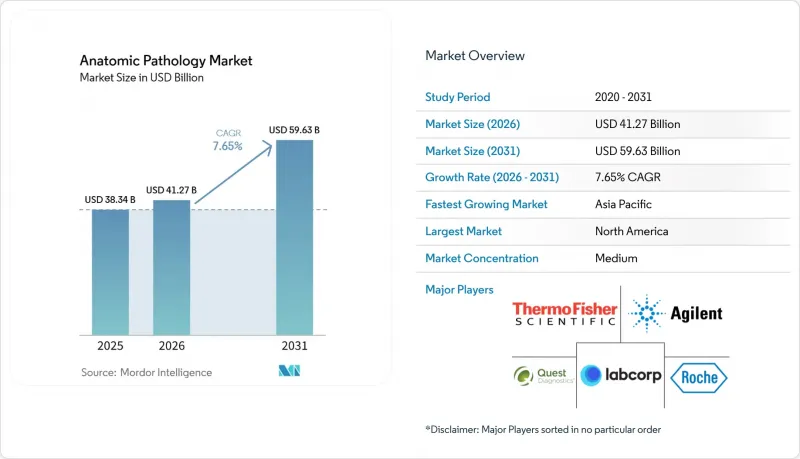
본 보고서는 제품 및 서비스(장비, 소모품, 서비스), 용도(질병 진단, 신약 개발, 기타 용도), 최종 사용자(병원, 진단실험실 등), 지역(북미, 유럽, 아시아태평양, 중동 및 아프리카, 남미)별로 분류되어 있습니다. 시장 전망은 금액(달러) 기준으로 제시되어 있습니다.
세계의 해부 병리학 시장 동향 및 인사이트
암 및 만성 질환으로 인한 부담 증가
2022년 전 세계 암 환자 수는 2,000만 명에 달했으며, 그중 폐암만 해도 250만 명의 진단 사례가 보고되었습니다. 미국암협회(American Cancer Society)는 2025년에 미국에서 200만 명 이상의 신규 암 환자가 발생하고 61만 8,000명이 사망했으며, 검체 수는 증가 추세를 유지하고 있습니다. 선진국의 고령화와 신흥 지역의 생활 방식 변화도 동시에 성장을 뒷받침하고 있는 반면, 선별 검진 프로그램은 조기 발견이 가져다주는 경제적 효과를 여실히 보여주고 있습니다. 이러한 동향은 조직학, 세포학, 분자병리학 등 각 세부 전문 분야에 걸친 지속적인 수요를 견인하며, 해부 병리학 시장을 종양학 의료의 필수적인 축으로 확고히 자리매김하게 하고 있습니다.
정밀의료 및 맞춤형 의료의 보급 확대
현재 동반 진단은 많은 항암제의 출시 과정에서 핵심적인 역할을 하고 있습니다. 2025년 4월, 로슈는 비소세포폐암 치료 지침이 될 AI 기반 TROP2 검사에 대해 ‘획기적인 의료기기(Breakthrough Device)’ 지정을 받았습니다. 이 검사는 면역조직화학 기법과 디지털 알고리즘을 결합한 것입니다. 인간 프로테옴 프로젝트를 통해 예측된 인간 단백질의 93%가 확인됨에 따라, 향후 검사를 위한 바이오마커의 선택 폭이 넓어지고 있습니다. 순환 DNA 단편 오믹스를 포함한 체액 생검 플랫폼은 HPV 관련 암에 대해 0.32 카피/µL 미만의 검출 한계를 가진 비침습적 대안을 제공합니다. 따라서 검사 기관들은 이러한 ‘의약품 우선’ 수익원을 확보하기 위해 다중 염색, 차세대 염기서열 분석 및 영상 분석 소프트웨어에 투자하고 있습니다.
엄격한 규제 및 인증 요건
2024년 7월에 발효된 FDA의 ‘실험실 개발 검사(LDT)’에 관한 최종 규정에 따라, 수십 년에 걸친 집행상의 재량권이 종료되고 수천 건의 검사가 의료기기 승인 절차에 포함되게 됩니다. 이에 따라 설계 관리, 유해사건 보고 및 시판 전 심사 의무가 부과됩니다. 품질 시스템 규정의 개정은 ISO 13485와 일치하며, 광범위한 문서 업데이트 및 감사가 요구됩니다. 유럽에서는 전문 학회가 제시한 디지털 병리학 지침이 표준화된 검증과 지속가능성을 요구하고 있어, 국경을 초월한 일관성을 높이는 한편, 규정 준수에 드는 비용이 증가하고 있습니다. 한편, 미국의 보험사들은 네트워크를 축소하고 보상액을 삭감함으로써 소규모 검사실에 가해지는 압박을 더욱 가중시키고 있습니다.
부문별 분석
2025년에는 모든 조직 블록에 시약, 염색제, 슬라이드가 필요했기 때문에 소모품이 매출의 46.54%를 차지했습니다. 검사의 복잡성이 높아짐에 따라 고품질 항체 및 분자 검사 키트에 대한 수요가 증가하며, 꾸준한 점진적 성장을 뒷받침하고 있습니다. 서비스 부문은 아웃소싱이 보편화되고 전문적인 분자 검사가 병원 내 처리 능력을 초과함에 따라, 2031년까지 10.25%라는 가장 높은 연평균 성장률(CAGR)을 보일 것으로 전망됩니다. 기기 부문은 검사실 확장에 발맞추어 변화하고 있으며, 디지털 스캐너와 자동 염색 장치가 인력 부족을 완화하고 표준화를 촉진하고 있습니다. 퀘스트 다이아그노스틱스(Quest Diagnostics)사는 디지털을 통한 실시간 판독이 진단 지연을 방지하고 병리학자 간의 협력을 개선함으로써 효율성 향상으로 이어진다고 지적하고 있습니다.
해부 병리학 시장의 소모품 시장 규모는 2031년에 275억 9,000만 달러에 달하고, 시장 총액의 46.27%를 차지할 것으로 예측됩니다. 반면, 서비스 부문은 지속적인 두 자릿수 성장에 힘입어 예측 기간 종료 시점에는 병리학 시장 규모의 34.20%를 차지할 것으로 전망됩니다. 따라서 소모품 공급업체들은 고객의 재정적 부담을 줄이면서 지속적인 수익을 확보할 수 있는 시약 임대 모델을 추진하고 있습니다.
지역별 분석
북미는 높은 암 검진율, 확립된 보험 환급 제도, 그리고 디지털 기술의 조기 도입 덕분에 2025년에는 매출의 41.12%를 차지했습니다. 미국의 의료 지출은 4조 달러를 넘어섰으며, 병리 진단은 임상 판단의 3분의 2에 영향을 미치고 있어 서비스 수요를 확고히 하고 있습니다. 미국임상병리학회(ASCP)의 인재 양성 프로그램은 장학금 제도와 보험 환급 제안에 중점을 두고 있지만, 인력 부족은 여전히 두 자릿수 수준을 유지하고 있습니다.
아시아태평양은 2031년까지 연평균 성장률(CAGR) 9.31%를 기록하며 가장 높은 성장률을 보이고 있습니다. 중국의 의료비 지출은 2022년에 8조 5,300억 위안에 달했으며, 2030년까지 20조 위안을 넘어설 가능성이 있어 각 성의 중심 도시에 있는 검사실 확충을 뒷받침하고 있습니다. 일본에서는 수작업으로 인한 부담을 줄이기 위해 일상적인 병리 검사 워크플로우에 AI 영상 진단이 도입되어 있으며, 인도에서는 예방 검진 수요를 흡수하기 위해 진단 네트워크가 4급 도시로 확대되고 있습니다. 원격 병리 진단 시범 사업을 통해 외딴 지역의 병원과 중앙 검사실이 협력함으로써, 인프라 중복을 초래하지 않으면서 접근성을 높이고 있습니다.
유럽에서는 유럽병리학회(European Society of Pathology)의 주도로 디지털 슬라이드의 표준화 및 품질 관리 체계가 탄력을 받는 가운데, 디지털 슬라이드가 꾸준히 보급되고 있습니다. 영국의 병리과 중 인력이 충원되었다고 보고한 곳은 고작 3%에 불과하여, 자동 커버글라스 부착 장치와 AI 분류 도구의 도입이 시급한 과제로 대두되고 있습니다. 중동 및 아프리카 및 남미에서는 대형 장비에 대한 투자가 뒤처지고 있지만, 휴대용 슬라이드 스캐너와 클라우드 포털이 점차 보급되면서 해부병리 시장에 단계적으로 진출할 수 있게 되었습니다.
기타 혜택 :
- 엑셀 형식 시장 예측(ME) 시트
- 3개월간의 애널리스트 지원
자주 묻는 질문
목차
제1장 서론
제2장 조사 방법
제3장 주요 요약
제4장 시장 구도
제5장 시장 규모 및 성장 예측
제6장 경쟁 구도
제7장 시장 기회 및 향후 전망
KTH 26.06.29According to Mordor Intelligence, the anatomic pathology market size is expected to grow from USD 38.34 billion in 2025 to USD 41.27 billion in 2026 and is forecast to reach USD 59.63 billion by 2031 at 7.65% CAGR over 2026-2031.
This report is Segmented by Product & Services (Instruments, Consumables, and Services), Application (Disease Diagnosis, Drug Discovery & Development, and Other Applications), End User (Hospitals, Diagnostic Laboratories, and More), Geography (North America, Europe, Asia-Pacific, The Middle East and Africa, and South America). The Market Forecasts are Provided in Terms of Value (USD).
Global Anatomic Pathology Market Trends and Insights
Rising Burden of Cancer and Chronic Diseases
Global cancer cases reached 20 million in 2022, with lung cancer alone contributing 2.5 million diagnoses. The American Cancer Society forecasts more than 2 million new US diagnoses and 618,000 deaths in 2025, keeping specimen volumes on an upward curve. Aging populations in developed economies and lifestyle shifts in emerging regions add parallel growth, while screening programs highlight the economic payoff of early detection. These trends drive sustained demand across histology, cytology, and molecular sub-specialties, cementing the anatomic pathology market as an indispensable pillar of oncology care.
Growing Adoption of Precision and Personalized Medicine
Companion diagnostics now sit at the core of many oncology drug launches. In April 2025, Roche received breakthrough device designation for its AI-enabled TROP2 test that guides treatment of non-small-cell lung cancer and unites immunohistochemistry with digital algorithms. The Human Proteome Project confirms identification of 93% of predicted human proteins, broadening the biomarker pool for future assays. Liquid biopsy platforms, including circulating DNA fragmentomics, add non-invasive options with detection limits below 0.32 copies/µL for HPV-driven cancers. Laboratories therefore invest in multiplex staining, next-generation sequencing, and image analysis software to secure this medicine-first revenue stream.
Stringent Regulatory and Accreditation Requirements
The FDA final rule on laboratory-developed tests, effective July 2024, ends decades of enforcement discretion and forces thousands of assays into the medical-device pathway with design control, adverse event reporting, and premarket review obligations. Quality System Regulation revisions harmonize with ISO 13485, requiring broad documentation updates and audits. In Europe, digital pathology guidance from professional societies demands standardized validation and sustainability, adding compliance expense while improving cross-border consistency. US payers simultaneously narrow networks and reduce reimbursement, compounding pressure on smaller labs.
Other drivers and restraints analyzed in the detailed report include:
- Continuous Technological Advancements in Pathology Instruments and Automation
- Increasing Integration of Digital Pathology and Artificial Intelligence
- Shortage of Skilled Pathologists and Histotechnologists
For complete list of drivers and restraints, kindly check the Table Of Contents.
Segment Analysis
Consumables held 46.54% revenue in 2025 because every tissue block requires reagents, stains, and slides. Rising test complexity boosts premium antibody and molecular kit demand, supporting steady incremental growth. Services post the fastest 10.25% CAGR to 2031 as outsourcing gains traction and specialized molecular assays exceed in-house bandwidth. Instruments move in step with lab expansions, with digital scanners and automated stainers mitigating staff gaps and lifting standardization. Quest Diagnostics notes that upfront digital readouts prevent diagnostic delay and improve inter-pathologist collaboration, highlighting efficiency gains.
The anatomic pathology market size for consumables is projected to reach USD 27.59 billion in 2031, equal to 46.27% of total value. In contrast, services are anticipated to account for 34.20% of the anatomic pathology market size at the end of the forecast horizon due to sustained double-digit growth. Consumable suppliers therefore pursue reagent-lease models, guaranteeing recurring revenue while easing customer capital strain.
Geography Analysis
North America commanded 41.12% revenue in 2025 owing to high cancer screening rates, established reimbursement, and early digital adoption. US healthcare spending surpasses USD 4 trillion, and pathology influences two-thirds of clinical decisions, solidifying service demand. Workforce programs from the American Society for Clinical Pathology focus on scholarship funding and reimbursement advocacy, though vacancies remain in double digits.
Asia-Pacific delivers the fastest 9.31% CAGR through 2031. China's healthcare outlays reached 8.53 trillion yuan in 2022 and may pass 20 trillion yuan by 2030, boosting laboratory build-outs across provincial centers. Japan embeds AI imaging within routine pathology workflows to cut manual fatigue, and India's diagnostic chains expand into tier-4 towns to capture preventive testing demand. Telepathology pilots link remote hospitals to central labs, improving access without duplicating infrastructure.
Europe shows steady uptake as digital slide standards and quality frameworks gain momentum under the European Society of Pathology. Only 3% of UK departments report full staffing, creating urgency for automated coverslippers and AI triage tools. Middle East & Africa and South America lag on large instrument investment, yet mobile slide scanners and cloud portals are spreading, enabling gradual participation in the anatomic pathology market.
- Roche
- Danaher (Leica Biosystems)
- Thermo Fisher Scientific
- Agilent Technologies
- Sakura Finetek
- Quest Diagnostics
- LabCorp
- NeoGenomics
- Cardinal Health
- BioGenex
- Bio SB
- 3DHISTECH
- Koninklijke Philips
- Ventana Medical Systems
- Indica Labs
- Hologic (Biocare)
- Sysmex
- PerkinElmer
- OptraSCAN
- Hamamatsu Photonics
- Microsoft (GigaPath)
Additional Benefits:
- The market estimate (ME) sheet in Excel format
- 3 months of analyst support
TABLE OF CONTENTS
1 Introduction
- 1.1 Study Assumptions & Market Definition
- 1.2 Scope Of The Study
2 Research Methodology
3 Executive Summary
4 Market Landscape
- 4.1 Market Overview
- 4.2 Market Drivers
- 4.2.1 Rising Burden of Cancer and Chronic Diseases
- 4.2.2 Growing Adoption of Precision and Personalized Medicine
- 4.2.3 Continuous Technological Advancements in Pathology Instruments And Automation
- 4.2.4 Increasing Integration of Digital Pathology and Artificial Intelligence
- 4.2.5 Expansion of Molecular and Spatial Omics in Routine Histopathology
- 4.2.6 Emergence of Telepathology Networks in Resource-Limited Settings
- 4.3 Market Restraints
- 4.3.1 Stringent Regulatory and Accreditation Requirements
- 4.3.2 Shortage of Skilled Pathologists and Histotechnologists
- 4.3.3 High Capital and Operating Costs of Advanced Systems
- 4.3.4 Lack of Standardized Data Formats and Interoperability
- 4.4 Regulatory Landscape
- 4.5 Porter's Five Forces
- 4.5.1 Threat Of New Entrants
- 4.5.2 Bargaining Power Of Buyers
- 4.5.3 Bargaining Power Of Suppliers
- 4.5.4 Threat Of Substitute Products
- 4.5.5 Intensity Of Competitive Rivalry
5 Market Size & Growth Forecasts (Value, USD)
- 5.1 By Product & Services
- 5.1.1 Instruments
- 5.1.2 Consumables
- 5.1.3 Services
- 5.2 By Application
- 5.2.1 Disease Diagnosis
- 5.2.1.1 Cancer
- 5.2.1.2 Infectious Diseases
- 5.2.1.3 Other Conditions
- 5.2.2 Drug Discovery & Development
- 5.2.2.1 Pre-Clinical Toxicology
- 5.2.2.2 Companion Diagnostics
- 5.2.2.3 Biomarker Validation
- 5.2.3 Other Applications
- 5.2.1 Disease Diagnosis
- 5.3 By End User
- 5.3.1 Hospitals
- 5.3.2 Diagnostic Laboratories
- 5.3.3 Research Laboratories
- 5.3.4 Other End Users
- 5.4 Geography
- 5.4.1 North America
- 5.4.1.1 United States
- 5.4.1.2 Canada
- 5.4.1.3 Mexico
- 5.4.2 Europe
- 5.4.2.1 Germany
- 5.4.2.2 United Kingdom
- 5.4.2.3 France
- 5.4.2.4 Italy
- 5.4.2.5 Spain
- 5.4.2.6 Rest of Europe
- 5.4.3 Asia-Pacific
- 5.4.3.1 China
- 5.4.3.2 Japan
- 5.4.3.3 India
- 5.4.3.4 Australia
- 5.4.3.5 South Korea
- 5.4.3.6 Rest of Asia-Pacific
- 5.4.4 Middle East & Africa
- 5.4.4.1 GCC
- 5.4.4.2 South Africa
- 5.4.4.3 Rest of Middle East & Africa
- 5.4.5 South America
- 5.4.5.1 Brazil
- 5.4.5.2 Argentina
- 5.4.5.3 Rest of South America
- 5.4.1 North America
6 Competitive Landscape
- 6.1 Market Concentration
- 6.2 Market Share Analysis
- 6.3 Company Profiles (includes Global level Overview, Market level overview, Core Business Segments, Financials, Headcount, Key Information, Market Rank, Market Share, Products and Services, and analysis of Recent Developments)
- 6.3.1 F. Hoffmann-La Roche
- 6.3.2 Danaher (Leica Biosystems)
- 6.3.3 Thermo Fisher Scientific, Inc.
- 6.3.4 Agilent Technologies, Inc.
- 6.3.5 Sakura Finetek
- 6.3.6 Quest Diagnostics Incorporated
- 6.3.7 Laboratory Corporation of America Holdings
- 6.3.8 NeoGenomics
- 6.3.9 Cardinal Health
- 6.3.10 BioGenex
- 6.3.11 Bio SB
- 6.3.12 3DHISTECH
- 6.3.13 Philips Healthcare
- 6.3.14 Ventana Medical Systems
- 6.3.15 Indica Labs
- 6.3.16 Hologic (Biocare)
- 6.3.17 Sysmex
- 6.3.18 PerkinElmer
- 6.3.19 OptraSCAN
- 6.3.20 Hamamatsu Photonics
- 6.3.21 Microsoft (GigaPath)
7 Market Opportunities & Future Outlook
- 7.1 White-Space & Unmet-Need Assessment


