|
시장보고서
상품코드
2120869
스마트 병원 시장 예측(-2032년) : 의료용 영상 시스템, 환자 모니터링 기기, 스마트 침대, 전자건강기록, 병원 정보 시스템, 도입 및 시스템 통합 서비스, 운영 및 지원/유지보수Smart Hospital Market by Medical Imaging Systems, Patient Monitoring Devices, Smart Beds, Electronic Health Records, Hospital Information Systems, Deployment & System Integration Services, and Managed & Support/Maintenance - Global Forecast to 2032 |
||||||

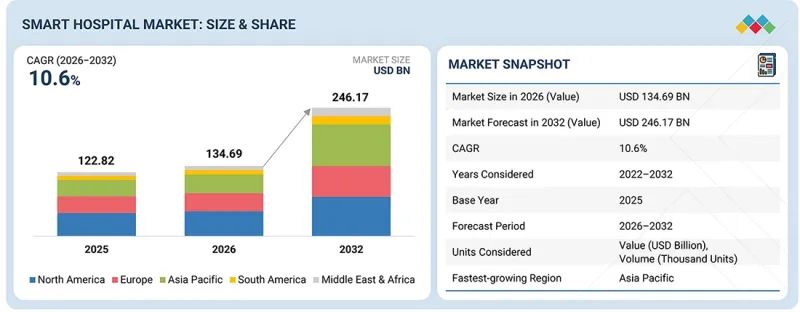
스마트 병원 시장 규모는 2026년 1,346억 9,000만 달러에서 2032년까지 2,461억 7,000만 달러에 달할 것으로 예측되고 있으며, 예측 기간 중 CAGR은 10.6%에 달할 전망입니다.
병원 전반에 걸친 AI 기반 의료, 의료용 IoT(IoMT), 클라우드 컴퓨팅, 고도화된 연결성, 로봇공학, 디지털 헬스 플랫폼의 도입 확대가 원동력이 되어 해당 시장은 강력한 성장을 이룰 것으로 예상됩니다. 또한 환자 수 증가, 의료 인력 부족, 의료비 상승, 임상 및 운영 효율성 향상에 대한 수요가 스마트 병원 기술에 대한 투자를 가속화하고 있습니다.
| 조사 범위 | |
|---|---|
| 조사 대상 기간 | 2022-2032년 |
| 기준연도 | 2025년 |
| 예측 기간 | 2026-2032년 |
| 단위 | 금액(달러) |
| 부문 | 제공, 도입 형태, 접속 기술, 기술, 용도, 최종사용자, 지역별 |
| 대상 지역 | 북미, 유럽, 아시아태평양, 기타 지역 |
병원에서는 환자 치료 및 자원 활용도를 높이기 위해 커넥티드 환자 모니터링, 전자 건강 기록(EHR), AI 분석, 원격 환자 모니터링, 스마트 의료기기, 자동화된 워크플로우 도입이 진행되고 있습니다. 또한 클라우드 기반 병원용 소프트웨어, 상호 운용 가능한 의료 시스템, 실시간 데이터 분석, 커넥티드 의료 인프라로의 전환이 진행됨에 따라 기술 제공업체에게 새로운 사업 기회가 창출되고 있습니다. 디지털 헬스 인프라 및 병원 현대화에 대한 투자 확대 또한 선진국 및 신흥 국가에서 시장 확대를 지원하고 있습니다. 임상 의사결정 개선, 워크플로우 효율화, 환자 모니터링 강화, 행정 업무 부담 경감, 자원 활용 최적화와 같은 장기적인 이점으로 인해 스마트 병원 기술은 현대 의료 서비스 제공에서 점점 더 중요한 요소로서의 입지를 확고히 하고 있습니다.
"도입 형태별로는 예측 기간 중 클라우드 기반 부문이 가장 큰 시장 점유율을 차지할 것으로 전망됩니다."
클라우드 기반 도입은 확장성, 유연성, 그리고 급속히 진화하는 스마트 병원 용도와의 친화성 덕분에 예측 기간 중 최대 시장 점유율을 차지할 것으로 전망됩니다. 클라우드 기반 플랫폼은 전자 건강 기록(EHR), 병원 정보 시스템(HIS), AI 분석, 환자 참여, 원격 환자 모니터링, 커넥티드 헬스케어 용도 등에서 도입이 확대되고 있습니다. 이러한 용도에서는 데이터에 대한 통합적인 접근과 확장성이 뛰어난 인프라가 필수적입니다. 이러한 플랫폼을 통해 병원은 끊임없이 증가하는 임상 데이터와 운영 데이터를 관리할 수 있을 뿐만 아니라, 부서 간 및 의료 시설 간의 상호 운용성도 지원할 수 있습니다. 또한 AI, IoMT, 원격의료, 디지털 헬스 인프라에 대한 투자 확대도 클라우드 기반 병원용 소프트웨어의 도입을 가속화하고 있습니다. 클라우드 배포으로 대규모 사내 IT 인프라에 대한 의존도가 낮아져, 병원은 소프트웨어 업데이트나 디지털 애플리케이션 도입을 보다 효율적으로 수행할 수 있게 됩니다. 통합형이자 데이터 주도형 의료 환경으로의 전환이 진행되고 있는 점도 병원 및 의료 네트워크 전반에서 클라우드 기반 솔루션에 대한 수요를 더욱 부추기고 있습니다.
"연결 기술별로는 Wi-Fi가 예측 기간 중 큰 시장 점유율을 차지할 것으로 전망됩니다."
Wi-Fi는 임상, 관리, 환자 치료 등 각 용도에서 신뢰성 높은 무선 연결을 실현하기 위해 병원 환경에서 널리 활용되고 있으며, 큰 점유율을 차지할 것으로 예상됩니다. Wi-Fi 네트워크는 전자건강기록, 연결형 의료기기, 모바일 임상 워크플로우, 환자 모니터링,원격의료, 환자 참여 서비스를 지원하기 위해 병원 내에서 광범위하게 도입되고 있습니다. 광범위한 실내 커버리지를 제공하고 다수의 기기를 연결할 수 있으므로 Wi-Fi는 병원이 연결되고 데이터베이스의 운영으로 전환하는 데 있으며, 중요한 연결 기술이 되고 있습니다. 또한 IoMT, 스마트 의료기기, 클라우드 기반 의료 애플리케이션, 디지털 병원 인프라에 대한 투자 증가로 인해 대용량 무선 네트워크에 대한 수요가 가속화되고 있습니다.
"예측 기간 중 아시아태평양이 가장 빠르게 성장할 것으로 전망됩니다."
아시아태평양은 중국, 인도, 일본, 한국, 싱가포르, 호주 등 경제권내 의료 디지털화의 진전, 병원의 현대화, 그리고 AI, IoMT, 클라우드 컴퓨팅, 커넥티드 의료 인프라에 대한 투자에 힘입어 예측 기간 중 가장 빠르게 성장하는 지역이 될 것으로 전망됩니다. 의료 수요 증가, 고령화, 인력 부족, 접근성 및 운영 효율성 향상의 필요성이 스마트 병원 기술 도입을 가속화하고 있습니다. AI를 활용한 진단, 원격 환자 모니터링, 전자 건강 기록, 로봇 공학, 고도화된 연결성, 사이버 보안에 대한 투자 증가가 이 지역의 시장 성장을 더욱 지원하고 있습니다.
이 보고서는 전 세계 스마트 병원 시장을 조사하여 시장 개요, 시장 성장에 영향을 미치는 다양한 요인에 대한 분석, 기술 및 특허 동향, 법규제 환경, 사례 연구, 시장 규모 추이 및 전망, 각종 분류·지역/주요 국가별 상세 분석, 경쟁 구도, 주요 기업 개요 등을 종합적으로 다루고 있습니다.
자주 묻는 질문
목차
제1장 서론
제2장 개요
제3장 주요 인사이트
제4장 시장 개요
제5장 업계 동향
제6장 기술의 진보, AI에 의한 영향, 특허, 혁신
제7장 규제 상황
제8장 고객 상황과 구매 행동
제9장 스마트 병원 시장 : 제공별
제10장 스마트 병원 시장 : 도입 형태별
제11장 스마트 병원 시장 : 커넥티비티 기술별
제12장 스마트 병원 시장 : 기술별
제13장 스마트 병원 시장 : 용도별
제14장 스마트 병원 시장 : 최종사용자별
제15장 스마트 병원 시장 : 지역별
제16장 경쟁 구도
제17장 기업 개요
제18장 조사 방법
제19장 부록
KSA 26.09.07According to MarketsandMarkets, the smart hospital market is projected to reach USD 246.17 billion by 2032 from USD 134.69 billion in 2026, at a CAGR of 10.6% during the forecast period. The market is expected to witness strong growth, driven by the increasing adoption of AI-enabled healthcare, Internet of Medical Things (IoMT), cloud computing, advanced connectivity, robotics, and digital health platforms across hospitals. Rising patient volumes, healthcare workforce shortages, increasing healthcare expenditure, and the need to improve clinical and operational efficiency are accelerating investments in smart hospital technologies.
| Scope of the Report | |
|---|---|
| Years Considered for the Study | 2022-2032 |
| Base Year | 2025 |
| Forecast Period | 2026-2032 |
| Units Considered | Value (USD Billion) |
| Segments | By Offering, Deployment Mode, Connectivity Technology, Technology, Application, End User, Region |
| Regions covered | North America, Europe, APAC, RoW |
Hospitals are increasingly deploying connected patient monitoring, electronic health records, AI analytics, remote patient monitoring, smart medical devices, and automated workflows to enhance patient care and resource utilization. Furthermore, the increasing transition toward cloud-based hospital software, interoperable healthcare systems, real-time data analytics, and connected medical infrastructure is creating new opportunities for technology providers. Growing investments in digital health infrastructure and hospital modernization are also supporting market expansion across developed and emerging economies. The long-term benefits of improved clinical decision-making, streamlined workflows, enhanced patient monitoring, reduced administrative burden, and optimized resource utilization are positioning smart hospital technologies as an increasingly important component of modern healthcare delivery.
"By deployment mode, cloud-based segment to account for largest market share during the forecast period."
Cloud-based deployment is expected to account for the largest market share during the forecast period due to its scalability, flexibility, and compatibility with rapidly evolving smart hospital applications. Cloud-based platforms are increasingly adopted for electronic health records (EHRs), hospital information systems (HIS), AI analytics, patient engagement, remote patient monitoring, and connected healthcare applications, where centralized data access and scalable infrastructure are essential. These platforms enable hospitals to manage growing volumes of clinical and operational data while supporting interoperability across departments and healthcare facilities. Additionally, increasing investments in AI, IoMT, telemedicine, and digital health infrastructure are accelerating the adoption of cloud-based hospital software. Cloud deployment reduces dependence on extensive in-house IT infrastructure and enables hospitals to implement software updates and digital applications more efficiently. The growing shift toward integrated and data-driven healthcare environments is further supporting demand for cloud-based solutions across hospitals and healthcare networks.
"By connectivity technology, Wi-Fi is expected to account for significant market share during the forecast period."
Wi-Fi is expected to capture a significant share of the smart hospital market due to its widespread use in hospital environments for reliable wireless connectivity across clinical, administrative, and patient-care applications. Wi-Fi networks are extensively deployed to support electronic health records, connected medical devices, mobile clinical workflows, patient monitoring, telemedicine, and patient engagement services. Their ability to provide broad indoor coverage and connect large numbers of devices makes Wi-Fi an important connectivity technology for hospitals transitioning toward connected and data-driven operations. Furthermore, increasing investments in IoMT, smart medical devices, cloud-based healthcare applications, and digital hospital infrastructure are accelerating the demand for high-capacity wireless networks.
"Asia Pacific to be fastest-growing region in smart hospital market during the forecast period."
Asia Pacific is projected to be the fastest-growing region in the smart hospital market during the forecast period, driven by increasing healthcare digitalization, hospital modernization, and investments in AI, IoMT, cloud computing, and connected medical infrastructure across economies such as China, India, Japan, South Korea, Singapore, and Australia. Growing healthcare demand, aging populations, workforce shortages, and the need to improve access and operational efficiency are accelerating the adoption of smart hospital technologies. Rising investments in AI-enabled diagnostics, remote patient monitoring, electronic health records, robotics, advanced connectivity, and cybersecurity are further supporting regional market growth.
Breakdown of Primaries
A variety of executives from key organizations operating in the smart hospital market were interviewed in-depth, including CEOs, marketing directors, and innovation and technology directors.
- By Company Type: Tier 1 - 40%, Tier 2 - 35%, and Tier 3 - 25%
- By Designation: C-level Executives - 33%, Directors - 38%, and Others - 29%
- By Region: North America - 30%, Europe - 20%, Asia Pacific - 40%, South America - 5%, and Middle East & Africa - 5%
Note: The RoW region includes the Middle East, Africa, and South America. Other designations include product, sales, and marketing managers. Three tiers of companies have been defined based on their total revenues as of 2025: Tier 3: revenue less than USD 100 million; Tier 2: revenue between USD 100 million and USD 1 billion; and Tier 1: revenue more than USD 1 billion.
Major players profiled in this report include Siemens Healthineers AG (Germany), Koninklijke Philips N.V. (Netherlands), GE HealthCare (US), Oracle (US), Epic Systems Corporation (US), Medtronic (Ireland), Cisco (US), Microsoft (US), Honeywell International Inc. (US), and Schneider Electric (France), among others.
These companies compete by continuously enhancing smart hospital capabilities, focusing on AI-enabled healthcare, connected medical devices, cloud-based platforms, advanced analytics, automation, interoperability, and cybersecurity. Strategic emphasis is placed on developing integrated solutions that connect clinical, operational, and administrative workflows across hospitals and healthcare networks. Market participants prioritize improving patient care, operational efficiency, resource utilization, workflow automation, and data-driven decision-making across diverse healthcare environments. Strong focus is also placed on AI-enabled diagnostics, IoMT, remote patient monitoring, digital health platforms, robotics, digital twins, and advanced connectivity. Continued investments in AI, cloud computing, connected healthcare infrastructure, data analytics, and cybersecurity, along with collaborations across the healthcare ecosystem, are expected to strengthen competition and accelerate the adoption of smart hospital technologies globally.
The study provides a detailed competitive analysis of these key players in the market, presenting their company profiles, recent developments, technology portfolios, and key market strategies.
Research Coverage
This report on the smart hospital market presents a detailed analysis based on offering, deployment mode, connectivity technology, technology, application, end user, and region. By offering, the market is segmented into hardware, software, and services. By deployment mode, it is segmented into cloud-based, on-premises, and hybrid. By connectivity technology, the market includes Wi-Fi, Bluetooth/BLE, RFID, near-field communication, Zigbee, cellular (4G/5G), Ethernet/LAN, and LoRaWAN/LPWAN. By technology, the market includes artificial intelligence & machine learning, Internet of Medical Things, cloud computing, edge computing, big data analytics, robotics, digital twin, and cybersecurity. By application, it is segmented into patient care management, clinical workflow optimization, asset tracking, remote patient monitoring, medication management, telemedicine, diagnostic imaging, hospital workflow management, building & energy management, and security & surveillance. By end user, the market covers hospitals (public/private), ambulatory surgery centers, specialty & outpatient clinics, diagnostics & imaging centers, and academic medical centers. The regional analysis includes North America, Europe, Asia Pacific, South America, and Middle East & Africa, enabling evaluation of demand patterns, growth drivers, and industry trends.
Reasons to Buy the Report
The report will help the leaders/new entrants in this market with information on the closest approximations of the revenue numbers for the overall market and the subsegments. This report will help stakeholders understand the competitive landscape and gain more insights to position their businesses better and plan suitable go-to-market strategies. The report also helps stakeholders understand the smart hospital market's pulse and provides information on key market drivers, restraints, challenges, and opportunities.
Key Benefits of Buying the Report
- Analysis of key drivers (increasing deployment of connected smart hospital infrastructure and automation, growing integration of artificial intelligence across smart hospital operations), restraints (high upfront costs and integration complexity limit smart hospital adoption, persistent cybersecurity risks across connected smart hospital ecosystems), opportunities (expansion of hospital command centers for intelligent operations, growing adoption of digital twins creates opportunities for smart hospital optimization), and challenges (addressing workforce readiness for intelligent hospital operations, balancing innovation with regulatory compliance and data governance) influencing the growth of the smart hospital market.
- Product Development/Innovation: Detailed insights on upcoming technologies, research & development activities, and product launches in the smart hospital market.
- Market Development: Comprehensive information about lucrative markets by analyzing the smart hospital market across varied regions.
- Market Diversification: Exhaustive information about new products/services, untapped geographies, recent developments, and investments in the smart hospital market.
- Competitive Assessment: In-depth assessment of market shares, growth strategies, and service offerings of leading players such as Siemens Healthineers AG (Germany), Koninklijke Philips N.V. (Netherlands), GE HealthCare (US), Oracle (US), Epic Systems Corporation (US), Medtronic (Ireland), Cisco (US), Microsoft (US), Honeywell International Inc. (US), and Schneider Electric (France), among others.
TABLE OF CONTENTS
1 INTRODUCTION
- 1.1 STUDY OBJECTIVES
- 1.2 MARKET DEFINITION
- 1.3 MARKET SCOPE
- 1.3.1 MARKET SEGMENTATION
- 1.3.2 REGIONAL SCOPE
- 1.3.3 INCLUSIONS AND EXCLUSIONS
- 1.3.4 YEARS CONSIDERED
- 1.4 CURRENCY CONSIDERED
- 1.5 UNIT CONSIDERED
- 1.6 STAKEHOLDERS
- 1.7 SUMMARY OF CHANGES
2 EXECUTIVE SUMMARY
- 2.1 MARKET HIGHLIGHTS AND KEY INSIGHTS
- 2.2 KEY MARKET PARTICIPANTS: MAPPING OF STRATEGIC DEVELOPMENTS
- 2.3 DISRUPTIVE TRENDS IN SMART HOSPITAL MARKET
- 2.4 HIGH-GROWTH SEGMENTS
- 2.5 REGIONAL SNAPSHOT: MARKET SIZE, GROWTH RATE, AND FORECAST
3 PREMIUM INSIGHTS
- 3.1 ATTRACTIVE OPPORTUNITIES FOR PLAYERS IN SMART HOSPITAL MARKET
- 3.2 SMART HOSPITAL MARKET, BY OFFERING
- 3.3 SMART HOSPITAL MARKET, BY DEPLOYMENT MODE
- 3.4 SMART HOSPITAL MARKET, BY CONNECTIVITY TECHNOLOGY
- 3.5 SMART HOSPITAL MARKET, BY TECHNOLOGY
- 3.6 SMART HOSPITAL MARKET, BY APPLICATION
- 3.7 SMART HOSPITAL MARKET, BY END USER
- 3.8 SMART HOSPITAL MARKET, BY REGION
- 3.9 SMART HOSPITAL MARKET, BY COUNTRY/REGION
4 MARKET OVERVIEW
- 4.1 INTRODUCTION
- 4.2 MARKET DYNAMICS
- 4.2.1 DRIVERS
- 4.2.1.1 Increasing deployment of connected smart hospital infrastructure and automation
- 4.2.1.2 Growing integration of artificial intelligence across smart hospital operations
- 4.2.1.3 Rising capital investment in smart hospital infrastructure modernization
- 4.2.1.4 Growing pressure to improve clinical productivity and hospital operational efficiency
- 4.2.1.5 Expanding adoption of interoperable IoMT and RTLS ecosystems
- 4.2.2 RESTRAINTS
- 4.2.2.1 High upfront costs and integration complexity
- 4.2.2.2 Persistent cybersecurity risks across connected smart hospital ecosystems
- 4.2.2.3 Limited budget availability among small and mid-sized hospitals
- 4.2.3 OPPORTUNITIES
- 4.2.3.1 Expansion of hospital command centers for intelligent operations
- 4.2.3.2 Growing adoption of digital twin technology
- 4.2.3.3 Increasing adoption of autonomous service robotics in smart hospitals
- 4.2.3.4 Increasing smart hospital investments across emerging healthcare markets
- 4.2.4 CHALLENGES
- 4.2.4.1 Addressing workforce readiness for intelligent hospital operations
- 4.2.4.2 Balancing innovation with regulatory compliance and data governance
- 4.2.1 DRIVERS
- 4.3 INTERCONNECTED MARKETS AND CROSS-SECTOR OPPORTUNITIES
- 4.3.1 INTERCONNECTED MARKETS
- 4.3.2 CROSS-SECTOR OPPORTUNITIES
- 4.4 STRATEGIC MOVES BY TIER-1/2/3 PLAYERS
- 4.4.1 STRATEGIC FOCUS AND MOVES CARRIED OUT BY MARKET PLAYERS
5 INDUSTRY TRENDS
- 5.1 INTRODUCTION
- 5.2 PORTER'S FIVE FORCES ANALYSIS
- 5.2.1 BARGAINING POWER OF SUPPLIERS
- 5.2.2 BARGAINING POWER OF BUYERS
- 5.2.3 THREAT OF NEW ENTRANTS
- 5.2.4 THREAT OF SUBSTITUTES
- 5.2.5 INTENSITY OF COMPETITIVE RIVALRY
- 5.3 MACROECONOMIC OUTLOOK
- 5.3.1 INTRODUCTION
- 5.3.2 GDP TRENDS AND FORECAST
- 5.3.3 TRENDS IN SMART HOSPITAL MARKET
- 5.4 VALUE CHAIN ANALYSIS
- 5.5 ECOSYSTEM ANALYSIS
- 5.6 PRICING ANALYSIS
- 5.6.1 AVERAGE SELLING PRICE OF SMART BEDS
- 5.6.2 AVERAGE SELLING PRICE OF SMART BEDS, BY REGION
- 5.7 TRADE ANALYSIS
- 5.7.1 IMPORT SCENARIO (HS CODE 9022)
- 5.7.2 EXPORT SCENARIO (HS CODE 9022)
- 5.8 KEY CONFERENCES AND EVENTS, 2026-2027
- 5.9 TRENDS/DISRUPTIONS IMPACTING CUSTOMER BUSINESS
- 5.10 INVESTMENT AND FUNDING SCENARIO
- 5.11 CASE STUDY ANALYSIS
- 5.11.1 SIEMENS' SMART HOSPITAL PLATFORM DRIVES 35% COST REDUCTION AT HOSPITAL SAN JUAN DE DIOS
- 5.11.2 HONEYWELL FORGE HELPS BLUEWATER HEALTH CUT ENERGY USE AND MODERNIZE FACILITY MAINTENANCE
- 5.11.3 CISCO SPACES ENABLES CONNECTED CARE AT FRANKFURT UNIVERSITY HOSPITAL
- 5.12 IMPACT OF 2025 US TARIFF - SMART HOSPITAL MARKET
- 5.12.1 INTRODUCTION
- 5.12.2 KEY TARIFF RATES
- 5.12.3 PRICE IMPACT ANALYSIS
- 5.12.4 IMPACT ON COUNTRIES/REGIONS
- 5.12.4.1 US
- 5.12.4.2 Europe
- 5.12.4.3 Asia Pacific
- 5.12.5 IMPACT ON END USERS
6 TECHNOLOGICAL ADVANCEMENTS, AI-DRIVEN IMPACT, PATENTS, AND INNOVATIONS
- 6.1 KEY TECHNOLOGIES
- 6.1.1 ARTIFICIAL INTELLIGENCE (AI) & GENERATIVE AI
- 6.1.2 INTERNET OF MEDICAL THINGS (IOMT)
- 6.2 COMPLEMENTARY TECHNOLOGIES
- 6.2.1 ELECTRONIC HEALTH RECORDS
- 6.2.2 REAL-TIME LOCATION SYSTEMS
- 6.2.3 5G & ADVANCED WIRELESS CONNECTIVITY
- 6.3 TECHNOLOGY/PRODUCT ROADMAP
- 6.4 PATENT ANALYSIS
- 6.5 IMPACT OF AI/GEN AI ON SMART HOSPITAL MARKET
- 6.5.1 TOP USE CASES AND MARKET POTENTIAL
- 6.5.1.1 Real-time clinical monitoring and workflow automation
- 6.5.1.2 Remote patient care and telehealth services
- 6.5.1.3 Inventory optimization and real-time asset tracking
- 6.5.1.4 Patient safety and remote equipment monitoring
- 6.5.2 BEST PRACTICES FOLLOWED BY MANUFACTURERS/OEMS IN SMART HOSPITAL MARKET
- 6.5.3 CASE STUDIES RELATED TO AI IMPLEMENTATION IN SMART HOSPITAL MARKET
- 6.5.4 INTERCONNECTED/ADJACENT ECOSYSTEM AND IMPACT ON MARKET PLAYERS
- 6.5.5 CLIENTS' READINESS TO ADOPT SMART HOSPITAL
- 6.5.1 TOP USE CASES AND MARKET POTENTIAL
- 6.6 SUCCESS STORIES AND REAL-WORLD APPLICATIONS
7 REGULATORY LANDSCAPE
- 7.1 REGIONAL REGULATIONS AND COMPLIANCE
- 7.1.1 REGULATORY BODIES, GOVERNMENT AGENCIES, AND OTHER ORGANIZATIONS
- 7.2 INDUSTRY STANDARDS
- 7.3 SUSTAINABILITY IMPACT AND REGULATORY POLICY INITIATIVES
8 CUSTOMER LANDSCAPE & BUYER BEHAVIOR
- 8.1 DECISION-MAKING PROCESS
- 8.2 KEY STAKEHOLDERS INVOLVED IN BUYING PROCESS AND THEIR EVALUATION CRITERIA
- 8.2.1 KEY STAKEHOLDERS IN BUYING PROCESS
- 8.2.2 BUYING CRITERIA
- 8.3 ADOPTION BARRIERS & INTERNAL CHALLENGES
- 8.4 UNMET NEEDS OF VARIOUS END USERS
9 SMART HOSPITAL MARKET, BY OFFERING
- 9.1 INTRODUCTION
- 9.2 HARDWARE
- 9.2.1 PATIENT MONITORING DEVICES
- 9.2.1.1 Rising demand for continuous patient monitoring to drive adoption
- 9.2.2 SMART BEDS
- 9.2.2.1 Smart beds improve patient safety and support efficient hospital care
- 9.2.3 MEDICAL IMAGING SYSTEMS
- 9.2.3.1 AI integration and rising imaging workloads accelerate smart medical imaging investments
- 9.2.4 SMART THERAPEUTIC & LIFE SUPPORT DEVICES
- 9.2.4.1 Connected critical care requirements drive investment in smart therapeutic and life support devices
- 9.2.5 NETWORKING & COMMUNICATION INFRASTRUCTURE
- 9.2.5.1 Growing connected care requirements to strengthen demand for hospital networking infrastructure
- 9.2.6 RFID & RTLS HARDWARE
- 9.2.6.1 Real-time visibility of patients and assets fuels RFID and RTLS hardware adoption
- 9.2.7 WEARABLE MEDICAL DEVICES
- 9.2.7.1 Remote monitoring and workforce efficiency expand hospital demand for wearable medical devices
- 9.2.8 ROBOTS
- 9.2.8.1 Workforce constraints and automation requirements support growing hospital robot adoption
- 9.2.9 OTHER HARDWARE
- 9.2.1 PATIENT MONITORING DEVICES
- 9.3 SOFTWARE
- 9.3.1 ELECTRONIC HEALTH RECORDS
- 9.3.1.1 Interoperability and digital patient records remain central to EHR investment
- 9.3.2 HOSPITAL INFORMATION SYSTEMS
- 9.3.2.1 Hospital-wide digitalization increases demand for integrated information management platforms
- 9.3.3 CLINICAL DECISION SUPPORT SYSTEMS
- 9.3.3.1 Data-driven care and clinical efficiency accelerate demand for decision support systems
- 9.3.4 LABORATORY INFORMATION SYSTEMS
- 9.3.4.1 Laboratory digitalization and data integration strengthen demand for LIS platforms
- 9.3.5 RADIOLOGY INFORMATION SYSTEMS
- 9.3.5.1 Increasing imaging workloads and workflow digitalization support RIS adoption
- 9.3.6 ASSET MANAGEMENT SOFTWARE
- 9.3.6.1 Rising pressure to optimize expensive resources drives hospital asset management investments
- 9.3.7 AI ANALYTICS PLATFORMS
- 9.3.7.1 Growing healthcare data volumes make AI analytics strategic hospital investment
- 9.3.8 WORKFORCE MANAGEMENT SOFTWARE
- 9.3.8.1 Staff shortages and operational pressures accelerate workforce management investments
- 9.3.9 CYBERSECURITY SOFTWARE
- 9.3.9.1 Growing healthcare digitalization drives investment in cybersecurity solutions
- 9.3.10 OTHER SOFTWARE
- 9.3.1 ELECTRONIC HEALTH RECORDS
- 9.4 SERVICES
- 9.4.1 CONSULTING & ADVISORY SERVICES
- 9.4.1.1 Increasing digital transformation complexity to drive demand for healthcare consulting services
- 9.4.2 DEPLOYMENT & SYSTEM INTEGRATION SERVICES
- 9.4.2.1 Growing technology complexity makes system integration critical to smart hospital deployment
- 9.4.3 MANAGED & SUPPORT/MAINTENANCE SERVICES
- 9.4.3.1 Increasing digital infrastructure dependence strengthens demand for managed services
- 9.4.4 TRAINING & EDUCATION SERVICES
- 9.4.4.1 Expanding digital hospital workflows increase demand for workforce training and education
- 9.4.1 CONSULTING & ADVISORY SERVICES
10 SMART HOSPITAL MARKET, BY DEPLOYMENT MODE
- 10.1 INTRODUCTION
- 10.2 CLOUD-BASED
- 10.2.1 SCALABILITY, AI ADOPTION, AND LOWER IT COMPLEXITY ACCELERATE CLOUD-BASED HOSPITAL SOFTWARE DEPLOYMENT
- 10.3 ON-PREMISES
- 10.3.1 DATA CONTROL, LEGACY INTEGRATION, AND SECURITY REQUIREMENTS TO SUPPORT MARKET GROWTH
- 10.4 HYBRID
- 10.4.1 BALANCING CLOUD SCALABILITY WITH LOCAL CONTROL POSITIONS HYBRID DEPLOYMENT AS FLEXIBLE HOSPITAL IT STRATEGY
11 SMART HOSPITAL MARKET, BY CONNECTIVITY TECHNOLOGY
- 11.1 INTRODUCTION
- 11.2 WI-FI
- 11.2.1 GROWING MOBILE WORKFLOWS AND CONNECTED MEDICAL DEVICES STRENGTHEN DEMAND FOR HOSPITAL WI-FI INFRASTRUCTURE
- 11.3 BLUETOOTH/BLE
- 11.3.1 WEARABLES, PATIENT MONITORING, AND LOW-POWER MEDICAL DEVICES EXPAND BLUETOOTH/BLE ADOPTION
- 11.4 RFID
- 11.4.1 DEMAND FOR REAL-TIME ASSET AND INVENTORY VISIBILITY DRIVES RFID ADOPTION ACROSS SMART HOSPITALS
- 11.5 NEAR FIELD COMMUNICATION
- 11.5.1 CONTACTLESS IDENTIFICATION AND MEDICATION MANAGEMENT CREATE NEW OPPORTUNITIES FOR NFC IN SMART HOSPITALS
- 11.6 ZIGBEE
- 11.6.1 LOW-POWER CONNECTED SENSORS AND SMART-ROOM APPLICATIONS SUPPORT ZIGBEE ADOPTION IN HOSPITALS
- 11.7 CELLULAR (4G/5G)
- 11.7.1 PRIVATE 5G AND MOBILE CONNECTIVITY EXPAND SMART HOSPITAL CAPABILITIES BEYOND CONVENTIONAL NETWORKS
- 11.8 ETHERNET/LAN
- 11.8.1 MISSION-CRITICAL APPLICATIONS AND CONNECTED INFRASTRUCTURE SUSTAIN DEMAND FOR HIGH-RELIABILITY HOSPITAL LANS
- 11.9 LORAWAN/LPWAN
- 11.9.1 LOW-POWER WIDE-AREA CONNECTIVITY EXPANDS SMART HOSPITAL MONITORING ACROSS LARGE AND DISTRIBUTED FACILITIES
12 SMART HOSPITAL MARKET, BY TECHNOLOGY
- 12.1 INTRODUCTION
- 12.2 ARTIFICIAL INTELLIGENCE & MACHINE LEARNING
- 12.2.1 AI-ENABLED CLINICAL AND OPERATIONAL INTELLIGENCE ACCELERATES SMART HOSPITAL TRANSFORMATION
- 12.3 INTERNET OF MEDICAL THINGS
- 12.3.1 GROWING DEVICE CONNECTIVITY AND REMOTE MONITORING TO EXPAND ROLE OF IOMT IN SMART HOSPITALS
- 12.4 CLOUD COMPUTING
- 12.4.1 SCALABLE INFRASTRUCTURE AND AI WORKLOADS TO DRIVE CLOUD ADOPTION ACROSS SMART HOSPITALS
- 12.5 EDGE COMPUTING
- 12.5.1 REAL-TIME CLINICAL APPLICATIONS INCREASE DEMAND FOR LOCALIZED HEALTHCARE DATA PROCESSING
- 12.6 BIG DATA ANALYTICS
- 12.6.1 INCREASING HEALTHCARE DATA VOLUMES STRENGTHEN DEMAND FOR ADVANCED HOSPITAL ANALYTICS
- 12.7 ROBOTICS
- 12.7.1 WORKFORCE CONSTRAINTS AND DEMAND FOR PRECISION SUPPORT ACCELERATE ADOPTION OF HOSPITAL ROBOTICS
- 12.8 DIGITAL TWIN
- 12.8.1 SCENARIO-BASED HOSPITAL PLANNING POSITIONS DIGITAL TWIN AS STRATEGIC OPERATIONAL TECHNOLOGY
- 12.9 CYBERSECURITY
- 12.9.1 EXPANDING DIGITAL ATTACK SURFACES MAKE CYBERSECURITY ESSENTIAL FOR SMART HOSPITAL TRANSFORMATION
13 SMART HOSPITAL MARKET, BY APPLICATION
- 13.1 INTRODUCTION
- 13.2 PATIENT CARE MANAGEMENT
- 13.2.1 INCREASING FOCUS ON INTEGRATING PATIENT DATA TO DRIVE MARKET GROWTH
- 13.3 CLINICAL WORKFLOW OPTIMIZATION
- 13.3.1 INCREASING ADOPTION OF AI AND DATA ANALYTICS TO PROPEL MARKET
- 13.4 ASSET TRACKING
- 13.4.1 INCREASING ADOPTION OF ASSET TRACKING SYSTEMS TO DRIVE MARKET
- 13.5 REMOTE PATIENT MONITORING
- 13.5.1 INCREASING ADOPTION OF MONITORING APPLICATIONS TO DRIVE MARKET
- 13.6 MEDICATION MANAGEMENT
- 13.6.1 INCREASING ADOPTION OF AUTOMATED DISPENSING CABINETS TO SUPPORT MARKET GROWTH
- 13.7 TELEMEDICINE
- 13.7.1 INCREASING DEMAND FOR REMOTE CONSULTATIONS TO DRIVE MARKET
- 13.8 DIAGNOSTIC IMAGING
- 13.8.1 INCREASING ADOPTION OF IMAGING APPLICATIONS TO DRIVE MARKET
- 13.9 HOSPITAL WORKFLOW MANAGEMENT
- 13.9.1 ELIMINATE PATIENT TRANSFER BOTTLENECKS AND STREAMLINE DAILY DISCHARGE PROCESSES
- 13.10 BUILDING & ENERGY MANAGEMENT
- 13.10.1 INCREASING ADOPTION OF CENTRAL SMART BUILDING CONTROLS TO DRIVE GROWTH
- 13.11 SECURITY & SURVEILLANCE
- 13.11.1 INCREASING ADOPTION OF SMART ACCESS CONTROL DEVICES TO PROPEL MARKET
14 SMART HOSPITAL MARKET, BY END USER
- 14.1 INTRODUCTION
- 14.2 HOSPITALS
- 14.2.1 INCREASING DEPLOYMENT OF ENTERPRISE AUTOMATED TECHNOLOGIES TO DRIVE GROWTH
- 14.3 AMBULATORY SURGICAL CENTERS
- 14.3.1 INCREASING ADOPTION OF STREAMLINED OUTPATIENT SURGICAL PROCEDURES TO DRIVE GROWTH
- 14.4 SPECIALTY & OUTPATIENT CLINICS
- 14.4.1 INCREASING IMPLEMENTATION OF STREAMLINED DIGITAL TOOLS TO DRIVE MARKET
- 14.5 DIAGNOSTIC & IMAGING CENTERS
- 14.5.1 INCREASING INTEGRATION OF CONNECTED IMAGE PROCESSING AND DIAGNOSTIC TECHNOLOGIES TO PROPEL MARKET
- 14.6 ACADEMIC MEDICAL CENTERS
- 14.6.1 INCREASING ADOPTION OF SMART TECHNOLOGIES AND PREDICTIVE ANALYTICS TO SUPPORT MARKET GROWTH
15 SMART HOSPITAL MARKET, BY REGION
- 15.1 INTRODUCTION
- 15.2 NORTH AMERICA
- 15.2.1 US
- 15.2.1.1 Rising investments in hospital automation and clinical AI to drive market growth
- 15.2.2 CANADA
- 15.2.2.1 Increasing provincial funding and healthcare modernization programs to propel market
- 15.2.3 MEXICO
- 15.2.3.1 Increasing infrastructure expansion and private sector investments to support market growth
- 15.2.1 US
- 15.3 EUROPE
- 15.3.1 UK
- 15.3.1.1 Increasing NHS digital transformation investments to drive market growth
- 15.3.2 GERMANY
- 15.3.2.1 Increasing government funding and mandatory infrastructure modernization initiatives to drive growth
- 15.3.3 FRANCE
- 15.3.3.1 Increasing national digital health programs to drive hospital market growth
- 15.3.4 ITALY
- 15.3.4.1 Rising EU recovery fund investments in digital infrastructure to drive growth
- 15.3.5 SPAIN
- 15.3.5.1 Increasing investments in digital health infrastructure to propel market
- 15.3.6 NETHERLANDS
- 15.3.6.1 Rising digital maturity and strategic partnerships to drive market growth
- 15.3.7 NORDICS
- 15.3.7.1 Increasing digital health adoption and advanced infrastructure to drive growth
- 15.3.8 REST OF EUROPE
- 15.3.1 UK
- 15.4 ASIA PACIFIC
- 15.4.1 CHINA
- 15.4.1.1 Increasing government initiatives and infrastructure deployments to drive market
- 15.4.2 JAPAN
- 15.4.2.1 Rising workforce shortages and aging population to propel market growth
- 15.4.3 SOUTH KOREA
- 15.4.3.1 Increasing government digital health initiatives and advanced telecommunication infrastructure to drive growth
- 15.4.4 INDIA
- 15.4.4.1 Increasing private healthcare investments and digital initiatives to support market growth
- 15.4.5 SINGAPORE
- 15.4.5.1 Increasing government support and advanced digital infrastructure to drive market
- 15.4.6 AUSTRALIA
- 15.4.6.1 Increasing public health funding and digital health transformation strategies to drive market
- 15.4.7 SOUTHEAST ASIA
- 15.4.7.1 Increasing private healthcare expansion and growing medical tourism are key growth drivers
- 15.4.8 REST OF ASIA PACIFIC
- 15.4.1 CHINA
- 15.5 SOUTH AMERICA
- 15.5.1 BRAZIL
- 15.5.1.1 Increasing adoption of digital health technologies to drive growth
- 15.5.2 ARGENTINA
- 15.5.2.1 Expanding adoption of smart hospital applications to drive market
- 15.5.3 REST OF SOUTH AMERICA
- 15.5.1 BRAZIL
- 15.6 MIDDLE EAST & AFRICA
- 15.6.1 GCC COUNTRIES
- 15.6.1.1 Increasing government funding and national vision programs to propel market
- 15.6.2 SOUTH AFRICA
- 15.6.2.1 Increasing infrastructure investments and digital health adoption to drive growth
- 15.6.3 REST OF MIDDLE EAST & AFRICA
- 15.6.1 GCC COUNTRIES
16 COMPETITIVE LANDSCAPE
- 16.1 OVERVIEW
- 16.2 KEY PLAYER COMPETITIVE STRATEGIES/RIGHT TO WIN, AUGUST 2024-JULY 2026
- 16.3 REVENUE ANALYSIS, 2021-2025
- 16.4 MARKET SHARE ANALYSIS, 2025
- 16.5 COMPANY VALUATION AND FINANCIAL METRICS
- 16.5.1 COMPANY VALUATION
- 16.5.2 FINANCIAL METRICS
- 16.6 BRAND COMPARISON
- 16.7 COMPANY EVALUATION MATRIX: KEY PLAYERS, 2025
- 16.7.1 STARS
- 16.7.2 EMERGING LEADERS
- 16.7.3 PERVASIVE PLAYERS
- 16.7.4 PARTICIPANTS
- 16.7.5 COMPANY FOOTPRINT: KEY PLAYERS, 2025
- 16.7.5.1 Company footprint
- 16.7.5.2 Region footprint
- 16.7.5.3 Offering footprint
- 16.7.5.4 Deployment mode footprint
- 16.7.5.5 Connectivity technology footprint
- 16.7.5.6 Technology footprint
- 16.7.5.7 Application footprint
- 16.7.5.8 End-user footprint
- 16.8 COMPANY EVALUATION MATRIX: STARTUPS/SMES, 2025
- 16.8.1 PROGRESSIVE COMPANIES
- 16.8.2 RESPONSIVE COMPANIES
- 16.8.3 DYNAMIC COMPANIES
- 16.8.4 STARTING BLOCKS
- 16.8.5 COMPETITIVE BENCHMARKING: STARTUPS/SMES, 2025
- 16.8.5.1 Detailed list of key startups/SMEs
- 16.8.5.2 Competitive benchmarking of key startups/SMEs
- 16.9 COMPETITIVE SCENARIO
- 16.9.1 PRODUCT LAUNCHES
- 16.9.2 DEALS
17 COMPANY PROFILES
- 17.1 KEY PLAYERS
- 17.1.1 SIEMENS HEALTHINEERS AG
- 17.1.1.1 Business overview
- 17.1.1.2 Products/Solutions/Services offered
- 17.1.1.3 Recent developments
- 17.1.1.3.1 Product launches
- 17.1.1.3.2 Deals
- 17.1.1.4 MnM view
- 17.1.1.4.1 Key strengths/Right to win
- 17.1.1.4.2 Strategic choices
- 17.1.1.4.3 Weaknesses/Competitive threats
- 17.1.2 KONINKLIJKE PHILIPS N.V.
- 17.1.2.1 Business overview
- 17.1.2.2 Products/Solutions/Services offered
- 17.1.2.3 Recent developments
- 17.1.2.3.1 Product launches
- 17.1.2.3.2 Deals
- 17.1.2.4 MnM view
- 17.1.2.4.1 Key strengths/Right to win
- 17.1.2.4.2 Strategic choices
- 17.1.2.4.3 Weaknesses/Competitive threats
- 17.1.3 GE HEALTHCARE
- 17.1.3.1 Business overview
- 17.1.3.2 Products/Solutions/Services offered
- 17.1.3.3 Recent developments
- 17.1.3.3.1 Product launches
- 17.1.3.3.2 Deals
- 17.1.3.4 MnM view
- 17.1.3.4.1 Key strengths/Right to win
- 17.1.3.4.2 Strategic choices
- 17.1.3.4.3 Weaknesses/Competitive threats
- 17.1.4 FUJIFILM HOLDINGS CORPORATION
- 17.1.4.1 Business overview
- 17.1.4.2 Products/Solutions/Services offered
- 17.1.4.3 Recent developments
- 17.1.4.3.1 Deals
- 17.1.4.3.2 Other developments
- 17.1.4.4 MnM view
- 17.1.4.4.1 Key strengths/Right to win
- 17.1.4.4.2 Strategic choices
- 17.1.4.4.3 Weaknesses/Competitive threats
- 17.1.5 CANON INC.
- 17.1.5.1 Business overview
- 17.1.5.2 Products/Solutions/Services offered
- 17.1.5.3 Recent developments
- 17.1.5.3.1 Deals
- 17.1.5.4 MnM view
- 17.1.5.4.1 Key strengths/Right to win
- 17.1.5.4.2 Strategic choices
- 17.1.5.4.3 Weaknesses/Competitive threats
- 17.1.6 ORACLE
- 17.1.6.1 Business overview
- 17.1.6.2 Products/Solutions/Services offered
- 17.1.6.3 Recent developments
- 17.1.6.3.1 Deals
- 17.1.7 MEDTRONIC
- 17.1.7.1 Business overview
- 17.1.7.2 Products/Solutions/Services offered
- 17.1.7.3 Recent developments
- 17.1.7.3.1 Product launches
- 17.1.7.3.2 Deals
- 17.1.7.3.3 Expansions
- 17.1.8 MICROSOFT
- 17.1.8.1 Business overview
- 17.1.8.2 Products/Solutions/Services offered
- 17.1.8.3 Recent developments
- 17.1.8.3.1 Product launches
- 17.1.8.3.2 Deals
- 17.1.9 HONEYWELL INTERNATIONAL INC.
- 17.1.9.1 Business overview
- 17.1.9.2 Products/Solutions/Services offered
- 17.1.9.3 Recent developments
- 17.1.9.3.1 Product launches
- 17.1.9.3.2 Deals
- 17.1.10 SCHNEIDER ELECTRIC
- 17.1.10.1 Business overview
- 17.1.10.2 Products/Solutions/Services offered
- 17.1.10.3 Recent developments
- 17.1.10.3.1 Product launches
- 17.1.10.3.2 Deals
- 17.1.1 SIEMENS HEALTHINEERS AG
- 17.2 OTHER PLAYERS
- 17.2.1 BAXTER
- 17.2.2 STRYKER
- 17.2.3 ABBOTT
- 17.2.4 BD
- 17.2.5 FUJITSU
- 17.2.6 ZEBRA TECHNOLOGIES CORP.
- 17.2.7 ASCOM
- 17.2.8 SECURITAS HEALTHCARE LLC
- 17.2.9 DEDALUS S.P.A.
- 17.2.10 QUALCOMM TECHNOLOGIES, INC.
- 17.2.11 VERADIGM LLC
- 17.2.12 ATHENAHEALTH
- 17.2.13 NVIDIA CORPORATION
- 17.2.14 EPIC SYSTEMS CORPORATION
- 17.2.15 CISCO SYSTEMS, INC.
18 RESEARCH METHODOLOGY
- 18.1 RESEARCH DATA
- 18.1.1 SECONDARY DATA
- 18.1.1.1 List of key secondary sources
- 18.1.1.2 Key data from secondary sources
- 18.1.2 PRIMARY DATA
- 18.1.2.1 List of primary interview participants
- 18.1.2.2 Breakdown of primary interviews
- 18.1.2.3 Key data from primary sources
- 18.1.2.4 Key industry insights
- 18.1.3 SECONDARY AND PRIMARY RESEARCH
- 18.1.1 SECONDARY DATA
- 18.2 MARKET SIZE ESTIMATION
- 18.2.1 BOTTOM-UP APPROACH
- 18.2.1.1 Approach to arrive at market size using bottom-up analysis (demand side)
- 18.2.2 TOP-DOWN APPROACH
- 18.2.2.1 Approach to arrive at market size using top-down analysis (supply side)
- 18.2.1 BOTTOM-UP APPROACH
- 18.3 FACTOR ANALYSIS
- 18.3.1 DEMAND-SIDE ANALYSIS
- 18.3.2 SUPPLY-SIDE ANALYSIS
- 18.4 MARKET BREAKDOWN AND DATA TRIANGULATION
- 18.5 RESEARCH ASSUMPTIONS
- 18.6 RISK ASSESSMENT
- 18.7 RESEARCH LIMITATIONS
19 APPENDIX
- 19.1 KNOWLEDGESTORE: MARKETSANDMARKETS' SUBSCRIPTION PORTAL
- 19.2 CUSTOMIZATION OPTIONS
- 19.3 RELATED REPORTS
- 19.4 AUTHOR DETAILS