|
시장보고서
상품코드
2123393
스마트 병원 : 시장 점유율 분석, 업계 동향과 통계, 성장 예측(2026년-2031년)Smart Hospital - Market Share Analysis, Industry Trends & Statistics, Growth Forecasts (2026 - 2031) |
||||||
 Mordor Intelligence
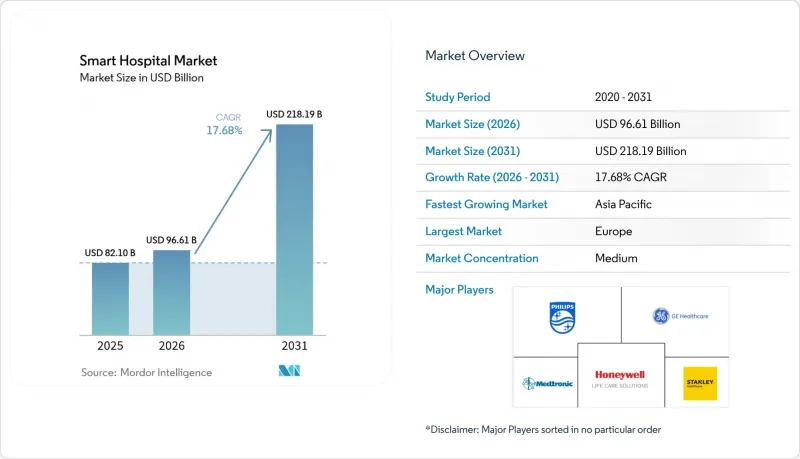
Mordor Intelligence에 의하면, 스마트 병원 시장 규모는 2025년에 821억 달러로 평가되었고, 2026년 966억 1,000만 달러에서 2031년까지 2,181억 9,000만 달러에 이를 것으로 예측되며, 예측 기간(2026년-2031년) CAGR은 17.68%를 기록할 전망입니다.
본 보고서는 구성 요소(하드웨어, 소프트웨어, 서비스), 용도(전자 진료 기록, 원격 환자 모니터링, 약국 자동화, 의료 자산 추적 등) 및 지역별로 분류되어 있습니다. 시장 예측은 금액(달러)으로 표시되어 있습니다.
세계 스마트 병원 시장 동향 및 인사이트
의료 인프라의 현대화
현대화를 위한 자금 투자가 현재의 성장 단계를 뒷받침하고 있습니다. '미국 구제 계획(American Rescue Plan)'에서는 의료시설을 위해 1조 달러가 배정되었으며, 여기에는 4억 5,200만 달러 규모의 노스 텍사스 주립 병원과 8억 5,500만 달러 규모의 유타주 의료 캠퍼스가 포함됩니다. 뉴욕주의 1억 8,800만 달러 규모의 ‘세이프티넷 혁신 프로그램(Safety Net Transformation Program)’은 전자건강기록(EHR) 통합에 중점을 두고 있으며, 정부가 기술 기반의 업그레이드에 의존하고 있음을 뒷받침합니다. 또한 병원에서는 센서 데이터, 자동 조명, 예측 유지보수를 처리하기 위한 디지털 인프라에 대한 투자도 이루어지고 있습니다. 이러한 종단간 업그레이드는 단편적인 개선을 대체하며, 스마트 병원 시장 전체에 견고한 수요를 창출하고 있습니다. 인프라, 소프트웨어, 서비스를 번들로 제공할 수 있는 공급업체는 총 소유 비용(TCO) 측면에서 경쟁 우위를 확보하고 있습니다.
연결 기기의 보급률 급증
스마트 병원에서는 방대한 양의 임상 데이터를 생성하는 IoT 지원 기기에 대한 의존도가 높아지고 있습니다. 삼성의료센터가 획득한 HIMSS의 ‘쿼드러플 스테이지 7’ 인증은 기기 데이터가 원활하게 통합됨으로써 효율성이 향상됨을 보여줍니다. 웨스트 헬스 인스티튜트(West Health Institute)의 추산에 따르면, 기기의 상호 운용성을 향상시킴으로써 중복 검사를 줄이고 연간 300억 달러의 비용을 절감할 수 있을 것으로 보입니다. 이러한 인센티브로 인해 병원의 조달 활동은 데이터 흐름을 통합하는 플랫폼으로 방향을 전환하고 있습니다. 기기 수 증가는 상호 운용성의 장벽을 높이고 있지만, 벤더 간의 통합과 개방형 프로토콜 덕분에 통합은 점차 용이해지고 있습니다. 따라서 기기 도입 가속화는 스마트 병원 시장을 활성화하는 동시에 표준 규격에 기반한 생태계 형성을 촉진합니다.
완전 연결형 시스템의 높은 설비 투자(Capex)
스마트 병원의 종합적인 도입에는 막대한 자본이 필요합니다. 벤더가 개발한 CPOE 시스템만 해도 710만 달러에서 1,930만 달러의 비용이 소요되며, 투자 회수(ROI) 기간은 8년 이상입니다. 중규모 병원은 이익률 압박과 공급망 내 물가 상승이라는 상황 속에서 이러한 지출을 감당하는 데 어려움을 겪고 있습니다. 하드웨어, 통합, 교육, 유지보수 비용이 총 소유 비용(TCO)을 끌어올려, 지출을 상쇄할 수 있는 대규모 네트워크에 유리하게 작용하고 있습니다. 이러한 자본 집약성으로 인해 신흥 시장이나 지방 의료시설에서의 도입이 주춤해지면서, 스마트 병원 시장의 단기적인 성장을 억제하고 있습니다.
부문 분석
2025년에는 병원이 디지털 운영에 필수적인 서버, 네트워크 장비, 영상 진단 시스템, 센서 어레이를 도입한 결과, 하드웨어가 최대 수익원이 되어 스마트 병원 시장 점유율의 45.30%를 차지했습니다. 스마트 병원 시장의 하드웨어 규모는 꾸준히 확대될 것으로 예상되지만, 서비스 부문은 2031년까지 연평균 성장률(CAGR) 20.78%라는 더 빠른 속도로 성장하고 있으며, 이는 관리형 유지보수, 분석, 수명 주기 지원에 대한 수요를 반영한 것입니다. 병원들은 설비 투자(Capex)를 운영비(OpEx)로 전환하고, 최신 전문 지식을 활용하면서 지출을 예측 가능하게 하는 다년간의 서비스 계약을 선호하는 경향이 있습니다. 지멘스 헬시니어스(Siemens Healthineers)와 같은 벤더들은 이러한 요구에 부응하기 위해 국내 제조 거점 및 서비스 거점을 확대되고 있습니다.
이러한 서비스 확대 추세는 하드웨어 중심의 수익 모델에 과제를 안겨주고 있습니다. 각 공급업체는 설치, 원격 모니터링, AI를 활용한 최적화를 성과 연계형 계약에 포함시키고 있습니다. 이러한 가치의 전환은 벤더 종속성을 강화하는 한편, 고객의 운영 위험을 줄여줍니다. 소프트웨어는 양자 사이에 위치하며, 현장 IT 부담을 경감시키는 동시에 기능의 신속한 배포를 가능하게 하는 클라우드 제공의 이점을 누리고 있습니다. 이를 종합해 보면, 하드웨어의 신뢰성, 스마트 소프트웨어, 그리고 서비스의 충실도가 하나로 어우러진 제안이 스마트 병원 시장 전체의 경쟁력 동향을 형성하고 있습니다.
지역별 분석
북미는 성숙한 인프라, 연방 정부의 경기 부양책, 그리고 강력한 벤더 생태계의 뒷받침을 받아 2025년 스마트 병원 시장 점유율의 40.45%를 차지했습니다. ‘미국 구제 계획’에 포함된 1조 달러 규모의 의료 예산 배분은 시설 업그레이드를 뒷받침하고 있으며, 뉴욕주의 1억 8,800만 달러 규모 ‘세이프티넷 트랜스포메이션(Safety Net Transformation)’ 프로그램 등은 전자의무기록(EHR) 및 응급 의료 역량 향상을 추진하고 있습니다. 가스리 클리닉이 700만 달러의 인건비 절감을 실현한 사례로 대표되는 가상 간호 허브는 디지털 투자를 통한 실현 가능한 수익을 보여주고 있습니다. 그러나 공급망 부족으로 인해 평균 5개 병원으로 구성된 네트워크에서 350만 달러의 손실이 발생하고 있어 취약성이 부각되고 있습니다.
아시아태평양은 가장 빠르게 성장하는 지역으로, 2031년까지 연평균 성장률(CAGR)이 19.62%를 나타낼 것으로 예측됩니다. 중국의 ‘트리니티’ 정책은 스마트 의료, 서비스, 관리를 병원 건설의 핵심으로 삼고 있으며, 국내 스마트 헬스케어 시장 규모는 1,500억 위안으로 성장하고 있습니다. 태국의 시릴라트 5G 스마트 병원에서는 진단 시간을 15분에서 25초로 단축하여, 고도화된 연결성이 임상 현장에 미치는 효과를 입증했습니다. 한국의 삼성의료원은 HIMSS 쿼드러플 스테이지 7을 달성하여 지역 내 벤치마크를 확립했습니다. ZTE와 차이나텔레콤이 구축한 5G IoT 네트워크 등 벤더 간 협력을 통해 업그레이드 비용을 80%, 구축 기간을 90% 절감할 수 있었습니다(ZTE).
유럽은 중간 위치를 차지하고 있으며, ‘유럽 헬스 데이터 스페이스(European Health Data Space)’에 힘입어 향후 10년간 110억 유로의 비용 절감이 예상됩니다. 사이버 사고는 여전히 과제로 남아 있으며, 이에 대응하기 위해 조만간 ‘사이버 보안 지원 센터’가 설립될 예정입니다. DIGITALEUROPE는 AI, 원격의료, 상호운용 가능한 데이터 시스템에 대한 접근을 보장하기 위해 디지털 헬스 분야에 대한 EU의 전용 자금 지원을 요청하고 있습니다. 조율된 프레임워크와 자금 조달을 통해 이 지역은 착실한 도입을 위한 태세를 갖추고 있으며, 스마트 병원 시장의 장기적인 확대가 촉진될 전망입니다.
기타 혜택:
- 엑셀 형식 시장 예측(ME) 시트
- 3개월간 애널리스트 지원
자주 묻는 질문
목차
제1장 서론
제2장 조사 방법
제3장 주요 요약
제4장 시장 구도
제5장 시장 규모와 성장 예측
제6장 경쟁 구도
제7장 시장 기회와 향후 전망
LSH 26.09.04According to Mordor Intelligence, the smart hospital market size was valued at USD 82.10 billion in 2025 and estimated to grow from USD 96.61 billion in 2026 to reach USD 218.19 billion by 2031, at a CAGR of 17.68% during the forecast period (2026-2031).
This report is Segmented by Component (Hardware, Software, and Services), Application (Electronic Health Record, Remote Patient Monitoring, Pharmacy Automation, Medical Asset Tracking, and More), and Geography. The Market Forecasts are Provided in Terms of Value (USD).
Global Smart Hospital Market Trends and Insights
Modernisation of Healthcare Infrastructure
Modernisation funding anchors the current growth phase. The American Rescue Plan apportioned USD 1 trillion for healthcare facilities, including a USD 452 million North Texas State Hospital and a USD 855 million Utah medical campus. New York's USD 188 million Safety Net Transformation Programme targets EHR integrations, confirming government reliance on technology-enabled upgrades.Hospitals also invest in digital backbones to handle sensor data, automated lighting, and predictive maintenance. These end-to-end upgrades displace piecemeal fixes, creating robust demand across the smart hospital market. Vendors able to bundle infrastructure, software, and services gain a competitive cost-of-ownership edge.
Surge in Connected-Device Penetration
Smart hospitals increasingly rely on IoT-enabled devices that produce high-volume clinical data. Samsung Medical Centre's HIMSS Quadruple Stage 7 certification shows efficiency gains when device data integrates seamlessly. West Health Institute estimates that better device interoperability could save USD 30 billion each year by cutting redundant testing. This incentive drives hospital procurement toward platforms that unify data flows. While device proliferation raises interoperability hurdles, vendor consolidation and open protocols are easing integration. Accelerating device adoption, therefore, boosts the smart hospital market while spurring standards-based ecosystems.
High Capex of Fully Connected Systems
Comprehensive smart hospital roll-outs demand significant capital. Vendor-developed CPOE systems alone can cost USD 7.1 million to USD 19.3 million, with ROI horizons of eight years or more. Mid-sized hospitals struggle to meet these outlays amid margin pressure and supply chain inflation. Hardware, integration, training, and maintenance amplify total cost of ownership, favouring large networks that can amortise spending. Capital intensity thus slows adoption in emerging markets and rural facilities, tempering short-term growth in the smart hospital market.
Other drivers and restraints analyzed in the detailed report include:
- Government Smart-Hospital Stimulus Programmes
- Nursing-Staff Shortages Accelerating Virtual-Care Adoption
- Cyber-Security and Data-Governance Liabilities
For complete list of drivers and restraints, kindly check the Table Of Contents.
Segment Analysis
Hardware generated the largest component revenue, securing 45.30% of the smart hospital market share in 2025 as hospitals installed servers, networking gear, imaging systems, and sensor arrays essential for digital operations. The smart hospital market size for hardware is projected to expand steadily, yet the services segment is growing faster at a 20.78% CAGR through 2031, reflecting demand for managed maintenance, analytics, and lifecycle support. Hospitals gravitate toward multi-year service contracts that convert capex to opex, ensuring predictable spend while accessing up-to-date expertise. Vendors such as Siemens Healthineers are expanding domestic manufacturing and service hubs to meet that need.
The services uptrend challenges hardware-centric revenue models. Providers bundle installation, remote monitoring, and AI-driven optimisation into outcome-linked agreements. This value shift boosts vendor lock-in yet lowers client operational risk. Software stands between the two, benefiting from cloud delivery that reduces onsite IT burden while enabling rapid feature deployment. Taken together, hardware reliability, smart software, and service depth create integrated propositions that shape competitive dynamics across the smart hospital market.
Complete Report Scope:
- By Component
- Hardware
- Software
- Services
- By Application
- Electronic Health Record
- Remote Patient Monitoring
- Pharmacy Automation
- Medical Asset Tracking
- Other Applications
- By Geography
- North America
- United States
- Canada
- South America
- Brazil
- Argentina
- Rest of South America
- Europe
- Germany
- United Kingdom
- France
- Spain
- Russia
- Rest of Europe
- Asia-Pacific
- China
- Japan
- India
- South Korea
- Rest of Asia-Pacific
- Middle East
- Saudi Arabia
- United Arab Emirates
- Rest of Middle East
- Africa
- South Africa
- Nigeria
- Rest of Africa
- North America
Geography Analysis
North America captured 40.45% of the smart hospital market share in 2025, buoyed by mature infrastructure, federal stimulus, and strong vendor ecosystems. The American Rescue Plan's USD 1 trillion healthcare allocation fuels facility upgrades, while programmes such as New York's USD 188 million Safety Net Transformation advance EHR and emergency capabilities. Virtual nursing hubs, exemplified by Guthrie Clinic's USD 7 million labour savings, demonstrate achievable returns on digital investments. Yet supply chain shortages cost an average of five-hospital networks USD 3.5 million, highlighting vulnerability.
Asia-Pacific is the fastest-growing region, projected at a 19.62% CAGR to 2031. China's Trinity policy places smart medicine, services, and management at the core of hospital construction, with national smart healthcare value heading toward 150 billion yuan. Thailand's Siriraj 5G Smart Hospital cut diagnosis time from 15 minutes to 25 seconds, showcasing the clinical impact of advanced connectivity. South Korea's Samsung Medical Centre achieved HIMSS Quadruple Stage 7, setting a regional benchmark. Vendor collaborations, such as ZTE's 5G IoT network with China Telecom, trimmed upgrade costs by 80% and build time by 90% ZTE.
Europe occupies a midway position, supported by the European Health Data Space, which could save EUR 11 billion over a decade. Cyber incidents remain a challenge, prompting a forthcoming Cybersecurity Support Centre. DIGITALEUROPE urges dedicated EU funding for digital health to ensure access to AI, telehealth, and interoperable data systems. With coordinated frameworks and funding, the region is poised for steady adoption, enhancing the long-term expansion of the smart hospital market.
- Koninklijke Philips N.V.
- GE Healthcare (General Electric)
- Siemens Healthineers
- Medtronic plc
- Honeywell Life Care Solutions
- Schneider Electric
- Microsoft Corporation
- Oracle Health (Cerner)
- Allscripts Healthcare Solutions
- Cisco Systems
- IBM Watson Health
- SAP SE
- STANLEY Healthcare
- ThoughtWire Corp.
- McKesson Corporation
- Epic Systems
- BD (Becton Dickinson)
- Abbott Laboratories
- Huawei Technologies
- Johnson Controls Digital Health
Additional Benefits:
- The market estimate (ME) sheet in Excel format
- 3 months of analyst support
TABLE OF CONTENTS
1 INTRODUCTION
- 1.1 Study Assumptions and Market Definition
- 1.2 Scope of the Study
2 RESEARCH METHODOLOGY
3 EXECUTIVE SUMMARY
4 MARKET LANDSCAPE
- 4.1 Market Overview
- 4.2 Market Drivers
- 4.2.1 Modernization of healthcare infrastructure
- 4.2.2 Surge in connected?device penetration
- 4.2.3 Government smart-hospital stimulus programs (e.g., Chinas Trinity policy)
- 4.2.4 Corporate net-zero mandates driving smart-building retrofits
- 4.2.5 Nursing-staff shortages accelerating virtual-care adoption
- 4.2.6 6G-ready network pilots enabling near-real-time analytics
- 4.3 Market Restraints
- 4.3.1 High capex of fully connected systems
- 4.3.2 Cyber-security and data-governance liabilities
- 4.3.3 Inter-vendor interoperability gaps
- 4.3.4 Limited digital-skills workforce in developing regions
- 4.4 Industry Value Chain Analysis
- 4.5 Regulatory Landscape
- 4.6 Technological Outlook
- 4.7 Porter's Five Forces Analysis
- 4.7.1 Threat of New Entrants
- 4.7.2 Bargaining Power of Suppliers
- 4.7.3 Bargaining Power of Consumers
- 4.7.4 Threat of Substitutes
- 4.7.5 Intensity of Competitive Rivalry
5 MARKET SIZE AND GROWTH FORECASTS (VALUE)
- 5.1 By Component
- 5.1.1 Hardware
- 5.1.2 Software
- 5.1.3 Services
- 5.2 By Application
- 5.2.1 Electronic Health Record
- 5.2.2 Remote Patient Monitoring
- 5.2.3 Pharmacy Automation
- 5.2.4 Medical Asset Tracking
- 5.2.5 Other Applications
- 5.3 By Geography
- 5.3.1 North America
- 5.3.1.1 United States
- 5.3.1.2 Canada
- 5.3.2 South America
- 5.3.2.1 Brazil
- 5.3.2.2 Argentina
- 5.3.2.3 Rest of South America
- 5.3.3 Europe
- 5.3.3.1 Germany
- 5.3.3.2 United Kingdom
- 5.3.3.3 France
- 5.3.3.4 Spain
- 5.3.3.5 Russia
- 5.3.3.6 Rest of Europe
- 5.3.4 Asia-Pacific
- 5.3.4.1 China
- 5.3.4.2 Japan
- 5.3.4.3 India
- 5.3.4.4 South Korea
- 5.3.4.5 Rest of Asia-Pacific
- 5.3.5 Middle East
- 5.3.5.1 Saudi Arabia
- 5.3.5.2 United Arab Emirates
- 5.3.5.3 Rest of Middle East
- 5.3.6 Africa
- 5.3.6.1 South Africa
- 5.3.6.2 Nigeria
- 5.3.6.3 Rest of Africa
- 5.3.1 North America
6 COMPETITIVE LANDSCAPE
- 6.1 Market Concentration
- 6.2 Strategic Moves
- 6.3 Market Share Analysis
- 6.4 Company Profiles (includes Global level Overview, Market level overview, Core Segments, Financials as available, Strategic Information, Market Rank/Share, Products and Services, Recent Developments)
- 6.4.1 Koninklijke Philips N.V.
- 6.4.2 GE Healthcare (General Electric)
- 6.4.3 Siemens Healthineers
- 6.4.4 Medtronic plc
- 6.4.5 Honeywell Life Care Solutions
- 6.4.6 Schneider Electric
- 6.4.7 Microsoft Corporation
- 6.4.8 Oracle Health (Cerner)
- 6.4.9 Allscripts Healthcare Solutions
- 6.4.10 Cisco Systems
- 6.4.11 IBM Watson Health
- 6.4.12 SAP SE
- 6.4.13 STANLEY Healthcare
- 6.4.14 ThoughtWire Corp.
- 6.4.15 McKesson Corporation
- 6.4.16 Epic Systems
- 6.4.17 BD (Becton Dickinson)
- 6.4.18 Abbott Laboratories
- 6.4.19 Huawei Technologies
- 6.4.20 Johnson Controls Digital Health
7 MARKET OPPORTUNITIES AND FUTURE OUTLOOK
- 7.1 White-space and Unmet-need Assessment