|
시장보고서
상품코드
2123821
자동차용 소프트웨어 시장 : 내연기관(ICE) 및 전기자동차(EV) 용도별, 소프트웨어 층별, 차량 유형별, 판매 채널별, 추진 방식별, 지역별 예측(-2033년)Automotive Software Market by ICE & EV Application, Sales Channel, Software Layer, Vehicle Type, Propulsion, and Region-Global Forecast to 2033 |
||||||

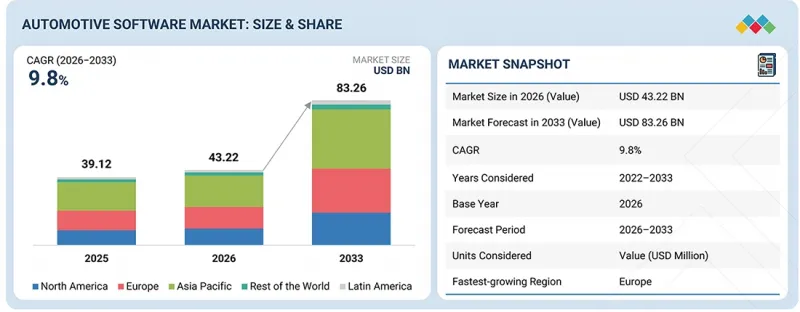
세계의 자동차용 소프트웨어 시장 규모는 2026년 432억 2,000만 달러로 추정되고, 2033년까지 832억 6,000만 달러로 성장이 전망되며, CAGR 9.8%로 확대될 것으로 예측됩니다.
차량이 소프트웨어 기반 기능에 대한 의존도를 높이고 있는 만큼, 자동차용 소프트웨어 시장은 통합형 소프트웨어 플랫폼으로 전환되고 있습니다.
| 조사 범위 | |
|---|---|
| 조사 대상 기간 | 2026-2033년 |
| 기준 연도 | 2025년 |
| 예측 기간 | 2026-2033년 |
| 대상 단위 | 10억 달러 |
| 부문 | 내연기관(ICE) 및 전기자동차(EV) 용도별, 소프트웨어 층별, 차량 유형별, 판매 채널별, 추진 방식별, 지역별 |
| 대상 지역 | 아시아태평양, 북미, 유럽, 라틴아메리카 및 세계 기타 지역 |
각 OEM 업체들은 차량 개발을 간소화하고 소프트웨어 시스템의 복잡화에 대응하기 위해 중앙 집중형 컴퓨팅 아키텍처, 도메인 컨트롤러 및 가상화된 소프트웨어 환경을 채택하고 있습니다. 동시에, 각 제조업체는 소프트웨어 기술 제공업체와 협력하여 자율 주행, 커넥티드 서비스 및 디지털 차량 애플리케이션 개발을 가속화하고 있습니다. 이러한 변화로 인해 각 OEM은 차량의 전체 수명 주기 동안 기능의 지속적인 개선, 신속한 업데이트 및 새로운 수익 기회를 뒷받침하는 소프트웨어 기능에 집중하고 있습니다.
예측 기간 동안 애플리케이션 소프트웨어 부문은 가장 큰 소프트웨어 계층이 될 것으로 예측됩니다.
애플리케이션 소프트웨어는 커넥티드 인포테인먼트 시스템, 온라인 내비게이션 서비스 및 차량용 디지털 기능의 채택 확대에 힘입어 자동차 소프트웨어 시장에서 강력한 성장 기회를 보일 것으로 예측됩니다. OEM 각사는 내비게이션, 멀티미디어, 음성 어시스턴트, 커넥티비티 서비스 및 개인화된 용도를 결합한 소프트웨어 기반의 콕핏 솔루션에 주력하여 차량 내 경험을 향상시키고 있습니다. 커넥티드카 플랫폼의 활용이 확대됨에 따라, 실시간 정보, 클라우드 기반 서비스, 지속적인 기능 업데이트를 제공할 수 있는 애플리케이션 소프트웨어에 대한 수요가 높아지고 있습니다. 예를 들어, 2026년 5월, HERE Technologies는 현대오토에버와의 제휴를 확대하여 유럽 내 현대, 기아, 제네시스 차량에 온라인 내비게이션 소프트웨어를 제공하게 되었습니다. 이 솔루션은 HERE의 커넥티드 내비게이션 플랫폼과 현대오토에버의 인포테인먼트 시스템을 통합하여 실시간 교통 정보, 동적 경로 안내, 온라인 검색 및 최신 지도 서비스를 제공합니다. 인포테인먼트와 커넥티드 용도의 통합이 진행됨에 따라, 예측 기간 동안 자동차용 애플리케이션 소프트웨어의 채택이 촉진될 것으로 예측됩니다.
예측 기간 동안 자율주행 부문은 전기차 애플리케이션 중 가장 빠르게 성장하는 분야가 될 전망입니다.
OEM 및 기술 제공업체들이 기본적인 운전 보조 기능에서 소프트웨어 주도형 자율주행 시스템으로 전환함에 따라, 오토파일럿은 자동차 소프트웨어 시장에서 가장 빠르게 성장하는 EV 애플리케이션이 될 것으로 예측됩니다. 이에 따라 ADAS의 지각, 센서 퓨전, 위치 추정, 자율주행 알고리즘, 의사결정, 차량 제어 등의 소프트웨어에 대한 수요가 증가하고 있습니다. 자동화 수준이 향상됨에 따라 차량당 소프트웨어 탑재량도 증가하여, 기능 업그레이드, 구독 서비스, OTA 업데이트를 통해 지속적인 수익 기회가 창출됩니다. 각 OEM 업체에게 오토파일럿 기능은 프리미엄 모델을 차별화하고 소프트웨어 정의 차량(SDV)으로의 전환을 촉진하는 중요한 수단이 되고 있습니다. 상용차 제조업체들도 차량군의 효율성과 안전성을 향상시키기 위해 자율주행 소프트웨어에 대한 투자를 확대되고 있습니다. 예를 들어, 2026년 2월, 칼산(Karsan)은 지각, 위치 추정, 의사 결정, 차량 제어 시스템 등의 자율주행 소프트웨어 기능을 통합하여 자사의 전기 버스 ‘e ATAK’의 자율주행 버전을 발표했습니다. 자율주행 기능의 활용이 확대됨에 따라, 향후 차량 개발 및 제품 차별화 측면에서 소프트웨어의 중요성은 더욱 높아질 것으로 예측됩니다.
유럽은 자동차 소프트웨어 시장에서 큰 점유율을 차지할 것으로 예측됩니다.
유럽은 ADAS, 자율주행, 디지털 콕핏, 커넥티비티 및 차량 운영 체제 분야에서 OEM 및 기술 제공업체들의 강력한 소프트웨어 투자에 힘입어, 전 세계 자동차 소프트웨어 시장에서 큰 점유율을 차지할 것으로 예측됩니다. 유럽의 각 OEM 업체들은 여러 차종에 걸쳐 소프트웨어 기능을 전개하기 위해 중앙 집중식 컴퓨팅과 공통 소프트웨어 플랫폼을 채택하고 있습니다. 예를 들어, 메르세데스-벤츠는 신형 CLA를 포함한 자율주행 및 지능형 콕핏 기능을 지원하기 위해 NVIDIA DRIVE AGX, DRIVE OS 및 MB.OS를 통합하고 있습니다. BMW 그룹은 디지털 콕핏, 커넥티비티 및 ADAS 기능에 퀄컴의 ‘Snapdragon Digital Chassis’를 채택하고 있습니다. 스텔란티스 또한 콕핏, 커넥티비티 및 ADAS 용도를 지원하기 위해 자사의 전체 차량 플랫폼에 ‘Snapdragon Digital Chassis’를 채택하고 있습니다. 이러한 동향으로 인해 ADAS 및 안전 시스템, 인포테인먼트, 차량 관리·텔레매틱스, 자율주행 용도 전반에 걸쳐 소프트웨어 수요가 증가하는 한편, Tier 1 공급업체에게는 여러 OEM 차량 프로그램에 걸쳐 소프트웨어 플랫폼을 제공할 기회가 생겨나고 있습니다.
자동차 소프트웨어 시장에서 사업을 전개하는 주요 조직의 CEO, 마케팅 책임자, 기타 혁신 및 기술 책임자, 그리고 임원을 대상으로 상세한 인터뷰를 실시했습니다. 주요 인터뷰 대상은 다음과 같습니다.
자동차 소프트웨어 시장에는 Robert Bosch GmbH(독일), NVIDIA Corporation(미국), NXP Semiconductors(네덜란드), Mobileye(이스라엘), AUMOVIO(독일) 등의 주요 제조업체가 포함됩니다.
조사 범위 :
본 조사는 자동차 소프트웨어 시장의 다양한 부문을 대상으로 합니다. 내연기관(ICE)용 애플리케이션, 전기자동차(EV)용 애플리케이션, 소프트웨어 계층, 차종, 지역 등 서로 다른 부문별로 시장 규모와 향후 성장 가능성을 추정하는 것을 목적으로 합니다. 또한, 주요 시장 참여자에 대한 상세한 경쟁 분석, 각 기업의 프로파일, 제품 및 사업 제공과 관련된 주요 관찰 사항, 최근 동향, 그리고 인수 합병 사례에 대해서도 다루고 있습니다.
본 조사 보고서에서는 자동차용 소프트웨어 시장을 ICE(내연기관)용 애플리케이션(ADAS 및 안전 시스템, 오토파일럿, 차량 제어 및 편의 시스템, 인포테인먼트 시스템, 엔진 관리 및 파워트레인, 차량 텔레매틱스), EV(전기차)용 애플리케이션(배터리 관리 시스템, ADAS 및 안전 시스템, 자율 주행, 차량 제어 및 편의 시스템, 인포테인먼트 시스템, 전기 구동, 엔진 관리 및 파워트레인, 차량 텔레매틱스), 차종(승용차, 소형 상용차, 대형 상용차), 추진 방식(전기자동차(EV), 내연기관(ICE)), 판매 채널(OEM, 애프터마켓), 소프트웨어 계층(운영체제, 미들웨어, 애플리케이션 소프트웨어), 지역(아시아태평양, 유럽, 북미, 라틴아메리카, 기타 지역)별로 분류하고 있습니다.
본 보고서의 범위에는 자동차 소프트웨어 시장의 성장에 영향을 미치는 주요 요인(촉진요인, 제약 요인, 과제 및 기회 등)에 대한 상세 정보가 포함되어 있습니다. 주요 업계 기업에 대한 상세한 분석을 통해 각 기업의 사업 개요, 솔루션, 서비스,주요 전략, 계약, 파트너십, 합의 사항, 신제품 및 서비스 출시, 합병 및 인수, 그리고 자동차 소프트웨어 시장과 관련된 최근 동향에 대한 인사이트를 제공합니다. 본 보고서에서는 자동차 소프트웨어 시장 생태계 내 중소기업(SME) 및 스타트업 기업의 경쟁 분석에 대해서도 다루고 있습니다.
본 보고서를 구매해야 하는 이유 :
본 보고서는 자동차 소프트웨어 시장 전체 및 각 하위 부문의 매출에 대한 가장 정확한 추정치를 제공함으로써, 이 시장 시장 선도 기업과 신규 진출기업을 지원합니다. 또한 이해관계자가 경쟁 구도를 이해하고, 자사의 비즈니스를 더 나은 위치로 이끌며, 적절한 시장 진출 전략을 수립하기 위한 추가적인 인사이트력을 얻는 데 도움이 됩니다. 더불어 본 보고서는 이해관계자가 시장 동향을 파악하는 데 도움을 주며, 주요 시장 성장 촉진요인, 억제요인, 과제 및 기회에 대한 정보를 제공합니다.
본 보고서는 다음 사항에 대한 인사이트력을 제공합니다.
- 주요 촉진요인 분석(소프트웨어 정의 차량(SDV)으로의 전환, 소프트웨어의 보조 기능에서 차량 핵심 플랫폼으로의 변혁, 분산형 ECU에서 중앙 집중형 차량 컴퓨팅 플랫폼으로의 전환, AI 기반 차량 인텔리전스 및 자율 컴퓨팅에 따른 차량 도메인 전반에 걸친 소프트웨어 복잡성 증가), 제약 요인(소프트웨어 수익화를 지연시키는 분산된 소프트웨어 아키텍처 및 레거시 차량 플랫폼), 기회(새로운 자동차 소프트웨어 생태계를 창출하는 AI 네이티브 차량 플랫폼, ‘온디맨드 기능’ 및 플릿 기반 SaaS 플랫폼을 통한 소프트웨어 수익화), 그리고 과제(구독형 비즈니스 모델을 통한 지속 가능한 소프트웨어 수익성 실현) 등, 자동차 소프트웨어 시장의 성장에 영향을 미치는 요인
- 제품 개발 및 혁신 : 자동차 소프트웨어 시장의 향후 기술, 연구개발 활동, 그리고 제품 및 서비스 출시에 대한 상세한 인사이트
- 시장 개발 : 수익성이 높은 시장에 대한 종합적인 정보(본 보고서에서는 다양한 지역에 걸친 자동차 소프트웨어 시장을 분석하고 있습니다)
- 시장 다각화 : 자동차 소프트웨어 시장의 신제품 및 서비스, 미개척 지역, 최근 동향 및 투자에 대한 종합적인 정보
- 경쟁 분석 : 자동차 소프트웨어 시장에서 Robert Bosch GmbH(독일), NVIDIA Corporation(미국), NXP Semiconductors(네덜란드), Mobileye(이스라엘), AUMOVIO(독일)와 같은 주요 기업의 시장 점유율, 성장 전략 및 서비스 제공 내용에 대한 상세한 평가
자주 묻는 질문
목차
제1장 서론
제2장 주요 요약
제3장 프리미엄 인사이트
제4장 시장 개요
제5장 업계 동향
제6장 기술 진보, AI의 영향, 특허, 혁신, 그리고 향후 용도
제7장 규제 상황 및 지속가능성 이니셔티브
제8장 고객 현황 및 구매 행동
제9장 자동차 소프트웨어 시장 : ICE 용도별
제10장 자동차용 소프트웨어 시장 : 소프트웨어 층별
제11장 자동차 소프트웨어 시장 : 차량 유형별
제12장 자동차용 소프트웨어 시장 : EV 용도별
제13장 자동차 소프트웨어 시장 : 판매 채널별
제14장 자동차용 소프트웨어 시장 : 추진 방식별
제15장 자동차 소프트웨어 시장 : 지역별
제16장 경쟁 구도
제17장 기업 개요
제18장 조사 방법
제19장 부록
AJYThe global automotive software market size is projected to grow from USD 43.22 billion in 2026 to USD 83.26 billion by 2033, at a CAGR of 9.8%. The automotive software market is moving toward integrated software platforms as vehicles are becoming more dependent on software-driven functions.
| Scope of the Report | |
|---|---|
| Years Considered for the Study | 2026-2033 |
| Base Year | 2025 |
| Forecast Period | 2026-2033 |
| Units Considered | USD billion |
| Segments | ICE & EV Application, Sales Channel, Software Layer, Vehicle Type, Propulsion, and Region |
| Regions covered | Asia Pacific, North America, Europe, Latin America, and Rest of the World |
OEMs are adopting centralized computing architectures, domain controllers, and virtualized software environments to simplify vehicle development and manage the growing complexity of software systems. At the same time, manufacturers are also working with software technology providers to accelerate the development of autonomous driving, connected services, and digital vehicle applications. This shift is encouraging OEMs to focus on software capabilities that support continuous feature improvements, faster updates, and new revenue opportunities throughout the vehicle lifecycle.
The application software segment is expected to be the largest software layer during the forecast period.
Application software is expected to witness strong growth opportunities in the automotive software market, supported by the increasing adoption of connected infotainment systems, online navigation services, and digital features in vehicles. OEMs are focusing on software-based cockpit solutions that combine navigation, multimedia, voice assistance, connectivity services, and personalized applications to improve the in-vehicle experience. The growing use of connected vehicle platforms is increasing the demand for application software that can provide real-time information, cloud-based services, and continuous feature updates. For instance, in May 2026, HERE Technologies expanded its partnership with Hyundai AutoEver to provide online navigation software for Hyundai, Kia, and Genesis vehicles in Europe. The solution integrates HERE's connected navigation platform with Hyundai AutoEver's infotainment system to deliver real-time traffic information, dynamic route guidance, online search, and updated map services. The increasing integration of infotainment and connected applications is expected to drive the adoption of automotive application software during the forecast period.
The autopilot segment is likely to be the fastest-growing EV application during the forecast period.
Autopilot is expected to be the fastest-growing EV application in the automotive software market as OEMs and technology providers move from basic driver assistance features toward software-driven autonomous driving systems. This is increasing demand for software such as ADAS perception, sensor fusion, localization, automated driving algorithms, decision-making, and vehicle control. Higher levels of automation also increase software content per vehicle and create opportunities for recurring revenue through feature upgrades, subscriptions, and OTA updates. For OEMs, Autopilot capabilities are becoming an important way to differentiate premium models and support the shift toward software-defined vehicles. Commercial vehicle manufacturers are also investing in autonomous software to improve fleet efficiency and safety. For instance, in February 2026, Karsan introduced the autonomous version of its e ATAK electric bus by integrating autonomous driving software capabilities, including perception, localization, decision-making, and vehicle control systems. The growing use of autonomous functions is expected to increase the importance of software in future vehicle development and product differentiation.
Europe is expected to hold a significant share in the automotive software market.
Europe is expected to hold a significant share of the global automotive software market, supported by strong software investments by OEMs and technology providers in ADAS, automated driving, digital cockpit, connectivity, and vehicle operating systems. European OEMs are adopting centralized computing and common software platforms to deploy software functions across multiple vehicle models. For instance, Mercedes-Benz is integrating NVIDIA DRIVE AGX, DRIVE OS, and MB.OS to support automated driving and intelligent cockpit functions, including the new CLA. BMW Group is using Qualcomm's Snapdragon Digital Chassis for digital cockpit, connectivity, and ADAS functions. Stellantis is also adopting the Snapdragon Digital Chassis across its vehicle platforms to support cockpit, connectivity, and ADAS applications. These developments are increasing software demand across ADAS and safety systems, infotainment, vehicle management and telematics, and autonomous driving applications, while creating opportunities for Tier 1 suppliers to provide software platforms across multiple OEM vehicle programs.
In-depth interviews were conducted with CEOs, marketing directors, other innovation and technology directors, and executives from various key organizations operating in the automotive software market. The breakdown of the primary interviews is as follows:
- By Company Type: OEMs - 40%, Tier I & Tier II - 60%
- By Designation: C-Level Executives - 15%, Directors - 20%, and Executives - 65%
- By Region: North America - 30%, Europe - 35%, Asia Pacific - 25%, Latin America - 6%, and Rest of the World - 4%
The automotive software market comprises major manufacturers such as Robert Bosch GmbH (Germany), NVIDIA Corporation (US), NXP Semiconductors (Netherlands), Mobileye (Israel), and AUMOVIO (Germany).
Research Coverage:
The study covers the automotive software market across various segments. It aims to estimate the market size and future growth potential of this market across different segments such as ICE application, EV application, software layer, vehicle type, and region. The study also includes an in-depth competitive analysis of key market players, their company profiles, key observations related to product and business offerings, recent developments, and acquisitions.
This research report categorizes the Automotive Software Market by ICE Application (ADAS & Safety Systems, Auto Pilot, Body Control & Comfort Systems, Infotainment Systems, Engine Management & Powertrain, and Vehicle Telematics), EV Application (Battery Management Systems, ADAS & Safety Systems, Autonomous Driving, Body Control & Comfort Systems, Infotainment Systems, Electric Drive, Engine Management & Powertrain, and Vehicle Telematics), Vehicle Type (Passenger Cars, Light Commercial Vehicles, Heavy Commercial Vehicles), Propulsion (Electric Vehicle (EV), Internal Combustion Engine (ICE)), Sales Channel (OEM, Aftermarket), Software Layer (Operating System, Middleware, and Application Software), and Region (Asia Pacific, Europe, North America, Latin America, and Rest of the World).
The report's scope covers detailed information regarding the major factors, such as drivers, restraints, challenges, and opportunities, influencing the growth of the automotive software market. A detailed analysis of the key industry players provides insights into their business overview, solutions, and services; key strategies; contracts, partnerships, agreements, new product & service launches, mergers and acquisitions, and recent developments associated with the automotive software market. Competitive analysis of SMEs/startups in the automotive software market ecosystem is covered in this report.
Reasons to buy this report:
The report will help the market leaders/new entrants in this market with information on the closest approximations of the revenue numbers for the overall automotive software market and the subsegments. This report will help stakeholders understand the competitive landscape and gain more insights to position their businesses better and to plan suitable go-to-market strategies. The report will also help stakeholders understand the market pulse and provide information on key market drivers, restraints, challenges, and opportunities.
The report provides insights on the following pointers:
- Analysis of key Drivers (Transition to Software-defined Vehicles (SDVs) Transforming Software from a Supporting Function to a Core Vehicle Platform, Shift from Distributed ECUs to Centralized Vehicle Compute Platforms, AI-driven Vehicle Intelligence and Autonomous Computing Increasing Software Complexity Across Vehicle Domains), Restraints (Fragmented Software Architectures and Legacy Vehicle Platforms Delaying Software Monetization), Opportunities (AI-Native Vehicle Platforms Creating New Automotive Software Ecosystem, Software monetization through Feature on Demand and Fleet-based SaaS platforms), and Challenges (Achieving Sustainable Software Profitability Through Subscription-based Business Models) influencing the growth of the automotive software market
- Product Development/Innovation: Detailed insights into upcoming technologies, research & development activities, and product & service launches in the automotive software market
- Market Development: Comprehensive information about lucrative markets (the report analyzes the automotive software market across varied regions)
- Market Diversification: Exhaustive information about new products & services, untapped geographies, recent developments, and investments in the automotive software market
- Competitive Assessment: In-depth assessment of market shares, growth strategies, and service offerings of leading players like Robert Bosch GmbH (Germany), NVIDIA Corporation (US), NXP Semiconductors (Netherlands), Mobileye (Israel), and AUMOVIO (Germany) in the automotive software market
TABLE OF CONTENTS
1 INTRODUCTION
- 1.1 STUDY OBJECTIVES
- 1.2 MARKET DEFINITION
- 1.2.1 INCLUSIONS AND EXCLUSIONS
- 1.3 STUDY SCOPE
- 1.3.1 YEARS CONSIDERED
- 1.4 CURRENCY CONSIDERED
- 1.5 STAKEHOLDERS
- 1.6 SUMMARY OF CHANGES
2 EXECUTIVE SUMMARY
- 2.1 KEY INSIGHTS AND MARKET HIGHLIGHTS
- 2.2 KEY MARKET PARTICIPANTS: INSIGHTS AND STRATEGIC DEVELOPMENTS
- 2.3 DISRUPTIVE TRENDS SHAPING AUTOMOTIVE SOFTWARE MARKET
- 2.4 HIGH-GROWTH SEGMENTS & EMERGING FRONTIERS
- 2.5 SNAPSHOT: GLOBAL MARKET SIZE, GROWTH RATE, AND FORECAST
3 PREMIUM INSIGHTS
- 3.1 ATTRACTIVE OPPORTUNITIES FOR PLAYERS IN AUTOMOTIVE SOFTWARE MARKET
- 3.2 AUTOMOTIVE SOFTWARE MARKET, BY ICE APPLICATION
- 3.3 AUTOMOTIVE SOFTWARE MARKET, BY SOFTWARE LAYER
- 3.4 AUTOMOTIVE SOFTWARE MARKET, BY EV APPLICATION
- 3.5 AUTOMOTIVE SOFTWARE MARKET, BY VEHICLE TYPE
- 3.6 AUTOMOTIVE SOFTWARE MARKET, BY PROPULSION
- 3.7 AUTOMOTIVE SOFTWARE MARKET, BY SALES CHANNEL
- 3.8 AUTOMOTIVE SOFTWARE MARKET, BY REGION
4 MARKET OVERVIEW
- 4.1 INTRODUCTION
- 4.2 MARKET DYNAMICS
- 4.2.1 DRIVERS
- 4.2.1.1 Transition to software-defined vehicles transforming software from supporting function to core vehicle platform
- 4.2.1.2 Shift from distributed electronic control units to centralized vehicle compute platforms
- 4.2.1.3 AI-driven vehicle intelligence and autonomous computing increasing software complexity across vehicle domains
- 4.2.2 RESTRAINTS
- 4.2.2.1 Fragmented software architectures and legacy vehicle platforms delaying software monetization
- 4.2.3 OPPORTUNITIES
- 4.2.3.1 AI-native vehicle platforms creating new automotive software ecosystem
- 4.2.3.2 Software monetization through feature-on-demand and fleet-based SaaS platforms
- 4.2.4 CHALLENGES
- 4.2.4.1 Achieving sustainable software profitability through subscription-based business models
- 4.2.1 DRIVERS
- 4.3 UNMET NEEDS AND WHITE SPACES
- 4.3.1 SOFTWARE STANDARDIZATION GAP ACROSS VEHICLE PLATFORMS
- 4.3.2 LIMITED SOFTWARE MONETIZATION MODELS BEYOND VEHICLE SALES
- 4.3.3 SOFTWARE VALIDATION AND LIFECYCLE MANAGEMENT COMPLEXITY
- 4.4 INTERCONNECTED MARKET AND CROSS-SECTOR OPPORTUNITIES
- 4.5 STRATEGIC MOVES BY KEY PLAYERS IN AUTOMOTIVE SOFTWARE INDUSTRY
- 4.6 SOFTWARE REVENUE POOL ANALYSIS
- 4.6.1 OPERATING SYSTEM (OS)
- 4.6.2 MIDDLEWARE
- 4.6.3 HYPERVISOR
- 4.6.4 AUTOSAR
- 4.6.5 VEHICLE APPLICATIONS
- 4.6.6 ADAS SOFTWARE
- 4.6.7 AUTONOMOUS DRIVING STACK
- 4.6.8 INFOTAINMENT SOFTWARE
- 4.6.9 CYBERSECURITY
- 4.6.10 OVER-THE-AIR (OTA) PLATFORMS
- 4.6.11 AI SOFTWARE
- 4.6.12 CLOUD & DIGITAL SERVICES
5 INDUSTRY TRENDS
- 5.1 MACROECONOMIC INDICATORS
- 5.1.1 INTRODUCTION
- 5.1.2 GDP TRENDS AND FORECAST
- 5.1.3 TRENDS IN AUTOMOTIVE SOFTWARE MARKET
- 5.1.4 TRENDS IN GLOBAL AUTOMOTIVE INDUSTRY
- 5.2 TRENDS AND DISRUPTIONS IMPACTING CUSTOMER BUSINESS
- 5.3 ECOSYSTEM ANALYSIS
- 5.3.1 SEMICONDUCTOR VS. SOFTWARE ECOSYSTEM
- 5.4 SUPPLY CHAIN ANALYSIS
- 5.5 INVESTMENT AND FUNDING SCENARIO
- 5.6 CASE STUDY ANALYSIS
- 5.6.1 GREEN HILLS SOFTWARE DELIVERED SAFETY AND SECURITY FOR MAHINDRA RACING'S ALL-ELECTRIC FORMULA E RACE CAR
- 5.6.2 GREEN HILLS SOFTWARE'S INTEGRITY MULTIVISOR POWERED ADVANCEMENTS IN MULTI-OS COCKPIT PLATFORMS FOR MARELLI
- 5.6.3 WIND RIVER AND AIRBIQUITY COLLABORATED ON VEHICLE-TO-CLOUD OTA SOLUTIONS FOR CONNECTED AND AUTONOMOUS CARS
- 5.6.4 GREEN HILLS SOFTWARE AND EXCELFORE COLLABORATED TO OFFER AUTOMOTIVE IN-VEHICLE NETWORKING PRODUCTS FOR ADVANCED VEHICLE GATEWAY PLATFORMS
- 5.6.5 AWS ENABLED CLOUD-BASED SOFTWARE DEVELOPMENT AND SDV INNOVATION FOR AUTOMOTIVE OEMS
- 5.6.6 ADVANCED LUXOFT ENABLES CONNECTED CAR DATA MONETIZATION FOR MOTER TECHNOLOGIES
- 5.6.7 DELOITTE HELPED AUTOMOTIVE COMPANIES ACCELERATE SOFTWARE-DEFINED VEHICLE TRANSFORMATION
- 5.7 TRADE ANALYSIS
- 5.7.1 IMPORT SCENARIO (HS CODE 8537)
- 5.7.2 EXPORT SCENARIO (HS CODE 8537)
- 5.8 KEY CONFERENCES AND EVENTS, 2026-2027
- 5.9 TECHNOLOGY/PRODUCT ROADMAP
- 5.9.1 SHORT- TERM (2026 TO 2027): SOFTWARE PLATFORM CONSOLIDATION AND SDV FOUNDATION
- 5.9.2 MID-TERM (2028 TO 2030): SOFTWARE STANDARDIZATION AND INTELLIGENT VEHICLE SERVICES
- 5.9.3 LONG TERM (2031 TO 2033): AUTONOMOUS SOFTWARE ECOSYSTEMS AND CONTINUOUS VEHICLE EVOLUTION
- 5.10 FEATURE-ON-DEMAND & SOFTWARE MONETIZATION ANALYSIS
- 5.10.1 SUBSCRIPTION SERVICES
- 5.10.2 OVER-THE-AIR (OTA) UPGRADES
- 5.10.3 PAY-PER-USE FEATURES
- 5.10.4 PERFORMANCE UNLOCKS
- 5.10.5 AUTONOMOUS DRIVING SUBSCRIPTIONS
- 5.10.6 PREMIUM INFOTAINMENT
- 5.11 SOFTWARE CONTENT PER VEHICLE: ICE VS. BATTERY ELECTRIC VS. HYBRID VS. SOFTWARE-DEFINED VEHICLE
- 5.12 OEM SOFTWARE OUTSOURCING VS. IN-HOUSE DEVELOPMENT MATRIX
- 5.13 STRATEGIC BENCHMARKING
- 5.13.1 OEM VS. OS MATRIX
- 5.13.2 OEM VS. OTA CAPABILITY MATRIX
- 5.13.3 OEM VS. SOFTWARE MONETIZATION MATRIX
- 5.13.4 TIER-1 VS. SOFTWARE CAPABILITY MATRIX
- 5.14 SOFTWARE DEVELOPMENT COST ANALYSIS, ICE VS. EV
- 5.14.1 EMBEDDED SOFTWARE
- 5.14.2 VALIDATION
- 5.14.3 FUNCTIONAL SAFETY
- 5.14.4 CYBERSECURITY
- 5.14.5 OTA MAINTENANCE
- 5.14.6 CLOUD OPERATIONS
6 TECHNOLOGICAL ADVANCEMENTS, AI-DRIVEN IMPACT, PATENTS, INNOVATIONS, AND FUTURE APPLICATIONS
- 6.1 PATENT ANALYSIS
- 6.2 TECHNOLOGY ANALYSIS
- 6.2.1 KEY EMERGING TECHNOLOGIES
- 6.2.1.1 Adoption of zonal controller architecture
- 6.2.1.2 Over-the-air (OTA) updates
- 6.2.1.3 Cybersecurity for in-vehicle software
- 6.2.2 COMPLEMENTARY TECHNOLOGIES
- 6.2.2.1 Application program interface
- 6.2.2.2 Open-source software (OSS)
- 6.2.2.3 Middleware and service-oriented architecture (SOA)
- 6.2.2.4 Cloud native software platforms
- 6.2.3 ADJACENT TECHNOLOGIES
- 6.2.3.1 Software defined Cybersecurity
- 6.2.3.2 AI Agents for automotive software
- 6.2.1 KEY EMERGING TECHNOLOGIES
- 6.3 AI ADOPTION ACROSS VEHICLE DOMAINS
- 6.3.1 ADAS
- 6.3.2 AUTONOMOUS DRIVING
- 6.3.3 DIGITAL COCKPIT
- 6.3.4 VOICE ASSISTANT
- 6.3.5 PREDICTIVE MAINTENANCE
- 6.3.6 BATTERY MANAGEMENT
- 6.3.7 FLEET MANAGEMENT
- 6.3.8 THERMAL MANAGEMENT
- 6.3.9 DRIVER MONITORING
7 REGULATORY LANDSCAPE AND SUSTAINABILITY INITIATIVES
- 7.1 REGULATORY FRAMEWORK
- 7.1.1 REGULATIONS AND INITIATIVES PERTAINING AUTONOMOUS TRUCKS, BY KEY COUNTRY
- 7.1.1.1 US
- 7.1.1.2 JAPAN
- 7.1.1.3 EUROPEAN COMMISSION
- 7.1.1.4 CHINA
- 7.1.1.5 UK
- 7.1.1.6 GERMANY
- 7.1.2 REGULATORY BODIES, GOVERNMENT AGENCIES, AND OTHER ORGANIZATIONS
- 7.1.3 KEY REGULATIONS, BY SOFTWARE SEGMENT
- 7.1.4 INTERNATIONAL STANDARDS FOR AUTOMOTIVE SOFTWARE DEVELOPMENT
- 7.1.4.1 System and software engineering: ISO/IEC 12207
- 7.1.4.2 Automotive SPICE: ISO/IEC 15504
- 7.1.4.3 Software engineering-product quality: ISO/IEC 9126 and ISO/IEC 25010:2011
- 7.1.4.4 Functional safety road vehicles: ISO 26262 and IEC 61508
- 7.1.4.5 Road vehicles, Cybersecurity engineering: ISO/SAE 21434:2021
- 7.1.4.6 Safety of the Intended Functionality (SOTIF): ISO 21448:2022
- 7.1.4.7 Road vehicles, Software update engineering: ISO 24089:2023
- 7.1.4.8 Road vehicles, Safety and Artificial Intelligence: ISO/PAS 8800:2024
- 7.1.1 REGULATIONS AND INITIATIVES PERTAINING AUTONOMOUS TRUCKS, BY KEY COUNTRY
- 7.2 SUSTAINABILITY INITIATIVES
- 7.2.1 CHINA: INTELLIGENT CONNECTED VEHICLE (ICV) INITIATIVES
- 7.2.2 JAPAN: AUTOMATED DRIVING AND SOFTWARE SAFETY
- 7.2.3 GERMANY: AUTONOMOUS DRIVING ACT
- 7.2.4 US: AUTOMATED VEHICLE FRAMEWORK
- 7.2.5 UK: AUTOMATED VEHICLE SUSTAINABILITY POLICY
- 7.2.6 EUROPEAN UNION: SOFTWARE DEFINED VEHICLE REGULATIONS
- 7.3 IMPACT OF REGULATORY POLICIES ON SUSTAINABILITY INITIATIVES
8 CUSTOMER LANDSCAPE & BUYER BEHAVIOR
- 8.1 DECISION-MAKING PROCESS
- 8.2 KEY STAKEHOLDERS AND BUYING CRITERIA
- 8.2.1 KEY STAKEHOLDERS IN BUYING PROCESS
- 8.2.2 BUYING CRITERIA
- 8.3 ADOPTION BARRIERS & INTERNAL CHALLENGES
- 8.4 UNMET NEEDS OF VARIOUS END USERS/END-USE INDUSTRIES
9 AUTOMOTIVE SOFTWARE MARKET, BY ICE APPLICATION
- 9.1 INTRODUCTION
- 9.1.1 L2 AUTONOMOUS VEHICLE LAUNCHES, 2024-2026
- 9.2 ADAS & SAFETY SYSTEMS
- 9.2.1 INCREASING ADOPTION OF ADAS BY AUTOMOTIVE OEMS TO DRIVE GROWTH
- 9.3 AUTOPILOT
- 9.3.1 ADVANCEMENTS IN AUTOPILOT TECHNOLOGIES TO DRIVE GROWTH
- 9.4 BODY CONTROL & COMFORT SYSTEMS
- 9.4.1 FOCUS ON VEHICLE COMFORT AND SAFETY TO DRIVE GROWTH
- 9.5 INFOTAINMENT SYSTEMS
- 9.5.1 CONSUMER DEMAND FOR ENTERTAINMENT AND SEAMLESS CONNECTIVITY TO DRIVE GROWTH
- 9.6 ENGINE MANAGEMENT & POWERTRAIN
- 9.6.1 GROWING ADOPTION OF ADVANCED POWERTRAIN SOFTWARE TO DRIVE GROWTH
- 9.7 VEHICLE TELEMATICS
- 9.7.1 INCREASING ADOPTION OF TELEMATICS SYSTEMS BY FLEET OPERATORS TO DRIVE GROWTH
- 9.8 AI
- 9.8.1 INCREASING DEPLOYMENT OF AI SOFTWARE IN VEHICLES TO DRIVE GROWTH
- 9.9 KEY PRIMARY INSIGHTS
10 AUTOMOTIVE SOFTWARE MARKET, BY SOFTWARE LAYER
- 10.1 INTRODUCTION
- 10.1.1 AUTOMOTIVE SOFTWARE OFFERING, BY KEY PLAYER
- 10.2 MIDDLEWARE
- 10.2.1 GROWING ADOPTION OF SOFTWARE-DEFINED VEHICLE ARCHITECTURES TO DRIVE GROWTH
- 10.3 APPLICATION SOFTWARE
- 10.3.1 SHIFT TOWARD SOFTWARE-DEFINED VEHICLES TO DRIVE GROWTH
- 10.4 OPERATING SYSTEM
- 10.4.1 INCREASING DEMAND FOR CONNECTED CARS TO DRIVE GROWTH
- 10.5 KEY PRIMARY INSIGHTS
11 AUTOMOTIVE SOFTWARE MARKET, BY VEHICLE TYPE
- 11.1 INTRODUCTION
- 11.2 PASSENGER CAR
- 11.2.1 RISE OF VEHICLE-TO-VEHICLE (V2V) AND VEHICLE-TO-INFRASTRUCTURE (V2I) COMMUNICATIONS TO DRIVE GROWTH
- 11.2.1.1 A-Segment
- 11.2.1.2 B-Segment
- 11.2.1.3 C-Segment
- 11.2.1.4 D-Segment
- 11.2.1.5 E-Segment
- 11.2.1.6 F-Segment
- 11.2.1.7 SUVs and MUVs
- 11.2.1 RISE OF VEHICLE-TO-VEHICLE (V2V) AND VEHICLE-TO-INFRASTRUCTURE (V2I) COMMUNICATIONS TO DRIVE GROWTH
- 11.3 LIGHT COMMERCIAL VEHICLE
- 11.3.1 RISING DEMAND FOR ADVANCED VEHICLE FEATURES TO DRIVE GROWTH
- 11.4 HEAVY COMMERCIAL VEHICLE
- 11.4.1 RAPID DEPLOYMENT OF SOFTWARE-BASED ELECTRONICS TO DRIVE GROWTH
- 11.5 KEY PRIMARY INSIGHTS
12 AUTOMOTIVE SOFTWARE MARKET, BY EV APPLICATION
- 12.1 INTRODUCTION
- 12.1.1 ELECTRIC CAR SALES, BY REGION, 2023-2025
- 12.2 ELECTRIC DRIVE
- 12.2.1 FOCUS ON SOFTWARE-DEFINED ELECTRIC POWERTRAINS TO DRIVE GROWTH
- 12.3 BATTERY MANAGEMENT SYSTEMS
- 12.3.1 INCREASING PREVALENCE OF ELECTRIC VEHICLES TO DRIVE GROWTH
- 12.4 ADAS & SAFETY SYSTEMS
- 12.4.1 RAPID ADOPTION OF SOFTWARE BASED ADAS FEATURES IN ELECTRIC VEHICLES TO DRIVE GROWTH
- 12.5 AUTO PILOT
- 12.5.1 ADVANTAGES OF ELECTRIC VEHICLES OVER GASOLINE-POWERED VEHICLES TO DRIVE GROWTH
- 12.6 BODY CONTROL & COMFORT SYSTEMS
- 12.6.1 DEVELOPMENT OF PANORAMIC SUNROOFS AND NOISE CANCELLATION SYSTEMS TO DRIVE GROWTH
- 12.7 INFOTAINMENT SYSTEMS
- 12.7.1 INNOVATIONS SUCH AS 3D NAVIGATION AND OVER-THE-AIR UPGRADES TO DRIVE GROWTH
- 12.8 ENGINE MANAGEMENT & POWERTRAIN
- 12.8.1 BOOMING SALES OF PLUG-IN HYBRID ELECTRIC VEHICLES TO DRIVE GROWTH
- 12.9 VEHICLE TELEMATICS
- 12.9.1 AUTOMATION IN ELECTRIC VEHICLES TO DRIVE GROWTH
- 12.10 AI
- 12.10.1 STRATEGIC SOFTWARE LAYER IN ELECTRIC VEHICLES
- 12.11 KEY PRIMARY INSIGHTS
13 AUTOMOTIVE SOFTWARE MARKET, BY SALES CHANNEL
- 13.1 INTRODUCTION
- 13.2 OEM
- 13.2.1 INCREASING INTEGRATION OF SOFTWARE-DEFINED VEHICLE ARCHITECTURE TO DRIVE MARKET
- 13.3 AFTERMARKET
- 13.3.1 RISING DEMAND FOR VEHICLE UPGRADES AND CONNECTED AFTERMARKET SOLUTIONS TO DRIVE GROWTH
14 AUTOMOTIVE SOFTWARE MARKET, BY PROPULSION
- 14.1 INTRODUCTION
- 14.2 INTERNAL COMBUSTION ENGINE (ICE)
- 14.2.1 INCREASING SOFTWARE INTEGRATION FOR VEHICLE EFFICIENCY AND EMISSION CONTROL TO DRIVE GROWTH
- 14.3 ELECTRIC VEHICLE (EV)
- 14.3.1 GROWING DEMAND FOR BATTERY AND ENERGY MANAGEMENT SOFTWARE TO DRIVE GROWTH
- 14.3.2 BATTERY ELECTRIC VEHICLE (BEV)
- 14.3.3 PLUG-IN HYBRID ELECTRIC VEHICLE (PHEV)
15 AUTOMOTIVE SOFTWARE MARKET, BY REGION
- 15.1 INTRODUCTION
- 15.2 ASIA PACIFIC
- 15.2.1 CHINA
- 15.2.1.1 Growing investments in software-defined vehicle technologies to drive market
- 15.2.2 INDIA
- 15.2.2.1 Increasing deployment of connected vehicle and digital cockpit software to drive market
- 15.2.3 JAPAN
- 15.2.3.1 Domestic OEMs accelerating integration of software defined vehicle platforms
- 15.2.4 SOUTH KOREA
- 15.2.4.1 Rapid development of AI driven vehicle software to drive market
- 15.2.5 THAILAND
- 15.2.5.1 Growing adoption of connected vehicle and digital cockpit software to drive market
- 15.2.6 REST OF ASIA PACIFIC
- 15.2.1 CHINA
- 15.3 EUROPE
- 15.3.1 GERMANY
- 15.3.1.1 Strong OEM focus on in house vehicle software development to drive market
- 15.3.2 FRANCE
- 15.3.2.1 Increasing integration of advanced digital vehicle functions to drive market
- 15.3.3 UK
- 15.3.3.1 Predominance of premium car segment to drive market
- 15.3.4 SPAIN
- 15.3.4.1 Expansion of Autopilot technologies to drive growth
- 15.3.5 ITALY
- 15.3.5.1 Increasing adoption of software-based vehicle technologies to drive market
- 15.3.6 RUSSIA
- 15.3.6.1 Favorable government initiatives for autonomous commercialization to drive market
- 15.3.7 TURKEY
- 15.3.7.1 Growing development of intelligent mobility software to drive market
- 15.3.8 REST OF EUROPE
- 15.3.1 GERMANY
- 15.4 NORTH AMERICA
- 15.4.1 US
- 15.4.1.1 Increasing collaborations between automotive OEMs and software providers to drive market
- 15.4.2 CANADA
- 15.4.2.1 Increasing integration automated driving capabilities to drive market
- 15.4.3 MEXICO
- 15.4.3.1 Emphasis on vehicle telematics to drive market
- 15.4.1 US
- 15.5 LATIN AMERICA
- 15.5.1 BRAZIL
- 15.5.1.1 Increasing adoption of cloud based automotive software to drive market growth
- 15.5.2 ARGENTINA
- 15.5.2.1 Growing production of passenger cars to drive market
- 15.5.3 REST OF LATIN AMERICA
- 15.5.1 BRAZIL
- 15.6 REST OF THE WORLD
- 15.6.1 IRAN
- 15.6.1.1 Growing investments in intelligent vehicle technologies to drive market
- 15.6.2 SOUTH AFRICA
- 15.6.2.1 OEM investments in automotive software technologies to drive market
- 15.6.3 OTHERS
- 15.6.1 IRAN
16 COMPETITIVE LANDSCAPE
- 16.1 OVERVIEW
- 16.2 RIGHT TO WIN, JANUARY 2024-JULY 2026
- 16.3 REVENUE ANALYSIS, 2021-2025
- 16.4 MARKET SHARE ANALYSIS, 2025
- 16.5 COMPANY VALUATION AND FINANCIAL METRICS
- 16.6 BRAND/PRODUCT COMPARISON
- 16.7 OEM SOFTWARE STRATEGY BENCHMARKING
- 16.7.1 SDV MATURITY
- 16.7.2 OTA CAPABILITY
- 16.7.3 IN-HOUSE SOFTWARE DEVELOPMENT
- 16.7.4 AI INTEGRATION
- 16.7.5 SUBSCRIPTION SERVICES
- 16.7.6 SOFTWARE PARTNERSHIPS
- 16.8 COMPANY EVALUATION MATRIX, 2025
- 16.8.1 STARS
- 16.8.2 EMERGING LEADERS
- 16.8.3 PERVASIVE PLAYERS
- 16.8.4 PARTICIPANTS
- 16.8.5 COMPANY FOOTPRINT
- 16.8.5.1 Company footprint
- 16.9 STARTUP/SME EVALUATION MATRIX, 2025
- 16.9.1 PROGRESSIVE COMPANIES
- 16.9.2 RESPONSIVE COMPANIES
- 16.9.3 DYNAMIC COMPANIES
- 16.9.4 STARTING BLOCKS
- 16.9.5 COMPETITIVE BENCHMARKING
- 16.10 COMPETITIVE SCENARIO
- 16.10.1 PRODUCT LAUNCHES
- 16.10.2 DEALS
- 16.10.3 EXPANSIONS
- 16.10.4 OTHERS
17 COMPANY PROFILES
- 17.1 KEY PLAYERS
- 17.1.1 ROBERT BOSCH GMBH
- 17.1.1.1 Business overview
- 17.1.1.2 Products offered
- 17.1.1.3 Recent developments
- 17.1.1.3.1 Product developments/enhancements
- 17.1.1.3.2 Deals
- 17.1.1.3.3 Others
- 17.1.1.4 MnM view
- 17.1.1.4.1 Key strengths
- 17.1.1.4.2 Strategic choices
- 17.1.1.4.3 Weaknesses and competitive threats
- 17.1.2 NVIDIA CORPORATION
- 17.1.2.1 Business overview
- 17.1.2.2 Products offered
- 17.1.2.3 Recent developments
- 17.1.2.3.1 Product launches
- 17.1.2.3.2 Deals
- 17.1.2.4 MnM view
- 17.1.2.4.1 Key strengths
- 17.1.2.4.2 Strategic choices
- 17.1.2.4.3 Weaknesses and competitive threats
- 17.1.3 NXP SEMICONDUCTORS
- 17.1.3.1 Business overview
- 17.1.3.2 Products offered
- 17.1.3.3 Recent developments
- 17.1.3.3.1 Product launches
- 17.1.3.3.2 Deals
- 17.1.3.4 MnM view
- 17.1.3.4.1 Key strengths
- 17.1.3.4.2 Strategic choices
- 17.1.3.4.3 Weaknesses and competitive threats
- 17.1.4 AUMOVIO
- 17.1.4.1 Business overview
- 17.1.4.2 Products offered
- 17.1.4.3 Recent developments
- 17.1.4.3.1 Product launches
- 17.1.4.3.2 Deals
- 17.1.4.3.3 Others
- 17.1.4.4 MnM view
- 17.1.4.4.1 Key strengths
- 17.1.4.4.2 Strategic choices
- 17.1.4.4.3 Weaknesses and competitive threats
- 17.1.5 MOBILEYE
- 17.1.5.1 Business overview
- 17.1.5.2 Products offered
- 17.1.5.3 Recent developments
- 17.1.5.3.1 Product launches/developments
- 17.1.5.3.2 Deals
- 17.1.5.4 MnM view
- 17.1.5.4.1 Key strengths
- 17.1.5.4.2 Strategic choices
- 17.1.5.4.3 Weaknesses & competitive threats
- 17.1.6 ELEKTROBIT
- 17.1.6.1 Business overview
- 17.1.6.2 Products offered
- 17.1.6.3 Recent developments
- 17.1.6.3.1 Product launches
- 17.1.6.3.2 Deals
- 17.1.7 APTIV
- 17.1.7.1 Business overview
- 17.1.7.2 Products offered
- 17.1.7.3 Recent developments
- 17.1.7.3.1 Product launches
- 17.1.7.3.2 Deals
- 17.1.7.3.3 Expansions
- 17.1.7.3.4 Others
- 17.1.8 SIEMENS
- 17.1.8.1 Business overview
- 17.1.8.2 Products offered
- 17.1.8.3 Recent developments
- 17.1.8.3.1 Product launches
- 17.1.8.3.2 Deals
- 17.1.8.3.3 Others
- 17.1.9 ALPHABET INC.
- 17.1.9.1 Business overview
- 17.1.9.2 Products offered
- 17.1.9.3 Recent developments
- 17.1.9.3.1 Product launches
- 17.1.9.3.2 Deals
- 17.1.10 AUTOMOTIVE GRADE LINUX
- 17.1.10.1 Business overview
- 17.1.10.2 Products offered
- 17.1.10.3 Recent developments
- 17.1.10.3.1 Product launches
- 17.1.10.3.2 Deals
- 17.1.11 KPIT
- 17.1.11.1 Business overview
- 17.1.11.2 Products offered
- 17.1.11.3 Recent developments
- 17.1.11.3.1 Product launches
- 17.1.11.3.2 Deals
- 17.1.11.3.3 Expansions
- 17.1.11.3.4 Others
- 17.1.12 BLACKBERRY LIMITED
- 17.1.12.1 Business overview
- 17.1.12.2 Products offered
- 17.1.12.3 Recent developments
- 17.1.12.3.1 Product launches
- 17.1.12.3.2 Deals
- 17.1.13 GREEN HILLS SOFTWARE
- 17.1.13.1 Business overview
- 17.1.13.2 Products offered
- 17.1.13.3 Recent developments
- 17.1.13.3.1 Product launches/developments
- 17.1.13.3.2 Deals
- 17.1.1 ROBERT BOSCH GMBH
- 17.2 OTHER PLAYERS
- 17.2.1 AIRBIQUITY INC.
- 17.2.2 TOMTOM INTERNATIONAL BV
- 17.2.3 SIGMA SOFTWARE
- 17.2.4 ZF FRIEDRICHSHAFEN AG
- 17.2.5 DXC TECHNOLOGY
- 17.2.6 RED HAT, INC.
- 17.2.7 MONTAVISTA SOFTWARE, LLC.
- 17.2.8 AIMOTIVE
- 17.2.9 WIND RIVER
- 17.2.10 COGNIZANT
- 17.2.11 VECTOR INFORMATIK
- 17.2.12 SONATUS
18 RESEARCH METHODOLOGY
- 18.1 RESEARCH DATA
- 18.1.1 SECONDARY DATA
- 18.1.1.1 Secondary sources
- 18.1.1.2 Key data from secondary sources
- 18.1.2 PRIMARY DATA
- 18.1.2.1 Primary participants
- 18.1.1 SECONDARY DATA
- 18.2 MARKET SIZE ESTIMATION
- 18.2.1 TOP-DOWN APPROACH
- 18.3 DATA TRIANGULATION
- 18.4 FACTOR ANALYSIS
- 18.5 RESEARCH ASSUMPTIONS
- 18.6 RESEARCH LIMITATIONS
- 18.7 RISK ASSESSMENT
19 APPENDIX
- 19.1 DISCUSSION GUIDE
- 19.2 KNOWLEDGESTORE: MARKETSANDMARKETS' SUBSCRIPTION PORTAL
- 19.3 CUSTOMIZATION OPTIONS
- 19.3.1 ADDITIONAL MARKET PLAYERS (UP TO 5)
- 19.3.2 AUTOMOTIVE SOFTWARE MARKET, BY EV APPLICATION, AT COUNTRY LEVEL
- 19.3.3 AUTOMOTIVE SOFTWARE MARKET, BY EV PROPULSION, AT COUNTRY LEVEL
- 19.4 RELATED REPORTS
- 19.5 AUTHOR DETAILS