
|
시장보고서
상품코드
2123822
자동차 사이버 보안 시장 : 용도별, 보안 유형별, 차량 자동화 레벨별, 차량 유형별, 추진 방식별, 전개 유형별, 제공 제품별, EV 용도별, 접근별, 차량 아키텍처별, 지역별 예측(-2033년)Automotive Cybersecurity Market by ICE & EV Application, Security Type, Vehicle Autonomy, Vehicle Type, Deployment, Offering, and Region - Global Forecast to 2033 |
||||||

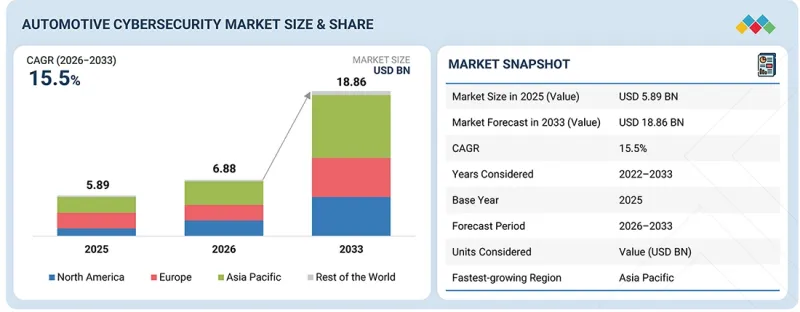
자동차 사이버 보안 시장 규모는 2026년 68억 8,000만 달러로 추정되고, 2033년에는 188억 6,000만 달러로 성장이 전망되며, CAGR 15.5%로 확대될 것으로 예측됩니다.
소프트웨어 정의 차량(SDV), 중앙 집중형 및 구역형 E/E 아키텍처, 첨단 ADAS 및 자율 주행, AI 기반 차량 기능, OTA를 통한 소프트웨어 배포의 채택이 확대됨에 따라, 보호가 필요한 차량용 소프트웨어, 컴퓨팅 리소스, 센서, 통신 인터페이스의 양이 크게 증가하고 있습니다.
| 조사 범위 | |
|---|---|
| 조사 대상 기간 | 2026-2033년 |
| 기준 연도 | 2025년 |
| 예측 기간 | 2026-2033년 |
| 대상 단위 | 10억 달러 |
| 부문 | 용도별, 보안 유형별, 차량 자동화 레벨별, 차량 유형별, 추진 방식별, 전개 유형별, 제공 제품별, EV 용도별, 접근별, 차량 아키텍처별, 지역별 |
| 대상 지역 | 아시아태평양, 유럽, 북미 및 세계 기타 지역 |
차량 기능이 소프트웨어 및 고성능 컴퓨팅에 점점 더 의존함에 따라, 사이버 보안은 단순한 개발 요구 사항에서 차량의 설계, 생산, 도입, 소프트웨어 업데이트 및 생산 후 모니터링을 포괄하는 지속적인 보호로 전환되고 있습니다.
레벨 2 및 레벨 3 자율 주행의 도입에 따라 카메라, 레이더, 라이더, 지각 소프트웨어, 차량 제어 시스템 및 고성능 컴퓨팅 플랫폼에 대한 사이버 보안 요구 사항이 높아지고 있습니다. 이러한 시스템이 침해될 경우 차량 안전에 직접적인 영향을 미칠 수 있기 때문입니다. 마찬가지로, 중앙 집중형 및 구역형 아키텍처로의 전환으로 인해 여러 차량 기능이 소수의 고성능 컨트롤러에 집약되면서, 사이버 공격이 성공할 경우 그 영향이 더욱 커지고 있습니다. 또한, AI를 활용한 주행 기능 및 콕핏 기능의 보급으로 인해 AI 모델,훈련 데이터, 소프트웨어 인터페이스, 의사결정 시스템 보호에 관한 새로운 요구사항도 대두되고 있습니다. OTA(Over-the-Air)를 통한 소프트웨어 배포가 보편화됨에 따라, 차량의 전체 수명 주기에 걸친 안전한 업데이트 메커니즘, 취약점 관리, SBOM 관리, 그리고 지속적인 보안 검증에 대한 수요가 더욱 높아지고 있습니다.
“ADAS 및 자율주행의 보급이 확대됨에 따라, 사이버 보안 요구 사항도 확대되고 있습니다.”
차량이 카메라, 레이더, 라이다(LiDAR), 고성능 컴퓨팅, AI 기반 지각 기능 및 차량 제어 소프트웨어에 대한 의존도를 높여감에 따라, ADAS 및 자율주행 애플리케이션은 자동차 사이버 보안 수요의 주요 원천이 되고 있습니다. 센서 데이터나 차량 제어 명령의 변조는 주행 안전성에 직접적인 영향을 미칠 수 있으므로, 센서 인터페이스, 인식 알고리즘, 통신 네트워크, 도메인 또는 존 컨트롤러, 그리고 액추에이터 시스템 전반에 걸쳐 사이버 보안 보호가 요구됩니다. 따라서 메르세데스-벤츠, BMW, 테슬라, 폭스바겐 등의 OEM이 레벨 2 및 레벨 3 시스템 도입을 확대함에 따라, 보안이 강화된 ECU, 침입 감지, 보안 통신, 소프트웨어 검증 및 지속적인 취약점 모니터링에 대한 수요가 증가하고 있습니다.
“전동화로 인해 EV 소프트웨어 용도 전반에 걸쳐 사이버 보안 요구 사항이 높아지고 있습니다.”
전동화로 인해 배터리 관리 시스템, 파워트레인 제어, 충전 시스템, 에너지 관리, 차량 관리, 텔레매틱스 용도 등 모든 분야에서 사이버 보안 요구 사항이 높아지고 있습니다. 배터리 및 전력 관리 시스템은 소프트웨어 기반 모니터링과 여러 ECU 간의 통신에 대한 의존도를 높이고 있는 반면, 커넥티드 충전의 도입으로 차량, 충전기, 백엔드 플랫폼, 결제 및 인증 시스템 간의 새로운 인터페이스가 추가되고 있습니다. 따라서 사이버 보안 측면에서는 배터리 관리 및 파워트레인 소프트웨어,충전 통신, 차량 게이트웨이, 클라우드 플랫폼을 무단 접근이나 소프트웨어 변조로부터 보호해야 합니다. EV 플랫폼 내 ADAS, 자율주행, 디지털 콕핏, 차량 관리 기능의 통합이 진행됨에 따라, 지속적인 사이버 보안 보호가 필요한 안전상 중요한 소프트웨어 용도의 수는 더욱 증가하고 있습니다.
“SDV(소프트웨어 정의 차량) 및 L3 ADAS의 도입 확대에 따라 유럽의 사이버 보안 요구 사항이 높아지고 있습니다.”
유럽에서는 각 OEM 업체들이 소프트웨어 정의 차량(SDV) 아키텍처와 더욱 진보된 ADAS 및 자율주행을 도입함에 따라 사이버 보안에 대한 수요가 높아지고 있습니다. 중앙 집중식 컴퓨팅, 고성능 프로세서, 카메라, 레이더, 라이다(LiDAR), AI 기반 지각 기능, OTA 소프트웨어 업데이트 및 클라우드 연결 차량 기능의 활용이 증가함에 따라, 기존의 커넥티드카보다 규모가 크고 안전상 극히 중요한 공격 표면이 형성되고 있습니다. 메르세데스-벤츠는 ‘DRIVE PILOT’을 확장하여 S-클래스 및 EQS에서 독일 고속도로에서 최고 시속 95km/h까지 레벨 3 자율주행을 지원하게 되었습니다. 이 시스템은 35개 이상의 센서와 이중화된 차량 시스템에 의존하고 있습니다.
이러한 전환에 따라 지각 시스템, 차량 제어 기능, 고성능 컴퓨팅 플랫폼, 통신 인터페이스 및 소프트웨어 업데이트 메커니즘을 보호하는 사이버 보안 기능에 대한 수요가 높아지고 있습니다. 따라서 유럽의 자동차 제조업체들은 위협 분석, 위험 평가, 보안 소프트웨어 개발, 침투 테스트, 취약점 관리, 보안 OTA, 지속적인 모니터링을 통해 SDV 및 ADAS 개발의 초기 단계부터 사이버 보안을 통합하고 있습니다. UNECE R155에서는 제조업체에 효과적인 사이버 보안 관리 시스템의 도입을 요구하고 있으며, R156에서는 소프트웨어 업데이트 관리 시스템에 대한 요건이 규정되어 있습니다. 차량이 지속적인 소프트웨어 업데이트를 받고, 안전상 극히 중요한 주행 기능에서 소프트웨어에 대한 의존도가 높아지고 있기 때문에 이러한 요건은 특히 중요해지고 있습니다.
자동차 사이버 보안 시장은 Robert Bosch GmbH(독일), Continental AG(독일), Harman International(미국), DENSO Corporation(일본), Aptiv PLC(아일랜드)와 같은 세계 기업들이 주도하고 있습니다. 이들 기업은 시장 내 입지를 유지하기 위해 다양한 전략을 채택하고 있습니다. 주요 전략으로는 제품 출시, 제휴, 사업 확장 등이 있습니다. 예를 들어, 통합형 차량 소프트웨어나 ECU 플랫폼을 통한 사이버 보안 강화, OEM과의 협력 강화, 차량용 전자 기기 및 소프트웨어 아키텍처 내 사이버 보안 심화 등이 있습니다. 이러한 전략을 분석함으로써 각 기업 시장 내 위치를 파악하고 있습니다. 제조업체들은 진화하는 규제와 소비자의 요구에 부응하기 위해, 첨단 사이버 보안 기술을 제공함으로써 시장 내 전략적 지위 유지에 주력하고 있습니다.
조사 범위 :
본 보고서는 ICE 및 EV의 용도, 보안 유형, 차량의 자율주행 수준, 차종, 접근 방식, 추진 방식, 도입 형태, 제공 서비스, 차량 아키텍처 및 지역별로 자동차 사이버 보안 시장을 종합적으로 다루고 있습니다. 또한, 자동차 사이버 보안 시장 생태계 내 주요 시장 진출기업경쟁 구도와 기업 프로파일에 대해서도 다루고 있습니다.
아울러 본 조사에서는 시장의 주요 기업에 대한 상세한 경쟁 분석 외에도, 각 기업의 프로파일, 제품 및 사업 제공에 관한 주요 소견, 최근 동향, 주요 시장 전략에 대해서도 수록했습니다.
본 보고서를 구매할 때의 주요 이점 :
- 본 보고서는 자동차 사이버 보안 시장 생태계 및 그 하위 부문의 매출에 대한 가장 정확한 추정치를 제공함으로써, 이 시장 시장 리더와 신규 진출기업을 지원합니다.
- 본 보고서는 자동차 사이버 보안 기술 및 OEM 경쟁 분석, 그리고 OEM 생태계에 대한 정보를 제공함으로써 이 시장 시장 리더와 신규 진출기업을 지원합니다.
- 본 보고서는 이해관계자가 경쟁 구도를 이해하고, 더 깊은 인사이트력을 얻어 자사의 비즈니스를 최적의 위치에 배치하며, 적절한 시장 진출 전략을 수립하는 데 도움이 됩니다.
- 또한, 본 보고서는 이해관계자가 시장 동향을 파악하고, 주요 시장 성장 촉진요인, 억제요인, 과제 및 기회에 대한 정보를 제공하는 데 도움이 됩니다.
본 보고서는 다음 사항에 대한 인사이트를 제공합니다.
- 주요 촉진요인 분석(커넥티드카의 도입 확대가 자동차 사이버 보안 솔루션 수요를 증가시키고 있다는 점, 의무화된 사이버 보안 규제가 차량 개발 전반에 걸친 보안 통합을 가속화하고 있다는 점, 소프트웨어 정의 차량(SDV)의 성장이 수명 주기 전반에 걸친 지속적인 사이버 보안 수요를 창출하고 있다는 점, OTA 소프트웨어 업데이트 증가가 안전한 소프트웨어 관리 플랫폼의 채택을 촉진하고 있다는 점), 제약 요인(차량 전자 아키텍처의 복잡화로 인한 사이버 보안 통합 지연, 레거시 차량 플랫폼으로 인한 최신 사이버 보안 기술 도입 제한, 전 세계 각국의 다양한 규제로 인한 자동차 사이버 보안 규정 준수의 복잡화), 기회(인공지능의 발전에 따른 자동차용 위협 감지 능력 향상, 하드웨어 루트 오브 트러스트(HROT) 도입 확대에 따른 차량 보안 강화, 사이버 보안 서비스(CSaaS)) 및 과제(사이버 보안 도입 비용이 높아 차량 플랫폼 전체에 걸친 대규모 배포를 제한하고 있는 점, 다층적인 소프트웨어 공급망 전반에 걸친 사이버 보안 관리, 지속적인 소프트웨어 배포가 소프트웨어 정의 차량(SDV)의 보안 확보를 더욱 복잡하게 만들고 있는 점)
- 제품 개발 및 혁신 : 자동차 사이버 보안 시장의 향후 기술, 연구개발 활동 및 제품 출시에 대한 상세한 인사이트
- 시장 개발 : 수익성이 높은 시장에 대한 종합적인 정보(본 보고서에서는 다양한 지역에 걸친 자동차 사이버 보안 시장을 분석하고 있습니다)
- 시장 다각화 : 자동차 사이버 보안 시장의 신제품, 미개척 지역, 최근 동향 및 투자에 대한 종합적인 정보
- 경쟁 분석 : 주요 기업의 시장 순위, 성장 전략 및 서비스 제공 내용에 대한 상세한 평가
자주 묻는 질문
목차
제1장 서론
제2장 주요 요약
제3장 프리미엄 인사이트
제4장 시장 개요
제5장 업계 동향
제6장 기술 진보, AI의 영향, 특허, 혁신, 그리고 향후 용도
제7장 고객 현황 및 구매 행동
제8장 지속가능성 및 규제 상황
제9장 자동차 사이버 보안 시장 : 용도별
제10장 자동차 사이버 보안 시장 : 보안 유형별
제11장 자동차 사이버 보안 시장 : 차량 자동화 레벨별
제12장 자동차 사이버 보안 시장 : 차량 유형별
제13장 자동차 사이버 보안 시장 : 추진 방식별
제14장 자동차 사이버 보안 시장 : 전개 유형별
제15장 자동차 사이버 보안 시장 : 제공 제품별
제16장 자동차 사이버 보안 시장 : EV 용도별
제17장 자동차 사이버 보안 시장 : 접근별
제18장 자동차 사이버 보안 시장 : 차량 아키텍처별
제19장 자동차 사이버 보안 시장 : 지역별
제20장 경쟁 구도
제21장 기업 개요
제22장 조사 방법
제23장 부록
AJY 26.09.09The automotive cybersecurity market is projected to grow from USD 6.88 billion in 2026 to USD 18.86 billion in 2033, at a CAGR of 15.5%. The increasing adoption of software-defined vehicles, centralized and zonal E/E architectures, advanced ADAS and automated driving, AI-based vehicle functions, and OTA software deployment is significantly increasing the volume of vehicle software, computing resources, sensors, and communication interfaces that require protection.
| Scope of the Report | |
|---|---|
| Years Considered for the Study | 2026-2033 |
| Base Year | 2025 |
| Forecast Period | 2026-2033 |
| Units Considered | USD billion |
| Segments | by Application Type, Security Type, Vehicle Autonomy, Vehicle Type, Propulsion, Deployment Type, Offering Type, EV Application, Approach, and Vehicle Architecture |
| Regions covered | Asia Pacific, Europe, North America, and Rest of the World |
As vehicle functions increasingly depend on software and high-performance computing, cybersecurity is shifting from a development requirement toward continuous protection covering vehicle design, production, deployment, software updates, and post-production monitoring.
The deployment of Level 2 and Level 3 automated driving is increasing cybersecurity requirements for cameras, radar, lidar, perception software, vehicle control systems, and high-performance computing platforms, as compromise of these systems can directly affect vehicle safety. Similarly, the transition toward centralized and zonal architectures is concentrating multiple vehicle functions within fewer high-performance controllers, increasing the potential impact of a successful cyberattack. AI-based driving and cockpit functions are also creating new requirements for protection of AI models, training data, software interfaces, and decision-making systems. OTA-based software deployment is further creating demand for secure update mechanisms, vulnerability management, SBOM management, and continuous security validation throughout the vehicle lifecycle.
"Increasing ADAS and automated driving adoption is expanding cybersecurity requirements."
The ADAS and automated driving application is becoming a major source of automotive cybersecurity demand as vehicles increasingly rely on cameras, radar, LiDAR, high-performance computing, AI-based perception, and vehicle control software. Cybersecurity protection is required across sensor interfaces, perception algorithms, communication networks, domain or zonal controllers, and actuation systems because manipulation of sensor data or vehicle control commands can directly affect driving safety. The increasing deployment of Level 2 and Level 3 systems by OEMs such as Mercedes-Benz, BMW, Tesla, and Volkswagen is therefore increasing demand for secure ECUs, intrusion detection, secure communication, software validation, and continuous vulnerability monitoring.
"Electrification is increasing cybersecurity requirements across EV software applications."
Electrification is increasing cybersecurity requirements across battery management systems, powertrain control, charging systems, energy management, vehicle management, and telematics applications. Battery and power management systems increasingly depend on software-based monitoring and communication between multiple ECUs, while connected charging introduces additional interfaces between the vehicle, charger, backend platform, and payment or authentication systems. Cybersecurity therefore needs to protect battery management and powertrain software, charging communication, vehicle gateways, and cloud platforms against unauthorized access and software manipulation. The increasing integration of ADAS, automated driving, digital cockpit, and vehicle management functions within EV platforms is further increasing the number of safety-critical software applications that require continuous cybersecurity protection.
"Increasing SDV and L3 ADAS deployment is raising cybersecurity requirements in Europe."
Europe is experiencing increasing cybersecurity demand as OEMs are deploying software-defined vehicle architectures and higher levels of ADAS and automated driving. The increasing use of centralized computing, high-performance processors, cameras, radar, LiDAR, AI-based perception, OTA software updates, and cloud-connected vehicle functions is creating a larger and more safety-critical attack surface than conventional connected vehicles. Mercedes-Benz has expanded DRIVE PILOT to support Level 3 automated driving at speeds of up to 95 km/h on German motorways in the S-Class and EQS, with the system relying on more than 35 sensors and redundant vehicle systems.
This transition is increasing demand for cybersecurity capabilities that protect perception systems, vehicle control functions, high-performance computing platforms, communication interfaces, and software update mechanisms. European OEMs are therefore integrating cybersecurity earlier into SDV and ADAS development through threat analysis and risk assessment, secure software development, penetration testing, vulnerability management, secure OTA, and continuous monitoring. UNECE R155 requires manufacturers to demonstrate an effective Cybersecurity Management System, while R156 establishes requirements for Software Update Management Systems. These requirements are particularly relevant as vehicles receive continuous software updates and increasingly depend on software for safety-critical driving functions.
In-depth interviews were conducted with CEOs, marketing directors, other innovation and technology directors, and executives from various key organizations operating in this market.
- By Company Type: Automotive cybersecurity solution provider - 40%, Tier I - 15%, Tier II - 10%, OEMs - 35%
- By Designation: CXOs - 20%, Directors - 40%, Others - 40%
- By Country: Asia Pacific - 25%, North America - 25%, Europe - 30%, and Rest of the World - 20%
The automotive cybersecurity market is dominated by global players, such as Robert Bosch GmbH (Germany), Continental AG (Germany), Harman International (US), DENSO Corporation (Japan), and Aptiv PLC (Ireland). These players have been adopting various strategies to sustain their position in the market. Major strategies adopted are product launches, deals, and expansions. For instance, expanding cybersecurity through integrated vehicle software and ECU platforms and deepening OEM integration and cybersecurity within vehicle electronics and software architectures. These strategies have been analyzed to understand the positions of these companies in the market. Manufacturers focus on maintaining their strategic position in the market by offering advanced cybersecurity technologies to meet evolving regulatory and consumer demands.
Research Coverage:
The report covers the automotive cybersecurity market by ICE and EV application, security type, vehicle autonomy, vehicle type, approach, propulsion, deployment type, offering, vehicle architecture, and region. It covers the competitive landscape and company profiles of the major players in the automotive cybersecurity market ecosystem.
The study also includes an in-depth competitive analysis of the key players in the market, along with their company profiles, key observations related to product and business offerings, recent developments, and key market strategies.
Key Benefits of Buying the Report:
- This report will help market leaders/new entrants in this market with information on the closest approximations of revenue numbers for the automotive cybersecurity market ecosystem and its subsegments.
- This report will help market leaders/new entrants in this market with information on automotive cybersecurity technology & OEM competitive analysis and OEM ecosystem.
- This report will help stakeholders understand the competitive landscape and gain more insights to better position their businesses and plan suitable go-to-market strategies.
- This report will also help stakeholders understand the market's pulse and provide information on key market drivers, restraints, challenges, and opportunities.
The report provides insight on the following pointers:
- Analysis of key Drivers (Growing Connected Vehicle Deployment is Increasing Demand for Automotive Cybersecurity Solutions, Mandatory Cybersecurity Regulations Accelerating Security Integration Across Vehicle Development, Growth of Software-defined Vehicles Creating Demand for Continuous Lifecycle Cybersecurity, Rising OTA Software Updates Driving Adoption of Secure Software Management Platforms), Restraints (Increasing Complexity of Vehicle Electronic Architectures Slowing Cybersecurity Integration, Legacy Vehicle Platforms Limiting Adoption of Modern Cybersecurity Technologies, Diverse Global Regulations Increasing Complexity of Automotive Cybersecurity Compliance), Opportunities (Advancements in Artificial Intelligence Enhancing Automotive Threat Detection Capabilities, Increasing Adoption of Hardware Root of Trust Strengthening Embedded Vehicle Security, Cybersecurity as a Service (CSaaS)) and Challenges (High Cybersecurity Implementation Costs Limiting Large-scale Deployment Across Vehicle Platforms, Managing Cybersecurity Across Multi-tier Software Supply Chains, Continuous Software Deployment Increasing Complexity of Securing Software-defined Vehicles)
- Product Development/Innovation: Detailed insights into upcoming technologies, research & development activities, and product launches in the automotive cybersecurity market
- Market Development: Comprehensive information about lucrative markets (the report analyzes the automotive cybersecurity market across varied regions)
- Market Diversification: Exhaustive information about new products, untapped geographies, recent developments, and investments in the automotive cybersecurity market
- Competitive Assessment: In-depth assessment of market ranking, growth strategies, and service offerings of leading players
TABLE OF CONTENTS
1 INTRODUCTION
- 1.1 STUDY OBJECTIVES
- 1.2 MARKET DEFINITION
- 1.3 INCLUSIONS AND EXCLUSIONS
- 1.4 MARKET SCOPE
- 1.4.1 YEARS CONSIDERED
- 1.5 CURRENCY CONSIDERED
- 1.6 STAKEHOLDERS
- 1.7 SUMMARY OF CHANGES
2 EXECUTIVE SUMMARY
- 2.1 MARKET HIGHLIGHTS AND KEY INSIGHTS
- 2.2 KEY MARKET PARTICIPANTS: MAPPING OF STRATEGIC DEVELOPMENTS
- 2.3 DISRUPTIVE TRENDS IN AUTOMOTIVE CYBERSECURITY MARKET
- 2.4 HIGH-GROWTH SEGMENTS IN AUTOMOTIVE CYBERSECURITY MARKET
- 2.5 REGIONAL SNAPSHOT: MARKET SIZE, GROWTH RATE, AND FORECAST
3 PREMIUM INSIGHTS
- 3.1 ATTRACTIVE OPPORTUNITIES FOR KEY PLAYERS IN AUTOMOTIVE CYBERSECURITY MARKET
- 3.2 AUTOMOTIVE CYBERSECURITY MARKET, BY APPLICATION
- 3.3 AUTOMOTIVE CYBERSECURITY MARKET, BY OFFERING
- 3.4 AUTOMOTIVE CYBERSECURITY MARKET, BY DEPLOYMENT TYPE
- 3.5 AUTOMOTIVE CYBERSECURITY MARKET, BY VEHICLE TYPE
- 3.6 AUTOMOTIVE CYBERSECURITY MARKET, BY VEHICLE AUTONOMY
- 3.7 AUTOMOTIVE CYBERSECURITY MARKET, BY PROPULSION TYPE
- 3.8 AUTOMOTIVE CYBERSECURITY MARKET, BY EV APPLICATION
- 3.9 AUTOMOTIVE CYBERSECURITY MARKET, BY REGION
4 MARKET OVERVIEW
- 4.1 INTRODUCTION
- 4.2 MARKET DYNAMICS
- 4.2.1 DRIVERS
- 4.2.1.1 Growing connected vehicle deployment
- 4.2.1.2 Mandatory cybersecurity regulations accelerating security integration across vehicle development
- 4.2.1.3 Growth of software-defined vehicles (SDVs) creating demand for continuous lifecycle cybersecurity
- 4.2.1.4 Rising OTA software updates driving adoption of secure software management platforms
- 4.2.2 RESTRAINTS
- 4.2.2.1 Increasing complexity of vehicle electronic architectures slowing cybersecurity integration
- 4.2.2.2 Legacy vehicle platforms limiting adoption of modern cybersecurity technologies
- 4.2.2.3 Diverse global regulations increasing complexity of automotive cybersecurity compliance
- 4.2.3 OPPORTUNITIES
- 4.2.3.1 Advancements in artificial intelligence (AI) enhancing automotive threat detection capabilities
- 4.2.3.2 Increasing adoption of hardware root of trust (HRoT) strengthening embedded vehicle security
- 4.2.3.3 Cybersecurity as a Service (CSaaS)
- 4.2.4 CHALLENGES
- 4.2.4.1 High cybersecurity implementation costs challenging large-scale deployment across vehicle platforms
- 4.2.4.2 Managing cybersecurity across multi-tier software supply chains
- 4.2.4.3 Continuous software deployment and OTA update releases increasing complexity of securing SDVs
- 4.2.1 DRIVERS
- 4.3 UNMET NEEDS AND WHITE SPACES
- 4.3.1 LACK OF UNIFIED LIFECYCLE CYBERSECURITY PLATFORMS ACROSS VEHICLE ECOSYSTEM
- 4.3.2 LIMITED REAL-TIME CYBERSECURITY PROTECTION FOR AI-DRIVEN AND CENTRALIZED VEHICLE ARCHITECTURES
- 4.3.3 INSUFFICIENT CYBERSECURITY VISIBILITY ACROSS MULTI-TIER AUTOMOTIVE SOFTWARE SUPPLY CHAIN
5 INDUSTRY TRENDS
- 5.1 MACROECONOMIC INDICATORS
- 5.1.1 INTRODUCTION
- 5.1.2 GDP TRENDS AND FORECAST
- 5.1.3 TRENDS IN AUTOMOTIVE CYBERSECURITY MARKET
- 5.1.4 TRENDS IN GLOBAL AUTOMOTIVE & TRANSPORTATION INDUSTRY
- 5.2 SUPPLY CHAIN ANALYSIS
- 5.3 ECOSYSTEM ANALYSIS
- 5.3.1 CYBERSECURITY SOLUTION PROVIDERS
- 5.3.2 TIER 2 SUPPLIERS
- 5.3.3 TIER 1 SUPPLIERS
- 5.3.4 OEMS
- 5.3.5 END USERS
- 5.4 PRICING ANALYSIS
- 5.4.1 AVERAGE SELLING TREND, BY KEY PLAYERS, 2024-2026
- 5.4.2 AVERAGE SELLING PRICE TREND, BY REGION, 2024-2026
- 5.5 TRADE ANALYSIS
- 5.5.1 IMPORT SCENARIO (HS CODE 8537)
- 5.5.2 EXPORT SCENARIO (HS CODE 8537)
- 5.6 KEY CONFERENCES AND EVENTS, 2026-2027
- 5.7 TRENDS AND DISRUPTIONS IMPACTING CUSTOMER BUSINESS
- 5.8 INVESTMENT AND FUNDING SCENARIO
- 5.9 CASE STUDY ANALYSIS
- 5.9.1 ETAS SUPPORTS MERCEDES-BENZ IN STRENGTHENING VEHICLE CYBERSECURITY AND UNECE WP.29 COMPLIANCE
- 5.9.2 VICONE STRENGTHENS JRC MOBILITY'S SOFTWARE VULNERABILITY MANAGEMENT
- 5.9.3 PLAXIDITYX COLLABORATES WITH MARQUARDT TO SECURE NEXT-GENERATION VEHICLE PLATFORMS
- 5.9.4 ETAS AND DEUTSCHE TELEKOM SECURITY DELIVER MANAGED VEHICLE SECURITY OPERATIONS CENTER SERVICES
- 5.9.5 VICONE AND PANASONIC AUTOMOTIVE SYSTEMS PROTECT CONNECTED VEHICLE SOFTWARE SUPPLY CHAINS
- 5.9.6 SKODA PARTNERS WITH UPSTREAM TO STRENGTHEN CONNECTED VEHICLE CYBER RESILIENCE
- 5.9.7 VECTOR INFORMATIK GMBH DEVELOPED FIRMWARE FOR SECURED COMMUNICATION
- 5.10 SECURITY LEVELS IN AUTOMOTIVE CYBERSECURITY
- 5.10.1 INTRODUCTION
- 5.10.2 CAL DETERMINATION
- 5.10.3 CAL USAGE
- 5.10.4 VERIFICATION METHOD
- 5.11 OTA SECURITY SUCCESS STORIES
- 5.11.1 MERCEDES BENZ AND ETAS (ESCRYPT), SECURE OTA AND UNECE WP.29 COMPLIANCE
- 5.11.2 PANASONIC AUTOMOTIVE SYSTEMS AND VICONE, SECURE OTA SOFTWARE SUPPLY CHAIN
- 5.11.3 AIRBIQUITY AND BLACKBERRY QNX, PRODUCTION-GRADE SECURE OTA UPDATE PLATFORM
- 5.12 OEM CYBERSECURITY PROGRAMS
- 5.12.1 MERCEDES BENZ WHITE HAT VULNERABILITY DISCLOSURE PROGRAM
- 5.12.1.1 Overview
- 5.12.1.2 Key features
- 5.12.1.3 Business Impact
- 5.12.2 VOLVO CARS PRODUCT SECURITY INCIDENT RESPONSE TEAM (PSIRT)
- 5.12.2.1 Overview
- 5.12.2.2 Key features
- 5.12.2.3 Business impact
- 5.12.3 GENERAL MOTORS COORDINATED VULNERABILITY DISCLOSURE PROGRAM
- 5.12.3.1 Overview
- 5.12.3.2 Key features
- 5.12.3.3 Business impact
- 5.12.1 MERCEDES BENZ WHITE HAT VULNERABILITY DISCLOSURE PROGRAM
- 5.13 CYBER RECALL ANALYSIS
- 5.13.1 DEFINITION
- 5.13.2 OBJECTIVES OF CYBER RECALL ANALYSIS
- 5.13.3 CYBERSECURITY RECALL CASE STUDIES
- 5.13.3.1 Tesla OTA Recall For Full Self Driving Software
- 5.13.3.2 Fiat Chrysler Automobiles (FCA) Uconnect Recall
- 5.13.3.3 Volvo Cars Infotainment Software Recall
- 5.14 SOFTWARE AND TECH PROVIDER STRATEGY
- 5.14.1 ETAS
- 5.14.1.1 Secure ECU
- 5.14.1.2 Cloud security
- 5.14.2 ARGUS CYBER SECURITY
- 5.14.2.1 Secure ECU
- 5.14.2.2 Cloud security
- 5.14.3 BLACKBERRY QNX
- 5.14.3.1 Secure ECU
- 5.14.3.2 Cloud Security
- 5.14.4 UPSTREAM SECURITY
- 5.14.4.1 Secure ECU
- 5.14.4.2 Cloud Security
- 5.14.1 ETAS
- 5.15 IMPACT OF US-IRAN WAR
- 5.15.1 INTRODUCTION
- 5.15.2 IMPACT ON ECU AND AUTOMOTIVE ELECTRONICS SHIPMENTS
- 5.16 EU-INDIA TRADE DEAL IMPACT ANALYSIS
- 5.16.1 INTRODUCTION
- 5.16.2 EU TARIFFS
6 TECHNOLOGICAL ADVANCEMENTS, AI-DRIVEN IMPACT, PATENTS, INNOVATIONS, AND FUTURE APPLICATIONS
- 6.1 TECHNOLOGY ANALYSIS
- 6.1.1 INTRODUCTION
- 6.1.2 KEY EMERGING TECHNOLOGIES
- 6.1.2.1 AI and Generative AI-powered threat detection
- 6.1.2.1.1 Predictive threat detection
- 6.1.2.1.2 Synthetic attack simulation
- 6.1.2.1.3 AI-driven behavioral analytics
- 6.1.2.1.4 Cyber honeypots and decoys
- 6.1.2.1.5 AI in endpoint security
- 6.1.2.2 Digital twin-based cybersecurity validation
- 6.1.2.3 Over-the-air updates
- 6.1.2.1 AI and Generative AI-powered threat detection
- 6.1.3 COMPLEMENTARY TECHNOLOGIES
- 6.1.3.1 Vehicle-to-Everything (V2X) communication
- 6.1.3.2 Vehicle cloud platforms
- 6.1.3.3 Autonomous driving software stacks
- 6.2 TECHNOLOGY/PRODUCT ROADMAP
- 6.2.1 INDUSTRY REVOLUTION
- 6.3 CYBERSECURITY LIFECYCLE MANAGEMENT
- 6.4 PATENT ANALYSIS
- 6.5 FUTURE APPLICATIONS
- 6.5.1 AI-POWERED AUTONOMOUS VEHICLE PROTECTION
- 6.5.2 CYBERSECURITY FOR V2X ECOSYSTEMS
- 6.5.3 DIGITAL IDENTITY AND SECURE VEHICLE COMMERCE
- 6.6 AUTOMOTIVE THREAT INTELLIGENCE
- 6.7 IMPACT OF AI/GENERATIVE AI ON AUTOMOTIVE CYBERSECURITY MARKET
- 6.7.1 TOP USE CASES AND MARKET POTENTIAL
- 6.7.2 BEST PRACTICES FOLLOWED BY MANUFACTURERS IN AI-ENABLED AUTOMOTIVE CYBERSECURITY
- 6.7.3 CASE STUDIES RELATED TO AI IMPLEMENTATION IN AUTOMOTIVE CYBERSECURITY MARKET
- 6.7.4 CLIENTS' READINESS TO ADOPT AI-INTEGRATED AUTOMOTIVE CYBERSECURITY VEHICLES
7 CUSTOMER LANDSCAPE AND BUYING BEHAVIOR
- 7.1 DECISION-MAKING PROCESS
- 7.2 KEY STAKEHOLDERS AND BUYING CRITERIA
- 7.2.1 KEY STAKEHOLDERS IN BUYING PROCESS
- 7.2.2 BUYING CRITERIA
- 7.3 ADOPTION BARRIERS & INTERNAL CHALLENGES
- 7.4 UNMET NEED TO VARIOUS END USERS
8 SUSTAINABILITY AND REGULATORY LANDSCAPE
- 8.1 REGULATORY LANDSCAPE
- 8.1.1 UNECE WP.29 REGULATION
- 8.1.2 ISO/SAE DIS 21434 STANDARD
- 8.1.3 AIS 140 STANDARD
- 8.1.4 REGULATIONS BY COUNTRY/REGION
- 8.1.4.1 European Union
- 8.1.4.2 US
- 8.1.4.3 China
- 8.1.4.4 Japan
- 8.1.4.5 South Korea
- 8.1.4.6 India
- 8.1.5 REGULATORY BODIES, GOVERNMENT AGENCIES, AND OTHER ORGANIZATIONS
- 8.1.6 INDUSTRY STANDARDS
- 8.2 SUSTAINABILITY INITIATIVES
- 8.2.1 CARBON IMPACT AND ECO-APPLICATIONS OF ELECTRIC VEHICLES
- 8.3 CERTIFICATIONS, LABELING, AND ECO-STANDARDS
9 AUTOMOTIVE CYBERSECURITY MARKET, BY APPLICATION
- 9.1 INTRODUCTION
- 9.1.1 CYBERSECURITY FROM ECU CONSOLIDATION PERSPECTIVE
- 9.2 ADAS & SAFETY
- 9.2.1 INCREASING DEPLOYMENT OF SAFETY-CRITICAL DRIVING FUNCTIONS TO STRENGTHEN DEMAND
- 9.3 AUTOPILOT
- 9.3.1 ADVANCEMENT OF AUTONOMOUS DRIVING TECHNOLOGIES TO ACCELERATE INVESTMENT IN AUTOPILOT CYBERSECURITY
- 9.4 AI
- 9.4.1 GROWING ADOPTION OF AI-DRIVEN VEHICLE INTELLIGENCE TO EXPAND NEED FOR AI-FOCUSED CYBERSECURITY
- 9.5 BODY CONTROL & COMFORT
- 9.5.1 RISING VEHICLE CONNECTIVITY TO INCREASING CYBERSECURITY REQUIREMENTS FOR BODY CONTROL SYSTEMS
- 9.6 INFOTAINMENT
- 9.6.1 EXPANSION OF CONNECTED DIGITAL COCKPIT PLATFORMS TO DRIVE CYBERSECURITY ADOPTION IN INFOTAINMENT SYSTEMS
- 9.7 VEHICLE MANAGEMENT & TELEMATICS
- 9.7.1 GROWTH OF CONNECTED VEHICLE SERVICES INCREASING DEMAND FOR SECURE TELEMATICS PLATFORMS
- 9.8 ENGINE MANAGEMENT & POWERTRAIN SYSTEMS
- 9.8.1 CONNECTED POWERTRAIN SYSTEMS TO DRIVE ADVANCED CYBERSECURITY IMPLEMENTATION
- 9.9 COMMUNICATION SYSTEMS
- 9.9.1 INCREASING INTERCONNECTIVITY ACROSS VEHICLE NETWORKS TO ACCELERATE ADOPTION OF SECURE COMMUNICATION ARCHITECTURES
- 9.10 KEY PRIMARY INSIGHTS
10 AUTOMOTIVE CYBERSECURITY MARKET, BY SECURITY TYPE
- 10.1 INTRODUCTION
- 10.1.1 AUTOMOTIVE CYBERSECURITY ATTACK VECTORS AND SECURITY TYPE REQUIREMENTS
- 10.2 APPLICATION SECURITY
- 10.3 WIRELESS NETWORK SECURITY
- 10.4 ENDPOINT SECURITY
- 10.5 CLOUD SECURITY
- 10.6 DATA SECURITY
- 10.7 IDENTITY SECURITY
11 AUTOMOTIVE CYBERSECURITY MARKET, BY VEHICLE AUTONOMY
- 11.1 INTRODUCTION
- 11.1.1 OPERATIONAL DATA
- 11.2 NON-AUTONOMOUS VEHICLES
- 11.2.1 GROWING VEHICLE ELECTRIFICATION TO DRIVE GROWTH OF AUTOMOTIVE CYBERSECURITY
- 11.3 SEMI-AUTONOMOUS VEHICLES
- 11.3.1 EXPANSION OF ADAS AND SOFTWARE DEFINED VEHICLES TO ACCELERATE CYBERSECURITY INVESTMENT
- 11.3.2 LEVEL 1
- 11.3.3 LEVEL 2
- 11.4 AUTONOMOUS VEHICLES
- 11.4.1 COMMERCIAL AUTONOMOUS MOBILITY TO DRIVE NEXT-GENERATION CYBERSECURITY ARCHITECTURES
- 11.4.2 LEVEL 3
- 11.4.3 LEVEL 4
- 11.4.4 LEVEL 5
- 11.5 KEY PRIMARY INSIGHTS
12 AUTOMOTIVE CYBERSECURITY MARKET, BY VEHICLE TYPE
- 12.1 INTRODUCTION
- 12.2 PASSENGER VEHICLES
- 12.2.1 RISING CONNECTED CAR ADOPTION TO STRENGTHEN PASSENGER VEHICLE CYBERSECURITY INVESTMENTS
- 12.3 LIGHT COMMERCIAL VEHICLES
- 12.3.1 FLEET CONNECTIVITY TO INCREASE CYBERSECURITY REQUIREMENTS IN LIGHT COMMERCIAL VEHICLES
- 12.4 HEAVY COMMERCIAL VEHICLES
- 12.4.1 AUTONOMOUS FREIGHT AND CONNECTED TRUCKING TO DRIVE HEAVY COMMERCIAL VEHICLE CYBERSECURITY
- 12.5 KEY PRIMARY INSIGHTS
13 AUTOMOTIVE CYBERSECURITY MARKET, BY PROPULSION
- 13.1 INTRODUCTION
- 13.2 INTERNAL COMBUSTION ENGINE (ICE)
- 13.2.1 GROWING VEHICLE CONNECTIVITY TO EXPAND CYBERSECURITY REQUIREMENTS FOR ICE VEHICLES
- 13.3 ELECTRIC VEHICLE (EV)
- 13.3.1 SOFTWARE-DEFINED VEHICLE ADOPTION AND CONNECTED MOBILITY TO ACCELERATE CYBERSECURITY DEMAND IN ELECTRIC VEHICLES
- 13.3.2 BATTERY ELECTRIC VEHICLE (BEV)
- 13.3.3 PLUG-IN HYBRID ELECTRIC VEHICLE (PHEV)
- 13.4 KEY PRIMARY INSIGHTS
14 AUTOMOTIVE CYBERSECURITY MARKET, BY DEPLOYMENT TYPE
- 14.1 INTRODUCTION
- 14.1.1 OPERATIONAL DATA
- 14.2 IN-VEHICLE
- 14.2.1 GROWING PENETRATION OF CONNECTED VEHICLES AND AUTONOMOUS MOBILITY TO DRIVE MARKET
- 14.3 EXTERNAL CLOUD SERVICES
- 14.3.1 INCREASING CLOUD CONNECTIVITY FEATURES TO DRIVE DEMAND
- 14.4 HYBRID
- 14.4.1 INCREASING SOFTWARE-DEFINED VEHICLE DEPLOYMENT TO ACCELERATE ADOPTION OF HYBRID AUTOMOTIVE SECURITY SOLUTIONS
- 14.5 KEY PRIMARY INSIGHTS
15 AUTOMOTIVE CYBERSECURITY MARKET, BY OFFERING
- 15.1 INTRODUCTION
- 15.1.1 OPERATIONAL DATA
- 15.2 HARDWARE
- 15.2.1 GROWING ADOPTION OF SOFTWARE-DEFINED VEHICLES TO DRIVE DEMAND FOR HARDWARE-BASED SECURITY ARCHITECTURES
- 15.3 SOFTWARE
- 15.3.1 INCREASING SOFTWARE COMPLEXITY IN VEHICLES TO ACCELERATE ADOPTION OF AUTOMOTIVE CYBERSECURITY SOFTWARE
- 15.4 KEY PRIMARY INSIGHTS
16 AUTOMOTIVE CYBERSECURITY MARKET, BY EV APPLICATION
- 16.1 INTRODUCTION
- 16.2 ADAS & SAFETY
- 16.2.1 SENSOR CONNECTIVITY TO DRIVE DEMAND FOR SAFETY SYSTEM SECURITY
- 16.3 AUTOPILOT
- 16.3.1 INFRASTRUCTURE SUPPORT FOR LARGE-SCALE AUTOMATE DRIVING DEPLOYMENT TO DRIVE DEMAND
- 16.4 AI
- 16.4.1 INTEGRATION OF AI INTO EV DRIVING, BATTERY AND COCKPIT FUNCTIONS TO DRIVE DEMAND
- 16.5 BODY CONTROL & COMFORT
- 16.5.1 INTEGRATION OF COMFORT AND CONVENIENCE FEATURES INTO CENTRALIZED VEHICLE ELECTRONICS TO DRIVE DEMAND
- 16.6 INFOTAINMENT
- 16.6.1 INTEGRATION OF CONNECTED DIGITAL COCKPITS INTO EVS TO DRIVE DEMAND
- 16.7 VEHICLE MANAGEMENT & TELEMATICS
- 16.7.1 INTEGRATION OF REMOTE VEHICLE MANAGEMENT WITH EV-SPECIFIC FUNCTIONS TO DRIVE DEMAND
- 16.8 BATTERY MANAGEMENT & POWERTRAIN SYSTEMS
- 16.8.1 STRONG EV MANUFACTURING ECOSYSTEM IN ASIA PACIFIC TO DRIVE DEMAND
- 16.9 COMMUNICATION SYSTEMS
- 16.9.1 NETWORK INTEGRATION EXPANDS COMMUNICATION ATTACK SURFACES
- 16.10 KEY PRIMARY INSIGHTS
17 AUTOMOTIVE CYBERSECURITY MARKET, BY APPROACH
- 17.1 INTRODUCTION
- 17.2 INTRUSION DETECTION SYSTEM
- 17.2.1 REQUIREMENTS FOR AN AUTOMOTIVE INTRUSION DETECTION SYSTEM
- 17.2.2 STRUCTURE OF AUTOMOTIVE IDS
- 17.3 SECURITY OPERATIONS CENTER
- 17.3.1 KEY FUNCTIONS OF SECURITY OPERATIONS CENTER
- 17.3.2 USE CASES OF SECURITY OPERATIONS CENTER
- 17.4 KEY PRIMARY INSIGHTS
18 AUTOMOTIVE CYBERSECURITY MARKET, BY VEHICLE ARCHITECTURE
- 18.1 INTRODUCTION
- 18.2 DISTRIBUTED ARCHITECTURE
- 18.3 DOMAIN-CENTRALIZED ARCHITECTURE
- 18.4 ZONAL CONTROL ARCHITECTURE
19 AUTOMOTIVE CYBERSECURITY MARKET, BY REGION
- 19.1 INTRODUCTION
- 19.2 ASIA PACIFIC
- 19.2.1 CHINA
- 19.2.1.1 Connected vehicle expansion to drive automotive cybersecurity investment
- 19.2.2 INDIA
- 19.2.2.1 Vehicle digitalization to drive cybersecurity demand
- 19.2.3 JAPAN
- 19.2.3.1 Software-defined mobility to accelerate automotive cybersecurity adoption
- 19.2.4 SOUTH KOREA
- 19.2.4.1 Software-defined vehicle leadership to fuel automotive cybersecurity growth
- 19.2.5 REST OF ASIA PACIFIC
- 19.2.1 CHINA
- 19.3 EUROPE
- 19.3.1 GERMANY
- 19.3.1.1 Germany's software-defined vehicle leadership to drive investment in automotive cybersecurity
- 19.3.2 FRANCE
- 19.3.2.1 Investment in connected mobility and SDVs to accelerate demand for automotive cybersecurity solutions
- 19.3.3 SPAIN
- 19.3.3.1 Connected vehicle expansion to drive market
- 19.3.4 ITALY
- 19.3.4.1 Luxury vehicle software advancement to drive market
- 19.3.5 UK
- 19.3.5.1 Connected vehicle innovation to drive cybersecurity investments
- 19.3.6 RUSSIA
- 19.3.6.1 Investments in automotive sector by major manufacturers to drive market
- 19.3.7 TURKEY
- 19.3.7.1 Electric vehicle production growth to increase automotive cybersecurity requirements
- 19.3.8 REST OF EUROPE
- 19.3.1 GERMANY
- 19.4 NORTH AMERICA
- 19.4.1 US
- 19.4.1.1 Rising connected vehicle deployment to drive regulatory compliance and cybersecurity investments
- 19.4.2 CANADA
- 19.4.2.1 Government connected mobility programs and global vehicle exports to drive market
- 19.4.3 MEXICO
- 19.4.3.1 Expansion of automotive manufacturing and cross-border supply chains to drive market
- 19.4.1 US
- 19.5 REST OF THE WORLD (ROW)
- 19.5.1 BRAZIL
- 19.5.1.1 Connected vehicle expansion and global cybersecurity standards to drive automotive cybersecurity investments
- 19.5.2 SOUTH AFRICA
- 19.5.2.1 Export-driven connected vehicle manufacturing and global cybersecurity compliance to drive automotive cybersecurity adoption
- 19.5.3 OTHERS
- 19.5.1 BRAZIL
20 COMPETITIVE LANDSCAPE
- 20.1 OVERVIEW
- 20.2 KEY PLAYERS' STRATEGIES/RIGHT TO WIN
- 20.3 MARKET RANKING ANALYSIS FOR KEY PLAYERS, 2025
- 20.4 REVENUE ANALYSIS OF KEY PLAYERS, 2025
- 20.5 COMPANY VALUATION AND FINANCIAL METRICS
- 20.5.1 COMPANY VALUATION
- 20.5.2 FINANCIAL METRICS
- 20.6 BRAND/PRODUCT COMPARISON
- 20.7 COMPANY EVALUATION MATRIX: OEMS, 2025
- 20.7.1 STARS
- 20.7.2 EMERGING LEADERS
- 20.7.3 PERVASIVE PLAYERS
- 20.7.4 PARTICIPANTS
- 20.7.5 COMPANY FOOTPRINT: KEY PLAYERS, 2025
- 20.7.5.1 Company footprint
- 20.8 STARTUP/SME EVALUATION MATRIX, 2025
- 20.8.1 PROGRESSIVE COMPANIES
- 20.8.2 RESPONSIVE COMPANIES
- 20.8.3 DYNAMIC COMPANIES
- 20.8.4 STARTING BLOCKS
- 20.9 COMPETITIVE BENCHMARKING OF STARTUPS/SMES
- 20.10 COMPETITIVE SCENARIO
- 20.10.1 PRODUCT LAUNCHES/DEVELOPMENTS
- 20.10.2 DEALS
- 20.10.3 EXPANSIONS
- 20.10.4 OTHERS
21 COMPANY PROFILES
- 21.1 KEY PLAYERS
- 21.1.1 CONTINENTAL AG
- 21.1.1.1 Business overview
- 21.1.1.2 Products offered
- 21.1.1.3 Recent developments
- 21.1.1.4 MnM view
- 21.1.1.4.1 Right to win
- 21.1.1.4.2 Strategic choices
- 21.1.1.4.3 Weaknesses and competitive threats
- 21.1.2 ROBERT BOSCH GMBH
- 21.1.2.1 Business overview
- 21.1.2.2 Products offered
- 21.1.2.3 Recent developments
- 21.1.2.3.1 Others
- 21.1.2.4 MnM view
- 21.1.2.4.1 Right to win
- 21.1.2.4.2 Strategic choices
- 21.1.2.4.3 Weaknesses and competitive threats
- 21.1.3 HARMAN INTERNATIONAL
- 21.1.3.1 Business overview
- 21.1.3.2 Products offered
- 21.1.3.3 Recent developments
- 21.1.3.4 MnM view
- 21.1.3.4.1 Right to win
- 21.1.3.4.2 Strategic choices
- 21.1.3.4.3 Weaknesses and competitive threats
- 21.1.4 DENSO CORPORATION
- 21.1.4.1 Business overview
- 21.1.4.2 Products offered
- 21.1.4.3 Recent developments
- 21.1.4.4 MnM view
- 21.1.4.4.1 Key Strengths
- 21.1.4.4.2 Strategic choices
- 21.1.4.4.3 Weaknesses and competitive threats
- 21.1.5 APTIV PLC
- 21.1.5.1 Business overview
- 21.1.5.2 Products offered
- 21.1.5.3 Recent developments
- 21.1.5.4 MnM view
- 21.1.5.4.1 Right to win
- 21.1.5.4.2 Strategic choices
- 21.1.5.4.3 Weaknesses and competitive threats
- 21.1.6 NXP SEMICONDUCTORS
- 21.1.6.1 Business overview
- 21.1.6.2 Products offered
- 21.1.6.3 Recent developments
- 21.1.6.4 Recent developments
- 21.1.7 THALES
- 21.1.7.1 Business overview
- 21.1.7.2 Products offered
- 21.1.7.3 Recent developments
- 21.1.8 BLACKBERRY LIMITED
- 21.1.8.1 Business overview
- 21.1.8.2 Products offered
- 21.1.8.3 Recent developments
- 21.1.9 GARRETT MOTION INC.
- 21.1.9.1 Business overview
- 21.1.9.2 Products offered
- 21.1.9.3 Recent developments
- 21.1.10 RENESAS ELECTRONICS CORPORATION
- 21.1.10.1 Business overview
- 21.1.10.2 Products offered
- 21.1.10.3 Recent developments
- 21.1.11 VICONE CORPORATION
- 21.1.11.1 Business overview
- 21.1.11.2 Products offered
- 21.1.11.3 Recent developments
- 21.1.12 VECTOR INFORMATIK GMBH
- 21.1.12.1 Business overview
- 21.1.12.2 Recent developments
- 21.1.13 KARAMBA SECURITY
- 21.1.13.1 Business overview
- 21.1.13.2 Products offered
- 21.1.13.3 Recent developments
- 21.1.1 CONTINENTAL AG
- 21.2 OTHER KEY PLAYERS
- 21.2.1 SHEELDS
- 21.2.2 SAFERIDE TECHNOLOGIES
- 21.2.3 GUARDKNOX CYBER TECHNOLOGIES LTD.
- 21.2.4 UPSTREAM SECURITY LTD.
- 21.2.5 BROADCOM INC.
- 21.2.6 AIRBIQUITY INC.
- 21.2.7 GREEN HILLS SOFTWARE
- 21.2.8 REAL-TIME INNOVATIONS
- 21.2.9 IRDETO
- 21.2.10 STMICROELECTRONICS N.V.
- 21.2.11 ID QUANTIQUE
- 21.2.12 ATOS SE
- 21.2.13 AVL SOFTWARE AND FUNCTIONS GMBH
- 21.2.14 COMBITECH AB
- 21.2.15 AUTOCRYPT CO., LTD.
- 21.2.16 AUTOTALKS
- 21.2.17 CYBELLUM
- 21.2.18 2A-SEC LTD
- 21.2.19 CYMOTIVE TECHNOLOGIES
22 RESEARCH METHODOLOGY
- 22.1 RESEARCH DATA
- 22.1.1 SECONDARY DATA
- 22.1.1.1 List of key secondary sources
- 22.1.1.2 Key data from secondary sources
- 22.1.2 PRIMARY DATA
- 22.1.2.1 Primary interview participants
- 22.1.2.2 Breakdown of primary interviews
- 22.1.2.3 List of primary participants
- 22.1.1 SECONDARY DATA
- 22.2 MARKET SIZE ESTIMATION
- 22.2.1 TOP-DOWN APPROACH
- 22.3 DATA TRIANGULATION
- 22.4 FACTOR ANALYSIS
- 22.5 RESEARCH ASSUMPTIONS
- 22.6 RISK ASSESSMENT
- 22.7 RESEARCH LIMITATIONS
23 APPENDIX
- 23.1 KEY INSIGHTS OF INDUSTRY EXPERTS
- 23.2 DISCUSSION GUIDE
- 23.3 KNOWLEDGESTORE: MARKETSANDMARKETS' SUBSCRIPTION PORTAL
- 23.4 CUSTOMIZATION OPTIONS
- 23.4.1 AUTOMOTIVE CYBERSECURITY MARKET, BY VEHICLE TYPE, AT A COUNTRY LEVEL
- 23.4.2 AUTOMOTIVE CYBERSECURITY MARKET, BY PROPULSION, AT A COUNTRY LEVEL
- 23.4.3 PROFILING OF ADDITIONAL MARKET PLAYERS (UP TO 5)
- 23.5 RELATED REPORTS
- 23.6 AUTHOR DETAILS


