|
시장보고서
상품코드
2125000
IVD 원재료 시장 예측(-2031년) : 제품 유형별, 기술별, 용도별, 공급원별, 유래별, 최종사용자별, 지역별IVD Raw Material Market by Product Type (Proteins, Beads, Particles, Antibodies), Technology (Immunoassay, Hematology), Application (Infectious Disease, Diabetes), Supply Source, Origin (Biological, Synthetic), End User (CROs) - Global Forecast to 2031 |
||||||

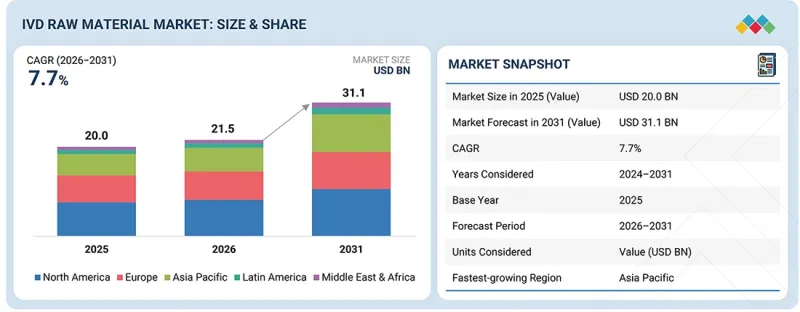
IVD 원재료 시장 규모는 2026년 215억 달러에서 2031년까지 311억 달러로 확대하며, CAGR 7.7%로 성장할 것으로 예측됩니다.
이는 만성질환 및 감염병 유병률의 증가, 조기 및 정확한 질병 진단에 대한 수요 증가, 그리고 첨단 진단 기술의 도입 확대에 기인합니다.
| 조사 범위 | |
|---|---|
| 조사 대상 기간 | 2026-2031년 |
| 기준연도 | 2025년 |
| 예측 기간 | 2026-2031년 |
| 산정 단위 | 금액(10억 달러) |
| 부문 | 제품 유형별, 기술별, 용도별, 공급원별, 유래별, 최종사용자별, 지역별 |
| 대상 지역 | 북미, 유럽, 아시아태평양(APAC), 라틴아메리카(LATAM), 중동 및 아프리카(MEA) |
PCR, NGS, FISH, LAMP 등의 분자 진단 기술 활용이 확대됨에 따라 고품질 올리고뉴클레오티드, 핵산, 효소 및 기타 특수 원자재에 대한 수요가 증가하고 있습니다. 동시에, 현장 진단(Point-of-Care) 검사의 급속한 확산으로 인해 신속 진단 분석에 사용되는 항체, 항원, 막, 표지제, 검출 재료에 대한 수요도 증가하고 있습니다. 또한 재조합 기술, 단백질 엔지니어링 및 분석법 개발의 진보로 인해 진단 검사의 성능, 민감도 및 신뢰성이 향상되고 있습니다. 이러한 혁신을 통해 진단 기기 제조업체는 보다 정확하고 효율적인 검사 솔루션을 개발할 수 있게 되었으며, 그 결과 전 세계 IVD 원자재 시장의 성장을 지원하고 있습니다.
"예측 기간 중, 용도별로는 감염증 검사 부문이 IVD 원자재 시장에서 가장 큰 점유율을 차지할 것으로 예상됩니다."
용도별로 보면 IVD 원자재 시장은 감염병 검사, 종양학/암 마커, 심장 마커, 당뇨병 및 대사성 질환, 자가면역 질환, 혈액 선별 검사, 여성 건강 및 불임, 유전성 및 희귀 질환 검사, 기타로 분류됩니다. 감염병 검사 부문은 전 세계에서 감염병의 부담이 크고, 신속하고 정확하며 대규모 진단 검사에 대한 수요가 증가하고 있으므로 가장 큰 시장 점유율을 차지하고 있습니다. 진단 기기 제조업체들은 세균, 바이러스, 진균, 기생충에 의한 감염증을 검출하기 위한 면역측정법, 분자 진단 검사 및 현장 진단(Point-of-Care) 검사 솔루션을 개발함에 있으며, 항체, 항원, 효소, 올리고뉴클레오티드, 핵산, 검출 시약 등의 원자재를 폭넓게 사용하고 있습니다. 또한 공중보건 프로그램에 대한 투자 확대, 질병 조기 진단에 대한 의식의 향상, 그리고 첨단 분자 진단 기술의 지속적인 도입으로 인해 감염병 검사 분야에서 고품질 IVD 원자재에 대한 수요가 견인되고 있으며, 이로 인해 해당 분야가 시장에서 가장 큰 용도 부문로 자리 잡고 있습니다.
"예측 기간 중 IVD 원자재 시장에서 면역분석 부문이 가장 큰 시장 점유율을 차지할 것으로 보입니다."
전 세계 IVD 원자재 시장은 기술별로 면역 분석법, 분자 진단, 임상화학, 혈액학, 미생물학·배양, 응고 검사, 현장 진단(POCT), 유세포분석, 기타로 분류할 수 있습니다. 이 중 면역 분석 부문이 가장 큰 시장 점유율을 차지했습니다. 면역측정에 기반한 진단법은 높은 민감도, 특이도, 비용 대비 효과, 그리고 감염증, 종양학, 심장 마커, 자가면역질환, 호르몬 검사 등 폭넓은 응용 분야에서 일상적인 질환 검사의 기반이 되는 요소로 자리 잡고 있습니다. 면역측정 플랫폼의 보급으로 인해 항체, 항원, 단백질, 효소, 표지제, 검출 시약 등 중요한 원자재에 대한 수요가 크게 증가하고 있습니다. 또한 분석법 개발의 지속적인 발전, 진단 검사 건수의 증가, 신속하고 정확한 진단 솔루션에 대한 수요 증가, 그리고 자동 면역 분석기의 보급으로 인해 면역 분석 기술의 채택이 앞으로도 계속될 것이며, 그 결과 전 세계 IVD 원자재 수요가 견인될 것으로 예상됩니다.
"아시아태평양: 2026-2031년까지 IVD 원자재 시장에서 가장 빠르게 성장할 지역"
전 세계 IVD 원자재 시장은 북미, 유럽, 아시아태평양, 라틴아메리카, 중동 및 아프리카로 구분됩니다. 아시아태평양은 2026-2031년까지 지역별 가장 높은 연평균 성장률(CAGR)을 기록할 것으로 예측됩니다. 이 지역의 성장은 만성질환 및 감염증 유병률 증가, 의료 인프라 확충, 진단 기술에 대한 투자 확대, 그리고 조기 및 정확한 질병 진단에 대한 수요 증가에 의해 주도되고 있습니다. 중국에서는 의료 현대화를 위한 노력과 생명공학 및 생명과학 분야에 대한 투자 확대를 통해 국내 진단 기기 제조 역량 강화가 진행되고 있습니다. 인도에서는 임상 검사실 및 분자 진단 시설의 확대, 그리고 현장 진단(Point-of-Care) 검사의 도입에 힘입어 진단 검사 건수가 대폭 증가하고 있습니다. 또한 일본의 첨단인 의료 시스템, 고령화, 그리고 정밀 의학에 대한 강력한 집중이 고품질 진단 분석법 및 그 개발에 필요한 원자재에 대한 수요를 지속적으로 견인하고 있습니다. 이러한 요인들로 인해 예측 기간 중 아시아태평양 전체에서 IVD 원자재 시장의 급속한 성장이 촉진될 것으로 전망됩니다.
Merck KGaA(독일), Thermo Fisher Scientific Inc.(미국), Medix Biochemica(핀란드), Bio-Techne Corporation(미국), Fapon Biotech Inc.(중국), Meridian Bioscience, Inc.(미국), BBI Solutions(영국),Toyobo(일본), Roche CustomBiotech(스위스), Integrated DNA Technologies, Inc.(미국), Cytiva(미국),Sartorius AG(독일), LGC Biosearch Technologies(미국), Fitzgerald Industries International(미국) 및 Bangs Laboratories, Inc.(미국)는 전 세계 IVD 원자재 시장에서 사업을 운영하는 주요 기업 중 일부입니다.
조사 범위:
본 조사 보고서에서는 IVD 원자재 시장을 제품 유형별(항체, 항원·단백질, 효소·기질, 올리고뉴클레오티드·핵산, 비드·입자, 막, 표지·검출 재료, 완충액·희석액, 기타), 기술별(면역측정법, 분자진단, 임상화학,혈액학, 미생물학·배양, 응고, 현장 진단(POCT), 유세포분석, 기타), 용도별(감염증 검사, 종양학/암 마커, 심장 마커, 당뇨병·대사성 질환, 자가면역 질환, 혈액 스크리닝,여성 건강·불임, 유전성·희귀질환 검사, 기타), 공급원별(자사 제조[캡티브] 및 제3자 공급[머천트]), 유래별(생물 유래/천연 유래, 재조합/합성, 기타),최종사용자별(체외진단용 의약품(IVD) 제조사, 수탁 연구 기관(CRO), 학술·연구 기관, 제약·바이오기술 기업, 기타) 및 지역별(북미, 유럽, 아시아태평양, 라틴아메리카, 중동 및 아프리카)로 분류하여 분석하고 있습니다. 이 보고서의 조사 범위에는 IVD 원자재 시장의 성장에 영향을 미치는 주요 요인(촉진요인, 제약 요인, 기회, 과제 등)에 대한 상세한 정보가 포함되어 있습니다. 주요 업계 참여 기업에 대한 상세한 분석을 통해 각 기업의 사업 개요, 제품 포트폴리오, 인수, 제휴, 공동 연구, 생산 능력 확대, 제품 출시 등의 주요 전략, 그리고 IVD 원자재 시장과 관련된 최근 동향에 대한 인사이트를 제공합니다. 또한 이 보고서에서는 IVD 원자재 생태계 내의 신생 기업 및 시장 진입 기업에 대한 경쟁 분석도 다루고 있습니다.
이 보고서를 구매해야 하는 이유:
이 보고서는 IVD 원자재 시장 전체 및 각 하위 부문의 매출에 대한 가장 정확한 추정치를 제공함으로써, 이 시장의 선도 기업 및 신규 진입 기업 여러분을 지원합니다. 이 보고서는 이해관계자 여러분이 경쟁 구도를 이해하고, 더 심층 인사이트를 얻어, 자사의 비즈니스를 최적의 위치에 자리매김하며, 적절한 시장 진입 전략을 수립하는 데 도움이 됩니다. 또한 이 보고서는 이해관계자 여러분이 시장 동향을 파악하고, 주요 시장 촉진요인, 억제요인, 기회 및 과제에 대한 정보를 얻는 데 도움이 됩니다.
이 보고서는 다음 사항에 대한 인사이트를 제공합니다. :
- 주요 촉진요인(고령 인구 증가 및 이에 따른 만성질환 증가, 신흥 국가에서의 질병 조기 진단에 대한 의식의 향상, 신속한 현장 진단(POC) 기술의 부상 및 자동 분석 장비의 보급 확대, 그리고 맞춤형 의료에 대한 관심 증가) 및 제약 요인(불리한 보험 환급 상황, 엄격한 규제 요건)에 대한 분석, 기회(질환 특이적 바이오마커 및 검사의 도입, 동반 진단의 중요성 증대, 개발도상국에서의 성장 기회, 면역측정 진단 기술의 발전, 그리고 디지털화 확대 추세),그리고 과제(로트 간 균일성 및 원자재 품질 유지, 그리고 중요한 생물학적·합성 시약의 입수 가능성에 영향을 미치는 공급망 혼란) 등, IVD 원자재 시장의 성장에 영향을 미치는 요인들에 대해 분석하고 있습니다
- 제품 개발 및 혁신: IVD 원자재 시장의 향후 기술, 연구개발 활동 및 신제품 출시에 대한 상세 인사이트
- 시장 개발: 수익성이 높은 시장에 대한 포괄적인 정보 - 이 보고서에서는 다양한 지역의 IVD 원자재 시장을 분석하고 있습니다.
- 시장 다각화: IVD 원자재 시장의 신제품, 미개발 지역, 최근 동향 및 투자에 대한 포괄적인 정보
- 경쟁 분석: Merck KGaA(독일), Thermo Fisher Scientific Inc.(미국), Medix Biochemica(핀란드), Bio-Techne Corporation(미국), Fapon Biotech Inc.(중국) 등 주요 기업의 시장 점유율, 성장 전략 및 제품 포트폴리오에 대한 상세한 평가
자주 묻는 질문
목차
제1장 서론
제2장 개요
제3장 주요 인사이트
제4장 시장 개요
제5장 업계 동향
제6장 기술 진보, AI에 의한 영향, 특허, 혁신, 향후 응용
제7장 규제 상황과 지속가능성 구상
제8장 고객 상황과 구매 행동
제9장 IVD 원재료 시장(제품 유형별)
제10장 IVD 원재료 시장(기술별)
제11장 IVD 원재료 시장(용도별)
제12장 IVD 원재료 시장(공급원별)
제13장 IVD 원재료 시장(유래별)
제14장 IVD 원재료 시장(최종사용자별)
제15장 IVD 원재료 시장(지역별)
제16장 IVD 원재료 시장 : 수량 분석
제17장 경쟁 구도
제18장 기업 개요
제19장 조사 방법
제20장 부록
KSA 26.09.08The IVD raw material market is projected to grow from USD 21.5 billion in 2026 to USD 31.1 billion by 2031, growing at a CAGR of 7.7%. The increasing prevalence of chronic and infectious diseases, the rising demand for early and accurate disease diagnosis, and the expanding adoption of advanced diagnostic technologies.
| Scope of the Report | |
|---|---|
| Years Considered for the Study | 2026-2031 |
| Base Year | 2025 |
| Forecast Period | 2026-2031 |
| Units Considered | Value (USD billion) |
| Segments | By product type, Technology, application, Supply Source, Source/Origin, end user, and region. |
| Regions covered | North America, Europe, APAC, LATAM, MEA |
The growing use of molecular diagnostic techniques such as PCR, NGS, FISH, and LAMP is increasing demand for high-quality oligonucleotides, nucleic acids, enzymes, and other specialized raw materials. At the same time, the rapid expansion of point-of-care testing is driving the need for antibodies, antigens, membranes, labels, and detection materials used in rapid diagnostic assays. Furthermore, advancements in recombinant technologies, protein engineering, and assay development are improving the performance, sensitivity, and reliability of diagnostic tests. These innovations are enabling diagnostic manufacturers to develop more accurate and efficient testing solutions, thereby supporting the growth of the global IVD raw material market.
"The infectious disease testing segment is expected to account for the largest share of the IVD raw material market, by application, during the forecast period."
Based on application, the IVD raw material market is segmented into infectious disease testing, oncology/cancer markers, cardiac markers, diabetes & metabolic disorders, autoimmune disease, blood screening, women's health & fertility, genetic & rare disease testing, and others. The infectious disease testing segment accounts for the largest market share due to the high global burden of infectious diseases and the increasing demand for rapid, accurate, and large-scale diagnostic testing. Diagnostic manufacturers extensively use raw materials such as antibodies, antigens, enzymes, oligonucleotides, nucleic acids, and detection reagents to develop immunoassays, molecular diagnostic tests, and point-of-care testing solutions for detecting bacterial, viral, fungal, and parasitic infections. Additionally, growing investments in public health programs, increasing awareness of early disease diagnosis, and the continued adoption of advanced molecular diagnostic technologies are driving demand for high-quality IVD raw materials in infectious disease testing, making it the largest application segment of the market.
"The immunoassay segment has the largest market share in the IVD raw material market during the forecast period."
The global IVD raw material market can be segmented by technology into immunoassay, molecular diagnostics, clinical chemistry, hematology, microbiology & culture, coagulation, point-of-care testing, flow cytometry, and others. Among these, the immunoassay segment accounted for the largest market share. Immunoassay-based diagnostics remain a fundamental component of routine disease testing due to their high sensitivity, specificity, cost-effectiveness, and broad application across infectious diseases, oncology, cardiac markers, autoimmune disorders, and hormone testing. The widespread adoption of immunoassay platforms has generated substantial demand for critical raw materials, including antibodies, antigens, proteins, enzymes, labels, and detection reagents. Furthermore, continuous advancements in assay development, increasing diagnostic testing volumes, growing demand for rapid and accurate diagnostic solutions, and the expansion of automated immunoassay analyzers are expected to support the continued adoption of immunoassay technologies, thereby driving demand for IVD raw materials worldwide.
"Asia Pacific: The fastest-growing market for IVD raw material from 2026 to 2031"
The global IVD raw material market is segmented into North America, Europe, Asia Pacific, Latin America, and the Middle East & Africa. The Asia Pacific is projected to grow at the highest regional CAGR from 2026 to 2031. The region's growth is driven by the increasing prevalence of chronic and infectious diseases, expanding healthcare infrastructure, rising investments in diagnostic technologies, and growing demand for early and accurate disease diagnosis. China is strengthening its domestic diagnostic manufacturing capabilities through healthcare modernization initiatives and increased investment in biotechnology and life sciences. India is witnessing significant growth in diagnostic testing volumes, supported by the expansion of clinical laboratories and molecular diagnostic facilities, as well as the adoption of point-of-care testing. Additionally, Japan's advanced healthcare system, aging population, and strong focus on precision medicine continue to drive demand for high-quality diagnostic assays and the raw materials required for their development. These factors are expected to support the rapid growth of the IVD raw material market across the Asia Pacific region during the forecast period.
The break-up of the profile of primary participants in the IVD raw market:
- By Company Type: Tier 1 - 40%, Tier 2 - 30%, and Tier - 30%
- By Designation: C-level Executives - 27%, Directors - 18%, and Others - 55%
- By Region: North America - 51%, Europe - 21%, Asia Pacific - 18%, Latin America - 6%, and Middle East & Africa - 4%
Merck KGaA (Germany), Thermo Fisher Scientific Inc. (U.S.), Medix Biochemica (Finland), Bio-Techne Corporation (U.S.), Fapon Biotech Inc. (China), Meridian Bioscience, Inc. (U.S.), BBI Solutions (U.K.), Toyobo Co., Ltd. (Japan), Roche CustomBiotech (Switzerland), Integrated DNA Technologies, Inc. (U.S.), Cytiva (U.S.), Sartorius AG (Germany), LGC Biosearch Technologies (U.S.), Fitzgerald Industries International (U.S.), and Bangs Laboratories, Inc. (U.S.) are some of the key players operating in the global IVD raw material market.
Research Coverage:
This research report categorizes the IVD raw material market by product type (antibodies, antigens & proteins, enzymes & substrates, oligonucleotides & nucleic acids, beads & particles, membranes, labels & detection materials, buffers & diluents, and others), by technology (immunoassay, molecular diagnostics, clinical chemistry, hematology, microbiology & culture, coagulation, point-of-care testing, flow cytometry, and others), by application (infectious disease testing, oncology/cancer markers, cardiac markers, diabetes & metabolic disorders, autoimmune disease, blood screening, women's health & fertility, genetic & rare disease testing, and others), by supply source (in-house manufacturing [captive] and third-party supply [merchant]), by source/origin (biological/natural source, recombinant/synthetic, and others), by end user (IVD manufacturers, contract research organizations, academic & research institutes, pharmaceutical & biotech companies, and others), and by region (North America, Europe, Asia Pacific, Latin America, and the Middle East & Africa). The scope of the report covers detailed information regarding the major factors, such as drivers, restraints, opportunities, and challenges influencing the growth of the IVD raw material market. A detailed analysis of the key industry players has been conducted to provide insights into their business overview, product portfolios, key strategies such as acquisitions, partnerships, collaborations, capacity expansions, and product launches, as well as recent developments associated with the IVD raw material market. Competitive analysis of emerging companies and market participants within the IVD raw materials ecosystem is also covered in this report.
Reasons to buy this report:
The report will help the market leaders/new entrants in this market with information on the closest approximations of the revenue numbers for the overall IVD raw material market and the subsegments. This report will help stakeholders understand the competitive landscape and gain deeper insights to better position their businesses and plan suitable go-to-market strategies. The report also helps stakeholders understand the pulse of the market and provides them with information on key market drivers, restraints, opportunities, and challenges.
The report provides insights into the following pointers:
- Analysis of key drivers (increasing geriatric population and subsequent rise in chronic diseases, growing awareness of early disease diagnosis in emerging economies, emergence of rapid point-of-care [POC] technologies and rising adoption of automated analyzers, and growing preference for personalized medicine), restraints (unfavorable reimbursement scenario, stringent regulatory requirements), opportunities (introduction of disease-specific biomarkers and tests, increasing significance of companion diagnostics, growth opportunities in developing countries, improvements in immunoassay diagnostic technologies, and the growing digitalization trend), and challenges (maintaining batch-to-batch consistency and quality of raw materials, and supply chain disruptions affecting the availability of critical biological and synthetic reagents) influencing the growth of the IVD raw material market
- Product Development/Innovation: Detailed insights on upcoming technologies, research & development activities, and new product launches in the IVD raw material market
- Market Development: Comprehensive information about lucrative markets-the report analyzes the IVD raw material market across varied regions.
- Market Diversification: Exhaustive information about new products, untapped geographies, recent developments, and investments in the IVD raw material market
- Competitive Assessment: In-depth assessment of market shares, growth strategies, and product portfolios of leading players such as Merck KGaA (Germany), Thermo Fisher Scientific Inc. (U.S.), Medix Biochemica (Finland), Bio-Techne Corporation (U.S.), and Fapon Biotech Inc. (China), among others
TABLE OF CONTENTS
1 INTRODUCTION
- 1.1 STUDY OBJECTIVES
- 1.2 MARKET DEFINITION
- 1.3 STUDY SCOPE
- 1.3.1 MARKETS COVERED AND REGIONAL SCOPE
- 1.3.2 INCLUSIONS AND EXCLUSIONS
- 1.3.3 YEARS CONSIDERED
- 1.3.4 CURRENCY CONSIDERED
- 1.4 STAKEHOLDERS
2 EXECUTIVE SUMMARY
- 2.1 KEY INSIGHTS AND MARKET HIGHLIGHTS
- 2.2 KEY MARKET PARTICIPANTS: SHARE INSIGHTS AND STRATEGIC DEVELOPMENTS
- 2.3 DISRUPTIVE TRENDS SHAPING THE MARKET
- 2.4 HIGH-GROWTH SEGMENTS AND EMERGING FRONTIERS
- 2.5 SNAPSHOT: GLOBAL MARKET SIZE, GROWTH RATE, AND FORECAST
3 PREMIUM INSIGHTS
- 3.1 IVD RAW MATERIALS MARKET OVERVIEW
- 3.2 IVD RAW MATERIALS MARKET, BY PRODUCT TYPE, 2026 VS. 2031
- 3.3 IVD RAW MATERIALS MARKET, BY TECHNOLOGY, 2026 VS. 2031
- 3.4 IVD RAW MATERIALS MARKET, BY APPLICATION, 2026 VS. 2031
- 3.5 IVD RAW MATERIALS MARKET, BY SUPPLY SOURCE, 2026 VS. 2031
- 3.6 IVD RAW MATERIALS MARKET, BY SOURCE/ORIGIN, 2026 VS. 2031
- 3.7 IVD RAW MATERIALS MARKET, BY END USER, 2026 VS. 2031
- 3.8 IVD RAW MATERIALS MARKET: GEOGRAPHIC GROWTH OPPORTUNITIES
4 MARKET OVERVIEW
- 4.1 INTRODUCTION
- 4.2 MARKET DYNAMICS
- 4.2.1 DRIVERS
- 4.2.1.1 Rising prevalence of chronic and infectious diseases
- 4.2.1.2 Growing adoption of personalized medicine and companion diagnostics
- 4.2.1.3 Increasing use of recombinant antibodies, proteins, and enzymes
- 4.2.1.4 Growing demand for raw materials supporting decentralized and rapid diagnostics
- 4.2.2 RESTRAINTS
- 4.2.2.1 High validation and quality-control costs
- 4.2.2.2 Long supplier qualification cycles
- 4.2.2.3 Limited availability of specialized biological raw materials
- 4.2.3 OPPORTUNITIES
- 4.2.3.1 Adoption of recombinant and animal-free raw materials
- 4.2.3.2 Localization of raw material manufacturing in emerging markets
- 4.2.3.3 Development of next-generation molecular diagnostic reagents
- 4.2.4 CHALLENGES
- 4.2.4.1 Maintaining batch-to-batch consistency
- 4.2.4.2 Building resilient supply chains for critical biological inputs
- 4.2.4.3 Meeting evolving IVDR/FDA supplier documentation requirements
- 4.2.1 DRIVERS
- 4.3 UNMET NEEDS AND WHITE SPACES
- 4.3.1 UNMET NEEDS IN IVD RAW MATERIALS MARKET
- 4.3.2 WHITE SPACE OPPORTUNITIES
- 4.4 INTERCONNECTED MARKETS AND CROSS-SECTOR OPPORTUNITIES
- 4.4.1 INTERCONNECTED MARKETS
- 4.4.2 CROSS-SECTOR OPPORTUNITIES
- 4.5 STRATEGIC MOVES BY TIER 1/2/3 PLAYERS
- 4.5.1 KEY MOVES AND STRATEGIC FOCUS
5 INDUSTRY TRENDS
- 5.1 PORTER'S FIVE FORCES ANALYSIS
- 5.1.1 THREAT OF NEW ENTRANTS
- 5.1.2 THREAT OF SUBSTITUTES
- 5.1.3 BARGAINING POWER OF SUPPLIERS
- 5.1.4 BARGAINING POWER OF BUYERS
- 5.1.5 INTENSITY OF COMPETITIVE RIVALRY
- 5.2 MACROECONOMIC INDICATORS
- 5.2.1 INTRODUCTION
- 5.2.2 GDP TRENDS AND FORECAST
- 5.3 SUPPLY CHAIN ANALYSIS
- 5.4 VALUE CHAIN ANALYSIS
- 5.5 ECOSYSTEM ANALYSIS
- 5.6 PRICING ANALYSIS
- 5.6.1 AVERAGE SELLING PRICE, BY REGION, 2024-2026
- 5.6.2 AVERAGE SELLING PRICE, BY KEY PLAYER, 2024-2026
- 5.7 TRADE ANALYSIS
- 5.7.1 IMPORT SCENARIO (HS CODE 300213)
- 5.7.2 EXPORT SCENARIO (HS CODE 300213)
- 5.8 KEY CONFERENCES & EVENTS, 2026-2027
- 5.9 TRENDS/DISRUPTIONS IMPACTING CUSTOMER BUSINESS
- 5.10 INVESTMENT & FUNDING SCENARIO
- 5.11 IMPACT OF US TARIFFS-IVD RAW MATERIALS MARKET
- 5.11.1 INTRODUCTION
- 5.11.2 KEY TARIFF RATES
- 5.11.3 PRICE IMPACT ANALYSIS
- 5.11.4 IMPACT ON REGIONS
- 5.11.4.1 North America
- 5.11.4.2 Europe
- 5.11.4.3 Asia Pacific
- 5.11.5 IMPACT ON END-USE INDUSTRIES
- 5.11.5.1 OEM IVD manufacturers
- 5.11.5.2 Biopharmaceutical companies
- 5.11.5.3 CROs and research institutions
6 TECHNOLOGICAL ADVANCEMENTS, AI-DRIVEN IMPACT, PATENTS, INNOVATIONS, AND FUTURE APPLICATIONS
- 6.1 KEY EMERGING TECHNOLOGIES
- 6.1.1 IMMUNOASSAY
- 6.2 COMPLEMENTARY TECHNOLOGIES
- 6.2.1 MOLECULAR DIAGNOSTICS
- 6.3 TECHNOLOGY/PRODUCT ROADMAP
- 6.4 PATENT ANALYSIS
- 6.4.1 LIST OF KEY PATENTS
- 6.5 FUTURE APPLICATIONS
- 6.6 IMPACT OF AI/GENERATIVE AI ON IVD RAW MATERIALS MARKET
- 6.6.1 INTRODUCTION
- 6.6.2 TOP USE CASES AND MARKET POTENTIAL
- 6.6.3 KEY COMPANIES IMPLEMENTING AI
- 6.6.4 FUTURE OF AI
7 REGULATORY LANDSCAPE AND SUSTAINABILITY INITIATIVES
- 7.1 REGIONAL REGULATIONS AND COMPLIANCE
- 7.1.1 REGULATORY LANDSCAPE
- 7.1.1.1 North America
- 7.1.1.1.1 US
- 7.1.1.1.2 Canada
- 7.1.1.2 Europe
- 7.1.1.3 Asia Pacific
- 7.1.1.3.1 Japan
- 7.1.1.3.2 China
- 7.1.1.3.3 India
- 7.1.1.1 North America
- 7.1.2 REGULATORY BODIES, GOVERNMENT AGENCIES, AND OTHER ORGANIZATIONS
- 7.1.2.1 North America
- 7.1.2.2 Europe
- 7.1.2.3 Asia Pacific
- 7.1.2.4 Latin America
- 7.1.2.5 Middle East & Africa
- 7.1.1 REGULATORY LANDSCAPE
- 7.2 SUSTAINABILITY INITIATIVES
- 7.2.1 ENVIRONMENTAL IMPACT AND ECO-FRIENDLY INITIATIVES IN IVD RAW MATERIALS MARKET
- 7.2.1.1 Eco-friendly Initiatives
- 7.2.2 IMPACT OF REGULATORY POLICIES ON SUSTAINABILITY INITIATIVES
- 7.2.1 ENVIRONMENTAL IMPACT AND ECO-FRIENDLY INITIATIVES IN IVD RAW MATERIALS MARKET
8 CUSTOMER LANDSCAPE & BUYER BEHAVIOR
- 8.1 DECISION-MAKING PROCESS
- 8.2 BUYER STAKEHOLDERS AND BUYING EVALUATION CRITERIA
- 8.2.1 KEY STAKEHOLDERS IN BUYING PROCESS
- 8.2.2 BUYING CRITERIA
- 8.3 ADOPTION BARRIERS & INTERNAL CHALLENGES
- 8.4 UNMET NEEDS IN VARIOUS END-USE INDUSTRIES
- 8.5 MARKET PROFITABILITY
- 8.5.1 REVENUE POTENTIAL
- 8.5.2 COST DYNAMICS
- 8.5.3 MARGIN OPPORTUNITIES IN KEY APPLICATIONS
9 IVD RAW MATERIALS MARKET, BY PRODUCT TYPE
- 9.1 INTRODUCTION
- 9.2 ANTIBODIES
- 9.2.1 MONOCLONAL ANTIBODIES
- 9.2.1.1 Increasing demand for highly specific and reproducible antibody reagents in immunoassay and rapid diagnostic applications to drive segment growth
- 9.2.2 POLYCLONAL ANTIBODIES
- 9.2.2.1 Broad target recognition and strong signal generation to sustain demand for polyclonal antibodies in diagnostic assays
- 9.2.3 RECOMBINANT ANTIBODIES
- 9.2.3.1 Growing adoption of engineered antibodies to improve consistency, scalability, and performance of IVD assays
- 9.2.1 MONOCLONAL ANTIBODIES
- 9.3 ANTIGENS & PROTEINS
- 9.3.1 RECOMBINANT ANTIGENS
- 9.3.1.1 Growing preference for scalable and consistent antigen production to support increasing IVD assay demand
- 9.3.2 NATIVE PROTEINS
- 9.3.2.1 Continued demand for biologically authentic proteins in sensitive assay development and clinically representative IVD applications
- 9.3.3 CALIBRATORS & STANDARDS
- 9.3.3.1 Increasing emphasis on assay standardization and traceability to drive demand for calibrators & reference materials
- 9.3.1 RECOMBINANT ANTIGENS
- 9.4 ENZYMES & SUBSTRATES
- 9.4.1 DETECTION ENZYMES
- 9.4.1.1 Increasing adoption of enzyme-based signal generation to improve sensitivity and quantitative performance of immunoassays
- 9.4.2 AMPLIFICATION ENZYMES
- 9.4.2.1 Growing adoption of molecular diagnostic testing to accelerate demand for high-performance amplification enzymes
- 9.4.3 SUBSTRATES & COENZYMES
- 9.4.3.1 Increasing need for optimized reaction components to enhance enzyme activity and diagnostic assay signal generation
- 9.4.1 DETECTION ENZYMES
- 9.5 OLIGONUCLEOTIDES & NUCLEIC ACIDS
- 9.5.1 PRIMERS & PROBES
- 9.5.1.1 Increasing adoption of PCR and multiplex molecular assays to drive demand for sequence-specific primers and probes
- 9.5.2 SYNTHETIC DNA/RNA
- 9.5.2.1 Growing use of synthetic DNA and RNA sequences to accelerate molecular assay development and validation
- 9.5.1 PRIMERS & PROBES
- 9.6 BEADS & PARTICLES
- 9.6.1 MAGNETIC BEADS
- 9.6.1.1 Growing adoption of automated magnetic-particle immunoassays to drive demand for high-performance magnetic beads
- 9.6.2 LATEX BEADS
- 9.6.2.1 Widespread use of latex particle-based agglutination and turbidimetric assays to sustain demand for latex beads
- 9.6.3 GOLD NANOPARTICLES
- 9.6.3.1 Increasing adoption of gold nanoparticle-based signal generation in rapid and visually readable diagnostic assays
- 9.6.1 MAGNETIC BEADS
- 9.7 MEMBRANES
- 9.7.1 NITROCELLULOSE MEMBRANES
- 9.7.1.1 High protein-binding capacity and controlled capillary flow to underpin nitrocellulose use across lateral flow and membrane-based immunodiagnostics
- 9.7.2 NYLON & PVDF MEMBRANES
- 9.7.2.1 Higher chemical resistance and specialized biomolecule immobilization requirements to sustain demand
- 9.7.3 GLASS FIBER PADS
- 9.7.3.1 Consistent sample and conjugate transport to strengthen role of glass fiber pads in lateral flow test construction
- 9.7.1 NITROCELLULOSE MEMBRANES
- 9.8 LABELS & DETECTION MATERIALS
- 9.8.1 FLUORESCENT DYES
- 9.8.1.1 Higher analytical sensitivity and instrument-based quantification to expand use of fluorescent detection in IVD
- 9.8.2 CHEMILUMINESCENT LABELS
- 9.8.2.1 Demand for ultra-sensitive immunoassays to sustain adoption of chemiluminescent labels
- 9.8.3 COLLOIDAL GOLD CONJUGATES
- 9.8.3.1 Established visual-readout capability and simplicity of lateral flow testing to sustain demand for colloidal gold conjugates
- 9.8.1 FLUORESCENT DYES
- 9.9 BUFFERS & DILUENTS
- 9.9.1 GREATER EMPHASIS ON REACTION STABILITY AND INTERFERENCE CONTROL TO SUPPORT RELIABLE IVD ASSAY PERFORMANCE
- 9.10 OTHER PRODUCTS
10 IVD RAW MATERIALS MARKET, BY TECHNOLOGY
- 10.1 INTRODUCTION
- 10.2 IMMUNOASSAY
- 10.2.1 INCREASING ADOPTION OF HIGH-SENSITIVITY, AUTOMATED IMMUNOASSAYS TO SUSTAIN DEMAND FOR RAW MATERIALS
- 10.3 MOLECULAR DIAGNOSTICS
- 10.3.1 EXPANSION OF PCR AND ISOTHERMAL AMPLIFICATION FORMATS TO INCREASE DEMAND FOR ENGINEERED POLYMERASES, MASTER MIXES, OLIGONUCLEOTIDES, AND NUCLEIC ACID CONTROLS
- 10.4 CLINICAL CHEMISTRY
- 10.4.1 INCREASING DEMAND FOR HIGH-QUALITY ENZYMES, PROTEINS, LIPOPROTEINS, AND REFERENCE MATERIALS TO SUPPORT AUTOMATED QUANTITATIVE TESTING
- 10.5 HEMATOLOGY
- 10.5.1 GROWING DEMAND FOR CELL-BASED REFERENCE MATERIALS AND BLOOD-DERIVED COMPONENTS TO STRENGTHEN RAW-MATERIAL REQUIREMENTS FOR HEMATOLOGY DIAGNOSTICS
- 10.6 MICROBIOLOGY & CULTURE
- 10.6.1 ADVANCES IN CULTURE-MEDIA FORMULATION AND MICROBIAL IDENTIFICATION TO STRENGTHEN DEMAND FOR SPECIALIZED MICROBIOLOGY RAW MATERIALS
- 10.7 COAGULATION TESTING
- 10.7.1 GREATER EMPHASIS ON FAST, STANDARDIZED MEASUREMENT OF CLOTTING AND FIBRINOLYSIS TO SHAPE RAW MATERIAL REQUIREMENTS IN COAGULATION DIAGNOSTICS
- 10.8 FLOW CYTOMETRY
- 10.8.1 MULTIPARAMETER CELLULAR ANALYSIS TO INCREASE DEMAND FOR HIGHLY SPECIFIC ANTIBODIES AND FLUORESCENT DETECTION MATERIALS
- 10.9 OTHER TECHNOLOGIES
11 IVD RAW MATERIALS MARKET, BY APPLICATION
- 11.1 INTRODUCTION
- 11.2 INFECTIOUS DISEASES
- 11.2.1 BROAD PATHOGEN COVERAGE AND FREQUENT DEMAND FOR RAPID, SENSITIVE TESTING TO DRIVE MARKET GROWTH
- 11.3 ONCOLOGY/CANCER MARKERS
- 11.3.1 MOLECULAR EXPANSION OF BIOMARKER-BASED CANCER DETECTION AND MONITORING TO INCREASE DEMAND FOR RAW MATERIALS
- 11.4 CARDIAC MARKERS
- 11.4.1 HIGH DISEASE PREVALENCE AND USE OF HIGH-SENSITIVITY BIOMARKERS TO STRENGTHEN DEMAND FOR CARDIAC-MARKER RAW MATERIALS
- 11.5 DIABETES & METABOLIC DISORDERS
- 11.5.1 EXPANDING BIOMARKER-BASED SCREENING TO SUSTAIN DEMAND FOR HBA1C, INSULIN, GLUCOSE, AND RELATED IVD RAW MATERIALS
- 11.6 AUTOIMMUNE DISEASES
- 11.6.1 GROWING RELIANCE ON AUTOANTIBODY-BASED TESTING TO SUPPORT DIAGNOSIS OF DIVERSE AUTOIMMUNE CONDITIONS AND EXPAND DEMAND FOR HIGHLY SPECIFIC IVD RAW MATERIALS
- 11.7 BLOOD SCREENING
- 11.7.1 MANDATORY SCREENING OF DONATED BLOOD AND NEED TO DETECT MULTIPLE TRANSFUSION-TRANSMISSIBLE INFECTIONS UNDERPIN DEMAND FOR DIVERSE IVD RAW MATERIALS
- 11.8 WOMEN'S HEALTH & FERTILITY
- 11.8.1 HIGH PREVALENCE OF INFERTILITY AND EXPANDING HORMONE-BASED REPRODUCTIVE TESTING TO SUSTAIN THE DEMAND
- 11.9 GENETIC & RARE DISEASE TESTING
- 11.9.1 EXPANSION OF MOLECULAR AND GENETIC TESTING TO ADDRESS A LARGE AND CLINICALLY DIVERSE POPULATION
- 11.10 OTHER APPLICATIONS
12 IVD RAW MATERIALS MARKET, BY SUPPLY SOURCE
- 12.1 INTRODUCTION
- 12.2 IN-HOUSE MANUFACTURING
- 12.2.1 GREATER CONTROL OVER CRITICAL REAGENTS AND ASSAY PERFORMANCE TO SUSTAIN IN-HOUSE PRODUCTION
- 12.3 THIRD-PARTY SUPPLY
- 12.3.1 OUTSOURCING SPECIALIZED CAPABILITIES TO IMPROVE FLEXIBILITY AND ACCELERATE IVD DEVELOPMENT
13 IVD RAW MATERIALS MARKET, BY SOURCE/ORIGIN
- 13.1 INTRODUCTION
- 13.2 BIOLOGICAL/NATURAL SOURCES
- 13.2.1 ANIMAL-DERIVED
- 13.2.1.1 Established assay performance and broad availability to sustain use of animal-derived IVD raw materials
- 13.2.2 HUMAN-DERIVED
- 13.2.2.1 Clinical relevance and patient-like matrices to sustain demand for human-derived IVD raw materials
- 13.2.1 ANIMAL-DERIVED
- 13.3 RECOMBINANT/SYNTHETIC SOURCES
- 13.3.1 E. COLI-EXPRESSED
- 13.3.1.1 Scalable production and strong suitability for non-glycosylated proteins to support E. coli-based recombinant IVD materials
- 13.3.2 CHO-EXPRESSED
- 13.3.2.1 Mammalian expression for structurally complex biomarkers to improve assay relevance and performance
- 13.3.3 CHEMICALLY SYNTHESIZED
- 13.3.3.1 Precisely defined composition and scalable manufacturing to expand the role of synthetic materials in IVD
- 13.3.1 E. COLI-EXPRESSED
- 13.4 OTHER SOURCES
14 IVD RAW MATERIALS MARKET, BY END USER
- 14.1 INTRODUCTION
- 14.2 IVD MANUFACTURERS
- 14.2.1 EXPANDING ASSAY PORTFOLIOS AND TIGHTER CONTROL OF CRITICAL COMPONENTS TO DRIVE RAW-MATERIAL CONSUMPTION
- 14.3 CONTRACT RESEARCH ORGANIZATIONS
- 14.3.1 INCREASING OUTSOURCING OF ASSAY DEVELOPMENT AND VALIDATION TO ACCELERATE IVD COMMERCIALIZATION
- 14.4 ACADEMIC & RESEARCH INSTITUTES
- 14.4.1 GROWING TRANSLATIONAL RESEARCH AND ASSAY DEVELOPMENT TO EXPAND CONSUMPTION OF SPECIALIZED IVD RAW MATERIALS
- 14.5 PHARMACEUTICAL & BIOTECHNOLOGY COMPANIES
- 14.5.1 INTEGRATION OF DIAGNOSTICS INTO DRUG DEVELOPMENT TO INCREASE DEMAND FOR BIOMARKER AND ASSAY COMPONENTS
- 14.6 OTHER END USERS
15 IVD RAW MATERIALS MARKET, BY REGION
- 15.1 INTRODUCTION
- 15.2 NORTH AMERICA
- 15.2.1 US
- 15.2.1.1 Increasing demand for advanced diagnostics and a mature reimbursement framework to drive market
- 15.2.2 CANADA
- 15.2.2.1 Rising disease prevalence and demand for early diagnoses drive market growth
- 15.2.1 US
- 15.3 EUROPE
- 15.3.1 GERMANY
- 15.3.1.1 Increasing investments in life sciences and advanced diagnostics to propel demand for IVD raw materials
- 15.3.2 UK
- 15.3.2.1 Rising adoption of genomic testing and advanced diagnostics to support demand growth
- 15.3.3 FRANCE
- 15.3.3.1 High healthcare expenditure and continued investment in genomic medicine to drive market
- 15.3.4 ITALY
- 15.3.4.1 Growing geriatric population and increasing burden of chronic diseases to boost demand for IVD raw materials
- 15.3.5 SPAIN
- 15.3.5.1 Increasing adoption of genomic testing and advanced diagnostics to support the market
- 15.3.6 REST OF EUROPE
- 15.3.1 GERMANY
- 15.4 ASIA PACIFIC
- 15.4.1 CHINA
- 15.4.1.1 Growing focus on preventive care and localization of IVD raw materials to boost market
- 15.4.2 JAPAN
- 15.4.2.1 Increasing research investment and adoption of advanced diagnostics to support market growth
- 15.4.3 INDIA
- 15.4.3.1 Rising incidence of diabetes and cancer and increasing localization of IVD manufacturing to augment growth
- 15.4.4 REST OF ASIA PACIFIC
- 15.4.1 CHINA
- 15.5 LATIN AMERICA
- 15.5.1 INCREASING HEALTHCARE INVESTMENT, DISEASE BURDEN, AND EXPANSION OF DIAGNOSTIC ACCESS TO SUPPORT MARKET GROWTH
- 15.6 MIDDLE EAST & AFRICA
- 15.6.1 INCREASING HEALTHCARE INVESTMENT, PREVENTIVE SCREENING, AND DIAGNOSTIC INFRASTRUCTURE TO SUPPORT MARKET GROWTH
16 IVD RAW MATERIALS MARKET: VOLUME ANALYSIS
- 16.1 INTRODUCTION
- 16.2 GLOBAL: NAT BASED PCR EQUIPMENT SOLD, 2024-2031 (THOUSAND UNITS)
17 COMPETITIVE LANDSCAPE
- 17.1 INTRODUCTION
- 17.2 KEY PLAYER STRATEGIES/RIGHT TO WIN
- 17.2.1 OVERVIEW OF STRATEGIES DEPLOYED BY PLAYERS IN IVD RAW MATERIALS MARKET
- 17.3 REVENUE ANALYSIS, 2023-2025
- 17.4 MARKET SHARE ANALYSIS, 2025
- 17.4.1 THIRD-PARTY SUPPLIERS MARKET SHARE ANALYSIS, 2025
- 17.5 COMPANY EVALUATION MATRIX: KEY PLAYERS, 2025
- 17.5.1 STARS
- 17.5.2 EMERGING LEADERS
- 17.5.3 PERVASIVE PLAYERS
- 17.5.4 PARTICIPANTS
- 17.5.5 COMPANY FOOTPRINT: KEY PLAYERS, 2025
- 17.5.5.1 Company footprint
- 17.5.5.2 Region footprint
- 17.5.5.3 Product type footprint
- 17.5.5.4 End-user footprint
- 17.6 COMPANY EVALUATION MATRIX: STARTUPS/SMES, 2025
- 17.6.1 PROGRESSIVE COMPANIES
- 17.6.2 RESPONSIVE COMPANIES
- 17.6.3 DYNAMIC COMPANIES
- 17.6.4 STARTING BLOCKS
- 17.6.5 COMPANY EVALUATION MATRIX: STARTUPS/SMES, 2025
- 17.6.5.1 Detailed list of key startups/SMEs
- 17.6.5.2 Competitive benchmarking of startups/SMEs (1/2)
- 17.6.5.3 Competitive benchmarking of startups/SMEs (2/2)
- 17.7 COMPANY VALUATION & FINANCIAL METRICS
- 17.7.1 FINANCIAL METRICS
- 17.7.2 COMPANY VALUATION
- 17.8 BRAND/PRODUCT COMPARISON
- 17.9 COMPETITIVE SCENARIO
- 17.9.1 PRODUCT LAUNCHES & APPROVALS
- 17.9.2 DEALS
18 COMPANY PROFILES
- 18.1 KEY PLAYERS
- 18.1.1 MERCK KGAA
- 18.1.1.1 Business overview
- 18.1.1.2 Products offered
- 18.1.1.3 Recent developments
- 18.1.1.3.1 Product launches & approvals
- 18.1.1.3.2 Deals
- 18.1.1.4 MnM view
- 18.1.1.4.1 Key strengths
- 18.1.1.4.2 Strategic choices
- 18.1.1.4.3 Weaknesses and competitive threats
- 18.1.2 THERMO FISHER SCIENTIFIC
- 18.1.2.1 Business overview
- 18.1.2.2 Products offered
- 18.1.2.3 Recent developments
- 18.1.2.3.1 Product enhancements
- 18.1.2.3.2 Deals
- 18.1.2.4 MnM view
- 18.1.2.4.1 Key strengths
- 18.1.2.4.2 Strategic choices
- 18.1.2.4.3 Weaknesses & competitive threats
- 18.1.3 BIO-TECHNE CORPORATION
- 18.1.3.1 Business overview
- 18.1.3.2 Products & services offered
- 18.1.3.3 Recent developments
- 18.1.3.3.1 Product launches & approvals
- 18.1.3.3.2 Deals
- 18.1.3.4 MnM view
- 18.1.3.4.1 Key strengths
- 18.1.3.4.2 Strategic choices
- 18.1.3.4.3 Weaknesses & competitive threats
- 18.1.4 FAPON BIOTECH
- 18.1.4.1 Business overview
- 18.1.4.2 Products & services offered
- 18.1.4.3 Recent developments
- 18.1.4.3.1 Product launches & approvals
- 18.1.4.4 MnM view
- 18.1.4.4.1 Key strengths
- 18.1.4.4.2 Strategic choices
- 18.1.4.4.3 Weaknesses & competitive threats
- 18.1.5 MERIDIAN BIOSCIENCE
- 18.1.5.1 Business overview
- 18.1.5.2 Products offered
- 18.1.5.3 Recent developments
- 18.1.5.3.1 Product launches
- 18.1.5.3.2 Deals
- 18.1.5.4 MnM view
- 18.1.5.4.1 Key strengths
- 18.1.5.4.2 Strategic choices
- 18.1.5.4.3 Weaknesses & competitive threats
- 18.1.6 MEDIX BIOCHEMICA
- 18.1.6.1 Business overview
- 18.1.6.2 Products & services offered
- 18.1.6.3 Recent developments
- 18.1.6.3.1 Deals
- 18.1.6.3.2 Expansions
- 18.1.7 ROCHE CUSTOMBIOTECH
- 18.1.7.1 Business overview
- 18.1.7.2 Products & services offered
- 18.1.8 DANAHER CORPORATION
- 18.1.8.1 Business overview
- 18.1.8.2 Products & services offered
- 18.1.8.3 Recent developments
- 18.1.8.3.1 Deals
- 18.1.9 SARTORIUS AG
- 18.1.9.1 Business overview
- 18.1.9.2 Products offered
- 18.1.10 HYTEST LTD.
- 18.1.10.1 Business overview
- 18.1.10.2 Products offered
- 18.1.11 TOYOBO CO., LTD.
- 18.1.11.1 Business overview
- 18.1.11.2 Products offered
- 18.1.12 LGC BIOSEARCH TECHNOLOGIES
- 18.1.12.1 Business overview
- 18.1.12.2 Products offered
- 18.1.1 MERCK KGAA
- 18.2 OTHER PLAYERS
- 18.2.1 BBI SOLUTIONS
- 18.2.2 SURMODICS IVD
- 18.2.3 AHLSTROM OYJ
- 18.2.4 BANGS LABORATORIES
- 18.2.5 SCRIPPS LABORATORIES, INC.
- 18.2.6 MIKROGEN GMBH
- 18.2.7 ADVANCED MICRODEVICES PVT. LTD.
- 18.2.8 SEKISUI DIAGNOSTICS
- 18.2.9 RANDOX LABORATORIES LTD.
- 18.2.10 HIMEDIA LABORATORIES
- 18.2.11 SINO BIOLOGICAL
- 18.2.12 BIOSYNTH
- 18.2.13 NEW ENGLAND BIOLABS, INC.
19 RESEARCH METHODOLOGY
- 19.1 RESEARCH DATA
- 19.2 SECONDARY DATA
- 19.2.1 LIST OF SECONDARY SOURCES
- 19.2.2 PRIMARY DATA
- 19.2.2.1 Key data from primary sources
- 19.2.2.2 Breakdown of primary interviews
- 19.3 MARKET SIZE ESTIMATION
- 19.3.1 TOTAL MARKET SIZE: IVD RAW MATERIALS MARKET
- 19.3.2 BOTTOM-UP APPROACH
- 19.3.2.1 Approach 2: Study of annual reports and investor presentations
- 19.3.2.2 Approach 3: Primary interviews
- 19.3.2.3 Growth forecast
- 19.3.3 TOP-DOWN APPROACH
- 19.4 DATA TRIANGULATION
- 19.5 RESEARCH ASSUMPTIONS
- 19.5.1 STUDY-RELATED ASSUMPTIONS
- 19.6 STUDY ASSUMPTIONS
- 19.6.1 GROWTH RATE ASSUMPTIONS
- 19.7 RESEARCH LIMITATIONS
- 19.8 RISK ASSESSMENT
20 APPENDIX
- 20.1 DISCUSSION GUIDE
- 20.2 KNOWLEDGESTORE: MARKETSANDMARKETS' SUBSCRIPTION PORTAL
- 20.3 CUSTOMIZATION OPTIONS
- 20.4 RELATED REPORTS
- 20.5 AUTHOR DETAILS