

|
시장보고서
상품코드
2126322
자동차용 터보차저 시장 예측(-2033년) : 차종별, 연료 유형별, 터보 유형별, 재료별, 컴포넌트별, 용도별, 지역별Automotive Turbocharger Market by Type (VGT, Wastegate, e-Turbo), Component (Turbine Wheel, Compressor Wheel, Housing), Fuel Type (Diesel & Gasoline), Material, Off-Highway Equipment, Vehicle Type, Aftermarket, and Region - Global Forecast to 2033 |
||||||

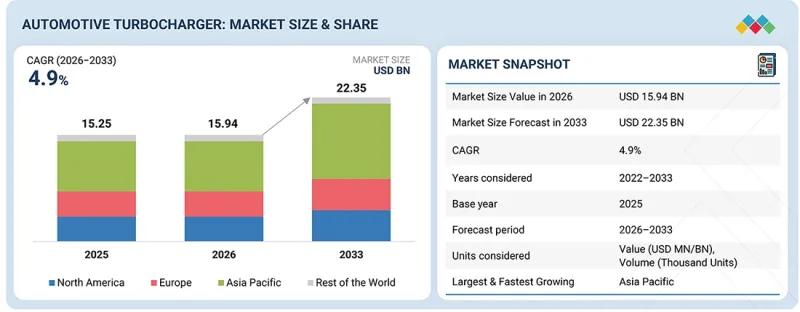
자동차용 터보차저 시장 규모는 2026년 159억 4,000만 달러에서 2033년까지 223억 5,000만 달러로, CAGR 4.9%로 확대할 것으로 예측됩니다.
배기가스 규제 강화, 터보차저가 장착된 가솔린 엔진의 채택 확대, 그리고 차량 성능을 저하시키지 않으면서 연비 효율을 향상시키려는 지속적인 수요가 시장 성장을 지원하고 있습니다.
| 조사 범위 | |
|---|---|
| 조사 대상 기간 | 2026-2033년 |
| 기준연도 | 2025년 |
| 예측 기간 | 2026-2033년 |
| 대상 단위 | 10억 달러 |
| 부문 | 차종별, 연료 유형별, 터보 유형별, 재료별, 컴포넌트별, 용도별, 지역별 |
| 대상 지역 | 아시아태평양, 북미, 유럽, 세계의 기타 지역 |
또한 자동차 제조사들은 하이브리드 파워트레인 및 더욱 진보된 엔진 기술로의 전환을 추진하고 있습니다. 이에 따라 부스트 응답성을 향상시키고 하이브리드 시스템과 더욱 효과적으로 연동되는 첨단 전동 보조식 터보차저에 대한 수요가 증가하고 있습니다.
"예측 기간 중, 가솔린 승용차가 전 세계 자동차용 터보차저 시장을 주도하고 있습니다."
디젤 수요 감소, 배기가스 규제 강화, 그리고 디젤 차량에 대한 규제로 인해 OEM의 제품 라인업이 가솔린 파워트레인으로 계속 전환되고 있는 만큼, 가솔린 터보차저는 승용차 시장에서 계속해서 견고한 입지를 유지할 것으로 전망됩니다. 이러한 추세는 유럽, 인도, 북미 전역에서 두드러지지만, 선호되는 엔진 배기량이나 차량 용도는 시장마다 다릅니다. 또한 터보차저의 적용이 소형·중형 배기량 엔진에 그치지 않고 더 큰 배기량 용도로 확대되고 있으며, 가솔린 엔진의 배기량 대를 불문하고 시장 기회는 확대되고 있습니다. 중국에서는 GDI(직접 분사) 터보차저 장착 가솔린 엔진으로의 전환이 현저히 진행되어, 최근 그 채택률이 약 55%에서 60%에 달하고 있습니다. 인도에서도 각 OEM 업체들이 소형 배기량 승용차에 터보차저 장착 가솔린 엔진을 점점 더 많이 도입함에 따라 이러한 추세가 강화되고 있습니다.
유럽에서는 2025년 신차 등록 대수에서 디젤차의 비중이 8.9%에 그치는 반면, 터보차저가 장착된 가솔린 엔진은 1.0L, 1.5L, 2.0L, 3.0L 및 그 이상의 배기량 플랫폼에서 계속해서 사용 가능합니다. 북미에서는 하이브리드차량의 보급이 확대되는 한편, 주로 중형 및 대형 SUV에서 터보차저가 장착된 가솔린 엔진에 대한 수요가 계속해서 발생하고 있습니다. BorgWarner Inc.의 최근 프로젝트에서도 1.0L 가솔린 엔진 및 3.0L 가솔린 엔진 용도 외에도 새로운 가변 터빈 지오메트리 기술 등 다양한 배기량과 시장을 아우르는 개발이 지속되고 있음이 드러났습니다. 따라서 하이브리드차량 및 BEV로의 전환을 추진하면서도 내연기관(ICE) 탑재 차량을 계속 공급하고, 더 높은 출력 밀도와 성능을 실현하고자 하는 각 OEM 업체들에게 가솔린 터보차저 엔진은 여전히 중요한 초점이 되고 있습니다. 그 결과, 파워트레인의 전환기를 거치는 동안 가솔린 터보차저가 주류를 유지할 것으로 예상됩니다. 수요는 신흥 시장에서는 소형 고출력 엔진으로, 선진국 시장에서는 대형 고성능 지향 가솔린 엔진으로 이동할 것입니다.
"2033년까지 E-터보차저가 가장 빠르게 성장하는 터보차저 유형이 될 것으로 예상됩니다."
자동차 제조사들이 엔진 크기를 확대하지 않으면서도 가솔린 엔진에서 더 많은 출력과 효율을 이끌어낼 방법을 모색하고 있는 만큼, 자동차용 터보차저 시장에서 E-터보차저는 유형별로는 급속한 성장이 예상됩니다. 기존 터보차저와 달리, E-터보차저는 저회전 영역에서도 과급압을 공급하여 터보 랙을 줄일 수 있을 뿐만 아니라, 다양한 주행 조건에서 과급압을 보다 정밀하게 제어할 수 있습니다. 이 기술은 유럽에서 하이브리드화가 확대됨에 따라 주목을 받고 있습니다. 유럽에서는 2026년 상반기 EU내 신차 등록 대수 중 하이브리드차량이 37.3%를 차지했고, 플러그인 하이브리드차량은 9.8%에 달했습니다. 하이브리드 및 PHEV 파워트레인의 채택 확대에 따라 특히 프리미엄 차량이나 고출력 승용차에서 반응성이 빠른 과급에 대한 수요가 높아지고 있습니다.
e-터보차저는 소형 고출력 엔진부터 대형 고성능 차량에 이르기까지 폭넓게 채택되고 있습니다. 보그워너(BorgWarner)와 같은 터보차저 공급업체들은 48V 및 고전압 e-터보 시스템을 개발하고 있으며, 새로운 프로젝트를 통해 이 기술을 하이브리드 분야로 확대하고 있습니다. 현재는 시스템 비용이 높기 때문에 그 채택이 주로 프리미엄 차량이나 하이엔드 차량으로 한정되어 있지만, 하이브리드화의 진전과 엔진의 응답성 및 효율 향상 수요 증가에 따라 그 적용 범위는 확대될 것으로 예상됩니다. 각 OEM 업체들이 배기량 단위당 성능을 더욱 끌어내기 위해 가솔린 엔진과 전동화를 결합하는 움직임을 강화함에 따라 예측 기간 내에 e-터보차저는 터보차저 기술 중에서도 급속히 보급될 것으로 전망됩니다.
"유럽은 자동차용 터보차저 시장에서 2위 규모로 추정됩니다."
유럽은 엄격한 배기가스 규제와 차량 성능을 희생하지 않으면서도 효율적인 파워트레인을 요구하는 지속적인 수요에 힘입어, 자동차용 터보차저 시장에서 여전히 2위 주요 시장으로서의 지위를 유지하고 있습니다. 디젤 승용차 수요는 감소 추세를 이어가고 있지만, 2025년 EU내 신차 등록 대수에서 디젤이 차지하는 비율은 8.9%였던 반면, 가솔린 및 하이브리드 파워트레인은 각각 26.6%와 34.5%를 차지했습니다. 이러한 변화로 인해 GDI(직분사) 엔진을 포함한 터보차저 장착 가솔린 엔진의 수요가 지원되고 있으며, 폭스바겐,BMW, 메르세데스-벤츠, 스텔란티스 등 각 OEM 업체들은 계속해서 터보차저가 장착된 가솔린 모델을 제공하고 있을 뿐만 아니라, 일부 LCV(소형 상용차)에서도 터보차저가 장착된 가솔린 파워트레인이 채택되고 있습니다. 상용차의 경우 여전히 디젤이 주류를 이루고 있으며, 2025년에는 EU내 신형 밴 신규 등록 대수의 80.7%, 트럭의 93.2%, 버스의 62.1%를 디젤 차량이 차지하여, 디젤용 터보차저에 대한 수요가 계속해서 지원되고 있습니다. 부품 공급업체 입장에서는 차종에 관계없이 분명한 비즈니스 기회가 창출되고 있습니다. 승용차 및 일부 LCV에서는 가솔린차와 하이브리드차의 터보차저 중요성이 높아지고 있는 반면, 중형·대형 차량 용도에서는 VGT(가변 기하학 터보차저) 및 기타 첨단 디젤용 터보차저가 여전히 중요한 역할을 수행하고 있습니다. 유로 7 규제로 인해 가솔린, 디젤, 하이브리드 각 파워트레인에서 정밀한 부스트 제어, 열 관리, 배기가스 최적화의 필요성이 더욱 높아지고 있으며, 이는 첨단 웨스트게이트, VGT, 전동 보조식 터보차저에 대한 수요를 지원하고 있습니다. 승용차 및 일부 LCV에서는 가솔린 및 하이브리드 파워트레인이 확대되는 반면, 트럭 및 기타 대형 차량 용도에서는 디젤이 여전히 주류를 이루고 있으며, 유럽의 다양한 파워트레인 환경은 2033년까지 터보차저 공급업체에게 비즈니스 기회를 제공할 것으로 예상됩니다.
주요 기업으로는 BorgWarner Inc.(미국), Garrett Motion Inc.(미국), Mitsubishi Heavy Industries(일본), IHI Corporation(일본), Cummins Inc.(미국) 등이 있으며, 이들은 세계 시장에서 자동차용 터보차저의 주요 제조사입니다.
조사 범위:
본 조사 보고서에서는 자동차용 터보차저 시장을 차종별(승용차, LCV, 트럭, 버스), 연료 유형별(디젤, 가솔린, 대체 연료),디젤 차량의 터보 유형별(VGT, 웨스트게이트, E-터보), 가솔린 차량의 터보 유형별(VGT, 웨스트게이트, E-터보), 가솔린 차량의 차종별(승용차, LCV, 트럭, 버스), 소재별(주철, 알루미늄, 기타),구성품별(터빈 휠, 컴프레서 휠, 하우징), 오프로드 용도별(농업용 트랙터, 건설 기계, 광산 기계), 애프터마켓 차종별(LCV, HCV), 지역별(아시아태평양, 북미, 유럽, 기타 지역)로 분류하고 있습니다. 이 보고서의 범위에는 자동차용 터보차저 시장의 성장에 영향을 미치는 주요 요인(촉진요인, 제약 요인, 과제, 기회 등)에 대한 상세 정보가 포함되어 있습니다. 주요 업계 플레이어에 대한 상세한 분석을 통해 각 기업의 사업 개요, 솔루션, 서비스,주요 전략, 계약, 파트너십, 합의 사항, 신제품·서비스 출시, 합병·인수, 경기 침체의 영향, 그리고 자동차용 터보차저 시장의 최근 동향에 대한 인사이트를 제공합니다. 이 보고서에서는 자동차용 터보차저 시장 생태계에서 두각을 보이고 있는 신생 기업에 대한 경쟁 분석도 다루고 있습니다.
이 보고서를 구매해야 하는 이유:
이 보고서는 자동차용 터보차저 시장 전체 및 각 하위 부문의 매출에 대한 가장 정확한 추정치를 제공함으로써 시장 선도 기업과 신규 진입 기업을 지원합니다. 이 보고서에는 포괄적인 시장 점유율 분석, 공급망 분석, 부품 제조업체에 대한 상세한 리스트 및 인사이트, 소재별 세분화 분석, 철저한 공급망 분석, 그리고 경쟁 구도가 포함되어 있습니다. 또한 이 보고서는 이해관계자가 시장 동향을 파악하는 데 도움을 주며, 주요 시장 촉진요인, 억제요인, 과제 및 기회에 대한 정보를 제공합니다.
이 보고서는 다음 사항에 대한 인사이트를 제공합니다. :
- 주요 촉진요인(차세대 하이브리드 파워트레인에 전동 보조식 터보차저 통합의 진전 및 터보차저 구성을 최적화하는 소프트웨어 제어 연소로 전환),제약 요인(파워트레인의 전동화로 인해 OEM의 투자가 기존 과급 기술에서 전환되고 있음), 기회(지능형 공기 관리 시스템을 가능하게 하는 소프트웨어 정의 파워트레인),그리고 과제(첨단 터보차저 시스템에서의 초저배출, 하이브리드 성능, 비용의 균형 조정, 그리고 기존 터보차저에서 전동화 공기 관리 기술로의 전환 관리)가 자동차용 터보차저 시장의 성장에 영향을 미치고 있습니다.
- 제품 개발/혁신: 자동차용 터보차저 시장의 향후 기술, 연구개발 활동 및 신제품·서비스 출시에 대한 상세 인사이트.
- 시장 개발: 수익성이 높은 시장에 대한 포괄적인 정보 - 이 보고서에서는 다양한 지역에 걸친 자동차용 터보차저 시장을 분석합니다.
- 시장 다각화: 자동차용 터보차저 시장의 신제품 및 서비스, 미개발 지역, 최근 동향 및 투자에 관한 포괄적인 정보
- 경쟁 분석: 자동차용 터보차저 시장에서 BorgWarner Inc.(미국), Garrett Motion Inc.(미국), Mitsubishi Heavy Industries, Ltd.(일본), IHI Corporation(일본), Cummins Inc.(미국) 등 주요 기업의 시장 점유율, 성장 전략 및 서비스 제공에 대한 상세한 평가.
또한 이 보고서는 이해관계자들이 자동차용 터보차저 시장을 형성하는 주요 요인을 이해하는 데 도움이 될 것입니다. 여기에는 주요 시장 촉진요인, 억제요인, 새로운 기회, 기술 개발, 그리고 승용차 및 상용차에서의 터보차저 채택에 영향을 미치는 과제 등이 포함됩니다.
자주 묻는 질문
목차
제1장 서론
제2장 개요
제3장 주요 인사이트
제4장 시장 개요
제5장 업계 동향
제6장 기술 진보, AI에 의한 영향, 특허, 혁신, 향후 전략적 응용
제7장 규제 상황
제8장 고객 상황과 구매 행동
제9장 자동차용 터보차저 시장(차종별)
제10장 자동차용 터보차저 시장(연료 유형별)
제11장 자동차용 디젤 터보차저 시장(터보 유형별)
제12장 자동차용 가솔린 터보차저 시장(터보 유형별)
제13장 자동차용 가솔린 터보차저 시장(차종별)
제14장 자동차용 터보차저 시장(재료별)
제15장 자동차용 터보차저 시장(컴포넌트별)
제16장 오프로드 터보차저 시장(용도별)
제17장 자동차용 터보차저 애프터마켓(차종별)
제18장 자동차용 터보차저 시장(지역별)
제19장 경쟁 구도
제20장 기업 개요
제21장 조사 방법
제22장 부록
KSA 26.09.11The automotive turbocharger market is projected to grow from USD 15.94 billion in 2026 to USD 22.35 billion by 2033, at a CAGR of 4.9%. Stricter emission requirements, rising adoption of turbocharged gasoline engines, and the continued need for better fuel efficiency without compromising vehicle performance are supporting market growth.
| Scope of the Report | |
|---|---|
| Years Considered for the Study | 2026-2033 |
| Base Year | 2025 |
| Forecast Period | 2026-2033 |
| Units Considered | USD billion |
| Segments | Type, Component, Fuel Type, Material, Off-Highway Equipment, Vehicle Type, Aftermarket, and Region |
| Regions covered | Asia Pacific, North America, Europe, Rest of the World |
Furthermore, automakers are moving toward hybrid powertrains and more advanced engine technologies. This is driving demand for advanced, electrically assisted turbochargers that improve boost response and work more effectively with hybrid systems.
"Gasoline passenger cars are leading the global automotive turbocharger market during the forecast period."
Gasoline turbochargers are likely to retain a strong position in passenger cars as declining diesel demand, tighter emission norms, and restrictions on diesel vehicles continue to shift OEM portfolios toward gasoline powertrains. This trend is evident across Europe, India, and North America, although the preferred engine sizes and vehicle applications vary by market. The opportunity is also broadening across gasoline engine sizes, with turbocharging moving beyond small- and mid-sized engines to larger-displacement applications. China has seen a strong shift toward GDI turbocharged gasoline engines, with adoption reaching around 55% to 60% in recent years. India is reinforcing this trend as OEMs increasingly introduce turbocharged gasoline engines across smaller-displacement passenger cars.
In Europe, diesel accounted for only 8.9% of new car registrations in 2025, while turbocharged gasoline engines remain available across 1.0 L, 1.5 L, 2.0 L, 3.0 L, and larger engine platforms. North America continues to generate demand for turbocharged gasoline engines, primarily in midsize and large SUVs, alongside growing hybrid adoption. Recent programs from BorgWarner also indicate continued development across different engine sizes and markets, including 1.0 L gasoline and 3.0 L gasoline applications, along with new variable turbine geometry technology. Hence, gasoline turbocharged engines remain a key focus for OEMs seeking to deliver higher power density and performance while continuing to offer ICE-based vehicles alongside the transition toward hybrids and BEVs. Consequently, gasoline turbochargers are expected to remain dominant through the powertrain transition, with demand shifting toward smaller high-output engines in developing markets and larger performance-oriented gasoline engines in developed markets.
"E-turbochargers are anticipated to be the fastest-growing turbocharger type by 2033."
E-turbochargers are expected to grow rapidly in the automotive turbocharger market by type, as automotive OEMs look for ways to extract more power and efficiency from gasoline engines without increasing engine size. Unlike conventional turbochargers, e-turbochargers can provide boost at low engine speeds and reduce turbo lag, while also allowing more precise control of boost pressure across different operating conditions. The technology is gaining traction as hybridization expands in Europe, where hybrid-electric vehicles accounted for 37.3% of new EU car registrations in H1 2026, while plug-in hybrids reached 9.8% in H1 2026. This growing adoption of hybrid and PHEV powertrains is increasing the need for faster-response boosting, particularly in premium and higher-output passenger vehicles.
The e-turbochargers are being applied across both smaller high-output engines and larger performance applications. Turbocharger suppliers such as BorgWarner are developing 48 V and high-voltage e-turbo systems, while new programs are extending the technology toward hybrid applications. Although higher system costs currently limit adoption mainly to premium and higher-end vehicles, increasing hybridization and the need for better engine response and efficiency are expected to broaden its application. As OEMs increasingly combine gasoline engines with electrification to extract greater performance from each unit of displacement, e-turbochargers are likely to gain adoption rapidly within turbocharger technology during the forecast period.
"Europe is estimated to be the second-largest automotive turbocharger market."
Europe remains the second-largest dominant market for automotive turbochargers, supported by stringent emissions regulations and the continued need for efficient powertrains without sacrificing vehicle performance. Although diesel passenger-car demand continues to decline, diesel accounted for 8.9% of new EU car registrations in 2025, while gasoline and hybrid powertrains accounted for 26.6% and 34.5%, respectively. This shift is supporting demand for turbocharged gasoline engines, including GDI applications, with OEMs such as Volkswagen, BMW, Mercedes-Benz, and Stellantis continuing to offer turbocharged gasoline models, while turbocharged gasoline powertrains are also being adopted in selected LCVs. Commercial vehicles remain predominantly diesel-based, with diesel accounting for 80.7% of new EU van registrations, 93.2% of truck registrations, and 62.1% of bus registrations in 2025, supporting continued demand for diesel turbochargers. For suppliers, this creates distinct opportunities across vehicle types, with gasoline and hybrid turbochargers gaining importance in passenger cars and selected LCVs, while VGT and other advanced diesel turbochargers remain important for medium- and heavy-duty applications. Euro 7 is further increasing the need for precise boost control, thermal management, and emissions optimization across gasoline, diesel, and hybrid powertrains, supporting demand for advanced wastegate, VGT, and electrically assisted turbochargers. As gasoline and hybrid powertrains expand in passenger cars and selected LCVs, while diesel remains dominant in trucks and other heavy-duty applications, Europe's mixed powertrain landscape is expected to sustain opportunities for turbocharger suppliers through 2033.
The break-up of the profile of primary participants in the automotive turbocharger market:
- By Company Type: Tier 1 - 80%, OEM - 20 %
- By Designation: C-level - 60%, Director Level - 20%, Others - 20%
- By Region: North America- 50%, Europe - 35%, Asia Pacific - 15%.
Prominent companies include BorgWarner Inc. (US), Garrett Motion Inc. (US), Mitsubishi Heavy Industries (Japan), IHI Corporation (Japan), and Cummins Inc. (US), which are the leading manufacturers of automotive turbochargers in the global market.
Research Coverage:
This research report categorizes the Automotive turbocharger market by vehicle type (passenger car, LCV, trucks, buses), fuel type (diesel, gasoline, alternate fuel), diesel by turbo type (VGT, Wastegate, E-turbo), gasoline by turbo type (VGT, Wastegate, E-turbo), gasoline by vehicle type (passenger car, LCV, trucks, buses), by material (cast iron, aluminum, others), by component (turbine wheel, compressor wheel, housing), off-highway by application (agricultural tractors, construction equipment, mining equipment), aftermarket by vehicle type (LCV, HCV), by region (Asia Pacific, North America, Europe, Rest of the World). The report's scope covers detailed information regarding the major factors, such as drivers, restraints, challenges, and opportunities, influencing the growth of the automotive turbocharger market. A detailed analysis of key industry players provides insights into their business overview, solutions, and services; key strategies; contracts, partnerships, agreements, new product and service launches, mergers and acquisitions, recession impact, and recent developments in the automotive turbocharger market. This report covers the competitive analysis of upcoming startups in the automotive turbocharger market ecosystem.
Reasons to buy this report:
The report will help market leaders/new entrants with information on the closest approximations of the revenue numbers for the overall automotive turbocharger market and the subsegments. The report includes a comprehensive market share analysis, supply chain analysis, extensive lists and insights into component manufacturers, chapter segmentation based on materials, a thorough supply chain analysis, and a competitive landscape. The report also helps stakeholders understand the market pulse and provides information on key market drivers, restraints, challenges, and opportunities.
The report provides insights on the following pointers:
- Analysis of key drivers (Growing Integration of Electrically Assisted Turbochargers in Next-Generation Hybrid Powertrains, and Shift Toward Software-Controlled Combustion Optimizing Turbocharger Content), restraints (Powertrain Electrification Shifting OEM Investments Away from Conventional Boosting Technologies), opportunities (Software-Defined Powertrains Enabling Intelligent Air Management Systems), and challenges (Balancing Ultra-Low Emissions, Hybrid Performance, and Cost in Advanced Turbocharging Systems, and Managing the Transition from Conventional Turbochargers to Electrified Air Management Technologies) are influencing the growth of the automotive turbocharger market.
- Product Development/Innovation: Detailed insights on upcoming technologies, research and development activities, and new product and service launches in the automotive turbocharger market.
- Market Development: Comprehensive information about lucrative markets - the report analyses the automotive turbocharger market across varied regions.
- Market Diversification: Exhaustive information about new products and services, untapped geographies, recent developments, and investments in the automotive turbocharger market
- Competitive Assessment: In-depth assessment of market shares, growth strategies, and service offerings of leading players like BorgWarner Inc. (US), Garrett Motion Inc. (US), Mitsubishi Heavy Industries Ltd. (Japan), IHI Corporation (Japan), and Cummins Inc. (US), among others in the automotive turbocharger market.
The report also helps stakeholders understand the key factors shaping the automotive turbocharger market, including major market drivers, restraints, emerging opportunities, technology developments, and challenges influencing turbocharger adoption across passenger cars and commercial vehicles.
TABLE OF CONTENTS
1 INTRODUCTION
- 1.1 STUDY OBJECTIVES
- 1.2 MARKET DEFINITION
- 1.3 INCLUSIONS AND EXCLUSIONS
- 1.4 MARKET SCOPE
- 1.4.1 YEARS CONSIDERED
- 1.5 CURRENCY CONSIDERED
- 1.6 STAKEHOLDERS
- 1.7 SUMMARY OF CHANGES
2 EXECUTIVE SUMMARY
- 2.1 MARKET HIGHLIGHTS AND KEY INSIGHTS
- 2.2 KEY MARKET PARTICIPANTS: MAPPING OF STRATEGIC DEVELOPMENTS
- 2.3 DISRUPTIVE TRENDS FOR AUTOMOTIVE TURBOCHARGER MARKET
- 2.4 HIGH-GROWTH SEGMENTS IN AUTOMOTIVE TURBOCHARGER MARKET
- 2.5 REGIONAL SNAPSHOT: MARKET SIZE, GROWTH RATE, AND FORECAST
3 PREMIUM INSIGHTS
- 3.1 ATTRACTIVE OPPORTUNITIES FOR PLAYERS IN AUTOMOTIVE TURBOCHARGER MARKET
- 3.2 AUTOMOTIVE TURBOCHARGER MARKET, BY VEHICLE TYPE
- 3.3 AUTOMOTIVE DIESEL TURBOCHARGER MARKET, BY TURBO TYPE
- 3.4 AUTOMOTIVE GASOLINE TURBOCHARGER MARKET, BY TURBO TYPE
- 3.5 AUTOMOTIVE GASOLINE TURBOCHARGER MARKET, BY VEHICLE TYPE
- 3.6 AUTOMOTIVE TURBOCHARGER MARKET, BY MATERIAL
- 3.7 AUTOMOTIVE TURBOCHARGER MARKET, BY FUEL TYPE
- 3.8 OFF-HIGHWAY AUTOMOTIVE TURBOCHARGER MARKET, BY APPLICATION
- 3.9 AUTOMOTIVE TURBOCHARGER AFTERMARKET, BY VEHICLE TYPE
- 3.10 AUTOMOTIVE TURBOCHARGER MARKET, BY REGION
4 MARKET OVERVIEW
- 4.1 INTRODUCTION
- 4.2 MARKET DYNAMICS
- 4.2.1 DRIVERS
- 4.2.1.1 Growing Integration of Electrically Assisted Turbochargers in Next-Generation Hybrid Powertrains
- 4.2.1.2 Shift Toward Software-Controlled Combustion Optimizing Turbocharger Content
- 4.2.2 RESTRAINTS
- 4.2.2.1 Powertrain Electrification Shifting OEM Investments Away from Conventional Boosting Technologies
- 4.2.3 OPPORTUNITIES
- 4.2.3.1 Software-Defined Powertrains Enabling Intelligent Air Management Systems
- 4.2.4 CHALLENGES
- 4.2.4.1 Balancing Ultra-Low Emissions, Hybrid Performance, and Cost in Advanced Turbocharging Systems
- 4.2.4.2 Managing the Transition from Conventional Turbochargers to Electrified Air Management Technologies
- 4.2.1 DRIVERS
- 4.3 UNMET NEEDS AND WHITE SPACES
- 4.4 INTERCONNECTED MARKETS AND CROSS-SECTOR OPPORTUNITIES
- 4.5 STRATEGIC MOVES BY TIER-1/2/3 PLAYERS
- 4.5.1 STRATEGIC MOVES BY TIER-1 PLAYERS
- 4.5.2 STRATEGIC MOVES BY TIER-2 PLAYERS
- 4.5.3 STRATEGIC MOVES BY TIER-3 PLAYERS
- 4.5.4 STRATEGIC MOVES BY OEMS
5 INDUSTRY TRENDS
- 5.1 MACROECONOMIC OUTLOOK
- 5.1.1 INTRODUCTION
- 5.1.2 GDP TRENDS AND FORECAST
- 5.1.3 TRENDS IN GLOBAL AUTOMOTIVE INDUSTRY INFLUENCING AUTOMOTIVE TURBOCHARGER MARKET
- 5.1.3.1 Hybrid Powertrain Expansion Driving Demand for Advanced Turbocharging Systems
- 5.1.3.2 Continued Engine Downsizing Accelerating Turbocharger Penetration
- 5.1.3.3 Global Emission Standards Accelerating Adoption of Advanced Turbocharger Technologies
- 5.1.3.4 Vehicle Electrification Transforming Turbocharger Technology Development
- 5.1.3.5 Software-Defined Powertrains Enhancing Intelligent Turbocharger Control
- 5.2 SUPPLY CHAIN ANALYSIS
- 5.3 AVERAGE SELLING PRICE ANALYSIS
- 5.4 TURBOCHARGER CONTENT EVOLUTION ($/VEHICLE)
- 5.5 TRADE ANALYSIS
- 5.5.1 IMPORT DATA
- 5.5.1.1 Import Scenario of Automotive Turbocharger (HS code 841480)
- 5.5.2 EXPORT DATA
- 5.5.2.1 Export Scenario of Automotive Turbocharger (HS code 841480)
- 5.5.1 IMPORT DATA
- 5.6 KEY CONFERENCES AND EVENTS
- 5.6.1 AUTOMOTIVE TURBOCHARGER MARKET: KEY CONFERENCES AND EVENTS, 2026-2027
- 5.7 TRENDS/DISRUPTIONS IMPACTING CUSTOMER BUSINESS
- 5.8 ECOSYSTEM ANALYSIS
- 5.9 INVESTMENT AND FUNDING SCENARIO
- 5.10 CASE STUDY ANALYSIS
- 5.10.1 DEVELOPMENT OF E-TURBO TECHNOLOGY BY GARRETT MOTION TO IMPROVE HYBRID POWERTRAIN EFFICIENCY
- 5.10.2 DEVELOPMENT OF ETURBO TECHNOLOGY BY BORGWARNER TO IMPROVE ENGINE EFFICIENCY
- 5.10.3 DEVELOPMENT OF EBOOSTER TECHNOLOGY BY BORGWARNER TO REDUCE EMISSIONS
- 5.10.4 DEVELOPMENT OF HIGH-EFFICIENCY GAS ENGINE WITH TWO-STAGE TURBOCHARGING SYSTEM BY MITSUBISHI HEAVY INDUSTRIES LTD
- 5.10.5 DEVELOPMENT OF KEY TECHNOLOGY FOR EU7 - HYBRIDIZED POWERTRAIN BY GARRETT
- 5.10.6 TURBOCHARGER HOUSING DESIGN BY IHI CORPORATION
- 5.10.7 DEVELOPMENT OF NATURAL GAS TURBOCHARGER TECHNOLOGY BY CUMMINS TURBO TECHNOLOGIES
6 TECHNOLOGICAL ADVANCEMENTS, AI-DRIVEN IMPACT, PATENTS, INNOVATIONS, AND FUTURE STRATEGIC APPLICATIONS
- 6.1 TECHNOLOGY ANALYSIS
- 6.1.1 COMPLEMENTARY TECHNOLOGY
- 6.1.1.1 48V Mild Hybrid Systems
- 6.1.1.2 Advanced Engine Management Systems
- 6.1.1.3 Direct Fuel Injection Systems
- 6.1.2 ADJACENT TECHNOLOGY
- 6.1.2.1 Electric Superchargers
- 6.1.2.2 Fuel Cell Air Compressors
- 6.1.1 COMPLEMENTARY TECHNOLOGY
- 6.2 TECHNOLOGY ROADMAP
- 6.3 E-TURBOS TECHNOLOGY ROADMAP
- 6.4 PATENT ANALYSIS
- 6.4.1 INTRODUCTION
- 6.5 IMPACT OF AI/GEN AI ON AUTOMOTIVE TURBOCHARGER MARKET
- 6.6 IMPACT OF REGULATIONS/TRADE AGREEMENTS ON AUTOMOTIVE TURBOCHARGER MARKET, BY REGION
- 6.6.1 NORTH AMERICA
- 6.6.1.1 USMCA (United States-Mexico-Canada Agreement)
- 6.6.2 ASIA PACIFIC
- 6.6.2.1 Regional Comprehensive Economic Partnership (RCEP)
- 6.6.3 EUROPE
- 6.6.3.1 EU-UK Trade and Cooperation Agreement (TCA) & Euro 7 Emission Regulations
- 6.6.1 NORTH AMERICA
- 6.7 IMPACT OF EU-FTA TRADE DEAL ON AUTOMOTIVE TURBOCHARGER MARKET
- 6.8 IMPACT OF ISRAEL-IRAN WAR ON AUTOMOTIVE TURBOCHARGER MARKET
- 6.8.1 ENERGY MARKET DISRUPTION
- 6.9 OPPORTUNITY ASSESSMENT
- 6.10 COMPETITIVE TECHNOLOGY BENCHMARK
- 6.11 FUTURE REVENUE POOLS FOR TURBOCHARGER SUPPLIERS
- 6.12 REGIONAL POWERTRAIN TRANSITION ANALYSIS
7 REGULATORY LANDSCAPE
- 7.1 REGIONAL REGULATIONS AND COMPLIANCE
- 7.1.1 REGULATORY BODIES, GOVERNMENT AGENCIES, AND OTHER ORGANIZATIONS
- 7.1.2 EMISSION REGULATIONS
- 7.1.2.1 On-road vehicles
- 7.1.2.2 Non-road mobile machinery (NRMM) emission regulation outlook
- 7.2 FUEL ECONOMY NORMS
- 7.2.1 US
- 7.2.2 EUROPE
- 7.2.3 CHINA
- 7.2.4 INDIA
- 7.3 INDUSTRY STANDARDS
- 7.4 SUSTAINABILITY INITIATIVES
- 7.4.1 LOW-EMISSION TURBOCHARGER TECHNOLOGIES
- 7.4.2 SUSTAINABLE MANUFACTURING AND MATERIAL EFFICIENCY
8 CUSTOMER LANDSCAPE & BUYER BEHAVIOR
- 8.1 DECISION-MAKING PROCESS
- 8.2 BUYER STAKEHOLDER AND BUYING EVALUATION CRITERIA
- 8.2.1 KEY STAKEHOLDERS IN BUYING PROCESS
- 8.2.2 BUYING CRITERIA
- 8.3 ADOPTION BARRIERS & INTERNAL CHALLENGES
- 8.4 UNMET NEEDS FROM VARIOUS END-USE INDUSTRIES
- 8.5 MARKET PROFITABILITY
9 AUTOMOTIVE TURBOCHARGER MARKET, BY VEHICLE TYPE
- 9.1 INTRODUCTION
- 9.2 PASSENGER CARS
- 9.2.1 ASIA PACIFIC'S PASSENGER VEHICLE PRODUCTION AND GROWING SUV & HYBRID DEMAND TO DRIVE MARKET
- 9.3 LIGHT COMMERCIAL VEHICLES (LCVS)
- 9.3.1 LAST-MILE DELIVERY, FLEET UTILIZATION, AND CONTINUED DEMAND FOR EFFICIENT POWERTRAINS TO SUPPORT LCV TURBOCHARGER MARKET
- 9.4 TRUCKS
- 9.4.1 FREIGHT DEMAND AND ADVANCED ENGINE TECHNOLOGIES TO SUPPORT TRUCK TURBOCHARGER MARKET
- 9.5 BUSES
- 9.5.1 GROWING PUBLIC TRANSPORT DEMAND AND POWERTRAIN DIVERSIFICATION TO SHAPE BUS TURBOCHARGER MARKET
- 9.6 INDUSTRY INSIGHTS
10 AUTOMOTIVE TURBOCHARGER MARKET, BY FUEL TYPE
- 10.1 INTRODUCTION
- 10.2 DIESEL
- 10.2.1 HEAVY TRUCKS & BUSES TO SUPPORT DIESEL TURBOCHARGER MARKET DEMAND GLOBALLY
- 10.3 GASOLINE
- 10.3.1 RISING ADOPTION OF TURBOCHARGED SMALLER GASOLINE ENGINES ACROSS PASSENGER CARS TO DRIVE GASOLINE TURBOCHARGER MARKET
- 10.4 ALTERNATIVE FUEL/CNG
- 10.4.1 EXPANDING CNG INFRASTRUCTURE AND FACTORY-FITTED TURBOCHARGED CNG VEHICLES TO SUPPORT MARKET GROWTH
- 10.5 INDUSTRY INSIGHTS
11 AUTOMOTIVE DIESEL TURBOCHARGER MARKET, BY TURBO TYPE
- 11.1 INTRODUCTION
- 11.2 VARIABLE GEOMETRY TURBOCHARGER (VGT)
- 11.2.1 STRINGENT EMISSION STANDARDS AND EFFICIENCY REQUIREMENTS SUPPORT VGT ADOPTION IN DIESEL COMMERCIAL VEHICLES
- 11.3 WASTEGATE TURBOCHARGER
- 11.3.1 COST-EFFECTIVENESS AND SIMPLER DESIGN SUPPORT WGT ADOPTION IN COST-SENSITIVE DIESEL APPLICATIONS
- 11.4 ELECTRIC TURBOCHARGER (E-TURBO)
- 11.4.1 ADVANCED BOOST CONTROL REQUIREMENTS DRIVE E-TURBO ADOPTION IN DIESEL APPLICATIONS
- 11.5 VARIABLE TWIN-SCROLL TURBOCHARGER
- 11.6 TWIN TURBOCHARGER
- 11.6.1 TWO-STAGE SERIES TURBOCHARGER
- 11.6.2 TWO-STAGE PARALLEL TURBOCHARGER
- 11.6.3 TWIN-SCROLL TURBOCHARGER
- 11.7 FREE-FLOATING TURBOCHARGER
- 11.8 DOUBLE-AXLE TURBOCHARGER
- 11.9 INDUSTRY INSIGHTS
12 AUTOMOTIVE GASOLINE TURBOCHARGER MARKET, BY TURBO TYPE
- 12.1 INTRODUCTION
- 12.2 VARIABLE GEOMETRY TURBOCHARGER/VARIABLE NOZZLE TURBOCHARGER (VGT/VNT)
- 12.2.1 HIGH-EFFICIENCY GASOLINE ENGINES AND MILLER-CYCLE ADOPTION SUPPORT VGT GROWTH
- 12.3 WASTEGATE TURBOCHARGER
- 12.3.1 ENGINE DOWNSIZING AND COST-EFFECTIVE BOOSTING SUPPORT WGT ADOPTION IN GASOLINE VEHICLES
- 12.4 ELECTRIC TURBOCHARGER (E-TURBO)
- 12.4.1 GASOLINE HYBRIDIZATION AND ELECTRIFIED DRIVE E-TURBO ADOPTION
- 12.5 VARIABLE TWIN-SCROLL TURBOCHARGER
- 12.6 TWIN TURBOCHARGER
- 12.6.1 TWO-STAGE SERIES TURBOCHARGER
- 12.6.2 TWO-STAGE PARALLEL TURBOCHARGER
- 12.6.3 TWIN-SCROLL TURBOCHARGER
- 12.7 INDUSTRY INSIGHTS
13 AUTOMOTIVE GASOLINE TURBOCHARGER MARKET, BY VEHICLE TYPE
- 13.1 INTRODUCTION
- 13.2 PASSENGER CARS
- 13.2.1 RISING GDI ADOPTION PROMOTES GROWTH OF GASOLINE TURBOCHARGERS IN PASSENGER CARS GLOBALLY
- 13.3 LIGHT COMMERCIAL VEHICLE (LCV)
- 13.3.1 INCREASING POWER AND TORQUE REQUIREMENTS IN GASOLINE LCVS DRIVE TURBOCHARGER ADOPTION
- 13.4 INDUSTRY INSIGHTS
14 AUTOMOTIVE TURBOCHARGER MARKET, BY MATERIAL
- 14.1 INTRODUCTION
- 14.2 CAST IRON
- 14.2.1 DEMAND FOR COST-EFFECTIVE AND HEAT-RESISTANT MATERIALS TO SUPPORT THE SEGMENT
- 14.3 ALUMINUM
- 14.3.1 GROWING USE OF LIGHTWEIGHT ALUMINUM COMPONENTS TO SUPPORT THE SEGMENT
- 14.4 OTHER MATERIALS
- 14.5 INDUSTRY INSIGHTS
15 AUTOMOTIVE TURBOCHARGER MARKET, BY COMPONENT
- 15.1 INTRODUCTION
- 15.2 TURBINE WHEEL
- 15.2.1 DEMAND FOR HIGH-EFFICIENCY AND HIGH-TEMPERATURE TURBINE WHEELS TO SUPPORT SEGMENT
- 15.3 COMPRESSOR WHEELS
- 15.3.1 GROWING DEMAND FOR LIGHTWEIGHT AND HIGH-EFFICIENCY COMPRESSOR WHEELS TO SUPPORT SEGMENT
- 15.4 TURBOCHARGER HOUSING
- 15.4.1 ADVANCEMENTS IN TURBOCHARGER HOUSING DESIGN TO IMPROVE EFFICIENCY AND DURABILITY
- 15.5 INDUSTRY INSIGHTS
16 OFF-HIGHWAY TURBOCHARGER MARKET, BY APPLICATION
- 16.1 INTRODUCTION
- 16.2 AGRICULTURAL TRACTORS
- 16.2.1 RISING DEMAND FOR HIGH-HORSEPOWER AND MORE EFFICIENT TRACTORS TO SUPPORT TURBOCHARGER DEMAND
- 16.3 CONSTRUCTION EQUIPMENT
- 16.3.1 RISING DEMAND FOR HIGH-PERFORMANCE AND MORE EFFICIENT EQUIPMENT TO SUPPORT TURBOCHARGER DEMAND
- 16.4 MINING EQUIPMENT
- 16.4.1 RISING MINERAL DEMAND AND HIGH EQUIPMENT UTILIZATION TO SUPPORT MARKET
- 16.5 INDUSTRY INSIGHTS
17 AUTOMOTIVE TURBOCHARGER AFTERMARKET, BY VEHICLE TYPE
- 17.1 INTRODUCTION
- 17.2 LIGHT COMMERCIAL VEHICLES (LCVS)
- 17.2.1 AGING FLEETS, HIGH VEHICLE UTILIZATION, AND REPLACEMENT DEMAND TO SUPPORT LCV TURBOCHARGER AFTERMARKET
- 17.3 HEAVY COMMERCIAL VEHICLES (HCVS)
- 17.3.1 HIGH VEHICLE UTILIZATION AND AN AGING TRUCK FLEET TO SUPPORT HCV TURBOCHARGER AFTERMARKET
- 17.4 INDUSTRY INSIGHTS
18 AUTOMOTIVE TURBOCHARGER MARKET, BY REGION
- 18.1 INTRODUCTION
- 18.1.1 AUTOMOTIVE TURBOCHARGER MARKET: BY TURBO TYPE
- 18.2 ASIA PACIFIC
- 18.2.1 ASIA PACIFIC: AUTOMOTIVE TURBOCHARGER MARKET, BY TECHNOLOGY
- 18.2.2 CHINA
- 18.2.2.1 TGDI Penetration and China VI Push Advanced Turbocharger Adoption
- 18.2.3 INDIA
- 18.2.3.1 SUV-Led Engine Downsizing Expands the Turbocharged Vehicle Base
- 18.2.4 JAPAN
- 18.2.4.1 Hybrid Powertrains Sustain Demand for Efficient ICE
- 18.2.5 SOUTH KOREA
- 18.2.5.1 Export-Oriented OEM Production Supports Turbocharged Gasoline Platforms
- 18.2.6 THAILAND
- 18.2.6.1 Pickup-Centric Production Keeps Diesel Turbocharging at the Core
- 18.2.7 INDONESIA
- 18.2.7.1 Localization and Rising Vehicle Production Broaden Turbocharger Applications
- 18.2.8 REST OF ASIA PACIFIC
- 18.2.8.1 Emerging Manufacturing Hubs Expand Turbocharger Fitment Across ICE and Hybrid Platforms
- 18.3 EUROPE
- 18.3.1 EUROPE: AUTOMOTIVE TURBOCHARGER MARKET, BY TECHNOLOGY
- 18.3.2 GERMANY
- 18.3.2.1 Premiumization Drives Higher-Value Turbocharger Content
- 18.3.3 FRANCE
- 18.3.3.1 Downsized and Hybrid Powertrains Extend the Turbocharged ICE Opportunity
- 18.3.4 UK
- 18.3.4.1 Performance and Luxury Vehicles Favor Advanced Turbocharger Technologies
- 18.3.5 SPAIN
- 18.3.5.1 High-Volume Export Manufacturing Sustains OEM Turbocharger Demand
- 18.3.6 ITALY
- 18.3.6.1 Performance-Oriented Powertrains Create Demand for High-Output Turbocharging
- 18.3.7 RUSSIA
- 18.3.7.1 Domestic Production Recovery Supports Localized Turbocharger Applications
- 18.3.8 TURKEY
- 18.3.8.1 Commercial Vehicle Manufacturing Strengthens Diesel Turbocharger Demand
- 18.3.9 REST OF EUROPE
- 18.3.9.1 Central and Eastern European Production Hubs Support Regional Turbocharger Growth
- 18.4 NORTH AMERICA
- 18.4.1 NORTH AMERICA: AUTOMOTIVE TURBOCHARGER MARKET, BY TECHNOLOGY
- 18.4.2 US
- 18.4.2.1 Pickups and SUVs Anchor Turbocharged Gasoline Engine Demand
- 18.4.3 CANADA
- 18.4.3.1 High-Efficiency Powertrains Support Advanced Turbocharger Applications
- 18.4.4 MEXICO
- 18.4.4.1 Export Manufacturing Drives Large-Scale OEM Turbocharger Fitment
- 18.5 REST OF WORLD
- 18.5.1 REST OF WORLD: AUTOMOTIVE TURBOCHARGER MARKET, BY TECHNOLOGY
- 18.5.2 BRAZIL
- 18.5.2.1 Flex-Fuel Platforms Create Distinct Turbocharging Opportunity
- 18.5.3 ARGENTINA
- 18.5.3.1 Recovery in domestic vehicle sales & production, supported by new investment and stronger export activity, to expand turbocharger demand
- 18.5.4 SOUTH AFRICA
- 18.5.4.1 Vehicle Manufacturing and Localization Sustain Turbocharger Adoption
- 18.5.5 OTHERS IN ROW
- 18.6 INDUSTRY INSIGHTS
19 COMPETITIVE LANDSCAPE
- 19.1 OVERVIEW
- 19.2 KEY PLAYER STRATEGIES/RIGHT TO WIN, 2022-2026
- 19.3 MARKET SHARE ANALYSIS, 2025
- 19.4 REVENUE ANALYSIS, 2022-2025
- 19.5 COMPANY EVALUATION MATRIX (AUTOMOTIVE TURBOCHARGER MANUFACTURERS)
- 19.5.1 STARS
- 19.5.2 EMERGING LEADERS
- 19.5.3 PERVASIVE PLAYERS
- 19.5.4 PARTICIPANTS
- 19.5.5 COMPANY FOOTPRINT
- 19.5.5.1 Company footprint (Automotive Turbocharger Manufactures)
- 19.5.5.2 Vehicle type footprint
- 19.5.5.3 Turbo type footprint
- 19.5.5.4 Region footprint
- 19.6 COMPANY EVALUATION MATRIX (AUTOMOTIVE TURBOCHARGER COMPONENT MANUFACTURERS)
- 19.6.1 STARS
- 19.6.2 EMERGING LEADERS
- 19.6.3 PERVASIVE PLAYERS
- 19.6.4 PARTICIPANTS
- 19.6.5 COMPANY FOOTPRINT (AUTOMOTIVE TURBOCHARGER COMPONENT MANUFACTURERS)
- 19.6.5.1 Company footprint
- 19.6.5.2 Region footprint
- 19.6.5.3 Component footprint
- 19.7 SUPPLIER ANALYSIS
- 19.8 LIST OF SUPERALLOY MANUFACTURERS
- 19.9 LIST OF TURBINE WHEEL MANUFACTURERS
- 19.10 PRODUCT COMPARISON
- 19.11 COMPANY VALUATION AND FINANCIAL METRICS
- 19.11.1 COMPANY VALUATION
- 19.11.2 COMPANY FINANCIAL METRICS, 2025
- 19.12 COMPETITIVE SCENARIOS AND TRENDS
- 19.12.1 PRODUCT LAUNCHES
- 19.12.2 DEALS
- 19.12.3 EXPANSIONS
- 19.12.4 OTHER DEVELOPMENTS
20 COMPANY PROFILES
- 20.1 KEY PLAYERS
- 20.1.1 BORGWARNER INC.
- 20.1.1.1 Business overview
- 20.1.1.2 Products Offered
- 20.1.1.3 Recent developments
- 20.1.1.3.1 Product launches
- 20.1.1.3.2 Deals
- 20.1.1.3.3 Other developments
- 20.1.1.4 MnM view
- 20.1.1.4.1 Key Strengths
- 20.1.1.4.2 Strategic choices
- 20.1.1.4.3 Weaknesses and competitive threats
- 20.1.2 GARRETT MOTION INC.
- 20.1.2.1 Business overview
- 20.1.2.2 Products Offered
- 20.1.2.3 Recent developments
- 20.1.2.3.1 Product launches
- 20.1.2.3.2 Deals
- 20.1.2.3.3 Expansions
- 20.1.2.3.4 Other developments
- 20.1.2.4 MnM view
- 20.1.2.4.1 Key Strengths
- 20.1.2.4.2 Strategic choices
- 20.1.2.4.3 Weaknesses and competitive threats
- 20.1.3 MITSUBISHI HEAVY INDUSTRIES LTD.
- 20.1.3.1 Business overview
- 20.1.3.2 Products offered
- 20.1.3.3 Recent developments
- 20.1.3.3.1 Product launches
- 20.1.3.3.2 Expansions
- 20.1.3.3.3 Other developments
- 20.1.3.4 MnM view
- 20.1.3.4.1 Key Strengths
- 20.1.3.4.2 Strategic choices
- 20.1.3.4.3 Weaknesses and competitive threats
- 20.1.4 IHI CORPORATION
- 20.1.4.1 Business overview
- 20.1.4.2 Products offered
- 20.1.4.3 Recent developments
- 20.1.4.3.1 Other developments
- 20.1.4.4 MnM view
- 20.1.4.4.1 Key Strengths
- 20.1.4.4.2 Strategic choices
- 20.1.4.4.3 Weaknesses and competitive threats
- 20.1.5 CUMMINS INC.
- 20.1.5.1 Business overview
- 20.1.5.2 Products offered
- 20.1.5.3 Recent developments
- 20.1.5.3.1 Product launches
- 20.1.5.3.2 Product launches
- 20.1.5.3.3 Other developments
- 20.1.5.4 MnM view
- 20.1.5.4.1 Key strengths
- 20.1.5.4.2 Strategic choices
- 20.1.5.4.3 Weaknesses and competitive threats
- 20.1.6 BMTS TECHNOLOGY GMBH
- 20.1.6.1 Business overview
- 20.1.6.2 Products offered
- 20.1.6.3 Recent developments
- 20.1.6.3.1 Product launches
- 20.1.6.3.2 Deals
- 20.1.6.3.3 Expansions
- 20.1.6.3.4 Other developments
- 20.1.7 TURBO ENERGY PRIVATE LIMITED
- 20.1.7.1 Business overview
- 20.1.7.2 Products offered
- 20.1.8 WEIFU HIGH-TECHNOLOGY GROUP CO., LTD.
- 20.1.8.1 Business overview
- 20.1.8.2 Products offered
- 20.1.8.3 Recent developments
- 20.1.8.3.1 Product launches
- 20.1.8.3.2 Deals
- 20.1.8.3.3 Expansions
- 20.1.8.3.4 Other developments
- 20.1.1 BORGWARNER INC.
- 20.2 OTHER PLAYERS
- 20.2.1 ROTOMASTER INTERNATIONAL
- 20.2.2 PRECISION TURBO & ENGINE INC.
- 20.2.3 TURBONETICS INC.
- 20.2.4 TURBO INTERNATIONAL
- 20.2.5 KOMPRESSORENBAU BANNEWITZ GMBH
- 20.2.6 MAGNUM PERFORMANCE TURBOS
- 20.2.7 NINGBO WEIFU TIANLI TURBOCHARGING TECHNOLOGY CO., LTD.
- 20.2.8 WEIFANG FUYUAN CO., LTD.
- 20.2.9 HUNAN TYEN MACHINERY CO., LTD.
- 20.2.10 EVERLLENCE SE (FORMERLY MAN ENERGY SOLUTIONS)
- 20.2.11 KEYYANG PRECISION CO., LTD
21 RESEARCH METHODOLOGY
- 21.1 RESEARCH DATA
- 21.1.1 SECONDARY DATA
- 21.1.1.1 Key secondary sources referred to for vehicle production
- 21.1.1.2 Key secondary sources referred for market sizing
- 21.1.2 PRIMARY DATA
- 21.1.2.1 List of primary participants
- 21.1.1 SECONDARY DATA
- 21.2 MARKET SIZE ESTIMATION
- 21.2.1 AUTOMOTIVE TURBOCHARGER MARKET: BOTTOM-UP APPROACH
- 21.2.2 AUTOMOTIVE TURBOCHARGER MARKET, BY MATERIAL: APPROACH 2: TOP-DOWN
- 21.3 MARKET BREAKDOWN AND DATA TRIANGULATION
- 21.4 RESEARCH ASSUMPTIONS AND RISK ANALYSIS
- 21.5 RESEARCH LIMITATIONS
22 APPENDIX
- 22.1 KEY INDUSTRY INSIGHTS
- 22.2 DISCUSSION GUIDE
- 22.3 KNOWLEDGESTORE: MARKETSANDMARKETS' SUBSCRIPTION PORTAL
- 22.4 CUSTOMIZATION OPTIONS
- 22.4.1 AUTOMOTIVE TURBOCHARGER MARKET, BY SALES CHANNEL
- 22.4.2 OFF-HIGHWAY TURBOCHARGER MARKET, BY TECHNOLOGY
- 22.4.3 DETAILED ANALYSIS AND PROFILING OF ADDITIONAL MARKET PLAYERS
- 22.5 RELATED REPORTS
- 22.6 AUTHOR DETAILS


