
|
시장보고서
상품코드
2129344
UAV 레이더 시장 예측(-2031년) : 스캔 방식별, 유형별, 탑재 레이더 유형별, 외부 설치형 레이더별, 주파수대별, UAV 클래스별, 최종사용자별, 지역별UAV Radar Market by Scanning, Onboard Radar, Offboard Radar, Frequency Band, UAV Class, End User and Region - Global Forecast to 2031 |
||||||

방위 기관, 국경 경비 기관, 중요 인프라 사업자 및 UAV 제조업체에 의한 전천후 탐지, 자율 비행, 지속적 감시 및 대 UAS 방어를 위한 레이더 활용이 UAV 레이더 시장의 성장을 주도하고 있습니다.
| 조사 범위 | |
|---|---|
| 조사 대상 기간 | 2021-2032년 |
| 기준연도 | 2025년 |
| 예측 기간 | 2026-2032년 |
| 산정 단위 | 금액(10억 달러) |
| 부문 | 스캔 방식별, 유형별, 탑재 레이더 유형별, 외부 설치형 레이더별, 주파수대별, UAV 클래스별, 최종사용자별, 지역별 |
| 대상 지역 | 북미, 유럽, 아시아태평양, 기타 지역 |
무인 시스템 도입 확대, 저가시성·저고도 비행 드론 탐지 수요, SAR/GMTI 페이로드 활용 확대, 소형 기체에 탑재 가능한 소형 전자주사식 레이더의 동향 등 다양한 요인으로 인해 수요가 증가하고 있습니다.
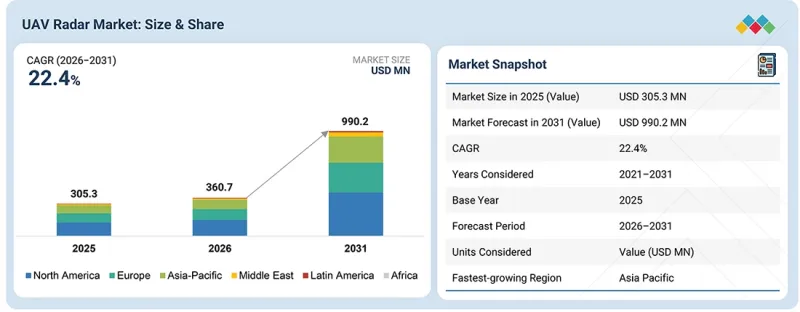
현재의 조달 및 통합 파이프라인을 바탕으로, UAV 레이더 시장은 2026년에 3억 6,070만 달러, 2031년까지 9억 9,020만 달러에 달할 것으로 예측되며, 예측 기간 중 연평균 성장률(CAGR)은 22.4%로 추정됩니다. ISR, 해상 감시, 탐지·회피, 항법 및 임무 안전 등 각 용도에서 기내 레이더의 수요는 확대되고 있지만, 현재는 기체 외부 설치형 UAV 탐지 레이더가 더 큰 수입원이 되고 있습니다. 이러한 성장은 전술 플랫폼 및 MALE 플랫폼에 대한 레이더 탑재 확대, 군용 UAV 인도 대수 증가, 대 UAS(무인항공기시스템) 대책 조달 가속화, 그리고 소프트웨어 정의형, AESA, MIMO 및 저 SWaP 레이더 아키텍처의 활용 확대에 의해 주도되고 있습니다.
"스캔 방식별로는 예측 기간 중 전자 스캔 어레이(ESA) 레이더 부문이 가장 큰 시장 점유율을 차지할 것으로 전망됩니다."
제조사와 시스템 통합사업자들이 임무 감지 및 드론 탐지 모두에서 소형이며 고속의 지향 제어 기능이 가능한 아키텍처를 점점 더 많이 채택함에 따라 전자 스캔 어레이 레이더가 UAV 레이더 시장에서 가장 큰 점유율을 차지할 것으로 예상됩니다. AESA 및 기타 전자식 지향 제어 시스템은 기계적 안테나 움직임에 의존하지 않기 때문에 신속한 빔 관리, 다중 표적 추적, 빠른 갱신 속도 및 적응성이 뛰어난 소프트웨어 정의 모드를 실현합니다. 예측 기간 중 이 부문은 탐지 및 회피 센서, 다기능 감시 레이더, SAR/GMTI 페이로드, 그리고 대 UAS 시스템에서의 활용 확대에 힘입어 더욱 강화될 것으로 전망됩니다.
"최종사용자별 예측 기간 중 방위 부문이 현저한 성장을 기록할 전망"
군사 조직은 드론 대응 범위를 확대하고 있으며, ISR(정보·감시·정찰), 해상, 전술 및 전투 지향 UAV에 레이더 페이로드를 통합하고 있습니다. 추가 수요의 대부분은 방위 분야 고객으로부터 발생할 것으로 예상됩니다. 신규 도입 및 업그레이드 프로그램을 모두 지원하기 위해, 조달 동향도 다층적 방공 아키텍처 전반에 걸쳐 지속적인 추적, 표적 분류 및 유도를 제공할 수 있는 네트워크화된 센서로 전환되고 있습니다.
"예측 기간 중 북미가 큰 점유율을 차지할 전망"
북미는 성숙한 레이더 산업 기반, 막대한 국방 예산, 활발한 대-UAS 프로그램, 그리고 무인 항공기에 대한 광범위한 레이더 통합에 힘입어 계속해서 주요 UAV 레이더 시장이 될 전망입니다. 또한 이 지역은 소형 AESA, 메타물질, 탐지·회피(Detect-and-Avoid), 소프트웨어 정의 레이더 분야의 활발한 개발 활동은 물론, 기존 무인기 및 방공 기체에 대한 지속적인 업그레이드의 혜택도 누리고 있습니다.
RTX(미국), Leonardo S.p.A(이탈리아), Saab AB(스웨덴), HENSOLDT AG(독일) 및 Israel Aerospace Industries(이스라엘)는 UAV 레이더 시장 평가 대상에 포함된 주요 기업 중 일부입니다.
조사 범위:
본 시장 조사에서는 UAV 레이더 시장을 주요 부문 및 하위 부문별로 평가하고, 주요 지역 및 각국에서의 시장 잠재력을 분석하고 있습니다. 본 조사에는 주요 기업, 제품 포트폴리오, 기업 포지셔닝, 통합 프로그램, 계약 동향, 기술 개발, 조달 동향 및 시장내 입지를 강화하기 위해 채택된 전략에 대한 상세한 평가가 포함되어 있습니다.
이 보고서를 구매해야 하는 이유:
이 보고서는 시장 선도 기업, 공급업체, 통합업체 및 신규 진입 기업이 UAV 레이더의 수익 기회와 경쟁 환경에 대해 현실적인 전망을 세울 수 있도록 돕는 것을 목적으로 합니다. 수요 촉진요인, 제약 요인, 국가 차원의 조달 동향, 기술 변화 및 경쟁사 동향을 단일 시장 관점으로 통합함으로써, 포트폴리오 계획, 시장 진입 의사결정, 파트너 선정 및 시장 출시 우선순위 설정을 지원합니다.
이 보고서는 다음 사항에 대한 인사이트를 제공합니다. :
- 시장 촉진요인(UAS(무인 항공기 시스템) 조달, 무인 ISR(정보·감시·정찰) 기체군, 저고도 방공 시스템 현대화에 따른 성장), 제약 요인(통합의 복잡성, 주파수 대역 및 인증상의 제약, 수출 규제, 그리고 첨단 AESA 하드웨어 비용), 기회(소형이며 SWaP이 낮은 AESA/MIMO 레이더,자율형 탐지·회피 기능, 소프트웨어 정의 처리 및 멀티센서 C-UAS 통합), 그리고 과제(잡음 속의 소형 표적 탐지, 위협의 급속한 진화, 오경보 관리 및 플랫폼 간 및 지휘 네트워크 간의 상호운용성)
- 시장 침투: 주요 공급업체가 제공하는 기내 및 기외용 UAV 레이더 시스템 및 레이더 탑재 솔루션에 대한 포괄적인 정보
- 제품 개발/혁신: 신흥 레이더 아키텍처, 신호 처리의 발전, 저 SWaP 설계, AI 기반 분류, 탐지·회피 기능 및 시장 전반의 제품 개발 활동에 대한 상세한 평가
- 시장 개발: 조달 프로그램, 기체 군 현대화, 대-UAS(무인 항공기 시스템) 배치, 레이더 통합 기회 등 지역별 성장 잠재력이 높은 시장에 대한 포괄적인 정보
- 시장 다각화: 새로운 레이더 제품, 관련 UAV 용도 시장 침투율이 낮은 지역, 최근 계약, 파트너십, 투자 및 새로운 시장 진입 경로에 대한 상세한 정보
- 경쟁 분석: 주요 기업의 시장 점유율, 성장 전략, 제품 포지셔닝, 레이더 제품 포트폴리오, 통합 분야의 강점, 제조 능력 및 프로그램 참여 현황에 대한 상세한 평가
자주 묻는 질문
목차
제1장 서론
제2장 개요
제3장 주요 인사이트
제4장 시장 개요
제5장 업계 동향
제6장 기술 진보, AI에 의한 영향, 특허, 혁신, 향후 응용
제7장 지속가능성과 규제 상황
제8장 고객 상황과 구매 행동
제9장 UAV 레이더 시장(스캔 방식별)(시장 규모 및 2031년까지의 예측 - 100만 달러)
제10장 UAV 레이더 시장(레이더 유형별)(시장 규모 및 2031년까지의 예측 - 100만 달러)
제11장 UAV 레이더 시장, 탑재 레이더 유형별(시장 규모 및 2031년까지의 예측 - 100만 달러)
제12장 UAV 레이더 시장(탑재형별)(시장 규모 및 2031년까지의 예측 - 100만 달러)
제13장 UAV 레이더 시장(주파수 대역별)(시장 규모 및 2031년까지의 예측 - 100만 달러)
제14장 UAV 레이더 시장(UAV 클래스별)(시장 규모 및 2031년까지의 예측 - 100만 달러)
제15장 UAV 레이더 시장(최종사용자별)(시장 규모 및 2031년까지의 예측 - 100만 달러)
제16장 UAV 레이더 시장(지역별)(시장 규모 및 2031년까지의 예측 - 100만 달러)
제17장 경쟁 구도
제18장 기업 개요
제19장 조사 방법
제20장 부록
KSA 26.09.17The use of radar for all-weather sensing, autonomous flight, persistent surveillance, and counter-UAS protection by defense forces, border agencies, critical infrastructure operators, and UAV manufacturers is driving growth in the UAV radar market.
| Scope of the Report | |
|---|---|
| Years Considered for the Study | 2021-2032 |
| Base Year | 2025 |
| Forecast Period | 2026-2032 |
| Units Considered | Value (USD Billion) |
| Segments | By Scanning, Frequency, End User and Region |
| Regions covered | North America, Europe, APAC, RoW |
Demand is rising due to a number of factors, including increased acquisition of unmanned systems, the need to detect low-observable and low-flying drones, the growing use of SAR/GMTI payloads, and the trend toward small electronically scanned radars that can be installed on smaller airframes.
Based on the current procurement and integration pipeline, the UAV radar market is projected to reach USD 360.7 million in 2026 and USD 990.2 million by 2031, representing an estimated CAGR of 22.4% over the forecast period. While onboard radar demand is growing across ISR, maritime surveillance, detect-and-avoid, navigation, and mission-safety applications, offboard UAV-detection radar now constitutes the larger revenue stream. This growth is driven by wider radar installations on tactical and MALE platforms, increased military UAV deliveries, expedited counter-UAS acquisition, and expanding use of software-defined, AESA, MIMO, and low-SWaP radar architectures.
"By Scanning Type, Electronically Scanned Array Radar Segment to Hold the Largest Market Share During the Forecast Period"
As manufacturers and system integrators increasingly adopt compact, fast-steering architectures for both mission sensing and drone detection, electronic scanned array radar is expected to capture the largest share of the UAV radar market. By avoiding reliance on mechanical antenna movement, AESA and other electronically steered systems enable rapid beam management, multi-target tracking, fast update rates, and adaptable software-defined modes. Throughout the projection period, this segment is expected to be strengthened by their growing use in detect-and-avoid sensors, multi-function surveillance radars, SAR/GMTI payloads, and counter-UAS systems.
"Defense Segment to Record Significant Growth During the Forecast Period by End User"
Military organizations are expanding counter-drone coverage and incorporating radar payloads into ISR, maritime, tactical, and combat-oriented UAVs. The majority of the additional demand is anticipated to come from defense clients. To support both new-build installations and upgrade programs, procurement is also moving toward networked sensors that can provide persistent tracking, target classification, and cueing across layered air-defense architectures.
"North America to Register Substantial Share During the Forecast Period"
North America is expected to remain a major UAV radar market, supported by a mature radar industrial base, large defense budgets, active counter-UAS programs, and extensive radar integration on unmanned aircraft. The region also benefits from strong development activity in compact AESA, metamaterials, detect-and-avoid, and software-defined radar, along with recurring upgrades to existing unmanned and air-defense fleets.
The breakdown of profiles for primary participants in the UAV radar market is provided below:
- By Company Type: Tier 1 - 45%, Tier 2 - 30%, and Tier 3 - 25%
- By Designation: Directors - 25%, C-Level Executives - 15%, and Others (Managers and Other Non-C-Level Executives) - 60%
- By Region: North America - 35%, Europe - 25%, Asia Pacific - 20%, Middle East - 10%, Latin America - 5%, and Africa - 5%
RTX (US), Leonardo S.p.A (Italy), Saab AB (Sweden), HENSOLDT AG (Germany), and Israel Aerospace Industries (Israel) are among the key companies considered in the UAV radar market assessment.
Research Coverage:
This market study evaluates the UAV radar market across its principal segments and subsegments and assesses the potential of each market across major regions and countries. The study includes an in-depth assessment of key participants, product portfolios, company positioning, integration programs, contract activity, technological developments, procurement trends, and the strategies adopted to strengthen market presence.
Reasons to Buy This Report:
The report is intended to help market leaders, suppliers, integrators, and new entrants develop a grounded view of the UAV Radar revenue opportunity and its competitive environment. It supports portfolio planning, market-entry decisions, partner identification, and go-to-market prioritization by combining demand drivers, restraints, country-level procurement signals, technology shifts, and competitive activity into a single market view.
The report provides insights into the following pointers:
- Market drivers (growth in counter-UAS procurement, unmanned ISR fleets, and low-altitude air-defense modernization), restraints (integration complexity, spectrum/certification constraints, export restrictions, and the cost of advanced AESA hardware), opportunities (compact low-SWaP AESA/MIMO radar, autonomous detect-and-avoid, software-defined processing, and multi-sensor C-UAS integration), and challenges (small-target detection in clutter, rapid threat evolution, false-alarm management, and interoperability across platforms and command networks)
- Market Penetration: Comprehensive information on UAV radar systems and radar-enabled solutions offered by leading suppliers across onboard and offboard applications
- Product Development/Innovation: Detailed assessment of emerging radar architectures, signal-processing advances, low-SWaP design, AI-enabled classification, detect-and-avoid capabilities, and product-development activity across the market
- Market Development: Comprehensive information on high-potential markets across regions, including procurement programs, fleet modernization, counter-UAS deployment, and radar integration opportunities
- Market Diversification: Detailed coverage of new radar products, adjacent UAV applications, underpenetrated geographies, recent contracts, partnerships, investments, and new routes to market
- Competitive Assessment: In-depth evaluation of market share, growth strategies, product positioning, radar portfolios, integration strengths, manufacturing capabilities, and program exposure of leading companies
TABLE OF CONTENTS
1 INTRODUCTION
- 1.1 STUDY OBJECTIVES
- 1.2 MARKET DEFINITION
- 1.3 STUDY SCOPE
- 1.3.1 MARKET SEGMENTATION & REGIONAL SNAPSHOT
- 1.3.2 INCLUSIONS & EXCLUSIONS
- 1.4 YEARS CONSIDERED
- 1.5 CURRENCY CONSIDERED
- 1.5.1 USD EXCHANGE RATES, 2021-2025
- 1.6 STAKEHOLDERS
- 1.7 SUMMARY OF CHANGES
2 EXECUTIVE SUMMARY
- 2.1 KEY INSIGHTS & MARKET HIGHLIGHTS
- 2.2 KEY MARKET PARTICIPANTS: MAPPING OF STRATEGIC DEVELOPMENTS
- 2.3 DISRUPTIVE TRENDS IN UAV RADAR MARKET
- 2.4 HIGH GROWTH SEGMENTS
- 2.5 REGIONAL SNAPSHOT: MARKET SIZE, GROWTH RATE, AND FORECAST
3 PREMIUM INSIGHTS
- 3.1 ATTRACTIVE OPPORTUNITIES FOR PLAYERS IN UAV RADAR MARKET
- 3.2 UAV RADAR MARKET, BY SCANNING TYPE
- 3.3 UAV RADAR MARKET, BY ONBOARD RADAR TYPE
- 3.4 UAV RADAR MARKET, BY OFFBOARD RADAR TYPE
- 3.5 UAV RADAR MARKET, BY END-USER
4 MARKET OVERVIEW
- 4.1 INTRODUCTION
- 4.2 MARKET DYNAMICS
- 4.2.1 DRIVERS
- 4.2.1.1 Rising demand for counter-UAS detection and tracking
- 4.2.1.2 Expansion of radar missions on UAV platforms
- 4.2.1.3 Need for all-weather and low-visibility sensing
- 4.2.2 RESTRAINTS
- 4.2.2.1 Size, weight, power, and thermal limits on UAV platforms
- 4.2.2.2 High platform integration and qualification requirements
- 4.2.3 OPPORTUNITIES
- 4.2.3.1 Compact detect-and-avoid radar for BVLOS UAV operations
- 4.2.3.2 Distributed and networked counter-UAS radar systems
- 4.2.4 CHALLENGES
- 4.2.4.1 Detection and classification of small UAVs in cluttered environments
- 4.2.4.2 Interoperability between radar, C2, sensors, and effectors
- 4.2.1 DRIVERS
- 4.3 UNMET NEEDS AND WHITE SPACES IN UAV RADAR MARKET
- 4.4 INTER-CONNECTED MARKETS AND CROSS-SECTOR OPPORTUNITIES
- 4.5 STRATEGIC MOVES BY TIER 1/2/3 PLAYERS
- 4.5.1 STRATEGIC MOVES BY TIER 1, 2, AND 3 PLAYERS
5 INDUSTRY TRENDS
- 5.1 INTRODUCTION
- 5.2 MACROECONOMIC OUTLOOK
- 5.2.1 INTRODUCTION
- 5.2.2 GDP TRENDS AND FORECAST
- 5.2.3 TRENDS IN GLOBAL UAV RADAR INDUSTRY
- 5.2.4 TRENDS IN GLOBAL AESA RADAR IN UAVS
- 5.3 VALUE CHAIN ANALYSIS
- 5.4 ECOSYSTEM ANALYSIS
- 5.5 TRADE ANALYSIS
- 5.5.1 IMPORT SCENARIO (HS CODE 852610)
- 5.5.2 EXPORT SCENARIO (HS CODE 852610)
- 5.6 KEY CONFERENCES & EVENTS, 2026-2027
- 5.7 TRENDS & DISRUPTIONS IMPACTING CUSTOMER BUSINESS
- 5.8 INVESTMENT & FUNDING SCENARIO
- 5.9 PRICING ANALYSIS
- 5.9.1 AVERAGE SELLING PRICE OF UAV RADAR, BY ONBOARD RADAR HARDWARE MODULE TYPE
- 5.9.2 AVERAGE SELLING PRICE OF UAV RADAR, BY REGION
- 5.10 CASE STUDIES
- 5.10.1 CASE STUDY 1: GENERAL ATOMICS DEVELOPED EAGLEEYE RADAR FOR GRAY EAGLE UAVS
- 5.10.2 CASE STUDY 2: AATI USED ECHOFLIGHT RADAR FOR BVLOS UAV OPERATIONS
- 5.10.3 CASE STUDY 3: US ARMY INTEGRATED KURFS RADAR WITH LIDS FOR COUNTER-UAS OPERATIONS
- 5.11 TOTAL COST OF OWNERSHIP
- 5.11.1 INTEGRATION AND DEPLOYMENT COSTS
- 5.11.2 INTEGRATION AND DEPLOYMENT COSTS
- 5.11.3 ANNUAL OPERATIONS & MAINTENANCE COSTS
- 5.11.4 MID-LIFE UPGRADE AND TECHNOLOGY REFRESH COSTS
- 5.11.5 OTHER COSTS
- 5.12 BILL OF MATERIALS (BOM ANALYSIS)
- 5.12.1 ELECTRONICALLY SCANNED ARRAY RADARS
- 5.12.2 MECHANICALLY SCANNED RADARS
- 5.12.3 HYBRID MECHANICAL-ELECTRONIC SCANNING RADARS
- 5.12.4 FIXED APERTURE/NON-SCANNING RADARS
- 5.13 BUSINESS MODELS
- 5.13.1 DIRECT SALES & PROCUREMENT MODEL
- 5.13.2 OEM & PLATFORM INTEGRATION MODEL
- 5.13.3 SYSTEM INTEGRATION & PRIME CONTRACTING MODEL
- 5.13.4 RETROFIT, UPGRADES & LIFECYCLE SUPPORT MODEL
- 5.13.5 SOFTWARE & RADAR-DATA SUBSCRIPTION MODEL
- 5.13.6 MANAGED DEPLOYMENT & CAPABILITY-AS-A-SERVICE MODEL
6 TECHNOLOGICAL ADVANCEMENTS, AI-DRIVEN IMPACT, PATENTS, INNOVATIONS, AND FUTURE APPLICATIONS
- 6.1 KEY EMERGING TECHNOLOGIES
- 6.1.1 SWAP-C REDUCTION AND RADAR MINIATURIZATION
- 6.1.1.1 GaAs-to-GaN transition in high-power RF sections
- 6.1.1.2 Silicon RF, SIGE, SOI, CMOS, and highly integrated front ends
- 6.1.1.3 Analog, hybrid, and digital beamforming
- 6.1.1.4 Direct RF sampling and high-speed mixed-signal conversion
- 6.1.1.5 Software-defined and cognitive radar
- 6.1.1 SWAP-C REDUCTION AND RADAR MINIATURIZATION
- 6.2 COMPLEMENTARY TECHNOLOGIES
- 6.2.1 AI-ASSISTED DETECTION, CLASSIFICATION, AND CLUTTER SUPPRESSION
- 6.2.2 CONFORMAL, DISTRIBUTED, AND MULTI-PANEL APERTURES
- 6.2.3 MULTIFUNCTION RF AND INTEGRATED SENSING/COMMUNICATIONS
- 6.2.4 MIMO, MULTISTATIC, BISTATIC, AND SWARM-BASED RADAR
- 6.3 ADJACENT TECHNOLOGIES
- 6.3.1 OPEN ARCHITECTURE AND MODULAR PAYLOAD INTERFACES
- 6.3.2 THERMAL MANAGEMENT AND POWER ELECTRONICS TRENDS
- 6.3.3 CYBERSECURITY AND ELECTRONIC PROTECTION REQUIREMENTS
- 6.4 TECHNOLOGY ROADMAP
- 6.5 PATENT ANALYSIS
- 6.6 FUTURE APPLICATIONS
- 6.7 IMPACT OF AI/ GENERATIVE AI ON UAV RADAR MARKET
- 6.7.1 TOP USE CASES AND MARKET POTENTIAL
- 6.7.2 BEST PRACTICES IN UAV RADAR MARKET
- 6.7.3 INTERCONNECTED ADJACENT ECOSYSTEM AND IMPACT ON MARKET PLAYERS
- 6.7.4 CLIENTS' READINESS TO ADOPT GENERATIVE AI IN UAV RADAR MARKET
7 SUSTAINABILITY AND REGULATORY LANDSCAPE
- 7.1 REGIONAL REGULATIONS AND COMPLIANCE
- 7.1.1 REGULATORY BODIES, GOVERNMENT AGENCIES, AND OTHER ORGANIZATIONS
- 7.1.2 KEY REGULATIONS
- 7.1.3 INDUSTRY STANDARDS
- 7.2 SUSTAINABILITY INITIATIVES
- 7.2.1 LOWER-POWER RF ELECTRONICS AND IMPROVED THERMAL MANAGEMENT
- 7.2.2 SOFTWARE-DEFINED AND MODULAR RADAR ARCHITECTURES
- 7.2.3 REPAIR, UPGRADES, AND LIFECYCLE MANAGEMENT
- 7.3 IMPACT OF REGULATORY POLICIES ON SUSTAINABILITY INITIATIVES
- 7.3.1 ENERGY-EFFICIENT RF COMPONENTS AND THERMAL MANAGEMENT
- 7.3.2 MODULAR UPGRADES, REPAIR, AND LIFECYCLE EXTENSION
8 CUSTOMER LANDSCAPE & BUYER BEHAVIOR
- 8.1 DECISION-MAKING PROCESS
- 8.2 BUYERS, STAKEHOLDERS, AND BUYING EVALUATION CRITERIA
- 8.2.1 KEY STAKEHOLDERS IN BUYING PROCESS
- 8.2.2 BUYING CRITERIA
- 8.3 ADOPTION BARRIERS & INTERNAL CHALLENGES
9 UAV RADAR MARKET, BY SCANNING TYPE (MARKET SIZE & FORECAST TO 2031 - IN USD MILLION)
- 9.1 INTRODUCTION
- 9.2 ELECTRONICALLY SCANNED ARRAY RADARS
- 9.2.1 FASTER TARGET DETECTION, MULTI-TARGET TRACKING, AND FLEXIBLE INSTALLATION TO DRIVE GROWTH
- 9.2.2 ACTIVE ELECTRONICALLY SCANNED ARRAY (AESA)
- 9.2.2.1 Analog beamforming AESA
- 9.2.2.2 Hybrid beamforming AESA
- 9.2.2.3 Digital beamforming AESA
- 9.2.2.4 Distributed/Multifunction AESA
- 9.2.3 OTHER ELECTRONICALLY SCANNED ARRAYS
- 9.2.3.1 Passive electronically scanned array (PESA)
- 9.2.3.2 Metamaterial electronically scanned array (MESA)
- 9.2.3.3 Multi-input multiple-output (MIMO)
- 9.2.3.4 Digital array
- 9.3 MECHANICALLY SCANNED RADAR
- 9.3.1 WIDE-AREA COVERAGE, PROVEN RADAR DESIGNS, AND COST CONSIDERATIONS TO SUSTAIN DEMAND
- 9.3.1.1 Rotating antenna radar
- 9.3.1.2 Gimballed/Steered antenna radar
- 9.3.1.3 Mechanically swept sector-scanning radar
- 9.3.1 WIDE-AREA COVERAGE, PROVEN RADAR DESIGNS, AND COST CONSIDERATIONS TO SUSTAIN DEMAND
- 9.4 HYBRID MECHANICAL-ELECTRONIC SCANNING RADAR
- 9.4.1 COMBINED ELECTRONIC BEAM CONTROL AND MECHANICAL REPOSITIONING TO DRIVE HYBRID GROWTH
- 9.4.1.1 Mechanically rotated AESA
- 9.4.1.2 Mechanically positioned fixed-panel AESA
- 9.4.1.3 Electronic sector scan with mechanical repositioning
- 9.4.1 COMBINED ELECTRONIC BEAM CONTROL AND MECHANICAL REPOSITIONING TO DRIVE HYBRID GROWTH
- 9.5 FIXED BEAM/NON-SCANNING RADAR
- 9.5.1 WIDER SPATIAL COVERAGE AND MULTI-POSITION IMAGING TO SUPPORT GROWTH
- 9.5.1.1 Fixed side-looking radar
- 9.5.1.2 Fixed forward-looking radar
- 9.5.1.3 Fixed multi-aperture radar
- 9.5.1 WIDER SPATIAL COVERAGE AND MULTI-POSITION IMAGING TO SUPPORT GROWTH
10 UAV RADAR MARKET, BY RADAR TYPE (MARKET SIZE & FORECAST TO 2031 - IN USD MILLION)
- 10.1 INTRODUCTION
- 10.2 ONBOARD RADAR TYPE
- 10.2.1 BVLOS OPERATIONS AND COMPACT RADAR INTEGRATION TO DRIVE DEMAND
- 10.3 OFFBOARD RADAR TYPE
- 10.3.1 DISTRIBUTED COUNTER-UAS NETWORKS AND WIDER COVERAGE TO DRIVE DEMAND
11 UAV RADAR MARKET, BY ONBOARD RADAR TYPE (MARKET SIZE & FORECAST TO 2031 - IN USD MILLION)
- 11.1 INTRODUCTION
- 11.2 ISR & SURVEILLANCE RADAR
- 11.2.1 PERSISTENT ISR AND MARITIME SURVEILLANCE TO DRIVE DEMAND
- 11.2.1.1 Dedicated SAR imaging radar
- 11.2.1.2 Dedicated GMTI radar
- 11.2.1.3 Maritime surveillance radar
- 11.2.1.4 Air surveillance radar
- 11.2.1 PERSISTENT ISR AND MARITIME SURVEILLANCE TO DRIVE DEMAND
- 11.3 FIRE-CONTROL & TARGETING RADAR
- 11.3.1 ARMED UAV MISSIONS TO DRIVE FIRE-CONTROL AND TARGETING RADAR DEMAND
- 11.3.1.1 Target detection and acquisition radar
- 11.3.1.2 Target tracking radar
- 11.3.1.3 Weapon cueing and guidance-support radar
- 11.3.1.4 Interceptor guidance radar
- 11.3.1 ARMED UAV MISSIONS TO DRIVE FIRE-CONTROL AND TARGETING RADAR DEMAND
- 11.4 DETECT-AND-AVOID AND AIRSPACE-SAFETY RADAR
- 11.4.1 BVLOS OPERATIONS AND AIRSPACE INTEGRATION TO DRIVE GROWTH
- 11.4.1.1 Air-to-air radar for traffic surveillance
- 11.4.1.2 Integrated DAA radar subsystems
- 11.4.1 BVLOS OPERATIONS AND AIRSPACE INTEGRATION TO DRIVE GROWTH
- 11.5 NAVIGATION AND FLIGHT-SAFETY RADAR
- 11.5.1 AUTONOMOUS FLIGHT AND LOW-ALTITUDE OPERATIONS TO DRIVE DEMAND
- 11.5.1.1 Radar altimeters
- 11.5.1.2 Terrain and obstacle-avoidance radar
- 11.5.1.3 Landing and approach-support radar
- 11.5.1 AUTONOMOUS FLIGHT AND LOW-ALTITUDE OPERATIONS TO DRIVE DEMAND
- 11.6 WEATHER & ATMOSPHERIC RADAR
- 11.6.1 LONG-ENDURANCE UAV OPERATIONS TO SUPPORT WEATHER RADAR GROWTH
- 11.6.1.1 Weather detection radar
- 11.6.1.2 Precipitation/Atmospheric/Cloud radar
- 11.6.1 LONG-ENDURANCE UAV OPERATIONS TO SUPPORT WEATHER RADAR GROWTH
- 11.7 MULTIMODE AND SPECIALIZED RADAR
- 11.7.1 SPECIALIZED SENSING MISSIONS TO EXPAND RADAR APPLICATIONS IN UAV RADAR MARKET
- 11.7.1.1 SAR/GMTI multimode radar
- 11.7.1.2 Maritime multimode radar
- 11.7.1.3 Multimode combat radar
- 11.7.2 OTHER SPECIALIZED UAV RADAR
- 11.7.2.1 Ground-penetrating radar
- 11.7.2.2 Foliage-penetrating radar
- 11.7.2.3 Ice/Snow-sounding radar
- 11.7.2.4 Environmental & scientific radar
- 11.7.1 SPECIALIZED SENSING MISSIONS TO EXPAND RADAR APPLICATIONS IN UAV RADAR MARKET
12 UAV RADAR MARKET, BY OFFBOARD TYPE (MARKET SIZE & FORECAST TO 2031 - IN USD MILLION)
- 12.1 INTRODUCTION
- 12.2 SEARCH AND DETECTION RADAR
- 12.2.1 SMALL DRONE THREATS AND LAYERED C-UAS NETWORKS TO DRIVE DEMAND
- 12.3 PRECISION TRACKING AND CUEING RADAR
- 12.3.1 INTEGRATED C-UAS ARCHITECTURES TO DRIVE DEMAND
- 12.4 MULTI-FUNCTION COUNTER-UAS RADAR
- 12.4.1 EVOLVING DRONE THREATS AND MOBILE DEFENSE NEEDS TO DRIVE ADOPTION
- 12.5 FIRE-CONTROL AND ENGAGEMENT-SUPPORT RADAR
- 12.5.1 KINETIC COUNTER-UAS SYSTEMS TO DRIVE DEMAND
13 UAV RADAR MARKET, BY FREQUENCY BAND (MARKET SIZE & FORECAST TO 2031 - IN USD MILLION)
- 13.1 INTRODUCTION
- 13.2 L-BAND
- 13.2.1 WIDE-AREA SURVEILLANCE AND COUNTER-UAS DETECTION TO DRIVE GROWTH
- 13.3 S-BAND
- 13.3.1 LONG-RANGE UAV DETECTION AND LAYERED AIR DEFENSE TO DRIVE DEMAND
- 13.4 C-BAND
- 13.4.1 MOBILE AIR DEFENSE AND MULTI-MISSION SURVEILLANCE TO DRIVE GROWTH
- 13.5 X-BAND
- 13.5.1 HIGH-RESOLUTION SENSING AND PRECISION TRACKING TO DRIVE DEMAND
- 13.6 KU-BAND
- 13.6.1 COMPACT SAR PAYLOADS AND PRECISION COUNTER-UAS TRACKING TO DRIVE DEMAND
- 13.7 K-BAND
- 13.7.1 AUTONOMOUS FLIGHT AND RADAR ALTIMETRY TO DRIVE ADOPTION
- 13.8 KA-BAND
- 13.8.1 HIGH-RESOLUTION MAPPING AND PRECISION MEASUREMENT TO DRIVE DEMAND
- 13.9 V/W-BAND AND OTHER MILLIMETER_WAVE BANDS
- 13.9.1 SHORT-RANGE PRECISION SENSING AND AUTONOMOUS FLIGHT TO DRIVE GROWTH
- 13.10 MULTI-BAND
- 13.10.1 COMBINED WIDE-AREA SEARCH AND PRECISION TRACKING TO DRIVE ADOPTION
- 13.10.2 OTHER FREQUENCY BANDS
14 UAV RADAR MARKET, BY UAV CLASS (MARKET SIZE & FORECAST TO 2031 - IN USD MILLION)
- 14.1 INTRODUCTION
- 14.2 SMALL UAVS (<=25 KG)
- 14.2.1 COMPACT RADAR INTEGRATION AND AUTONOMOUS OPERATIONS TO DRIVE DEMAND
- 14.2.2 MICRO UAVS
- 14.2.3 MINI UAVS
- 14.2.4 SMALL TACTICAL UAVS
- 14.3 TACTICAL UAVS (>25-150 KG)
- 14.3.1 MULTI-SENSOR ISR AND LONGER-ENDURANCE MISSIONS TO DRIVE ADOPTION
- 14.4 MEDIUM UAVS (>150-600 KG)
- 14.4.1 MARITIME SURVEILLANCE AND WIDE-AREA ISR TO DRIVE DEMAND
- 14.5 LARGE UAVS (600 KG)
- 14.5.1 PERSISTENT SURVEILLANCE AND COMBAT MISSIONS TO DRIVE GROWTH
- 14.5.2 MEDIUM-ALTITUDE LONG-ENDURANCE (MALE) UAVS
- 14.5.3 HIGH-ALTITUDE LONG-ENDURANCE (HALE) UAVS
- 14.5.4 UNMANNED COMBAT AERIAL VEHICLES (UCAVS)
15 UAV RADAR MARKET, BY END USER (MARKET SIZE & FORECAST TO 2031 - IN USD MILLION)
- 15.1 INTRODUCTION
- 15.2 DEFENSE
- 15.2.1 PERSISTENT ISR AND DEFENSE MODERNIZATION TO DRIVE DEMAND
- 15.3 HOMELAND SECURITY & LAW ENFORCEMENT
- 15.3.1 BORDER SURVEILLANCE AND COUNTER-UAS OPERATIONS TO DRIVE DEMAND
- 15.4 CIVIL & COMMERCIAL
- 15.4.1 BVLOS OPERATIONS AND INFRASTRUCTURE MONITORING TO DRIVE ADOPTION
16 UAV RADAR MARKET, BY REGION (MARKET SIZE & FORECAST TO 2031 - IN USD MILLION)
- 16.1 INTRODUCTION
- 16.2 NORTH AMERICA
- 16.2.1 US
- 16.2.1.1 Counter-UAS programs to drive market
- 16.2.2 CANADA
- 16.2.2.1 Arctic surveillance, RPAS procurement, and counter-UAS investment to drive market
- 16.2.1 US
- 16.3 EUROPE
- 16.3.1 UK
- 16.3.1.1 Surveillance UAV modernization and counter-UAS funding to drive market
- 16.3.2 FRANCE
- 16.3.2.1 Radar-equipped tactical and naval UAV programs to expand market
- 16.3.3 GERMANY
- 16.3.3.1 Persistent unmanned ISR and mobile air-defense programs to strengthen radar adoption
- 16.3.4 ITALY
- 16.3.4.1 Naval UAV integration and counter-UAS deployment to drive demand for radar systems
- 16.3.5 SPAIN
- 16.3.5.1 SIRTAP development and mobile counter-UAS programs to support market growth
- 16.3.6 POLAND
- 16.3.6.1 Eastern-flank drone threats and counter-UAS procurement to accelerate radar deployment
- 16.3.7 SWEDEN
- 16.3.7.1 Distributed counter-UAS systems and common radar architecture to expand market opportunities
- 16.3.8 NORWAY
- 16.3.8.1 High North surveillance and military-base protection to drive UAV radar requirements
- 16.3.9 NETHERLANDS
- 16.3.9.1 Naval UAV deployment and domestic sensor localization to strengthen radar demand
- 16.3.10 REST OF EUROPE
- 16.3.1 UK
- 16.4 ASIA PACIFIC
- 16.4.1 CHINA
- 16.4.1.1 Expansion of low-altitude drone operations and defense modernization to drive market
- 16.4.2 INDIA
- 16.4.2.1 Border surveillance requirements and counter-UAS procurement to drive market
- 16.4.3 JAPAN
- 16.4.3.1 Maritime ISR and protection of military facilities to drive market
- 16.4.4 SOUTH KOREA
- 16.4.4.1 Indigenous radar-equipped UAV production and counter-drone programs to drive market
- 16.4.5 AUSTRALIA
- 16.4.5.1 Long-range maritime surveillance and LAND 156 deployments to drive market
- 16.4.6 SINGAPORE
- 16.4.6.1 Dense airspace safety and critical infrastructure protection to drive market
- 16.4.7 TAIWAN
- 16.4.7.1 Cross-strait ISR expansion and layered counter-UAS defense to drive Taiwan's UAV Radar Market
- 16.4.8 REST OF ASIA PACIFIC
- 16.4.1 CHINA
- 16.5 MIDDLE EAST
- 16.5.1 GCC
- 16.5.1.1 UAE
- 16.5.1.1.1 Expansion of radar-equipped UAV programs and critical infrastructure surveillance to drive market
- 16.5.1.2 Saudi Arabia
- 16.5.1.2.1 Defense localization and UAV sensor integration to drive market
- 16.5.1.1 UAE
- 16.5.2 ISRAEL
- 16.5.2.1 Established UAV-radar integration and persistent ISR requirements to drive market
- 16.5.3 TURKEY
- 16.5.3.1 Indigenous combat UAV Development and AESA radar integration to drive adoption
- 16.5.4 REST OF MIDDLE EAST
- 16.5.1 GCC
- 16.6 LATIN AMERICA
- 16.6.1 BRAZIL
- 16.6.1.1 Border surveillance, Amazon monitoring, and counter-UAS investment to drive market
- 16.6.2 MEXICO
- 16.6.2.1 Airspace protection, strategic RPAS procurement, and critical-infrastructure security to drive market
- 16.6.3 ARGENTINA
- 16.6.3.1 Domestic radar development and northern-border security programs to drive market
- 16.6.4 REST OF LATIN AMERICA
- 16.6.1 BRAZIL
- 16.7 AFRICA
- 16.7.1 SOUTHERN AFRICA
- 16.7.1.1 Border monitoring and counter-drone requirements to support market growth
- 16.7.2 NORTHERN AFRICA
- 16.7.2.1 Air-defense modernization and radar-enabled UAV operations to support market growth
- 16.7.1 SOUTHERN AFRICA
17 COMPETITIVE LANDSCAPE
- 17.1 INTRODUCTION
- 17.2 KEY PLAYER STRATEGIES/RIGHT TO WIN, 2021-2025
- 17.3 REVENUE ANALYSIS, 2021-2025
- 17.4 MARKET SHARE ANALYSIS, 2025
- 17.5 BRAND COMPARISON
- 17.6 COMPANY VALUATION AND FINANCIAL METRICS
- 17.7 ONBOARD COMPANY EVALUATION MATRIX: KEY PLAYERS, 2025
- 17.7.1 STARS
- 17.7.2 EMERGING LEADERS
- 17.7.3 PERVASIVE PLAYERS
- 17.7.4 PARTICIPANTS
- 17.8 OFFBOARD COMPANY EVALUATION MATRIX: KEY PLAYERS, 2025
- 17.8.1 STARS
- 17.8.2 EMERGING LEADERS
- 17.8.3 PERVASIVE PLAYERS
- 17.8.4 PARTICIPANTS
- 17.8.5 COMPANY FOOTPRINT
- 17.8.5.1 Company footprint
- 17.8.5.2 Region footprint
- 17.8.5.3 Onboard radar type footprint
- 17.8.5.4 Offboard radar type footprint
- 17.8.5.5 End user footprint
- 17.9 COMPANY EVALUATION MATRIX: STARTUPS/SMES, 2025
- 17.9.1 PROGRESSIVE COMPANIES
- 17.9.2 RESPONSIVE COMPANIES
- 17.9.3 DYNAMIC COMPANIES
- 17.9.4 STARTING BLOCKS
- 17.9.5 COMPETITIVE BENCHMARKING
- 17.9.5.1 List of startups/SMEs
- 17.9.5.2 Competitive benchmarking of startups/SMEs
- 17.10 COMPETITIVE SCENARIO
- 17.10.1 PRODUCT LAUNCHES/ENHANCEMENTS/DEVELOPMENTS
- 17.10.2 DEALS
- 17.10.3 OTHER DEVELOPMENTS
18 COMPANY PROFILES
- 18.1 KEY PLAYERS
- 18.1.1 RTX
- 18.1.1.1 Business overview
- 18.1.1.2 Products offered
- 18.1.1.3 Recent developments
- 18.1.1.3.1 Product developments
- 18.1.1.3.2 Other developments
- 18.1.1.4 MnM view
- 18.1.1.4.1 Right to win
- 18.1.1.4.2 Strategic choices
- 18.1.1.4.3 Weaknesses and competitive threats
- 18.1.2 THALES
- 18.1.2.1 Business overview
- 18.1.2.2 Products offered
- 18.1.2.3 Recent developments
- 18.1.2.3.1 Product launches
- 18.1.2.3.2 Deals
- 18.1.2.3.3 Other developments
- 18.1.2.4 MnM view
- 18.1.2.4.1 Right to win
- 18.1.2.4.2 Strategic choices
- 18.1.2.4.3 Weaknesses and competitive threats
- 18.1.3 HENSOLDT AG
- 18.1.3.1 Business overview
- 18.1.3.2 Products offered
- 18.1.3.3 Recent developments
- 18.1.3.3.1 Product launches & developments
- 18.1.3.3.2 Deals
- 18.1.3.3.3 Other developments
- 18.1.3.4 MnM view
- 18.1.3.4.1 Right to win
- 18.1.3.4.2 Strategic choices
- 18.1.3.4.3 Weaknesses and competitive threats
- 18.1.4 SAAB AB
- 18.1.4.1 Business overview
- 18.1.4.2 Products offered
- 18.1.4.3 Recent developments
- 18.1.4.3.1 Product launches
- 18.1.4.3.2 Deals
- 18.1.4.3.3 Other developments
- 18.1.4.4 MnM view
- 18.1.4.4.1 Right to win
- 18.1.4.4.2 Strategic choices
- 18.1.4.4.3 Weaknesses and competitive threats
- 18.1.5 LEONARDO S.P.A.
- 18.1.5.1 Business overview
- 18.1.5.2 Products offered
- 18.1.5.3 Recent developments
- 18.1.5.3.1 Product launches & enhancements
- 18.1.5.3.2 Deals
- 18.1.5.3.3 Other developments
- 18.1.5.4 MnM view
- 18.1.5.4.1 Right to win
- 18.1.5.4.2 Strategic choices
- 18.1.5.4.3 Weaknesses and competitive threats
- 18.1.6 GENERAL ATOMICS
- 18.1.6.1 Business overview
- 18.1.6.2 Products offered
- 18.1.6.3 Recent developments
- 18.1.6.3.1 Product launches & enhancements
- 18.1.6.3.2 Deals
- 18.1.6.3.3 Other developments
- 18.1.7 NORTHROP GRUMMAN
- 18.1.7.1 Business overview
- 18.1.7.2 Products offered
- 18.1.7.3 Recent developments
- 18.1.7.3.1 Product enhancements
- 18.1.7.3.2 Other developments
- 18.1.8 ASELSAN A.S.
- 18.1.8.1 Business overview
- 18.1.8.2 Products offered
- 18.1.8.3 Recent developments
- 18.1.8.3.1 Product launches & developments
- 18.1.8.3.2 Other developments
- 18.1.9 HANWHA SYSTEMS CO., LTD.
- 18.1.9.1 Business overview
- 18.1.9.2 Products offered
- 18.1.9.3 Recent developments
- 18.1.9.3.1 Product launches & developments
- 18.1.9.3.2 Deals
- 18.1.9.3.3 Other developments
- 18.1.10 HONEYWELL INTERNATIONAL INC.
- 18.1.10.1 Business overview
- 18.1.10.2 Products offered
- 18.1.10.3 Recent developments
- 18.1.10.3.1 Product launches & developments
- 18.1.10.3.2 Deals
- 18.1.10.3.3 Other developments
- 18.1.11 ECHODYNE CORP.
- 18.1.11.1 Business overview
- 18.1.11.2 Products offered
- 18.1.11.3 Recent developments
- 18.1.11.3.1 Product launches
- 18.1.11.3.2 Deals
- 18.1.11.3.3 Other developments
- 18.1.12 MITSUBISHI ELECTRIC CORPORATION
- 18.1.12.1 Business overview
- 18.1.12.2 Products offered
- 18.1.12.3 Recent developments
- 18.1.12.3.1 Product developments
- 18.1.12.3.2 Other developments
- 18.1.13 METEKSAN DEFENCE INDUSTRY INC.
- 18.1.13.1 Business overview
- 18.1.13.2 Products offered
- 18.1.13.3 Recent developments
- 18.1.13.3.1 Product launches & enhancements
- 18.1.13.3.2 Other developments
- 18.1.14 ISRAEL AEROSPACE INDUSTRIES
- 18.1.14.1 Business overview
- 18.1.14.2 Products offered
- 18.1.14.3 Recent developments
- 18.1.14.3.1 Product launches & developments
- 18.1.14.3.2 Deals
- 18.1.14.3.3 Other developments
- 18.1.15 IMSAR
- 18.1.15.1 Business overview
- 18.1.15.2 Products offered
- 18.1.15.3 Recent developments
- 18.1.15.3.1 Product upgrades
- 18.1.15.3.2 Deals
- 18.1.15.3.3 Other developments
- 18.1.16 LOCKHEED MARTIN CORPORATION
- 18.1.16.1 Business overview
- 18.1.16.2 Products offered
- 18.1.16.3 Recent developments
- 18.1.16.3.1 Deals
- 18.1.16.3.2 Other developments
- 18.1.17 TELEDYNE TECHNOLOGIES INCORPORATED
- 18.1.17.1 Business overview
- 18.1.17.2 Products offered
- 18.1.17.3 Recent developments
- 18.1.17.3.1 Product launches & enhancements
- 18.1.17.3.2 Deals
- 18.1.17.3.3 Other developments
- 18.1.18 ELBIT SYSTEMS LTD.
- 18.1.18.1 Business overview
- 18.1.18.2 Products offered
- 18.1.18.3 Recent developments
- 18.1.18.3.1 Product launches & developments
- 18.1.18.3.2 Deals
- 18.1.18.3.3 Other developments
- 18.1.19 BHARAT ELECTRONICS LIMITED (BEL)
- 18.1.19.1 Business overview
- 18.1.19.2 Products offered
- 18.1.19.3 Recent developments
- 18.1.19.3.1 Product launches & developments
- 18.1.19.3.2 Deals
- 18.1.19.3.3 Other developments
- 18.1.20 ROBIN RADAR SYSTEMS
- 18.1.20.1 Business overview
- 18.1.20.2 Products offered
- 18.1.20.3 Recent developments
- 18.1.20.3.1 Product launches & enhancements
- 18.1.20.3.2 Deals
- 18.1.20.3.3 Other developments
- 18.1.1 RTX
- 18.2 OTHER PLAYERS
- 18.2.1 ANALOG DEVICES, INC.
- 18.2.2 QORVO US, INC.
- 18.2.3 NXP SEMICONDUCTORS
- 18.2.4 INFINEON TECHNOLOGIES AG
- 18.2.5 MACOM
- 18.2.6 METASENSING SRL
- 18.2.7 AINSTEIN
- 18.2.8 SMARTMICRO
- 18.2.9 SPACEFOREST
19 RESEARCH METHODOLOGY
- 19.1 RESEARCH DATA
- 19.1.1 SECONDARY DATA
- 19.1.1.1 Key data from secondary sources
- 19.1.2 BREAKDOWN OF PRIMARY INTERVIEWS
- 19.1.3 PRIMARY DATA
- 19.1.1 SECONDARY DATA
- 19.2 FACTOR ANALYSIS
- 19.2.1 INTRODUCTION
- 19.3 STUDY SCOPE
- 19.3.1 SEGMENTS AND SUBSEGMENTS
- 19.3.1.1 UAV radar market, by frequency band
- 19.3.1.2 UAV radar market, by UAV class
- 19.3.1.3 UAV radar market, by end user
- 19.3.1.4 UAV radar market, by scanning type
- 19.3.1.5 UAV radar market, by onboard radar type
- 19.3.1.6 UAV radar market, by offboard radar type
- 19.3.1 SEGMENTS AND SUBSEGMENTS
- 19.4 RESEARCH APPROACH AND METHODOLOGY
- 19.4.1 MARKET SIZE ESTIMATION
- 19.4.1.1 Bottom-up approach
- 19.4.1.2 Top-down approach
- 19.4.1 MARKET SIZE ESTIMATION
- 19.5 DATA TRIANGULATION
- 19.6 RESEARCH ASSUMPTIONS
- 19.7 RISK ASSESSMENT
- 19.8 RESEARCH LIMITATIONS
20 APPENDIX
- 20.1 DISCUSSION GUIDE
- 20.2 KNOWLEDGESTORE: MARKETSANDMARKETS' SUBSCRIPTION PORTAL
- 20.3 CUSTOMIZATION OPTIONS
- 20.4 RELATED REPORTS
- 20.5 AUTHOR DETAILS