

|
시장보고서
상품코드
2129355
체성분 분석기 시장 : 제품별, 이용 구분별, 모달리티별, 최종사용자별 - 세계 예측(-2031년)Body Composition Analyzers Market by Product, Usage, Modality, End User - Global Forecast to 2031 |
||||||

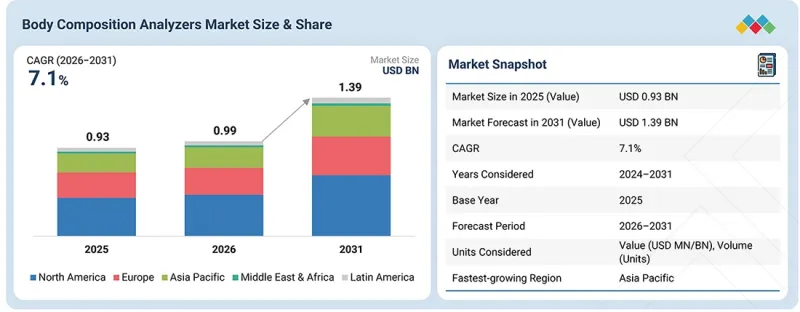
세계의 체성분 분석기 시장 규모는 2026년 9억 9,000만 달러에서 2031년에는 13억 9,000만 달러로 성장하여, 예측 기간 동안 CAGR은 7.1%에 달할 것으로 전망됩니다.
체성분 분석기는 병원, 진료소, 피트니스·웰니스 센터, 학술·연구 기관, 일반 가정 등에서 널리 사용되고 있습니다. 또한 개인의 체성분 데이터를 바탕으로 피트니스 프로그램을 모니터링하고, 개개인의 상황에 맞춰 조정하는 용도로도 활용되고 있습니다. 아시아태평양 등의 신흥 시장은 매력적인 성장 기회를 제공하고 있습니다.
| 조사 범위 | |
|---|---|
| 조사 대상 기간 | 2026-2031년 |
| 기준 연도 | 2025년 |
| 예측 기간 | 2026-2031년 |
| 단위 | 금액(달러) |
| 부문 | 제품, 이용 구분, 모달리티, 적용 분야, 최종사용자, 지역 |
| 대상 지역 | 북미, 유럽, 아시아태평양, 라틴아메리카, 중동 및 아프리카 |
비만 및 대사성 질환 유병률의 증가, 예방 의학의 보급 확대, 맞춤형 영양 및 피트니스 프로그램에 대한 수요 증가가 시장을 견인하고 있습니다. 또한, 생체전기임피던스 분석(BIA) 기술의 발전과 디지털 헬스 플랫폼 및 웨어러블 기기와의 통합을 통해 더욱 정확하고 연결성 및 편의성이 뛰어난 체성분 모니터링이 가능해지면서 시장 전체의 성장을 뒷받침하고 있습니다.
“2026년부터 2031년까지 생체 임피던스 분석기 부문이 가장 높은 성장률을 보일 전망”
제품별로 보면 생체 임피던스 분석기 부문이 예측 기간 동안 가장 높은 성장률을 기록할 것으로 전망됩니다. 주요 촉진요인으로는 정확도, 신뢰성, 사용 편의성을 향상시키기 위한 생체 임피던스 기술의 지속적인 개선이 꼽힙니다. 비침습적 체성분 평가에 대한 수요 증가, 다중 주파수 및 부위별 분석의 채택 확대, 피트니스 및 웰니스 프로그램의 보급도 이 부문의 성장에 기여하고 있습니다. 또한, 가정 내 건강 모니터링의 증가와 커넥티드 기기 및 디지털 헬스 플랫폼과의 연동도 이 부문을 견인하고 있습니다. 이러한 동향에 따라 임상 및 소비자용 분야 모두에서 측정 정확도, 사용 편의성, 개인 맞춤화, 실시간 건강 추적 기능이 향상되고 있습니다.
“2025년에는 부위별 체성분 측정 부문이 가장 큰 시장 점유율을 기록”
부위별 체성분 측정은 전신 측정과 비교하여 보다 정밀하고 정확한 분석이 가능하며, 신체의 특정 부위에 대한 상세한 정보를 제공합니다. 이 부문은 특히 지방 분포, 근육량, 체액 균형 모니터링을 목적으로 하는 정밀한 부위별 체성분 평가에 대한 수요 증가에 힘입어 성장하고 있습니다. 또한, 비만 관리, 스포츠 퍼포먼스, 영양 관리, 임상 치료 분야에서의 도입이 증가함에 따라 활용 범위도 확대되고 있습니다. 다주파수 BIA, 8극 구성, 디지털 분석 기술의 발전으로 부위별 측정 능력이 향상되고 있을 뿐만 아니라, 맞춤형 피트니스 및 헬스케어 프로그램에 대한 수요가 높아지고 있는 점도 보다 광범위한 도입을 뒷받침하고 있습니다.
“2026년부터 2031년까지 아시아태평양이 가장 빠르게 성장할 전망”
지역별로 보면 아시아태평양은 주로 급속한 도시화와 앉아 있는 생활 습관, 부적절한 식습관 등의 라이프스타일 변화로 인해 예측 기간 동안 체성분 분석기 시장에서 가장 높은 성장률을 기록할 것으로 예상됩니다. 체성분 분석기는 체성분에 대한 상세한 정보를 제공함으로써 새롭게 대두되는 건강 문제에 대처하는 데 도움을 주며, 효과적인 건강 관리 솔루션에 대한 수요 확대에 부응하고 있습니다. 이 지역의 시장 성장은 비만 및 대사성 질환의 증가, 건강 및 피트니스에 대한 인식 제고, 의료 인프라 확충, 가처분 소득 증가에 의해 주도되고 있습니다. 또한, 피트니스 클럽과 웰니스 프로그램, 예방 의료 활동의 확대도 이 제품의 보급을 더욱 촉진하고 있습니다. 특히 인도,중국, 일본, 동남아시아에서는 합리적인 가격에 휴대 가능하며 네트워크 연결 기능을 갖춘 체성분 분석기에 대한 수요가 높아지면서 시장 침투가 가속화되고 있습니다. BIA(생체전기임피던스 분석) 기술의 발전과 디지털 헬스와의 통합을 통해 임상, 피트니스, 가정에서의 활용 범위가 확대되고 있습니다.
본 보고서에서는 전 세계 체성분 분석기 시장을 조사하여, 시장 개요, 시장 성장에 영향을 미치는 각종 요인에 대한 분석, 기술 및 특허 동향, 법규제 환경, 사례 연구, 시장 규모 추정 및 전망, 각종 분류·지역/주요 국가별 상세 분석, 경쟁 구도, 주요 기업 개요 등을 정리하고 있습니다.
자주 묻는 질문
목차
제1장 소개
제2장 주요 요약
제3장 주요 인사이트
제4장 시장 개요
제5장 업계 동향
제6장 기술의 진보, AI의 영향, 특허, 혁신, 향후 용도
제7장 규제 상황과 지속가능성에 대한 대처
제8장 고객 상황과 구매 행동
제9장 체성분 분석기 시장 : 제품별
제10장 체성분 분석기 시장 : 이용 구분별
제11장 체성분 분석기 시장 : 측정 방식별
제12장 체성분 분석기 시장 : 용도별
제13장 체성분 분석기 시장 : 최종사용자별
제14장 체성분 분석기 시장 : 지역별
제15장 경쟁 구도
제16장 기업 개요
제17장 조사 방법
제18장 부록
KSM 26.09.17The global body composition analyzers market is anticipated to grow from USD 0.99 billion in 2026 to USD 1.39 billion by 2031, at a CAGR of 7.1% during the forecast period. Body composition analyzers are widely used by hospitals & clinics, fitness & wellness centers, academic & research centers, and home users. They are also used in monitoring and tailoring fitness programs based on individual body composition data. Emerging markets such as Asia Pacific offer lucrative market growth opportunities.
| Scope of the Report | |
|---|---|
| Years Considered for the Study | 2026-2031 |
| Base Year | 2025 |
| Forecast Period | 2026-2031 |
| Units Considered | Value (USD billion) |
| Segments | Product, Usage type, Modality, Application, End User, and Region |
| Regions covered | North America, Europe, Asia Pacific, Latin America, and the Middle East & Africa |
Rising prevalence of obesity and metabolic disorders, growing adoption of preventive healthcare, and increasing demand for personalized nutrition and fitness programs drive the market. Furthermore, technological advancements in bioelectrical impedance analysis (BIA) and integration with digital health platforms and wearable devices enable more accurate, connected, and convenient body composition monitoring, driving the overall market.
"Bioimpedance analyzers segment to exhibit the highest growth rate from 2026 to 2031"
Based on product, the bioimpedance analyzers segment is likely to register the highest growth rate in the body composition analyzers market during the forecast period. Major driving factors include continuous improvements in bioimpedance technology to enhance accuracy, reliability, and user-friendliness. The rising demand for non-invasive body composition assessment, growing adoption of multifrequency and segmental analysis, and expansion of fitness and wellness programs also contribute to the segmental growth. Additionally, increasing home-based health monitoring and integration with connected devices and digital health platforms drive the segment. These trends are enhancing measurement accuracy, accessibility, personalization, and real-time health tracking across clinical and consumer applications.
"Segmental body measurement segment captured the largest market share in 2025"
Based on application, the segmental body measurement segment accounted for the largest share of the body composition analyzers market in 2025. Segmental body measurement offers more precise and accurate analysis compared with whole-body measurements, providing detailed insights into specific areas of the body. The segment is driven by growing demand for precise regional body composition assessment, particularly for monitoring fat distribution, muscle mass, and fluid balance. Increasing adoption in obesity management, sports performance, nutrition, and clinical care is expanding applications. Technological advances in multifrequency BIA, octopolar configurations, and digital analytics are improving regional measurement capabilities, while demand for personalized fitness and healthcare programs is encouraging broader adoption.
"Asia Pacific to be the fastest-growing regional market between 2026 and 2031"
Based on region, Asia Pacific is expected to register the highest growth rate in the body composition analyzers market during the forecast period, mainly due to rapid urbanization and lifestyle changes, such as sedentary habits and poor diets. These devices help address emerging health concerns by providing detailed insights into body composition, which reflects the growing need for effective health management solutions. The regional market is driven by rising obesity and metabolic disorders, increasing health and fitness awareness, expanding healthcare infrastructure, and growing disposable incomes. Adoption is further supported by the expansion of fitness clubs, wellness programs, and preventive healthcare initiatives. Demand for affordable, portable, and connected analyzers, particularly across India, China, Japan, and Southeast Asia, is also accelerating market penetration. Technological advancements in BIA and digital health integration are broadening clinical, fitness, and home-use applications.
A breakdown of the primary participants referred to for this report is provided below:
- By Company Type: Tier 1-35%, Tier 2-40%, and Tier 3-25%
- By Designation: Directors-25%, Managers-50%, and Others-25%
- By Region: North America-43%, Europe-14%, Asia Pacific-26%, Latin America- 12%, and the Middle East & Africa- 5%
Prominent players in the body composition analyzers market include GE HealthCare (US), OMRON Corporation (Japan), Hologic, Inc. (US), InBody Co., Ltd. (South Korea), Tanita Corporation (Japan), seca (Germany), Withings (France), SELVAS Healthcare, Inc. (South Korea), COSMED srl (Italy), and RJL Systems (US).
Research Coverage
This report studies the body composition analyzers market based on product, usage type, modality, application, end user, and region. It also covers the factors affecting market growth, analyzes the various opportunities and challenges in the market, and provides details of the competitive landscape for market leaders. Furthermore, the report analyzes micro markets with respect to their individual growth trends. It forecasts the revenue of the market segments with respect to five main regions (and the respective countries in these regions).
Reasons to Buy the Report
The report will enable established firms as well as entrants/smaller firms to gauge the pulse of the market, which, in turn, would help them to garner a larger market share. Firms purchasing the report could use one or a combination of the below-mentioned strategies to strengthen their market presence.
This report provides insights into the following pointers:
- Analysis of key drivers (Rising prevalence of obesity and focus on body fat and muscle mass assessment, Growing adoption of body composition analysis in weight management and preventive healthcare), restraints (Limited reimbursement for routine body composition assessment, High sensitivity of bioimpedance measurements to hydration status and measurement conditions), opportunities (Increasing establishment of fitness, wellness and sports performance centers, Mounting demand for connected and data-driven monitoring), and challenges (Lack of standardization, Competition from established clinical imaging technologies) influencing the growth of the body composition analyzers market
- Product Development/Innovation: Detailed insights on upcoming technologies, research & development activities, and new product launches in the market
- Market Development: Comprehensive information about lucrative markets - the report analyzes the market across varied regions
- Market Diversification: Exhaustive information about new products, untapped geographies, recent developments, and investments in the market
- Competitive Assessment: In-depth assessment of market shares, growth strategies, product offerings of leading players such as Omron Corporation (Japan), Hologic Inc. (US), and GE Healthcare (US)
TABLE OF CONTENTS
1 INTRODUCTION
- 1.1 STUDY OBJECTIVES
- 1.2 MARKET DEFINITION
- 1.3 MARKET SCOPE
- 1.3.1 MARKET SEGMENTATION
- 1.3.2 INCLUSIONS & EXCLUSIONS
- 1.3.3 YEARS CONSIDERED
- 1.3.4 CURRENCY CONSIDERED
- 1.4 STAKEHOLDERS
- 1.5 SUMMARY OF CHANGES
2 EXECUTIVE SUMMARY
- 2.1 MARKET HIGHLIGHTS AND KEY INSIGHTS
- 2.2 KEY MARKET PARTICIPANTS: MAPPING OF STRATEGIC DEVELOPMENTS
- 2.3 DISRUPTIVE TRENDS IN BODY COMPOSITION ANALYZERS MARKET
- 2.4 HIGH-GROWTH SEGMENTS
- 2.5 REGIONAL SNAPSHOT: MARKET SIZE, GROWTH RATE, AND FORECAST
3 PREMIUM INSIGHTS
- 3.1 BODY COMPOSITION ANALYZERS MARKET OVERVIEW
- 3.2 EUROPE: BODY COMPOSITION ANALYZERS MARKET, BY END USER AND COUNTRY (2025)
- 3.3 BODY COMPOSITION ANALYZERS MARKET: REGION (2026-2031)
4 MARKET OVERVIEW
- 4.1 INTRODUCTION
- 4.2 MARKET DYNAMICS
- 4.2.1 DRIVERS
- 4.2.1.1 Rising prevalence of obesity and increasing focus on body fat and muscle mass assessment
- 4.2.1.2 Growing adoption of body composition analysis in weight management and preventive healthcare
- 4.2.1.3 Growing geriatric population and rising demand for sarcopenia & muscle mass monitoring
- 4.2.2 RESTRAINTS
- 4.2.2.1 Limited reimbursement for routine body composition assessment
- 4.2.2.2 High sensitivity of bioimpedance measurements to hydration status and measurement conditions
- 4.2.3 OPPORTUNITIES
- 4.2.3.1 Increasing establishment of fitness, wellness, and sports performance centers
- 4.2.3.2 Growing demand for connected and data-driven monitoring
- 4.2.4 CHALLENGES
- 4.2.4.1 Lack of standardization across BIA devices, algorithms, and measurement protocols
- 4.2.4.2 Competition from established clinical imaging technologies such as CT and MRI
- 4.2.1 DRIVERS
- 4.3 UNMET NEEDS AND WHITE SPACES
- 4.3.1 UNMET NEEDS IN BODY COMPOSITION ANALYZERS MARKET
- 4.3.2 WHITE SPACE OPPORTUNITIES
- 4.4 INTERCONNECTED MARKETS & CROSS-SECTOR OPPORTUNITIES
- 4.4.1 INTERCONNECTED MARKETS
- 4.4.2 CROSS-SECTOR OPPORTUNITIES
- 4.5 STRATEGIC MOVES BY TIER 1/2/3 PLAYERS
- 4.5.1 STRATEGIC MOVES IN BODY COMPOSITION ANALYZERS MARKET
5 INDUSTRY TRENDS
- 5.1 PORTER'S FIVE FORCES ANALYSIS
- 5.1.1 THREAT FROM NEW ENTRANTS
- 5.1.2 THREAT FROM SUBSTITUTES
- 5.1.3 BARGAINING POWER OF SUPPLIERS
- 5.1.4 BARGAINING POWER OF BUYERS
- 5.1.5 INTENSITY OF COMPETITIVE RIVALRY
- 5.2 MACROECONOMIC INDICATORS
- 5.2.1 INTRODUCTION
- 5.2.2 GDP TRENDS AND FORECAST
- 5.2.3 TRENDS IN GLOBAL HEALTHCARE INDUSTRY
- 5.2.4 TRENDS IN GLOBAL MEDICAL DEVICE INDUSTRY
- 5.3 SUPPLY CHAIN ANALYSIS
- 5.4 VALUE CHAIN ANALYSIS
- 5.5 ECOSYSTEM ANALYSIS
- 5.5.1 MANUFACTURERS
- 5.5.2 END USERS
- 5.5.3 REGULATORY BODIES
- 5.6 PRICING ANALYSIS
- 5.6.1 AVERAGE SELLING PRICE TREND, BY KEY PLAYER, 2023-2025
- 5.6.2 AVERAGE SELLING PRICE TREND, BY MODALITY, 2023-2025
- 5.6.3 AVERAGE SELLING PRICE TREND, BY REGION, 2023-2025
- 5.7 TRADE ANALYSIS
- 5.7.1 IMPORT DATA (HS CODE 901819)
- 5.7.2 EXPORT DATA (HS CODE 901819)
- 5.7.3 IMPORT DATA (HS CODE 903180)
- 5.7.4 EXPORT DATA FOR (HS CODE 903180)
- 5.8 REIMBURSEMENT SCENARIO
- 5.9 KEY CONFERENCES & EVENTS, 2026-2027
- 5.10 TRENDS/DISRUPTIONS IMPACTING CUSTOMERS' BUSINESSES
- 5.11 INVESTMENT & FUNDING SCENARIO
- 5.12 CASE STUDY ANALYSIS
- 5.13 IMPACT OF 2025 US TARIFFS-BODY COMPOSITION ANALYZERS MARKET
- 5.13.1 INTRODUCTION
- 5.13.2 KEY TARIFF RATES
- 5.13.3 PRICE IMPACT ANALYSIS
- 5.13.4 IMPACT ON COUNTRIES/REGIONS
- 5.13.5 IMPACT ON END-USE SEGMENTS
- 5.13.5.1 Hospitals & clinics
- 5.13.5.2 Fitness clubs & wellness centers
- 5.13.5.3 Academic & research centers
- 5.13.5.4 Home Users
6 TECHNOLOGICAL ADVANCEMENTS, AI-DRIVEN IMPACT, PATENTS, INNOVATIONS, AND FUTURE APPLICATIONS
- 6.1 TECHNOLOGY ANALYSIS
- 6.1.1 KEY EMERGING TECHNOLOGIES
- 6.1.1.1 Wearable body composition monitoring
- 6.1.1.2 AI-enabled body composition analysis and smartphone-based assessment
- 6.1.2 COMPLEMENTARY TECHNOLOGIES
- 6.1.2.1 Cloud-based body composition data platforms
- 6.1.2.2 Digital nutrition and weight-management technologies
- 6.1.3 ADJACENT TECHNOLOGIES
- 6.1.3.1 MRI and CT-based body composition analysis
- 6.1.3.2 Ultrasound body composition assessment
- 6.1.1 KEY EMERGING TECHNOLOGIES
- 6.2 TECHNOLOGY/PRODUCT ROADMAP
- 6.2.1 NEAR-TERM (2025-2027)
- 6.2.2 MID-TERM (2028-2030)
- 6.2.3 LONG-TERM (2030+)
- 6.3 PATENT ANALYSIS
- 6.3.1 JURISDICTION AND TOP APPLICANT ANALYSIS
- 6.4 FUTURE APPLICATIONS
- 6.4.1 AI-ASSISTED PERSONALIZED BODY COMPOSITION MANAGEMENT
- 6.4.2 REMOTE AND HOME-BASED BODY COMPOSITION MONITORING
- 6.4.3 OBESITY AND WEIGHT-MANAGEMENT APPLICATIONS
- 6.4.4 SARCOPENIA AND MUSCLE-HEALTH ASSESSMENT
- 6.5 IMPACT OF AI/GEN AI ON BODY COMPOSITION ANALYZERS
- 6.5.1 INTRODUCTION
- 6.5.2 MARKET POTENTIAL OF AI IN BODY COMPOSITION ANALYZERS
- 6.5.3 AI USE CASES
- 6.5.4 KEY COMPANIES IMPLEMENTING AI
7 REGULATORY LANDSCAPE AND SUSTAINABILITY INITIATIVES
- 7.1 REGULATORY LANDSCAPE
- 7.1.1 REGULATORY FRAMEWORK
- 7.1.1.1 North America
- 7.1.1.2 Europe
- 7.1.1.3 Asia Pacific
- 7.1.1.4 Latin America
- 7.1.1.5 Middle East & Africa
- 7.1.2 REGULATORY BODIES, GOVERNMENT AGENCIES, AND OTHER ORGANIZATIONS
- 7.1.3 INDUSTRY STANDARDS
- 7.1.1 REGULATORY FRAMEWORK
- 7.2 SUSTAINABILITY INITIATIVES
- 7.2.1 REDUCING MEDICAL WASTE & USE OF LOWER-IMPACT MATERIALS AND PACKAGING
- 7.2.2 WATER, ENERGY, AND RESOURCE EFFICIENCY
- 7.2.3 CERTIFICATIONS, LABELING, AND ECO-STANDARDS
8 CUSTOMER LANDSCAPE & BUYER BEHAVIOR
- 8.1 DECISION-MAKING PROCESS
- 8.2 KEY STAKEHOLDERS & BUYING CRITERIA
- 8.2.1 KEY STAKEHOLDERS IN THE BUYING PROCESS
- 8.2.2 BUYING CRITERIA
- 8.3 ADOPTION BARRIERS & INTERNAL CHALLENGES
- 8.4 UNMET NEEDS FROM VARIOUS END-USE INDUSTRIES
- 8.5 MARKET PROFITABILITY
9 BODY COMPOSITION ANALYZERS MARKET, BY PRODUCT
- 9.1 INTRODUCTION
- 9.2 BIOIMPEDANCE ANALYZERS
- 9.2.1 MULTI-FREQUENCY BIOIMPEDANCE ANALYZERS
- 9.2.1.1 Detailed body water and segmental assessment supporting demand
- 9.2.1.2 Global volume analysis of multi-frequency bioimpedance analyzers, 2024-2031 (units)
- 9.2.2 SINGLE-FREQUENCY BIOIMPEDANCE ANALYZERS
- 9.2.2.1 Cost-effective assessment expanding accessibility
- 9.2.2.2 Global volume analysis of single-frequency bioimpedance analyzers, 2024-2031 (units)
- 9.2.3 DUAL-FREQUENCY BIOIMPEDANCE ANALYZERS
- 9.2.3.1 Enhanced fluid assessment and practical measurement supporting adoption
- 9.2.3.2 Global volume analysis of dual-frequency bioimpedance analyzers, 2024-2031 (units)
- 9.2.1 MULTI-FREQUENCY BIOIMPEDANCE ANALYZERS
- 9.3 DUAL-ENERGY X-RAY ABSORPTIOMETRY EQUIPMENT
- 9.3.1 COMPREHENSIVE BONE AND BODY COMPOSITION ASSESSMENT SUPPORTING ADOPTION
- 9.4 SKINFOLD CALIPERS
- 9.4.1 SIMPLE MEASUREMENT OF SUBCUTANEOUS FAT SUPPORTING CONTINUED USE
- 9.5 AIR DISPLACEMENT PLETHYSMOGRAPHY EQUIPMENT
- 9.5.1 RAPID ASSESSMENT AND COST-EFFECTIVE TESTING SUPPORTING ADOPTION
- 9.6 HYDROSTATIC WEIGHING EQUIPMENT
- 9.6.1 ESTABLISHED BODY DENSITY METHOD SUPPORTING NICHE APPLICATIONS
10 BODY COMPOSITION ANALYZERS MARKET, BY USAGE TYPE
- 10.1 INTRODUCTION
- 10.2 PROFESSIONAL-GRADE BODY COMPOSITION ANALYZERS
- 10.2.1 EXPANDING FITNESS AND SPECIALIZED ASSESSMENT FACILITIES SUPPORTING DEMAND
- 10.3 CONSUMER-GRADE BODY COMPOSITION ANALYZERS
- 10.3.1 ADVANCEMENTS IN CONNECTED AND HOME-BASED MONITORING SUPPORTING GROWTH
11 BODY COMPOSITION ANALYZERS MARKET, BY MODALITY
- 11.1 INTRODUCTION
- 11.2 PORTABLE BODY COMPOSITION ANALYZERS
- 11.2.1 MOBILITY AND WIRELESS DATA CONNECTIVITY SUPPORTING BROADER ADOPTION
- 11.3 STATIONARY/BENCHTOP BODY COMPOSITION ANALYZERS
- 11.3.1 STANDARDIZED MEASUREMENT AND PROFESSIONAL-GRADE FEATURES SUPPORTING ADOPTION
12 BODY COMPOSITION ANALYZERS MARKET, BY APPLICATION
- 12.1 INTRODUCTION
- 12.2 SEGMENTAL BODY MEASUREMENT
- 12.2.1 DETAILED REGIONAL ANALYSIS SUPPORTING PERSONALIZED ASSESSMENT
- 12.3 WHOLE-BODY MEASUREMENT
- 12.3.1 COMPREHENSIVE BODY COMPOSITION ASSESSMENT SUPPORTING WIDER APPLICATION
13 BODY COMPOSITION ANALYZERS MARKET, BY END USER
- 13.1 INTRODUCTION
- 13.2 FITNESS CLUBS & WELLNESS CENTERS
- 13.2.1 EXPANDING FITNESS INFRASTRUCTURE SUPPORTING DEMAND
- 13.3 HOSPITALS & CLINICS
- 13.3.1 OSTEOPOROSIS ASSESSMENT AND CLINICAL BODY COMPOSITION MONITORING SUPPORTING DEMAND
- 13.4 ACADEMIC & RESEARCH CENTERS
- 13.4.1 INCREASING RESEARCH FUNDING AND TECHNOLOGY VALIDATION ACTIVITIES SUPPORTING DEMAND
- 13.5 HOME USERS
- 13.5.1 CONNECTED AND USER-FRIENDLY DEVICES SUPPORTING HOME-BASED MONITORING
14 BODY COMPOSITION ANALYZERS MARKET, BY REGION
- 14.1 INTRODUCTION
- 14.2 NORTH AMERICA
- 14.2.1 MACROECONOMIC OUTLOOK FOR NORTH AMERICA
- 14.2.2 NORTH AMERICA: VOLUME ANALYSIS, 2024-2031 (UNITS)
- 14.2.3 US
- 14.2.3.1 High Obesity Prevalence and Growing Need for Direct Body Composition Assessment Driving Market Growth
- 14.2.4 CANADA
- 14.2.4.1 Increasing Adiposity and Growing Attention to Abdominal Fat Assessment Supporting Market Growth
- 14.3 EUROPE
- 14.3.1 MACROECONOMIC OUTLOOK FOR EUROPE
- 14.3.2 EUROPE: VOLUME ANALYSIS, 2024-2031 (UNITS)
- 14.3.3 GERMANY
- 14.3.3.1 Widespread Excess Weight and Rising Demand for More Detailed Body Assessment Supporting Market Growth
- 14.3.4 FRANCE
- 14.3.4.1 Growing Clinical Use of Body Composition Assessment in Obesity Care Supporting Market Growth
- 14.3.5 UK
- 14.3.5.1 Expansion of Large-Scale Body Composition Research Supporting Demand for Advanced Assessment Technologies
- 14.3.6 ITALY
- 14.3.6.1 Growing Adoption of Body Composition Assessment in Obesity Management Supporting Market Expansion
- 14.3.7 SPAIN
- 14.3.7.1 Increasing Use of Body Composition Monitoring in Obesity and Metabolic Health Supporting Market Growth
- 14.3.8 REST OF EUROPE
- 14.4 ASIA PACIFIC
- 14.4.1 MACROECONOMIC OUTLOOK FOR ASIA PACIFIC
- 14.4.2 ASIA PACIFIC: VOLUME ANALYSIS, 2024-2031 (UNITS)
- 14.4.3 CHINA
- 14.4.3.1 Rising cases of obesity in children to propel the market
- 14.4.4 JAPAN
- 14.4.4.1 Growing Emphasis on Healthy Aging and Muscle Mass Assessment Creating Demand for Body Composition Technologies
- 14.4.5 INDIA
- 14.4.5.1 Expanding Obesity Management Initiatives and Greater Focus on Body Fat Assessment Driving Market Growth
- 14.4.6 AUSTRALIA
- 14.4.6.1 Use of body composition assessment in high-performance sports to sustain demand
- 14.4.7 SOUTH KOREA
- 14.4.7.1 Evolving Obesity Assessment Practices Driving Demand for Body Composition Technologies
- 14.4.8 REST OF ASIA PACIFIC
- 14.5 LATIN AMERICA
- 14.5.1 MACROECONOMIC OUTLOOK FOR LATIN AMERICA
- 14.5.2 LATIN AMERICA: VOLUME ANALYSIS, 2024-2031 (UNITS)
- 14.5.3 BRAZIL
- 14.5.3.1 Strengthening Obesity Management Practices Creating Opportunities for Body Composition Assessment
- 14.5.4 MEXICO
- 14.5.4.1 Increasing Emphasis on Comprehensive Obesity Assessment Creating Opportunities for Body Composition Technologies
- 14.5.5 REST OF LATIN AMERICA
- 14.6 MIDDLE EAST & AFRICA
- 14.6.1 MIDDLE EAST & AFRICA: MACROECONOMIC OUTLOOK
- 14.6.2 MIDDLE EAST & AFRICA: VOLUME ANALYSIS, 2024-2031 (UNITS)
- 14.6.3 GCC COUNTRIES
- 14.6.3.1 Kingdom of Saudi Arabia
- 14.6.3.1.1 Expanding weight management programs creating opportunities for body composition assessment
- 14.6.3.2 UAE
- 14.6.3.2.1 Rising emphasis on obesity prevention and weight management to propel market
- 14.6.3.1 Kingdom of Saudi Arabia
- 14.6.4 REST OF GCC COUNTRIES
- 14.6.5 REST OF MIDDLE EAST & AFRICA
15 COMPETITIVE LANDSCAPE
- 15.1 OVERVIEW
- 15.2 KEY PLAYER STRATEGIES/RIGHT TO WIN
- 15.2.1 OVERVIEW OF STRATEGIES ADOPTED BY PLAYERS IN THE BODY COMPOSITION ANALYZERS MARKET
- 15.3 REVENUE ANALYSIS
- 15.4 MARKET SHARE ANALYSIS
- 15.4.1 GLOBAL BODY COMPOSITION ANALYZERS MARKET SHARE ANALYSIS, 2025
- 15.4.2 US BODY COMPOSITION ANALYZERS MARKET SHARE ANALYSIS, 2025
- 15.4.3 EUROPE BODY COMPOSITION ANALYZERS MARKET SHARE ANALYSIS, 2025
- 15.5 COMPANY EVALUATION MATRIX: KEY PLAYERS, 2025
- 15.5.1 STARS
- 15.5.2 EMERGING LEADERS
- 15.5.3 PERVASIVE PLAYERS
- 15.5.4 PARTICIPANTS
- 15.6 COMPANY FOOTPRINT
- 15.6.1 COMPANY FOOTPRINT: KEY PLAYERS, 2025
- 15.6.1.1 Company footprint
- 15.6.1.2 Region footprint
- 15.6.1.3 Product footprint
- 15.6.1.4 Modality footprint
- 15.6.1.5 Usage type footprint
- 15.6.1.6 Application footprint
- 15.6.1 COMPANY FOOTPRINT: KEY PLAYERS, 2025
- 15.7 COMPANY EVALUATION MATRIX: STARTUPS/SMES, 2025
- 15.7.1 PROGRESSIVE COMPANIES
- 15.7.2 RESPONSIVE COMPANIES
- 15.7.3 DYNAMIC COMPANIES
- 15.7.4 STARTING BLOCKS
- 15.7.5 COMPETITIVE BENCHMARKING: STARTUPS/SMES, 2025
- 15.7.5.1 Detailed list of key startups/SMEs
- 15.7.5.2 Competitive benchmarking of key startups/SMEs
- 15.8 COMPANY VALUATION & FINANCIAL METRICS
- 15.8.1 FINANCIAL METRICS
- 15.8.2 COMPANY VALUATION
- 15.9 BRAND/PRODUCT COMPARISON
- 15.10 COMPETITIVE SCENARIO
- 15.10.1 PRODUCT LAUNCHES & APPROVALS
- 15.10.2 DEALS
- 15.10.3 EXPANSIONS
- 15.10.4 OTHER DEVELOPMENTS
16 COMPANY PROFILES
- 16.1 KEY PLAYERS
- 16.1.1 GE HEALTHCARE
- 16.1.1.1 Business overview
- 16.1.1.2 Products offered
- 16.1.1.3 Recent developments
- 16.1.1.3.1 Deals
- 16.1.1.4 MnM view
- 16.1.1.4.1 Key strengths/Right to win
- 16.1.1.4.2 Strategic choices
- 16.1.1.4.3 Weaknesses & competitive threats
- 16.1.2 OMRON CORPORATION
- 16.1.2.1 Business overview
- 16.1.2.2 Products offered
- 16.1.2.3 Recent developments
- 16.1.2.3.1 Deals
- 16.1.2.3.2 Expansions
- 16.1.2.4 MnM view
- 16.1.2.4.1 Key strengths/Right to win
- 16.1.2.4.2 Strategic choices
- 16.1.2.4.3 Weaknesses & competitive threats
- 16.1.3 HOLOGIC, INC.
- 16.1.3.1 Business overview
- 16.1.3.2 Products offered
- 16.1.3.3 Recent developments
- 16.1.3.3.1 Deals
- 16.1.3.4 MnM view
- 16.1.3.4.1 Key strengths/Right to win
- 16.1.3.4.2 Strategic choices
- 16.1.3.4.3 Weaknesses & competitive threats
- 16.1.4 INBODY CO., LTD.
- 16.1.4.1 Business overview
- 16.1.4.2 Products offered
- 16.1.4.3 Recent developments
- 16.1.4.3.1 Product launches & approvals
- 16.1.4.3.2 Expansions
- 16.1.4.4 MnM view
- 16.1.4.4.1 Key strengths/Right to win
- 16.1.4.4.2 Strategic choices
- 16.1.4.4.3 Weaknesses & competitive threats
- 16.1.5 SELVAS HEALTHCARE, INC.
- 16.1.5.1 Business overview
- 16.1.5.2 Products offered
- 16.1.5.3 Recent developments
- 16.1.5.3.1 Other developments
- 16.1.6 IMPEDIMED LIMITED
- 16.1.6.1 Business overview
- 16.1.6.2 Products offered
- 16.1.7 DMS IMAGING
- 16.1.7.1 Business overview
- 16.1.7.2 Products offered
- 16.1.7.3 Recent developments
- 16.1.7.3.1 Product launches & approvals
- 16.1.7.3.2 Deals
- 16.1.8 A&D COMPANY, LIMITED
- 16.1.8.1 Business overview
- 16.1.8.2 Products offered
- 16.1.8.3 Recent developments
- 16.1.8.3.1 Deals
- 16.1.9 XIAOMI CORPORATION
- 16.1.9.1 Business overview
- 16.1.9.2 Products offered
- 16.1.9.3 Recent developments
- 16.1.9.3.1 Product launches & approvals
- 16.1.10 TANITA CORPORATION
- 16.1.10.1 Business overview
- 16.1.10.2 Products offered
- 16.1.10.3 Recent developments
- 16.1.10.3.1 Product launches & approvals
- 16.1.10.3.2 Deals
- 16.1.11 SECA
- 16.1.11.1 Business overview
- 16.1.11.2 Products offered
- 16.1.11.3 Recent developments
- 16.1.11.3.1 Product launches
- 16.1.11.3.2 Deals
- 16.1.12 WITHINGS
- 16.1.12.1 Business overview
- 16.1.12.2 Products offered
- 16.1.12.3 Recent developments
- 16.1.12.3.1 Product & services launches
- 16.1.12.3.2 Deals
- 16.1.13 COSMED S.R.L.
- 16.1.13.1 Business overview
- 16.1.13.2 Products offered
- 16.1.13.3 Recent developments
- 16.1.13.3.1 Deals
- 16.1.14 RJL SYSTEMS
- 16.1.14.1 Business overview
- 16.1.14.2 Products offered
- 16.1.15 CHARDER ELECTRONIC CO., LTD.
- 16.1.15.1 Business overview
- 16.1.15.2 Products offered
- 16.1.15.3 Recent developments
- 16.1.15.3.1 Other developments
- 16.1.16 BODYSTAT LIMITED
- 16.1.16.1 Business overview
- 16.1.16.2 Products offered
- 16.1.1 GE HEALTHCARE
- 16.2 OTHER PLAYERS
- 16.2.1 MALTRON INTERNATIONAL LTD.
- 16.2.2 AKERN S.R.L.
- 16.2.3 BIOTEKNA
- 16.2.4 BIODYNAMICS CORPORATION
- 16.2.5 MICROLIFE CORPORATION
- 16.2.6 NUMED S.A.R.L.
- 16.2.7 TONGYONG TIZHI HEALTH TECHNOLOGY CO., LTD.
- 16.2.8 FOOK TIN TECHNOLOGIES LTD.
- 16.2.9 OSTEOSYS CORP.
- 16.2.10 EXERTECH
- 16.2.11 SHANGHAI GOLDENWELL MEDICAL TECHNOLOGY CO., LTD.
17 RESEARCH METHODOLOGY
- 17.1 RESEARCH DATA
- 17.1.1 SECONDARY DATA
- 17.1.1.1 Key secondary sources
- 17.1.2 PRIMARY DATA
- 17.1.2.1 Primary sources
- 17.1.2.2 Key data from primary sources
- 17.1.2.3 Key industry insights
- 17.1.2.4 Breakdown of primaries
- 17.1.1 SECONDARY DATA
- 17.2 MARKET SIZE ESTIMATION
- 17.2.1 APPROACH 1: COMPANY REVENUE ANALYSIS APPROACH
- 17.2.2 APPROACH 2: CUSTOMER-BASED MARKET ESTIMATION
- 17.2.3 APPROACH 3: TOP-DOWN APPROACH
- 17.2.4 APPROACH 4: BOTTOM-UP APPROACH
- 17.2.5 APPROACH 5: PRIMARY INTERVIEWS
- 17.2.6 APPROACH 6: DEMAND-SIDE APPROACH
- 17.2.7 APPROACH 7: VOLUME DATA ANALYSIS
- 17.3 DATA TRIANGULATION AND MARKET BREAKDOWN
- 17.4 MARKET SHARE ASSESSMENT
- 17.5 RESEARCH ASSUMPTIONS
- 17.5.1 STUDY ASSUMPTIONS
- 17.5.2 GROWTH RATE ASSUMPTIONS
- 17.6 RISK ASSESSMENT
- 17.6.1 RESEARCH LIMITATIONS
18 APPENDIX
- 18.1 DISCUSSION GUIDE
- 18.2 KNOWLEDGESTORE: MARKETSANDMARKETS' SUBSCRIPTION PORTAL
- 18.3 CUSTOMIZATION OPTIONS
- 18.3.1 PRODUCT ANALYSIS
- 18.3.2 COMPANY INFORMATION
- 18.3.3 GEOGRAPHIC ANALYSIS
- 18.4 RELATED REPORTS
- 18.5 AUTHOR DETAILS


