

|
시장보고서
상품코드
2121396
체성분 분석기 : 시장 점유율 분석, 업계 동향과 통계, 성장 예측(2026-2031년)Body Composition Analyzers - Market Share Analysis, Industry Trends & Statistics, Growth Forecasts (2026 - 2031) |
||||||
 Mordor Intelligence
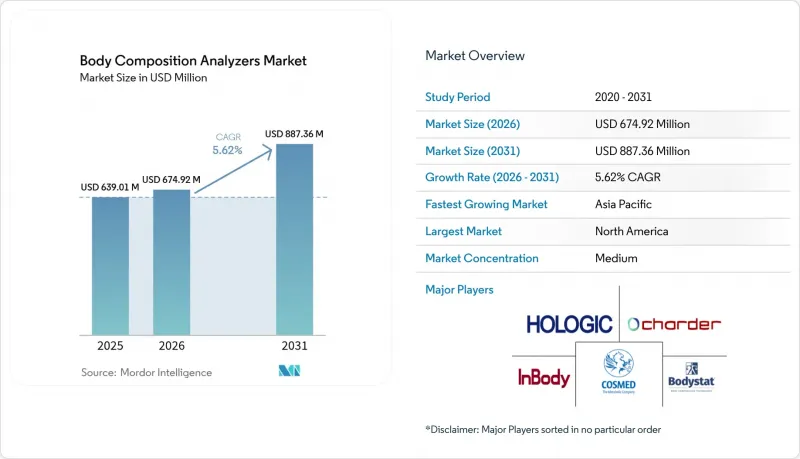
Mordor Intelligence에 따르면 2026년 체성분 분석기 시장 규모는 6억 7,492만 달러로 추정되고 있으며, 2025년 6억 3,901만 달러에서 확대하며, 2031년에는 8억 8,736만 달러에 달할 것으로 예측됩니다.
2026-2031년까지 연평균 성장률(CAGR) 5.62%로 성장할 것으로 전망됩니다.
이 보고서는 제품별(생체전기임피던스법(BIA), 피지 두께 측정기, 수중 체중 측정 장치 등), 측정 기술별(단일 주파수 BIA, 다중 주파수 BIA 등),최종사용자별(병원·클리닉 등), 지역별(북미, 유럽, 아시아태평양, 중동 및 아프리카, 남미)로 분류되어 있습니다. 시장 전망은 금액(달러) 기준으로 제시되어 있습니다.
전 세계 체성분 분석기 시장의 동향 및 인사이트
비만 및 대사이상 환자의 엄청난 수
비만은 유례없는 속도로 증가하고 있으며, 비만을 앓고 있는 성인 수는 2030년까지 11억 3,000만 명으로 2배 이상 증가할 것으로 예측됩니다. 임피던스 기반 분석을 통해 BMI만으로는 간과되기 쉬운 ‘고지방·저근육’ 프로필에 숨겨진 근감소성 비만을 밝혀낼 수 있으므로 임상 지침에서는 BMI보다 체성분 지표가 점점 더 중요시되고 있습니다. 세계 추정치에 따르면 2024년 시점에 이미 5억 600만 명이 대사성 질환을 앓고 있는 것으로 나타났습니다. 따라서 의료 시스템에서는 내장 지방 측정을 목적으로 하는 임피던스 검사를 진단 프로토콜에 포함하도록 개정 작업이 진행되고 있으며, 분석 장치는 단순한 선택적 장비에서 예방 의료의 핵심을 이루는 기기로 변모하고 있습니다. 이러한 변화는 조기 위험 계층화를 장려하는 보험사 측의 인센티브와도 부합합니다. 보험사는 대사 기능의 악화를 조기에 발견함으로써 장기적인 지출 감소를 기대할 수 있다고 인식하고 있기 때문입니다. 그 결과, 병원에서는 분석 장치를 연간 건강검진이나 비만 외과수술의 진료 과정에 통합하고 있으며, 장기적인 수요가 확고해지고 있습니다.
다주파수 BIA의 기술적 진보
다주파수 BIA는 세포내 수분과 세포 외 수분을 개별적으로 측정하며, 현재 임상 연구에서 DEXA와의 상관계수를 0.973 이상으로 높이고 있습니다. 8극 배치 및 위상각 분석의 발전으로 세포막의 건전성을 파악할 수 있게 되었으며, 이는 종양학, 신장학, 중환자 치료 분야의 영양 관리에 유용합니다. 각 제조사는 인종별로 최적의 계산식을 자동으로 선택하는 인공지능(AI) 루틴을 탑재하여, 다양한 집단에서 정확도를 높이는 데 있으며, 큰 장벽을 제거하고 있습니다. 웨어러블 임피던스 패치는 현재 수분량 및 근육 글리코겐의 추정치를 모바일 대시보드로 전송하여 지속적인 모니터링을 가능하게 하고 있습니다. 이러한 개선을 통해 검사자 간의 편차가 감소되었으며, 사용 사례는 체중 관리에 그치지 않고 포괄적인 대사 프로파일링으로 확대되고 있습니다.
높은 장비 및 유지보수 비용
엔트리 레벨 다중 주파수 장비는 6,755달러 정도부터 시작되며, 연구용 등급 시스템의 경우 5만 달러에 달합니다. 연 1회 교정, 전극 교체, 소프트웨어 라이선스 갱신으로 인해 수명 주기 비용이 증가하여, 소규모 클리닉이나 개인 운영 체육관에게는 도입 장벽이 되고 있습니다. 신흥 시장의 사업자들에게는 자금 조달 비용이 높고 서비스 지역 커버리지도 불안정하므로 가동 중단 위험이 높아지고 있습니다. 리스 프로그램을 통해 그 부담은 경감되지만, 인구 밀도가 낮은 지역에서는 달성하기 어려운 이용량 보장이 여전히 요구됩니다. 규모의 경제로 인해 가격이 하락하기 전까지는 비용에 민감한 지역에서 초기 비용이 체성분 분석기의 시장 침투율을 억제하게 될 것입니다.
부문 분석
생체 임피던스 분석 장치는 광범위한 임상 검증과 비교적 적정한 설비 투자를 바탕으로 2025년 체성분 분석기 시장에서 43.85%의 점유율을 차지했습니다. 반면, 3D 광학식 바디 스캐너는 컴퓨터 비전 알고리즘의 성숙과 하드웨어 비용의 하락에 따라 2031년까지 7.22%라는 가장 높은 CAGR을 기록할 것으로 예상됩니다. 이중 에너지 X선 흡수 측정법(DXA)은 조사 및 골다공증 선별 검사에서 여전히 중요한 위치를 차지하고 있지만, 높은 구입 가격과 방사선 피폭에 관한 프로토콜로 인해 보급에는 한계가 있습니다. 피하 지방 캘리퍼는 정확도보다 예산과 조작의 간편성이 중시되는 교육 현장에서 계속해서 활용되고 있습니다. 공기 치환 플레티스모그래피와 정수압법은 골드 스탠다드 수준의 정확도를 요구하는 연구 기관에서 사용되고 있는 반면, 스마트 연결형 체중계는 비용을 중시하는 일반 가정 사용자에게 지지를 받고 있습니다. 전극 재료, 임피던스 신호의 필터링, 위상각 분석에 대한 지속적인 연구개발을 통해 광학 기술의 진보가 진행되는 가운데서도 생체 임피던스 측정 장치는 경쟁력을 유지하고 있습니다.
임피던스의 핵심 기술과 광학 카메라를 융합한 하이브리드 시스템이 등장하여, 체내 구성 지표와 체형의 시각적 정보를 모두 제공함으로써 제품 시장은 더욱 다양해지고 있습니다. 이러한 융합을 통해 제조사들은 피트니스 앱과의 제휴나 소셜미디어에서의 공유 동향을 활용할 수 있는 입장에 서게 되었습니다. 지적재산권 출원 현황을 보면, 동적 전극 선택 및 소형화된 전류 주입 회로에 대한 관심이 엿보이며, 향후 의료기관을 방문하지 않고도 DEXA와 동등한 분석 결과를 제공하는 웨어러블 기기의 등장이 시사되고 있습니다. 따라서 현재는 기존 기업이 판매량의 주류를 이루고 있지만, 인공지능이나 대체 센싱 기법을 활용하는 혁신적인 기업이야말로 장기적인 수요를 주도해 나갈 것입니다.
지역별 분석
북미는 2025년에 전 세계 매출의 33.60%를 차지하며, 자금력이 풍부한 의료제도, 명확한 CPT 환급 코드, 그리고 성숙한 원격의료 인프라가 이를 지원하고 있습니다. 이 지역의 시장 확대는 현재 첫 임상 구매보다는 교체 수요, 소프트웨어 구독의 추가 서비스, 일반 가정에서의 보급 확대에 힘입고 있습니다. 캐나다는 미국의 동향을 반영하고 있지만, 전문의 부족을 보완하기 위해 지방 진료소에 휴대용 분석 장비를 배치하는 주 차원의 원격 영양 관리 시범 사업이 추가되었습니다.
아시아태평양은 고령화, 비만 증가, 정부 주도의 예방 의료 캠페인에 힘입어 2031년까지 연평균 성장률(CAGR) 9.35%라는 견실한 성장세를 기록하고 있습니다. 일본에서는 사르코페니아(근감소증) 선별 검사 지침이 병원의 기기 도입을 촉진하고 있으며, 중국에서는 피트니스 클럽 붐에 따라 회원의 참여도를 높이기 위해 커넥티드 체중계가 도입되고 있습니다. 한국과 중국의 현지 제조 클러스터가 기기 비용을 절감하여 가격에 민감한 부문를 지원하고 있습니다. 인도와 동남아시아 전역에서 원격의료가 확대됨에 따라 농촌 지역에서도 도입이 가능해졌으나, 기기 자금 조달 및 의사 교육에 대한 격차가 단기적인 판매량 증가를 억제하고 있습니다.
유럽은 안정적인 추세를 유지하고 있으며, 의료기기의 품질을 보장하는 엄격한 EU MDR(의료기기 규정) 준수 및 위험 회피 성향이 강한 의료 제공자에게 매력적인 GDPR(일반 데이터 보호 규정)에 부합하는 데이터 거버넌스의 혜택을 받고 있습니다. 공중보건 기관이 영양실조 및 근감소증 선별 검사를 추진하고 있으며, 임상에서의 활용이 확대되고 있습니다. 북유럽 국가들에서는 거의 전국적인 전자건강기록(EHR) 통합이 진행되고 있으며, 원활한 데이터 흐름의 벤치마크를 확립하고 있습니다. 남유럽 및 동유럽 국가들은 빠듯한 예산과 디지털 헬스 현대화를 위한 EU의 자금 지원 사이에서 균형을 맞추며 점진적으로 진전을 보이고 있습니다.
기타 혜택:
- 엑셀 형식의 시장 예측(ME) 시트
- 3개월간의 애널리스트 지원
자주 묻는 질문
목차
제1장 서론
제2장 조사 방법
제3장 개요
제4장 시장 구도
제5장 시장 규모와 성장 예측
제6장 경쟁 구도
제7장 시장 기회와 향후 전망
KSA 26.09.04According to Mordor Intelligence, body composition analyzers market size in 2026 is estimated at USD 674.92 million, growing from 2025 value of USD 639.01 million with 2031 projections showing USD 887.36 million, growing at 5.62% CAGR over 2026-2031.
This report is Segmented by Product (Bio-Impedance Analyzers, Skinfold Calipers, Hydrostatic Weighing Equipment, and More), Measurement Technology (Single-Frequency BIA, Multi-Frequency BIA, and More), End User (Hospitals & Clinics, and More), and Geography (North America, Europe, Asia-Pacific, Middle East & Africa, South America). The Market Forecasts are Provided in Terms of Value (USD).
Global Body Composition Analyzers Market Trends and Insights
Large Pool of Obese & Metabolic-Disorder Patients
Obesity is rising at an unprecedented pace, with adults living with obesity projected to more than double to 1.13 billion by 2030. Clinical guidelines increasingly prefer body composition metrics over BMI because impedance-based analysis can uncover sarcopenic obesity hidden high-fat low-muscle profiles that BMI alone misses. Global estimates show 506 million people already living with metabolic disorders in 2024. Health systems are therefore upgrading diagnostic protocols to include impedance testing for visceral adiposity, transforming analyzers from optional equipment into core preventative-care devices. The shift aligns with payer incentives that reward early risk stratification; insurers see reduced long-term outlays when metabolic deterioration is caught early. Hospitals consequently incorporate analyzers into annual wellness checks and bariatric-surgery pathways, cementing demand over the long term.
Technological Advancements in Multi-Frequency BIA
Multi-frequency BIA measures intracellular and extracellular water separately, pushing correlation with DEXA beyond 0.973 in current clinical studies. Advancements in eight-electrode placement and phase-angle analytics provide a window on cellular membrane integrity-useful for oncology, nephrology, and critical-care nutrition. Manufacturers embed artificial-intelligence routines that auto-select ethnic-specific equations, removing a key accuracy barrier in diverse populations. Wearable impedance patches now relay hydration and muscle-glycogen estimates to mobile dashboards, enabling continuous monitoring. Together these upgrades reduce inter-operator variability and extend use cases beyond weight management to comprehensive metabolic profiling.
High Equipment & Maintenance Costs
Entry-level multi-frequency units start around USD 6,755 and climb to USD 50,000 for research-grade systems. Annual calibration, electrode replacement, and software-license renewals inflate lifetime cost, deterring small clinics and independently owned gyms. Emerging-market providers face higher financing costs and spotty service coverage, raising downtime risk. Leasing programs soften the blow but still require volume guarantees difficult to meet in sparsely populated regions. Until economies of scale drive pricing down, upfront expense will cap the body composition analyzers market penetration rate in cost-sensitive geographies.
Other drivers and restraints analyzed in the detailed report include:
- Rising Consumer Awareness for Health & Fitness
- Expansion of Preventive-Care Reimbursements
- Measurement Inconsistency Across Device Types
For complete list of drivers and restraints, kindly check the Table Of Contents.
Segment Analysis
Bio-impedance Analyzers held a 43.85% body composition analyzers market share in 2025 due to extensive clinical validation and relatively modest capital requirements. 3-D Optical Body Scanners, however, post the fastest 7.22% CAGR to 2031 as computer-vision algorithms mature and hardware costs fall. Dual-energy X-ray Absorptiometry retains relevance for research and osteoporosis screening but remains limited by high purchase price and radiation protocols. Skinfold Calipers continue in educational settings where budget and technical simplicity outweigh precision. Air-Displacement Plethysmography and Hydrostatic Weighing serve research institutions seeking gold-standard accuracy, whereas smart connected scales attract cost-conscious home users. Continuous R&D in electrode materials, impedance signal filtration, and phase-angle analytics ensure that bio-impedance devices stay competitive amid optical advances.
The product landscape diversifies further as hybrid systems fuse impedance cores with optical cameras, delivering both internal composition metrics and external body-shape visuals. Such convergence positions manufacturers to tap fitness-app partnerships and leverage social-media-sharing trends. Intellectual-property filings reveal interest in dynamic electrode selection and miniaturized current-injection circuits, pointing to future wearables that deliver DEXA-like insight without clinic visits. Hence, while incumbents anchor volume today, innovators leveraging artificial intelligence and alternative sensing modalities will shape longer-term demand.
Complete Report Scope:
- By Product
- Bio-impedance Analyzers
- Skinfold Calipers
- Hydrostatic Weighing Equipment
- Air-Displacement Plethysmography
- Dual-energy X-ray Absorptiometry (DEXA)
- 3-D Optical Body Scanners
- Smart Connected Scales
- Other Products
- By Measurement Technology
- Single-frequency BIA
- Multi-frequency BIA
- Segmental BIA
- Portable/Hand-held Systems
- Benchtop/Standalone Systems
- By End User
- Hospitals & Clinics
- Sports Medicine Centers
- Home Care Settings
- Academic & Research Institutes
- By Geography
- North America
- United States
- Canada
- Mexico
- Europe
- Germany
- United Kingdom
- France
- Italy
- Spain
- Rest of Europe
- Asia-Pacific
- China
- Japan
- India
- Australia
- South Korea
- Rest of Asia-Pacific
- Middle East & Africa
- GCC
- South Africa
- Rest of Middle East & Africa
- South America
- Brazil
- Argentina
- Rest of South America
- North America
Geography Analysis
North America held 33.60% of global revenue in 2025, anchored by well-funded healthcare systems, explicit CPT reimbursement codes, and mature telehealth infrastructure. Market expansion there now leans on replacement demand, software-subscription add-ons, and broader household uptake rather than first-time clinical purchases. Canada mirrors U.S. trends but adds provincial tele-nutrition pilots that outfit rural clinics with portable analyzers to offset specialist shortages.
Asia Pacific records a robust 9.35% CAGR through 2031, underpinned by aging populations, obesity escalation, and government-backed preventive-health campaigns. Japan's sarcopenia-screening guidelines spur hospital procurement, while China's fitness-club boom embraces connected scales for member engagement. Local manufacturing clusters in South Korea and China cut device cost, aiding price-sensitive segments. Telemedicine expansions across India and Southeast Asia unlock rural deployments, though device financing and physician-training gaps temper near-term volumes.
Europe remains steady, benefiting from stringent EU MDR compliance that assures device quality and GDPR-aligned data governance attractive to risk-averse providers. Public-health agencies promote malnutrition and sarcopenia screening, expanding clinical use. Nordic countries showcase near-universal electronic-health-record integration, setting benchmarks for seamless data flow. Southern and Eastern European nations advance gradually, balancing tight budgets with EU funding earmarked for digital health modernization.
- Inbody
- OMRON
- Hologic
- Tanita
- Seca GmbH & Co. KG
- COSMED Srl
- Bodystat
- Charder Electronic
- Withings SA
- Google (Fitbit Inc.)
- Koninklijke Philips
- EatSmart
- Evolt 360
- Styku Inc.
- Renpho Health
- BVI Medical Ltd (Body Volume Indicator)
- Maltron International
- Biospace Co. Ltd (InBody's brand)
- AKERN Srl
- Xiaomi (Mi Body Composition)
Additional Benefits:
- The market estimate (ME) sheet in Excel format
- 3 months of analyst support
TABLE OF CONTENTS
1 Introduction
- 1.1 Study Assumptions & Market Definition
- 1.2 Scope of the Study
2 Research Methodology
3 Executive Summary
4 Market Landscape
- 4.1 Market Overview
- 4.2 Market Drivers
- 4.2.1 Large Pool of Obese & Metabolic-Disorder Patients
- 4.2.2 Technological Advancements in Multi-Frequency Bia
- 4.2.3 Rising Consumer Awareness for Health & Fitness
- 4.2.4 Expansion of Preventive-Care Reimbursements
- 4.2.5 Integration with Tele-Nutrition & Telehealth Platforms
- 4.2.6 Adoption in Professional Sports Performance Analytics
- 4.3 Market Restraints
- 4.3.1 High Equipment & Maintenance Costs
- 4.3.2 Measurement Inconsistency Across Device Types
- 4.3.3 Data-Privacy & Cybersecurity Compliance Hurdles
- 4.3.4 Emerging Optical/AI Body-Scan Substitutes
- 4.4 Regulatory Landscape
- 4.5 Technological Outlook
- 4.6 Porter's Five Forces Analysis
- 4.6.1 Threat of New Entrants
- 4.6.2 Bargaining Power of Buyers
- 4.6.3 Bargaining Power of Suppliers
- 4.6.4 Threat of Substitute Products
- 4.6.5 Intensity of Competitive Rivalry
5 Market Size & Growth Forecasts (Value in USD)
- 5.1 By Product
- 5.1.1 Bio-impedance Analyzers
- 5.1.2 Skinfold Calipers
- 5.1.3 Hydrostatic Weighing Equipment
- 5.1.4 Air-Displacement Plethysmography
- 5.1.5 Dual-energy X-ray Absorptiometry (DEXA)
- 5.1.6 3-D Optical Body Scanners
- 5.1.7 Smart Connected Scales
- 5.1.8 Other Products
- 5.2 By Measurement Technology
- 5.2.1 Single-frequency BIA
- 5.2.2 Multi-frequency BIA
- 5.2.3 Segmental BIA
- 5.2.4 Portable/Hand-held Systems
- 5.2.5 Benchtop/Standalone Systems
- 5.3 By End User
- 5.3.1 Hospitals & Clinics
- 5.3.2 Sports Medicine Centers
- 5.3.3 Home Care Settings
- 5.3.4 Academic & Research Institutes
- 5.4 By Geography
- 5.4.1 North America
- 5.4.1.1 United States
- 5.4.1.2 Canada
- 5.4.1.3 Mexico
- 5.4.2 Europe
- 5.4.2.1 Germany
- 5.4.2.2 United Kingdom
- 5.4.2.3 France
- 5.4.2.4 Italy
- 5.4.2.5 Spain
- 5.4.2.6 Rest of Europe
- 5.4.3 Asia-Pacific
- 5.4.3.1 China
- 5.4.3.2 Japan
- 5.4.3.3 India
- 5.4.3.4 Australia
- 5.4.3.5 South Korea
- 5.4.3.6 Rest of Asia-Pacific
- 5.4.4 Middle East & Africa
- 5.4.4.1 GCC
- 5.4.4.2 South Africa
- 5.4.4.3 Rest of Middle East & Africa
- 5.4.5 South America
- 5.4.5.1 Brazil
- 5.4.5.2 Argentina
- 5.4.5.3 Rest of South America
- 5.4.1 North America
6 Competitive Landscape
- 6.1 Market Concentration
- 6.2 Market Share Analysis
- 6.3 Company Profiles (includes Global level Overview, Market level overview, Core Segments, Financials as available, Strategic Information, Market Rank/Share for key companies, Products & Services, and Recent Developments)
- 6.3.1 InBody Co. Ltd
- 6.3.2 Omron Healthcare Inc.
- 6.3.3 Hologic Inc.
- 6.3.4 Tanita Corporation
- 6.3.5 Seca GmbH & Co. KG
- 6.3.6 COSMED Srl
- 6.3.7 Bodystat Ltd
- 6.3.8 Charder Electronic Co. Ltd
- 6.3.9 Withings SA
- 6.3.10 Google (Fitbit Inc.)
- 6.3.11 Koninklijke Philips N.V.
- 6.3.12 EatSmart Inc.
- 6.3.13 Evolt 360
- 6.3.14 Styku Inc.
- 6.3.15 Renpho Health
- 6.3.16 BVI Medical Ltd (Body Volume Indicator)
- 6.3.17 Maltron International Ltd
- 6.3.18 Biospace Co. Ltd (InBody's brand)
- 6.3.19 AKERN Srl
- 6.3.20 Xiaomi (Mi Body Composition)
7 Market Opportunities & Future Outlook
- 7.1 White-space & Unmet-Need Assessment


