

|
시장보고서
상품코드
2131872
패혈증 진단 시장 예측(-2031년) : 제품별, 기술별, 방법별, 병원체 유형별, 검사 유형별, 시료 유형별, 플렉스별, 임상 활용/관리 경로별, 최종사용자별, 지역별Sepsis Diagnostics Market by Technology, Product, Sample, Test Type, Pathogen, End User - Global Forecast to 2031 |
||||||

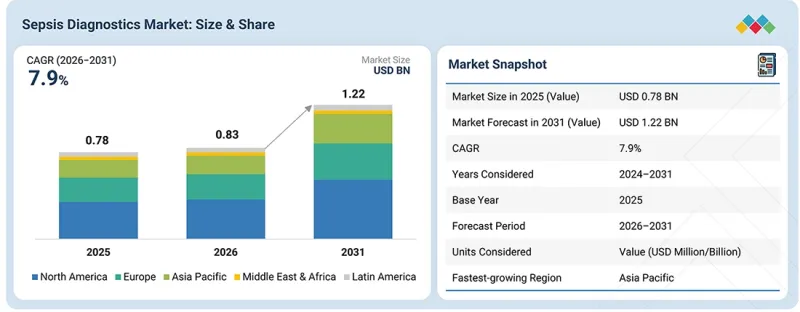
패혈증 진단 시장 규모는 2026년 8억 3,000만 달러에서 CAGR 7.9%로 확대하며, 2031년에는 12억 2,000만 달러에 달할 것으로 예측됩니다.
전 세계 패혈증 진단 시장은 패혈증 및 혈류 감염의 부담 증가, 중환자실(ICU) 입원 건수 증가, 병원체 신속 식별에 대한 수요 증가, 그리고 분자 진단, 자동화 미생물학 플랫폼, 면역 분석법, 바이오마커 기반 검사의 도입 확대를 배경으로 예측 기간 중 꾸준히 성장할 것으로 전망됩니다.
| 조사 범위 | |
|---|---|
| 조사 대상 기간 | 2026-2031년 |
| 기준연도 | 2025년 |
| 예측 기간 | 2026-2031년 |
| 산정 단위 | 금액(10억 달러) |
| 부문 | 제품별, 기술별, 방법별, 병원체 유형별, 검사 유형별, 시료 유형별, 플렉스별, 임상 활용/관리 경로별, 최종사용자별, 지역별 |
| 대상 지역 | 북미, 유럽, 아시아태평양, 라틴아메리카, 중동 및 아프리카 |
시장의 성장은 항생제 적정 사용 프로그램에 대한 관심 증가, 진단 결과 보고까지 소요되는 시간 단축의 필요성, 그리고 병원 및 검사 기관에서의 자동화된 진단 워크플로우 도입에 힘입어 더욱 가속화되고 있습니다. 그러나 첨단 분자 진단 플랫폼의 높은 비용, 새로운 진단 기술에 대한 보험 환급 제한, 패혈증의 복잡한 임상 증상, 워크플로우 통합의 과제, 숙련된 검사 기술자 인력 부족 등이 시장 성장을 어느 정도 억제할 것으로 예상됩니다.
"2025년 시점에 제품별로는 패혈증 진단 시장에서 분석법 및 시약 키트가 가장 큰 점유율을 차지했습니다."
제품별로 보면 패혈증 진단 시장은 혈액 배양 배지, 분석법 및 시약 키트, 장비, 소프트웨어로 분류됩니다. 2025년에는 혈액 배양 검사, 면역 분석법, 분자 진단, 항균제 감수성 검사 및 바이오마커 기반 패혈증 평가에서 반복적으로 사용된 것이 주요 요인이 되어, 분석법 및 시약 키트가 가장 큰 시장 점유율을 차지했습니다. 병원체 검출 키트,PCR 기반 시약, 증후군 검사 패널, 염증성 바이오마커 분석법 및 패혈증 관련 소모품에 대한 수요 증가가 이 부문의 우위를 지속적으로 지원하고 있습니다. 또한 병원 및 검사 기관에서의 자동화 및 분자 검사 플랫폼 도입 확대가 분석법 및 시약 키트에 대한 수요를 더욱 강화하고 있습니다.
"2025년 시점에 기술별로는 패혈증 진단 시장에서 혈액 배양/미생물학적 검사가 가장 큰 점유율을 차지했습니다."
기술별로 보면 전 세계 패혈증 진단 시장은 혈액 배양·미생물학적 검사, 면역 분석법, 분자 진단, 유세포분석, 질량분석, 그리고 임상화학·혈액 가스 분석으로 분류됩니다. 2025년에는 혈액 배양·미생물학적 검사가 가장 큰 점유율을 차지할 것으로 예상되며, 이는 혈류 감염의 검출 및 항균제 감수성 검사 지원에 있으며, 표준 진단 기법으로서 확립된 역할을 반영한 것입니다. 이러한 기술들은 병원체 검출, 미생물 동정 및 치료 지침 수립을 위해 병원 미생물학 검사실에서 널리 활용되고 있습니다. 그러나 병원체 및 내성 마커의 신속한 검출을 목적으로 하는 PCR/RT-PCR, 멀티플렉스 PCR 패널, 마이크로어레이, FISH/PNA-FISH, DNA 시퀀싱,NGS, LAMP 및 TMA 기반 기법의 도입 확대에 힘입어, 예측 기간 중 분자 진단 분야의 성장률이 가장 높을 것으로 예상됩니다.
"2026-2031년에 패혈증 진단 시장에서 아시아태평양이 가장 높은 연평균 성장률(CAGR)을 기록할 것으로 예측됩니다."
패혈증 진단 시장은 북미, 유럽, 아시아태평양, 라틴아메리카, 중동 및 아프리카로 구분됩니다. 예측 기간 중 아시아태평양은 감염증 및 혈류 감염의 부담 증가, 병원 및 중환자실(ICU) 인프라 확충, 의료비 증가, 그리고 자동화된 미생물학 및 분자 진단 플랫폼의 도입 확대에 힘입어 가장 높은 연평균 성장률(CAGR)을 보일 것으로 예상됩니다. 또한 검사실 처리 능력 향상, 패혈증 관리에 대한 의식의 향상, 신속 진단에 대한 수요 증가, 그리고 중국, 일본, 인도, 한국, 호주, 동남아시아의 방대한 환자 수가 시장 성장을 지원하고 있습니다.
이 보고서에 소개된 기업 개요 리스트
- Biomerieux
- Becton Dickinson and Company
- Danaher Corporation
- Diasorin S.P.A(Luminex)
- F. Hoffmann-La Roche AG
- Thermo Fisher Scientific, Inc
- Bruker Corporation
- Abbott Laboratories
- Sysmex Corporation
- Siemens Healthineers
- Qiagen
- Quidelortho Corporation
- Shenzhen Mindray Bio-Medical Electronics
조사 범위
본 조사 보고서에서는 패혈증 진단 시장을 제품, 기술, 방법, 병원체 유형, 검사 유형, 검체 유형, 복잡도, 임상적 유용성/관리 경로, 최종사용자 및 지역별로 분류하고 있습니다. 이 보고서의 조사 범위에는 시장에 영향을 미치는 주요 요인(촉진요인, 제약 요인, 기회, 과제 등)에 대한 상세한 정보가 포함되어 있습니다. 또한 주요 업계 기업에 대한 상세한 분석을 포함하고 있으며, 각 기업의 사업 개요, 제품 포트폴리오, 신제품 출시, 규제 당국의 승인, 제휴, 파트너십, 인수, 사업 확장 등 주요 전략 및 패혈증 진단 시장과 관련된 최근 동향에 대한 인사이트를 제공합니다. 이 보고서에서는 패혈증 진단 생태계내 주요 기업 및 신생 기업의 경쟁 분석에 대해서도 다루고 있습니다.
이 보고서를 구매할 때의 주요 이점
이 보고서는 패혈증 진단 시장 전체 및 그 하위 부문의 매출에 대해 가장 정확한 추정치를 제공함으로써, 시장을 선도하는 기업과 신규 진입 기업을 지원합니다. 또한 이해관계자가 경쟁 구도를 더 깊이 이해하고, 자사의 비즈니스를 효과적으로 포지셔닝하며, 적절한 시장 진입 전략을 수립하기 위한 인사이트를 얻는 데에도 도움이 됩니다. 이 보고서를 통해 이해관계자는 시장 동향을 파악하고, 주요 시장 촉진요인, 억제요인, 기회 및 과제에 대한 정보를 얻을 수 있습니다.
이 보고서는 다음 사항에 대한 인사이트를 제공합니다. :
- 주요 촉진요인 분석: 패혈증 및 혈류 감염의 높은 발생률, 신속한 분자 진단 및 증후군 진단의 채택 확대, 항생제 적정 사용에 대한 관심 증가, 바이오마커 기반 검사의 확대 등. 주요 제약 요인 분석: 첨단 분자 진단 플랫폼의 높은 비용, 신규 진단 기술에 대한 보험 급여 제한 등. 기회: AI를 활용한 패혈증 진단, 임상 의사결정 지원, 차세대 숙주 반응 바이오마커, 신속한 POC 검사, 분산형 검사 등; 과제: 임상적 복잡성, 패혈증의 다양한 임상 양상, 병원 워크플로우로의 통합, 훈련된 검사 기술자 부족 등
- 제품 개발/혁신: 자동 혈액 배양 시스템, 분자 진단 패널, 증후군 진단 플랫폼, 면역 분석법, 바이오마커 기반 검사, 질량분석법을 기반으로 한 미생물 동정 플랫폼, 항균제 감수성 검사 솔루션, AI를 활용한 임상 의사결정 지원 툴 등, 새롭게 출시된 및 신흥 패혈증 진단 제품에 대한 상세 인사이트
- 시장 개발: 수익성이 높은 시장에 대한 포괄적인 정보 - 이 보고서는 북미, 유럽, 아시아태평양, 라틴아메리카, 중동 및 아프리카의 패혈증 진단 시장을 분석하고, 주요 국가 차원의 비즈니스 기회 및 도입 동향에 대해 상세히 평가하고 있습니다
- 시장 다각화: 패혈증 진단 시장의 제품 포트폴리오, 기술 개발, 규제 당국의 승인, 제휴, 파트너십, 인수, 지역적 확장 및 투자에 관한 포괄적인 정보
경쟁 분석: bioMerieux SA, Becton, Dickinson and Company, Danaher Corporation, F. Hoffmann-La Roche AG, Thermo Fisher Scientific Inc., Abbott Laboratories, Siemens Healthineers AG, Bruker Corporation, DiaSorin S.p.A. 등 주요 기업의 시장 점유율,성장 전략, 기술력, 진단 플랫폼, 서비스 제공 및 경쟁 구도 등에 대해 상세히 평가하고 있습니다.
자주 묻는 질문
목차
제1장 서론
제2장 개요
제3장 주요 인사이트
제4장 시장 개요
제5장 업계 동향
제6장 기술 진보, AI에 의한 영향, 특허, 혁신, 향후 응용
제7장 규제 상황과 지속가능성 구상
제8장 고객 상황과 구매 행동
제9장 패혈증 진단 시장(제품별)
제10장 패혈증 진단 시장(기술별)
제11장 패혈증 진단 시장(방법별)
제12장 패혈증 진단 시장(병원체 유형별)
제13장 패혈증 진단 시장(검사 유형별)
제14장 패혈증 진단 시장(시료 유형별)
제15장 패혈증 진단 시장(플렉스별)
제16장 패혈증 진단 시장(임상 활용/관리 경로별)
제17장 패혈증 진단 시장(최종사용자별)
제18장 패혈증 진단 시장의 지역별 건수 분석(검사 건수 : 100만 건)
제19장 패혈증 진단 시장(지역별)
제20장 경쟁 구도
제21장 기업 개요
제22장 조사 방법
제23장 부록
KSAThe sepsis diagnostics market is projected to reach USD 1.22 billion by 2031, up from USD 0.83 billion in 2026, at a CAGR of 7.9%. The global sepsis diagnostics market is expected to grow steadily over the forecast period, driven by the rising burden of sepsis and bloodstream infections, increasing ICU admissions, growing demand for rapid pathogen identification, and rising adoption of molecular diagnostics, automated microbiology platforms, immunoassays, and biomarker-based testing.
| Scope of the Report | |
|---|---|
| Years Considered for the Study | 2026-2031 |
| Base Year | 2025 |
| Forecast Period | 2026-2031 |
| Units Considered | Value (USD billion) |
| Segments | Product, Technology, Method, Pathogen Type, Test Type, Sample Type, Plexity, Clinical Utility/Management Pathway, and End User |
| Regions covered | North America, Europe, the Asia Pacific, Latin America, the Middle East, and Africa |
Market growth is further supported by the increasing focus on antimicrobial stewardship programs, the need to reduce diagnostic turnaround time, and the adoption of automated diagnostic workflows in hospital and reference laboratories. However, the high cost of advanced molecular diagnostic platforms, limited reimbursement for novel diagnostic technologies, the clinical complexity of sepsis presentation, workflow integration challenges, and a shortage of trained laboratory personnel are expected to restrain market growth to some extent.
"Assays & reagent kits accounted for the largest share of the sepsis diagnostics market, by product, in 2025."
By product, the sepsis diagnostics market is segmented into blood culture media, assays & reagent kits, instruments, and software. In 2025, assays & reagent kits accounted for the largest market share, driven by their recurring use in blood culture testing, immunoassays, molecular diagnostics, antimicrobial susceptibility testing, and biomarker-based sepsis assessment. Rising demand for pathogen detection kits, PCR-based reagents, syndromic testing panels, inflammatory biomarker assays, and sepsis-related consumables continues to support this segment's dominance. Additionally, the growing adoption of automated and molecular testing platforms across hospitals and reference laboratories is further strengthening demand for assays and reagent kits.
"Blood culture/microbiology testing accounted for the largest share of the sepsis diagnostics market, by technology, in 2025."
By technology, the global sepsis diagnostics market is segmented into blood culture/microbiology testing, immunoassays, molecular diagnostics, flow cytometry, mass spectrometry, and clinical chemistry & blood gas analysis. In 2025, blood culture/microbiology testing accounted for the largest share, reflecting its established role as the standard diagnostic approach for detecting bloodstream infections and supporting antimicrobial susceptibility testing. These technologies are widely used in hospital microbiology laboratories for pathogen detection, organism identification, and therapy guidance. However, molecular diagnostics is expected to grow faster over the forecast period, supported by increasing adoption of PCR/RT-PCR, multiplex PCR panels, microarrays, FISH/PNA-FISH, DNA sequencing, NGS, LAMP, and TMA-based methods for rapid pathogen and resistance marker detection.
"The Asia Pacific region is projected to grow at the highest CAGR in the sepsis diagnostics market from 2026 to 2031."
The sepsis diagnostics market is segmented into North America, Europe, Asia Pacific, Latin America, and the Middle East & Africa. During the forecast period, the Asia Pacific region is projected to have the highest CAGR, driven by the rising burden of infectious diseases and bloodstream infections, expanding hospital and ICU infrastructure, rising healthcare expenditure, and growing adoption of automated microbiology and molecular diagnostic platforms. Growth is further supported by improving laboratory capacity, greater awareness of sepsis management, rising demand for rapid diagnostics, and large patient populations across China, Japan, India, South Korea, Australia, and Southeast Asia.
List of Companies Profiled in the Report
- Biomerieux
- Becton Dickinson and Company
- Danaher Corporation
- Diasorin S.P.A (Luminex)
- F. Hoffmann-La Roche AG
- Thermo Fisher Scientific, Inc
- Bruker Corporation
- Abbott Laboratories
- Sysmex Corporation
- Siemens Healthineers
- Qiagen
- Quidelortho Corporation
- Shenzhen Mindray Bio-Medical Electronics Co., Ltd.
Research Coverage
This research report categorizes the sepsis diagnostics market by product, technology, method, pathogen type, test type, sample type, complexity, clinical utility/management pathway, end user, and region. The scope of the report covers detailed information on the major factors influencing the market, including drivers, restraints, opportunities, and challenges. It includes a detailed analysis of key industry players, providing insights into their business overview, product portfolio, key strategies such as product launches, regulatory approvals, collaborations, partnerships, acquisitions, and expansions, as well as recent developments associated with the sepsis diagnostics market. This report also covers a competitive analysis of leading players and emerging companies in the sepsis diagnostics ecosystem.
Key Benefits of Buying the Report
The report will help market leaders and new entrants by providing the closest approximations of revenue for the overall sepsis diagnostics market and its subsegments. It will also help stakeholders better understand the competitive landscape and gain insights to position their businesses effectively and develop suitable go-to-market strategies. The report will enable stakeholders to understand the market pulse and provide information on key market drivers, restraints, opportunities, and challenges.
The report provides insights into the following points:
- Analysis of key drivers, including the high incidence of sepsis and bloodstream infections, growing adoption of rapid molecular and syndromic diagnostics, increasing focus on antimicrobial stewardship, and expansion of biomarker-based testing; restraints, including the high cost of advanced molecular diagnostic platforms and limited reimbursement for novel diagnostic technologies; opportunities, including AI-enabled sepsis diagnosis, clinical decision support, next-generation host-response biomarkers, rapid POC testing, and decentralized testing; and challenges, including clinical complexity, heterogeneous sepsis presentation, integration into hospital workflows, and a shortage of trained laboratory personnel
- Product Development/Innovation: Detailed insights into newly launched and emerging sepsis diagnostics products, including automated blood culture systems, molecular diagnostic panels, syndromic testing platforms, immunoassays, biomarker-based tests, mass spectrometry-based microbial identification platforms, antimicrobial susceptibility testing solutions, and AI-enabled clinical decision support tools
- Market Development: Comprehensive information about lucrative markets - the report analyzes the sepsis diagnostics market across North America, Europe, Asia Pacific, Latin America, and the Middle East & Africa, with detailed assessment of major country-level opportunities and adoption trends
- Market Diversification: Comprehensive information on product portfolios, technological developments, regulatory approvals, collaborations, partnerships, acquisitions, geographic expansions, and investments in the sepsis diagnostics market
Competitive Assessment: In-depth assessment of market shares, growth strategies, technological capabilities, diagnostic platforms, service offerings, and competitive positioning of leading players, including bioMerieux SA, Becton, Dickinson and Company, Danaher Corporation, F. Hoffmann-La Roche AG, Thermo Fisher Scientific Inc., Abbott Laboratories, Siemens Healthineers AG, Bruker Corporation, and DiaSorin S.p.A., among others
TABLE OF CONTENTS
1 INTRODUCTION
- 1.1 STUDY OBJECTIVES
- 1.2 MARKET DEFINITION
- 1.3 STUDY SCOPE
- 1.3.1 MARKETS COVERED & REGIONAL SCOPE
- 1.3.2 INCLUSIONS & EXCLUSIONS
- 1.3.3 YEARS CONSIDERED
- 1.3.4 CURRENCY CONSIDERED
- 1.4 STAKEHOLDERS
- 1.5 SUMMARY OF CHANGES
2 EXECUTIVE SUMMARY
- 2.1 KEY INSIGHTS & MARKET HIGHLIGHTS
- 2.2 KEY MARKET PARTICIPANTS: INSIGHTS & STRATEGIC DEVELOPMENTS
- 2.3 DISRUPTIVE TRENDS SHAPING MARKET GROWTH
- 2.4 HIGH-GROWTH SEGMENTS & EMERGING FRONTIERS
- 2.5 SNAPSHOT: GLOBAL MARKET SIZE, GROWTH RATE, AND FORECAST
3 PREMIUM INSIGHTS
- 3.1 SEPSIS DIAGNOSTICS MARKET OVERVIEW
- 3.2 SEPSIS DIAGNOSTICS MARKET, BY PRODUCT, 2026 VS. 2031
- 3.3 SEPSIS DIAGNOSTICS MARKET, BY TECHNOLOGY, 2026 VS. 2031
- 3.4 SEPSIS DIAGNOSTICS MARKET, BY METHOD, 2026 VS. 2031
- 3.5 SEPSIS DIAGNOSTICS MARKET, BY PATHOGEN TYPE, 2026 VS. 2031
- 3.6 SEPSIS DIAGNOSTICS MARKET, BY TEST TYPE, 2026 VS. 2031
- 3.7 SEPSIS DIAGNOSTICS MARKET, SAMPLE TYPE, 2026 VS. 2031
- 3.8 SEPSIS DIAGNOSTICS MARKET, BY PLEXITY, 2026 VS. 2031
- 3.9 SEPSIS DIAGNOSTICS MARKET, CLINICAL UTILITY/MANAGEMENT PATHWAY, 2026 VS. 2031
- 3.10 SEPSIS DIAGNOSTICS MARKET, BY END USER, 2026 VS. 2031
- 3.11 SEPSIS DIAGNOSTICS MARKET: GEOGRAPHIC GROWTH OPPORTUNITIES
4 MARKET OVERVIEW
- 4.1 INTRODUCTION
- 4.2 MARKET DYNAMICS
- 4.2.1 DRIVERS
- 4.2.1.1 High incidence of sepsis and bloodstream infections
- 4.2.1.2 Growing adoption of rapid molecular and syndromic diagnostics
- 4.2.1.3 Increasing focus on antimicrobial stewardship and expansion of biomarker-based testing for early sepsis detection and risk assessment
- 4.2.2 RESTRAINTS
- 4.2.2.1 High cost of advanced molecular diagnostic platforms
- 4.2.2.2 Limited reimbursement for novel sepsis diagnostic technologies
- 4.2.3 OPPORTUNITIES
- 4.2.3.1 AI-enabled sepsis diagnosis and clinical decision support
- 4.2.3.2 Development of next-generation host-response biomarkers
- 4.2.3.3 Growth of rapid POC and decentralized testing
- 4.2.4 CHALLENGES
- 4.2.4.1 Clinical complexity and heterogeneous presentation of sepsis
- 4.2.1 DRIVERS
- 4.3 UNMET NEEDS & WHITE SPACES
- 4.3.1 UNMET NEEDS IN SEPSIS DIAGNOSTICS MARKET
- 4.3.2 WHITE SPACE OPPORTUNITIES
- 4.4 INTERCONNECTED MARKETS & CROSS-SECTOR OPPORTUNITIES
- 4.4.1 INTERCONNECTED MARKETS
- 4.4.2 CROSS-SECTOR OPPORTUNITIES
- 4.5 STRATEGIC MOVES BY TIER 1/2/3 PLAYERS
- 4.5.1 KEY MOVES & STRATEGIC FOCUS
5 INDUSTRY TRENDS
- 5.1 PORTER'S FIVE FORCES ANALYSIS
- 5.1.1 BARGAINING POWER OF SUPPLIERS
- 5.1.2 BARGAINING POWER OF BUYERS
- 5.1.3 THREAT OF NEW ENTRANTS
- 5.1.4 THREAT OF SUBSTITUTES
- 5.1.5 INTENSITY OF COMPETITIVE RIVALRY
- 5.2 MACROECONOMIC OUTLOOK
- 5.2.1 INTRODUCTION
- 5.2.2 GDP TRENDS & FORECAST
- 5.2.3 TRENDS IN GLOBAL SEPSIS DIAGNOSTICS INDUSTRY
- 5.3 SUPPLY CHAIN ANALYSIS
- 5.4 VALUE CHAIN ANALYSIS
- 5.5 ECOSYSTEM ANALYSIS
- 5.5.1 SEPSIS DIAGNOSTICS MARKET: ROLE OF COMPANIES IN ECOSYSTEM
- 5.6 PRICING ANALYSIS
- 5.6.1 AVERAGE SELLING PRICE TREND, BY KEY PLAYER, 2024-2026
- 5.6.2 AVERAGE SELLING PRICE TREND, BY REGION, 2024-2026
- 5.7 TRADE ANALYSIS
- 5.7.1 IMPORT SCENARIO (HS CODE 3822)
- 5.7.2 EXPORT SCENARIO (HS CODE 3822)
- 5.8 KEY CONFERENCES & EVENTS, 2026-2027
- 5.9 TRENDS/DISRUPTIONS IMPACTING CUSTOMERS' BUSINESSES
- 5.10 INVESTMENT & FUNDING SCENARIO
- 5.11 IMPACT OF US TARIFFS-SEPSIS DIAGNOSTICS MARKET
- 5.11.1 INTRODUCTION
- 5.11.2 KEY TARIFF RATES
- 5.11.3 PRICE IMPACT ANALYSIS
- 5.11.4 IMPACT ON REGIONS
- 5.11.4.1 North America
- 5.11.4.2 Europe
- 5.11.4.3 Asia Pacific
- 5.11.5 IMPACT ON END-USE INDUSTRIES
- 5.11.5.1 Hospital and specialty clinics
- 5.11.5.2 Pathology and reference laboratories
- 5.11.5.3 Research laboratories, academic institutes, and CROs
6 TECHNOLOGICAL ADVANCEMENTS, AI-DRIVEN IMPACT, PATENTS, INNOVATIONS, AND FUTURE APPLICATIONS
- 6.1 KEY EMERGING TECHNOLOGIES
- 6.1.1 HOST-RESPONSE DIAGNOSTICS (TRANSCRIPTOMICS & IMMUNE PROFILING)
- 6.1.2 AI-ENABLED AND PREDICTIVE SEPSIS DIAGNOSTICS
- 6.2 COMPLEMENTARY TECHNOLOGIES
- 6.2.1 RAPID ANTIMICROBIAL SUSCEPTIBILITY TESTING (RAPID AST)
- 6.2.2 NEXT-GENERATION SEQUENCING (NGS) AND METAGENOMIC SEQUENCING
- 6.3 ADJACENT TECHNOLOGIES
- 6.3.1 CONTINUOUS PATIENT MONITORING & CLINICAL DECISION SUPPORT SYSTEMS (CDSS)
- 6.4 TECHNOLOGY/PRODUCT ROADMAP
- 6.5 PATENT ANALYSIS
- 6.5.1 LIST OF MAJOR PATENTS
- 6.6 FUTURE APPLICATIONS
- 6.7 IMPACT OF AI/GENERATIVE AI ON SEPSIS DIAGNOSTICS MARKET
- 6.7.1 INTRODUCTION
- 6.7.2 TOP USE CASES & MARKET POTENTIAL
- 6.7.3 KEY COMPANIES IMPLEMENTING AI
- 6.7.4 FUTURE OF AI
7 REGULATORY LANDSCAPE AND SUSTAINABILITY INITIATIVES
- 7.1 REGIONAL REGULATIONS & COMPLIANCE
- 7.1.1 REGULATORY ANALYSIS
- 7.1.1.1 North America
- 7.1.1.1.1 US
- 7.1.1.1.2 Canada
- 7.1.1.2 Europe
- 7.1.1.2.1 Germany
- 7.1.1.2.2 UK
- 7.1.1.2.3 France
- 7.1.1.2.4 Italy
- 7.1.1.3 Asia Pacific
- 7.1.1.3.1 China
- 7.1.1.3.2 Japan
- 7.1.1.3.3 India
- 7.1.1.3.4 Australia
- 7.1.1.4 Latin America
- 7.1.1.4.1 Brazil
- 7.1.1.4.2 Mexico
- 7.1.1.5 Middle East
- 7.1.1.5.1 Africa
- 7.1.1.1 North America
- 7.1.2 REGULATORY BODIES, GOVERNMENT AGENCIES, AND OTHER ORGANIZATIONS
- 7.1.1 REGULATORY ANALYSIS
- 7.2 SUSTAINABILITY INITIATIVES
- 7.2.1 ENVIRONMENTAL IMPACT & ECO-FRIENDLY INITIATIVES
- 7.2.1.1 Eco-friendly initiatives
- 7.2.2 SUSTAINABILITY IMPACT & REGULATORY POLICY INITIATIVES
- 7.2.1 ENVIRONMENTAL IMPACT & ECO-FRIENDLY INITIATIVES
8 CUSTOMER LANDSCAPE & BUYER BEHAVIOR
- 8.1 DECISION-MAKING PROCESS
- 8.2 BUYER STAKEHOLDERS & BUYING EVALUATION CRITERIA
- 8.2.1 KEY STAKEHOLDERS IN BUYING PROCESS
- 8.2.2 BUYING CRITERIA
- 8.3 ADOPTION BARRIERS & INTERNAL CHALLENGES
- 8.4 UNMET NEEDS IN VARIOUS END-USE INDUSTRIES
- 8.5 MARKET PROFITABILITY
- 8.6 REVENUE POTENTIAL
- 8.6.1 COST DYNAMICS
9 SEPSIS DIAGNOSTICS MARKET, BY PRODUCT
- 9.1 INTRODUCTION
- 9.2 BLOOD CULTURE MEDIA
- 9.2.1 CONTINUED RELIANCE ON BLOOD CULTURE AS GOLD STANDARD FOR BLOODSTREAM INFECTION DIAGNOSIS SUSTAINS DEMAND
- 9.3 ASSAYS & REAGENT KITS
- 9.3.1 INCREASING ADOPTION OF RAPID MOLECULAR AND BIOMARKER-BASED TESTING DRIVES RECURRING DEMAND FOR ASSAYS AND REAGENT KITS
- 9.4 INSTRUMENTS
- 9.4.1 EXPANSION OF LAB AUTOMATION AND RAPID DIAGNOSTIC PLATFORMS ACCELERATES INVESTMENT IN ADVANCED INSTRUMENTS
- 9.5 SOFTWARE
- 9.5.1 IMPLEMENTATION OF LAB INFORMATICS AND ANTIMICROBIAL STEWARDSHIP SOLUTIONS SUPPORTS SOFTWARE ADOPTION
10 SEPSIS DIAGNOSTICS MARKET, BY TECHNOLOGY
- 10.1 INTRODUCTION
- 10.2 BLOOD CULTURE (MICROBIOLOGY TESTING)
- 10.2.1 AS REGULATORY AND CLINICAL GOLD STANDARD, BLOOD CULTURE HOLDS LARGEST MARKET SHARE
- 10.3 IMMUNOASSAYS
- 10.3.1 EXPANDING ADOPTION OF HOST-RESPONSE BIOMARKERS FOR EARLY SEPSIS ASSESSMENT AND ANTIMICROBIAL STEWARDSHIP DRIVES MARKET GROWTH
- 10.4 MOLECULAR DIAGNOSTICS
- 10.4.1 PCR
- 10.4.1.1 Widespread hospital adoption of syndromic multiplex panels for rapid pathogen and resistance gene identification to propel market growth
- 10.4.2 MICROARRAYS
- 10.4.2.1 Stable utilization in established blood culture identification workflows supports moderate growth
- 10.4.3 FISH/PNA-FISH
- 10.4.3.1 Retention of rapid Gram stain-adjunct testing in cost-constrained laboratories sustains low-growth utilization amid progressive substitution
- 10.4.4 DNA SEQUENCING & NGS
- 10.4.4.1 Growing clinical interest in culture-independent broad-spectrum pathogen detection drives adoption, constrained by cost and reimbursement barriers
- 10.4.5 OTHER MOLECULAR DIAGNOSTIC TECHNOLOGIES
- 10.4.1 PCR
- 10.5 FLOW CYTOMETRY
- 10.5.1 GROWING CLINICAL INTEREST IN CELLULAR HOST-RESPONSE BIOMARKERS FOR EARLY SEPSIS RISK ASSESSMENT SUPPORTS STEADY MARKET GROWTH
- 10.6 MASS SPECTROMETRY
- 10.6.1 RISING EMPHASIS ON RAPID DIAGNOSTICS, LAB AUTOMATION, AND ANTIMICROBIAL STEWARDSHIP PROPELS ADOPTION
- 10.7 CLINICAL CHEMISTRY & BLOOD GAS ANALYSIS
- 10.7.1 WIDE UTILIZATION OF INFLAMMATORY BIOMARKERS AND RISING ADOPTION OF POC DIAGNOSTICS PROPEL MARKET GROWTH
11 SEPSIS DIAGNOSTICS MARKET, BY METHOD
- 11.1 INTRODUCTION
- 11.2 CONVENTIONAL DIAGNOSTICS
- 11.2.1 RELIANCE ON MANUAL MICROBIOLOGICAL AND BIOCHEMICAL WORKFLOWS IN RESOURCE-CONSTRAINED AND LOW-THROUGHPUT SETTINGS SUSTAINS DEMAND
- 11.3 AUTOMATED DIAGNOSTICS
- 11.3.1 GROWING INSTALLATION OF AUTOMATED PLATFORMS TO EXPEDITE TIME-TO-RESULT AND ADDRESS STAFFING SHORTAGES DRIVES SEGMENT GROWTH
12 SEPSIS DIAGNOSTICS MARKET, BY PATHOGEN TYPE
- 12.1 INTRODUCTION
- 12.2 BACTERIAL SEPSIS
- 12.2.1 GRAM-NEGATIVE BACTERIAL SEPSIS
- 12.2.1.1 Rising prevalence of carbapenem-resistant and ESBL-producing organisms driving demand for resistance-marker testing
- 12.2.2 GRAM-POSITIVE BACTERIAL SEPSIS
- 12.2.2.1 Established diagnostic workflows for staphylococcal and enterococcal bloodstream infection sustain stable growth
- 12.2.1 GRAM-NEGATIVE BACTERIAL SEPSIS
- 12.3 FUNGAL SEPSIS
- 12.3.1 RISING INCIDENCE OF FUNGAL BLOODSTREAM INFECTIONS DRIVES DEMAND
- 12.4 OTHER PATHOGEN TYPES
13 SEPSIS DIAGNOSTICS MARKET, BY TEST TYPE
- 13.1 INTRODUCTION
- 13.2 LABORATORY TESTS
- 13.2.1 CENTRALIZATION OF BLOOD CULTURE, MOLECULAR, AND MASS SPECTROMETRY WORKFLOWS WITHIN ACCREDITED HOSPITAL LABORATORIES SUSTAINS THE DOMINANT SHARE
- 13.3 POC TESTS
- 13.3.1 EXPANDING NEAR-PATIENT LACTATE AND BIOMARKER TESTING TO MEET SEPSIS BUNDLE COMPLIANCE TIMELINES DRIVES GROWTH
14 SEPSIS DIAGNOSTICS MARKET, BY SAMPLE TYPE
- 14.1 INTRODUCTION
- 14.2 WHOLE BLOOD
- 14.2.1 EMERGENCE OF DIRECT-FROM-BLOOD MOLECULAR TESTING AND WIDESPREAD USAGE OF WHOLE BLOOD SPECIMENS DRIVE MARKET
- 14.3 SERUM
- 14.3.1 SUSTAINED RELIANCE ON SERUM AND PLASMA FOR BIOMARKER-BASED TRIAGE AND ANTIBIOTIC STEWARDSHIP MAINTAINS STABLE GROWTH
15 SEPSIS DIAGNOSTICS MARKET, BY PLEXITY
- 15.1 INTRODUCTION
- 15.2 SINGLEPLEX
- 15.2.1 RECURRING VOLUME OF SINGLE-ANALYTE BIOMARKER AND CHEMISTRY TESTING SUSTAINS MARKET SHARE
- 15.3 MULTIPLEX
- 15.3.1 WIDESPREAD ADOPTION OF SYNDROMIC PANELS DELIVERING SIMULTANEOUS PATHOGEN AND RESISTANCE GENE IDENTIFICATION DRIVES GROWTH
16 SEPSIS DIAGNOSTICS MARKET, BY CLINICAL UTILITY/MANAGEMENT PATHWAY
- 16.1 INTRODUCTION
- 16.2 SEPSIS DIAGNOSIS
- 16.2.1 EXPANDING AVAILABILITY OF ASSAYS AND WIDESPREAD TESTING TO DRIVE MARKET
- 16.3 PATHOGEN IDENTIFICATION
- 16.3.1 ENTRENCHED CULTURE AND IDENTIFICATION WORKFLOWS SUSTAIN SUBSTANTIAL VOLUME
- 16.4 SEPSIS RISK STRATIFICATION
- 16.4.1 RISING DEPLOYMENT OF AUTOMATED SEVERITY SCORING AND CELLULAR HOST-RESPONSE MARKERS INTEGRATED WITH EARLY WARNING SYSTEMS DRIVES HIGH GROWTH
- 16.5 ANTIMICROBIAL STEWARDSHIP SUPPORT
- 16.5.1 INSTITUTIONAL REQUIREMENT FOR STEWARDSHIP AND ESCALATING BURDEN OF ANTIMICROBIAL RESISTANCE TO DRIVE MARKET
- 16.6 PROGNOSIS & OUTCOME PREDICTION
- 16.6.1 LIMITED UTILITY OF PROGNOSTIC INFORMATION CONTINUES TO HINDER DEDICATED ADOPTION
17 SEPSIS DIAGNOSTICS MARKET, BY END USER
- 17.1 INTRODUCTION
- 17.2 HOSPITALS & SPECIALTY CLINICS
- 17.2.1 INCREASING BURDEN OF SEPSIS AND GROWING ADOPTION OF RAPID DIAGNOSTIC WORKFLOWS IN ACUTE CARE SETTINGS TO DRIVE MARKET LEADERSHIP
- 17.3 PATHOLOGY & REFERENCE LABORATORIES
- 17.3.1 INCREASING OUTSOURCING OF SPECIALIZED MICROBIOLOGY AND MOLECULAR TESTING SUPPORTS STEADY MARKET GROWTH
- 17.4 RESEARCH LABORATORIES, ACADEMIC INSTITUTES, AND CROS
- 17.4.1 EXPANDING SEPSIS BIOMARKER RESEARCH AND DIAGNOSTIC INNOVATION CONTINUE TO SUPPORT LONG-TERM MARKET DEVELOPMENT
18 SEPSIS DIAGNOSTICS MARKET VOLUME ANALYSIS, BY REGION, (NUMBER OF TESTS IN MILLIONS)
- 18.1 SEPSIS DIAGNOSTICS MARKET VOLUME ANALYSIS, BY REGION, (NUMBER OF TESTS IN MILLIONS)
19 SEPSIS DIAGNOSTICS MARKET, BY REGION
- 19.1 INTRODUCTION
- 19.2 NORTH AMERICA
- 19.2.1 US
- 19.2.1.1 High burden of sepsis and early adoption of advanced diagnostic technologies drive market leadership
- 19.2.2 CANADA
- 19.2.2.1 Strong public healthcare infrastructure and expanding adoption of advanced microbiology technologies support market growth
- 19.2.1 US
- 19.3 EUROPE
- 19.3.1 GERMANY
- 19.3.1.1 Advanced clinical microbiology infrastructure and strong laboratory automation drive market leadership
- 19.3.2 UK
- 19.3.2.1 National sepsis initiatives and NHS investments continue to accelerate adoption of rapid diagnostics
- 19.3.3 FRANCE
- 19.3.3.1 Expansion of hospital microbiology networks and leadership of domestic diagnostic manufacturers drive growth
- 19.3.4 ITALY
- 19.3.4.1 Growing burden of HAIs supports adoption of advanced sepsis diagnostics
- 19.3.5 SWITZERLAND
- 19.3.5.1 Presence of global diagnostic manufacturers and strong healthcare investment support market growth
- 19.3.6 SPAIN
- 19.3.6.1 Increasing healthcare modernization and laboratory automation continue to strengthen market growth
- 19.3.7 REST OF EUROPE
- 19.3.1 GERMANY
- 19.4 ASIA PACIFIC
- 19.4.1 CHINA
- 19.4.1.1 Rapid healthcare modernization and expanding hospital laboratory infrastructure drive market growth
- 19.4.2 JAPAN
- 19.4.2.1 Advanced healthcare infrastructure and high adoption of innovative diagnostics support market expansion
- 19.4.3 INDIA
- 19.4.3.1 Expanding healthcare infrastructure and rising sepsis burden accelerate adoption of advanced diagnostics
- 19.4.4 SOUTH KOREA
- 19.4.4.1 Government investment in precision medicine and diagnostic innovation drives market expansion
- 19.4.5 AUSTRALIA
- 19.4.5.1 Strong clinical guidelines and high adoption of laboratory automation support market growth
- 19.4.6 REST OF ASIA PACIFIC
- 19.4.1 CHINA
- 19.5 LATIN AMERICA
- 19.5.1 BRAZIL
- 19.5.1.1 Growing burden of infectious diseases and expansion of hospital laboratory infrastructure drive market growth
- 19.5.2 MEXICO
- 19.5.2.1 Healthcare modernization and expanding access to advanced diagnostics support market growth
- 19.5.3 REST OF LATIN AMERICA
- 19.5.1 BRAZIL
- 19.6 MIDDLE EAST & AFRICA
- 19.6.1 GCC COUNTRIES
- 19.6.1.1 Healthcare modernization and government investments in advanced diagnostics drive regional growth
- 19.6.2 REST OF MIDDLE EAST & AFRICA
- 19.6.1 GCC COUNTRIES
20 COMPETITIVE LANDSCAPE
- 20.1 INTRODUCTION
- 20.2 KEY PLAYER STRATEGIES/RIGHT TO WIN
- 20.2.1 OVERVIEW OF STRATEGIES DEPLOYED BY PLAYERS IN SEPSIS DIAGNOSTICS MARKET
- 20.3 REVENUE ANALYSIS, 2023-2025
- 20.4 MARKET SHARE ANALYSIS, 2025
- 20.4.1 GLOBAL MARKET SHARE ANALYSIS, 2025
- 20.5 COMPANY EVALUATION MATRIX: KEY PLAYERS, 2025
- 20.5.1 STARS
- 20.5.2 EMERGING LEADERS
- 20.5.3 PERVASIVE PLAYERS
- 20.5.4 PARTICIPANTS
- 20.5.5 COMPANY FOOTPRINT: KEY PLAYERS, 2025
- 20.5.5.1 Company footprint
- 20.5.5.2 Region footprint
- 20.5.5.3 Product footprint
- 20.5.5.4 Technology footprint
- 20.5.5.5 Pathogen type footprint
- 20.5.5.6 Test type footprint
- 20.5.5.7 Method footprint
- 20.6 COMPANY EVALUATION MATRIX: STARTUPS/SMES, 2025
- 20.6.1 PROGRESSIVE COMPANIES
- 20.6.2 RESPONSIVE COMPANIES
- 20.6.3 DYNAMIC COMPANIES
- 20.6.4 STARTING BLOCKS
- 20.6.5 COMPANY EVALUATION MATRIX: STARTUPS/SMES, 2025
- 20.6.5.1 Detailed list of key startups/SMEs
- 20.6.5.2 Competitive benchmarking of startups/SMEs (1/2)
- 20.6.5.3 Competitive benchmarking of startups/SMEs (2/2)
- 20.7 COMPANY VALUATION & FINANCIAL METRICS
- 20.7.1 FINANCIAL METRICS
- 20.7.2 COMPANY VALUATION
- 20.8 BRAND/PRODUCT COMPARISON
- 20.9 COMPETITIVE SCENARIO
- 20.9.1 PRODUCT LAUNCHES & APPROVALS
- 20.9.2 DEALS
- 20.9.3 OTHER DEVELOPMENTS
21 COMPANY PROFILES
- 21.1 KEY PLAYERS
- 21.1.1 BIOMERIEUX
- 21.1.1.1 Business overview
- 21.1.1.2 Products offered
- 21.1.1.3 Recent developments
- 21.1.1.3.1 Product launches & approvals
- 21.1.1.3.2 Deals
- 21.1.1.3.3 Other developments
- 21.1.1.4 MnM view
- 21.1.1.4.1 Key strengths
- 21.1.1.4.2 Strategic choices
- 21.1.1.4.3 Weaknesses & competitive threats
- 21.1.2 BECTON, DICKINSON AND COMPANY (BD)
- 21.1.2.1 Business overview
- 21.1.2.2 Products offered
- 21.1.2.3 Recent developments
- 21.1.2.3.1 Product launches & approvals
- 21.1.2.3.2 Deals
- 21.1.2.3.3 Other developments
- 21.1.2.4 MnM view
- 21.1.2.4.1 Key strengths
- 21.1.2.4.2 Strategic choices
- 21.1.2.4.3 Weaknesses and competitive threats
- 21.1.3 DANAHER
- 21.1.3.1 Business overview
- 21.1.3.2 Products offered
- 21.1.3.3 Recent developments
- 21.1.3.3.1 Deals
- 21.1.3.4 MnM view
- 21.1.3.4.1 Key strengths
- 21.1.3.4.2 Strategic choices
- 21.1.3.4.3 Weaknesses & competitive threats
- 21.1.4 DIASORIN S.P.A.
- 21.1.4.1 Business overview
- 21.1.4.2 Products offered
- 21.1.4.3 Recent developments
- 21.1.4.3.1 Product launches & approvals
- 21.1.4.4 MnM view
- 21.1.4.4.1 Key strengths
- 21.1.4.4.2 Strategic choices
- 21.1.4.4.3 Weaknesses & competitive threats
- 21.1.5 F. HOFFMANN-LA ROCHE LTD.
- 21.1.5.1 Business overview
- 21.1.5.2 Products offered
- 21.1.5.3 Recent developments
- 21.1.5.3.1 Product launches & approvals
- 21.1.5.4 MnM view
- 21.1.5.4.1 Key strengths
- 21.1.5.4.2 Strategic choices
- 21.1.5.4.3 Weaknesses & competitive threats
- 21.1.6 THERMO FISHER SCIENTIFIC INC.
- 21.1.6.1 Business overview
- 21.1.6.2 Products offered
- 21.1.7 BRUKER CORPORATION
- 21.1.7.1 Business overview
- 21.1.7.2 Products offered
- 21.1.7.3 Recent developments
- 21.1.7.3.1 Product launches & approvals
- 21.1.7.3.2 Other developments
- 21.1.8 ABBOTT
- 21.1.8.1 Business overview
- 21.1.8.2 Products offered
- 21.1.9 SYSMEX CORPORATION
- 21.1.9.1 Business overview
- 21.1.9.2 Products offered
- 21.1.9.3 Recent developments
- 21.1.9.3.1 Deals
- 21.1.10 SIEMENS HEALTHINEERS AG
- 21.1.10.1 Business overview
- 21.1.10.2 Products offered
- 21.1.11 QIAGEN
- 21.1.11.1 Business overview
- 21.1.11.2 Products offered
- 21.1.11.3 Recent developments
- 21.1.11.3.1 Product launches & approvals
- 21.1.12 SEEGENE INC.
- 21.1.12.1 Business overview
- 21.1.12.2 Products offered
- 21.1.12.3 Recent developments
- 21.1.12.3.1 Product launches & approvals
- 21.1.13 PHC HOLDINGS CORPORATION
- 21.1.13.1 Business overview
- 21.1.13.2 Products offered
- 21.1.14 QUIDELORTHO CORPORATION
- 21.1.14.1 Business overview
- 21.1.14.2 Products offered
- 21.1.15 SHENZHEN MINDRAY BIO-MEDICAL ELECTRONICS CO., LTD.
- 21.1.15.1 Business overview
- 21.1.15.2 Products offered
- 21.1.1 BIOMERIEUX
- 21.2 OTHER PLAYERS
- 21.2.1 EKF DIAGNOSTICS HOLDINGS PLC
- 21.2.2 INFLAMMATIX, INC.
- 21.2.3 BODITECH MED INC
- 21.2.4 ALIFAX S.R.L.
- 21.2.5 ADVANDX (OPGEN)
- 21.2.6 FUJIREBIO
- 21.2.7 IMMUNEXPRESS
- 21.2.8 RESPONSE BIOMEDICAL CORPORATION
- 21.2.9 DEEPULL DIAGNOSTICS S.L.
- 21.2.10 SEKISUI DIAGNOSTICS
22 RESEARCH METHODOLOGY
- 22.1 RESEARCH DATA
- 22.2 SECONDARY DATA
- 22.2.1 LIST OF SECONDARY SOURCES
- 22.2.2 KEY DATA FROM SECONDARY SOURCES
- 22.2.3 PRIMARY DATA
- 22.2.3.1 List of primary sources
- 22.2.3.2 Key data from primary sources
- 22.2.3.3 Key industry insights
- 22.2.3.4 Breakdown of primary interviews
- 22.3 MARKET SIZE ESTIMATION
- 22.3.1 TOTAL MARKET SIZE: SEPSIS DIAGNOSTICS MARKET
- 22.3.2 BOTTOM-UP APPROACH
- 22.3.2.1 Approach 1: Revenue estimation of key players
- 22.3.2.2 Approach 2: Study of annual reports and investor presentations
- 22.3.2.3 Approach 3: Primary interviews
- 22.3.2.4 Growth forecast
- 22.3.2.5 CAGR projections
- 22.3.3 TOP-DOWN APPROACH
- 22.4 DATA TRIANGULATION
- 22.5 RESEARCH ASSUMPTIONS
- 22.5.1 STUDY ASSUMPTIONS
- 22.5.2 PARAMETRIC ASSUMPTIONS
- 22.5.3 GROWTH RATE ASSUMPTIONS
- 22.6 RESEARCH LIMITATIONS
- 22.7 RISK ASSESSMENT
23 APPENDIX
- 23.1 DISCUSSION GUIDE
- 23.2 KNOWLEDGESTORE: MARKETSANDMARKETS' SUBSCRIPTION PORTAL
- 23.3 CUSTOMIZATION OPTIONS
- 23.4 RELATED REPORTS
- 23.5 AUTHOR DETAILS


