
|
시장보고서
상품코드
2132666
내방사선 전자기기 시장 예측(-2032년) : 컴포넌트(혼합 신호 IC, 프로세서 및 컨트롤러, 메모리, 파워 매니지먼트), 제조 기술(RHBD, RHBP), 제품 유형, 용도, 지역별Radiation Hardened Electronics Market by Component (Mixed Signal ICs, Processors & Controllers, Memory, Power Management), Manufacturing Techniques (RHBD, RHBP), Product Type, Application, and Region - Global Forecast to 2032 |
||||||

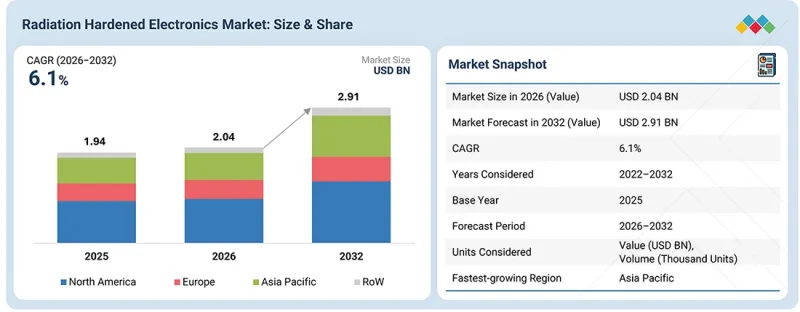
세계의 내방사선 전자기기 시장 규모는 2026년 20억 4,000만 달러에서 2032년까지 29억 1,000만 달러로 확대하며, 예측 기간 중 CAGR은 6.1%에 달할 것으로 전망되고 있습니다.
위성, 드론, 방위 시스템 등의 정보·감시·정찰(ISR) 플랫폼이 가혹한 환경에서도 신뢰성 높은 작동을 수행하기 위해 방사선 내성 프로세서, 컨트롤러, 메모리 디바이스, 혼합 신호 IC에 대한 의존도를 높이고 있으며, 방사선 내성 전자기기 시장은 꾸준한 성장을 달성하고 있습니다.
| 조사 범위 | |
|---|---|
| 조사 대상 기간 | 2021-2032년 |
| 기준연도 | 2025년 |
| 예측 기간 | 2026-2032년 |
| 단위 | 금액(달러) |
| 부문 | 컴포넌트, 제품 유형, 용도, 지역별 |
| 대상 지역 | 북미, 유럽, 아시아태평양, 기타 지역 |
방위 기관 및 우주 기관의 첨단 ISR(정보·감시·정찰) 능력, 보안 통신, 상황 인식에 대한 투자 확대에 따라 고신뢰성 내방사선 부품에 대한 수요가 증가하고 있습니다. 한편, 높은 개발 비용과 실제 환경에서의 방사선 시험 환경 부족이 여전히 시장 확대를 제약하고 있습니다. 또한 우주 임무의 증가와 상용 기성품(COTS) 부품의 채택 확대가 새로운 기회를 창출하고 있는 반면, 최종사용자의 고도로 맞춤화된 요구 사항이 제품 개발 및 경쟁 전략에 계속해서 영향을 미치고 있습니다.
"전력 관리 부문은 2025년에 가장 큰 시장 점유율을 차지했습니다."
전력 관리 부품은 우주·방위용 전자 시스템 전체에서 전력의 조정 및 분배에 중요한 역할을 수행하고 있으므로 2025년에 가장 큰 시장 점유율을 차지할 것으로 예상됩니다. 위성, 우주선, 군사 플랫폼에서는 방사선량이 많은 환경에서도 중단 없는 운영을 보장하기 위해, 높은 신뢰성을 갖춘 파워 매니지먼트 IC, 전압 레귤레이터, 컨버터 및 관련 부품이 필요합니다. 또한 첨단 페이로드, 통신 시스템, 기내 프로세서에서 전자 서브시스템의 수가 증가하고 전력 요구 사항이 고도화되면서 수요가 한층 더 증가하고 있습니다. 따라서 위성 발사 증가, 우주 탐사 프로그램, 국방 분야의 현대화 구상이 시장에서 전력 관리 부품의 우위를 지원하고 있습니다.
"우주 용도는 예측 기간 중 가장 높은 성장률을 기록할 것으로 전망"
용도별로는 위성 군집, 심우주 탐사 임무, 상업 우주 활동의 급속한 확대에 힘입어 우주 부문이 가장 높은 성장률을 기록할 것으로 예상됩니다. 통신, 지구 관측, 항법, 과학 관측용 위성의 배치가 증가함에 따라 내방사선 프로세서, 메모리, 전력 관리 소자, 혼합 신호 IC에 대한 강력한 수요가 발생하고 있습니다. 민간 우주 기업의 시장 진입 확대에 더해, 달·행성 탐사 및 국가 안보 관련 우주 프로그램에 대한 정부 투자의 증가도 이 시장의 확산을 더욱 가속화하고 있습니다. 우주선의 자율화가 진행되고 데이터 처리량이 방대해짐에 따라 가혹한 방사선 환경에서도 작동 가능한 신뢰성이 높은 고성능 전자 기기에 대한 수요가 크게 증가할 것으로 예상됩니다.
"2032년에는 미국이 최대 점유율을 차지할 전망"
미국은 우주 탐사, 국방 현대화, 국가 안보 프로그램에 대한 정부의 강력한 지출에 힘입어 최대 시장 점유율을 차지할 것으로 예상됩니다. 주요 항공우주, 방위, 반도체 기업의 존재가 내방사선 전자기기 분야에서 미국의 기술력과 제조 능력을 더욱 강화하고 있습니다. NASA나 미국 국방부 등의 기관에 의한 막대한 투자 또한 위성, 미사일, 우주선 및 기타 미션 크리티컬 시스템에 사용되는 신뢰성 높은 부품에 대한 수요를 지속적으로 견인하고 있습니다. 또한 민간 우주 기업 및 위성 군집 계획의 급속한 성장에 힘입어 미국 시장의 주도적 지위는 유지될 것으로 예상됩니다.
이 보고서에서는 전 세계 방사선 내성 전자기기 시장을 조사하여, 시장 개요, 시장 성장에 영향을 미치는 각종 요인에 대한 분석, 기술 및 특허 동향, 법규제 환경, 사례 연구, 시장 규모 추이 및 전망, 각종 분류·지역/주요 국가별 상세 분석, 경쟁 구도, 주요 기업 개요 등을 종합적으로 다루고 있습니다.
자주 묻는 질문
목차
제1장 서론
제2장 개요
제3장 주요 인사이트
제4장 시장 개요
제5장 업계 동향
제6장 기술의 진보, AI의 영향, 특허, 혁신, 향후 응용
제7장 규제 상황
제8장 고객 상황과 구매 행동
제9장 내방사선 전자기기 재료 및 패키지 유형
제10장 내방사선 전자기기 시장 : 컴포넌트별
제11장 내방사선 전자기기 시장 : 제조 기술별
제12장 내방사선 전자기기 시장 : 제품 유형별
제13장 내방사선 전자기기 시장 : 용도별
제14장 내방사선 전자기기 시장 : 지역별
제15장 경쟁 구도
제16장 기업 개요
제17장 조사 방법
제18장 부록
KSA 26.10.01The global radiation hardened electronics market is projected to grow from USD 2.04 billion in 2026 to USD 2.91 billion by 2032, at a CAGR of 6.1% during the forecast period. The radiation hardened electronics market is witnessing steady growth as intelligence, surveillance, and reconnaissance (ISR) platforms, including satellites, drones, and defense systems, increasingly depend on radiation-tolerant processors, controllers, memory devices, and mixed-signal ICs for reliable operation in harsh environments.
| Scope of the Report | |
|---|---|
| Years Considered for the Study | 2021-2032 |
| Base Year | 2025 |
| Forecast Period | 2026-2032 |
| Units Considered | Value (USD Billion) |
| Segments | By Component, Product Type, Application and Region |
| Regions covered | North America, Europe, APAC, RoW |
Growing investments by defense agencies and space organizations in advanced ISR capabilities, secure communications, and situational awareness are strengthening demand for high-reliability rad-hard components. However, high development costs and limited availability of real-world radiation-testing environments continue to restrict market expansion. At the same time, rising space missions and increasing adoption of commercial-off-the-shelf (COTS) components are creating new opportunities, while highly customized requirements from end users continue to influence product development and competitive strategies.
"Power management segment accounted for the largest market share in 2025."
Power management components are expected to hold the largest share of the radiation hardened electronics market in 2025, driven by their critical role in regulating and distributing power across space and defense electronic systems. Satellites, spacecraft, and military platforms require highly reliable power management ICs, voltage regulators, converters, and related components to ensure uninterrupted operation in radiation-intensive environments. The increasing number of electronic subsystems and higher power requirements of advanced payloads, communication systems, and onboard processors are further strengthening demand. Growing satellite launches, space exploration programs, and defense modernization initiatives are therefore supporting the dominant position of power management components in the market.
"Space applications are expected to register the highest growth rate during the forecast period."
The space applications segment is expected to register the highest growth rate in the radiation hardened electronics market, driven by the rapid expansion of satellite constellations, deep-space missions, and commercial space activities. Increasing deployment of communication, Earth observation, navigation, and scientific satellites is creating strong demand for radiation-tolerant processors, memory, power management devices, and mixed-signal ICs. Growing participation of private space companies, along with rising government investments in lunar, planetary, and national-security space programs, is further accelerating adoption. As spacecraft become more autonomous and data-intensive, the need for reliable high-performance electronics capable of operating in harsh radiation environments is expected to increase significantly.
"The US is likely to account for the largest share of the radiation hardened electronics market in 2032."
The US is expected to account for the largest market share of the radiation hardened electronics market, supported by strong government spending on space exploration, defense modernization, and national-security programs. The presence of leading aerospace, defense, and semiconductor companies further strengthens the country's technological and manufacturing capabilities in rad-hard electronics. Significant investments by agencies such as NASA and the US Department of Defense continue to drive demand for reliable components used in satellites, missiles, spacecraft, and other mission-critical systems. In addition, the rapid growth of commercial space companies and satellite constellation programs is expected to sustain the US market's leading position.
Extensive primary interviews were conducted with key industry experts in the radiation hardened electronics market space to determine and verify the market size for various segments and subsegments gathered through secondary research. The breakdown of primary participants for the report is shown below.
The study contains insights from various industry experts, from component suppliers to Tier 1 companies and OEMs. The breakdown of the primary participants is as follows:
- By Company Type: Tier 1 - 20%, Tier 2 - 25%, and Tier 3 - 55%
- By Designation: C-level Executives - 30%, Directors - 30%, and Others - 40%
- By Region: Asia Pacific - 30%, Europe - 20%, North America - 40%, and RoW - 10%
Note: Other designations include technology heads, media analysts, sales managers, marketing managers, and product managers.
The three tiers of companies are based on their total revenues as of 2025: Tier: >USD 1 billion, Tier 2: USD 500 million to 1 billion, and Tier 3: <USD 500 million.
The study includes an in-depth competitive analysis of these key players in the radiation hardened electronics market, with their company profiles, recent developments, and key market strategies.
Research Coverage:
The report describes detailed information regarding the key factors, such as drivers, restraints, challenges, and opportunities, influencing the growth of the radiation hardened electronics market. It also includes information like technology trends, trade data, and patent analysis. This research report categorizes the radiation hardened electronics market based on components, manufacturing techniques, product type, and region. A detailed analysis of the major industry players was carried out to provide insights into their business overviews, products offered, major strategies adopted that include new product launches, deals (acquisitions, partnerships, agreements, and contracts), and others (expansions), and AI/Gen AI impact on the radiation hardened electronics market.
Key Benefits of Buying the Report:
- Analysis of key drivers (increasing use of radiation hardened electronics in space applications), restraints (issues in creating a real testing environment), opportunities (favorable government initiatives and increasing space missions), and challenges (customization required for high-end consumers)
- Product development/Innovation: Detailed insights on growing technologies, research and development activities, and new product and service launches in the radiation hardened electronics market
- Market Development: Comprehensive information about adjacent markets; the report analyses the radiation hardened electronics market across various geographies
- Market Diversification: Exhaustive information about new products and services, untapped geographies, recent developments, and investments in the radiation hardened electronics market
- Competitive Assessment: In-depth assessment of market share, growth strategies, and product offerings of leading players, such as Microchip Technology Inc. (US), BAE Systems (UK), Renesas Electronics Corporation (Japan), Infineon Technologies AG (Germany), and STMicroelectronics (Switzerland), in the radiation hardened electronics market
TABLE OF CONTENTS
1 INTRODUCTION
- 1.1 STUDY OBJECTIVES
- 1.2 MARKET DEFINITION
- 1.3 STUDY SCOPE
- 1.3.1 MARKETS COVERED AND REGIONAL SCOPE
- 1.3.2 YEARS CONSIDERED
- 1.3.3 INCLUSIONS AND EXCLUSIONS
- 1.4 CURRENCY CONSIDERED
- 1.5 UNIT CONSIDERED
- 1.6 STAKEHOLDERS
- 1.7 SUMMARY OF CHANGES
2 EXECUTIVE SUMMARY
- 2.1 KEY MARKET PARTICIPANTS: MAPPING OF STRATEGIC DEVELOPMENTS
- 2.2 DISRUPTIVE TRENDS IN RADIATION-HARDENED ELECTRONICS MARKET
- 2.3 HIGH-GROWTH SEGMENTS
- 2.4 REGIONAL SNAPSHOT: MARKET SIZE, GROWTH RATE, AND FORECAST
3 PREMIUM INSIGHTS
- 3.1 ATTRACTIVE OPPORTUNITIES FOR PLAYERS IN RADIATION-HARDENED ELECTRONICS MARKET
- 3.2 RADIATION-HARDENED ELECTRONICS MARKET, BY MANUFACTURING TECHNIQUE
- 3.3 RADIATION-HARDENED ELECTRONICS MARKET, BY PRODUCT TYPE
- 3.4 RADIATION-HARDENED ELECTRONICS MARKET, BY COMPONENT
- 3.5 RADIATION-HARDENED ELECTRONICS MARKET, BY APPLICATION
- 3.6 RADIATION-HARDENED ELECTRONICS MARKET, BY GEOGRAPHY
4 MARKET OVERVIEW
- 4.1 INTRODUCTION
- 4.2 RADIATION-HARDENED ELECTRONICS MARKET EVOLUTION
- 4.3 MARKET DYNAMICS
- 4.3.1 DRIVERS
- 4.3.1.1 Rising intelligence, surveillance, and reconnaissance (ISR) activities
- 4.3.1.2 Rapid advances in multicore processors for military and space applications
- 4.3.1.3 Growing emphasis on cost-effective satellite communication
- 4.3.1.4 Increasing demand for electronic systems resilient to severe nuclear environments
- 4.3.2 RESTRAINTS
- 4.3.2.1 Barriers to establishing real-world testing environments
- 4.3.2.2 High costs and long development cycles
- 4.3.3 OPPORTUNITIES
- 4.3.3.1 Increasing number of global space missions
- 4.3.3.2 Mounting demand for reconfigurable radiation-hardened FPGAs
- 4.3.3.3 Rising adoption of commercial off-the-shelf components in satellites
- 4.3.4 CHALLENGES
- 4.3.4.1 Complexities in scaling customized product offerings
- 4.3.1 DRIVERS
- 4.4 INTERCONNECTED MARKETS AND CROSS-SECTOR OPPORTUNITIES
- 4.4.1 INTERCONNECTED MARKETS
- 4.4.2 CROSS-SECTOR OPPORTUNITIES
- 4.5 STRATEGIC MOVES BY TIER-1/2/3 PLAYERS
5 INDUSTRY TRENDS
- 5.1 PORTER'S FIVE FORCES ANALYSIS
- 5.1.1 INTENSITY OF COMPETITIVE RIVALRY
- 5.1.2 BARGAINING POWER OF SUPPLIERS
- 5.1.3 BARGAINING POWER OF BUYERS
- 5.1.4 THREAT OF SUBSTITUTES
- 5.1.5 THREAT OF NEW ENTRANTS
- 5.2 MACROECONOMIC OUTLOOK
- 5.2.1 INTRODUCTION
- 5.2.2 GDP TRENDS AND FORECAST
- 5.2.3 TRENDS IN GLOBAL SPACE INDUSTRY
- 5.2.3.1 Shift of satellite manufacturing toward Asia Pacific
- 5.2.3.2 Localization of space electronics supply chains
- 5.2.3.3 Increasing investment in satellite constellation programs
- 5.2.3.4 Growing public-private partnerships in space programs
- 5.2.4 TRENDS IN GLOBAL AEROSPACE & DEFENSE INDUSTRY
- 5.2.4.1 India's emergence as a hub for defense electronics manufacturing
- 5.2.4.2 Accelerating modernization of next-generation defense platforms
- 5.2.4.3 Increasing investment in electronic warfare and missile defense systems
- 5.3 SUPPLY CHAIN ANALYSIS
- 5.4 ECOSYSTEM ANALYSIS
- 5.5 PRICING ANALYSIS
- 5.5.1 AVERAGE SELLING PRICE OF POWER MANAGEMENT PRODUCTS OFFERED BY KEY PLAYERS, BY TYPE, 2025
- 5.5.2 PRICING RANGE OF MIXED-SIGNAL ICS OFFERED BY KEY PLAYERS, BY TYPE, 2025
- 5.5.3 PRICING RANGE OF PROCESSORS & CONTROLLERS OFFERED BY KEY PLAYERS, BY TYPE, 2025
- 5.5.4 PRICING RANGE OF MEMORY PRODUCTS, BY KEY PLAYER, 2025
- 5.5.5 AVERAGE SELLING PRICE TREND OF RADIATION-HARDENED ELECTRONICS, BY REGION, 2022-2025
- 5.6 TRADE ANALYSIS
- 5.6.1 IMPORT SCENARIO (HS CODE 8541)
- 5.6.2 EXPORT SCENARIO (HS CODE 8541)
- 5.7 KEY CONFERENCES AND EVENTS, 2026-2027
- 5.8 TRENDS/DISRUPTIONS IMPACTING CUSTOMER BUSINESS
- 5.9 INVESTMENT AND FUNDING SCENARIO
- 5.10 CASE STUDY ANALYSIS
- 5.11 IMPACT OF US TARIFFS - RADIATION-HARDENED ELECTRONICS MARKET
- 5.11.1 INTRODUCTION
- 5.11.2 KEY TARIFF RATES
- 5.11.3 PRICE IMPACT ANALYSIS
- 5.11.4 KEY IMPACTS ON COUNTRIES/REGIONS
- 5.11.4.1 US
- 5.11.4.2 Europe
- 5.11.4.3 Asia Pacific
- 5.11.5 IMPACT ON APPLICATIONS
6 TECHNOLOGICAL ADVANCEMENTS, AI-DRIVEN IMPACT, PATENTS, INNOVATIONS, AND FUTURE APPLICATIONS
- 6.1 TECHNOLOGY ANALYSIS
- 6.1.1 KEY TECHNOLOGIES
- 6.1.1.1 Radiation-hardened semiconductors
- 6.1.1.2 Rad-hard design techniques
- 6.1.1.3 Rad-hard packaging
- 6.1.2 COMPLEMENTARY TECHNOLOGIES
- 6.1.2.1 Radiation testing and simulation tools
- 6.1.2.2 Thermal management solutions
- 6.1.3 ADJACENT TECHNOLOGIES
- 6.1.3.1 Satellite and space systems
- 6.1.3.2 Defense electronics and avionics
- 6.1.3.3 Cryogenic electronics
- 6.1.1 KEY TECHNOLOGIES
- 6.2 PATENT ANALYSIS
- 6.3 IMPACT OF AI/GEN AI ON RADIATION-HARDENED ELECTRONICS MARKET
- 6.3.1 TOP USE CASES AND MARKET POTENTIAL
- 6.3.2 BEST PRACTICES FOLLOWED BY MANUFACTURERS IN RADIATION-HARDENED ELECTRONICS MARKET
- 6.3.3 CASE STUDIES RELATED TO AI/GEN AI IMPLEMENTATION IN RADIATION-HARDENED ELECTRONICS MARKET
- 6.3.4 INTERCONNECTED ECOSYSTEMS AND IMPACT ON MARKET PLAYERS
- 6.3.5 CLIENTS' READINESS TO ADOPT AI/GEN AI-INTEGRATED RADIATION-HARDENED ELECTRONICS
- 6.4 FUTURE APPLICATIONS
7 REGULATORY LANDSCAPE
- 7.1 REGIONAL REGULATIONS AND COMPLIANCE
- 7.1.1 REGULATORY BODIES, GOVERNMENT AGENCIES, AND OTHER ORGANIZATIONS
- 7.1.2 STANDARDS AND REGULATIONS
- 7.1.2.1 North America
- 7.1.2.1.1 US
- 7.1.2.1.1.1 MIL-STD-750D
- 7.1.2.1.1.2 MIL-STD-750F
- 7.1.2.1.1.3 Radiation Hardness Assurance SSB1_005
- 7.1.2.1.1.4 MIL-STD-975M (NASA)
- 7.1.2.1.2 Canada
- 7.1.2.1.2.1 Radiation Emitting Devices Regulations (C.R.C., c. 1370)
- 7.1.2.1.1 US
- 7.1.2.2 Europe
- 7.1.2.2.1 ECSS-Q-60-01A
- 7.1.2.2.2 ECSS-Q-ST-60-15C
- 7.1.2.2.3 ECSS-Q-HB-60-02A
- 7.1.2.3 Asia Pacific
- 7.1.2.3.1 India
- 7.1.2.3.1.1 IS:1885
- 7.1.2.3.2 Japan
- 7.1.2.3.2.1 Japan Product Safety Compliance
- 7.1.2.3.2.2 JMR-001
- 7.1.2.3.1 India
- 7.1.2.1 North America
- 7.2 REGULATORY POLICY INITIATIVES
8 CUSTOMER LANDSCAPE AND BUYER BEHAVIOR
- 8.1 INTRODUCTION
- 8.2 DECISION-MAKING PROCESS
- 8.3 KEY STAKEHOLDERS INVOLVED IN BUYING PROCESS AND THEIR EVALUATION CRITERIA
- 8.3.1 KEY STAKEHOLDERS IN BUYING PROCESS
- 8.3.2 BUYING CRITERIA
- 8.4 ADOPTION BARRIERS AND INTERNAL CHALLENGES
- 8.5 UNMET NEEDS OF VARIOUS APPLICATIONS
9 RADIATION-HARDENED ELECTRONICS MATERIALS AND PACKAGING TYPES
- 9.1 INTRODUCTION
- 9.2 MATERIALS
- 9.2.1 SILICON (SI)
- 9.2.2 SILICON CARBIDE (SIC)
- 9.2.3 GALLIUM NITRIDE (GAN)
- 9.2.4 GALLIUM ARSENIDE (GAAS)
- 9.3 PACKAGING TYPES
- 9.3.1 FLIP-CHIP
- 9.3.2 CERAMIC PACKAGES
10 RADIATION-HARDENED ELECTRONICS MARKET, BY COMPONENT
- 10.1 INTRODUCTION
- 10.2 MIXED-SIGNAL ICS
- 10.2.1 A/D & D/A CONVERTERS
- 10.2.1.1 Ongoing trend of compact-sized satellites to contribute to segmental growth
- 10.2.2 MULTIPLEXERS & RESISTORS
- 10.2.2.1 Increasing space missions and use of data acquisition systems to bolster segmental growth
- 10.2.1 A/D & D/A CONVERTERS
- 10.3 PROCESSORS & CONTROLLERS
- 10.3.1 MPU
- 10.3.1.1 Rising development in multicore processors for space and defense applications to fuel segmental growth
- 10.3.2 MCU
- 10.3.2.1 Proliferating deep space missions and planetary exploration to augment segmental growth
- 10.3.3 ASIC
- 10.3.3.1 High degree of flexibility and ability to address highly customized design requirements to spur demand
- 10.3.4 FPGA
- 10.3.4.1 Increasing use to eliminate costs related to redesigning or manual updating to expedite segmental growth
- 10.3.1 MPU
- 10.4 MEMORY
- 10.4.1 VOLATILE
- 10.4.1.1 DRAM
- 10.4.1.1.1 High node capacitance and gradual voltage scaling to foster segmental growth
- 10.4.1.2 SRAM
- 10.4.1.2.1 High adoption in image processing applications to accelerate segmental growth
- 10.4.1.1 DRAM
- 10.4.2 NON-VOLATILE
- 10.4.2.1 MRAM
- 10.4.2.1.1 Non-volatile and power-efficient features to boost segmental growth
- 10.4.2.2 Flash
- 10.4.2.2.1 Ability to provide high-density memory capacity in small volumes to augment segmental growth
- 10.4.2.3 Other memory technologies
- 10.4.2.1 MRAM
- 10.4.1 VOLATILE
- 10.5 POWER MANAGEMENT
- 10.5.1 MOSFETS
- 10.5.1.1 Use to address high-reliability requirements and outer space applications to facilitate segmental growth
- 10.5.2 DIODES
- 10.5.2.1 High voltage and improved electrical radiation performance to contribute to segmental growth
- 10.5.3 THYRISTORS
- 10.5.3.1 Adoption in aerospace and defense applications to bolster segmental growth
- 10.5.4 IGBTS
- 10.5.4.1 High current density and low power dissipation to fuel segmental growth
- 10.5.1 MOSFETS
- 10.6 IMAGE SENSORS
- 10.6.1 MOUNTING DEMAND FOR RELIABLE IMAGING SYSTEMS IN SPACE AND DEFENSE APPLICATIONS TO BOOST SEGMENTAL GROWTH
- 10.7 OTHER COMPONENTS
11 RADIATION-HARDENED ELECTRONICS MARKET, BY MANUFACTURING TECHNIQUE
- 11.1 INTRODUCTION
- 11.2 RADIATION-HARDENED BY DESIGN
- 11.2.1 LOW CHIP COSTS, FLEXIBILITY IN HIGH-VOLUME PRODUCTION, AND LESS CUSTOMIZED PROCESSES TO FUEL SEGMENTAL GROWTH
- 11.2.2 TOTAL IONIZING DOSE
- 11.2.3 SINGLE EVENT EFFECT (SEE)
- 11.3 RADIATION-HARDENED BY PROCESS
- 11.3.1 INCREASING INVESTMENT AND STRATEGIC ADVANCEMENTS TO BOLSTER SEGMENTAL GROWTH
- 11.3.2 SILICON ON INSULATOR (SOI)
- 11.3.3 SILICON ON SAPPHIRE (SOS)
- 11.4 RADIATION-HARDENED BY SOFTWARE (QUALITATIVE)
12 RADIATION-HARDENED ELECTRONICS MARKET, BY PRODUCT TYPE
- 12.1 INTRODUCTION
- 12.2 COMMERCIAL OFF-THE-SHELF
- 12.2.1 BURGEONING DEMAND FOR RELIABLE AND LOW-COST MICROELECTRONICS IN SPACE INDUSTRY TO FUEL SEGMENTAL GROWTH
- 12.3 CUSTOM-MADE
- 12.3.1 ABILITY TO WITHSTAND HIGH LEVELS OF RADIATION TO ACCELERATE SEGMENTAL GROWTH
13 RADIATION-HARDENED ELECTRONICS MARKET, BY APPLICATION
- 13.1 INTRODUCTION
- 13.2 SPACE
- 13.2.1 COMMERCIAL
- 13.2.1.1 Escalating adoption of global positioning systems and navigation systems to expedite segmental growth
- 13.2.1.2 Small satellites
- 13.2.1.3 New space
- 13.2.1.4 Nanosatellites
- 13.2.2 MILITARY
- 13.2.2.1 Rising need for quality components that can withstand high levels of radiation to drive market
- 13.2.1 COMMERCIAL
- 13.3 AEROSPACE & DEFENSE
- 13.3.1 WEAPONS & MISSILES
- 13.3.1.1 Use of processors with high radiation resistance and low power consumption to foster segmental growth
- 13.3.2 VEHICLES/AVIONICS
- 13.3.2.1 Requirement for electronics that operate effectively in harsh environments to expedite segmental growth
- 13.3.1 WEAPONS & MISSILES
- 13.4 NUCLEAR POWER PLANTS
- 13.4.1 STRONG FOCUS ON ENVIRONMENT-FRIENDLY POWER GENERATION TO AUGMENT MARKET GROWTH
- 13.5 MEDICAL
- 13.5.1 IMPLANTABLE DEVICES
- 13.5.1.1 Advances in medical devices and chronic disease prevalence to facilitate segmental growth
- 13.5.2 RADIOLOGY
- 13.5.2.1 Growing prevalence of chronic diseases and aging population to facilitate segmental growth
- 13.5.1 IMPLANTABLE DEVICES
- 13.6 OTHER APPLICATIONS
14 RADIATION-HARDENED ELECTRONICS MARKET, BY REGION
- 14.1 INTRODUCTION
- 14.2 NORTH AMERICA
- 14.2.1 US
- 14.2.1.1 Increasing investment in civil, defense, and commercial space programs to boost market growth
- 14.2.2 CANADA
- 14.2.2.1 Rising government initiatives in space exploration to contribute to market growth
- 14.2.3 MEXICO
- 14.2.3.1 Expanding satellite infrastructure and domestic space capabilities to foster market growth
- 14.2.1 US
- 14.3 EUROPE
- 14.3.1 UK
- 14.3.1.1 Increasing investment in satellite communications, in-orbit servicing, and national space infrastructure to drive market
- 14.3.2 GERMANY
- 14.3.2.1 Growing participation in space missions to contribute to market growth
- 14.3.3 FRANCE
- 14.3.3.1 Increasing partnership in space launch missions to bolster market growth
- 14.3.4 REST OF EUROPE
- 14.3.1 UK
- 14.4 ASIA PACIFIC
- 14.4.1 CHINA
- 14.4.1.1 Increasing funding for military operations and technologies to expedite market growth
- 14.4.2 INDIA
- 14.4.2.1 Growing emphasis on satellite manufacturing, Earth observation, and advanced space exploration programs to drive market
- 14.4.3 JAPAN
- 14.4.3.1 Strong focus on developing advanced space technologies to accelerate market growth
- 14.4.4 SOUTH KOREA
- 14.4.4.1 Increasing investment in infrastructure, industrial, commercial, military, space, and defense projects to fuel market growth
- 14.4.5 REST OF ASIA PACIFIC
- 14.4.1 CHINA
- 14.5 ROW
- 14.5.1 MIDDLE EAST
- 14.5.1.1 Saudi Arabia
- 14.5.1.1.1 Ambitious space and defense initiatives to support market growth
- 14.5.1.2 UAE
- 14.5.1.2.1 Expanding space program and focus on defense modernization to foster market growth
- 14.5.1.3 Rest of Middle East
- 14.5.1.1 Saudi Arabia
- 14.5.2 SOUTH AMERICA
- 14.5.2.1 Rising partnership with foreign agencies for space missions to augment market growth
- 14.5.3 AFRICA
- 14.5.3.1 Increasing investment in satellite programs, defense upgrades, and space exploration initiatives to boost market growth
- 14.5.1 MIDDLE EAST
15 COMPETITIVE LANDSCAPE
- 15.1 OVERVIEW
- 15.2 KEY PLAYER COMPETITIVE STRATEGIES/RIGHT TO WIN, 2023-2026
- 15.3 REVENUE ANALYSIS, 2021-2025
- 15.4 MARKET SHARE ANALYSIS, 2025
- 15.5 COMPANY VALUATION AND FINANCIAL METRICS
- 15.6 BRAND/PRODUCT COMPARATIVE ANALYSIS
- 15.6.1 BAE SYSTEMS (UK)
- 15.6.2 MICROCHIP TECHNOLOGY (US)
- 15.6.3 STMICROELECTRONICS (SWITZERLAND)
- 15.6.4 RENESAS ELECTRONICS (JAPAN)
- 15.6.5 INFINEON TECHNOLOGIES (GERMANY)
- 15.7 COMPANY EVALUATION MATRIX: KEY PLAYERS, 2025
- 15.7.1 STARS
- 15.7.2 EMERGING LEADERS
- 15.7.3 PERVASIVE PLAYERS
- 15.7.4 PARTICIPANTS
- 15.7.5 COMPANY FOOTPRINT: KEY PLAYERS, 2025
- 15.7.5.1 Company footprint
- 15.7.5.2 Region footprint
- 15.7.5.3 Component footprint
- 15.7.5.4 Manufacturing technique footprint
- 15.7.5.5 Product type footprint
- 15.7.5.6 Application footprint
- 15.8 COMPANY EVALUATION MATRIX: STARTUPS/SMES, 2025
- 15.8.1 PROGRESSIVE COMPANIES
- 15.8.2 RESPONSIVE COMPANIES
- 15.8.3 DYNAMIC COMPANIES
- 15.8.4 STARTING BLOCKS
- 15.8.5 COMPETITIVE BENCHMARKING: STARTUPS/SMES, 2025
- 15.8.5.1 Detailed list of key startups/SMEs
- 15.8.5.2 Competitive benchmarking of key startups/SMEs
- 15.9 COMPETITIVE SCENARIO
- 15.9.1 PRODUCT LAUNCHES
- 15.9.2 DEALS
- 15.9.3 EXPANSIONS
16 COMPANY PROFILES
- 16.1 KEY PLAYERS
- 16.1.1 MICROCHIP TECHNOLOGY INC.
- 16.1.1.1 Business overview
- 16.1.1.2 Products/Solutions/Services offered
- 16.1.1.3 Recent developments
- 16.1.1.3.1 Product launches
- 16.1.1.3.2 Deals
- 16.1.1.3.3 Expansions
- 16.1.1.4 MnM view
- 16.1.1.4.1 Right to win
- 16.1.1.4.2 Strategic choices
- 16.1.1.4.3 Weaknesses and competitive threats
- 16.1.2 BAE SYSTEMS
- 16.1.2.1 Business overview
- 16.1.2.2 Products/Solutions/Services offered
- 16.1.2.3 Recent developments
- 16.1.2.3.1 Product launches
- 16.1.2.3.2 Deals
- 16.1.2.4 MnM view
- 16.1.2.4.1 Right to win
- 16.1.2.4.2 Strategic choices
- 16.1.2.4.3 Weaknesses and competitive threats
- 16.1.3 RENESAS ELECTRONICS CORPORATION
- 16.1.3.1 Business overview
- 16.1.3.2 Products/Solutions/Services offered
- 16.1.3.3 Recent developments
- 16.1.3.3.1 Product launches
- 16.1.3.3.2 Deals
- 16.1.3.4 MnM view
- 16.1.3.4.1 Right to win
- 16.1.3.4.2 Strategic choices
- 16.1.3.4.3 Weaknesses and competitive threats
- 16.1.4 INFINEON TECHNOLOGIES AG
- 16.1.4.1 Business overview
- 16.1.4.2 Products/Solutions/Services offered
- 16.1.4.3 Recent developments
- 16.1.4.3.1 Product launches
- 16.1.4.3.2 Deals
- 16.1.4.4 MnM view
- 16.1.4.4.1 Right to win
- 16.1.4.4.2 Strategic choices
- 16.1.4.4.3 Weaknesses and competitive threats
- 16.1.5 STMICROELECTRONICS
- 16.1.5.1 Business overview
- 16.1.5.2 Products/Solutions/Services offered
- 16.1.5.3 Recent developments
- 16.1.5.3.1 Product launches
- 16.1.5.3.2 Deals
- 16.1.5.4 MnM view
- 16.1.5.4.1 Right to win
- 16.1.5.4.2 Strategic choices
- 16.1.5.4.3 Weaknesses and competitive threats
- 16.1.6 ADVANCED MICRO DEVICES, INC. (AMD)
- 16.1.6.1 Business overview
- 16.1.6.2 Products/Solutions/Services offered
- 16.1.6.3 Recent developments
- 16.1.6.3.1 Product launches
- 16.1.6.3.2 Deals
- 16.1.7 TEXAS INSTRUMENTS INCORPORATED
- 16.1.7.1 Business overview
- 16.1.7.2 Products/Solutions/Services offered
- 16.1.7.3 Recent developments
- 16.1.7.3.1 Product launches
- 16.1.7.3.2 Deals
- 16.1.8 HONEYWELL INTERNATIONAL INC.
- 16.1.8.1 Business overview
- 16.1.8.2 Products/Solutions/Services offered
- 16.1.8.3 Recent developments
- 16.1.8.3.1 Product launches
- 16.1.8.3.2 Deals
- 16.1.9 TELEDYNE TECHNOLOGIES INCORPORATED
- 16.1.9.1 Business overview
- 16.1.9.2 Products/Solutions/Services offered
- 16.1.9.3 Recent developments
- 16.1.9.3.1 Product launches
- 16.1.9.3.2 Deals
- 16.1.10 TTM TECHNOLOGIES, INC.
- 16.1.10.1 Business overview
- 16.1.10.2 Products/Solutions/Services offered
- 16.1.10.3 Recent developments
- 16.1.10.3.1 Product launches
- 16.1.1 MICROCHIP TECHNOLOGY INC.
- 16.2 OTHER PLAYERS
- 16.2.1 THALES
- 16.2.2 ANALOG DEVICES, INC.
- 16.2.3 DATA DEVICE CORPORATION
- 16.2.4 3D PLUS
- 16.2.5 MERCURY SYSTEMS, INC.
- 16.2.6 PCB PIEZOTRONICS, INC.
- 16.2.7 VORAGO TECHNOLOGIES
- 16.2.8 GSI TECHNOLOGY, INC.
- 16.2.9 EVERSPIN TECHNOLOGIES INC.
- 16.2.10 SEMICONDUCTOR COMPONENTS INDUSTRIES, LLC (ON SEMICONDUCTOR)
- 16.2.11 AITECH
- 16.2.12 MICROELECTRONICS RESEARCH DEVELOPMENT CORPORATION
- 16.2.13 TRIAD SEMICONDUCTOR
- 16.2.14 ZERO TEST SYSTEMS
- 16.2.15 RESILIENT COMPUTING
17 RESEARCH METHODOLOGY
- 17.1 RESEARCH DATA
- 17.1.1 SECONDARY AND PRIMARY RESEARCH
- 17.1.2 SECONDARY DATA
- 17.1.2.1 List of key secondary sources
- 17.1.2.2 Key data from secondary sources
- 17.1.3 PRIMARY DATA
- 17.1.3.1 Key data from primary sources
- 17.1.3.2 List of primary interview participants
- 17.1.3.3 Breakdown of primaries
- 17.1.3.4 Key industry insights
- 17.2 MARKET SIZE ESTIMATION
- 17.2.1 BOTTOM-UP APPROACH
- 17.2.1.1 Approach to obtain market size using bottom-up analysis
- 17.2.2 TOP-DOWN APPROACH
- 17.2.2.1 Approach to obtain market size using top-down analysis
- 17.2.1 BOTTOM-UP APPROACH
- 17.3 DATA TRIANGULATION
- 17.4 RESEARCH ASSUMPTIONS
- 17.5 RESEARCH LIMITATIONS
- 17.6 RISK ANALYSIS
18 APPENDIX
- 18.1 DISCUSSION GUIDE
- 18.2 KNOWLEDGESTORE: MARKETSANDMARKETS' SUBSCRIPTION PORTAL
- 18.3 CUSTOMIZATION OPTIONS
- 18.4 RELATED REPORTS
- 18.5 AUTHOR DETAILS


