

|
시장보고서
상품코드
2132667
네트워크용 AI 시장 예측(-2032년) : 오퍼링별, 네트워크 유형별, 최종사용자별, 지역별AI in Network Market by Solution (Network Management, Network Optimization, Network Security, Network Automation, Network Orchestration, Network Planning & Design) - Global Forecast to 2032 |
||||||

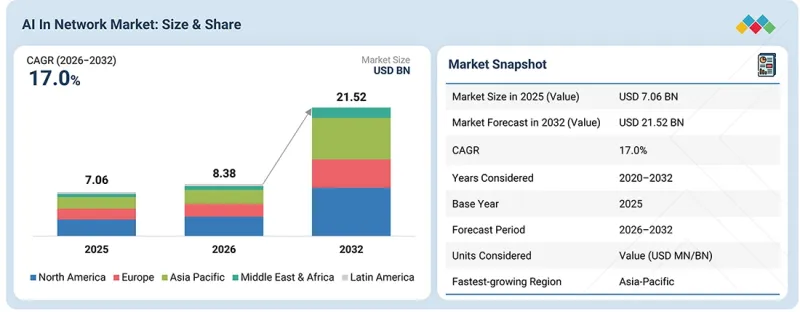
네트워크용 AI 시장 규모는 2026년에 83억 8,000만 달러로 추정되고 있으며, 2032년까지 215억 2,000만 달러에 달하며, CAGR은 17.0%에 달할 전망입니다.
시장 성장은 AI를 활용한 네트워크 자동화, 5G, 엣지 컴퓨팅, 클라우드 인프라, IoT 도입 확대에 의해 주도되고 있습니다. AI는 실시간 네트워크 최적화, 예측 유지보수, 이상 탐지, 자동 문제 해결, 사이버 보안 강화를 가능하게 하여, 조직이 네트워크 성능 향상, 가동 중단 시간 단축, 자원 최적화, 운영 비용 절감을 실현할 수 있도록 지원합니다.
| 조사 범위 | |
|---|---|
| 조사 대상 기간 | 2020-2032년 |
| 기준연도 | 2025년 |
| 예측 기간 | 2026-2032년 |
| 대상 단위 | 금액(100만/10억 달러) |
| 부문 | 오퍼링별, 네트워크 유형별, 최종사용자별, 지역별 |
| 대상 지역 | 북미, 유럽, 아시아태평양, 중동 및 아프리카 및 라틴아메리카 |
디지털 인프라에 대한 투자 증가와 신뢰성이 높고 지연 시간이 짧은 연결성에 대한 수요 증가가 도입을 더욱 가속화하고 있습니다. 아시아태평양은 5G의 급속한 확산, 클라우드 및 엣지 인프라의 확대, 디지털 전환(DX) 노력에 힘입어 가장 높은 성장률을 기록할 것으로 예상됩니다. 네트워크가 더욱 자율적이고 지능적인 운영으로 전환됨에 따라 통신 사업자, 기업, 데이터센터 및 공공 기관에서 도입이 가속화될 것으로 전망됩니다.
"네트워크 유형별로는 예측 기간 중 데이터센터 네트워크가 가장 큰 시장 점유율을 차지할 것으로 예상됩니다."
데이터센터 네트워크는 기업 및 하이퍼스케일러의 AI 워크로드, 클라우드 컴퓨팅, 고성능 컴퓨팅의 급속한 도입에 힘입어 AI in Network 시장에서 가장 큰 시장 점유율을 차지할 것으로 예상됩니다. AI 애플리케이션에서는 대규모 데이터세트를 전송하고 GPU, 서버, 스토리지 시스템 간의 통신을 가능하게 하기 위해 고대역폭, 저지연, 그리고 고도로 확장 가능한 네트워크 인프라가 필요합니다. AI 기반 네트워크 솔루션을 통해 데이터센터는 트래픽 관리 최적화, 네트워크 운영 자동화, 성능 문제 예측 및 해결, 그리고 리소스 활용도 향상을 실현할 수 있습니다. 생성형 AI, 머신러닝, 그리고 가속 컴퓨팅의 도입 확대에 따라 데이터센터내 지능형 네트워크 기능에 대한 수요는 더욱 높아지고 있습니다. 조직들이 AI 인프라 확충과 차세대 데이터센터에 대한 투자를 지속하는 가운데, AI를 활용한 네트워크 모니터링, 최적화, 보안 및 자동화에 대한 수요로 인해 예측 기간 중 데이터센터 네트워크는 시장에서 주도적인 위치를 유지할 것으로 전망됩니다.
"클라우드 네트워크 분야는 예측 기간 중 가장 높은 성장률을 기록할 것으로 전망됩니다."
클라우드 네트워크는 클라우드 환경, 데이터센터, 지사, 엣지 인프라 전반에 걸쳐 확장 가능하고 유연한 연결성을 제공합니다. 기업이 클라우드 전환을 가속화하고 하이브리드 및 멀티클라우드 아키텍처를 채택함에 따라 실시간 네트워크 가시화, 자동 구성, 지능형 트래픽 관리, 예측적 성능 최적화를 제공하는 AI 지원 솔루션에 대한 수요가 증가하고 있습니다. AI는 네트워크 데이터 분석, 이상 탐지, 리소스 최적화, 운영 자동화를 지원하여 네트워크의 신뢰성과 효율성을 향상시킵니다. 클라우드 네이티브 애플리케이션의 채택 확대, 멀티클라우드의 복잡성 증가, 그리고 원활하고 안전한 연결성에 대한 수요가 높아짐에 따라 기업은 AI 기반 클라우드 네트워킹 솔루션으로 눈을 돌리고 있습니다. 조직들이 확장 가능하고 자율적이며 회복력 있는 클라우드 인프라를 우선시함에 따라 AI 기반 클라우드 네트워크에 대한 수요는 급속히 확대될 것으로 예상되며, 이에 따라 예측 기간 중 AI 네트워크 시장에서 가장 빠르게 성장하는 부문이 될 전망입니다.
"아시아태평양은 예측 기간 중 가장 높은 성장률을 기록할 것으로 전망됩니다."
아시아태평양에서는 급속한 디지털 전환, 5G 인프라 확대, 클라우드 보급, 그리고 지능형 네트워크 관리에 대한 수요 증가가 나타나고 있으며, 이러한 요인들이 네트워크 AI 시장의 강력한 성장을 촉진하고 있습니다. 중국, 인도, 일본, 한국, 호주 등의 국가들은 증가하는 데이터 트래픽과 연결 기기를 지원하기 위해 첨단 통신 인프라, 데이터센터, 클라우드 네트워크에 대한 투자를 추진하고 있습니다. 통신 사업자와 기업은 예측 유지보수, 네트워크 최적화, 트래픽 관리, 이상 탐지 및 운영 자동화를 위해 AI를 활용한 네트워크 솔루션 도입을 점점 더 확대하고 있습니다. 또한 IoT, 엣지 컴퓨팅, 5G 네트워크의 보급으로 인해 대량의 네트워크 데이터가 생성되고 있으며, 이는 AI를 활용한 분석 및 자동화의 기회를 창출하고 있습니다. 디지털화, 스마트 인프라, 차세대 연결성을 추진하는 정부의 지원 정책에 힘입어 해당 지역 전체의 AI 도입은 더욱 가속화되고 있습니다. 이러한 요인들이 복합적으로 작용함에 따라 아시아태평양은 예측 기간 중 네트워크 분야에서 AI 성장이 가장 빠른 지역 시장이 될 것으로 전망됩니다.
1차 조사 내역
네트워크 AI 시장의 주요 기업 : Cisco(미국), HPE(미국), Nokia(핀란드), Ericsson(스웨덴), Huawei(중국), Arista Networks(미국), NVIDIA(미국), Extreme Networks(미국),Broadcom(미국), IBM(미국), Fujitsu(일본), Dell Technologies(미국), Ciena(미국), NEC(일본), Forward Networks(미국), BlueCat Networks(캐나다), A10 Networks(미국), ScienceLogic(미국), Versa Networks(미국),Dynatrace(미국), Infoblox(미국), EfficientIP(프랑스), Riverbed(미국), NETSCOUT(미국), SolarWinds(미국), NetBrain(미국), ManageEngine(미국), VIAVI Solutions(미국), Selector(미국),Aviz Networks(미국), Nile(미국), NetBox Labs(미국), Celona(미국), Shabodi(캐나다), A5G Networks(미국).
조사 범위
본 시장 조사에서는 다양한 부문에 걸친 네트워크 분야의 AI 시장 규모를 포괄적으로 다루고 있습니다. 본 조사는 제공 서비스, 네트워크 유형, 최종사용자, 지역 등의 부문별로 시장 규모와 성장 가능성을 추정하는 것을 목적으로 합니다. 또한 주요 시장 참여 기업에 대한 상세한 경쟁 분석도 포함되어 있으며, 기업 개요, 제품 및 사업 내용에 관한 주요 관찰 사항, 최근 동향, 시장 전략 등이 수록되어 있습니다.
이 보고서를 구매할 때의 주요 이점
이 보고서는 전 세계 ‘네트워크내 AI’ 시장의 매출 및 하위 부문에 대한 가장 정확한 추정치를 제공함으로써, 시장 선도 기업 및 신규 진입 기업을 지원합니다. 이 보고서는 이해관계자 여러분이 경쟁 구도를 이해하고, 자사의 비즈니스를 더 유리한 위치에 놓으며, 적절한 시장 진입 전략을 수립하기 위한 인사이트를 얻는 데 도움이 됩니다. 또한 이 보고서는 이해관계자 여러분이 시장 동향을 파악하고, 주요 시장 촉진요인, 억제요인, 과제 및 기회에 대한 정보를 얻는 데 도움이 됩니다.
이 보고서는 다음 사항에 대한 인사이트를 제공합니다. :
주요 촉진요인 분석(AI 에이전트의 보급에 따른 DNS/IP 수요 증가, 네트워크 운영 및 자동화 분야의 AI, 생성형 AI, AI 에이전트 도입 확대, AI 워크로드로 인한 복잡성 증가 및 트래픽 패턴 변화, 자율형·자가 최적화형·폐루프형 네트워크에 대한 관심 증가),제약 요인(AI 주도 네트워크 결정에 대한 설명 가능성과 신뢰성 부족, 그리고 AI와 레거시 네트워크 인프라 통합의 높은 복잡성), 기회(자율적인 네트워크 운영을 위한 생성형 AI 및 에이전트형 AI 도입 확대, 그리고 클라우드,엣지, 5G 환경에서 AI를 활용한 네트워크 관리의 확대), 그리고 과제(AI 모델을 위한 고품질이면서 신뢰성 높고 안전한 네트워크 데이터 확보, 그리고 사이버 보안, 데이터 거버넌스, 운영 리스크 관리)에 대해 인사이트를 제공합니다.
제품 개발/혁신: 네트워크 AI 시장에서 향후 기술, 연구개발 활동 및 신제품·서비스 출시에 관한 상세 인사이트.
시장 개발: 수익성이 높은 시장에 대한 포괄적인 정보. 이 보고서에서는 각 지역의 네트워크 AI 시장을 분석하고 있습니다.
시장 다각화: 네트워크 AI 시장의 신제품·서비스, 미개발 지역, 최근 동향 및 투자에 관한 포괄적인 정보.
경쟁 분석: Cisco(미국), HPE(미국), Nokia(핀란드), Ericsson(스웨덴), Huawei(중국), Arista Networks(미국), NVIDIA(미국), Extreme Networks(미국), Broadcom(미국), IBM(미국), Fujitsu(일본),Dell Technologies(미국), Ciena(미국), NEC(일본), Forward Networks(미국), BlueCat Networks(캐나다), A10 Networks(미국), ScienceLogic(미국), Versa Networks(미국),Dynatrace(미국), Infoblox(미국), EfficientIP(프랑스), Riverbed(미국), NETSCOUT(미국), SolarWinds(미국), NetBrain(미국), ManageEngine(미국), VIAVI Solutions(미국), Selector(미국),Aviz Networks(미국), Nile(미국), NetBox Labs(미국), Celona(미국), Shabodi(캐나다), A5G Networks(미국)입니다.
자주 묻는 질문
목차
제1장 서론
제2장 개요
제3장 주요 인사이트
제4장 시장 개요와 업계 동향
제5장 업계 동향
제6장 기술 진보, AI에 의한 영향, 특허, 혁신, 향후 응용
제7장 규제 상황
제8장 고객 상황과 구매 행동
제9장 네트워크용 AI 시장(오퍼링별)
제10장 네트워크용 AI 시장(네트워크 유형별)
제11장 네트워크용 AI 시장(최종사용자별)
제12장 네트워크용 AI 시장(지역별)
제13장 경쟁 구도
제14장 기업 개요
제15장 조사 방법
제16장 부록
KSA 26.10.01The AI in network market is estimated at USD 8.38 billion in 2026 and will reach USD 21.52 billion by 2032, at a CAGR of 17.0%. Market growth is driven by the increasing adoption of AI-powered network automation, 5G, edge computing, cloud infrastructure, and IoT. AI enables real-time network optimization, predictive maintenance, anomaly detection, automated troubleshooting, and enhanced cybersecurity, helping organizations improve network performance, reduce downtime, optimize resources, and lower operational costs.
| Scope of the Report | |
|---|---|
| Years Considered for the Study | 2020-2032 |
| Base Year | 2025 |
| Forecast Period | 2026-2032 |
| Units Considered | Value (USD Million/Billion) |
| Segments | By Offering, Network Type, End User, and Region |
| Regions covered | North America, Europe, Asia Pacific, Middle East & Africa, and Latin America |
Rising investments in digital infrastructure and demand for reliable, low-latency connectivity are further accelerating adoption. Asia Pacific is expected to register the highest growth rate, supported by rapid 5G deployment, expanding cloud and edge infrastructure, and digital transformation initiatives. Adoption is expected to accelerate across telecom, enterprises, data centers, and public-sector organizations as networks shift toward more autonomous, intelligent operations.
"By network type, data center networks are expected to hold the largest market share during the forecast period."
Data center networks are expected to account for the largest market share in the AI in network market, driven by the rapid adoption of AI workloads, cloud computing, and high-performance computing across enterprises and hyperscalers. AI applications require high-bandwidth, low-latency, and highly scalable network infrastructure to transfer large datasets and enable communication among GPUs, servers, and storage systems. AI-driven network solutions enable data centers to optimize traffic management, automate network operations, predict and resolve performance issues, and improve resource utilization. The growing deployment of generative AI, machine learning, and accelerated computing is further increasing demand for intelligent networking capabilities within data centers. As organizations continue to expand AI infrastructure and invest in next-generation data centers, the need for AI-enabled network monitoring, optimization, security, and automation is expected to sustain data center networks' leading market position during the forecast period.
"The cloud networks segment is expected to register the fastest growth rate during the forecast period."
Cloud networks provide scalable, flexible connectivity across cloud environments, data centers, branch locations, and edge infrastructure. As enterprises accelerate cloud migration and adopt hybrid and multicloud architectures, demand is increasing for AI-enabled solutions that offer real-time network visibility, automated configuration, intelligent traffic management, and predictive performance optimization. AI helps analyze network data, detect anomalies, optimize resources, and automate operations, improving network reliability and efficiency. Growing cloud-native application adoption, multicloud complexity, and the need for seamless, secure connectivity are driving enterprises toward AI-driven cloud networking solutions. As organizations prioritize scalable, autonomous, and resilient cloud infrastructure, demand for AI-enabled cloud networks is expected to grow rapidly, making this the fastest-growing segment in the AI in network market during the forecast period.
"Asia Pacific will register the highest growth rate during the forecast period."
The Asia Pacific region is witnessing rapid digital transformation, expanding 5G infrastructure, cloud adoption, and increasing demand for intelligent network management, driving strong growth in the AI in network market. Countries such as China, India, Japan, South Korea, and Australia are investing in advanced telecommunications infrastructure, data centers, and cloud networks to support growing data traffic and connected devices. Telecom operators and enterprises are increasingly adopting AI-powered network solutions for predictive maintenance, network optimization, traffic management, anomaly detection, and automated operations. In addition, the proliferation of IoT, edge computing, and 5G networks is generating large volumes of network data, creating opportunities for AI-driven analytics and automation. Supportive government initiatives promoting digitalization, smart infrastructure, and next-generation connectivity are further accelerating AI adoption across the region. Together, these factors position Asia Pacific as the fastest-growing regional market for AI in networks during the forecast period.
Breakdown of primaries
The study contains insights from various industry experts, from solution vendors to Tier 1 companies. The breakdown of primaries is as follows:
- By Company Type: Tier 1 (34%), Tier 2 (43%), and Tier 3 (23%)
- By Designation: C-level Executives (50%), Directors (30%), and Others (20%)
- By Region: North America (25%), Europe (30%), Asia Pacific (30%), Middle East & Africa (10%), and Latin America (5%)
The major players in the AI in network market are Cisco (US), HPE (US), Nokia (Finland), Ericsson (Sweden), Huawei (China), Arista Networks (US), NVIDIA (US), Extreme Networks (US), Broadcom (US), IBM (US), Fujitsu (Japan), Dell Technologies (US), Ciena (US), NEC (Japan), Forward Networks (US), BlueCat Networks (Canada), A10 Networks (US), ScienceLogic (US), Versa Networks (US), Dynatrace (US), Infoblox (US), EfficientIP (France), Riverbed (US), NETSCOUT (US), SolarWinds (US), NetBrain (US), ManageEngine (US), VIAVI Solutions (US), Selector (US), Aviz Networks (US), Nile (US), NetBox Labs (US), Celona (US), Shabodi (Canada), and A5G Networks (US).
Research Coverage
The market study covers the AI in network market size across different segments. It aims to estimate market size and growth potential across segments, including offering, network type, end user, and regions. The study includes an in-depth competitive analysis of leading market players, including company profiles, key observations on product and business offerings, recent developments, and market strategies.
Key Benefits of Buying the Report
The report will help market leaders/new entrants with information on the closest approximations of the global AI in network market's revenue numbers and subsegments. This report will help stakeholders understand the competitive landscape and gain insights to better position their businesses and plan suitable go-to-market strategies. Moreover, the report will help stakeholders understand the market's pulse and provide information on key market drivers, restraints, challenges, and opportunities.
The report provides insights on the following pointers:
Analysis of key drivers (AI agent proliferation increasing DNS/IP demand; growing adoption of AI, generative AI, and AI agents for network operations and automation; rising complexity and changing traffic patterns driven by AI workloads; and growing focus on autonomous, self-optimizing, and closed-loop networks), restraints (lack of explainability and trust in AI-driven network decisions and high complexity of integrating AI with legacy network infrastructure), opportunities (growing adoption of generative and agentic AI for autonomous network operations and expansion of AI-powered network management across cloud, edge, and 5G environments), and challenges (ensuring high-quality, reliable, and secure network data for AI models and managing cybersecurity, data governance, and operational risks).
Product Development/Innovation: Detailed insights on upcoming technologies, research and development activities, and new product and service launches in the AI in network market.
Market Development: Comprehensive information on lucrative markets; the report analyzes AI in network markets across various regions.
Market Diversification: Exhaustive information about new products and services, untapped geographies, recent developments, and investments in the AI in network market.
Competitive Assessment: In-depth assessment of market shares, growth strategies, and service offerings of leading players like Cisco (US), HPE (US), Nokia (Finland), Ericsson (Sweden), Huawei (China), Arista Networks (US), NVIDIA (US), Extreme Networks (US), Broadcom (US), IBM (US), Fujitsu (Japan), Dell Technologies (US), Ciena (US), NEC (Japan), Forward Networks (US), BlueCat Networks (Canada), A10 Networks (US), ScienceLogic (US), Versa Networks (US), Dynatrace (US), Infoblox (US), EfficientIP (France), Riverbed (US), NETSCOUT (US), SolarWinds (US), NetBrain (US), ManageEngine (US), VIAVI Solutions (US), Selector (US), Aviz Networks (US), Nile (US), NetBox Labs (US), Celona (US), Shabodi (Canada), and A5G Networks (US).
TABLE OF CONTENTS
1 INTRODUCTION
- 1.1 STUDY OBJECTIVES
- 1.2 MARKET DEFINITION
- 1.3 MARKET SCOPE
- 1.3.1 MARKET SEGMENTATION AND REGIONAL SCOPE
- 1.3.2 INCLUSIONS AND EXCLUSIONS
- 1.4 YEARS CONSIDERED
- 1.5 CURRENCY CONSIDERED
- 1.6 STAKEHOLDERS
2 EXECUTIVE SUMMARY
- 2.1 MARKET HIGHLIGHTS AND KEY INSIGHTS
- 2.2 KEY MARKET PARTICIPANTS: MAPPING OF STRATEGIC DEVELOPMENTS
- 2.3 DISRUPTIVE TRENDS IN AI IN NETWORK MARKET
- 2.4 HIGH-GROWTH SEGMENTS
- 2.5 REGIONAL SNAPSHOT: MARKET SIZE, GROWTH RATE, AND FORECAST
3 PREMIUM INSIGHTS
- 3.1 ATTRACTIVE OPPORTUNITIES FOR PLAYERS IN AI IN NETWORK MARKET
- 3.2 AI IN NETWORK MARKET, BY SERVICE AND REGION
- 3.3 AI IN NETWORK MARKET, BY OFFERING
- 3.4 AI IN NETWORK MARKET, BY END USER
4 MARKET OVERVIEW AND INDUSTRY TRENDS
- 4.1 INTRODUCTION
- 4.2 MARKET DYNAMICS
- 4.2.1 DRIVERS
- 4.2.1.1 AI agent proliferation increasing DNS/IP demand
- 4.2.1.2 Growing adoption of AI, generative AI, and AI agents for network operations and automation
- 4.2.1.3 Rising complexity and changing traffic patterns driven by AI workloads
- 4.2.1.4 Increasing focus on autonomous, self-optimizing, and closed-loop networks
- 4.2.2 RESTRAINTS
- 4.2.2.1 Lack of explainability and trust in AI-driven network decisions
- 4.2.2.2 High complexity of integrating AI with legacy network infrastructure
- 4.2.3 OPPORTUNITIES
- 4.2.3.1 Expansion of autonomous and intent-based networking enabled by AI
- 4.2.3.2 Expansion of AI-powered network management across cloud, edge, and 5G environments
- 4.2.4 CHALLENGES
- 4.2.4.1 Ensuring high-quality, reliable, and secure network data for AI models
- 4.2.4.2 Managing cybersecurity, data governance, and operational risks
- 4.2.1 DRIVERS
- 4.3 INTERCONNECTED MARKETS AND CROSS-SECTOR OPPORTUNITIES
- 4.3.1 CLOUD COMPUTING AND DATA CENTER MARKET
- 4.3.2 INTERNET OF THINGS (IOT) MARKET
- 4.3.3 CYBERSECURITY MARKET
- 4.3.4 TELECOMMUNICATIONS AND 5G MARKET
- 4.3.5 HEALTHCARE AND LIFE SCIENCES
- 4.3.6 MANUFACTURING AND INDUSTRIAL AUTOMATION
- 4.3.7 TRANSPORTATION AND SMART MOBILITY
- 4.3.8 ENERGY AND UTILITIES
- 4.3.9 RETAIL AND SMART ENTERPRISE
- 4.4 STRATEGIC MOVES BY TIER-1/2/3 PLAYERS
5 INDUSTRY TRENDS
- 5.1 PORTER'S FIVE FORCES ANALYSIS
- 5.1.1 THREAT OF NEW ENTRANTS
- 5.1.2 THREAT OF SUBSTITUTES
- 5.1.3 BARGAINING POWER OF SUPPLIERS
- 5.1.4 BARGAINING POWER OF BUYERS
- 5.1.5 INTENSITY OF COMPETITIVE RIVALRY
- 5.2 MACROECONOMICS INDICATORS
- 5.2.1 INTRODUCTION
- 5.2.2 GDP TRENDS AND FORECAST
- 5.2.3 TRENDS IN TELECOMMUNICATIONS INDUSTRY
- 5.2.4 TRENDS IN DATA CENTER & CLOUD INFRASTRUCTURE INDUSTRY
- 5.3 SUPPLY CHAIN ANALYSIS
- 5.4 ECOSYSTEM ANALYSIS
- 5.5 PRICING ANALYSIS
- 5.5.1 AVERAGE SELLING PRICE OF AI-ENABLED NETWORK MANAGEMENT PLATFORMS, BY KEY PLAYERS
- 5.5.2 INDICATIVE PRICING ANALYSIS OF KEY PLAYERS, BY SOLUTION, 2025
- 5.6 KEY CONFERENCES AND EVENTS, 2026-2027
- 5.7 TRENDS/DISRUPTIONS IMPACTING CUSTOMER BUSINESS
- 5.8 INVESTMENT AND FUNDING SCENARIO
- 5.9 CASE STUDY ANALYSIS
- 5.9.1 CISCO'S SELF-DEFENDING NETWORK FOR AI-DRIVEN SECURITY
- 5.9.2 NOKIA AI-POWERED AUTONOMOUS RAN OPERATIONS FOR STC
- 5.9.3 ERICSSON AI-DRIVEN NETWORK OPTIMIZATION FOR AT&T
- 5.9.4 SHABODI ENABLES AI-DRIVEN COGNITIVE FACTORY FOR GLOBAL MANUFACTURER
- 5.9.5 AVIZ NETWORKS BUILDS AI-READY NETWORK FOR GLOBAL E-COMMERCE
- 5.10 IMPACT OF 2025 US TARIFF - AI IN NETWORK MARKET
- 5.10.1 INTRODUCTION
- 5.10.2 KEY TARIFF RATES
- 5.10.3 PRICE IMPACT ANALYSIS
- 5.10.3.1 Strategic shifts and emerging trends
- 5.10.4 IMPACT ON COUNTRIES/REGIONS
- 5.10.4.1 US
- 5.10.4.2 Europe
- 5.10.4.3 Asia Pacific
- 5.10.5 IMPACT ON END-USER INDUSTRIES
- 5.10.5.1 Enterprises
- 5.10.5.2 Telecom & communication service providers
- 5.10.5.3 Government & defense
6 TECHNOLOGICAL ADVANCEMENTS, AI-DRIVEN IMPACT, PATENTS, INNOVATIONS, AND FUTURE APPLICATIONS
- 6.1 KEY EMERGING TECHNOLOGIES
- 6.1.1 ARTIFICIAL INTELLIGENCE (AI)
- 6.1.2 MACHINE LEARNING (ML)
- 6.1.3 GENERATIVE AI (GEN AI) AND LARGE LANGUAGE MODELS (LLMS)
- 6.1.4 AGENTIC AI
- 6.1.5 AI-NATIVE NETWORK AUTOMATION AND AUTONOMOUS NETWORKING
- 6.1.6 COMPLEMENTARY TECHNOLOGIES
- 6.1.6.1 Edge computing
- 6.1.6.2 Cloud computing
- 6.1.6.3 Network telemetry and observability
- 6.1.6.4 5G and 6G connectivity
- 6.1.7 ADJACENT TECHNOLOGIES
- 6.1.7.1 Digital twins
- 6.1.7.2 Internet of Things (IoT)
- 6.1.7.3 Intent-based networking (IBN)
- 6.1.7.4 Zero-touch network management
- 6.2 TECHNOLOGY/PRODUCT ROADMAP
- 6.2.1 SHORT-TERM ROADMAP (2026-2027)
- 6.2.2 MID-TERM ROADMAP (2028-2029)
- 6.2.3 LONG-TERM ROADMAP (2030-2032)
- 6.3 PATENT ANALYSIS
- 6.4 IMPACT OF AI/GEN AI ON AI IN NETWORK MARKET
- 6.4.1 TOP USE CASES AND MARKET POTENTIAL
- 6.4.2 BEST PRACTICES IN AI IN NETWORK PROCESS
- 6.4.3 CASE STUDIES OF AI IMPLEMENTATION IN AI IN NETWORK MARKET
- 6.4.4 INTERCONNECTED ADJACENT ECOSYSTEM AND IMPACT ON MARKET PLAYERS
- 6.4.5 CLIENTS' READINESS TO ADOPT GENERATIVE AI IN AI IN NETWORK
7 REGULATORY LANDSCAPE
- 7.1 REGULATORY BODIES, GOVERNMENT AGENCIES, AND OTHER ORGANIZATIONS
- 7.2 INDUSTRY STANDARDS
8 CUSTOMER LANDSCAPE AND BUYING BEHAVIOR
- 8.1 DECISION-MAKING PROCESS
- 8.2 KEY STAKEHOLDERS INVOLVED IN BUYING PROCESS AND THEIR EVALUATION CRITERIA
- 8.2.1 KEY STAKEHOLDERS IN BUYING PROCESS
- 8.2.2 BUYING CRITERIA
- 8.3 ADOPTION BARRIERS AND INTERNAL CHALLENGES
- 8.4 UNMET NEEDS FROM VARIOUS END-USE INDUSTRIES
9 AI IN NETWORK MARKET, BY OFFERING
- 9.1 INTRODUCTION
- 9.1.1 OFFERING: AI IN NETWORK MARKET DRIVERS
- 9.2 SOLUTIONS
- 9.2.1 ENABLING INTELLIGENT, AUTOMATED, AND AUTONOMOUS NETWORK OPERATIONS
- 9.2.2 AI-DRIVEN NETWORK MANAGEMENT
- 9.2.2.1 Network monitoring & management
- 9.2.2.2 Network observability
- 9.2.2.3 DDI
- 9.2.2.4 Fault management
- 9.2.2.5 Performance management
- 9.2.3 AI-DRIVEN NETWORK OPTIMIZATION
- 9.2.3.1 Traffic optimization
- 9.2.3.2 Capacity optimization
- 9.2.3.3 Predictive performance analytics
- 9.2.3.4 Observability-driven optimization
- 9.2.4 AI-DRIVEN NETWORK SECURITY
- 9.2.4.1 Network policy & risk analytics
- 9.2.4.2 DNS security
- 9.2.4.3 Anomaly detection
- 9.2.4.4 Threat detection & response
- 9.2.5 AI-DRIVEN NETWORK AUTOMATION
- 9.2.5.1 Configuration automation
- 9.2.5.2 Provisioning automation
- 9.2.5.3 Policy automation
- 9.2.5.4 Closed-loop automation
- 9.2.5.5 DDI automation
- 9.2.6 AI-DRIVEN NETWORK ORCHESTRATION
- 9.2.6.1 Multi-domain network orchestration
- 9.2.6.2 Service orchestration
- 9.2.6.3 Intent-based orchestration
- 9.2.6.4 Autonomous network orchestration
- 9.2.7 AI-DRIVEN NETWORK PLANNING & DESIGN
- 9.2.7.1 Capacity planning & forecasting
- 9.2.7.2 Network architecture & topology design
- 9.2.7.3 Network simulation & digital twin
- 9.2.8 OTHER SOLUTIONS
- 9.3 SERVICES
- 9.3.1 ENABLING AI-DRIVEN NETWORK TRANSFORMATION AND AUTONOMOUS OPERATIONS
- 9.3.2 PROFESSIONAL SERVICES
- 9.3.2.1 Consulting & advisory
- 9.3.2.2 Integration & deployment
- 9.3.2.3 Support & maintenance
- 9.3.3 MANAGED SERVICES
10 AI IN NETWORK MARKET, BY NETWORK TYPE
- 10.1 INTRODUCTION
- 10.1.1 NETWORK TYPE: AI IN NETWORK MARKET DRIVERS
- 10.2 DATA CENTER NETWORKS
- 10.2.1 AI-DRIVEN OPTIMIZATION OF HIGH-PERFORMANCE INFRASTRUCTURE
- 10.3 CLOUD NETWORKS
- 10.3.1 AI-ENABLED MANAGEMENT OF DISTRIBUTED CLOUD INFRASTRUCTURE
- 10.4 WIRELESS NETWORKS
- 10.4.1 AI-DRIVEN OPTIMIZATION OF NEXT-GENERATION CONNECTIVITY
- 10.5 SOFTWARE-DEFINED WIDE AREA NETWORKS (SD-WAN)
- 10.5.1 AI-ENABLED INTELLIGENT TRAFFIC MANAGEMENT
- 10.6 CAMPUS NETWORKS
- 10.6.1 AI-DRIVEN NETWORK AUTOMATION AND PERFORMANCE MANAGEMENT
- 10.7 OTHER NETWORK TYPES
11 AI IN NETWORK MARKET, BY END USER
- 11.1 INTRODUCTION
- 11.1.1 END USER: AI IN NETWORK MARKET DRIVERS
- 11.2 SERVICE PROVIDERS
- 11.2.1 INCREASING ADOPTION OF AI TO ENABLE AUTONOMOUS AND INTELLIGENT NETWORK OPERATIONS
- 11.3 ENTERPRISES
- 11.3.1 GROWING DEPLOYMENT OF AI-DRIVEN NETWORKS TO ENHANCE OPERATIONAL EFFICIENCY, SECURITY, AND CONNECTIVITY
- 11.3.2 BFSI
- 11.3.3 HEALTHCARE
- 11.3.4 RETAIL & E-COMMERCE
- 11.3.5 MANUFACTURING
- 11.3.6 GOVERNMENT & DEFENSE
- 11.3.7 ENERGY & UTILITIES
- 11.3.8 OTHER ENTERPRISES
12 AI IN NETWORK MARKET, BY REGION
- 12.1 INTRODUCTION
- 12.2 NORTH AMERICA
- 12.2.1 NORTH AMERICA: AI IN NETWORK MARKET DRIVERS
- 12.2.2 US
- 12.2.2.1 Strong AI infrastructure investments driving autonomous and AI-native networks
- 12.2.3 CANADA
- 12.2.3.1 Sovereign AI infrastructure and 5G modernization supporting intelligent networks
- 12.3 EUROPE
- 12.3.1 EUROPE: AI IN NETWORK MARKET DRIVERS
- 12.3.2 UK
- 12.3.2.1 AI-enabled network automation and growing demand for intelligent connectivity
- 12.3.3 GERMANY
- 12.3.3.1 Industry 4.0 and autonomous network operations driving AI adoption
- 12.3.4 ITALY
- 12.3.4.1 5G modernization and industrial digitalization accelerating AI in networks
- 12.3.5 FRANCE
- 12.3.5.1 AI-native communications and digital sovereignty strengthening network intelligence
- 12.3.6 REST OF EUROPE
- 12.4 ASIA PACIFIC
- 12.4.1 ASIA PACIFIC: AI IN NETWORK MARKET DRIVERS
- 12.4.2 CHINA
- 12.4.2.1 Government-led AI integration and extensive 5G infrastructure driving autonomous networks
- 12.4.3 INDIA
- 12.4.3.1 Rapid 5G expansion and high data consumption fueling AI-driven network optimization
- 12.4.4 JAPAN
- 12.4.4.1 Advanced telecom infrastructure and AI automation supporting next-generation networks
- 12.4.5 REST OF ASIA PACIFIC
- 12.5 MIDDLE EAST & AFRICA
- 12.5.1 MIDDLE EAST & AFRICA: AI IN NETWORK MARKET DRIVERS
- 12.5.2 UAE
- 12.5.2.1 Sovereign AI and advanced 5G infrastructure accelerating AI-native network development
- 12.5.3 KSA
- 12.5.3.1 Vision 2030 and AI infrastructure investments driving intelligent connectivity
- 12.5.4 SOUTH AFRICA
- 12.5.4.1 5G Expansion and Digital Infrastructure Investment Supporting AI-Enabled Networks
- 12.5.5 REST OF MIDDLE EAST & AFRICA
- 12.6 LATIN AMERICA
- 12.6.1 LATIN AMERICA: AI IN NETWORK MARKET DRIVERS
- 12.6.2 BRAZIL
- 12.6.2.1 5G densification and operator automation driving adoption of AI in network
- 12.6.3 MEXICO
- 12.6.3.1 5G expansion and industrial digitalization supporting intelligent network growth
- 12.6.4 REST OF LATIN AMERICA
13 COMPETITIVE LANDSCAPE
- 13.1 INTRODUCTION
- 13.2 KEY PLAYER COMPETITIVE STRATEGIES/RIGHT TO WIN, 2023-2026
- 13.3 MARKET SHARE ANALYSIS, 2025
- 13.4 REVENUE ANALYSIS, 2021-2025
- 13.5 BRAND/PRODUCT COMPARISON
- 13.6 COMPANY EVALUATION MATRIX: KEY PLAYERS, 2025
- 13.6.1 STARS
- 13.6.2 EMERGING LEADERS
- 13.6.3 PERVASIVE PLAYERS
- 13.6.4 PARTICIPANTS
- 13.6.5 COMPANY FOOTPRINT: KEY PLAYERS, 2025
- 13.6.5.1 Company footprint
- 13.6.5.2 Region footprint
- 13.6.5.3 Offering footprint
- 13.6.5.4 Solution footprint
- 13.6.5.5 Service footprint
- 13.6.5.6 Network type footprint
- 13.6.5.7 End user footprint
- 13.7 COMPANY EVALUATION MATRIX: STARTUPS/SMES, 2025
- 13.7.1 PROGRESSIVE COMPANIES
- 13.7.2 RESPONSIVE COMPANIES
- 13.7.3 DYNAMIC COMPANIES
- 13.7.4 STARTING BLOCKS
- 13.7.5 COMPETITIVE BENCHMARKING: STARTUPS/SMES, 2025
- 13.7.5.1 Detailed list of key startups/SMEs
- 13.7.5.2 Competitive benchmarking of key startups/SMEs
- 13.8 COMPANY VALUATION AND FINANCIAL METRICS
- 13.9 COMPETITIVE SCENARIO
- 13.9.1 PRODUCT LAUNCHES/ENHANCEMENTS
- 13.9.2 DEALS
14 COMPANY PROFILES
- 14.1 MAJOR PLAYERS
- 14.1.1 CISCO
- 14.1.1.1 Business overview
- 14.1.1.2 Products/Solutions/Services offered
- 14.1.1.3 Recent developments
- 14.1.1.3.1 Product launches/enhancements
- 14.1.1.3.2 Deals
- 14.1.1.4 MnM view
- 14.1.1.4.1 Right to win
- 14.1.1.4.2 Strategic choices
- 14.1.1.4.3 Weaknesses and competitive threats
- 14.1.2 HPE
- 14.1.2.1 Business overview
- 14.1.2.2 Products/Solutions/Services offered
- 14.1.2.3 Recent developments
- 14.1.2.3.1 Product launches/enhancements
- 14.1.2.3.2 Deals
- 14.1.2.4 MnM view
- 14.1.2.4.1 Right to win
- 14.1.2.4.2 Strategic choices
- 14.1.2.4.3 Weaknesses and competitive threats
- 14.1.3 NOKIA
- 14.1.3.1 Business overview
- 14.1.3.2 Products/Solutions/Services offered
- 14.1.3.3 Recent developments
- 14.1.3.3.1 Product launches/enhancements
- 14.1.3.3.2 Deals
- 14.1.3.4 MnM view
- 14.1.3.4.1 Right to win
- 14.1.3.4.2 Strategic choices
- 14.1.3.4.3 Weaknesses and competitive threats
- 14.1.4 HUAWEI
- 14.1.4.1 Business overview
- 14.1.4.2 Products/Solutions/Services offered
- 14.1.4.3 Recent developments
- 14.1.4.3.1 Product launches/enhancements
- 14.1.4.3.2 Deals
- 14.1.4.3.3 Other developments
- 14.1.4.4 MnM view
- 14.1.4.4.1 Right to win
- 14.1.4.4.2 Strategic choices
- 14.1.4.4.3 Weaknesses and competitive threats
- 14.1.5 ERICSSON
- 14.1.5.1 Business overview
- 14.1.5.2 Products/Solutions/Services offered
- 14.1.5.3 Recent developments
- 14.1.5.3.1 Product launches/enhancements
- 14.1.5.3.2 Deals
- 14.1.5.3.3 Other developments
- 14.1.5.4 MnM view
- 14.1.5.4.1 Right to win
- 14.1.5.4.2 Strategic choices
- 14.1.5.4.3 Weaknesses and competitive threats
- 14.1.6 ARISTA NETWORKS
- 14.1.6.1 Business overview
- 14.1.6.2 Products/Solutions/Services offered
- 14.1.6.3 Recent developments
- 14.1.6.3.1 Product launches/enhancements
- 14.1.6.3.2 Deals
- 14.1.7 NVIDIA
- 14.1.7.1 Business overview
- 14.1.7.2 Products/Solutions/Services offered
- 14.1.7.3 Recent developments
- 14.1.7.3.1 Product launches/enhancements
- 14.1.7.3.2 Deals
- 14.1.8 DYNATRACE
- 14.1.8.1 Business overview
- 14.1.8.2 Products/Solutions/Services offered
- 14.1.9 IBM
- 14.1.9.1 Business overview
- 14.1.9.2 Products/Solutions/Services offered
- 14.1.9.3 Recent developments
- 14.1.9.3.1 Product launches/enhancements
- 14.1.9.3.2 Deals
- 14.1.10 INFOBLOX
- 14.1.10.1 Business overview
- 14.1.10.2 Products/Solutions/Services offered
- 14.1.10.3 Recent developments
- 14.1.10.3.1 Product launches/enhancements
- 14.1.10.3.2 Deals
- 14.1.1 CISCO
- 14.2 OTHER PLAYERS
- 14.2.1 BROADCOM
- 14.2.2 FUJITSU
- 14.2.3 DELL TECHNOLOGIES
- 14.2.4 NEC
- 14.2.5 A10 NETWORKS
- 14.2.6 SCIENCELOGIC
- 14.2.7 CIENA
- 14.2.8 EXTREME NETWORKS
- 14.2.9 EFFICIENTIP
- 14.2.10 RIVERBED
- 14.2.11 NETSCOUT
- 14.2.12 SOLARWINDS
- 14.2.13 NETBRAIN
- 14.2.14 MANAGEENGINE
- 14.2.15 VIAVI
- 14.3 SMES/STARTUPS
- 14.3.1 FORWARD NETWORKS
- 14.3.2 BLUECAT NETWORKS
- 14.3.3 VERSA NETWORKS
- 14.3.4 SELECTOR
- 14.3.5 AVIZ NETWORKS
- 14.3.6 NILE
- 14.3.7 NETBOX LABS
- 14.3.8 CELONA
- 14.3.9 SHABODI
- 14.3.10 A5G NETWORKS
15 RESEARCH METHODOLOGY
- 15.1 RESEARCH DATA
- 15.1.1 SECONDARY DATA
- 15.1.2 PRIMARY DATA
- 15.1.2.1 Primary interviews with experts
- 15.1.2.2 Breakdown of primary profiles
- 15.1.2.3 Key data from primary sources
- 15.1.2.4 Key industry insights
- 15.2 MARKET BREAKUP AND DATA TRIANGULATION
- 15.3 MARKET SIZE ESTIMATION
- 15.3.1 TOP-DOWN APPROACH
- 15.3.2 BOTTOM-UP APPROACH
- 15.4 MARKET FORECAST
- 15.4.1 FACTOR ANALYSIS
- 15.5 RESEARCH ASSUMPTIONS
- 15.6 RESEARCH LIMITATIONS
16 APPENDIX
- 16.1 DISCUSSION GUIDE
- 16.2 KNOWLEDGESTORE: MARKETSANDMARKETS' SUBSCRIPTION PORTAL
- 16.3 CUSTOMIZATION OPTIONS
- 16.4 RELATED REPORTS
- 16.5 AUTHOR DETAILS


