

|
시장보고서
상품코드
2099420
스케일업 AI 네트워킹 : 시장 점유율 분석, 업계 동향 및 통계, 성장 예측(2026-2031년)Scale-Up AI Networking - Market Share Analysis, Industry Trends & Statistics, Growth Forecasts (2026 - 2031) |
||||||
 Mordor Intelligence
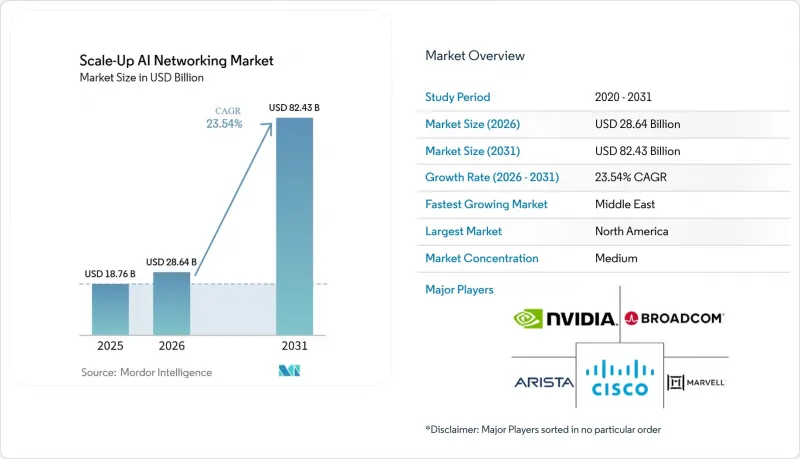
Mordor Intelligence에 의하면, 스케일업 AI 네트워킹 시장 규모는 2025년에 187억 6,000만 달러로 평가되었습니다. 2026년 286억 4,000만 달러에서 2031년까지 824억 3,000만 달러에 이를 것으로 예상되며, 예측 기간(2026-2031년) CAGR은 23.54%를 나타낼 전망입니다.
본 보고서는 제공 분야(하드웨어, 소프트웨어, 서비스), 패브릭 기술(자체 개발 가속기·스케일업 패브릭, 오픈 스케일업 패브릭 등), 스케일업 도메인 규모(액셀러레이터 8개 이하, 9-72개, 기타), 워크로드(AI 훈련, AI 추론 등), 최종 사용자(하이퍼스케일 클라우드 제공업체 등), 지역별로 분류되어 있습니다. 시장 예측은 금액(달러) 기준으로 제시되어 있습니다.
세계의 스케일업 AI 네트워킹 시장 동향 및 인사이트
AI 훈련 클러스터의 급속한 확대
스케일업 AI 네트워킹 시장은 AI 훈련 클러스터 규모의 급속한 확대에 힘입어 성장하고 있습니다. 이는 대규모 동기화 워크로드에서 네트워크 신뢰성이 부차적인 요건이 아닌 설계상의 핵심 요건이 되기 때문입니다. OpenAI는 훈련 중 클러스터 전체를 재시작해야만 했던 네트워크 중단 문제를 해결하기 위해, 자사의 'Multipath Reliable Connection' 프로토콜을 최대 규모의 NVIDIA GB200 슈퍼컴퓨터 전체에 도입했다고 발표했습니다. 이 프로토콜을 Open Compute Project에 기증하기로 한 결정은 최첨단 훈련 시스템이 점점 더 복잡해짐에 따라 스케일업 AI 네트워킹 시장이 신뢰성 확보를 위한 공통된 방식으로 전환되고 있음을 보여줍니다. 또한 이는 벤더의 포지셔닝에도 변화를 가져옵니다. 스케일업, 스케일아웃 및 운영 소프트웨어를 통합적으로 지원할 수 있는 공급업체는 클러스터 아키텍처가 랙, 열, 나아가 사이트 전체로 확장될 때 더 유리한 입지를 차지하게 되기 때문입니다. 그 결과, 스케일업 AI 네트워킹 시장은 단순한 구성 요소 판매의 범위를 넘어 풀스택 인프라 결정으로 전환되고 있습니다.
독점 규격 링크에서 오픈 이더넷 패브릭으로의 전환
또한, 스케일업 AI 네트워킹 시장은 오픈 이더넷 패브릭으로의 전환으로부터도 힘을 얻고 있습니다. 이는 구매자들이 가속기, 스위치, 제어 소프트웨어 간에 더 광범위한 상호 운용성을 요구하고 있기 때문입니다. Open Compute Project는 주요 반도체, 클라우드, 시스템 벤더가 참여하는 표준 기반 커뮤니티 활동으로서, 스케일업 AI 인프라용 이더넷을 정의하는 ESUN 이니셔티브를 출범시켰습니다. 울트라 이더넷 컨소시엄(Ultra Ethernet Consortium)은 AI 및 HPC 워크로드를 위한 이더넷 기반 통신 스택을 공식적으로 수립하고, 2026년에 이를 업데이트했습니다. 이를 통해 오픈 이더넷은 단순한 개념에서 준수성을 중시하는 방향으로 전환하는 데 기여했습니다. 이는 스케일업 AI 네트워킹 시장에서 중요한 의미를 지닙니다. AMD, 맞춤형 실리콘 또는 혼합 환경을 채택하는 고객들은 단일 가속기의 로드맵에 얽매이지 않는 패브릭을 필요로 하기 때문입니다. 또한 이는 차별화의 초점이 폐쇄적인 연결성에서 통합의 품질, 자동화, 그리고 대규모 상호 운용성을 입증하는 능력으로 이동하고 있음을 의미합니다.
스케일업 계층의 높은 전력 및 냉각 부하
전력과 냉각에 대한 압박은 스케일업 AI 네트워킹 시장에서 가장 명백한 제약 요인 중 하나입니다. 네트워크 장비가 현재 기존 데이터센터가 예상했던 것보다 훨씬 더 고밀도인 AI 인프라 환경 내에 설치되어 있기 때문입니다. Applied Thermal Engineering사와 IEEE ITherm은 모두 액체 냉각이 필수적인 방향이라고 지적하면서도, 배관, 냉각액 호환성 및 장기적인 유지보수 측면에서 복잡성이 증가하고 있다는 점도 언급하고 있습니다. Ciena사는 자사의 플러그인 방식 CPO 접근법을 통해 전력 소비를 최대 70%까지 줄일 수 있다고 밝혔으며, 이는 스케일업 AI 네트워킹 시장이 더 이상 대역폭뿐만 아니라 전력 및 성능 간의 상충 관계에 의해 크게 형성되고 있음을 보여줍니다. 이로 인해 새로운 열 요구 사항에 맞추어 설계할 수 있는 신규 캠퍼스가 유리해지는 반면, 구형 시설의 개보수 시에는 준비 기간이 길어지거나 통합 위험이 높아지는 문제에 직면하게 됩니다. 또한 이는 패브릭 선정이 현장 엔지니어링 및 도입 순서와 더욱 밀접하게 연결되고 있음을 의미합니다.
부문 분석
2025년에는 하드웨어가 매출의 90.11%를 차지하며, 물리 계층이 스케일업 AI 네트워킹 시장의 주요 지출 분야로 자리매김했습니다. 이러한 비중은 새로운 AI 클러스터를 구축하는 데 필요한 스위치, ASIC, 네트워크 인터페이스 카드, 케이블 및 광학 부품의 자본 집약성을 반영합니다. 또한 스케일업 AI 네트워킹 시장의 상당 부분은 여전히 구축 단계에 있으며, 구매자들은 우선 물리 계층의 대역폭, 토폴로지, 신뢰성을 확보한 후 오케스트레이션에 대한 지출을 확대하고 있음을 보여줍니다. 사업자들이 기존 패브릭 구축에 텔레메트리, 혼잡 제어, 자동화 도구를 추가함에 따라 소프트웨어는 2031년까지 연평균 성장률(CAGR) 24.21%로 가장 빠르게 성장하는 분야가 되었습니다.
스케일업 AI 네트워킹 업계가 더욱 복잡하고 분산된 클러스터 운영으로 전환됨에 따라 소프트웨어의 중요성은 더욱 커지고 있습니다. Ultra Ethernet Consortium의 사양은 AI 및 HPC 환경을 위한 표준 기반 소프트웨어 및 전송 프레임워크를 제공하며, 벤더를 초월한 공통 운영 방식의 보급을 촉진하고 있습니다. 또한 구글은 ‘Matryoshka’ 네트워크 설계 시스템을 통해 모델 기반 관리가 수년에 걸쳐 대규모 데이터센터 환경을 지원할 수 있음을 보여주었으며, 이는 스케일업 AI 네트워킹 시장에서 소프트웨어 계층의 장기적인 가치를 뒷받침합니다. 서비스 부문의 매출은 여전히 소규모이지만, 멀티사이트 AI 팩토리 아키텍처에는 전문적인 설계, 시운전 및 지속적인 지원이 필요하기 때문에 통합의 복잡성이 증가함에 따라 그 중요성은 높아지고 있습니다.
2025년에는 독자 사양의 가속기 스케일업 패브릭이 매출의 85.33%를 차지했습니다. 이는 스케일업 AI 네트워킹 시장에서 긴밀하게 통합된 가속기 생태계의 도입 실적이 가진 우위를 반영한 것입니다. 이러한 선두 위치는 하드웨어와 소프트웨어의 공동 설계를 통한 기술적 및 상업적 강점에 기인하며, 특히 대규모 훈련 시스템 도입을 위한 최단 경로를 모색하는 구매자들 사이에서 두드러졌습니다. 오픈 스케일업 패브릭은 2031년까지 연평균 성장률(CAGR)이 24.62%로 가장 빠르게 성장하는 부문이며, 비독점 사양의 가속기 옵션이 보급됨에 따라 고객들이 대안을 모색하고 있음을 보여줍니다. 오픈 스케일업 패브릭용 스케일업 AI 네트워킹 시장 규모는 더 폭넓은 실리콘 선택지와 더 긴 조달 주기를 수용할 수 있는 아키텍처에 대한 수요가 증가함에 따라 확대되고 있습니다.
AMD와 Celestica는 Helios 랙 스케일 AI 플랫폼에서 스케일업 연결에 'Ultra Accelerator Link over Ethernet'을 채택한다고 발표했습니다. 이를 통해 오픈 패브릭 분야는 단순한 표준화 논의에 그치지 않고, 보다 명확한 제품 로드맵이 제시될 것입니다. 이에 대응해 NVIDIA는 ‘NVLink Fusion’으로 대응하며, 인접 영역을 비경쟁 상태로 방치하지 않고 타사 맞춤형 XPU가 NVLink 칩렛을 통해 통합될 수 있도록 함으로써 자사의 생태계를 확장하고 있습니다. 또한 ESUN이나 Arista의 7060XE7 플랫폼을 통해 이더넷 기반 스케일업 패브릭도 주목을 받고 있지만, Ayar Labs의 광 칩렛 기술과 같은 초기 단계의 광 I/O 접근 방식은 여전히 개발 주기의 초기 단계에 머물러 있습니다. 스케일업 AI 네트워킹 시장에서 패브릭 간의 경쟁은 더 이상 단순한 연결 성능만으로 결정되는 것이 아니라, 로드맵 관리, 상호 운용성, 그리고 생태계의 깊이에 의해 정의되고 있습니다.
지역별 분석
2025년, 북미는 스케일업 AI 네트워킹 시장 점유율의 58.44%를 차지하며 계속해서 최대 지역 기여자로서의 지위를 유지했습니다. 이 지역은 하이퍼스케일러의 자본력, 가속기 생태계의 리더십, 그리고 개방형 표준에 대한 적극적인 참여가 결합되어 스케일업 AI 네트워킹 시장의 중심지로 자리매김하고 있습니다. 수요의 대부분은 미국이 차지하고 있지만, 캐나다는 연구 주도형 활동을, 멕시코는 신흥 코로케이션 및 니어쇼어 인프라에 대한 관심을 주도하고 있습니다. 또한 이더넷, UALink 및 랙스케일 AI 시스템을 구성하는 많은 기업과 업계 단체가 이 지역의 생태계와 밀접하게 연결되어 있어, 북미는 벤더와의 지리적 근접성 측면에서도 우위를 점하고 있습니다.
아시아태평양은 스케일업 AI 네트워킹 시장에서 두 번째로 큰 지역이며, 수요는 중국, 일본, 한국, 인도, 동남아시아로 확산되고 있습니다. 화웨이가 2026년 6월 MWC 상하이에서 10종의 AI용 광네트워크 제품을 발표한 것은 중국이 AI 중심의 광 및 네트워크 인프라 개발에 적극적으로 나서고 있음을 보여줍니다. 일본은 자국 주도의 컴퓨팅 전략과 광 인터커넥트 분야의 노력을 통해 기술적으로 중요한 위치를 계속 차지하고 있는 반면, 한국은 메모리 및 반도체 산업의 기반을 통해 보다 광범위한 생태계를 뒷받침하고 있습니다. 인도와 동남아시아는 AI 도입에 대한 의지가 높아짐에 따라 지역 내 디지털 인프라 구축이 확대되고 있어, 스케일업 AI 네트워킹 시장에서 성장세가 두드러지는 지역으로 부상하고 있습니다.
유럽, 중동 및 아프리카에서는 스케일업 AI 네트워킹 시장에서 서로 다른 수요 패턴이 관찰됩니다. 유럽은 2025년에 견조한 성장세를 기록했으며, 독일은 주요 데이터센터 입지이자 적어도 하나의 AI 기가팩토리에 대해 연방 정부의 지원을 받는 국가로서 두드러졌습니다. 이 지역의 성장 경로는 주권적 컴퓨팅에 대한 우선순위, 규정 준수 요건, 그리고 민관 조달 주기가 긴 점에 따라 좌우됩니다. 중동 및 아프리카는 각국 정부의 AI 투자와 대규모 캠퍼스 개발 계획에 힘입어 2031년까지 연평균 성장률(CAGR)이 24.42%에 달하며, 가장 빠르게 성장하는 지역입니다. 총 비용이 300억 달러를 초과하고 1단계가 2026년 3분기에 시작될 것으로 예상되는 ‘스타게이트 UAE’ 프로젝트는 이 지역이 정책적 목표에서 물리적 인프라 구축으로 얼마나 신속하게 전환하고 있는지를 보여줍니다. 남미는 여전히 발전의 초기 단계에 있으며, 수요는 코로케이션 확대와 아직 규모를 확장해 나가고 있는 국내 인프라 구축 프로그램에 집중되어 있습니다.
기타 혜택 :
- 엑셀 형식 시장 예측(ME) 시트
- 3개월간의 애널리스트 지원
자주 묻는 질문
목차
제1장 서론
제2장 조사 방법
제3장 주요 요약
제4장 시장 구도
제5장 시장 규모 및 성장 예측
제6장 경쟁 구도
제7장 시장 기회 및 향후 전망
KTH 26.08.10According to Mordor Intelligence, the scale-up AI networking market size was valued at USD 18.76 billion in 2025 and estimated to grow from USD 28.64 billion in 2026 to reach USD 82.43 billion by 2031, at a CAGR of 23.54% during the forecast period (2026-2031).
This report is Segmented by Offering (Hardware, Software, and Services), Fabric Technology (Proprietary Accelerator Scale-Up Fabrics, Open Scale-Up Fabrics, and More), Domain Size (Up To 8 Accelerators, 9 To 72 Accelerators, and More), Workload (AI Training, AI Inference, and More), End User (Hyperscale Cloud Providers, and More), and Geography. The Market Forecasts are Provided in Terms of Value (USD).
Global Scale-Up AI Networking Market Trends and Insights
Rapid Expansion of AI Training Clusters
The scale-up AI networking market is being pushed forward by the rapid increase in AI training cluster size, because larger synchronous workloads make network reliability a central design requirement rather than a secondary one. OpenAI said its Multipath Reliable Connection protocol was deployed across its largest NVIDIA GB200 supercomputers to address the network interruptions that had previously forced cluster-wide restarts during training. The decision to contribute that protocol to the Open Compute Project shows that the scale-up AI networking market is moving toward shared methods for reliability as frontier training systems become more complex. This also changes vendor positioning, because suppliers that can support scale-up, scale-out, and operational software together are better placed when cluster architectures expand across racks, rows, and sites. As a result, the scale-up AI networking market is widening beyond a component sale and moving closer to a full-stack infrastructure decision.
Migration From Proprietary Links to Open Ethernet Fabrics
The scale-up AI networking market is also gaining support from the move toward open Ethernet fabrics, because buyers want broader interoperability across accelerators, switches, and control software. The Open Compute Project launched the ESUN initiative to define Ethernet for scale-up AI infrastructure as a standards-based community effort with participation from major silicon, cloud, and systems vendors. The Ultra Ethernet Consortium formalized an Ethernet-based communication stack for AI and HPC workloads, then updated it in 2026, which helped turn open Ethernet from a concept into a compliance-driven path. In the scale-up AI networking market, that matters because customers adopting AMD, custom silicon, or mixed environments need a fabric that is not tied to a single accelerator roadmap. It also means differentiation is shifting away from closed connectivity alone and toward integration quality, automation, and the ability to prove interoperability at scale.
High Power and Cooling Load at Scale-Up Layer
Power and cooling pressure is one of the clearest restraints on the scale-up AI networking market because network equipment now sits inside much denser AI infrastructure environments than conventional data halls were built for. Applied Thermal Engineering and IEEE ITherm both point to liquid cooling as a necessary direction, but they also note added complexity in plumbing, coolant compatibility, and long-term serviceability. Ciena said its pluggable CPO approach can reduce power consumption by up to 70%, which shows how strongly the scale-up AI networking market is now being shaped by power-performance tradeoffs rather than bandwidth alone. This favors greenfield campuses that can be designed around new thermal requirements, while retrofits in older facilities face longer readiness cycles and higher integration risk. It also means fabric decisions are becoming tied more closely to site engineering and deployment sequencing.
Other drivers and restraints analyzed in the detailed report include:
- Higher Rack-Level Bandwidth Density Requirements
- Co-Packaged Optics and Silicon Photonics Adoption
- Supply Chain Dependence for High-Speed Switch Silicon and Optics
For complete list of drivers and restraints, kindly check the Table Of Contents.
Segment Analysis
Hardware held 90.11% of revenue in 2025, which kept the physical layer as the main spending center of the scale-up AI networking market. That mix reflects the capital intensity of switches, ASICs, network interface cards, cables, and optical components required to stand up new AI clusters. It also shows that much of the scale-up AI networking market is still in a build phase where buyers first secure bandwidth, topology, and reliability at the physical layer before widening spend into orchestration. Software is the fastest-growing offering at a 24.21% CAGR through 2031, as operators add telemetry, congestion control, and automation tools around existing fabric deployments.
The software case is becoming stronger because the scale-up AI networking industry is moving toward more complex and distributed cluster operations. The Ultra Ethernet Consortium's specification provides a standards-driven software and transport framework for AI and HPC environments, which supports wider use of common operational methods across vendors. Google also showed through its Matryoshka network design system that model-driven management can support large data center estates over multiple years, which reinforces the long-run value of software layers in the scale-up AI networking market. Services remain smaller in revenue, but they rise with integration complexity because multi-site AI factory architectures need specialized design, commissioning, and ongoing support.
Proprietary accelerator scale-up fabrics held 85.33% of revenue in 2025, which reflected the installed base advantage of tightly integrated accelerator ecosystems in the scale-up AI networking market. That lead came from the technical and commercial strength of hardware-software co-design, especially where buyers wanted the shortest path to large training system deployment. Open scale-up fabrics are the fastest-growing segment at a 24.62% CAGR through 2031, which shows that customers are looking for alternatives as non-proprietary accelerator options gain traction. The scale-up AI networking market size for open scale-up fabrics is rising with demand for architectures that can work across broader silicon choices and longer procurement cycles.
AMD and Celestica said the Helios rack-scale AI platform will use Ultra Accelerator Link over Ethernet for scale-up connectivity, which gives the open fabric segment a clearer product path rather than just a standards narrative. NVIDIA responded with NVLink Fusion, which extends its ecosystem by allowing third-party custom XPUs to integrate through NVLink chiplets instead of leaving that adjacent space uncontested. Ethernet-based scale-up fabrics are also becoming more visible through ESUN and Arista's 7060XE7 platforms, while early optical I/O approaches such as Ayar Labs' optical chiplet work remain earlier in the development cycle. In the scale-up AI networking market, fabric competition is now defined less by raw connectivity alone and more by roadmap control, interoperability, and ecosystem depth.
Complete Report Scope:
- By Offering
- Hardware
- Software
- Services
- By Fabric Technology
- Proprietary Accelerator Scale-Up Fabrics
- Open Scale-Up Fabrics
- Ethernet-Based Scale-Up Fabrics
- Other Emerging Scale-Up Fabrics
- By Scale-Up Domain Size
- Up to 8 Accelerators
- 9 to 72 Accelerators
- 73 to 256 Accelerators
- Above 256 Accelerators
- By Workload
- AI Training
- AI Inference
- Fine-Tuning and Model Adaptation
- HPC and Scientific Computing
- Other Workloads
- By End User
- Hyperscale Cloud Providers
- AI Cloud and GPU-as-a-Service Providers
- Enterprise Data Centers
- Government, Research, and HPC Centers
- Colocation Data Centers
- By Geography
- North America
- United States
- Canada
- Mexico
- Europe
- Germany
- United Kingdom
- France
- Italy
- Rest of Europe
- Asia-Pacific
- China
- Japan
- South Korea
- India
- Southeast Asia
- Rest of Asia-Pacific
- South America
- Middle East and Africa
- North America
Geography Analysis
North America held 58.44% of the scale-up AI networking market share in 2025, which kept it as the largest regional contributor. The region remains the center of the scale-up AI networking market because it combines hyperscaler capital, accelerator ecosystem leadership, and strong participation in open standards efforts. The United States accounts for most of that demand, while Canada adds research-led activity and Mexico supports emerging colocation and nearshore infrastructure interest. North America also has an advantage in vendor proximity, because several of the companies and industry groups shaping Ethernet, UALink, and rack-scale AI systems are closely tied to the regional ecosystem.
Asia-Pacific is the second-largest geography in the scale-up AI networking market, with demand spread across China, Japan, South Korea, India, and Southeast Asia. Huawei's June 2026 launch of 10 AI-Optical Network products at MWC Shanghai showed that China is pushing actively into AI-centric optical and network infrastructure development. Japan remains technically important through sovereign computing priorities and optical interconnect work, while South Korea supports the broader ecosystem through its memory and semiconductor base. India and Southeast Asia are growing parts of the scale-up AI networking market because regional digital infrastructure buildouts are expanding alongside AI deployment ambitions.
Europe and the Middle East and Africa show different demand patterns within the scale-up AI networking market. Europe recorded solid momentum in 2025, with Germany standing out as a major data center location and as a recipient of federal support for at least one AI Gigafactory. The region's growth path is tied to sovereign compute priorities, compliance requirements, and longer public-private procurement cycles. The Middle East and Africa is the fastest-growing geography at a 24.42% CAGR through 2031, supported by sovereign AI investment and large campus-scale development plans. The Stargate UAE project, with total cost exceeding USD 30 billion and Phase 1 expected in Q3 2026, shows how quickly the region is moving from policy ambition to physical infrastructure commitment. South America remains earlier in development, with demand centered on colocation growth and domestic infrastructure programs that are still building scale.
- NVIDIA Corporation
- Broadcom Inc.
- Cisco Systems, Inc.
- Arista Networks, Inc.
- Marvell Technology, Inc.
- Hewlett Packard Enterprise Company
- Juniper Networks, Inc.
- Huawei Technologies Co., Ltd.
- Dell Technologies Inc.
- Intel Corporation
- Celestica Inc.
- Accton Technology Corporation
- Foxconn Interconnect Technology Limited
- Quanta Computer Inc.
- Nokia Corporation
- Extreme Networks, Inc.
- NEC Corporation
- ZTE Corporation
- Ciena Corporation
- Coherent Corp.
- Lumentum Holdings Inc.
Additional Benefits:
- The market estimate (ME) sheet in Excel format
- 3 months of analyst support
TABLE OF CONTENTS
1 INTRODUCTION
- 1.1 Study Assumptions and Market Definition
- 1.2 Scope of the Study
2 RESEARCH METHODOLOGY
3 EXECUTIVE SUMMARY
4 MARKET LANDSCAPE
- 4.1 Market Overview
- 4.2 Market Drivers
- 4.2.1 Rapid Expansion of AI Training Clusters
- 4.2.2 Migration From Proprietary Links To Open Ethernet Fabrics
- 4.2.3 Higher Rack-Level Bandwidth Density Requirements
- 4.2.4 Co-Packaged Optics And Silicon Photonics Adoption
- 4.2.5 AI-Ready Network Automation And Telemetry Adoption
- 4.2.6 Sovereign AI Infrastructure Buildouts In Key Markets
- 4.3 Market Restraints
- 4.3.1 High Power And Cooling Load At Scale-Up Layer
- 4.3.2 Supply Chain Dependence For High-Speed Switch Silicon And Optics
- 4.3.3 Interoperability Gaps Between Vendor Ecosystems
- 4.3.4 Immature Standards Across Emerging Scale-Up Architectures
- 4.4 Impact of Macroeconomic Factors on the Market
- 4.5 Industry Value Chain Analysis
- 4.6 Regulatory Landscape
- 4.7 Technological Outlook
- 4.8 Porter's Five Forces Analysis
- 4.8.1 Threat of New Entrants
- 4.8.2 Bargaining Power of Suppliers
- 4.8.3 Bargaining Power of Buyers
- 4.8.4 Threat of Substitutes
- 4.8.5 Industry Rivalry
5 MARKET SIZE AND GROWTH FORECASTS (VALUE)
- 5.1 By Offering
- 5.1.1 Hardware
- 5.1.2 Software
- 5.1.3 Services
- 5.2 By Fabric Technology
- 5.2.1 Proprietary Accelerator Scale-Up Fabrics
- 5.2.2 Open Scale-Up Fabrics
- 5.2.3 Ethernet-Based Scale-Up Fabrics
- 5.2.4 Other Emerging Scale-Up Fabrics
- 5.3 By Scale-Up Domain Size
- 5.3.1 Up to 8 Accelerators
- 5.3.2 9 to 72 Accelerators
- 5.3.3 73 to 256 Accelerators
- 5.3.4 Above 256 Accelerators
- 5.4 By Workload
- 5.4.1 AI Training
- 5.4.2 AI Inference
- 5.4.3 Fine-Tuning and Model Adaptation
- 5.4.4 HPC and Scientific Computing
- 5.4.5 Other Workloads
- 5.5 By End User
- 5.5.1 Hyperscale Cloud Providers
- 5.5.2 AI Cloud and GPU-as-a-Service Providers
- 5.5.3 Enterprise Data Centers
- 5.5.4 Government, Research, and HPC Centers
- 5.5.5 Colocation Data Centers
- 5.6 By Geography
- 5.6.1 North America
- 5.6.1.1 United States
- 5.6.1.2 Canada
- 5.6.1.3 Mexico
- 5.6.2 Europe
- 5.6.2.1 Germany
- 5.6.2.2 United Kingdom
- 5.6.2.3 France
- 5.6.2.4 Italy
- 5.6.2.5 Rest of Europe
- 5.6.3 Asia-Pacific
- 5.6.3.1 China
- 5.6.3.2 Japan
- 5.6.3.3 South Korea
- 5.6.3.4 India
- 5.6.3.5 Southeast Asia
- 5.6.3.6 Rest of Asia-Pacific
- 5.6.4 South America
- 5.6.5 Middle East and Africa
- 5.6.1 North America
6 COMPETITIVE LANDSCAPE
- 6.1 Market Concentration
- 6.2 Strategic Moves
- 6.3 Market Share Analysis
- 6.4 Company Profiles (includes Global Level Overview, Market Level Overview, Core Segments, Financials as available, Strategic Information, Market Rank/Share, Products and Services, Recent Developments)
- 6.4.1 NVIDIA Corporation
- 6.4.2 Broadcom Inc.
- 6.4.3 Cisco Systems, Inc.
- 6.4.4 Arista Networks, Inc.
- 6.4.5 Marvell Technology, Inc.
- 6.4.6 Hewlett Packard Enterprise Company
- 6.4.7 Juniper Networks, Inc.
- 6.4.8 Huawei Technologies Co., Ltd.
- 6.4.9 Dell Technologies Inc.
- 6.4.10 Intel Corporation
- 6.4.11 Celestica Inc.
- 6.4.12 Accton Technology Corporation
- 6.4.13 Foxconn Interconnect Technology Limited
- 6.4.14 Quanta Computer Inc.
- 6.4.15 Nokia Corporation
- 6.4.16 Extreme Networks, Inc.
- 6.4.17 NEC Corporation
- 6.4.18 ZTE Corporation
- 6.4.19 Ciena Corporation
- 6.4.20 Coherent Corp.
- 6.4.21 Lumentum Holdings Inc.
7 MARKET OPPORTUNITIES AND FUTURE OUTLOOK
- 7.1 White-Space and Unmet-Need Assessment


