
|
시장보고서
상품코드
2132776
바이오시밀러 시장 예측(-2036년) : 약제 클래스별, 적응증별, 지역별Biosimilars Market by Drug Class (mAbs, GCSF, Insulin, Anticoagulant, rhGH, Teriparatide, GLP-1), Indication (Oncology, Autoimmune, Diabetes, Obesity), Competitive Landscape, Region - Global Forecast to 2036 |
||||||

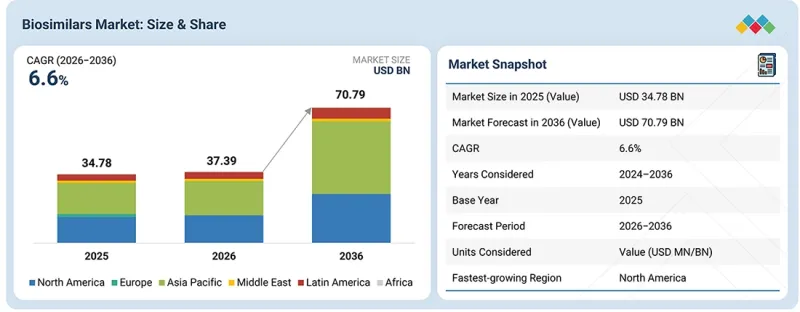
바이오시밀러 시장 규모는 2026년 추정 373억 9,000만 달러에서 2036년에는 707억 9,000만 달러에 달할 것으로 예측되고 있으며, 예측 기간 중 CAGR은 6.6%에 달할 전망입니다.
시장 성장은 주로 바이오시밀러의 안전성, 유효성 및 호환성에 대한 의식의 향상와 교육 활동에 힘입어 주도되고 있으며, 그 결과 의료 종사자와 환자들 사이에서 수용도가 높아지고 있습니다.
| 조사 범위 | |
|---|---|
| 조사 대상 기간 | 2026-2031년 |
| 기준연도 | 2025 |
| 예측 기간 | 2026-2031년 |
| 산정 단위 | 금액(10억 달러) |
| 부문 | 약제 클래스별, 적응증별, 지역별 |
| 대상 지역 | 북미, 유럽, 아시아태평양, 라틴아메리카, 중동 및 아프리카 |
동시에, 공공 및 민간 의료제도에서 유리한 보험 적용 범위와 환급 정책이 바이오시밀러 치료의 합리적인 가격과 접근성을 향상시킴으로써 그 보급을 지원하고 있습니다. 의료비 절감과 비용 대비 효과가 높은 생물제제 치료에 대한 환자의 접근성 확대에 대한 수요가 높아짐에 따라 시장 수요는 더욱 가속화되고 있습니다.
그러나 바이오시밀러의 개발 및 제조는 첨단 기술, 엄격한 품질관리, 그리고 막대한 투자를 필요로 하므로 그 복잡성이 증가하고 있으며, 시장 확대에 제약이 따르고 있습니다. 또한 동일한 치료 분야에서 경쟁하는 바이오시밀러의 수가 증가함에 따라 특히 성숙한 시장에서 가격 경쟁과 이익률에 대한 압박이 커지고 있습니다. 이러한 요인들로 인해 바이오시밀러의 이용 확대와 시장 침투는 지속되겠지만, 예측 기간 중의 시장 성장은 완만해질 것으로 예상됩니다.
모노클로널 항체 부문은 조사 기간 중 가장 높은 성장률을 보일 것으로 예상됩니다.
약제 분류별로는 인플릭시맙, 렙틸리맙, 아달리무맙, 트라스투주맙, 펨브롤리주맙, 듀필루맙, 우스테키누맙, 리산키주맙, 달라주맙, 니볼루맙 및 기타 mAb가 종양학,자가면역 질환, 만성 염증성 질환 및 특정 감염증 분야에서 널리 사용되고 있다는 점이 배경이 됩니다. 암 및 자가면역 질환의 유병률 증가에 더해, 적격 환자 수의 확대와 생물제제 요법의 이용 확대가 맞물리면서 mAb 바이오시밀러에 대한 수요가 더욱 높아질 것으로 예상됩니다. 또한 몇몇 고부가가치 참조 생물제제에 대해 특허 및 규제상의 독점권이 만료될 것으로 예상됨에 따라 바이오시밀러 제조사에게는 대규모의 확립된 치료 시장에 진입할 기회가 생길 것입니다.
mAb는 암, 류마티스 관절염, 건선, 염증성 장 질환 및 기타 만성적이고 생명을 위협할 수 있는 질환의 치료에 널리 사용되고 있으며, 그 수요는 고령화와 만성질환 부담의 증가에 의해 더욱 지원되고 있습니다. 바이오시밀러라는 대체 수단이 이용 가능해짐에 따라 특히 비용에 민감한 의료 시스템에서 치료비 절감, 환자의 접근성 확대, 그리고 생물제제 요법의 이용 촉진이 도모될 것입니다. 향후 10년 동안 여러 고부가가치 mAb의 독점권이 만료될 것으로 예상됨에 따라 더 많은 제약사와 바이오기술 기업이 시장에 진입하여 경쟁이 격화되는 동시에 전 세계 바이오시밀러 시장이 확대될 전망입니다. 따라서 mAb 참조 제품의 폭넓은 치료 용도와 특히 종양학 및 면역학 분야에서의 큰 상업적 가치로 인해 모노클로널 항체 바이오시밀러는 2036년까지 시장 성장의 주요 원동력이 될 것으로 기대됩니다.
예측 기간 중 미국은 가장 높은 연평균 성장률(CAGR)을 기록할 것으로 전망됩니다.
국가별로 보면 2026-2036년에 걸친 전 세계 바이오시밀러 시장에서 미국이 가장 높은 연평균 성장률(CAGR)을 기록할 것으로 예상됩니다. 이는 바이오시밀러 출시 건수의 증가, 고부가가치 생물제제의 독점권 상실, 지불자 측의 수용도 향상, 그리고 ‘생물제제 가격 경쟁 및 혁신법(BPCIA)’에 기반한 규제 체계의 지속적인 정비에 힘입은 결과입니다. 미국 시장은 더 많은 참조 생물제제가 특허 및 규제상의 독점권을 상실함에 따라 바이오시밀러가 대폭 확대되는 시기에 접어들었으며, 종양학, 면역학, 안과, 내분비학 등 고부가가치 치료 분야 전반에 걸쳐 기회가 창출되고 있습니다.
스텔라라(우스테키누맙), 아이레아(아플라벨셉트) 및 기타 고부가가치 참조 제품을 포함한 주요 생물제제에 대한 바이오시밀러의 상용화로 인해 예측 기간 중 대상 시장이 크게 확대될 것으로 전망됩니다. 미국에서는 2023년부터 ‘휴미라(아달리무맙)’의 바이오시밀러가 도입된 이래, Amgen, Boehringer Ingelheim, Sandoz를 비롯한 여러 제조사가 시장에 진입하여 이미 치열한 경쟁이 펼쳐지고 있습니다. 제약사 간의 경쟁 심화는 가격 하락과 보험사 및 처방약 리스트에 대한 접근성 확대에 기여하고 있으며, 일부 바이오시밀러에 대한 상호 대체성 인정은 대체 및 채택을 더욱 촉진할 것으로 예상됩니다.
또한 의사, 환자, 보험사, 의료 제공자 간의 인지도 제고와 더불어, 합리적인 가격 실현 및 의료비 절감을 목표로 한 연방 정부의 노력까지 더해져 바이오시밀러의 지속적인 보급이 지원될 것으로 예상됩니다. 상호 대체가 인정된 바이오시밀러의 수가 증가하고, 이해관계자들이 참조 생물제제와 바이오시밀러로의 전환에 대한 경험을 쌓아감에 따라 도입은 가속화될 것으로 예상됩니다. 이러한 요인들에 더해, 미국의 거대한 생물제제 시장, 높은 의료비, 방대한 적격 환자 수, 그리고 바이오시밀러 경쟁 제품들의 지속적인 진입이 맞물리면서, 2036년까지 미국은 바이오시밀러 시장에서 가장 빠르게 성장하고 상업적으로 가장 매력적인 시장 중 하나가 될 것으로 예상됩니다.
이 보고서에서 다룬 주요 기업 리스트:
바이오시밀러 시장의 주요 기업은 Sandoz Group AG(스위스), Pfizer Inc.(미국), Amgen Inc.(미국), Celltrion Inc.(한국), Biocon Limited(인도),Dr. Reddy's Laboratories Ltd.(인도), Eli Lilly and Company(미국), Teva Pharmaceutical Industries Ltd.(이스라엘), Fresenius Kabi AG(독일), Stada Arzneimittel AG(독일), Boehringer Ingelheim International GmbH(독일),삼성바이오에피스(한국), Amneal Pharmaceuticals, Inc.(미국), Bio-Thera Solutions, Ltd.(중국), Aprogen Inc.(한국), Shanghai Henlius Biotech, Inc.(중국), Alvotech(아이슬란드)입니다.
조사 범위:
본 조사 보고서에서는 바이오시밀러 시장을 약물 분류별(모노클로널 항체, 과립구 콜로니 자극인자(G-CSF), 인슐린, 에리스로포이에틴, 재조합 인간성장호르몬, 에타넬셉트, 폴리트로핀, 테리파라티드, 인터페론, 항응고제,아프리벨셉트, GLP-1 작용제 및 기타 약물 분류), 적응증별(종양학, 염증성·자가면역 질환, 만성질환, 혈액 질환, 성장호르몬 결핍증, 감염증, 제2형 당뇨병, 비만 및 기타 적응증), 그리고 지역별(북미, 유럽,아시아태평양, 라틴아메리카, 중동 및 아프리카)별로 분류하고 있습니다.
이 보고서의 조사 범위에는 바이오시밀러 시장의 성장에 영향을 미치는 주요 요인(촉진요인, 제약 요인, 과제 및 기회 등)에 대한 상세한 정보가 포함되어 있습니다. 주요 업계 플레이어에 대한 심층 분석을 통해 각 기업의 사업 개요, 제품, 솔루션, 주요 전략, 제휴, 파트너십 및 계약에 대한 인사이트를 제공합니다.
이 보고서를 구매할 때의 주요 이점:
이 보고서는 바이오시밀러 시장 전체 및 그 하위 부문의 매출에 대해 가장 정확한 추정치를 제공함으로써, 시장을 선도하는 기업과 신규 진입 기업을 지원합니다. 또한 이해관계자가 경쟁 구도를 더 깊이 이해하고, 자사의 비즈니스를 더 유리한 위치에 놓을 수 있는 인사이트를 얻어, 적절한 시장 진입 전략을 수립하는 데에도 도움이 됩니다. 이 보고서를 통해 이해관계자는 시장 동향을 파악하고, 주요 시장 촉진요인, 시장 억제요인, 기회 및 과제에 대한 정보를 얻을 수 있습니다.
이 보고서는 다음과 같은 사항에 대한 인사이트를 제공합니다. :
- 주요 촉진요인(블록버스터 바이오의약품의 특허 만료, 의료비 억제 및 유리한 환급 정책, 의사 및 환자별 바이오시밀러에 대한 수용도 증가, 규제 조화 및 바이오시밀러의 신속한 승인 절차) 및 제약 요인(바이오시밀러 간의 치열한 경쟁에 따른 가격 하락, 높은 개발·제조 비용,신흥 시장의 규제 복잡성, 특정 지역의 의사 신뢰도 저하), 기회(고부가가치 바이오의약품의 차기 특허 만료, 신흥 시장 진출, 호환성 및 약국에서의 자동 대체, 국내 바이오의약품 제조에 대한 정부의 인센티브),및 과제(바이오시밀러 제조사 간의 경쟁 심화, 오리지널 의약품의 수명주기관리 전략, 제조 능력 및 공급망의 복잡성)에 대해 인사이트를 제공합니다.
- 제품 개발/혁신: 바이오시밀러 시장의 향후 기술 및 연구개발 활동에 대한 상세 인사이트.
- 시장 개발: 수익성이 높은 시장에 대한 포괄적인 정보입니다. 이 보고서에서는 다양한 지역에 걸친 시장을 분석하고 있습니다.
- 시장 다각화: 바이오시밀러 시장의 미개발 지역, 최근 동향 및 투자에 대한 포괄적인 정보.
- 경쟁 평가: 주요 기업의 시장 점유율, 성장 전략 및 제품 라인업에 대한 상세한 평가입니다. 바이오시밀러 시장의 주요 기업에 대한 상세한 분석을 통해 각 기업의 주요 전략, 제품 출시 및 승인, 인수, 제휴, 계약, 합작 투자, 기타 최근 동향, 투자 및 자금 조달 활동, 브랜드 및 제품 비교 분석, 그리고 공급업체의 기업 가치 평가 및 재무 지표에 대한 인사이트를 제공합니다.
자주 묻는 질문
목차
제1장 서론
제2장 개요
제3장 주요 인사이트
제4장 시장 개요
제5장 업계 동향
제6장 기술 진보, AI에 의한 영향, 특허, 혁신, 향후 응용
제7장 지속가능성과 규제 상황
제8장 고객 상황과 구매 행동
제9장 바이오시밀러 시장(약제 클래스별)
제10장 바이오시밀러 시장(적응증별)
제11장 바이오시밀러 시장(지역별)
제12장 경쟁 구도
제13장 기업 개요
제14장 조사 방법
제15장 부록
KSA 26.10.01The biosimilars market is projected to reach USD 70.79 billion by 2036 from an estimated USD 37.39 billion in 2026, registering a CAGR of 6.6% during the forecast period. Market growth is primarily driven by increasing awareness and education regarding the safety, efficacy, and interchangeability of biosimilars, resulting in increased acceptance among healthcare providers and patients.
| Scope of the Report | |
|---|---|
| Years Considered for the Study | 2026-2031 |
| Base Year | 2025 |
| Forecast Period | 2026-2031 |
| Units Considered | Value (USD billion) |
| Segments | Drug Class and Indication |
| Regions covered | North America, Europe, Asia Pacific, Latin America, Middle East, and Africa |
In parallel, favorable insurance coverage and reimbursement policies across public and private healthcare systems are supporting broader adoption by improving the affordability and accessibility of biosimilar therapies. The growing need to reduce healthcare expenditure and expand patient access to cost-effective biologic treatments is further accelerating demand.
However, the market's expansion is constrained by the increasing complexity of biosimilar development and manufacturing, which requires sophisticated technologies, stringent quality controls, and substantial investment. In addition, the growing number of biosimilars competing within the same therapeutic categories is intensifying price competition and margin pressure, particularly in mature markets. These factors are expected to moderate market growth over the forecast period despite continued expansion in biosimilar utilization and market penetration.
The monoclonal antibodies segment is expected to witness the highest growth rate during the study period.
By drug class, the monoclonal antibodies (mAbs) segment is expected to register the highest CAGR during the forecast period, supported by the extensive use of biologics such as Infliximab, Rituximab, Adalimumab, Trastuzumab, Pembrolizumab, Dupilumab, Ustekinumab, Risankizumab, Daratumumab, Nivolumab, and other mAbs across oncology, autoimmune diseases, chronic inflammatory conditions, and selected infectious diseases. The growing prevalence of cancer and autoimmune disorders, combined with an expanding eligible patient population and increasing utilization of biologic therapies, is expected to strengthen demand for mAb biosimilars. In addition, the anticipated loss of patent and regulatory exclusivity for several high-value reference biologics will create opportunities for biosimilar manufacturers to enter large and established therapeutic markets.
mAbs are widely used in the management of cancer, rheumatoid arthritis, psoriasis, inflammatory bowel disease, and other chronic and potentially life-threatening conditions, with demand further supported by an aging population and the increasing burden of chronic diseases. The availability of biosimilar alternatives can reduce treatment costs, expand patient access, and encourage greater utilization of biologic therapies, particularly in cost-sensitive healthcare systems. Over the next decade, the expected loss of exclusivity of multiple high-value mAbs is likely to attract additional pharmaceutical and biotechnology companies, intensifying competition and expanding the global biosimilar landscape. The broad therapeutic applicability and substantial commercial value of mAb reference products, particularly across oncology and immunology, are therefore expected to make monoclonal antibody biosimilars a major contributor to market growth through 2036.
The US is expected to register the highest CAGR during the forecast period.
By country, the US is expected to register the highest CAGR in the global biosimilars market between 2026 and 2036, supported by the growing number of biosimilar launches, loss of exclusivity of high-value biologics, increasing payer acceptance, and continued development of the regulatory framework under the Biologics Price Competition and Innovation Act (BPCIA). The US market is entering a period of significant biosimilar expansion as additional reference biologics lose patent and regulatory exclusivity, creating opportunities across high-value therapeutic areas such as oncology, immunology, ophthalmology, and endocrinology.
The commercialization of biosimilars to major biologics, including Stelara (ustekinumab), Eylea (aflibercept), and other high-value reference products, is expected to substantially expand the addressable market during the forecast period. The US has already demonstrated strong competitive activity following the introduction of biosimilars to Humira (adalimumab) beginning in 2023, with multiple manufacturers, including Amgen, Boehringer Ingelheim, and Sandoz, entering the market. Increasing competition among manufacturers has contributed to lower prices and broader payer and formulary access, while interchangeability designations for selected biosimilars can further facilitate substitution and adoption.
In addition, growing awareness among physicians, patients, payers, and healthcare providers, together with federal initiatives aimed at improving affordability and reducing healthcare expenditure, is expected to support continued biosimilar uptake. As the number of interchangeable biosimilars increases and stakeholders gain greater experience with switching between reference biologics and biosimilars, adoption is expected to accelerate. These factors, combined with the large US biologics market, high healthcare expenditure, substantial eligible patient population, and continued influx of biosimilar competitors, are expected to position the US as one of the fastest-growing and most commercially attractive markets for biosimilars through 2036.
The primary interviews conducted for this report can be categorized as follows:
- By Respondent: Supply Side (70%) and Demand Side (30%)
- By Designation: Managers (45%), CXOs & Directors (30%), and Executives (25%)
- By Region: North America (40%), Europe (25%), Asia Pacific (20%), Latin America (10%), and Middle East & Africa (5%)
List of Key Companies Profiled in the Report:
Key players in the biosimilars market include Sandoz Group AG (Switzerland), Pfizer Inc. (US), Amgen Inc. (US), Celltrion Inc. (South Korea), Biocon Limited (India), Dr. Reddy's Laboratories Ltd. (India), Eli Lilly and Company (US), Teva Pharmaceutical Industries Ltd. (Israel), Fresenius Kabi AG (Germany), Stada Arzneimittel AG (Germany), Boehringer Ingelheim International GmbH (Germany), Samsung Bioepis Co., Ltd. (South Korea), Amneal Pharmaceuticals, Inc. (US), Bio-Thera Solutions, Ltd. (China), Aprogen Inc. (South Korea), Shanghai Henlius Biotech, Inc. (China), and Alvotech (Iceland).
Research Coverage:
This research report categorizes the biosimilars market by drug class (Monoclonal Antibodies, Granulocyte Colony-Stimulating Factor (G-CSF), Insulin, Erythropoietin, Recombinant Human Growth Hormone, Etanercept, Follitropin, Teriparatide, Interferons, Anticoagulants, Aflibercept, GLP-1 Agonist, and Other Drug Classes), indication (Oncology, Inflammatory & Autoimmune Diseases, Chronic Diseases, Blood Disorders, Growth Hormone Deficiencies, Infectious Diseases, Type II Diabetes, Obesity, and Other Indications), and region (North America, Europe, Asia Pacific, Latin America, the Middle East, and Africa).
The scope of the report covers detailed information regarding the major factors, such as drivers, restraints, challenges, and opportunities, influencing the growth of the biosimilars market. A detailed analysis of key industry players has been conducted to provide insights into their business overviews, products, solutions, key strategies, collaborations, partnerships, and agreements.
Key Benefits of Buying the Report:
The report will help market leaders and new entrants by providing the closest approximations of revenue for the overall biosimilars market and its subsegments. It will also help stakeholders better understand the competitive landscape, gain more insights into better positioning of their businesses, and develop suitable go-to-market strategies. This report will enable stakeholders to understand the market's pulse and provide information on key drivers, restraints, opportunities, and challenges.
The report provides insights into the following pointers:
- Analysis of key drivers (Patent expiry of blockbuster biologics, Healthcare cost-containment & favorable reimbursement policies, Increasing physician & patient acceptance of biosimilars, Regulatory harmonization & faster biosimilar approval pathways), restraints (Price erosion due to intense biosimilar competition, High development & manufacturing costs, Regulatory complexity across emerging markets, Limited physician confidence in certain regions), opportunities (Next-wave patent expiries of high-value biologics, Expansion into emerging markets, Interchangeability & automatic pharmacy substitution, Government incentives for domestic biologics manufacturing), and challenges (Intensifying competition among biosimilar manufacturers, Originator lifecycle management strategies, Manufacturing capacity & supply chain complexity).
- Product Development/Innovation: Detailed insights into upcoming technologies and research & development activities in the biosimilars market.
- Market Development: Comprehensive information about lucrative markets. The report analyses the market across varied regions.
- Market Diversification: Exhaustive information about untapped geographies, recent developments, and investments in the biosimilars market.
- Competitive Assessment: In-depth assessment of market shares, growth strategies, and product offerings of leading players. A detailed analysis of the key industry players has been carried out to provide insights into their key strategies, product launches/approvals, acquisitions, partnerships, agreements, collaborations, other recent developments, investments & funding activities, brand/product comparative analysis, and vendor valuation & financial metrics of the biosimilars market.
TABLE OF CONTENTS
1 INTRODUCTION
- 1.1 STUDY OBJECTIVES
- 1.2 MARKET DEFINITION
- 1.3 INCLUSIONS AND EXCLUSIONS
- 1.4 STUDY SCOPE
- 1.4.1 SEGMENTS CONSIDERED
- 1.4.2 YEARS CONSIDERED
- 1.4.3 CURRENCY CONSIDERED
- 1.5 STAKEHOLDERS
- 1.6 SUMMARY OF CHANGES
2 EXECUTIVE SUMMARY
- 2.1 MARKET HIGHLIGHTS AND KEY INSIGHTS
- 2.2 KEY MARKET PARTICIPANTS: MAPPING OF STRATEGIC DEVELOPMENTS
- 2.3 DISRUPTIVE TRENDS IN BIOSIMILARS MARKET
- 2.4 HIGH-GROWTH SEGMENTS
- 2.5 REGIONAL SNAPSHOT: MARKET SIZE, GROWTH RATE, AND FORECAST
3 PREMIUM INSIGHTS
- 3.1 BIOSIMILARS MARKET OVERVIEW
- 3.2 NORTH AMERICA: BIOSIMILARS MARKET, BY DRUG CLASS
- 3.3 BIOSIMILARS MARKET: GEOGRAPHIC GROWTH OPPORTUNITIES
- 3.4 BIOSIMILARS MARKET SHARE, BY INDICATION, 2026 VS. 2036 (%)
4 MARKET OVERVIEW
- 4.1 INTRODUCTION
- 4.2 MARKET DYNAMICS
- 4.2.1 DRIVERS
- 4.2.1.1 Patent Expiry of Blockbuster Biologics
- 4.2.1.2 Healthcare Cost-Containment and Favorable Reimbursement Policies
- 4.2.1.3 Increasing Physician and Patient Acceptance of Biosimilars
- 4.2.1.4 Regulatory Harmonization and Faster Biosimilar Approval Pathways
- 4.2.2 RESTRAINTS
- 4.2.2.1 Price Erosion Due to Intense Biosimilar Competition
- 4.2.2.2 High Development and Manufacturing Costs
- 4.2.2.3 Regulatory Complexity Across Emerging Markets
- 4.2.2.4 Limited Physician Confidence in Certain Regions
- 4.2.3 OPPORTUNITIES
- 4.2.3.1 Next-Wave Patent Expiries of High-Value Biologics
- 4.2.3.2 Expansion into Emerging Markets
- 4.2.3.3 Interchangeability & Automatic Pharmacy Substitution
- 4.2.3.4 Government Incentives for Domestic Biologics Manufacturing
- 4.2.4 CHALLENGES
- 4.2.4.1 Intensifying Competition Among Biosimilar Manufacturers
- 4.2.4.2 Originator Lifecycle Management Strategies
- 4.2.4.3 Manufacturing Capacity & Supply Chain Complexity
- 4.2.1 DRIVERS
- 4.3 UNMET NEEDS & WHITE SPACES
- 4.4 INTERCONNECTED MARKETS & CROSS-SECTOR OPPORTUNITIES
- 4.5 STRATEGIC MOVES BY TIER-1/2/3 PLAYERS
5 INDUSTRY TRENDS
- 5.1 PORTER'S FIVE FORCES ANALYSIS
- 5.1.1 THREAT OF NEW ENTRANTS
- 5.1.2 THREAT OF SUBSTITUTES
- 5.1.3 BARGAINING POWER OF BUYERS
- 5.1.4 BARGAINING POWER OF SUPPLIERS
- 5.1.5 INTENSITY OF COMPETITIVE RIVALRY
- 5.2 MACROECONOMIC OUTLOOK
- 5.2.1 INTRODUCTION
- 5.2.2 GDP TRENDS AND FORECAST
- 5.2.3 TRENDS IN GLOBAL BIOSIMILARS MARKET
- 5.2.4 TRENDS IN HEALTHCARE EXPENDITURE
- 5.3 VALUE CHAIN ANALYSIS
- 5.4 SUPPLY CHAIN ANALYSIS
- 5.5 ECOSYSTEM ANALYSIS
- 5.5.1 EMERGING BUSINESS MODELS AND ECOSYSTEM SHIFTS
- 5.6 PRICING ANALYSIS
- 5.6.1 AVERAGE SELLING PRICE TREND OF BIOSIMILAR PRODUCTS, BY KEY PLAYER, 2023-2025
- 5.6.2 AVERAGE SELLING PRICE TREND OF BIOSIMILAR PRODUCTS, BY REGION, 2023-2025
- 5.7 KEY CONFERENCES & EVENTS
- 5.8 TRENDS/DISRUPTIONS IMPACTING CUSTOMERS' BUSINESSES
- 5.9 INVESTMENT/FUNDING ACTIVITY
- 5.10 CASE STUDY ANALYSIS
- 5.11 IMPACT OF 2025 US TARIFF ON BIOSIMILARS MARKET
- 5.11.1 INTRODUCTION
- 5.11.2 KEY TARIFF RATES
- 5.11.3 PRICE IMPACT ANALYSIS
- 5.11.4 IMPACT ON COUNTRY/REGION
- 5.11.4.1 North America
- 5.11.4.1.1 US
- 5.11.4.2 Europe
- 5.11.4.3 Asia Pacific
- 5.11.4.1 North America
- 5.11.5 IMPACT ON UPSTREAM MANUFACTURING INDUSTRIES
- 5.12 PIPELINE ANALYSIS
- 5.12.1 BIOSIMILAR PRODUCTS IN CLINICAL PIPELINE
- 5.13 LIST OF KEY BIOLOGICS TO GO OFF-PATENT
- 5.14 LIST OF BIOSIMILARS MANUFACTURING FACILITIES, BY KEY PLAYER
- 5.15 MANUFACTURING FACILITY EXPANSION
6 TECHNOLOGICAL ADVANCEMENTS, AI-DRIVEN IMPACT, PATENTS, INNOVATIONS, AND FUTURE APPLICATIONS
- 6.1 TECHNOLOGY ANALYSIS
- 6.1.1 KEY TECHNOLOGIES
- 6.1.1.1 Advanced bioprocessing & manufacturing technologies
- 6.1.1.2 Analytical & characterization techniques
- 6.1.2 COMPLEMENTARY TECHNOLOGIES
- 6.1.2.1 AI & ML
- 6.1.2.2 Lab automation & robotics
- 6.1.3 ADJACENT TECHNOLOGIES
- 6.1.3.1 Microbial fermentation
- 6.1.3.2 3D bioprinting & high-density cell culture
- 6.1.1 KEY TECHNOLOGIES
- 6.2 FUTURE APPLICATIONS
- 6.3 IMPACT OF AI/GEN AI ON BIOSIMILARS MARKET
- 6.3.1 TOP USE CASES AND MARKET POTENTIAL
- 6.3.1.1 Accelerated Drug Development and Reduced Costs
- 6.3.1.2 Enhanced Manufacturing and Quality Control
- 6.3.1.3 Smarter Commercialization and Regulatory Strategy
- 6.3.2 CASE STUDIES OF AI IMPLEMENTATION IN BIOSIMILARS MARKET
- 6.3.3 INTERCONNECTED ADJACENT ECOSYSTEM AND IMPACT ON MARKET PLAYERS
- 6.3.4 CLIENTS' READINESS TO ADOPT GENERATIVE AI IN BIOSIMILARS MARKET
- 6.3.1 TOP USE CASES AND MARKET POTENTIAL
- 6.4 SUCCESS STORIES AND REAL-WORLD APPLICATIONS
7 SUSTAINABILITY AND REGULATORY LANDSCAPE
- 7.1 REGIONAL REGULATIONS AND COMPLIANCE
- 7.1.1 REGULATORY BODIES, GOVERNMENT AGENCIES, AND OTHER ORGANIZATIONS
- 7.1.2 REGULATORY FRAMEWORK
- 7.2 REIMBURSEMENT SCENARIO ANALYSIS
- 7.2.1 INDUSTRY STANDARDS
- 7.3 SUSTAINABILITY IMPACT AND REGULATORY POLICY INITIATIVES
- 7.4 CERTIFICATIONS, LABELING, & ECO-STANDARDS
8 CUSTOMER LANDSCAPE & BUYER BEHAVIOR
- 8.1 DECISION-MAKING PROCESS
- 8.2 BUYER STAKEHOLDERS AND BUYING EVALUATION CRITERIA
- 8.2.1 KEY STAKEHOLDERS IN BUYING PROCESS
- 8.2.2 KEY BUYING CRITERIA, BY END USER
- 8.3 ADOPTION BARRIERS & INTERNAL CHALLENGES
- 8.4 UNMET NEEDS FROM VARIOUS END-USE INDUSTRIES
- 8.5 MARKET PROFITABILITY
9 BIOSIMILARS MARKET, BY DRUG CLASS
- 9.1 INTRODUCTION
- 9.2 MONOCLONAL ANTIBODIES
- 9.2.1 RITUXIMAB
- 9.2.1.1 Increasing cancer and autoimmune disease burden, coupled with expanding biosimilar competition, to support market growth
- 9.2.2 INFLIXIMAB
- 9.2.2.1 Loss of patent exclusivity to fuel adoption of Infliximab for treating autoimmune diseases
- 9.2.3 ADALIMUMAB
- 9.2.3.1 Cost-effectiveness and improved patient access to fuel segment growth
- 9.2.4 TRASTUZUMAB
- 9.2.4.1 Rising incidence of breast cancer to support market growth
- 9.2.5 PEMBROLIZUMAB
- 9.2.5.1 High-value oncology opportunity driven by Keytruda's patent expiry and strong biosimilar pipeline
- 9.2.6 DUPILUMAB
- 9.2.6.1 Broad indication base and blockbuster sales make dupilumab high-value next-wave biosimilar opportunity
- 9.2.7 USTEKINUMAB
- 9.2.7.1 Highly competitive biosimilars market, with multiple products commercialized across major regions
- 9.2.8 RISANKIZUMAB
- 9.2.8.1 Rapidly growing Skyrizi sales and broad inflammatory-disease footprint make risankizumab major future biosimilar opportunity
- 9.2.9 DARATUMUMAB
- 9.2.9.1 High-value oncology franchise and expanding multiple myeloma use make daratumumab major future biosimilar opportunity
- 9.2.10 NIVOLUMAB
- 9.2.10.1 Large oncology revenue base and broad tumor coverage make nivolumab important future checkpoint
- 9.2.11 OTHER MONOCLONAL ANTIBODIES
- 9.2.1 RITUXIMAB
- 9.3 GRANULOCYTE COLONY-STIMULATING FACTOR
- 9.3.1 MATURE COMMERCIALIZATION AND ESTABLISHED BIOSIMILAR ADOPTION MAKE G-CSF HIGH-VOLUME, PRICE-COMPETITIVE BIOSIMILAR SEGMENT
- 9.4 INSULIN
- 9.4.1 HIGH PREVALENCE OF DIABETES TO BOOST MARKET GROWTH
- 9.5 ERYTHROPOIETIN
- 9.5.1 RISING INCIDENCE OF BLOOD DISORDERS TO AUGMENT MARKET GROWTH
- 9.6 RECOMBINANT HUMAN GROWTH HORMONE
- 9.6.1 RISING INCIDENCE OF GROWTH DEFICIENCY DISORDERS IN ADULTS AND CHILDREN TO PROPEL MARKET GROWTH
- 9.7 ETANERCEPT
- 9.7.1 APPROVAL AND COMMERCIALIZATION OF ETANERCEPT BIOSIMILARS TO ACCELERATE MARKET EXPANSION
- 9.8 FOLLITROPIN
- 9.8.1 POPULARITY OF FOLLITROPIN IN INFERTILITY TREATMENT TO SPUR MARKET GROWTH
- 9.9 TERIPARATIDE
- 9.9.1 INCREASING INCIDENCE OF OSTEOPOROSIS TO BOOST DEMAND
- 9.10 INTERFERONS
- 9.10.1 GROWING PREVALENCE OF INFECTIOUS DISEASES TO SUPPORT MARKET GROWTH
- 9.11 ANTICOAGULANTS
- 9.11.1 RISING PREVALENCE OF CARDIOVASCULAR DISEASES TO FUEL MARKET GROWTH
- 9.12 AFLIBERCEPT
- 9.12.1 LARGE OPHTHALMOLOGY MARKET AND RAPID BIOSIMILAR UPTAKE ARE MAKING AFLIBERCEPT KEY COMMERCIAL BIOSIMILAR SEGMENT
- 9.13 GLP-1 AGONIST
- 9.13.1 HIGH PREVALENCE OF DIABETES AND OBESITY TO AID MARKET GROWTH
- 9.14 OTHER DRUG CLASSES
10 BIOSIMILARS MARKET, BY INDICATION
- 10.1 INTRODUCTION
- 10.2 ONCOLOGY
- 10.2.1 INCREASED APPROVALS AND LAUNCH OF BIOSIMILARS FOR CANCER TO DRIVE MARKET
- 10.3 INFLAMMATORY & AUTOIMMUNE DISEASES
- 10.3.1 CHANGES IN LIFESTYLES AND ENVIRONMENTAL CONDITIONS LEAD TO INCREASING INCIDENCES OF INFLAMMATORY AND AUTOIMMUNE DISEASES
- 10.4 CHRONIC DISEASES
- 10.4.1 HIGH BURDEN OF CVD WORLDWIDE TO DRIVE MARKET GROWTH
- 10.5 BLOOD DISORDERS
- 10.5.1 INCREASING INCIDENCE OF BLOOD DISORDERS TO BOOST BIOSIMILAR DEMAND
- 10.6 GROWTH HORMONE DEFICIENCY
- 10.6.1 RISING USE OF BIOSIMILARS FOR TREATMENT OF GHD
- 10.7 INFECTIOUS DISEASES
- 10.7.1 BIOSIMILARS MARKET FOR INFECTIOUS DISEASES TO GROW RAPIDLY IN ASIA PACIFIC
- 10.8 TYPE II DIABETES
- 10.8.1 RISING PREVALENCE OF DIABETES PROPELS MARKET GROWTH
- 10.9 OBESITY
- 10.9.1 DEVELOPMENT OF GLP-1 ANTAGONIST BIOSIMILARS PROPELS MARKET GROWTH
- 10.10 OTHER INDICATIONS
11 BIOSIMILARS MARKET, BY REGION
- 11.1 INTRODUCTION
- 11.2 NORTH AMERICA
- 11.2.1 US
- 11.2.1.1 US to dominate North American biosimilars market
- 11.2.2 CANADA
- 11.2.2.1 Favorable government initiatives to support market
- 11.2.1 US
- 11.3 EUROPE
- 11.3.1 GERMANY
- 11.3.1.1 Germany to dominate European biosimilars market
- 11.3.2 UK
- 11.3.2.1 Increasing adoption of biosimilars to boost market
- 11.3.3 FRANCE
- 11.3.3.1 Rising geriatric population to drive market growth
- 11.3.4 ITALY
- 11.3.4.1 Favorable government policies to propel adoption of biosimilars
- 11.3.5 SPAIN
- 11.3.5.1 Favorable patient incentives to promote biosimilar use
- 11.3.6 REST OF EUROPE
- 11.3.1 GERMANY
- 11.4 ASIA PACIFIC
- 11.4.1 CHINA
- 11.4.1.1 China to register fastest growth in Asia Pacific market
- 11.4.2 JAPAN
- 11.4.2.1 Large geriatric population to drive market growth
- 11.4.3 INDIA
- 11.4.3.1 Increasing biosimilar launches and approvals to support market growth
- 11.4.4 SOUTH KOREA
- 11.4.4.1 Favorable government initiatives to support growth
- 11.4.5 AUSTRALIA
- 11.4.5.1 Favorable regulatory changes and increasing disease incidence to propel growth
- 11.4.6 REST OF ASIA PACIFIC
- 11.4.1 CHINA
- 11.5 LATIN AMERICA
- 11.5.1 BRAZIL
- 11.5.1.1 Increased government investments in pharmaceutical R&D to drive market
- 11.5.2 MEXICO
- 11.5.2.1 Rising demand for chronic disease treatment to support market growth
- 11.5.3 REST OF LATIN AMERICA
- 11.5.1 BRAZIL
- 11.6 MIDDLE EAST
- 11.6.1 GCC COUNTRIES
- 11.6.1.1 Saudi Arabia
- 11.6.1.1.1 Centralized procurement, localization policies, and increasingly biosimilar-supportive regulatory framework to accelerate biosimilar adoption in Saudi Arabia
- 11.6.1.2 UAE
- 11.6.1.2.1 Rapid expansion of advanced healthcare infrastructure combined with payer pressure to reduce biologic treatment costs is strengthening commercial case for biosimilars in UAE
- 11.6.1.3 Rest of GCC
- 11.6.1.1 Saudi Arabia
- 11.6.2 REST OF MIDDLE EAST
- 11.6.1 GCC COUNTRIES
- 11.7 AFRICA
12 COMPETITIVE LANDSCAPE
- 12.1 OVERVIEW
- 12.2 KEY PLAYER STRATEGIES/RIGHT TO WIN
- 12.2.1 OVERVIEW OF STRATEGIES ADOPTED BY KEY PLAYERS IN BIOSIMILARS MARKET, 2024-2026
- 12.3 REVENUE ANALYSIS, 2023-2025
- 12.4 MARKET SHARE ANALYSIS, 2025
- 12.5 COMPANY EVALUATION MATRIX: KEY PLAYERS, 2025
- 12.5.1 STARS
- 12.5.2 EMERGING LEADERS
- 12.5.3 PERVASIVE PLAYERS
- 12.5.4 PARTICIPANTS
- 12.6 COMPETITIVE BENCHMARKING OF TOP PLAYERS
- 12.6.1 COMPANY FOOTPRINT
- 12.6.2 REGION FOOTPRINT
- 12.6.3 DRUG CLASS FOOTPRINT
- 12.6.4 INDICATION FOOTPRINT
- 12.7 COMPANY EVALUATION MATRIX: STARTUPS/SMES, 2025
- 12.7.1 PROGRESSIVE COMPANIES
- 12.7.2 RESPONSIVE COMPANIES
- 12.7.3 DYNAMIC COMPANIES
- 12.7.4 STARTING BLOCKS
- 12.8 COMPETITIVE BENCHMARKING: STARTUPS/SMES, 2025
- 12.9 VALUATION AND FINANCIAL METRICS OF BIOSIMILAR VENDORS
- 12.9.1 FINANCIAL METRICS
- 12.9.2 COMPANY VALUATION
- 12.10 BRAND/PRODUCT COMPARISON
- 12.11 COMPETITIVE SCENARIO
- 12.11.1 PRODUCT APPROVALS
- 12.11.2 DEALS
- 12.11.3 EXPANSIONS
13 COMPANY PROFILES
- 13.1 KEY PLAYERS
- 13.1.1 SANDOZ GROUP AG
- 13.1.1.1 Products offered
- 13.1.1.2 Products in pipeline
- 13.1.1.3 Recent developments
- 13.1.1.3.1 Product launches and approvals
- 13.1.1.3.2 Deals
- 13.1.1.3.3 Expansions
- 13.1.1.3.4 Other developments
- 13.1.1.4 MnM view
- 13.1.1.4.1 Key strengths
- 13.1.1.4.2 Strategic choices
- 13.1.1.4.3 Weaknesses & competitive threats
- 13.1.2 AMGEN INC.
- 13.1.2.1 Products offered
- 13.1.2.2 Products in pipeline
- 13.1.2.3 Recent developments
- 13.1.2.3.1 Product launches and approvals
- 13.1.2.3.2 Deals
- 13.1.2.3.3 Expansions
- 13.1.2.4 MnM view
- 13.1.2.4.1 Key strengths
- 13.1.2.4.2 Strategic choices
- 13.1.2.4.3 Weaknesses & competitive threats
- 13.1.3 CELLTRION INC.
- 13.1.3.1 Products offered
- 13.1.3.2 Recent developments
- 13.1.3.2.1 Product launches and approvals
- 13.1.3.2.2 Deals
- 13.1.3.2.3 Expansions
- 13.1.3.3 MnM view
- 13.1.3.3.1 Key strengths
- 13.1.3.3.2 Strategic choices
- 13.1.3.3.3 Weaknesses & competitive threats
- 13.1.4 PFIZER INC.
- 13.1.4.1 Business overview
- 13.1.4.2 Products offered
- 13.1.4.3 Recent developments
- 13.1.4.3.1 Product approvals
- 13.1.4.3.2 Deals
- 13.1.4.4 MnM view
- 13.1.4.4.1 Key strengths
- 13.1.4.4.2 Strategic choices
- 13.1.4.4.3 Weaknesses & competitive threats
- 13.1.5 BIOCON
- 13.1.5.1 Business overview
- 13.1.5.2 Products offered
- 13.1.5.3 Recent developments
- 13.1.5.3.1 Product approvals
- 13.1.5.3.2 Deals
- 13.1.5.3.3 Other developments
- 13.1.5.4 MnM view
- 13.1.5.4.1 Key strengths
- 13.1.5.4.2 Strategic choices
- 13.1.5.4.3 Weaknesses & competitive threats
- 13.1.6 DR. REDDY'S LABORATORIES LTD.
- 13.1.6.1 Products offered
- 13.1.6.2 Recent developments
- 13.1.6.2.1 Product launches
- 13.1.6.2.2 Deals
- 13.1.6.2.3 Other developments
- 13.1.7 ELI LILLY AND COMPANY
- 13.1.7.1 Products offered
- 13.1.7.2 Recent developments
- 13.1.7.2.1 Product launches
- 13.1.7.2.2 Deals
- 13.1.7.2.3 Expansions
- 13.1.8 TEVA PHARMACEUTICAL INDUSTRIES LTD.
- 13.1.8.1 Products offered
- 13.1.8.2 Recent developments
- 13.1.8.2.1 Product launches and approvals
- 13.1.8.2.2 Deals
- 13.1.8.2.3 Other developments
- 13.1.9 FRESENIUS KABI AG
- 13.1.9.1 Products offered
- 13.1.9.2 Recent developments
- 13.1.9.2.1 Product Launches and Approvals
- 13.1.9.2.2 Deals
- 13.1.9.2.3 Other developments
- 13.1.10 STADA ARZNEIMITTEL AG
- 13.1.10.1 Products offered
- 13.1.10.2 Recent developments
- 13.1.10.2.1 Product launches/Approvals
- 13.1.10.2.2 Deals
- 13.1.10.2.3 Expansions
- 13.1.10.2.4 Other developments
- 13.1.11 BOEHRINGER INGELHEIM INTERNATIONAL GMBH
- 13.1.11.1 Products offered
- 13.1.11.2 Recent developments
- 13.1.11.2.1 Product approvals
- 13.1.11.2.2 Deals
- 13.1.11.2.3 Expansions
- 13.1.12 SAMSUNG BIOEPIS HOLDINGS CO., LTD.
- 13.1.12.1 Business overview
- 13.1.12.2 Products offered
- 13.1.12.3 Recent developments
- 13.1.12.3.1 Product Launches and Approvals
- 13.1.12.3.2 Deals
- 13.1.13 AMNEAL PHARMACEUTICALS LLC
- 13.1.13.1 Business overview
- 13.1.13.2 Products offered
- 13.1.13.3 Recent developments
- 13.1.13.3.1 Product approvals
- 13.1.13.3.2 Deals
- 13.1.13.3.3 Other developments
- 13.1.14 BIO THERA SOLUTIONS
- 13.1.14.1 Business overview
- 13.1.14.2 Products offered
- 13.1.14.3 Recent developments
- 13.1.14.3.1 Product approvals
- 13.1.14.3.2 Deals
- 13.1.15 APROGEN
- 13.1.15.1 Business overview
- 13.1.15.2 Products offered
- 13.1.15.3 Recent developments
- 13.1.15.3.1 Product approvals
- 13.1.15.4 Products in pipeline
- 13.1.16 SHANGHAI HENLIUS BIOTECH, INC.
- 13.1.16.1 Business overview
- 13.1.16.2 Products offered
- 13.1.16.3 Products in pipeline
- 13.1.16.4 Recent developments
- 13.1.16.4.1 Product approvals
- 13.1.16.4.2 Deals
- 13.1.16.4.3 Other developments
- 13.1.17 ALVOTECH
- 13.1.17.1 Business overview
- 13.1.17.2 Products offered
- 13.1.17.3 Products in pipeline
- 13.1.17.4 Recent developments
- 13.1.17.4.1 Product approvals
- 13.1.17.4.2 Deals
- 13.1.1 SANDOZ GROUP AG
- 13.2 OTHER PLAYERS
- 13.2.1 AMEGA BIOTECH
- 13.2.2 BIOCAD
- 13.2.3 PROBIOMED S.A. DE C.V.
- 13.2.4 FUJIFILM KYOWA KIRIN BIOLOGICS CO., LTD.
- 13.2.5 POLPHARMA BIOLOGICS GROUP
- 13.2.6 NEUCLONE
- 13.2.7 XENTRIA
- 13.2.8 NANOGEN PHARMACEUTICAL BIOTECHNOLOGY JSC
- 13.2.9 SYNERMORE BIOLOGICS (SUZHOU) CO., LTD.
- 13.2.10 CURATEQ BIOLOGICS PVT. LTD.
- 13.2.11 XBRANE BIOPHARMA AB
- 13.2.12 FORMYCON AG
- 13.2.13 SAM CHUN DANG PHARM. CO., LTD.
- 13.2.14 PRESTIGE BIOPHARMA
- 13.2.15 BIOEQ AG
14 RESEARCH METHODOLOGY
- 14.1 RESEARCH DATA
- 14.1.1 SECONDARY DATA
- 14.1.1.1 Key data from secondary sources
- 14.1.2 PRIMARY DATA
- 14.1.1 SECONDARY DATA
- 14.2 MARKET ESTIMATION METHODOLOGY
- 14.2.1 GLOBAL MARKET ESTIMATION
- 14.2.2 INSIGHTS OF PRIMARY EXPERTS
- 14.2.3 SEGMENTAL MARKET SIZE ESTIMATION
- 14.3 MARKET GROWTH RATE PROJECTIONS
- 14.4 MARKET BREAKDOWN AND DATA TRIANGULATION
- 14.5 RESEARCH ASSUMPTIONS
- 14.6 RESEARCH LIMITATIONS
- 14.7 RISK ANALYSIS
15 APPENDIX
- 15.1 DISCUSSION GUIDE
- 15.2 KNOWLEDGESTORE: MARKETSANDMARKETS' SUBSCRIPTION PORTAL
- 15.3 CUSTOMIZATION OPTIONS
- 15.4 RELATED REPORTS
- 15.5 AUTHOR DETAILS


