|
시장보고서
상품코드
2099517
종양학 바이오시밀러 시장 : 점유율 분석, 업계 동향 및 통계, 성장 예측(2026-2031년)Oncology Biosimilars - Market Share Analysis, Industry Trends & Statistics, Growth Forecasts (2026 - 2031) |
||||||
 Mordor Intelligence
Mordor Intelligence에 의하면, 종양학 바이오시밀러 시장 규모는 2025년에 112억 2,000만 달러로 평가되었고 2026년 128억 1,000만 달러에서 2031년까지 249억 6,000만 달러에 이를 것으로 예측되며, 예측 기간(2026-2031년) CAGR은 14.25%를 나타낼 전망입니다.
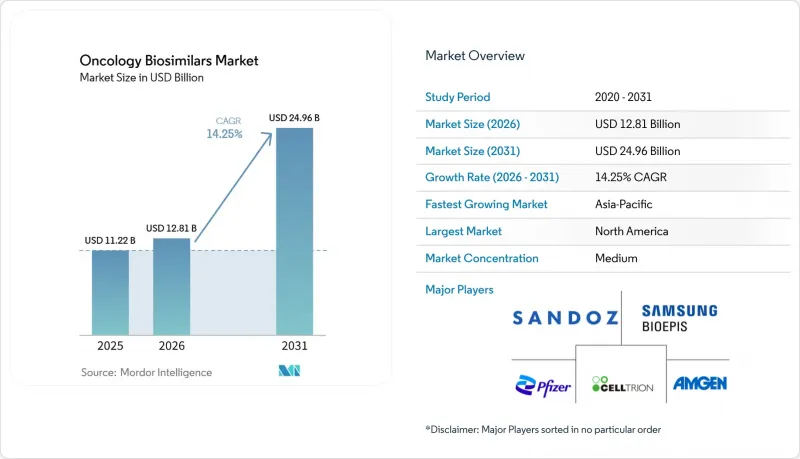
본 보고서는 적응증(유방암, 폐암 등), 약물 분류별(단일클론 항체, 과립구 콜로니 자극 인자 등), 투여 경로(정맥 내 투여, 피하 투여), 유통 채널(병원 약국, 소매 약국 등), 지역(북미, 유럽 등)별로 분류되어 있습니다. 예측치는 금액(달러)으로 표시되어 있습니다.
전 세계 종양학 바이오시밀러 시장 동향 및 인사이트
특허 만료를 앞둔 종양학 분야의 블록버스터 생물학적 제제
특허 만료는 암 치료용 바이오시밀러 시장에 있어 가장 명확한 구조적 견인력 중 하나로 계속 작용하고 있습니다. 이는 지금까지 암 치료용 바이오의약품 중 가장 높은 매출을 기록해 온 치료법에 대한 접근을 가능하게 하기 때문입니다. 현재의 기회는 기존의 단일클론항체에 국한되지 않습니다. 다음 물결에는 진출기업이 소수일지라도 치료의 경제성을 크게 바꿀 가능성이 있는 복잡한 암 치료 자산이 점점 더 많이 포함되고 있기 때문입니다. 삼성바이오에피스는 2026년 6월, 펨브롤리주맙의 바이오시밀러 후보인 SB27에 대해 1상 및 3상 예비 데이터가 양호했다고 보고했습니다. 이는 매우 높은 가치를 지닌 체크포인트 억제제 부문에서 종양학 바이오시밀러 시장이 이미 후발 제품과의 경쟁 단계로 접어들고 있음을 보여줍니다. 2026년 4월, 유럽집행위원회가 유럽 최초의 펠츠주맙 바이오시밀러인 ‘POHERDY’를 승인한 것은 대규모 항암제 분자가 1세대 바이오시밀러의 범위를 넘어 상용화의 다음 단계로 접어들고 있음을 보여주는 또 다른 신호입니다. 더 많은 항암제 바이오의약품이 독점권 만료를 앞두고 있는 가운데, 항암제 바이오시밀러 시장에서는 포트폴리오 확대가 가속화될 것으로 예상되지만, 선제적으로 대응한 기업들은 보험사와의 계약 및 병원 접근성 측면에서 여전히 우위를 유지할 것입니다. 이 추세가 중요한 이유는 항암제 바이오시밀러 시장이 더 이상 성숙한 대체품만으로 정의되는 것이 아니라, 임상적·규제적·상업적 준비를 이미 마친 상태에서 다음 출시 시기를 맞이할 수 있는 기업이 누구인지에 따라서도 좌우되기 때문입니다.
암 치료비 절감을 요구하는 지불자의 압력
지불자의 압력은 종양학 바이오시밀러 시장의 성장을 뒷받침하고 있습니다. 왜냐하면 저비용 대체제는 예산 관리와 치료 접근성 확대라는 두 가지 목표 모두에 부합하게 되었기 때문입니다. 2025년에 실시된 암 약학 실무에 관한 조사에서도, 지불자가 지정하는 바이오시밀러의 선정이나 상환 상한선이 현장 수준의 제품 선택에 영향을 미치고 있는 것으로 밝혀졌으며, 이는 종양학 바이오시밀러 시장이 의사의 선호뿐만 아니라 상환 제도의 설계를 통해 점점 더 주도되고 있음을 뒷받침합니다. 이러한 압력은 종양학 바이오시밀러 시장에 긍정적으로 작용합니다. 전환 결정이 계약, 우선 제품, 포트폴리오 표준화와 연계됨으로써 의료 기관에 대한 비용 절감 효과가 더욱 명확해지기 때문입니다. 또한, 출시 순서의 중요성도 높아집니다. 조기에 지불 기관과 보조를 맞출 수 있었던 기업은 후발 기업보다 더 빨리 임상적 동등성을 일상적인 사용으로 전환할 수 있기 때문입니다. 장기적으로는 이러한 역학 관계로 인해 항종양학 바이오시밀러 시장은 접근성 확대와 가격 규율이 서로를 강화하는 궤도를 유지해 나갈 것으로 전망됩니다.
항암제 처방 의사의 호환성 및 면역원성에 대한 신중한 태도
처방 의사의 신중한 태도는 종양학 바이오시밀러 시장에 여전히 현실적인 제약 요인으로 작용하고 있습니다. 이는 의료 기관과의 계약 협상을 통해 제품 선정이 진행되는 속도가 개별 임상의의 신뢰도 변화보다 빠르기 때문입니다. 또한 BioDrugs의 보고에 따르면, 한국 종양 전문의의 31.4%에서 56.8%가 이미 오리지널 생물학적 제제를 투여받고 있는 환자에 대한 전환에 소극적이며, 이러한 주저함의 주된 요인은 유효성에 대한 광범위한 의심이라기보다는 면역원성이나 치료의 지속성에 대한 우려에 있는 것으로 밝혀졌습니다. 2025년에 발표된 인도 임상의들을 대상으로 한 조사에서는 응답자의 69.2%가 표준 80%-125%의 생물학적 동등성 허용 범위를 초과하는 편차가 임상 사용에 영향을 미칩니다고 답했으며, 이는 기술적 해석이 여전히 실질적인 도입에 영향을 미치고 있음을 보여줍니다. 암 치료용 바이오시밀러 시장에서 이는 교육, 실세계 데이터, 그리고 전환에 대한 적응이 여전히 중요함을 의미합니다. 왜냐하면 제품이 승인되어 구할 수 있다 하더라도, 임상 현장에서의 주저함이 사용 지연으로 이어질 수 있기 때문입니다. 또한, 최종 결정이 여전히 주로 개별 의사의 판단에 맡겨져 있는 환경에 비해, 의료기관 주도의 도입 경로에서는 채택이 계속해서 활발해질 가능성이 있음을 시사합니다.
부문 분석
2025년, 유방암은 종양학 바이오시밀러 시장 점유율의 28.15%를 차지하며 1위 자리를 유지했습니다. 이는 트라스투주맙 바이오시밀러가 이미 HER2 양성 치료 경로에 깊이 정착했기 때문입니다. 이러한 위상은 임상적 익숙함과 상업적 성숙도를 모두 반영합니다. 트라스투주맙 바이오시밀러는 초기 도입 단계를 넘어 주요 의료기관에서 일상적인 사용으로 전환되기에 충분한 시간을 거쳤기 때문입니다. 미국에서는 트라스투주맙 바이오시밀러 카테고리에 2026년 기준 7개의 경쟁 제품이 존재하며, 삼성바이오에피스는 ‘칸진티’의 점유율을 31%, ‘트라지메라’를 25%, ‘오기브리’를 24%로 보고하고 있습니다. 이는 종양학 바이오시밀러 시장의 이 부문에서 이미 얼마나 치열한 경쟁이 벌어지고 있는지를 보여줍니다. 혈액암 역시 여전히 중요한 수익 기반이 되고 있습니다. 이는 릿룩시맙 바이오시밀러가 의료기관에서 도입이 더욱 확대되어, JAMA가 대상으로 한 미국 병원 표본에서 2024년까지 바이오시밀러 사용률이 84%에 달했기 때문입니다. 대장암 또한 중요한 요소로 작용하고 있습니다. 이는 베바시주맙 바이오시밀러가 전이성 치료 현장에서 이미 경제적 유효성이 입증되었기 때문입니다.
2025년 『Journal of Medical Economics』 지에 실린 연구에 따르면, 전이성 대장암에서 베바시주맙(bvzr)은 바이오시밀러 선택지 중 가장 큰 비용 절감 효과와 가장 낮은 전환 필요 환자 수(NNC)를 달성한 것으로 밝혀졌으며, 이는 이 적응증이 종양학 바이오시밀러 시장에서 여전히 상업적으로 중요한 이유를 뒷받침하고 있습니다. 폐암은 연평균 성장률(CAGR) 16.75%로 가장 빠르게 성장하는 적응증이며, 그 전망은 질병 부담은 물론 체크포인트 억제제 바이오시밀러의 향후 확대 가능성에 의해서도 뒷받침되고 있습니다. 국제암연구소(IARC)는 2024년에 폐암이 전 세계에서 발생률이 가장 높은 암이 되어 신규 환자 수가 260만 명에 달할 것으로 예측했습니다. 또한, 폐암은 암으로 인한 사망의 주요 원인이기도 하며, 이는 종양학 바이오시밀러 시장의 이 분야를 뒷받침하는 환자 기반이 규모가 크고 지속적임을 의미합니다. 난소암, 위암 및 기타 점유율이 낮은 적응증은 현재로서는 여전히 규모가 작은 상태입니다. 그러나 베바시주맙 관련 치료 영역에서 적응증 범위가 넓기 때문에 종양학 바이오시밀러 업계는 종양 유형별로 개별적인 상용화 모델을 필요로 하지 않고도 여러 암 진료 분야에 걸쳐 가치를 확대할 수 있으므로, 이러한 적응증들도 여전히 중요합니다.
2025년 기준으로, 단일클론 항체는 종양학 바이오시밀러 시장 규모의 68.54%를 차지하고 있으며, 이는 고형암 및 혈액암 두 분야 모두에서 트라스투주맙, 베바시주맙, 리툭시맙의 바이오시밀러가 강력한 상업적 입지를 확립하고 있음을 반영합니다. 이러한 우위는 성숙한 참조 제품, 충분히 이해된 임상 경로, 그리고 병원 측이 이미 이러한 치료법을 대규모로 계약하고 투여하는 방법을 잘 알고 있다는 사실이 결합되어 형성되었습니다. G-CSF 제제는 화학요법에 수반되는 호중구 감소증 관리를 지원하기 위해 두 번째 주요 분류를 형성하고 있습니다. 2025년 종양학 분야의 약국 조사에 따르면, 필그라스팀 바이오시밀러의 이용률은 가중 평균 88%, 페그필그라스팀은 52%로 보고되었으며, 이는 지지 요법 분야에서 종양학 바이오시밀러 시장에 여전히 큰 전환의 여지가 있음을 시사합니다. 조혈제 역시 여전히 수요가 성숙한 분야이며, 사용자 초안에 따르면 의료기관 보급률은 84%에 육박하고 있는데, 이는 종양학 바이오시밀러 시장에서 안정적이지만 성장성은 비교적 낮은 구성 요소로서의 역할을 뒷받침합니다. 따라서 현재의 제품군 구성은 여전히 확립된 분자에 크게 치우쳐 있어, 기업 수준보다 분자 수준에서 수익 집중이 더욱 두드러지게 나타납니다.
보다 더 빠른 변화가 나타나는 분야는 기타 카테고리이며, 향후 체크포인트 억제제 및 VEGF 관련 바이오시밀러의 기회를 포착함에 따라 2031년까지 연평균 성장률(CAGR) 18.16%를 나타낼 것으로 예측됩니다. 삼성바이오에피스는 2026년 6월, 개발 중인 펨브롤리주맙 바이오시밀러 'SB27'에 대해 1상 및 3상 임상시험의 긍정적인 예비 데이터를 발표했습니다. 여기에는 약동학적 동등성 및 비소세포폐암(NSCLC) 환자에서 24주 시점에 나타난 동등한 객관적 반응률이 포함되어 있으며, 이는 종양학 바이오시밀러 업계가 다음 상업적 개척지로 다가가고 있음을 보여주는 가장 분명한 징후 중 하나입니다. 이러한 자산들이 허가 신청 및 출시를 향해 나아감에 따라, 종양학 바이오시밀러 시장은 1세대 단일클론 항체의 가격 주기에만 의존하던 상황에서 벗어나게 될 것입니다. 이러한 변화는 중요한 의미를 지닙니다. 왜냐하면 종양학 바이오시밀러 시장의 다음 단계는 기존 카테고리에 얼마나 많은 기업이 진입해 있는지가 아니라, 오히려 더 새롭고 복잡한 면역종양학 카테고리에 어떤 기업이 먼저 진입하느냐에 따라 형성될 가능성이 높기 때문입니다.
지역별 분석
2025년, 북미는 종양학 바이오시밀러 시장 규모의 36.18%를 차지했으며, 병원 내 도입률, 바이오의약품에 대한 친숙도 및 상용화 침투도가 여전히 가장 높기 때문에 지역별로는 최대 기여 지역으로서의 지위를 유지했습니다. JAMA 연구에 따르면, 2024년 기준 미국 병원에서의 바이오시밀러 사용률은 베바시주맙 93%, 트라스투주맙 87%, 리툭시맙 84%에 달했으며, 이는 암 치료용 바이오시밀러 시장을 위한 성숙한 제도적 환경이 조성되어 있음을 보여줍니다. 또한, 이 지역은 암 치료 분야에서 정맥 주사 요법의 광범위한 도입 실적, 대규모 보험사, 그리고 정교한 처방약 목록 관리의 혜택을 지속적으로 누리고 있으며, 이 모든 요소가 대규모 제품 전환을 용이하게 하고 있습니다. 따라서 새로운 분자가 경쟁 환경을 변화시키기 시작했음에도 불구하고, 북미는 여전히 암 치료용 바이오시밀러 시장에서 가장 발전된 수익 기반을 유지하고 있습니다.
유럽은 규제 당국의 수용과 조달 체계가 역사적으로 다른 많은 지역보다 빠른 단계에서 바이오시밀러의 정착을 뒷받침해 왔기 때문에 계속해서 종양학 바이오시밀러 시장의 핵심 지역으로 자리 잡고 있습니다. 2026년 4월, 유럽집행위원회가 유럽 최초의 펠츠주맙 바이오시밀러인 ‘POHERDY’를 승인한 것은 해당 지역 전체의 종양학 바이오시밀러 시장에 있어 포트폴리오 확장에 있어 또 하나의 중요한 이정표가 되었습니다. 또한, 유럽의약품청(EMA)은 2026년 6월, 뼈로 전이된 진행성 암 성인 환자의 골 합병증 예방을 목적으로 하는 ‘Xgeva’의 바이오시밀러로 권장된 ‘Denosumab Ascend’에 대해 긍정적인 견해를 표명했습니다. 이로써 유럽 유통 경로 내 향후 항암제 바이오시밀러 제품 라인업이 한층 더 충실해질 것입니다. 이러한 움직임은 정책에 대한 이해와 이용 가능한 제품의 꾸준한 확대라는 두 가지 측면을 통해, 항암제 바이오시밀러 시장이 지속적으로 성장하고 있는 지역으로서 유럽의 역할을 강화하는 것입니다.
아시아태평양은 2031년까지 연평균 성장률(CAGR)이 18.05%로 가장 빠르게 성장하고 있는 지역이며, 이는 대규모이고 비용 효율성을 중시하는 의료 시스템 속에서 종양학 바이오시밀러 시장이 향후 가장 강력한 성장세를 보일 것임을 시사합니다. 이 지역의 성장 추세는 암 부담 증가, 국내 생산 능력의 확대, 그리고 더 광범위한 환자층에게 더 낮은 치료 비용으로 생물학적 제제 요법을 제공해야 할 필요성이 높아지고 있음을 반영합니다. IARC(국제암연구소)의 최신 세계 암 통계도 이러한 배경을 뒷받침하고 있으며, 전 세계적으로 암 발병률이 지속적으로 증가하고 있어, 합리적인 가격의 암 치료 역량을 필요로 하는 인구가 많은 지역에서 지속적인 수요 압력이 발생하고 있습니다.
기타 혜택:
- 엑셀 형식 시장 예측(ME) 시트
- 3개월간의 애널리스트 지원
자주 묻는 질문
목차
제1장 서론
제2장 조사 방법
제3장 주요 요약
제4장 시장 구도
제5장 시장 규모와 성장 예측
제6장 경쟁 구도
제7장 시장 기회와 향후 전망
JHS 26.08.05According to Mordor Intelligence, the oncology biosimilars market size was valued at USD 11.22 billion in 2025 and is estimated to grow from USD 12.81 billion in 2026 to reach USD 24.96 billion by 2031, at a CAGR of 14.25% during the forecast period (2026-2031).
This report is Segmented by Indication (Breast Cancer, Lung Cancer, and More), by Drug Class (Monoclonal Antibodies, Granulocyte Colony-Stimulating Factors, and More), by Route of Administration (Intravenous and Subcutaneous), by Distribution Channel (Hospital Pharmacies, Retail Pharmacies, and More), Geography (North America, Europe, and More). Forecasts are Provided in Terms of Value (USD).
Global Oncology Biosimilars Market Trends and Insights
Expiring Blockbuster Oncology Biologic Patents
Patent expiry remains one of the clearest structural supports for the oncology biosimilars market because it opens access to therapies that historically carried some of the highest oncology biologic revenues. The current opportunity is not limited to older monoclonal antibodies, because the next wave increasingly includes complex oncology assets where even a small number of entrants can materially change treatment economics. Samsung Bioepis reported positive preliminary Phase 1 and Phase 3 data in June 2026 for SB27, its proposed biosimilar to pembrolizumab, which shows that the oncology biosimilars market is already moving closer to follow-on competition in a very high-value checkpoint inhibitor category. The April 2026 European Commission approval of POHERDY as the first approved pertuzumab biosimilar in Europe adds another sign that large oncology molecules are entering the next stage of commercialization beyond first-generation biosimilar classes. As more oncology biologics move toward loss of exclusivity, the oncology biosimilars market should see faster portfolio broadening, but the companies that move first will still have an advantage in payer contracting and hospital access. This pattern matters because the oncology biosimilars market is no longer defined only by mature substitutions, but also by who can reach the next launch window with clinical, regulatory, and commercial readiness already in place.
Payer Pressure to Lower Oncology Treatment Costs
Payer pressure is reinforcing growth in the oncology biosimilars market because lower-cost substitution now aligns with both budget control and broader treatment access goals. A 2025 survey of oncology pharmacy practices also found that payer-specified biosimilar selections and reimbursement limits are shaping product choice at the practice level, which confirms that the oncology biosimilars market is increasingly being steered through reimbursement design instead of only physician preference. This pressure helps the oncology biosimilars market because cost savings become more visible to institutions when switching decisions are tied to contracting, preferred products, and portfolio standardization. It also raises the importance of launch sequencing, because companies that secure payer alignment early can convert clinical similarity into routine utilization faster than late entrants can. Over time, this dynamic should keep the oncology biosimilars market on a path where access expansion and pricing discipline continue to reinforce each other.
Oncology Prescriber Caution on Interchangeability and Immunogenicity
Prescriber caution remains a real restraint for the oncology biosimilars market because institutional contracting can move product selection faster than individual clinical confidence changes. BioDrugs also reported that 31.4% to 56.8% of Korean oncologists were reluctant to switch patients already established on originator biologics, with the hesitation centered on immunogenicity and continuity concerns rather than broad doubt about efficacy. An Indian clinician survey published in 2025 found that 69.2% believed deviations beyond the standard 80% to 125% bioequivalence margin would affect clinical use, which shows that technical interpretation still influences practical adoption. For the oncology biosimilars market, this means education, real-world evidence, and switching familiarity still matter because clinical hesitation can slow utilization even when products are approved and available. It also means that uptake may continue to be stronger in institution-led pathways than in settings where the final decision still rests mainly on individual physician comfort.
Other drivers and restraints analyzed in the detailed report include:
- Rising Global Cancer Incidence and Treatment Volumes
- Hospital and Oncology Group Purchasing Adoption of Biosimilar Contracts
- Complex Clinical Development and Manufacturing Requirements
For complete list of drivers and restraints, kindly check the Table Of Contents.
Segment Analysis
Breast cancer accounted for 28.15% of the oncology biosimilars market share in 2025, which kept it in the lead because trastuzumab biosimilars are already deeply embedded in HER2-positive treatment pathways. This position reflects both clinical familiarity and commercial maturity, since trastuzumab biosimilars have had enough time to move beyond early adoption and into routine use across major institutional settings. In the United States, the trastuzumab biosimilar category entered 2026 with seven competing products, and Samsung Bioepis reported category shares of 31% for Kanjinti, 25% for Trazimera, and 24% for Ogivri, which shows how dense competition has already become inside this segment of the oncology biosimilars market. Blood cancer also remains a meaningful revenue base because rituximab biosimilars have moved into advanced institutional adoption, with biosimilar use reaching 84% by 2024 in the U.S. hospital sample covered by JAMA. Colorectal cancer adds another important layer because bevacizumab biosimilars already have a validated economic role in metastatic treatment settings.
A 2025 Journal of Medical Economics study found that bevacizumab-bvzr delivered the greatest cost savings and the lowest number needed to convert among biosimilar options in metastatic colorectal cancer, which reinforces why this indication remains commercially relevant to the oncology biosimilars market. Lung cancer is the fastest-growing indication at a 16.75% CAGR, and that outlook is supported by disease burden as well as the future expansion potential of checkpoint inhibitor biosimilars. IARC identified lung cancer as the most incident cancer globally in 2024, with 2.6 million new cases, and also the leading cause of cancer death, which means the patient base behind this part of the oncology biosimilars market is both large and persistent. Ovarian, gastric, and other lower-share indications remain smaller today. However, they still matter because label breadth across bevacizumab-related treatment settings allows the oncology biosimilars industry to extend value across multiple oncology departments without needing a separate commercialization model for each tumor type.
Monoclonal antibodies held 68.54% of the oncology biosimilars market size in 2025, which reflects the strong commercial position of trastuzumab, bevacizumab, and rituximab biosimilars across both solid tumor and hematologic oncology use. Their lead is tied to a combination of mature reference products, well-understood clinical pathways, and the fact that hospitals already know how to contract and administer these therapies at scale. G-CSFs form the second major class because they support chemotherapy-related neutropenia management, and a 2025 oncology pharmacy survey reported weighted average biosimilar utilization of 88% for filgrastim and 52% for pegfilgrastim, which suggests that supportive care still has meaningful conversion room in the oncology biosimilars market. Hematopoietic agents also remain a mature part of demand, with the user draft indicating institutional penetration near 84%, which supports their role as a steady but less dynamic component of the oncology biosimilars market. Th,e current class structure, therefore, still leans heavily toward established molecules, and that makes revenue concentration look stronger at the molecule level than at the company level.
The faster shift is happening in the other category, which is forecast to grow at an 18.16% CAGR through 2031 because it captures future checkpoint inhibitor and VEGF-related biosimilar opportunities. Samsung Bioepis announced positive preliminary Phase 1 and Phase 3 data in June 2026 for SB27, its proposed pembrolizumab biosimilar, including pharmacokinetic equivalence and an equivalent objective response rate in NSCLC at Week 24, which makes this one of the clearest signs that the oncology biosimilars industry is approaching the next commercial frontier. As these assets move closer to filing and launch, the oncology biosimilars market should become less dependent on first-generation monoclonal antibody pricing cycles alone. That shift is important because the next phase of the oncology biosimilars market may be shaped less by how many entrants exist in older classes and more by which firms arrive first in newer, more complex immuno-oncology categories.
Complete Report Scope:
- By Indication
- Breast Cancer
- Lung Cancer
- Colorectal Cancer
- Blood Cancer
- Liver Cancer
- Prostate Cancer
- Gastric Cancer
- Ovarian Cancer
- Others (Pancreatic Cancer, Multiple Myeloma, etc.)
- By Drug Class
- Monoclonal Antibodies
- Granulocyte Colony-Stimulating Factors
- Hematopoietic Agents
- Others (Immune Checkpoint Inhibitors, VEGF Inhibitors, etc.)
- By Route of Administration
- Intravenous
- Subcutaneous
- By Distribution Channel
- Hospital Pharmacies
- Retail Pharmacies
- Online Pharmacies
- Others (Specialty Pharmacies, Government Cancer Institutes, etc.)
- By Geography
- North America
- United States
- Canada
- Mexico
- Europe
- Germany
- United Kingdom
- France
- Italy
- Spain
- Rest of Europe
- Asia-Pacific
- China
- India
- Japan
- South Korea
- Australia
- Rest of Asia-Pacific
- Middle East and Africa
- GCC
- South Africa
- Rest of Middle East and Africa
- South America
- Brazil
- Argentina
- Rest of South America
- North America
Geography Analysis
North America held 36.18% of the oncology biosimilars market size in 2025, which kept it as the largest regional contributor because hospital adoption, biologics familiarity, and commercialization depth remain strongest there. A JAMA study showed that U.S. hospital biosimilar use had already reached 93% for bevacizumab, 87% for trastuzumab, and 84% for rituximab by 2024, which points to a mature institutional environment for the oncology biosimilars market. This region also continues to benefit from a broad installed base of oncology infusion care, large payers, and sophisticated formulary management, all of which make product switching easier to implement at scale. North America,the therefore, remains the most developed revenue base for the oncology biosimilars market, even as newer molecules begin to change the competitive mix.
Europe remains a core region for the oncology biosimilars market because regulatory acceptance and procurement discipline have historically supported earlier biosimilar normalization than in many other regions. The April 2026 European Commission approval of POHERDY as the first approved pertuzumab biosimilar in Europe marked another important portfolio expansion point for the oncology biosimilars market across the region. The European Medicines Agency also adopted a positive opinion in June 2026 for Denosumab Ascend, recommended as a biosimilar to Xgeva for prevention of bone complications in adults with advanced cancer involving bone, which adds to future oncology biosimilar breadth in European channels. These steps reinforce Europe's role as a region where the oncology biosimilars market continues to broaden through both policy familiarity and a steady expansion of available products.
Asia-Pacific is the fastest-growing region at an 18.05% CAGR through 2031, which shows that the oncology biosimilars market has its strongest future momentum in large, cost-sensitive healthcare systems. The regional growth profile reflects rising cancer burden, expanding domestic manufacturing capabilities, and a stronger need to deliver biologic therapy at lower treatment cost across wider patient populations. IARC's latest global cancer statistics support that backdrop, with cancer incidence continuing to rise worldwide and creating durable demand pressure in high-population regions that need affordable oncology treatment capacity.
- Accord Healthcare Limited
- Amgen
- Apotex
- Aurobindo Pharma
- Biocon Biologics Limited
- Celltrion, Inc.
- Cipla
- Dr. Reddy's Laboratories
- Fresenius
- Gedeon Richter Plc.
- Hetero Labs Limited
- Hikma Pharmaceuticals
- Intas Pharmaceutical
- Mabxience S.L.U.
- Pfizer
- Samsung Bioepis Co., Ltd.
- Sandoz Group AG
- Shanghai Henlius Biotech, Inc.
- Stada Arzneimittel
- Teva Pharmaceutical Industries
Additional Benefits:
- The market estimate (ME) sheet in Excel format
- 3 months of analyst support
TABLE OF CONTENTS
1 INTRODUCTION
- 1.1 Study Assumptions and Market Definition
- 1.2 Scope of the Study
2 RESEARCH METHODOLOGY
3 EXECUTIVE SUMMARY
4 MARKET LANDSCAPE
- 4.1 Market Overview
- 4.2 Market Drivers
- 4.2.1 Expiring Blockbuster Oncology Biologic Patents
- 4.2.2 Payer Pressure to Lower Oncology Treatment Costs
- 4.2.3 Rising Global Cancer Incidence and Treatment Volumes
- 4.2.4 Hospital and Oncology Group Purchasing Adoption of Biosimilar Contracts
- 4.2.5 Biosimilar Switching and Formulary Expansion in Supportive Care Molecules
- 4.2.6 Tender-Based Uptake in Public Cancer Programs
- 4.3 Market Restraints
- 4.3.1 Oncology Prescriber Caution on Interchangeability and Immunogenicity
- 4.3.2 Complex Clinical Development and Manufacturing Requirements
- 4.3.3 Patent Litigation and Reference Product Exclusivity Extensions
- 4.3.4 Uneven Reimbursement and Pharmacy Substitution Policies Across Countries
- 4.4 Supply Chain Analysis
- 4.5 Regulatory Landscape
- 4.6 Technological Outlook
- 4.7 Porter's Five Forces Analysis
- 4.7.1 Bargaining Power of Suppliers
- 4.7.2 Bargaining Power of Buyers
- 4.7.3 Threat of New Entrants
- 4.7.4 Threat of Substitutes
- 4.7.5 Industry Rivalry
5 MARKET SIZE AND GROWTH FORECASTS (VALUE, USD)
- 5.1 By Indication
- 5.1.1 Breast Cancer
- 5.1.2 Lung Cancer
- 5.1.3 Colorectal Cancer
- 5.1.4 Blood Cancer
- 5.1.5 Liver Cancer
- 5.1.6 Prostate Cancer
- 5.1.7 Gastric Cancer
- 5.1.8 Ovarian Cancer
- 5.1.9 Others (Pancreatic Cancer, Multiple Myeloma, etc.)
- 5.2 By Drug Class
- 5.2.1 Monoclonal Antibodies
- 5.2.2 Granulocyte Colony-Stimulating Factors
- 5.2.3 Hematopoietic Agents
- 5.2.4 Others (Immune Checkpoint Inhibitors, VEGF Inhibitors, etc.)
- 5.3 By Route of Administration
- 5.3.1 Intravenous
- 5.3.2 Subcutaneous
- 5.4 By Distribution Channel
- 5.4.1 Hospital Pharmacies
- 5.4.2 Retail Pharmacies
- 5.4.3 Online Pharmacies
- 5.4.4 Others (Specialty Pharmacies, Government Cancer Institutes, etc.)
- 5.5 By Geography
- 5.5.1 North America
- 5.5.1.1 United States
- 5.5.1.2 Canada
- 5.5.1.3 Mexico
- 5.5.2 Europe
- 5.5.2.1 Germany
- 5.5.2.2 United Kingdom
- 5.5.2.3 France
- 5.5.2.4 Italy
- 5.5.2.5 Spain
- 5.5.2.6 Rest of Europe
- 5.5.3 Asia-Pacific
- 5.5.3.1 China
- 5.5.3.2 India
- 5.5.3.3 Japan
- 5.5.3.4 South Korea
- 5.5.3.5 Australia
- 5.5.3.6 Rest of Asia-Pacific
- 5.5.4 Middle East and Africa
- 5.5.4.1 GCC
- 5.5.4.2 South Africa
- 5.5.4.3 Rest of Middle East and Africa
- 5.5.5 South America
- 5.5.5.1 Brazil
- 5.5.5.2 Argentina
- 5.5.5.3 Rest of South America
- 5.5.1 North America
6 COMPETITIVE LANDSCAPE
- 6.1 Market Concentration
- 6.2 Market Share Analysis
- 6.3 Company Profiles (includes Global Level Overview, Market Level Overview, Core Segments, Financials as available, Strategic Information, Market Rank/Share, Products and Services, Recent Developments)
- 6.3.1 Accord Healthcare Limited
- 6.3.2 Amgen Inc.
- 6.3.3 Apotex Inc.
- 6.3.4 Aurobindo Pharma Limited
- 6.3.5 Biocon Biologics Limited
- 6.3.6 Celltrion, Inc.
- 6.3.7 Cipla Limited
- 6.3.8 Dr. Reddy's Laboratories Ltd.
- 6.3.9 Fresenius Kabi AG
- 6.3.10 Gedeon Richter Plc.
- 6.3.11 Hetero Labs Limited
- 6.3.12 Hikma Pharmaceuticals PLC
- 6.3.13 Intas Pharmaceuticals Limited
- 6.3.14 Mabxience S.L.U.
- 6.3.15 Pfizer Inc.
- 6.3.16 Samsung Bioepis Co., Ltd.
- 6.3.17 Sandoz Group AG
- 6.3.18 Shanghai Henlius Biotech, Inc.
- 6.3.19 STADA Arzneimittel AG
- 6.3.20 Teva Pharmaceutical Industries Ltd.
7 MARKET OPPORTUNITIES AND FUTURE OUTLOOK
- 7.1 White-Space and Unmet-Need Assessment