

|
시장보고서
상품코드
2134056
디지털 서명 시장 : 제공별, 유형별, 전개 방식별, 업무 기능별, 최종사용자별, 업계별, 지역별 - 세계 예측(-2031년)Digital Signature Market by Offering (Hardware, Software, and Services), Type (SES, AES, and QES), End User (Individual and Enterprises), Business Function (Finance & Accounting, Legal, IT, HR, Sales, and Marketing) - Global Forecast to 2031 |
||||||

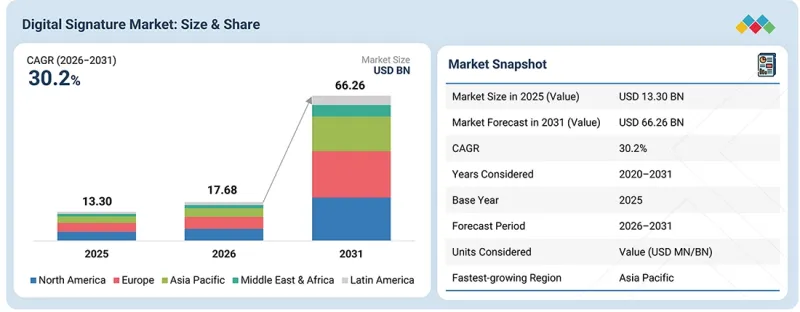
디지털 서명 시장 규모는 예측 기간 동안 CAGR 30.2%로 확대되어, 2026년 176억 8,000만 달러에서 2031년에는 662억 6,000만 달러에 달할 것으로 전망됩니다.
| 조사 범위 | |
|---|---|
| 조사 대상 기간 | 2020-2031년 |
| 기준 연도 | 2025년 |
| 예측 기간 | 2026-2031년 |
| 산정 단위 | 금액(100만/10억 달러) |
| 부문 | 제공별, 유형별, 전개 방식별, 업무 기능별, 최종사용자별, 업계별, 지역별 |
| 대상 지역 | 북미, 유럽, 아시아태평양, 중동 및 아프리카 및 라틴아메리카 |
“하드웨어별로는 2026년에 하드웨어 보안 모듈(HSM) 부문이 가장 큰 시장 점유율을 차지할 것으로 추정됩니다.”
하드웨어별로는, 암호 키의 안전한 생성, 저장, 관리에 대한 수요가 증가함에 따라 하드웨어 보안 모듈(HSM) 부문이 디지털 서명 시장을 주도할 것으로 추정됩니다. HSM은 디지털 서명의 생성 및 검증에 사용되는 비밀 키를 보호하기 위해 변조 방지 기능을 갖춘 전용 환경을 제공함으로써, 키 도난, 무단 접근 및 서명 변조의 위험을 줄여줍니다. HSM 도입은 금융 기관, 정부 기관, 의료 기관, 대기업 등 기밀성이 높은 거래나 규제 대상 거래를 다루는 조직에서 특히 활발히 진행되고 있습니다. 또한 HSM은 보안 및 암호화 요구 사항 준수를 지원하며, 공개 키 인프라(PKI), 인증 기관(CA), 디지털 ID 시스템, 기업 애플리케이션과의 통합이 가능합니다. 클라우드 기반 디지털 서명의 이용 확대는 클라우드 HSM 및 HSM-as-a-Service 모델의 도입을 더욱 촉진하고 있으며, 조직은 대규모 물리적 인프라를 유지 관리할 필요 없이 하드웨어를 통한 키 보호를 실현할 수 있게 되었습니다. 더 나아가, 더 강력한 암호화 알고리즘으로의 전환과 양자 보안 시대에 대비함에 따라, 중앙 집중화되고 적응성이 높은 암호화 인프라의 중요성이 커지고 있습니다. 디지털 서명 처리량이 증가하고 조직이 더 높은 수준의 신뢰성, 무결성, 부인 방지를 요구함에 따라, HSM은 안전한 디지털 서명 생태계를 뒷받침하는 중요한 하드웨어 구성요소로 계속 남아 있을 것으로 예상됩니다.
“최종사용자별로는 개인 부문이 예측 기간 동안 높은 성장률을 기록할 것으로 전망됩니다.”
최종사용자별로는 디지털 거래의 확대와 편의성이 높은 클라우드 기반 서명 솔루션의 보급에 힘입어, 개인 부문이 기업 부문보다 높은 성장률을 기록할 것으로 예상됩니다. 개인은 고용 관련 서류, 임대차 계약서, 금융 신청서, 보험 서류, 교육 관련 서류, 행정 신청서, 기타 계약서에 디지털 서명을 해야 할 필요성이 점점 더 커지고 있습니다. 재택근무, 온라인 뱅킹, 디지털 커머스 및 행정 전자 서비스의 확대로 인해, 개인이 물리적 접촉 없이 문서를 인증 및 승인해야 할 필요성이 더욱 커지고 있습니다. 최신 디지털 서명 플랫폼은 모바일 지원 인터페이스, 신원 확인, 전자 인증 및 자동화된 워크플로를 제공하여 기술적 전문 지식이 제한적인 사용자도 서명할 수 있게 되었습니다. 또한, 이메일, 문서 관리 플랫폼, 모바일 애플리케이션, 온라인 포털에 디지털 서명을 통합함으로써 도입 장벽이 낮아지고 있습니다. 전자서명과 관련된 보안, 편의성, 법적 유효성에 대한 인식 제고 또한 개인이 자필 서명을 디지털 서명으로 대체하도록 촉진하고 있습니다. 각 벤더들은 간소화된 서명 경험, 유연한 인증 옵션, 그리고 스마트폰, 태블릿, PC를 통해 거래를 완료할 수 있는 내장형 서명 기능을 점점 더 많이 제공하고 있습니다. 디지털 기반 상호작용이 일상 활동에 점점 더 깊숙이 스며들면서, 소비자, 프리랜서, 전문가 및 소규모 사업주 사이에서 이용이 확대됨에 따라 개인 최종사용자 부문의 성장이 가속화될 것으로 예상됩니다.
“산업별로는 2026년에 BFSI 부문이 가장 큰 시장 점유율을 차지할 것으로 추정됩니다.”
BFSI 부문이 가장 큰 시장 점유율을 차지할 것으로 추정됩니다. 이는 주로 은행, 보험사 및 기타 금융 기관이 처리하는 금융 거래와 문서의 거래량이 방대하고 기밀성이 높기 때문입니다. 디지털 서명은 고객 온보딩, 계좌 개설, 대출 신청, 주택 담보 대출 계약, 보험 증서, 투자 관련 서류, 결제 관련 프로세스 및 기타 금융 계약에서 점점 더 널리 활용되고 있습니다. 서명자의 인증, 문서의 무결성 유지, 감사 추적 기록 생성, 그리고 거래 완료의 신속화를 가능하게 하는 디지털 서명은 안전하고 효율적인 디지털 워크플로우를 추구하는 금융 기관에게 특히 가치 있는 요소입니다. 온라인 뱅킹 및 모바일 뱅킹으로의 전환이 지속됨에 따라, 신원 확인이 완료된 신뢰할 수 있는 전자서명 기능에 대한 수요는 더욱 높아지고 있습니다. 또한 금융 기관들은 디지털 서명을 고객 신원 확인, PKI, 부정 행위 탐지, 문서 관리, 워크플로우 자동화 플랫폼과 통합하여 종단 간 디지털 거래 프로세스를 구축하고 있습니다. 고객 인증, 기록 보관, 데이터 보안, 거래 무결성에 관한 규제 및 규정 준수 요건 또한 이러한 도입을 뒷받침하고 있습니다. 더욱이 디지털 서명은 BFSI(은행·금융·보험) 기관이 종이 기반 문서나 오프라인 지점 프로세스에 대한 의존도를 낮추는 동시에, 보다 신속한 서비스 제공을 가능하게 합니다. 금융 기관들이 대출, 보험, 자산 운용 및 고객 서비스 프로세스의 디지털화를 지속함에 따라, 안전하고 확장성이 뛰어나며 상호 운용이 가능한 디지털 서명 솔루션에 대한 수요는 계속해서 견조할 것으로 예상되며, 이는 BFSI 부문 시장에서 선도적인 입지를 뒷받침할 것으로 전망됩니다.
주요 응답자 구성
디지털 서명 시장의 주요 공급업체로는 Docusign(미국), Adobe(미국), Thales(프랑스), Entrust(미국), GlobalSign(벨기에), Zoho(인도), DigiCert(미국), OneSpan(미국), Ascertia(영국),Dropbox Sign(미국), IdenTrust(미국), Nitro(미국), Dioss(벨기에), Dokobit(Signicat)(리투아니아), Penneo(덴마크), QuickSign(프랑스), Symtrax(미국), AlphaTrust(미국), Notarius(미국), Actalis(이탈리아), SIGNiX(미국), SigniFlow(영국), vintegrisTECH(스페인), Signority(캐나다), Bit4id(이탈리아), LawTrust(남아프리카공화국), DigiSigner(독일), WISeKey(스위스) 등이 있습니다.
본 조사에서는 디지털 서명 시장의 주요 기업에 대한 상세한 경쟁 분석, 기업 개요, 최근 동향 및 주요 시장 전략을 다루고 있습니다.
조사 범위
본 보고서에서는 디지털 서명 시장을 세분화하여 제공 형태(하드웨어, 소프트웨어, 서비스), 종류(간이 전자서명(SES), 고도 전자서명(AES), 인증 전자서명(QES)), 도입 형태(온프레미스, 클라우드, 하이브리드), 업무 기능(영업·마케팅, IT, 법무, 인사, 재무·회계), 최종사용자(개인, 기업), 업종(BFSI, 정부 기관, 의료·생명과학, 법무, 부동산, IT·ITeS, 교육, 소매·E-Commerce,에너지·공공사업, 기타), 및 지역(북미, 유럽, 아시아태평양, 중동 및 아프리카, 라틴아메리카)을 기준으로 디지털 서명 시장을 산업별로 세분화하고, 그 규모를 예측하고 있습니다.
또한, 본 조사에서는 시장의 주요 기업에 대한 상세한 경쟁 분석, 각 기업 개요, 제품 및 사업 제공에 관한 주요 발견 사항, 최근 동향, 그리고 주요 시장 전략에 대해서도 다루고 있습니다.
본 보고서를 구매할 때의 주요 이점
본 보고서는 디지털 서명 시장 전체 및 그 하위 부문의 매출에 대한 가장 정확한 추정치를 제공함으로써, 시장을 선도하는 기업 및 신규 진입 기업을 지원합니다. 본 보고서는 이해관계자들이 경쟁 구도를 이해하고, 비즈니스 위치를 최적화하며, 적절한 시장 진입 전략을 수립하는 데 필요한 귀중한 인사이트를 얻는 데 도움이 됩니다. 또한, 본 보고서는 이해관계자들이 시장 동향을 파악하는 데 도움을 주며, 주요 시장 촉진요인, 억제요인, 과제 및 기회에 대한 정보를 제공합니다.
본 보고서는 다음 사항에 대한 인사이트를 제공합니다:
- 주요 촉진요인 분석(디지털 사기 증가에 따른 안전한 디지털 서명 솔루션에 대한 수요 확대, 엄격한 규제 기준 및 데이터 개인정보 보호 규정 준수, E-Commerce 및 원격 근무로 인한 디지털 서명 도입 촉진, 디지털 서명을 통한 안전한 인증 및 워크플로우 효율화),제약요인(높은 초기 도입 비용, 신흥국에서의 도입 제한성), 기회(디지털 서명 통합을 통한 고객 경험 향상, 클라우드를 활용한 보안 솔루션을 통한 디지털 서명 보급, 디지털 서명 시장의 재편 흐름에 대한 대응, 디지털 서명 시장 성장을 이끄는 AI 기반 보안), 및 과제(벤더 간 디지털 서명 솔루션의 상호 운용성 문제)
- 제품 개발/혁신 : 디지털 서명 시장의 향후 기술, 연구 개발 활동, 신제품 및 서비스 출시에 관한 상세한 인사이트
- 시장 개발 : 수익성이 높은 시장에 대한 종합적인 정보(본 보고서에서는 다양한 지역에 걸친 디지털 서명 시장을 분석하고 있습니다).
- 시장 다각화 : 디지털 서명 시장의 새로운 솔루션 및 서비스, 미개척 지역, 최근 동향 및 투자에 대한 종합적인 정보
- 경쟁 분석 : Docusign(미국), Adobe(미국), Thales(프랑스), Entrust(미국),GlobalSign(벨기에), Zoho(인도), DigiCert(미국), OneSpan(미국), Ascertia(영국), Dropbox Sign(미국) 등 디지털 서명 시장의 주요 기업들의 시장 점유율, 성장 전략, 서비스 제공 내용에 대해 상세히 평가하고 있습니다.
자주 묻는 질문
목차
제1장 소개
제2장 주요 요약
제3장 주요 인사이트
제4장 시장 개요
제5장 업계 동향
제6장 기술 진보, AI에 의한 영향, 특허, 혁신, 향후 응용
제7장 규제 상황
제8장 소비자 상황과 구매 행동
제9장 디지털 서명 시장(제공별)
제10장 디지털 서명 시장(유형별)
제11장 디지털 서명 시장(전개 방식별)
제12장 디지털 서명 시장(사업 기능별)
제13장 디지털 서명 시장(최종사용자별)
제14장 디지털 서명 시장(업계별)
제15장 디지털 서명 시장(지역별)
제16장 경쟁 구도
제17장 기업 개요
제18장 조사 방법
제19장 부록
KSMThe digital signature market is projected to grow from USD 17.68 billion in 2026 to USD 66.26 billion by 2031 at a CAGR of 30.2% during the forecast period.
| Scope of the Report | |
|---|---|
| Years Considered for the Study | 2020-2031 |
| Base Year | 2025 |
| Forecast Period | 2026-2031 |
| Units Considered | Value (USD Million/Billion) |
| Segments | Offering, Type, Business Function, Deployment Mode, End User, Vertical, and Region |
| Regions covered | North America, Europe, Asia Pacific, Middle East & Africa, and Latin America |
"By hardware, the hardware security modules (HSMs) segment is estimated to hold the largest market share in 2026."
By hardware, the hardware security modules (HSMs) segment is estimated to lead the digital signature market, owing to the increasing need for the secure generation, storage, and management of cryptographic keys. HSMs provide a dedicated, tamper-resistant environment for protecting private keys used to create and validate digital signatures, thereby reducing the risk of key theft, unauthorized access, and signature compromise. Their adoption is particularly strong among organizations handling sensitive or regulated transactions, including financial institutions, government agencies, healthcare organizations, and large enterprises. HSMs also support compliance with security and cryptographic requirements and can integrate with public key infrastructure (PKI), certificate authorities, digital identity systems, and enterprise applications. The growing use of cloud-based digital signatures is further encouraging deployment of cloud HSMs and HSM-as-a-Service models, allowing organizations to obtain hardware-backed key protection without maintaining extensive physical infrastructure. In addition, the transition toward stronger cryptographic algorithms and preparation for post-quantum security are increasing the importance of centralized and adaptable cryptographic infrastructure. As digital signing volumes increase and organizations seek higher levels of trust, integrity, and non-repudiation, HSMs are expected to remain a critical hardware component supporting secure digital signature ecosystems.
"By end user, the individual segment is expected to record a higher growth rate during the forecast period."
By end user, the individual segment is expected to record a higher growth rate than the enterprise segment, driven by the increasing use of digital transactions and the growing availability of convenient, cloud-based signing solutions. Individuals are increasingly required to digitally sign employment documents, rental agreements, financial applications, insurance forms, educational documents, government applications, and other contracts. The expansion of remote work, online banking, digital commerce, and government e-services has further increased the need for individuals to authenticate and approve documents without physical interaction. Modern digital signature platforms provide mobile-friendly interfaces, identity verification, electronic authentication, and automated workflows, making signing accessible to users with limited technical expertise. In addition, the integration of digital signatures into email, document-management platforms, mobile applications, and online portals is reducing barriers to adoption. Growing awareness of the security, convenience, and legal validity associated with electronic signatures is also encouraging individuals to replace handwritten signatures with digital alternatives. Vendors are increasingly offering simplified signing experiences, flexible authentication options, and embedded signing capabilities that allow individuals to complete transactions from smartphones, tablets, or personal computers. As digital interactions become increasingly embedded in everyday activities, expanding use among consumers, freelancers, professionals, and small business owners is expected to accelerate the growth of the individual end-user segment.
"By vertical, the BFSI segment is estimated to account for the largest market share in 2026."
The BFSI segment is estimated to hold the largest market share, primarily due to the high volume and sensitivity of financial transactions and documentation handled by banks, insurance companies, and other financial institutions. Digital signatures are increasingly used across customer onboarding, account opening, loan applications, mortgage agreements, insurance policies, investment documentation, payment-related processes, and other financial contracts. The ability to authenticate signatories, preserve document integrity, create audit trails, and accelerate transaction completion makes digital signatures particularly valuable for financial institutions seeking secure and efficient digital workflows. The continued shift toward online and mobile banking is further increasing demand for identity-verified and high-assurance electronic signing capabilities. Financial institutions are also integrating digital signatures with customer identity verification, PKI, fraud detection, document management, and workflow automation platforms to create end-to-end digital transaction processes. Regulatory and compliance requirements related to customer authentication, record-keeping, data security, and transaction integrity further support adoption. In addition, digital signatures help BFSI organizations reduce dependence on paper-based documentation and physical branch processes while enabling faster service delivery. As financial institutions continue to digitize lending, insurance, wealth management, and customer-service processes, demand for secure, scalable, and interoperable digital signature solutions is expected to remain strong, supporting the BFSI segment's leading market position.
Breakdown of Primaries
The study draws insights from a range of industry experts, including component suppliers, Tier 1 companies, and OEMs. The breakdown of the primaries is as follows:
- By Company Type: Tier 1 - 35%, Tier 2 - 45%, and Tier 3 - 20%
- By Designation: C-level - 40% and Managerial & Others - 60%
- By Region: North America - 35%, Europe - 30%, Asia Pacific - 25%, Middle East and Africa - 5%, Latin America - 5%
Major vendors in the digital signature market include Docusign (US), Adobe (US), Thales (France), Entrust (US), GlobalSign (Belgium), Zoho (India), DigiCert (US), OneSpan (US), Ascertia (UK), Dropbox Sign (US), IdenTrust (US), Nitro (US), Dioss (Belgium), Dokobit (Signicat) (Lithuania), Penneo (Denmark), QuickSign (France), Symtrax (US), AlphaTrust (US), Notarius (US), Actalis (Italy), SIGNiX (US), SigniFlow (UK), vintegrisTECH (Spain), Signority (Canada), Bit4id (Italy), LawTrust (South Africa), DigiSigner (Germany), and WISeKey (Switzerland), among others.
The study includes an in-depth competitive analysis of the key players in the digital signature market, their company profiles, recent developments, and key market strategies.
Research Coverage
The report segments the digital signature market and forecasts its size based on offering (hardware, software, services), type (simple electronic signature (SES), advanced electronic signature (AES), qualified electronic signature (QES)), deployment mode (on-premises, cloud, hybrid), business function (sales & marketing, IT, legal, HR, finance & accounting), end user (individual, enterprise), vertical (BFSI, government, healthcare & life sciences, legal, real estate, IT & ITeS, education, retail & e-commerce, energy & utilities, others), and region (North America, Europe, Asia Pacific, Middle East & Africa, and Latin America).
The study also includes an in-depth competitive analysis of the market's key players, their company profiles, key observations related to product and business offerings, recent developments, and key market strategies.
Key Benefits of Buying the Report
The report will help market leaders/new entrants with information on the closest approximations of revenue numbers for the overall digital signature market and its subsegments. This report will help stakeholders understand the competitive landscape and gain valuable insights to better position their businesses and plan suitable go-to-market strategies. The report also helps stakeholders understand the market pulse and provides information on key market drivers, restraints, challenges, and opportunities.
The report provides insights into the following pointers:
- Analysis of critical drivers (Rising incidence of digital fraud to amplify demand for secure digital signature solutions, stringent regulatory standards and data privacy compliance, E-commerce and remote work to catalyze digital signature adoption, secure authentication and streamlined workflows with digital signatures), restraints (High initial setup costs, limited adoption in emerging economies), opportunities (Enhancing customer experiences with digital signature integration, digital signature adoption through cloud-enhanced security solutions, navigating wave of digital signature market consolidations, AI-enhanced security to pave way for digital signature market growth), and challenges (Interoperability issues in cross-vendor digital signature solutions)
- Product Development/Innovation: Detailed insights on upcoming technologies, research and development activities, new products, and service launches in the digital signature market
- Market Development: Comprehensive information about lucrative markets (The report analyses the digital signature market across varied regions).
- Market Diversification: Exhaustive information about new solutions and services, untapped geographies, recent developments, and investments in the digital signature market
- Competitive Assessment: In-depth assessment of market shares, growth strategies, and service offerings of leading players, such as Docusign (US), Adobe (US), Thales (France), Entrust (US), GlobalSign (Belgium), Zoho (India), DigiCert (US), OneSpan (US), Ascertia (UK), and Dropbox Sign (US), among others, in the digital signature market.
TABLE OF CONTENTS
1 INTRODUCTION
- 1.1 STUDY OBJECTIVES
- 1.2 MARKET DEFINITION
- 1.3 STUDY SCOPE
- 1.3.1 MARKET SEGMENTATION & REGIONAL SCOPE
- 1.3.2 INCLUSIONS AND EXCLUSIONS
- 1.3.3 YEARS CONSIDERED
- 1.4 CURRENCY CONSIDERED
- 1.5 STAKEHOLDERS
- 1.6 SUMMARY OF CHANGES
2 EXECUTIVE SUMMARY
- 2.1 KEY INSIGHTS AND MARKET HIGHLIGHTS
- 2.2 KEY MARKET PARTICIPANTS: MAPPING OF STRATEGIC DEVELOPMENTS
- 2.3 DISRUPTIONS SHAPING MARKET
- 2.4 HIGH-GROWTH SEGMENTS
- 2.5 SNAPSHOT: GLOBAL MARKET SIZE, GROWTH RATE, AND FORECAST
3 PREMIUM INSIGHTS
- 3.1 ATTRACTIVE OPPORTUNITIES FOR PLAYERS IN DIGITAL SIGNATURE MARKET
- 3.2 DIGITAL SIGNATURE MARKET, BY OFFERING
- 3.3 DIGITAL SIGNATURE MARKET, BY HARDWARE
- 3.4 DIGITAL SIGNATURE MARKET, BY SOFTWARE
- 3.5 DIGITAL SIGNATURE MARKET, BY SERVICE
- 3.6 DIGITAL SIGNATURE MARKET, BY TYPE
- 3.7 DIGITAL SIGNATURE MARKET, BY VERTICAL
- 3.8 DIGITAL SIGNATURE MARKET, BY REGION
4 MARKET OVERVIEW
- 4.1 INTRODUCTION
- 4.2 MARKET DYNAMICS
- 4.2.1 DRIVERS
- 4.2.1.1 Rising incidence of digital fraud
- 4.2.1.2 Stringent regulatory standards and data privacy compliance
- 4.2.1.3 Increasing popularity of e-commerce and remote work
- 4.2.1.4 Secure authentication and streamlined workflows with digital signatures
- 4.2.2 RESTRAINTS
- 4.2.2.1 High initial setup costs
- 4.2.3 OPPORTUNITIES
- 4.2.3.1 Enhancing customer experience with digital signature integration
- 4.2.3.2 Digital signature adoption through cloud-enhanced security solutions
- 4.2.3.3 Navigating the wave of digital signature market consolidations
- 4.2.3.4 Surge in adoption of AI technologies
- 4.2.4 CHALLENGES
- 4.2.4.1 Interoperability issues in cross-vendor digital signature solutions
- 4.2.1 DRIVERS
- 4.3 UNMET NEEDS AND WHITE SPACES
- 4.4 INTERCONNECTED MARKETS AND CROSS-SECTOR OPPORTUNITIES
- 4.4.1 INTERCONNECTED MARKETS
- 4.4.2 CROSS-SECTOR OPPORTUNITIES
- 4.5 STRATEGIC MOVES BY TIER-1/2/3 PLAYERS
- 4.5.1 CROSS-TIER STRATEGIC PATTERNS
- 4.5.2 STRATEGIC TRENDS
- 4.5.2.1 Convergence of eSignatures with Digital Trust and Identity
- 4.5.2.2 AI-driven Signing, Fraud Detection, and Workflow Automation
- 4.5.2.3 Post-quantum Readiness and Crypto-agility
5 INDUSTRY TRENDS
- 5.1 PORTER'S FIVE FORCES ANALYSIS
- 5.1.1 THREAT OF NEW ENTRANTS
- 5.1.2 THREAT OF SUBSTITUTES
- 5.1.3 BARGAINING POWER OF SUPPLIERS
- 5.1.4 BARGAINING POWER OF BUYERS
- 5.1.5 INTENSITY OF COMPETITIVE RIVALRY
- 5.2 MACROECONOMIC INDICATORS
- 5.2.1 INTRODUCTION
- 5.2.2 GDP TRENDS AND FORECAST
- 5.2.3 TRENDS IN GLOBAL ICT INDUSTRY
- 5.2.4 TRENDS IN GLOBAL CYBERSECURITY INDUSTRY
- 5.3 VALUE CHAIN ANALYSIS
- 5.4 ECOSYSTEM
- 5.5 PRICING ANALYSIS
- 5.5.1 AVERAGE SELLING PRICE OF OFFERING, BY KEY PLAYERS, 2025
- 5.5.2 INDICATIVE PRICING ANALYSIS, BY VENDOR, 2025
- 5.6 KEY CONFERENCES AND EVENTS IN 2026-2027
- 5.7 TRENDS/DISRUPTIONS IMPACTING CUSTOMER BUSINESS
- 5.8 INVESTMENT AND FUNDING SCENARIO
- 5.9 CASE STUDY ANALYSIS
- 5.9.1 DOCUSIGN HELPED MEDICAL DEVICE MANUFACTURING COMPANY STREAMLINE PHYSICIAN SIGNATURES WITH DIGITAL TRANSACTION MANAGEMENT
- 5.9.2 SECURED SIGNING HELPED H&R BLOCK EASE TAX BURDEN
- 5.9.3 DOCUSIGN ESIGNATURE UPHELD IN COURT AS LEGAL AND ENFORCEABLE IN COMMON LAW JURISDICTIONS
- 5.9.4 DOCUSIGN ESIGNATURE HELPED SALESFORCE SPEED UP GLOBAL RECRUITING EFFORTS WITH WORKDAY
- 5.9.5 GLOBALSIGN HELPED CLOUGH HARBOR & ASSOCIATES LLP IMPROVE EFFICIENCY OF DOCUMENT DELIVERY
- 5.9.6 EMUDHRA HELPED MAURITIUS GOVERNMENT IMPLEMENT NATIONAL PKI INFRASTRUCTURE
- 5.10 IMPACT OF 2025 US TARIFF - DIGITAL SIGNATURE MARKET
- 5.10.1 INTRODUCTION
- 5.10.2 KEY TARIFF RATES
- 5.10.3 PRICE IMPACT ANALYSIS
- 5.10.4 IMPACT ON REGIONS
- 5.10.4.1 North America
- 5.10.4.2 Europe
- 5.10.4.3 Asia Pacific
- 5.10.5 IMPACT ON END-USE INDUSTRIES
6 TECHNOLOGICAL ADVANCEMENTS, AI-DRIVEN IMPACT, PATENTS, INNOVATIONS, AND FUTURE APPLICATIONS
- 6.1 TECHNOLOGY ANALYSIS
- 6.1.1 KEY EMERGING TECHNOLOGIES
- 6.1.1.1 Public key infrastructure (PKI)
- 6.1.1.2 Hashing Algorithms
- 6.1.1.3 Digital Certificates
- 6.1.1.4 Time Stamping
- 6.1.2 COMPLEMENTARY TECHNOLOGIES
- 6.1.2.1 Cloud-based digital signatures
- 6.1.2.2 Quantum-safe signatures
- 6.1.3 ADJACENT TECHNOLOGIES
- 6.1.3.1 Biometric signatures and advanced identity verification in electronic signatures
- 6.1.3.2 IoT
- 6.1.3.3 AI and blockchain
- 6.1.1 KEY EMERGING TECHNOLOGIES
- 6.2 TECHNOLOGY ROADMAP
- 6.2.1 SHORT-TERM (2026-2027) | FOUNDATION & EARLY PLATFORM EXPANSION
- 6.2.2 MID-TERM (2027-2030) | SCALING, AUTOMATION & DIGITAL TRUST CONSOLIDATION
- 6.2.3 LONG-TERM (2030-2035+) | AUTONOMOUS, ADAPTIVE & POST-QUANTUM-READY DIGITAL SIGNATURES
- 6.3 PATENT ANALYSIS
- 6.4 FUTURE APPLICATIONS
- 6.4.1 AI-DRIVEN DIGITAL SIGNATURE AND AGREEMENT MANAGEMENT
- 6.4.2 IDENTITY-CENTRIC AND HIGH-ASSURANCE DIGITAL SIGNING
- 6.4.3 POST-QUANTUM-READY DIGITAL SIGNATURE INFRASTRUCTURE
- 6.4.4 EMBEDDED AND CROSS-PLATFORM DIGITAL SIGNING
- 6.4.5 UNIFIED DIGITAL TRUST AND SIGNATURE ECOSYSTEMS
- 6.5 IMPACT OF AI/GEN AI ON DIGITAL SIGNATURE MARKET
- 6.5.1 BEST PRACTICES IN DIGITAL SIGNATURE MARKET
- 6.5.2 CASE STUDIES OF AI IMPLEMENTATION IN DIGITAL SIGNATURE MARKET
- 6.5.3 INTERCONNECTED ADJACENT ECOSYSTEM AND IMPACT ON MARKET PLAYERS
- 6.5.4 CLIENTS' READINESS TO ADOPT GENERATIVE AI IN DIGITAL SIGNATURE MARKET
- 6.6 SUCCESS STORIES AND REAL-WORLD APPLICATIONS
- 6.6.1 DOCUSIGN: AI-POWERED AGREEMENT MANAGEMENT FOR A GLOBAL ENTERPRISE
- 6.6.2 ADOBE: AI-ASSISTED CONTRACT REVIEW AND DIGITAL SIGNING
7 REGULATORY LANDSCAPE
- 7.1 REGIONAL REGULATIONS AND COMPLIANCE
- 7.1.1 REGULATORY BODIES, GOVERNMENT AGENCIES, AND OTHER ORGANIZATIONS
- 7.1.2 INDUSTRY STANDARDS
- 7.2 TRADE ANALYSIS
- 7.2.1 IMPORT SCENARIO OF RECORDING MEDIA: DISCS, TAPES, SOLID-STATE DEVICES, SMART CARDS, AND PRODUCTION MATERIALS
- 7.2.2 EXPORT SCENARIO OF RECORDING MEDIA: DISCS, TAPES, SOLID-STATE DEVICES, SMART CARDS, AND PRODUCTION MATERIALS
8 CONSUMER LANDSCAPE AND BUYER BEHAVIOR
- 8.1 DECISION-MAKING PROCESS
- 8.2 KEY STAKEHOLDERS IN BUYING PROCESS AND THEIR EVALUATION CRITERIA
- 8.2.1 KEY STAKEHOLDERS IN BUYING PROCESS
- 8.2.2 BUYING CRITERIA
- 8.3 ADOPTION BARRIERS AND INTERNAL CHALLENGES
- 8.4 UNMET NEEDS IN VARIOUS END-USE INDUSTRIES
- 8.4.1 REVENUE POTENTIAL
- 8.4.2 COST DYNAMICS
- 8.4.3 MARGIN OPPORTUNITIES IN KEY APPLICATIONS
9 DIGITAL SIGNATURE MARKET, BY OFFERING
- 9.1 INTRODUCTION
- 9.1.1 OFFERING: DIGITAL SIGNATURE MARKET DRIVERS
- 9.2 HARDWARE
- 9.2.1 MULTIPLE LAYERS OF AUTHENTICATION, ENCRYPTION, AND IDENTITY VERIFICATION TO ENHANCE OVERALL SECURITY INFRASTRUCTURE OF DIGITAL SIGNATURE SYSTEMS
- 9.2.2 HARDWARE SECURITY MODULES
- 9.2.3 SMART CARDS
- 9.2.4 USB TOKENS
- 9.2.5 BIOMETRIC SIGNATURE PADS
- 9.2.6 TRUSTED PLATFORM MODULES
- 9.2.7 OTHER HARDWARE
- 9.3 SOFTWARE
- 9.3.1 ENHANCED REMOTE SIGNING AND COMPLIANCE TO BOOST MARKET
- 9.3.2 DOCUMENT GENERATION & WEB FORMS
- 9.3.3 DIGITAL CERTIFICATES
- 9.3.4 DOCUMENT SIGNING TOOLS
- 9.3.5 APPLICATION PROGRAMMING INTERFACES (APIS) AND SOFTWARE DEVELOPMENT KITS (SDKS)
- 9.3.6 OTHER SOFTWARE
- 9.4 SERVICES
- 9.4.1 RISING DEMAND FOR DIGITAL SIGNATURE SOLUTIONS TO FUEL MARKET GROWTH
- 9.4.2 PROFESSIONAL SERVICES
- 9.4.2.1 Deployment & integration
- 9.4.2.2 Support & maintenance
- 9.4.3 MANAGED SERVICES
10 DIGITAL SIGNATURE MARKET, BY TYPE
- 10.1 INTRODUCTION
- 10.1.1 TYPE: DIGITAL SIGNATURE MARKET DRIVERS
- 10.2 SIMPLE ELECTRONIC SIGNATURE (SES)
- 10.2.1 EASE OF USE, EFFICIENCY, AND LEGAL ADEQUACY TO BOLSTER GROWTH
- 10.2.1.1 Signature via PIN/password
- 10.2.1.2 Email-based signature
- 10.2.1.3 Typed signature
- 10.2.1.4 Voice signature
- 10.2.1.5 Click-to-sign
- 10.2.1 EASE OF USE, EFFICIENCY, AND LEGAL ADEQUACY TO BOLSTER GROWTH
- 10.3 ADVANCED ELECTRONIC SIGNATURE (AES)
- 10.3.1 ENHANCED SECURITY, LEGAL COMPLIANCE, AND USER ACCESSIBILITY TO BOOST MARKET
- 10.3.1.1 Cryptographic-based AES
- 10.3.1.2 Biometric Authentication AES
- 10.3.1.3 Time-stamped AES
- 10.3.1.4 Digital certificate-based AES
- 10.3.1.5 Smartcard-based AES
- 10.3.1 ENHANCED SECURITY, LEGAL COMPLIANCE, AND USER ACCESSIBILITY TO BOOST MARKET
- 10.4 QUALIFIED ELECTRONIC SIGNATURE (QES)
- 10.4.1 HIGHEST SECURITY, LEGAL EQUIVALENCE, AND STRINGENT COMPLIANCE TO ACCELERATE GROWTH
- 10.4.1.1 PKI-based QES
- 10.4.1.2 Biometric QES
- 10.4.1.3 Smartcard/USB token-based QES
- 10.4.1.4 Digital identity QES
- 10.4.1 HIGHEST SECURITY, LEGAL EQUIVALENCE, AND STRINGENT COMPLIANCE TO ACCELERATE GROWTH
11 DIGITAL SIGNATURE MARKET, BY DEPLOYMENT MODE
- 11.1 INTRODUCTION
- 11.1.1 DEPLOYMENT MODE: DIGITAL SIGNATURE MARKET DRIVERS
- 11.2 ON-PREMISES
- 11.2.1 INCREASING NEED FOR ENHANCED SECURITY AND PRIVACY TO FUEL DEMAND FOR ON-PREMISES SOLUTIONS
- 11.3 CLOUD
- 11.3.1 LOW MAINTENANCE COSTS AND INCREASED SCALABILITY TO PROMOTE ADOPTION OF CLOUD-BASED DIGITAL SIGNATURES
- 11.4 HYBRID
- 11.4.1 HYBRID DEPLOYMENT MODE TO ENABLE SECURE REMOTE WORK AND TEAM COLLABORATION WITHOUT COMPROMISING DATA PROTECTION
12 DIGITAL SIGNATURE MARKET, BY BUSINESS FUNCTION
- 12.1 INTRODUCTION
- 12.1.1 BUSINESS FUNCTION: DIGITAL SIGNATURE MARKET DRIVERS
- 12.2 FINANCE & ACCOUNTING
- 12.2.1 DIGITAL SIGNATURES TO STREAMLINE PROCESSES, REDUCE PAPER USAGE, AND ACCELERATE TRANSACTION TIMES
- 12.3 SALES & MARKETING
- 12.3.1 SURGING DEMAND FOR SPEEDY DEAL CLOSURES AND IMPROVED CUSTOMER EXPERIENCE TO SUPPORT MARKET GROWTH
- 12.4 IT
- 12.4.1 DIGITAL SIGNATURES TO ENHANCE DOCUMENT SECURITY BY PROVIDING ENCRYPTION, AUTHENTICATION, AND TAMPER-EVIDENCE FEATURES
- 12.5 LEGAL OPERATIONS
- 12.5.1 REDUCED NEED FOR PHYSICAL PAPERWORK, FASTER CONTRACT EXECUTION, AND IMPROVED OVERALL PRODUCTIVITY TO DRIVE MARKET
- 12.6 HR
- 12.6.1 REDUCED ADMINISTRATIVE OVERHEAD AND BETTER SECURITY FOR SENSITIVE PERSONNEL DATA TO SUPPORT MARKET GROWTH
13 DIGITAL SIGNATURE MARKET, BY END USER
- 13.1 INTRODUCTION
- 13.1.1 END USER: DIGITAL SIGNATURE MARKET DRIVERS
- 13.2 INDIVIDUAL
- 13.2.1 CRYPTOGRAPHIC TECHNIQUES TO GUARANTEE AUTHENTICITY AND INTEGRITY OF ELECTRONIC DOCUMENTS
- 13.3 ENTERPRISE
- 13.3.1 DIGITAL SIGNATURES TO EXPEDITE CONTRACT EXECUTION AND BOOST PRODUCTIVITY BY ENABLING REMOTE SIGNING
14 DIGITAL SIGNATURE MARKET, BY VERTICAL
- 14.1 INTRODUCTION
- 14.1.1 VERTICAL: DIGITAL SIGNATURE MARKET DRIVERS
- 14.2 BANKING, FINANCIAL SERVICES, AND INSURANCE (BFSI)
- 14.2.1 DIGITAL SIGNATURES TO ENHANCE EFFICIENCY OF WORKFLOWS AND HELP COMPLY WITH REGULATIONS
- 14.2.2 BFSI: DIGITAL SIGNATURE MARKET DRIVERS
- 14.3 GOVERNMENT
- 14.3.1 RISING DEMAND FOR PRODUCTIVITY IMPROVEMENT, COST REDUCTION, AND ENHANCED SECURITY TO BOOST MARKET
- 14.3.2 GOVERNMENT: DIGITAL SIGNATURE MARKET DRIVERS
- 14.4 HEALTHCARE & LIFE SCIENCES
- 14.4.1 DIGITAL SIGNATURES TO HELP IN ONBOARDING PROCESSES AND OPTIMIZING WORKFLOWS
- 14.4.2 HEALTHCARE & LIFE SCIENCES: DIGITAL SIGNATURE MARKET DRIVERS
- 14.5 LEGAL
- 14.5.1 DIGITAL SIGNING METHODS TO OFFER COST SAVINGS, INCREASED EFFICIENCY, AND CONVENIENCE
- 14.5.2 LEGAL: DIGITAL SIGNATURE MARKET DRIVERS
- 14.6 REAL ESTATE
- 14.6.1 INCREASING NEED FOR CONVENIENT, FAST, AND SECURE REAL ESTATE TRANSACTIONS TO FUEL MARKET GROWTH
- 14.6.2 REAL ESTATE: DIGITAL SIGNATURE MARKET DRIVERS
- 14.7 IT & ITES
- 14.7.1 ADOPTION OF ADVANCED TECHNOLOGIES AND INCREASED CYBER RISK TO BOOST MARKET GROWTH
- 14.7.2 IT & ITES: DIGITAL SIGNATURE MARKET DRIVERS
- 14.8 EDUCATION
- 14.8.1 DIGITAL SIGNATURES TO HELP EDUCATIONAL INSTITUTES STREAMLINE OPERATIONS AND REDUCE COSTS
- 14.8.2 EDUCATION: DIGITAL SIGNATURE MARKET DRIVERS
- 14.9 RETAIL & E-COMMERCE
- 14.9.1 DIGITAL SIGNATURES TO PROVIDE ROBUST PROTECTION BY ENCRYPTING CUSTOMER SIGNATURES WITH UNIQUE CODES
- 14.9.2 RETAIL & E-COMMERCE: DIGITAL SIGNATURE MARKET DRIVERS
- 14.10 ENERGY & UTILITIES
- 14.10.1 ADOPTION OF DIGITAL SIGNATURES TO ENHANCE OPERATIONAL EFFICIENCY AND IMPROVE PROCESS MANAGEMENT
- 14.10.2 ENERGY & UTILITIES: DIGITAL SIGNATURE MARKET DRIVERS
- 14.11 OTHER VERTICALS
- 14.11.1 OTHER VERTICALS: DIGITAL SIGNATURE MARKET DRIVERS
15 DIGITAL SIGNATURE MARKET, BY REGION
- 15.1 INTRODUCTION
- 15.2 NORTH AMERICA
- 15.2.1 NORTH AMERICA: DIGITAL SIGNATURE MARKET DRIVERS
- 15.2.2 US
- 15.2.2.1 Technological advancements, regulatory frameworks, and rising cybersecurity challenges to propel market growth
- 15.2.3 CANADA
- 15.2.3.1 High internet penetration, government support, and rising digital fraud to drive market
- 15.3 EUROPE
- 15.3.1 EUROPE: DIGITAL SIGNATURE MARKET DRIVERS
- 15.3.2 UK
- 15.3.2.1 Rapid digitalization and increasing investments in emerging fields to foster market growth
- 15.3.3 GERMANY
- 15.3.3.1 Rising internet penetration and growing inclination toward digitalization to boost market
- 15.3.4 FRANCE
- 15.3.4.1 Progressive digitalization strategies and robust internet usage to encourage market expansion
- 15.3.5 ITALY
- 15.3.5.1 Increasing focus on enhancing reliability and authenticity of digital signatures to boost market
- 15.3.6 BELGIUM
- 15.3.6.1 Enhanced legal framework, increasing digitalization, and robust security measures to catalyze market growth
- 15.3.7 REST OF EUROPE
- 15.4 ASIA PACIFIC
- 15.4.1 ASIA PACIFIC: DIGITAL SIGNATURE MARKET DRIVERS
- 15.4.2 CHINA
- 15.4.2.1 Legal framework, technological advancements, and increasing digitalization to drive market
- 15.4.3 JAPAN
- 15.4.3.1 Investment in advanced technologies and digitalization initiatives to accelerate market growth
- 15.4.4 INDIA
- 15.4.4.1 Growth of e-commerce and retail sector to fuel growth
- 15.4.5 REST OF ASIA PACIFIC
- 15.5 MIDDLE EAST & AFRICA
- 15.5.1 MIDDLE EAST & AFRICA: DIGITAL SIGNATURE MARKET DRIVERS
- 15.5.2 GCC COUNTRIES
- 15.5.2.1 Governmental digital strategies, private sector participation, and enhanced cybersecurity measures to support market growth
- 15.5.2.2 UAE
- 15.5.2.2.1 Government initiatives and evolving technological landscapes to foster market growth
- 15.5.2.3 KSA
- 15.5.2.3.1 Legal recognition of electronic signatures to aid market growth
- 15.5.2.4 Rest of GCC countries
- 15.5.3 SOUTH AFRICA
- 15.5.3.1 Increasing need for secure and efficient document authentication to accelerate market growth
- 15.5.3.2 Rest of Middle East & Africa
- 15.6 LATIN AMERICA
- 15.6.1 LATIN AMERICA: DIGITAL SIGNATURE MARKET DRIVERS
- 15.6.2 BRAZIL
- 15.6.2.1 Digital transformation, high internet usage, and startup innovations in secure technologies to propel market growth
- 15.6.3 MEXICO
- 15.6.3.1 Technological advancements, legislative frameworks, and strategic initiatives to spur growth
- 15.6.4 REST OF LATIN AMERICA
16 COMPETITIVE LANDSCAPE
- 16.1 INTRODUCTION
- 16.2 KEY PLAYER STRATEGIES/RIGHT TO WIN, 2022-2025
- 16.3 REVENUE ANALYSIS, 2021-2025
- 16.4 MARKET SHARE ANALYSIS, 2025
- 16.5 BRAND COMPARISON, 2025
- 16.5.1 DOCUSIGN
- 16.5.2 ADOBE
- 16.5.3 THALES
- 16.5.4 DIGICERT
- 16.5.5 ENTRUST
- 16.6 COMPANY VALUATION AND FINANCIAL METRICS, 2025
- 16.6.1 COMPANY VALUATION, 2025
- 16.6.2 FINANCIAL METRICS USING EV/EBIDTA, 2025
- 16.7 COMPANY EVALUATION MATRIX: KEY PLAYERS, 2025
- 16.7.1 STARS
- 16.7.2 EMERGING LEADERS
- 16.7.3 PERVASIVE PLAYERS
- 16.7.4 PARTICIPANTS
- 16.7.5 COMPANY FOOTPRINT: KEY PLAYERS
- 16.7.5.1 Company footprint
- 16.7.5.2 Region footprint
- 16.7.5.3 Offering footprint
- 16.7.5.4 Vertical footprint
- 16.8 COMPANY EVALUATION MATRIX: STARTUPS/SMES, 2025
- 16.8.1 PROGRESSIVE COMPANIES
- 16.8.2 RESPONSIVE COMPANIES
- 16.8.3 DYNAMIC COMPANIES
- 16.8.4 STARTING BLOCKS
- 16.8.5 COMPETITIVE BENCHMARKING: STARTUPS/SMES, 2025
- 16.8.5.1 Detailed list of key startups/SMEs
- 16.8.5.2 Competitive benchmarking of key startups/SMEs
- 16.9 COMPETITIVE SCENARIO
- 16.9.1 PRODUCT LAUNCHES & ENHANCEMENTS
- 16.9.2 DEALS
17 COMPANY PROFILES
- 17.1 KEY PLAYERS
- 17.1.1 DOCUSIGN
- 17.1.1.1 Business overview
- 17.1.1.2 Products/Solutions/Services offered
- 17.1.1.3 Recent developments
- 17.1.1.3.1 Product launches & enhancements
- 17.1.1.3.2 Deals
- 17.1.1.4 MnM view
- 17.1.1.4.1 Key strengths
- 17.1.1.4.2 Strategic choices
- 17.1.1.4.3 Weaknesses and competitive threats
- 17.1.2 ADOBE
- 17.1.2.1 Business overview
- 17.1.2.2 Products/Solutions/Services offered
- 17.1.2.3 Recent developments
- 17.1.2.3.1 Product launches & enhancements
- 17.1.2.4 MnM view
- 17.1.2.4.1 Key strengths
- 17.1.2.4.2 Strategic choices
- 17.1.2.4.3 Weaknesses and competitive threats
- 17.1.3 THALES
- 17.1.3.1 Business overview
- 17.1.3.2 Products/Solutions/Services offered
- 17.1.3.3 Recent developments
- 17.1.3.3.1 Product launches & enhancements
- 17.1.3.4 MnM view
- 17.1.3.4.1 Key strengths
- 17.1.3.4.2 Strategic choices
- 17.1.3.4.3 Weaknesses and competitive threats
- 17.1.4 DIGICERT
- 17.1.4.1 Business overview
- 17.1.4.2 Products/Solutions/Services offered
- 17.1.4.3 Recent developments
- 17.1.4.3.1 Product launches & enhancements
- 17.1.4.3.2 Deals
- 17.1.4.4 MnM view
- 17.1.4.4.1 Key strengths
- 17.1.4.4.2 Strategic choices
- 17.1.4.4.3 Weaknesses and competitive threats
- 17.1.5 ENTRUST
- 17.1.5.1 Business overview
- 17.1.5.2 Products/Solutions/Services offered
- 17.1.5.3 Recent developments
- 17.1.5.3.1 Product launches & enhancements
- 17.1.5.3.2 Deals
- 17.1.5.4 MnM view
- 17.1.5.4.1 Key strengths
- 17.1.5.4.2 Strategic choices
- 17.1.5.4.3 Weaknesses and competitive threats
- 17.1.6 ESIGN/T-SIGN
- 17.1.6.1 Business overview
- 17.1.6.2 Products/Solutions/Services Offered
- 17.1.6.3 Recent developments
- 17.1.6.3.1 Product launches and enhancements
- 17.1.7 FOXIT SOFTWARE
- 17.1.7.1 Business overview
- 17.1.7.2 Products/Solutions/Services offered
- 17.1.7.3 Recent developments
- 17.1.7.3.1 Product launches and enhancements
- 17.1.7.3.2 Deals
- 17.1.8 ASCERTIA (INFOCERT)
- 17.1.8.1 Business overview
- 17.1.8.2 Products/Solutions/Services offered
- 17.1.8.3 Recent developments
- 17.1.8.3.1 Product launches & enhancements
- 17.1.8.3.2 Deals
- 17.1.9 GLOBALSIGN
- 17.1.9.1 Business overview
- 17.1.9.2 Products/Solutions/Services offered
- 17.1.9.3 Recent developments
- 17.1.9.3.1 Deals
- 17.1.10 ZOHO
- 17.1.10.1 Business overview
- 17.1.10.2 Products/Solutions/Services offered
- 17.1.10.3 Recent developments
- 17.1.10.3.1 Product launches & enhancements
- 17.1.10.3.2 Deals
- 17.1.11 ONESPAN
- 17.1.11.1 Business overview
- 17.1.11.2 Products/Solutions/Services offered
- 17.1.11.3 Recent developments
- 17.1.11.3.1 Product launches & enhancements
- 17.1.11.3.2 Deals
- 17.1.12 DROPBOX SIGN
- 17.1.12.1 Business Overview
- 17.1.12.2 Products/Solutions/Services offered
- 17.1.12.3 Recent developments
- 17.1.12.3.1 Product launches & enhancements
- 17.1.13 IDENTRUST
- 17.1.13.1 Business overview
- 17.1.13.2 Products/Solutions/Services offered
- 17.1.1 DOCUSIGN
- 17.2 OTHER PLAYERS
- 17.2.1 NITRO
- 17.2.2 DIOSS
- 17.2.3 DOKOBIT (SIGNICAT)
- 17.2.4 PENNEO (VISMA)
- 17.2.5 QUICKSIGN
- 17.2.6 SYMTRAX
- 17.2.7 ALPHATRUST
- 17.2.8 NOTARIUS
- 17.2.9 ACTALIS (ARUBA)
- 17.2.10 SIGNIX
- 17.2.11 SIGNIFLOW
- 17.2.12 VINTEGRISTECH (EURONOVATE GROUP)
- 17.2.13 SIGNORITY (FILECLOUD)
- 17.2.14 BIT4ID (AMBIENTA)
- 17.2.15 LAWTRUST (ALTRON)
- 17.2.16 DIGISIGNER
- 17.2.17 WISEKEY
18 RESEARCH METHODOLOGY
- 18.1 RESEARCH DATA
- 18.1.1 SECONDARY DATA
- 18.1.2 PRIMARY DATA
- 18.1.2.1 Breakup of primaries
- 18.1.2.2 Key industry insights
- 18.2 MARKET BREAKUP AND DATA TRIANGULATION
- 18.3 MARKET SIZE ESTIMATION
- 18.3.1 TOP-DOWN APPROACH
- 18.3.2 BOTTOM-UP APPROACH
- 18.4 MARKET FORECAST
- 18.5 RESEARCH ASSUMPTIONS
- 18.6 RESEARCH LIMITATIONS
19 APPENDIX
- 19.1 DISCUSSION GUIDE
- 19.2 KNOWLEDGESTORE: MARKETSANDMARKETS' SUBSCRIPTION PORTAL
- 19.3 CUSTOMIZATION OPTIONS
- 19.4 RELATED REPORTS
- 19.5 AUTHOR DETAILS


