

|
시장보고서
상품코드
2134058
군용 로봇 시장 : 유형별, 용도별, 사정별, 시스템별, 발사 방식별, 자율 레벨별, 제휴 아키텍처별, 지역별 - 세계 예측(-2031년)Military Robots Market by Type (Land, Marine, Airborne), Application, Range, System, Launch Mode, Level of Autonomy, Collaboration Architecture, and Region - Global Forecast to 2031 |
||||||

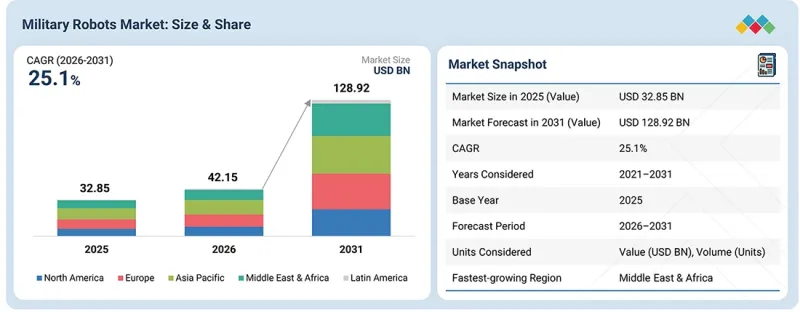
군용 로봇 시장 규모는 2026년 421억 5,000만 달러에서 2031년까지 1,289억 2,000만 달러로 확대될 것으로 예상되며, 예측 기간 동안 CAGR은 25.1%에 달할 것으로 전망됩니다.
수량 기준으로는 시장이 2026년 7만 4,817대에서 2031년까지 10만 9,010대로 확대될 것으로 예측됩니다. 군대가 고위험 임무에서 요원의 위험 노출을 줄이고 작전 범위를 확대하기 위해 무인 시스템을 활용하고 있기 때문에 군사용 로봇에 대한 수요가 증가하고 있습니다.
| 조사 범위 | |
|---|---|
| 조사 대상 기간 | 2020-2031년 |
| 기준 연도 | 2025년 |
| 예측 기간 | 2026-2031년 |
| 산정 단위 | 금액(10억 달러) |
| 부문 | 유형별, 용도별, 사정별, 시스템별, 발사 방식별, 자율 레벨별, 제휴 아키텍처별, 지역별 |
| 대상 지역 | 북미, 유럽, 아시아태평양, 기타 지역 |
군사용 로봇은 감시, 정찰, 미폭발탄 처리, 병참, 지뢰 제거, 전투 지원을 비롯해 기타 국방 용도로도 활용되고 있습니다. 자율성, 센서, 내비게이션, 통신 시스템, 인공지능의 발전으로 인해 이러한 시스템이 수행할 수 있는 임무의 범위도 확대되고 있습니다. 방위 현대화 프로그램의 확대, 현재 분쟁에서 무인 시스템의 활용 증가, 그리고 자율형·원격 조종형 플랫폼의 조달 증가가 주요 방위 시장에서 군사용 로봇의 수요를 뒷받침하고 있습니다.
“시스템별로는 예측 기간 동안 항공기 탑재형 부문이 가장 큰 규모를 차지할 것으로 전망됩니다.”
항공기 탑재 부문은 예측 기간 내내 가장 큰 규모를 유지할 것으로 예상됩니다. 항공기 탑재형 군용 로봇은 정보 수집, 감시, 정찰, 표적 추적, 공격 임무, 국경 감시, 통신 지원 등에 폭넓게 활용되고 있습니다. 광범위한 지역을 커버하고 다양한 고도에서 운용할 수 있으며, 고위험 임무에서 인원의 노출 위험을 줄일 수 있는 능력이 각국 국방군의 활용을 뒷받침하고 있습니다. 무인 항공 시스템의 조달 확대, 자율 기능의 보급, 그리고 첨단 센서, 통신 시스템, 임무용 페이로드의 지속적인 통합이 이 부문 시장의 주도적인 위치를 뒷받침할 것으로 예상됩니다.
“발사 방식별로는 해상에서 공중 투하하는 부문이 예측 기간 동안 가장 높은 연평균 성장률(CAGR)을 기록할 것으로 전망됩니다.”
해상 공중 투하 부문은 예측 기간 동안 가장 빠른 성장률을 보일 것으로 예상됩니다. 이러한 군사용 로봇은 함정, 항공기 및 기타 군사 플랫폼에서 전개되어, 인원이 직접 진입하기 어렵거나 위험한 지역에서의 임무를 지원합니다. 이들은 감시, 정찰, 대기뢰 작전, 병참 지원 및 기타 전술 작전에 활용되고 있습니다. 해상 및 원정 임무에서 무인 시스템의 활용 확대와 더불어, 보다 신속한 전개 및 작전 범위 확대에 대한 수요가 높아지고 있는 점이 해상 공중 투하형 군사용 로봇의 수요를 뒷받침할 것으로 전망됩니다.
“라틴아메리카는 예측 기간 동안 두 번째로 높은 성장률을 보일 것으로 전망됩니다.”
라틴아메리카는 예측 기간 동안 군사용 로봇 시장에서 두 번째로 높은 성장률을 기록할 것으로 전망됩니다. 이 지역 각국에서는 국경 감시, 정찰, 미발사탄 처리, 해상 보안 및 기타 방위 작전에서 무인 시스템과 로봇 시스템의 활용을 확대하고 있습니다. 방위 현대화 프로그램, 고위험 임무 수행 시 인원의 위험 노출을 줄여야 할 필요성, 그리고 원격 조종형 및 자율형 플랫폼의 활용 확대가 수요를 견인하고 있습니다. 또한, UAV(무인항공기), UGV(무인지상차량) 및 무인 해상 시스템의 조달 확대 역시 라틴아메리카 시장의 성장을 견인할 것으로 예상됩니다.
조사 범위:
본 시장 조사는 다양한 부문 및 하위 부문에 걸친 군사용 로봇 시장을 대상으로 합니다. 본 조사는 서로 다른 분야 및 지역별 시장 규모와 성장 잠재력을 추정하는 것을 목적으로 합니다. 또한, 시장 내 주요 기업에 대한 상세한 경쟁 분석, 기업 개요, 제품 및 사업 제공에 관한 주요 관찰 사항, 최근 동향, 그리고 각 기업이 채택한 주요 시장 전략에 대해서도 포괄적으로 다루고 있습니다.
본 보고서를 구매해야 하는 이유:
본 보고서는 시장을 선도하는 기업 및 신규 진입 기업에게 군사용 로봇 시장 전체 매출에 대한 가장 정확한 추정치를 제공합니다. 또한 이해관계자가 경쟁 구도를 이해하고, 자사의 비즈니스를 보다 적절하게 포지셔닝하며, 적절한 시장 진입 전략을 수립하기 위한 추가적인 인사이트를 얻는 데 도움이 됩니다. 더불어 본 보고서는 이해관계자가 시장 동향을 파악하는 데 도움을 주며, 주요 시장 촉진요인, 억제요인, 과제 및 기회에 대한 정보를 제공합니다.
본 보고서는 다음 사항에 대한 인사이트를 제공합니다:
- 시장 촉진요인(고위험 군사 작전 시 인원의 피폭 위험 저감에 대한 수요 증가, 지속적인 ISR(정보·감시·정찰) 및 전장 상황 인식 확대에 대한 수요 증가),제약요인(군용 로봇 플랫폼의 운용 시간, 적재 능력 및 탑재 전력 제한; 무장 자율 시스템에 대한 규제, 안전성 및 인간 중심 제어 관련 요건), 기회(전장 후방 지원, 전투 공병, 불발탄 처리(EOD),기뢰전, 부상자 이송 임무에 대한 군사용 로봇의 배치 확대; 군사 임무를 위한 협업형 멀티로봇 및 군집 운용 개발), 과제(GPS를 이용할 수 없는 환경이나 전자전이 진행 중인 환경에서의 지휘, 항법, 통신 유지; 군사용 로봇, 임무용 페이로드,제어 스테이션 및 동맹군 간의 상호 운용성 실현)
- 시장 침투도 : 시장을 선도하는 주요 기업이 제공하는 군사용 로봇에 관한 종합적인 정보
- 제품 개발/혁신 : 시장의 향후 기술, 연구개발 활동 및 신제품 출시에 관한 상세한 분석
- 시장 개발 : 다양한 지역의 수익성 높은 시장에 대한 종합적인 정보
- 시장 다각화 : 신제품, 미개척 지역, 최근 동향 및 시장 투자에 대한 종합적인 정보
- 경쟁 분석 : 군사용 로봇 시장의 주요 기업들의 시장 점유율, 성장 전략, 제품 및 제조 능력에 대한 상세한 평가
자주 묻는 질문
목차
제1장 소개
제2장 주요 요약
제3장 주요 인사이트
제4장 시장 개요
제5장 업계 동향
제6장 기술 진보, AI에 의한 영향, 특허, 혁신, 향후 응용
제7장 지속가능성과 규제 상황
제8장 고객 상황과 구매 행동
제9장 군용 로봇 시장(유형별)
제10장 군용 로봇 시장(용도별)
제11장 군용 로봇 시장(사정별)
제12장 군용 로봇 시장(시스템별)
제13장 군용 로봇 시장(발사 방식별)
제14장 군용 로봇 시장(자율 레벨별)
제15장 군용 로봇 시장(제휴 아키텍처별)
제16장 군용 로봇 시장(지역별)
제17장 경쟁 구도
제18장 기업 개요
제19장 조사 방법
제20장 부록
KSM 26.10.02The military robots market is projected to grow from USD 42.15 billion in 2026 to USD 128.92 billion by 2031, at a CAGR of 25.1% during the forecast period. In terms of volume, the market is projected to grow from 74,817 units in 2026 to 109,010 units by 2031. Demand for military robots is increasing as armed forces use unmanned systems to reduce personnel exposure in high-risk missions and improve operational coverage.
| Scope of the Report | |
|---|---|
| Years Considered for the Study | 2020-2031 |
| Base Year | 2025 |
| Forecast Period | 2026-2031 |
| Units Considered | Value (USD Billion) |
| Segments | By Type, Application, System and Region |
| Regions covered | North America, Europe, APAC, RoW |
Military robots are being used for surveillance, reconnaissance, explosive ordnance disposal, logistics, mine clearance, and combat support, along with other defense applications. Advances in autonomy, sensors, navigation, communication systems, and artificial intelligence are also increasing the range of tasks that these systems can perform. Rising defense modernization programs, higher use of unmanned systems in current conflicts, and increased procurement of autonomous and remotely operated platforms are supporting demand for military robots across major defense markets.
"By system, the airborne segment is projected to be the largest during the forecast period."
The airborne segment is expected to remain the largest system during the forecast period. Airborne military robots are widely used for intelligence, surveillance, reconnaissance, target tracking, strike missions, border monitoring, and communication support. Their ability to cover large areas, operate at different altitudes and reduce personnel exposure in high-risk missions supports their use across defense forces. Growing procurement of unmanned aerial systems, wider use of autonomous functions and continued integration of advanced sensors, communication systems and mission payloads are expected to support the segment's leading market position.
"By launch mode, the marine-airdropped segment is likely to grow at the highest CAGR during the forecast period."
The marine-airdropped segment is expected to grow at the fastest rate during the forecast period. These military robots can be deployed from ships, aircraft, and other military platforms to support missions in areas that are difficult or unsafe for personnel to access directly. They are used for surveillance, reconnaissance, mine countermeasures, logistics support, and other tactical operations. Growing use of unmanned systems in maritime and expeditionary missions, along with the need for faster deployment and greater operational reach, is expected to support demand for marine-airdropped military robots.
"Latin America is projected to grow at the second-fastest rate during the forecast period."
Latin America is expected to record the second-fastest growth in the military robots market during the forecast period. Countries in the region are increasing the use of unmanned and robotic systems for border surveillance, reconnaissance, explosive ordnance disposal, maritime security, and other defense operations. Defense modernization programs, the need to reduce personnel exposure in high-risk missions, and growing use of remotely operated and autonomous platforms are supporting demand. Increased procurement of UAVs, UGVs, and unmanned maritime systems is also expected to support the growth of the market in Latin America.
The breakdown of profiles for primary participants in the military robots market is provided below:
- By Company Type: Tier 1 - 40%, Tier 2 - 35%, and Tier 3 - 25%
- By Designation: C-level - 25%, Director-level - 35%, and Others - 40%
- By Region: North America - 35%, Europe - 30%, Asia Pacific - 25%, Middle east & Africa - 5%, and Latin America - 5%
Research Coverage:
This market study covers the military robots market across various segments and subsegments. It aims to estimate the size and growth potential of this market across different parts and regions. This study also includes an in-depth competitive analysis of the key players in the market, their company profiles, key observations related to their products and business offerings, recent developments, and key market strategies they adopted.
Reasons to buy this report:
The report will help the market leaders/new entrants with information on the closest approximations of the revenue numbers for the overall military robots market. It will also help stakeholders understand the competitive landscape and gain more insights to position their businesses better and plan suitable go-to-market strategies. The report will also help stakeholders understand the market pulse and will provide information on key market drivers, restraints, challenges, and opportunities.
The report provides insights into the following pointers:
- Market drivers (growing requirement to reduce personnel exposure in high-risk military operations; increasing requirement for persistent ISR and expanded battlespace awareness), restraints (limited endurance, payload capacity, and onboard power availability of military robotic platforms; regulatory, safety, and human-control requirements for weaponized autonomous systems), opportunities (expansion of military robots into battlefield logistics, combat engineering, EOD, mine warfare, and casualty evacuation missions; development of coordinated multi-robot and swarm operations for military missions), challenges (maintaining command, navigation, and communications in GPS-denied and electronically contested environments; achieving interoperability across military robots, mission payloads, control stations, and allied forces)
- Market Penetration: Comprehensive information on military robots offered by the top players in the market
- Product Development/Innovation: Detailed insights into upcoming technologies, research & development activities, and product launches in the Market
- Market Development: Comprehensive information about lucrative markets across varied regions
- Market Diversification: Exhaustive information about new products, untapped geographies, recent developments, and investments in the market
- Competitive Assessment: In-depth assessment of market share, growth strategies, products, and manufacturing capabilities of leading players in the military robots market
TABLE OF CONTENTS
1 INTRODUCTION
- 1.1 STUDY OBJECTIVES
- 1.2 MARKET DEFINITION
- 1.3 STUDY SCOPE
- 1.3.1 MARKET SEGMENTATION & REGIONAL SNAPSHOT
- 1.3.2 INCLUSIONS AND EXCLUSIONS
- 1.4 YEARS CONSIDERED
- 1.5 CURRENCY CONSIDERED
- 1.6 STAKEHOLDERS
- 1.7 SUMMARY OF CHANGES
2 EXECUTIVE SUMMARY
- 2.1 KEY INSIGHTS & MARKET HIGHLIGHTS
- 2.2 KEY MARKET PARTICIPANTS: MAPPING OF STRATEGIC DEVELOPMENTS
- 2.3 HIGH-GROWTH SEGMENTS
- 2.4 DISRUPTIVE TRENDS SHAPING MARKET
- 2.5 REGIONAL SNAPSHOT: MARKET SIZE, GROWTH RATE, AND FORECAST
3 PREMIUM INSIGHTS
- 3.1 ATTRACTIVE OPPORTUNITIES FOR PLAYERS IN MILITARY ROBOTS MARKET
- 3.2 MILITARY ROBOTS MARKET, BY TYPE
- 3.3 MILITARY ROBOTS MARKET, BY APPLICATION
- 3.4 MILITARY ROBOTS MARKET, BY LEVEL OF AUTONOMY
- 3.5 MILITARY ROBOTS MARKET, BY COLLABORATION ARCHITECTURE
4 MARKET OVERVIEW
- 4.1 INTRODUCTION
- 4.2 MARKET DYNAMICS
- 4.2.1 DRIVERS
- 4.2.1.1 Growing requirement to reduce personnel exposure in high-risk military operations
- 4.2.1.2 Increasing requirement for persistent ISR and expanded battlespace awareness
- 4.2.1.3 Battlefield validation of unmanned systems accelerating integration into routine military operations
- 4.2.2 RESTRAINTS
- 4.2.2.1 Limited endurance, payload capacity, and on-board power availability of military robotic platforms
- 4.2.2.2 Regulatory, safety, and human control requirements for weaponized autonomous systems
- 4.2.3 OPPORTUNITIES
- 4.2.3.1 Expansion of military robots into battlefield logistics, combat engineering, EOD, mine warfare, and casualty evacuation missions
- 4.2.3.2 Development of coordinated multi-robot and swarm operations for military missions
- 4.2.3.3 Adoption of modular military robotic platforms supporting mission-specific payload integration
- 4.2.4 CHALLENGES
- 4.2.4.1 Maintaining command, navigation, and communications in GPS-denied and electronically contested environments
- 4.2.4.2 Achieving interoperability across military robots, mission payloads, control stations, and allied forces
- 4.2.1 DRIVERS
- 4.3 UNMET NEEDS AND WHITE SPACES
- 4.3.1 RESILIENT NAVIGATION AND COMMUNICATIONS IN CONTESTED ENVIRONMENTS
- 4.3.2 HIGHER ENDURANCE, PAYLOAD CAPACITY, AND POWER EFFICIENCY
- 4.3.3 CROSS-PLATFORM AND CROSS-OEM INTEROPERABILITY
- 4.3.4 MODULAR AND RAPIDLY RECONFIGURABLE MILITARY ROBOTIC PLATFORMS
- 4.4 INTERCONNECTED MARKETS AND CROSS-SECTOR OPPORTUNITIES
- 4.4.1 AI, AUTONOMY, AND EDGE COMPUTING MARKET
- 4.4.2 MILITARY SENSORS AND ISR PAYLOADS MARKET
- 4.4.3 TACTICAL COMMUNICATIONS AND RESILIENT NETWORKING MARKET
- 4.4.4 MILITARY POWER AND ENERGY SYSTEMS MARKET
- 4.5 STRATEGIC MOVES BY TIER-1/2/3 PLAYERS
5 INDUSTRY TRENDS
- 5.1 ECOSYSTEM ANALYSIS
- 5.1.1 PROMINENT COMPANIES
- 5.1.2 STARTUPS AND SMES
- 5.1.3 END USERS
- 5.2 VALUE CHAIN ANALYSIS
- 5.3 TRADE ANALYSIS
- 5.3.1 IMPORT SCENARIO (HS CODE 8806)
- 5.3.2 EXPORT SCENARIO (HS CODE 8806)
- 5.4 CASE STUDY ANALYSIS
- 5.4.1 RHEINMETALL VALIDATED MISSION MASTER AUTONOMOUS UGV IN NATO REPMUS/DYMS 2025 EXERCISE
- 5.4.2 ANDURIL ADVANCED GHOST SHARK XL-AUV INTO ROYAL AUSTRALIAN NAVY PROGRAM OF RECORD
- 5.4.3 BOEING ADVANCED MQ-25A STINGRAY TOWARD US NAVY CARRIER OPERATIONS AND INITIAL PRODUCTION
- 5.5 KEY CONFERENCES AND EVENTS (2026-2027)
- 5.6 INVESTMENT AND FUNDING SCENARIO
- 5.7 TRENDS/DISRUPTIONS IMPACTING CUSTOMER BUSINESS
- 5.8 MACROECONOMIC OUTLOOK
- 5.8.1 INTRODUCTION
- 5.8.2 GDP TRENDS AND FORECAST
- 5.8.3 TRENDS IN GLOBAL MILITARY ROBOTS INDUSTRY
- 5.8.4 TRENDS IN GLOBAL DEFENSE INDUSTRY
- 5.9 PRICING ANALYSIS
- 5.10 VOLUME ANALYSIS
- 5.11 IMPACT OF 2025 US TARIFFS
- 5.11.1 INTRODUCTION
- 5.11.2 KEY TARIFF RATES
- 5.11.3 PRICE IMPACT ANALYSIS
- 5.11.4 IMPACT ON COUNTRY/REGION
- 5.11.4.1 US
- 5.11.4.2 Europe
- 5.11.4.3 Asia Pacific
- 5.11.5 IMPACT ON END-USE INDUSTRIES
6 TECHNOLOGICAL ADVANCEMENTS, AI-DRIVEN IMPACT, PATENTS, INNOVATIONS, AND FUTURE APPLICATIONS
- 6.1 KEY TECHNOLOGIES
- 6.1.1 AUTONOMY & INTELLIGENT CONTROL
- 6.1.2 PERCEPTION & SENSOR FUSION
- 6.1.3 MOBILITY, PROPULSION & ROBOTIC ACTUATION
- 6.2 COMPLEMENTARY TECHNOLOGIES
- 6.2.1 RESILIENT COMMUNICATIONS & TACTICAL NETWORKING
- 6.2.2 ONBOARD COMPUTING & EDGE PROCESSING
- 6.2.3 MODULAR OPEN ARCHITECTURE & MISSION SYSTEM INTEGRATION
- 6.3 ADJACENT TECHNOLOGIES
- 6.3.1 HUMAN-MACHINE TEAMING & OPERATOR INTERFACES
- 6.3.2 MULTI-ROBOT COORDINATION & SWARMING
- 6.3.3 DIGITAL ENGINEERING, SIMULATION & VIRTUAL TESTING
- 6.4 TECHNOLOGY ROADMAP
- 6.5 PATENT ANALYSIS
- 6.6 FUTURE APPLICATIONS
- 6.6.1 IMPACT OF AI/GENERATIVE AI
- 6.6.2 IMPLEMENTATION OF AI IN MILITARY ROBOTS MARKET: TOP USE CASES AND MARKET POTENTIAL
- 6.6.3 IMPLEMENTATION OF AI IN MILITARY ROBOTS MARKET: CASE STUDIES
- 6.6.4 INTERCONNECTED ECOSYSTEM AND IMPACT ON MARKET PLAYERS
- 6.6.5 CLIENTS' READINESS TO ADOPT AI/GENERATIVE AI
7 SUSTAINABILITY AND REGULATORY LANDSCAPE
- 7.1 REGIONAL REGULATIONS AND COMPLIANCE
- 7.1.1 REGULATORY BODIES, GOVERNMENT AGENCIES, AND OTHER ORGANIZATIONS
- 7.1.2 KEY REGULATIONS
- 7.1.3 INDUSTRY STANDARDS
- 7.2 SUSTAINABILITY INITIATIVES
- 7.2.1 ENERGY-EFFICIENT PROPULSION & POWER SYSTEMS
- 7.2.2 MODULAR DESIGN & PRODUCT LIFE EXTENSION
- 7.2.3 PREDICTIVE MAINTENANCE & DIGITAL TWIN-BASED SUSTAINMENT
- 7.2.4 ADDITIVE MANUFACTURING & LOCAL SPARE-PART PRODUCTION
- 7.2.5 DIGITAL ENGINEERING & VIRTUAL TESTING
- 7.3 CERTIFICATIONS, LABELING, AND ECO-STANDARDS
8 CUSTOMER LANDSCAPE & BUYER BEHAVIOR
- 8.1 DECISION-MAKING PROCESS
- 8.2 BUYER STAKEHOLDERS AND BUYING EVALUATION CRITERIA
- 8.2.1 BUYING EVALUATION CRITERIA
- 8.2.2 BUYING CRITERIA
- 8.3 ADOPTION BARRIERS & INTERNAL CHALLENGES
- 8.4 UNMET NEEDS OF VARIOUS END-USE INDUSTRIES
9 MILITARY ROBOTS MARKET, BY TYPE
- 9.1 INTRODUCTION
- 9.2 LAND
- 9.2.1 WHEELED
- 9.2.1.1 Requirement for faster robotic logistics across tactical areas to drive growth
- 9.2.2 TRACKED
- 9.2.2.1 Difficult-terrain mobility and higher payload requirements to drive growth
- 9.2.3 LEGGED & HUMANOID
- 9.2.3.1 Requirement to cross terrain inaccessible to conventional vehicles to drive growth
- 9.2.4 HYBRID
- 9.2.4.1 Higher endurance and onboard power requirements to drive growth
- 9.2.1 WHEELED
- 9.3 MARINE
- 9.3.1 UNMANNED SURFACE VEHICLE (USV)
- 9.3.1.1 Fleet-level use of crewless surface platforms to drive growth
- 9.3.2 UNMANNED UNDERWATER VEHICLE (UUV)
- 9.3.2.1 Longer-duration undersea surveillance and mine missions to drive market
- 9.3.1 UNMANNED SURFACE VEHICLE (USV)
- 9.4 AIRBORNE
- 9.4.1 SMALL
- 9.4.1.1 Wider distribution of drones to tactical units to drive growth
- 9.4.2 TACTICAL
- 9.4.2.1 Crewed-uncrewed air teaming requirements to drive growth
- 9.4.3 STRATEGIC
- 9.4.3.1 Persistent wide-area surveillance requirements to drive growth
- 9.4.1 SMALL
10 MILITARY ROBOTS MARKET, BY APPLICATION
- 10.1 INTRODUCTION
- 10.2 LAND
- 10.2.1 INTELLIGENCE, SURVEILLANCE & RECONNAISSANCE (ISR)
- 10.2.1.1 Requirement to extend battlefield sensing ahead of troops to drive growth
- 10.2.2 EXPLOSIVE ORDNANCE DISPOSAL (EOD)
- 10.2.2.1 Greater stand-off from explosive threats to drive growth
- 10.2.3 COMBAT
- 10.2.3.1 Integration of robotic firepower into ground formations to drive growth
- 10.2.4 TRANSPORTATION & DELIVERY
- 10.2.4.1 Contested battlefield resupply requirements to drive growth
- 10.2.5 OTHER MISSION SUPPORT
- 10.2.5.1 Expansion of casualty evacuation and specialized support tasks to drive growth
- 10.2.1 INTELLIGENCE, SURVEILLANCE & RECONNAISSANCE (ISR)
- 10.3 MARINE
- 10.3.1 INTELLIGENCE, SURVEILLANCE & RECONNAISSANCE (ISR)
- 10.3.1.1 Distributed maritime sensing requirements to Drive growth
- 10.3.2 MINE DISPOSAL
- 10.3.2.1 Removal of sailors from mine danger areas to drive growth
- 10.3.3 SEARCH & RESCUE
- 10.3.3.1 Safer access to hazardous maritime areas to drive growth
- 10.3.4 COMBAT
- 10.3.4.1 Addition of strike and warfare payloads to drive growth
- 10.3.5 OTHER MISSION SUPPORT
- 10.3.5.1 Longer autonomous endurance to drive growth
- 10.3.1 INTELLIGENCE, SURVEILLANCE & RECONNAISSANCE (ISR)
- 10.4 AIRBORNE
- 10.4.1 INTELLIGENCE, SURVEILLANCE & RECONNAISSANCE (ISR)
- 10.4.1.1 Wider distribution of aerial sensors across tactical formations to drive growth
- 10.4.2 COMBAT
- 10.4.2.1 Crewed-uncrewed combat teaming to drive growth
- 10.4.3 DELIVERY
- 10.4.3.1 Requirement to resupply forward forces without crewed aircraft to drive growth
- 10.4.4 OTHER MISSION SUPPORT
- 10.4.4.1 Expansion of communication relay and specialized support roles to drive growth
- 10.4.1 INTELLIGENCE, SURVEILLANCE & RECONNAISSANCE (ISR)
11 MILITARY ROBOTS MARKET, BY RANGE
- 11.1 INTRODUCTION
- 11.2 LAND
- 11.2.1 <1 KM
- 11.2.1.1 Close-range hazard inspection and EOD requirements to drive growth
- 11.2.2 1-5 KM
- 11.2.2.1 Forward logistics and casualty movement across tactical areas to drive growth
- 11.2.3 >5 KM
- 11.2.3.1 Long-distance autonomous logistics and reconnaissance to drive growth
- 11.2.1 <1 KM
- 11.3 MARINE
- 11.3.1 <3 NAUTICAL MILES / 5.5 KM
- 11.3.1.1 Local mine hunting and underwater inspection requirements to drive growth
- 11.3.2 3-5 NAUTICAL MILES / 5.5-9.3 KM
- 11.3.2.1 Greater stand-off distance in mine warfare to drive growth
- 11.3.3 >5 NAUTICAL MILES / >9.6 KM
- 11.3.3.1 Persistent distributed maritime operations to drive growth
- 11.3.1 <3 NAUTICAL MILES / 5.5 KM
- 11.4 AIRBORNE
- 11.4.1 VISUAL LINE OF SIGHT (VLOS)
- 11.4.1.1 Unit-level local reconnaissance requirements to drive growth
- 11.4.2 EXTENDED VISUAL LINE OF SIGHT (EVLOS)
- 11.4.2.1 Requirement for deeper tactical observation to drive growth
- 11.4.3 BEYOND VISUAL LINE OF SIGHT (BVLOS)
- 11.4.3.1 Long-range persistent ISR and remote operations to drive growth
- 11.4.1 VISUAL LINE OF SIGHT (VLOS)
12 MILITARY ROBOTS MARKET, BY SYSTEM
- 12.1 INTRODUCTION
- 12.2 LAND
- 12.2.1 PAYLOAD
- 12.2.1.1 Expansion of mission-specific tasks to drive modular payload requirements for land military robots
- 12.2.1.2 RADAR/SENSORS
- 12.2.1.3 CAMERA
- 12.2.1.4 LASERS
- 12.2.1.5 ROBOTIC ARMS
- 12.2.1.6 COMBAT SYSTEM
- 12.2.2 NAVIGATION SYSTEM
- 12.2.2.1 Operation in GPS-denied and complex terrain to drive navigation systems for land military robots
- 12.2.3 CONTROLLER SYSTEM
- 12.2.3.1 Human-machine teaming requirements to drive more capable controller systems for land military robots
- 12.2.4 POWER SYSTEM
- 12.2.4.1 Higher sensor and computing loads to drive power system requirements for land military robots
- 12.2.5 OTHERS
- 12.2.1 PAYLOAD
- 12.3 MARINE
- 12.3.1 CAMERA
- 12.3.1.1 Requirement for remote maritime observation to drive growth
- 12.3.2 SENSORS & RADAR
- 12.3.2.1 Wider maritime threat detection requirements to drive growth
- 12.3.3 LIGHTING
- 12.3.3.1 Day-and-night marine operations to drive growth
- 12.3.4 NAVIGATION SYSTEM
- 12.3.4.1 Longer autonomous missions and reduced operator control to drive marine robot navigation systems
- 12.3.5 COMBAT SYSTEM
- 12.3.5.1 Integration of strike and warfare missions to drive growth
- 12.3.6 OTHERS
- 12.3.1 CAMERA
- 12.4 AIRBORNE
- 12.4.1 PAYLOAD
- 12.4.1.1 Wider assignment of ISR and electronic missions to drive growth
- 12.4.1.2 Radar
- 12.4.1.2.1 Synthetic aperture radar
- 12.4.1.2.2 Active electronically scanned array radar
- 12.4.1.3 Camera
- 12.4.1.3.1 High-resolution camera
- 12.4.1.3.2 Multispectral/hyperspectral camera
- 12.4.1.3.3 Thermal camera
- 12.4.1.3.4 EO/IR camera
- 12.4.1.4 CBRN sensors
- 12.4.1.5 Combat system
- 12.4.2 COMMUNICATION SYSTEM
- 12.4.2.1 Longer-range remote control and sensor data transfer to drive growth
- 12.4.3 NAVIGATION SYSTEM
- 12.4.3.1 Greater autonomous flight in contested environments to drive growth
- 12.4.3.2 GPS/GNSS
- 12.4.3.3 Inertial navigation systems/inertial measurement units (INS/IMU)
- 12.4.3.4 Sense & avoid system
- 12.4.4 PROPULSION SYSTEM
- 12.4.4.1 Higher endurance and payload requirements to drive growth
- 12.4.4.2 Fully electric
- 12.4.4.3 Fuel-based
- 12.4.5 OTHERS
- 12.4.1 PAYLOAD
13 MILITARY ROBOTS MARKET, BY LAUNCH MODE
- 13.1 INTRODUCTION
- 13.2 LAND
- 13.2.1 AIRDROPPED
- 13.2.1.1 Rapid insertion beyond ground access routes to drive growth
- 13.2.2 HAND/GROUND LAUNCHED
- 13.2.2.1 Routine deployment directly from tactical units to drive growth
- 13.2.1 AIRDROPPED
- 13.3 MARINE
- 13.3.1 TUBE LAUNCHED
- 13.3.1.1 Requirement to extend submarine reach without exposing host platform to drive growth
- 13.3.2 SURFACE DEPLOYED
- 13.3.2.1 Wider use of unmanned systems from ships and shore to drive growth
- 13.3.3 AIRDROPPED
- 13.3.3.1 Rapid maritime force projection over long distances to drive growth
- 13.3.1 TUBE LAUNCHED
- 13.4 AIRBORNE
- 13.4.1 HAND/GROUND LAUNCHED
- 13.4.1.1 Requirement for immediate drone access at small-unit level to drive growth
- 13.4.2 CATAPULT LAUNCHED
- 13.4.2.1 Runway-free deployment of larger fixed-wing UAVs to drive growth
- 13.4.3 AIR LAUNCHED
- 13.4.3.1 Requirement to extend crewed and uncrewed aircraft reach to drive growth
- 13.4.4 RUNWAY LAUNCHED
- 13.4.4.1 Long-endurance and heavy-payload missions to drive growth
- 13.4.1 HAND/GROUND LAUNCHED
14 MILITARY ROBOTS MARKET, BY LEVEL OF AUTONOMY
- 14.1 INTRODUCTION
- 14.2 HUMAN-IN-THE-LOOP
- 14.2.1 REQUIREMENT FOR DIRECT HUMAN CONTROL IN HIGH-CONSEQUENCE MISSIONS TO DRIVE GROWTH
- 14.3 HUMAN-ON-THE-LOOP
- 14.3.1 REQUIREMENT TO REDUCE OPERATOR WORKLOAD WHILE RETAINING HUMAN OVERSIGHT TO DRIVE GROWTH
- 14.4 HIGHLY AUTONOMOUS
- 14.4.1 OPERATION IN COMPLEX AND COMMUNICATION-CONSTRAINED ENVIRONMENTS TO DRIVE GROWTH
15 MILITARY ROBOTS MARKET, BY COLLABORATION ARCHITECTURE
- 15.1 INTRODUCTION
- 15.2 SINGLE-ROBOT OPERATION
- 15.2.1 REQUIREMENT FOR SIMPLE DIRECT CONTROL IN SPECIALIZED MISSIONS TO DRIVE GROWTH
- 15.3 HOMOGENEOUS MULTI-ROBOT TEAM
- 15.3.1 REQUIREMENT TO COVER LARGER AREAS WITH SIMILAR PLATFORMS TO DRIVE GROWTH
- 15.4 HETEROGENEOUS MULTI-ROBOT TEAM
- 15.4.1 COMBINING DIFFERENT ROBOTIC CAPABILITIES FOR SAME MISSION TO DRIVE GROWTH
- 15.5 MANNED-UNMANNED TEAM
- 15.5.1 REQUIREMENT TO EXTEND CREWED PLATFORM REACH AND REDUCE PERSONNEL EXPOSURE TO DRIVE GROWTH
- 15.6 SWARM OPERATION
- 15.6.1 REQUIREMENT TO COORDINATE LARGE NUMBERS OF ROBOTS WITH LIMITED OPERATOR INPUT TO DRIVE GROWTH
16 MILITARY ROBOTS MARKET, BY REGION
- 16.1 INTRODUCTION
- 16.2 NORTH AMERICA
- 16.2.1 US
- 16.2.1.1 Human-machine formations accelerate integration of military robots across US forces
- 16.2.2 CANADA
- 16.2.2.1 Maritime surveillance requirements expand Canada's adoption of military robotic platforms
- 16.2.1 US
- 16.3 EUROPE
- 16.3.1 UK
- 16.3.1.1 Front-line risk reduction advances UK's deployment of robotic military platforms
- 16.3.2 FRANCE
- 16.3.2.1 Robotic combat formations advance France's military robots market
- 16.3.3 GERMANY
- 16.3.3.1 Mine-warfare modernization strengthens Germany's use of autonomous underwater robots
- 16.3.4 ITALY
- 16.3.4.1 Operational experimentation advances Italy's integration of military robotic platforms
- 16.3.5 POLAND
- 16.3.5.1 Battlefield readiness and domestic procurement strengthen Poland's military robots market
- 16.3.6 UKRAINE
- 16.3.6.1 Frontline personnel substitution accelerates Ukraine's military robots market
- 16.3.7 REST OF EUROPE
- 16.3.1 UK
- 16.4 ASIA PACIFIC
- 16.4.1 CHINA
- 16.4.1.1 Multi-domain force integration advances China's military robots market
- 16.4.2 INDIA
- 16.4.2.1 High-altitude and remote-border operations strengthen India's adoption of military robots
- 16.4.3 JAPAN
- 16.4.3.1 Island-defense and undersea requirements expand Japan's military robots market
- 16.4.4 SOUTH KOREA
- 16.4.4.1 Manpower constraints and frontline readiness strengthen South Korea's military robots market
- 16.4.5 AUSTRALIA
- 16.4.5.1 Long-range operations and distributed force requirements broaden Australia's military robot deployment
- 16.4.6 REST OF ASIA PACIFIC
- 16.4.1 CHINA
- 16.5 MIDDLE EAST
- 16.5.1 GCC
- 16.5.1.1 UAE
- 16.5.1.1.1 Large-scale autonomous procurement accelerates military robot adoption in UAE
- 16.5.1.2 Saudi Arabia
- 16.5.1.2.1 Defense localization expands Saudi Arabia's domestic base for military robotic systems
- 16.5.1.1 UAE
- 16.5.2 ISRAEL
- 16.5.2.1 Combat experience accelerates Israel's deployment of robotic systems across multiple domains
- 16.5.3 TURKEY
- 16.5.3.1 Domestic platform development broadens Turkey's military robot deployment across land and sea
- 16.5.4 REST OF MIDDLE EAST
- 16.5.1 GCC
- 16.6 REST OF THE WORLD
- 16.6.1 LATIN AMERICA
- 16.6.1.1 Territorial coverage and selective modernization sustain the Latin America military robots market
- 16.6.2 AFRICA
- 16.6.2.1 Counter-insurgency and persistent surveillance requirements expand Africa's military robots market
- 16.6.1 LATIN AMERICA
17 COMPETITIVE LANDSCAPE
- 17.1 INTRODUCTION
- 17.2 KEY PLAYER STRATEGIES/RIGHT TO WIN, 2021-2025
- 17.3 REVENUE ANALYSIS, 2021-2025
- 17.4 MARKET SHARE ANALYSIS, 2026
- 17.5 BRAND/PRODUCT COMPARISON
- 17.6 COMPANY VALUATION AND FINANCIAL METRICS
- 17.7 COMPANY EVALUATION MATRIX: KEY PLAYERS, 2025
- 17.7.1 STARS
- 17.7.2 EMERGING LEADERS
- 17.7.3 PERVASIVE PLAYERS
- 17.7.4 PARTICIPANTS
- 17.7.5 COMPANY FOOTPRINT KEY PLAYERS
- 17.7.5.1 Company footprint
- 17.7.5.2 Region footprint
- 17.7.5.3 type footprint
- 17.7.5.4 application footprint
- 17.7.5.5 system footprint
- 17.8 COMPANY EVALUATION MATRIX: STARTUPS/SMES, 2025
- 17.8.1 PROGRESSIVE COMPANIES
- 17.8.2 RESPONSIVE COMPANIES
- 17.8.3 DYNAMIC COMPANIES
- 17.8.4 STARTING BLOCKS
- 17.8.5 COMPETITIVE BENCHMARKING
- 17.8.5.1 List of startups/SMEs
- 17.8.5.2 Competitive benchmarking of startups/SMEs
- 17.9 COMPETITIVE SCENARIO
- 17.9.1 PRODUCT LAUNCHES
- 17.9.2 DEALS
- 17.9.3 OTHER DEVELOPMENTS
18 COMPANY PROFILES
- 18.1 KEY PLAYERS
- 18.1.1 NORTHROP GRUMMAN
- 18.1.1.1 Business overview
- 18.1.1.2 Products offered
- 18.1.1.3 Recent developments
- 18.1.1.3.1 Deals
- 18.1.1.3.2 Other developments
- 18.1.2 BOEING
- 18.1.2.1 Business overview
- 18.1.2.2 Products offered
- 18.1.2.3 Recent developments
- 18.1.2.3.1 Product enhancements
- 18.1.2.3.2 Deals
- 18.1.2.3.3 Other developments
- 18.1.3 ISRAEL AEROSPACE INDUSTRIES
- 18.1.3.1 Business overview
- 18.1.3.2 Products offered
- 18.1.3.3 Recent developments
- 18.1.3.3.1 Deals
- 18.1.3.3.2 Other developments
- 18.1.4 LOCKHEED MARTIN CORPORATION
- 18.1.4.1 Business overview
- 18.1.4.2 Products offered
- 18.1.4.3 Recent developments
- 18.1.4.3.1 Deals
- 18.1.4.3.2 Other developments
- 18.1.5 TELEDYNE TECHNOLOGIES INCORPORATED
- 18.1.5.1 Business overview
- 18.1.5.2 Products offered
- 18.1.5.3 Recent developments
- 18.1.5.3.1 Deals
- 18.1.5.3.2 Other developments
- 18.1.5.4 MnM View
- 18.1.5.4.1 Right to win
- 18.1.5.4.2 Strategic choices
- 18.1.5.4.3 Weaknesses and competitive threats
- 18.1.6 BAE SYSTEMS
- 18.1.6.1 Business overview
- 18.1.6.2 Products offered
- 18.1.6.3 Recent developments
- 18.1.6.3.1 Product enhancements
- 18.1.6.3.2 Deals
- 18.1.7 ELBIT SYSTEMS LTD.
- 18.1.7.1 Business overview
- 18.1.7.2 Products offered
- 18.1.7.3 Recent developments
- 18.1.7.3.1 Deals
- 18.1.7.3.2 Other developments
- 18.1.7.4 MnM View
- 18.1.7.4.1 Right to win
- 18.1.7.4.2 Strategic choices
- 18.1.7.4.3 Weaknesses and competitive threats
- 18.1.8 EDGE GROUP PJSC
- 18.1.8.1 Business overview
- 18.1.8.2 Products offered
- 18.1.8.3 Recent developments
- 18.1.8.3.1 Product launches
- 18.1.8.3.2 Deals
- 18.1.8.3.3 Other developments
- 18.1.8.4 MnM View
- 18.1.8.4.1 Right to win
- 18.1.8.4.2 Strategic choices
- 18.1.8.4.3 Weaknesses and competitive threats
- 18.1.9 L3HARRIS TECHNOLOGIES, INC.
- 18.1.9.1 Business overview
- 18.1.9.2 Products offered
- 18.1.9.3 Recent developments
- 18.1.9.3.1 Product enhancements
- 18.1.9.3.2 Deals
- 18.1.9.3.3 Other developments
- 18.1.10 LEONARDO S.P.A.
- 18.1.10.1 Business overview
- 18.1.10.2 Products offered
- 18.1.10.3 Recent developments
- 18.1.10.3.1 Deals
- 18.1.10.3.2 Other developments
- 18.1.11 THALES
- 18.1.11.1 Business overview
- 18.1.11.2 Products offered
- 18.1.11.3 Recent developments
- 18.1.11.3.1 Deals
- 18.1.11.3.2 Other developments
- 18.1.12 GENERAL DYNAMICS CORPORATION
- 18.1.12.1 Business overview
- 18.1.12.2 Products offered
- 18.1.12.3 Recent developments
- 18.1.12.3.1 Product launches
- 18.1.12.3.2 Deals
- 18.1.12.3.3 Other developments
- 18.1.13 TEXTRON INC.
- 18.1.13.1 Business overview
- 18.1.13.2 Products offered
- 18.1.13.3 Recent developments
- 18.1.13.3.1 Deals
- 18.1.13.3.2 Other developments
- 18.1.14 RTX
- 18.1.14.1 Business overview
- 18.1.14.2 Products offered
- 18.1.14.3 Recent developments
- 18.1.14.3.1 Deals
- 18.1.15 KRATOS
- 18.1.15.1 Business overview
- 18.1.15.2 Products offered
- 18.1.15.3 Recent developments
- 18.1.15.3.1 Product launches
- 18.1.15.3.2 Deals
- 18.1.15.3.3 Other developments
- 18.1.16 GENERAL ATOMICS
- 18.1.16.1 Business overview
- 18.1.16.2 Products offered
- 18.1.16.3 Recent developments
- 18.1.16.3.1 Deals
- 18.1.16.3.2 Other developments
- 18.1.17 RHEINMETALL AG
- 18.1.17.1 Business overview
- 18.1.17.2 Products offered
- 18.1.17.3 Recent developments
- 18.1.17.3.1 Deals
- 18.1.17.3.2 Other developments
- 18.1.17.4 MnM View
- 18.1.17.4.1 Right to win
- 18.1.17.4.2 Strategic choices
- 18.1.17.4.3 Weaknesses and competitive threats
- 18.1.18 QINETIQ
- 18.1.18.1 Business overview
- 18.1.18.2 Products offered
- 18.1.18.3 Recent developments
- 18.1.18.3.1 Deals
- 18.1.18.3.2 Other developments
- 18.1.19 AEROVIRONMENT, INC.
- 18.1.19.1 Business overview
- 18.1.19.2 Products offered
- 18.1.19.3 Recent developments
- 18.1.19.3.1 Product launches
- 18.1.19.3.2 Deals
- 18.1.19.3.3 Other developments
- 18.1.20 SAAB AB
- 18.1.20.1 Business overview
- 18.1.20.2 Products offered
- 18.1.20.3 Recent developments
- 18.1.20.3.1 Deals
- 18.1.20.3.2 Other developments
- 18.1.21 ANDURIL INDUSTRIES
- 18.1.21.1 Business overview
- 18.1.21.2 Products offered
- 18.1.21.3 Recent developments
- 18.1.21.3.1 Product launches
- 18.1.21.3.2 Deals
- 18.1.21.3.3 Other developments
- 18.1.22 TENCORE
- 18.1.22.1 Business overview
- 18.1.22.2 Products offered
- 18.1.22.3 Recent developments
- 18.1.22.3.1 Deals
- 18.1.22.3.2 Other developments
- 18.1.22.4 MnM View
- 18.1.22.4.1 Right to win
- 18.1.22.4.2 Strategic choices
- 18.1.22.4.3 Weaknesses and competitive threats
- 18.1.1 NORTHROP GRUMMAN
- 18.2 OTHER PLAYERS
- 18.2.1 BOSTON DYNAMICS
- 18.2.2 SHIELD AI
- 18.2.3 ROCKWELL AUTOMATION, INC.
- 18.2.4 MARITIME ROBOTICS
- 18.2.5 SARONIC TECHNOLOGIES
- 18.2.6 OVERLAND AI
- 18.2.7 HAVOC
19 RESEARCH METHODOLOGY
- 19.1 RESEARCH DATA
- 19.1.1 SECONDARY DATA
- 19.1.1.1 Key data from secondary sources
- 19.1.2 PRIMARY DATA
- 19.1.2.1 Primary sources
- 19.1.2.2 Key data from primary sources
- 19.1.3 BREAKDOWN OF PRIMARY INTERVIEWS
- 19.1.1 SECONDARY DATA
- 19.2 FACTOR ANALYSIS
- 19.2.1 INTRODUCTION
- 19.2.2 DEMAND-SIDE INDICATORS
- 19.2.3 SUPPLY-SIDE INDICATORS
- 19.3 MARKET SIZE ESTIMATION
- 19.3.1 BOTTOM-UP APPROACH
- 19.3.1.1 Market size estimation methodology (demand side)
- 19.3.1.2 Market size estimation methodology (supply side)
- 19.3.2 TOP-DOWN APPROACH
- 19.3.1 BOTTOM-UP APPROACH
- 19.4 DATA TRIANGULATION
- 19.5 RESEARCH ASSUMPTIONS
- 19.6 RESEARCH LIMITATIONS
- 19.7 RISK ASSESSMENT
20 APPENDIX
- 20.1 DISCUSSION GUIDE
- 20.2 KNOWLEDGESTORE: MARKETSANDMARKETS' SUBSCRIPTION PORTAL
- 20.3 CUSTOMIZATION OPTIONS
- 20.4 RELATED REPORTS
- 20.5 AUTHOR DETAILS


