

|
시장보고서
상품코드
2138091
생물 안전 캐비닛 시장 : 유형별(클래스 I, 클래스 II(유형 A, 유형 B, 유형 C1), 클래스 III), 최종사용자별(제약 및 바이오의약품 기업, 임상 검사실, 학술 및 바이오메디컬 연구기관, 기타), 지역별 - 세계 예측(-2031년)Biological Safety Cabinet Market by Type (Class I, Class II [Type A, Type B, Type C1], Class III), End User (Pharma & Biopharma Organization, Clinical Laboratories, Academic & Biomedical Research Institutes, Others), and Region - Global Forecast to 2031 |
||||||

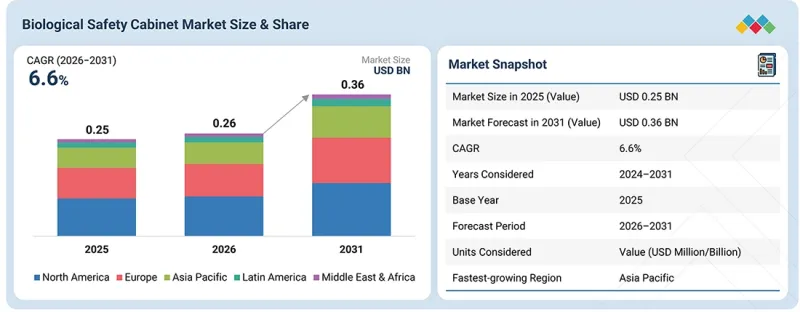
세계의 생물 안전 캐비닛 시장 규모는 2026년 2억 6,000만 달러에서 2031년에는 3억 6,000만 달러로 성장할 것으로 예상되며, 연평균 성장률(CAGR)은 6.6%에 달할 것으로 전망됩니다.
세계 생물 안전 캐비닛 시장은 제약 및 바이오의약품 연구에 대한 투자 확대, 임상 및 학술 연구소의 확충, 감염성 및 유해한 생물학적 물질의 안전한 취급에 대한 수요 증가에 힘입어 꾸준히 성장할 것으로 전망됩니다.
| 조사 범위 | |
|---|---|
| 조사 대상 기간 | 2026-2031년 |
| 기준 연도 | 2025년 |
| 예측 기간 | 2026-2031년 |
| 단위 | 금액(달러) |
| 부문 | 제품별, 제품 유형별, 최종사용자별 |
| 대상 지역 | 북미, 유럽, 아시아태평양, 라틴아메리카, 중동 및 아프리카 |
수요는 통제된 격리 환경이 필요한 백신, 생물학적 제제, 세포·유전자 치료, 미생물학 분야의 응용 기술 개발에 힘입어 더욱 증가하고 있습니다. 클래스 II 캐비닛은 인력, 제품, 환경을 보호하며 연구, 제약, 임상 검사 현장에서 널리 사용되고 있어 여전히 주요 제품 카테고리로 자리 잡고 있습니다.
“클래스 II는 2026년부터 2031년까지 시장에서 가장 높은 연평균 성장률(CAGR)을 기록할 것으로 예상됩니다.”
유형별로 보면 클래스 II 부문은 예측 기간 동안 가장 높은 연평균 성장률(CAGR)을 기록할 전망입니다. 이 부문은 작업자, 제품, 환경을 보호하는 능력에 주로 뒷받침되며, 클래스 II 캐비닛은 제약, 바이오의약품, 임상, 학술, 미생물학 분야의 각 연구소에서 폭넓게 적용되고 있습니다. 클래스 II BSC는 생물안전 수준 1, 2, 3과 관련된 작업을 위해 설계되었으며, 세포 배양 및 미생물학 연구 등의 용도에 대응합니다. 제약·바이오의약품 연구, 임상 진단, 감염병 조사, 학술 연구소의 인프라 확충은 물론, 노후화된 장비의 교체 및 인증된 봉쇄 시스템에 대한 집중으로 인해 클래스 II 생물 안전 캐비닛에 대한 수요는 지속될 것으로 예상됩니다. NSF/ANSI 49 규격은 클래스 II 생물 안전 캐비닛의 설계, 성능, 인증 요건을 구체적으로 규정하고 있습니다.
“제약·바이오의약품 기업이 2025년에 가장 큰 점유율을 차지했습니다.”
최종사용자별로 보면 2025년에는 제약·바이오의약품 기업이 가장 큰 시장 점유율을 차지했습니다. 이는 신약 개발, 생물학적 제제 개발, 백신 연구, 세포·유전자 치료, 품질 관리, 무균 제제 조제 과정에서 생물 안전 캐비닛이 널리 활용되고 있는 것이 배경입니다. 이러한 기관에서는 미생물, 생물학적 시료, 잠재적으로 유해한 물질을 취급할 때 통제된 격리 환경이 필요하며, 이는 클래스 II 생물 안전 캐비닛에 대한 지속적인 수요를 창출하고 있습니다. 바이오의약품 연구·제조 시설의 확충과 연구 시설 인프라에 대한 투자 증가도 캐비닛 설치를 뒷받침하고 있습니다. Thermo Fisher Scientific은 자사의 클래스 II 생물 안전 캐비닛의 주요 사용처로 제약, 생명공학, 임상 검사 시설을 꼽고 있습니다.
“아시아태평양은 2026년부터 2031년까지 가장 높은 성장률을 기록할 전망입니다.”
이 지역의 성장은 제약 및 바이오의약품 제조에 대한 투자 확대, 임상·진단 검사실 확충, 중국, 인도, 일본, 한국 및 기타 신흥 경제국에서의 연구 활동 활성화에 힘입고 있습니다. 이 지역의 생명공학 분야 확대, 백신 및 생물학적 제제 개발 증가, 그리고 새로운 연구·의료 시설의 확충이 생물 안전 캐비닛에 대한 수요를 창출하고 있습니다.
특히 중국과 인도는 제약·생명공학 산업의 확대와 실험실 인프라에 대한 투자에 힘입어 특히 중요한 성장 시장으로 부상하고 있습니다. 연구 시설 인프라의 현대화, 인증된 격리 장비의 도입 확대, 바이오의약품 연구 및 임상 연구 역량의 확충으로 인해 이 시장에는 큰 성장 기회가 있습니다. 연구 시설에서 생물안전 및 오염 관리를 중시하는 경향이 강해짐에 따라, 기존형 또는 노후화된 장비에서 기류 제어, 에너지 효율, 모니터링 기능이 향상된 첨단 클래스 II 캐비닛으로의 교체가 진행되고 있습니다.
실험실 인프라의 현대화, 인증된 격리 장비의 도입 확대, 바이오의약품 및 임상 연구 역량 확충 등을 통해 이 시장에는 큰 성장 기회가 열리고 있습니다. 실험실의 생물안전 및 오염 관리에 대한 중요성이 커짐에 따라, 실험실에서는 기존 장비나 노후화된 장비를 기류 제어, 에너지 효율, 모니터링 기능이 향상된 첨단 클래스 II 캐비닛으로 교체하는 움직임이 진행되고 있습니다.
본 보고서에서는 전 세계 생물 안전 캐비닛 시장을 조사하여, 시장 개요, 시장 성장에 영향을 미치는 각종 요인에 대한 분석, 기술 및 특허 동향, 법규제 환경, 사례 연구, 시장 규모 추정 및 전망, 각종 분류·지역/주요 국가별 상세 분석, 경쟁 구도, 주요 기업 개요 등을 정리하고 있습니다.
자주 묻는 질문
목차
제1장 소개
제2장 주요 요약
제3장 주요 인사이트
제4장 시장 개요
제5장 업계 동향
제6장 기술의 진보, AI의 영향, 특허, 혁신, 향후 응용
제7장 규제 상황과 지속가능성에 대한 대처
제8장 고객 상황과 구매 행동
제9장 생물 안전 캐비닛 시장 : 유형별
제10장 생물 안전 캐비닛 시장 : 최종사용자별
제11장 생물 안전 캐비닛 시장 : 지역별
제12장 경쟁 구도
제13장 기업 개요
제14장 조사 방법
제15장 부록
KSM 26.10.08The global biological safety cabinet market is anticipated to grow from USD 0.26 billion in 2026 to USD 0.36 billion by 2031, reflecting a CAGR of 6.6%. The global biological safety cabinet market is anticipated to grow steadily, supported by increasing investments in pharmaceutical and biopharmaceutical research, expansion of clinical and academic laboratories, and growing requirements for safe handling of infectious and hazardous biological materials.
| Scope of the Report | |
|---|---|
| Years Considered for the Study | 2026-2031 |
| Base Year | 2025 |
| Forecast Period | 2026-2031 |
| Units Considered | Value (USD billion) |
| Segments | By Product, Type, End User |
| Regions covered | North America, Europe, the Asia Pacific, Latin America, the Middle East, and Africa |
Demand is further supported by the development of vaccines, biologics, cell and gene therapies, and microbiology applications that require controlled containment environments. Class II cabinets remain the primary product category because they provide personnel, product, and environmental protection and are widely used across research, pharmaceutical, and clinical laboratory settings.
"Class II to register the highest CAGR in the biological safety cabinet market from 2026 to 2031"
Based on type, the Class II segment is likely to register the highest CAGR during the forecast period. The segment is primarily driven by its ability to provide personnel, product, and environmental protection, making Class II cabinets widely applicable across pharmaceutical, biopharmaceutical, clinical, academic, and microbiology laboratories. Class II BSCs are designed for work involving Biosafety Levels 1, 2, and 3 and support applications such as cell culture and microbiological research. The expansion of pharmaceutical and biopharmaceutical research, clinical diagnostics, infectious disease studies, and academic laboratory infrastructure, coupled with replacement of aging equipment and increasing emphasis on certified containment systems, is expected to sustain demand for Class II biological safety cabinets. NSF/ANSI 49 specifically establishes design, performance, and certification requirements for Class II biosafety cabinetry.
"Pharma & biopharma organizations captured the largest share of the biological safety cabinet market in 2025"
Based on end user, pharma & biopharma organizations accounted for the largest market share in 2025, supported by extensive use of biological safety cabinets in drug discovery, biologics development, vaccine research, cell and gene therapy, quality control, and sterile drug preparation. These organizations require controlled containment for handling microorganisms, biological samples, and potentially hazardous materials, creating sustained demand for Class II biological safety cabinets. The expansion of biopharmaceutical research and manufacturing facilities, along with increasing investments in laboratory infrastructure, is further supporting cabinet installations. Thermo Fisher Scientific identifies pharmaceutical, biotechnology, and clinical facilities among key application settings for its Class II biological safety cabinets.
"Asia Pacific to register the fastest growth rate in the biological safety cabinet market between 2026 and 2031"
Based on region, Asia Pacific is expected to register the fastest growth during the forecast period. Regional expansion is supported by increasing investments in pharmaceutical and biopharmaceutical manufacturing, expansion of clinical and diagnostic laboratories, and growing research activities across China, India, Japan, South Korea, and other emerging economies. The region's expanding biotechnology sector, increasing vaccine and biologics development, and development of new research and healthcare facilities are generating demand for biological safety cabinets. China and India are particularly important growth markets, supported by expanding pharmaceutical and biotechnology industries and investments in laboratory infrastructure. The market presents significant growth opportunities through the modernization of laboratory infrastructure, increasing adoption of certified containment equipment, and expansion of biopharmaceutical and clinical research capabilities. Growing emphasis on laboratory biosafety and contamination control is encouraging laboratories to replace conventional or aging equipment with advanced Class II cabinets offering improved airflow control, energy efficiency, and monitoring capabilities.
Breakdown of primary participants in the biological safety cabinet market is as follows:
- By Company Type: Tier 1 (32%), Tier 2 (41%), and Tier 3 (27%)
- By Designation: C-level Executives (30%), Directors (26%), and Others (44%)
- By Region: North America (53%), Europe (21%), Asia Pacific (17%), Latin America (6%), and the Middle East & Africa (4%)
Key players in the biological safety cabinet market are Thermo Fisher Scientific Inc. (US), Kewaunee Scientific Corporation (US), Labconco Corporation (US), The Baker Company, Inc. (US), Esco Lifesciences (Singapore), Air Science (US), Cruma, S.A. (Spain), Berner International GmbH (USA), LaboGene ApS (Denmark), Biolab Scientific Ltd. (Canada), LAMSYSTEMS GmbH (Germany), and FASTER S.r.l. (Italy).
Research Coverage:
This research report categorizes the biological safety cabinet market by type (Class I, Class II, Class III), end user (Pharma & Biopharma Organizations, Clinical Laboratories, Academic & Biomedical Research Institutes, Other End Users), and region (North America, Europe, Asia Pacific, Latin America, and the Middle East & Africa).
The scope of the report covers detailed information regarding the major factors, such as drivers, restraints, opportunities, and challenges influencing the growth of the biological safety cabinet market. A detailed analysis of key industry players has been conducted to provide insights into their business overview, solutions, and key strategies, such as partnerships, collaborations, expansions, agreements, product launches, and recent developments in the market. This report covers the competitive analysis of upcoming startups in the biological safety cabinet ecosystem.
Reasons to Buy This Report:
The report will help leaders/new entrants in this market by providing information on the closest approximations of revenue for the overall biological safety cabinet market and its subsegments. This report will help stakeholders understand the competitive landscape and gain deeper insights to better position their businesses and plan suitable go-to-market strategies. The report also helps stakeholders understand the market pulse and provides information on key drivers, restraints, opportunities, and challenges.
The report provides insights into the following pointers:
- Analysis of key drivers (Rising pharmaceutical and biopharmaceutical R&D activities, Rapid growth in biologics, cell and gene therapies, increasing risk of pandemics and communicable diseases, Growing concerns over cell culture contamination, Expansion of clinical diagnostics and microbiology laboratories), restraints (Availability of alternative containment cabinets, High acquisition and installation costs) opportunities (Growth opportunities in emerging economies, Development of smart and connected biological safety cabinets) and Challenges (Stringent and evolving regulatory requirements across regions, Shortage of qualified service and maintenance personnel) influencing the biological safety cabinet market growth
- Product Development/Innovation: Detailed insights on upcoming technologies, research & development activities, and product launches in the biological safety cabinet market
- Market Development: Comprehensive information about lucrative markets; the report analyzes the biological safety cabinet market across varied regions
- Market Diversification: Exhaustive information about new products, untapped geographies, recent developments, and investments in the biological safety cabinet market
- Competitive Assessment: In-depth assessment of market shares, growth strategies, and product offerings of leading players like Thermo Fisher Scientific Inc. (US), Kewaunee Scientific Corporation (US), Labconco Corporation (US), and The Baker Company, Inc. (US).
TABLE OF CONTENTS
1 INTRODUCTION
- 1.1 STUDY OBJECTIVES
- 1.2 MARKET DEFINITION
- 1.3 STUDY SCOPE
- 1.3.1 MARKETS COVERED AND REGIONAL SCOPE
- 1.3.2 INCLUSIONS AND EXCLUSIONS
- 1.3.3 YEARS CONSIDERED
- 1.3.4 CURRENCY CONSIDERED
- 1.4 STAKEHOLDERS
- 1.5 SUMMARY OF CHANGES
2 EXECUTIVE SUMMARY
- 2.1 KEY INSIGHTS AND MARKET HIGHLIGHTS
- 2.2 KEY MARKET PARTICIPANTS: SHARE INSIGHTS AND STRATEGIC DEVELOPMENTS
- 2.3 DISRUPTIVE TRENDS SHAPING MARKET
- 2.4 HIGH-GROWTH SEGMENTS AND EMERGING FRONTIERS
- 2.5 SNAPSHOT: GLOBAL MARKET SIZE, GROWTH RATE, AND FORECAST
3 PREMIUM INSIGHTS
- 3.1 BIOLOGICAL SAFETY CABINET MARKET OVERVIEW
- 3.2 BIOLOGICAL SAFETY CABINET MARKET, BY TYPE, 2026 VS. 2031
- 3.3 BIOLOGICAL SAFETY CABINET MARKET, BY END USER, 2026 VS. 2031
- 3.4 BIOLOGICAL SAFETY CABINET MARKET: GEOGRAPHIC GROWTH OPPORTUNITIES
4 MARKET OVERVIEW
- 4.1 INTRODUCTION
- 4.2 MARKET DYNAMICS
- 4.2.1 DRIVERS
- 4.2.1.1 Growing biological development and biopharmaceutical activity
- 4.2.1.2 Increasing investments in laboratory infrastructure
- 4.2.1.3 Rising emphasis on laboratory biosafety and contamination control
- 4.2.1.4 Persistent burden of infectious diseases and pathogenic agents
- 4.2.2 RESTRAINTS
- 4.2.2.1 High installation, certification, and maintenance requirements
- 4.2.2.2 High cost of biological safety cabinets
- 4.2.3 OPPORTUNITIES
- 4.2.3.1 Growth opportunities in emerging markets
- 4.2.3.2 Technological advancements in biological safety cabinets
- 4.2.4 CHALLENGES
- 4.2.4.1 Shortage of skilled personnel for BSC certification and maintenance
- 4.2.1 DRIVERS
- 4.3 UNMET NEEDS AND WHITE SPACES
- 4.3.1 UNMET NEEDS IN BIOLOGICAL SAFETY CABINET MARKET
- 4.3.2 WHITE SPACE OPPORTUNITIES
- 4.4 INTERCONNECTED MARKETS AND CROSS-SECTOR OPPORTUNITIES
- 4.4.1 INTERCONNECTED MARKETS
- 4.4.2 CROSS-SECTOR OPPORTUNITIES
- 4.5 STRATEGIC MOVES BY TIER 1/2/3 PLAYERS
- 4.5.1 KEY MOVES AND STRATEGIC FOCUS
5 INDUSTRY TRENDS
- 5.1 PORTER'S FIVE FORCES ANALYSIS
- 5.1.1 THREAT OF NEW ENTRANTS
- 5.1.2 THREAT OF SUBSTITUTES
- 5.1.3 BARGAINING POWER OF BUYERS
- 5.1.4 BARGAINING POWER OF SUPPLIERS
- 5.1.5 INTENSITY OF COMPETITIVE RIVALRY
- 5.2 MACROECONOMIC INDICATORS
- 5.2.1 INTRODUCTION
- 5.2.2 GDP TRENDS AND FORECAST
- 5.3 SUPPLY CHAIN ANALYSIS
- 5.4 VALUE CHAIN ANALYSIS
- 5.5 ECOSYSTEM ANALYSIS
- 5.5.1 BIOLOGICAL SAFETY CABINET MARKET: ROLE OF COMPANIES IN ECOSYSTEM
- 5.6 PRICING ANALYSIS
- 5.6.1 AVERAGE SELLING PRICE, BY KEY PLAYER, 2024-2026
- 5.6.2 AVERAGE SELLING PRICE, BY REGION, 2024-2026
- 5.7 TRADE ANALYSIS
- 5.7.1 IMPORT SCENARIO (HS CODE 8414.70)
- 5.7.2 EXPORT SCENARIO (HS CODE 8414.70)
- 5.8 KEY CONFERENCES & EVENTS, 2026-2027
- 5.9 TRENDS/DISRUPTIONS IMPACTING CUSTOMER BUSINESS
- 5.10 INVESTMENT & FUNDING SCENARIO
- 5.11 IMPACT OF 2025 US TARIFFS-BIOLOGICAL SAFETY CABINET MARKET
- 5.11.1 INTRODUCTION
- 5.11.2 KEY TARIFF RATES
- 5.11.3 PRICE IMPACT ANALYSIS
- 5.11.4 IMPACT ON REGIONS
- 5.11.4.1 North America
- 5.11.4.2 Europe
- 5.11.4.3 Asia Pacific
- 5.11.5 IMPACT ON END-USE INDUSTRIES
- 5.11.5.1 Pharmaceutical & biopharmaceutical companies
- 5.11.5.2 Clinical laboratories
6 TECHNOLOGICAL ADVANCEMENTS, AI-DRIVEN IMPACT, PATENTS, INNOVATIONS, AND FUTURE APPLICATIONS
- 6.1 KEY EMERGING TECHNOLOGIES
- 6.1.1 HEPA FILTRATION
- 6.1.2 AIRFLOW & CONTAINMENT CONTROL
- 6.2 COMPLEMENTARY TECHNOLOGIES
- 6.2.1 DECONTAMINATION TECHNOLOGY
- 6.3 ADJACENT TECHNOLOGIES
- 6.3.1 LABORATORY ENVIRONMENTAL MONITORING SYSTEMS
- 6.4 TECHNOLOGY/PRODUCT ROADMAP
- 6.5 PATENT ANALYSIS
- 6.5.1 LIST OF MAJOR PATENTS
- 6.6 FUTURE APPLICATIONS
- 6.7 IMPACT OF AI/GENERATIVE AI ON BIOLOGICAL SAFETY CABINET MARKET
- 6.7.1 INTRODUCTION
- 6.7.2 TOP USE CASES AND MARKET POTENTIAL
- 6.7.3 KEY COMPANIES IMPLEMENTING AI
- 6.7.4 FUTURE OF AI/GEN AI
7 REGULATORY LANDSCAPE AND SUSTAINABILITY INITIATIVES
- 7.1 REGIONAL REGULATIONS AND COMPLIANCE
- 7.1.1 REGULATORY BODIES, GOVERNMENT AGENCIES, AND OTHER ORGANIZATIONS
- 7.2 SUSTAINABILITY INITIATIVES
- 7.2.1 ENVIRONMENTAL IMPACT AND ECO-FRIENDLY INITIATIVES IN BIOLOGICAL SAFETY CABINET
- 7.2.1.1 Eco-friendly Initiatives
- 7.2.1 ENVIRONMENTAL IMPACT AND ECO-FRIENDLY INITIATIVES IN BIOLOGICAL SAFETY CABINET
- 7.3 IMPACT OF REGULATORY POLICIES ON SUSTAINABILITY INITIATIVES
8 CUSTOMER LANDSCAPE & BUYER BEHAVIOR
- 8.1 DECISION-MAKING PROCESS
- 8.2 BUYER STAKEHOLDERS AND BUYING EVALUATION CRITERIA
- 8.2.1 KEY STAKEHOLDERS IN BUYING PROCESS
- 8.2.2 BUYING CRITERIA
- 8.3 ADOPTION BARRIERS & INTERNAL CHALLENGES
- 8.4 UNMET NEEDS IN VARIOUS END-USE INDUSTRIES
- 8.5 MARKET PROFITABILITY
- 8.5.1 REVENUE POTENTIAL
- 8.5.2 COST DYNAMICS
- 8.5.3 MARGIN OPPORTUNITIES IN KEY APPLICATIONS
9 BIOLOGICAL SAFETY CABINET MARKET, BY TYPE
- 9.1 INTRODUCTION
- 9.2 CLASS I
- 9.2.1 BASIC CONTAINMENT REQUIREMENTS SUSTAIN CLASS I CABINET DEMAND
- 9.3 CLASS II
- 9.3.1 CLASS II TYPE A
- 9.3.1.1 Class II Type A1
- 9.3.1.1.1 Established laboratory installations maintain Type A1 demand
- 9.3.1.2 Class II Type A2
- 9.3.1.2.1 Broad biological workflows drive Type A2 demand
- 9.3.1.1 Class II Type A1
- 9.3.2 CLASS II TYPE B
- 9.3.2.1 Class II Type B1
- 9.3.2.1.1 Specialized chemical-biological applications support Type B1 demand
- 9.3.2.2 Class II Type B2
- 9.3.2.2.1 Total-exhaust requirements support specialized Type B2 demand
- 9.3.2.1 Class II Type B1
- 9.3.3 CLASS II TYPE C1
- 9.3.3.1 Flexible exhaust configurations create a differentiated Type C1 niche
- 9.3.1 CLASS II TYPE A
- 9.4 CLASS III
- 9.4.1 MAXIMUM-CONTAINMENT REQUIREMENTS SUPPORT CLASS III CABINET DEMAND
10 BIOLOGICAL SAFETY CABINET MARKET, BY END USER
- 10.1 INTRODUCTION
- 10.2 PHARMA & BIOPHARMA ORGANIZATIONS
- 10.2.1 RISING BIOLOGICS DEVELOPMENT AND R&D INVESTMENT TO DRIVE HIGH-END BSC ADOPTION
- 10.3 CLINICAL LABORATORIES
- 10.3.1 RISING DISEASE BURDEN AND DIAGNOSTIC TESTING VOLUMES TO SUPPORT MARKET GROWTH
- 10.4 ACADEMIC & BIOMEDICAL RESEARCH INSTITUTES
- 10.4.1 SUSTAINED RESEARCH FUNDING TO SHAPE MARKET GROWTH
- 10.5 OTHER END USERS
11 BIOLOGICAL SAFETY CABINET MARKET, BY REGION
- 11.1 INTRODUCTION
- 11.2 NORTH AMERICA
- 11.2.1 US
- 11.2.1.1 Growth in biosimilars market to boost preclinical research
- 11.2.2 CANADA
- 11.2.2.1 Government support for R&D to support market growth
- 11.2.1 US
- 11.3 EUROPE
- 11.3.1 GERMANY
- 11.3.1.1 Increased pharmaceutical R&D and biomanufacturing investments to drive market growth
- 11.3.2 UK
- 11.3.2.1 Expanding biopharmaceutical R&D to support market growth
- 11.3.3 FRANCE
- 11.3.3.1 Expansion of biopharmaceutical manufacturing to support market growth
- 11.3.4 ITALY
- 11.3.4.1 Expansion of biomedical research to support market growth
- 11.3.5 SPAIN
- 11.3.5.1 Expansion of biomedical research to support market growth
- 11.3.6 REST OF EUROPE
- 11.3.1 GERMANY
- 11.4 ASIA PACIFIC
- 11.4.1 CHINA
- 11.4.1.1 Government support for innovative drug development to support market growth
- 11.4.2 JAPAN
- 11.4.2.1 Strong academic-industry collaboration to support market growth
- 11.4.3 INDIA
- 11.4.3.1 Expansion of biotechnology research and biomanufacturing to support market growth
- 11.4.4 REST OF ASIA PACIFIC
- 11.4.1 CHINA
- 11.5 LATIN AMERICA
- 11.5.1 EXPANSION OF PHARMACEUTICAL R&D AND CLINICAL RESEARCH TO SUPPORT MARKET GROWTH
- 11.6 MIDDLE EAST & AFRICA
- 11.6.1 INCREASING CLINICAL RESEARCH AND BIOTECHNOLOGY ACTIVITIES TO DRIVE MARKET GROWTH
12 COMPETITIVE LANDSCAPE
- 12.1 INTRODUCTION
- 12.2 KEY PLAYER STRATEGIES/RIGHT TO WIN
- 12.2.1 OVERVIEW OF STRATEGIES DEPLOYED BY PLAYERS IN BIOLOGICAL SAFETY CABINET MARKET
- 12.3 REVENUE ANALYSIS, 2023-2025
- 12.4 MARKET SHARE ANALYSIS, 2025
- 12.4.1 GLOBAL MARKET SHARE ANALYSIS, 2025
- 12.5 COMPANY EVALUATION MATRIX: KEY PLAYERS, 2025
- 12.5.1 STARS
- 12.5.2 EMERGING LEADERS
- 12.5.3 PERVASIVE PLAYERS
- 12.5.4 PARTICIPANTS
- 12.5.5 COMPANY FOOTPRINT: KEY PLAYERS, 2025
- 12.5.5.1 Company footprint
- 12.5.5.2 Region footprint
- 12.5.5.3 Type footprint
- 12.5.5.4 End-user footprint
- 12.6 COMPANY EVALUATION MATRIX: STARTUPS/SMES, 2025
- 12.6.1 PROGRESSIVE COMPANIES
- 12.6.2 RESPONSIVE COMPANIES
- 12.6.3 DYNAMIC COMPANIES
- 12.6.4 STARTING BLOCKS
- 12.6.5 COMPANY FOOTPRINT: STARTUPS/SMES, 2025
- 12.6.5.1 Detailed list of key startups/SMEs
- 12.7 COMPANY VALUATION & FINANCIAL METRICS
- 12.7.1 FINANCIAL METRICS
- 12.7.2 COMPANY VALUATION
- 12.8 BRAND/PRODUCT COMPARISON
- 12.9 COMPETITIVE SCENARIO
- 12.9.1 PRODUCT/SERVICE LAUNCHES & APPROVALS
- 12.9.2 DEALS
- 12.9.3 EXPANSIONS
13 COMPANY PROFILES
- 13.1 KEY PLAYERS
- 13.1.1 THERMO FISHER SCIENTIFIC INC.
- 13.1.1.1 Business overview
- 13.1.1.2 Products offered
- 13.1.1.3 MnM view
- 13.1.1.3.1 Right to win
- 13.1.1.3.2 Strategic choices
- 13.1.1.3.3 Weaknesses & competitive threats
- 13.1.2 KEWAUNEE SCIENTIFIC CORPORATION
- 13.1.2.1 Business overview
- 13.1.2.2 Products offered
- 13.1.2.3 Recent developments
- 13.1.2.3.1 Deals
- 13.1.2.4 MnM view
- 13.1.2.4.1 Right to win
- 13.1.2.4.2 Strategic choices
- 13.1.2.4.3 Weaknesses & competitive threats
- 13.1.3 ESCO LIFESCIENCES GROUP
- 13.1.3.1 Business overview
- 13.1.3.2 Products offered
- 13.1.3.3 Recent developments
- 13.1.3.3.1 Product launches & approvals
- 13.1.3.3.2 Deals
- 13.1.3.3.3 Expansions
- 13.1.3.4 MnM view
- 13.1.3.4.1 Right to win
- 13.1.3.4.2 Strategic choices
- 13.1.3.4.3 Weaknesses & competitive threats
- 13.1.4 LABCONCO CORPORATION
- 13.1.4.1 Business overview
- 13.1.4.2 Products offered
- 13.1.4.3 Recent developments
- 13.1.4.3.1 Product launches & approvals
- 13.1.4.4 MnM view
- 13.1.4.4.1 Right to win
- 13.1.4.4.2 Strategic choices
- 13.1.4.4.3 Weaknesses & competitive threats
- 13.1.5 THE BAKER COMPANY, INC.
- 13.1.5.1 Business overview
- 13.1.5.2 Products offered
- 13.1.5.3 Recent developments
- 13.1.5.3.1 Product launches & approvals
- 13.1.5.4 MnM view
- 13.1.5.4.1 Right to win
- 13.1.5.4.2 Strategic choices
- 13.1.5.4.3 Weaknesses & competitive threats
- 13.1.6 GERMFREE LABORATORIES, INC.
- 13.1.6.1 Business overview
- 13.1.6.2 Products offered
- 13.1.7 CRUMA
- 13.1.7.1 Business overview
- 13.1.7.2 Products offered
- 13.1.8 AIR SCIENCE USA LLC
- 13.1.8.1 Business overview
- 13.1.8.2 Products offered
- 13.1.9 BERNER INTERNATIONAL GMBH
- 13.1.9.1 Business overview
- 13.1.9.2 Products offered
- 13.1.10 LABOGENE
- 13.1.10.1 Business overview
- 13.1.10.2 Products offered
- 13.1.11 BIOLAB SCIENTIFIC LTD.
- 13.1.11.1 Business overview
- 13.1.11.2 Products offered
- 13.1.12 LAMSYSTEMS CC
- 13.1.12.1 Business overview
- 13.1.12.2 Products offered
- 13.1.1 THERMO FISHER SCIENTIFIC INC.
- 13.2 OTHER PLAYERS
- 13.2.1 FASTER S.R.L.
- 13.2.2 BIOBASE GROUP
- 13.2.3 THERMOLAB SCIENTIFIC EQUIPMENTS PVT. LTD.
- 13.2.4 LABMATE SCIENTIFIC LLC
- 13.2.5 TOPAIR SYSTEMS INC.
- 13.2.6 ZHEJIANG FUXIA MEDICAL TECHNOLOGY CO., LTD.
- 13.2.7 BIONICS SCIENTIFIC
- 13.2.8 SCITEK GLOBAL CO., LTD.
- 13.2.9 HEAL FORCE BIO-MEDITECH HOLDINGS LIMITED
- 13.2.10 SHANGHAI BOXUN MEDICAL BIOLOGICAL INSTRUMENT CORP.
- 13.2.11 HAIER BIOMEDICAL
- 13.2.12 HMC EUROPE GMBH
- 13.2.13 NORDIC LABTECH AB
14 RESEARCH METHODOLOGY
- 14.1 RESEARCH DATA
- 14.2 RESEARCH APPROACH
- 14.2.1 SECONDARY DATA
- 14.2.1.1 Key data from secondary sources
- 14.2.2 PRIMARY DATA
- 14.2.2.1 List of primary sources
- 14.2.2.2 Key data from primary sources
- 14.2.2.3 Key industry insights
- 14.2.2.4 Breakdown of primary interviews
- 14.2.1 SECONDARY DATA
- 14.3 MARKET SIZE ESTIMATION
- 14.3.1 TOTAL MARKET SIZE: BIOLOGICAL SAFETY CABINET MARKET
- 14.3.2 BOTTOM-UP APPROACH
- 14.3.2.1 Approach 1: Company revenue estimation approach
- 14.3.2.2 Approach 2: Presentations of companies and primary interviews
- 14.3.2.3 Growth forecast
- 14.3.2.4 CAGR projections
- 14.3.3 TOP-DOWN APPROACH
- 14.4 DATA TRIANGULATION
- 14.5 RESEARCH ASSUMPTIONS
- 14.5.1 STUDY-RELATED ASSUMPTIONS
- 14.6 STUDY ASSUMPTIONS
- 14.6.1 PARAMETRIC ASSUMPTIONS
- 14.6.2 GROWTH RATE ASSUMPTIONS
- 14.7 RESEARCH LIMITATIONS
- 14.8 RISK ASSESSMENT
15 APPENDIX
- 15.1 DISCUSSION GUIDE
- 15.2 KNOWLEDGESTORE: MARKETSANDMARKETS' SUBSCRIPTION PORTAL
- 15.3 CUSTOMIZATION OPTIONS
- 15.4 RELATED REPORTS
- 15.5 AUTHOR DETAILS


