

|
시장보고서
상품코드
2142608
고유량 비강 캐뉼라 시장 : 제품별, 용도별, 최종사용자별, 환자 유형별, 지역별 - 세계 예측(-2031년)High Flow Nasal Cannula Market by Product (Systems, Consumables & Accessories (Humidifiers, Interfaces)), Patient Type (Neonatal & Pediatric), Application (Acute Respiratory Failure, COPD), End User (Hospitals), & Region - Global Forecast to 2031 |
||||||

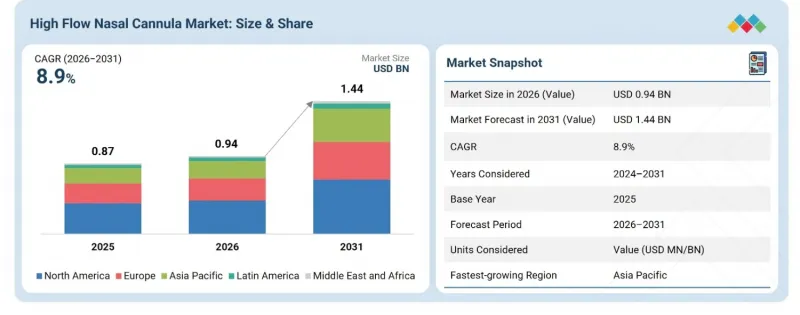
고유량 비강 캐뉼라(HFNC) 시장은 2026년 9억 4,000만 달러에서 2031년까지 14억 4,000만 달러에 달할 것으로 예측되며, 예측 기간 동안 CAGR은 8.9%가 될 전망입니다.
| 조사 범위 | |
|---|---|
| 조사 대상 기간 | 2026-2031년 |
| 기준 연도 | 2025년 |
| 예측 기간 | 2026-2031년 |
| 산정 단위 | 금액(10억 달러) |
| 부문 | 제품별, 용도별, 최종사용자별, 환자 유형별, 지역별 |
| 대상 지역 | 북미, 유럽, 아시아태평양, 라틴아메리카, 중동 및 아프리카 |
HFNC 시장은 급성 및 만성 호흡기 질환의 부담 증가, 급성 저산소성 호흡부전 사례 증가, 그리고 비침습적 호흡 지원에 대한 수요 증가로 인해 성장하고 있습니다. HFNC는 가열 및 가습된 가스를 통해 보다 안정적인 산소 공급, 산소화 개선, 호흡 노력 경감, 상기도 사각 공간 세척 및 분비물 배출 촉진을 가져옵니다. 또한, 기존의 산소 요법이나 일부 NIV에 비해 환자의 쾌적성과 내약성이 높다는 점도 임상 현장에서의 보다 광범위한 도입을 뒷받침하고 있습니다. 더 나아가 중환자실, 응급실, 튜브 제거 후 관리, 삽관 전 산소 포화도 향상, 수술 전후 관리, 기관지경 검사, 그리고 NIV나 CPAP 중단 기간 등 HFNC의 적용 범위가 확대되고 있는 점도 시장 성장에 기여하고 있습니다. 임상 현장에서의 수용도가 높아지고 있는 데 더해, 신생아, 소아, 성인 환자를 위한 HFNC 시스템이 이용 가능해짐에 따라 의료 현장 전반에서의 사용 범위가 더욱 확대되고 있습니다.
“용도별로는 급성 호흡부전 부문이 고유량 비강 캐뉼라(HFNC) 시장에서 가장 큰 점유율을 차지할 것으로 추정됩니다.”
용도별로는 급성 호흡부전 부문이 고유량 비강 캐뉼라(HFNC) 시장에서 가장 큰 점유율을 차지하고 있으며, 이는 주로 급성 저산소성 호흡부전 환자를 위한 비침습적 호흡 지원 옵션으로서 HFNC의 사용이 증가하고 있기 때문입니다. HFNC는 가온·가습된 산소를 고유량으로 공급할 수 있어, 산소화 개선, 호흡 부하 경감 및 중증 호흡곤란을 보이는 환자를 지원하는 데 도움이 됩니다. 임상 지침에서는 급성 저산소성 호흡부전을 겪는 성인 환자에게 기존 산소 요법보다 HFNC 사용을 권장하고 있으며, 이는 중환자실, 응급실 및 기타 급성기 의료 현장에서 HFNC의 광범위한 도입을 촉진하고 있습니다. 폐렴, 급성 호흡곤란 증후군, 폐 감염증, 그리고 기저 질환인 심폐 질환의 악화 발생률 증가 또한 이 용도에서 HFNC에 대한 수요를 더욱 부추기고 있습니다. 또한, 비침습적 호흡 지원에 대한 선호도가 높아지고, 적절한 환자에게서 침습적 인공호흡 관리의 필요성을 줄이거나 지연시킬 가능성이 이 부문의 지속적인 성장을 뒷받침하고 있습니다.
“최종사용자별로는 병원 부문이 고유량 비강 캐뉼라(HFNC) 시장에서 가장 큰 점유율을 차지할 것으로 추정됩니다.”
최종사용자별로 보면 병원이 고유량 비강 캐뉼라(HFNC) 시장에서 가장 큰 점유율을 차지하고 있으며, 그 주요 이유는 중환자실, 응급실, 호흡기 병동 및 수술 후 관리에서 HFNC가 널리 사용되고 있기 때문입니다. 병원에서는 급성 저산소성 호흡부전이나 고도의 호흡 지원이 필요한 기타 질환을 가진 환자를 다수 수용하고 있으며, 이것이 HFNC 이용의 주요 현장이 되고 있습니다. 임상 지침 또한 급성 호흡부전, 특히 면밀한 모니터링과 호흡 지원의 적시 강화가 필요한 중증 환자에 대한 HFNC 사용을 권장하고 있습니다. 또한, 전문적인 중환자 치료 인프라, 훈련을 받은 의료진, 산소 공급 시스템 및 모니터링 장비가 잘 갖춰져 있어 병원은 보다 광범위하고 빈번한 HFNC 사용을 지원할 수 있습니다. 관 제거 후 관리, 사전 산소화, 수술 전후 관리 및 응급 호흡 관리 분야에서 HFNC의 적용 범위가 확대되고 있는 점도 이 부문의 선도적 위치를 더욱 공고히 하고 있습니다.
“북미 고유량 비강 캐뉼라 시장에서 미국은 가장 높은 연평균 성장률(CAGR)을 기록할 것으로 예상됩니다.”
미국은 선진적인 의료 인프라, 호흡기 질환의 높은 유병률, 그리고 비침습적 호흡 지원 기술의 광범위한 도입에 힘입어 북미 고유량 비강 캐뉼라(HFNC) 시장에서 가장 높은 성장률을 보일 것으로 예상됩니다. HFNC는 급성 저산소성 호흡부전, 응급 의료, 중환자 치료 및 삽관 제거 후 지원 분야에서 미국 병원들에서 널리 사용되고 있습니다. 미국 내 조사에 따르면, 응답한 병원들에서 HFNC가 사용되고 있으며, 특히 응급실에서의 이용률이 높아 임상 현장에서의 도입이 두드러진다는 사실이 드러났습니다. 확고히 자리 잡은 HFNC 제조사의 존재와 규제 당국의 지속적인 승인 또한 시장 확대를 뒷받침하고 있습니다. 예를 들어, 미국 FDA는 Vapotherm 및 Fisher & Paykel Healthcare와 같은 제조사의 HFNC 시스템을 승인함으로써, 미국 내 첨단 HFNC 기술의 접근성을 확대하고 있습니다. 또한, 임상적 근거의 축적, 중환자실 이외의 사용 확대, 그리고 급성기 및 호흡기 치료 현장에서의 HFNC 적용 범위 지속적 확대가 미국 시장의 추가 성장을 견인할 것으로 예상됩니다.
고유량 비강 캐뉼라 시장의 주요 기업으로는 Fisher & Paykel Healthcare Limited(뉴질랜드), Vapotherm(미국), ResMed(미국), Hamilton Medical AG(스위스), Dragerwerk AG & Co. KGaA(독일) 등이 있습니다.
조사 범위:
본 보고서는 고유량 비강 캐뉼라 시장을 분석하고, 제품 유형, 환자 유형, 용도, 최종사용자, 지역 등 다양한 부문을 바탕으로 해당 시장의 규모 및 향후 성장 가능성을 추정하는 것을 목적으로 합니다. 또한, 본 보고서에는 해당 시장의 주요 기업에 대한 경쟁 분석 외에도 각 기업 개요, 제공 서비스, 최근 동향 및 주요 시장 전략도 포함되어 있습니다.
본 보고서를 구매해야 하는 이유
본 보고서는 고유량 비강 캐뉼라 시장 전체 매출에 대한 가장 정확한 추정치를 제공함으로써, 이 시장의 시장 선도 기업 및 신규 진입 기업을 지원합니다. 또한 이해관계자가 경쟁 구도를 이해하고, 자사의 비즈니스를 더 나은 위치로 이끌며, 적절한 시장 진입 전략을 수립하기 위한 추가적인 인사이트를 얻는 데 도움이 됩니다. 더불어 본 보고서는 이해관계자가 시장 동향을 파악할 수 있도록 지원하며, 주요 시장 촉진요인, 억제요인, 과제 및 기회에 대한 정보를 제공합니다.
본 보고서는 다음 사항에 대한 인사이트를 제공합니다:
- 주요 촉진요인(“급성 및 만성 호흡기 질환의 부담 증가, 비침습적 호흡 지원에 대한 선호도 상승, 중환자실(ICU) 및 응급실에서의 HFNC 이용 확대, 조산아 및 신생아의 호흡기 합병증으로 인한 높은 부담”) 분석, 제약요인(“높은 초기 도입 비용 및 소모품의 지속적인 비용,높은 의료용 산소 수요”)에 대한 분석, 기회(“가정 및 장기 요양 환경으로의 HFNC 확대, 신흥 경제국에서의 미개척된 거대한 시장 기회, 소형 및 휴대 가능한 고유량 시스템 개발”) 및 과제(HFNC 치료 실패의 조기 발견, 지속적인 임상 모니터링 및 훈련된 인력의 필요성)에 대한 인사이트를 제공합니다.
- 시장 침투율 : 본 보고서에는 고유량 비강 캐뉼라 시장의 주요 기업들이 제공하는 제품에 대한 광범위한 정보가 포함되어 있습니다. 본 보고서에는 제품 유형, 환자 유형, 용도, 최종사용자, 지역 등 다양한 부문이 포함되어 있습니다.
- 제품 기능 강화 및 혁신 : 고유량 비강 캐뉼라 시장에서 신제품 출시 및 예상되는 동향에 대한 종합적인 상세 정보.
- 시장 개발 : 제품, 환자 유형, 용도, 최종사용자, 지역별로 수익성이 높은 성장 시장에 대한 상세한 인사이트와 분석을 제공합니다.
- 시장 다각화 : 고유량 비강 캐뉼라 시장의 신제품 출시, 시장 확대, 최신 동향 및 투자에 관한 종합적인 정보입니다.
- 경쟁 평가 : 고유량 비강 캐뉼라 시장에서 주요 경쟁사의 시장 점유율, 성장 계획, 제품 라인업 및 생산능력에 대한 철저한 평가입니다.
자주 묻는 질문
목차
제1장 소개
제2장 주요 요약
제3장 주요 인사이트
제4장 시장 개요
제5장 업계 동향
제6장 기술 진보, AI에 의한 영향, 특허, 혁신, 향후 응용
제7장 규제 상황
제8장 고객 상황과 구매 행동
제9장 고유량 비강 캐뉼라 시장(제품별)
제10장 고유량 비강 캐뉼라 시장(용도별)
제11장 고유량 비강 캐뉼라 시장(최종사용자별)
제12장 고유량 비강 캐뉼라 시장(환자 유형별)
제13장 고유량 비강 캐뉼라 시장(지역별)
제14장 경쟁 구도
제15장 기업 개요
제16장 조사 방법
제17장 부록
KSM 26.10.13The high-flow nasal cannula (HFNC) market is projected to reach USD 1.44 billion by 2031 from USD 0.94 billion in 2026, at a CAGR of 8.9% during the forecast period.
| Scope of the Report | |
|---|---|
| Years Considered for the Study | 2026-2031 |
| Base Year | 2025 |
| Forecast Period | 2026-2031 |
| Units Considered | Value (USD billion) |
| Segments | Product, Patient type, Application, End User, and Region |
| Regions covered | North America, Europe, APAC, LATAM, MEA |
The HFNC market is experiencing growth due to the increasing burden of acute and chronic respiratory disorders, rising cases of acute hypoxemic respiratory failure, and growing demand for non-invasive respiratory support. HFNC provides more reliable oxygen delivery along with heated and humidified gas, improved oxygenation, reduced work of breathing, upper-airway dead-space washout, and enhanced secretion clearance. Its greater patient comfort and tolerance compared with conventional oxygen therapy and certain forms of NIV also support wider clinical adoption. In addition, the expansion of HFNC applications across intensive care units, emergency departments, post-extubation care, pre-oxygenation before intubation, perioperative management, bronchoscopy, and during breaks from NIV or CPAP is contributing to market growth. Increasing clinical acceptance and the availability of HFNC systems for neonatal, pediatric, and adult patients are further broadening its use across healthcare settings.
"By application, the acute respiratory failure segment is estimated to account for the largest share of the high-flow nasal cannula market."
Acute respiratory failure holds the largest share of the high-flow nasal cannula (HFNC) market by application, primarily due to the increasing use of HFNC as a non-invasive respiratory support option for patients with acute hypoxemic respiratory failure. HFNC can deliver high flows of heated and humidified oxygen, helping improve oxygenation, reduce work of breathing, and support patients with significant respiratory distress. Clinical guidelines recommend HFNC over conventional oxygen therapy in adults with acute hypoxemic respiratory failure, supporting its widespread adoption in intensive care units, emergency departments, and other acute-care settings. The growing incidence of pneumonia, acute respiratory distress, pulmonary infections, and exacerbations of underlying cardiopulmonary conditions further contributes to demand for HFNC in this application. In addition, the increasing preference for non-invasive respiratory support and the potential to reduce or delay the need for invasive ventilation in appropriate patients are supporting the continued expansion of this segment.
"By end user, the hospitals segment is estimated to account for the largest share of the high-flow nasal cannula market."
Hospitals hold the largest share of the high-flow nasal cannula (HFNC) market by end user, primarily due to the widespread use of HFNC in intensive care units, emergency departments, respiratory wards, and post-operative care. Hospitals manage a large volume of patients with acute hypoxemic respiratory failure and other conditions requiring advanced respiratory support, making them the primary setting for HFNC utilization. Clinical guidelines also support the use of HFNC in acute respiratory failure, particularly in critically ill patients who require close monitoring and timely escalation of respiratory support. Furthermore, the availability of specialized critical-care infrastructure, trained healthcare professionals, oxygen supply systems, and monitoring equipment enables hospitals to support wider and more frequent HFNC use. The expanding application of HFNC for post-extubation support, pre-oxygenation, perioperative care, and emergency respiratory management is further contributing to the segment's leading position.
"The US is expected to witness the highest CAGR in the high-flow nasal cannula market in North America."
The US is expected to grow at the highest rate within the North American high-flow nasal cannula (HFNC) market, supported by the country's advanced healthcare infrastructure, high prevalence of respiratory disorders, and widespread adoption of non-invasive respiratory support technologies. HFNC is extensively used across US hospitals for acute hypoxemic respiratory failure, emergency care, intensive care, and post-extubation support. A US survey found that HFNC was used in responding hospitals, with particularly high utilization in emergency departments, highlighting its strong clinical adoption. The presence of established HFNC manufacturers and continued regulatory clearances also supports market expansion. For example, the US FDA has cleared HFNC systems from manufacturers such as Vapotherm and Fisher & Paykel Healthcare, expanding the availability of advanced HFNC technologies in the country. In addition, growing clinical evidence, increasing use beyond intensive care units, and continued expansion of HFNC applications across acute and respiratory care settings are expected to further drive US market growth.
A breakdown of the primary participants (supply-side) for the high-flow nasal cannula market referred to in this report is provided below:
- By Company Type: Tier 1-35%, Tier 2-40%, and Tier 3-25%
- By Designation: C-level-45%, Director Level-35%, and Others-20%
- By Region: North America-27%, Europe-25%, Asia Pacific-30%, Latin America- 8%, Middle East & Africa-10%.
Prominent players in the high-flow nasal cannula market include Fisher & Paykel Healthcare Limited (New Zealand), Vapotherm (US), ResMed (US), Hamilton Medical AG (Switzerland), and Dragerwerk AG & Co. KGaA (Germany).
Research Coverage:
The report analyzes the high-flow nasal cannula market and aims at estimating the market size and future growth potential of this market based on various segments such as product, patient type, application, end user and region. The report also includes a competitive analysis of the key players in this market along with their company profiles, service offerings, recent developments, and key market strategies.
Reasons to Buy the Report
The report will help market leaders/new entrants in this market with information on the closest approximations of the revenue numbers for the overall high-flow nasal cannula market. This report will help stakeholders understand the competitive landscape and gain more insights to position their businesses better and plan suitable go-to-market strategies. The report also helps stakeholders understand the pulse of the market and provides them with information on key market drivers, restraints, challenges, and opportunities.
This report provides insights into the following pointers:
- Analysis of key drivers (" Growing burden of acute and chronic respiratory diseases, Increasing preference for non-invasive respiratory support, Increasing HFNC utilization in ICUs and emergency departments, High burden of premature births and neonatal respiratory complications) restraints (High acquisition and recurring consumable costs, High medical oxygen requirement) opportunities (Expansion of HFNC into home and long-term care settings, Large untapped opportunity in emerging economies, Development of compact and portable high-flow systems) and challenges (Early identification of HFNC treatment failure, Need for continuous clinical monitoring and trained personnel).
- Market Penetration: It includes extensive information on products offered by the major players in the high-flow nasal cannula market. The report includes various segments, including product, patient type, application, end user, and region.
- Product Enhancement/Innovation: Comprehensive details about new product launches and anticipated trends in the high-flow nasal cannula market.
- Market Development: Thorough knowledge and analysis of the profitable rising markets by product, patient type, application, end user, and region.
- Market Diversification: Comprehensive information about newly launched products, expanding markets, current advancements, and investments in the high-flow nasal cannula market.
- Competitive Assessment: Thorough evaluation of the market shares, growth plans, product offerings, and capacities of the major competitors in the high-flow nasal cannula market.
TABLE OF CONTENTS
1 INTRODUCTION
- 1.1 STUDY OBJECTIVES
- 1.2 MARKET DEFINITION
- 1.3 INCLUSIONS AND EXCLUSIONS
- 1.4 STUDY SCOPE
- 1.4.1 SEGMENTS CONSIDERED
- 1.4.2 YEARS CONSIDERED
- 1.4.3 CURRENCY CONSIDERED
- 1.5 STAKEHOLDERS
2 EXECUTIVE SUMMARY
- 2.1 KEY INSIGHTS & MARKET HIGHLIGHTS
- 2.2 KEY MARKET PARTICIPANTS: INSIGHTS & DEVELOPMENTS
- 2.3 DISRUPTIVE TRENDS SHAPING MARKET GROWTH
- 2.4 HIGH-GROWTH SEGMENTS & EMERGING FRONTIERS
- 2.5 SNAPSHOT: GLOBAL MARKET SIZE, GROWTH RATE, AND FORECAST
3 PREMIUM INSIGHTS
- 3.1 HIGH FLOW NASAL CANNULA MARKET OVERVIEW
- 3.2 ASIA PACIFIC: HIGH FLOW NASAL CANNULA MARKET, BY PRODUCT AND COUNTRY (2025)
- 3.3 HIGH FLOW NASAL CANNULA MARKET: GEOGRAPHIC GROWTH OPPORTUNITIES (2025)
- 3.4 HIGH FLOW NASAL CANNULA MARKET, BY REGION (2024-2031)
- 3.5 HIGH FLOW NASAL CANNULA MARKET: DEVELOPED MARKETS VS. EMERGING ECONOMIES
4 MARKET OVERVIEW
- 4.1 INTRODUCTION
- 4.2 MARKET DYNAMICS
- 4.2.1 DRIVERS
- 4.2.1.1 Growing burden of acute and chronic respiratory diseases
- 4.2.1.2 Increasing preference for non-invasive respiratory support
- 4.2.1.3 Increasing HFNC utilization in ICUs and emergency departments
- 4.2.1.4 High burden of premature births and neonatal respiratory complications
- 4.2.2 RESTRAINTS
- 4.2.2.1 High acquisition and recurring consumable costs
- 4.2.2.2 High medical oxygen requirement
- 4.2.3 OPPORTUNITIES
- 4.2.3.1 Expansion of HFNC into home and long-term care settings
- 4.2.3.2 Large untapped opportunity in emerging economies
- 4.2.3.3 Development of compact and portable high-flow systems
- 4.2.4 CHALLENGES
- 4.2.4.1 Early identification of HFNC treatment failure
- 4.2.4.2 Need for continuous clinical monitoring and trained personnel
- 4.2.1 DRIVERS
- 4.3 UNMET NEEDS AND WHITE SPACES
- 4.3.1 UNMET NEEDS IN HIGH FLOW NASAL CANNULA MARKET
- 4.3.2 WHITE SPACE OPPORTUNITIES
- 4.4 INTERCONNECTED MARKETS AND CROSS-SECTOR OPPORTUNITIES
- 4.4.1 INTERCONNECTED MARKET
- 4.4.2 CROSS-SECTOR OPPORTUNITIES
- 4.5 STRATEGIC MOVES BY TIER-1/2/3 PLAYERS
5 INDUSTRY TRENDS
- 5.1 PORTER'S FIVE FORCES ANALYSIS
- 5.1.1 THREAT OF NEW ENTRANTS
- 5.1.2 THREAT OF SUBSTITUTES
- 5.1.3 BARGAINING POWER OF SUPPLIERS
- 5.1.4 BARGAINING POWER OF BUYERS
- 5.1.5 INTENSITY OF COMPETITIVE RIVALRY
- 5.2 MACROECONOMIC OUTLOOK
- 5.2.1 INTRODUCTION
- 5.2.2 GDP TRENDS AND FORECAST
- 5.2.3 TRENDS IN VENTILATORS INDUSTRY
- 5.2.4 TRENDS IN OXYGEN THERAPY EQUIPMENT INDUSTRY
- 5.3 SUPPLY CHAIN ANALYSIS
- 5.4 VALUE CHAIN ANALYSIS
- 5.5 ECOSYSTEM ANALYSIS
- 5.6 PRICING ANALYSIS (2023-2025)
- 5.6.1 AVERAGE SELLING PRICE TREND OF PRODUCT, BY KEY PLAYER (2025)
- 5.6.2 AVERAGE SELLING PRICE TREND, BY REGION (2023-2025)
- 5.7 TRADE DATA ANALYSIS
- 5.7.1 IMPORT DATA FOR HIGH FLOW NASAL CANNULA PRODUCTS (HS CODE 9019)
- 5.7.2 EXPORT DATA FOR HIGH FLOW NASAL CANNULA PRODUCTS (HS CODE 9019)
- 5.8 KEY CONFERENCES AND EVENTS, 2026-2027
- 5.9 TRENDS/DISRUPTIONS IMPACTING CUSTOMER BUSINESS
- 5.10 HIGH FLOW NASAL CANNULA MARKET, INVESTMENT AND FUNDING SCENARIO
- 5.11 CASE STUDY ANALYSIS
- 5.11.1 CASE STUDY 1: HIGH-FLOW NASAL CANNULA FOR HYPOXEMIC RESPIRATORY FAILURE
- 5.11.2 CASE STUDY 2: HFNC OXYGEN THERAPY OUTSIDE THE ICU
- 5.11.3 CASE STUDY 3: HIGH-FLOW NASAL OXYGEN FOR COVID-19-ASSOCIATED ACUTE RESPIRATORY FAILURE
- 5.12 IMPACT OF 2025 US TARIFF - OVERVIEW
- 5.12.1 INTRODUCTION
- 5.12.2 KEY TARIFF RATES
- 5.13 PRICE IMPACT ANALYSIS
- 5.13.1 IMPACT ON COUNTRY/REGION
- 5.13.1.1 US
- 5.13.1.2 Europe
- 5.13.1.3 Asia Pacific
- 5.13.1 IMPACT ON COUNTRY/REGION
- 5.14 IMPACT ON END USER INDUSTRIES
6 TECHNOLOGICAL ADVANCEMENTS, AI-DRIVEN IMPACT, PATENTS, INNOVATIONS, AND FUTURE APPLICATIONS
- 6.1 KEY EMERGING TECHNOLOGIES
- 6.1.1 HIGH-FLOW GAS GENERATION
- 6.1.2 AIR-OXYGEN BLENDING
- 6.1.3 TURBINE/BLOWER-BASED FLOW GENERATION
- 6.1.4 COMPLEMENTARY TECHNOLOGIES
- 6.1.4.1 Humidification chamber technology
- 6.1.4.2 Heated-wire circuit technology
- 6.1.5 ADJACENT TECHNOLOGIES
- 6.1.5.1 Conventional oxygen therapy (COT)
- 6.2 TECHNOLOGY/PRODUCT ROADMAP
- 6.2.1 SHORT-TERM (2025-2027) | FOUNDATION & EARLY COMMERCIALIZATION
- 6.2.2 MID-TERM (2027-2030) | EXPANSION & STANDARDIZATION
- 6.2.3 LONG-TERM (2030-2035+) | MASS COMMERCIALIZATION & DISRUPTION
- 6.3 PATENT ANALYSIS
- 6.4 FUTURE APPLICATIONS OF HIGH FLOW NASAL CANNULA
- 6.5 IMPACT OF AI/GEN AI ON HIGH FLOW NASAL CANNULA MARKET
- 6.5.1 TOP USE CASES AND MARKET POTENTIAL
- 6.5.2 BEST PRACTICES IN HIGH FLOW NASAL CANNULA FOR AI MODEL DEVELOPMENT AND DEPLOYMENT
- 6.5.3 CASE STUDIES OF AI IMPLEMENTATION IN THE HIGH FLOW NASAL CANNULA MARKET
- 6.5.4 INTERCONNECTED ADJACENT ECOSYSTEM AND IMPACT ON MARKET PLAYERS
- 6.5.5 CLIENTS' READINESS TO ADOPT GENERATIVE AI IN HIGH FLOW NASAL CANNULA MARKET
7 REGULATORY LANDSCAPE
- 7.1 REGIONAL REGULATIONS AND COMPLIANCE
- 7.1.1 REGULATORY BODIES, GOVERNMENT AGENCIES, AND OTHER ORGANIZATIONS
- 7.1.2 REGULATORY FRAMEWORK
- 7.1.2.1 North America
- 7.1.2.1.1 US
- 7.1.2.1.2 Canada
- 7.1.2.2 Europe
- 7.1.2.3 Asia Pacific
- 7.1.2.3.1 Japan
- 7.1.2.3.2 China
- 7.1.2.3.3 India
- 7.1.2.1 North America
- 7.1.3 INDUSTRY STANDARDS
- 7.2 CERTIFICATIONS, LABELING, ECO-STANDARDS
8 CUSTOMER LANDSCAPE & BUYER BEHAVIOR
- 8.1 DDECISION-MAKING PROCESS
- 8.2 BUYER STAKEHOLDERS AND BUYING EVALUATION CRITERIA
- 8.2.1 KEY STAKEHOLDERS IN BUYING PROCESS
- 8.2.2 SOURCE: INTERVIEW WITH EXPERTS AND MARKETSANDMARKETS ANALYSIS
- 8.3 ADOPTION BARRIERS & INTERNAL CHALLENGES
- 8.4 UNMET NEEDS FROM VARIOUS END-USE INDUSTRIES
- 8.5 MARKET PROFITABILITY
- 8.5.1 REVENUE POTENTIAL
- 8.5.2 COST DYNAMICS
- 8.5.3 MARGIN OPPORTUNITIES IN KEY APPLICATIONS
9 HIGH FLOW NASAL CANNULA MARKET, BY PRODUCT
- 9.1 INTRODUCTION
- 9.2 HFNC SYSTEMS/EQUIPMENT
- 9.3 CONSUMABLES AND ACCESSORIES
- 9.3.1 HUMIDIFIERS
- 9.3.1.1 Increasing recognition of heated humidification in high-flow therapy to drive adoption of HFNC-compatible humidifiers
- 9.3.2 NASAL CANNULAS/INTERFACES
- 9.3.2.1 Growing preference for comfortable and patient-specific interfaces to support HFNC adoption
- 9.3.3 BREATHING CIRCUITS/SETS
- 9.3.3.1 Rising use of disposable patient circuits and improved circuit designs to support recurring market demand
- 9.3.4 HUMIDIFICATION CHAMBERS
- 9.3.4.1 Increasing demand for efficient water management and humidification delivery to support humidification chamber adoption
- 9.3.5 OTHER CONSUMABLES & ACCESSORIES
- 9.3.5.1 Expansion of HFNC system configurations to increase demand for complementary accessories
- 9.3.1 HUMIDIFIERS
10 HIGH FLOW NASAL CANNULA MARKET, BY APPLICATION
- 10.1 INTRODUCTION
- 10.2 ACUTE RESPIRATORY FAILURE
- 10.2.1 INCREASING ADOPTION OF HFNC AS NONINVASIVE RESPIRATORY-SUPPORT STRATEGY FOR ACUTE HYPOXEMIC RESPIRATORY FAILURE TO DRIVE MARKET GROWTH
- 10.3 CHRONIC OBSTRUCTIVE PULMONARY DISEASE (COPD)
- 10.3.1 GROWING EVIDENCE FOR LONG-TERM AND ACUTE USE OF HFNC IN COPD TO SUPPORT MARKET EXPANSION
- 10.4 ACUTE HEART FAILURE
- 10.4.1 INCREASING CLINICAL EVALUATION OF HFNC FOR HYPOXEMIA ASSOCIATED WITH ACUTE HEART FAILURE TO CREATE GROWTH OPPORTUNITIES
- 10.5 OTHER APPLICATIONS
11 HIGH FLOW NASAL CANNULA MARKET, BY END USER
- 11.1 INTRODUCTION
- 11.2 HOSPITALS
- 11.2.1 INCREASING ADOPTION OF HFNC IN EMERGENCY, INTENSIVE-CARE, NEONATAL, AND GENERAL HOSPITAL SETTINGS TO MAINTAIN HOSPITAL DOMINANCE
- 11.3 HOME CARE SETTINGS
- 11.3.1 EXPANSION OF LONG-TERM HFNC THERAPY INTO HOME SETTING TO CREATE NEW GROWTH OPPORTUNITIES
- 11.4 LONG-TERM CARE FACILITIES
- 11.4.1 GROWING NEED FOR NON-INVASIVE RESPIRATORY SUPPORT IN CHRONIC RESPIRATORY DISEASE TO SUPPORT HFNC ADOPTION IN LONG-TERM CARE
- 11.5 OTHER END USERS
12 HIGH FLOW NASAL CANNULA MARKET, BY PATIENT TYPE
- 12.1 INTRODUCTION
- 12.2 NEONATAL & PEDIATRIC (0-17YRS)
- 12.2.1 INCREASING USE OF HFNC FOR NEONATAL AND PEDIATRIC RESPIRATORY SUPPORT TO DRIVE MARKET GROWTH
- 12.3 ADULT (18-64)
- 12.3.1 INCREASING PREVALENCE OF ACUTE RESPIRATORY FAILURE AND BROADER CLINICAL ADOPTION OF HFNC TO DRIVE THE ADULT SEGMENT
- 12.4 GERIATRIC (65+)
- 12.4.1 RISING BURDEN OF RESPIRATORY DISORDERS AMONG OLDER ADULTS TO SUPPORT HFNC ADOPTION IN GERIATRIC PATIENTS
13 HIGH FLOW NASAL CANNULA MARKET, BY REGION
- 13.1 INTRODUCTION
- 13.2 NORTH AMERICA
- 13.2.1 US
- 13.2.1.1 Large respiratory-care burden and preterm-birth population to support HFNC utilization
- 13.2.2 CANADA
- 13.2.2.1 Population aging and severe seasonal respiratory infections to drive demand
- 13.2.1 US
- 13.3 EUROPE
- 13.3.1 GERMANY
- 13.3.1.1 Large hospital infrastructure and an aging population to sustain HFNC demand
- 13.3.2 FRANCE
- 13.3.2.1 Aging population and severe winter respiratory activity to support adoption
- 13.3.3 UK
- 13.3.3.1 High emergency respiratory admissions to propel market growth
- 13.3.4 ITALY
- 13.3.4.1 Rapid population aging to shift demand toward adult and geriatric HFNC applications
- 13.3.5 SPAIN
- 13.3.5.1 Increasing respiratory mortality to strengthen the requirement for advanced oxygen support
- 13.3.6 REST OF EUROPE
- 13.3.1 GERMANY
- 13.4 ASIA PACIFIC
- 13.4.1 JAPAN
- 13.4.1.1 Exceptionally high elderly population to sustain respiratory-support demand
- 13.4.2 CHINA
- 13.4.2.1 Expanding hospital capacity and rapid aging to propel HFNC adoption
- 13.4.3 INDIA
- 13.4.3.1 Expansion of district-level critical-care infrastructure to widen addressable market
- 13.4.4 AUSTRALIA
- 13.4.4.1 High COPD-related hospital utilization and preterm births to support demand
- 13.4.5 SOUTH KOREA
- 13.4.5.1 Transition to a super-aged society to increase respiratory-care requirements
- 13.4.6 REST OF ASIA PACIFIC
- 13.4.1 JAPAN
- 13.5 LATIN AMERICA
- 13.5.1 BRAZIL
- 13.5.1.1 Rapid population aging and formal respiratory-care pathways to support market development
- 13.5.2 MEXICO
- 13.5.2.1 Tobacco exposure and a large hospital population to sustain respiratory-support demand
- 13.5.3 REST OF LATIN AMERICA
- 13.5.1 BRAZIL
- 13.6 MIDDLE EAST & AFRICA
- 13.6.1 GCC COUNTRIES
- 13.6.1.1 Modern hospital infrastructure and chronic disease to support HFNC adoption
- 13.6.2 REST OF MIDDLE EAST AND AFRICA
- 13.6.1 GCC COUNTRIES
14 COMPETITIVE LANDSCAPE
- 14.1 INTRODUCTION
- 14.2 KEY PLAYER STRATEGY/RIGHT TO WIN
- 14.2.1 OVERVIEW OF STRATEGIES ADOPTED BY KEY PLAYERS IN HIGH FLOW NASAL CANNULA MARKET
- 14.3 REVENUE ANALYSIS, 2021-2025
- 14.4 MARKET SHARE ANALYSIS, 2025
- 14.5 COMPANY EVALUATION MATRIX: KEY PLAYERS, 2025
- 14.5.1 STARS
- 14.5.2 EMERGING LEADERS
- 14.5.3 PERVASIVE PLAYERS
- 14.5.4 PARTICIPANTS
- 14.5.5 COMPANY FOOTPRINT: KEY PLAYERS, 2025
- 14.5.5.1 Company footprint
- 14.5.5.2 Region footprint
- 14.5.5.3 Product footprint
- 14.5.5.4 Procedure footprint
- 14.5.5.5 Application footprint
- 14.5.5.6 End-user footprint
- 14.6 COMPANY EVALUATION MATRIX: STARTUPS/SMES, 2025
- 14.6.1 PROGRESSIVE COMPANIES
- 14.6.2 DYNAMIC COMPANIES
- 14.6.3 STARTING BLOCKS
- 14.6.4 RESPONSIVE COMPANIES
- 14.6.5 COMPETITIVE BENCHMARKING: STARTUPS/SMES, 2025
- 14.7 COMPANY VALUATION AND FINANCIAL METRICS
- 14.7.1 FINANCIAL METRICS
- 14.7.2 COMPANY VALUATION
- 14.7.3 BRAND/PRODUCT COMPARISON
- 14.8 COMPETITIVE SCENARIO
- 14.8.1 DEALS
15 COMPANY PROFILES
- 15.1 KEY PLAYERS
- 15.1.1 FISHER & PAYKEL HEALTHCARE LIMITED
- 15.1.1.1 Business overview
- 15.1.1.2 Products offered
- 15.1.1.3 MnM view
- 15.1.1.3.1 Key strengths
- 15.1.1.3.2 Strategic choices
- 15.1.1.3.3 Weaknesses and competitive threats
- 15.1.2 VAPOTHERM
- 15.1.2.1 Business overview
- 15.1.2.2 Products offered
- 15.1.2.3 Recent developments
- 15.1.2.3.1 Deals
- 15.1.2.4 MnM view
- 15.1.2.4.1 Key strengths
- 15.1.2.4.2 Strategic choices made
- 15.1.2.4.3 Weaknesses and competitive threats
- 15.1.3 RESMED INC.
- 15.1.3.1 Business overview
- 15.1.3.2 Products offered
- 15.1.3.3 MnM view
- 15.1.3.3.1 Key strengths
- 15.1.3.3.2 Strategic choices made
- 15.1.3.3.3 Weaknesses and competitive threats
- 15.1.4 HAMILTON MEDICAL
- 15.1.4.1 Business overview
- 15.1.4.2 Products offered
- 15.1.4.3 Recent developments
- 15.1.4.3.1 Expansions
- 15.1.4.4 MnM view
- 15.1.4.4.1 Key strengths
- 15.1.4.4.2 Strategic choices made
- 15.1.4.4.3 Weaknesses and competitive threats
- 15.1.5 DRAGERWERK AG & CO. KGAA
- 15.1.5.1 Business overview
- 15.1.5.2 Products offered
- 15.1.5.3 MnM view
- 15.1.5.3.1 Key strengths
- 15.1.5.3.2 Strategic choices made
- 15.1.5.3.3 Weaknesses and competitive threats
- 15.1.6 INSPIRATION HEALTHCARE GROUP PLC
- 15.1.6.1 Business overview
- 15.1.6.2 Products offered
- 15.1.7 MASIMO (SUBSIDIARY OF DANAHER CORPORATION)
- 15.1.7.1 Business overview
- 15.1.7.2 Products offered
- 15.1.7.3 Recent developments
- 15.1.7.3.1 Deals
- 15.1.8 VINCENT MEDICAL HOLDINGS LIMITED
- 15.1.8.1 Business overview
- 15.1.8.2 Products offered
- 15.1.9 FLEXICARE (GROUP) LIMITED
- 15.1.9.1 Business overview
- 15.1.9.2 Products offered
- 15.1.10 MICOMME MEDICAL
- 15.1.10.1 Business overview
- 15.1.10.2 Products offered
- 15.1.11 BMC MEDICAL CO., LTD.
- 15.1.11.1 Business overview
- 15.1.11.2 Products offered
- 15.1.12 EAKIN HEALTHCARE
- 15.1.12.1 Business overview
- 15.1.12.2 Products offered
- 15.1.13 LOWENSTEIN MEDICAL SE & CO. KG
- 15.1.13.1 Business overview
- 15.1.13.2 Products offered
- 15.1.14 SHENZHEN COMEN MEDICAL INSTRUMENTS CO., LTD.
- 15.1.14.1 Business overview
- 15.1.14.2 Products offered
- 15.1.15 MEDLINE
- 15.1.15.1 Business overview
- 15.1.15.2 Products offered
- 15.1.1 FISHER & PAYKEL HEALTHCARE LIMITED
- 15.2 OTHER PLAYERS
- 15.2.1 INTERSURGICAL LTD
- 15.2.2 RESPIRCARE MEDICAL
- 15.2.3 GREAT GROUP MEDICAL CO., LTD.
- 15.2.4 GALEMED CORPORATION
- 15.2.5 SILMAG S.A.
- 15.2.6 SALAERA LLC
- 15.2.7 TELESAIR, INC.
- 15.2.8 HEKA MEDICALS INDIA PVT. LTD.
- 15.2.9 BESMED HEALTH BUSINESS CORP.
- 15.2.10 CREATE BIOTECH CO., LTD.
16 RESEARCH METHODOLOGY
- 16.1 RESEARCH DATA
- 16.1.1 SECONDARY DATA
- 16.1.1.1 Key data from secondary sources
- 16.1.2 PRIMARY DATA
- 16.1.2.1 Key data from primary sources
- 16.1.2.2 Key industry insights
- 16.1.1 SECONDARY DATA
- 16.2 MARKET SIZE ESTIMATION
- 16.2.1 BOTTOM-UP APPROACH
- 16.2.2 TOP-DOWN APPROACH
- 16.2.3 BASE NUMBER ESTIMATION
- 16.3 MARKET FORECAST APPROACH
- 16.4 MARKET BREAKDOWN AND DATA TRIANGULATION
- 16.5 ASSUMPTIONS
- 16.5.1 MARKET SHARE ASSUMPTIONS
- 16.6 FACTOR ANALYSIS
- 16.7 RISK ASSESSMENT
- 16.8 METHODOLOGY-RELATED LIMITATIONS
17 APPENDIX
- 17.1 DISCUSSION GUIDE
- 17.2 KNOWLEDGESTORE: MARKETSANDMARKETS' SUBSCRIPTION PORTAL
- 17.3 CUSTOMIZATION OPTIONS
- 17.4 RELATED REPORTS
- 17.5 AUTHOR DETAILS


