

|
시장보고서
상품코드
2144544
스마트 글라스 시장 예측(-2032년) : 유형, 기술, 제어 시스템별Smart Glass Market by Type (Tinted, Coated), Technology (Electrochromic, Suspended Particle Display [SPD], Liquid Crystal, Photochromic, Nanocrystalline), Control System (Voice-based, Building Automation System, Mobile-based) - Global Forecast to 2032 |
||||||

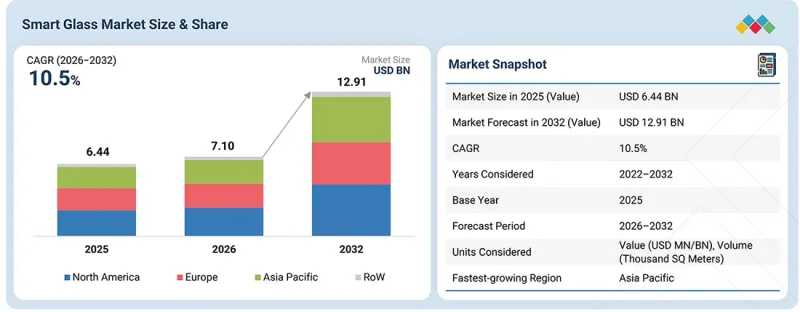
MarketsandMarkets에 따르면 스마트 글라스 시장은 2026년 71억 달러에서 2032년까지 129억 1,000만 달러로, CAGR 10.5%로 확대할 것으로 예측됩니다.
이 시장은 건축·건설, 자동차·운송, 항공우주, 호텔·관광, 헬스케어 및 상업용 분야에서 다이내믹 글레이징, 에너지 효율이 높은 건축 솔루션, 그리고 첨단 유리 기술의 채택이 확대되고 있는 것을 배경으로 강력한 성장이 예상됩니다. 조직과 소비자들이 에너지 절약, 거주자의 쾌적성, 사생활 보호, 그리고 지능형 공간 관리에 점점 더 중점을 두게 됨에 따라 창문, 파사드, 칸막이, 채광창, 파노라마 루프, 선루프, 항공기용 유리 등의 용도에서 스마트 유리에 대한 수요가 증가하고 있습니다. 이러한 솔루션을 통해 사용자는 빛의 투과, 눈부심, 일사열, 사생활 보호를 제어할 수 있을 뿐만 아니라, 건물과 차량을 더욱 효율적으로 설계할 수 있게 됩니다. 각 제조사들은 전환 성능, 광학 투명도, 내구성 및 설계 유연성이 향상된 일렉트로크로믹, 서스펜디드 파티클 디바이스(SPD), 폴리머 분산형 액정(PDLC), 서모크로믹 및 포토크로믹과 같은 스마트 유리 솔루션 개발을 점점 더 적극적으로 추진하고 있습니다.
| 조사 범위 | |
|---|---|
| 조사 대상 기간 | 2021-2032년 |
| 기준 연도 | 2025년 |
| 예측 기간 | 2026-2032년 |
| 산정 단위 | 금액(10억 달러) |
| 부문 | 유형별, 기술별, 제어 시스템별, 지역별 |
| 대상 지역 | 북미, 유럽, 아시아태평양(APAC), 기타 지역(RoW) |
스마트 유리와 센서, 모바일 기반 제어, 자동화 시스템 및 빌딩 관리 플랫폼과의 통합을 통해 그 기능성이 더욱 확대되고 있으며, 환경 및 사용자의 요구 사항에 기반한 반응성이 뛰어난 제어가 가능해졌습니다. 또한 그린 빌딩, 스마트 인프라, 전기자동차 및 프리미엄 차량, 지속가능한 건설, 차세대 교통 수단에 대한 투자가 시장내 보급을 가속화하고 있습니다. 에너지 효율 향상, 프라이버시 강화, 자연광 및 눈부심에 대한 적절한 관리, 거주자의 쾌적성 향상과 같은 장기적인 이점으로 인해 스마트 유리는 현대 건축 및 교통 분야에서 점점 더 중요한 기술이 될 것으로 기대됩니다.
"2032년에는 코팅 제품 부문이 스마트 유리 시장에서 가장 큰 점유율을 차지할 것으로 전망됩니다."
유형별로는 동적 광 제어, 태양열 관리, 눈부심 저감 및 에너지 효율 향상을 실현하는 기능성 코팅의 보급에 힘입어, 2032년에는 코팅형 부문이 최대 시장 점유율을 차지할 것으로 예상됩니다. 코팅형 스마트 유리는 유리 표면에 특수 재료나 기능층을 접목하여 광학적 특성 및 열적 특성을 조절하며, 상업용 건물, 주택, 자동차용 유리, 파사드, 창문, 채광창 등에 적합합니다. 코팅된 스마트 유리는 채광 관리, 단열 성능, 거주자의 쾌적성 및 에너지 절약이 중요한 용도에서 점점 더 많이 채택되고 있습니다. 스마트 기능과 기존 유리 디자인을 결합할 수 있으므로 제조업체와 건축 개발업자는 유리 구성을 대폭 변경하지 않고도 동적 성능을 도입할 수 있습니다. 또한 일렉트로크로믹 코팅, 저방사율 코팅, 일사 제어 코팅 및 기타 기능성 표면 처리 기술의 발전으로 인해 광학 성능, 내구성 및 에너지 관리 능력이 향상되고 있습니다. 친환경 건축, 에너지 절약형 건축, 스마트 인프라 및 첨단 자동차용 유리에 대한 투자 확대에 힘입어, 코팅된 스마트 유리의 채택이 더욱 가속화되고 시장내 우위가 유지될 것으로 예상됩니다.
"2026-2032년에 스마트 유리 시장에서 ‘스위치’ 부문이 가장 높은 연평균 성장률(CAGR)을 보일 것으로 예측됩니다."
제어 시스템별로는 건축, 자동차, 운송 분야에서 투명도 및 착색 제어에 대한 간단하고 편리하며 비용 효율적인 수요가 증가하는 것을 배경으로, 스위치 부문이 예측 기간 중 가장 빠르게 성장할 것으로 전망됩니다. 스위치 제어 방식의 스마트 윈도우, 파티션, 프라이버시 유리,선루프, 인테리어 글레이징의 채택 확대가 이 부문의 성장을 가속화하고 있습니다. 또한 스위치식 필름, 일렉트로크로믹 기술, PDLC 기술의 발전에 더해, 스마트 빌딩, 고급차, 에너지 절약형 유리에 대한 투자 확대가 전 세계에서 스위치식 제어 시스템에 새로운 기회를 창출하고 있습니다.
예측 기간 중, 스마트 유리 시장에서 북미가 가장 큰 성장 지역이 될 전망입니다.
지역별로 보면 미국 및 캐나다 전역에서 에너지 효율 건축, 스마트 인프라, 첨단 자동차용 유리, 그리고 지속가능한 건설 방식의 도입이 확대되고 있으며, 2032년에도 북미가 스마트 유리 시장에서 최대 점유율을 유지할 것으로 예상됩니다. 확립된 건설 및 자동차 생태계에 더해, 스마트 빌딩, 그린 파사드,전기자동차, 그리고 고급차용 기술에 대한 수요 증가가 스마트 유리 솔루션 도입을 지원하고 있습니다. 상업용 건물, 사무실, 의료 시설, 공항, 파노라마 루프, 선루프 및 교통수단용 유리 분야에서 스마트 유리의 채택 확대가 해당 지역의 수요를 더욱 부추기고 있습니다. 또한 건물 현대화, 에너지 효율화 노력, 커넥티드 빌딩 시스템, 그리고 일렉트로크로믹, SPD, PDLC와 같은 첨단 유리 기술에 대한 투자가 북미 전역의 스마트 유리 제조업체 및 기술 제공업체에게 더 많은 비즈니스 기회를 창출할 것으로 예상됩니다.
1차 조사 내역
스마트 글라스 시장에서 사업을 운영하는 주요 조직의 CEO, 마케팅 이사, 혁신·기술 이사 등 다양한 임원들을 대상으로 상세한 인터뷰를 시행했습니다.
- 기업 규모별: Tier 1-38%, Tier 2-28%, Tier 3-34%
- 직책별: C레벨 임원-40%, 이사-30%, 기타-30%
- 지역별: 북미-35%, 유럽-35%, 아시아태평양-20%, 기타 지역(RoW)-10%
참고: 기타 지역(RoW)에는 중동 및 아프리카, 남미가 포함됩니다. 기타 직책에는 제품, 영업, 마케팅 매니저 등이 포함됩니다. 기업 규모는 2025년 기준 총매출을 바탕으로 다음 3가지 티어로 분류됩니다. : Tier 3: 매출 1억 달러 미만, Tier 2: 매출 1억 달러 이상 10억 달러 미만, Tier 1: 매출 10억 달러 이상.
이 기업은 다양한 용도에서 스마트 글라스의 성능, 전환 속도, 광학 투명도, 에너지 효율, 내구성 및 통합 기능을 지속적으로 개선함으로써 경쟁하고 있습니다. 일렉트로크로믹, 부유 입자 장치(SPD), 고분자 분산형 액정(PDLC), 서모크로믹 및 포토크로믹 기술을 접목한 첨단 스마트 글라스 솔루션 개발에 전략적 중점을 두고 있습니다. 시장에 진출한 기업은 건축·건설, 자동차·운송, 항공우주, 호텔·관광, 의료, 상업용 건물 등 다양한 산업 분야에 맞춤화된 고성능 솔루션을 우선시하고 있습니다. 또한 자연광 및 눈부심 제어, 태양열 관리, 사생활 보호, 거주자 편의성, 에너지 효율 향상은 물론, 스마트 빌딩 및 차량 제어 시스템과의 원활한 통합에도 중점을 두고 있습니다. 첨단 소재, 기능성 코팅, 스마트 필름, 자동 제어, 모바일 연결, 차세대 유리 기술에 대한 지속적인 투자와 더불어 OEM, 건축가, 건설사, 유리 가공업체, 시스템 통합사업자와의 협력을 통해 경쟁이 심화되고, 전 세계에서 스마트 유리 솔루션의 도입이 가속화될 것으로 예상됩니다.
본 조사에서는 시장의 주요 기업에 대해 상세한 경쟁 분석을 수행하고, 각 기업의 프로필, 최근 동향, 제품 포트폴리오, 기술력 및 주요 시장 전략을 소개하고 있습니다.
조사 범위
본 스마트 글라스 시장 보고서는 기술, 유형, 제어 시스템, 용도, 최종 용도 및 지역을 기반으로 한 상세한 분석을 제시하고 있습니다. 기술별로는 시장이 일렉트로크로믹, 부유 입자 장치(SPD), 액정, 서모크로믹, 마이크로 블라인드, 포토크로믹 및 기타 기술로 분류됩니다. 유형별로는 착색, 코팅, 하이브리드로 분류됩니다. 제어 시스템별로는 스위치, 리모컨, 모바일 단말기 기반, 음성 제어, 빌딩 자동화 시스템 및 기타 제어 시스템이 포함됩니다. 작동 방식별로는 능동형과 수동형이 포함됩니다. 최종 용도별로는 건축, 운송, 발전소 및 기타 용도로 구분됩니다. 지역별 분석에는 북미, 유럽, 아시아태평양 및 기타 지역(RoW)이 포함되어 있으며, 주요 시장의 수요 패턴, 성장 요인, 기술 도입 현황 및 업계 동향을 평가할 수 있습니다.
이 보고서를 구매해야 하는 이유
이 보고서는 시장을 선도하는 기업 및 신규 진입 기업에게 시장 전체 및 각 하위 부문의 매출에 관한 가장 정확한 추정치를 제공합니다. 또한 이해관계자가 경쟁 구도를 이해하고, 자사의 비즈니스를 더 나은 위치로 이끌며, 적절한 시장 진입 전략을 수립하기 위한 인사이트를 얻는 데 도움이 됩니다. 더불어 이 보고서는 스마트 글라스 시장의 동향을 파악하는 데 도움이 되며, 주요 시장 촉진요인, 억제요인, 과제 및 기회에 대한 정보를 제공합니다.
이 보고서를 구매할 때의 주요 이점
- 주요 촉진요인 분석(최신 고급 차량에서의 스마트 글라스 활용 확대, 스마트 글라스에 대한 일렉트로크로믹 소재 통합 진행), 제약 요인(높은 초기 투자 및 선행 비용, 운영 및 기능상의 문제),기회(미니멀리스트 디자인 동향의 확산, 에너지 비용 상승에 따른 대체 전원에 대한 수요 증가), 그리고 과제(스마트 글라스 기술의 장기적 이점에 대한 인식 부족, 건축 기준 및 규제 준수 유지의 복잡성) 등, 스마트 글라스 시장의 성장에 영향을 미치는 요인에 대한 분석
- 제품 개발/혁신: 시장의 향후 기술, 연구개발 활동 및 신제품 출시에 대한 상세한 분석
- 시장 개발: 다양한 지역에 걸친 시장 분석을 통해 수익성이 높은 시장에 대한 포괄적인 정보를 제공합니다.
- 시장 다각화: 신제품·서비스, 미개발 지역, 최근 동향 및 시장 투자에 관한 포괄적인 정보
- 경쟁 분석: 주요 기업의 시장 점유율, 성장 전략, 서비스 제공에 대한 상세한 평가
자주 묻는 질문
목차
제1장 서론
제2장 요약
제3장 주요 인사이트
- 스마트글라스 시장에서 사업자에게 매력적인 기회
- 스마트 글라스 시장: 유형별
- 스마트글라스 시장: 기술별
- 스마트 글래스 시장: 메커니즘별
- 스마트 글라스 시장: 최종 용도별
- 스마트글라스 시장: 지역별
제4장 시장 개요
- 시장 역학
- 촉진요인
- 억제요인
- 기회
- 과제
- 상호 연관된 시장 및 부문 간 기회
- Tier 1/2/3 주요 기업의 전략적 움직임
제5장 업계 동향
- Porter's Five Forces 분석
- 경쟁 기업 간의 적대적 관계
- 공급업체의 협상력
- 구매자의 협상력
- 대체품의 위협
- 신규 진입자의 위협
- 거시경제 전망
- GDP 동향 및 전망
- 세계 건축 업계의 동향
- 세계 운송 업계의 동향
- 밸류체인 분석
- 생태계 분석
- 가격 분석
- 주요 기업별 일렉트로크로믹 스마트 글라스 가격대(2025년)
- 기술별 스마트 글라스의 평균 판매 가격 동향(2021-2025년)
- 지역별 스마트 글라스의 평균 판매 가격 동향(2021-2025년)
- 무역 분석
- 수입 데이터(HS 코드 70)
- 수출 데이터(HS 코드 70)
- 주요 회의 및 행사(2026-2027년)
- 고객의 비즈니스에 영향을 미치는 동향/파괴적 변화
- 투자 및 자금 조달 시나리오
- 사례 연구 분석
- SAGEGLASS, 브라운스빌 사우스 파드레 아일랜드 국제공항의 열적 쾌적성 향상
- VIEW DYNAMIC GLASS, 레이크 유니언 빌딩의 에너지 비용 절감
- GAUZY, 메르세데스-벤츠에 듀얼 스마트 글라스 통합으로 동적 차광 및 프라이버시 보호 기능 구현
- 2025년 미국 관세가 스마트 글라스 시장에 미치는 영향
- 주요 관세율
- 가격에 미치는 영향 분석
- 국가 및 지역에 미치는 영향
- 최종 용도에 미치는 영향
제6장 기술 발전, AI의 영향, 특허 및 혁신
- 기술 분석
- 주요 기술
- 보완 기술
- 인접 기술
- 기술 로드맵
- 특허 분석
- AI가 스마트글라스 시장에 미치는 영향
- 주요 활용 사례 및 시장 잠재력
- 스마트글라스 시장에서 OEM 기업이 실천하고 있는 베스트 프랙티스
- 스마트글라스 시장에서의 AI 도입에 관한 사례 연구
- 상호 연계되는 생태계와 시장 참여자에 미치는 영향
- AI 통합형 스마트글라스 도입에 대한 고객의 준비 현황
제7장 규제 현황
- 지역별 규제 및 규정 준수
- 규제기관, 정부 기관 및 기타 조직
- 업계 표준
제8장 고객 현황과 구매 행동
- 의사결정 과정
- 주요 이해관계자와 구매 기준
- 구매 과정의 주요 이해관계자
- 구매 기준
- 도입 장벽 및 사내 과제
- 다양한 최종사용자의 충족되지 않은 요구
제9장 스마트 글라스 시장: 유형별
- 틴트
- 코팅
- 하이브리드
제10장 스마트 글라스 시장: 유형별
- 일렉트로크로믹
- 부유 입자 디스플레이
- 액정
- 포토크로믹
- 열변색
- 마이크로 블라인드
- 기타 기술
제11장 스마트 유리 시장: 메커니즘별
- 능동형
- 수동형
제12장 스마트 글라스 시장: 제어 시스템별
- 스위치식
- 원격 모니터링
- 모바일 기반
- 음성 기반
- 빌딩 자동화 시스템
- 기타 제어 시스템
제13장 스마트 글라스 시장: 최종 용도별
- 건축
- 운송
- 발전소
- 기타 최종 용도
제14장 스마트 유리 시장: 지역별
- 북미
- 미국
- 캐나다
- 멕시코
- 유럽
- 영국
- 독일
- 프랑스
- 이탈리아
- 기타 유럽
- 아시아태평양
- 중국
- 일본
- 한국
- 기타 아시아태평양
- 기타 지역
- 남미
- 중동 및 아프리카
제15장 경쟁 현황
- 개요
- 주요 진입 기업의 전략/강점, 2023-2026년
- 수익 분석(2021-2025년)
- 시장 점유율 분석(2025년)
- 기업 평가 및 재무 지표(2025년)
- 서비스 제공 지역/응대 시간 비교
- 기업 평가 매트릭스: 주요 기업, 2025년
- 기업 평가 매트릭스: 스타트업/중소기업, 2025년
- 선도적인 기업
- 대응력이 뛰어난 기업
- 역동적인 기업
- 스타트업
- 경쟁사 벤치마킹: 스타트업/중소기업, 2025년
- 경쟁 시나리오
- 제품 출시
- 거래
- 사업 확장
제16장 기업 개요
- 주요 기업
- SAINT-GOBAIN
- AGC INC.
- GENTEX CORPORATION
- CORNING INCORPORATED
- NIPPON SHEET GLASS CO., LTD
- VIEW INC.
- GAUZY LTD AND ENTITIES
- XINYI GLASS HOLDINGS LIMITED
- RESEARCH FRONTIERS
- DIAMOND SWITCHABLE GLASS LTD
- 기타 주요 기업
- PLEOTINT LLC
- TAIWAN GLASS IND. CORP.
- FUYAO GROUP
- CENTRAL GLASS CO., LTD.
- CHROMOGENICS
- RAVENWINDOW
- POLYTRONIX, INC.
- PGW AUTO GLASS, LLC
- AGP GROUP
- SPD CONTROL SYSTEMS CORPORATION
- SCIENSTRY, INC.
- INNOVATIVE GLASS CORP.
- HALIO, INC.
- MIRU SMART TECHNOLOGIES
- MERCK KGAA
- HUICHI INDUSTRIAL DEVELOPMENT CO., LTD.
- PRO DISPLAY
- SKYLINE DESIGN
제17장 조사 방법
제18장 부록
KSA 26.10.15According to MarketsandMarkets, the smart glass market is anticipated to grow from USD 7.10 billion in 2026 to USD 12.91 billion by 2032, at a CAGR of 10.5%. The market is projected to witness strong growth, driven by the increasing adoption of dynamic glazing, energy-efficient building solutions, and advanced glass technologies across architecture & construction, automotive & transportation, aerospace, hospitality, healthcare, and commercial applications. As organizations and consumers increasingly focus on energy conservation, occupant comfort, privacy, and intelligent space management, the demand for smart glass is rising across applications such as windows, facades, partitions, skylights, panoramic roofs, sunroofs, and aircraft glazing. These solutions enable users to control light transmission, glare, solar heat, and privacy while supporting more efficient building and vehicle designs. Manufacturers are increasingly developing electrochromic, suspended particle device (SPD), polymer-dispersed liquid crystal (PDLC), thermochromic, and photochromic smart glass solutions with improved switching performance, optical clarity, durability, and design flexibility.
| Scope of the Report | |
|---|---|
| Years Considered for the Study | 2021-2032 |
| Base Year | 2025 |
| Forecast Period | 2026-2032 |
| Units Considered | Value (USD Billion) |
| Segments | By Type, Technology, Control System and Region |
| Regions covered | North America, Europe, APAC, RoW |
The integration of smart glass with sensors, mobile-based controls, automated systems, and building-management platforms is further expanding its functionality and enabling responsive control based on environmental and user requirements. Additionally, investments in green buildings, smart infrastructure, electric and premium vehicles, sustainable construction, and next-generation transportation are accelerating market adoption. The long-term benefits of improved energy efficiency, enhanced privacy, better daylight and glare management, and greater occupant comfort are expected to make smart glass an increasingly important technology across modern architectural and transportation applications.
"Coated segment to capture the largest share of the smart glass market in 2032"
By type, the coated segment is expected to account for the largest market share in 2032, supported by the widespread use of functional coatings to provide dynamic light control, solar-heat management, glare reduction, and improved energy efficiency. Coated smart glass incorporates specialized materials or functional layers on the glass surface to modify its optical and thermal properties, making it suitable for commercial buildings, residential properties, automotive glazing, facades, windows, and skylights. Coated smart glass is increasingly adopted in applications where daylight management, thermal performance, occupant comfort, and energy conservation are important. Its ability to combine smart functionality with conventional glass designs allows manufacturers and building developers to incorporate dynamic performance without significantly altering glazing configurations. Furthermore, advancements in electrochromic coatings, low-emissivity coatings, solar-control coatings, and other functional surface treatments are improving optical performance, durability, and energy-management capabilities. Growing investments in green buildings, energy-efficient construction, smart infrastructure, and advanced automotive glazing are expected to further accelerate the adoption of coated smart glass and support its continued market dominance.
"Switch segment to exhibit the highest CAGR in the smart glass market between 2026 and 2032"
By control system, the switch segment is projected to be the fastest-growing segment during the forecast period, driven by increasing demand for simple, convenient, and cost-effective control of transparency and tint across architectural, automotive, and transportation applications. Rising adoption of switch-controlled smart windows, partitions, privacy glass, sunroofs, and interior glazing is accelerating segmental growth. Additionally, advancements in switchable films, electrochromic and PDLC technologies, along with growing investments in smart buildings, premium vehicles, and energy-efficient glazing, are creating new opportunities for switch-based control systems globally.
"North America to be the largest-growing region in the smart glass market during the forecast period"
By region, North America is expected to maintain the largest share of the smart glass market in 2032, owing to the growing adoption of energy-efficient buildings, smart infrastructure, advanced automotive glazing, and sustainable construction practices across the US and Canada. The established construction and automotive ecosystem, coupled with increasing demand for smart buildings, green facades, electric vehicles, and premium vehicle technologies, is supporting the deployment of smart glass solutions. Rising adoption of smart glass in commercial buildings, offices, healthcare facilities, airports, panoramic roofs, sunroofs, and transportation glazing is further strengthening regional demand. Additionally, investments in building modernization, energy-efficiency initiatives, connected building systems, and advanced glazing technologies such as electrochromic, SPD, and PDLC are expected to create further opportunities for smart glass manufacturers and technology providers across North America.
Breakdown of Primaries
A variety of executives from key organizations operating in the smart glass market were interviewed in-depth, including CEOs, marketing directors, and innovation and technology directors.
- By Company Type: Tier 1 - 38%, Tier 2 - 28%, and Tier 3 - 34%
- By Designation: C-level Executives - 40%, Directors - 30%, and Others - 30%
- By Region: North America - 35%, Europe - 35, Asia Pacific - 20%, and RoW - 10%
Note: RoW includes the Middle East, Africa, and South America. Other designations include product, sales, and marketing managers. Three tiers of companies have been defined based on their total revenues as of 2025: Tier 3: revenue less than USD 100 million; Tier 2: revenue between USD 100 million and USD 1 billion; and Tier 1: revenue more than USD 1 billion.
Major players profiled in this report are as follows: Saint-Gobain (France), AGC Inc. (Japan), Gentex Corporation (US), Corning Incorporated (US), Nippon Sheet Glass Co., Ltd. (Japan), View, Inc. (US), Gauzy Ltd. (Israel), Xinyi Glass Holdings Limited (China), Research Frontiers (US), and Diamond Switchable Glass ltd (Ireland), among others.
These companies compete by continuously enhancing smart glass performance, switching speed, optical clarity, energy efficiency, durability, and integration capabilities across diverse applications. Strategic emphasis is placed on developing advanced smart glazing solutions incorporating electrochromic, suspended particle device (SPD), polymer-dispersed liquid crystal (PDLC), thermochromic, and photochromic technologies. Market participants prioritize high-performance solutions tailored for industries such as architecture & construction, automotive & transportation, aerospace, hospitality, healthcare, and commercial buildings. Strong focus is also placed on improving daylight and glare control, solar-heat management, privacy, occupant comfort, and energy efficiency, along with seamless integration with smart-building and vehicle control systems. Continued investments in advanced materials, functional coatings, smart films, automated controls, mobile connectivity, and next-generation glazing technologies, along with collaborations with OEMs, architects, construction companies, glass fabricators, and system integrators, are expected to strengthen competition and accelerate the adoption of smart glass solutions globally.
The study provides a detailed competitive analysis of these key players in the market, presenting their company profiles, recent developments, product portfolios, technological capabilities, and key market strategies.
Research Coverage
This report on the smart glass market presents a detailed analysis based on technology, type, control system, application, end use, and region. By technology, the market is segmented into electrochromic, suspended particle device (SPD), liquid crystal, thermochromic, micro-blinds, photochromic, and other technologies. By type, it is segmented into tinted, coated, and hybrid. By control system, the market includes switch, remote, mobile-based, voice-based, building automation systems, and other control systems. By mechanism, the market includes active and passive. By end use, the market is segmented into architecture, transportation, power generation plants, and other end uses. The regional analysis includes North America, Europe, Asia Pacific, and RoW, enabling evaluation of demand patterns, growth drivers, technology adoption, and industry trends across key markets.
Reasons to Buy the Report
The report will help the leaders/new entrants in this market with information on the closest approximations of the revenue numbers for the overall market and the subsegments. This report will help stakeholders understand the competitive landscape and gain more insights to position their businesses better and plan suitable go-to-market strategies. The report also helps stakeholders understand the smart glass market's pulse and provides information on key market drivers, restraints, challenges, and opportunities.
Key Benefits of Buying the Report
- Analysis of key drivers (Increasing use of smart glass in modern luxury cars, Rising integration of electrochromic materials into smart glasses), restraints (High initial investments and upfront costs, Operational and functional issues), opportunities (Growing trend of minimalist designs, Increasing demand for alternative power sources due to rising energy costs), and challenges (Lack of awareness about long-term benefits of smart glass technology, Complexities in maintaining compliance with building codes and regulations) influencing the growth of the smart glass market
- Product Development/Innovation: Detailed insights on upcoming technologies, research & development activities, and product launches in the market
- Market Development: Comprehensive information about lucrative markets by analyzing the market across varied regions
- Market Diversification: Exhaustive information about new products/services, untapped geographies, recent developments, and investments in the market
- Competitive Assessment: In-depth assessment of market shares, growth strategies, and service offerings of leading players such as Saint-Gobain (France), AGC Inc. (Japan), Gentex Corporation (US), Corning Incorporated (US), Nippon Sheet Glass Co., Ltd (Japan), View, Inc. (US), Gauzy Ltd (Israel), Xinyi Glass Holdings Limited (China), Research Frontiers (US), and Diamond Switchable Glass Ltd (Ireland), among others
TABLE OF CONTENTS
1 INTRODUCTION
- 1.1 STUDY OBJECTIVES
- 1.2 MARKET DEFINITION
- 1.3 MARKET SCOPE
- 1.3.1 MARKETS COVERED AND REGIONAL SCOPE
- 1.3.2 YEARS CONSIDERED
- 1.3.3 INCLUSIONS AND EXCLUSIONS
- 1.4 CURRENCY CONSIDERED
- 1.5 UNIT CONSIDERED
- 1.6 LIMITATIONS
- 1.7 STAKEHOLDERS
- 1.8 SUMMARY OF CHANGES
2 EXECUTIVE SUMMARY
- 2.1 MARKET HIGHLIGHTS AND KEY INSIGHTS
- 2.2 KEY MARKET PARTICIPANTS: MAPPING OF STRATEGIC DEVELOPMENTS
- 2.3 DISRUPTIVE TRENDS SHAPING SMART GLASS MARKET
- 2.4 HIGH-GROWTH SEGMENTS
- 2.5 REGIONAL SNAPSHOT: MARKET SIZE, GROWTH RATE, AND FORECAST
3 PREMIUM INSIGHTS
- 3.1 ATTRACTIVE OPPORTUNITIES FOR PLAYERS IN SMART GLASS MARKET
- 3.2 SMART GLASS MARKET, BY TYPE
- 3.3 SMART GLASS MARKET, BY TECHNOLOGY
- 3.4 SMART GLASS MARKET, BY MECHANISM
- 3.5 SMART GLASS MARKET, BY END USE
- 3.6 SMART GLASS MARKET, BY GEOGRAPHY
4 MARKET OVERVIEW
- 4.1 INTRODUCTION
- 4.2 MARKET DYNAMICS
- 4.2.1 DRIVERS
- 4.2.1.1 High adoption of smart glass technology in modern luxury cars
- 4.2.1.2 Significant use of advanced electrochromic materials for occupant comfort
- 4.2.1.3 Increasing demand for energy-efficient building solutions
- 4.2.1.4 Growing emphasis on low-carbon economy policies
- 4.2.2 RESTRAINTS
- 4.2.2.1 High upfront cost of smart glass implementation
- 4.2.2.2 Operational and functional challenges
- 4.2.2.3 Supply chain disruptions and complex manufacturing processes
- 4.2.3 OPPORTUNITIES
- 4.2.3.1 Growing trend of minimalist architecture designs
- 4.2.3.2 Increasing demand for alternative power sources due to rising energy costs
- 4.2.3.3 Expanding cross-industry applications and strategic partnerships
- 4.2.3.4 Expanding adoption of smart glass in sustainable and green building projects
- 4.2.4 CHALLENGES
- 4.2.4.1 Lack of awareness regarding long-term benefits of smart glass technology
- 4.2.4.2 Complying with building codes and regulations
- 4.2.1 DRIVERS
- 4.3 INTERCONNECTED MARKETS AND CROSS-SECTOR OPPORTUNITIES
- 4.4 STRATEGIC MOVES BY TIER 1/2/3 PLAYERS
5 INDUSTRY TRENDS
- 5.1 PORTER'S FIVE FORCES ANALYSIS
- 5.1.1 INTENSITY OF COMPETITIVE RIVALRY
- 5.1.2 BARGAINING POWER OF SUPPLIERS
- 5.1.3 BARGAINING POWER OF BUYERS
- 5.1.4 THREAT OF SUBSTITUTES
- 5.1.5 THREAT OF NEW ENTRANTS
- 5.2 MACROECONOMIC OUTLOOK
- 5.2.1 INTRODUCTION
- 5.2.2 GDP TRENDS AND FORECAST
- 5.2.3 TRENDS IN GLOBAL ARCHITECTURE INDUSTRY
- 5.2.4 TRENDS IN GLOBAL TRANSPORTATION INDUSTRY
- 5.3 VALUE CHAIN ANALYSIS
- 5.4 ECOSYSTEM ANALYSIS
- 5.5 PRICING ANALYSIS
- 5.5.1 PRICING RANGE OF ELECTROCHROMIC SMART GLASS, BY KEY PLAYER, 2025
- 5.5.2 AVERAGE SELLING PRICE TREND OF SMART GLASS, BY TECHNOLOGY, 2021-2025
- 5.5.3 AVERAGE SELLING PRICE TREND OF SMART GLASS, BY REGION, 2021-2025
- 5.6 TRADE ANALYSIS
- 5.6.1 IMPORT DATA (HS CODE 70)
- 5.6.2 EXPORT DATA (HS CODE 70)
- 5.7 KEY CONFERENCES AND EVENTS, 2026-2027
- 5.8 TRENDS/DISRUPTIONS IMPACTING CUSTOMER BUSINESS
- 5.9 INVESTMENT AND FUNDING SCENARIO
- 5.10 CASE STUDY ANALYSIS
- 5.10.1 SAGEGLASS IMPROVES THERMAL COMFORT AT BROWNSVILLE SOUTH PADRE ISLAND INTERNATIONAL AIRPORT
- 5.10.2 VIEW DYNAMIC GLASS REDUCES ENERGY COSTS AT LAKE UNION BUILDING
- 5.10.3 GAUZY INTEGRATES DUAL SMART GLASS INTO MERCEDES-BENZ TO ENABLE DYNAMIC SHADING AND PRIVACY FUNCTIONS
- 5.11 IMPACT OF 2025 US TARIFF ON SMART GLASS MARKET
- 5.11.1 INTRODUCTION
- 5.11.2 KEY TARIFF RATES
- 5.11.3 PRICE IMPACT ANALYSIS
- 5.11.4 IMPACT ON COUNTRIES/REGIONS
- 5.11.4.1 US
- 5.11.4.2 Europe
- 5.11.4.3 Asia Pacific
- 5.11.5 IMPACT ON END USES
6 TECHNOLOGICAL ADVANCEMENTS, AI-DRIVEN IMPACTS, PATENTS, AND INNOVATIONS
- 6.1 TECHNOLOGY ANALYSIS
- 6.1.1 KEY TECHNOLOGIES
- 6.1.1.1 Electrochromic
- 6.1.2 COMPLEMENTARY TECHNOLOGIES
- 6.1.2.1 IoT and smart home systems
- 6.1.3 ADJACENT TECHNOLOGIES
- 6.1.3.1 Photovoltaics
- 6.1.1 KEY TECHNOLOGIES
- 6.2 TECHNOLOGY ROADMAP
- 6.3 PATENT ANALYSIS
- 6.4 IMPACT OF AI ON SMART GLASS MARKET
- 6.4.1 TOP USE CASES AND MARKET POTENTIAL
- 6.4.2 BEST PRACTICES FOLLOWED BY OEMS IN SMART GLASS MARKET
- 6.4.3 CASE STUDIES RELATED TO AI IMPLEMENTATION IN SMART GLASS MARKET
- 6.4.4 INTERCONNECTED ECOSYSTEM AND IMPACT ON MARKET PLAYERS
- 6.4.5 CLIENTS' READINESS TO ADOPT AI-INTEGRATED SMART GLASS
7 REGULATORY LANDSCAPE
- 7.1 REGIONAL REGULATIONS AND COMPLIANCE
- 7.1.1 REGULATORY BODIES, GOVERNMENT AGENCIES, AND OTHER ORGANIZATIONS
- 7.1.2 INDUSTRY STANDARDS
8 CUSTOMER LANDSCAPE AND BUYER BEHAVIOR
- 8.1 DECISION-MAKING PROCESS
- 8.2 KEY STAKEHOLDERS AND BUYING CRITERIA
- 8.2.1 KEY STAKEHOLDERS IN BUYING PROCESS
- 8.2.2 BUYING CRITERIA
- 8.3 ADOPTION BARRIERS AND INTERNAL CHALLENGES
- 8.4 UNMET NEEDS OF VARIOUS END USERS
9 SMART GLASS MARKET, BY TYPE
- 9.1 INTRODUCTION
- 9.2 TINTED
- 9.2.1 GROWING ADOPTION OF TINTED SMART GLASS FOR GLARE CONTROL AND THERMAL COMFORT TO DRIVE MARKET
- 9.3 COATED
- 9.3.1 ADVANCEMENTS IN COATINGS TO IMPROVE SOLAR CONTROL AND ENERGY PERFORMANCE TO ACCELERATE DEMAND
- 9.4 HYBRID
- 9.4.1 ELEVATING DEMAND FOR HYBRID SMART GLASS TO COMBINE SHADING, PRIVACY, AND DISPLAY FUNCTIONALITY
10 SMART GLASS MARKET, BY TECHNOLOGY
- 10.1 INTRODUCTION
- 10.2 ELECTROCHROMIC
- 10.2.1 RISING USE IN AUTOMOTIVE, AVIATION, AND MARINE APPLICATIONS TO REINFORCE SEGMENTAL GROWTH
- 10.3 SUSPENDED PARTICLE DISPLAY
- 10.3.1 ELEVATING USE IN SUNROOFS AND WINDOWS FOR ENHANCED COMFORT, GLARE REDUCTION, AND ENERGY EFFICIENCY TO PROPEL MARKET
- 10.4 LIQUID CRYSTAL
- 10.4.1 POLYMER-DISPERSED LIQUID CRYSTAL
- 10.4.1.1 Laminated
- 10.4.1.1.1 Growing application in new construction and renovation projects to support market growth
- 10.4.1.2 Retrofit
- 10.4.1.2.1 Rising installation in budget-conscious projects to fuel market growth
- 10.4.1.1 Laminated
- 10.4.2 TWISTED NEMATIC LIQUID CRYSTAL
- 10.4.2.1 Increasing application for boosting aesthetics in interior designs to accelerate demand
- 10.4.1 POLYMER-DISPERSED LIQUID CRYSTAL
- 10.5 PHOTOCHROMIC
- 10.5.1 GROWING FOCUS ON ENERGY SAVINGS TO FOSTER MARKET GROWTH
- 10.6 THERMOCHROMIC
- 10.6.1 REGULATIONS PROMOTING ENERGY-EFFICIENT TECHNOLOGIES TO FACILITATE MARKET EXPANSION
- 10.7 MICRO-BLINDS
- 10.7.1 ADVANCEMENTS IN ULTRAFAST SWITCHING AND LARGE-AREA FABRICATION TO SUPPORT SEGMENTAL GROWTH
- 10.8 OTHER TECHNOLOGIES
11 SMART GLASS MARKET, BY MECHANISM
- 11.1 INTRODUCTION
- 11.2 ACTIVE
- 11.2.1 POTENTIAL TO OFFER DYNAMIC LIGHT CONTROL AND ENHANCED PRIVACY TO BOOST ADOPTION
- 11.3 PASSIVE
- 11.3.1 CAPACITY TO ENHANCE BUILDING AESTHETICS AND INDOOR COMFORT TO FACILITATE ADOPTION
12 SMART GLASS MARKET, BY CONTROL SYSTEM
- 12.1 INTRODUCTION
- 12.2 SWITCH-BASED
- 12.2.1 SIMPLICITY, RELIABILITY, AND LOW INSTALLATION COST TO FUEL MARKET GROWTH
- 12.3 REMOTE MONITORING
- 12.3.1 RISING FOCUS ON ENHANCING BUILDING MANAGEMENT AND OPERATIONAL EFFICIENCY TO BOOST SEGMENTAL GROWTH
- 12.4 MOBILE-BASED
- 12.4.1 INTEGRATION OF MOBILE-BASED CONTROL SYSTEMS FOR CONVENIENT GLASS MANAGEMENT TO DRIVE MARKET
- 12.5 VOICE-BASED
- 12.5.1 INCREASING POPULARITY OF SMART HOME ECOSYSTEMS TO ELEVATE DEMAND
- 12.6 BUILDING AUTOMATION SYSTEM
- 12.6.1 RISING FOCUS ON ENHANCING ENERGY EFFICIENCY AND OCCUPANT COMFORT TO SUPPORT SEGMENTAL GROWTH
- 12.7 OTHER CONTROL SYSTEMS
13 SMART GLASS MARKET, BY END USE
- 13.1 INTRODUCTION
- 13.2 ARCHITECTURE
- 13.2.1 LUXURY APARTMENTS
- 13.2.1.1 Elevating premium lifestyle demand through enhanced functionality and aesthetics to create growth opportunities
- 13.2.2 COMMERCIAL BUILDINGS
- 13.2.2.1 Escalating demand to improve energy efficiency, privacy, and operational flexibility to contribute to market growth
- 13.2.2.2 Offices
- 13.2.2.3 Retail shops
- 13.2.2.4 Hospitals
- 13.2.1 LUXURY APARTMENTS
- 13.3 TRANSPORTATION
- 13.3.1 AUTOMOTIVE
- 13.3.1.1 Strong focus of premium and electric vehicle manufacturers on enhancing comfort and driving experience to boost adoption
- 13.3.2 AEROSPACE
- 13.3.2.1 Rising installation of electronically dimmable aircraft windows to offer passenger comfort to fuel market growth
- 13.3.3 MARINE
- 13.3.3.1 Increasing demand for customizable shading, privacy features, and advanced functionalities in marine vessels to drive market
- 13.3.1 AUTOMOTIVE
- 13.4 POWER GENERATION PLANTS
- 13.4.1 RISING ADOPTION OF SMART PHOTOVOLTAIC GLAZING TO SUPPORT CLEAN ENERGY GENERATION AND BUILDING DECARBONIZATION
- 13.5 OTHER END USES
14 SMART GLASS MARKET, BY REGION
- 14.1 INTRODUCTION
- 14.2 NORTH AMERICA
- 14.2.1 US
- 14.2.1.1 Increasing adoption of smart glass across architecture and automotive applications to accelerate market growth
- 14.2.2 CANADA
- 14.2.2.1 Supportive government policies promoting energy-efficient technologies to and facilitate market growth
- 14.2.3 MEXICO
- 14.2.3.1 Expanding tourism and hospitality sectors to accelerate demand
- 14.2.1 US
- 14.3 EUROPE
- 14.3.1 UK
- 14.3.1.1 Growing emphasis on sustainable construction practices to offer lucrative growth opportunities
- 14.3.2 GERMANY
- 14.3.2.1 Increasing investments in automotive R&D and advanced smart-glass technologies to drive market
- 14.3.3 FRANCE
- 14.3.3.1 Rising demand for luxury living spaces with modern amenities to support market growth
- 14.3.4 ITALY
- 14.3.4.1 Increasing integration of advanced technologies in automobiles to offer market expansion opportunities
- 14.3.5 REST OF EUROPE
- 14.3.1 UK
- 14.4 ASIA PACIFIC
- 14.4.1 CHINA
- 14.4.1.1 Expanding green building investments and smart glass manufacturing capabilities to augment market growth
- 14.4.2 JAPAN
- 14.4.2.1 Rising demand for advanced automotive glazing and electric vehicles to contribute to market growth
- 14.4.3 SOUTH KOREA
- 14.4.3.1 Rising integration into high-end electronic devices to support market growth
- 14.4.4 REST OF ASIA PACIFIC
- 14.4.1 CHINA
- 14.5 ROW
- 14.5.1 SOUTH AMERICA
- 14.5.1.1 Sustainable development and urbanization to boost demand
- 14.5.2 MIDDLE EAST & AFRICA
- 14.5.2.1 Increasing collaboration between regional companies and prominent smart glass providers to fuel market growth
- 14.5.2.2 GCC
- 14.5.2.3 Africa & Rest of Middle East
- 14.5.1 SOUTH AMERICA
15 COMPETITIVE LANDSCAPE
- 15.1 OVERVIEW
- 15.2 KEY PLAYER COMPETITIVE STRATEGIES/RIGHT TO WIN, 2023-2026
- 15.3 REVENUE ANALYSIS, 2021-2025
- 15.4 MARKET SHARE ANALYSIS, 2025
- 15.5 COMPANY VALUATION AND FINANCIAL METRICS, 2025
- 15.6 COVERAGE AREA/RESPONSE TIME COMPARISON
- 15.7 COMPANY EVALUATION MATRIX: KEY PLAYERS, 2025
- 15.7.1 STARS
- 15.7.2 EMERGING LEADERS
- 15.7.3 PERVASIVE PLAYERS
- 15.7.4 PARTICIPANTS
- 15.7.5 COMPANY FOOTPRINT: KEY PLAYERS, 2025
- 15.7.5.1 Company footprint
- 15.7.5.2 Region footprint
- 15.7.5.3 Technology footprint
- 15.7.5.4 Mechanism footprint
- 15.7.5.5 End use footprint
- 15.8 COMPANY EVALUATION MATRIX: STARTUPS/SMES, 2025
- 15.8.1 PROGRESSIVE COMPANIES
- 15.8.2 RESPONSIVE COMPANIES
- 15.8.3 DYNAMIC COMPANIES
- 15.8.4 STARTING BLOCKS
- 15.8.5 COMPETITIVE BENCHMARKING: STARTUPS/SMES, 2025
- 15.8.5.1 Detailed list of key startups/SMEs
- 15.8.5.2 Competitive benchmarking of key startups/SMEs
- 15.9 COMPETITIVE SCENARIO
- 15.9.1 PRODUCT LAUNCHES
- 15.9.2 DEALS
- 15.9.3 EXPANSIONS
16 COMPANY PROFILES
- 16.1 KEY PLAYERS
- 16.1.1 SAINT-GOBAIN
- 16.1.1.1 Business overview
- 16.1.1.2 Products/Solutions/Services offered
- 16.1.1.3 Recent developments
- 16.1.1.3.1 Product launches
- 16.1.1.3.2 Deals
- 16.1.1.3.3 Other developments
- 16.1.1.4 MnM view
- 16.1.1.4.1 Key strengths/Right to win
- 16.1.1.4.2 Strategic choices
- 16.1.1.4.3 Weaknesses/Competitive threats
- 16.1.2 AGC INC.
- 16.1.2.1 Business overview
- 16.1.2.2 Products/Solutions/Services offered
- 16.1.2.3 Recent developments
- 16.1.2.3.1 Deals
- 16.1.2.3.2 Expansions
- 16.1.2.4 MnM view
- 16.1.2.4.1 Key strengths/Right to win
- 16.1.2.4.2 Strategic choices
- 16.1.2.4.3 Weaknesses/Competitive threats
- 16.1.3 GENTEX CORPORATION
- 16.1.3.1 Business overview
- 16.1.3.2 Products/Solutions/Services offered
- 16.1.3.3 Recent developments
- 16.1.3.3.1 Deals
- 16.1.3.4 MnM view
- 16.1.3.4.1 Key strengths/Right to win
- 16.1.3.4.2 Strategic choices
- 16.1.3.4.3 Weaknesses/Competitive threats
- 16.1.4 CORNING INCORPORATED
- 16.1.4.1 Business overview
- 16.1.4.2 Products/Solutions/Services offered
- 16.1.4.3 Recent developments
- 16.1.4.3.1 Deals
- 16.1.4.4 MnM view
- 16.1.4.4.1 Key strengths/Right to win
- 16.1.4.4.2 Strategic choices
- 16.1.4.4.3 Weaknesses/Competitive threats
- 16.1.5 NIPPON SHEET GLASS CO., LTD
- 16.1.5.1 Business overview
- 16.1.5.2 Products/Solutions/Services offered
- 16.1.5.3 Recent developments
- 16.1.5.3.1 Expansions
- 16.1.5.4 MnM view
- 16.1.5.4.1 Key strengths/Right to win
- 16.1.5.4.2 Strategic choices
- 16.1.5.4.3 Weaknesses/Competitive threats
- 16.1.6 VIEW INC.
- 16.1.6.1 Business overview
- 16.1.6.2 Products/Solutions/Services offered
- 16.1.7 GAUZY LTD AND ENTITIES
- 16.1.7.1 Business overview
- 16.1.7.2 Products/Solutions/Services offered
- 16.1.7.3 Recent developments
- 16.1.7.3.1 Deals
- 16.1.8 XINYI GLASS HOLDINGS LIMITED
- 16.1.8.1 Business overview
- 16.1.8.2 Products/Solutions/Services offered
- 16.1.9 RESEARCH FRONTIERS
- 16.1.9.1 Business overview
- 16.1.9.2 Products/Solutions/Services offered
- 16.1.9.3 Recent developments
- 16.1.9.3.1 Product launches
- 16.1.10 DIAMOND SWITCHABLE GLASS LTD
- 16.1.10.1 Business overview
- 16.1.10.2 Products/Solutions/Services offered
- 16.1.1 SAINT-GOBAIN
- 16.2 OTHER PLAYERS
- 16.2.1 PLEOTINT LLC
- 16.2.2 TAIWAN GLASS IND. CORP.
- 16.2.3 FUYAO GROUP
- 16.2.4 CENTRAL GLASS CO., LTD.
- 16.2.5 CHROMOGENICS
- 16.2.6 RAVENWINDOW
- 16.2.7 POLYTRONIX, INC.
- 16.2.8 PGW AUTO GLASS, LLC
- 16.2.9 AGP GROUP
- 16.2.10 SPD CONTROL SYSTEMS CORPORATION
- 16.2.11 SCIENSTRY, INC.
- 16.2.12 INNOVATIVE GLASS CORP.
- 16.2.13 HALIO, INC.
- 16.2.14 MIRU SMART TECHNOLOGIES
- 16.2.15 MERCK KGAA
- 16.2.16 HUICHI INDUSTRIAL DEVELOPMENT CO., LTD.
- 16.2.17 PRO DISPLAY
- 16.2.18 SKYLINE DESIGN
17 RESEARCH METHODOLOGY
- 17.1 RESEARCH DATA
- 17.1.1 SECONDARY AND PRIMARY RESEARCH
- 17.1.2 SECONDARY DATA
- 17.1.2.1 List of key secondary sources
- 17.1.2.2 Key data from secondary sources
- 17.1.3 PRIMARY DATA
- 17.1.3.1 Intended participants and key opinion leaders
- 17.1.3.2 Key data from primary sources
- 17.1.3.3 Key industry insights
- 17.1.3.4 Breakdown of primaries
- 17.2 MARKET FORECAST APPROACH
- 17.3 MARKET SIZE ESTIMATION METHODOLOGY
- 17.3.1 BOTTOM-UP APPROACH
- 17.3.1.1 Approach to estimate market size using bottom-up analysis (demand side)
- 17.3.2 TOP-DOWN APPROACH
- 17.3.2.1 Approach to estimate market size using top-down analysis (supply side)
- 17.3.1 BOTTOM-UP APPROACH
- 17.4 MARKET BREAKDOWN AND DATA TRIANGULATION
- 17.5 RESEARCH ASSUMPTIONS
- 17.6 RESEARCH LIMITATIONS
- 17.7 RISK ANALYSIS
18 APPENDIX
- 18.1 DISCUSSION GUIDE
- 18.2 KNOWLEDGESTORE: MARKETSANDMARKETS' SUBSCRIPTION PORTAL
- 18.3 CUSTOMIZATION OPTIONS
- 18.4 RELATED REPORTS
- 18.5 AUTHOR DETAILS


