|
시장보고서
상품코드
2121203
스마트 글래스 : 시장 점유율 분석, 업계 동향과 통계, 성장 예측(2026-2031년)Smart Glass - Market Share Analysis, Industry Trends & Statistics, Growth Forecasts (2026 - 2031) |
||||||
 Mordor Intelligence
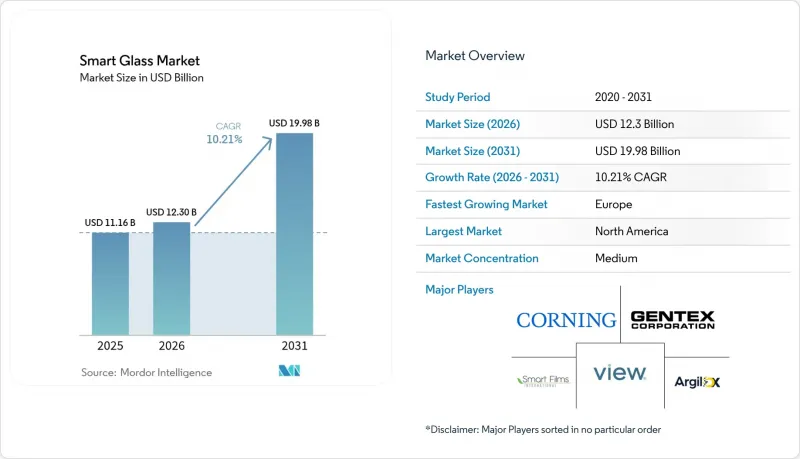
Mordor Intelligence에 의하면, 스마트 글래스 시장 규모는 2025년 111억 6,000만 달러에서 2026년에는 123억 달러에 이르고, 2026-2031년 CAGR 10.21%로 성장을 지속하여 2031년에는 199억 8,000만 달러에 달할 것으로 예측됩니다.
본 보고서는 기술 유형(일렉트로크로믹, 서모크로믹, 포토크로믹 등), 최종 사용자(자동차, 항공 전자 기기, 선박, 소매 등), 제어 모드(유선 스위치/벽면 패널,리모컨/RF 컨트롤러, 조광 패널/슬라이더 등), 용도(파사드 및 커튼월, 실내 칸막이 및 프라이버시 패널 등), 그리고 지역별로 분류되어 있습니다.
세계 스마트 유리 시장 동향 및 인사이트
엄격한 그린 빌딩 기준 및 개보수 의무
캘리포니아주의 ‘2025년 건축물 에너지 효율 기준’과 같이 건축 외피의 성능에 관한 의무적 기준치로 인해, U값 및 일사열 획득률 기준에서 기존 유리보다 우수한 성능을 발휘하는 일렉트로크로믹 파사드에 대한 선택의 여지가 없는 수요가 발생하고 있습니다. 2024년판 ‘국제 에너지 절약 기준(IECC)’의 개정을 통해 이전 주기에 비해 9.8%의 추가적인 에너지 절약 효과가 발생하고, 트레이드오프의 허점이 제거됨과 동시에 유리의 성능 기준이 상향 조정되었습니다. 네덜란드의 하이브리드 스토브 이니셔티브를 포함한 유럽의 유사한 조치들은 규제 준수를 주도하는 조달 주기를 강화하고, 개보수 활동을 촉진하고 있습니다. 소유주들이 피크 시간대 냉방 부하 감소, 그린 파이낸스 적용 자격, 자산 가치 향상을 체감함에 따라 스마트 유리 시장은 지속적인 규제 측면의 호재를 누리고 있습니다.
고급 자동차용 유리 및 선루프의 급속한 보급
각 자동차 제조업체들은 차량 내부의 차별화와 공조 부하 최적화를 위해 동적 광 제어 기능을 갖춘 루프를 채택하고 있습니다. 르노의 ‘Solarbay PDLC’ 선루프는 부문별로 불투명도를 조절할 수 있을 뿐만 아니라, 약 50%의 재생 소재를 사용하고 있습니다. 메르세데스-벤츠 S-클래스 쿠페에 탑재된 AGC사의 SPD 기반 ‘원더라이트’ 루프는 공조 수요를 줄이고 배기가스 내 CO2를 저감합니다. 현대자동차의 ‘나노 쿨링 필름’은 시범 차량군에서 실내 온도를 12.33°C 낮추었으며, 주류로 자리 잡을 조짐을 보이고 있습니다. 3-5년이라는 자동차 디자인 주기는 비용 감소를 가속화하고, 이것이 건축 부문으로 파급됨에 따라 스마트 글라스 시장의 잠재 고객 기반을 확대되고 있습니다.
높은 초기 비용 대 기존 유리
일렉트로크로믹 창문의 가격은 여전히 평방미터당 180-250달러인 반면, 표준 유리는 20-30달러입니다. 분석가들은 대량 대체의 분기점을 제곱미터당 215달러(제곱피트당 20달러)로 추정하고 있으며, 이것이 기술 혁신 경쟁을 가속화하고 있습니다. 전극이 필요 없는 일렉트로크로믹 창 프로토타입은 인듐-주석 산화물 층을 제거함으로써 비용을 1제곱미터당 80달러까지 절감했습니다. 플라즈마 강화 화학 기상 증착법(PECVD)을 사용하면 연간 생산 규모 140만 m2에서 비용을 1m2당 5.26달러 가까이까지 낮출 수 있을 것으로 전망됩니다. 시공 업체의 숙련도가 높아짐에 따라 설치의 복잡성은 해소되고 있지만, 가격에 민감한 스마트 유리 시장 부문에서는 여전히 가격에 대한 거부감이 가장 큰 제약 요인으로 작용하고 있습니다.
부문 분석
2025년에는 일렉트로크로믹 솔루션이 스마트 유리 시장의 42.55%를 차지하며 시장을 주도했습니다. 저전력 작동, 단계적 착색, 그리고 검증된 5만 사이클의 수명 덕분에 대규모 파사드나 기업 캠퍼스에서 기본적인 선택지로 자리 잡았습니다. 일렉트로크로믹 제품의 스마트 유리 시장 규모는 2025년 47억 5,000만 달러에서 2031년까지 연평균 성장률(CAGR) 9.37%를 기록하며 80억 9,000만 달러로 확대될 것으로 예측됩니다. 인라인 스퍼터링에서 전고체 화학 기술에 이르는 비용 절감 로드맵을 통해 설비 투자 예산의 예측 가능성이 확보되고 있습니다. 한편, 하이브리드 태양광 발전 유리는 덴마크의 CitySolar 프로젝트에서 이미 12.3%의 셀 효율을 달성한 투명 유기 태양전지를 활용하여 연평균 성장률(CAGR) 17.62%로 시장을 확대되고 있습니다. NEXT Energy Technologies사의 추정에 따르면, 이러한 패널은 건축물의 투명성을 유지하면서 일반 사무실 전력 수요의 25%를 상쇄할 가능성이 있으며, 하이브리드 제품은 일렉트로크로믹 제품에 대한 고정관념에 도전하는 혁신적인 존재로 자리매김하고 있습니다.
부유 입자 장치 제품은 1초 미만의 전환이 필수적인 틈새 시장-조종석, 철도 차량 객실, 고급 세단-에서 그 입지를 유지하고 있습니다. 폴리머 분산형 액정(PDLC) 창은 저전압 프라이버시 파티션으로서 의료시설이나 회의실에 보급되고 있습니다. 열변색 및 광변색 유형은 수동적인 기후 조건으로 제한되지만, 배선이 필요 없는 설치 방식이 리모델링 예산에 부합합니다. 따라서 기술 스택은 양극화되고 있습니다. 에너지 규제를 충족하는 일렉트로크로믹, 넷 제로 파사드를 위한 하이브리드 PV, 그리고 속도와 프라이버시 이용 사례를 아우르는 SPD 및 PDLC로 구성되어 있습니다.
상업용 부동산 분야에서는 사무실 및 소매점에서의 광범위한 채택으로 인해 2025년 매출의 37.68%를 차지했습니다. 이 부문에서는 프리미엄 가격을 정당화하기 위해 에너지 절약, 자연광 최적화 및 ESG 인증이 중시되었습니다. 상업용 부동산용 스마트 유리 시장 규모는 연평균 성장률(CAGR) 9.21%로 확대되어, 2025년 42억 1,000만 달러에서 2031년에는 71억 5,000만 달러에 달할 것으로 예측됩니다. 한편, 의료 분야에서는 감염 방지 프로토콜에서 비접촉식 사생활 보호가 중시되고 있어 가장 높은 연평균 성장률(CAGR)인 16.70%를 나타낼 것으로 전망됩니다. 중환자실에서는 커튼 세탁 횟수를 줄이기 위해 순식간에 불투명해지는 PDLC 패널이 도입되고 있으며, 한편 정신과 병동에서는 환자 감시와 존엄성 사이의 균형을 맞추기 위해 내충격성 다이내믹 유리가 활용되고 있습니다.
자동차용 유리는 여전히 세 번째 수익 축이며, 특히 고급차 및 전기차 분야에서는 다이내믹 스카이라이트가 배터리 소모를 유발하는 공조 시스템(HVAC)의 부하를 상쇄하고 있습니다. 주택 분야에서의 보급은 완만하지만, 세제 혜택과 모듈 가격 하락으로 인해 고성능 주택에서의 투자 수익률(ROI) 전망이 변화하고 있습니다. 항공우주, 철도, 선박 분야는 기반 규모는 작지만 착실히 발전하고 있으며, 소비자용 전자기기 분야에서는 소형화된 일렉트로크로믹 스크린과 AR 헤드셋에 대한 실험이 진행되고 있습니다.
지역별 분석
2025년 매출의 34.22%를 북미가 차지했습니다. 이는 캘리포니아주의 건축 기준법에 따라 유리 사양 기준이 상향 조정된 것과, 연방 CHIPS법에 따라 고순도 유리 제조 공장에 인센티브가 투입된 것이 요인입니다. 코닝(Corning)사가 뉴욕에서 실시한 3억 1,500만 달러 규모의 용융 석영 생산 확대 프로젝트는 리드 타임을 단축하고 5년간의 서비스 보증을 뒷받침하는 현지 공급망의 성숙도를 상징하는 사례입니다. 또한, 이 지역의 스마트 글라스 시장은 파노라마 루프에 대한 OEM 수요와 연방 정부 소유 건물을 대상으로 한 민관 공동 개보수 프로그램에 의해 뒷받침되고 있습니다.
아시아태평양은 중국의 BOE가 추진하는 88억 달러 규모의 OLED 캠퍼스, 일본의 5G 파사드 실증 실험, 한국의 전기차용 유리 업그레이드에 힘입어 2031년까지 연평균 성장률(CAGR) 14.05%로 가장 높은 성장세를 보이고 있습니다. Fuyao와 같은 중국 제조업체들은 자동차용 등급의 생산 능력을 58억 위안 규모로 확대하고 있으며, 이로 인해 규모의 경제가 확대되어 판매 가격 하락으로 이어지고 있습니다. 텅스텐 산화물 전구체의 규제가 공급 리스크를 초래하고 있는 반면, 각 지역 정부는 전략적 자립성을 강화하기 위해 현지 채굴 및 재활용을 가속화하고 있습니다.
유럽에서는 더욱 엄격해진 EPC 평가 기준과 리모델링 붐에 따른 보조금에 힘입어 시장이 안정적인 속도로 확대되고 있습니다. 상고반(Saint-Gobain)의 저탄소 ‘ORAE’ 유리 및 AGC 인터페인의 여러 거점에서의 확장은 재활용 소재 활용과 넷제로 제조에 대한 지역적 집중이 정당화되고 있음을 보여줍니다. 그러나 전력 가격 급등과 허가 체계의 중복으로 인해 일반 주택 시장의 수익성이 저하되고 있으며, 수요는 상업용 고층 빌딩 및 고급 리노베이션 건물로 이동하고 있습니다. 이러한 동향들이 맞물려 지리적으로 분산된 스마트 유리 시장의 기반이 유지되고 있습니다.
기타 혜택:
- 엑셀 형식 시장 예측(ME) 시트
- 3개월간 애널리스트 지원
자주 묻는 질문
목차
제1장 서론
제2장 조사 방법
제3장 주요 요약
제4장 시장 역학
제5장 시장 규모와 성장 예측
제6장 경쟁 구도
제7장 시장 기회와 향후 전망
LSH 26.09.08According to Mordor Intelligence, the smart glass market size is expected to grow from USD 11.16 billion in 2025 to USD 12.3 billion in 2026 and is forecast to reach USD 19.98 billion by 2031 at 10.21% CAGR over 2026-2031.
This report is Segmented by Technology Type (Electrochromic, Thermochromic, Photochromic, and More), End User (Automotive, Avionics, Marine, Retail, and More), Control Mode (Wired Switch / Wall Panel, Remote / RF Controller, Dimming Panel / Slider, and More), Application (Facades and Curtain Walls, Interior Partitions and Privacy Panels, and More), and Geography.
Global Smart Glass Market Trends and Insights
Stringent Green-Building Codes and Retrofit Mandates
Mandatory envelope performance thresholds such as California's 2025 Building Energy Efficiency Standards are creating non-discretionary demand for electrochromic facades that outperform conventional glazing on U-factor and Solar Heat Gain Coefficient criteria. The 2024 International Energy Conservation Code revision delivers 9.8% incremental savings versus the prior cycle, eliminating trade-off loopholes and elevating glass performance baselines. Similar measures in Europe, including the Netherlands' hybrid-furnace initiative, reinforce a compliance-driven procurement cycle that lifts retrofit activity. As owners witness lower peak cooling loads, green-finance eligibility, and enhanced asset values, the smart glass market gains a durable regulatory tailwind.
Rapid Adoption in Premium Automotive Glazing and Sunroofs
Automakers are deploying dynamic light-control roofs to differentiate cabins and trim HVAC loads. Renault's Solarbay PDLC sunroof supplies segmental opacification while using nearly 50% recycled content. AGC's SPD-based Wonderlite roof on the Mercedes S-Class Coupe cuts air-conditioning demand and lowers tailpipe CO2. Hyundai's Nano Cooling Film shows mainstream migration by shaving interior temperatures by 12.33 °C in pilot fleets. Automotive design cycles of 3-5 years accelerate cost degression that cascades into the building sector, expanding the smart glass market addressable base.
High Upfront Cost vs. Conventional Glazing
Electrochromic windows still price at USD 180-250 m2 against USD 20-30 m2 for standard units. Analysts peg USD 215 m2 (USD 20 ft2) as the crossover point for mass substitution, prompting an innovation race. Electrode-free electrochromic prototypes have sliced costs toward USD 80 m2 by stripping indium-tin-oxide layers. Plasma-enhanced chemical vapor deposition promises costs near USD 5.26 m2 at 1.4 million m2 annual scale. Installation complexity is receding as contractor familiarity grows, but price resistance remains the foremost limiting factor in cost-sensitive slices of the smart glass market.
Other drivers and restraints analyzed in the detailed report include:
- Energy-Cost Savings for Commercial Real-Estate Operators
- IoT-Ready Glass-as-a-Sensor Platforms for Smart Buildings
- Reliability Issues in Extreme Climates
For complete list of drivers and restraints, kindly check the Table Of Contents.
Segment Analysis
Electrochromic solutions dominated 2025 with 42.55% smart glass market share. Their low-power operation, gradual tinting, and proven 50,000 cycle life make them the default choice for large facades and corporate campuses. The smart glass market size for electrochromic products is projected to expand from USD 4.75 billion in 2025 to USD 8.09 billion by 2031 at a 9.37% CAGR. Cost-out roadmaps ranging from in-line sputtering to all-solid-state chemistries keep capex budgets predictable. Meanwhile, hybrid photovoltaic glass is scaling at an 17.62% CAGR, leveraging transparent organic photovoltaics that already hit 12.3% cell efficiency in Denmark's CitySolar project. NEXT Energy Technologies estimates these panels could offset 25% of typical office demand while retaining architectural clarity, positioning hybrids as the disruptor that challenges electrochromic incumbency.
Suspended Particle Device products maintain a niche where sub-second switching is critical-cockpits, rail cabins, and luxury sedans. Polymer-Dispersed Liquid Crystal windows are penetrating healthcare suites and conference rooms as low-voltage privacy partitions. Thermochromic and photochromic variants stay limited to passive climates, yet their wiring-free installation appeals to retrofit budgets. The technology stack is therefore bifurcating: electrochromic for energy mandates and hybrid PV for net-zero facades, with SPD and PDLC covering speed and privacy use cases.
Commercial real-estate applications captured 37.68% of 2025 revenue through broad office and retail uptake. The segment relied on energy savings, daylight optimization, and ESG credentialing to justify premium costs. Smart glass market size for commercial real estate is forecast to grow at 9.21% CAGR, moving from USD 4.21 billion in 2025 to USD 7.15 billion in 2031. Healthcare, however, secures the steepest 16.70% CAGR as infection-control protocols privilege touch-free privacy. Intensive-care wards deploy instant-opaque PDLC panels to reduce curtain laundering, while psychiatric units harness break-resistant dynamic glass to balance patient oversight with dignity.
Automotive glazing remains the third revenue pillar, particularly within luxury and electric vehicles, where dynamic skylights offset battery-draining HVAC. Residential uptake is slower, but tax incentives and lower module prices are shifting the ROI narrative for high-performance homes. Aerospace, rail, and marine progress steadily, albeit off smaller bases, and consumer electronics experiment with miniaturized electrochromic screens and AR headsets.
Complete Report Scope:
- By Technology Type
- Electrochromic
- Suspended Particle Device (SPD)
- Polymer-Dispersed Liquid Crystal (PDLC)
- Thermochromic
- Photochromic
- Hybrid and Photovoltaic
- By End User
- Automotive
- Architectural - Residential
- Architectural - Commercial
- Avionics
- Marine
- Rail
- Consumer Electronics and Wearables
- Healthcare Facilities
- Other End Users
- By Control Mode
- Wired Switch / Wall Panel
- Remote / RF Controller
- Dimming Panel / Slider
- Smartphone / Voice Assistant
- Sensor-Based Automatic Control
- By Application
- Facades and Curtain Walls
- Interior Partitions and Privacy Panels
- Sunroofs, Skylights and Roof Glazing
- Mirrors and Displays
- By Geography
- North America
- United States
- Canada
- Mexico
- South America
- Brazil
- Argentina
- Rest of South America
- Europe
- Germany
- United Kingdom
- France
- Italy
- Spain
- Russia
- Rest of Europe
- Asia Pacific
- China
- India
- Japan
- South Korea
- ASEAN
- Rest of Asia Pacific
- Middle East and Africa
- Middle East
- Turkey
- Saudi Arabia
- United Arab Emirates
- Qatar
- Rest of Middle East
- Africa
- South Africa
- Nigeria
- Egypt
- Rest of Africa
- Middle East
- North America
Geography Analysis
North America anchored 34.22% of 2025 revenue as California's building code raised glazing baselines and the federal CHIPS Act funnelled incentives to high-purity glass fabs. Corning's USD 315 million fused-silica expansion in New York exemplifies local supply-chain maturation that lowers lead times and underwrites five-year service warranties. The regional smart glass market is also buoyed by OEM demand for panoramic roofs and public-private retrofit programmes targeting federal properties.
Asia Pacific charts the fastest 14.05% CAGR through 2031, propelled by China's BOE USD 8.8 billion OLED campus, Japan's 5G facade pilots, and South Korea's EV-glass upgrades. Chinese producers such as Fuyao are adding CNY 5.8 billion of auto-grade capacity, amplifying economies of scale that compress selling prices. While tungsten-oxide precursor restrictions pose supply risk, regional governments are accelerating localised mining and recycling to fortify strategic autonomy.
Europe advances at a stable pace underpinned by stricter EPC ratings and renovation-wave subsidies. Saint-Gobain's low-carbon ORAE glass and AGC Interpane's multi-site expansion validate a regional focus on recycled content and net-zero manufacturing. However, elevated electricity prices and overlapping permitting frameworks dampen return profiles in mass-market housing, steering demand toward commercial towers and premium retrofits. Together, these dynamics sustain a geographically diversified smart glass market footprint.
- AGC Inc.
- Compagnie de Saint-Gobain S.A. (SageGlass)
- Guardian Glass LLC
- View Inc.
- Halio International SA
- Gentex Corporation
- Corning Incorporated
- Nippon Sheet Glass Co. Ltd. (NSG)
- Polytronix Inc.
- Research Frontiers Inc.
- Pleotint LLC
- EControl-Glas GmbH
- BOE Technology Group Co.
- Hitachi Chemical Co.
- Merck KGaA (liquid-crystal materials)
- Smart Films International
- uniteGlass (CNBM)
- Pro Display / Intelligent Glass
- Magic Film Factory
- Argil Inc.
Additional Benefits:
- The market estimate (ME) sheet in Excel format
- 3 months of analyst support
TABLE OF CONTENTS
1 INTRODUCTION
- 1.1 Study Assumptions and Market Definition
- 1.2 Scope of the Study
2 RESEARCH METHODOLOGY
3 EXECUTIVE SUMMARY
4 MARKET DYNAMICS
- 4.1 Market Overview
- 4.2 Market Drivers
- 4.2.1 Stringent green-building codes and retrofit mandates
- 4.2.2 Rapid adoption in premium automotive glazing and sunroofs
- 4.2.3 Energy-cost savings for commercial real-estate operators
- 4.2.4 IoT-ready glass-as-a-sensor platforms for smart-buildings
- 4.2.5 5G/mm-wave friendly, low-loss facade solutions
- 4.2.6 Post-COVID demand for antimicrobial, touch-free surfaces
- 4.3 Market Restraints
- 4.3.1 High upfront cost vs. conventional glazing
- 4.3.2 Reliability issues in extreme climates
- 4.3.3 EMI-emission compliance limits for large EC facades
- 4.3.4 Supply bottlenecks for specialty EC precursors
- 4.4 Value Chain Analysis
- 4.5 Regulatory Landscape
- 4.6 Technological Outlook
- 4.7 Technology Snapshot
- 4.8 Porter's Five Forces Analysis
- 4.8.1 Bargaining Power of Suppliers
- 4.8.2 Bargaining Power of Buyers
- 4.8.3 Threat of New Entrants
- 4.8.4 Threat of Substitutes
- 4.8.5 Competitive Rivalry
- 4.9 Investment Analysis
5 MARKET SIZE AND GROWTH FORECASTS (VALUE)
- 5.1 By Technology Type
- 5.1.1 Electrochromic
- 5.1.2 Suspended Particle Device (SPD)
- 5.1.3 Polymer-Dispersed Liquid Crystal (PDLC)
- 5.1.4 Thermochromic
- 5.1.5 Photochromic
- 5.1.6 Hybrid and Photovoltaic
- 5.2 By End User
- 5.2.1 Automotive
- 5.2.2 Architectural - Residential
- 5.2.3 Architectural - Commercial
- 5.2.4 Avionics
- 5.2.5 Marine
- 5.2.6 Rail
- 5.2.7 Consumer Electronics and Wearables
- 5.2.8 Healthcare Facilities
- 5.2.9 Other End Users
- 5.3 By Control Mode
- 5.3.1 Wired Switch / Wall Panel
- 5.3.2 Remote / RF Controller
- 5.3.3 Dimming Panel / Slider
- 5.3.4 Smartphone / Voice Assistant
- 5.3.5 Sensor-Based Automatic Control
- 5.4 By Application
- 5.4.1 Facades and Curtain Walls
- 5.4.2 Interior Partitions and Privacy Panels
- 5.4.3 Sunroofs, Skylights and Roof Glazing
- 5.4.4 Mirrors and Displays
- 5.5 By Geography
- 5.5.1 North America
- 5.5.1.1 United States
- 5.5.1.2 Canada
- 5.5.1.3 Mexico
- 5.5.2 South America
- 5.5.2.1 Brazil
- 5.5.2.2 Argentina
- 5.5.2.3 Rest of South America
- 5.5.3 Europe
- 5.5.3.1 Germany
- 5.5.3.2 United Kingdom
- 5.5.3.3 France
- 5.5.3.4 Italy
- 5.5.3.5 Spain
- 5.5.3.6 Russia
- 5.5.3.7 Rest of Europe
- 5.5.4 Asia Pacific
- 5.5.4.1 China
- 5.5.4.2 India
- 5.5.4.3 Japan
- 5.5.4.4 South Korea
- 5.5.4.5 ASEAN
- 5.5.4.6 Rest of Asia Pacific
- 5.5.5 Middle East and Africa
- 5.5.5.1 Middle East
- 5.5.5.1.1 Turkey
- 5.5.5.1.2 Saudi Arabia
- 5.5.5.1.3 United Arab Emirates
- 5.5.5.1.4 Qatar
- 5.5.5.1.5 Rest of Middle East
- 5.5.5.2 Africa
- 5.5.5.2.1 South Africa
- 5.5.5.2.2 Nigeria
- 5.5.5.2.3 Egypt
- 5.5.5.2.4 Rest of Africa
- 5.5.5.1 Middle East
- 5.5.1 North America
6 COMPETITIVE LANDSCAPE
- 6.1 Market Concentration
- 6.2 Strategic Moves
- 6.3 Market Share Analysis
- 6.4 Company Profiles (includes Global level Overview, Market level overview, Core Segments, Financials as available, Strategic Information, Market Rank/Share for key companies, Products and Services, and Recent Developments)
- 6.4.1 AGC Inc.
- 6.4.2 Compagnie de Saint-Gobain S.A. (SageGlass)
- 6.4.3 Guardian Glass LLC
- 6.4.4 View Inc.
- 6.4.5 Halio International SA
- 6.4.6 Gentex Corporation
- 6.4.7 Corning Incorporated
- 6.4.8 Nippon Sheet Glass Co. Ltd. (NSG)
- 6.4.9 Polytronix Inc.
- 6.4.10 Research Frontiers Inc.
- 6.4.11 Pleotint LLC
- 6.4.12 EControl-Glas GmbH
- 6.4.13 BOE Technology Group Co.
- 6.4.14 Hitachi Chemical Co.
- 6.4.15 Merck KGaA (liquid-crystal materials)
- 6.4.16 Smart Films International
- 6.4.17 uniteGlass (CNBM)
- 6.4.18 Pro Display / Intelligent Glass
- 6.4.19 Magic Film Factory
- 6.4.20 Argil Inc.
7 MARKET OPPORTUNITIES AND FUTURE OUTLOOK
- 7.1 White-space and Unmet-need Assessment