

|
시장보고서
상품코드
2152958
PFAS 검사 시장 : 제품 유형, 기술, 용도, 지역별 - 세계 예측(-2031년)PFAS Testing Market by Product Type, Technology, Application and Region - Global Forecast to 2031 |
||||||

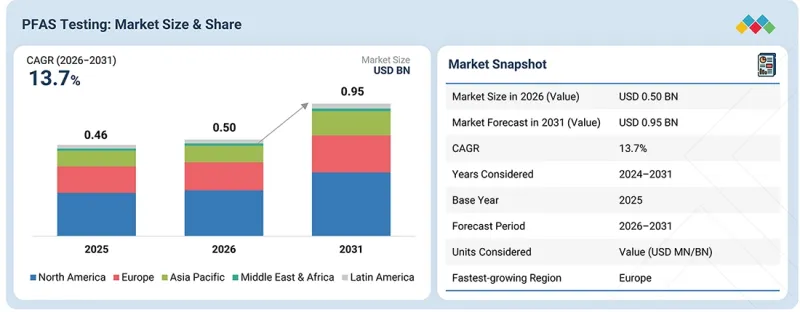
전 세계 PFAS 검사 시장은 2026년 5억 달러에서 2031년까지 9억 5,000만 달러에 달할 것으로 예상되며, 2026년부터 2031년까지 연평균 성장률(CAGR) 13.7%를 기록할 전망입니다.
엄격한 검출 및 규정 준수 요건을 충족하기 위해 검사 기관과 규제 당국이 고감도 LC-MS/MS, 고분해능 질량 분석법(HRMS), 자동 시료 전처리 시스템 및 첨단 크로마토그래피 기술을 점점 더 많이 도입함에 따라 이 시장은 강력한 성장을 이루고 있습니다.
| 조사 범위 | |
|---|---|
| 조사 대상 기간 | 2026-2031년 |
| 기준 연도 | 2025년 |
| 예측 기간 | 2026-2031년 |
| 산정 단위 | 금액(10억 달러) |
| 부문 | 제품 유형, 기술, 방법, 용도 및 지역 |
| 대상 지역 | 북미, 유럽, 아시아태평양, 라틴아메리카, 중동 및 아프리카 |
음용수, 폐수, 토양, 퇴적물, 식품 및 산업 시료에서 보다 광범위한 PFAS 패널, 신규 PFAS 화합물 및 미량 오염 분석에 대한 수요가 증가함에 따라, 각 연구소는 분석 역량 강화를 도모하고 있습니다. 이와 병행하여, 자동 고체상 추출(SPE), 고처리량 검사 워크플로우, PFAS 전용 컬럼 및 소모품, 오염 관리 솔루션, 통합 데이터 분석 소프트웨어의 도입으로 검사의 효율, 정확도, 재현성 및 실험실의 처리 능력이 향상되고 있습니다. 이러한 기술적 진보는 규제 기반 모니터링 및 환경 복원 활동의 확대와 맞물려 지속적인 투자를 뒷받침하며, 전 세계 PFAS 검사 시장의 성장을 견인할 것으로 예상됩니다.
“2025년에는 장비 부문이 시장에서 가장 큰 점유율을 차지했습니다.”
제품 유형별로 보면 PFAS 검사 시장은 장비(액체 크로마토그래피-질량 분석(LC-MS), 가스 크로마토그래피-질량 분석(GC-MS), 독립형 질량 분석기, 핵자기 공명 분광법, 기타 기기), 소모품(시료 전처리 제품, 크로마토그래피 컬럼, 기준 물질 및 분석 표준 물질, 용매, 막 필터 및 주사기 필터, 시약, 기타 소모품), 그리고 소프트웨어 및 서비스로 분류됩니다. 2025년에는 기기 부문이 PFAS 검사 시장에서 가장 큰 점유율을 차지했습니다. 분석 기기는 초미량 검출 및 보다 광범위한 PFAS 패널 분석을 위한 고감도 LC-MS/MS 및 고분해능 질량 분석(HRMS)의 채택 확대에 힘입어 주요 성장 요인으로 작용하고 있습니다. LC-MS/MS는 일상적인 표적 분석 및 규제 준수를 위한 주요 플랫폼으로 자리 잡고 있지만, HRMS는 새로운 PFAS 화합물의 의심 물질 및 비표적 스크리닝 분야에서 주목을 받고 있습니다. 각 연구소에서는 처리 능력, 재현성 및 데이터 품질을 향상시키기 위해 자동 고체상 추출(SPE), 고처리량 시료 전처리 시스템, 직접 주입 워크플로우 및 PFAS 전용 오염 관리 구성요소의 도입이 점점 더 확대되고 있습니다. 동시에, 각 장비 제조사들은 점점 더 엄격해지는 음용수 및 환경 모니터링 요건에 대응하기 위해 고감도화, 분석 속도 향상, 분석 대상 물질의 범위 확대 및 자동화 향상에 주력하고 있습니다.
“2025년에는 탠덤 질량 분석법(LC-MS/MS)을 이용한 액체 크로마토그래피 분야가 시장에서 가장 큰 점유율을 차지했습니다.”
분석 기법별로 보면 PFAS 검사 시장은 액체 크로마토그래피·탠덤 질량 분석법(LC-MS/MS), 가스 크로마토그래피·질량 분석법(GC-MS), 핵자기 공명 분광법(NMR), 질량 분석법, 연소 이온 크로마토그래피, 효소 면역분석법(ELISA), 그리고 기타 기법으로 분류됩니다. 2025년, PFAS 검사 시장에서 액체 크로마토그래피·탠덤 질량 분석법(LC-MS/MS) 부문이 가장 큰 점유율을 차지했습니다. 액체 크로마토그래피-탠덤 질량 분석법(LC-MS/MS)은 높은 감도와 선택성, 그리고 복잡한 환경 매트릭스 내의 미량·초미량 농도의 PFAS를 정량할 수 있는 능력을 바탕으로 PFAS 검사 시장에서 강력한 성장을 이루고 있습니다. 최근의 규제 동향도 수요를 더욱 부추기고 있으며, EPA의 분석법 533 및 537.1에서는 음용수 분석에 LC-MS/MS가 채택되었고, 분석법 1633A에서는 폐수, 지표수, 지하수, 토양, 바이오솔리드, 퇴적물, 매립지 침출수 및 조직 시료에 포함된 40종류의 PFAS 분석에 LC-MS/MS가 적용되고 있습니다. 검사 기관에서는 보다 광범위한 PFAS 패널과 엄격한 검출 요건에 대응하기 위해 감도 향상, 다중 반응 모니터링(MRM), 동위원소 희석 워크플로우, 자동 시료 전처리, 그리고 고처리량 기능을 갖춘 첨단 트리플 쿼드러폴러 LC-MS/MS 시스템으로의 업그레이드가 진행되고 있습니다. 동시에, LC-MS/MS는 새로운 PFAS 의심 물질이나 비표적 스크리닝에서 HRMS에 의해 보완되는 사례가 증가하고 있지만, LC-MS/MS는 일상적인 표적 정량 및 규제 준수 시험을 위한 주요 플랫폼으로 계속 자리 잡고 있습니다.
“수질 검사 응용 분야는 예측 기간 동안 가장 높은 연평균 성장률(CAGR)을 기록할 것으로 전망됩니다.”
용도별로 보면 PFAS 검사 시장은 수질 검사(지하수·음용수 검사, 폐수 검사), 토양 검사, 식품·음료 검사, 혈액·혈청 검사, 대기 모니터링, 미생물 검사 및 기타 용도로 분류됩니다. 2025년에는 수질 검사 부문이 PFAS 검사 시장에서 가장 큰 점유율을 차지했습니다. PFAS 검사 시장에서 수질 검사는 강력한 성장을 이루고 있습니다. 이는 음용수, 지하수, 지표수 및 폐수 내 PFAS 오염에 대한 우려가 높아지는 데 더해, 규제 요건의 강화와 모니터링 프로그램의 확대가 원동력이 되고 있습니다. 미국에서는 EPA 방법 533 및 537.1에 따라 검사 기관이 식수 내 29종의 PFAS를 측정할 수 있게 되었으며, 한편, EPA 방법 1633A에서는 폐수 및 기타 환경 매트릭스에서 검사 대상이 40종의 PFAS로 확대됨에 따라, 고감도이며 표준화된 분석 워크플로우에 대한 수요가 증가하고 있습니다. 유럽에서는 2026년 1월부터 시행되는 PFAS-20 요건 또한 음용수 내 PFAS에 대한 보다 광범위한 모니터링을 촉진하고 있습니다. 그 결과, 검사 기관에서는 검출 한계의 저하, 보다 광범위한 PFAS 패널 분석, 그리고 검사의 재현성 향상을 실현하기 위해 LC-MS/MS, 자동 SPE, 고처리량 시료 전처리, PFAS 전용 컬럼 및 오염 관리 솔루션의 도입이 점점 더 확대되고 있습니다. 이러한 규제 및 기술적 진전에 힘입어, 수질 검사는 PFAS 검사의 주요 응용 분야로서 지속적으로 성장할 것으로 예상됩니다.
“예측 기간 동안 유럽 시장이 가장 높은 성장률을 보일 것으로 예상됩니다.”
유럽의 PFAS 검사 시장에서 수질 검사 분야는 강력한 성장세를 보이고 있습니다. 그 배경에는 규제 요건의 강화, PFAS 오염에 대한 인식 제고, 그리고 음용수, 지하수, 지표수, 산업 폐수에 대한 체계적인 모니터링 프로그램의 시행이 있습니다. 독일은 2026년부터 PFAS-20에 대한 100 ng/L 기준치와 2028년부터 PFAS-4에 대한 추가 20 ng/L 기준치 등을해당국의 ‘음용수 조례’에 기반한 PFAS 기준치 도입에 힘입어 유럽 내 주요 시장으로 부상하고 있습니다. 이러한 추세는 PFOA, PFOS, PFHxS 및 더 광범위한 PFAS 군에 대한 검사 요건 강화로 인해 더욱 가속화되고 있으며, 한편 검사 기관에서는 미량 분석을 가능하게 하기 위해 LC-MS/MS, 자동 시료 전처리, PFAS 전용 소모품 및 낮은 검출 한계를 가진 워크플로우가 도입되고 있습니다. 산업용 부지, 소화용 거품제 사용, 오염된 수원에 의한 오염에 대한 우려가 높아지는 데 더해, 유럽 내 수질 모니터링 및 PFAS 규제 노력의 확대에 따라 유럽 전역에서 PFAS 수질 검사 수요가 더욱 증가할 것으로 예상됩니다.
본 보고서에서 언급된 주요 참여 기업의 내역은 다음과 같습니다:
- 기업 유형별 : Tier 1 - 48%, Tier 2 - 36%, Tier 3 - 16%
- 직책별 : C-레벨 10%, 이사급 14%, 기타 76%
- 지역별 : 북미 40%, 유럽 32%, 아시아태평양 20%, 라틴아메리카 5%, 중동 및 아프리카 3%
조사 범위
본 보고서에서는 PFAS 검사 시장을 제품 유형, 기술, 방법, 용도 및 지역별로 분석하고 있습니다. 또한, 시장 성장에 영향을 미치는 요인을 포괄적으로 다루고, 시장의 기회와 과제를 분석하는 한편, 시장을 선도하는 기업들의 경쟁 구도에 대한 상세한 정보를 제공합니다. 아울러, 본 보고서에서는 각 마이크로 시장의 성장 동향을 분석하고, 5개 주요 지역(및 해당 지역 내 각국)의 시장 부문별 매출 전망을 제시합니다.
본 보고서를 구매해야 하는 이유
본 보고서는 시장 선도 기업 및 신규 진입 기업에게 PFAS 검사 시장 전체 및 그 하위 부문의 매출에 관한 가장 정확한 추정치를 제공합니다. 이를 통해 이해관계자는 경쟁 구도를 이해하고, 자사의 비즈니스를 보다 효과적으로 포지셔닝하며, 적절한 시장 진입 전략을 수립하기 위한 인사이트를 얻을 수 있습니다. 또한, 본 보고서는 이해관계자가 시장 동향을 파악하는 데 도움을 주며, 주요 시장 촉진요인, 과제 및 기회에 대한 정보를 제공합니다.
본 보고서는 다음 사항에 대한 인사이트를 제공합니다:
- PFAS 검사 시장의 성장에 영향을 미치는 주요 시장 촉진요인(음용수 및 환경 시료 내 PFAS 오염을 규제하는 법규의 도입 확대), 제약요인(LC-MS/MS 등 첨단 분석 장비 및 관련 검사 소모품의 높은 비용), 기회(PFAS 검사 및 환경 모니터링 프로그램에 대한 자금 지원 증가), 과제(국가 및 지역 간 통일된 PFAS 검사 기준 및 규제 요건의 부재)에 대한 분석
- 제품 개발 및 혁신 : PFAS 검사 시장의 향후 기술, 연구 개발 활동, 신제품 및 서비스 출시에 대한 상세한 인사이트
- 시장 동향 : PFAS 검사 시장 보고서에 대한 종합적인 정보를 바탕으로 다양한 지역의 PFAS 검사 시장을 분석합니다
- 시장 다각화 : PFAS 검사 시장의 신제품 및 서비스, 미개척 지역, 최근 동향 및 투자에 대한 종합적인 정보
- 경쟁 분석 : 주요 기업의 시장 점유율, 성장 전략 및 서비스 제공 내용에 대한 상세한 평가.
자주 묻는 질문
목차
제1장 서론
제2장 요약
제3장 주요 인사이트
- PFAS 검사 시장 개요
- PFAS 검사 시장 : 제품 유형별, 2026년 대비 2031년
- PFAS 검사 시장 : 제품 유형별·지역별, 2025년
- PFAS 검사 시장 : 지역별 성장 기회
- 지역별 구성 : PFAS 검사 시장(2024-2031년)
제4장 시장 개요
- 시장 역학
- 성장 촉진요인
- 성장 억제요인
- 기회
- 과제
제5장 업계 동향
- Porter's Five Forces 분석
- 경쟁 기업 간의 적대적 관계
- 공급업체의 협상력
- 구매자의 협상력
- 대체품의 위협
- 신규 진입자의 위협
- 거시경제 전망
- GDP 동향 및 전망
- 세계 PFAS 검사 시장의 동향
- 밸류체인 분석
- 연구 개발
- 원자재 조달
- 제조
- 유통
- 마케팅·판매
- 사후 서비스
- 생태계 분석
- 가격 분석
- 주요 기업별 LC-MS 장비의 평균 판매 가격 동향(2025년)
- 2025년 PFAS 분석 장비의 평균 판매 가격 동향(유형별)
- 지역별 평균 판매 가격 동향(2023-2025년)
- 무역 데이터 분석
- HS 코드 390460의 수입 데이터
- HS 코드 390460의 수출 데이터
- 주요 회의 및 행사(2026-2027년)
- 고객의 비즈니스에 영향을 미치는 동향 및 변화
- 투자 및 자금 조달 시나리오
- 사례 연구 분석
- 음용수용 고감도 PFAS 검사 역량 구축
- 음용수에 대한 대규모 PFAS 모니터링
- 폐수 및 바이오솔리드에서의 PFAS 분석 확대
- 미국 관세의 영향 - PFAS 검사 시장
- 주요 관세율
- 가격에 미치는 영향 분석
- 국가 및 지역에 미치는 영향
- 최종사용자에 미치는 영향
제6장 기술, 특허 및 AI 도입에 따른 전략적 변혁
- 주요 기술
- 크로마토그래피
- 질량 분석
- 이온 크로마토그래피
- 보완 기술
- 총 유기 불소(TOF) 분석
- AI를 활용한 영상 처리 및 진단 소프트웨어
- 관련 기술
- 환경 모니터링 기술
- 수처리 및 여과 기술
- 특허 분석
- AI/생성형 AI가 PFAS 검사 시장에 미치는 영향
- 주요 활용 사례 및 시장 잠재력
- PFAS 검사 시장에서 기업의 모범 사례
- PFAS 검사 시장에서 AI/생성형 AI 도입에 관한 사례 연구
- 상호 연계된 생태계와 시장 참여자에 미치는 영향
- PFAS 검사 시장에서 AI/생성형 AI 도입에 대한 고객의 준비 현황
- 성공 사례 및 실제 사회에서의 활용 사례
제7장 규제 현황
- 규제 시나리오
- 규제 현황
- 규제 지침
제8장 고객 동향과 구매 행동
- 의사결정 과정
- 구매자의 이해관계자와 구매 평가 기준
- 구매 과정에서 주요 이해관계자
- 주요 구매 기준
- 도입 장벽 및 사내 과제
- 다양한 최종사용자의 미충족 요구
제9장 PFAS 검사 시장 : 제품 유형별
- 측정 기기
- 소모품
- 소프트웨어 및 서비스
제10장 PFAS 검사 시장 : 분석 기법별
- 탠덤 질량 분석법을 이용한 액체 크로마토그래피(LC-MS/MS)
- 가스 크로마토그래피-질량 분석법(GC-MS)
- 핵자기공명 분광법(NMR 분광법)
- 질량 분석법
- 연소 이온 크로마토그래피
- 효소면역측정법(ELISA)
- 기타 기법
제11장 PFAS 검사 시장 : 분석법별
- EPA
- DIN
- ISO
- ASTM
- 기타 방법
제12장 PFAS 검사 시장 : 용도별
- 수질 검사
- 토양 시험
- 식품·음료 검사
- 혈액·혈청 검사
- 대기 모니터링
- 미생물 검사
- 기타 용도
제13장 PFAS 검사 시장 : 지역별
- 북미
- 북미의 거시경제 전망
- 미국
- 캐나다
- 유럽
- 유럽의 거시경제 전망
- 독일
- 영국
- 프랑스
- 이탈리아
- 스페인
- 기타 유럽
- 아시아태평양
- 아시아태평양의 거시경제 전망
- 일본
- 중국
- 인도
- 호주
- 한국
- 기타 아시아태평양
- 라틴아메리카
- 라틴아메리카의 거시경제 전망
- 브라질
- 멕시코
- 기타 라틴아메리카
- 중동 및 아프리카
- 중동 및 아프리카의 거시경제 전망
- GCC 국가들
- 기타 중동 및 아프리카
제14장 경쟁 현황
- 주요 진입 기업의 전략/강점
- PFAS 검사 시장의 주요 기업 전략 개요
- 수익 분석(2022-2025년)
- 시장 점유율 분석(2025년)
- 시장 순위 분석(2025년)
- 기업 평가 매트릭스 : 주요 기업, 2025년
- 스타 기업
- 신흥 리더
- 광범위한 사업 전개를 하는 기업
- 진입 기업
- 기업의 사업 전개 : 주요 기업, 2025년
- 기업 평가 매트릭스 : 스타트업/중소기업, 2025년
- 선도적인 기업
- 대응력이 뛰어난 기업
- 역동적인 기업
- 출발점
- 스타트업/중소기업의 경쟁사 벤치마킹, 2025년
- 경쟁 시나리오
- 제품 출시
- 거래
- 사업 확장
- 기업 평가 및 재무 지표
- 브랜드·제품 비교
제15장 기업 개요
- 주요 기업
- AGILENT TECHNOLOGIES, INC.
- DANAHER CORPORATION
- WATERS CORPORATION
- THERMO FISHER SCIENTIFIC INC.
- SHIMADZU CORPORATION
- MERCK KGAA
- PERKINELMER INC.
- LGC LIMITED
- BIOTAGE
- MACHEREY-NAGEL GMBH &CO. KG
- ACCUSTANDARD
- WELLINGTON LABORATORIES INC.
- CAMBRIDGE ISOTOPE LABORATORIES, INC.
- CHIRON AS
- METROHM INULA GMBH
- 기타 기업
- RESTEK CORPORATION
- MICROSAIC
- EVONIK
- LCTECH
- ABSOLUTE STANDARDS INC.
- CYTIVA
- AVANTOR, INC.
- GREYHOUND CHROMATOGRAPHY AND ALLIED CHEMICALS LTD.
- LANXESS
- THE CHEMOURS COMPANY
제16장 조사 방법
제17장 부록
KSM 26.10.26The global PFAS testing market is projected to reach USD 0.95 billion by 2031, up from USD 0.50 billion in 2026, reflecting a 13.7% CAGR from 2026 to 2031. The market is experiencing strong growth as laboratories and regulatory agencies increasingly adopt high-sensitivity LC-MS/MS, high-resolution mass spectrometry (HRMS), automated sample-preparation systems, and advanced chromatography technologies to meet stringent detection and compliance requirements.
| Scope of the Report | |
|---|---|
| Years Considered for the Study | 2026-2031 |
| Base Year | 2025 |
| Forecast Period | 2026-2031 |
| Units Considered | Value (USD billion) |
| Segments | Product Type, Techniques, Method, Application, and Region |
| Regions covered | North America, Europe, Asia Pacific, Latin America, and Middle East and Africa |
Growing demand for broader PFAS panels, emerging PFAS compounds, and trace-level contamination analysis across drinking water, wastewater, soil, sediment, food, and industrial samples is prompting laboratories to upgrade their analytical capabilities. In parallel, adoption of automated solid-phase extraction (SPE), high-throughput testing workflows, PFAS-specific columns and consumables, contamination-control solutions, and integrated data-analysis software is improving testing efficiency, accuracy, reproducibility, and laboratory throughput. These technological advancements, combined with expanding regulatory monitoring and environmental remediation activities, are expected to support continued investment and drive growth in the global PFAS testing market.
"The instruments segment held the largest share of the market in 2025"
By product type, the PFAS testing market is segmented into instruments (liquid chromatography-mass spectrometry (LC-MS), gas chromatography-mass spectrometry (GC-MS), standalone mass spectrometry, nuclear magnetic resonance spectroscopy, other instruments), consumables (sample preparation products, chromatography columns, reference materials & analytical standards, solvents, membrane & syringe filters, reagents, other consumables), and software & services. The instruments segment held the largest share of the PFAS testing market in 2025. Instruments are a major growth driver, supported by the increasing adoption of high-sensitivity LC-MS/MS and high-resolution mass spectrometry (HRMS) for ultra-trace detection and broader PFAS panels. LC-MS/MS remains the dominant platform for routine targeted analysis and regulatory compliance, while HRMS is gaining traction for suspect and non-targeted screening of emerging PFAS compounds. Laboratories are increasingly adopting automated solid-phase extraction (SPE), high-throughput sample-preparation systems, direct-injection workflows, and PFAS-specific contamination-control components to improve throughput, reproducibility, and data quality. At the same time, instrument manufacturers are focusing on higher sensitivity, faster analysis, broader analyte coverage, and improved automation to address stricter drinking-water and environmental monitoring requirements.
"The liquid chromatography with tandem mass spectrometry (LC-MS/MS) segment held the largest share of the market in 2025"
By technique, the PFAS testing market is segmented into liquid chromatography with tandem mass spectrometry (LC-MS/MS), gas chromatography-mass spectrometry (GC-MS), nuclear magnetic resonance spectroscopy (NMR), mass spectrometry, combustion ion chromatography, enzyme-linked immunosorbent assays (ELISA), and other techniques. The liquid chromatography with tandem mass spectrometry (LC-MS/MS) segment held the largest share of the PFAS testing market in 2025. The liquid chromatography-tandem mass spectrometry (LC-MS/MS) technique is experiencing strong growth in the PFAS testing market, driven by its high sensitivity, selectivity, and ability to quantify PFAS at trace and ultra-trace concentrations across complex environmental matrices. Recent regulatory developments are further strengthening demand, with EPA Methods 533 and 537.1 using LC-MS/MS for drinking-water analysis and Method 1633A applying LC-MS/MS to 40 PFAS across wastewater, surface water, groundwater, soil, biosolids, sediment, landfill leachate, and tissue samples. Laboratories are increasingly upgrading to advanced triple-quadrupole LC-MS/MS systems with improved sensitivity, multiple-reaction monitoring, isotope-dilution workflows, automated sample preparation, and higher-throughput capabilities to support broader PFAS panels and stringent detection requirements. At the same time, LC-MS/MS is increasingly being complemented by HRMS for suspect and non-targeted screening of emerging PFAS, while LC-MS/MS remains a key platform for routine targeted quantification and regulatory compliance testing.
"The water testing application segment is projected to register the highest CAGR during the forecast period"
Based on application, the PFAS testing market is segmented into water testing (ground & potable water testing, wastewater testing), soil testing, food & beverage testing, blood/serum testing, air monitoring, microbial testing, and other applications. The water testing segment held the largest share of the PFAS testing market in 2025. Water testing is experiencing strong growth in the PFAS testing market, driven by rising concerns about PFAS contamination in drinking water, groundwater, surface water, and wastewater, along with tightening regulatory requirements and expanding monitoring programs. In the US, EPA Methods 533 and 537.1 enable laboratories to measure 29 PFAS in drinking water, while EPA Method 1633A expands testing to 40 PFAS across wastewater and other environmental matrices, increasing demand for sensitive, standardized analytical workflows. In Europe, PFAS-20 requirements, effective from January 2026, are also supporting broader monitoring of PFAS in drinking water. As a result, laboratories are increasingly adopting LC-MS/MS, automated SPE, high-throughput sample preparation, PFAS-specific columns, and contamination-control solutions to achieve lower detection limits, analyze broader PFAS panels, and improve testing reproducibility. These regulatory and technological developments are expected to sustain water testing as a key application area for PFAS testing.
"The market in Europe is expected to witness the highest growth during the forecast period."
The water testing application is witnessing strong growth in the European PFAS testing market, driven by tightening regulatory requirements, increasing awareness of PFAS contamination, and the implementation of systematic monitoring programs for drinking water, groundwater, surface water, and industrial wastewater. Germany is emerging as a key market within Europe, supported by the implementation of PFAS limits under its Drinking Water Ordinance, including a 100 ng/L limit for PFAS-20 from 2026 and an additional 20 ng/L limit for PFAS-4 from 2028. The trend is further supported by increasing testing requirements for PFOA, PFOS, PFHxS, and broader PFAS groups, while laboratories are adopting LC-MS/MS, automated sample preparation, PFAS-specific consumables, and low-detection-limit workflows to enable trace-level analysis. Growing concerns around contamination from industrial sites, firefighting-foam applications, and contaminated water sources, together with expanding European water-quality monitoring and PFAS regulatory initiatives, are expected to further increase demand for PFAS water testing across Europe.
A breakdown of the primary participants referred to for this report is provided below:
- By Company Type: Tier 1-48%, Tier 2-36%, and Tier 3- 16%
- By Designation: C-level-10%, Director-level-14%, and Others-76%
- By Region: North America-40%, Europe-32%, Asia Pacific-20%, Latin America-5%, and the Middle East & Africa-3%
The prominent players in the PFAS testing market are Thermo Fisher Scientific Inc. (US), Danaher Corporation (US), Merck Kgaa (Germany), Shimadzu Corporation (Japan), among others.
Research Coverage
This report studies the PFAS testing market by product type, techniques, methods, applications, and region. It also covers the factors affecting market growth, analyzes the opportunities and challenges in the market, and provides details of the competitive landscape for market leaders. Furthermore, the report analyzes micromarkets with respect to their growth trends and forecasts the revenue of the market segments with respect to five main regions (and the respective countries in these regions).
Reasons to Buy the Report
The report will provide market leaders and new entrants with the closest approximations of revenue for the overall PFAS testing market and its subsegments. It will help stakeholders understand the competitive landscape and gain insights to position their businesses more effectively and plan suitable go-to-market strategies. The report also helps stakeholders understand the market pulse and provides information on key market drivers, restraints, challenges, and opportunities.
This report provides insights on the following pointers:
- Analysis of key drivers (Increasing implementation of regulations governing PFAS contamination in drinking water and environmental samples), restraints (High cost of advanced analytical instruments, such as LC-MS/MS, and associated testing consumables), opportunities (Increasing funding for PFAS testing and environmental monitoring programs), and challenges (Lack of harmonized PFAS testing standards and regulatory requirements across countries and regions) influencing the growth of the PFAS testing market
- Product Development/Innovation: Detailed insights on upcoming technologies, research & development activities, and new product & service launches in the PFAS testing market
- Market Development: Comprehensive information about PFAS testing market report analyses the PFAS testing market across varied regions
- Market Diversification: Exhaustive information about new products & services, untapped geographies, recent developments, and investments in the PFAS testing market
- Competitive Assessment: In-depth assessment of market shares, growth strategies, and service offerings of leading players like Thermo Fisher Scientific Inc. (US), Danaher Corporation (US), Agilent Technologies, Inc. (US), Waters Corporation (US), Shimadzu Corporation (Japan), among others.
TABLE OF CONTENTS
1 INTRODUCTION
- 1.1 STUDY OBJECTIVES
- 1.2 MARKET DEFINITION
- 1.3 STUDY SCOPE
- 1.3.1 MARKETS COVERED AND REGIONAL SCOPE
- 1.3.2 INCLUSIONS & EXCLUSIONS
- 1.3.3 YEARS CONSIDERED
- 1.3.4 CURRENCY CONSIDERED
- 1.4 STAKEHOLDERS
- 1.5 SUMMARY OF CHANGES
2 EXECUTIVE SUMMARY
- 2.1 MARKET HIGHLIGHTS AND KEY INSIGHTS
- 2.2 DISRUPTIVE TRENDS IN PFAS TESTING MARKET
- 2.3 HIGH GROWTH SEGMENTS
- 2.4 REGIONAL SNAPSHOT: MARKET SIZE, GROWTH RATE, AND FORECAST
3 PREMIUM INSIGHTS
- 3.1 PFAS TESTING MARKET OVERVIEW
- 3.2 PFAS TESTING MARKET, BY PRODUCT TYPE, 2026 VS. 2031 (USD MILLION)
- 3.3 PFAS TESTING MARKET, BY PRODUCT TYPE & REGION (2025)
- 3.4 PFAS TESTING MARKET: GEOGRAPHIC GROWTH OPPORTUNITIES
- 3.5 REGIONAL MIX: PFAS TESTING MARKET, 2024-2031 (USD MILLION)
4 MARKET OVERVIEW
- 4.1 INTRODUCTION
- 4.2 MARKET DYNAMICS
- 4.2.1 DRIVERS
- 4.2.1.1 Regulatory reforms addressing environmental pollution
- 4.2.1.2 Growing concerns over PFAS contamination in water
- 4.2.1.3 Favorable investment climate driving improvements in testing
- 4.2.1.4 Increasing financial support for wastewater treatment projects and programs
- 4.2.2 RESTRAINTS
- 4.2.2.1 Limited adoption due to high cost of consumables and maintenance of MS instruments
- 4.2.2.2 Strict storage requirements for PFAS testing reagents and analytical standards
- 4.2.3 OPPORTUNITIES
- 4.2.3.1 Growth opportunities presented by major markets
- 4.2.3.2 Growing financial support for treatment projects and programs
- 4.2.3.3 Higher public awareness regarding pollution levels
- 4.2.4 CHALLENGES
- 4.2.4.1 Lack of standardized testing methods across regions
- 4.2.4.2 Limited availability of skilled labor
- 4.2.1 DRIVERS
5 INDUSTRY TRENDS
- 5.1 PORTER'S FIVE FORCES ANALYSIS
- 5.1.1 INTENSITY OF COMPETITIVE RIVALRY
- 5.1.2 BARGAINING POWER OF SUPPLIERS
- 5.1.3 BARGAINING POWER OF BUYERS
- 5.1.4 THREAT OF SUBSTITUTES
- 5.1.5 THREAT OF NEW ENTRANTS
- 5.2 MACROECONOMIC OUTLOOK
- 5.2.1 INTRODUCTION
- 5.2.2 GDP TRENDS AND FORECAST
- 5.2.3 TRENDS IN GLOBAL PFAS TESTING MARKET
- 5.2.3.1 Growing adoption of advanced LC-MS/MS technologies
- 5.2.3.2 Increasing adoption of HRMS for emerging PFAS analysis
- 5.2.3.3 Growing automation of PFAS sample preparation
- 5.2.3.4 Expansion of PFAS testing across multiple sample matrices
- 5.2.3.5 Increasing demand for broader PFAS testing panels
- 5.3 VALUE CHAIN ANALYSIS
- 5.3.1 RESEARCH & DEVELOPMENT
- 5.3.2 RAW MATERIAL PROCUREMENT
- 5.3.3 MANUFACTURING
- 5.3.4 DISTRIBUTION
- 5.3.5 MARKETING & SALES
- 5.3.6 POST-SALES SERVICES
- 5.4 ECOSYSTEM ANALYSIS
- 5.5 PRICING ANALYSIS
- 5.5.1 AVERAGE SELLING PRICE TREND OF LC-MS INSTRUMENTS, BY KEY PLAYER, 2025
- 5.5.2 AVERAGE SELLING PRICE TREND OF PFAS INSTRUMENTS, BY TYPE, 2025
- 5.5.3 AVERAGE SELLING PRICE TREND, BY REGION, 2023-2025
- 5.6 TRADE DATA ANALYSIS
- 5.6.1 IMPORT DATA FOR HS CODE 390460
- 5.6.2 EXPORT DATA FOR HS CODE 390460
- 5.7 KEY CONFERENCES & EVENTS, 2026-2027
- 5.8 TRENDS/DISRUPTIONS IMPACTING CUSTOMER BUSINESS
- 5.9 INVESTMENT & FUNDING SCENARIO
- 5.10 CASE STUDY ANALYSIS
- 5.10.1 BUILDING HIGH-SENSITIVITY PFAS TESTING CAPABILITY FOR DRINKING WATER
- 5.10.2 LARGE-SCALE PFAS MONITORING IN DRINKING WATER
- 5.10.3 EXPANDING PFAS ANALYSIS IN WASTEWATER AND BIOSOLIDS
- 5.11 IMPACT OF US TARIFF - PFAS TESTING MARKET
- 5.11.1 INTRODUCTION
- 5.11.2 KEY TARIFF RATES
- 5.11.3 PRICE IMPACT ANALYSIS
- 5.11.4 IMPACT ON COUNTRIES/REGIONS
- 5.11.4.1 US
- 5.11.4.2 Europe
- 5.11.4.3 Asia Pacific
- 5.11.5 IMPACT ON END USERS
6 STRATEGIC DISRUPTION THROUGH TECHNOLOGY, PATENTS, AND AI ADOPTION
- 6.1 KEY TECHNOLOGIES
- 6.1.1 CHROMATOGRAPHY
- 6.1.2 MASS SPECTROMETRY
- 6.1.3 ION CHROMATOGRAPHY
- 6.2 COMPLEMENTARY TECHNOLOGIES
- 6.2.1 TOTAL ORGANIC FLUORINE (TOF) ANALYSIS
- 6.2.2 AI-BASED IMAGE PROCESSING AND DIAGNOSTIC SOFTWARE
- 6.3 ADJACENT TECHNOLOGIES
- 6.3.1 ENVIRONMENTAL MONITORING TECHNOLOGIES
- 6.3.2 WATER TREATMENT AND FILTRATION TECHNOLOGIES
- 6.4 PATENT ANALYSIS
- 6.5 IMPACT OF AI/GEN AI ON PFAS TESTING MARKET
- 6.5.1 TOP USE CASES AND MARKET POTENTIAL
- 6.5.2 BEST PRACTICES FOLLOWED BY COMPANIES IN PFAS TESTING MARKET
- 6.5.3 CASE STUDIES RELATED TO AI/GEN AI IMPLEMENTATION IN PFAS TESTING MARKET
- 6.5.4 INTERCONNECTED ECOSYSTEM AND IMPACT ON MARKET PLAYERS
- 6.5.5 CLIENT'S READINESS TO ADOPT AI/GEN AI IN PFAS TESTING MARKET
- 6.6 SUCCESS STORIES AND REAL-WORLD APPLICATIONS
7 REGULATORY LANDSCAPE
- 7.1 REGULATORY SCENARIO
- 7.1.1 REGULATORY LANDSCAPE
- 7.1.2 REGULATORY GUIDELINES
- 7.1.2.1 North America
- 7.1.2.1.1 US
- 7.1.2.1.1.1 Water quality guidelines
- 7.1.2.1.1.2 Air quality guidelines
- 7.1.2.1.1.3 Food quality guidelines
- 7.1.2.1.2 Canada
- 7.1.2.1.2.1 Water quality guidelines
- 7.1.2.1.2.2 Air quality guidelines
- 7.1.2.1.2.3 Food quality guidelines
- 7.1.2.1.1 US
- 7.1.2.2 Europe
- 7.1.2.2.1 UK
- 7.1.2.2.1.1 Water quality guidelines
- 7.1.2.2.1.2 Air quality guidelines
- 7.1.2.2.1.3 Food quality guidelines
- 7.1.2.2.2 France
- 7.1.2.2.2.1 Water quality guidelines
- 7.1.2.2.2.2 Air quality guidelines
- 7.1.2.2.2.3 Food quality guidelines
- 7.1.2.2.3 Germany
- 7.1.2.2.3.1 Water quality guidelines
- 7.1.2.2.3.2 Air quality guidelines
- 7.1.2.2.3.3 Food quality guidelines
- 7.1.2.2.1 UK
- 7.1.2.3 Asia Pacific
- 7.1.2.3.1 China
- 7.1.2.3.1.1 Water quality guidelines
- 7.1.2.3.1.2 Air quality guidelines
- 7.1.2.3.1.3 Food quality guidelines
- 7.1.2.3.2 Japan
- 7.1.2.3.2.1 Water quality guidelines
- 7.1.2.3.2.2 Air quality guidelines
- 7.1.2.3.2.3 Food quality guidelines
- 7.1.2.3.3 India
- 7.1.2.3.3.1 Water quality guidelines
- 7.1.2.3.3.2 Air quality guidelines
- 7.1.2.3.3.3 Food quality guidelines
- 7.1.2.3.1 China
- 7.1.2.4 Latin America
- 7.1.2.4.1 Brazil
- 7.1.2.4.1.1 Water quality guidelines
- 7.1.2.4.1.2 Air quality guidelines
- 7.1.2.4.1.3 Food quality guidelines
- 7.1.2.4.1 Brazil
- 7.1.2.5 Middle East & Africa
- 7.1.2.5.1 UAE
- 7.1.2.5.1.1 Water quality guidelines
- 7.1.2.5.1.2 Air quality guidelines
- 7.1.2.5.1.3 Food quality guidelines
- 7.1.2.5.1 UAE
- 7.1.2.1 North America
8 CUSTOMER LANDSCAPE AND BUYER BEHAVIOR
- 8.1 DECISION MAKING PROCESS
- 8.2 BUYER STAKEHOLDERS & BUYING EVALUATION CRITERIA
- 8.2.1 KEY STAKEHOLDERS IN BUYING PROCESS
- 8.2.2 KEY BUYING CRITERIA
- 8.3 ADOPTION BARRIERS AND INTERNAL CHALLENGES
- 8.4 UNMET NEEDS FROM VARIOUS END USE CUSTOMERS
9 PFAS TESTING MARKET, BY PRODUCT TYPE
- 9.1 INTRODUCTION
- 9.2 INSTRUMENTS
- 9.2.1 LIQUID CHROMATOGRAPHY-MASS SPECTROMETRY (LC-MS)
- 9.2.1.1 Advancements in LC-MS to boost market
- 9.2.2 GAS CHROMATOGRAPHY-MASS SPECTROMETRY (GC-MS)
- 9.2.2.1 Strict regulations, environmental concerns, and rising demand for PFAS testing to drive segmental growth
- 9.2.3 STANDALONE MASS SPECTROMETRY
- 9.2.3.1 Stringent regulations to drive adoption of mass spectrometry
- 9.2.4 NUCLEAR MAGNETIC RESONANCE SPECTROSCOPY
- 9.2.4.1 Advancements in drug discovery and structural analysis to drive NMR instrument growth
- 9.2.5 OTHER INSTRUMENTS
- 9.2.1 LIQUID CHROMATOGRAPHY-MASS SPECTROMETRY (LC-MS)
- 9.3 CONSUMABLES
- 9.3.1 SAMPLE PREPARATION PRODUCTS
- 9.3.1.1 Rising demand for high-quality analytical results to drive growth of sample preparation products
- 9.3.2 CHROMATOGRAPHY COLUMNS
- 9.3.2.1 Increasing demand for high-performance separation in chromatography to drive market growth
- 9.3.3 REFERENCE MATERIALS & ANALYTICAL STANDARDS
- 9.3.3.1 Stringent regulatory standards and quality control requirements to drive propel growth
- 9.3.4 SOLVENTS
- 9.3.4.1 Growing demand for high-purity solvents in analytical testing to fuel growth
- 9.3.5 MEMBRANE & SYRINGE FILTERS
- 9.3.5.1 Increasing demand for sample purification and contamination control in laboratories to boost market
- 9.3.6 REAGENTS
- 9.3.6.1 Rising demand for high-quality reagents in research to favor growth
- 9.3.7 OTHER CONSUMABLES
- 9.3.1 SAMPLE PREPARATION PRODUCTS
- 9.4 SOFTWARE & SERVICES
10 PFAS TESTING MARKET, BY TECHNIQUE
- 10.1 INTRODUCTION
- 10.2 LIQUID CHROMATOGRAPHY WITH TANDEM MASS SPECTROMETRY (LC-MS/MS)
- 10.2.1 PREFERRED ANALYTICAL TECHNIQUE FOR DETECTION AND ANALYSIS OF PFAS COMPOUNDS TO DRIVE MARKET GROWTH
- 10.3 GAS CHROMATOGRAPHY-MASS SPECTROMETRY (GC-MS)
- 10.3.1 HIGH COST OF GC INSTRUMENTS AND CONSUMABLES TO LIMIT WIDESPREAD ADOPTION AMONG END USERS
- 10.4 NUCLEAR MAGNETIC RESONANCE SPECTROSCOPY (NMR SPECTROSCOPY)
- 10.4.1 DEMAND FOR HIGH-SPEED, ACCURATE, AND RELIABLE DETECTION CAPABILITIES TO FAVOR GROWTH
- 10.5 MASS SPECTROMETRY
- 10.5.1 AUTOMATED TECHNIQUES WITH MULTI-ANALYTE PFAS DETECTION CAPABILITIES TO CONTRIBUTE TO GROWTH
- 10.6 COMBUSTION ION CHROMATOGRAPHY
- 10.6.1 SHORTAGE OF TRAINED PROFESSIONALS TO OPERATE CHROMATOGRAPHY INSTRUMENTS TO RESTRAIN MARKET GROWTH
- 10.7 ENZYME-LINKED IMMUNOSORBENT ASSAYS (ELISA)
- 10.7.1 COST-EFFECTIVE SAMPLE PREPARATION AND USER-FRIENDLY METHODS TO DRIVE ADOPTION
- 10.8 OTHER TECHNIQUES
11 PFAS TESTING MARKET, BY METHOD
- 11.1 INTRODUCTION
- 11.2 EPA
- 11.2.1 GROWING NEED TO MONITOR AND LIMIT PFAS CONTAMINATION IN DRINKING WATER TO DRIVE MARKET GROWTH
- 11.3 DIN
- 11.3.1 GROWING CONCERNS ABOUT AIR AND WATER POLLUTION TO DRIVE MARKET GROWTH
- 11.4 ISO
- 11.4.1 INCREASING DISCHARGE OF INDUSTRIAL WASTEWATER AND EFFLUENTS TO BOOST GROWTH
- 11.5 ASTM
- 11.5.1 GOVERNMENT REGULATIONS AIMED AT CONTROLLING WATER POLLUTION TO FAVOR MARKET GROWTH
- 11.6 OTHER METHODS
12 PFAS TESTING MARKET, BY APPLICATION
- 12.1 INTRODUCTION
- 12.2 WATER TESTING
- 12.2.1 GROUND & POTABLE WATER TESTING
- 12.2.1.1 Rising demand for water quality testing driven by PFAS contamination to boost market
- 12.2.2 WASTEWATER TESTING
- 12.2.2.1 Rising demand for wastewater and irrigation water testing to propel market
- 12.2.1 GROUND & POTABLE WATER TESTING
- 12.3 SOIL TESTING
- 12.3.1 GROWING DEMAND FOR SOIL TESTING TO DRIVE MARKET GROWTH
- 12.4 FOOD & BEVERAGE TESTING
- 12.4.1 GROWING DEMAND FOR ADVANCED ANALYTICAL METHODS IN FOOD & BEVERAGE INDUSTRY TO FUEL GROWTH
- 12.5 BLOOD/SERUM TESTING
- 12.5.1 EFFORTS BY REGULATORY AGENCIES TO MONITOR AND RESTRICT PFAS CONTAMINATION TO CREATE OPPORTUNITIES
- 12.6 AIR MONITORING
- 12.6.1 COLLABORATIVE REGULATORY ACTIONS DRIVING ENVIRONMENTAL REMEDIATION TO AID GROWTH
- 12.7 MICROBIAL TESTING
- 12.7.1 GROWING RESEARCH FUNDING TO DRIVE GROWTH
- 12.8 OTHER APPLICATIONS
13 PFAS TESTING MARKET, BY REGION
- 13.1 INTRODUCTION
- 13.2 NORTH AMERICA
- 13.2.1 MACROECONOMIC OUTLOOK FOR NORTH AMERICA
- 13.2.2 US
- 13.2.2.1 US to dominate North American PFAS testing market
- 13.2.3 CANADA
- 13.2.3.1 Increasing government funding to drive adoption of PFAS testing instruments
- 13.3 EUROPE
- 13.3.1 MACROECONOMIC OUTLOOK FOR EUROPE
- 13.3.2 GERMANY
- 13.3.2.1 Germany to dominate market for PFAS testing in Europe
- 13.3.3 UK
- 13.3.3.1 Favorable funding & investment scenario to drive market growth.
- 13.3.4 FRANCE
- 13.3.4.1 Rising industrial contaminants & pollution drive market growth
- 13.3.5 ITALY
- 13.3.5.1 High levels of water pollution to offer growth opportunities
- 13.3.6 SPAIN
- 13.3.6.1 Strict food regulations and high agricultural imports to drive market growth in Spain
- 13.3.7 REST OF EUROPE
- 13.4 ASIA PACIFIC
- 13.4.1 MACROECONOMIC OUTLOOK FOR ASIA PACIFIC
- 13.4.2 JAPAN
- 13.4.2.1 Rising awareness about analytical technologies to support market growth
- 13.4.3 CHINA
- 13.4.3.1 Increasing R&D expenditure to drive market growth
- 13.4.4 INDIA
- 13.4.4.1 Rising funding programs to drive market
- 13.4.5 AUSTRALIA
- 13.4.5.1 Growing government regulation to support adoption and development of analytical technologies
- 13.4.6 SOUTH KOREA
- 13.4.6.1 Increasing alliances & investments in research to drive market
- 13.4.7 REST OF ASIA PACIFIC
- 13.5 LATIN AMERICA
- 13.5.1 MACROECONOMIC OUTLOOK FOR LATIN AMERICA
- 13.5.2 BRAZIL
- 13.5.2.1 Brazil to dominate Latin American market during forecast period
- 13.5.3 MEXICO
- 13.5.3.1 Strong pharmaceutical industry and increased government support to augment market
- 13.5.4 REST OF LATIN AMERICA
- 13.6 MIDDLE EAST & AFRICA
- 13.6.1 MACROECONOMIC OUTLOOK FOR MIDDLE EAST & AFRICA
- 13.6.2 GCC COUNTRIES
- 13.6.2.1 Lack of regulations for PFAS substances to restrict market growth
- 13.6.3 REST OF MIDDLE EAST & AFRICA
14 COMPETITIVE LANDSCAPE
- 14.1 INTRODUCTION
- 14.2 KEY PLAYER STRATEGIES/RIGHT TO WIN
- 14.2.1 OVERVIEW OF STRATEGIES ADOPTED BY PLAYERS IN PFAS TESTING MARKET
- 14.3 REVENUE ANALYSIS, 2022-2025
- 14.4 MARKET SHARE ANALYSIS, 2025
- 14.5 MARKET RANKING ANALYSIS, 2025
- 14.6 COMPANY EVALUATION MATRIX: KEY PLAYERS, 2025
- 14.6.1 STARS
- 14.6.2 EMERGING LEADERS
- 14.6.3 PERVASIVE PLAYERS
- 14.6.4 PARTICIPANTS
- 14.6.5 COMPANY FOOTPRINT: KEY PLAYERS, 2025
- 14.6.5.1 Company footprint
- 14.6.5.2 Region footprint
- 14.6.5.3 Product type footprint
- 14.6.5.4 Technique footprint
- 14.6.5.5 Method footprint
- 14.6.5.6 Application footprint
- 14.7 COMPANY EVALUATION MATRIX: STARTUPS/SMES, 2025
- 14.7.1 PROGRESSIVE COMPANIES
- 14.7.2 RESPONSIVE COMPANIES
- 14.7.3 DYNAMIC COMPANIES
- 14.7.4 STARTING BLOCKS
- 14.7.5 COMPETITIVE BENCHMARKING OF STARTUPS/SMES, 2025
- 14.7.5.1 Detailed list of key startups/SMEs
- 14.7.5.2 Competitive benchmarking of key startups/SMEs
- 14.8 COMPETITIVE SCENARIO
- 14.8.1 PRODUCT LAUNCHES
- 14.8.2 DEALS
- 14.8.3 EXPANSIONS
- 14.9 COMPANY VALUATION & FINANCIAL METRICS
- 14.10 BRAND/PRODUCT COMPARISON
15 COMPANY PROFILES
- 15.1 KEY PLAYERS
- 15.1.1 AGILENT TECHNOLOGIES, INC.
- 15.1.1.1 Business overview
- 15.1.1.2 Products offered
- 15.1.1.3 Recent developments
- 15.1.1.3.1 Product launches
- 15.1.1.3.2 Deals
- 15.1.1.3.3 Expansions
- 15.1.1.4 MnM view
- 15.1.1.4.1 Key strengths
- 15.1.1.4.2 Strategic choices
- 15.1.1.4.3 Weaknesses & competitive threats
- 15.1.2 DANAHER CORPORATION
- 15.1.2.1 Business overview
- 15.1.2.2 Products offered
- 15.1.2.3 Recent developments
- 15.1.2.3.1 Product launches
- 15.1.2.3.2 Deals
- 15.1.2.4 MnM view
- 15.1.2.4.1 Key strengths
- 15.1.2.4.2 Strategic choices
- 15.1.2.4.3 Weaknesses & competitive threats
- 15.1.3 WATERS CORPORATION
- 15.1.3.1 Business overview
- 15.1.3.2 Products offered
- 15.1.3.3 Recent developments
- 15.1.3.3.1 Product launches
- 15.1.3.4 MnM view
- 15.1.3.4.1 Key strengths
- 15.1.3.4.2 Strategic choices
- 15.1.3.4.3 Weaknesses & competitive threats
- 15.1.4 THERMO FISHER SCIENTIFIC INC.
- 15.1.4.1 Business overview
- 15.1.4.2 Products offered
- 15.1.4.3 Recent developments
- 15.1.4.3.1 Product launches
- 15.1.4.3.2 Expansions
- 15.1.4.4 MnM view
- 15.1.4.4.1 Key strengths
- 15.1.4.4.2 Strategic choices
- 15.1.4.4.3 Weaknesses & competitive threats
- 15.1.5 SHIMADZU CORPORATION
- 15.1.5.1 Business overview
- 15.1.5.2 Products offered
- 15.1.5.3 Recent developments
- 15.1.5.3.1 Product launches
- 15.1.5.3.2 Expansions
- 15.1.5.4 MnM view
- 15.1.5.4.1 Key strengths
- 15.1.5.4.2 Strategic choices
- 15.1.5.4.3 Weaknesses & competitive threats
- 15.1.6 MERCK KGAA
- 15.1.6.1 Business overview
- 15.1.6.2 Products offered
- 15.1.6.3 Recent developments
- 15.1.6.3.1 Deals
- 15.1.6.3.2 Expansions
- 15.1.7 PERKINELMER INC.
- 15.1.7.1 Business overview
- 15.1.7.2 Products offered
- 15.1.7.3 Recent developments
- 15.1.7.3.1 Product launches
- 15.1.7.3.2 Deals
- 15.1.8 LGC LIMITED
- 15.1.8.1 Business overview
- 15.1.8.2 Products offered
- 15.1.8.3 Recent developments
- 15.1.8.3.1 Product launches
- 15.1.8.3.2 Deals
- 15.1.8.3.3 Expansions
- 15.1.9 BIOTAGE
- 15.1.9.1 Business overview
- 15.1.9.2 Products offered
- 15.1.9.3 Recent developments
- 15.1.9.3.1 Product launches
- 15.1.9.3.2 Expansions
- 15.1.10 MACHEREY-NAGEL GMBH & CO. KG
- 15.1.10.1 Business overview
- 15.1.10.2 Products offered
- 15.1.10.3 Recent developments
- 15.1.10.3.1 Product launches
- 15.1.11 ACCUSTANDARD
- 15.1.11.1 Business overview
- 15.1.11.2 Products offered
- 15.1.11.3 Recent developments
- 15.1.11.3.1 Product launches
- 15.1.12 WELLINGTON LABORATORIES INC.
- 15.1.12.1 Business overview
- 15.1.12.2 Products offered
- 15.1.12.3 Recent developments
- 15.1.12.3.1 Product launches
- 15.1.13 CAMBRIDGE ISOTOPE LABORATORIES, INC.
- 15.1.13.1 Business overview
- 15.1.13.2 Products offered
- 15.1.13.3 Recent developments
- 15.1.13.3.1 Expansions
- 15.1.14 CHIRON AS
- 15.1.14.1 Business overview
- 15.1.14.2 Products offered
- 15.1.15 METROHM INULA GMBH
- 15.1.15.1 Business overview
- 15.1.15.2 Products offered
- 15.1.1 AGILENT TECHNOLOGIES, INC.
- 15.2 OTHER COMPANIES
- 15.2.1 RESTEK CORPORATION
- 15.2.2 MICROSAIC
- 15.2.3 EVONIK
- 15.2.4 LCTECH
- 15.2.5 ABSOLUTE STANDARDS INC.
- 15.2.6 CYTIVA
- 15.2.7 AVANTOR, INC.
- 15.2.8 GREYHOUND CHROMATOGRAPHY AND ALLIED CHEMICALS LTD.
- 15.2.9 LANXESS
- 15.2.10 THE CHEMOURS COMPANY
16 RESEARCH METHODOLOGY
- 16.1 RESEARCH DATA
- 16.1.1 SECONDARY RESEARCH
- 16.1.1.1 Key secondary sources
- 16.1.1.2 Key data from secondary sources
- 16.1.2 PRIMARY RESEARCH
- 16.1.2.1 Key primary sources
- 16.1.2.2 Key supply- and demand-side participants
- 16.1.2.3 Breakdown of primary interviews
- 16.1.2.4 Key primary insights
- 16.1.1 SECONDARY RESEARCH
- 16.2 MARKET SIZE ESTIMATION METHODOLOGY
- 16.2.1 REVENUE MAPPING-BASED MARKET ESTIMATION
- 16.2.2 END USER-BASED MAPPING MARKET ESTIMATION
- 16.3 GROWTH FORECASTING MODEL
- 16.4 DATA TRIANGULATION AND MARKET BREAKDOWN
- 16.5 RESEARCH ASSUMPTIONS
- 16.6 RESEARCH LIMITATIONS
- 16.7 RISK ANALYSIS
17 APPENDIX
- 17.1 DISCUSSION GUIDE
- 17.2 KNOWLEDGESTORE: MARKETSANDMARKETS' SUBSCRIPTION PORTAL
- 17.3 CUSTOMIZATION OPTIONS
- 17.4 RELATED REPORTS
- 17.5 AUTHOR DETAILS


