

|
시장보고서
상품코드
2158066
컴파운딩 약국 시장 예측(-2031년) : 제품별, 유형별, 치료 용도별, 무균성별, 최종사용자별, 경쟁별, 지역별Compounding Pharmacy Market by Product, Type, Therapeutic Application, Sterility, End User, Competition, Region - Global Forecast to 2031 |
||||||

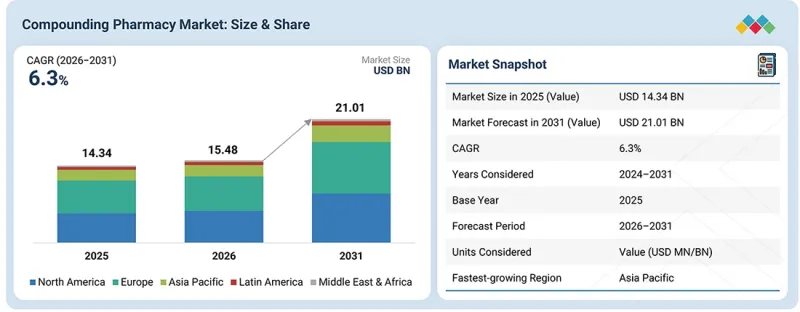
전 세계 조제 약국 시장은 2026년 154억 8,000만 달러에서 2031년에는 210억 1,000만 달러에 달할 것으로 예상되며, 예측 기간 중 연평균 성장률(CAGR)은 6.3%를 기록할 것으로 전망됩니다.
전 세계 조제 약국 시장은 맞춤형 의료, 맞춤형 제형 및 시판되지 않는 제제에 대한 수요 증가를 배경으로, 예측 기간 중 크게 확대될 것으로 전망됩니다.
| 조사 범위 | |
|---|---|
| 조사 대상 기간 | 2026-2031년 |
| 기준 연도 | 2025년 |
| 예측 기간 | 2026-2031년 |
| 산정 단위 | 금액(10억 달러) |
| 부문 | 제품, 컴파운딩 유형, 치료 용도, 무균성, 최종사용자 및 지역 |
| 대상 지역 | 북미, 유럽, 아시아태평양, 라틴아메리카, 중동 및 아프리카 |
시장 성장은 만성질환 및 복합 질환의 유병률 증가, 환자 맞춤형 치료의 확산, 그리고 의약품 부족시 조제 의약품에 대한 의존도 증가에 힘입고 있습니다. 자동 조제 시스템, 디지털 처방전 관리, 정밀 투여 기술의 발전으로 효율성과 품질이 더욱 향상되고 있습니다. 그러나 엄격한 규제 요건, 무균 조제 시설에 대한 막대한 투자, 전문 인력 확보, 그리고 품질관리상 과제가 특히 소규모 조제 약국의 경우 시장 확장을 제약할 가능성이 있습니다.
제품 유형별로는 2025년에 경구용 의약품이 조제 약국 시장에서 가장 큰 점유율을 차지했습니다.
제품 유형별로 보면 조제 약국 시장은 외용제, 경구용 의약품, 비경구용 의약품, 직장용 의약품, 비강용 의약품, 안약 및 기타 제품으로 분류됩니다. 이 중 경구약 부문은 맞춤형 의료에 대한 수요 증가에 힘입어 조제 약국 시장에서 중요한 위치를 차지하고 있습니다. 조제 캡슐, 정제, 로젠지, 용액, 현탁액은 소아, 노인 및 만성질환 환자를 위해 투여량, 맛, 부형제, 방출 프로파일을 맞춤화할 수 있게 해줍니다. 내분비 질환, 당뇨병 및 기타 만성질환의 유병률 증가가 수요를 더욱 부추기고 있습니다. 맛 가림, 서방형 제제, 생체이용률 향상 분야의 기술적 진보로 인해 환자의 복약 순응도와 치료 성과가 개선되고 있습니다. 맞춤형 의료에 대한 관심 증가, FDA 및 USP 기준 준수, 그리고 병원, 전문 클리닉, 소매 약국을 통한 접근성 확대가 이 부문의 성장을 지속적으로 지원하고 있습니다.
치료 용도별로는 2025년에 통증 관리 부문이 가장 큰 시장 점유율을 차지했습니다.
치료 용도별로 보면 시장은 통증 관리, 호르몬 대체요법, 피부 질환, 영양 보충제 및 기타 치료 용도로 분류됩니다. 2025년, 급성 및 만성 통증이 널리 만연해 있는 것을 배경으로, 통증 관리 부문이 조제 약국 시장에서 가장 큰 점유율을 차지했습니다. 관절염, 신경병성 통증, 암 관련 통증, 편두통, 수술 후 증상의 사례가 증가하고 있으며, 이에 따라 환자 개개인에 맞춤화된 진통제 제제에 대한 수요가 높아지고 있습니다. 조제 약국에서는 환자 개개인에 맞춘 유효 성분의 농도, 제형, 투여 방법이 가능해져 내약성 및 복약 순응도 강화에 기여하고 있습니다. 외용 제제, 경피 흡수 시스템, 서방형 제제 및 국소 요법의 발전으로 치료 선택지는 더욱 확대되고 있습니다. 개인 맞춤형 통증 관리에 대한 수요 증가, 고령화 및 헬스케어에 대한 의식의 향상로 인해 이 부문의 지속적인 성장이 촉진될 것으로 예상됩니다.
2026-2031년에 아시아태평양은 조제 약국 시장에서 가장 높은 연평균 성장률(CAGR)을 기록할 것으로 전망됩니다.
조제 약국 시장은 북미, 유럽, 아시아태평양, 라틴아메리카, 중동 및 아프리카로 구분됩니다. 예측 기간 중 아시아태평양은 맞춤형 의약품에 대한 수요 증가, 의료비 상승, 그리고 제약 및 생명공학 산업의 확장에 힘입어 가장 높은 연평균 성장률(CAGR)을 기록할 것으로 예상됩니다. 지역적 성장은 의료 인프라 개선, 맞춤형 치료에 대한 의식의 향상, 만성질환 유병률 증가, 그리고 첨단 조제 기술의 도입 확대에 의해 더욱 가속화되고 있습니다. 병원 네트워크, 전문 클리닉, 조제 약국의 확대에 더해, 무균 조제 시설 및 품질관리 시스템에 대한 투자가 해당 지역의 역량을 강화하고 있습니다. 또한 중국, 일본, 한국, 인도에서 제약 및 헬스케어 분야의 확장이 맞춤형 의약품 제제 및 조제 서비스에 대한 수요를 견인할 것으로 예상됩니다.
이 보고서를 위해 실시된 주요인터뷰는 다음과 같이 분류됩니다. :
- 응답자별: 공급 측(70%) 및 수요 측(30%)
- 직책별: 매니저(45%), CXO 및 이사(30%), 임원(25%)
- 지역별: 북미(40%), 유럽(25%), 아시아태평양(20%), 라틴아메리카(10%), 중동 및 아프리카(5%)
조사 범위:
본 조사 보고서에서는 컴파운딩 약국 시장을 제품 유형, 조제 유형, 치료 용도, 무균성 및 최종사용자별로 분류하고 있습니다. 이 보고서에는 성장 요인, 제약 요인, 과제, 기회 등 컴파운딩 약국 시장의 성장에 영향을 미치는 주요 요인에 대한 상세한 정보가 포함되어 있습니다. 또한 주요 업계 플레이어에 대한 상세한 분석도 수록되어 있으며, 각 기업의 사업 개요, 제품, 솔루션, 전략, 제휴, 파트너십 및 계약에 대한 인사이트를 제공합니다. 이 보고서에서는 컴파운딩 약국 시장의 신규 승인, 신제품 출시, 제휴, 인수 및 기타 최신 동향과 같은 최근 동향에 대해서도 다루고 있습니다.
이 보고서를 구매할 때의 주요 이점:
이 보고서는 컴파운딩 약국 시장 전체 및 그 하위 부문의 매출에 대한 가장 정확한 추정치를 제공함으로써, 시장을 선도하는 기업과 신규 진입 기업을 지원합니다. 또한 이해관계자가 경쟁 구도를 더 깊이 이해하고, 자사의 비즈니스를 효과적으로 포지셔닝하며, 적절한 시장 진입 전략을 수립하는 데 필요한 추가적인 인사이트를 얻는 데 도움이 됩니다. 이 보고서를 통해 이해관계자는 시장의 주요 지표를 파악하고, 주요 시장 촉진요인 및 과제에 대한 정보를 얻을 수 있습니다.
이 보고서는 다음 사항에 대한 인사이트를 제공합니다. :
- 주요 촉진요인(북미 및 유럽의 지속적인 의약품 부족, USP 기준의 완전 시행, 투여 준비가 완료된 의약품 및 표준화된 투여량에 대한 안전성 중시, GLP-1 제제의 지속적인 수요로 인한 공급 격차 발생, 그리고 투여량의 개별화를 향한 동향), 제약 요인(GLP-1 제제의 공급 부족 해소로 인한 조제 대체품에 대한 의존도 감소, FDA의 감독 강화 및 비위생적 상황에 대한 단속 강화, 원료의약품 공급 제한), 기회(병원의 아웃소싱 확대: 마취, 중환자 치료, 안과 및 항암 치료 보조제 분야로의 확장, 그리고 방사성 의약품 조제 표준화) 및 과제(API, 첨가제의 공급, CCI/시험에서의 생산 능력 병목 현상, 품질관리 시스템의 성숙도 부족, 안정성/BUD(사용 기한)에 관한 증거 생성에서의 격차) 등, 시장 성장에 영향을 미치는 요인에 대해 분석하고 있습니다.
- 서비스 개발 및 혁신: 컴파운딩 약국 시장의 향후 기술 동향 및 연구개발 활동에 대한 상세 인사이트.
- 시장 개발: 수익성이 높은 시장에 대한 포괄적인 정보. 이 보고서에서는 다양한 지역에 걸친 시장 분석을 수행하고 있습니다.
- 시장 다각화: 컴파운딩 약국 시장의 미개발 지역, 최근 동향 및 투자에 관한 포괄적인 정보.
- 경쟁 평가: 주요 기업의 시장 점유율, 성장 전략 및 제품 라인업에 대한 상세한 평가입니다. 복합조제 약국 시장의 주요 기업에 대한 상세한 분석을 통해 각 기업의 주요 전략, 제품 출시 및 승인, 파이프라인 분석, 인수, 제휴, 계약, 합작 투자, 기타 최근 동향, 투자 및 자금 조달 활동, 브랜드 및 제품 비교 분석, 그리고 공급업체의 기업 가치 평가 및 재무 지표에 대한 인사이트를 제공합니다.
자주 묻는 질문
목차
제1장 서론
제2장 요약
제3장 주요 인사이트
- 조제 약국 시장 개요
- 조제 약국 시장: 조제 유형별·지역별
- 복합조제 약국 시장: 지역별 개요
- 복합조제 약국 시장 점유율: 무균 여부별, 2026년 대 2031년
제4장 시장 개요
- 시장 역학
- 촉진요인
- 억제요인
- 기회
- 과제
- 미충족 수요와 미개발 분야
- 상호 연관된 시장 및 부문 간 기회
- Tier 1/2/3 주요 기업의 전략적 움직임
제5장 업계 동향
- Porter's Five Forces 분석
- 신규 진입자의 위협
- 대체품의 위협
- 공급업체의 협상력
- 구매자의 협상력
- 경쟁 기업 간의 적대적 관계
- 거시경제 전망
- GDP 동향 및 전망
- 세계 복합 약국 시장의 동향
- 밸류체인 분석
- 생태계 분석
- 생태계 내에서의 역할
- 가격 분석
- 2025년 기준 주요 기업별 조제 약국 제품 참고 가격 분석
- 2025년, 지역별 복합조제 약국 제품 참고 가격 분석
- 주요 회의 및 행사(2026-2027년)
- 고객의 비즈니스에 영향을 미치는 동향 및 파괴적 변화
- 투자 및 자금 조달 시나리오
- 2025년 미국 관세가 복합조제 약국 시장에 미치는 영향
- 주요 관세율
- 가격에 미치는 영향 분석
- 국가·지역별 영향
- 최종 용도 산업에 미치는 영향
제6장 기술 발전, AI의 영향, 특허, 혁신 및 향후 활용
- 기술 분석
- 주요 신규 기술
- AI를 활용한 처방·배합 관리
- 자동화·로봇화 배합 시스템
- 관련 기술
- 바코드 및 이미지 기반 검증 기술
- 밀폐형 시스템을 통한 이송·격리 기술
- 보완 기술
- 전자 처방 및 조제 워크플로우 관리
- 클라우드 기반 약국 관리 및 데이터 분석
- 기술·제품 로드맵
- 미래의 응용
- AI/생성형 AI가 조제 약국 시장에 미치는 영향
- 주요 사용 사례 및 시장 잠재력
- 조제 약국 시장에서 AI 도입 사례 연구
- 상호 연관된 인접 생태계 및 시장 참여자에 미치는 영향
- 복합조제 약국 시장용 생성형 AI 도입에 대한 고객의 준비 현황
제7장 지속가능성과 규제 현황
- 지역별 규제 및 규정 준수
- 지역별 규제기관, 정부 기관 및 기타 조직
- 업계 표준
- 지속가능성 추진 활동
- 영향 및 규제 정책에 대한 대응
- 인증, 표시 및 환경 기준
제8장 고객 동향 및 구매 행동
- 의사결정 과정
- 구매자의 이해관계자와 구매 평가 기준
- 구매 과정의 주요 이해관계자
- 주요 구매 기준
- 도입 장벽 및 사내 과제
- 다양한 최종 용도 산업 분야의 미충족 수요
- 시장의 수익성
제9장 컴파운딩 약국 시장: 제품별
- 경구용 의약품
- 외용제
- 주사제
- 안약
- 비강 스프레이
- 직장용 의약품
- 기타 제품
제10장 조제 약국 시장: 조제 유형별
- 제제 투여 변경
- 제제의 성분 변경
- 현재 구할 수 없는 의약품의 제조
제11장 조제 약국 시장: 치료 용도별
- 통증 관리
- 호르몬 대체요법
- 피부 질환
- 영양 보충제
- 기타 치료 용도
제12장 복합조제 약국 시장: 무균/비무균
- 무균
- 비무균
제13장 조제 약국 시장: 최종사용자별
- 성인
- 고령자
- 소아 환자
제14장 복합조제 약국 시장: 지역별
- 북미
- 미국
- 캐나다
- 유럽
- 독일
- 영국
- 프랑스
- 이탈리아
- 스페인
- 기타 유럽
- 아시아태평양
- 중국
- 일본
- 인도
- 호주
- 한국
- 기타 아시아태평양
- 라틴아메리카
- 브라질
- 멕시코
- 기타 라틴아메리카
- 중동 및 아프리카
- GCC 국가들
- 기타 중동 및 아프리카
제15장 경쟁 현황
- 주요 진입 기업의 전략/강점
- 2024-2026년 복합조제 약국 시장의 주요 업체 전략 개요
- 수익 분석(2023-2025년)
- 시장 점유율 분석(2025년)
- 기업 평가 매트릭스: 주요 기업, 2025년
- 기업 평가 매트릭스: 스타트업/중소기업, 2025년
- 선도적인 기업
- 대응력이 뛰어난 기업
- 역동적인 기업
- 출발점
- 경쟁사 벤치마킹: 스타트업/중소기업, 2025년
- 기업 평가 및 재무 지표
- 재무 지표
- 기업 평가
- 브랜드·제품 비교
- 경쟁 시나리오
- 제품 출시
- 거래
- 사업 확장
제16장 기업 개요
- 주요 기업
- BAXTER
- EMPOWER PHARMACY
- B. BRAUN SE
- FAGRON
- QUVA PHARMA, INC.
- SCA PHARMA
- NEPHRON PHARMACEUTICALS
- LEITERS HEALTH
- ICON GROUP
- ROSEWAY LABS
- ITH PHARMA
- PENCOL COMPOUNDING PHARMACY
- FORMUL8
- AURORA COMPOUNDING PHARMACY
- 기타 주요 기업
- CUSTOM MED APOTHECARY
- INSTITUTIONAL PHARMACY SOLUTIONS
- FUSION APOTHECARY
- INNOVATION COMPOUNDING PHARMACY
- RX3 COMPOUNDING PHARMACY
- DOUGHERTY'S PHARMACY, INC.
- LORRAINE'S PHARMACY
- WELLS PHARMA
- OLYMPIA PHARMACY
- FRESH THERAPEUTICS
- MEDIOS AG
제17장 조사 방법
제18장 부록
KSA 26.11.03The global compounding pharmacy market is projected to reach USD 21.01 billion by 2031 from USD 15.48 billion in 2026, reflecting a CAGR of 6.3% over the forecast period. The global compounding pharmacy market is projected to expand significantly over the forecast period, driven by rising demand for personalized medications, customized dosage forms, and formulations not commercially available.
| Scope of the Report | |
|---|---|
| Years Considered for the Study | 2026-2031 |
| Base Year | 2025 |
| Forecast Period | 2026-2031 |
| Units Considered | Value (USD billion) |
| Segments | Product, Compounding Type, Therapeutic Application, Sterility, End User, and Region |
| Regions covered | North America, Europe, Asia Pacific, Latin America, Middle East & Africa |
Market growth is supported by the increasing prevalence of chronic and complex conditions, greater adoption of patient-specific therapies, and growing reliance on compounded medications during drug shortages. Advances in automated compounding systems, digital prescription management, and precision dosing technologies are further improving efficiency and quality. However, stringent regulatory requirements, high investments in sterile compounding facilities, specialized workforce requirements, and quality-control challenges may constrain market expansion, particularly for smaller compounding pharmacies.
By product type, oral drugs held the largest share of the compounding pharmacy market in 2025.
By product type, the compounding pharmacy market is segmented into topical drugs, oral drugs, parenteral drugs, rectal drugs, nasal drugs, ophthalmic drugs, and other products. Among these, the oral drugs segment holds a significant position in the compounding pharmacy market, supported by rising demand for personalized medications. Compounded capsules, tablets, lozenges, solutions, and suspensions enable customized dosages, flavors, excipients, and release profiles for pediatric, geriatric, and chronic disease patients. The growing prevalence of endocrine disorders, diabetes, and other chronic conditions further drives demand. Technological advancements in taste masking, sustained-release formulations, and bioavailability enhancement improve patient adherence and treatment outcomes. Increasing emphasis on personalized medicine, compliance with FDA and USP standards, and expanding availability through hospitals, specialty clinics, and retail pharmacies continue to support segment growth.
By therapeutic application, the pain management segment reported the largest market share in 2025.
By therapeutic application, the market is segmented into pain management, hormone replacement therapy, dermal disorders, nutritional supplements, and other therapeutic applications. In 2025, the pain management segment held the largest share of the compounding pharmacy market, driven by the widespread prevalence of acute and chronic pain. Growing cases of arthritis, neuropathic pain, cancer-related pain, migraines, and postoperative conditions are increasing demand for customized analgesic formulations. Compounding pharmacies enable personalized strengths, dosage forms, and delivery methods, supporting improved tolerability and adherence. Advances in topical preparations, transdermal systems, sustained-release formulations, and localized therapies further expand treatment options. Rising demand for individualized pain management, an aging population, and increasing healthcare awareness are expected to support continued segment growth.
Asia Pacific is growing at the highest CAGR in the compounding pharmacy market from 2026 to 2031.
The compounding pharmacy market is segmented into North America, Europe, Asia Pacific, Latin America, and the Middle East & Africa. During the forecast period, Asia Pacific is expected to register the highest CAGR, driven by rising demand for personalized medications, increasing healthcare expenditure, and expanding pharmaceutical and biotechnology industries. Regional growth is further supported by improving healthcare infrastructure, growing awareness of customized therapies, increasing prevalence of chronic diseases, and rising adoption of advanced compounding technologies. Expanding hospital networks, specialty clinics, and compounding pharmacies, along with investments in sterile compounding facilities and quality-control systems, are strengthening the region's capabilities. Additionally, pharmaceutical and healthcare expansion in China, Japan, South Korea, and India is expected to drive demand for customized drug formulations and compounding services.
The primary interviews conducted for this report can be categorized as follows:
- By Respondent: Supply Side (70%) and Demand Side (30%)
- By Designation: Managers (45%), CXOs & Directors (30%), and Executives (25%)
- By Region: North America (40%), Europe (25%), Asia Pacific (20%), Latin America (10%), and the Middle East & Africa (5%)
Companies Profiled in the Report:
- Baxter (US)
- Empower Pharmacy (US)
- B. Braun (Germany)
- Fagron (Netherlands)
- QuVa Pharma (US)
- SCA Pharma (US)
- Nephron Pharmaceuticals (US)
- Leiters Health (US)
- Pharmaxo (UK)
- Icon Group (Australia)
- Roseway Labs (UK)
- ITH Pharma (UK)
- Pencol Compounding Pharmacy (Canada)
- Formula 8 (South Africa)
- Aurora Compounding Pharmacy (Canada)
Research Coverage:
This research report categorizes the compounding pharmacy market by product, compounding type, therapeutic application, sterility, and end user. The report includes detailed information on the main factors affecting growth in the compounding pharmacy market, such as drivers, restraints, challenges, and opportunities. It also features an in-depth analysis of key industry players, offering insights into their business overview, products, solutions, strategies, collaborations, partnerships, and agreements. The report covers recent developments such as new approvals, launches, collaborations, acquisitions, and other updates in the compounding pharmacy market.
Key Benefits of Buying the Report:
The report will help market leaders and new entrants by providing the closest estimates of revenue for the entire compounding pharmacy market and its subsegments. It will also help stakeholders better understand the competitive landscape and gain more insights to position their businesses effectively and develop appropriate go-to-market strategies. This report enables stakeholders to understand the market's key indicators and provides information on the main market drivers, restraints, opportunities, and challenges.
The report provides insights into the following pointers:
- Analysis of key drivers (persistent drug shortages in North America and Europe, full enforcement of USP standards, safety push for ready-to-administer and standardized doses, continued demand creating supply gap for GLP-1 drugs, and trend toward personalization of doses), restraints (resolution of GLP-1 shortages reduces reliance on compounded alternatives, stricter FDA oversight and insanitary conditions enforcement, and limitations on bulk drug substances), opportunities (expansion of hospital outsourcing into anesthesia, critical care, ophthalmic & chemo-adjuncts and radiopharmaceutical compounding standardization), and challenges (capacity bottlenecks in API, excipient supply, and CCI/testing, and limited quality-system maturity and gaps in stability/BUD evidence generation) influencing the growth of the market.
- Service Development/Innovation: Detailed insights on upcoming technologies, research & development activities in the compounding pharmacy market.
- Market Development: Comprehensive information about lucrative markets; the report analyzes the market across varied regions.
- Market Diversification: Exhaustive information about untapped geographies, recent developments, and investments in the compounding pharmacy market.
- Competitive Assessment: In-depth assessment of market shares, growth strategies, and product offerings of leading players. A detailed analysis of the key industry players has been done to provide insights into their key strategies, product launches/approvals, pipeline analysis, acquisitions, partnerships, agreements, collaborations, other recent developments, investment and funding activities, brand/product comparative analysis, and vendor valuation and financial metrics of the compounding pharmacy market.
TABLE OF CONTENTS
1 INTRODUCTION
- 1.1 STUDY OBJECTIVES
- 1.2 MARKET DEFINITION
- 1.3 STUDY SCOPE
- 1.3.1 MARKET SEGMENTATION & REGIONAL SCOPE
- 1.3.2 INCLUSIONS & EXCLUSIONS
- 1.3.3 YEARS CONSIDERED
- 1.3.4 CURRENCY CONSIDERED
- 1.4 STAKEHOLDERS
- 1.5 SUMMARY OF CHANGES
2 EXECUTIVE SUMMARY
- 2.1 KEY INSIGHTS & MARKET HIGHLIGHTS
- 2.2 KEY MARKET PARTICIPANTS: INSIGHTS & STRATEGIC DEVELOPMENTS
- 2.3 DISRUPTIVE TRENDS SHAPING MARKET GROWTH
- 2.4 HIGH-GROWTH SEGMENTS & EMERGING FRONTIERS
- 2.5 SNAPSHOT: GLOBAL MARKET SIZE, GROWTH RATE, AND FORECAST
3 PREMIUM INSIGHTS
- 3.1 COMPOUNDING PHARMACY MARKET OVERVIEW
- 3.2 COMPOUNDING PHARMACY MARKET, BY COMPOUNDING TYPE & REGION
- 3.3 COMPOUNDING PHARMACY MARKET: GEOGRAPHIC SNAPSHOT
- 3.4 COMPOUNDING PHARMACY MARKET SHARE, BY STERILITY, 2026 VS. 2031
4 MARKET OVERVIEW
- 4.1 INTRODUCTION
- 4.2 MARKET DYNAMICS
- 4.2.1 DRIVERS
- 4.2.1.1 Persistent drug shortages in North America and Europe
- 4.2.1.2 Enforcement of USP standards
- 4.2.1.3 Push for ready-to-administer (RTA) and standardized doses
- 4.2.1.4 Continued demand-supply gap for GLP-1 drugs
- 4.2.1.5 Trend towards personalization of doses
- 4.2.2 RESTRAINTS
- 4.2.2.1 Resolution of GLP-1 shortages and reduced reliance on compounded alternatives
- 4.2.2.2 Stricter FDA oversight and intensified enforcement of unsanitary conditions violations
- 4.2.2.3 Limitations on bulk drug substances
- 4.2.3 OPPORTUNITIES
- 4.2.3.1 Expansion of hospital outsourcing into anesthesia, critical care, ophthalmic, and chemo-adjuncts
- 4.2.3.2 Radiopharmaceutical compounding standardization
- 4.2.4 CHALLENGES
- 4.2.4.1 Capacity bottlenecks in API, excipient supply, and critical compounding infrastructure testing
- 4.2.4.2 Limited quality-system maturity and gaps in stability/BUD evidence generation
- 4.2.1 DRIVERS
- 4.3 UNMET NEEDS & WHITE SPACES
- 4.4 INTERCONNECTED MARKETS & CROSS-SECTOR OPPORTUNITIES
- 4.5 STRATEGIC MOVES BY TIER-1/2/3 PLAYERS
5 INDUSTRY TRENDS
- 5.1 PORTER'S FIVE FORCES ANALYSIS
- 5.1.1 THREAT OF NEW ENTRANTS
- 5.1.2 THREAT OF SUBSTITUTES
- 5.1.3 BARGAINING POWER OF SUPPLIERS
- 5.1.4 BARGAINING POWER OF BUYERS
- 5.1.5 INTENSITY OF COMPETITIVE RIVALRY
- 5.2 MACROECONOMIC OUTLOOK
- 5.2.1 INTRODUCTION
- 5.2.2 GDP TRENDS & FORECAST
- 5.2.3 TRENDS IN GLOBAL COMPOUNDING PHARMACY MARKET
- 5.3 VALUE CHAIN ANALYSIS
- 5.4 ECOSYSTEM ANALYSIS
- 5.4.1 ROLE IN ECOSYSTEM
- 5.5 PRICING ANALYSIS
- 5.5.1 INDICATIVE PRICING ANALYSIS FOR COMPOUNDING PHARMACY PRODUCTS, BY KEY PLAYER, 2025
- 5.5.2 INDICATIVE PRICING ANALYSIS FOR COMPOUNDING PHARMACY PRODUCTS, BY REGION, 2025
- 5.6 KEY CONFERENCES & EVENTS, 2026-2027
- 5.7 TRENDS/DISRUPTIONS IMPACTING CUSTOMERS' BUSINESSES
- 5.8 INVESTMENT & FUNDING SCENARIO
- 5.9 IMPACT OF 2025 US TARIFFS ON COMPOUNDING PHARMACY MARKET
- 5.9.1 INTRODUCTION
- 5.9.2 KEY TARIFF RATES
- 5.9.3 PRICE IMPACT ANALYSIS
- 5.9.4 IMPACT ON COUNTRY/REGION
- 5.9.4.1 US
- 5.9.4.2 Europe
- 5.9.4.3 Asia Pacific
- 5.9.4.4 Rest of the World
- 5.9.5 IMPACT ON END-USE INDUSTRIES
6 TECHNOLOGICAL ADVANCEMENTS, AI-DRIVEN IMPACT, PATENTS, INNOVATIONS, AND FUTURE APPLICATIONS
- 6.1 TECHNOLOGY ANALYSIS
- 6.2 KEY EMERGING TECHNOLOGIES
- 6.2.1 AI-DRIVEN FORMULATION & COMPOUNDING MANAGEMENT
- 6.2.2 AUTOMATED & ROBOTIC COMPOUNDING SYSTEMS
- 6.3 ADJACENT TECHNOLOGIES
- 6.3.1 BARCODE & IMAGE-BASED VERIFICATION TECHNOLOGIES
- 6.3.2 CLOSED-SYSTEM TRANSFER & CONTAINMENT TECHNOLOGIES
- 6.4 COMPLEMENTARY TECHNOLOGIES
- 6.4.1 ELECTRONIC PRESCRIBING & COMPOUNDING WORKFLOW MANAGEMENT
- 6.4.2 CLOUD-BASED PHARMACY MANAGEMENT & DATA ANALYTICS
- 6.5 TECHNOLOGY/PRODUCT ROADMAP
- 6.6 FUTURE APPLICATIONS
- 6.7 IMPACT OF AI/GEN AI ON COMPOUNDING PHARMACY MARKET
- 6.7.1 TOP USE CASES & MARKET POTENTIAL
- 6.7.2 CASE STUDIES OF AI IMPLEMENTATION IN COMPOUNDING PHARMACY MARKET
- 6.7.3 INTERCONNECTED ADJACENT ECOSYSTEM & IMPACT ON MARKET PLAYERS
- 6.7.4 CLIENTS' READINESS TO ADOPT GENERATIVE AI IN COMPOUNDING PHARMACY MARKET
7 SUSTAINABILITY & REGULATORY LANDSCAPE
- 7.1 REGIONAL REGULATIONS & COMPLIANCE
- 7.1.1 REGULATORY BODIES, GOVERNMENT AGENCIES, AND OTHER ORGANIZATIONS, BY REGION
- 7.1.2 INDUSTRY STANDARDS
- 7.2 SUSTAINABILITY INITIATIVES
- 7.3 IMPACT & REGULATORY POLICY INITIATIVES
- 7.4 CERTIFICATIONS, LABELING, & ECO-STANDARDS
8 CUSTOMER LANDSCAPE & BUYER BEHAVIOR
- 8.1 DECISION-MAKING PROCESS
- 8.2 BUYER STAKEHOLDERS & BUYING EVALUATION CRITERIA
- 8.2.1 KEY STAKEHOLDERS IN BUYING PROCESS
- 8.2.2 KEY BUYING CRITERIA
- 8.3 ADOPTION BARRIERS & INTERNAL CHALLENGES
- 8.4 UNMET NEEDS FROM VARIOUS END-USE INDUSTRIES
- 8.5 MARKET PROFITABILITY
9 COMPOUNDING PHARMACY MARKET, BY PRODUCT
- 9.1 INTRODUCTION
- 9.2 ORAL DRUGS
- 9.2.1 INCREASING DEMAND FOR PRECISE AND CUSTOMIZABLE ORAL FORMULATIONS IN UNMET PATIENT POPULATIONS TO DRIVE MARKET
- 9.3 TOPICAL DRUGS
- 9.3.1 RISING DEMAND FOR PERSONALIZED TOPICAL TREATMENTS AND ADVANCED DELIVERY VEHICLES TO FUEL MARKET GROWTH
- 9.4 PARENTERAL DRUGS
- 9.4.1 RISING DEMAND FOR STERILE INJECTABLE THERAPIES AND SUPPLY-CHAIN DISRUPTIONS TO BOOST MARKET GROWTH
- 9.5 OPHTHALMIC DRUGS
- 9.5.1 RISING CASES OF EYE-RELATED DISORDERS TO ACCELERATE MARKET GROWTH
- 9.6 NASAL DRUGS
- 9.6.1 ADVANCEMENTS IN NASAL DRUG DELIVERY SYSTEMS AND FAVORABLE REGULATORY POLICIES TO PROPEL MARKET GROWTH
- 9.7 RECTAL DRUGS
- 9.7.1 PERSONALIZED FORMULATIONS AND REGULATORY SUPPORT TO DRIVE GROWTH IN RECTAL COMPOUNDING THERAPIES
- 9.8 OTHER PRODUCTS
10 COMPOUNDING PHARMACY MARKET, BY COMPOUNDING TYPE
- 10.1 INTRODUCTION
- 10.2 PHARMACEUTICAL DOSAGE ALTERATION
- 10.2.1 TAILORED DOSAGE FORMS TO ENHANCE PATIENT ADHERENCE AND CUSTOMIZATION IN COMPOUNDED MEDICATIONS
- 10.3 PHARMACEUTICAL INGREDIENT ALTERATION
- 10.3.1 INCREASED NEED FOR CUSTOMIZED PHARMACEUTICAL INGREDIENTS TO ENHANCE PATIENT-CENTRIC COMPOUNDING SOLUTIONS
- 10.4 CURRENTLY UNAVAILABLE PHARMACEUTICAL MANUFACTURING
- 10.4.1 PERSISTENT GLOBAL DRUG SHORTAGES AND LIMITATIONS OF LARGE-SCALE PHARMACEUTICAL PRODUCTION TO PROPEL ADOPTION
11 COMPOUNDING PHARMACY MARKET, BY THERAPEUTIC APPLICATION
- 11.1 INTRODUCTION
- 11.2 PAIN MANAGEMENT
- 11.2.1 NEED FOR PERSONALIZED PAIN RELIEF SOLUTIONS FOR CHRONIC AILMENTS TO SUPPORT MARKET
- 11.3 HORMONE REPLACEMENT THERAPY
- 11.3.1 POPULARITY OF PERSONALIZED HORMONE THERAPIES TO DRIVE STEADY GROWTH IN GLOBAL COMPOUNDING PHARMACY MARKET
- 11.4 DERMAL DISORDERS
- 11.4.1 CUSTOMIZED DERMATOLOGICAL SOLUTIONS TO PROPEL GLOBAL COMPOUNDING PHARMACY MARKET EXPANSION
- 11.5 NUTRITIONAL SUPPLEMENTS
- 11.5.1 PERSONALIZED NUTRACEUTICALS TO OFFER NICHE BUT BETTER GROWTH OPPORTUNITIES IN COMPOUNDING PHARMACIES
- 11.6 OTHER THERAPEUTIC APPLICATIONS
12 COMPOUNDING PHARMACY MARKET, BY STERILITY
- 12.1 INTRODUCTION
- 12.2 STERILE
- 12.2.1 RTU/RTA STERILE PREPARATIONS AND OPHTHALMIC PACKS TO DRIVE RAPID GROWTH IN COMPOUNDING PHARMACIES
- 12.3 NON-STERILE
- 12.3.1 503A/MAGISTRAL NON-STERILE PREPARATIONS TO DRIVE GLOBAL VOLUME AND VALUE LEADERSHIP IN COMPOUNDING PHARMACIES
13 COMPOUNDING PHARMACY MARKET, BY END USER
- 13.1 INTRODUCTION
- 13.2 ADULTS
- 13.2.1 RISING CHRONIC DISEASE BURDEN AND PERSONALIZED THERAPIES TO AUGMENT ADULT SEGMENT GROWTH
- 13.3 GERIATRIC PATIENTS
- 13.3.1 AGING DEMOGRAPHICS AND DOSE-FORM CUSTOMIZATION TO PROPEL GERIATRIC SEGMENT GROWTH
- 13.4 PEDIATRIC PATIENTS
- 13.4.1 CUSTOMIZED DOSAGE FORMS AND PEDIATRIC-SPECIFIC NEEDS TO DRIVE GROWTH
14 COMPOUNDING PHARMACY MARKET, BY REGION
- 14.1 INTRODUCTION
- 14.2 NORTH AMERICA
- 14.2.1 US
- 14.2.1.1 US to dominate North American compounding pharmacy market during forecast period
- 14.2.2 CANADA
- 14.2.2.1 Personalized treatments, regulatory reinforcement, and supply-gap filling to fuel global compounding pharmacy growth
- 14.2.1 US
- 14.3 EUROPE
- 14.3.1 GERMANY
- 14.3.1.1 Aging demographics, technological advancements, and supportive regulations to drive market
- 14.3.2 UK
- 14.3.2.1 Personalized treatments, chronic disease management, and regulatory support to support market growth
- 14.3.3 FRANCE
- 14.3.3.1 Focus on chronic disease management to fuel growth in French compounding pharmacy market
- 14.3.4 ITALY
- 14.3.4.1 Rising commercial drug development pipeline to spur market growth
- 14.3.5 SPAIN
- 14.3.5.1 Global regulatory advancements and rising R&D activities to drive market
- 14.3.6 REST OF EUROPE
- 14.3.1 GERMANY
- 14.4 ASIA PACIFIC
- 14.4.1 CHINA
- 14.4.1.1 Low manufacturing cost and high demand for medicines to favor market growth
- 14.4.2 JAPAN
- 14.4.2.1 Increasing prevalence of chronic diseases and growing geriatric population to fuel demand for customized medications
- 14.4.3 INDIA
- 14.4.3.1 Increasing pharma R&D activities to support market growth
- 14.4.4 AUSTRALIA
- 14.4.4.1 Innovation in clinical practice and regulatory support to accelerate compounding pharmacy growth
- 14.4.5 SOUTH KOREA
- 14.4.5.1 Regulatory innovation and automation to fuel South Korean compounding pharmacy market growth
- 14.4.6 REST OF ASIA PACIFIC
- 14.4.1 CHINA
- 14.5 LATIN AMERICA
- 14.5.1 BRAZIL
- 14.5.1.1 Growing pharmacy & biologics manufacturing sectors and rising R&D spending to drive market
- 14.5.2 MEXICO
- 14.5.2.1 Regulatory improvements, high cancer rates, and robust pharmaceutical industry to boost market growth
- 14.5.3 REST OF LATIN AMERICA
- 14.5.1 BRAZIL
- 14.6 MIDDLE EAST & AFRICA
- 14.6.1 GCC COUNTRIES
- 14.6.1.1 Rising demand for biologics and increasing prevalence of non-communicable diseases to propel market growth
- 14.6.2 REST OF MIDDLE EAST & AFRICA
- 14.6.1 GCC COUNTRIES
15 COMPETITIVE LANDSCAPE
- 15.1 INTRODUCTION
- 15.2 KEY PLAYER STRATEGIES/RIGHT TO WIN
- 15.2.1 OVERVIEW OF STRATEGIES ADOPTED BY KEY PLAYERS IN COMPOUNDING PHARMACY MARKET, 2024-2026
- 15.3 REVENUE ANALYSIS, 2023-2025
- 15.4 MARKET SHARE ANALYSIS, 2025
- 15.5 COMPANY EVALUATION MATRIX: KEY PLAYERS, 2025
- 15.5.1 STARS
- 15.5.2 EMERGING LEADERS
- 15.5.3 PERVASIVE PLAYERS
- 15.5.4 PARTICIPANTS
- 15.5.5 COMPETITIVE BENCHMARKING: KEY PLAYERS, 2025
- 15.5.5.1 Company footprint
- 15.5.5.2 Region footprint
- 15.5.5.3 Product footprint
- 15.5.5.4 Therapeutic application footprint
- 15.5.5.5 Sterility footprint
- 15.6 COMPANY EVALUATION MATRIX: STARTUPS/SMES, 2025
- 15.6.1 PROGRESSIVE COMPANIES
- 15.6.2 RESPONSIVE COMPANIES
- 15.6.3 DYNAMIC COMPANIES
- 15.6.4 STARTING BLOCKS
- 15.6.5 COMPETITIVE BENCHMARKING: STARTUPS/SMES, 2025
- 15.6.5.1 Detailed list of key startup/SMEs
- 15.6.5.2 Competitive benchmarking of key startups/SMEs
- 15.7 COMPANY VALUATION & FINANCIAL METRICS
- 15.7.1 FINANCIAL METRICS
- 15.7.2 COMPANY VALUATION
- 15.8 BRAND/PRODUCT COMPARISON
- 15.9 COMPETITIVE SCENARIO
- 15.9.1 PRODUCT LAUNCHES
- 15.9.2 DEALS
- 15.9.3 EXPANSIONS
16 COMPANY PROFILES
- 16.1 KEY PLAYERS
- 16.1.1 BAXTER
- 16.1.1.1 Business overview
- 16.1.1.2 Products offered
- 16.1.1.3 Recent developments
- 16.1.1.3.1 Product launches
- 16.1.1.3.2 Expansions
- 16.1.1.4 MnM view
- 16.1.1.4.1 Key strengths
- 16.1.1.4.2 Strategic choices
- 16.1.1.4.3 Weaknesses & competitive threats
- 16.1.2 EMPOWER PHARMACY
- 16.1.2.1 Business overview
- 16.1.2.2 Products offered
- 16.1.2.3 Recent developments
- 16.1.2.3.1 Product launches
- 16.1.2.3.2 Expansions
- 16.1.2.4 MnM view
- 16.1.2.4.1 Key strengths
- 16.1.2.4.2 Strategic choices
- 16.1.2.4.3 Weaknesses & competitive threats
- 16.1.3 B. BRAUN SE
- 16.1.3.1 Business overview
- 16.1.3.2 Products offered
- 16.1.3.3 Recent developments
- 16.1.3.3.1 Product launches
- 16.1.3.4 MnM view
- 16.1.3.4.1 Key strengths
- 16.1.3.4.2 Strategic choices
- 16.1.3.4.3 Weaknesses & competitive threats
- 16.1.4 FAGRON
- 16.1.4.1 Business overview
- 16.1.4.2 Products offered
- 16.1.4.3 Recent developments
- 16.1.4.3.1 Deals
- 16.1.4.3.2 Expansions
- 16.1.4.4 MnM view
- 16.1.4.4.1 Key strengths
- 16.1.4.4.2 Strategic choices
- 16.1.4.4.3 Weaknesses & competitive threats
- 16.1.5 QUVA PHARMA, INC.
- 16.1.5.1 Business overview
- 16.1.5.2 Products offered
- 16.1.5.3 Recent developments
- 16.1.5.3.1 Expansions
- 16.1.5.4 MnM view
- 16.1.5.4.1 Key strengths
- 16.1.5.4.2 Strategic choices
- 16.1.5.4.3 Weaknesses & competitive threats
- 16.1.6 SCA PHARMA
- 16.1.6.1 Business overview
- 16.1.6.2 Products offered
- 16.1.6.3 Recent developments
- 16.1.6.3.1 Product launches
- 16.1.6.3.2 Deals
- 16.1.7 NEPHRON PHARMACEUTICALS
- 16.1.7.1 Business overview
- 16.1.7.2 Products offered
- 16.1.7.3 Recent developments
- 16.1.7.3.1 Expansions
- 16.1.8 LEITERS HEALTH
- 16.1.8.1 Business overview
- 16.1.8.2 Products offered
- 16.1.8.3 Recent developments
- 16.1.8.3.1 Product Launches
- 16.1.8.3.2 Expansions
- 16.1.9 ICON GROUP
- 16.1.9.1 Business overview
- 16.1.9.2 Products offered
- 16.1.9.3 Recent developments
- 16.1.9.3.1 Deals
- 16.1.10 ROSEWAY LABS
- 16.1.10.1 Business overview
- 16.1.10.2 Products offered
- 16.1.10.3 Recent developments
- 16.1.10.3.1 Deals
- 16.1.11 ITH PHARMA
- 16.1.11.1 Business overview
- 16.1.11.2 Products offered
- 16.1.11.3 Recent developments
- 16.1.11.3.1 Expansions
- 16.1.12 PENCOL COMPOUNDING PHARMACY
- 16.1.12.1 Business overview
- 16.1.12.2 Products offered
- 16.1.13 FORMUL8
- 16.1.13.1 Business overview
- 16.1.13.2 Products offered
- 16.1.14 AURORA COMPOUNDING PHARMACY
- 16.1.14.1 Business overview
- 16.1.14.2 Products offered
- 16.1.1 BAXTER
- 16.2 OTHER PLAYERS
- 16.2.1 CUSTOM MED APOTHECARY
- 16.2.2 INSTITUTIONAL PHARMACY SOLUTIONS
- 16.2.3 FUSION APOTHECARY
- 16.2.4 INNOVATION COMPOUNDING PHARMACY
- 16.2.5 RX3 COMPOUNDING PHARMACY
- 16.2.6 DOUGHERTY'S PHARMACY, INC.
- 16.2.7 LORRAINE'S PHARMACY
- 16.2.8 WELLS PHARMA
- 16.2.9 OLYMPIA PHARMACY
- 16.2.10 FRESH THERAPEUTICS
- 16.2.11 MEDIOS AG
17 RESEARCH METHODOLOGY
- 17.1 RESEARCH DATA
- 17.1.1 SECONDARY DATA
- 17.1.1.1 Key sources of secondary data
- 17.1.1.2 Key objective of secondary research
- 17.1.2 PRIMARY DATA
- 17.1.2.1 Breakdown of primaries
- 17.1.2.2 Key objectives of primary research
- 17.1.1 SECONDARY DATA
- 17.2 MARKET ESTIMATION METHODOLOGY
- 17.2.1 GLOBAL MARKET ESTIMATION
- 17.2.1.1 Company revenue analysis (bottom-up approach)
- 17.2.1.2 Revenue share analysis
- 17.2.1.3 MnM repository analysis
- 17.2.1.4 Primary interviews
- 17.2.2 INSIGHTS OF PRIMARY EXPERTS
- 17.2.3 SEGMENTAL MARKET SIZE ESTIMATION (TOP-DOWN APPROACH)
- 17.2.1 GLOBAL MARKET ESTIMATION
- 17.3 MARKET GROWTH RATE PROJECTIONS
- 17.4 DATA TRIANGULATION
- 17.5 STUDY ASSUMPTIONS
- 17.6 RESEARCH LIMITATIONS
- 17.7 RISK ANALYSIS
18 APPENDIX
- 18.1 DISCUSSION GUIDE
- 18.2 KNOWLEDGESTORE: MARKETSANDMARKETS' SUBSCRIPTION PORTAL
- 18.3 CUSTOMIZATION OPTIONS
- 18.4 RELATED REPORTS
- 18.5 AUTHOR DETAILS


