|
시장보고서
상품코드
1434290
식물 표현형 분석 : 시장 점유율 분석, 산업 동향 및 통계, 성장 예측(2024-2029년)Plant Phenotyping - Market Share Analysis, Industry Trends & Statistics, Growth Forecasts (2024 - 2029) |
||||||
 Mordor Intelligence
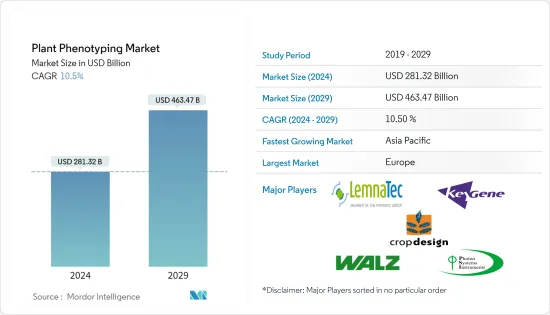
식물 표현형 분석 시장 규모는 2024년 2,813억 2,000만 달러로 추정되며, 2029년까지 4,634억 7,000만 달러에 달할 것으로 예상되며, 예측 기간(2024-2029년) 동안 10.5%의 CAGR로 성장할 것으로 예상됩니다.
인구 증가로 인해 식량 안보 요구를 충족시키기 위해 고수익 작물 재배의 필요성이 증가하고 있으며, 이에 따라 작물 생산성을 향상시키기 위한 혁신적인 식물 육종 기술에 대한 수요가 증가하고 있습니다. 잦은 기상이변과 지구 온난화로 인해 전 세계적으로 작물 생산성에 대한 요구가 증가하고 있으며, 이는 표현형 분석 시장에 유리하게 작용하고 있습니다. 이 시장은 유럽 지역이 독점하고 있습니다.
또한, 이미징 기술의 혁신은 특정 환경에 적합한 더 나은 작물 품종을 개발하기 위해 식물의 특성을 더 잘 평가할 수 있도록 돕습니다. 이미징 기술은 이미징 분광법, 적외선 이미징, 형광 이미징, 가시광선 이미징 등 다양한 기술을 사용하여 식물의 광학 특성을 감지하는 데 도움을 줍니다. 이러한 데이터는 거시적 규모에서 분자 규모까지 분류됩니다.
식물 표현형 분석 시장 동향
종자 매개 질병 증가가 시장을 주도
세계 모든 식용 작물의 거의 90%가 국내 및 국제 무역에서 널리 유통되는 종자에서 재배됩니다. 유전자원은 육종 프로그램에서 종자 형태로 배포 및 교환되기도 합니다. 그러나 많은 식물 병원균은 종자에 의해 전염될 수 있으며, 종자 보급은 식물 병해 확산에 매우 효율적인 방법입니다. 적절한 환경 조건에서 종자에 의해 운반되는 병원성 미생물이 전파되어 발육중인 묘목과 식물에 질병을 일으킬 수 있습니다. 일부 병원균은 발아 중인 묘목을 공격하여 묘목의 정착에 영향을 미치지만, 다른 병원균은 생육 후기까지 질병 증상이 나타나지 않는 경우도 있습니다. 작물 생산성에 영향을 미치는 종자 질병의 수가 증가함에 따라 이를 제거하고 더 나은 질병 없는 작물 품종을 번식시키기 위해 식물 표현형 분석과 같은 기술을 채택해야 할 필요성이 대두되고 있습니다. 따라서 시장은 전 세계 곡물, 과일, 채소, 지방 종자 및 기타 작물의 식물 병해 발생에 의해 점점 더 많이 움직이고 있습니다.
유럽이 표현형 분석 시장을 독점
2019년 식물 표현형 분석 시장에서 가장 큰 점유율을 차지한 지역은 유럽이었습니다. 유럽과 북미의 정부 및 기타 조직에서 식물 표현형 분석 실험에 대한 자금 지원을 강조한 것이 이 지역의 식물 표현형 분석 시장 성장에 중요한 역할을 했습니다. 또한, 식물 표현형 분석 시장의 주요 기업들이 유럽 지역에 집중되어 있어 다른 지역보다 효과적인 표현형 분석 연구와 서비스를 제공하는 지배적인 시장으로 자리 잡고 있습니다. 유럽 국가에서는 연구 활동의 수가 증가하고 있으며, 식물 표현형 분석 제품 및 서비스에 대한 인식이 높아지면서 시장도 확대되고 있습니다. 2019년 유럽에서 진행된 연구에 따르면 이탈리아, 그리스, 포르투갈, 스페인의 지중해성 기후는 덥고 건조한 여름과 잦은 가뭄과 함께 지중해 국가 내 표현형 분석의 이질적인 파노라마가 특징이며, 이는 농업의 최첨단을 설명하는 것으로 입증되었습니다. 생산, 육종 노력, 표현형 분석 능력이 이 지역 시장을 주도하고 있습니다.
식물 표현형 분석 산업 개요
식물 표현형 분석 시장은 통합되어 있으며 LemnaTec, CropDesign-BASF SE, Heinz Walz, Photon Systems Instruments, Qubit Systems, KeyGene과 같은 소수의 대기업이 독점하고 있습니다. 이 시장은 고도의 경쟁이 특징이며, 기업들은 점점 더 많은 투자를 하고 있습니다. 제품 출시, 인수 합병, 협업, 확장 등 경쟁에서 앞서 나가기 위해 투자를 늘리고 있습니다. 예를 들어, 2018년 BASF(CropDesign)는 눙헴에 세계 최첨단 오이 육종 센터를 설립하여 하이 와이어 오이, 긴 오이, 짧은 오이, 스낵 오이, 피클 오이 등 눙헴의 모든 오이 사전 육종 및 육종 프로그램을 수용했습니다. 을 수용했습니다. 또한 CropDesign의 엔지니어들은 식물의 성장과 토양의 품질을 모니터링하기 위한 새로운 센서도 개발하고 있습니다. 이 센서는 자체 개발한 사용자 친화적인 앱에 쉽게 연결할 수 있습니다.
기타 혜택
- 엑셀 형식의 시장 예측(ME) 시트
- 3개월간 애널리스트 지원
목차
제1장 서론
- 조사 성과
- 조사 가정
- 조사 범위
제2장 조사 방법
제3장 주요 요약
제4장 시장 역학
- 시장 개요
- 시장 성장 촉진요인
- 시장 성장 억제요인
- Porter's Five Forces 분석
- 신규 참여업체의 위협
- 구매자의 교섭력
- 공급 기업의 교섭력
- 대체품의 위협
- 경쟁 기업 간의 경쟁 관계
제5장 시장 세분화
- 제품
- 장비
- 자동화 유형별
- 수동
- 반자동
- 전자동
- 용도별
- High Throughput Screening
- 형질 동정
- 광합성 퍼포먼스
- 형태 및 성장 평가
- 기타 용도
- 분석 시스템별
- 이미지 분석 시스템
- 멀티스펙트럴 과학 카메라
- 캐노피 분석 시스템
- 형광 광도계
- 기타
- 사이트별
- 실험실
- 그린 하우스
- 필드
- 플랫폼별
- 컨베이어 기반/모듈러 시스템
- 벤치 기반 시스템
- 핸드헬드/휴대용 시스템
- 드론
- 소프트웨어
- 이미지 분석
- 데이터 수집
- 시스템 제어
- 기타 소프트웨어
- 센서
- 영상 센서
- NDVI 센서
- 온도 센서
- 기타 센서
- 장비
- 서비스
- 계측 데이터 취득·해석
- 통계 분석
- 지역
- 북미
- 미국
- 캐나다
- 멕시코
- 기타 북미
- 유럽
- 독일
- 영국
- 프랑스
- 이탈리아
- 러시아
- 스페인
- 기타 유럽
- 아시아태평양
- 중국
- 일본
- 인도
- 호주
- 기타 아시아태평양
- 남미
- 브라질
- 아르헨티나
- 기타 남미
- 아프리카
- 남아프리카공화국
- 기타 아프리카
- 북미
제6장 경쟁 상황
- 가장 많이 채용되고 있는 전략
- 시장 점유율 분석
- 기업 개요
- BASF SE(Crop Design)
- Delta-T Devices
- Heinz Walz GmbH
- Keygene
- LemnaTec GmbH
- Phenomix
- Phenospex
- PSI(Photon Systems Instruments)
- Qubit Systems
- Rothamsted Research
- The Vienna Biocenter Core Facilities
- WPS
제7장 시장 기회와 향후 동향
ksm 24.03.06The Plant Phenotyping Market size is estimated at USD 281.32 billion in 2024, and is expected to reach USD 463.47 billion by 2029, growing at a CAGR of 10.5% during the forecast period (2024-2029).
The increasing population has driven the need to grow high-yielding crops for the fulfillment of food security needs, which in turn is boosting the demand for innovative plant breeding techniques for improved crop productivity. High frequency of extreme weather conditions and global warming are also enhancing the need for crop productivity across the world which is favoring the phenotyping market. The market is dominated by the European region.
Furthermore, the innovations in imaging techniques facilitate the better assessment of plant characteristics for the development of better crop breeds suitable for the particular environment. Imaging techniques assist in detecting optical properties of plants by using various technologies like imaging spectroscopy, infrared imaging, fluorescence imaging, and visible light imaging, whose, data sorts from macroscopic to molecular scale.
Plant Phenotyping Market Trends
Increasing Number of Seed Borne Diseases is Driving the Market
Almost 90% of all the world's food crops are grown from seeds that are widely distributed in national trade and international trade. Germplasm is also distributed and exchanged in the form of seeds in breeding programs. However, many plant pathogens can be seed transmitted and seed distribution is a very efficient form of plant disease dispersal. Under suitable environmental conditions, disease-causing organisms that are carried by seeds may be transmitted to cause disease in developing seedlings or plants. The pathogen attacks the germinating seedling and affects the seedling establishment, with others, disease symptoms are not seen until a later stage of growth. With the rising number of seed diseases that are affecting crop productivity, it has become necessary to adopt techniques like plant phenotyping to eliminate them and propagate better and disease-free crop varieties. Hence, the market is increasingly been driven by the outbreak of plant diseases in cereals, fruits, vegetables, oilseeds and other crops across the world.
Europe Dominates the Phenotyping Market
Europe accounted for the largest share of the plant phenotyping market in 2019. High emphasis on the funding of plant phenotyping experiments from governments and other organizations in Europe and North America has played a vital role in the growth of the plant phenotyping market in these regions. Additionally, key players in the plant phenotyping market are located in the European region, which makes it the dominant market with effective phenotyping research and services over other regions. There is a rising number of research activities taking place across the European countries which are driving awareness and in turn the market for plant phenotyping products and services. In 2019, a study conducted in Europe established that the Mediterranean climate in the countries of Italy, Greece, Portugal, and Spain with hot dry summers and frequent droughts alongside the heterogeneous panorama of phenotyping within Mediterranean countries, describing the state of the art of agricultural production, breeding initiatives, and phenotyping capabilities, drive the market in the region.
Plant Phenotyping Industry Overview
The plant phenotyping market is consolidated and is dominated by a few major players likeLemnaTec, CropDesign - BASF SE, Heinz Walz, Photon Systems Instruments, Qubit Systems, and KeyGene.The market is characterized by a high degree of competition and the companies are increasingly investing in product launches, mergers & acquisitions,collaborations, and expansions to keep ahead of the competition. For example, in 2018,BASF (CropDesign) openeda global state-of-the-art breeding center for cucumbers in Nunhem,housing all cucumber pre-breeding and breeding programs in Nunhem: high wire, long, short, snack, and pickling cucumber types, including the phenotyping line which offers digital evaluation of fruit characteristics.Furthermore, CropDesign engineers are also developing novel sensors for monitoring plant growth or soil quality, which can be readily linked to in-house developed, user-friendly apps.
Additional Benefits:
- The market estimate (ME) sheet in Excel format
- 3 months of analyst support
TABLE OF CONTENTS
1 INTRODUCTION
- 1.1 Study Deliverables
- 1.2 Study Assumptions
- 1.3 Scope of the Study
2 RESEARCH METHODOLOGY
3 EXECUTIVE SUMMARY
4 MARKET DYNAMICS
- 4.1 Market Overview
- 4.2 Market Drivers
- 4.3 Market Restraints
- 4.4 Porter's Five Force Analysis
- 4.4.1 Threat of New Entrants
- 4.4.2 Bargaining Power of Buyers
- 4.4.3 Bargaining Power of Suppliers
- 4.4.4 Threat of Substitute Products
- 4.4.5 Competitive Rivalry
5 MARKET SEGMENTATION
- 5.1 Products
- 5.1.1 Equipment
- 5.1.1.1 By Automation Type
- 5.1.1.1.1 Manual
- 5.1.1.1.2 Semi-Automated
- 5.1.1.1.3 Fully Automated
- 5.1.1.2 By Application
- 5.1.1.2.1 High-Throughput Screening
- 5.1.1.2.2 Trait Identification
- 5.1.1.2.3 Photosynthetic Performance
- 5.1.1.2.4 Morphology and Growth Assessment
- 5.1.1.2.5 Other Applications
- 5.1.1.3 By Analysis System
- 5.1.1.3.1 Image Analysis Systems
- 5.1.1.3.2 Multispectral Scientific Cameras
- 5.1.1.3.3 Canopy Analysis Systems
- 5.1.1.3.4 Fluorometers
- 5.1.1.3.5 Others
- 5.1.1.4 By Site
- 5.1.1.4.1 Laboatory
- 5.1.1.4.2 Green House
- 5.1.1.4.3 Field
- 5.1.1.5 By Platform
- 5.1.1.5.1 Conveyor-Based/Modular Systems
- 5.1.1.5.2 Bench-Based Systems
- 5.1.1.5.3 Handheld/Portable Systems
- 5.1.1.5.4 Drones
- 5.1.2 Softwares
- 5.1.2.1 Image Analysis
- 5.1.2.2 Data Acquisition
- 5.1.2.3 System Control
- 5.1.2.4 Other Softwares
- 5.1.3 Sensors
- 5.1.3.1 Image Sensors
- 5.1.3.2 NDVI Sensors
- 5.1.3.3 Temperature Sensors
- 5.1.3.4 Other Sensors
- 5.1.1 Equipment
- 5.2 Services
- 5.2.1 Measurement Acquisition & Data Analysis
- 5.2.2 Statistical Analysis
- 5.3 Geography
- 5.3.1 North America
- 5.3.1.1 United States
- 5.3.1.2 Canada
- 5.3.1.3 Mexico
- 5.3.1.4 Rest of North America
- 5.3.2 Europe
- 5.3.2.1 Germany
- 5.3.2.2 United Kingdom
- 5.3.2.3 France
- 5.3.2.4 Italy
- 5.3.2.5 Russia
- 5.3.2.6 Spain
- 5.3.2.7 Rest of Europe
- 5.3.3 Asia Pacific
- 5.3.3.1 China
- 5.3.3.2 Japan
- 5.3.3.3 India
- 5.3.3.4 Australia
- 5.3.3.5 Rest of Asia-Pacific
- 5.3.4 South America
- 5.3.4.1 Brazil
- 5.3.4.2 Argentina
- 5.3.4.3 Rest of South America
- 5.3.5 Africa
- 5.3.5.1 South Africa
- 5.3.5.2 Rest of Africa
- 5.3.1 North America
6 COMPETITIVE LANDSCAPE
- 6.1 Most Adopted Strategies
- 6.2 Market Share Analysis
- 6.3 Company Profiles
- 6.3.1 BASF SE (Crop Design)
- 6.3.2 Delta-T Devices
- 6.3.3 Heinz Walz GmbH
- 6.3.4 Keygene
- 6.3.5 LemnaTec GmbH
- 6.3.6 Phenomix
- 6.3.7 Phenospex
- 6.3.8 PSI (Photon Systems Instruments)
- 6.3.9 Qubit Systems
- 6.3.10 Rothamsted Research
- 6.3.11 The Vienna Biocenter Core Facilities
- 6.3.12 WPS