

|
시장보고서
상품코드
2122220
재생에너지 : 시장 점유율 분석, 업계 동향과 통계, 성장 예측(2026-2031년)Renewable Energy - Market Share Analysis, Industry Trends & Statistics, Growth Forecasts (2026 - 2031) |
||||||
 Mordor Intelligence
에 따르면 설치용량 기반에서의 재생에너지 시장 규모는 2026년 6.03 테라와트에서 2031년까지 11.49 테라와트로 확대하며, 예측 기간(2026-2031년)에 CAGR은 13.78%에 달할 것으로 전망되고 있습니다.
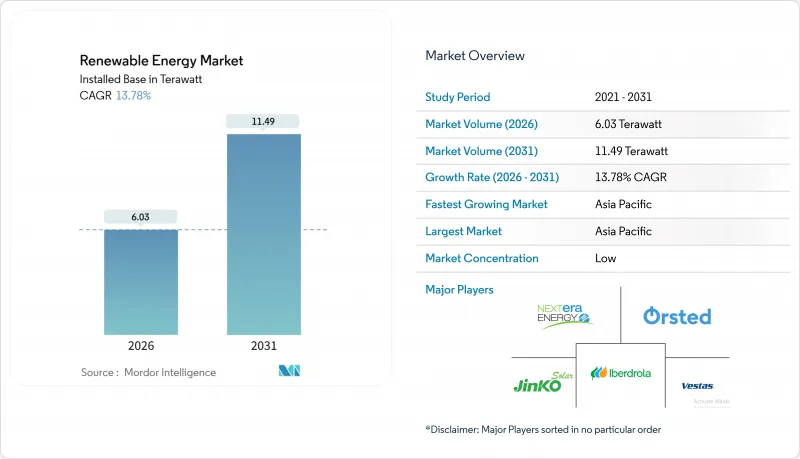
이 보고서는 기술별(태양광발전, 풍력발전, 수력 발전, 바이오에너지, 지열 발전, 해양 에너지), 최종사용자별(공공사업, 상업·산업, 주거용) 및 지역별(북미, 유럽, 아시아태평양, 남미, 중동 및 아프리카)로 분류되어 있습니다. 시장 규모 및 전망은 설치 용량(GW) 기준으로 제시되어 있습니다.
전 세계 재생에너지 시장 동향 및 인사이트
기업용 전력 구매 계약(CPPA)이 북미 및 유럽에서 유틸리티 규모의 건설을 가속화
기업용 PPA는 15-20년에 걸친 대차대조표상의 헤지 수단으로 성숙해졌으며, 상거래 위험을 투자 적격 등급의 신용도로 대체함으로써 개발 사업자는 기존 전력 회사의 입찰 방식보다 신속하게 금융 계약을 체결할 수 있게 되었습니다. 2024년 Meta가 RWE와 체결한 1.5GW 규모의 포트폴리오는 데이터센터 전력 구매자가 여러 국가에 걸친 개발 파이프라인을 보장함으로써, 태양광발전의 건설 주기를 24개월 미만으로, 육상 풍력발전의 경우 약 30개월로 단축한 좋은 사례입니다. 개발 사업자는 투기성 자산보다 계약이 완료된 프로젝트를 우선시하므로 재생에너지 시장은 현재 규제 당국이 아닌 대규모 구매자에 의해 주도되고 있습니다. 과학에 기반한 목표를 설정하는 기업이 늘어남에 따라 2030년까지 연간 40GW를 초과하는 신규 설비 용량의 총 수요가 예상되며, 이는 재생에너지 시장의 장기적인 성장 궤도를 더욱 공고히 하고 있습니다. 그 결과 전망이 명확해짐에 따라 가중평균자본비용이 하락하고, 재생에너지 보급률이 높은 전력망에서의 도입 상한선이 상향 조정되고 있습니다.
하이퍼스케일 데이터센터의 수요가 북유럽 및 아일랜드의 태양광·풍력발전 조달을 촉진하고 있습니다.
AI 워크로드가 클라우드 캠퍼스의 전력 수요 증가를 주도하고 있으며, 이로 인해 사업자들은 수력 및 풍력 잉여 전력이 있는 지역에서 재생 가능 에너지 발전을 확보해야 하는 압박을 받고 있습니다. 구글이 노르웨이에서 체결한 500MW 규모의 풍력발전 계약은 기업이 북유럽 국가들의 청정 전력 믹스를 어떻게 활용하고 있는지를 보여주는 반면, 더블린 주변 송전망의 혼잡으로 인해 투자는 스웨덴과 핀란드로 이동하고 있습니다. 이에 대응해 재생에너지 시장에서는 송전 제약이 있는 노드에 대한 의존도를 낮추는 온사이트 태양광발전 및 에너지 저장 시스템 개발이 진행되고 있습니다. 이러한 동향으로 인해 자본이 분산형 자산으로 유입되면서 그리드형 인버터와 마이크로그리드 아키텍처가 촉진되고 있습니다. 단기적인 수요 탄력성은 여전히 높은 수준이며, 발전과 축전지를 결합할 수 있는 개발업체들은 하이퍼스케일러 기업으로부터 우선 공급업체로서의 지위를 확보하고 있습니다.
ERCOT(미국) 및 내몽골(중국)의 송전망 혼잡 및 출력 제한 위험
ERCOT에서는 2024년에 서부 텍사스의 발전량이 휴스턴으로의 송전 용량을 초과함에 따라 3.2 TWh의 재생 가능 에너지 발전이 제한되었습니다. 현재 계통 연계 대기 기간은 5년을 초과하여, 에넬(Ener)의 300MW ‘아줄 스카이(Azul Sky)’ 풍력발전소 등의 프로젝트는 2026년까지 연기되었습니다. 중국에서는 내몽골의 출력 억제율이 여전히 4% 전후로 유지되고 있으며, 동부 지역의 구매자에게 전력을 판매할 때는 15-20%의 가격 할인이 필요합니다. 이러한 요인으로 인해 내부수익률이 하락하여, 자원이 풍부한 풍력 및 태양광발전의 신규 도입 약 10 GW가 일시적으로 연기되고 있습니다. 새로운 고전압 직류(HVDC) 송전선이 향후 이러한 제약을 완화해 줄 것으로 보이지만, 재생에너지 시장의 연평균 성장률(CAGR)에 대한 단기적인 제약은 피할 수 없습니다.
부문별 분석
해양 에너지는 2026-2031년까지 36.95%의 연평균 성장률(CAGR)을 기록하며, 재생 가능 에너지 시장에서 가장 빠르게 성장하는 분야가 되고 있습니다. 오비탈 마린 파워(Orbital Marine Power)가 오크니 제도에 설치한 2 MW 규모의 ‘O2’ 조력 터빈은 가동 첫해에 74%의 설비 가동률을 달성하여 해상 풍력의 표준치를 크게 상회했습니다. 이는 조력의 예측 가능성을 여실히 보여줍니다. 미네스트(Minest)사의 ‘드래곤 12’ 카이트는 저속 해류를 유용한 전력으로 변환하여, 해류가 빠른 해협 이외의 지역으로도 자원 기반을 확대하고 있습니다. 태양광발전은 2025년 재생에너지 시장 점유율의 44.61%를 차지했으며, 폴리실리콘 가격이 킬로그램당 8달러 아래로 떨어지면서 2024년에는 결정질 실리콘 패널 가격이 와트당 0.12달러까지 하락한 덕분에 계속해서 주도적인 위치를 유지하고 있습니다. TOPCon 및 헤테로 접합 셀의 효율이 25% 이상 향상됨에 따라 시스템 전체 비용이 더욱 절감되어, 온대 지역에서도 경쟁력 있는 가격 수준이 유지되고 있습니다.
풍력발전은 EU의 인허가 절차 효율화와 중국의 송전망 정비 진전을 뒷바람으로 삼아, 2025년 발전 용량의 약 35%를 차지할 전망입니다. 그러나 해상 풍력발전의 경우, 고정식 플랫폼이 1MW당 300만-400만 달러인 반면, 부유식 기초의 설비 투자(CAPEX)가 1MW당 400만-500만 달러로 치솟고 있다는 과제에 직면해 있습니다. 수력 발전은 적합한 부지가 줄어드는 가운데 완만한 확대에 그치고 있지만, 중국의 2.4기가와트급 바이허탄(白河灘) 양수 발전소는 변동이 심한 재생에너지로 구성된 전력계통에서 8시간의 축전 능력이 갖는 가치를 입증하고 있습니다. 바이오에너지와 지열 발전은 원료 가격 변동 및 고엔탈피 저류층 부족으로 인해 여전히 8% 미만의 틈새 시장으로 머물러 있지만, 아이슬란드의 90MW 테이스타레이킬 발전소 확장은 지열 발전이 베이스로드 전력원으로서 가진 매력을 보여주고 있습니다. 전반적으로 기술의 다양화는 재생에너지 시장을 단일 부문의 위험으로부터 보호하는 동시에 투자자들에게 다양한 진입 기회를 제공하고 있습니다.
지역별 분석
아시아태평양은 2025년에 발전 용량의 57.23%를 차지하며 주도적인 위치를 차지하고 있으며, 중국의 2024년 설치 용량 216GW와 인도의 2030년 목표 500GW에 힘입어 연평균 성장률(CAGR) 16.19%로 확대될 것으로 예측됩니다. 또한 중국의 국영 개발업체들은 모듈, 터빈, EPC 서비스를 패키지화한 우대 융자를 통해 동남아시아, 라틴아메리카, 아프리카로 자본과 설비를 수출하고 있습니다. 인도의 해상 풍력발전 입찰 및 생산 연계형 인센티브는 제조의 현지화를 도모하고, 중국에 대한 수입 의존도를 억제하는 것을 목적으로 하고 있습니다.
북미에서는 ‘인플레이션 억제법(Inflation Reduction Act)’에 따라 발전 설비 확충이 가속화되고 있습니다. 이 법은 세액 공제를 2032년까지 연장하는 것으로, 이미 1,500억 달러 규모의 국내 제조 투자를 유도하고 있습니다. 미국은 2024년에 태양광발전 32GW, 풍력발전 8GW를 도입했으나, ERCOT(텍사스주 전력 신뢰성 위원회)에 의한 출력 제한은 송전망 구축이 지연되고 있음을 보여줍니다. 캐나다는 수력 발전과 해상 풍력을 활용하여 2030년까지 전력의 90%를 재생 가능 에너지로 충당하는 것을 목표로 하고 있지만, 멕시코에서는 일사량이 풍부함에도 불구하고 규제 변경으로 인해 민간 투자가 위축되고 있습니다. 유럽은 ‘REPowerEU’를 활용하여 인허가 절차를 신속히 처리하고 있으며, 스페인과 그리스가 가장 큰 혜택을 보고 있습니다. 한편, 독일은 여전히 24개월을 초과하는 송전망 연결 지연으로 어려움을 겪고 있습니다.
중동 및 아프리카는 수소 수출국으로 부상하고 있으며, 사우디아라비아의 NEOM(4GW 규모의 전해설비)과 이집트의 10GW 규모 수에즈만 풍력발전 계획이 그 증거입니다. 남미의 성장은 브라질의 4GW 규모 풍력발전 입찰과 칠레의 25달러/MWh 태양광발전 회랑을 중심으로 전개되고 있습니다. 아르헨티나에서는 리튬 광산에 태양광발전 시설을 병설하여 가공 공정의 탈탄소화를 도모하고 있습니다. 이러한 지역별 동향이 맞물려 재생에너지 시장의 규모를 확대하고, 공급망의 다양화를 촉진하고 있습니다.
기타 혜택:
- 엑셀 형식의 시장 예측(ME) 시트
- 3개월간의 애널리스트 지원
자주 묻는 질문
목차
제1장 서론
제2장 조사 방법
제3장 개요
제4장 시장 구도
제5장 시장 규모와 성장 예측
제6장 경쟁 구도
제7장 시장 기회와 향후 전망
KSA 26.09.04According to Mordor Intelligence, the renewable energy market size in terms of installed base is expected to grow from 6.03 Terawatt in 2026 to 11.49 Terawatt by 2031, at a CAGR of 13.78% during the forecast period (2026-2031).
This report is Segmented by Technology (Solar Energy, Wind Energy, Hydropower, Bioenergy, Geothermal, and Ocean Energy), End-User (Utilities, Commercial and Industrial, and Residential), and Geography (North America, Europe, Asia-Pacific, South America, and Middle East and Africa). The Market Sizes and Forecasts are Provided in Terms of Installed Capacity (GW).
Global Renewable Energy Market Trends and Insights
Corporate Power-Purchase Agreements Accelerating Utility-Scale Builds in North America & Europe
Corporate PPAs have matured into 15-20-year balance-sheet hedges that replace merchant risk with investment-grade credit, allowing developers to reach financial close more quickly than under traditional utility tenders. Meta's 1.5 GW portfolio with RWE in 2024 exemplifies how data-center offtakers underwrite multi-country pipelines, compressing solar build cycles to under 24 months and onshore wind to roughly 30 months. Developers prioritize contracted projects over speculative assets, so the renewable energy market is now paced by large buyers rather than regulators. As more corporates set science-based targets, aggregate demand is expected to exceed 40 GW of new capacity annually through 2030, reinforcing the long-term trajectory of the renewable energy market. The resulting visibility lowers the weighted average cost of capital and lifts the deployment ceiling in high-penetration grids.
Hyperscale Data-Centre Demand Boosting Solar-Wind Procurement in the Nordics & Ireland
AI workloads are driving electricity growth at cloud campuses, pushing operators to lock in renewable generation in regions with surplus hydro and wind. Google's 500 MW Norwegian wind deal illustrates how firms exploit the Nordics' clean-power mix, whereas grid congestion around Dublin has shifted investment toward Sweden and Finland. The renewable energy market responds by developing on-site solar and storage that reduce dependence on transmission-constrained nodes. This dynamic channels capital into distributed assets, encouraging grid-forming inverters and microgrid architectures. Near-term demand elasticity remains high, and developers that can bundle generation with batteries gain preferred-supplier status with hyperscalers.
Grid Congestion & Curtailment Risks in ERCOT (US) and Inner Mongolia (CN)
ERCOT curtailed 3.2 TWh of renewable electricity in 2024 as West Texas output overwhelmed transmission to Houston. Interconnection queues now exceed five years, delaying projects such as Enel's 300 MW Azure Sky wind farm until 2026. In China, Inner Mongolia's curtailment still hovers near 4%, prompting price discounts of 15-20% to place power with eastern buyers. These factors trim internal rates of return and temporarily defer roughly 10 GW of high-resource wind and solar additions. While new HVDC lines will eventually alleviate constraints, short-term drag on the renewable energy market CAGR is inevitable.
Other drivers and restraints analyzed in the detailed report include:
- Green-Hydrogen Gigawatt Pipelines Driving Capacity Additions in MENA & Australia
- EU REPowerEU Fast-Track Permitting Cutting Onshore-Wind Lead-Times in Southern Europe
- End-of-Life Blade Waste Regulations Raising Costs in Germany & France
For complete list of drivers and restraints, kindly check the Table Of Contents.
Segment Analysis
Ocean Energy's 36.95% CAGR from 2026 to 2031 makes it the fastest-growing slice of the renewable energy market. Orbital Marine Power's 2 MW O2 tidal turbine in Orkney achieved a 74% capacity factor in its debut year, well above offshore wind norms, illustrating tidal predictability. Minesto's Dragon 12 kites convert low-velocity currents into useful electricity, expanding the resource base beyond high-flow straits. Solar Energy, at 44.61% renewable energy market share in 2025, maintains leadership thanks to crystalline-silicon panel prices that fell to USD 0.12 per watt in 2024 as polysilicon costs dropped below USD 8 per kilogram. Efficiency gains above 25% for TOPCon and heterojunction cells further compress balance-of-system expenses, sustaining competitive parity even in temperate zones.
Wind Energy contributes about 35% of 2025 capacity, benefiting from streamlined EU permitting and upgraded grid links in China. Offshore wind, however, faces escalating CAPEX for floating foundations that run USD 4-5 million per MW, compared with USD 3-4 million for fixed platforms. Hydropower expands modestly as site availability wanes, though China's 2.4 GW Baihetan pumped-storage plant demonstrates the value of eight-hour storage in a variable-renewable grid. Bioenergy and Geothermal remain niche at under 8%, constrained by feedstock price volatility and limited high-enthalpy reservoirs, yet Iceland's 90 MW Theistareykir expansion shows geothermal's baseload appeal. Collectively, technology diversification shields the renewable energy market from single-segment risk while offering investors multiple entry points.
Complete Report Scope:
- By Technology
- Solar Energy (PV and CSP)
- Wind Energy (Onshore and Offshore)
- Hydropower (Small, Large, PSH)
- Bioenergy
- Geothermal
- Ocean Energy (Tidal and Wave)
- By End-User
- Utilities
- Commercial and Industrial
- Residential
- By Geography
- North America
- United States
- Canada
- Mexico
- Europe
- United Kingdom
- Germany
- France
- Spain
- Nordic Countries
- Russia
- Rest of Europe
- Asia-Pacific
- China
- India
- Japan
- South Korea
- Malaysia
- Thailand
- Indonesia
- Vietnam
- Australia
- Rest of Asia-Pacific
- South America
- Brazil
- Argentina
- Colombia
- Rest of South America
- Middle East and Africa
- Saudi Arabia
- United Arab Emirates
- South Africa
- Egypt
- Rest of Middle East and Africa
- North America
Geography Analysis
Asia-Pacific dominated with 57.23% of capacity in 2025 and is forecast to advance at a 16.19% CAGR, led by China's 216 GW of 2024 installations and India's 500 GW 2030 target. Chinese state-owned developers are also exporting capital and equipment into Southeast Asia, Latin America, and Africa through concessional loans that bundle modules, turbines, and EPC services. India's offshore-wind tenders and production-linked incentives aim to localize manufacturing, curbing Chinese import reliance.
North America's build-out accelerates under the Inflation Reduction Act, which extends tax credits to 2032 and has already catalyzed USD 150 billion in domestic manufacturing commitments. The United States deployed 32 GW of solar and 8 GW of wind in 2024, although ERCOT's curtailments reveal transmission lag. Canada targets 90% renewable electricity by 2030 using hydropower and offshore wind, whereas Mexico's regulatory changes have chilled private investment despite strong irradiance. Europe leverages REPowerEU to compress permitting, with Spain and Greece benefiting most; Germany still battles interconnection delays exceeding 24 months.
The Middle East and Africa emerge as hydrogen exporters, evidenced by Saudi Arabia's NEOM (4 GW electrolyzer) and Egypt's 10 GW Gulf of Suez wind plan. South America's growth revolves around Brazil's 4 GW wind auction and Chile's USD 25/MWh solar corridor. Argentina co-locates solar with lithium mines to decarbonize processing. These regional dynamics collectively broaden the renewable energy market footprint and diversify supply chains.
- EPC Developers/Operators/Owners
- Equipment Suppliers
Additional Benefits:
- The market estimate (ME) sheet in Excel format
- 3 months of analyst support
TABLE OF CONTENTS
1 Introduction
- 1.1 Study Assumptions & Market Definition
- 1.2 Scope of the Study
2 Research Methodology
3 Executive Summary
4 Market Landscape
- 4.1 Market Overview
- 4.2 Renewable Energy Mix, 2024
- 4.3 Market Drivers
- 4.3.1 Corporate Power-Purchase Agreements Accelerating Utility-scale Builds in North America & Europe
- 4.3.2 Hyperscale Data-Centre Demand Boosting Solar-Wind Procurement in the Nordics & Ireland
- 4.3.3 Green-Hydrogen Gigawatt Pipelines Driving Capacity Additions in MENA & Australia
- 4.3.4 EU 'REPowerEU' Fast-Track Permitting Cutting Onshore-Wind Lead-Times (<12 Months) in Southern Europe
- 4.4 Market Restraints
- 4.4.1 Grid Congestion & Curtailment Risks in ERCOT (US) and Inner Mongolia (CN)
- 4.4.2 End-of-Life Blade Waste Regulations Raising Costs in Germany & France
- 4.4.3 Lack of Long-Duration Storage Slowing High VRE Penetration in SE-Asia
- 4.4.4 Local-Content Mandates Inflating Offshore-Wind CAPEX in India & Brazil
- 4.5 Supply-Chain Analysis
- 4.6 Regulatory Outlook
- 4.7 Technological Outlook
- 4.8 Porter's Five Forces
- 4.8.1 Bargaining Power of Suppliers
- 4.8.2 Bargaining Power of Consumers
- 4.8.3 Threat of New Entrants
- 4.8.4 Threat of Substitute Products & Services
- 4.8.5 Intensity of Competitive Rivalry
5 Market Size & Growth Forecasts
- 5.1 By Technology
- 5.1.1 Solar Energy (PV and CSP)
- 5.1.2 Wind Energy (Onshore and Offshore)
- 5.1.3 Hydropower (Small, Large, PSH)
- 5.1.4 Bioenergy
- 5.1.5 Geothermal
- 5.1.6 Ocean Energy (Tidal and Wave)
- 5.2 By End-User
- 5.2.1 Utilities
- 5.2.2 Commercial and Industrial
- 5.2.3 Residential
- 5.3 By Geography
- 5.3.1 North America
- 5.3.1.1 United States
- 5.3.1.2 Canada
- 5.3.1.3 Mexico
- 5.3.2 Europe
- 5.3.2.1 United Kingdom
- 5.3.2.2 Germany
- 5.3.2.3 France
- 5.3.2.4 Spain
- 5.3.2.5 Nordic Countries
- 5.3.2.6 Russia
- 5.3.2.7 Rest of Europe
- 5.3.3 Asia-Pacific
- 5.3.3.1 China
- 5.3.3.2 India
- 5.3.3.3 Japan
- 5.3.3.4 South Korea
- 5.3.3.5 Malaysia
- 5.3.3.6 Thailand
- 5.3.3.7 Indonesia
- 5.3.3.8 Vietnam
- 5.3.3.9 Australia
- 5.3.3.10 Rest of Asia-Pacific
- 5.3.4 South America
- 5.3.4.1 Brazil
- 5.3.4.2 Argentina
- 5.3.4.3 Colombia
- 5.3.4.4 Rest of South America
- 5.3.5 Middle East and Africa
- 5.3.5.1 Saudi Arabia
- 5.3.5.2 United Arab Emirates
- 5.3.5.3 South Africa
- 5.3.5.4 Egypt
- 5.3.5.5 Rest of Middle East and Africa
- 5.3.1 North America
6 Competitive Landscape
- 6.1 Market Concentration
- 6.2 Strategic Moves (M&A, JVs, Funding, PPAs)
- 6.3 Market Share Analysis (Market Rank/Share for key companies)
- 6.4 Company Profiles (includes Global-level Overview, Market-level Overview, Core Segments, Financials, Strategic Information, Products & Services, Recent Developments)
- 6.4.1 EPC Developers/Operators/Owners
- 6.4.1.1 NextEra Energy, Inc.
- 6.4.1.2 Orsted A/S
- 6.4.1.3 Iberdrola, S.A.
- 6.4.1.4 EDF Renewables (EDF S.A.)
- 6.4.1.5 Duke Energy Corporation
- 6.4.1.6 Berkshire Hathaway Energy
- 6.4.1.7 Acciona Energia S.A.
- 6.4.1.8 Engie S.A.
- 6.4.1.9 China Three Gorges Corporation
- 6.4.1.10 Enel Green Power S.p.A.
- 6.4.1.11 Statkraft A.S.
- 6.4.1.12 Pattern Energy Group
- 6.4.1.13 Invenergy LLC
- 6.4.1.14 RWE Renewables GmbH
- 6.4.1.15 ACWA Power
- 6.4.1.16 EDP Renovaveis S.A.
- 6.4.1.17 Brookfield Renewable Partners L.P.
- 6.4.1.18 ReNew Energy Global PLC
- 6.4.1.19 Scatec ASA
- 6.4.2 Equipment Suppliers
- 6.4.2.1 First Solar, Inc.
- 6.4.2.2 Vestas Wind Systems A/S
- 6.4.2.3 Siemens Gamesa Renewable Energy S.A.
- 6.4.2.4 GE Vernova (General Electric)
- 6.4.2.5 JinkoSolar Holding Co. Ltd.
- 6.4.2.6 Canadian Solar Inc.
- 6.4.2.7 Longi Green Energy Technology Co., Ltd.
- 6.4.2.8 Goldwind Science & Technology Co., Ltd.
- 6.4.2.9 Trina Solar Co., Ltd.
- 6.4.2.10 Enphase Energy, Inc.
- 6.4.2.11 Sungrow Power Supply Co., Ltd.
- 6.4.2.12 Mitsubishi Power, Ltd.
- 6.4.2.13 Nordex SE
- 6.4.2.14 MHI Vestas Offshore Wind A/S
- 6.4.2.15 Shanghai Electric Group Co., Ltd.
- 6.4.2.16 Hitachi Energy Ltd.
- 6.4.2.17 ABB Ltd.
- 6.4.2.18 Climeon AB
- 6.4.2.19 Pelamis Wave Power Ltd. (in Administration)
- 6.4.2.20 Ocean Power Technologies, Inc.
- 6.4.1 EPC Developers/Operators/Owners
7 Market Opportunities & Future Outlook
- 7.1 White-space & Unmet-Need Assessment


