|
시장보고서
상품코드
1521321
자동차용 폴리머 복합재 시장 : 시장 점유율 분석, 산업 동향, 성장 예측(2024-2029년)Automotive Polymer Composites - Market Share Analysis, Industry Trends & Statistics, Growth Forecasts (2024 - 2029) |
||||||
 Mordor Intelligence
자동차용 폴리머 복합재 시장 규모는 2024년에는 151만톤으로 추정되고, 2029년에는 199만톤에 이를 것으로 예측되며, 예측기간 중(2024-2029년) CAGR은 5% 이상의 성장이 예상됩니다.
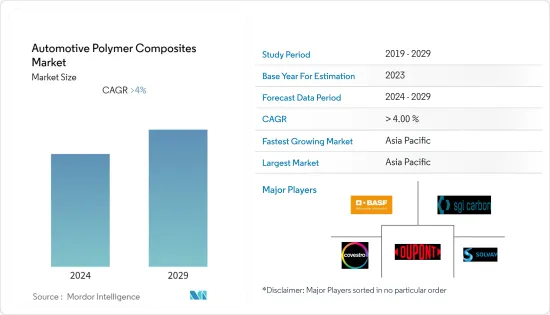
COVID-19의 대유행은 공급망을 혼란스럽게 하고, 생산의 감속 및 정지, 경기후퇴를 일으켜 자동차용 폴리머 복합재 시장에 큰 영향을 주었습니다. 남은 과제를 극복하고 시장 동향을 활용함으로써 자동차용 폴리머 복합재 시장은 경량의 고성능 소재로 자동차 산업에 혁명을 일으켜 밝은 미래로 향하고 있습니다.
자동차가 경량화되면 연비가 향상되고 오염물질의 배출량도 감소하기 때문에 세계 시장에서는 철강이나 알루미늄 등 종래의 재료보다 경량인 자동차용 폴리머 복합재에 대한 수요가 높아지고 있습니다.
반면, 철강이나 알루미늄과 같은 전통적인 재료에 비해 폴리머 복합재의 가공과 제조에는 복잡하고 노동 집약적인 기술이 수반되는 경우가 많아 비용을 밀어 올려 자동차용 폴리머 복합재 시장 성장 억제요인으로 될 것으로 예상됩니다.
로봇 엔지니어링, 자동화 및 디지털화의 혁신은 고분자 복합재의 생산 공정를 간소화하고 비용과 리드 타임을 줄이고 세계 시장에 흥미로운 잠재력을 제공합니다.
아시아태평양은 시장을 독점하고 중국, 인도, 일본, 한국 등의 국가에 의한 소비가 가장 큰 것으로 추정됩니다.
자동차용 폴리머 복합재 시장 동향
경차 부문에서 폴리머 사용 증가
- 자동차 산업은 큰 변혁기를 맞이하고 있어, 경량화가 연비 효율과 성능 향상의 중요한 원동력이 되고 있습니다. 이러한 전환 중, 폴리머가 주역의 역할을 하게 되어, 경차에서는 철강이나 알루미늄과 같은 종래의 재료를 대체하는 것이 증가하고 있습니다.
- 자동차 중량은 주행 역학과 연비 효율에 직접 영향을 주기 때문에 자동차 업계는 수십년전부터 차량의 경량화에 주력해 왔습니다. 미국 에너지부(DOE)에 따르면 차량 중량을 10% 줄이면 연비가 6-8% 향상됩니다. 세계 정부가 엄격한 배기가스 규제를 실시하고 향후 몇 년간 더 높은 배기가스 기준을 설정할 예정이기 때문에 경량 재료의 중요성은 점점 높아질 것으로 예상됩니다.
- 자동차에 사용되는 주요 복합 폴리머는 폴리 프로파일렌, 폴리 우레탄, 나일론, 폴리 염화 비닐, 아크릴로 니트릴-부타디엔-스티렌(ABS) 등을 기반으로 합니다. 폴리프로필렌과 폴리우레탄은 조사 대상 시장의 40% 이상을 차지할 뿐입니다.
- 자동차 제조업체도 프리프레그(폴리머 컴포지트의 일종)를 내장 및 외장 부품의 금속 대체에 사용해, 경량화에 의해 성능과 안전성을 향상시키고 있습니다. 근대화 및 자율주행차의 개발이 수요를 견인하고 있습니다.
- 탄소 프리프레그는 범용성이 높고 다양한 밀도, 형상, 크기로 성형할 수 있기 때문에 항공 업계와 자동차 업계에서는 알루미늄과 스틸의 대체품으로 인기가 있습니다. BMW, 페라리, 렉서스와 같은 주요 자동차 제조업체는 완전한 탄소섬유 차체 구조를 가진 신형 자동차를 적극적으로 설계하고 있습니다. 예를 들어, 2023년 5월에 출시된 2세대 BMW M2는 지붕, 인테리어, 차량 부품 등 주로 탄소섬유로 만들어졌습니다.
- 경주용 자동차 제조업체는 연비와 속도를 향상시키기 위해 차체 무게를 줄입니다. 미국 에너지부 보고서에 따르면 차량 중량을 10% 줄이면 연비가 6-8% 향상된다고 합니다. 이러한 이유로 프리프레그는 자동차 및 운송 산업, 특히 경주용 차량과 고속 차량에서 높은 인기를 얻고 있습니다.
- 국제자동차공업회(OICA)에 따르면 2022년 세계 자동차산업은 2021년 대비 6% 성장했습니다. 자동차 생산은 중국, 독일, 한국, 캐나다, 영국, 이탈리아 등 세계 선진국 및 신흥 국가에서 증가했습니다. 2022년에는 8,500만 대 이상의 자동차가 생산되었습니다.
- OICA에 따르면 2022년 소형 상용차 생산 대수는 2021년에 비해 세계 전체에서 7% 증가해 1,986만대가 됐습니다. 생산의 대부분은 미국 지역에서이며 세계에서 생산되는 소형 상용차의 약 60%를 차지합니다.
- 또한 자동차공업회에 따르면 영국의 상용차 생산 대수는 2022년 39.3% 증가(2021년 대비)인 10만 1,600대가 되었습니다. 2022년 국내 시장용 생산 대수는 전년 대비 14.0% 증가한 4만 409대로 10만 1,600대의 밴, 트럭, 택시, 버스, 코치가 공장 라인에서 출하되었습니다. 자동차 제조 활동 증가는 예측 기간 동안 조사 대상 시장의 성장을 뒷받침할 것으로 보입니다.
- 따라서 자동차에서 차지하는 플라스틱의 비율이 증가하고 자동차용 폴리머 복합 시장을 밀어올릴 것으로 예상됩니다.
아시아태평양이 시장을 독점할 전망
- 아시아태평양은 중국, 인도, 한국 등 국가의 대량 소비로 인한 수요 증가로 큰 시장 점유율을 차지하고 있으며 예측 기간 동안 자동차 폴리머 복합 시장을 독점할 것으로 예상됩니다.
- OICA에 따르면 아시아태평양의 자동차 생산 대수는 2022년에 2021년 대비 7% 증가했습니다. 중국, 한국, 인도 등 신흥 국가들은 2022년 자동차 생산이 급증했습니다. 아시아태평양에서는 2022년에 5,000만대 이상의 자동차가 생산되었습니다.
- 또한 2022년 1-9월 인도의 승용차 판매는 저축, 저금리, 개인 이동성 지향의 높아짐에 따라 호조를 유지해 고객에게 신차 구입을 납득시켰습니다. 그 결과 인도 신차등록 대수는 2022년 1-3분기에 약 20.2% 증가하여 280만대에 달했습니다. 또한 Aatma Nirbhar Bharat 및 Make in India 프로그램과 같은 정부 개혁도 일본의 자동차 산업을 지원했습니다.
- 인도, 한국, 중국과 같은 아시아태평양 국가의 정부는 대형 트럭 소유자에게 새로운 대형 트럭 및 기타 상용차를 구입하도록 하기 위해 오래되고 공해를 일으키는 상용차의 사용을 억제하려고 합니다. 이 프로그램은 오염 수준을 낮추고 폴리머 복합체를 채택하는 대형 트럭 부문의 발전을 촉진하는 것으로 보입니다.
- 또한 중국 정부는 2025년까지 전기자동차의 보급률을 20%로 예측했습니다. 이는 2022년 과거 최고를 기록한 이 나라의 전기차 판매 동향에 반영되어 있습니다. 중국 승용차 협회에 따르면 2022년에 이 나라에서 판매된 EV와 플러그인은 567만대로 2021년에 달성한 판매 대수의 거의 2배입니다. 이 나라에서는 자동차용 폴리머 복합재 수요 증가가 전망되고 있어 현시점에서도 판매는 계속할 자세입니다.
- 위의 요인과 정부에 의한 규제가 이 지역의 자동차용 폴리머 복합재 수요 증가에 기여하고 있습니다.
자동차용 폴리머 복합재 산업 개요
조사 대상 시장은 부분적으로 연결되어 있습니다. 주요 기업(순부동)에는 BASF SE, SGL Group, Covestro AG, Solvay, DuPont가 포함됩니다.
기타 혜택 :
- 엑셀 형식 시장 예측(ME) 시트
- 3개월간의 애널리스트 서포트
목차
제1장 서론
- 조사의 성과
- 조사의 전제
- 조사 범위
제2장 조사 방법
제3장 주요 요약
제4장 시장 역학
- 성장 촉진요인
- 경자동차 부문에서 폴리머 복합재의 사용 증가
- 전기자동차 산업의 고성장
- 기타 촉진요인
- 억제요인
- 화재 위험 및 충돌 안전성에 대한 안전 우려
- 높은 가공 및 제조 비용
- 업계의 밸류체인 분석
- Porter's Five Forces 분석
- 공급기업의 협상력
- 구매자의 협상력
- 신규 진입업자의 위협
- 대체품의 위협
- 경쟁도
제5장 시장 세분화 : 시장 규모(단위 : 양)
- 수지 유형별
- 폴리프로필렌
- 폴리우레탄
- 나일론
- 폴리염화비닐
- ABS
- 폴리에틸렌
- 폴리카보네이트
- 기타 수지 유형(폴리에테르에테르케톤, 폴리에스테르 등)
- 차량 유형별
- 승용차
- 소형 상용차
- 트럭 및 버스
- 기타 차종(스포츠카, 특수 차량 등)
- 지역별
- 아시아태평양
- 중국
- 인도
- 일본
- 한국
- 말레이시아
- 태국
- 인도네시아
- 베트남
- 기타 아시아태평양
- 북미
- 미국
- 캐나다
- 멕시코
- 유럽
- 영국
- 프랑스
- 독일
- 이탈리아
- 스페인
- 북유럽 국가
- 터키
- 러시아
- 기타 유럽
- 남미
- 브라질
- 아르헨티나
- 콜롬비아
- 기타 남미
- 중동 및 아프리카
- 모로코
- 남아프리카
- 나이지리아
- 카타르
- 이집트
- 아랍에미리트(UAE)
- 기타 중동 및 아프리카
- 아시아태평양
제6장 경쟁 구도
- M&A, 합작사업, 제휴 및 협정
- 시장 점유율(%)** 및 랭킹 분석
- 주요 기업의 전략
- 기업 프로파일
- BASF SE
- Covestro AG
- DuPont
- Gurit Services AG
- Hexcel Corporation
- Johns Manville
- Kolon Industries
- Mitsubishi Chemical Corporatio
- Owens Corning
- Plasan Sasa Ltd
- Pyrophobic Systems Ltd
- SGL Carbon
- Solvay
- Teijin Carbon
- Toray Advanced Composites
- UFP Technologies Inc.
제7장 시장 기회 및 향후 동향
- 첨단 제조 기술의 발전
- 지속가능성 및 순환형 경제에 대한 주목
The Automotive Polymer Composites Market size is estimated at 1.51 Million tons in 2024, and is expected to reach 1.99 Million tons by 2029, growing at a CAGR of greater than 5% during the forecast period (2024-2029).
The COVID-19 pandemic significantly impacted the automotive polymer composites market by disrupting the supply chain, causing production to slow down and shut down and an economic downturn. By overcoming the remaining challenges and capitalizing on the market trends, the automotive polymer composites market is poised for a positive future, revolutionizing the automotive industry with its lightweight, high-performance materials.
Lighter vehicles are more fuel-efficient and emit less pollution, which is driving demand for automotive polymer composites in the global market, which are lighter than traditional materials such as steel and aluminum.
On the flip side, compared to traditional materials like steel and aluminum, the processing and manufacturing of polymer composites often involve complex and labor-intensive techniques, driving up costs and is expected to act as a restraint for the automotive polymer composites market.
Innovations in robotics, automation, and digitalization are streamlining composite production processes, reducing costs and lead times, and creating exciting possibilities for the global market.
Asia-Pacific is estimated to dominate the market, with the most significant consumption coming from countries like China, India, Japan, and South Korea.
Automotive Polymer Composites Market Trends
Increasing Use of Polymers in the Light Vehicle Segment
- The automotive industry is undergoing a significant transformation, with lightweight emerging as a critical driver for fuel efficiency and performance improvements. In this shift, polymers are playing a starring role, increasingly replacing traditional materials like steel and aluminum in light vehicles.
- The automotive industry has been focusing on vehicle weight reduction for decades, as vehicle weight has a direct impact on driving dynamics and fuel efficiency. As per the US Department of Energy (DOE), reducing the weight of vehicles by 10% yields an increase of 6-8% in fuel economy. As governments around the world implement stringent emission regulations and plan to set even higher emissions standards in the coming years, the importance of lightweight materials is expected to increase.
- Major composite polymers used in automobiles are based on polypropylene, polyurethanes, nylon, polyvinyl chloride, acrylonitrile-butadiene-styrene (ABS), and others. Polypropylene and polyurethanes only account for more than 40% of the market studied.
- Automakers also use prepregs(a type of polymer composite) to replace metals in interior and exterior parts, reducing weight for better performance and safety. Modernization and autonomous vehicle development drive demand.
- Carbon prepregs are versatile and can be molded into various densities, shapes, and sizes, making them a popular substitute for aluminum and steel in the aviation and automotive industries. Major automakers like BMW, Ferrari, and Lexus are actively designing new models with complete carbon fiber body structures. For example, the second-generation BMW M2, launched in May 2023, is made mainly of carbon fiber, including the roof, interior, and vehicle components.
- Racing car manufacturers reduce curb weight to improve fuel efficiency and speed. According to a US Department of Energy report, a 10% reduction in vehicle weight can improve fuel economy by 6-8%. This makes prepregs highly sought-after in the automotive and transportation industries, especially for racing and high-speed vehicles.
- According to the International Organization of Motor Vehicle Manufacturers (OICA), the global automotive industry grew by 6% in 2022 compared to 2021. Automotive production increased in developed and developing countries worldwide, including China, Germany, South Korea, Canada, the United Kingdom, and Italy. Over 85 million motor vehicles were manufactured in 2022.
- According to OICA, light commercial vehicle production across the world increased in 2022 compared to 2021 by 7%, with 19.86 million units produced in 2022. The majority of the production comes from American regions, with about 60% of the total light commercial vehicles produced across the world.
- Moreover, according to the Society of Motor Manufacturers and Traders, British commercial vehicle production grew by 39.3% (as compared to 2021) to 101,600 units in 2022. The output for the domestic market in 2022 rose by 14.0 percent year-on-year to 40,409 units, with 101,600 vans, trucks, taxis, buses, and coaches leaving factory lines. The increased automotive manufacturing activities would aid the growth of the studied market during the forecast period.
- Hence, an increasing share of plastics in automobiles is expected to boost the automobile polymer composites market.
Asia-Pacific is Expected to Dominate the Market
- The Asia-Pacific region is expected to dominate the automotive polymer composites market throughout the forecast period, with its large market share driven by increasing demand from heavy consumption from countries like China, India, South Korea, and more.
- According to the OICA, motor vehicle production in the Asia-Pacific region grew by 7% in 2022 compared to 2021. Developed and developing countries in the area, such as China, South Korea, and India, experienced an upsurge in automotive production in 2022. Over 50 million motor vehicles were manufactured in the Asia-Pacific region in 2022.
- Furthermore, in the first nine months of 2022, Indian passenger car sales remained strong due to savings, lower interest rates, and an increasing preference for personal mobility, which convinced customers to buy new cars. As a result, new car registrations in India grew by around 20.2% in the first three quarters of 2022 to reach 2.8 million units. Also, government reforms such as "Aatma Nirbhar Bharat" and "Make in India" programs supported the country's automotive industry.
- Under the new scrappage policy, governments in Asia-Pacific countries, like India, South Korea, and China, seek to push heavy-duty truck owners to acquire new heavy-duty trucks and other commercial vehicles, discouraging the use of old, polluting ones. The program would reduce pollution levels and promote the advancements of the heavy trucks segment in adopting polymer composites.
- Moreover, the Chinese government estimates a 20% penetration rate of electric vehicle production by 2025. This is reflected in the country's electric vehicle sales trend, which went to a record-breaking high in 2022. As per the China Passenger Car Association, the country sold 5.67 million EVs and plug-ins in 2022, almost double the sales figures achieved in 2021. The market is anticipated to increase the demand for automotive polymer composites in the country, and sales are poised to continue at this moment.
- The factors above and supportive government regulations are contributing to the increased demand for automotive polymer composites in the region.
Automotive Polymer Composites Industry Overview
The market studied is partially consolidated in nature. The major players (not in any particular order) include BASF SE, SGL Group, Covestro AG., Solvay, and DuPont.
Additional Benefits:
- The market estimate (ME) sheet in Excel format
- 3 months of analyst support
TABLE OF CONTENTS
1 INTRODUCTION
- 1.1 Study Deliverables
- 1.2 Study Assumptions
- 1.3 Scope of the Study
2 RESEARCH METHODOLOGY
3 EXECUTIVE SUMMARY
4 MARKET DYNAMICS
- 4.1 Drivers
- 4.1.1 Increasing Use of Composite Material in Light Vehicle Segment
- 4.1.2 High Growth of the Electric Vehicles Industry
- 4.1.3 Other Drivers
- 4.2 Restraints
- 4.2.1 Safety Concerns about Fire Risk and Crashworthiness
- 4.2.2 High Processing and Manufacturing Costs
- 4.3 Industry Value-Chain Analysis
- 4.4 Porter's Five Forces Analysis
- 4.4.1 Bargaining Power of Suppliers
- 4.4.2 Bargaining Power of Buyers
- 4.4.3 Threat of New Entrants
- 4.4.4 Threat of Substitute Products and Services
- 4.4.5 Degree of Competition
5 MARKET SEGMENTATION (Market Size In Volume)
- 5.1 Resin Type
- 5.1.1 Polypropylene
- 5.1.2 Polyurethanes
- 5.1.3 Nylon
- 5.1.4 Polyvinyl Chloride
- 5.1.5 ABS
- 5.1.6 Polyethylenes
- 5.1.7 Polycarbonate
- 5.1.8 Others Resins Type (Polyetheretherketone, Polyester, etc.)
- 5.2 Vehicle Type
- 5.2.1 Passenger Cars
- 5.2.2 Light Commercial Vehicles
- 5.2.3 Trucks and Buses
- 5.2.4 Other Vehicle Types (Sports Cars, Specialty Vehicles, etc.)
- 5.3 Geography
- 5.3.1 Asia-Pacific
- 5.3.1.1 China
- 5.3.1.2 India
- 5.3.1.3 Japan
- 5.3.1.4 South Korea
- 5.3.1.5 Malaysia
- 5.3.1.6 Thailand
- 5.3.1.7 Indonesia
- 5.3.1.8 Vietnam
- 5.3.1.9 Rest of Asia-Pacific
- 5.3.2 North America
- 5.3.2.1 United States
- 5.3.2.2 Canada
- 5.3.2.3 Mexico
- 5.3.3 Europe
- 5.3.3.1 United Kingdom
- 5.3.3.2 France
- 5.3.3.3 Germany
- 5.3.3.4 Italy
- 5.3.3.5 Spain
- 5.3.3.6 NORDIC Countries
- 5.3.3.7 Turkey
- 5.3.3.8 Russia
- 5.3.3.9 Rest of Europe
- 5.3.4 South America
- 5.3.4.1 Brazil
- 5.3.4.2 Argentina
- 5.3.4.3 Colombia
- 5.3.4.4 Rest of South America
- 5.3.5 Middle-East and Africa
- 5.3.5.1 Morocco
- 5.3.5.2 South Africa
- 5.3.5.3 Nigeria
- 5.3.5.4 Qatar
- 5.3.5.5 Egypt
- 5.3.5.6 UAE
- 5.3.5.7 Rest of Middle-East and Africa
- 5.3.1 Asia-Pacific
6 COMPETITIVE LANDSCAPE
- 6.1 Mergers and Acquisitions, Joint Ventures, Collaborations, and Agreements
- 6.2 Market Share (%)**/Ranking Analysis
- 6.3 Strategies Adopted by Leading Players
- 6.4 Company Profiles
- 6.4.1 BASF SE
- 6.4.2 Covestro AG
- 6.4.3 DuPont
- 6.4.4 Gurit Services AG
- 6.4.5 Hexcel Corporation
- 6.4.6 Johns Manville
- 6.4.7 Kolon Industries
- 6.4.8 Mitsubishi Chemical Corporatio
- 6.4.9 Owens Corning
- 6.4.10 Plasan Sasa Ltd
- 6.4.11 Pyrophobic Systems Ltd
- 6.4.12 SGL Carbon
- 6.4.13 Solvay
- 6.4.14 Teijin Carbon
- 6.4.15 Toray Advanced Composites
- 6.4.16 UFP Technologies Inc.
7 MARKET OPPORTUNITIES AND FUTURE TRENDS
- 7.1 Development in Advanced Manufacturing Technologies
- 7.2 Focus on Sustainability and Circular Economy